By:-
Nitin Chhaperwal
Class- IX
Roll No- 915
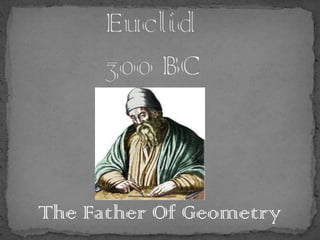
The Father Of Geometry
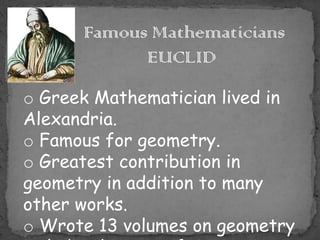
o Greek Mathematician lived in
Alexandria.
o Famous for geometry.
o Greatest contribution in
geometry in addition to many
other works.
o Wrote 13 volumes on geometry
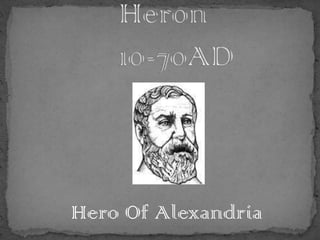
Hero Of Alexandria
o A great mathematician of Egyptian
origin.
oHe worked mostly in applied
mathematics.
oFamous because a formula was named
after him.
oWriter of three books dealing largely
in mensuration.
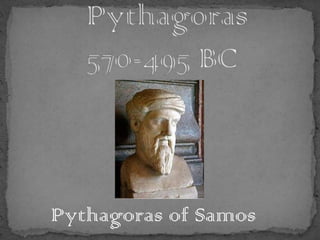
Pythagoras of Samos
o Philosopher who studied
Mathematics.
o Leader of the famous sect of
Pythagoreans who discovered
irrationals.
o Famous because of the
geometrical formula named after
him.
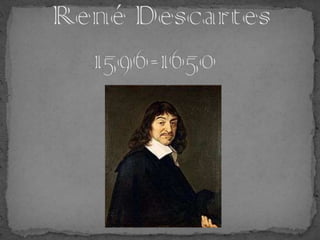
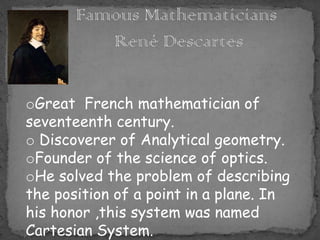
oGreat French mathematician of
seventeenth century.
o Discoverer of Analytical geometry.
oFounder of the science of optics.
oHe solved the problem of describing
the position of a point in a plane. In
his honor ,this system was named
Cartesian System.
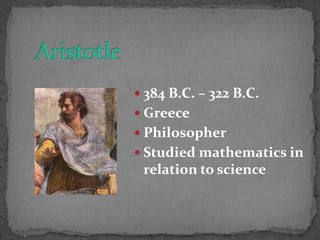
 384 B.C. – 322 B.C.
 Greece
 Philosopher
 Studied mathematics in
relation to science
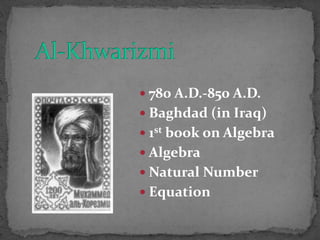
 780 A.D.-850 A.D.
 Baghdad (in Iraq)
 1st book on Algebra
 Algebra
 Natural Number
 Equation
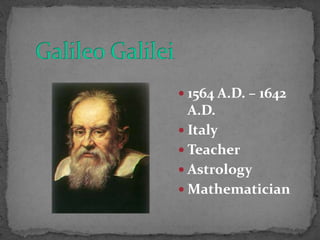
 1564 A.D. – 1642
A.D.
 Italy
 Teacher
 Astrology
 Mathematician
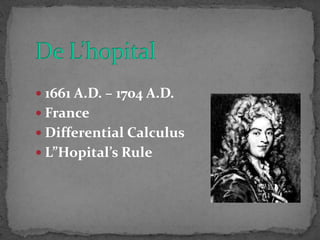
 1661 A.D. – 1704 A.D.
 France
 Differential Calculus
 L”Hopital’s Rule
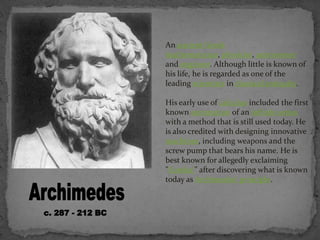
An ancient Greek
mathematician, physicist, astronomer
and engineer. Although little is known of
his life, he is regarded as one of the
leading scientists in classical antiquity.
His early use of calculus included the first
known summation of an infinite series
with a method that is still used today. He
is also credited with designing innovative
machines, including weapons and the
screw pump that bears his name. He is
best known for allegedly exclaiming
"Eureka!" after discovering what is known
today as Archimedes' principle.
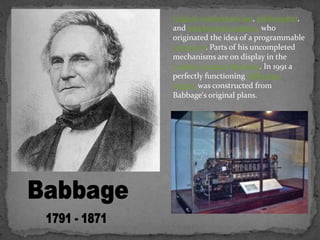
English mathematician, philosopher,
and mechanical engineer who
originated the idea of a programmable
computer. Parts of his uncompleted
mechanisms are on display in the
London Science Museum. In 1991 a
perfectly functioning difference
engine was constructed from
Babbage's original plans.
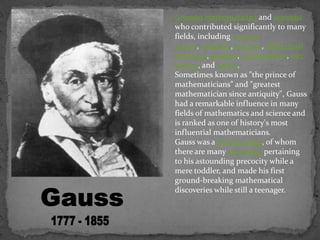
German mathematician and scientist
who contributed significantly to many
fields, including number
theory, statistics, analysis, differential
geometry, geodesy, electrostatics, astr
onomy, and optics.
Sometimes known as "the prince of
mathematicians" and "greatest
mathematician since antiquity", Gauss
had a remarkable influence in many
fields of mathematics and science and
is ranked as one of history's most
influential mathematicians.
Gauss was a child prodigy, of whom
there are many anecdotes pertaining
to his astounding precocity while a
mere toddler, and made his first
ground-breaking mathematical
discoveries while still a teenager.
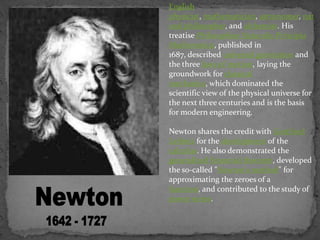
English
physicist, mathematician, astronomer, nat
ural philosopher, and alchemist. His
treatise Philosophiae Naturalis Principia
Mathematica, published in
1687, described universal gravitation and
the three laws of motion, laying the
groundwork for classical
mechanics, which dominated the
scientific view of the physical universe for
the next three centuries and is the basis
for modern engineering.
Newton shares the credit with Gottfried
Leibniz for the development of the
calculus. He also demonstrated the
generalized binomial theorem, developed
the so-called "Newton's method" for
approximating the zeroes of a
function, and contributed to the study of
power series.
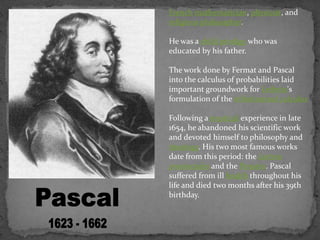
French mathematician, physicist, and
religious philosopher.
He was a child prodigy who was
educated by his father.
The work done by Fermat and Pascal
into the calculus of probabilities laid
important groundwork for Leibniz's
formulation of the infinitesimal calculus
Following a mystical experience in late
1654, he abandoned his scientific work
and devoted himself to philosophy and
theology. His two most famous works
date from this period: the Lettres
provinciales and the Pensées. Pascal
suffered from ill health throughout his
life and died two months after his 39th
birthday.
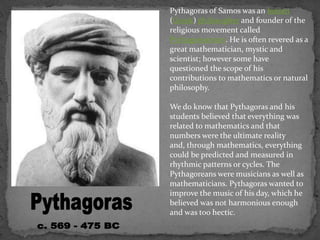
Pythagoras of Samos was an Ionian
(Greek) philosopher and founder of the
religious movement called
Pythagoreanism. He is often revered as a
great mathematician, mystic and
scientist; however some have
questioned the scope of his
contributions to mathematics or natural
philosophy.
We do know that Pythagoras and his
students believed that everything was
related to mathematics and that
numbers were the ultimate reality
and, through mathematics, everything
could be predicted and measured in
rhythmic patterns or cycles. The
Pythagoreans were musicians as well as
mathematicians. Pythagoras wanted to
improve the music of his day, which he
believed was not harmonious enough
and was too hectic.
Famous Mathematicians

Famous Mathematicians

  • 1.
  • 2.
    The Father OfGeometry
  • 3.
    o Greek Mathematicianlived in Alexandria. o Famous for geometry. o Greatest contribution in geometry in addition to many other works. o Wrote 13 volumes on geometry
  • 4.
  • 5.
    o A greatmathematician of Egyptian origin. oHe worked mostly in applied mathematics. oFamous because a formula was named after him. oWriter of three books dealing largely in mensuration.
  • 6.
  • 7.
    o Philosopher whostudied Mathematics. o Leader of the famous sect of Pythagoreans who discovered irrationals. o Famous because of the geometrical formula named after him.
  • 9.
    oGreat French mathematicianof seventeenth century. o Discoverer of Analytical geometry. oFounder of the science of optics. oHe solved the problem of describing the position of a point in a plane. In his honor ,this system was named Cartesian System.
  • 10.
     384 B.C.– 322 B.C.  Greece  Philosopher  Studied mathematics in relation to science
  • 11.
     780 A.D.-850A.D.  Baghdad (in Iraq)  1st book on Algebra  Algebra  Natural Number  Equation
  • 12.
     1564 A.D.– 1642 A.D.  Italy  Teacher  Astrology  Mathematician
  • 13.
     1661 A.D.– 1704 A.D.  France  Differential Calculus  L”Hopital’s Rule
  • 14.
    An ancient Greek mathematician,physicist, astronomer and engineer. Although little is known of his life, he is regarded as one of the leading scientists in classical antiquity. His early use of calculus included the first known summation of an infinite series with a method that is still used today. He is also credited with designing innovative machines, including weapons and the screw pump that bears his name. He is best known for allegedly exclaiming "Eureka!" after discovering what is known today as Archimedes' principle.
  • 15.
    English mathematician, philosopher, andmechanical engineer who originated the idea of a programmable computer. Parts of his uncompleted mechanisms are on display in the London Science Museum. In 1991 a perfectly functioning difference engine was constructed from Babbage's original plans.
  • 16.
    German mathematician andscientist who contributed significantly to many fields, including number theory, statistics, analysis, differential geometry, geodesy, electrostatics, astr onomy, and optics. Sometimes known as "the prince of mathematicians" and "greatest mathematician since antiquity", Gauss had a remarkable influence in many fields of mathematics and science and is ranked as one of history's most influential mathematicians. Gauss was a child prodigy, of whom there are many anecdotes pertaining to his astounding precocity while a mere toddler, and made his first ground-breaking mathematical discoveries while still a teenager.
  • 17.
    English physicist, mathematician, astronomer,nat ural philosopher, and alchemist. His treatise Philosophiae Naturalis Principia Mathematica, published in 1687, described universal gravitation and the three laws of motion, laying the groundwork for classical mechanics, which dominated the scientific view of the physical universe for the next three centuries and is the basis for modern engineering. Newton shares the credit with Gottfried Leibniz for the development of the calculus. He also demonstrated the generalized binomial theorem, developed the so-called "Newton's method" for approximating the zeroes of a function, and contributed to the study of power series.
  • 18.
    French mathematician, physicist,and religious philosopher. He was a child prodigy who was educated by his father. The work done by Fermat and Pascal into the calculus of probabilities laid important groundwork for Leibniz's formulation of the infinitesimal calculus Following a mystical experience in late 1654, he abandoned his scientific work and devoted himself to philosophy and theology. His two most famous works date from this period: the Lettres provinciales and the Pensées. Pascal suffered from ill health throughout his life and died two months after his 39th birthday.
  • 19.
    Pythagoras of Samoswas an Ionian (Greek) philosopher and founder of the religious movement called Pythagoreanism. He is often revered as a great mathematician, mystic and scientist; however some have questioned the scope of his contributions to mathematics or natural philosophy. We do know that Pythagoras and his students believed that everything was related to mathematics and that numbers were the ultimate reality and, through mathematics, everything could be predicted and measured in rhythmic patterns or cycles. The Pythagoreans were musicians as well as mathematicians. Pythagoras wanted to improve the music of his day, which he believed was not harmonious enough and was too hectic.