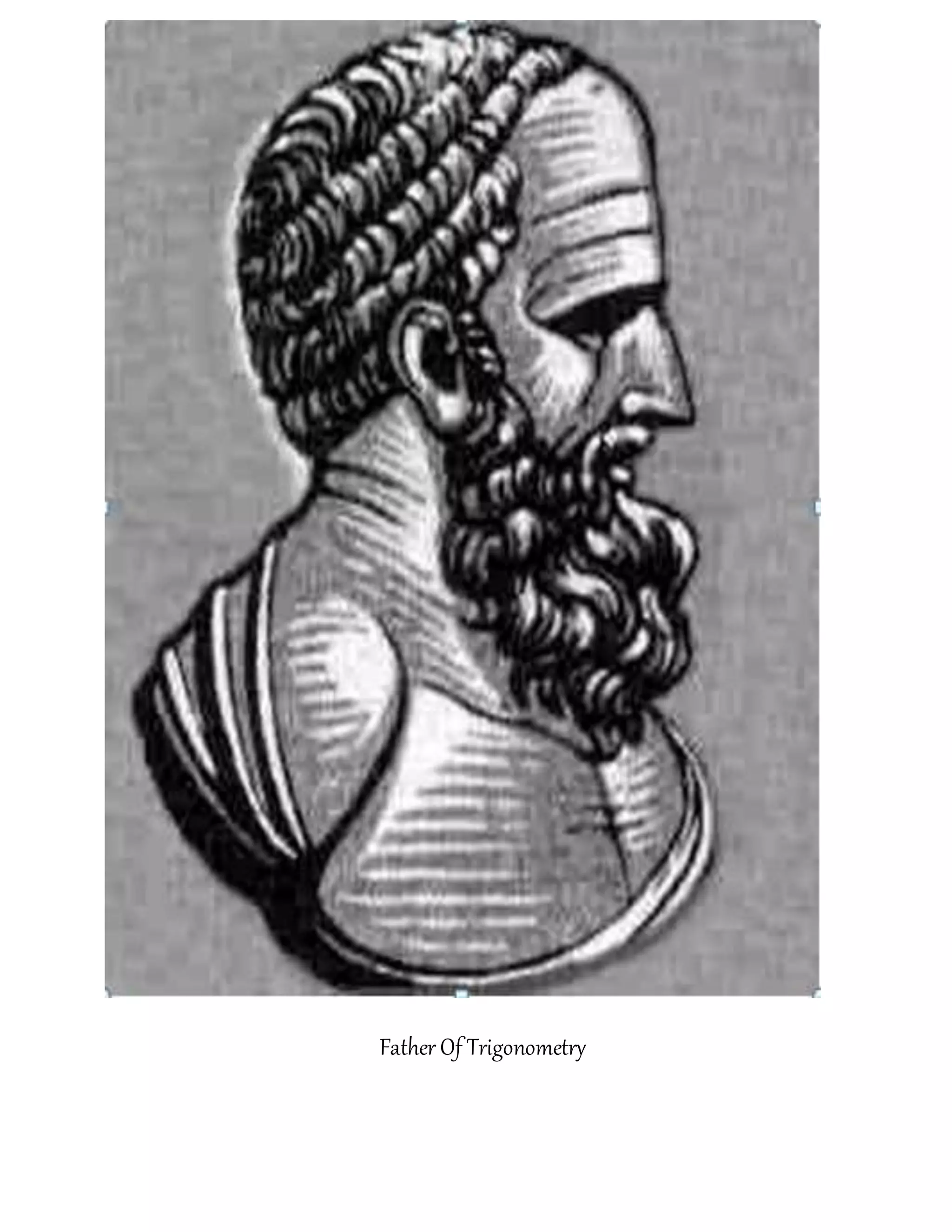
![Hipparchus /hɪˈpɑːrkəs/ of Nicaea,or more
correctly Hipparchos (Greek:Ἵππαρχος,Hipparkhos;c. 190 BC – c. 120 BC), was
a Greek astronomer,geographer,andmathematician of the Hellenistic period. He is
considered the founderof trigonometry[1]
but is most famous for his incidental discovery
of precessionof the equinoxes.[2]
Hipparchus was born in Nicaea, Bithynia (now Iznik, Turkey), and probably died on the island
of Rhodes.He is known to have been a working astronomerat least from 162 to
127 BC.[3]
Hipparchus is considered the greatest ancient astronomical observerand, by
some,the greatest overall astronomer of antiquity. He was the first whose quantitative and
accurate models forthe motion of the Sun and Moon survive. For this he certainly made use
of the observations and perhaps the mathematical techniques accumulated over centuries by
the Chaldeans from Babylonia. He developed trigonometryand
constructedtrigonometric tables,and he solved several problems of sphericaltrigonometry.
With his solar and lunar theories and his trigonometry, he may have beenthe first to develop
a reliable method to predict solar eclipses.His other reputed achievements include the
discoveryof Earth's precession,the compilation of the first comprehensive star catalog of the
western world, and possiblythe invention of the astrolabe, also of the armillary sphere,which
he used during the creation of much of the star catalogue. It would be three centuries
before Claudius Ptolemaeus' synthesis of astronomy would supersede the work of
Hipparchus; it is heavily dependenton it in many areas.](https://image.slidesharecdn.com/fatherofmathematician-130615042136-phpapp01/75/Father-of-m-athematician-1-2048.jpg)
![Euclid of Alexandria is the most prominent mathematician of antiquity best known for his treatise on
mathematics The Elements. The long lasting nature of The Elements must make Euclid the leading mathematics
teacher of all time.
There is other information about Euclid given by certain authors but it is not thought to be reliable. Two different types
of this extra information exists. The first type of extra information is that given by Arabian authors who state that
Euclid was the son of Naucrates and that he was born in Tyre. It is believed by historians of mathematics that this is
entirely fictitious and was merely invented by the authors.
The second type of information is that Euclid was born at Megara. This is due to an error on the part of the authors
who first gave this information. In fact there was aEuclid of Megara, who was a philosopher who lived about 100
years before the mathematician Euclid of Alexandria. It is not quite the coincidence that it might seem that there were
two learned men called Euclid. In fact Euclid was a very common name around this period and this is one further
complication that makes it difficult to discover information concerning Euclid of Alexandria since there are references
to numerous men called Euclid in the literature of this period.
Returning to the quotation from Proclus given above, the first point to make is that there is nothing inconsistent in the
dating given. However, although we do not know for certain exactly what reference to Euclid in Archimedes'
work Proclus is referring to, in what has come down to us there is only one reference to Euclid and this occurs in On
the sphere and the cylinder. The obvious conclusion, therefore, is that all is well with the argument of Proclus and this
was assumed until challenged by Hjelmslev in [48]. He argued that the reference to Euclid was added to Archimedes'
book at a later stage, and indeed it is a rather surprising reference. It was not the tradition of the time to give such
references, moreover there are many other places in Archimedes where it would be appropriate to refer to Euclid and
there is no such reference.
Euclid's most famous work is his treatise on mathematics The Elements. The book was a compilation of knowledge
that became the centre of mathematical teaching for 2000 years. Probably no results in The Elements were first
proved by Euclid but the organisation of the material and its exposition are certainly due to him. In fact there is ample
evidence that Euclid is using earlier textbooks as he writes the Elements since he introduces quite a number of
definitions which are never used such as that of an oblong, a rhombus, and a rhomboid.
The Elements begins with definitions and five postulates. The first three postulates are postulates of construction, for
example the first postulate states that it is possible to draw a straight line between any two points. These postulates
also implicitly assume the existence of points, lines and circles and then the existence of other geometric objects are
deduced from the fact that these exist. There are other assumptions in the postulates which are not explicit. For
example it is assumed that there is a unique line joining any two points. Similarly postulates two and three, on
producing straight lines and drawing circles, respectively, assume the uniqueness of the objects the possibility of
whose construction is being postulated.
The fourth and fifth postulates are of a different nature. Postulate four states that all right angles are equal. This may
seem "obvious" but it actually assumes that space in homogeneous - by this we mean that a figure will be
independent of the position in space in which it is placed. The famous fifth, or parallel, postulate states that one and
only one line can be drawn through a point parallel to a given line. Euclid's decision to make this a postulate led to
Euclidean geometry. It was not until the 19thcentury that this postulate was dropped and non-euclidean
geometries were studied.
There are also axioms which Euclid calls 'common notions'. These are not specific geometrical properties but rather
general assumptions which allow mathematics to proceed as a deductive science.](https://image.slidesharecdn.com/fatherofmathematician-130615042136-phpapp01/75/Father-of-m-athematician-3-2048.jpg)

![Diophantus of Alexandria (Ancient Greek: Διόφαντος ὁ Ἀλεξανδρεύς. b. between A.D. 200 and 214, d. between 284 and
298 at age 84), sometimes called "the father of algebra", was anAlexandrian Greek mathematician[1][2][3][4]
and the author
of a series of books calledArithmetica. These texts deal with solving algebraic equations, many of which are now lost.
In studying Arithmetica, Pierre de Fermat concluded that a certain equation considered by Diophantus had no
solutions, and noted without elaboration that he had found "a truly marvelous proof of this proposition," now referred
to as Fermat's Last Theorem. This led to tremendous advances in number theory, and the study of Diophantine
equations ("Diophantine geometry") and of Diophantine approximations remain important areas of mathematical
research. Diophantus coined the term παρισὀτης to refer to an approximate equality.[5]
This term was rendered
as adaequalitat in Latin, and became the technique of adequality developed by Pierre de Fermat to find maxima for
functions and tangent lines to curves. Diophantus was the firstGreek mathematician who recognized fractions as
numbers; thus he allowed positive rational numbers for the coefficients and solutions. In modern use, Diophantine
equations are usually algebraic equations with integer coefficients, for which integer solutions are sought. Diophantus
also made advances in mathematical notation.
Little is known about the life of Diophantus. He lived in Alexandria, Egypt, probably from between A.D. 200 and 214 to 284 or 298.
Much of our knowledge of the life of Diophantus is derived from a 5th century Greek anthology of number games and strategy
puzzles. One of the problems (sometimes called his epitaph) states:
'Here lies Diophantus,' the wonder behold.
Through art algebraic, the stone tells how old:
'God gave him his boyhood one-sixth of his life,
One twelfth more as youth while whiskers grew rife;
And then yet one-seventh ere marriage begun;
In five years there came a bouncing new son.
Alas, the dear child of master and sage
After attaining half the measure of his father's life chill fate took him. After consoling his fate by the science of numbers
for four years, he ended his life.'
This puzzle implies that Diophantus lived to be 84 years old. However, the accuracy of the information cannot be independently
confirmed.
In popular culture, this puzzle was the Puzzle No.142 in Professor Layton and Pandora's Box as one of the hardest solving puzzles
in the game, which needed to be unlocked by solving other puzzles first.
Like many other Greek mathematical treatises, Diophantus was forgotten in Western Europe during the so-
called Dark Ages, since the study of ancient Greek had greatly declined. The portion of the
Greek Arithmetica that survived, however, was, like all ancient Greek texts transmitted to the early modern
world, copied by, and thus known to, medieval Byzantine scholars. In addition, some portion of
the Arithmetica probably survived in the Arab tradition (see above). In 1463 German
mathematician Regiomontanus wrote:
“No one has yet translated from the Greek into Latin the thirteen books of Diophantus, in which the
very flower of the whole of arithmetic lies hidden . . . .”
Arithmetica was first translated from Greek into Latin by Bombelli in 1570, but the translation was never
published. However, Bombelli borrowed many of the problems for his own book Algebra. The editio
princeps of Arithmetica was published in 1575 by Xylander. The best known Latin translation](https://image.slidesharecdn.com/fatherofmathematician-130615042136-phpapp01/75/Father-of-m-athematician-5-2048.jpg)


Hipparchus was a Greek astronomer, geographer, and mathematician from the 2nd century BC. He is considered the founder of trigonometry and is most famous for his discovery of the precession of the equinoxes. Hipparchus made highly accurate observations and models of the motion of the sun and moon. He developed trigonometry, constructed trigonometric tables, and may have developed the first method to reliably predict solar eclipses. Hipparchus compiled the first comprehensive star catalog of the western world and possibly invented the astrolabe and armillary sphere. His work in astronomy and trigonometry was not superseded for over 300 years.


![A Reviewer for Math History and Trivia [Not Updated]](https://cdn.slidesharecdn.com/ss_thumbnails/mathhistoryandtriviareviewer-240320201819-f1b01a44-thumbnail.jpg?width=640&height=640&fit=bounds)


