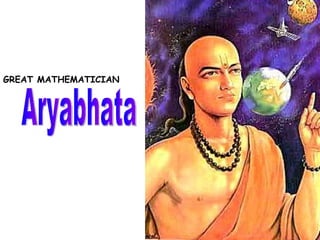
GREAT MATHEMATICIAN
Aryabhata (476–550 CE) was the first in the line of great mathematician-astronomers
from the classical age of Indian mathematics and Indian astronomy. His most famous
works are the Āryabhaṭ īya (499 CE, when he was 23 years old) and the Arya-siddhanta.
Aryabhata mentions in the Aryabhatiya that it was composed 3,630 years into the Kali
Yuga, when he was 23 years old. This corresponds to 499 CE, and implies that he was
born in 476
Aryabhata was born in Taregna (literally, song of the stars), which is a small town in
Bihar, India, about 30 km (19 mi) from Patna (then known as Pataliputra), the capital city
of Bihar State.
It is fairly certain that, at some point, he went to Kusumapura for advanced studies
and that he lived there for some time. Both Hindu and Buddhist tradition, as well as
Bhāskara I (CE 629), identify Kusumapura as Pāṭ aliputra, modern Patna. A verse
mentions that Aryabhata was the head of an institution (kulapati) at Kusumapura, and,
because the university of Nalanda was in Pataliputra at the time and had an astronomical
observatory, it is speculated that Aryabhata might have been the head of the Nalanda
university as well.[1]Aryabhata is also reputed to have set up an observatory at the Sun
temple in Taregana, Bihar.
arth is
                               y that E n.
                       on to sa d the su
               rst pers s aroun
He wa s the fi revolve
        a l and it
spheric
Great Works >>

•   Aryabhata's work was of great influence in the Indian astronomical tradition and
    influenced several neighbouring cultures through translations. The Arabic translation
    during the Islamic Golden Age (c. 820 CE), was particularly influenced. Some of his results
    are cited by Al-Khwarizmi and in the 10th century Al-Biruni stated that Aryabhata's
    followers believed that the Earth rotated on its axis.

•   His definitions of sine (jya), cosine (kojya), versine (utkrama-jya), and inverse sine (otkram
    jya) influenced the birth of trigonometry. He was also the first to specify sine and versine
    (1 − cos x) tables, in 3.75° intervals from 0° to 90°, to an accuracy of 4 decimal places.

•   Aryabhata's astronomical calculation methods were also very influential. Along with the
    trigonometric tables, they came to be widely used in the Islamic world and used to
    compute many Arabic astronomical tables (zijes). In particular, the astronomical tables in
    the work of the Arabic Spain scientist Al-Zarqali (11th century) were translated into Latin
    as the Tables of Toledo (12th c.) and remained the most accurate ephemeris used in
    Europe for centuries.

•   Calendric calculations devised by Aryabhata and his followers have been in continuous
    use in India for the practical purposes of fixing the Panchangam (the Hindu calendar). In
    the Islamic world, they formed the basis of the Jalali calendar introduced in 1073 CE by a
    group of astronomers including Omar Khayyam,[33] versions of which (modified in 1925)
    are the national calendars in use in Iran and Afghanistan today. The dates of the Jalali
    calendar are based on actual solar transit, as in Aryabhata and earlier Siddhanta
    calendars. calender.
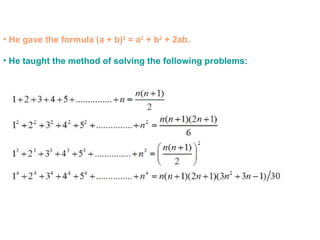
• He gave the formula (a + b)2 = a2 + b2 + 2ab.

• He taught the method of solving the following problems:
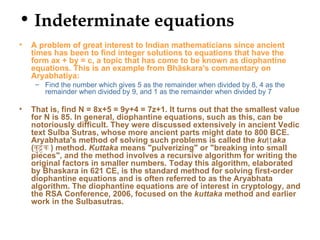
• Indeterminate equations
•   A problem of great interest to Indian mathematicians since ancient
    times has been to find integer solutions to equations that have the
    form ax + by = c, a topic that has come to be known as diophantine
    equations. This is an example from Bhāskara's commentary on
    Aryabhatiya:
     – Find the number which gives 5 as the remainder when divided by 8, 4 as the
       remainder when divided by 9, and 1 as the remainder when divided by 7

•   That is, find N = 8x+5 = 9y+4 = 7z+1. It turns out that the smallest value
    for N is 85. In general, diophantine equations, such as this, can be
    notoriously difficult. They were discussed extensively in ancient Vedic
    text Sulba Sutras, whose more ancient parts might date to 800 BCE.
    Aryabhata's method of solving such problems is called the kuṭṭ aka
    (कु ट क ) method. Kuttaka means "pulverizing" or "breaking into small
    pieces", and the method involves a recursive algorithm for writing the
    original factors in smaller numbers. Today this algorithm, elaborated
    by Bhaskara in 621 CE, is the standard method for solving first-order
    diophantine equations and is often referred to as the Aryabhata
    algorithm. The diophantine equations are of interest in cryptology, and
    the RSA Conference, 2006, focused on the kuttaka method and earlier
    work in the Sulbasutras.
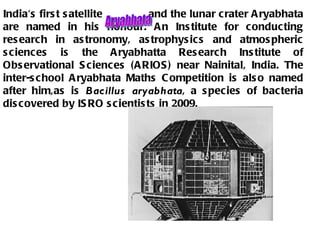
India's firs t s atellite       and the lunar crater A ryabhata
are named in his honour. A n Ins titute for conducting
res earch in as tronomy, as trophys ics and atmos pheric
s ciences is the A ryabhatta Res earch Ins titute of
Obs ervational S ciences (A RIOS ) near Nainital, India. The
inter-s c hool A ryabhata Maths C ompetition is als o named
after him,as is Bacillus aryabhata, a s pecies of bacteria
dis covered by IS RO s cientis ts in 2009.
Nivedita Tomar
    XII-A
    12017
MATHEMATICS

Aryabhata

  • 1.
  • 2.
    Aryabhata (476–550 CE)was the first in the line of great mathematician-astronomers from the classical age of Indian mathematics and Indian astronomy. His most famous works are the Āryabhaṭ īya (499 CE, when he was 23 years old) and the Arya-siddhanta. Aryabhata mentions in the Aryabhatiya that it was composed 3,630 years into the Kali Yuga, when he was 23 years old. This corresponds to 499 CE, and implies that he was born in 476 Aryabhata was born in Taregna (literally, song of the stars), which is a small town in Bihar, India, about 30 km (19 mi) from Patna (then known as Pataliputra), the capital city of Bihar State. It is fairly certain that, at some point, he went to Kusumapura for advanced studies and that he lived there for some time. Both Hindu and Buddhist tradition, as well as Bhāskara I (CE 629), identify Kusumapura as Pāṭ aliputra, modern Patna. A verse mentions that Aryabhata was the head of an institution (kulapati) at Kusumapura, and, because the university of Nalanda was in Pataliputra at the time and had an astronomical observatory, it is speculated that Aryabhata might have been the head of the Nalanda university as well.[1]Aryabhata is also reputed to have set up an observatory at the Sun temple in Taregana, Bihar.
  • 3.
    arth is y that E n. on to sa d the su rst pers s aroun He wa s the fi revolve a l and it spheric
  • 4.
    Great Works >> • Aryabhata's work was of great influence in the Indian astronomical tradition and influenced several neighbouring cultures through translations. The Arabic translation during the Islamic Golden Age (c. 820 CE), was particularly influenced. Some of his results are cited by Al-Khwarizmi and in the 10th century Al-Biruni stated that Aryabhata's followers believed that the Earth rotated on its axis. • His definitions of sine (jya), cosine (kojya), versine (utkrama-jya), and inverse sine (otkram jya) influenced the birth of trigonometry. He was also the first to specify sine and versine (1 − cos x) tables, in 3.75° intervals from 0° to 90°, to an accuracy of 4 decimal places. • Aryabhata's astronomical calculation methods were also very influential. Along with the trigonometric tables, they came to be widely used in the Islamic world and used to compute many Arabic astronomical tables (zijes). In particular, the astronomical tables in the work of the Arabic Spain scientist Al-Zarqali (11th century) were translated into Latin as the Tables of Toledo (12th c.) and remained the most accurate ephemeris used in Europe for centuries. • Calendric calculations devised by Aryabhata and his followers have been in continuous use in India for the practical purposes of fixing the Panchangam (the Hindu calendar). In the Islamic world, they formed the basis of the Jalali calendar introduced in 1073 CE by a group of astronomers including Omar Khayyam,[33] versions of which (modified in 1925) are the national calendars in use in Iran and Afghanistan today. The dates of the Jalali calendar are based on actual solar transit, as in Aryabhata and earlier Siddhanta calendars. calender.
  • 5.
    • He gavethe formula (a + b)2 = a2 + b2 + 2ab. • He taught the method of solving the following problems:
  • 6.
    • Indeterminate equations • A problem of great interest to Indian mathematicians since ancient times has been to find integer solutions to equations that have the form ax + by = c, a topic that has come to be known as diophantine equations. This is an example from Bhāskara's commentary on Aryabhatiya: – Find the number which gives 5 as the remainder when divided by 8, 4 as the remainder when divided by 9, and 1 as the remainder when divided by 7 • That is, find N = 8x+5 = 9y+4 = 7z+1. It turns out that the smallest value for N is 85. In general, diophantine equations, such as this, can be notoriously difficult. They were discussed extensively in ancient Vedic text Sulba Sutras, whose more ancient parts might date to 800 BCE. Aryabhata's method of solving such problems is called the kuṭṭ aka (कु ट क ) method. Kuttaka means "pulverizing" or "breaking into small pieces", and the method involves a recursive algorithm for writing the original factors in smaller numbers. Today this algorithm, elaborated by Bhaskara in 621 CE, is the standard method for solving first-order diophantine equations and is often referred to as the Aryabhata algorithm. The diophantine equations are of interest in cryptology, and the RSA Conference, 2006, focused on the kuttaka method and earlier work in the Sulbasutras.
  • 7.
    India's firs ts atellite and the lunar crater A ryabhata are named in his honour. A n Ins titute for conducting res earch in as tronomy, as trophys ics and atmos pheric s ciences is the A ryabhatta Res earch Ins titute of Obs ervational S ciences (A RIOS ) near Nainital, India. The inter-s c hool A ryabhata Maths C ompetition is als o named after him,as is Bacillus aryabhata, a s pecies of bacteria dis covered by IS RO s cientis ts in 2009.
  • 8.
    Nivedita Tomar XII-A 12017 MATHEMATICS