Personality Theories
Dr Mothapo M
M-Block 1st floor
Module Outline
• Introduction
• Psychodynamic theories
• Behavioural and learning theories
• Trait theories
• Humanistic theories
• Cognitive Theories
• Personality psychology and its relevance in South Africa
• Personality and culture
• Internal or external loci of control
• Commonality between various approaches to understanding personality
• ASSESSMENT: 08 AUGUST 20
Cont.
• Prescribed Book
Swartz, L., De la Rey, C., Duncan, N. & Townsend, T. (2011) Psychology: An
introduction, 3rd edition. Oxford University Press South Africa: South Africa
Introduction
• Personology -A field of psychology that focuses on the study of
personality (i.e. the individual’s most striking or dominant
characteristics). Also commonly known as personality psychology
Cont.
• Personality (English word derived from Latin word “persona”;
originally referring to theatrical mask that people wear).
• Personality is commonly defined as a set of psychological, physical
and spiritual traits within an individual that influence his/her
interaction and adaptations to others and the environment
Cont.
• Personality theory: the outcome of a purposeful, sustained effort to
develop a logically consistent conceptual (explanatory) system for
describing, explaining and/or predicting human behavior.
• Person: refers to an individual human being who act independently.
• Temperament: emotional aspects of the personality
Personality Theories
nature nurture
Beh
avio
ur
Cont.
 Personism – the view that behavior is influenced chiefly by the
individual’s personality
 Situationalism: The view that the situation / environment is the most
important determinant of behaviour
 Interactionalism: Behaviour is the outcome of the interaction between
the individual’s characteristics and the situation in which the behaviour
occurs
Classification of personality theories
• Psychodynamic theories: suggest that behaviour is due to forces
within the person of which he/she is mostly unaware (nature) and
parental guidance (nurture)
• Behavioural and learning theories: Emphasize observable behaviour
and generally consider learning and environmental influences in
behaviour
Cont.
• Humanistic and existential theories: Hold a positive view of human
nature, that is they are focused on an individual’s inner life (feelings
and thoughts) and emphasize free-will
• Trait theories: Emphasize the biological bases of behaviour. They are
more focused on the variety characteristics that form one’s
personality
Psychodynamin theories
1. Psychoanalytic theory (Sigmund Freud)
• Background
• Structure of personality
Anatomy of personality
Levels of consciousness
• Psychosexual stages
background
• Born in 1856 of Jewish parents in Moravia (a small town in Austria),
later in life migrated to England where he died in 1939
• Studied medicine and specialised in neurology –later to be known as
the father of psychoanalysis
• Some of the critical influences on his theory include:
1. Work with neurotic patients from higher social class in Vienna (Austria)
2. Over-emphasis of the role of sex in human functioning
Cont.
• Argues that the structure of personality are largely unconscious and
that behaviour is influenced by ongoing intrapsychic conflicts
• Life instincts and death instincts
Instincts: basic motivational drives that provide the basis for
personality
Life instincts: serve the need for survival and development and
ensure the reproduction of the species
Death instincts: the destructive force of human nature
Cont.
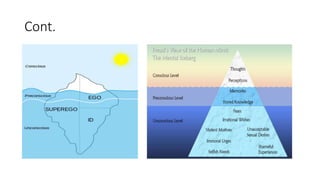
Levels of consciousness
Conscious level: Contains thoughts, feelings and experiences of which
individual is aware
Preconscious level: Information (usually less anxiety provoking memories
and experiences) that can be recalled to consciousness with little effort
Unconscious level: Contains painful memories and “forbidden drives”
• Intrapsychic conflicts: conflicts within the mind
Structure of personality
Anatomy of personality
• The id: Innate, primitive component of the psyche. It functions according to primary processes
(i.e. not capable of self-reflection, thought or planning) and pleasure principle (wish fulfillment,
creating images of desired objects and fantasizing)
• The ego: Develops from the id. Serves id needs by finding suitable objects for real drive
satisfaction. It functions according to secondary process (i.e. evaluates and weighs up a situation
before any action is taken) and reality principle (i.e. takes physical and social reality into account)
• The superego: Develops from the ego. Acts within the person as a representative of society. It
functions according to the moral principle (i.e. punishes the individual by making him/her feel
guilty about immoral wishes and behaviour)
Healthy development of personality requires a balance between the id and superego
Cont.
Psychosexual stages
• Personality evolves through a series of stages that occur during
childhood and adolescence
• Freud identified the following psychosexual stages:
1. Oral stage: From birth to approximately end of first year. The lips and mouth
are the main erogenous zones or source of sexual drive energy (Fixation
leads to oral personality type)
2. Anal stage: Roughly covers second and third year of life. Libidinal energy
shifts from the mouth to the anal region (fixation could lead to anal
personality type e.g. excessive neatness)
Cont.
3. Phallic stage: From approximately three to five or six years. Development of boys and girls take
different directions. Derived from the word phallus (meaning “penis in erection”). For a boy, penis is
the main source of energy (develops Oedipus complex and castration anxiety). In the case of girls
experience the Electra complex (characterized by penis envy)
4. Latent stage: Lasts from approximately five or six years to the start of puberty. Children of both
sexes are mainly concerned with learning gender roles, showing little interest in the opposite sex.
Freud also called this stage the ‘homosexual stage’
5. Genital stage: Commences with puberty and lasts until end of person’s life. Characterized chiefly
by reawakening of sexual wishes leading person to find new ways of coping with these challenges.
• Fixation: failure to fully satisfy one of the psychosexual stages
Evaluation
• The concept of the unconscious is considered Freud’s most important
and valuable contribution
• The theory puts emphasis on the influence that early childhood
development has on the later
• It was criticized for its emphasis on the sexual drive as a primary
motivating source of behaviour
• Considered to be overly deterministic
• Criticized for arguing that women are anatomically inferior because
they do not have penises, psychologically inferior because they do not
experience the oedipal conflict or castration anxiety
Cont.
• Women are morally inferior because they do not develop a strong
superego as man and culturally inferior because they are not able to
sublimate and use their creative energy to become productive
• Found to be too limiting as it suggest development becomes
complete during puberty
• Humanists criticized it for not acknowledging human agency and
choice
• Criticized for not being scientifically validated

1. Psychoanalytic theory(1).pptx

  • 1.
  • 2.
    Module Outline • Introduction •Psychodynamic theories • Behavioural and learning theories • Trait theories • Humanistic theories • Cognitive Theories • Personality psychology and its relevance in South Africa • Personality and culture • Internal or external loci of control • Commonality between various approaches to understanding personality • ASSESSMENT: 08 AUGUST 20
  • 3.
    Cont. • Prescribed Book Swartz,L., De la Rey, C., Duncan, N. & Townsend, T. (2011) Psychology: An introduction, 3rd edition. Oxford University Press South Africa: South Africa
  • 4.
    Introduction • Personology -Afield of psychology that focuses on the study of personality (i.e. the individual’s most striking or dominant characteristics). Also commonly known as personality psychology
  • 5.
    Cont. • Personality (Englishword derived from Latin word “persona”; originally referring to theatrical mask that people wear). • Personality is commonly defined as a set of psychological, physical and spiritual traits within an individual that influence his/her interaction and adaptations to others and the environment
  • 6.
    Cont. • Personality theory:the outcome of a purposeful, sustained effort to develop a logically consistent conceptual (explanatory) system for describing, explaining and/or predicting human behavior. • Person: refers to an individual human being who act independently. • Temperament: emotional aspects of the personality
  • 7.
  • 8.
    Cont.  Personism –the view that behavior is influenced chiefly by the individual’s personality  Situationalism: The view that the situation / environment is the most important determinant of behaviour  Interactionalism: Behaviour is the outcome of the interaction between the individual’s characteristics and the situation in which the behaviour occurs
  • 9.
    Classification of personalitytheories • Psychodynamic theories: suggest that behaviour is due to forces within the person of which he/she is mostly unaware (nature) and parental guidance (nurture) • Behavioural and learning theories: Emphasize observable behaviour and generally consider learning and environmental influences in behaviour
  • 10.
    Cont. • Humanistic andexistential theories: Hold a positive view of human nature, that is they are focused on an individual’s inner life (feelings and thoughts) and emphasize free-will • Trait theories: Emphasize the biological bases of behaviour. They are more focused on the variety characteristics that form one’s personality
  • 11.
    Psychodynamin theories 1. Psychoanalytictheory (Sigmund Freud) • Background • Structure of personality Anatomy of personality Levels of consciousness • Psychosexual stages
  • 12.
    background • Born in1856 of Jewish parents in Moravia (a small town in Austria), later in life migrated to England where he died in 1939 • Studied medicine and specialised in neurology –later to be known as the father of psychoanalysis • Some of the critical influences on his theory include: 1. Work with neurotic patients from higher social class in Vienna (Austria) 2. Over-emphasis of the role of sex in human functioning
  • 13.
    Cont. • Argues thatthe structure of personality are largely unconscious and that behaviour is influenced by ongoing intrapsychic conflicts • Life instincts and death instincts Instincts: basic motivational drives that provide the basis for personality Life instincts: serve the need for survival and development and ensure the reproduction of the species Death instincts: the destructive force of human nature
  • 14.
    Cont. Levels of consciousness Consciouslevel: Contains thoughts, feelings and experiences of which individual is aware Preconscious level: Information (usually less anxiety provoking memories and experiences) that can be recalled to consciousness with little effort Unconscious level: Contains painful memories and “forbidden drives” • Intrapsychic conflicts: conflicts within the mind
  • 15.
    Structure of personality Anatomyof personality • The id: Innate, primitive component of the psyche. It functions according to primary processes (i.e. not capable of self-reflection, thought or planning) and pleasure principle (wish fulfillment, creating images of desired objects and fantasizing) • The ego: Develops from the id. Serves id needs by finding suitable objects for real drive satisfaction. It functions according to secondary process (i.e. evaluates and weighs up a situation before any action is taken) and reality principle (i.e. takes physical and social reality into account) • The superego: Develops from the ego. Acts within the person as a representative of society. It functions according to the moral principle (i.e. punishes the individual by making him/her feel guilty about immoral wishes and behaviour) Healthy development of personality requires a balance between the id and superego
  • 16.
  • 17.
    Psychosexual stages • Personalityevolves through a series of stages that occur during childhood and adolescence • Freud identified the following psychosexual stages: 1. Oral stage: From birth to approximately end of first year. The lips and mouth are the main erogenous zones or source of sexual drive energy (Fixation leads to oral personality type) 2. Anal stage: Roughly covers second and third year of life. Libidinal energy shifts from the mouth to the anal region (fixation could lead to anal personality type e.g. excessive neatness)
  • 18.
    Cont. 3. Phallic stage:From approximately three to five or six years. Development of boys and girls take different directions. Derived from the word phallus (meaning “penis in erection”). For a boy, penis is the main source of energy (develops Oedipus complex and castration anxiety). In the case of girls experience the Electra complex (characterized by penis envy) 4. Latent stage: Lasts from approximately five or six years to the start of puberty. Children of both sexes are mainly concerned with learning gender roles, showing little interest in the opposite sex. Freud also called this stage the ‘homosexual stage’ 5. Genital stage: Commences with puberty and lasts until end of person’s life. Characterized chiefly by reawakening of sexual wishes leading person to find new ways of coping with these challenges. • Fixation: failure to fully satisfy one of the psychosexual stages
  • 19.
    Evaluation • The conceptof the unconscious is considered Freud’s most important and valuable contribution • The theory puts emphasis on the influence that early childhood development has on the later • It was criticized for its emphasis on the sexual drive as a primary motivating source of behaviour • Considered to be overly deterministic • Criticized for arguing that women are anatomically inferior because they do not have penises, psychologically inferior because they do not experience the oedipal conflict or castration anxiety
  • 20.
    Cont. • Women aremorally inferior because they do not develop a strong superego as man and culturally inferior because they are not able to sublimate and use their creative energy to become productive • Found to be too limiting as it suggest development becomes complete during puberty • Humanists criticized it for not acknowledging human agency and choice • Criticized for not being scientifically validated

Editor's Notes

  • #5 Say something about personality