Universidad Católica de la Santísima Concepción 
English Pedagogy 
Teaching Practice 
School Class: 
Nº of SS: 
Date: 
Time: Length: Pre service Teacher: Javiera Barrueto 
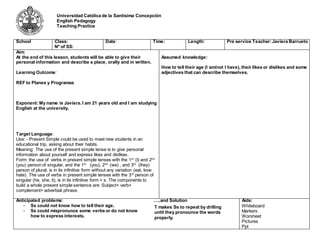
Aim: 
At the end of this lesson, students will be able to give their 
personal information and describe a place, orally and in written. 
Learning Outcome: 
REF to Planes y Programas 
Exponent: My name is Javiera. I am 21 years old and I am studying 
English at the university. 
Target Language: 
Use: - Present Simple could be used to meet new students in an 
educational trip, asking about their habits. 
Meaning: The use of the present simple tense is to give personal 
information about yourself and express likes and dislikes. 
Form: the use of verbs in present simple tenses with the 1st (I) and 2nd 
(you) person of singular, and the 1st (you), 2nd (we) , and 3rd (they) 
person of plural, is in its infinitive form without any variation (eat, love 
hate). The use of verbs in present simple tenses with the 3rd person of 
singular (he, she, it), is in its infinitive form + s. The components to 
build a whole present simple sentence are: Subject+ verb+ 
complement+ adverbial phrase. 
Assumed knowledge: 
How to tell their age (I am/not I have), their likes or dislikes and some 
adjectives that can describe themselves. 
Anticipated problems: …..and Solution 
- Ss could not know how to tell their age. 
- Ss could mispronunce some verbs or do not know 
how to express interests. 
Aids: 
Whiteboard 
Markers 
Worsheet 
Pictures 
Ppt 
T makes Ss to repeat by drilling 
until they pronounce the words 
properly.
Stages PROCEDURE (What T and SS are going to do) Time 
(min) 
What I’m going to say 
LEAD IN 
PRESENTATION 
T gives Ss a word search about food. 
T asks Ss about the last class. 
T writes the aims of the class. 
T shows a slide about her personal information. 
T makes Ss try to predict what the lesson is 
going to be about. 
T asks if Ss think personal information is useful 
T checks predictions made by Ss carefully. 
T tells the aim of the lesson. 
T pre-teaches vocabulary for the following 
activities. 
T reads her personal information and explaing 
every part of it. 
6 min 
10 min 
Try to find some familiar words. 
What do you remember about the last class? 
Students, what do you think we are going to talk about in this 
lesson? 
Students, after this lesson you will be able to know how to 
express your personal information. Here in the university is 
very useful when you are meeting someone else. 
Now, we are going to see the different parts of personal 
information.
PRACTICE 
PRODUCTION 
T projects on the whiteboard two different slides 
with pictures and descriptions. Ss have to 
decide which descripton correspond to each 
picture. 
T shows different images of beautiful places. 
T asks Ss to use the words on the ppt to 
describe each picture. 
T checks if Ss got the correct answers by 
CCQ’s. 
T asks Ss to write a paragraph presenting 
themselves. 
T gives Ss a worksheet to help them to do the 
exercise. 
T provides Ss some vocabulary in a worksheet. 
T asks Ss what they learn today. 
8 min 
10 min 
20 min 
Look at picures. You have to match or decide which personal 
information correspond to each picture. 
Now we are going to see images about different places. 
Using the words on the ppt and tell me one word for each 
picture. 
So, what it is a bautiful place? 
Now you have to write a paragraph presenting yourself and 
draw the pleace where do you live or your dream place and 
describe it in words. 
You have 10 minutes. 
Would you like to share your information with the class? 
What do you learn today?
School Class: 
Nº of SS: 
Date: 
Time: Length: Pre service Teacher: Javiera Barrueto 
Aim: 
At the end of this lesson, students will be able to describe things 
that are close to them, orally and written. 
Learning Outcome: 
REF to Planes y Programas 
Exponent: There is one pencil on the table. 
Target Language: 
Use: - Present Simple and use of There is/There are could be used to 
explain things that are around them and they want to express, in order 
to answer possible questions or ask for information. 
Meaning: The use of the present simple tense is to give information. 
The use of there is/there are to ask or specify where is a person or an 
object. 
Form: the use of verbs in present simple tenses with the 1st (I) and 2nd 
(you) person of singular, and the 1st (you), 2nd (we) , and 3rd (they) 
person of plural, is in its infinitive form without any variation. The use of 
verbs in present simple tenses with the 3rd person of singular (he, she, 
it), is in its infinitive form + s. the use of there is/there are: there, is (in 
the case of singular things), are (in the case of plural things). The 
components to build a whole present simple sentence are: Subject+ 
verb+ complement+ adverbial phrase. In the case of “there is” there+ 
is+ a/an+ person/object+where 
Assumed knowledge: 
Some words that they usually use when they are speaking or 
writing. 
Anticipated problems: …..and Solution 
- Ss could omit the final sound ‘s’ at the end 
of the verbs in the 3rd person of singular (he, she, it). T makes Ss to repeat by drilling until 
they pronounce the verbs properly. 
- Ss could mispronunce some words or thay can 
- make differences between something that is plural 
- or singular. 
Aids: 
Whiteboard 
Markers 
Worsheet 
Pictures 
Ppt 
Real objects
Stages PROCEDURE (What T and SS are going to do) Time 
(min) 
What I’m going to say 
LEAD IN 
PRESENTATION 
PRACTICE 
T shows a picture about materials in a 
classroom on a table. 
T asks students to talk about what they have on 
their desk. 
T makes Ss try to predict what the lesson is 
going to be about. 
T checks predictions made by Ss carefully. 
T tells the aim of the lesson. 
T pre-teaches vocabulary for the following 
activities. 
T projects on the whiteboard a ppt with different 
images, where Ss can see materials and real 
objects that are in showing in singular and plural 
ways. 
T gives on paper explaining a worksheet that Ss 
have to do. Ss have different pictures related to 
things or people that are around them, they 
have to put them in order according to what they 
see. Later, Ss have to compare their answers in 
pairs. 
T checks if Ss got the correct answers by 
CCQ’s. 
3 min 
8 min 
5 min 
7 min 
What do I have on my desk? 
There are two apples and three markers. 
There is a book. 
What do you have on your desks? 
Students, what do you think we are going to talk about in 
this lesson? 
Students, after this lesson you will be able to 
know how to express things that are around you. 
Now, what we are going to do is to learn some words 
that will be useful to express what it is near from you. 
Look at the images. You have to get what these things 
are plural or singular. 
Now, on your papers you can see different pictures of 
3 different situations related to things that are in 
the classroom, you have to put them in order with numbers, 
according to what do you think. Then get in pairs and compare 
your answers. 
So, what do we have on the table number one?
PRODUCTION 
T explains the following item from the 
worksheet. Ss have to pay attention to the 
details in a general picture, in order to be able to 
specify six different elements that they 
recognize. Later, T checks the answers. 
T puts in the classroom different objects that Ss 
should write on a piece of paper, giving the 
specification. 
T chooses some Ss at random to read theirs. 
8 min 
12 min 
Students, now you have to pay attention to this three general 
pictures. You have to identify six elements that you recognize 
and write it down in a piece of paper. Try to be very careful, 
the idea is that your partner can find what you are descrbing. 
Students, now you are going to write what things are in the 
classroom, you have to name it and specify if they are singular 
or plural and where are they. You have 10 minutes to do it. 
Would you like to share your descriptions with the class?

PPP LESSONS JAVI

  • 1.
    Universidad Católica dela Santísima Concepción English Pedagogy Teaching Practice School Class: Nº of SS: Date: Time: Length: Pre service Teacher: Javiera Barrueto Aim: At the end of this lesson, students will be able to give their personal information and describe a place, orally and in written. Learning Outcome: REF to Planes y Programas Exponent: My name is Javiera. I am 21 years old and I am studying English at the university. Target Language: Use: - Present Simple could be used to meet new students in an educational trip, asking about their habits. Meaning: The use of the present simple tense is to give personal information about yourself and express likes and dislikes. Form: the use of verbs in present simple tenses with the 1st (I) and 2nd (you) person of singular, and the 1st (you), 2nd (we) , and 3rd (they) person of plural, is in its infinitive form without any variation (eat, love hate). The use of verbs in present simple tenses with the 3rd person of singular (he, she, it), is in its infinitive form + s. The components to build a whole present simple sentence are: Subject+ verb+ complement+ adverbial phrase. Assumed knowledge: How to tell their age (I am/not I have), their likes or dislikes and some adjectives that can describe themselves. Anticipated problems: …..and Solution - Ss could not know how to tell their age. - Ss could mispronunce some verbs or do not know how to express interests. Aids: Whiteboard Markers Worsheet Pictures Ppt T makes Ss to repeat by drilling until they pronounce the words properly.
  • 2.
    Stages PROCEDURE (WhatT and SS are going to do) Time (min) What I’m going to say LEAD IN PRESENTATION T gives Ss a word search about food. T asks Ss about the last class. T writes the aims of the class. T shows a slide about her personal information. T makes Ss try to predict what the lesson is going to be about. T asks if Ss think personal information is useful T checks predictions made by Ss carefully. T tells the aim of the lesson. T pre-teaches vocabulary for the following activities. T reads her personal information and explaing every part of it. 6 min 10 min Try to find some familiar words. What do you remember about the last class? Students, what do you think we are going to talk about in this lesson? Students, after this lesson you will be able to know how to express your personal information. Here in the university is very useful when you are meeting someone else. Now, we are going to see the different parts of personal information.
  • 3.
    PRACTICE PRODUCTION Tprojects on the whiteboard two different slides with pictures and descriptions. Ss have to decide which descripton correspond to each picture. T shows different images of beautiful places. T asks Ss to use the words on the ppt to describe each picture. T checks if Ss got the correct answers by CCQ’s. T asks Ss to write a paragraph presenting themselves. T gives Ss a worksheet to help them to do the exercise. T provides Ss some vocabulary in a worksheet. T asks Ss what they learn today. 8 min 10 min 20 min Look at picures. You have to match or decide which personal information correspond to each picture. Now we are going to see images about different places. Using the words on the ppt and tell me one word for each picture. So, what it is a bautiful place? Now you have to write a paragraph presenting yourself and draw the pleace where do you live or your dream place and describe it in words. You have 10 minutes. Would you like to share your information with the class? What do you learn today?
  • 4.
    School Class: Nºof SS: Date: Time: Length: Pre service Teacher: Javiera Barrueto Aim: At the end of this lesson, students will be able to describe things that are close to them, orally and written. Learning Outcome: REF to Planes y Programas Exponent: There is one pencil on the table. Target Language: Use: - Present Simple and use of There is/There are could be used to explain things that are around them and they want to express, in order to answer possible questions or ask for information. Meaning: The use of the present simple tense is to give information. The use of there is/there are to ask or specify where is a person or an object. Form: the use of verbs in present simple tenses with the 1st (I) and 2nd (you) person of singular, and the 1st (you), 2nd (we) , and 3rd (they) person of plural, is in its infinitive form without any variation. The use of verbs in present simple tenses with the 3rd person of singular (he, she, it), is in its infinitive form + s. the use of there is/there are: there, is (in the case of singular things), are (in the case of plural things). The components to build a whole present simple sentence are: Subject+ verb+ complement+ adverbial phrase. In the case of “there is” there+ is+ a/an+ person/object+where Assumed knowledge: Some words that they usually use when they are speaking or writing. Anticipated problems: …..and Solution - Ss could omit the final sound ‘s’ at the end of the verbs in the 3rd person of singular (he, she, it). T makes Ss to repeat by drilling until they pronounce the verbs properly. - Ss could mispronunce some words or thay can - make differences between something that is plural - or singular. Aids: Whiteboard Markers Worsheet Pictures Ppt Real objects
  • 5.
    Stages PROCEDURE (WhatT and SS are going to do) Time (min) What I’m going to say LEAD IN PRESENTATION PRACTICE T shows a picture about materials in a classroom on a table. T asks students to talk about what they have on their desk. T makes Ss try to predict what the lesson is going to be about. T checks predictions made by Ss carefully. T tells the aim of the lesson. T pre-teaches vocabulary for the following activities. T projects on the whiteboard a ppt with different images, where Ss can see materials and real objects that are in showing in singular and plural ways. T gives on paper explaining a worksheet that Ss have to do. Ss have different pictures related to things or people that are around them, they have to put them in order according to what they see. Later, Ss have to compare their answers in pairs. T checks if Ss got the correct answers by CCQ’s. 3 min 8 min 5 min 7 min What do I have on my desk? There are two apples and three markers. There is a book. What do you have on your desks? Students, what do you think we are going to talk about in this lesson? Students, after this lesson you will be able to know how to express things that are around you. Now, what we are going to do is to learn some words that will be useful to express what it is near from you. Look at the images. You have to get what these things are plural or singular. Now, on your papers you can see different pictures of 3 different situations related to things that are in the classroom, you have to put them in order with numbers, according to what do you think. Then get in pairs and compare your answers. So, what do we have on the table number one?
  • 6.
    PRODUCTION T explainsthe following item from the worksheet. Ss have to pay attention to the details in a general picture, in order to be able to specify six different elements that they recognize. Later, T checks the answers. T puts in the classroom different objects that Ss should write on a piece of paper, giving the specification. T chooses some Ss at random to read theirs. 8 min 12 min Students, now you have to pay attention to this three general pictures. You have to identify six elements that you recognize and write it down in a piece of paper. Try to be very careful, the idea is that your partner can find what you are descrbing. Students, now you are going to write what things are in the classroom, you have to name it and specify if they are singular or plural and where are they. You have 10 minutes to do it. Would you like to share your descriptions with the class?