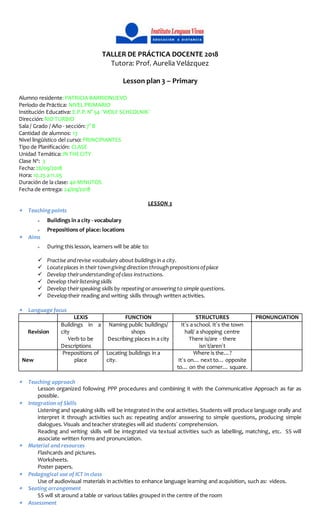
TALLER DE PRÁCTICA DOCENTE 2018
Tutora: Prof. Aurelia Velázquez
Lesson plan 3 – Primary
Alumno residente:PATRICIA BARRIONUEVO
Período de Práctica: NIVEL PRIMARIO
Institución Educativa: E.P.P.N° 54 ¨WOLF SCHCOLNIK¨
Dirección: RIO TURBIO
Sala / Grado / Año - sección: 7° B
Cantidad de alumnos: 13
Nivel lingüístico del curso: PRINCIPIANTES
Tipo de Planificación: CLASE
Unidad Temática: IN THECITY
Clase Nº: 3
Fecha: 26/09/2018
Hora: 10.25 a 11.05
Duración de la clase: 40 MINUTOS
Fecha de entrega: 24/09/2018
LESSON 3
 Teachingpoints
» Buildings in a city - vocabulary
» Prepositions of place: locations
 Aims
» During this lesson, learners will be able to:
 Practise andrevise vocabulary about buildingsin a city.
 Locateplaces in their towngiving direction throughprepositionsofplace
 Develop theirunderstanding ofclass instructions.
 Develop theirlistening skills
 Develop theirspeaking skills by repeating or answering to simple questions.
 Developtheir reading and writing skills through written activities.
 Language focus
LEXIS FUNCTION STRUCTURES PRONUNCIATION
Revision
Buildings in a
city
Verb to be
Descriptions
Naming public buildings/
shops
Describing places in a city
It´s a school. It´s the town
hall/ a shopping centre
There is/are - there
isn´t/aren´t
New
Prepositions of
place
Locating buildings in a
city.
Where is the…?
It´s on… next to… opposite
to… on the corner… square.
 Teaching approach
Lesson organized following PPP procedures and combining it with the Communicative Approach as far as
possible.
 Integration of Skills
Listening and speaking skills will be integrated in the oral activities. Students will produce language orally and
interpret it through activities such as: repeating and/or answering to simple questions, producing simple
dialogues. Visuals and teacher strategies will aid students´ comprehension.
Reading and writing skills will be integrated via textual activities such as labelling, matching, etc. SS will
associate written forms and pronunciation.
 Material and resources
Flashcards and pictures.
Worksheets.
Poster papers.
 Pedagogical use of ICT in class
Use of audiovisual materials in activities to enhance language learning and acquisition, such as: videos.
 Seating arrangement
SS will sit around a table or various tables grouped in the centre of the room
 Assessment
SS will be assessed by checking if they identify new and revised vocabulary when named, or, if they can
interpret new language. They will be asked simple questions to check understanding, and be encouraged to
produce vocabulary and the structures presented.
» LEAD-IN OR WARM-UP
Routine 3´
Purpose: to start the lesson, to put SS into the mood and establish rapport
Interaction: T-SS / S-T/ S-S
Skills: L - S
T enters the classroom and greets the students: “Hello everybody! How are you today?Fine? I´m very happy tosee you
again!¨
¨Now,I´ll call theroll. You´ll answerhereor present,please¨.T calls theroll and emphasizesnot here/not present forthose
who are absent.
Transition: ¨Great! Now It´s time to start working! Ready? Take your folders out of your bags, please! I´m going to
collect your homework¨
Warm up 5´
Purpose: to introduce SS to new contents.
Interaction:T-SS
Skills: L – S - W
T asks SS to opentheir folders and look for last class´s homework. T:¨I´m taking your worksheets home for correction
and to give you a mark! ¨
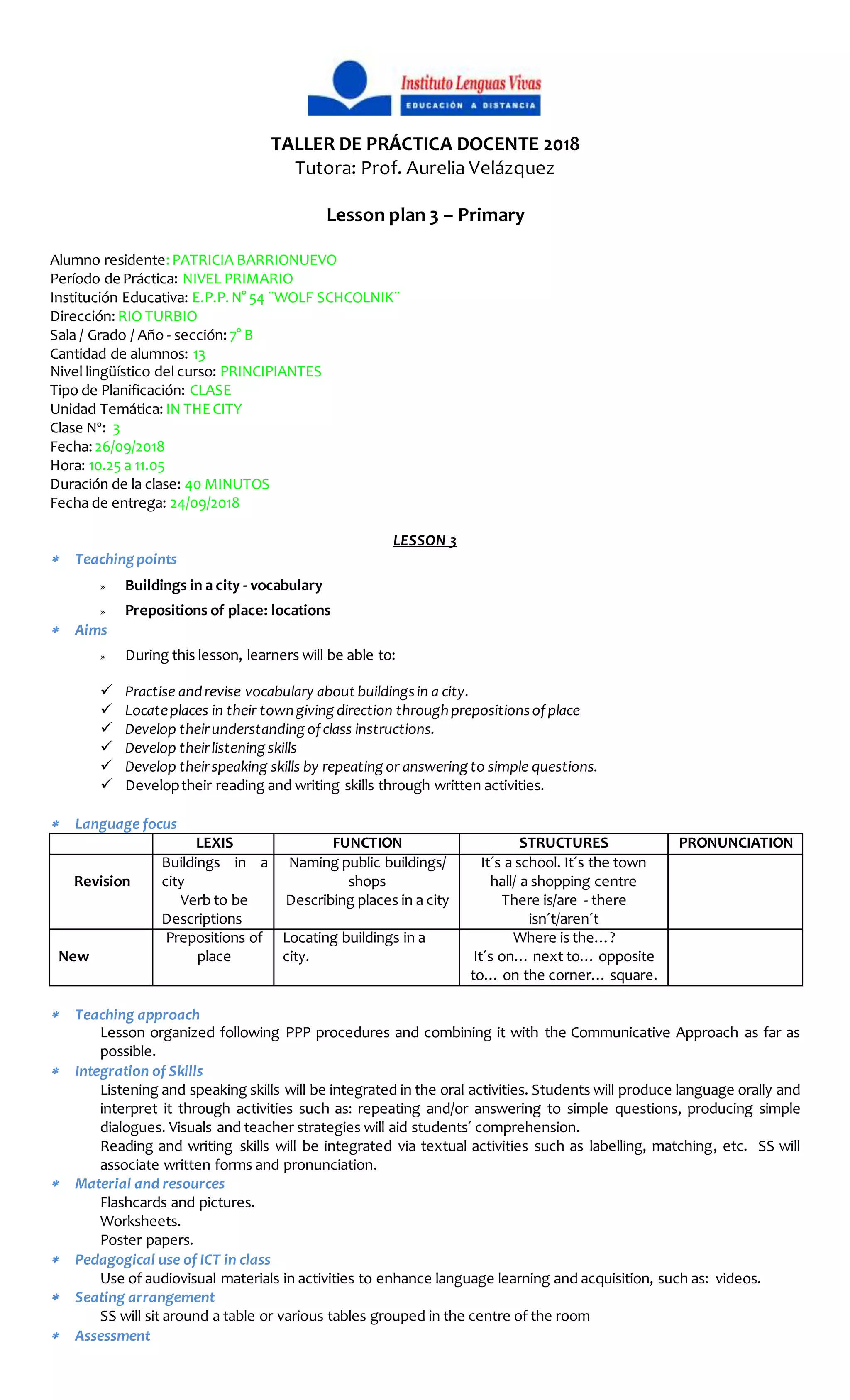
T shows SS a picture of their school and asks SS: ¨What is this building? ¨ SS: ¨It´s the school¨ T: ¨Very good! It’s our
school E.P.P.N° 54¨ T then produces a map of the school´s location (or draws it on the board): ¨Look, this is a citymap.
It shows us the location in a city or town, the same as Google maps in your phones! Now, let´s see where our school
is!¨
T writes: Where is E.P.P. N° 54?
Transition: ¨Very good! ¨Now, let´s do another activity about our town, Río Turbio!¨
» PRESENTATION 10¨
Purpose: to further expose the learners to the target language.
Interaction: T-SS
Skills: L – S – W - R
T writes the title on the board: Locations in a city
T starts describing as she points on the map on the board: ¨Look, there is a park here and there are two streets. The
school is on the corner of the square. There are traffic lights (T shows a picture). Then T writes the sentenceson the
board: The school is on the corner of the square. It´s on… T asks the ss: ¨What´s the name of this street/Avenue?Los
MinerosAvenueand San Martín Avenue.T:¨What´sthis park´s name? ¨ SS:¨SanMartín¨ T:¨Yes,the school is opposite
San Martín Park¨.
T does the same with the Police Office, to introduce next to: ¨Look, this is the police office. Can you tell me where is
it?¨ T points on the map and asks: What´s this street? What is this building?¨ SS:¨The fire station!¨ T writes: The police
office is on Agustín del Castillo street. It´s next to the fire station.
T underlinesand usescolours to emphasize the prepositions. ThenT illustrates eachpreposition orlocation expression
with a drawing. SS copy.
Transition: ¨Well done kids! Now, let´s do our own maps!¨
DEVELOPMENT
Purpose: to foster contextualized practice of the teaching points, and activate previously learned structures.
Activity 1 20´
Interaction: T-SS / S-T
Skills: L – S
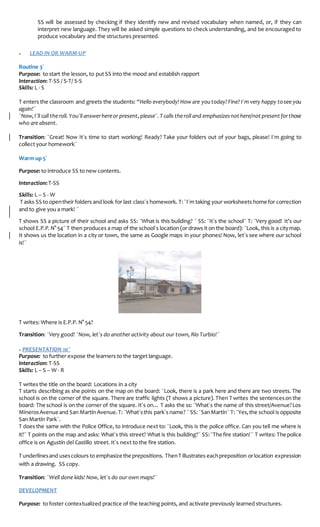
T divides the class in two groups and gives them a poster paper each. T: ¨Now, you´ll create a map. I´ll give each of
you one of these flashcards and you´ll have to locate them on the map. You´ll write the shops, buildings, and streets
or Avenues names on these labels (T gives them white strips of paper) and stick them on the map¨.
Prepositions will be written on the board.
T goes around the groups helping them or asking them to give directions.
If they have time T will have buildings´ names in a bag and as SS take them out of the bag they will have to ask and
answer to each other and point in the map.
Transition: ¨Great job! Let´s stick them on the walls for next class¨
» CLOSURE (2´)
Purpose: to round up the class and greet the students goodbye.
Interaction: T-SS
Skills: L – S
T: ¨It´s almost time to go! Here´s your homework! Copy it!¨
T writes: Draw a map of your home. Write streets´ names or buildings around.
¨You´ll guide us next class! Be prepared!¨
¨Have a nice weekend! See you next week!¨
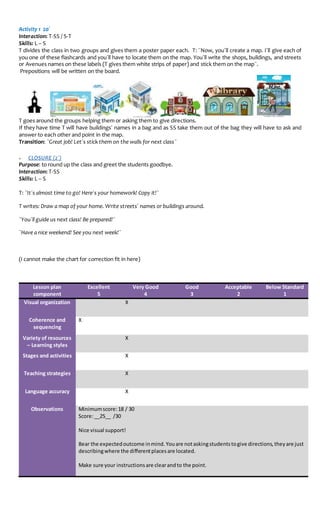
(I cannot make the chart for correction fit in here)
Lesson plan
component
Excellent
5
Very Good
4
Good
3
Acceptable
2
Below Standard
1
Visual organization X
Coherence and
sequencing
X
Variety of resources
– Learning styles
X
Stages and activities X
Teaching strategies X
Language accuracy X
Observations Minimumscore:18 / 30
Score:__25__ /30
Nice visual support!
Bear the expectedoutcome inmind.Youare notaskingstudentstogive directions,theyare just
describingwhere the differentplacesare located.
Make sure your instructionsare clearandto the point.

Barrionuevo primary - lesson plan 3 - passed (1)

  • 1.
    TALLER DE PRÁCTICADOCENTE 2018 Tutora: Prof. Aurelia Velázquez Lesson plan 3 – Primary Alumno residente:PATRICIA BARRIONUEVO Período de Práctica: NIVEL PRIMARIO Institución Educativa: E.P.P.N° 54 ¨WOLF SCHCOLNIK¨ Dirección: RIO TURBIO Sala / Grado / Año - sección: 7° B Cantidad de alumnos: 13 Nivel lingüístico del curso: PRINCIPIANTES Tipo de Planificación: CLASE Unidad Temática: IN THECITY Clase Nº: 3 Fecha: 26/09/2018 Hora: 10.25 a 11.05 Duración de la clase: 40 MINUTOS Fecha de entrega: 24/09/2018 LESSON 3  Teachingpoints » Buildings in a city - vocabulary » Prepositions of place: locations  Aims » During this lesson, learners will be able to:  Practise andrevise vocabulary about buildingsin a city.  Locateplaces in their towngiving direction throughprepositionsofplace  Develop theirunderstanding ofclass instructions.  Develop theirlistening skills  Develop theirspeaking skills by repeating or answering to simple questions.  Developtheir reading and writing skills through written activities.  Language focus LEXIS FUNCTION STRUCTURES PRONUNCIATION Revision Buildings in a city Verb to be Descriptions Naming public buildings/ shops Describing places in a city It´s a school. It´s the town hall/ a shopping centre There is/are - there isn´t/aren´t New Prepositions of place Locating buildings in a city. Where is the…? It´s on… next to… opposite to… on the corner… square.  Teaching approach Lesson organized following PPP procedures and combining it with the Communicative Approach as far as possible.  Integration of Skills Listening and speaking skills will be integrated in the oral activities. Students will produce language orally and interpret it through activities such as: repeating and/or answering to simple questions, producing simple dialogues. Visuals and teacher strategies will aid students´ comprehension. Reading and writing skills will be integrated via textual activities such as labelling, matching, etc. SS will associate written forms and pronunciation.  Material and resources Flashcards and pictures. Worksheets. Poster papers.  Pedagogical use of ICT in class Use of audiovisual materials in activities to enhance language learning and acquisition, such as: videos.  Seating arrangement SS will sit around a table or various tables grouped in the centre of the room  Assessment
  • 2.
    SS will beassessed by checking if they identify new and revised vocabulary when named, or, if they can interpret new language. They will be asked simple questions to check understanding, and be encouraged to produce vocabulary and the structures presented. » LEAD-IN OR WARM-UP Routine 3´ Purpose: to start the lesson, to put SS into the mood and establish rapport Interaction: T-SS / S-T/ S-S Skills: L - S T enters the classroom and greets the students: “Hello everybody! How are you today?Fine? I´m very happy tosee you again!¨ ¨Now,I´ll call theroll. You´ll answerhereor present,please¨.T calls theroll and emphasizesnot here/not present forthose who are absent. Transition: ¨Great! Now It´s time to start working! Ready? Take your folders out of your bags, please! I´m going to collect your homework¨ Warm up 5´ Purpose: to introduce SS to new contents. Interaction:T-SS Skills: L – S - W T asks SS to opentheir folders and look for last class´s homework. T:¨I´m taking your worksheets home for correction and to give you a mark! ¨ T shows SS a picture of their school and asks SS: ¨What is this building? ¨ SS: ¨It´s the school¨ T: ¨Very good! It’s our school E.P.P.N° 54¨ T then produces a map of the school´s location (or draws it on the board): ¨Look, this is a citymap. It shows us the location in a city or town, the same as Google maps in your phones! Now, let´s see where our school is!¨ T writes: Where is E.P.P. N° 54? Transition: ¨Very good! ¨Now, let´s do another activity about our town, Río Turbio!¨ » PRESENTATION 10¨ Purpose: to further expose the learners to the target language. Interaction: T-SS Skills: L – S – W - R T writes the title on the board: Locations in a city T starts describing as she points on the map on the board: ¨Look, there is a park here and there are two streets. The school is on the corner of the square. There are traffic lights (T shows a picture). Then T writes the sentenceson the board: The school is on the corner of the square. It´s on… T asks the ss: ¨What´s the name of this street/Avenue?Los MinerosAvenueand San Martín Avenue.T:¨What´sthis park´s name? ¨ SS:¨SanMartín¨ T:¨Yes,the school is opposite San Martín Park¨. T does the same with the Police Office, to introduce next to: ¨Look, this is the police office. Can you tell me where is it?¨ T points on the map and asks: What´s this street? What is this building?¨ SS:¨The fire station!¨ T writes: The police office is on Agustín del Castillo street. It´s next to the fire station. T underlinesand usescolours to emphasize the prepositions. ThenT illustrates eachpreposition orlocation expression with a drawing. SS copy. Transition: ¨Well done kids! Now, let´s do our own maps!¨ DEVELOPMENT Purpose: to foster contextualized practice of the teaching points, and activate previously learned structures.
  • 3.
    Activity 1 20´ Interaction:T-SS / S-T Skills: L – S T divides the class in two groups and gives them a poster paper each. T: ¨Now, you´ll create a map. I´ll give each of you one of these flashcards and you´ll have to locate them on the map. You´ll write the shops, buildings, and streets or Avenues names on these labels (T gives them white strips of paper) and stick them on the map¨. Prepositions will be written on the board. T goes around the groups helping them or asking them to give directions. If they have time T will have buildings´ names in a bag and as SS take them out of the bag they will have to ask and answer to each other and point in the map. Transition: ¨Great job! Let´s stick them on the walls for next class¨ » CLOSURE (2´) Purpose: to round up the class and greet the students goodbye. Interaction: T-SS Skills: L – S T: ¨It´s almost time to go! Here´s your homework! Copy it!¨ T writes: Draw a map of your home. Write streets´ names or buildings around. ¨You´ll guide us next class! Be prepared!¨ ¨Have a nice weekend! See you next week!¨ (I cannot make the chart for correction fit in here) Lesson plan component Excellent 5 Very Good 4 Good 3 Acceptable 2 Below Standard 1 Visual organization X Coherence and sequencing X Variety of resources – Learning styles X Stages and activities X Teaching strategies X Language accuracy X Observations Minimumscore:18 / 30 Score:__25__ /30 Nice visual support! Bear the expectedoutcome inmind.Youare notaskingstudentstogive directions,theyare just describingwhere the differentplacesare located. Make sure your instructionsare clearandto the point.