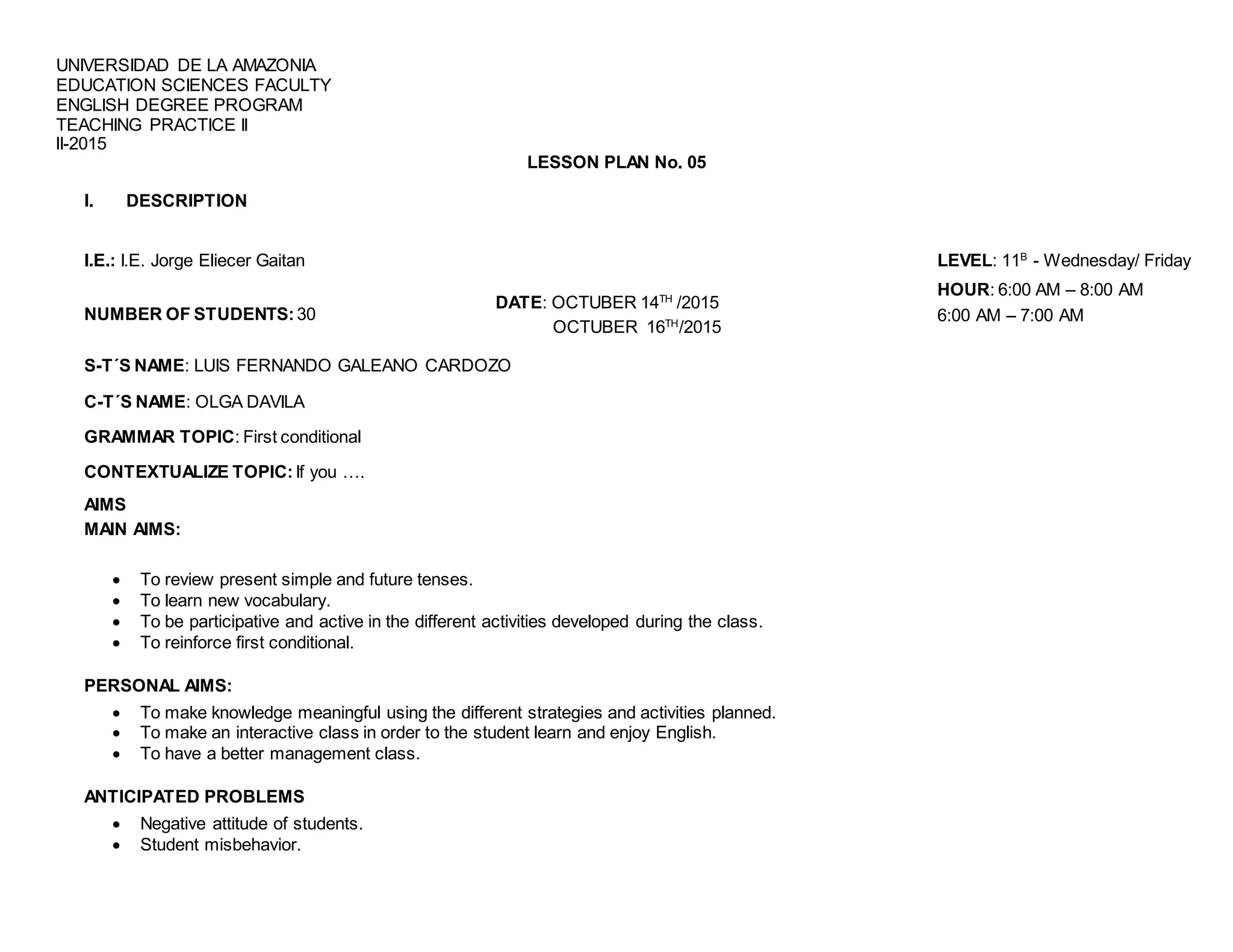
UNIVERSIDAD DE LA AMAZONIA
EDUCATION SCIENCES FACULTY
ENGLISH DEGREE PROGRAM
TEACHING PRACTICE Il
lI-2015
LESSON PLAN No. 05
I. DESCRIPTION
I.E.: I.E. Jorge Eliecer Gaitan LEVEL: 11B
- Wednesday/ Friday
NUMBER OF STUDENTS:30
DATE: OCTUBER 14TH
/2015
OCTUBER 16TH
/2015
HOUR: 6:00 AM – 8:00 AM
6:00 AM – 7:00 AM
S-T´S NAME: LUIS FERNANDO GALEANO CARDOZO
C-T´S NAME: OLGA DAVILA
GRAMMAR TOPIC: First conditional
CONTEXTUALIZE TOPIC: If you ….
AIMS
MAIN AIMS:
 To review present simple and future tenses.
 To learn new vocabulary.
 To be participative and active in the different activities developed during the class.
 To reinforce first conditional.
PERSONAL AIMS:
 To make knowledge meaningful using the different strategies and activities planned.
 To make an interactive class in order to the student learn and enjoy English.
 To have a better management class.
ANTICIPATED PROBLEMS
 Negative attitude of students.
 Student misbehavior.
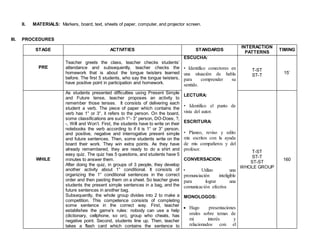
II. MATERIALS: Markers, board, text, sheets of paper, computer, and projector screen.
III. PROCEDURES
STAGE ACTIVITIES STANDARDS
INTERACTION
PATTERNS
TIMING
PRE
Teacher greets the class, teacher checks students’
attendance and subsequently, teacher checks the
homework that is about the tongue twisters learned
before. The first 5 students, who say the tongue twisters,
have positive point in participation and homework.
ESCUCHA:
• Identifico conectores en
una situación de habla
para comprender su
sentido.
LECTURA:
• Identifico el punto de
vista del autor.
ESCRITURA:
• Planeo, reviso y edito
mis escritos con la ayuda
de mis compañeros y del
profesor.
CONVERSACION:
• Utilizo una
pronunciación inteligible
para lograr una
comunicación efectiva
MONOLOGOS:
 Hago presentaciones
orales sobre temas de
mi interés y
relacionados con el
T-ST
ST-T
15’
WHILE
As students presented difficulties using Present Simple
and Future tense, teacher proposes an activity to
remember those tenses. It consists of delivering each
student a verb. The piece of paper which contains the
verb has 1° or 3°, it refers to the person. On the board,
some classifications are such 1°- 3° person, DO-Does, ?,
-, Will and Won’t. First, the students have to write on their
notebooks the verb according to if it is 1° or 3° person,
and positive, negative and interrogative present simple
and future sentences. Then, some students write on the
board their work. They win extra points. As they have
already remembered, they are ready to do a shirt and
easy quiz. The quiz has 5 questions, and students have 5
minutes to answer them.
After doing the quiz, in groups of 3 people, they develop
another activity about 1° conditional. It consists of
organizing the 1° conditional sentences in the correct
order and then pasting them on a sheet. So teacher gives
students the present simple sentences in a bag, and the
future sentences in another bag.
Subsequently, the whole group divides into 2 to make a
competition. This competence consists of completing
some sentence in the correct way. First, teacher
establishes the game’s rules: nobody can use a help
(dictionary, cellphone, so on), group who cheats, has
negative point. Second, students line up. Then, teacher
takes a flash card which contains the sentence to
T-ST
ST-T
ST-ST
WHOLE GROUP
160
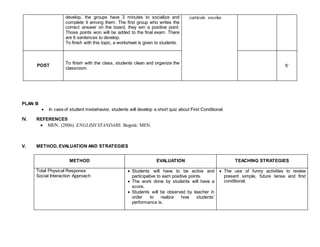
develop, the groups have 3 minutes to socialize and
complete it among them. The first group who writes the
correct answer on the board, they win a positive point.
Those points won will be added to the final exam. There
are 6 sentences to develop.
To finish with this topic, a worksheet is given to students.
currículo escolar.
POST
To finish with the class, students clean and organize the
classroom.
5’
PLAN B
 In case of student misbehavior, students will develop a short quiz about First Conditional.
IV. REFERENCES
 MEN. (2006). ENGLISH STANDARS. Bogotá: MEN.
V. METHOD, EVALUATION AND STRATEGIES
METHOD EVALUATION TEACHING STRATEGIES
Total Physical Response
Social Interaction Approach
 Students will have to be active and
participative to earn positive points.
 The work done by students will have a
score.
 Students will be observed by teacher in
order to realize how students’
performance is.
 The use of funny activities to review
present simple, future tense and first
conditional.

First Conditional - Lesson plan

  • 1.
    UNIVERSIDAD DE LAAMAZONIA EDUCATION SCIENCES FACULTY ENGLISH DEGREE PROGRAM TEACHING PRACTICE Il lI-2015 LESSON PLAN No. 05 I. DESCRIPTION I.E.: I.E. Jorge Eliecer Gaitan LEVEL: 11B - Wednesday/ Friday NUMBER OF STUDENTS:30 DATE: OCTUBER 14TH /2015 OCTUBER 16TH /2015 HOUR: 6:00 AM – 8:00 AM 6:00 AM – 7:00 AM S-T´S NAME: LUIS FERNANDO GALEANO CARDOZO C-T´S NAME: OLGA DAVILA GRAMMAR TOPIC: First conditional CONTEXTUALIZE TOPIC: If you …. AIMS MAIN AIMS:  To review present simple and future tenses.  To learn new vocabulary.  To be participative and active in the different activities developed during the class.  To reinforce first conditional. PERSONAL AIMS:  To make knowledge meaningful using the different strategies and activities planned.  To make an interactive class in order to the student learn and enjoy English.  To have a better management class. ANTICIPATED PROBLEMS  Negative attitude of students.  Student misbehavior.
  • 2.
    II. MATERIALS: Markers,board, text, sheets of paper, computer, and projector screen. III. PROCEDURES STAGE ACTIVITIES STANDARDS INTERACTION PATTERNS TIMING PRE Teacher greets the class, teacher checks students’ attendance and subsequently, teacher checks the homework that is about the tongue twisters learned before. The first 5 students, who say the tongue twisters, have positive point in participation and homework. ESCUCHA: • Identifico conectores en una situación de habla para comprender su sentido. LECTURA: • Identifico el punto de vista del autor. ESCRITURA: • Planeo, reviso y edito mis escritos con la ayuda de mis compañeros y del profesor. CONVERSACION: • Utilizo una pronunciación inteligible para lograr una comunicación efectiva MONOLOGOS:  Hago presentaciones orales sobre temas de mi interés y relacionados con el T-ST ST-T 15’ WHILE As students presented difficulties using Present Simple and Future tense, teacher proposes an activity to remember those tenses. It consists of delivering each student a verb. The piece of paper which contains the verb has 1° or 3°, it refers to the person. On the board, some classifications are such 1°- 3° person, DO-Does, ?, -, Will and Won’t. First, the students have to write on their notebooks the verb according to if it is 1° or 3° person, and positive, negative and interrogative present simple and future sentences. Then, some students write on the board their work. They win extra points. As they have already remembered, they are ready to do a shirt and easy quiz. The quiz has 5 questions, and students have 5 minutes to answer them. After doing the quiz, in groups of 3 people, they develop another activity about 1° conditional. It consists of organizing the 1° conditional sentences in the correct order and then pasting them on a sheet. So teacher gives students the present simple sentences in a bag, and the future sentences in another bag. Subsequently, the whole group divides into 2 to make a competition. This competence consists of completing some sentence in the correct way. First, teacher establishes the game’s rules: nobody can use a help (dictionary, cellphone, so on), group who cheats, has negative point. Second, students line up. Then, teacher takes a flash card which contains the sentence to T-ST ST-T ST-ST WHOLE GROUP 160
  • 3.
    develop, the groupshave 3 minutes to socialize and complete it among them. The first group who writes the correct answer on the board, they win a positive point. Those points won will be added to the final exam. There are 6 sentences to develop. To finish with this topic, a worksheet is given to students. currículo escolar. POST To finish with the class, students clean and organize the classroom. 5’ PLAN B  In case of student misbehavior, students will develop a short quiz about First Conditional. IV. REFERENCES  MEN. (2006). ENGLISH STANDARS. Bogotá: MEN. V. METHOD, EVALUATION AND STRATEGIES METHOD EVALUATION TEACHING STRATEGIES Total Physical Response Social Interaction Approach  Students will have to be active and participative to earn positive points.  The work done by students will have a score.  Students will be observed by teacher in order to realize how students’ performance is.  The use of funny activities to review present simple, future tense and first conditional.