Workshop
Messaging that makes a
change
23 June
Martin Cresswell and Jenny McArdle
What we will cover
The
challenge
A different
perspective
Practical
tools
Application
The challenge…
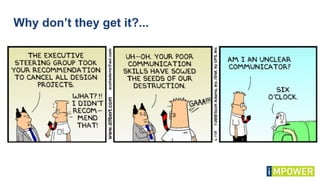
Why don’t they get it?...
A different perspective…
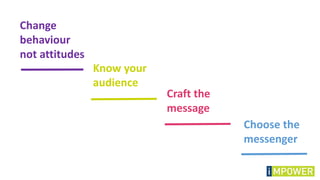
Change
behaviour
not attitudes
Know your
audience
Craft the
message
Choose the
messenger
Knowing your audience…
9
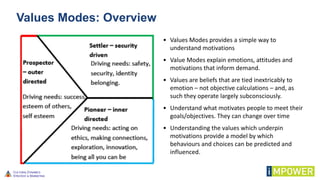
Values Modes: Overview
• Values Modes provides a simple way to
understand motivations
• Value Modes explain emotions, attitudes and
motivations that inform demand.
• Values are beliefs that are tied inextricably to
emotion – not objective calculations – and, as
such they operate largely subconsciously.
• Understand what motivates people to meet their
goals/objectives. They can change over time
• Understanding the values which underpin
motivations provide a model by which
behaviours and choices can be predicted and
influenced.
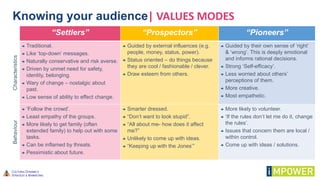
Knowing your audience| VALUES MODES
“Settlers” “Prospectors” “Pioneers”
Characteristics
 Traditional.
 Like ‘top-down’ messages.
 Naturally conservative and risk averse.
 Driven by unmet need for safety,
identity, belonging.
 Wary of change – nostalgic about
past.
 Low sense of ability to effect change.
 Guided by external influences (e.g.
people, money, status, power).
 Status oriented – do things because
they are cool / fashionable / clever.
 Draw esteem from others.
 Guided by their own sense of ‘right’
& ‘wrong’. This is deeply emotional
and informs rational decisions.
 Strong ‘Self-efficacy’.
 Less worried about others’
perceptions of them.
 More creative.
 Most empathetic.
Behaviour
 ‘Follow the crowd’.
 Least empathy of the groups.
 More likely to get family (often
extended family) to help out with some
tasks.
 Can be inflamed by threats.
 Pessimistic about future.
 Smarter dressed.
 “Don’t want to look stupid”.
 “All about me- how does it affect
me?”
 Unlikely to come up with ideas.
 “Keeping up with the Jones’”
 More likely to volunteer.
 ‘If the rules don’t let me do it, change
the rules’.
 Issues that concern them are local /
within control.
 Come up with ideas / solutions.
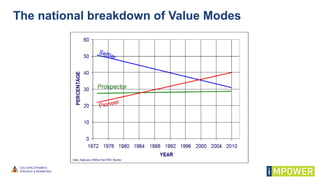
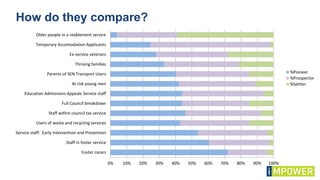
The national breakdown of Value Modes
How do they compare?
0% 10% 20% 30% 40% 50% 60% 70% 80% 90% 100%
Foster carers
Staff in foster service
Service staff: Early Intervention and Prevention
Users of waste and recycling services
Staff within council tax service
Full Council breakdown
Education Admissions Appeals Service staff
At risk young men
Parents of SEN Transport Users
Thriving families
Ex-service veterans
Temporary Accomodation Applicants
Older people in a reablement service
%Pioneer
%Prospector
%Settler
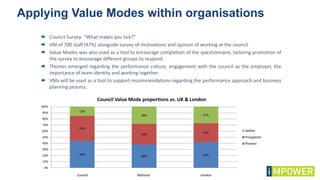
Applying Value Modes within organisations
 Council Survey: “What makes you tick?”
 VM of 700 staff (47%) alongside survey of motivations and opinion of working at the council
 Value Modes was also used as a tool to encourage completion of the questionnaire, tailoring promotion of
the survey to encourage different groups to respond.
 Themes emerged regarding the performance culture, engagement with the council as the employer, the
importance of team identity and working together.
 VMs will be used as a tool to support recommendations regarding the performance approach and business
planning process.
44%
38% 42%
41%
34% 31%
15%
28% 27%
0%
10%
20%
30%
40%
50%
60%
70%
80%
90%
100%
Council Value Mode proportions vs. UK & London
Settler
Prospector
Pioneer
Council National London
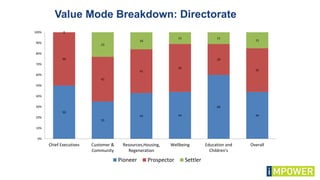
Value Mode Breakdown: Directorate
50
35
43 44
60
44
50
42
41
45
29
41
0
23
16
11 11
15
0%
10%
20%
30%
40%
50%
60%
70%
80%
90%
100%
Chief Executives Customer &
Community
Resources,Housing,
Regeneration
Wellbeing Education and
Children's
Overall
Pioneer Prospector Settler
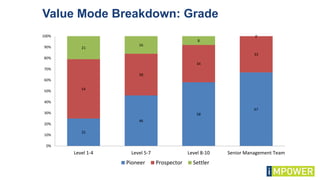
Value Mode Breakdown: Grade
25
46
58
67
54
38
34
33
21
16
8
0
0%
10%
20%
30%
40%
50%
60%
70%
80%
90%
100%
Level 1-4 Level 5-7 Level 8-10 Senior Management Team
Pioneer Prospector Settler
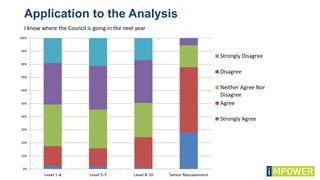
Application to the Analysis
0%
10%
20%
30%
40%
50%
60%
70%
80%
90%
100%
Level 1-4 Level 5-7 Level 8-10 Senior Management
Strongly Disagree
Disagree
Neither Agree Nor
Disagree
Agree
Strongly Agree
I know where the Council is going in the next year
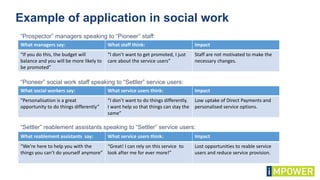
Example of application in social work
What managers say: What staff think: Impact
“If you do this, the budget will
balance and you will be more likely to
be promoted”
“I don’t want to get promoted, I just
care about the service users”
Staff are not motivated to make the
necessary changes.
“Prospector” managers speaking to “Pioneer” staff:
“Pioneer” social work staff speaking to “Settler” service users:
What social workers say: What service users think: Impact
“Personalisation is a great
opportunity to do things differently”
“I don’t want to do things differently.
I want help so that things can stay the
same”
Low uptake of Direct Payments and
personalised service options.
What reablement assistants say: What service users think: Impact
“We’re here to help you with the
things you can’t do yourself anymore”
“Great! I can rely on this service to
look after me for ever more!”
Lost opportunities to reable service
users and reduce service provision.
“Settler” reablement assistants speaking to “Settler” service users:
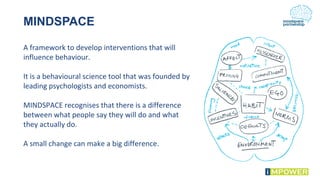
MINDSPACE
MINDSPACE
A framework to develop interventions that will
influence behaviour.
It is a behavioural science tool that was founded by
leading psychologists and economists.
MINDSPACE recognises that there is a difference
between what people say they will do and what
they actually do.
A small change can make a big difference.
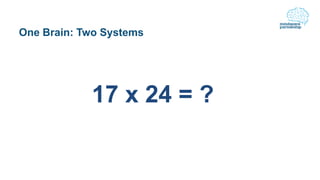
One Brain: Two Systems
17 x 24 = ?
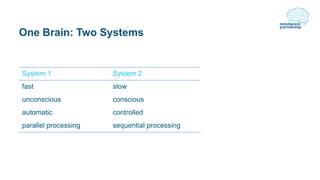
One Brain: Two Systems
System 1 System 2
fast slow
unconscious conscious
automatic controlled
parallel processing sequential processing
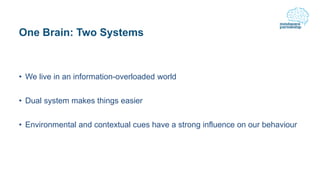
One Brain: Two Systems
• We live in an information-overloaded world
• Dual system makes things easier
• Environmental and contextual cues have a strong influence on our behaviour
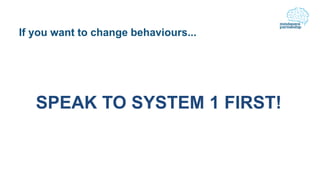
If you want to change behaviours...
SPEAK TO SYSTEM 1 FIRST!
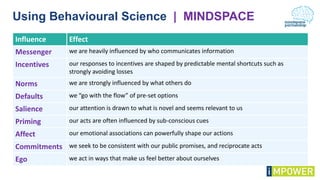
Influence Effect
Messenger we are heavily influenced by who communicates information
Incentives our responses to incentives are shaped by predictable mental shortcuts such as
strongly avoiding losses
Norms we are strongly influenced by what others do
Defaults we “go with the flow” of pre-set options
Salience our attention is drawn to what is novel and seems relevant to us
Priming our acts are often influenced by sub-conscious cues
Affect our emotional associations can powerfully shape our actions
Commitments we seek to be consistent with our public promises, and reciprocate acts
Ego we act in ways that make us feel better about ourselves
Using Behavioural Science | MINDSPACE
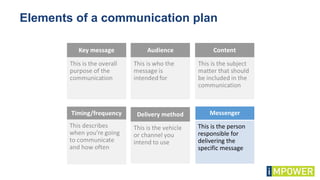
Elements of a communication plan
Messenger
This is the person
responsible for
delivering the
specific message
Messenger
We are heavily influenced by who
communicates information.
Authority - Trust - Similarity
Authority
from your
• position or role in society
• experience, training and qualifications
Authority
Hospital Study
Nurses were asked
• to administer an unauthorised medication
• at overdose levels
• over the telephone by an unknown doctor
Authority
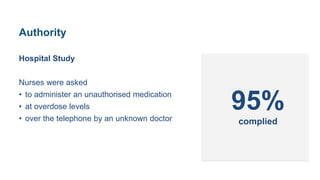
Hospital Study
Nurses were asked
• to administer an unauthorised medication
• at overdose levels
• over the telephone by an unknown doctor
95%
complied
Similarity
• age, gender or profession
• particularly lower socio-economic groups
Similarity
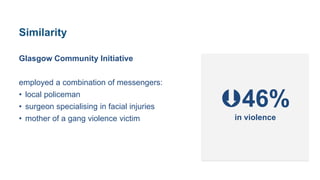
Glasgow Community Initiative
employed a combination of messengers:
• local policeman
• surgeon specialising in facial injuries
• mother of a gang violence victim
Similarity
Glasgow Community Initiative
employed a combination of messengers:
• local policeman
• surgeon specialising in facial injuries
• mother of a gang violence victim
46%
in violence
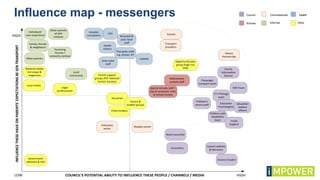
Influence map - messengers
Child minders
Other parents
Parenting
forums /
networks (online)
Other parents
of SEN
children
Individuals’
own experience
Government
websites & Info
Family, friends
& neighbours
COUNCIL’S POTENTIAL ABILITY TO INFLUENCE THESE PEOPLE / CHANNELS / MEDIA
INFLUENCETHESEHAVEONPARENTS’EXPECTATIONSRESENTRANSPORT
HIGH
LOW HIGH
Local media
National media
incl soaps &
magazines
Local
community
Legal
professionals
Hospital
consultants
Health
visitors
Ante natal
staff
Neonatal &
post natal
staff
Therapies staff,
e.g. physio, OT
Councillors
Family
Information
Service
Ward councillor
Nurseries
Parent &
toddler groups
GPs
Opportunity play
group (high nos
SEN)
Escorts
Parent support
groups (PIP, National
Autism Society)
Transport
providers
Parent
Partnership
EY / Portage
team
Mainstream
schools staff
Voluntary
sector
Children’s
centre staff
Children with
disabilities
team
SEN Team
CAMHS
Council website
& literature
Access Croydon
Youth
Support
Education
Psychologists
Education
welfare
officers
Special schools staff –
esp on provision visits
& annual review
Passenger
transport team
Respite centre
Council Commissioned Health
Schools Informal Other
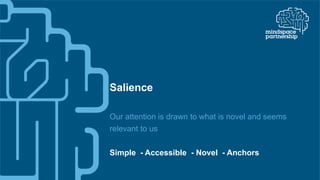
Salience
Our attention is drawn to what is novel and seems
relevant to us
Simple - Accessible - Novel - Anchors
35
Novelty
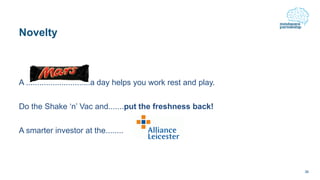
A .............................a day helps you work rest and play.
Do the Shake ‘n’ Vac and.......put the freshness back!
A smarter investor at the........
36
Affect
Our emotional associations can powerfully shape
our actions.
Attractiveness - Fear - Disgust - Fun
Attractiveness
If we feel attracted to a person we are more likely
to be influenced by them.
Attractiveness
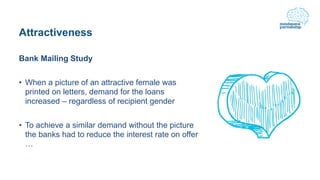
Bank Mailing Study
• When a picture of an attractive female was
printed on letters, demand for the loans
increased – regardless of recipient gender
• To achieve a similar demand without the picture
the banks had to reduce the interest rate on offer
…
Attractiveness
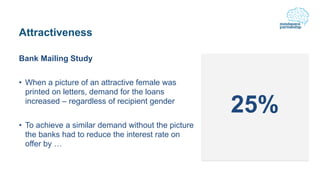
Bank Mailing Study
• When a picture of an attractive female was
printed on letters, demand for the loans
increased – regardless of recipient gender
• To achieve a similar demand without the picture
the banks had to reduce the interest rate on
offer by …
25%
It works…
Results| Overview of trial results
- 63% of practitioners in the First Team [agreed
or strongly agreed that they have] changed the
way they have conversations*
- 64% of Care Direct call handlers have changed
the way they deal with calls*
‘’It’s a whole
mind-shift…”
(Practitioner - First Team
South)
‘’Made me see the person
differently…’’
‘’We talked about positive risk
taking where I normally wouldn’t
have.’’
‘’Made me see that the person had
a lot more going for them then I
would have normally realised.’’
(First Team South)
* Self reported via post trial surveys
Pioneers
72-77%
Prospectors
20-25%
Settlers
3%
77%
20%
3%
72%
25%
3%
Pioneers Prospectors Settlers
Managers All Staff
Results| Overview of trial results
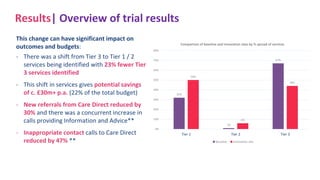
This change can have significant impact on
outcomes and budgets:
- There was a shift from Tier 3 to Tier 1 / 2
services being identified with 23% fewer Tier
3 services identified
- This shift in services gives potential savings
of c. £30m+ p.a. (22% of the total budget)
- New referrals from Care Direct reduced by
30% and there was a concurrent increase in
calls providing Information and Advice**
- Inappropriate contact calls to Care Direct
reduced by 47% **
32%
1%
67%
50%
6%
44%
0%
10%
20%
30%
40%
50%
60%
70%
80%
Tier 1 Tier 2 Tier 3
Comparison of baseline and innovation sites by % spread of services
Baseline Innovation site
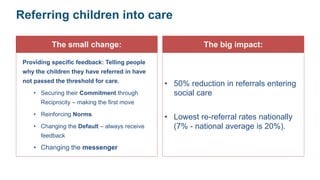
Referring children into care
The small change:
Providing specific feedback: Telling people
why the children they have referred in have
not passed the threshold for care.
• Securing their Commitment through
Reciprocity – making the first move
• Reinforcing Norms
• Changing the Default – always receive
feedback
• Changing the messenger
The big impact:
• 50% reduction in referrals entering
social care
• Lowest re-referral rates nationally
(7% - national average is 20%).
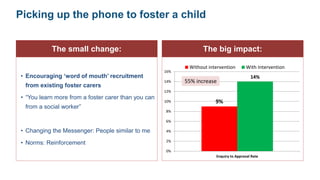
Picking up the phone to foster a child
The small change:
• Encouraging ‘word of mouth’ recruitment
from existing foster carers
• “You learn more from a foster carer than you can
from a social worker”
• Changing the Messenger: People similar to me
• Norms: Reinforcement
The big impact:
9%
14%
0%
2%
4%
6%
8%
10%
12%
14%
16%
Enquiry to Approval Rate
Without intervention With Intervention
55% increase
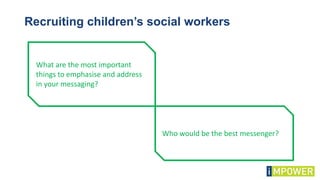
Try it out…
Recruiting children’s social workers
What are the most important
things to emphasise and address
in your messaging?
Who would be the best messenger?
Questions…
Contacts
Jenny McArdle, Director
e: jmcardle@impower.co.uk
m: 07525 403 611
Martin Cresswell, Chief Executive
e: mcresswell@impower.co.uk
m: 07912 300 216
www.impower.co.uk

PPMA Seminar 2016 - Messaging that Makes a Change

  • 1.
    Workshop Messaging that makesa change 23 June Martin Cresswell and Jenny McArdle
  • 2.
    What we willcover The challenge A different perspective Practical tools Application
  • 3.
  • 4.
    Why don’t theyget it?...
  • 6.
  • 7.
  • 8.
  • 9.
    9 Values Modes: Overview •Values Modes provides a simple way to understand motivations • Value Modes explain emotions, attitudes and motivations that inform demand. • Values are beliefs that are tied inextricably to emotion – not objective calculations – and, as such they operate largely subconsciously. • Understand what motivates people to meet their goals/objectives. They can change over time • Understanding the values which underpin motivations provide a model by which behaviours and choices can be predicted and influenced.
  • 10.
    Knowing your audience|VALUES MODES “Settlers” “Prospectors” “Pioneers” Characteristics  Traditional.  Like ‘top-down’ messages.  Naturally conservative and risk averse.  Driven by unmet need for safety, identity, belonging.  Wary of change – nostalgic about past.  Low sense of ability to effect change.  Guided by external influences (e.g. people, money, status, power).  Status oriented – do things because they are cool / fashionable / clever.  Draw esteem from others.  Guided by their own sense of ‘right’ & ‘wrong’. This is deeply emotional and informs rational decisions.  Strong ‘Self-efficacy’.  Less worried about others’ perceptions of them.  More creative.  Most empathetic. Behaviour  ‘Follow the crowd’.  Least empathy of the groups.  More likely to get family (often extended family) to help out with some tasks.  Can be inflamed by threats.  Pessimistic about future.  Smarter dressed.  “Don’t want to look stupid”.  “All about me- how does it affect me?”  Unlikely to come up with ideas.  “Keeping up with the Jones’”  More likely to volunteer.  ‘If the rules don’t let me do it, change the rules’.  Issues that concern them are local / within control.  Come up with ideas / solutions.
  • 11.
    The national breakdownof Value Modes
  • 12.
    How do theycompare? 0% 10% 20% 30% 40% 50% 60% 70% 80% 90% 100% Foster carers Staff in foster service Service staff: Early Intervention and Prevention Users of waste and recycling services Staff within council tax service Full Council breakdown Education Admissions Appeals Service staff At risk young men Parents of SEN Transport Users Thriving families Ex-service veterans Temporary Accomodation Applicants Older people in a reablement service %Pioneer %Prospector %Settler
  • 13.
    Applying Value Modeswithin organisations  Council Survey: “What makes you tick?”  VM of 700 staff (47%) alongside survey of motivations and opinion of working at the council  Value Modes was also used as a tool to encourage completion of the questionnaire, tailoring promotion of the survey to encourage different groups to respond.  Themes emerged regarding the performance culture, engagement with the council as the employer, the importance of team identity and working together.  VMs will be used as a tool to support recommendations regarding the performance approach and business planning process. 44% 38% 42% 41% 34% 31% 15% 28% 27% 0% 10% 20% 30% 40% 50% 60% 70% 80% 90% 100% Council Value Mode proportions vs. UK & London Settler Prospector Pioneer Council National London
  • 14.
    Value Mode Breakdown:Directorate 50 35 43 44 60 44 50 42 41 45 29 41 0 23 16 11 11 15 0% 10% 20% 30% 40% 50% 60% 70% 80% 90% 100% Chief Executives Customer & Community Resources,Housing, Regeneration Wellbeing Education and Children's Overall Pioneer Prospector Settler
  • 15.
    Value Mode Breakdown:Grade 25 46 58 67 54 38 34 33 21 16 8 0 0% 10% 20% 30% 40% 50% 60% 70% 80% 90% 100% Level 1-4 Level 5-7 Level 8-10 Senior Management Team Pioneer Prospector Settler
  • 16.
    Application to theAnalysis 0% 10% 20% 30% 40% 50% 60% 70% 80% 90% 100% Level 1-4 Level 5-7 Level 8-10 Senior Management Strongly Disagree Disagree Neither Agree Nor Disagree Agree Strongly Agree I know where the Council is going in the next year
  • 17.
    Example of applicationin social work What managers say: What staff think: Impact “If you do this, the budget will balance and you will be more likely to be promoted” “I don’t want to get promoted, I just care about the service users” Staff are not motivated to make the necessary changes. “Prospector” managers speaking to “Pioneer” staff: “Pioneer” social work staff speaking to “Settler” service users: What social workers say: What service users think: Impact “Personalisation is a great opportunity to do things differently” “I don’t want to do things differently. I want help so that things can stay the same” Low uptake of Direct Payments and personalised service options. What reablement assistants say: What service users think: Impact “We’re here to help you with the things you can’t do yourself anymore” “Great! I can rely on this service to look after me for ever more!” Lost opportunities to reable service users and reduce service provision. “Settler” reablement assistants speaking to “Settler” service users:
  • 18.
  • 19.
    MINDSPACE A framework todevelop interventions that will influence behaviour. It is a behavioural science tool that was founded by leading psychologists and economists. MINDSPACE recognises that there is a difference between what people say they will do and what they actually do. A small change can make a big difference.
  • 20.
  • 21.
    One Brain: TwoSystems 17 x 24 = ?
  • 22.
    One Brain: TwoSystems System 1 System 2 fast slow unconscious conscious automatic controlled parallel processing sequential processing
  • 23.
    One Brain: TwoSystems • We live in an information-overloaded world • Dual system makes things easier • Environmental and contextual cues have a strong influence on our behaviour
  • 24.
    If you wantto change behaviours... SPEAK TO SYSTEM 1 FIRST!
  • 25.
    Influence Effect Messenger weare heavily influenced by who communicates information Incentives our responses to incentives are shaped by predictable mental shortcuts such as strongly avoiding losses Norms we are strongly influenced by what others do Defaults we “go with the flow” of pre-set options Salience our attention is drawn to what is novel and seems relevant to us Priming our acts are often influenced by sub-conscious cues Affect our emotional associations can powerfully shape our actions Commitments we seek to be consistent with our public promises, and reciprocate acts Ego we act in ways that make us feel better about ourselves Using Behavioural Science | MINDSPACE
  • 26.
    Elements of acommunication plan Messenger This is the person responsible for delivering the specific message
  • 27.
    Messenger We are heavilyinfluenced by who communicates information. Authority - Trust - Similarity
  • 28.
    Authority from your • positionor role in society • experience, training and qualifications
  • 29.
    Authority Hospital Study Nurses wereasked • to administer an unauthorised medication • at overdose levels • over the telephone by an unknown doctor
  • 30.
    Authority Hospital Study Nurses wereasked • to administer an unauthorised medication • at overdose levels • over the telephone by an unknown doctor 95% complied
  • 31.
    Similarity • age, genderor profession • particularly lower socio-economic groups
  • 32.
    Similarity Glasgow Community Initiative employeda combination of messengers: • local policeman • surgeon specialising in facial injuries • mother of a gang violence victim
  • 33.
    Similarity Glasgow Community Initiative employeda combination of messengers: • local policeman • surgeon specialising in facial injuries • mother of a gang violence victim 46% in violence
  • 34.
    Influence map -messengers Child minders Other parents Parenting forums / networks (online) Other parents of SEN children Individuals’ own experience Government websites & Info Family, friends & neighbours COUNCIL’S POTENTIAL ABILITY TO INFLUENCE THESE PEOPLE / CHANNELS / MEDIA INFLUENCETHESEHAVEONPARENTS’EXPECTATIONSRESENTRANSPORT HIGH LOW HIGH Local media National media incl soaps & magazines Local community Legal professionals Hospital consultants Health visitors Ante natal staff Neonatal & post natal staff Therapies staff, e.g. physio, OT Councillors Family Information Service Ward councillor Nurseries Parent & toddler groups GPs Opportunity play group (high nos SEN) Escorts Parent support groups (PIP, National Autism Society) Transport providers Parent Partnership EY / Portage team Mainstream schools staff Voluntary sector Children’s centre staff Children with disabilities team SEN Team CAMHS Council website & literature Access Croydon Youth Support Education Psychologists Education welfare officers Special schools staff – esp on provision visits & annual review Passenger transport team Respite centre Council Commissioned Health Schools Informal Other
  • 35.
    Salience Our attention isdrawn to what is novel and seems relevant to us Simple - Accessible - Novel - Anchors 35
  • 36.
    Novelty A .............................a dayhelps you work rest and play. Do the Shake ‘n’ Vac and.......put the freshness back! A smarter investor at the........ 36
  • 37.
    Affect Our emotional associationscan powerfully shape our actions. Attractiveness - Fear - Disgust - Fun
  • 38.
    Attractiveness If we feelattracted to a person we are more likely to be influenced by them.
  • 39.
    Attractiveness Bank Mailing Study •When a picture of an attractive female was printed on letters, demand for the loans increased – regardless of recipient gender • To achieve a similar demand without the picture the banks had to reduce the interest rate on offer …
  • 40.
    Attractiveness Bank Mailing Study •When a picture of an attractive female was printed on letters, demand for the loans increased – regardless of recipient gender • To achieve a similar demand without the picture the banks had to reduce the interest rate on offer by … 25%
  • 41.
  • 42.
    Results| Overview oftrial results - 63% of practitioners in the First Team [agreed or strongly agreed that they have] changed the way they have conversations* - 64% of Care Direct call handlers have changed the way they deal with calls* ‘’It’s a whole mind-shift…” (Practitioner - First Team South) ‘’Made me see the person differently…’’ ‘’We talked about positive risk taking where I normally wouldn’t have.’’ ‘’Made me see that the person had a lot more going for them then I would have normally realised.’’ (First Team South) * Self reported via post trial surveys Pioneers 72-77% Prospectors 20-25% Settlers 3% 77% 20% 3% 72% 25% 3% Pioneers Prospectors Settlers Managers All Staff
  • 43.
    Results| Overview oftrial results This change can have significant impact on outcomes and budgets: - There was a shift from Tier 3 to Tier 1 / 2 services being identified with 23% fewer Tier 3 services identified - This shift in services gives potential savings of c. £30m+ p.a. (22% of the total budget) - New referrals from Care Direct reduced by 30% and there was a concurrent increase in calls providing Information and Advice** - Inappropriate contact calls to Care Direct reduced by 47% ** 32% 1% 67% 50% 6% 44% 0% 10% 20% 30% 40% 50% 60% 70% 80% Tier 1 Tier 2 Tier 3 Comparison of baseline and innovation sites by % spread of services Baseline Innovation site
  • 44.
    Referring children intocare The small change: Providing specific feedback: Telling people why the children they have referred in have not passed the threshold for care. • Securing their Commitment through Reciprocity – making the first move • Reinforcing Norms • Changing the Default – always receive feedback • Changing the messenger The big impact: • 50% reduction in referrals entering social care • Lowest re-referral rates nationally (7% - national average is 20%).
  • 45.
    Picking up thephone to foster a child The small change: • Encouraging ‘word of mouth’ recruitment from existing foster carers • “You learn more from a foster carer than you can from a social worker” • Changing the Messenger: People similar to me • Norms: Reinforcement The big impact: 9% 14% 0% 2% 4% 6% 8% 10% 12% 14% 16% Enquiry to Approval Rate Without intervention With Intervention 55% increase
  • 46.
  • 47.
    Recruiting children’s socialworkers What are the most important things to emphasise and address in your messaging? Who would be the best messenger?
  • 48.
  • 49.
    Contacts Jenny McArdle, Director e:jmcardle@impower.co.uk m: 07525 403 611 Martin Cresswell, Chief Executive e: mcresswell@impower.co.uk m: 07912 300 216 www.impower.co.uk