© 2015 Grant Thornton UK LLP. All rights reserved.
2020 Vision
Exploring finance and policy futures for English
Local Government
PPMA Annual Seminar
17 April 2015
Guy Clifton
© 2015 Grant Thornton UK LLP. All rights reserved.
• Introduction to 2020 Vision
• Context – the national picture
• The challenge of the next ten years
• Possible future scenarios
• Conclusion and recommendations
Agenda
© 2015 Grant Thornton UK LLP. All rights reserved.
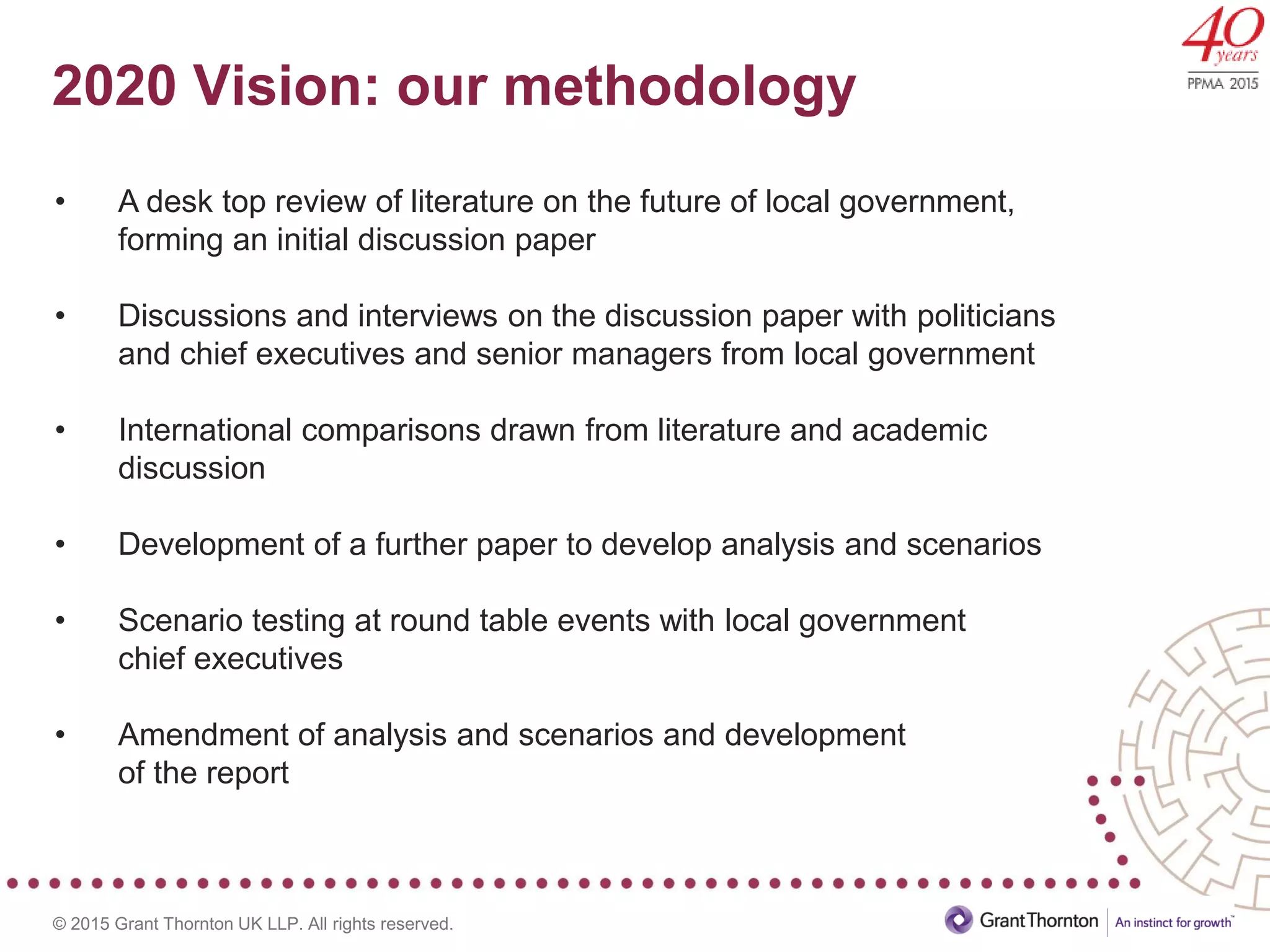
2020 Vision: our methodology
• A desk top review of literature on the future of local government,
forming an initial discussion paper
• Discussions and interviews on the discussion paper with politicians
and chief executives and senior managers from local government
• International comparisons drawn from literature and academic
discussion
• Development of a further paper to develop analysis and scenarios
• Scenario testing at round table events with local government
chief executives
• Amendment of analysis and scenarios and development
of the report
© 2015 Grant Thornton UK LLP. All rights reserved.
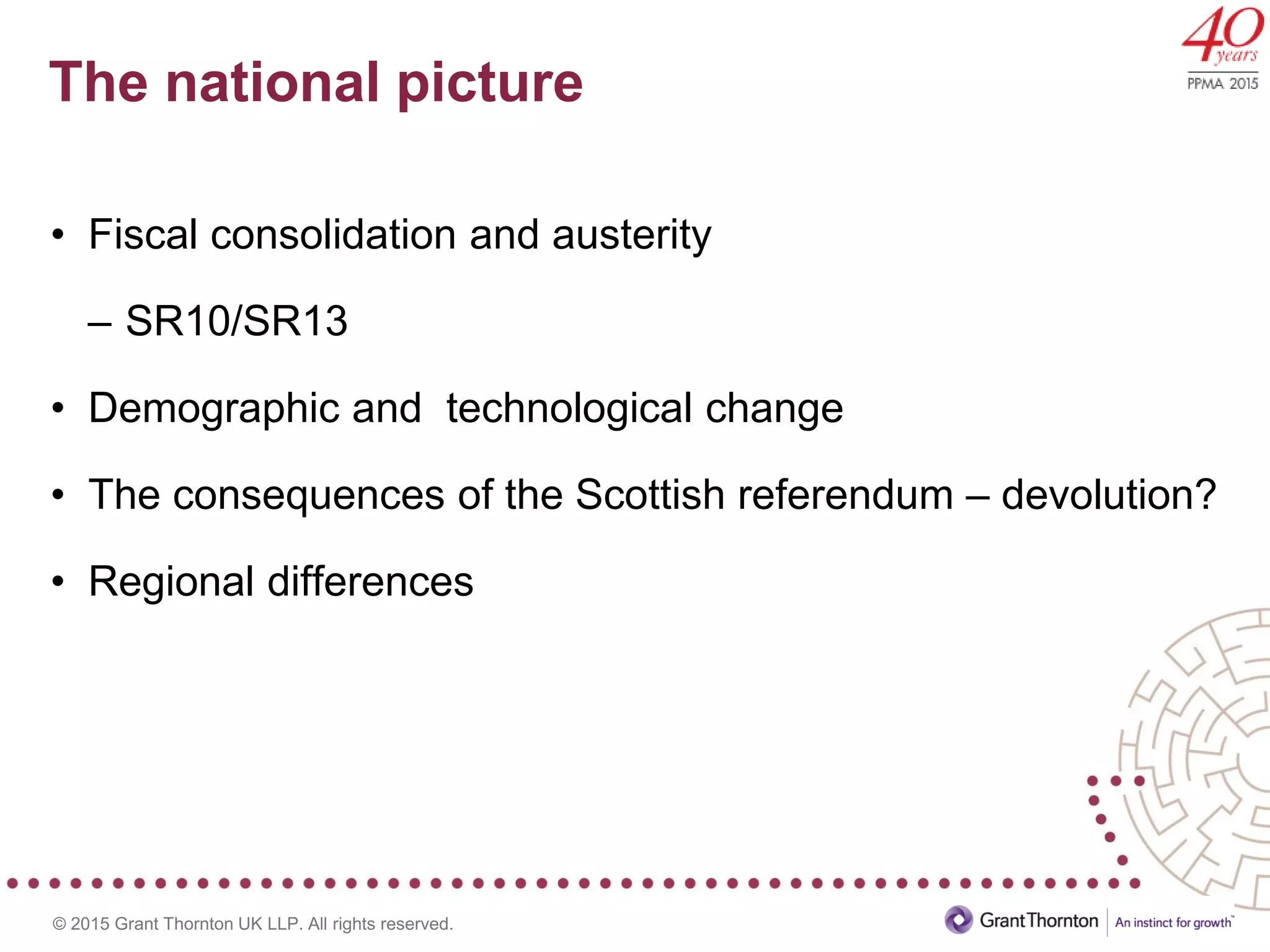
The national picture
• Fiscal consolidation and austerity
– SR10/SR13
• Demographic and technological change
• The consequences of the Scottish referendum – devolution?
• Regional differences
© 2015 Grant Thornton UK LLP. All rights reserved.
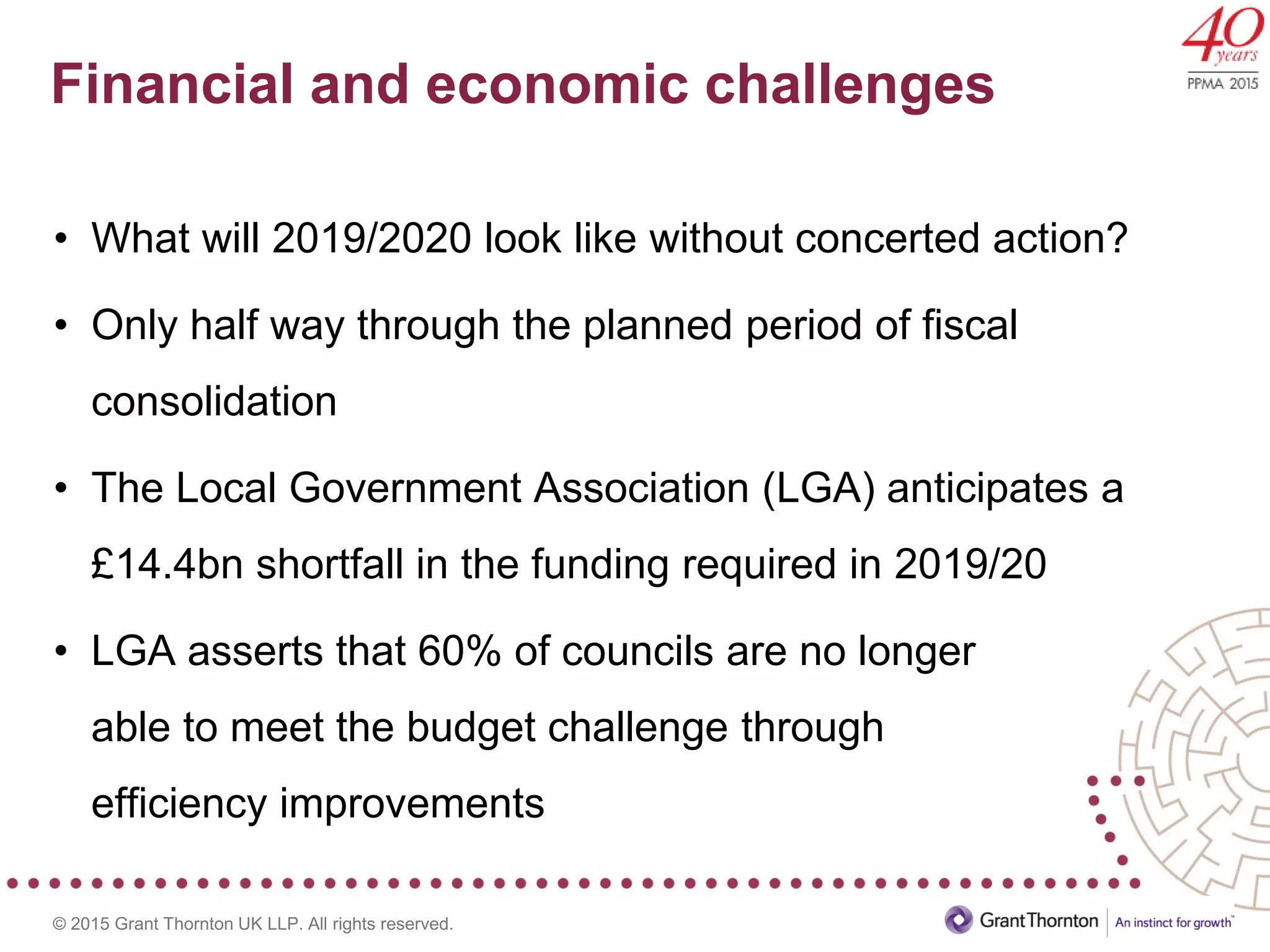
Financial and economic challenges
Challenge
• What will 2019/2020 look like without concerted action?
• Only half way through the planned period of fiscal
consolidation
• The Local Government Association (LGA) anticipates a
£14.4bn shortfall in the funding required in 2019/20
• LGA asserts that 60% of councils are no longer
able to meet the budget challenge through
efficiency improvements
© 2015 Grant Thornton UK LLP. All rights reserved.
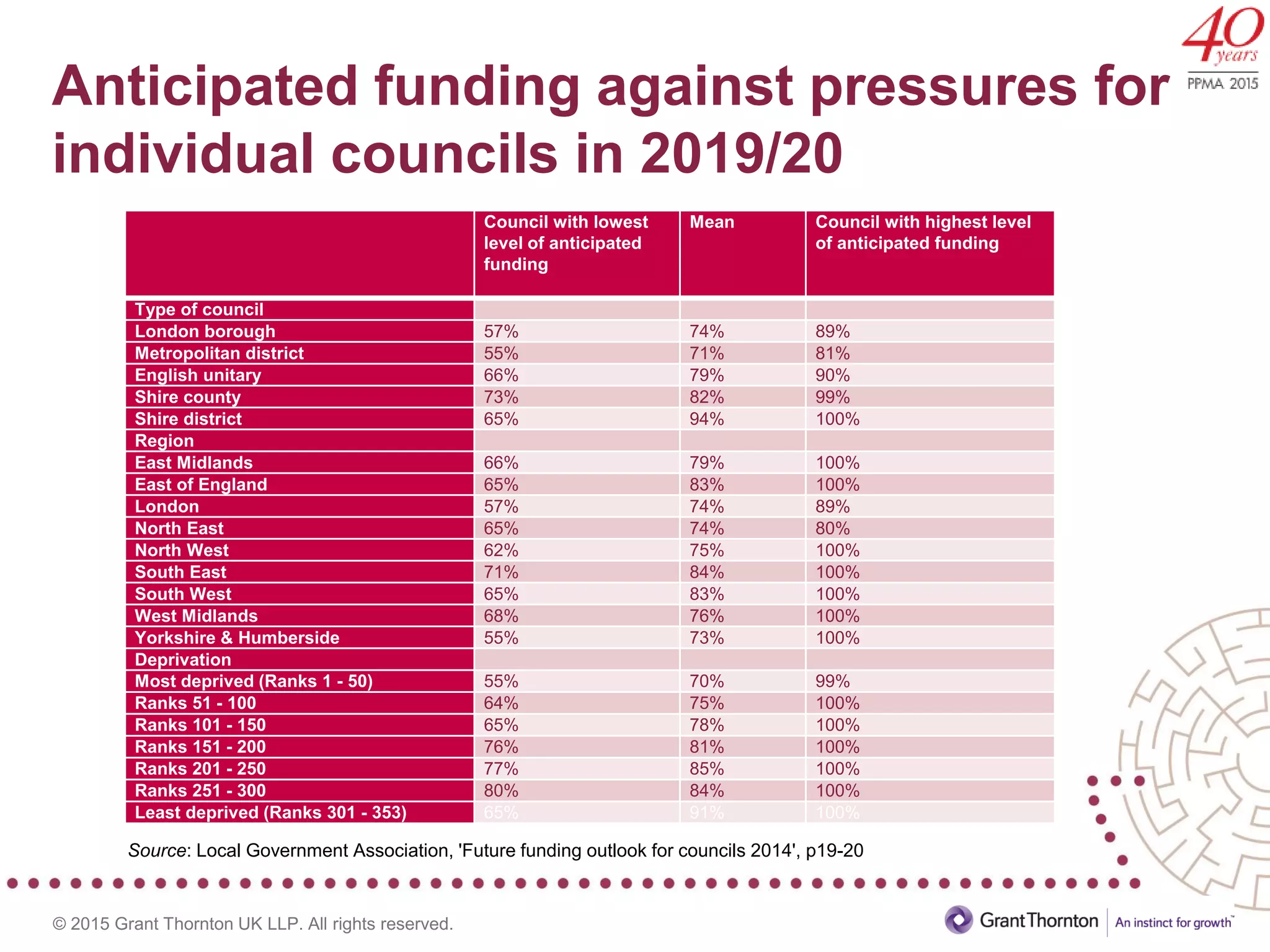
Anticipated funding against pressures for
individual councils in 2019/20
Council with lowest
level of anticipated
funding
Mean Council with highest level
of anticipated funding
Type of council
London borough 57% 74% 89%
Metropolitan district 55% 71% 81%
English unitary 66% 79% 90%
Shire county 73% 82% 99%
Shire district 65% 94% 100%
Region
East Midlands 66% 79% 100%
East of England 65% 83% 100%
London 57% 74% 89%
North East 65% 74% 80%
North West 62% 75% 100%
South East 71% 84% 100%
South West 65% 83% 100%
West Midlands 68% 76% 100%
Yorkshire & Humberside 55% 73% 100%
Deprivation
Most deprived (Ranks 1 - 50) 55% 70% 99%
Ranks 51 - 100 64% 75% 100%
Ranks 101 - 150 65% 78% 100%
Ranks 151 - 200 76% 81% 100%
Ranks 201 - 250 77% 85% 100%
Ranks 251 - 300 80% 84% 100%
Least deprived (Ranks 301 - 353) 65% 91% 100%
Source: Local Government Association, 'Future funding outlook for councils 2014', p19-20
© 2015 Grant Thornton UK LLP. All rights reserved.
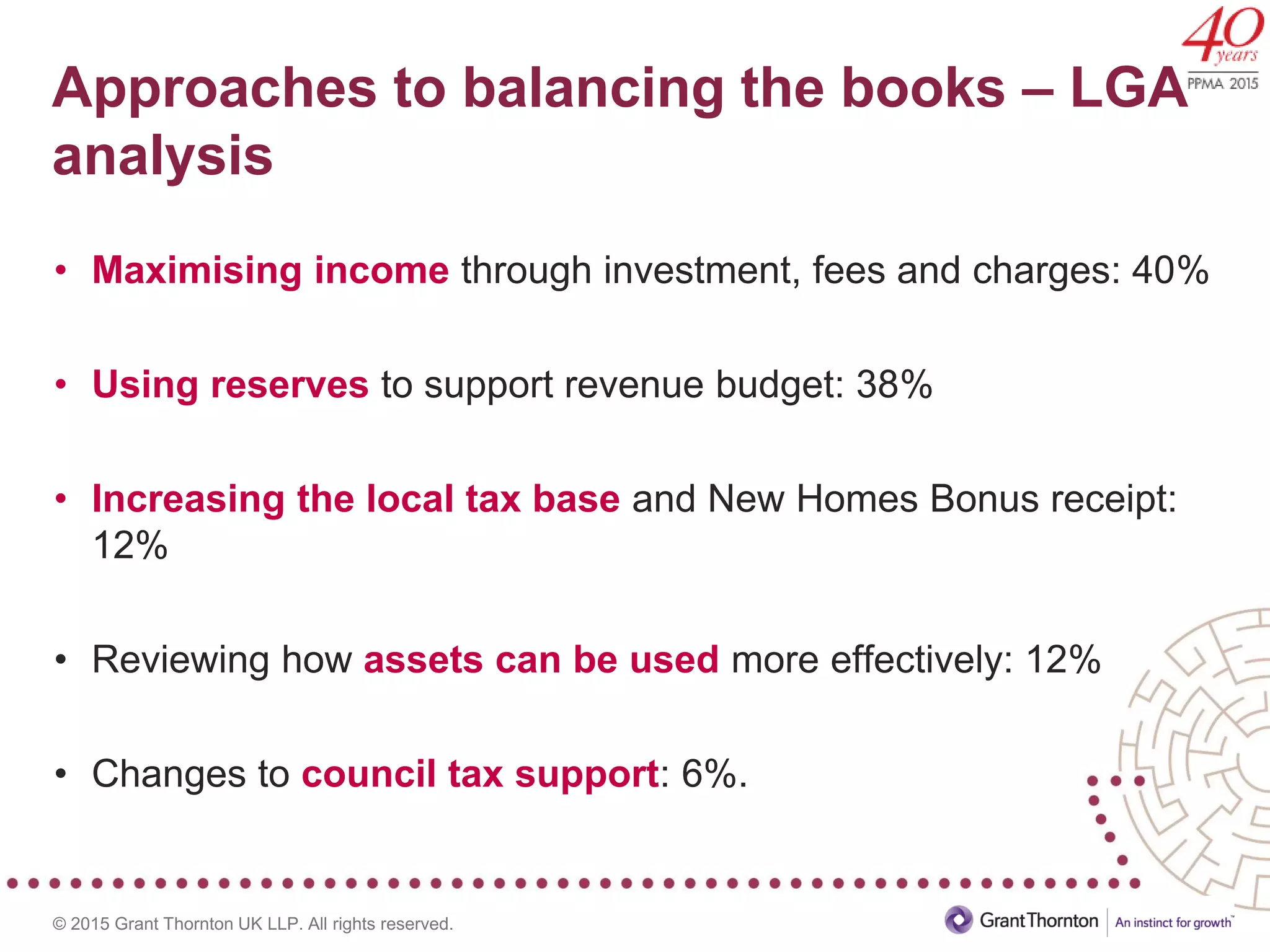
Approaches to balancing the books – LGA
analysis
• Maximising income through investment, fees and charges: 40%
• Using reserves to support revenue budget: 38%
• Increasing the local tax base and New Homes Bonus receipt:
12%
• Reviewing how assets can be used more effectively: 12%
• Changes to council tax support: 6%.
© 2015 Grant Thornton UK LLP. All rights reserved.
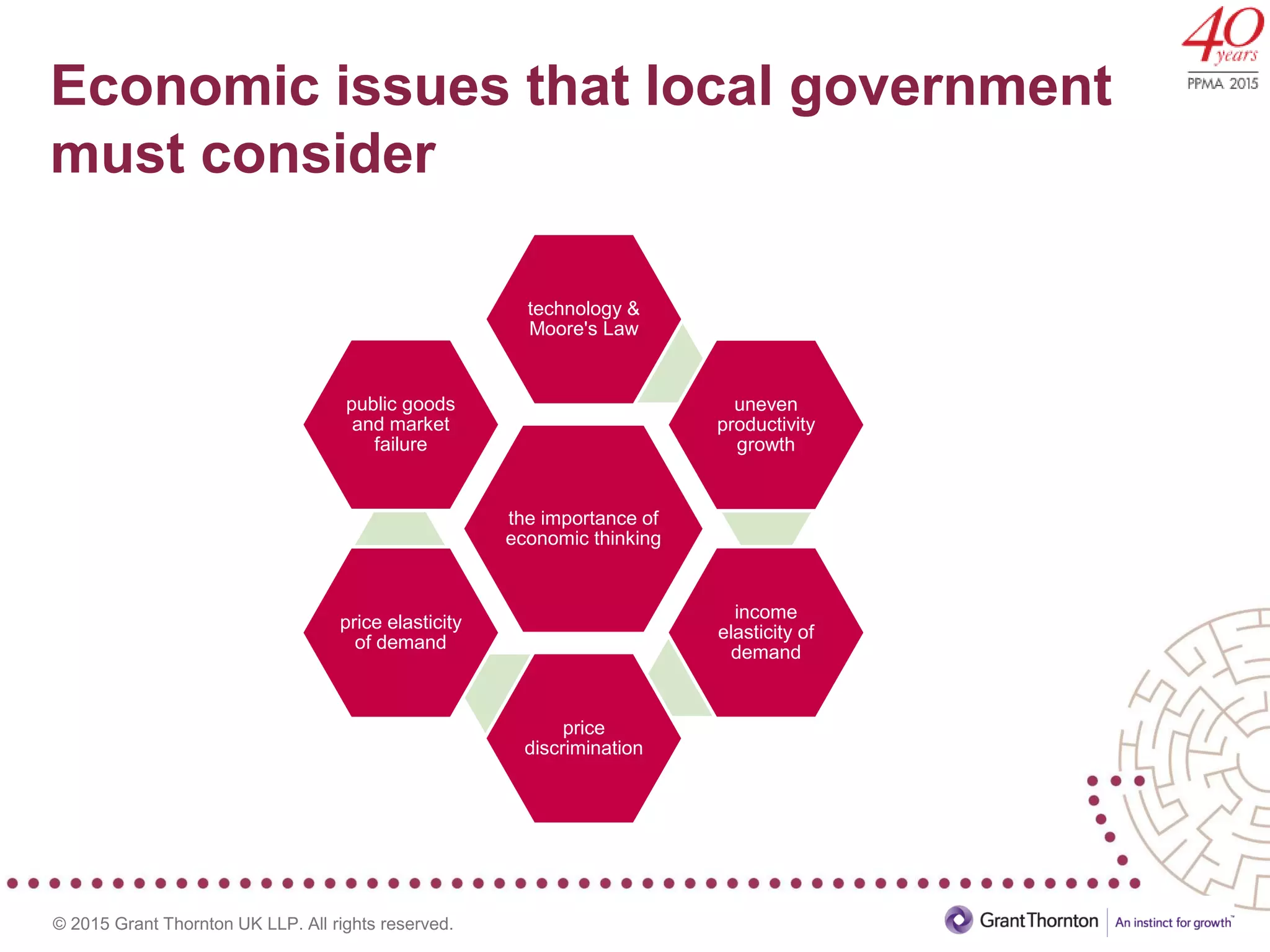
Economic issues that local government
must consider
the importance of
economic thinking
technology &
Moore's Law
uneven
productivity
growth
income
elasticity of
demand
price
discrimination
price elasticity
of demand
public goods
and market
failure
© 2015 Grant Thornton UK LLP. All rights reserved.
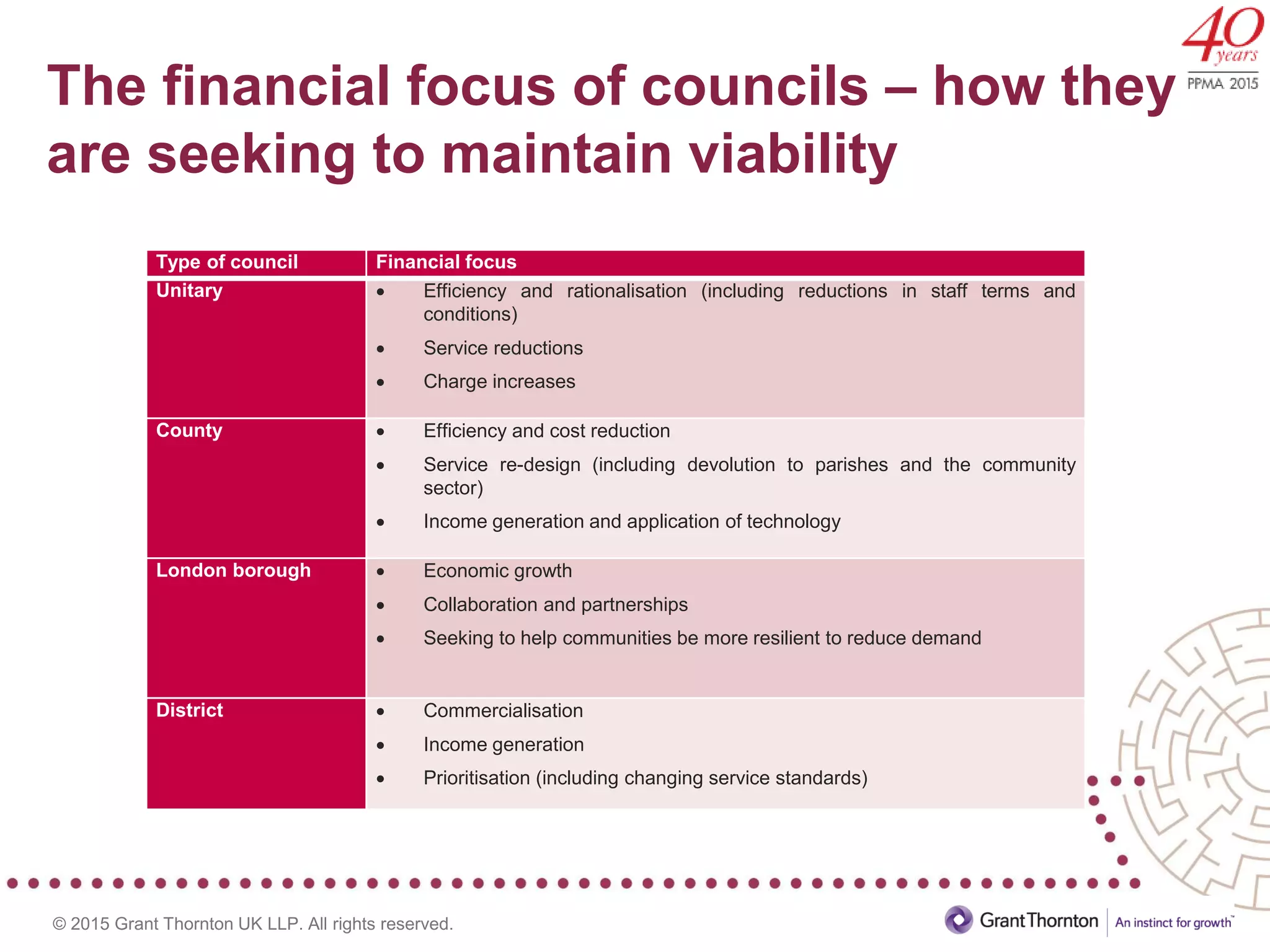
The financial focus of councils – how they
are seeking to maintain viability
Type of council Financial focus
Unitary  Efficiency and rationalisation (including reductions in staff terms and
conditions)
 Service reductions
 Charge increases
County  Efficiency and cost reduction
 Service re-design (including devolution to parishes and the community
sector)
 Income generation and application of technology
London borough  Economic growth
 Collaboration and partnerships
 Seeking to help communities be more resilient to reduce demand
District  Commercialisation
 Income generation
 Prioritisation (including changing service standards)
© 2015 Grant Thornton UK LLP. All rights reserved.
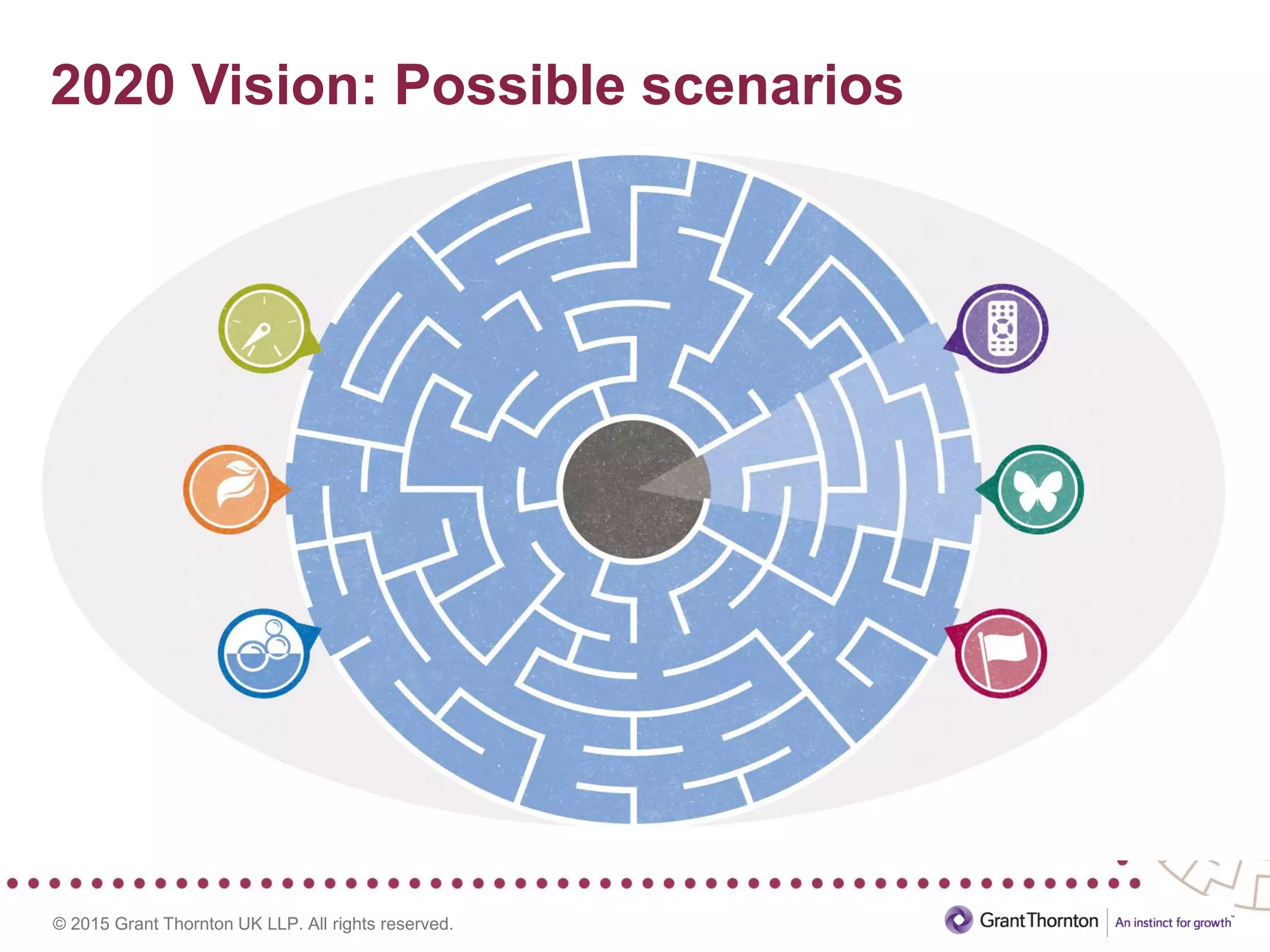
2020 Vision: Possible scenarios
© 2015 Grant Thornton UK LLP. All rights reserved.
Voting buttons
• As we progress through the scenarios, we have included a
number of questions. We would like your views.
• We understand that this is the first you will have seen of
these scenarios, so we ask for your initial thoughts on them
and how you feel they apply to your organisation.
© 2015 Grant Thornton UK LLP. All rights reserved.
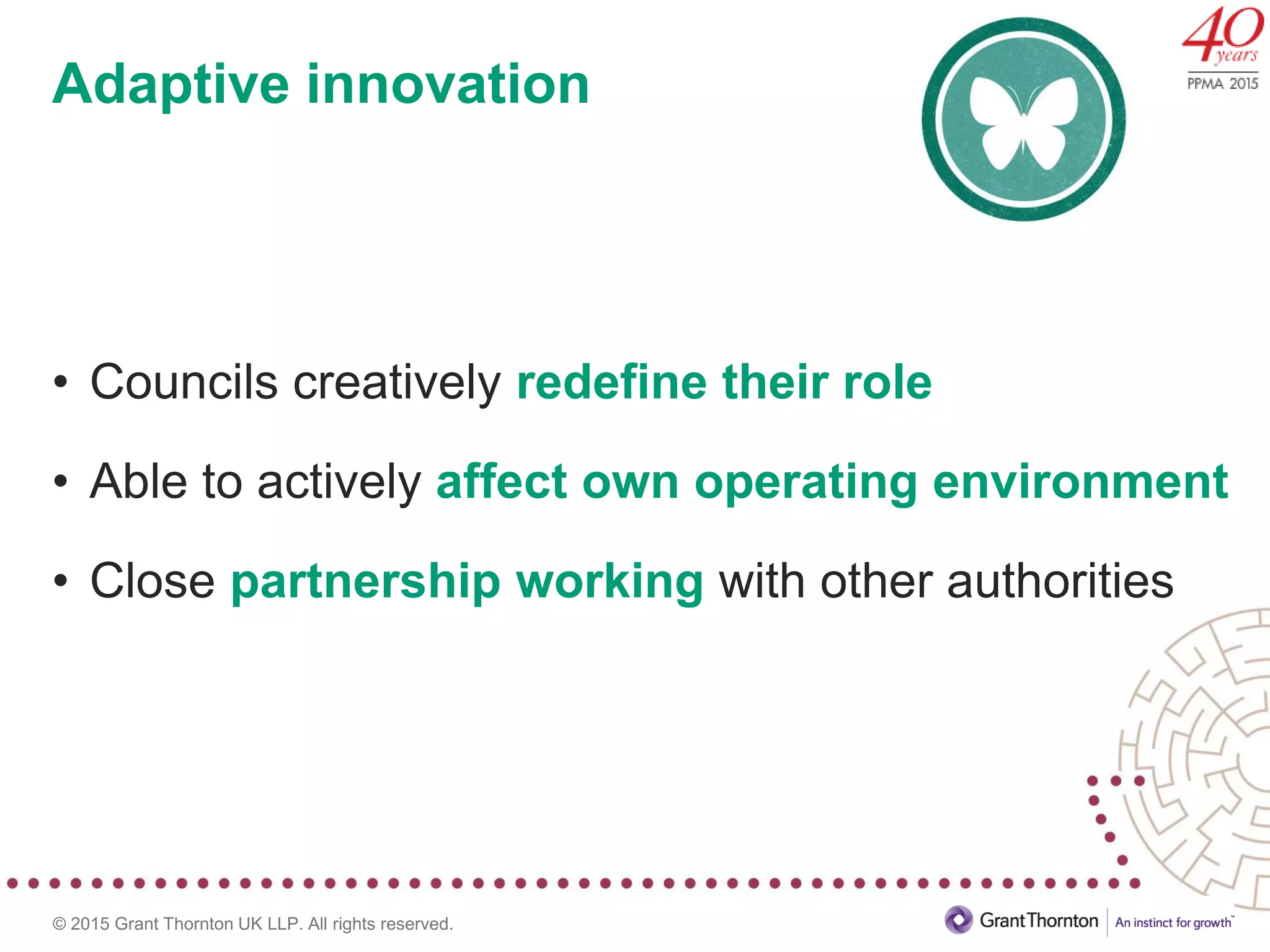
Adaptive innovation
• Councils creatively redefine their role
• Able to actively affect own operating environment
• Close partnership working with other authorities
© 2015 Grant Thornton UK LLP. All rights reserved.
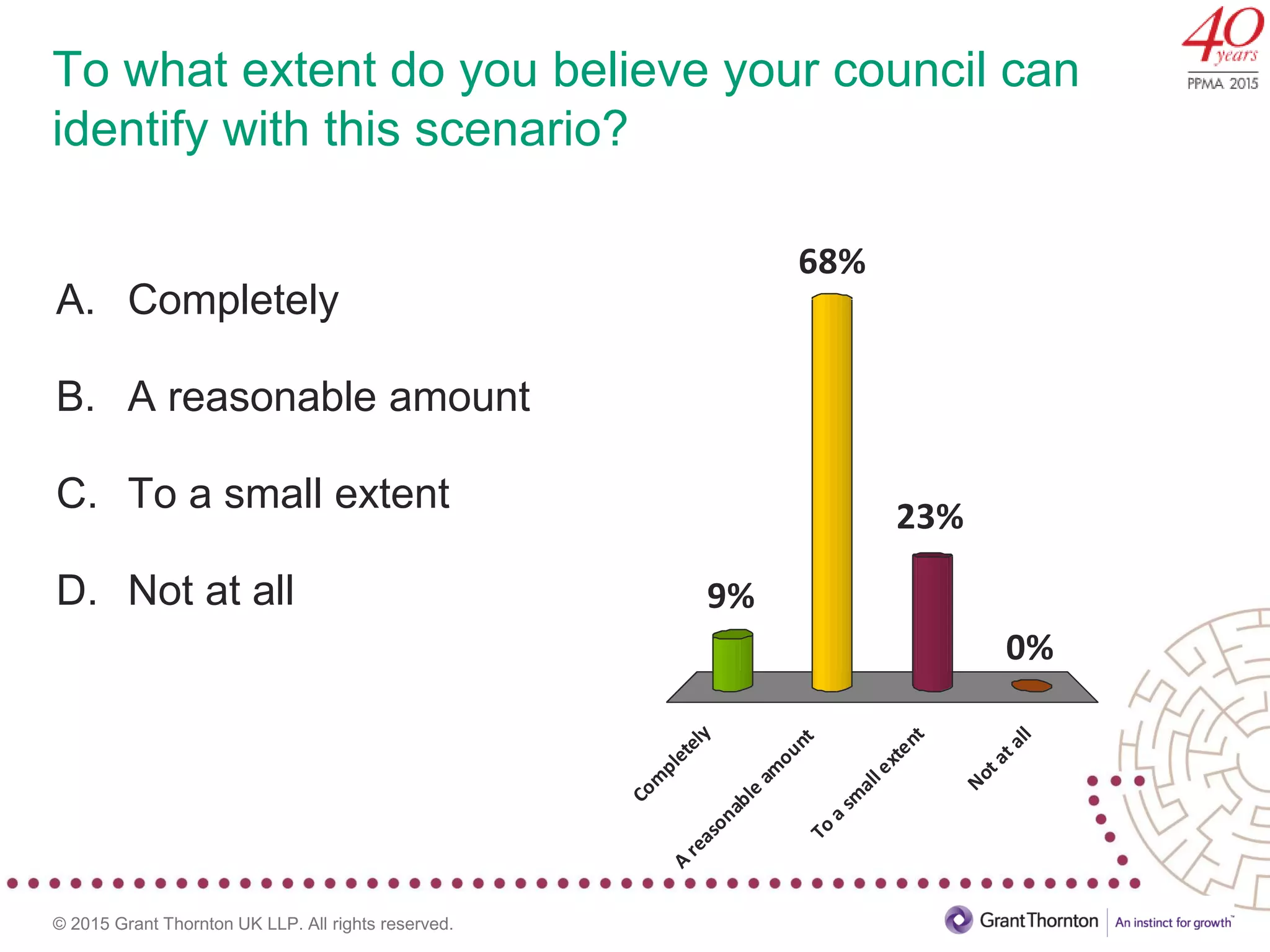
To what extent do you believe your council can
identify with this scenario?
A. Completely
B. A reasonable amount
C. To a small extent
D. Not at all
Com
pletely
A
reasonable
am
ountTo
a
sm
allextent
Notatall
9%
0%
23%
68%
© 2015 Grant Thornton UK LLP. All rights reserved.
Running to stand still
• Councils are led and managed well
• Can see a positive future provided they
maintain pace and there are no major shock
© 2015 Grant Thornton UK LLP. All rights reserved.
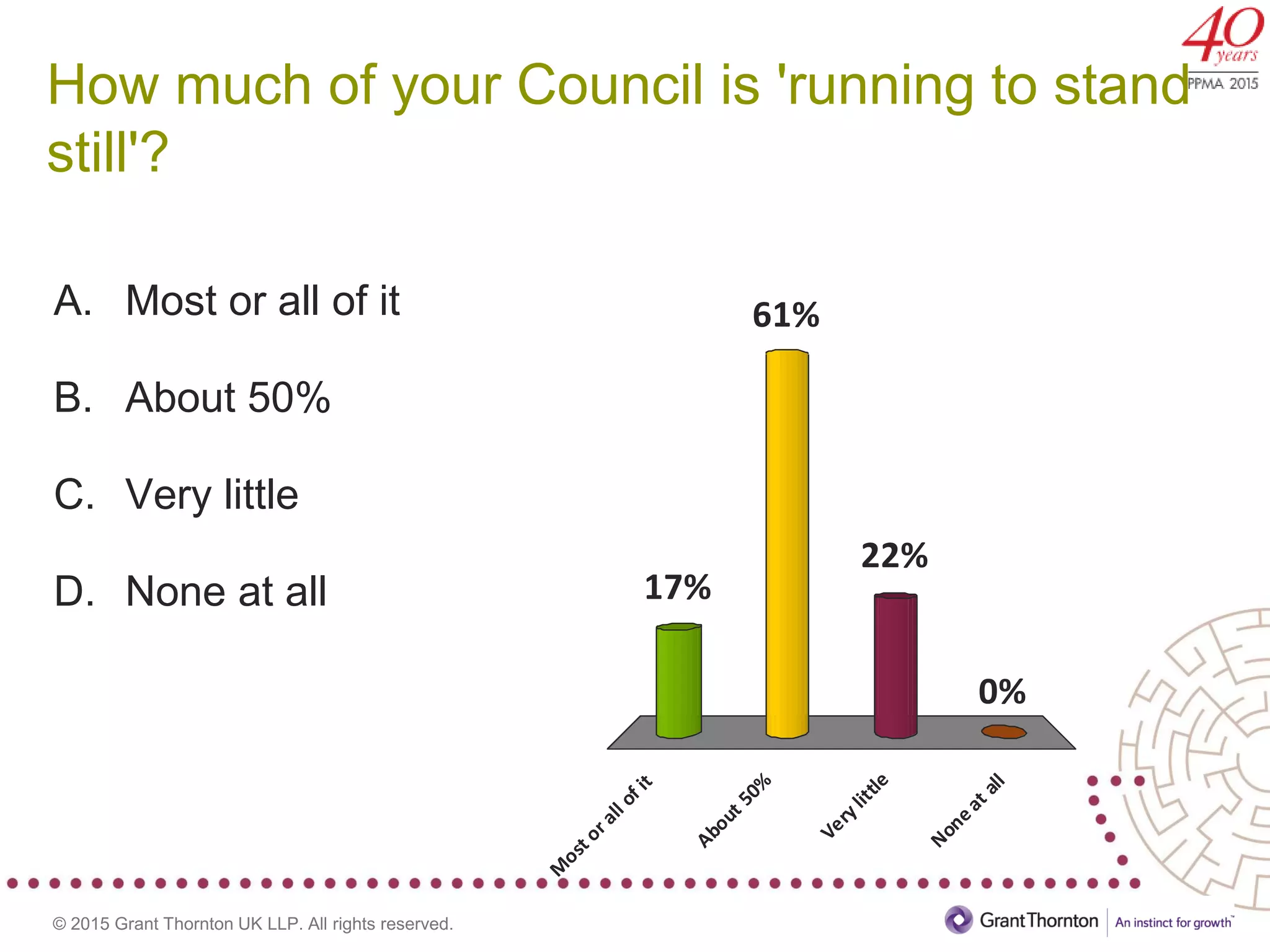
How much of your Council is 'running to stand
still'?
A. Most or all of it
B. About 50%
C. Very little
D. None at all
M
ostorallofit
About50%
Verylittle
Noneatall
17%
0%
22%
61%
© 2015 Grant Thornton UK LLP. All rights reserved.
A nostril above the waterline
• Councils acting with short-term view
• Hand to mouth existence
• Even a small external change can represent a
challenge to their viability
© 2015 Grant Thornton UK LLP. All rights reserved.
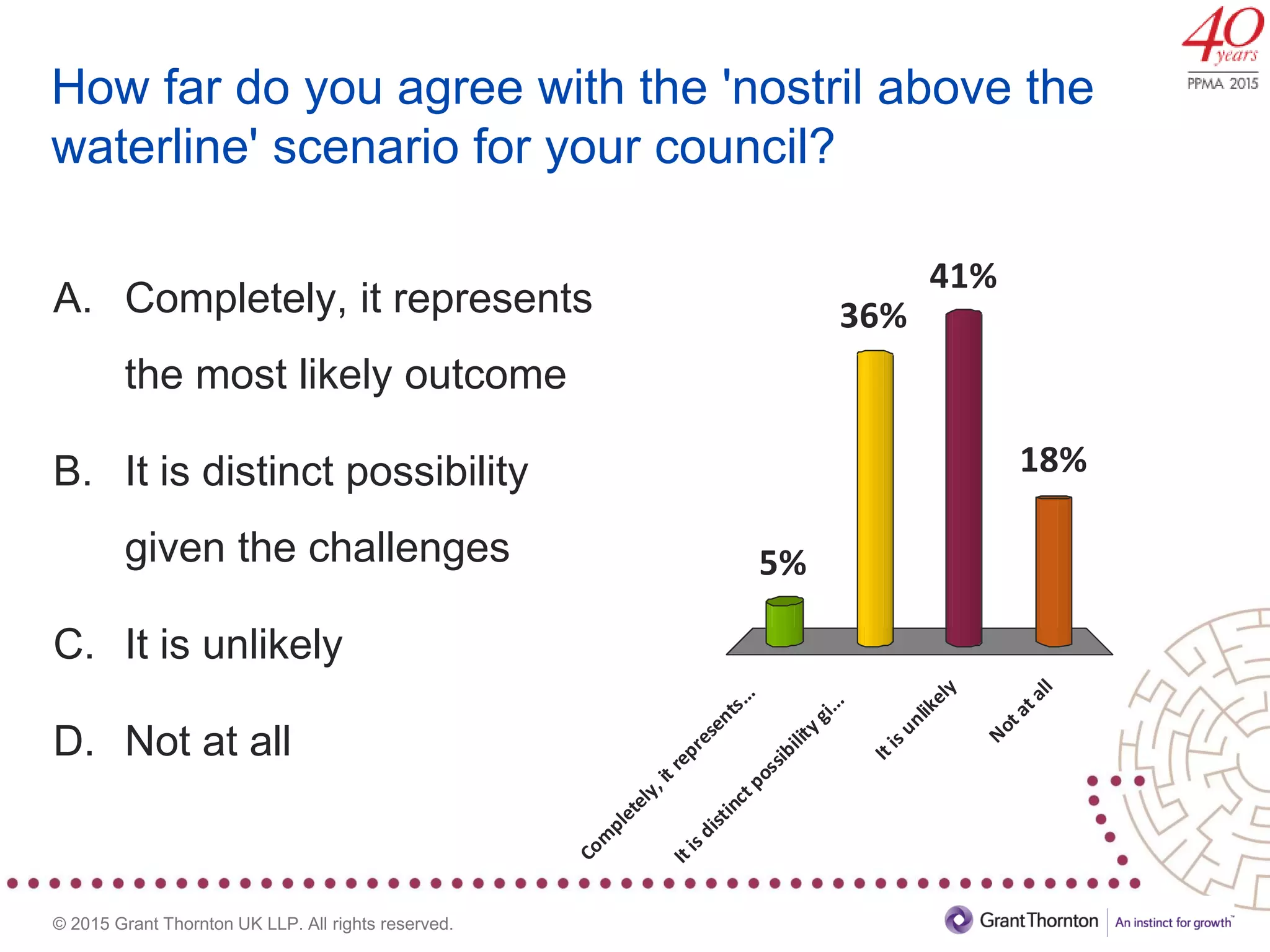
How far do you agree with the 'nostril above the
waterline' scenario for your council?
A. Completely, it represents
the most likely outcome
B. It is distinct possibility
given the challenges
C. It is unlikely
D. Not at all
Com
pletely,itrepresents...
Itisdistinctpossibilitygi...
Itisunlikely
Notatall
5%
18%
41%
36%
© 2015 Grant Thornton UK LLP. All rights reserved.
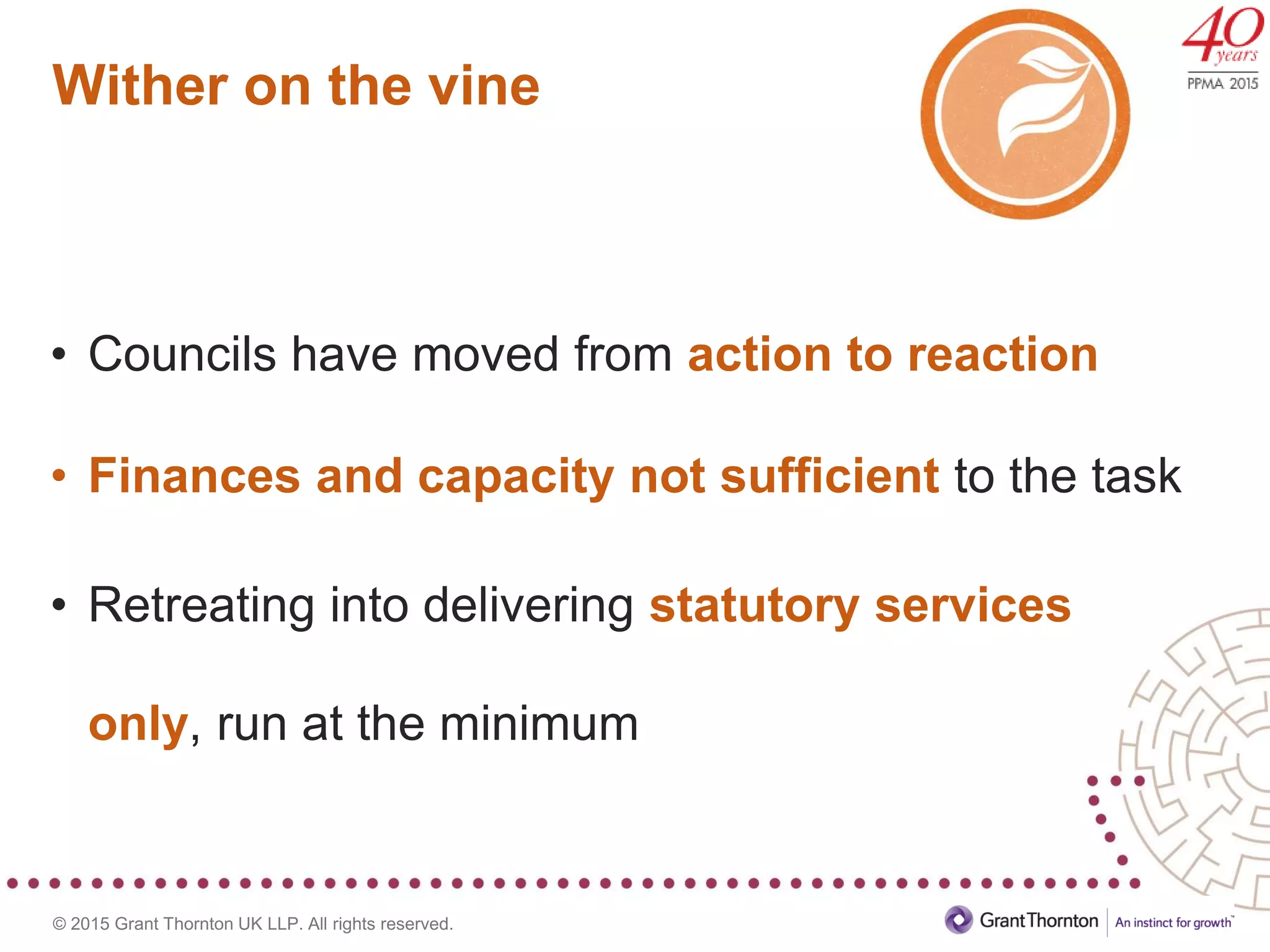
Wither on the vine
• Councils have moved from action to reaction
• Finances and capacity not sufficient to the task
• Retreating into delivering statutory services
only, run at the minimum
© 2015 Grant Thornton UK LLP. All rights reserved.
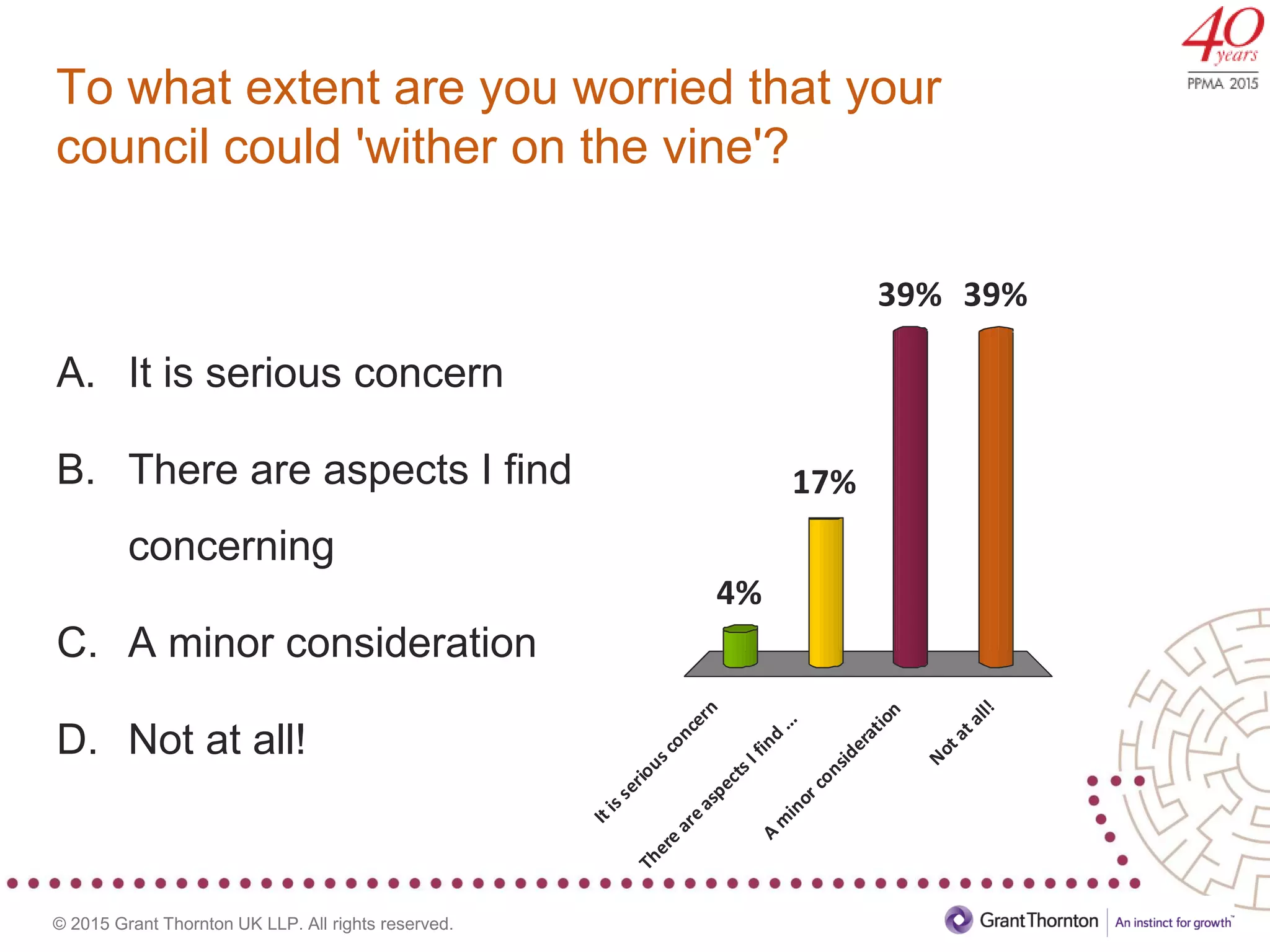
To what extent are you worried that your
council could 'wither on the vine'?
A. It is serious concern
B. There are aspects I find
concerning
C. A minor consideration
D. Not at all!
Itisseriousconcern
There
areaspectsIfind
...
A
m
inorconsideration
Notatall!
4%
39%39%
17%
© 2015 Grant Thornton UK LLP. All rights reserved.
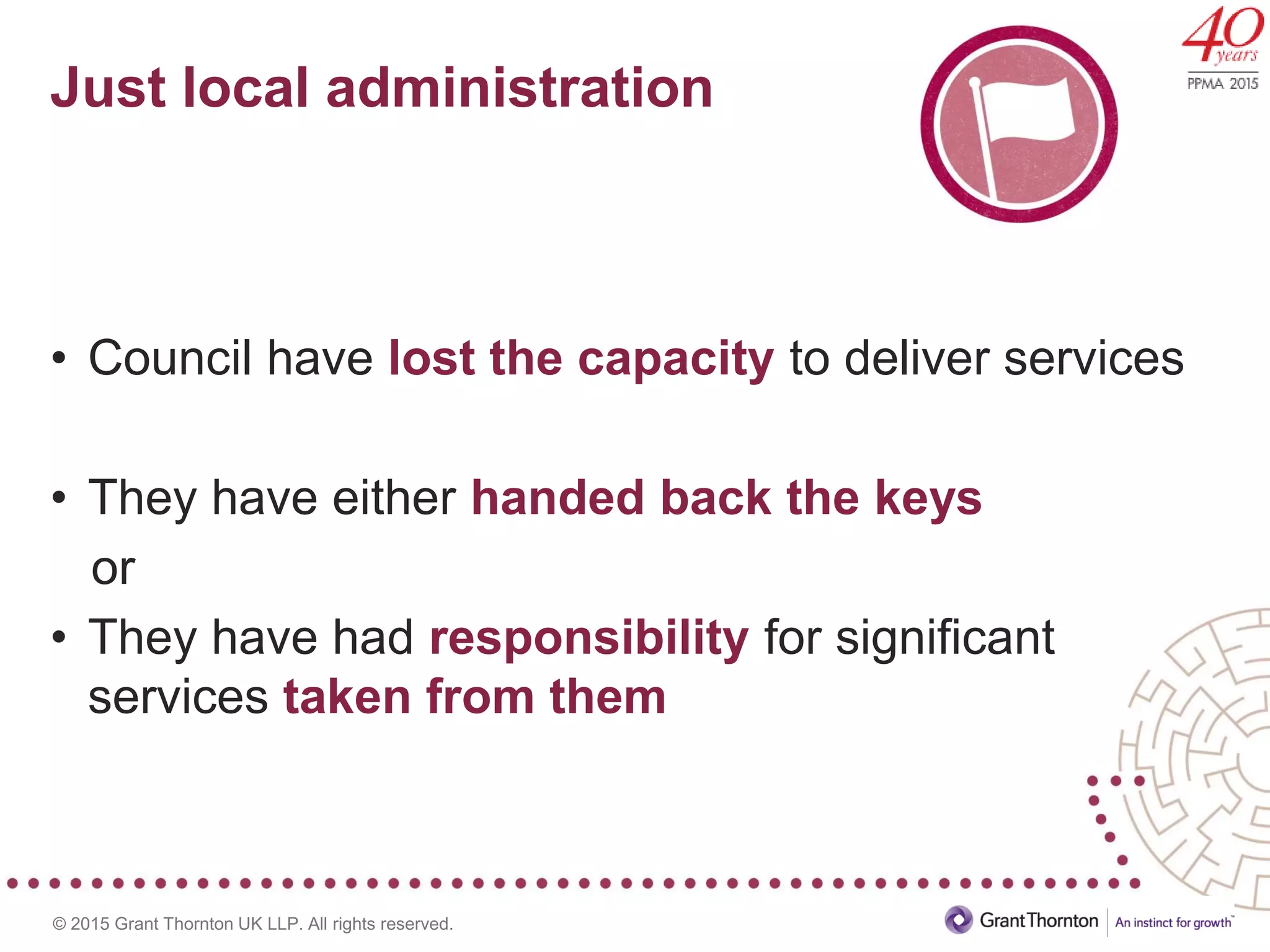
Just local administration
• Council have lost the capacity to deliver services
• They have either handed back the keys
or
• They have had responsibility for significant
services taken from them
© 2015 Grant Thornton UK LLP. All rights reserved.
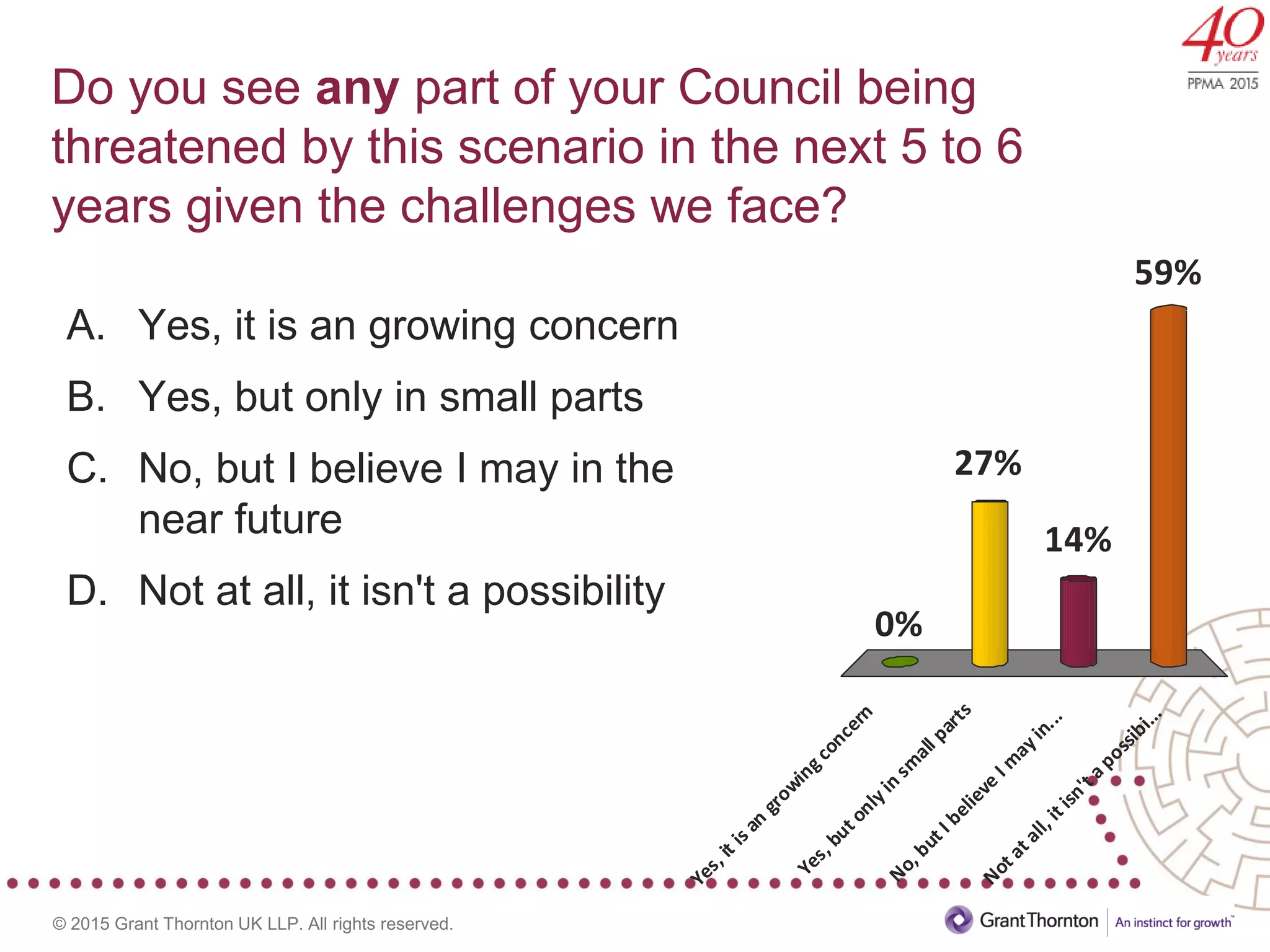
Do you see any part of your Council being
threatened by this scenario in the next 5 to 6
years given the challenges we face?
A. Yes, it is an growing concern
B. Yes, but only in small parts
C. No, but I believe I may in the
near future
D. Not at all, it isn't a possibility
Yes,itisan
growingconcern
Yes,butonlyin
sm
allparts
No,butIbelieve
Im
ayin...
Notatall,itisn'tapossibi...
0%
59%
14%
27%
© 2015 Grant Thornton UK LLP. All rights reserved.
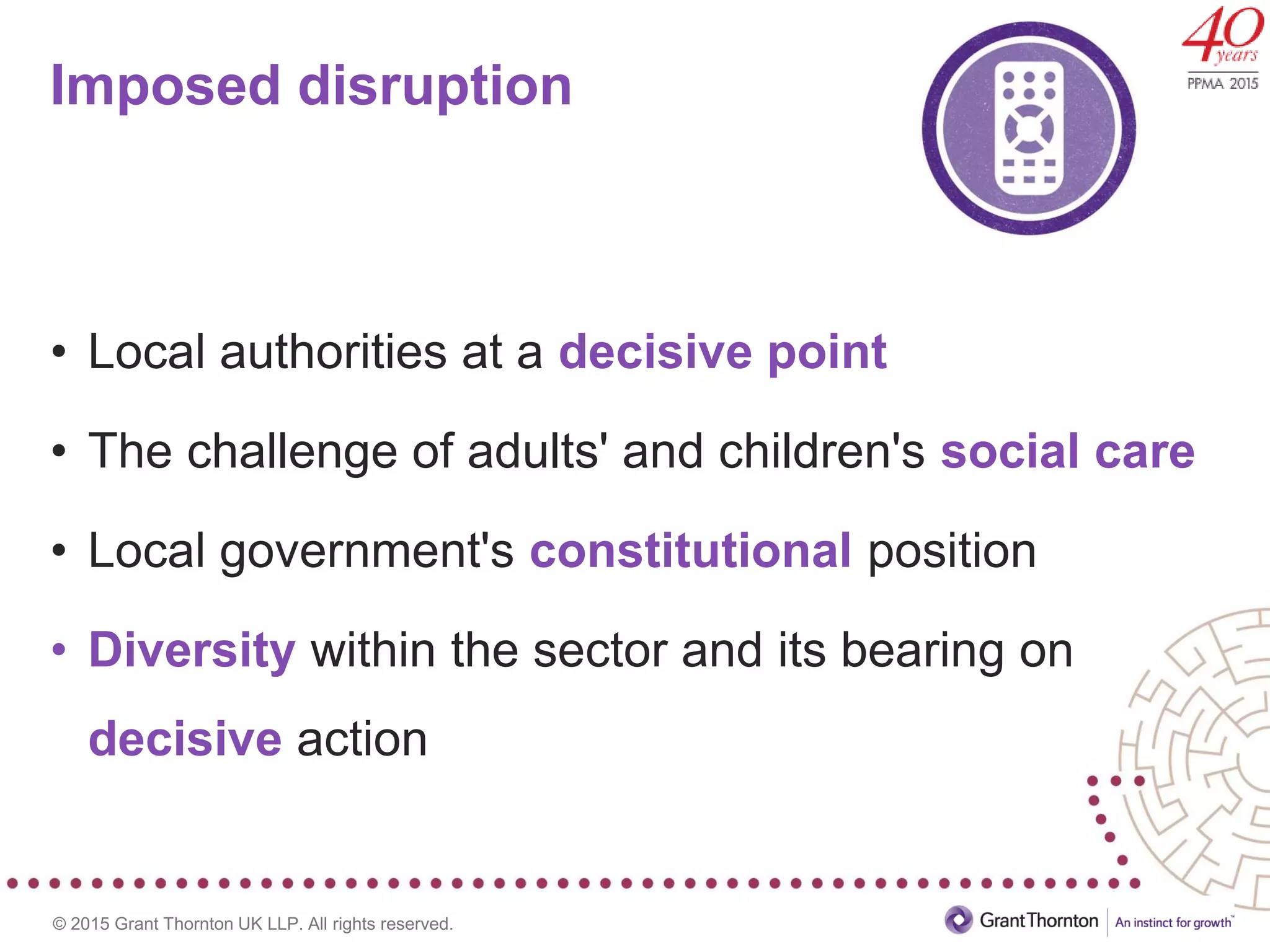
Imposed disruption
• Local authorities at a decisive point
• The challenge of adults' and children's social care
• Local government's constitutional position
• Diversity within the sector and its bearing on
decisive action
© 2015 Grant Thornton UK LLP. All rights reserved.
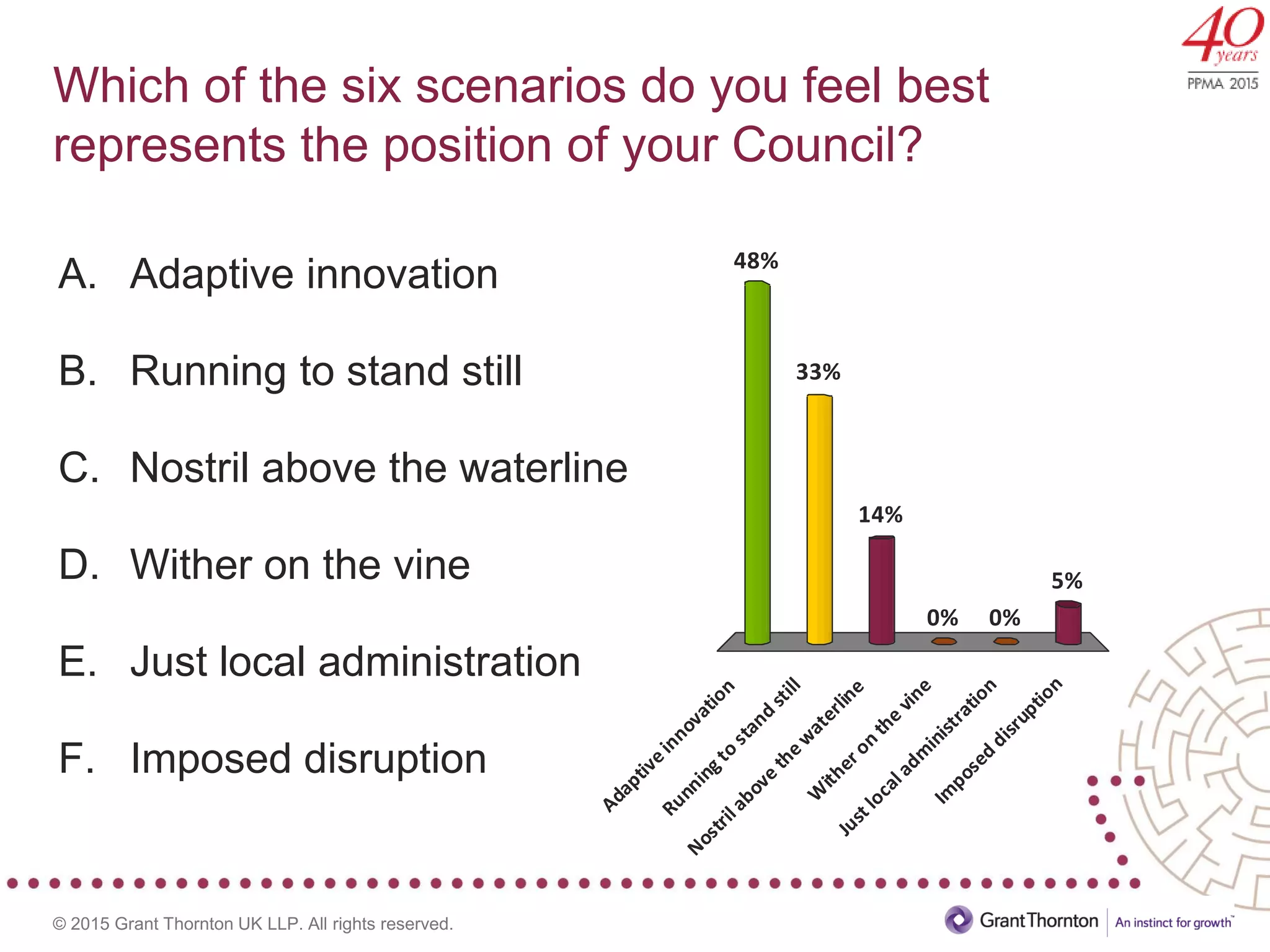
Which of the six scenarios do you feel best
represents the position of your Council?
A. Adaptive innovation
B. Running to stand still
C. Nostril above the waterline
D. Wither on the vine
E. Just local administration
F. Imposed disruption
Adaptiveinnovation
Runningto
stand
still
Nostrilabove
thew
aterline
W
itheron
the
vine
Justlocaladm
inistration
Im
posed
disruption
48%
33%
5%
0%0%
14%
© 2015 Grant Thornton UK LLP. All rights reserved.
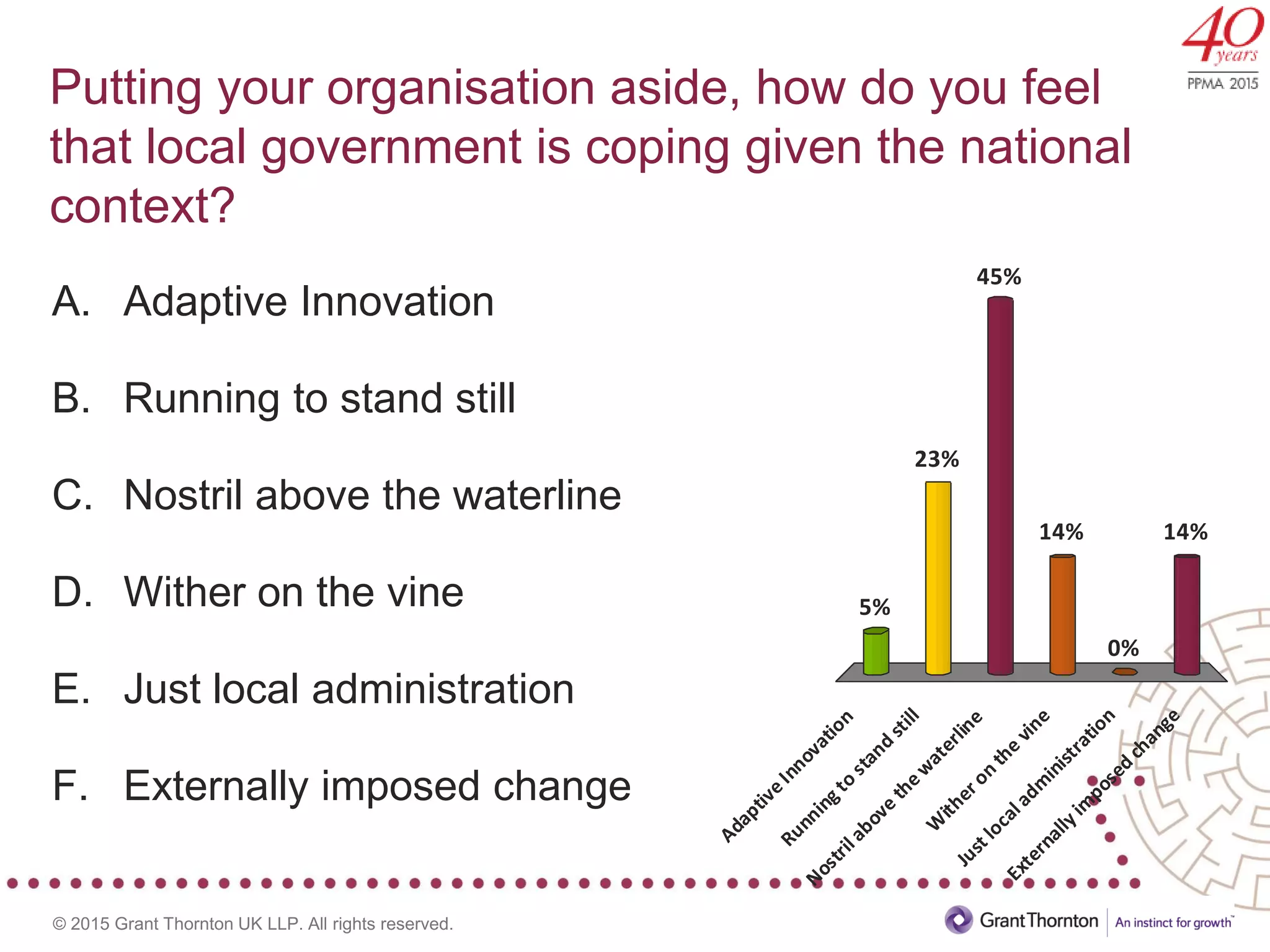
Putting your organisation aside, how do you feel
that local government is coping given the national
context?
AdaptiveInnovation
Runningto
stand
still
Nostrilabove
thew
aterline
W
itheron
the
vine
Justlocaladm
inistration
Externallyim
posed
change
5%
23%
14%
0%
14%
45%
A. Adaptive Innovation
B. Running to stand still
C. Nostril above the waterline
D. Wither on the vine
E. Just local administration
F. Externally imposed change
© 2015 Grant Thornton UK LLP. All rights reserved.
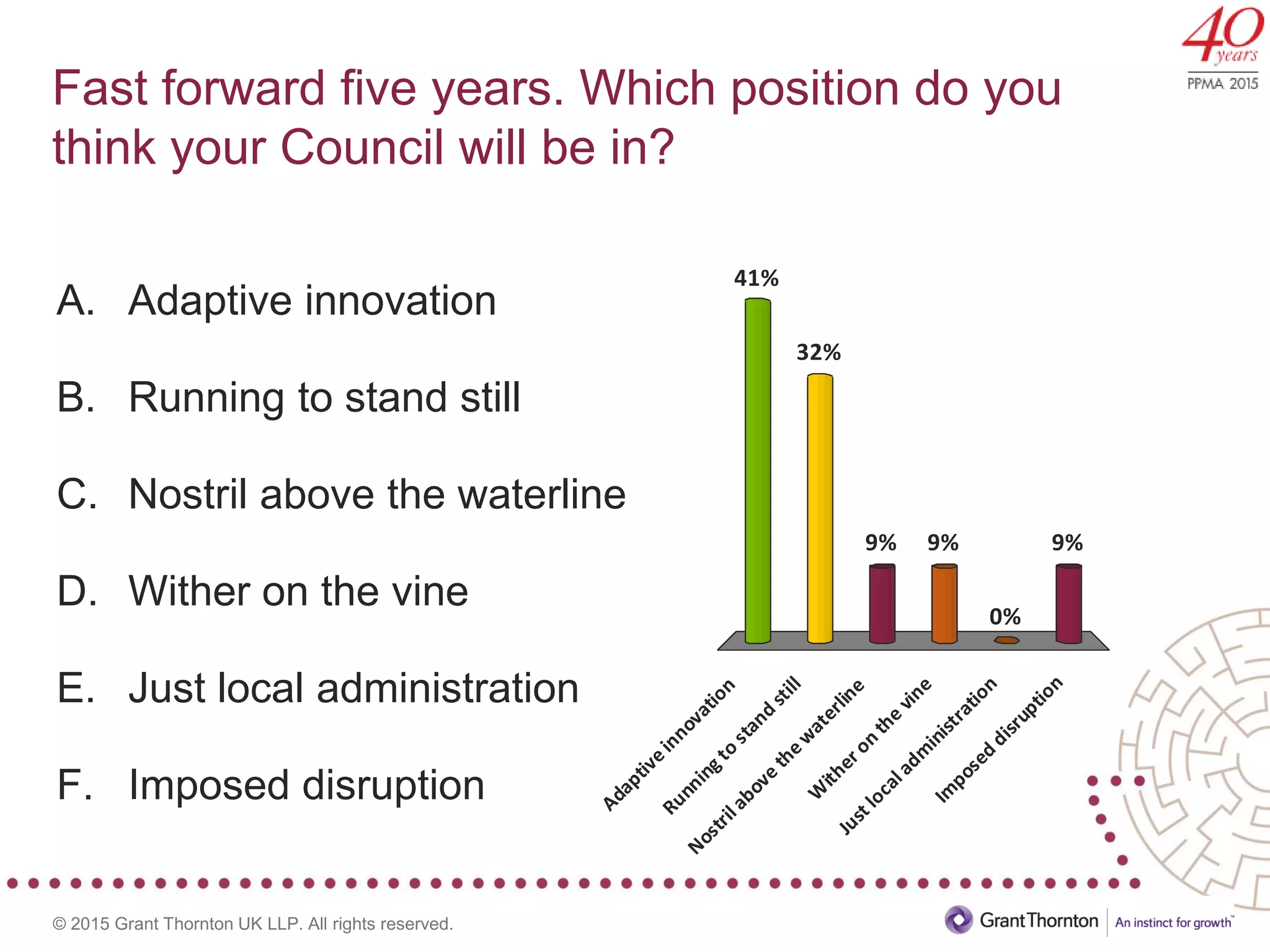
Fast forward five years. Which position do you
think your Council will be in?
A. Adaptive innovation
B. Running to stand still
C. Nostril above the waterline
D. Wither on the vine
E. Just local administration
F. Imposed disruption
Adaptiveinnovation
Runningto
stand
still
Nostrilabove
thew
aterline
W
itheron
the
vine
Justlocaladm
inistration
Im
posed
disruption
41%
32%
9%
0%
9%9%
© 2014 Grant Thornton UK LLP. All rights reserved.
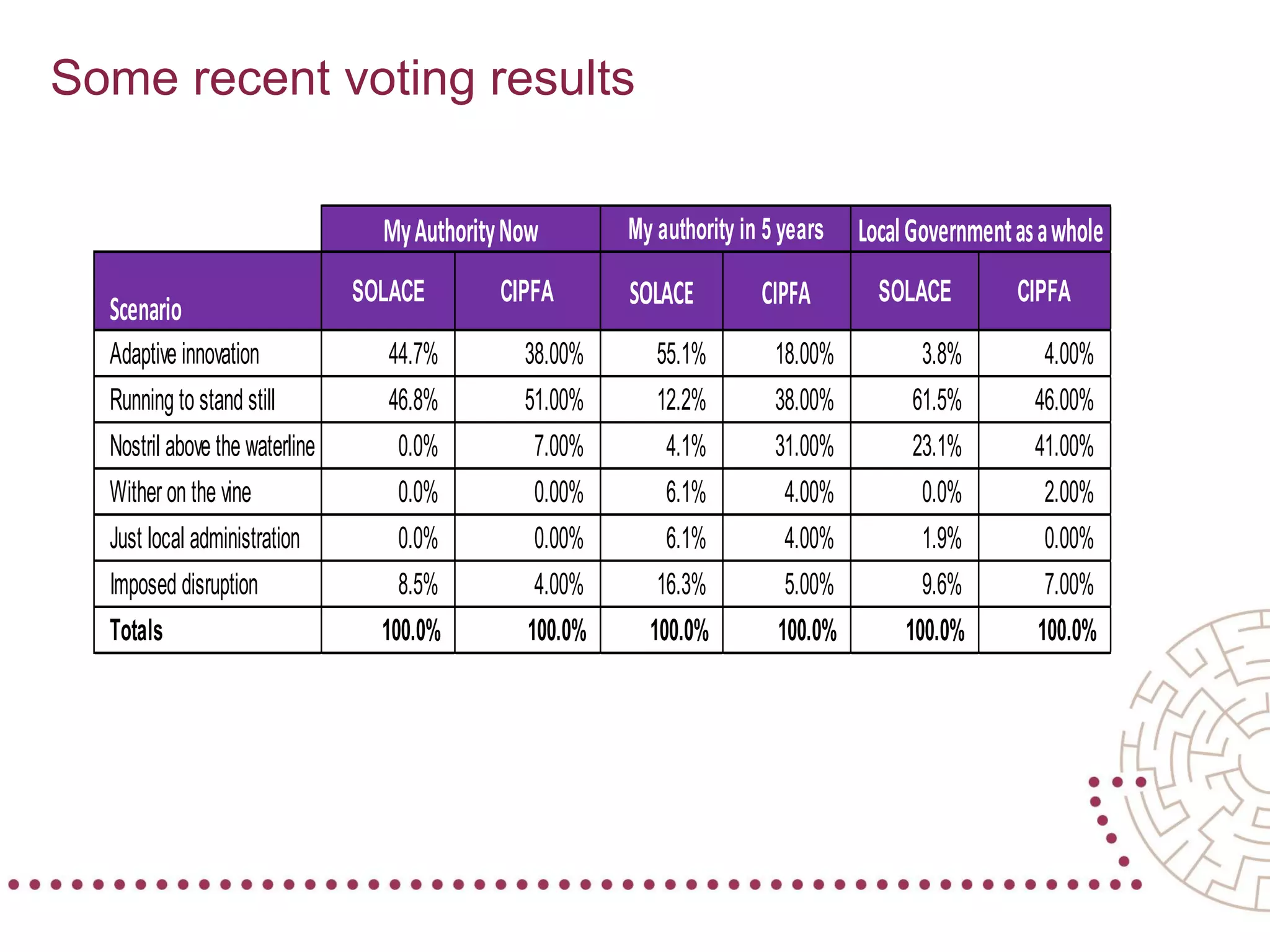
Some recent voting results
Scenario
SOLACE CIPFA SOLACE CIPFA SOLACE CIPFA
Adaptive innovation 44.7% 38.00% 55.1% 18.00% 3.8% 4.00%
Running to stand still 46.8% 51.00% 12.2% 38.00% 61.5% 46.00%
Nostril above the waterline 0.0% 7.00% 4.1% 31.00% 23.1% 41.00%
Wither on the vine 0.0% 0.00% 6.1% 4.00% 0.0% 2.00%
Just local administration 0.0% 0.00% 6.1% 4.00% 1.9% 0.00%
Imposed disruption 8.5% 4.00% 16.3% 5.00% 9.6% 7.00%
Totals 100.0% 100.0% 100.0% 100.0% 100.0% 100.0%
MyAuthorityNow My authority in 5 years LocalGovernmentasawhole
© 2014 Grant Thornton UK LLP. All rights reserved.
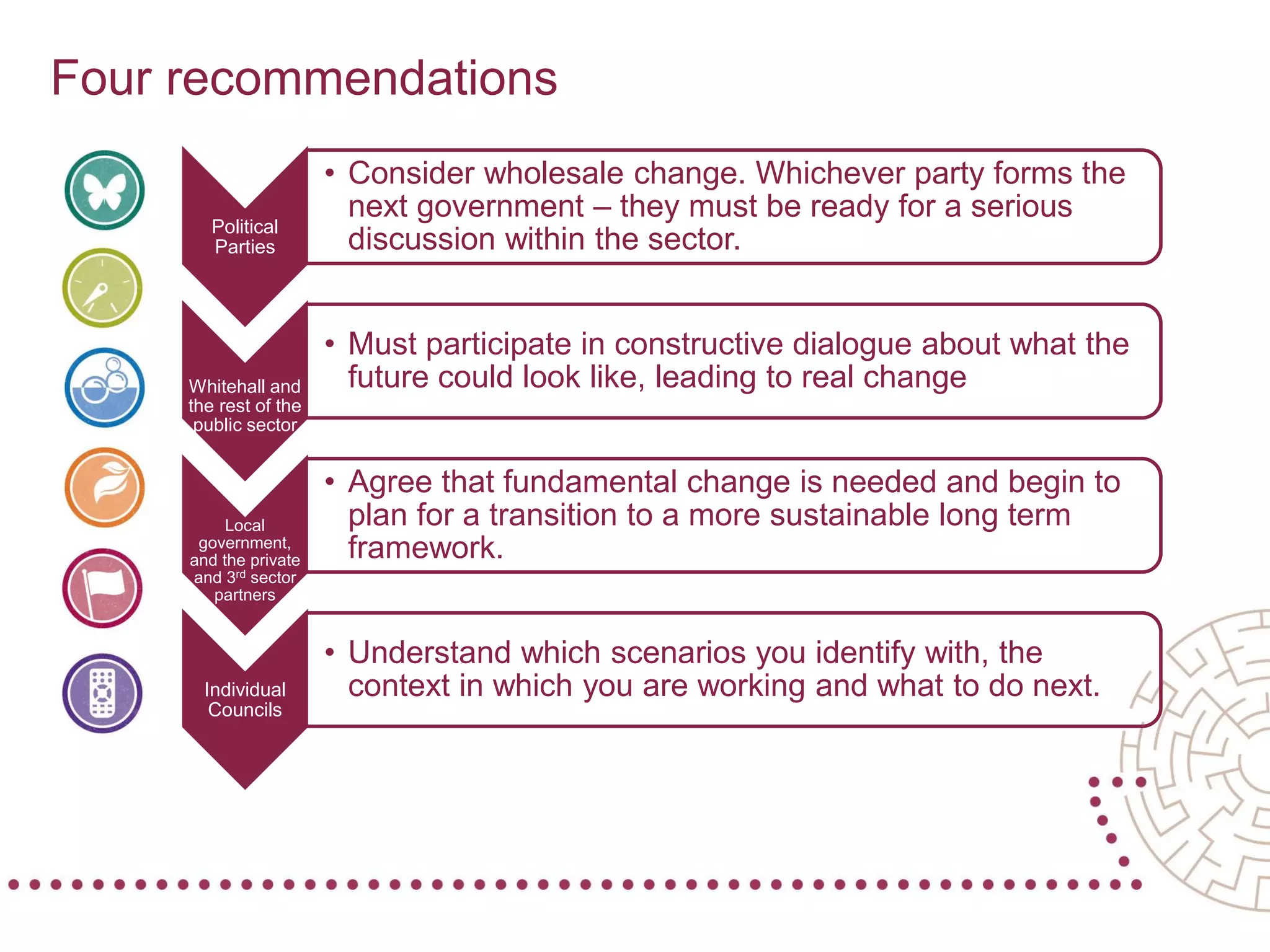
Four recommendations
Political
Parties
• Consider wholesale change. Whichever party forms the
next government – they must be ready for a serious
discussion within the sector.
Whitehall and
the rest of the
public sector
• Must participate in constructive dialogue about what the
future could look like, leading to real change
Local
government,
and the private
and 3rd sector
partners
• Agree that fundamental change is needed and begin to
plan for a transition to a more sustainable long term
framework.
Individual
Councils
• Understand which scenarios you identify with, the
context in which you are working and what to do next.
© 2015 Grant Thornton UK LLP. All rights reserved.
2020 Vision:
Exploring finance and policy futures for English
local government
www.gt-thornton.co.uk/2020-vision
© 2015 Grant Thornton UK LLP. All rights reserved.
Questions
© 2015 Grant Thornton UK LLP. All rights reserved.
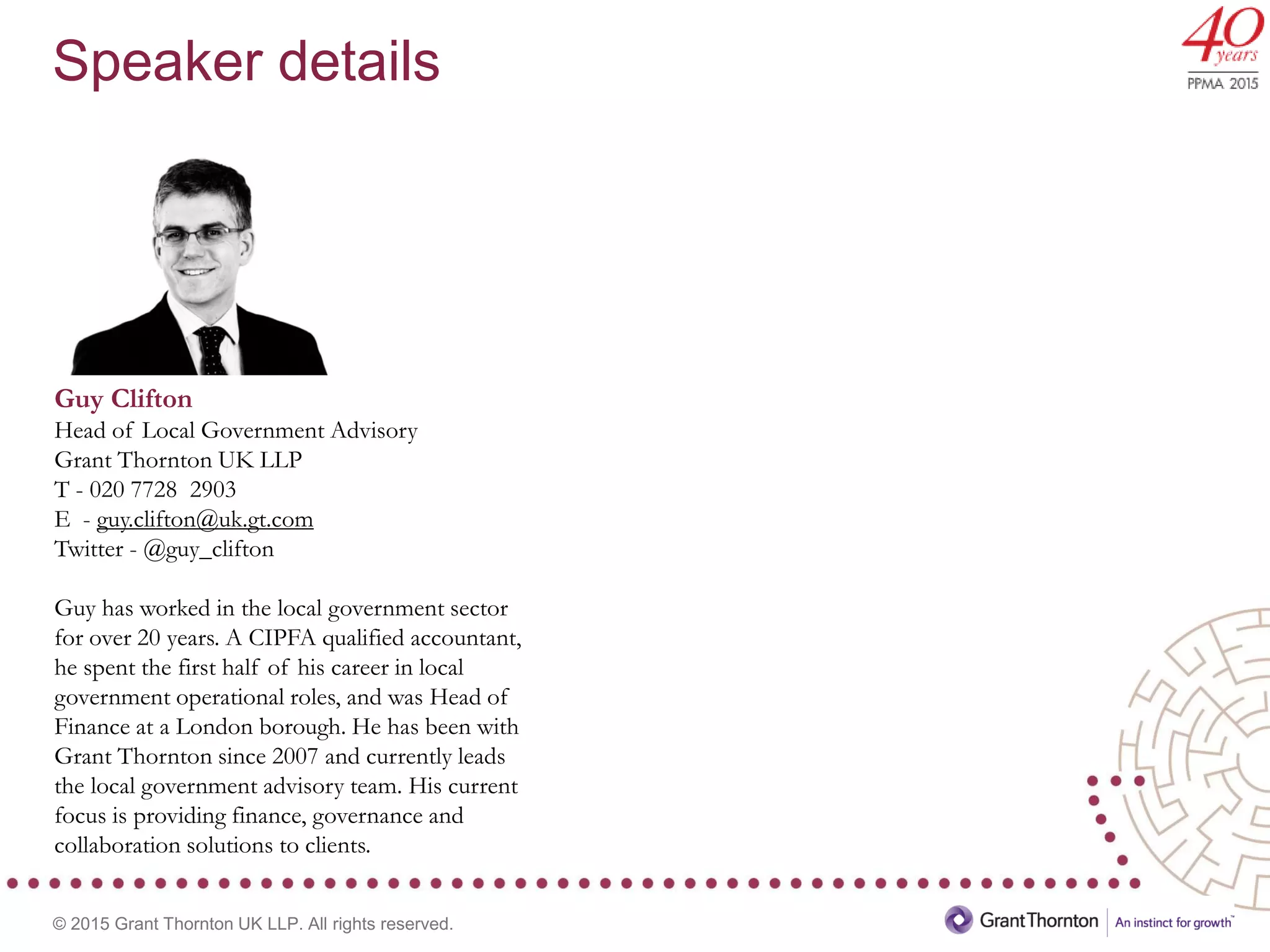
Guy Clifton
Head of Local Government Advisory
Grant Thornton UK LLP
T - 020 7728 2903
E - guy.clifton@uk.gt.com
Twitter - @guy_clifton
Guy has worked in the local government sector
for over 20 years. A CIPFA qualified accountant,
he spent the first half of his career in local
government operational roles, and was Head of
Finance at a London borough. He has been with
Grant Thornton since 2007 and currently leads
the local government advisory team. His current
focus is providing finance, governance and
collaboration solutions to clients.
Speaker details
© 2015 Grant Thornton UK LLP. All rights reserved.
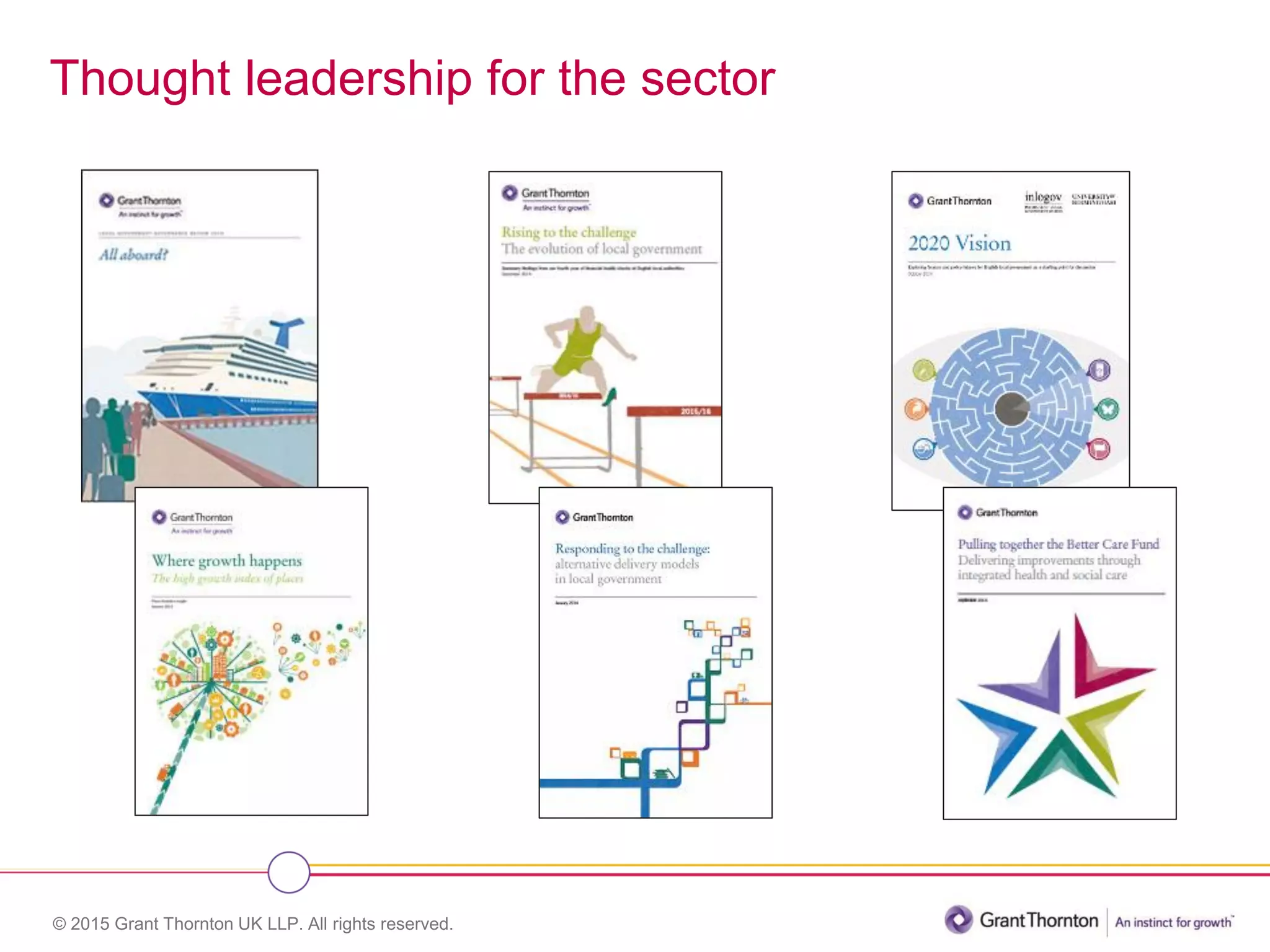
Thought leadership for the sector
© 2015 Grant Thornton UK LLP. All rights reserved.
About Grant Thornton
Grant Thornton has a well-established market in the public sector, and has been working with local
authorities for over 30 years. We are the largest employer of CIPFA members and students and our
national team of experienced local government specialists, including those who have held senior positions
within the sector, provide the growing range of assurance, tax and advisory services that our clients
require.
We are the leading firm in the local government audit market, and are the largest supplier of audit and
related services to the Audit Commission, and count 40% of local authorities in England as external
audit clients. We also audit local authorities in Wales and Scotland via framework contracts with Audit
Scotland and the Wales Audit Office. We have over 180 local government and related body audit clients in
the UK and over 75 local authority advisory clients. This includes London boroughs, county councils, district
councils, city councils, unitary councils and metropolitan authorities, as well as fire and police authorities.
This depth of experience ensures that our solutions are grounded in reality and draw on best practice.
Through proactive, client-focused relationships, our teams deliver solutions in a distinctive and personal
way, not pre-packaged products and services.
PPMA Annual Seminar 2015 - 2020 vision

PPMA Annual Seminar 2015 - 2020 vision

  • 1.
    © 2015 GrantThornton UK LLP. All rights reserved. 2020 Vision Exploring finance and policy futures for English Local Government PPMA Annual Seminar 17 April 2015 Guy Clifton
  • 2.
    © 2015 GrantThornton UK LLP. All rights reserved. • Introduction to 2020 Vision • Context – the national picture • The challenge of the next ten years • Possible future scenarios • Conclusion and recommendations Agenda
  • 3.
    © 2015 GrantThornton UK LLP. All rights reserved. 2020 Vision: our methodology • A desk top review of literature on the future of local government, forming an initial discussion paper • Discussions and interviews on the discussion paper with politicians and chief executives and senior managers from local government • International comparisons drawn from literature and academic discussion • Development of a further paper to develop analysis and scenarios • Scenario testing at round table events with local government chief executives • Amendment of analysis and scenarios and development of the report
  • 4.
    © 2015 GrantThornton UK LLP. All rights reserved. The national picture • Fiscal consolidation and austerity – SR10/SR13 • Demographic and technological change • The consequences of the Scottish referendum – devolution? • Regional differences
  • 5.
    © 2015 GrantThornton UK LLP. All rights reserved. Financial and economic challenges Challenge • What will 2019/2020 look like without concerted action? • Only half way through the planned period of fiscal consolidation • The Local Government Association (LGA) anticipates a £14.4bn shortfall in the funding required in 2019/20 • LGA asserts that 60% of councils are no longer able to meet the budget challenge through efficiency improvements
  • 6.
    © 2015 GrantThornton UK LLP. All rights reserved. Anticipated funding against pressures for individual councils in 2019/20 Council with lowest level of anticipated funding Mean Council with highest level of anticipated funding Type of council London borough 57% 74% 89% Metropolitan district 55% 71% 81% English unitary 66% 79% 90% Shire county 73% 82% 99% Shire district 65% 94% 100% Region East Midlands 66% 79% 100% East of England 65% 83% 100% London 57% 74% 89% North East 65% 74% 80% North West 62% 75% 100% South East 71% 84% 100% South West 65% 83% 100% West Midlands 68% 76% 100% Yorkshire & Humberside 55% 73% 100% Deprivation Most deprived (Ranks 1 - 50) 55% 70% 99% Ranks 51 - 100 64% 75% 100% Ranks 101 - 150 65% 78% 100% Ranks 151 - 200 76% 81% 100% Ranks 201 - 250 77% 85% 100% Ranks 251 - 300 80% 84% 100% Least deprived (Ranks 301 - 353) 65% 91% 100% Source: Local Government Association, 'Future funding outlook for councils 2014', p19-20
  • 7.
    © 2015 GrantThornton UK LLP. All rights reserved. Approaches to balancing the books – LGA analysis • Maximising income through investment, fees and charges: 40% • Using reserves to support revenue budget: 38% • Increasing the local tax base and New Homes Bonus receipt: 12% • Reviewing how assets can be used more effectively: 12% • Changes to council tax support: 6%.
  • 8.
    © 2015 GrantThornton UK LLP. All rights reserved. Economic issues that local government must consider the importance of economic thinking technology & Moore's Law uneven productivity growth income elasticity of demand price discrimination price elasticity of demand public goods and market failure
  • 9.
    © 2015 GrantThornton UK LLP. All rights reserved. The financial focus of councils – how they are seeking to maintain viability Type of council Financial focus Unitary  Efficiency and rationalisation (including reductions in staff terms and conditions)  Service reductions  Charge increases County  Efficiency and cost reduction  Service re-design (including devolution to parishes and the community sector)  Income generation and application of technology London borough  Economic growth  Collaboration and partnerships  Seeking to help communities be more resilient to reduce demand District  Commercialisation  Income generation  Prioritisation (including changing service standards)
  • 10.
    © 2015 GrantThornton UK LLP. All rights reserved. 2020 Vision: Possible scenarios
  • 11.
    © 2015 GrantThornton UK LLP. All rights reserved. Voting buttons • As we progress through the scenarios, we have included a number of questions. We would like your views. • We understand that this is the first you will have seen of these scenarios, so we ask for your initial thoughts on them and how you feel they apply to your organisation.
  • 12.
    © 2015 GrantThornton UK LLP. All rights reserved. Adaptive innovation • Councils creatively redefine their role • Able to actively affect own operating environment • Close partnership working with other authorities
  • 13.
    © 2015 GrantThornton UK LLP. All rights reserved. To what extent do you believe your council can identify with this scenario? A. Completely B. A reasonable amount C. To a small extent D. Not at all Com pletely A reasonable am ountTo a sm allextent Notatall 9% 0% 23% 68%
  • 14.
    © 2015 GrantThornton UK LLP. All rights reserved. Running to stand still • Councils are led and managed well • Can see a positive future provided they maintain pace and there are no major shock
  • 15.
    © 2015 GrantThornton UK LLP. All rights reserved. How much of your Council is 'running to stand still'? A. Most or all of it B. About 50% C. Very little D. None at all M ostorallofit About50% Verylittle Noneatall 17% 0% 22% 61%
  • 16.
    © 2015 GrantThornton UK LLP. All rights reserved. A nostril above the waterline • Councils acting with short-term view • Hand to mouth existence • Even a small external change can represent a challenge to their viability
  • 17.
    © 2015 GrantThornton UK LLP. All rights reserved. How far do you agree with the 'nostril above the waterline' scenario for your council? A. Completely, it represents the most likely outcome B. It is distinct possibility given the challenges C. It is unlikely D. Not at all Com pletely,itrepresents... Itisdistinctpossibilitygi... Itisunlikely Notatall 5% 18% 41% 36%
  • 18.
    © 2015 GrantThornton UK LLP. All rights reserved. Wither on the vine • Councils have moved from action to reaction • Finances and capacity not sufficient to the task • Retreating into delivering statutory services only, run at the minimum
  • 19.
    © 2015 GrantThornton UK LLP. All rights reserved. To what extent are you worried that your council could 'wither on the vine'? A. It is serious concern B. There are aspects I find concerning C. A minor consideration D. Not at all! Itisseriousconcern There areaspectsIfind ... A m inorconsideration Notatall! 4% 39%39% 17%
  • 20.
    © 2015 GrantThornton UK LLP. All rights reserved. Just local administration • Council have lost the capacity to deliver services • They have either handed back the keys or • They have had responsibility for significant services taken from them
  • 21.
    © 2015 GrantThornton UK LLP. All rights reserved. Do you see any part of your Council being threatened by this scenario in the next 5 to 6 years given the challenges we face? A. Yes, it is an growing concern B. Yes, but only in small parts C. No, but I believe I may in the near future D. Not at all, it isn't a possibility Yes,itisan growingconcern Yes,butonlyin sm allparts No,butIbelieve Im ayin... Notatall,itisn'tapossibi... 0% 59% 14% 27%
  • 22.
    © 2015 GrantThornton UK LLP. All rights reserved. Imposed disruption • Local authorities at a decisive point • The challenge of adults' and children's social care • Local government's constitutional position • Diversity within the sector and its bearing on decisive action
  • 23.
    © 2015 GrantThornton UK LLP. All rights reserved. Which of the six scenarios do you feel best represents the position of your Council? A. Adaptive innovation B. Running to stand still C. Nostril above the waterline D. Wither on the vine E. Just local administration F. Imposed disruption Adaptiveinnovation Runningto stand still Nostrilabove thew aterline W itheron the vine Justlocaladm inistration Im posed disruption 48% 33% 5% 0%0% 14%
  • 24.
    © 2015 GrantThornton UK LLP. All rights reserved. Putting your organisation aside, how do you feel that local government is coping given the national context? AdaptiveInnovation Runningto stand still Nostrilabove thew aterline W itheron the vine Justlocaladm inistration Externallyim posed change 5% 23% 14% 0% 14% 45% A. Adaptive Innovation B. Running to stand still C. Nostril above the waterline D. Wither on the vine E. Just local administration F. Externally imposed change
  • 25.
    © 2015 GrantThornton UK LLP. All rights reserved. Fast forward five years. Which position do you think your Council will be in? A. Adaptive innovation B. Running to stand still C. Nostril above the waterline D. Wither on the vine E. Just local administration F. Imposed disruption Adaptiveinnovation Runningto stand still Nostrilabove thew aterline W itheron the vine Justlocaladm inistration Im posed disruption 41% 32% 9% 0% 9%9%
  • 26.
    © 2014 GrantThornton UK LLP. All rights reserved. Some recent voting results Scenario SOLACE CIPFA SOLACE CIPFA SOLACE CIPFA Adaptive innovation 44.7% 38.00% 55.1% 18.00% 3.8% 4.00% Running to stand still 46.8% 51.00% 12.2% 38.00% 61.5% 46.00% Nostril above the waterline 0.0% 7.00% 4.1% 31.00% 23.1% 41.00% Wither on the vine 0.0% 0.00% 6.1% 4.00% 0.0% 2.00% Just local administration 0.0% 0.00% 6.1% 4.00% 1.9% 0.00% Imposed disruption 8.5% 4.00% 16.3% 5.00% 9.6% 7.00% Totals 100.0% 100.0% 100.0% 100.0% 100.0% 100.0% MyAuthorityNow My authority in 5 years LocalGovernmentasawhole
  • 27.
    © 2014 GrantThornton UK LLP. All rights reserved. Four recommendations Political Parties • Consider wholesale change. Whichever party forms the next government – they must be ready for a serious discussion within the sector. Whitehall and the rest of the public sector • Must participate in constructive dialogue about what the future could look like, leading to real change Local government, and the private and 3rd sector partners • Agree that fundamental change is needed and begin to plan for a transition to a more sustainable long term framework. Individual Councils • Understand which scenarios you identify with, the context in which you are working and what to do next.
  • 28.
    © 2015 GrantThornton UK LLP. All rights reserved. 2020 Vision: Exploring finance and policy futures for English local government www.gt-thornton.co.uk/2020-vision
  • 29.
    © 2015 GrantThornton UK LLP. All rights reserved. Questions
  • 30.
    © 2015 GrantThornton UK LLP. All rights reserved. Guy Clifton Head of Local Government Advisory Grant Thornton UK LLP T - 020 7728 2903 E - guy.clifton@uk.gt.com Twitter - @guy_clifton Guy has worked in the local government sector for over 20 years. A CIPFA qualified accountant, he spent the first half of his career in local government operational roles, and was Head of Finance at a London borough. He has been with Grant Thornton since 2007 and currently leads the local government advisory team. His current focus is providing finance, governance and collaboration solutions to clients. Speaker details
  • 31.
    © 2015 GrantThornton UK LLP. All rights reserved. Thought leadership for the sector
  • 32.
    © 2015 GrantThornton UK LLP. All rights reserved. About Grant Thornton Grant Thornton has a well-established market in the public sector, and has been working with local authorities for over 30 years. We are the largest employer of CIPFA members and students and our national team of experienced local government specialists, including those who have held senior positions within the sector, provide the growing range of assurance, tax and advisory services that our clients require. We are the leading firm in the local government audit market, and are the largest supplier of audit and related services to the Audit Commission, and count 40% of local authorities in England as external audit clients. We also audit local authorities in Wales and Scotland via framework contracts with Audit Scotland and the Wales Audit Office. We have over 180 local government and related body audit clients in the UK and over 75 local authority advisory clients. This includes London boroughs, county councils, district councils, city councils, unitary councils and metropolitan authorities, as well as fire and police authorities. This depth of experience ensures that our solutions are grounded in reality and draw on best practice. Through proactive, client-focused relationships, our teams deliver solutions in a distinctive and personal way, not pre-packaged products and services.