Isbiocoal
abioenergy
gamechanger?
Pöyry Point of View:
Shaping the next future
2
Climate change concerns have created
pressure to reduce fossil fuel consumption.
Once heralded as the next big thing - the
potential of co-firing biomass in coal boilers
has been limited by the significant capital
investment required to modify fuel handling
and combustion systems. However, biocoal
can be co-fired in existing coal fired power
plants, produced from a vast array of
feedstock, and is efficient to ship, even over
long distances. Is biocoal a game changer?
Biocoal:bioenergy
gamechanger?
Biocoal introduces a new class of solid
biomass-based fuel for global power and heat
generation. In order to mitigate carbon dioxide
emissions and increase the sustainability
of biomass in energy generation over the
coming years, existing power plants aim to
increase the amount of biomass and biofuel
in their fuel consumption mix. This has proven
challenging, as biomass feedstocks often have
high procurement costs, low energy density,
high water content, and challenging logistics,
storage and handling. Unprocessed biomass is
also non-homogenous, leading to efficiency and
combustion challenges.
Processing biomass into biocoal and densified
biocoal facilitates the use of biomass in energy
generation and creates opportunities for fuel
sourcing from further distances at reduced
costs. The technical market potential for co-
combustion of coal and CO2
neutral biocoal is
tremendous.
BIOCOAL MARKET POTENTIAL
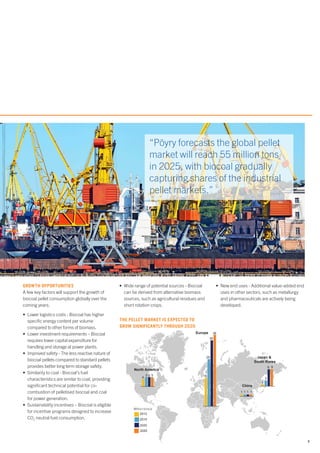
Pöyry forecasts the global pellet market will reach
55 million tons in 2025. The share of biocoal
will largely depend on the development and
commercialisation of processing technology
by the end of 2014. Europe will continue to
dominate the market, consuming up to 24,7
million tons by 2025. The co-combustion
suitability of biocoal has been verified up to 50%
or higher, depending on the biocoal quality and
boiler type. Utilities have invested in technology
developers and have publicly promoted their
plans to start using pelletised biocoal in large
quantities. However, it is important to note that
the biocoal market is still in development, and
commercial scale production facilities are limited.
Wider commercialisation will begin in 2018 if
financing and off-take opportunities maintain
momentum of technology development. In the
long term, biocoal is expected to become a
standardised and commodity traded product.
WHAT IS BIOCOAL?
Biocoal is produced through a process of torrefaction, during which water content, cellulose sugars and other volatile organic compounds
are removed from the biomass to produce a solid biofuel with characteristics similar to those of fossil coal. The main technologies for biocoal
production currently under development include torrefaction and steam explosion. The principles of both technologies were developed several
decades ago. The process can simply be described as the heating of biomass in a low oxygen atmosphere to a desired temperature. The
physical properties of densified biocoal are notably different compared to standard wood pellets. The main differences between biocoal and
standard wood pellets are that biocoal has a higher volumetric energy density, is less subject to biological degradation and is hydrophobic.
These factors lower the transportation and logistics costs of the biocoal.
3
North America
Europe
4
5 15
25
35
1
1
2012
2015
2020
China
Japan &
South Korea
3
9
2025
55
38
1 1 1
9
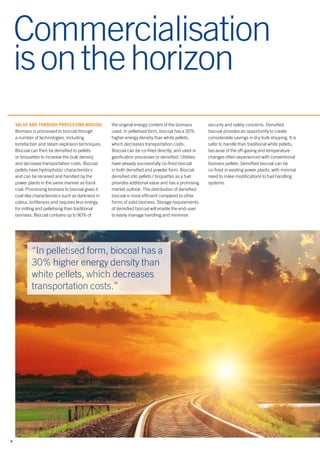
“Pöyry forecasts the global pellet
market will reach 55 million tons
in 2025, with biocoal gradually
capturing shares of the industrial
pellet markets.”
GROWTH OPPORTUNITIES
A few key factors will support the growth of
biocoal pellet consumption globally over the
coming years:
•	 Lower logistics costs - Biocoal has higher
specific energy content per volume
compared to other forms of biomass.
•	 Lower investment requirements – Biocoal
requires lower capital expenditure for
handling and storage at power plants.
•	 Improved safety - The less reactive nature of
biocoal pellets compared to standard pellets
provides better long term storage safety.
•	 Similarity to coal - Biocoal’s fuel
characteristics are similar to coal, providing
significant technical potential for co-
combustion of pelletised biocoal and coal
for power generation.
•	 Sustainability incentives – Biocoal is eligible
for incentive programs designed to increase
CO2
neutral fuel consumption.
•	 Wide range of potential sources - Biocoal
can be derived from alternative biomass
sources, such as agricultural residues and
short rotation crops.
THE PELLET MARKET IS EXPECTED TO
GROW SIGNIFICANTLY THROUGH 2020
•	 New end uses - Additional value-added end
uses in other sectors, such as metallurgy
and pharmaceuticals are actively being
developed.
Million tons/a
4
Commercialisation
isonthehorizon
VALUE ADD THROUGH PROCESSING BIOCOAL
Biomass is processed to biocoal through
a number of technologies, including
torrefaction and steam explosion techniques.
Biocoal can then be densified to pellets
or briquettes to increase the bulk density
and decrease transportation costs. Biocoal
pellets have hydrophobic characteristics
and can be received and handled by the
power plants in the same manner as fossil
coal. Processing biomass to biocoal gives it
coal-like characteristics such as darkness in
colour, brittleness and requires less energy
for milling and pelletising than traditional
biomass. Biocoal contains up to 90% of
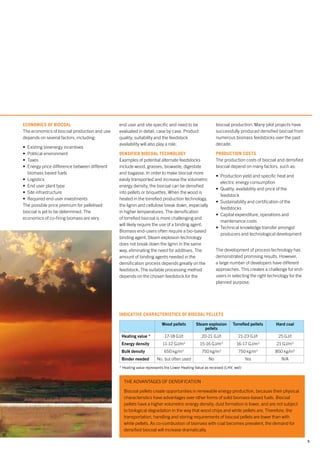
“In pelletised form, biocoal has a
30% higher energy density than
white pellets, which decreases
transportation costs.”
the original energy content of the biomass
used. In pelletised form, biocoal has a 30%
higher energy density than white pellets,
which decreases transportation costs.
Biocoal can be co-fired directly, and used in
gasification processes or densified. Utilities
have already successfully co-fired biocoal
in both densified and powder form. Biocoal
densified into pellets / briquettes as a fuel
provides additional value and has a promising
market outlook. The distribution of densified
biocoal is more efficient compared to other
forms of solid biomass. Storage requirements
of densified biocoal will enable the end-user
to easily manage handling and minimise
security and safety concerns. Densified
biocoal provides an opportunity to create
considerable savings in dry bulk shipping. It is
safer to handle than traditional white pellets,
because of the off-gasing and temperature
changes often experienced with conventional
biomass pellets. Densified biocoal can be
co-fired in existing power plants, with minimal
need to make modifications to fuel handling
systems.
5
ECONOMICS OF BIOCOAL
The economics of biocoal production and use
depends on several factors, including:
•	 Existing bioenergy incentives
•	 Political environment
•	 Taxes
•	 Energy price difference between different
biomass based fuels
•	 Logistics
•	 End user plant type
•	 Site infrastructure
•	 Required end user investments
The possible price premium for pelletised
biocoal is yet to be determined. The
economics of co-firing biomass are very
end user and site specific and need to be
evaluated in detail, case by case. Product
quality, suitability and the feedstock
availability will also play a role.
DENSIFIED BIOCOAL TECHNOLOGY
Examples of potential alternate feedstocks
include wood, grasses, biowaste, digestate
and bagasse. In order to make biocoal more
easily transported and increase the volumetric
energy density, the biocoal can be densified
into pellets or briquettes. When the wood is
heated in the torrefied production technology,
the lignin and cellulose break down, especially
in higher temperatures. The densification
of torrefied biocoal is more challenging and
will likely require the use of a binding agent.
Biomass end-users often require a bio-based
binding agent. Steam explosion technology
does not break down the lignin in the same
way, eliminating the need for additives. The
amount of binding agents needed in the
densification process depends greatly on the
feedstock. The suitable processing method
depends on the chosen feedstock for the
THE ADVANTAGES OF DENSIFICATION
Biocoal pellets create opportunities in renewable energy production, because their physical
characteristics have advantages over other forms of solid biomass-based fuels. Biocoal
pellets have a higher volumetric energy density, dust formation is lower, and are not subject
to biological degradation in the way that wood chips and white pellets are. Therefore, the
transportation, handling and storing requirements of biocoal pellets are lower than with
white pellets. As co-combustion of biomass with coal becomes prevalent, the demand for
densified biocoal will increase dramatically.
biocoal production. Many pilot projects have
successfully produced densified biocoal from
numerous biomass feedstocks over the past
decade.
PRODUCTION COSTS
The production costs of biocoal and densified
biocoal depend on many factors, such as:
•	 Production yield and specific heat and
electric energy consumption
•	 Quality, availability and price of the
feedstock
•	 Sustainability and certification of the
feedstocks
•	 Capital expenditure, operations and
maintenance costs
•	 Technical knowledge transfer amongst
producers and technological development
The development of process technology has
demonstrated promising results. However,
a large number of developers have different
approaches. This creates a challenge for end-
users in selecting the right technology for the
planned purpose.
Wood pellets Steam explosion
pellets
Torrefied pellets Hard coal
Heating value * 17-18 GJ/t 20-21 GJ/t 21-23 GJ/t 25 GJ/t
Energy density 11-12 GJ/m3
15-16 GJ/m3
16-17 GJ/m3
21 GJ/m3
Bulk density 650 kg/m3
750 kg/m3
750 kg/m3
850 kg/m3
Binder needed No, but often used No Yes N/A
INDICATIVE CHARACTERISTICS OF BIOCOAL PELLETS
* Heating value represents the Lower Heating Value as received (LHV, wet)
6
Comparing
technologies
THE WAY FORWARD
Biocoal will become a game changer in the
bioenergy market as developers execute
plans for ramping up demonstration-scale
operations within the next few years. End-
users must first familiarise themselves with
the biocoal product, to ensure its suitability
for co-firing and that it meets the boiler
requirements. The impact of biocoal on the
bioenergy market depends on the following
factors:
1.	Economies of scale must increase to ensure
that biocoal is economically competitive
with coal and white pellets.
2.	Political will and motivation must continue
to support bioenergy.
3.	The commercialisation and up-scaling
process of proven technologies must attract
finance and investment, as many
developers are using unique and new
equipment.
Commercialisation has been achieved within
the last year with promising results. Thus,
the forward thinkers of today will benefit from
the sustainable production of biocoal in the
future.
DEVELOPING THE RIGHT STRATEGY
Pöyry has been supporting collaboration
and development amongst industry leaders
in order to overcome market entry barriers.
Pöyry expects that not all technologies will
progress to reach commercialisation. The
suitability of the commercial technologies
for the prospective biocoal producers and
end-users depends on a wide range of factors,
such as scale, location, feedstock and desired
biocoal properties.
Entering the market for biocoal and
densified biocoal products at this stage is
an opportunity to lead the way in a rapidly
expanding market with large potential upside.
With Pöyry’s assistance and expertise,
clients benefit from the advantages of biocoal
and biocoal products in production, fuel
consumption enhancements and cost savings
throughout the supply chain.
We offer our clients assistance with evaluating
biocoal processing technology and provide:
•	 Project development services
•	 Technical and commercial due diligence
•	 Benchmarking and evaluating technology
developers and their process
•	 Biomass availability and logistics studies
from collection and harvesting to the
end-user markets
•	 Engineering and technology development
services
•	 Plant implementation and local industrial
project know-how, combined with world
class engineering and consulting services
Based on our experience and knowledge,
we have established a proven methodology
to evaluate and select the most appropriate
technology for our clients. Pöyry supports
its clients by evaluating these criteria on a
case-by-case basis. We draw on our strength
as a technology collaborator and our years
of experience in due diligence and feedstock
sourcing projects to help clients develop
the right strategy for market entry and joint
implementation projects.
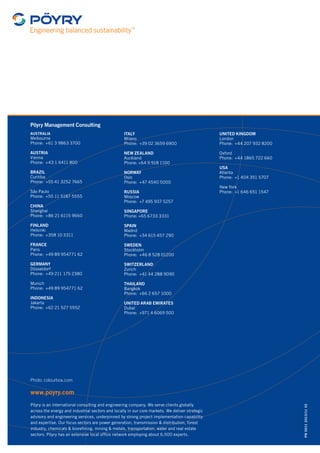
“With more than 60 technology
developers working on densified
biocoal around the world, investors
and end-users will find comparing
technologies challenging.”
7
AboutthePöyry
PointofView
Staying on top of your game means keeping
up with the latest thinking, trends and
developments. We know that this can
sometimes be tough as the pace of change
continues...
At Pöyry, we encourage our global network
of experts to actively contribute to the debate
- generating fresh insight and challenging
the status quo. The Pöyry Point of View is
our practical, accessible and issues-based
approach to sharing our latest thinking.
We invite you to take a look – please let us
know your thoughts.
Copyright © 2013 Pöyry Management Consulting Oy
All rights are reserved to Pöyry Management Consulting Oy
No part of this publication may be reproduced, stored in a retrieval system or transmitted in any form without the
prior written permission of Pöyry Management Consulting Oy (“Pöyry”).
Disclaimer
While Pöyry considers that the information and opinions given in this publication are sound, all parties must rely
upon their own skill and judgement when making use of it. This publication is partly based on information that is
not within Pöyry’s control. Therefore, Pöyry does not make any representation or warranty, expressed or implied,
as to the accuracy or completeness of the information contained in this publication. Pöyry expressly disclaims
any and all liability arising out of or relating to the use of this publication.
This publication contains projections which are based on assumptions subjected to uncertainties and contingen-
cies. Because of the subjective judgements and inherent uncertainties of projections, and because events
frequently do not occur as expected, there can be no assurance that the projections contained herein will be
realised and actual results may be different from projected results. Hence the projections supplied are not to be
regarded as firm predictions of the future, but rather as illustrations of what might happen.
R
www.linkedin.com/
company/Poyry
@PoyryPlc
#PoyryPOV
www.youtube.com/
PoyryPlc
www.facebook.com/
PoyryPlc
Join the debate
Photo: colourbox.com
Pöyry Management Consulting
www.poyry.com
Pöyry is an international consulting and engineering company. We serve clients globally
across the energy and industrial sectors and locally in our core markets. We deliver strategic
advisory and engineering services, underpinned by strong project implementation capability
and expertise. Our focus sectors are power generation, transmission & distribution, forest
industry, chemicals & biorefining, mining & metals, transportation, water and real estate
sectors. Pöyry has an extensive local office network employing about 6,500 experts.
AUSTRALIA
Melbourne
Phone: +61 3 9863 3700
AUSTRIA
Vienna
Phone: +43 1 6411 800
BRAZIL
Curitiba
Phone: +55 41 3252 7665
São Paulo
Phone: +55 11 5187 5555
CHINA
Shanghai
Phone: +86 21 6115 9660
FINLAND
Helsinki
Phone: +358 10 3311
FRANCE
Paris
Phone: +49 89 954771 62
GERMANY
Düsseldorf
Phone: +49 211 175 2380
Munich
Phone: +49 89 954771 62
INDONESIA
Jakarta
Phone: +62 21 527 5552
ITALY
Milano
Phone: +39 02 3659 6900
NEW ZEALAND
Auckland
Phone: +64 9 918 1100
NORWAY
Oslo
Phone: +47 4540 5000
RUSSIA
Moscow
Phone: +7 495 937 5257
SINGAPORE
Phone: +65 6733 3331
SPAIN
Madrid
Phone: +34 615 457 290
SWEDEN
Stockholm
Phone: +46 8 528 01200
SWITZERLAND
Zurich
Phone: +41 44 288 9090
THAILAND
Bangkok
Phone: +66 2 657 1000
UNITED ARAB EMIRATES
Dubai
Phone: +971 4 6069 500
UNITED KINGDOM
London
Phone: +44 207 932 8200
Oxford
Phone: +44 1865 722 660
USA
Atlanta
Phone: +1 404 351 5707
New York
Phone: +1 646 651 1547
PN00112013/11V2

Pöyry is biocoal_a_bioenergy_game_changer

  • 1.
  • 2.
    2 Climate change concernshave created pressure to reduce fossil fuel consumption. Once heralded as the next big thing - the potential of co-firing biomass in coal boilers has been limited by the significant capital investment required to modify fuel handling and combustion systems. However, biocoal can be co-fired in existing coal fired power plants, produced from a vast array of feedstock, and is efficient to ship, even over long distances. Is biocoal a game changer? Biocoal:bioenergy gamechanger? Biocoal introduces a new class of solid biomass-based fuel for global power and heat generation. In order to mitigate carbon dioxide emissions and increase the sustainability of biomass in energy generation over the coming years, existing power plants aim to increase the amount of biomass and biofuel in their fuel consumption mix. This has proven challenging, as biomass feedstocks often have high procurement costs, low energy density, high water content, and challenging logistics, storage and handling. Unprocessed biomass is also non-homogenous, leading to efficiency and combustion challenges. Processing biomass into biocoal and densified biocoal facilitates the use of biomass in energy generation and creates opportunities for fuel sourcing from further distances at reduced costs. The technical market potential for co- combustion of coal and CO2 neutral biocoal is tremendous. BIOCOAL MARKET POTENTIAL Pöyry forecasts the global pellet market will reach 55 million tons in 2025. The share of biocoal will largely depend on the development and commercialisation of processing technology by the end of 2014. Europe will continue to dominate the market, consuming up to 24,7 million tons by 2025. The co-combustion suitability of biocoal has been verified up to 50% or higher, depending on the biocoal quality and boiler type. Utilities have invested in technology developers and have publicly promoted their plans to start using pelletised biocoal in large quantities. However, it is important to note that the biocoal market is still in development, and commercial scale production facilities are limited. Wider commercialisation will begin in 2018 if financing and off-take opportunities maintain momentum of technology development. In the long term, biocoal is expected to become a standardised and commodity traded product. WHAT IS BIOCOAL? Biocoal is produced through a process of torrefaction, during which water content, cellulose sugars and other volatile organic compounds are removed from the biomass to produce a solid biofuel with characteristics similar to those of fossil coal. The main technologies for biocoal production currently under development include torrefaction and steam explosion. The principles of both technologies were developed several decades ago. The process can simply be described as the heating of biomass in a low oxygen atmosphere to a desired temperature. The physical properties of densified biocoal are notably different compared to standard wood pellets. The main differences between biocoal and standard wood pellets are that biocoal has a higher volumetric energy density, is less subject to biological degradation and is hydrophobic. These factors lower the transportation and logistics costs of the biocoal.
  • 3.
    3 North America Europe 4 5 15 25 35 1 1 2012 2015 2020 China Japan& South Korea 3 9 2025 55 38 1 1 1 9 “Pöyry forecasts the global pellet market will reach 55 million tons in 2025, with biocoal gradually capturing shares of the industrial pellet markets.” GROWTH OPPORTUNITIES A few key factors will support the growth of biocoal pellet consumption globally over the coming years: • Lower logistics costs - Biocoal has higher specific energy content per volume compared to other forms of biomass. • Lower investment requirements – Biocoal requires lower capital expenditure for handling and storage at power plants. • Improved safety - The less reactive nature of biocoal pellets compared to standard pellets provides better long term storage safety. • Similarity to coal - Biocoal’s fuel characteristics are similar to coal, providing significant technical potential for co- combustion of pelletised biocoal and coal for power generation. • Sustainability incentives – Biocoal is eligible for incentive programs designed to increase CO2 neutral fuel consumption. • Wide range of potential sources - Biocoal can be derived from alternative biomass sources, such as agricultural residues and short rotation crops. THE PELLET MARKET IS EXPECTED TO GROW SIGNIFICANTLY THROUGH 2020 • New end uses - Additional value-added end uses in other sectors, such as metallurgy and pharmaceuticals are actively being developed. Million tons/a
  • 4.
    4 Commercialisation isonthehorizon VALUE ADD THROUGHPROCESSING BIOCOAL Biomass is processed to biocoal through a number of technologies, including torrefaction and steam explosion techniques. Biocoal can then be densified to pellets or briquettes to increase the bulk density and decrease transportation costs. Biocoal pellets have hydrophobic characteristics and can be received and handled by the power plants in the same manner as fossil coal. Processing biomass to biocoal gives it coal-like characteristics such as darkness in colour, brittleness and requires less energy for milling and pelletising than traditional biomass. Biocoal contains up to 90% of “In pelletised form, biocoal has a 30% higher energy density than white pellets, which decreases transportation costs.” the original energy content of the biomass used. In pelletised form, biocoal has a 30% higher energy density than white pellets, which decreases transportation costs. Biocoal can be co-fired directly, and used in gasification processes or densified. Utilities have already successfully co-fired biocoal in both densified and powder form. Biocoal densified into pellets / briquettes as a fuel provides additional value and has a promising market outlook. The distribution of densified biocoal is more efficient compared to other forms of solid biomass. Storage requirements of densified biocoal will enable the end-user to easily manage handling and minimise security and safety concerns. Densified biocoal provides an opportunity to create considerable savings in dry bulk shipping. It is safer to handle than traditional white pellets, because of the off-gasing and temperature changes often experienced with conventional biomass pellets. Densified biocoal can be co-fired in existing power plants, with minimal need to make modifications to fuel handling systems.
  • 5.
    5 ECONOMICS OF BIOCOAL Theeconomics of biocoal production and use depends on several factors, including: • Existing bioenergy incentives • Political environment • Taxes • Energy price difference between different biomass based fuels • Logistics • End user plant type • Site infrastructure • Required end user investments The possible price premium for pelletised biocoal is yet to be determined. The economics of co-firing biomass are very end user and site specific and need to be evaluated in detail, case by case. Product quality, suitability and the feedstock availability will also play a role. DENSIFIED BIOCOAL TECHNOLOGY Examples of potential alternate feedstocks include wood, grasses, biowaste, digestate and bagasse. In order to make biocoal more easily transported and increase the volumetric energy density, the biocoal can be densified into pellets or briquettes. When the wood is heated in the torrefied production technology, the lignin and cellulose break down, especially in higher temperatures. The densification of torrefied biocoal is more challenging and will likely require the use of a binding agent. Biomass end-users often require a bio-based binding agent. Steam explosion technology does not break down the lignin in the same way, eliminating the need for additives. The amount of binding agents needed in the densification process depends greatly on the feedstock. The suitable processing method depends on the chosen feedstock for the THE ADVANTAGES OF DENSIFICATION Biocoal pellets create opportunities in renewable energy production, because their physical characteristics have advantages over other forms of solid biomass-based fuels. Biocoal pellets have a higher volumetric energy density, dust formation is lower, and are not subject to biological degradation in the way that wood chips and white pellets are. Therefore, the transportation, handling and storing requirements of biocoal pellets are lower than with white pellets. As co-combustion of biomass with coal becomes prevalent, the demand for densified biocoal will increase dramatically. biocoal production. Many pilot projects have successfully produced densified biocoal from numerous biomass feedstocks over the past decade. PRODUCTION COSTS The production costs of biocoal and densified biocoal depend on many factors, such as: • Production yield and specific heat and electric energy consumption • Quality, availability and price of the feedstock • Sustainability and certification of the feedstocks • Capital expenditure, operations and maintenance costs • Technical knowledge transfer amongst producers and technological development The development of process technology has demonstrated promising results. However, a large number of developers have different approaches. This creates a challenge for end- users in selecting the right technology for the planned purpose. Wood pellets Steam explosion pellets Torrefied pellets Hard coal Heating value * 17-18 GJ/t 20-21 GJ/t 21-23 GJ/t 25 GJ/t Energy density 11-12 GJ/m3 15-16 GJ/m3 16-17 GJ/m3 21 GJ/m3 Bulk density 650 kg/m3 750 kg/m3 750 kg/m3 850 kg/m3 Binder needed No, but often used No Yes N/A INDICATIVE CHARACTERISTICS OF BIOCOAL PELLETS * Heating value represents the Lower Heating Value as received (LHV, wet)
  • 6.
    6 Comparing technologies THE WAY FORWARD Biocoalwill become a game changer in the bioenergy market as developers execute plans for ramping up demonstration-scale operations within the next few years. End- users must first familiarise themselves with the biocoal product, to ensure its suitability for co-firing and that it meets the boiler requirements. The impact of biocoal on the bioenergy market depends on the following factors: 1. Economies of scale must increase to ensure that biocoal is economically competitive with coal and white pellets. 2. Political will and motivation must continue to support bioenergy. 3. The commercialisation and up-scaling process of proven technologies must attract finance and investment, as many developers are using unique and new equipment. Commercialisation has been achieved within the last year with promising results. Thus, the forward thinkers of today will benefit from the sustainable production of biocoal in the future. DEVELOPING THE RIGHT STRATEGY Pöyry has been supporting collaboration and development amongst industry leaders in order to overcome market entry barriers. Pöyry expects that not all technologies will progress to reach commercialisation. The suitability of the commercial technologies for the prospective biocoal producers and end-users depends on a wide range of factors, such as scale, location, feedstock and desired biocoal properties. Entering the market for biocoal and densified biocoal products at this stage is an opportunity to lead the way in a rapidly expanding market with large potential upside. With Pöyry’s assistance and expertise, clients benefit from the advantages of biocoal and biocoal products in production, fuel consumption enhancements and cost savings throughout the supply chain. We offer our clients assistance with evaluating biocoal processing technology and provide: • Project development services • Technical and commercial due diligence • Benchmarking and evaluating technology developers and their process • Biomass availability and logistics studies from collection and harvesting to the end-user markets • Engineering and technology development services • Plant implementation and local industrial project know-how, combined with world class engineering and consulting services Based on our experience and knowledge, we have established a proven methodology to evaluate and select the most appropriate technology for our clients. Pöyry supports its clients by evaluating these criteria on a case-by-case basis. We draw on our strength as a technology collaborator and our years of experience in due diligence and feedstock sourcing projects to help clients develop the right strategy for market entry and joint implementation projects. “With more than 60 technology developers working on densified biocoal around the world, investors and end-users will find comparing technologies challenging.”
  • 7.
    7 AboutthePöyry PointofView Staying on topof your game means keeping up with the latest thinking, trends and developments. We know that this can sometimes be tough as the pace of change continues... At Pöyry, we encourage our global network of experts to actively contribute to the debate - generating fresh insight and challenging the status quo. The Pöyry Point of View is our practical, accessible and issues-based approach to sharing our latest thinking. We invite you to take a look – please let us know your thoughts. Copyright © 2013 Pöyry Management Consulting Oy All rights are reserved to Pöyry Management Consulting Oy No part of this publication may be reproduced, stored in a retrieval system or transmitted in any form without the prior written permission of Pöyry Management Consulting Oy (“Pöyry”). Disclaimer While Pöyry considers that the information and opinions given in this publication are sound, all parties must rely upon their own skill and judgement when making use of it. This publication is partly based on information that is not within Pöyry’s control. Therefore, Pöyry does not make any representation or warranty, expressed or implied, as to the accuracy or completeness of the information contained in this publication. Pöyry expressly disclaims any and all liability arising out of or relating to the use of this publication. This publication contains projections which are based on assumptions subjected to uncertainties and contingen- cies. Because of the subjective judgements and inherent uncertainties of projections, and because events frequently do not occur as expected, there can be no assurance that the projections contained herein will be realised and actual results may be different from projected results. Hence the projections supplied are not to be regarded as firm predictions of the future, but rather as illustrations of what might happen. R www.linkedin.com/ company/Poyry @PoyryPlc #PoyryPOV www.youtube.com/ PoyryPlc www.facebook.com/ PoyryPlc Join the debate
  • 8.
    Photo: colourbox.com Pöyry ManagementConsulting www.poyry.com Pöyry is an international consulting and engineering company. We serve clients globally across the energy and industrial sectors and locally in our core markets. We deliver strategic advisory and engineering services, underpinned by strong project implementation capability and expertise. Our focus sectors are power generation, transmission & distribution, forest industry, chemicals & biorefining, mining & metals, transportation, water and real estate sectors. Pöyry has an extensive local office network employing about 6,500 experts. AUSTRALIA Melbourne Phone: +61 3 9863 3700 AUSTRIA Vienna Phone: +43 1 6411 800 BRAZIL Curitiba Phone: +55 41 3252 7665 São Paulo Phone: +55 11 5187 5555 CHINA Shanghai Phone: +86 21 6115 9660 FINLAND Helsinki Phone: +358 10 3311 FRANCE Paris Phone: +49 89 954771 62 GERMANY Düsseldorf Phone: +49 211 175 2380 Munich Phone: +49 89 954771 62 INDONESIA Jakarta Phone: +62 21 527 5552 ITALY Milano Phone: +39 02 3659 6900 NEW ZEALAND Auckland Phone: +64 9 918 1100 NORWAY Oslo Phone: +47 4540 5000 RUSSIA Moscow Phone: +7 495 937 5257 SINGAPORE Phone: +65 6733 3331 SPAIN Madrid Phone: +34 615 457 290 SWEDEN Stockholm Phone: +46 8 528 01200 SWITZERLAND Zurich Phone: +41 44 288 9090 THAILAND Bangkok Phone: +66 2 657 1000 UNITED ARAB EMIRATES Dubai Phone: +971 4 6069 500 UNITED KINGDOM London Phone: +44 207 932 8200 Oxford Phone: +44 1865 722 660 USA Atlanta Phone: +1 404 351 5707 New York Phone: +1 646 651 1547 PN00112013/11V2