Biofuels in Australia: Issues and Prospects Scientists in Schools 26 October 2007 Presented by Deborah O’Connell  Contributing authors: Brian Keating, Michael Dunlop, Michael O’Connor, Barrie May, John Raison, Tom Beer, David Batten, Tim Grant, Graham Turner, Franzi Poldy, David Lamb, Mick Poole, Andrew Braid, Victoria Haritos, Cameron Begley, Peter Campbell, Damien Farine
Biofuels – hype vs reality
Outline of talk What (global and local) forces will shape our transport energy futures? What are the options for our transport future? What is a biofuel? What is the current status of the industry? 5. What will be the role for biofuels in Australia’s transport? Could they, should they, will they? At the margins ?   2-5% of transport fuels In the main game?   10-20% of transport fuels  As the end game? > 60% of transport fuels 6. So what?
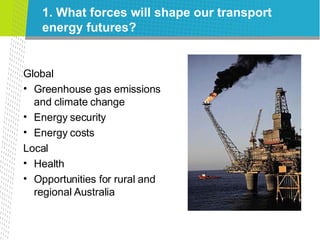
1. What forces will shape our transport energy futures? Global Greenhouse gas emissions and climate change Energy security Energy costs Local Health Opportunities for rural and regional Australia
2. What options for Australia’s transport energy future? Extend fossil reserves New fossil fuel discoveries  Cheaper extraction and processing Sequester the Carbon Geo – hope it stays down! Bio - algae to biodiesel or agrichar Diversify types of transport fuels   LPG, CNG, biogas, (renewable) electricity  New liquid fuel options Gas to liquids  Coal to liquids  Biomass to liquids (ie biofuels) Reduce demand Efficient engines – hybrid, electric, smaller eco-efficient urban design And in the longer term ….. Hydrogen economy from coal, nuclear or renewable electricity Source: http://www.toyota.com/prius/index.html?s_van=GM_TN_HYBRID_PRIUS
3. What are biofuels?  1 st  and 2 nd   generation conversion technologies Source:  Hamelinck and Faaij (2006) Outlook for advanced biofuels.  Energy Policy   34 : 3268-3283. Hydrogen (H 2 ) Methanol (CH 3 OH) DME (CH 3 OCH 3 ) FT Diesel (C x H y ) SNG (CH 4 ) Biodiesel (C x H y ) Ethanol (CH 3 CH 2 OH) Biodiesel (alkyl esters) Bio oil (vegetable oil) Water gas shift + separation Catalysed synthesis Purification Hydro treating and refining Fermentation Esterification Vegetable oil Sugar Bio oil Biogas Syngas Gasification Anaerobic digestion Flash pyrolysis Hydrothermal liquefaction Hydrolysis Milling and hydrolysis Pressing or extraction Lignocellulosic biomass Sugar/starch crops Oil plants
4. What is the current status of the industry? Ethanol Biodiesel Diesel 15  1.5 0.076 Biodiesel Petrol 20  1 0.084 Ethanol 2004/5 fuel usage (GL/yr) Proposed 2010 capacity (GL/yr) 2006/7 prdn (GL/yr) Australia 2007
5. What will be the role for biofuels in Australia’s transport future? Could they? Should they? Will they have a role? Will that role be At the margins ?   2-5% of transport fuels In the main game?   10-20% of transport fuels  As the end game? > 60% of transport fuels
Prospects… Could they?  1 st  generation biofuels in Australia From O’Connell et al 2007. Biofuels in Australia: Issues and Prospects. RIRDC Pub No  07/071 Coarse
Prospects…Could they?  1st generation - key messages 1 st   generation - currently available feedstocks / conversion technologies Limited by High cost of production (high quality land and high inputs) Low net energy yield May present useful regional opportunities May be useful first step in transitional fuels Can we move beyond this?
Prospects…Could they?  2nd generation technologies Lignocellulosic conversion technologies - $/l? Lower costs of production (less productive land, lower inputs) Broader range of fuels with higher energy yield Feedstocks – new production systems
Prospects – could they? Replacing oil … Crude Oil Oil Refinery US Department of Energy 2005, American Institute of Chemistry; in New Scientist, 7 th  July 2007 US$385bn ~US$375bn
Prospects –could they? With 3 rd  generation bioproducts and energy… Liquid Biofuel Electricity / Heat Paint Distillers Grain Organic Waste Other Adhesives Biomass Biorefinery
Prospects…Could they?  1 st , 2 nd , 3 rd  generation - key messages 1 st   generation – limited to margins 2 nd  generation – moving beyond the limits… Expand or intensify agricultural production  Optimise farming systems for energy Change feedstocks and technologies 3 rd  generation – intriguing prospects for the bioeconomy… Biorefineries for high value products AND energy
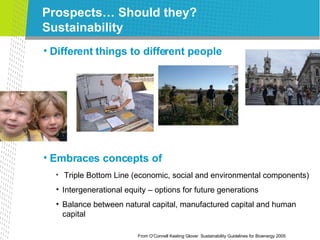
Prospects… Should they?  Sustainability Different things to different people Embraces concepts of Triple Bottom Line (economic, social and environmental components) Intergenerational equity – options for future generations Balance between natural capital, manufactured capital and human capital From O’Connell Keating Glover  Sustainability Guidelines for Bioenergy 2005
Prospects… Should they?  Sustainability Land and water resources increasingly contested   Human food Animal feed Fibre  Water yield Energy production Environmental services eg biodiversity, carbon sequestration Biofuels - full life cycle, range of criteria Greenhouse Gas, air quality, land and water impacts, biodiversity, Energy Production Ratio, financial viability, community and regional impacts
If only it was this simple ! Prospects … should they?
Prospects - Should they ?  Life cycle greenhouse gas emissions Biofuels have lower emissions than fossils   Ethanol from grain and sugar  - 20-50%  Biodiesel from oilseeds - 50-70%  Ethanol from lignocellulose - 80-90% BUT  ≠  ‘zero carbon’ emissions Depends on particular biofuel production system, and method
Prospects … should they?  Biodiversity –  eg palm oil for biodiesel Biodiversity loss   Peat land fires, carbon loss
Prospects … should they?  Land and water impacts Impacts largely through production of crops and biomass Impacts could be positive or negative Will depend on  scale of industry where feedstock produced what type of feedstock O’Connell et al 2007. Biofuels in Australia: Issues and Prospects. RIRDC Pub No  07/071
Prospects … should they?  Community ‘licence to operate’…. Big crowd expected to protest against charcoal plant … ABC News 20 September 2002 http://www.acr.net.au/~coastwatchers/charcoalition/abc200902a.html http://www.acr.net.au/~coastwatchers/charcoalition/abc200902a.html
Prospects … should they? Does  the current land use meet community expectation on sustainability? Is there a potential biomass source? Is energy the highest order use for it? Greenhouse gas abatement ? Air quality maintained or improved? ? Land and water quality maintained or improved ? Biodiversity maintained or improved ? Positive social outcomes ? Financial viability ? Community consultation  System design  From O’Connell Keating Glover  Sustainability Guidelines for Bioenergy 2005 The Sustainability Ladder Costs Benefits Costs Benefits Bioenergy not sustainable Bioenergy sustainable Costs Benefits Costs Benefits Bioenergy not sustainable Bioenergy sustainable Yes Conditional Yes Conditions Yes Conditional Yes Conditions Yes Yes Yes (existing) Yes (new) Yes (existing) Yes (new) Bioenergy not sustainable Bioenergy not sustainable No
Prospects…Should they?  Key messages summary Sustainability issues are crucial Replace an unsustainable system with another unsustainable one? True sustainability hard to achieve Content and process Community ‘licence to operate’ Track and trace certification http://images.google.com/imgres?imgurl=http://www.filmaust.com.au/wilderness/images/photogallery  Jenni Maree Bock ? Sustainability protests Biogas bus to destination ‘special’ Photo: Tom Beer
Prospects…Will they?  Volatile international and domestic commodity markets and oil price Policy settings Broader energy management Use or sequester target gases Diversify (renewable electricity, GTL, CTL) Carbon markets Energy efficient vehicles Eco efficient urban design Interactions with other resources eg water REDUCE overall demand
6. So what?? We need   fuel security lower greenhouse gas emissions carbon sequestration Can biofuels help? Depends on how its done 1 st  gen – margins 2 nd  gen - ‘main game’ - step change 3 rd  gen - biofuels and bioproducts - intriguing prospects   Sustainability is the key!
Thanks folks! Contact Deborah.O’Connell@csiro.au This work is funded through the CSIRO Energy Transformed Flagship, with funding partners including RIRDC and GRDC
Prospects… Could they?  Sustainable biomass production O’Connell et al 2007. Biofuels in Australia: Issues and Prospects. RIRDC Pub No  07/071 ? ? ? ? 3 rd  generation - high value products including energy Expansion of forestry, farm forestry, grasses Expansion new crops, GM  Algae Expand current base GM crops New tree crops eg Pongamia, Jatropha Future prodn base Crop residues (sugar, cereal) Grasses Farm forestry Plantation forestry – thinnings, residues Native forest residues and  Waste streams Sugar and starch crops Oilseed crops Current prodn base 2 nd  generation fuels / 1 st  generation bioelectricity (lignocellulosics) 1 st  generation fuels (ethanol and biodiesel)

SiS Biofuels O Connell 2007

  • 1.
    Biofuels in Australia:Issues and Prospects Scientists in Schools 26 October 2007 Presented by Deborah O’Connell Contributing authors: Brian Keating, Michael Dunlop, Michael O’Connor, Barrie May, John Raison, Tom Beer, David Batten, Tim Grant, Graham Turner, Franzi Poldy, David Lamb, Mick Poole, Andrew Braid, Victoria Haritos, Cameron Begley, Peter Campbell, Damien Farine
  • 2.
  • 3.
    Outline of talkWhat (global and local) forces will shape our transport energy futures? What are the options for our transport future? What is a biofuel? What is the current status of the industry? 5. What will be the role for biofuels in Australia’s transport? Could they, should they, will they? At the margins ? 2-5% of transport fuels In the main game? 10-20% of transport fuels As the end game? > 60% of transport fuels 6. So what?
  • 4.
    1. What forceswill shape our transport energy futures? Global Greenhouse gas emissions and climate change Energy security Energy costs Local Health Opportunities for rural and regional Australia
  • 5.
    2. What optionsfor Australia’s transport energy future? Extend fossil reserves New fossil fuel discoveries Cheaper extraction and processing Sequester the Carbon Geo – hope it stays down! Bio - algae to biodiesel or agrichar Diversify types of transport fuels LPG, CNG, biogas, (renewable) electricity New liquid fuel options Gas to liquids Coal to liquids Biomass to liquids (ie biofuels) Reduce demand Efficient engines – hybrid, electric, smaller eco-efficient urban design And in the longer term ….. Hydrogen economy from coal, nuclear or renewable electricity Source: http://www.toyota.com/prius/index.html?s_van=GM_TN_HYBRID_PRIUS
  • 6.
    3. What arebiofuels? 1 st and 2 nd generation conversion technologies Source: Hamelinck and Faaij (2006) Outlook for advanced biofuels. Energy Policy 34 : 3268-3283. Hydrogen (H 2 ) Methanol (CH 3 OH) DME (CH 3 OCH 3 ) FT Diesel (C x H y ) SNG (CH 4 ) Biodiesel (C x H y ) Ethanol (CH 3 CH 2 OH) Biodiesel (alkyl esters) Bio oil (vegetable oil) Water gas shift + separation Catalysed synthesis Purification Hydro treating and refining Fermentation Esterification Vegetable oil Sugar Bio oil Biogas Syngas Gasification Anaerobic digestion Flash pyrolysis Hydrothermal liquefaction Hydrolysis Milling and hydrolysis Pressing or extraction Lignocellulosic biomass Sugar/starch crops Oil plants
  • 7.
    4. What isthe current status of the industry? Ethanol Biodiesel Diesel 15 1.5 0.076 Biodiesel Petrol 20 1 0.084 Ethanol 2004/5 fuel usage (GL/yr) Proposed 2010 capacity (GL/yr) 2006/7 prdn (GL/yr) Australia 2007
  • 8.
    5. What willbe the role for biofuels in Australia’s transport future? Could they? Should they? Will they have a role? Will that role be At the margins ? 2-5% of transport fuels In the main game? 10-20% of transport fuels As the end game? > 60% of transport fuels
  • 9.
    Prospects… Could they? 1 st generation biofuels in Australia From O’Connell et al 2007. Biofuels in Australia: Issues and Prospects. RIRDC Pub No 07/071 Coarse
  • 10.
    Prospects…Could they? 1st generation - key messages 1 st generation - currently available feedstocks / conversion technologies Limited by High cost of production (high quality land and high inputs) Low net energy yield May present useful regional opportunities May be useful first step in transitional fuels Can we move beyond this?
  • 11.
    Prospects…Could they? 2nd generation technologies Lignocellulosic conversion technologies - $/l? Lower costs of production (less productive land, lower inputs) Broader range of fuels with higher energy yield Feedstocks – new production systems
  • 12.
    Prospects – couldthey? Replacing oil … Crude Oil Oil Refinery US Department of Energy 2005, American Institute of Chemistry; in New Scientist, 7 th July 2007 US$385bn ~US$375bn
  • 13.
    Prospects –could they?With 3 rd generation bioproducts and energy… Liquid Biofuel Electricity / Heat Paint Distillers Grain Organic Waste Other Adhesives Biomass Biorefinery
  • 14.
    Prospects…Could they? 1 st , 2 nd , 3 rd generation - key messages 1 st generation – limited to margins 2 nd generation – moving beyond the limits… Expand or intensify agricultural production Optimise farming systems for energy Change feedstocks and technologies 3 rd generation – intriguing prospects for the bioeconomy… Biorefineries for high value products AND energy
  • 15.
    Prospects… Should they? Sustainability Different things to different people Embraces concepts of Triple Bottom Line (economic, social and environmental components) Intergenerational equity – options for future generations Balance between natural capital, manufactured capital and human capital From O’Connell Keating Glover Sustainability Guidelines for Bioenergy 2005
  • 16.
    Prospects… Should they? Sustainability Land and water resources increasingly contested Human food Animal feed Fibre Water yield Energy production Environmental services eg biodiversity, carbon sequestration Biofuels - full life cycle, range of criteria Greenhouse Gas, air quality, land and water impacts, biodiversity, Energy Production Ratio, financial viability, community and regional impacts
  • 17.
    If only itwas this simple ! Prospects … should they?
  • 18.
    Prospects - Shouldthey ? Life cycle greenhouse gas emissions Biofuels have lower emissions than fossils Ethanol from grain and sugar - 20-50% Biodiesel from oilseeds - 50-70% Ethanol from lignocellulose - 80-90% BUT ≠ ‘zero carbon’ emissions Depends on particular biofuel production system, and method
  • 19.
    Prospects … shouldthey? Biodiversity – eg palm oil for biodiesel Biodiversity loss Peat land fires, carbon loss
  • 20.
    Prospects … shouldthey? Land and water impacts Impacts largely through production of crops and biomass Impacts could be positive or negative Will depend on scale of industry where feedstock produced what type of feedstock O’Connell et al 2007. Biofuels in Australia: Issues and Prospects. RIRDC Pub No 07/071
  • 21.
    Prospects … shouldthey? Community ‘licence to operate’…. Big crowd expected to protest against charcoal plant … ABC News 20 September 2002 http://www.acr.net.au/~coastwatchers/charcoalition/abc200902a.html http://www.acr.net.au/~coastwatchers/charcoalition/abc200902a.html
  • 22.
    Prospects … shouldthey? Does the current land use meet community expectation on sustainability? Is there a potential biomass source? Is energy the highest order use for it? Greenhouse gas abatement ? Air quality maintained or improved? ? Land and water quality maintained or improved ? Biodiversity maintained or improved ? Positive social outcomes ? Financial viability ? Community consultation System design From O’Connell Keating Glover Sustainability Guidelines for Bioenergy 2005 The Sustainability Ladder Costs Benefits Costs Benefits Bioenergy not sustainable Bioenergy sustainable Costs Benefits Costs Benefits Bioenergy not sustainable Bioenergy sustainable Yes Conditional Yes Conditions Yes Conditional Yes Conditions Yes Yes Yes (existing) Yes (new) Yes (existing) Yes (new) Bioenergy not sustainable Bioenergy not sustainable No
  • 23.
    Prospects…Should they? Key messages summary Sustainability issues are crucial Replace an unsustainable system with another unsustainable one? True sustainability hard to achieve Content and process Community ‘licence to operate’ Track and trace certification http://images.google.com/imgres?imgurl=http://www.filmaust.com.au/wilderness/images/photogallery Jenni Maree Bock ? Sustainability protests Biogas bus to destination ‘special’ Photo: Tom Beer
  • 24.
    Prospects…Will they? Volatile international and domestic commodity markets and oil price Policy settings Broader energy management Use or sequester target gases Diversify (renewable electricity, GTL, CTL) Carbon markets Energy efficient vehicles Eco efficient urban design Interactions with other resources eg water REDUCE overall demand
  • 25.
    6. So what??We need fuel security lower greenhouse gas emissions carbon sequestration Can biofuels help? Depends on how its done 1 st gen – margins 2 nd gen - ‘main game’ - step change 3 rd gen - biofuels and bioproducts - intriguing prospects Sustainability is the key!
  • 26.
    Thanks folks! ContactDeborah.O’Connell@csiro.au This work is funded through the CSIRO Energy Transformed Flagship, with funding partners including RIRDC and GRDC
  • 27.
    Prospects… Could they? Sustainable biomass production O’Connell et al 2007. Biofuels in Australia: Issues and Prospects. RIRDC Pub No 07/071 ? ? ? ? 3 rd generation - high value products including energy Expansion of forestry, farm forestry, grasses Expansion new crops, GM Algae Expand current base GM crops New tree crops eg Pongamia, Jatropha Future prodn base Crop residues (sugar, cereal) Grasses Farm forestry Plantation forestry – thinnings, residues Native forest residues and Waste streams Sugar and starch crops Oilseed crops Current prodn base 2 nd generation fuels / 1 st generation bioelectricity (lignocellulosics) 1 st generation fuels (ethanol and biodiesel)