East Tennessee State University
Digital Commons @ East
Tennessee State University
Electronic Theses and Dissertations Student Works
12-2010
Self-Determination and Career Planning Model for
Students with Disabilities: An Analysis of Evidence-
Based Practices.
Elizabeth Fussell
East Tennessee State University
Follow this and additional works at: https://dc.etsu.edu/etd
Part of the Disability and Equity in Education Commons
This Dissertation - Open Access is brought to you for free and open access by the Student Works at Digital Commons @ East Tennessee State
University. It has been accepted for inclusion in Electronic Theses and Dissertations by an authorized administrator of Digital Commons @ East
Tennessee State University. For more information, please contact digilib@etsu.edu.
Recommended Citation
Fussell, Elizabeth, "Self-Determination and Career Planning Model for Students with Disabilities: An Analysis of Evidence-Based
Practices." (2010). Electronic Theses and Dissertations. Paper 1757. https://dc.etsu.edu/etd/1757
Self-Determination and Career Planning Model for Students with Disabilities:
An Analysis of Evidence-Based Practices
________________________________
A dissertation
presented to
the faculty of the Department of Educational Leadership and Policy Analysis
East Tennessee State University
In partial fulfillment
of the requirements for the degree
Doctor of Education in Educational Leadership
_____________________________
by
Elizabeth Fussell
December 2010
_____________________________
Dr. Eric Glover, Chair
Dr. James Lampley
Dr. Lori Meier
Dr. Pamela Scott
Keywords: self-determination, self-advocacy, evidence-based curriculum
2
ABSTRACT
Self-Determination and Career Planning Model for Students with Disabilities:
An Analysis of Evidence-Based Practices
by
Elizabeth Fussell
This study investigated the capacity of a self-advocacy curriculum implemented in Tennessee
schools. The purpose of the study was to establish evidence that: (1) the curriculum contained 4
suggested components that make up the conceptual framework of self-determination curriculum,
(2) school-wide intervention had occurred, (3) self-determination goals were included in
individualized education programs (IEPs) and transition plans, and (4) there was awareness of
the curriculum capacity among Tennessee educators.
This study employed descriptive and comparative statistical methods to establish assumptions
regarding the curriculum’s effectiveness. Educators were grouped based on their teaching role
(i.e., special education, regular education, and administration) and whether or not they received
training and technical assistance from the University of Tennessee’s Center on Disability and
Employment. An on-line survey provided data necessary to determine educators’ perceptions of
the curriculum’s capacity to provide students opportunities to learn and practice self-advocacy
skills. Seven major findings evaluated the Self-Determination and Career Planning Model as
evidence-based.
• Educators agreed the curriculum helped students demonstrate self-advocacy skills.
• Educators who received training to implement the self-advocacy curriculum were better
prepared to observe students’ demonstration of self-advocacy skills.
3
• Self-advocacy goals were included in IEPs and transition plans.
• Attendance at IEP meetings did not bias educators’ opinions of students’ skills.
• The self-advocacy curriculum contained 4 recommended curriculum dimensions.
• Tennessee educators have a high awareness of self-determination curriculum capacity.
• Educators indicated an increase in student IEP participation.
These findings evaluated the Self-Determination and Career Planning Model as evidence-based.
Suggested curriculum improvements should be implemented and accountability of school
districts to implement the curriculum should be communicated to all educators.
4
DEDICATION
This study is dedicated to students with disabilities who have learned and practiced self-
advocacy skills in the effort to create successful transitions from school to adult life. It is my
dream that you will find success in your careers and pave the way for other students to follow in
your footsteps.
This study is also dedicated to my parents who have patiently waited for this day to
come. I know we missed a lot of outings on the Saturdays that I spent working on this “paper”.
Now we can begin writing new chapters in our excursions.
5
ACKNOWLEDGEMENTS
It is difficult to begin to say Thank You to all the people who helped make this
achievement possible. About 7 years ago I created a Planning Alternative Tomorrows with Hope
(PATH) plan for myself with a goal to earn a doctoral degree. At the time I thought it was a joke.
But look where I am today. I think that goes to show that your goals are more likely to happen if
you put them in writing.
I would like to express my appreciation to Dr. Eric Glover for his guidance throughout
this process. He interviewed me for the program and now he chaired my committee. This
exercise may have been delayed a while had Dr. Glover not taken the time (and shown great
patience) to guide me through this course of my life.
I guess everyone thinks they have the best committee. But my committee wins over all of
them. Dr. James Lampley, Dr. Lori Meier, and Dr. Pamela Scott have been wonderful to support
my work. Let’s remember that the new edition to APA made for some good discussions.
As I think back, I would have never had this opportunity had it not been for the relentless
requests from Jane and Robert Winstead. The Winsteads introduced this opportunity to our
cohort and kept us moving along. Dr. Sandra Enloe has provided endless support throughout this
program. Whether it was registering for class or finding the class location, Sandy was always
available to help.
My co-worker, Kathie Dobbins, was always there to lend a hand or just listen. Kathie,
that class in second life was a lot more interesting with your contribution. Finally, I say Thank
You to my family who rescheduled a lot of activities to fit my schedule. My sisters, Cheryl Allen
and Carol Polumbo, were just a phone call away with words of encouragement. I owe my
appreciation to you all for all your support.
6
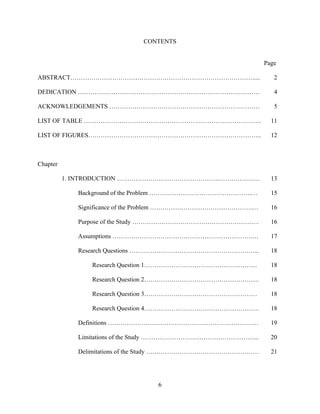
CONTENTS
Page
ABSTRACT……………………………………………………………………………..... 2
DEDICATION …………………………………………………………………………… 4
ACKNOWLEDGEMENTS ……………………………………………………………… 5
LIST OF TABLE …………………………………………………………………………. 11
LIST OF FIGURES……………………………………………………………………….. 12
Chapter
1. INTRODUCTION ………………………………………….…………….…. 13
Background of the Problem ………………………………………….… 15
Significance of the Problem ………………………………………….… 16
Purpose of the Study ………………………………………………….… 16
Assumptions ………………………………………………………….… 17
Research Questions …………………………………………………….. 18
Research Question 1……………………………………………… 18
Research Question 2………………………………………………. 18
Research Question 3……………………………………………… 18
Research Question 4………………………………………………. 18
Definitions ……………………………………………………………… 19
Limitations of the Study ………………………………………………... 20
Delimitations of the Study ……………………………………………… 21
7
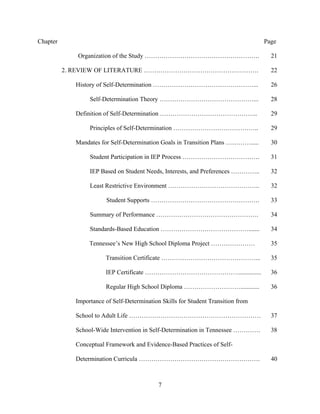
Chapter Page
Organization of the Study ………………………………………………. 21
2. REVIEW OF LITERATURE ………………………………………………. 22
History of Self-Determination …………………………………………... 26
Self-Determination Theory ………………………………………... 28
Definition of Self-Determination ……………………………………….. 29
Principles of Self-Determination ………………………………….. 29
Mandates for Self-Determination Goals in Transition Plans …………..... 30
Student Participation in IEP Process ………………………………. 31
IEP Based on Student Needs, Interests, and Preferences ………….. 32
Least Restrictive Environment …………………………………….. 32
Student Supports ……………………………………………. 33
Summary of Performance …………………………………………. 34
Standards-Based Education ……………………………………....... 34
Tennessee’s New High School Diploma Project ………………… 35
Transition Certificate ………………………………………... 35
IEP Certificate ……………………………………….............. 36
Regular High School Diploma ………………………............ 36
Importance of Self-Determination Skills for Student Transition from
School to Adult Life ……………………………………………………… 37
School-Wide Intervention in Self-Determination in Tennessee …………. 38
Conceptual Framework and Evidence-Based Practices of Self-
Determination Curricula …………………………………………………. 40
8
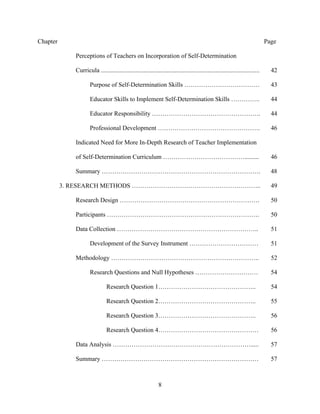
Chapter Page
Perceptions of Teachers on Incorporation of Self-Determination
Curricula ..................................................................................................... 42
Purpose of Self-Determination Skills ……………………………… 43
Educator Skills to Implement Self-Determination Skills ………….. 44
Educator Responsibility ……………………………………………. 44
Professional Development …………………………………………. 46
Indicated Need for More In-Depth Research of Teacher Implementation
of Self-Determination Curriculum …………………………………......... 46
Summary …………………………………………………………………. 48
3. RESEARCH METHODS …………………………………………………….. 49
Research Design …………………………………………………………. 50
Participants ………………………………………………………………. 50
Data Collection ………………………………………………………….. 51
Development of the Survey Instrument …………………………… 51
Methodology …………………………………………………………….. 52
Research Questions and Null Hypotheses ………………………… 54
Research Question 1……………………………………….. 54
Research Question 2……………………………………….. 55
Research Question 3……………………………………….. 56
Research Question 4………………………………………… 56
Data Analysis …………………………………………………………..... 57
Summary ………………………………………………………………… 57
9
Chapter Page
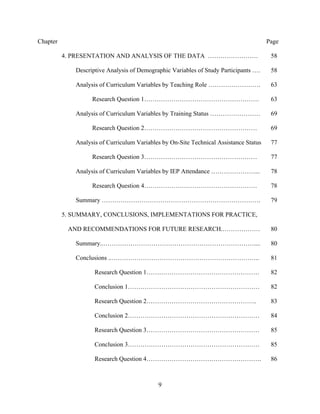
4. PRESENTATION AND ANALYSIS OF THE DATA …………………… 58
Descriptive Analysis of Demographic Variables of Study Participants …. 58
Analysis of Curriculum Variables by Teaching Role ……………………. 63
Research Question 1………………………………………………. 63
Analysis of Curriculum Variables by Training Status …………………… 69
Research Question 2……………………………………………… 69
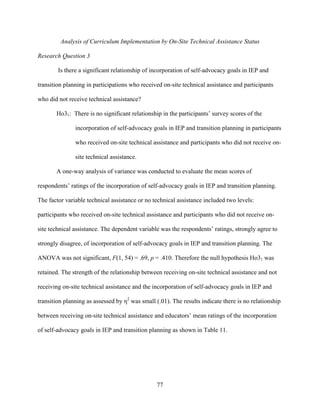
Analysis of Curriculum Variables by On-Site Technical Assistance Status 77
Research Question 3……………………………………………… 77
Analysis of Curriculum Variables by IEP Attendance …………………... 78
Research Question 4……………………………………………… 78
Summary …………………………………………………………………. 79
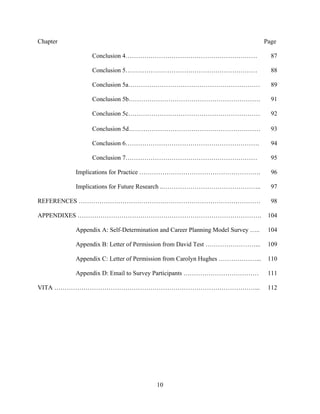
5. SUMMARY, CONCLUSIONS, IMPLEMENTATIONS FOR PRACTICE,
AND RECOMMENDATIONS FOR FUTURE RESEARCH.……………… 80
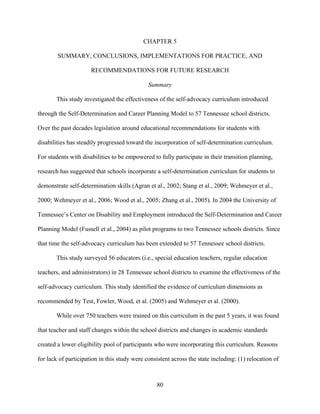
Summary..……………………………………………………………….... 80
Conclusions ..…………………………………………………………….. 81
Research Question 1……………………………………………… 82
Conclusion 1……………………………………………………… 82
Research Question 2…………………………………………….. 83
Conclusion 2……………………………………………………… 84
Research Question 3……………………………………………… 85
Conclusion 3……………………………………………………… 85
Research Question 4………………………………………………. 86
10
Chapter Page
Conclusion 4……………………………………………………… 87
Conclusion 5……………………………………………………… 88
Conclusion 5a……………………………………………………… 89
Conclusion 5b……………………………………………………… 91
Conclusion 5c……………………………………………………… 92
Conclusion 5d……………………………………………………… 93
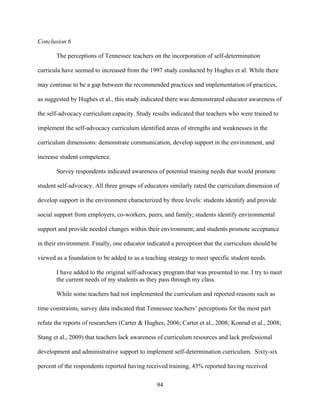
Conclusion 6………………………………………………………. 94
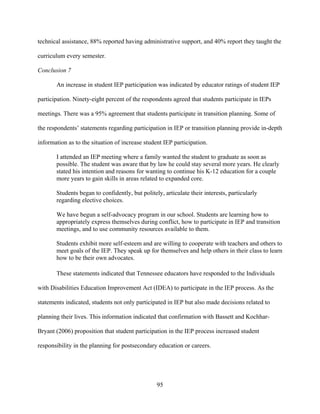
Conclusion 7……………………………………………………… 95
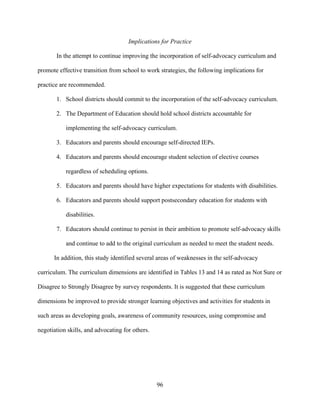
Implications for Practice …………………………………………………. 96
Implications for Future Research ..……………………………………….. 97
REFERENCES …………………………………………………………………………… 98
APPENDIXES ……………………………………………………………………………. 104
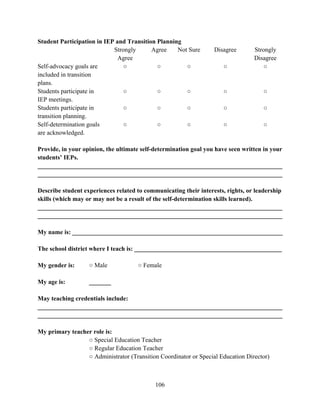
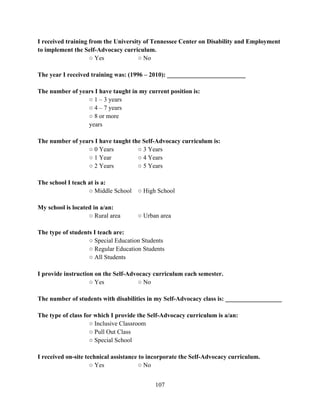
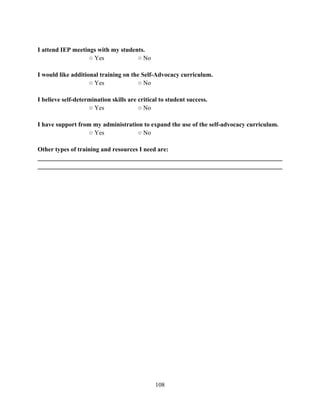
Appendix A: Self-Determination and Career Planning Model Survey ….. 104
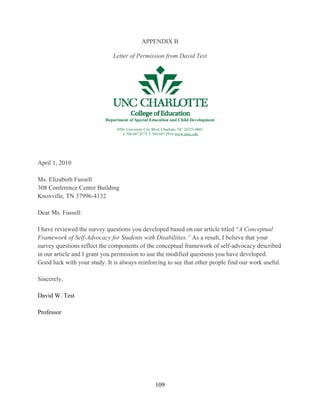
Appendix B: Letter of Permission from David Test ……………………... 109
Appendix C: Letter of Permission from Carolyn Hughes ………………... 110
Appendix D: Email to Survey Participants ……………………………… 111
VITA ……………………………………………………………………………………... 112
11
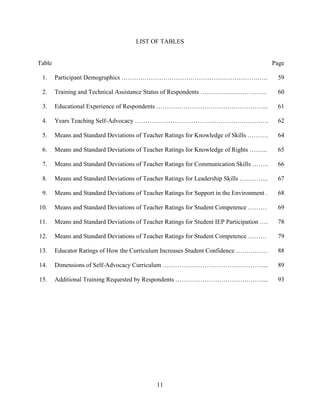
LIST OF TABLES
Table Page
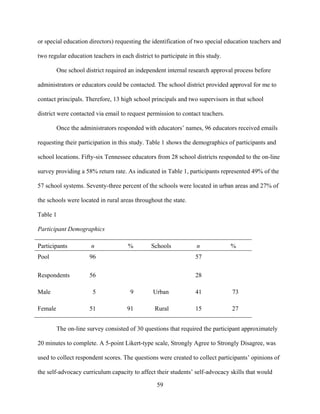
1. Participant Demographics ……………………………………………………………. 59
2. Training and Technical Assistance Status of Respondents ………………………….. 60
3. Educational Experience of Respondents ……………………………………………... 61
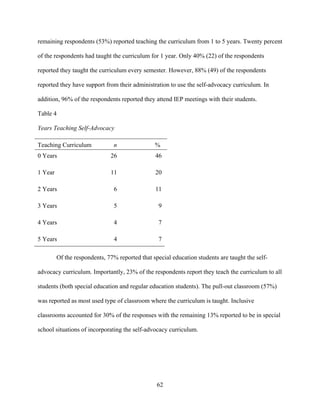
4. Years Teaching Self-Advocacy ………………………………………………………. 62
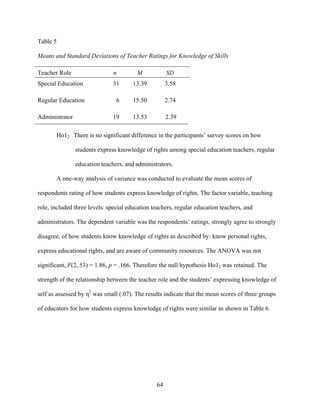
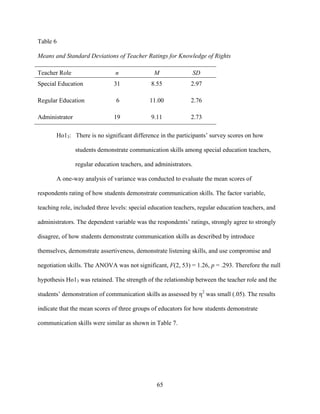
5. Means and Standard Deviations of Teacher Ratings for Knowledge of Skills ………. 64
6. Means and Standard Deviations of Teacher Ratings for Knowledge of Rights ……... 65
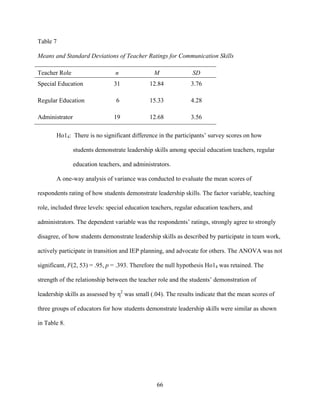
7. Means and Standard Deviations of Teacher Ratings for Communication Skills …….. 66
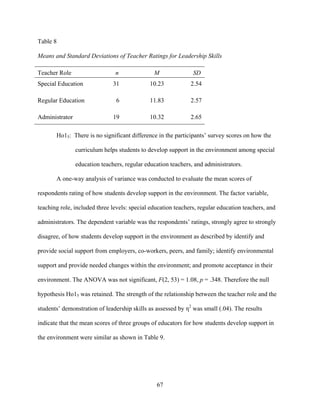
8. Means and Standard Deviations of Teacher Ratings for Leadership Skills ………….. 67
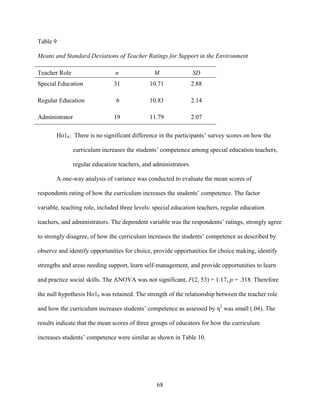
9. Means and Standard Deviations of Teacher Ratings for Support in the Environment . 68
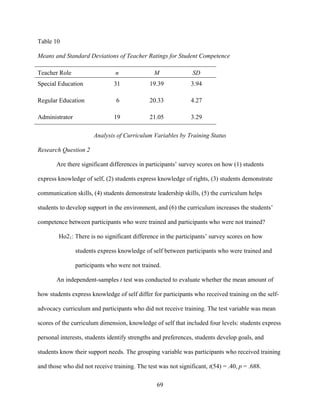
10. Means and Standard Deviations of Teacher Ratings for Student Competence ……… 69
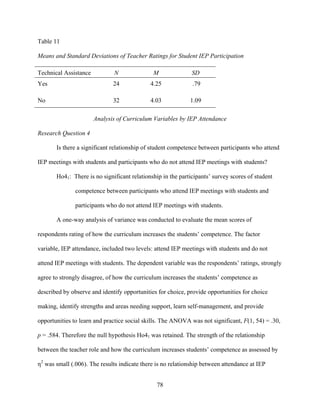
11. Means and Standard Deviations of Teacher Ratings for Student IEP Participation …. 78
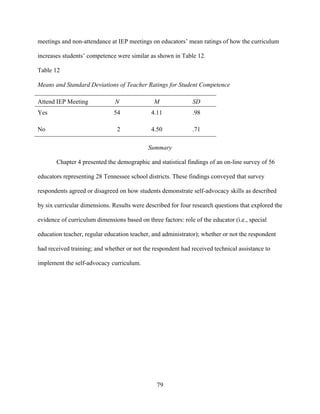
12. Means and Standard Deviations of Teacher Ratings for Student Competence ……… 79
13. Educator Ratings of How the Curriculum Increases Student Confidence …………… 88
14. Dimensions of Self-Advocacy Curriculum …………………………………………... 89
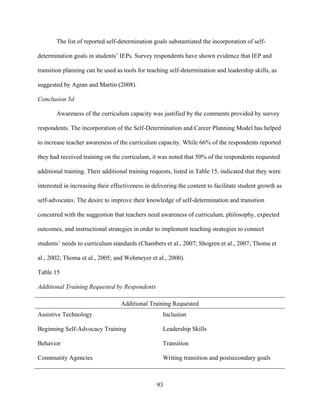
15. Additional Training Requested by Respondents ……………………………………... 93
12
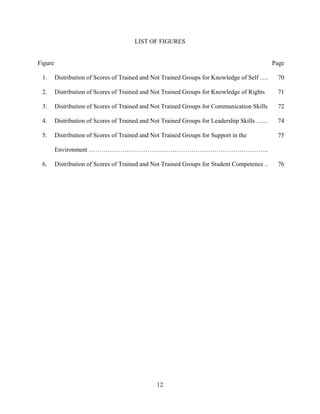
LIST OF FIGURES
Figure Page
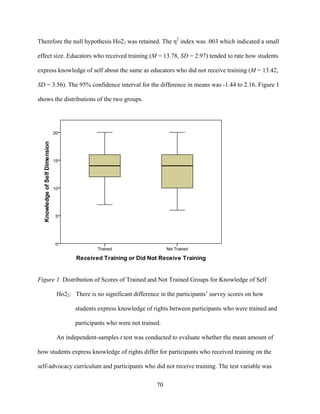
1. Distribution of Scores of Trained and Not Trained Groups for Knowledge of Self …. 70
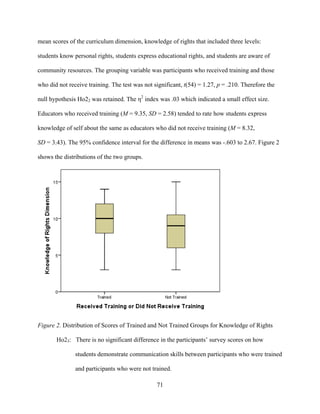
2. Distribution of Scores of Trained and Not Trained Groups for Knowledge of Rights 71
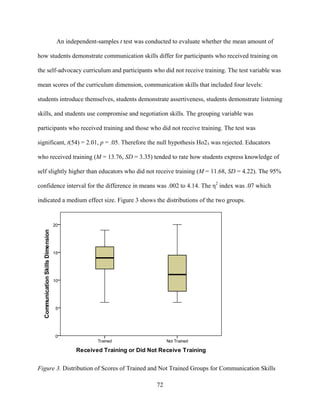
3. Distribution of Scores of Trained and Not Trained Groups for Communication Skills 72
4. Distribution of Scores of Trained and Not Trained Groups for Leadership Skills …... 74
5. Distribution of Scores of Trained and Not Trained Groups for Support in the
Environment …………………………………………………………………………..
75
6. Distribution of Scores of Trained and Not Trained Groups for Student Competence .. 76
13
CHAPTER 1
INTRODUCTION
Demonstration of self-determination skills such as autonomy, self-regulation,
empowerment, and self-realization is a predictor of quality of life (Chambers et al., 2007;
Lachapelle et al., 2005). Self-determination is a process developed in the last few decades that
has provided an avenue for students with disabilities to become empowered to advocate for
themselves and to plan for productive lives in society. Chambers et al. (2007) and Lachapelle et
al. (2005) suggested that students with high levels of self-determination have a correlation to
high quality of life that has been associated as an indicator of successful vocational outcomes.
Although self-determination has been a hot topic of legislators, educators, and employment
organizations for almost 4 decades; Agran, Blanchard, Wehmeyer, and Hughes (2001) and
Chambers et al. contended that self-determination has not yet become a common practice in all
schools.
Tennessee’s New High School Diploma Project, implemented in 2009, stipulated the
development of a focused program of study that allows students to identify accommodations
deemed necessary to be successful (Tennessee State Board of Education, 2007). The Individuals
with Disabilities Education Acts (IDEA) of 1997 and 2004 indicated the need for interventions
(i.e., problem-solving) and the inclusion of students’ interests, preferences, and skills in
transition plans and individualized education programs (IEPs; Agran, Cavin, Wehmeyer, &
Palmer, 2006; Konrad, Walker, Fowler, Test, & Wood, 2008). For students with disabilities to be
empowered to fully participate in their transition planning, research has suggested that schools
incorporate a self-determination curriculum for students to demonstrate self-determination skills
(Agran, Blanchard, Wehmeyer, & Hughes, 2002; Stang, Carter, Lane & Pierson, 2009;
14
Wehmeyer, Agran, & Hughes, 2000; Wehmeyer, Gragoudas, & Shogren, 2006; Wood, Fowler,
Uphold, & Test, 2005; Zhang, Wehmeyer, & Chen, 2005). These skills are intended to enable
students to: (1) identify interests or self-knowledge, (2) explore options for postsecondary
education or vocational training (Test, Fowler, Brewer, & Wood, 2005), and (3) actively
participate in these planning processes (Copeland, Hughes, Agran, Wehmeyer, & Fowler, 2002;
Shogren et al., 2007; Wehmeyer et al., 2000). Assor, Kaplan, and Roth (2002) suggested that
teachers should have the responsibility to ensure student autonomy in planning and identifying
self-knowledge.
In 2004 the University of Tennessee’s Center on Disability and Employment introduced
the Self-Determination and Career Planning Model (Fussell, Jones, & Stults, 2004) to two
Tennessee schools districts in pilot programs. As indicated by Thoma, Baker, and Saddler (2002)
curriculum resources for self-determination were not readily available to teachers. The intent of
the Self-Determination and Career Planning Model was to provide curriculum modules to
educators through professional development and technical assistance to address the need of
Tennessee schools to incorporate self-determination skills as an avenue of student self-discovery.
These curriculum modules were designed for students to: (1) identify their interests, preferences,
and skills; (2) build self-esteem; (3) practice decision making skills; (4) plan and implement goal
setting skills; and (5) develop resumes (Fussell, 2008). This curriculum correlated with school
standards as recommended by Agran et al. (2006). A culmination of the curriculum modules
should provide the information necessary to complete the Summary of Performance as suggested
by Bassett and Kachhar-Bryant (2006) and required by the Individuals with Disabilities
Education Improvement Act (IDEIA) when the student exits school.
15
Test, Fowler, Brewer, et al. (2005) suggested a need for “research involving component
analyses of intervention packages” (p. 121). Test, Fowler, Wood, Brewer, and Eddy (2005)
suggested a conceptual framework for self-advocacy curriculum that included four components:
(1) knowledge of self, (2) knowledge of rights, (3) communication, and (4) leadership. They
purported this “proposed conceptual framework of self-advocacy provides a starting point for
developing instructional strategies” (p. 52). Test, Fowler, Brewer, et al. and Wehmeyer et al.
(2000) have suggested that more information is needed regarding teachers’ awareness of
curricular techniques and the incorporation of self-advocacy goals in student transition plans and
IEPs. Given that, Agran et al. (2006) purported that school-wide interventions require more in-
depth investigation. This study will broaden the research areas in self-determination.
Background of the Problem
Test, Fowler, Brewer, et al. (2005) indicated that research in the area of evidence-based
self-determination curricula is very limited. The No Child Left Behind Act of 2001 and the
Individuals with Disabilities Education Acts of 1997 and 2004 stipulated that evidence-based
curricula are to be used to enhance student academic achievements (Rathvon, 2008). Rubin
(2007) described evidence-based practices as ensuring through rigorous evaluation that
interventions or curricula effectively provide the intended results. Bassett and Kochhar-Bryant
(2006) recommended a student-centered curriculum approach to instruction in order to align
transition and general education standards. Could the Self-Determination and Career Planning
Model be a bridge that assists students with disabilities to actively participant and enhance their
learning opportunities in general education classrooms?
Test, Fowler, Brewer, et al. (2005) indicated the need for further exploration of curricula
and evidence-based practices in the area of self-determination. Of particular interest have been
16
the perceptions of teachers regarding the availability and implementation of curricular resources
(Stang et al., 2009; Test, Fowler, Brewer, et al., 2005). Test, Fowler, Wood, et al. (2005)
recommended that self-determination curricula evaluation be based on a conceptual model.
Significance of the Problem
Wood et al. (2005) examined several self-determination curricula and determined these
curricula to be effective in successfully conveying self-determination skills for students to
actively participate in a rigorous course of study and plan for postsecondary education and
training opportunities following high school. However, the Self-Determination and Career
Planning Model curriculum has not yet been determined as evidence-based. In addition an
investigation of the suggested self-determination curriculum may help determine if educators
agree or disagree that students in Tennessee schools have the resources necessary to demonstrate
self-determination skills.
Purpose of the Study
The purpose of the study was to determine if the Self-Determination and Career Planning
Model included the components of the recommended conceptual framework for self-
determination curriculum. This study investigated the capacity of a self-determination
curriculum implemented in Tennessee schools to promote student demonstration of self-
determination skills. The purpose of this study was to establish evidence if: (1) the curriculum
contained the four curriculum dimensions that make up the conceptual framework of self-
determination curriculum, (2) school-wide intervention had occurred, (3) self-determination
goals were included in IEPs and transition plans, and (4) there was awareness of the curriculum
capacity. In addition, this study determined if there were significant differences in the
perceptions of: (1) special education teachers, regular education teachers, and administrators; and
17
(2) participants who were trained and participants who were not trained regarding the
observation of self-determination skills in students with disabilities.
The effectiveness of this curriculum was determined through a three-part investigation as
suggested by Test, Fowler, Wood, et al. (2005) and Wehmeyer et al. (2000). These areas were:
(1) analysis of the conceptual framework of the curriculum, (2) participant awareness of
curriculum capacity, and (3) incorporation of self-advocacy goals in student transition plans.
First, this study compared the Self-Determination and Career Planning Model used in 57
Tennessee school districts to the recommended conceptual model components of: (1) knowledge
of self, (2) knowledge of rights, (3) communication, and (4) leadership as suggested by Test,
Fowler, Wood, et al. Second, this study explored teachers’ perceptions of the importance of
implementing self-determination skills in Tennessee schools based on their awareness of
curriculum and implementation of self-determination goals in students’ IEPs.
Assumptions
Assumptions of this study included the need for participation on the part of educators to
complete the survey in a thought provoking manner. There was the assumption that educators
would take the time to participate in the survey. Although 750 educators had been trained over
the past 5 years, many of the educators may have relocated or changed positions. The ability to
reach educators via email was also assumed. However, many school districts block outside
electronic contacts. Therefore, it was necessary to identify a contact (e.g., transition coordinator)
on a local level to ensure that participants were identified and received the survey information.
There was the assumption that transition coordinators would identify teachers to complete the
survey. Based on frequent contact with educators, there was the assumption that this curriculum
had been implemented in some school districts as a school-wide intervention.
18
Research Questions
This study focused on the four research questions listed below.
Research Question 1
Are there significant differences in participants’ survey scores of how (1) students
express knowledge of self, (2) students express knowledge of rights, (3) students demonstrate
communication skills, (4) students demonstrate leadership skills, (5) the curriculum helps
students to develop support in the environment, and (6) the curriculum increases the students’
competence among special education teachers, regular education teachers, and administrators?
Research Question 2
Are there significant differences in participants’ survey scores on how (1) students
express knowledge of self, (2) students express knowledge of rights, (3) students demonstrate
communication skills, (4) students demonstrate leadership skills, (5) the curriculum helps
students do develop support in the environment, and (6) the curriculum increases the students’
competence among participants who were trained and participants who were not trained?
Research Question 3
Is there a significant relationship between the participants’ survey scores of the
incorporation of self-advocacy goals in IEP and transition planning in participants who received
on-site technical assistance and participants who did not receive on-site technical assistance?
Research Question 4
Is there a significant relationship in the participants’ survey scores of student competence
among participants who attend IEP meetings with students and participants who do not attend
IEP meetings with students?
19
Definitions
• Conceptual Framework of Self-Determination Curriculum: A guideline that includes
recommended instructional components such as knowledge of self, knowledge of
rights, communication skills, and leadership skills to establish an effective
curriculum.
• Deinstitutionalization: State and federal legislative mandates to provide services to
individuals with disabilities in a community setting rather than an institutional setting.
• Evidence-based Curriculum: Instructional content that has been proven through
empirical research to incorporate scientific practices.
• Focused Program of Study: A 4- to 6-year plan intended to assist middle school
students to identify a rigorous course of study in preparation for high school.
• Individualized Education Program: A federally required planning process for students
with disabilities to set annual educational goals to ensure students receive a free and
appropriate public education including accommodations.
• Postschool Outcomes: Successful or unsuccessful life situations of students after
exiting the school system (i.e., employment, independent living, etc.).
• Self-Advocacy: The act of speaking up for oneself to obtain desired outcomes.
• Self-Determination: The process of knowing your interests, preferences, and skills in
order to become a self-advocate.
• Self-Determination and Career Planning Model: A curriculum developed by the
University of Tennessee’s Center on Disability and Employment. The model includes
training and technical assistance for teachers to implement the curriculum effectively.
20
• Self-determination Skills: Personal abilities such as autonomy, self-regulation,
empowerment, and self-realization that empower individuals to speak up for
themselves.
• Supported Employment: A recognized program to promote employment of
individuals with significant disabilities in employment opportunities in the
community given a place and train methodology.
• Summary of Performance: A federally required document that all special education
students receive upon exit from high school indicating the student’s interests,
preferences, and skills related to postsecondary education and employment.
• Transition Plan: A federally mandated planning process for students with disabilities
beginning at the age 16 to set goals for postsecondary educational, employment
training, etc. upon exit from high school.
Limitations of the Study
Some factors that may have limited the quality of responses of participants are:
• There was participation from only 28 of the 57 school districts.
• Administrators had been replaced after the training was provided. The new
administrators had no knowledge of that the curriculum was in place or that training
was available.
• Teachers who were trained were no longer in the same school or position.
• Teachers did not implement the curriculum.
• Administrators did not ensure that the curriculum was implemented.
• There were changes in email addresses, making it difficult to contact teachers who
were trained.
21
• The small number of regular education teachers available to participate in this study
was considered unreliable.
Delimitations of the Study
This study included special education teachers and regular education teachers from
school districts that had received training or technical assistance from the University of
Tennessee Center’s on Disability and Employment on the Self-Determination and Career
Planning Model. Teachers who were trained may have shared the information with their
coworkers, thus creating situations where survey participants were not involved in the training or
technical assistance opportunities. Other school districts may have had an interest in the
curriculum or may have used other resources. However, this study focused on the specific self-
advocacy curriculum.
Organization of the Study
This study was organized in the following approach. Chapter 1 provides an overview and
significance of the problem to be investigated. Chapter 2 explores research literature related to
techniques of establishing evidence-based self-determination curriculum and educators’
perceptions of the benefits of self-determination as a necessary school-wide intervention.
Chapter 3 identifies the research design to develop the on-line survey, gather information from
educators, and to analyze the data to address four main research questions. Chapter 4 presents the
demographic and statistical findings of an on-line survey of 56 educators representing 28
Tennessee school districts. Chapter 5 summarizes the study and provides implications for
practice and future research.
22
CHAPTER 2
REVIEW OF LITERATURE
Sydney Harris, a syndicated journalist and former teacher said, “The whole purpose of
education is to turn mirrors into windows” (Thinkexist, 2010, para 3). This statement illustrates
the concept of self-determination. Bandura (1986) and Bassett and Kochhar-Bryant (2006)
maintained that students should have the opportunity to envision their individual roles and
purposes as successful adults. Education reform has escalated the roles of both educators and
students to be actively engaged in directing educational paths toward successful postschool
outcomes. While educators have selected evidence-based interventions for curricula or programs
proven through rigorous research to promote successful outcomes (Rathvon, 2008; U.S.
Department of Education, 2003); students have been encouraged to take an active, autonomous
role in developing the knowledge and skills that will enhance their opportunities to become
productive, contributing adults in the community. Stang et al. (2009) reported self-determination
skills such as autonomy, self-regulation, empowerment, and self-realization to effectively
facilitate “improved in-[school] and post-school outcomes” (p. 94).
Self-esteem, self-advocacy, self-concept, self-efficacy, and self-determination have been
referred to as the inner understanding of oneself (Merriam-Webster’s Collegiate Dictionary,
1990). These terms stem from activities in the field of self-determination that are effective for
people to validate personal worth to others in their lives. Substantial literature has claimed that
self-determination skills empower individuals to know who they are, what they like, and how to
communicate their preferences to others (Carter, Owens, Trainor, Sun, & Swedeen, 2009; Erwin
et al., 2009; Pennell, 2001; Shapiro, 1993; Shogren et al., 2007; Wehmeyer et al., 2006; Wood et
al., 2005).
23
What do you want to be when you grow up? is a common question in our society. Yet,
many high school students have not been equipped to answer that question. This lack of self-
determination skills has become a conflicting issue in middle schools and high schools today.
Agran and Martin (2008) and Test, Fowler, Wood, et al. (2005) stated that students are required
to plan for careers after high school, yet with particular attention to specific curriculum
dimensions (i.e., decision-making and problem-solving) students have not been taught the skills
to develop concrete plans. Bassett and Kochhar-Bryant (2006), Carter et al. (2009), and Thoma
et al. (2002) have agreed that this problem is intensified for students with disabilities. Konrad et
al. (2008), Stang et al. (2009), and Test, Fowler, Wood, et al. have suggested that self-
determination has been correlated to improved student outcomes. Yet, Carter, Lane, Pierson, and
Stang (2008) indicated that students with disabilities “lack the critical skills that can enhance
their self-determination” (p. 56).
Literature (Agran et al., 2001; Agran et al., 2002; Assor et al., 2002; Chambers et al.,
2007) has suggested that self-determination has not been incorporated in schools to the extent
necessary to provide students with disabilities the opportunities they need to be successful. In
fact, it has been argued that self-determination has often received low priority in instruction.
Bandura (1986) suggested that schools do not succeed in the purpose of promoting social
validation in students’ self-efficacy. Therefore, Erwin et al. (2009) suggested that schools should
incorporate self-determination curriculum as “an intentional and ongoing process” to promote
self-determination skills effectively (p. 28).
Self-determination, often synonymous with self-advocacy, has been endorsed by
legislators (Bassett & Kochhar-Bryant, 2006), educators (Wehmeyer, 1995), and employment
organizations, (Devlin, 2008). Individuals with disabilities have the right to make informed
24
choices in relation to their daily lives, education, careers, etc. Literature has purported the need
and benefits of self-determination skills for students with disabilities. Nevertheless, Thoma,
Williams, and Davis (2005) reported that only 14 out of 155 articles on self-determination
published between 1995 and 2002 addressed self-determination curriculum models.
Literature (Agran et al., 2001; Agran et al., 2002; Wehmeyer, 1995) has supported that
self-determination and self-advocacy instruction benefits students with cognitive or
developmental disabilities. Likewise, the skills associated with self-determination such as
autonomy, self-regulation, empowerment, and self-realization (Lachapelle et al., 2005;
Wehmeyer, 1995) benefit all students in planning successful lives. Bandura (1986) suggested
that students attain self-efficacy skills through individualized instruction and self-knowledge. A
blending of these skills contributes to students becoming self-determined (Erwin et al., 2009).
Thoma et al. (2005) suggested that self-determination is “a critical component of effective
transition planning” as students exit school and enter adulthood (p. 104).
The Individuals with Disabilities Education Act (IDEA) of 1997 indicated a need for
school-wide interventions in self-determination (Agran et al., 2006). The 2004 reauthorization of
the Individuals with Disabilities Education Improvement Act (IDEIA) put an emphasis on the
inclusion of self-determination and self-advocacy in transition plans and Individualized
Education Programs (IEPs). Encouraged by this legislation, the Tennessee Department of
Education, Division of Special Education strived to improve the incorporation of self-advocacy
goals and employment goals in transition plans through professional development for special
education teachers.
Thoma et al. (2002) suggested that professional development in self-determination is
necessary because coursework in self-determination is not available in most teacher preservice
25
programs. As recommended by Carter and Hughes (2006), Chambers et al. (2007), and Copeland
et al. (2002), Tennessee teachers have been offered, upon request, professional development to
facilitate self-determination goals for students to assist in transition from high school to
postschool activities. In addition, the Tennessee State Board of Education (2007) included a
detailed focus on professional development for teachers to incorporate modified curricula and
active learning for all students to encourage student participation in transition planning and IEP
development. These actions were intended to maximize opportunities for students with
disabilities to participate in general education programs as part of a rigorous course of study
(Agran et al., 2006).
Historical evidence has indicated that individuals with disabilities have had less
opportunity for independence than their peers without disabilities (Agran & Martin, 2008;
Pennell, 2001; Shapiro, 1993). While changes in our society have reflected more respect and
value for people with disabilities, there has continued to be some residual attitudes by educators
that students with disabilities do not have the skills to succeed in life as do their peers without
disabilities. Awareness of this issue has led grass-roots groups and the United States legislature
to encourage the incorporation of self-determination skills for students with disabilities (Pennell,
2001; Shapiro, 1993).
Test, Fowler, Wood, et al. (2005) found that self-determination skills are critical for
students with disabilities to be empowered to know their interests and express those interests to
others. Without self-determination skills, many students are pressured by peers, family members,
friends, educators, and support personnel to take jobs or live in housing arrangements that may
not reflect the students’ interests. However, literature has strongly supported the idea that when
people are self-determined and can advocate for themselves, it is more likely they will make their
26
own choices regarding their lives (Agran et al., 2001; Agran et al., 2002; Agran & Martin, 2008;
Chambers et al., 2007; Erwin et al., 2009; Miner & Bates, 2008; Thoma et al., 2002; Ward, 2005;
Wehmeyer et al., 2000; Wood et al., 2005; Zhang et al., 2005).
History of Self-Determination
Individuals with disabilities have not always had opportunities to exercise their rights to
make decisions about where they lived, what they learned, or how they were treated. At birth
doctors were quick to inform parents of babies born with disabilities they could not learn and
would be best served in an institution. Thinking that the doctors knew best, parents sent their
children to state run schools and institutions (Shapiro, 1993). Scotch (2009) reported that self-
determination and self-advocacy movements have been influenced by many groups including the
National Association of the Deaf (NAD) in 1880, the League of the Physically Handicapped in
the 1930s, the National Federation of the Blind in 1940, and the National Association for
Retarded Citizens (The Arc) to promote the rights of individuals with disabilities.
Shapiro (1993) explained that the self-advocacy movement began in 1968. Bengt Nirje,
an administrator in Sweden, was attempting to make living conditions for individuals with
disabilities align with other people in the community. This concept became known as
normalization. The notion of normalization was that people with disabilities “could and should
have a role in their own choices” (p. 193). The normalization movement influenced the United
States in 1969 to promote the closure of institutions and create inclusion for individuals with
disabilities. While grassroots efforts pursued self-advocacy through The Association of Retarded
Citizens, Centers for Independent Living, and People First Chapters, it would in the 1970s that
the concept gained the attention of policy makers. In the 1980s the concept of self-advocacy was
27
introduced as people with disabilities and the people supporting them encouraged others to view
them as people first, not their disability or limitations (Pennell, 2001).
Components of self-determination have been found in federal legislation since the 1970s
(Shapiro, 1993; Wood et al., 2005). However, Wood et al. mentioned that federal programs in
the 1980s such as supported employment and deinstitutionalization were implemented without
the benefit of self-determination mandates. The philosophy of self-determination was introduced
in the 1990s to advocate that the power and control of life should be shifted to each individual
(Pennell, 2001). People First chapters led by individuals with disabilities organized throughout
the United States under the support of The Arc. The Association for Retarded Citizens name was
changed to The Arc in 1991 when individuals with disabilities asked to be known as people first.
The self-determination movement gave individuals with disabilities a forum to express their
desire to make choices and have control of their own lives (Shapiro, 1993). Together with
disability service leaders and researchers self-advocates moved the self-determination movement
forward (Wood et al., 2005).
Self-advocates, through People First, developed the Principles of Self-Determination in
1989 that represented the choice of individuals with disabilities for respect and support for their
individual choices (Ward, 2005). Disability researchers have reported that positive life outcomes
and increases in quality of life indicators for people with disabilities are associated with the
incorporation of self-determination skills in daily school instruction. As the practice of self-
determination continued, disability organizations recognized the impact of self-determination on
the lives of individuals with disabilities (Stang et al., 2009; Wood et al., 2005).
The United States Department of Education, Office of Special Education Programs,
Secondary Education and Transition Services Bureau adopted the construct of self-determination
28
in 1990 with an emphasis on enhancing the learning experiences and life outcomes for students
with disabilities (Wehmeyer, 1995). As the self-determination movement continued to progress,
the practice of implementing self-determination in schools was initiated (Pennell, 2001). In 2004
specific mandates of the IDEIA implied the incorporation of self-determination skills (Konrad et
al., 2008). Students need self-determination skills in order to actively participate in the
development of IEPs in middle school and high school including goals related to work and
postsecondary education (Agran & Martin, 2008; Miner & Bates, 2008). The self-determination
movement has changed the way people with disabilities are respected for their abilities to gain
independent lives, take responsibility for their choices, and increase their quality of life (Agran &
Martin, 2008; Chambers et al., 2007; Lachapelle et al., 2005; Pennell, 2001; Scotch, 2009;
Wehmeyer, 2007).
Self-Determination Theory
In the past some physicians have indicated that individuals with disabilities could not and
should not make their own choices, thus, requiring permanent placement and supervision for
their actions. Thankfully, other practitioners had other thoughts regarding the capabilities of
individuals with disabilities to be responsible for learning and behaviors. Bandura (1986)
explained the Social Cognitive Theory as a relationship between behavior, knowledge of self,
and environmental variables. He further stated that people learn through awareness of the
behavior, active involvement, and awareness of the consequences associated with their
behaviors. Test, Fowler, Brewer, et al. (2005) found in the meta-analyses of 25 interventions that
the studies they examined “provide preliminary evidence” (p. 120) that individuals with
disabilities could learn to be responsible for their behaviors given awareness of options,
knowledge of self, and support in their surroundings. Agran and Martin (2008) proposed that
29
self-determination and its associated skills prepare students to plan successful transitions from
school to adult life. In addition Stang et al. (2009) found these skills to serve as a means for
students to be more independent and responsible for their actions as adults.
Definition of Self-Determination
T. J. Monroe, a self-advocate, defines self-advocacy in a letter to President George H.
Bush on the day of the signing of the Americans with Disabilities Act. Shapiro quoted T. J.’s
definition of self-advocacy as follows:
Self-advocate means knowing your rights and responsibilities. Self-advocate means
standing up for your own rights. Self-advocate means speak for yourself and make your
own decisions, being more independent, standing on your own two feet and sticking up
for your rights as a self-advocate (Shapiro, 1993, p. 209).
Self-determination has been defined as the ability and opportunity to make choices
(Agran & Martin, 2008). Yet, Wehmeyer (2007) indicated that this can be a complex effort. Due
to the work of the grassroots efforts of The Arc, Centers for Independent Living, People First
Chapters, and many other groups, the development of self-determination skills has been
recognized as essential curricular needs for students with disabilities to learn the options
available to them and how to take responsibility for their actions. Curricular components that
enable students with disabilities to have more control over their lives have been identified as
expressing preferences, problem-solving, and choice-making (Agran & Martin, 2008; Wehmeyer
et al., 2006) as well as “goal setting, self-regulation, and self-advocacy” (Thoma & Wehmeyer,
2005, p. 54).
Principles of Self-Determination
Self-advocates active in People First organizations across the United States developed
principles of self-determination. Five of the principles have served as the foundation for self-
determination literature: Freedom, Authority, Support, Responsibility, and Confirmation (Nerney
30
& Shumway, 1996; Pennell, 2001; Turnbull & Turnbull, 2006). The emphasis on these specific
principles stemmed from the heartfelt desire of individuals with disabilities to be seen as people
first. Individuals with disabilities explained if people treated them in a considerate and respectful
manner, they would learn to make choices for themselves based on their individual dreams (i.e.,
freedom); maintain control of their lives through supports (i.e., authority); and arrange for
necessary support to assist them to be successful in their work, home, and community (i.e.,
support). In addition, self-advocates indicated they were valued and contributing members of
society through their active participation in work and community organizations (i.e.,
responsibility). Finally, confirmation was added as a principle as self-advocates implemented
self-determination. Turnbull and Turnbull reported that the concept of the fifth principle (i.e.,
confirmation) indicated the recognition of others to be accepted as an integral part of change in
their lives and to celebrate their accomplishments.
Mandates for Self-Determination Goals in Transition Plans
The IDEA of 1997 indicated a need for school-wide interventions (e.g., problem-solving
skills) that would enable students with disabilities to access the general curriculum (Agran et al.,
2006). The 2004 reauthorization of the IDEIA put an emphasis on the inclusion of students’
interests, preferences, and skills in transition plans and individualized education programs (IEPs;
Konrad et al., 2008). These mandates strengthened the significance of free and appropriate public
education (Bassett & Kochhar-Bryant, 2006). Thoma et al. (2002) have encouraged teacher in-
services to include strategies whereby IEPs would “be based on student preferences and
interests” (p. 83). The Tennessee Division of Special Education focused on improving the
incorporation of self-determination goals (e.g., student responsibility for learning) and
employment goals in transition plans through professional development in transition planning
31
(Tennessee Department of Education, 2000). Thoma et al. stated that professional development
for educators in these areas is necessary as training in self-determination is not typically
available in most teacher preservice programs.
Student Participation in IEP Process
The principles of transition services, as stated in the IDEA 1997 and IDEIA 2004, have
indicated specific benchmarks for planning and implementing academic courses of study,
vocational skills, and community participation. Bassett and Kochhar-Bryant (2006) reported that
these principles require that the groundwork for transition services should begin in the
elementary and middle school years. The IDEA 1997 required that students be invited to the IEP
meetings at age 14. The IDEIA 2004 changed this age to 16 (Bassett & Kochhar-Bryant, 2006).
However, Tennessee chose to invite students to the IEP meeting at age 14 (Tennessee State
Department of Education, 2008).
The student invitation to the IEP meeting was intended for the student to fully participate
in the academic, social, and vocational planning for the high school experience, leading toward
the transition from school to postsecondary education or the workforce. Legislation and self-
determination best practices indicated that students should participate to the fullest capability
possible. Bassett and Kochhar-Bryant (2006) purported that the student’s participation in the IEP
process increased student responsibility in the planning for postsecondary education or careers.
Agran and Martin (2008), Miner and Bates (2008), and Test, Fowler, Wood, et al. (2005) have
agreed that students should be included in the planning process as early as possible to empower
students to enhance leadership skills. They have also agreed that student involvement promotes
student and family responsibility and commitment to the plan, leading to more positive
32
postschool outcomes. Therefore, Tennessee’s decision to keep the invitation age at 14
emphasized the importance of middle school student participation in the transition process.
IEP Based on Student Needs, Interests, and Preferences
Bassett and Kochhar-Bryant (2006) stated that principles of transition planning include
the incorporation of students’ individual needs, interests, preferences, and linkages to community
services. They argued that adults and students alike must realize the importance of student
participation in the IEP process. To fully participate, students must be empowered (e.g., by
adults and peers) to: (1) realize their interests and preferences, (2) demonstrate effective
communication skills to speak up about their interests and preferences, and (3) explore their
career options with peers and adults to adequately plan meaningful transition plans (Miner &
Bates, 2008).
Least Restrictive Environment
The IDEIA 2004 emphasized the concept of least restrictive environment. This concept
mandates that students with disabilities be educated in the same classrooms as general education
students. Three common terms have come from this legislation: mainstreaming, inclusion, and
full-inclusion. These terms have reflected the philosophy of educators when placing students in
general education classes. Spence-Cochran and Pearl (2006) defined that mainstreaming is the
“selective placement” of students with disabilities in particular classes (p. 138). Inclusion, they
said, indicates a greater commitment from educators for students with disabilities to be included
in classes for longer periods of time. Inclusion, they argued, emphasizes the need for schools to
provide a continuum of services for students with disabilities. Educators respond to the term full-
inclusion by including students with disabilities in general education classes on a full-time basis
providing needed accommodations or modifications (Spence-Cochran & Pearl, 2006).
33
Falvey, Rosenberg, Monson, and Eshilian (2006) reported that the concept of least
restrictive environment is beneficial for all students in that students with disabilities develop
friendships with all their peers and learn appropriate social skills among their peers. They said
students with disabilities performed better in both social and academic realms and are likely to
be more successful in employment and postsecondary opportunities. In addition, Falvey et al.
insisted that full inclusion allows students in general education to understand the rights and
capabilities of students with disabilities. They argued that these learning opportunities have
contributed to the development of a more caring and competent society.
Student Supports. Spence-Cochran and Pearl (2006) have pointed out that there are three
types of supports required by students with disabilities in the general education classroom. These
supports include: personal supports, curriculum accommodations and modifications, and
assistive and instructional technology. They stated that adhering to least restrictive environment
mandates required collaboration between the general and special educators. Differentiated
instructional practices were required and the role of the special educator revolved around the
individual needs of the students within the given content, process, or products of the class.
Falvey et al. (2006) and Spence-Cochran and Pearl suggested that all students benefit from
supports in the classroom through the implementation of universal design. McDonnell et al.
(2006) recommended embedded instruction as an effective instructional strategy. Falvey et al.
recommended another effective instructional strategy, that is both least intrusive and engages
students, is cooperative grouping. This strategy allows for student participation as well as teacher
team teaching.
34
Summary of Performance
The IDEIA 2004 stated that transition planning should culminate in a Summary of
Performance provided to each student with an IEP upon exit from high school. The summary of
performance includes the student’s interests, preferences, and skills as well as academic, social,
and vocational training (Agran & Martin, 2008; Bassett-Kochhar-Bryant, 2006). Agran and
Martin have purported that the Summary of Performance should be student directed rather than
educator directed. When developed in the student directed style, the final product served as
another self-determination tool that provided the student with greater awareness of the activities
planned for successful postschool outcomes.
Standards-Based Education
The No Child Left Behind Act (NCLB) of 2001 mandated that students with disabilities
are to be included in regular education classroom as well as to meet the regular education
curriculum standards (Bassett & Kochhar-Bryant, 2006; Wehmeyer, 2007). A concept behind the
NCLB Act was to align curriculum standards across school systems and states to ensure that all
students exit school prepared for postsecondary education or the workforce. This legislation has
held educators accountable for student graduation rates based on more rigid instructional
practices. The NCLB has emphasized “standards-based education…as a catalyst for improved
educational results” (Bassett & Kochhar-Bryant, 2006, p. 4). In addition, the NCLB and IDEA
legislations have stipulated that evidence-based curricula are to be used to further enhance
student academic achievements (Rathvon, 2008).
Educators have struggled with the NCLB Act mandate to hold students with disabilities
accountable for meeting general curriculum standards. Bassett and Kochhar-Bryant (2006)
reported that this concern has led to the call for collaboration between middle and high school
35
educators to ensure that transition planning and inclusion in general education courses begin
early. However, this strategy alone has not been enough to ensure that all students are included
and thrive in regular education classes. To comply with the NCLB requirements, there is a need
for a school-wide reform at the local level where educators understand and accept their role in
differentiated teaching strategies to ensure all students learn and demonstrate curriculum
standards. Rathvon (2008) has suggested that the NCLB Act “highlighted the importance of
classroom strategies that can enhance the capacity of teachers to meet student needs and the
capacity of students to respond to instruction” (p. 4). Bassett and Kochhar-Bryant recommended
a student-centered curriculum approach to instruction in order to align transition and general
education standards.
Tennessee’s New High School Diploma Project
Tennessee’s New High School Diploma Project became effective at the beginning of the
2009-2010 school year. This project increased the minimum number of required credits to 22 for
students to earn a high school diploma. Students are now required to complete 4 years of
English, math, and science courses (Tennessee State Board of Education, 2007). Until the 2009-
2010 school year Tennessee students with disabilities had the option of receiving a Special
Education Diploma in lieu of a Regular High School Diploma. However, the new high school
diploma project has eliminated the Special Education Diploma. Students with disabilities now
have the option of earning a Transition Certificate, IEP Certificate, or a Regular High School
Diploma.
Transition Certificate. A Transition Certificate is awarded to students with disabilities
who in their 4th year of high school have: (1) participated in regular education classes attempting
to earn the required 22 high school credits but failed to earn a required grade of 70 or above on
36
end-of-course exams, (2) satisfactorily completed the IEP goals, and (3) received good conduct
and attendance records. Students earning a Transition Certificate may return to school up to their
22nd
birthday to continue working toward a Regular High School Diploma (Tennessee State
Board of Education, 2008).
IEP Certificate. An IEP Certificate is awarded to students with disabilities who in the
year of their 22nd
birthday have: (1) satisfactorily completed the IEP goals, (2) developed a
portfolio, and (3) received satisfactory conduct and attendance records. The IEP Certificate
replaced the Special Education Diploma (Tennessee State Board of Education, 2008).
Regular High School Diploma. A Regular High School Diploma is awarded to students
who have: (1) completed at least 22 required high school credits and (2) received satisfactory
conduct and attendance records (Tennessee State Board of Education, 2008).
A concern about the new high school diploma program has been reported that the dropout
rate for students with disabilities will increase given the fact they will not earn a diploma. Stang
et al. (2009) reported that students with disabilities “become disengaged” with school and
dropout of school (p. 95). Bridgeland, DiIulio, and Morison (2006) reported that nationally the
top five reasons that students drop out of school are: (1) classes were not interesting, (2) missed
too many days and could not catch up, (3) people around them were not interested in school, (4)
had too much freedom, and (5) was failing classes. They continued to report that parent
involvement came too late to prevent student dropout. Of the dropouts surveyed, 71% indicated
the school should have done more to make school more interesting. Bridgeland et al. surveyed a
number of dropouts and reported 74% of them would have not dropped out of school had they
known how difficult it would be for them to achieve successful employment. Activities that
would have kept these students in school included were: (1) opportunities for real-world learning
37
(e.g., service learning), (2) teachers to keep the classes interesting, and (3) better communication
between parents and school (e.g., parental involvement).
A second concern has been established that students with disabilities have a greater
disadvantage of gaining competitive employment without a diploma than students who earn a
regular high school diploma. Wehman and Thoma (2006) suggested that the students who drop
out of school are typically unemployed or underemployed throughout life. There was a time
when a high school diploma was necessary to secure a good job in the community. More and
more we are seeing that a college degree or specific vocational training is required to meet the
demands of the employment arena. Employers generally ask if students have a high school
diploma. Yet, Murray (2008) has shown that employers look for personal characteristics such as
work ethic and interview skills rather than the type of diploma presented. Employers’
perspectives toward diploma types showed little difference. Employers have accepted a
Certificate of Attendance for entry level positions and an Occupational Diploma and the General
Education Diploma (GED) for any positions. If students drop out of school without the benefit of
a diploma or certificate, can they demonstrate the expected personal characteristics of work ethic
and interview skills to be successfully employed of establish careers?
Importance of Self-Determination Skills for Students Transitioning from School to Adult Life
Wehmeyer (2007) suggested that the initial step to promoting self-determination skills is
to infuse a self-determination curriculum into “day-to-day instruction” (p. 21). Self-
determination was originally implemented in schools for the purpose of improving students’
active participation in the transition process (Wehmeyer et al., 2006). Erwin et al. (2009),
Pennell (2001), and Wehmeyer et al. argued that learning to speak up for yourself and your rights
is a process that requires real-life experiences and practice to implement.
38
Agran et al. (2002), Stang et al. (2009), Wehmeyer et al. (2000), Wehmeyer et al. (2006),
Wood et al. (2005), and Zhang et al. (2005) have indicated that teaching self-determination skills
to students with disabilities promotes academic success; successful transition from school to
work; and improved social skills related to employment, independent living, and positive
relationships in the community. Thus, self-determined students have more positive outcomes as
adults. Ward (2005), Wehmeyer et al. (2000), and Wehmeyer et al. (2006) purported students
who display self-determined behavior are more likely to be employed, earn more money than
their peers, receive benefits, and live independently. Given the evidence to support positive
outcomes, it is accepted that self-determination is vital to the success of the transition from
school to adult life process for students with disabilities.
The process of self-determination has been found to enable students to acquire the skills
necessary to adequately participate in educational planning and subsequently gaining ownership
of those plans. Active participation in the IEP and transition processes has been determined to
have a potential impact on a student’s demonstration of self-determination skills (Agran &
Martin, 2008; Miner & Bates, 2008; Shogren et al., 2007). However, Stang et al. (2009) and
Thoma et al. (2002) indicated that student participation in the IEP and transition processes has
not increased and is lacking in many schools. In addition, Test, Fowler, Brewer, et al. (2005) and
Test, Fowler, Wood, et al. (2005) reported that self-determination goals have been found to
continue to be lacking in IEP and transition plans.
School-Wide Interventions in Self-Determination in Tennessee
In 2004 the University of Tennessee’s Center on Disability and Employment introduced
the Self-Determination and Career Planning Model (Fussell et al., 2004) as pilot programs to two
Tennessee schools districts. As indicated by Thoma et al. (2002) curriculum resources for self-
39
determination were not readily available to teachers. In correlation with school standards as
recommended by Agran et al. (2006) the intent of the Self-Determination and Career Planning
Model was to provide curriculum modules to educators through professional development and
technical assistance to address the need of Tennessee schools to incorporate self-determination
skills as an avenue of student self-discovery. These curriculum modules were designed for
students to identify their interests, preferences, and skills; build self-esteem; practice decision
making skills; plan and implement goal setting skills; and develop resumes (Fussell, 2008). A
culmination of the curriculum modules should provide the information necessary for educators to
complete the Summary of Performance required when the student exits the school system as
suggested by Bassett and Kachhar-Bryant (2006).
Rathvon (2008) suggested that a best practice in classroom intervention is to understand
the situation from the teachers’ perspective. She reported that the teacher needs to appreciate the
resource materials provided in the intervention and realize how the intervention will affect
student learning. Rathvon added that classroom or school-wide interventions should include all
school stakeholders including teachers, administrators, and parents regarding the rationale or
related theory and expected outcomes of the intervention provided. Embedding instruction of
self-determination in the general education classroom, she said, will ensure students with
disabilities have the opportunity to apply decision-making skills to their current situation.
McDonnell et al. (2006) reported that embedded instruction in general education classrooms was
as successful for students with disabilities as the self-contained special education class. They
further stated that embedded instruction enhances student learning outcomes and accommodates
individual student needs.
40
Conceptual Framework and Evidence-Based Practices of Self-Determination Curricula
Research conducted by Test, Fowler, Brewer, et al. (2005) suggested a need for “research
involving component analyses of intervention packages” (p. 121). The conceptual framework for
self-advocacy curriculum developed by Test, Fowler, Wood, et al. (2005) included four
components: (1) knowledge of self, (2) knowledge of rights, (3) communication, and (4)
leadership. They purported this “proposed conceptual framework of self-advocacy provides a
starting point for developing instructional strategies” (p. 52). They argued that practitioners need
to embrace the need for a conceptual framework for curriculum coupled with the need for
evidence-based curricula to develop school-wide interventions that will increase student
achievement in the general education curriculum as well as preparation for postsecondary
education and employment (Rathvon, 2008; Test, Fowler, Wood, et al., 2005).
Stang et al. (2009) and Test, Fowler, Brewer, et al. (2005) suggested that more
information is needed regarding teachers’ awareness of curricular techniques. Wehmeyer et al.
(2000) advocated for the incorporation of self-advocacy goals in student transition plans and
IEPs. Agran et al. (2006) purported that more in-depth investigation of school-wide interventions
is required to determine the successful implementation of self-determination skills. Chambers et
al. (2007), Thoma et al. (2002), and Thoma et al. (2005) have all suggested that preservice
teacher training and continuous professional development for teachers is necessary to ensure that
the construct of self-determination becomes an integral part of the development of IEPs and
transition plans.
Bassett and Kochhar-Bryant (2006) suggested that the transition process should have a
conceptual framework. IDEA legislation now requires the alignment of transition services and
general education curriculum standards. This alignment can occur when educators consider the
41
components of transition services as a coordinated plan to include a blending of system planning,
individual planning, and community linkages. Agran and Martin (2008) purported that the IEP
and transition plan can become tools for teaching self-determination and leadership skills.
Therefore, self-determination should be the foundation for transition planning. The foundation of
self-determination empowers students with skills and information to be active participants in
planning their lives.
Agran and Martin (2008) suggested seven key components of implementing self-
determination strategies. These components focus on the student learning and incorporating
responsibility for behaviors. Bassett and Kochhar-Bryant (2006) referred to this as a student-
centered approach. The fundamental components have been described as: (1) explain the purpose
of self-determination to the student, (2) ensure student awareness of behaviors, (3) establish a
realistic performance level, (4) determine the degree of student support needed, (5) decide on
specific instructional strategy, (6) provide instruction incorporating levels of decision making
and supports, and (7) monitor and evaluate student performance (Agran & Martin, 2008).
The conceptual framework of curriculum has been found to be important to the future
success of the student. Bassett and Kochhar-Bryant (2006) suggested that students are more
likely to become engaged in curricular activities and transition planning when the content relates
to their interests and preferences, as well as directly relates to their individual lives. Similarly,
Agran and Martin (2008), Bassett and Kochhar-Bryant, and Miner and Bates (2008) claimed that
when curricular activities including IEP development and transition planning are based on the
individual student’s interests and preferences, students and families alike have become more
involved in the process and taken more responsibility for postschool outcomes. Bassett and
Kochhar-Bryant suggested that “authentic learning practices offer viable means by which to
42
mediate academically challenging content and skills by illuminating their relevance to real-life
tasks” (p. 11).
Perceptions of Teachers on Incorporation of Self-Determination Curricula
Tennessee teachers are offered, upon request, professional development in developing
self-determination goals for students as they transition from high school to postschool activities
as recommended by Carter and Hughes (2006), Chambers et al. (2007), and Copeland et al.
(2002). In addition, the Tennessee State Board of Education (2007) included a detailed focus on
professional development for teachers to incorporate modified curricula and active learning for
all students that leads to student participation in transition planning and IEP development. These
actions were intended to maximize opportunities for students with disabilities to participate in
general education programs as part of a rigorous course of study (Agran et al., 2006). Each
student’s focused program of study should include accommodations deemed necessary for the
student be successful.
Conflicting results are reported from teachers’ perceptions of the implementation of self-
determination curriculum in schools. Chambers et al. (2007) reported a meta-analysis of
teachers’ perceptions suggesting that students would benefit from self-determination skills in
school activities and postschool outcomes. However, many of the same teachers reported that
teaching self-determination skills would not benefit their students. This perception has been
further emphasized through the lack of IEP goals linked to self-determination and the lack of
student involvement in the IEP process (Test, Fowler, Wood, et al., 2005).
One reason teachers have offered for their lack of self-determination instruction is time
constraints in their instructional schedules. However, Chambers et al. (2007), Konrad et al.
(2008), Thoma et al. (2002), and Thoma et al. (2005) reported that many teachers do not have the
43
knowledge or skills necessary to teach self-determination skills because this construct was not
included in their preservice training. Thoma et al. (2002) found that teachers were not aware of
curriculum or had access to curriculum to teach self-determination skills. Additionally, teachers
reported a lack of professional development and administrative support to implement self-
determination curriculum (Carter & Hughes, 2006; Carter et al., 2008; Konrad et al., 2008; Stang
et al., 2009). Devlin (2008) and Zhang et al. (2005) stated that it is evident that the teacher’s role
in promoting self-determination is vital. Chambers et al. explained that although teachers
consider self-determination skills to be helpful, they do not necessarily offer to implement self-
determination curricula in their classrooms. In addition classroom observations have indicated a
lack of teacher promotion of self-determination skills in curriculum instruction as well as in IEP
and transition planning processes (Thoma et al., 2002).
Purpose of Self-Determination Skills
For students to be empowered to fully participate in their transition planning, IEP
development, and subsequent academic or vocational course of study, it is considered best
practice for schools to incorporate a self-determination curriculum for students to learn, practice,
and demonstrate self-determination skills that will help them: (1) identify interests or self-
knowledge, (2) explore options for postsecondary education or training (Test, Fowler, Brewer, et
al., 2005), and (3) actively participate in these planning processes (Copeland et al., 2002;
Shogren et al., 2007; Wehmeyer et al., 2000). Assor et al. (2002) suggested that teachers are
responsible to ensure student autonomy in planning and identifying self-knowledge. Agran and
Martin (2008), Bassett and Kochhar-Bryant (2006), Miner and Bates (2008), and Wehmeyer et
al. (2006) have suggested that teachers should be equipped with the necessary skills (e.g.,
knowledge of self-determination, personal values assessment) and resources (e.g., curricula,
44
worksheets, access to IEP goals) to facilitate self-determination skills to empower students to be
active participants in their educational and transition planning. These actions are intended to
ensure that school systems are meeting the mandates of present legislation and promoting best
practice for students to achieve positive academic, social, and postschool outcomes.
Educator Skills to Implement Self-Determination Skills
Given the challenge to provide students with disabilities access to general curriculum and
to be accountable for student academic success, many educators are confronted with time
constraints to implement new strategies. Konrad et al. (2008) created A Model for Aligning Self-
Determination and General Curriculum Standards. Their model recommended that teachers
must first have an awareness of the self-determination construct. Next, teachers had to decide:
(1) what to teach, and (2) how to teach, followed by (3) evaluation and adjustment. This model
provided “planning worksheets (to) guide teachers through the process and can be applied to
instructional decision-making for an individual student” (p. 53-54).
Educator Responsibility
Research has indicated that teachers do not always take the responsibility of infusing self-
determination skills into their curriculum seriously. Agran et al. (2001) argued that the
opportunity to facilitate increased positive outcomes for students is “at best, underutilized”
(p. 321). Agran et al. and Hughes et al. (1997) argued that often not a high instructional priority.
Hughes et al. explored the perceptions of special education teachers throughout Tennessee to
actually implement “empirically-derived strategies” in transition best practices (p. 202). The
results of their study indicated that while teachers were receptive to strategies introduced, they
were more likely to implement the strategies in various forms, ignoring the original intent of the
curriculum. Thus, consistency of instruction or support was lacking from teacher to teacher as
45
well as situation to situation. Unfortunately, Test, Fowler, Brewer, et al. (2005) reported that
teachers surveyed had little or no knowledge of resources and materials for self-determination
instruction. Teachers have reported that they are less likely to provide self-determination to
students with significant disabilities because of their varying beliefs regarding the effectiveness
of self-determination (Agran et al., 2006; Chambers et al., 2007).
Agran and Martin (2008), Bassett and Kochhar-Bryant (2006), Miner and Bates (2008),
and Wehmeyer et al. (2006) suggested that to confidently teach self-determination skills,
teachers need to participate in professional development focusing on the philosophy of self-
determination and how self-determination skills promote increased student academic and
postschool outcomes. This professional development should occur in both teacher preservice
training and school in-services emphasizing self-determination skills and instructional techniques
to facilitate increased implementation in the classroom. Chambers et al. (2007), Shogren et al.
(2007), Thoma et al. (2002), Thoma et al. (2005), and Wehmeyer et al. (2000) argued that
teachers need awareness of curriculum, philosophy, expected outcomes, and instructional
strategies in order to implement teaching strategies to connect students’ needs to curriculum
standards and employ continuous assessments to determine student progress and areas where
students need more assistance. Rathvon (2008) stated that teachers need the knowledge and skills
to incorporate classroom strategies that will blend academic and social skills instruction in a
group setting. She added that there is a need for teachers to know “the process of designing,
implementing, and evaluating interventions” in a classroom of diverse students (p. 4). Additional
suggested instructional strategies included differentiated instruction (Spence-Cochran & Pearl,
2006), universal design, cooperative grouping (Falvey et al., 2006), and embedded instruction
(McDonnell et al., 2006).
46
Professional Development
Professional development for teachers and preservice training for teaching students have
been found to be imperative to promote the consistent implementation of self-determination as a
“critical component” (Shogren et al., 2007, p. 507) of the transition process (Chambers et al.,
2007; Shogren et al., 2007; Thoma et al., 2002; Thoma et al., 2005; Wehmeyer et al., 2000).
Thoma et al. (2002) suggested that if teachers are to lead this critical process of transition, it is
vital they receive comprehensive training in the complexities of self-determination and core
skills of transition services. In addition Test, Fowler, Brewer, et al. (2005) suggested that
teachers explore their personal values toward self-determination of students with disabilities in
an attempt to increase the teachers’ self-awareness of their perceptions toward self-
determination. Assor et al. (2002) found that students sense the teacher’s value of self-
determination and will respond more positively to teachers who demonstrate positive attitudes
toward empowerment and the student’s capability to be self-determined. Shogren et al. (2007)
suggested that “methods to promote self-determination across educational activities and settings
must be developed, evaluated, and shared with teachers” (p. 507).
Indicated Need for More In-Depth Research of Teacher Implementation
of Self-Determination Curriculum
Self-determination, often synonymous with self-advocacy, has been endorsed by
legislators (Bassett & Kochhar-Bryant, 2006), educators (Wehmeyer, 1995), and employment
organizations (Devlin, 2008) as a right of individuals to make informed choices in relation to
their daily lives, education, career, etc. Literature has supported the need for and benefits of self-
determination for students with disabilities. A total of 155 peer reviewed articles on self-
determination were identified between 1995 and 2002 by Thoma et al. (2005). Of these articles
47
only 9% addressed curriculum models. Yet, researchers (Agran et al., 2002; Agran et al., 2006;
Carter et al., 2008; Carter et al., 2009; Wehmeyer et al., 2006) have continued to contribute
empirical studies supporting the benefits of self-determination in the classroom.
While research has supported that self-determination instruction benefits students with
cognitive or developmental disabilities (Agran et al., 2001; Agran et al., 2002; Agran & Martin,
2008; Wehmeyer, 1995), it is noteworthy to mention that the skills associated with self-
determination such as autonomy, self-regulation, empowerment, and self-realization (Lachapelle
et al., 2005; Wehmeyer, 1995) have benefitted all students with the ability to plan successful
lives (Konrad et al., 2008). Bandura (1986) suggested that students attain self-efficacy skills
through individualized instruction and self-knowledge. A blending of these skills has contributed
to students being self-determined (Erwin et al., 2009). Self-determination has been found to be a
key component of transition as students exit school and enter adult life (Agran & Martin, 2008;
Bassett & Kochhar-Bryant, 2006; Miner & Bates, 2008; Thoma et al., 2005; Wehmeyer et al.,
2000).
Further research on the implementation and impact of self-determination skills for
students with disabilities has been advocated by numerous researchers (Agran et al., 2002; Agran
& Martin, 2008; Bassett & Kochhar-Bryant, 2006; Hughes et al., 1997; Test, Fowler, Brewer, et
al., 2005; Wehmeyer et al., 2000). Some aspects regarding the implementation of self-
determination skills merited local investigation to student outcomes in Tennessee. Particular
elements of self-determination included the extent to which students are invited to and
participate in their IEP and transition planning processes, the effectiveness of current self-
determination curriculum, as well as the actual implementation of curriculum provided by
educators in Tennessee. In addition it has been of particular interest to determine the status of
48
Tennessee educators’ perceptions in preparing students to transition from school to adult life and
to enter postsecondary education programs or the workforce related to the work of Hughes et al.
(1997).
Summary
Legislative mandates require student participation in the IEP goals planning process
based on student needs, interests, and preferences. In addition students with disabilities are to be
included in general education classrooms and be held accountable for their academic
achievements as well as to develop plans that will facilitate their transition from school to adult
life. Transition plans are required to include goals related to postsecondary education or
employment and connections to adult community supports when necessary.
Self-determination skills are known to effectively assist students with disabilities to
achieve greater postschool outcomes (e.g., employment, benefits, quality of life). Researchers
have recommended a conceptual framework for self-determination curricula as a means of
meeting both the needs of students and legal mandates. Given that self-determination skills are
the recommended tools and teachers are the key instructors of these skills, there are specific
questions related to the incorporation of self-determination curriculum in Tennessee schools.
Does the Self-Determination and Career Planning Model include the components of the
recommended conceptual framework? Do Tennessee teachers implement the curriculum? Is
there a need for professional development in the area of self-determination to better increase the
success of students with disabilities in the general educational curriculum? Awareness of the
educators’ perceptions of self-determination skills and curricula implementation strategies will
reveal the need for professional development and school-wide interventions that will enhance the
incorporation of self-determination skills.
49
CHAPTER 3
RESEARCH METHODS
Self-determination skills such as autonomy, self-regulation, empowerment, and self-
realization empower individuals to know who they are, what they like, and how to communicate
their preferences to others. Without self-determination skills many students are pressured by
peers, family members, friends, educators, and support personnel to take jobs or live in housing
arrangements that may not reflect the students’ interests. When students are self-determined and
can advocate for themselves, it is more likely they will make their own choices regarding their
lives. However, research in the area of evidence-based self-determination curricula is very
limited. Test, Fowler, Brewer, et al. (2005) have indicated the need for further exploration of
curricula and evidence-based practices in area of self-determination. Of particular interest are the
perceptions of teachers regarding the availability and implementation of curricular resources
(Stang et al., 2009; Test, Fowler, Brewer, et al., 2005). Test, Fowler, Wood, et al. (2005)
recommended that self-determination curricula evaluation should be based on a conceptual
model. This study compared the Self-Determination and Career Planning Model used in 57
Tennessee school districts to the recommended conceptual model components of: (1) knowledge
of self, (2) knowledge of rights, (3) communication, and (4) leadership suggested by Test,
Fowler, Wood, et al. Second, this study explored teachers’ perceptions of the importance of
implementing self-determination skills in Tennessee schools based on their awareness of
curriculum capacity of the Self-Determination and Career Planning Model and implementation
of self-determination goals in students’ Individualized Education Programs (IEPs).
50
Research Design
This nonexperimental study employed descriptive and comparative statistical designs to
present data gathered from 56 educators in 28 school districts throughout Tennessee that have
implemented the Self-Determination and Career Planning Model. Participants including special
education, regular education teachers, and administrators were asked to complete an on-line
survey pertaining to curriculum effectiveness, school-wide intervention, incorporation of self-
advocacy goals in IEPs, and awareness of curriculum capacity. Survey data were used to
describe participants based on nominal attributes such as gender, teaching credentials, experience
with curriculum (number of years implementing the curriculum), type of school (middle school
or high school), type of classroom (inclusive, pull-out, or special school), type of school
environment (rural or urban), and type of teacher training (intensive coaching or technical
assistance). In addition to demographic dimensions the survey asked participants to respond to
seven dimensions related to the curriculum’s impact on students’: (1) knowledge of self, (2)
knowledge of rights, (3) communication skills, (4) leadership skills, (5) support in the
environment, (6) competence, and (7) participation in IEP and transition planning.
Participants
Since 2005 more than 750 Tennessee teachers in 57 school districts have completed
training to incorporate the Self-Determination and Career Planning Model. These teachers, their
co-instructors, and administrators were asked to complete an on-line survey beginning in
September 2010. Transition coordinators at each of the 57 school systems were asked to select
two special education teachers and two regular education teachers to complete the survey as part
of this study. A total of 96 special education teachers, general education teachers, and
administrators (i.e., transition coordinators or special education directors) were identified to
51
participate in this study. Teachers were grouped by: (1) teaching role (special education teacher,
regular education, or administrator) and (2) trained or not trained. Teachers completed the on-
line survey containing 30 questions regarding the perceived benefits of the Self-Determination
and Career Planning Model and the student outcomes they have observed after: (1) teaching self-
determination skills and (2) incorporating self-determination goals in students’ IEPs.
Data Collection
Special education teachers, regular education teachers, and administrators were asked to
complete an on-line survey using a 5-point Likert-type scale. Survey data were analyzed to
evaluate curriculum to determine if based on participants’ survey scores the curriculum provided
adequate information for students to demonstrate self-determination skills. Test, Fowler, Wood,
et al., (2005) suggested four components in their conceptual framework for self-determination:
knowledge of self, knowledge of rights, communication skills, and leadership skills. Two open-
ended questions allowed participants to report student outcomes.
Development of the Survey Instrument
The survey incorporated a 5-point Likert-type scale to measure the six dimensions of
knowledge of self, knowledge of rights, communication skills, leadership skills, student
competence, and student participation in IEP and transition planning. In addition open-ended
questions were used to collect input regarding self-determination goals and student outcomes.
The survey was developed using a Statistical Package for the Social Sciences (SPSS)
DimensionNet (2006) survey software called mrInterview. The participants completed the survey
on-line. The survey contained 30 questions intended to capture information related to: (1)
demographic information, (2) conceptual framework for self-determination curriculum, and (3)
secondary transition support strategies. See Appendix A for a copy of the survey.
52
Validity in this study was established with the intent to expand on the research efforts of
previous studies (Hughes et al., 1997; Test, Fowler, Wood, et al., 2005; Wehmeyer et al., 2000).
Reliability was established through the efforts of: (1) quality in design and (2) the replicating
reliable instruments used in previous studies. Written permission was granted from the
researchers to tailor questions from previous studies to the specific curricula and practices in
Tennessee schools. See Appendixes B and C for copies of the letters.
Survey questions related to the conceptual framework were modified from the Test,
Fowler, Wood, et al. (2005) study using their suggested components. These components were
originally developed from a meta-analysis of literature and input from stakeholders including
individuals who research in the disability field, teachers, parents, and curriculum developers. The
framework was then used to review 20 curricula to establish these components as effective
strategies for self-determination (Test, Fowler, Wood, et al., 2005). Survey questions related to
secondary transition support strategies were modified from a study conducted by Hughes et al.
(1997) on practitioner validated secondary transition strategies. The original questionnaire was
validated through a review of literature and pre-established criterion for empirical validity as
well as a social validation through a national survey of 54 applied researchers in the area of
transition (Hughes et al., 1997). Thus, these survey questions had been proven to have both
validity and reliability.
Methodology
This study investigated a self-determination curriculum implemented in Tennessee
schools. The effectiveness of this curriculum was determined through a three-part investigation
suggested by Test, Fowler, Wood, et al. (2005) and Wehmeyer et al. (2000). These areas are: (1)
analysis of the conceptual framework of the curriculum, (2) participant awareness of curriculum
53
capacity, and (3) incorporation of self-advocacy goals in student transition plans. This study
compared the Self-Determination and Career Planning Model used in 57 Tennessee school
districts to the recommended conceptual model components of: (1) knowledge of self, (2)
knowledge of rights, (3) communication, and (4) leadership as suggested by Test, Fowler, Wood,
et al. Second, this study explored teachers’ perceptions of the importance of implementing self-
determination skills in Tennessee schools based on their awareness of curriculum and
implementation of self-determination goals in students’ IEPs.
Descriptive and comparative statistical methods were used to establish assumptions
regarding the curriculum’s effectiveness. The first step to implement this study was to develop
the survey instrument ensuring that valid and reliable questions and procedures are incorporated.
The on-line survey was developed using the statistical software package, SPSS mrInterview,
based on the capacity of this service to be easily made available to and completed by participants
(SPSS Statistics Software, 2006). Second, the participants and their contact information were
determined. Contact information was collected via phone and email contacts to each transition
coordinator in each school district.
Participants received an email requesting their participation in this study. The email
contained an explanation of the study, how and why they were selected to participate,
confidentiality of their responses, and timeline for completing the survey, and appreciation for
their input. See Appendix D for a copy of the email. An incentive for participation was offered.
Participants who completed the survey were added to a drawing to win a $50 pre-paid Visa card.
Participants had a 2-week period to complete the survey. Reminders were sent to potential
participants allowing an additional week to complete. Frequent contacts to participants were a
strategy to ensure response rate of the survey.
54
Research Questions and Null Hypotheses
This study focused on the four research questions listed below.
Research Question 1
Are there significant differences in participants’ survey scores of how (1) students
express knowledge of self, (2) students express knowledge of rights, (3) students demonstrate
communication skills, (4) students demonstrate leadership skills, (5) the curriculum helps
students to develop support in the environment, and (6) the curriculum increases the students’
competence among special education teachers, regular education teachers, and administrators?
Ho11: There is no significant difference in the participants’ survey scores on how
students express knowledge of self among special education teachers, regular
education teachers, and administrators.
Ho12: There is no significant difference in the participants’ survey scores on how
students express knowledge of rights among special education teachers, regular
education teachers, and administrators.
Ho13: There is no significant difference in the participants’ survey scores on how
students demonstrate communication skills among special education teachers,
regular education teachers, and administrators.
Ho14: There is no significant difference in the participants’ survey scores on how
students demonstrate leadership skills among special education teachers, regular
education teachers, and administrators.
Ho15: There is no significant difference in the participants’ survey scores on how the
curriculum helps students to develop support in the environment among special
education teachers, regular education teachers, and administrators.
55
Ho16: There is no significant difference in the participants’ survey scores on how the
curriculum increases the students’ competence among special education teachers,
regular education teachers, and administrators.
Research Question 2
Are there significant differences in participants’ survey scores on how (1) students
express knowledge of self, (2) students express knowledge of rights, (3) students demonstrate
communication skills, (4) students demonstrate leadership skills, (5) the curriculum helps
students do develop support in the environment, and (6) the curriculum increases the students’
competence between participants who were trained and participants who were not trained?
Ho21: There is no significant difference in the participants’ survey scores on how
students express knowledge of self among participants who were trained and
participants who were not trained.
Ho22: There is no significant difference in the participants’ survey scores on how
students express knowledge of rights among participants who were trained and
participants who were not trained.
Ho23: There is no significant difference in the participants’ survey scores on how
students demonstrate communication skills among participants who were trained
and participants who were not trained.
Ho24: There is no significant difference in the participants’ survey scores on how
students demonstrate leadership skills among participants who were trained and
participants who were not trained.
56
Ho25: There is no significant difference in the participants’ survey scores on how the
curriculum helps students to develop support in the environment among
participants who were trained and participants who were not trained.
Ho26: There is no significant difference in the participants’ survey scores on how the
curriculum increases the students’ competence among participants who were
trained and participants who were not trained.
Research Question 3
Is there a significant relationship between the participants’ survey scores of the
incorporation of self-advocacy goals in IEP and transition planning in participants who received
on-site technical assistance and participants who did not receive on-site technical assistance?
Ho31: There is no significant relationship in the participants’ survey scores of the
incorporation of self-advocacy goals in IEP and transition planning in participants
who received on-site technical assistance and participants who did not receive on-
site technical assistance.
Research Question 4
Is there a significant relationship in the participants’ survey scores of student competence
between participants who attend IEP meetings with students and participants who do not attend
IEP meetings with students?
Ho41: There is no significant difference in the participants’ survey scores of student
competence among participants who attend IEP meetings with students and
participants who do not attend IEP meetings with students.
57
Data Analysis
Descriptive statistics was used to describe participants’ perceptions related to the benefits
of the Self-Determination and Career Planning Model. The Predictive Analytics Software
(PASW; 2009) was used to analyze the data. Two statistical measures were used, the
independent-samples t test and the analysis of variance (ANOVA), to describe demographic
variables among the participants and answer the research questions.
To answer research questions 1, 3, and 4 ANOVAs were employed to determine if
participants agreed or disagreed that the curriculum incorporated the six dimensions listed. An
independent-sample t test was employed to determine if training on the curriculum made a
difference in participants’ perceptions of the curriculum components in research question 2.
Statistical measures determined the extent to which participants demonstrate awareness of
curriculum capacity as indicated by (1) number of years teaching curriculum and (2) teaching
curriculum each semester.
Summary
Researchers have suggested that self-determination curriculum follow a conceptual
model that includes four instructional components including: knowledge of self, knowledge of
rights, communication skills, and leadership skills. This nonexperimental study gathered data
from 56 special education teachers, regular education teachers, and administrators from 28
Tennessee school districts employing a 30 question survey. The purpose of the study was to
determine if the Self-Determination and Career Planning Model included the components of the
recommended conceptual framework for self-determination curriculum. The survey was
developed with permission from researchers to modify questions used in published research
articles. The survey was accessible on-line for convenience and ease of completion.
58
CHAPTER 4
PRESENTATION AND ANALYSIS OF THE DATA
This study investigated the capacity of a self-advocacy curriculum implemented in
Tennessee schools to promote student demonstration of self-determination skills. This study
determined if there were significant differences in the perceptions of: (1) special education
teachers, regular education teachers, and administrators and (2) participants who are trained and
participants who are not trained regarding the observation of self-determination skills in students
with disabilities.
The effectiveness of the self-advocacy curriculum was determined through a three-part
investigation as suggested by Test, Fowler, Wood, et al. (2005) and Wehmeyer et al. (2000).
These suggested areas are: (1) analysis of the conceptual framework of the curriculum, (2)
participant awareness of curriculum capacity, and (3) incorporation of self-advocacy goals in
student transition plans. First, this study compared the Self-Determination and Career Planning
Model used in 57 Tennessee school districts to the recommended conceptual model of: (1)
knowledge of self, (2) knowledge of rights, (3) communication, and (4) leadership as suggested
by Test, Fowler, Wood et al. Second, this study explored teachers’ perceptions of the importance
of implementing self-determination skills in Tennessee schools based on their awareness of
curriculum and implementation of self-determination goals in students’ Individualized
Educational Programs (IEPs).
Descriptive Analysis of Demographic Variables of Study Participants
Educators in 57 Tennessee school districts were asked to participant in an on-line survey
to evaluate a self-advocacy curriculum provided by the University of Tennessee’s Center on
Disability and Employment. Emails were sent to 57 administrators (i.e., transition coordinators
59
or special education directors) requesting the identification of two special education teachers and
two regular education teachers in each district to participate in this study.
One school district required an independent internal research approval process before
administrators or educators could be contacted. The school district provided approval for me to
contact principals. Therefore, 13 high school principals and two supervisors in that school
district were contacted via email to request permission to contact teachers.
Once the administrators responded with educators’ names, 96 educators received emails
requesting their participation in this study. Table 1 shows the demographics of participants and
school locations. Fifty-six Tennessee educators from 28 school districts responded to the on-line
survey providing a 58% return rate. As indicated in Table 1, participants represented 49% of the
57 school systems. Seventy-three percent of the schools were located in urban areas and 27% of
the schools were located in rural areas throughout the state.
Table 1
Participant Demographics
Participants n % Schools n %
Pool 96 57
Respondents 56 28
Male 5 9 Urban 41 73
Female 51 91 Rural 15 27
The on-line survey consisted of 30 questions that required the participant approximately
20 minutes to complete. A 5-point Likert-type scale, Strongly Agree to Strongly Disagree, was
used to collect respondent scores. The questions were created to collect participants’ opinions of
the self-advocacy curriculum capacity to affect their students’ self-advocacy skills that would
60
provide statistical results for four research questions. Research questions focused on six
curriculum dimensions including knowledge of self, knowledge of rights, communication skills,
leadership skills, support in the environment, and competence related to the opinions of
educators’ roles and experiences with the Self-Determination and Career Planning Model. A
seventh dimension, IEP participation, was included to determine educators’ opinions if students
participate in IEP meetings. Each of the seven dimensions was characterized by 3-5 levels.
Three groups of educators participated in the on-line survey: (1) special education
teachers at 57%, (2) regular education teachers at 11%, and (3) administrators (i.e., transition
coordinators or special education directors) at 32%. Respondents were grouped based on their
teaching role (special education teacher, regular education teacher, and administrator), whether
or not their received training to implement the curriculum, and whether or not they received on-
site technical assistance.
Survey respondents reported whether or not they had received training and on-site
technical assistance from the University of Tennessee’s Center on Disability and Employment. A
significant 66% of respondents reported having received training and 43% reported having
received on-site technical assistance as indicated in Table 2.
Table 2
Training and Technical Assistance Status of Respondents
Training n % Technical Assistance n %
Yes 37 66 Yes 24 43
No 19 34 No 32 57
The age of survey respondents ranged from 24 to 64 (M = 46, SD = 11). The mean age of
the respondents was 46 years old. Approximately 71% (40) of the respondents were 40 to 64
61
years old. Respondents who were 24-39 years old accounted for the remaining 29% (16). Eighty-
two percent of these educators reported teaching in high schools and 18% taught in middle
schools. The respondents reported 100% agreement that self-determination skills are critical to
student success.
Educators reported a wide range of educational experience with the greater percentage
(67%) having a Bachelor’s Degree. Other degrees are listed in Table 3. Educators’ experience in
the education field was spread over a range of years including: 1-3 years (27%), 4-7 years (32%),
with a larger percentage of respondents teaching 8 or more years (41%). Respondents also listed
additional qualifications including highly qualified to teach in English, Math, Science, Social
Studies, Government and Economics, and Language Arts as well as experience in Curriculum
and Instruction.
Table 3
Educational Experience of Respondents
Degree n % Years in Position n %
Associate’s Degree 1 1 1-3 15 27
Bachelor’s Degree 37 67 4-7 18 32
Master’s Degree 10 18 8+ 23 41
Education Specialist 5 10
Doctorate 2 4
Almost half of the respondents (46%) reported having taught the self-advocacy
curriculum for 0 years as shown in Table 4. Respondents reported reasons for not teaching the
curriculum as: (1) just received training and not yet implemented, (2) no time to implement given
new academic standards, and (3) would like additional training to teach the curriculum. The
62
remaining respondents (53%) reported teaching the curriculum from 1 to 5 years. Twenty percent
of the respondents had taught the curriculum for 1 year. Only 40% (22) of the respondents
reported they taught the curriculum every semester. However, 88% (49) of the respondents
reported they have support from their administration to use the self-advocacy curriculum. In
addition, 96% of the respondents reported they attend IEP meetings with their students.
Table 4
Years Teaching Self-Advocacy
Teaching Curriculum n %
0 Years 26 46
1 Year 11 20
2 Years 6 11
3 Years 5 9
4 Years 4 7
5 Years 4 7
Of the respondents, 77% reported that special education students are taught the self-
advocacy curriculum. Importantly, 23% of the respondents report they teach the curriculum to all
students (both special education and regular education students). The pull-out classroom (57%)
was reported as most used type of classroom where the curriculum is taught. Inclusive
classrooms accounted for 30% of the responses with the remaining 13% reported to be in special
school situations of incorporating the self-advocacy curriculum.
63
Analysis of Curriculum Variables by Teaching Roles
Research Question 1
Are there significant differences in participants’ survey scores of how (1) students
express knowledge of self, (2) students express knowledge of rights, (3) students demonstrate
communication skills, (4) students demonstrate leadership skills, (5) the curriculum helps
students to develop support in the environment, and (6) the curriculum increases the students’
competence among special education teachers, regular education teachers, and administrators?
Ho11: There is no significant difference in the participants’ survey scores on how
students express knowledge of self among special education teachers, regular
education teachers, and administrators.
A one-way analysis of variance was conducted to evaluate the mean scores of
respondents rating of how students express knowledge of self. The factor variable, teaching role,
included three levels: special education teachers, regular education teachers, and administrators.
The dependent variable was the respondents’ ratings, strongly agree to strongly disagree, of how
students express knowledge of self as described by: express personal interests, identify strengths
and preferences, develop goals, and know their support needs. The ANOVA was not significant,
F(2, 53) = 1.16, p = .322. Therefore the null hypothesis Ho11 was retained. The strength of the
relationship between the teacher role and the students’ expressing knowledge of self as assessed
by η2
was small (.04). The results indicate that the mean scores of three groups of educators for
how students express knowledge of self were similar as shown in Table 5.
64
Table 5
Means and Standard Deviations of Teacher Ratings for Knowledge of Skills
Teacher Role n M SD
Special Education 31 13.39 3.58
Regular Education 6 15.50 2.74
Administrator 19 13.53 2.39
Ho12: There is no significant difference in the participants’ survey scores on how
students express knowledge of rights among special education teachers, regular
education teachers, and administrators.
A one-way analysis of variance was conducted to evaluate the mean scores of
respondents rating of how students express knowledge of rights. The factor variable, teaching
role, included three levels: special education teachers, regular education teachers, and
administrators. The dependent variable was the respondents’ ratings, strongly agree to strongly
disagree, of how students know knowledge of rights as described by: know personal rights,
express educational rights, and are aware of community resources. The ANOVA was not
significant, F(2, 53) = 1.86, p = .166. Therefore the null hypothesis Ho12 was retained. The
strength of the relationship between the teacher role and the students’ expressing knowledge of
self as assessed by η2
was small (.07). The results indicate that the mean scores of three groups
of educators for how students express knowledge of rights were similar as shown in Table 6.
65
Table 6
Means and Standard Deviations of Teacher Ratings for Knowledge of Rights
Teacher Role n M SD
Special Education 31 8.55 2.97
Regular Education 6 11.00 2.76
Administrator 19 9.11 2.73
Ho13: There is no significant difference in the participants’ survey scores on how
students demonstrate communication skills among special education teachers,
regular education teachers, and administrators.
A one-way analysis of variance was conducted to evaluate the mean scores of
respondents rating of how students demonstrate communication skills. The factor variable,
teaching role, included three levels: special education teachers, regular education teachers, and
administrators. The dependent variable was the respondents’ ratings, strongly agree to strongly
disagree, of how students demonstrate communication skills as described by introduce
themselves, demonstrate assertiveness, demonstrate listening skills, and use compromise and
negotiation skills. The ANOVA was not significant, F(2, 53) = 1.26, p = .293. Therefore the null
hypothesis Ho13 was retained. The strength of the relationship between the teacher role and the
students’ demonstration of communication skills as assessed by η2
was small (.05). The results
indicate that the mean scores of three groups of educators for how students demonstrate
communication skills were similar as shown in Table 7.
66
Table 7
Means and Standard Deviations of Teacher Ratings for Communication Skills
Teacher Role n M SD
Special Education 31 12.84 3.76
Regular Education 6 15.33 4.28
Administrator 19 12.68 3.56
Ho14: There is no significant difference in the participants’ survey scores on how
students demonstrate leadership skills among special education teachers, regular
education teachers, and administrators.
A one-way analysis of variance was conducted to evaluate the mean scores of
respondents rating of how students demonstrate leadership skills. The factor variable, teaching
role, included three levels: special education teachers, regular education teachers, and
administrators. The dependent variable was the respondents’ ratings, strongly agree to strongly
disagree, of how students demonstrate leadership skills as described by participate in team work,
actively participate in transition and IEP planning, and advocate for others. The ANOVA was not
significant, F(2, 53) = .95, p = .393. Therefore the null hypothesis Ho14 was retained. The
strength of the relationship between the teacher role and the students’ demonstration of
leadership skills as assessed by η2
was small (.04). The results indicate that the mean scores of
three groups of educators for how students demonstrate leadership skills were similar as shown
in Table 8.
67
Table 8
Means and Standard Deviations of Teacher Ratings for Leadership Skills
Teacher Role n M SD
Special Education 31 10.23 2.54
Regular Education 6 11.83 2.57
Administrator 19 10.32 2.65
Ho15: There is no significant difference in the participants’ survey scores on how the
curriculum helps students to develop support in the environment among special
education teachers, regular education teachers, and administrators.
A one-way analysis of variance was conducted to evaluate the mean scores of
respondents rating of how students develop support in the environment. The factor variable,
teaching role, included three levels: special education teachers, regular education teachers, and
administrators. The dependent variable was the respondents’ ratings, strongly agree to strongly
disagree, of how students develop support in the environment as described by identify and
provide social support from employers, co-workers, peers, and family; identify environmental
support and provide needed changes within the environment; and promote acceptance in their
environment. The ANOVA was not significant, F(2, 53) = 1.08, p = .348. Therefore the null
hypothesis Ho15 was retained. The strength of the relationship between the teacher role and the
students’ demonstration of leadership skills as assessed by η2
was small (.04). The results
indicate that the mean scores of three groups of educators for how students develop support in
the environment were similar as shown in Table 9.
68
Table 9
Means and Standard Deviations of Teacher Ratings for Support in the Environment
Teacher Role n M SD
Special Education 31 10.71 2.88
Regular Education 6 10.83 2.14
Administrator 19 11.79 2.07
Ho16: There is no significant difference in the participants’ survey scores on how the
curriculum increases the students’ competence among special education teachers,
regular education teachers, and administrators.
A one-way analysis of variance was conducted to evaluate the mean scores of
respondents rating of how the curriculum increases the students’ competence. The factor
variable, teaching role, included three levels: special education teachers, regular education
teachers, and administrators. The dependent variable was the respondents’ ratings, strongly agree
to strongly disagree, of how the curriculum increases the students’ competence as described by
observe and identify opportunities for choice, provide opportunities for choice making, identify
strengths and areas needing support, learn self-management, and provide opportunities to learn
and practice social skills. The ANOVA was not significant, F(2, 53) = 1.17, p = .318. Therefore
the null hypothesis Ho16 was retained. The strength of the relationship between the teacher role
and how the curriculum increases students’ competence as assessed by η2
was small (.04). The
results indicate that the mean scores of three groups of educators for how the curriculum
increases students’ competence were similar as shown in Table 10.
69
Table 10
Means and Standard Deviations of Teacher Ratings for Student Competence
Teacher Role n M SD
Special Education 31 19.39 3.94
Regular Education 6 20.33 4.27
Administrator 19 21.05 3.29
Analysis of Curriculum Variables by Training Status
Research Question 2
Are there significant differences in participants’ survey scores on how (1) students
express knowledge of self, (2) students express knowledge of rights, (3) students demonstrate
communication skills, (4) students demonstrate leadership skills, (5) the curriculum helps
students to develop support in the environment, and (6) the curriculum increases the students’
competence between participants who were trained and participants who were not trained?
Ho21: There is no significant difference in the participants’ survey scores on how
students express knowledge of self between participants who were trained and
participants who were not trained.
An independent-samples t test was conducted to evaluate whether the mean amount of
how students express knowledge of self differ for participants who received training on the self-
advocacy curriculum and participants who did not receive training. The test variable was mean
scores of the curriculum dimension, knowledge of self that included four levels: students express
personal interests, students identify strengths and preferences, students develop goals, and
students know their support needs. The grouping variable was participants who received training
and those who did not receive training. The test was not significant, t(54) = .40, p = .688.
70
Therefore the null hypothesis Ho21 was retained. The η2
index was .003 which indicated a small
effect size. Educators who received training (M = 13.78, SD = 2.97) tended to rate how students
express knowledge of self about the same as educators who did not receive training (M = 13.42,
SD = 3.56). The 95% confidence interval for the difference in means was -1.44 to 2.16. Figure 1
shows the distributions of the two groups.
Figure 1. Distribution of Scores of Trained and Not Trained Groups for Knowledge of Self
Ho22: There is no significant difference in the participants’ survey scores on how
students express knowledge of rights between participants who were trained and
participants who were not trained.
An independent-samples t test was conducted to evaluate whether the mean amount of
how students express knowledge of rights differ for participants who received training on the
self-advocacy curriculum and participants who did not receive training. The test variable was
71
mean scores of the curriculum dimension, knowledge of rights that included three levels:
students know personal rights, students express educational rights, and students are aware of
community resources. The grouping variable was participants who received training and those
who did not receive training. The test was not significant, t(54) = 1.27, p = .210. Therefore the
null hypothesis Ho22 was retained. The η2
index was .03 which indicated a small effect size.
Educators who received training (M = 9.35, SD = 2.58) tended to rate how students express
knowledge of self about the same as educators who did not receive training (M = 8.32,
SD = 3.43). The 95% confidence interval for the difference in means was -.603 to 2.67. Figure 2
shows the distributions of the two groups.
Figure 2. Distribution of Scores of Trained and Not Trained Groups for Knowledge of Rights
Ho23: There is no significant difference in the participants’ survey scores on how
students demonstrate communication skills between participants who were trained
and participants who were not trained.
72
An independent-samples t test was conducted to evaluate whether the mean amount of
how students demonstrate communication skills differ for participants who received training on
the self-advocacy curriculum and participants who did not receive training. The test variable was
mean scores of the curriculum dimension, communication skills that included four levels:
students introduce themselves, students demonstrate assertiveness, students demonstrate listening
skills, and students use compromise and negotiation skills. The grouping variable was
participants who received training and those who did not receive training. The test was
significant, t(54) = 2.01, p = .05. Therefore the null hypothesis Ho23 was rejected. Educators
who received training (M = 13.76, SD = 3.35) tended to rate how students express knowledge of
self slightly higher than educators who did not receive training (M = 11.68, SD = 4.22). The 95%
confidence interval for the difference in means was .002 to 4.14. The η2
index was .07 which
indicated a medium effect size. Figure 3 shows the distributions of the two groups.
Figure 3. Distribution of Scores of Trained and Not Trained Groups for Communication Skills
73
Ho24: There is no significant difference in the participants’ survey scores on how
students demonstrate leadership skills between participants who were trained
and participants who were not trained.
An independent-samples t test was conducted to evaluate whether the mean amount of
how students demonstrate leadership skills differ for participants who received training on the
self-advocacy curriculum and participants who did not receive training. The test variable was
mean scores of the curriculum dimension, leadership skills that included three levels: students
participate in teamwork, students actively participate in transition and IEP planning, and student
advocate for others. The grouping variable was participants who received training and those who
did not receive training. The test was not significant, t(54) = 1.56, p = .133. Therefore the null
hypothesis Ho24 was retained. The η2
index was .04 which indicated a small effect size.
Educators who received training (M = 10.81, SD = 2.25) tended to rate how students express
knowledge of self about the same as educators who did not receive training (M = 9.68,
SD = 3.23). The 95% confidence interval for the difference in means was -.354 to 2.61. Figure 4
shows the distributions of the two groups.
74
Figure 4. Distribution of Scores of Trained and Not Trained Groups for Leadership Skills
Ho25: There is no significant difference in the participants’ survey scores on how the
curriculum helps students to develop support in the environment between
participants who were trained and participants who were not trained.
An independent-samples t test was conducted to evaluate whether the mean amount of
how students develop support in the environment differ for participants who received training on
the self-advocacy curriculum and participants who did not receive training. The test variable was
mean scores of the curriculum dimension, support in the environment that included three levels:
students identify and provide social support from employers, co-workers, peers, and family,
students identify environmental support and provide needed changes within their environment,
and students promote acceptance in their environment. The grouping variable was participants
who received training and those who did not receive training. The test was significant, t(54) =
75
1.99, p = .05. Therefore the null hypothesis Ho25 was rejected. Educators who received training
(M = 11.57, SD = 2.22) tended to rate how students express knowledge of self slightly higher
than educators who did not receive training (M = 10.16, SD = 2.99). The 95% confidence
interval for the difference in means was -.005 to 2.83. The η2
index was .07 which indicated a
medium effect size. Figure 5 shows the distributions of the two groups.
Figure 5. Distribution of Scores of Trained and Not Trained Groups for Support in the
Environment
Ho26: There is no significant difference in the participants’ survey scores on how the
curriculum increases the students’ competence between participants who were
trained and participants who were not trained.
An independent-samples t test was conducted to evaluate whether the mean amount of
how the curriculum increases the students’ competence differ for participants who received
training on the self-advocacy curriculum and participants who did not receive training. The test
76
variable was mean scores of the curriculum dimension, competence that included four levels:
students observe and identify opportunities for choice, curriculum provides opportunities for
choice making, students identify strengths and areas needing support, and curriculum provides
opportunities for students to learn and practice social skills. The grouping variable was
participants who received training and those who did not receive training. The test was
significant, t(54) = 2.16, p = .04. Therefore the null hypothesis Ho26 was rejected. Educators
who received training (M = 20.81, SD = 3.03) tended to rate how students express knowledge of
self slightly higher than educators who did not receive training (M = 18.58, SD = 4.67). The 95%
confidence interval for the difference in means was .162 to 4.30. The η2
index was .08 which
indicated a small medium size. Figure 6 shows the distributions of the two groups.
Figure 6. Distribution of Scores of Trained and Not Trained Groups for Student Competence
77
Analysis of Curriculum Implementation by On-Site Technical Assistance Status
Research Question 3
Is there a significant relationship of incorporation of self-advocacy goals in IEP and
transition planning in participations who received on-site technical assistance and participants
who did not receive technical assistance?
Ho31: There is no significant relationship in the participants’ survey scores of the
incorporation of self-advocacy goals in IEP and transition planning in participants
who received on-site technical assistance and participants who did not receive on-
site technical assistance.
A one-way analysis of variance was conducted to evaluate the mean scores of
respondents’ ratings of the incorporation of self-advocacy goals in IEP and transition planning.
The factor variable technical assistance or no technical assistance included two levels:
participants who received on-site technical assistance and participants who did not receive on-
site technical assistance. The dependent variable was the respondents’ ratings, strongly agree to
strongly disagree, of incorporation of self-advocacy goals in IEP and transition planning. The
ANOVA was not significant, F(1, 54) = .69, p = .410. Therefore the null hypothesis Ho31 was
retained. The strength of the relationship between receiving on-site technical assistance and not
receiving on-site technical assistance and the incorporation of self-advocacy goals in IEP and
transition planning as assessed by η2
was small (.01). The results indicate there is no relationship
between receiving on-site technical assistance and educators’ mean ratings of the incorporation
of self-advocacy goals in IEP and transition planning as shown in Table 11.
78
Table 11
Means and Standard Deviations of Teacher Ratings for Student IEP Participation
Technical Assistance N M SD
Yes 24 4.25 .79
No 32 4.03 1.09
Analysis of Curriculum Variables by IEP Attendance
Research Question 4
Is there a significant relationship of student competence between participants who attend
IEP meetings with students and participants who do not attend IEP meetings with students?
Ho41: There is no significant relationship in the participants’ survey scores of student
competence between participants who attend IEP meetings with students and
participants who do not attend IEP meetings with students.
A one-way analysis of variance was conducted to evaluate the mean scores of
respondents rating of how the curriculum increases the students’ competence. The factor
variable, IEP attendance, included two levels: attend IEP meetings with students and do not
attend IEP meetings with students. The dependent variable was the respondents’ ratings, strongly
agree to strongly disagree, of how the curriculum increases the students’ competence as
described by observe and identify opportunities for choice, provide opportunities for choice
making, identify strengths and areas needing support, learn self-management, and provide
opportunities to learn and practice social skills. The ANOVA was not significant, F(1, 54) = .30,
p = .584. Therefore the null hypothesis Ho41 was retained. The strength of the relationship
between the teacher role and how the curriculum increases students’ competence as assessed by
η2
was small (.006). The results indicate there is no relationship between attendance at IEP
79
meetings and non-attendance at IEP meetings on educators’ mean ratings of how the curriculum
increases students’ competence were similar as shown in Table 12.
Table 12
Means and Standard Deviations of Teacher Ratings for Student Competence
Attend IEP Meeting N M SD
Yes 54 4.11 .98
No 2 4.50 .71
Summary
Chapter 4 presented the demographic and statistical findings of an on-line survey of 56
educators representing 28 Tennessee school districts. These findings conveyed that survey
respondents agreed or disagreed on how students demonstrate self-advocacy skills as described
by six curricular dimensions. Results were described for four research questions that explored the
evidence of curriculum dimensions based on three factors: role of the educator (i.e., special
education teacher, regular education teacher, and administrator); whether or not the respondent
had received training; and whether or not the respondent had received technical assistance to
implement the self-advocacy curriculum.
80
CHAPTER 5
SUMMARY, CONCLUSIONS, IMPLEMENTATIONS FOR PRACTICE, AND
RECOMMENDATIONS FOR FUTURE RESEARCH
Summary
This study investigated the effectiveness of the self-advocacy curriculum introduced
through the Self-Determination and Career Planning Model to 57 Tennessee school districts.
Over the past decades legislation around educational recommendations for students with
disabilities has steadily progressed toward the incorporation of self-determination curriculum.
For students with disabilities to be empowered to fully participate in their transition planning,
research has suggested that schools incorporate a self-determination curriculum for students to
demonstrate self-determination skills (Agran et al., 2002; Stang et al., 2009; Wehmeyer et al.,
2000; Wehmeyer et al., 2006; Wood et al., 2005; Zhang et al., 2005). In 2004 the University of
Tennessee’s Center on Disability and Employment introduced the Self-Determination and Career
Planning Model (Fussell et al., 2004) as pilot programs to two Tennessee schools districts. Since
that time the self-advocacy curriculum has been extended to 57 Tennessee school districts.
This study surveyed 56 educators (i.e., special education teachers, regular education
teachers, and administrators) in 28 Tennessee school districts to examine the effectiveness of the
self-advocacy curriculum. This study identified the evidence of curriculum dimensions as
recommended by Test, Fowler, Wood, et al. (2005) and Wehmeyer et al. (2000).
While over 750 teachers were trained on this curriculum in the past 5 years, it was found
that teacher and staff changes within the school districts and changes in academic standards
created a lower eligibility pool of participants who were incorporating this curriculum. Reasons
for lack of participation in this study were consistent across the state including: (1) relocation of
81
teachers (teachers trained to implement the curriculum had transferred to other school districts),
(2) no time for curriculum given curriculum standards, (3) change in administration with no
awareness of the curriculum in place, or (4) staff preparing for monitoring. Although the
participation in this study seemed low, information provided by participants confirmed evidence
of curriculum benefits, demonstrated educator awareness of curriculum usefulness, and identified
areas in both curriculum and training and technical assistance dimensions of the Self-
Determination and Career Planning Model.
Conclusions
Information provided by Tennessee educators through the on-line survey helped
determine the evidence of curriculum dimensions in the self-advocacy curriculum. Areas that
need improvement were identified that would help make the curriculum more effective. The
conclusions of this study were beneficial to the continued success of the self-advocacy
curriculum being implemented in Tennessee school districts. First, there were some barriers to
conducting the survey. Some of those barriers are listed below.
• Administrators were aware of the curriculum and training.
• Teachers who were trained had changed positions or relocated.
• No one was accountable for implementing the curriculum.
• The change in academic standards interfered with the implementation of self-
determination. Teachers perceived if students were included in inclusion classes, the
self-advocacy curriculum would be difficult to implement.
• Teachers were not willing to devote 25 minutes of their time to complete the on-line
survey.
82
• In some cases it seemed the administrator was not involved with the curriculum did
not promote the incorporation of the curriculum.
While these barriers to conducting the survey existed, the information collected from the
56 educators was beneficial to the success and future implementations of the self-advocacy
curriculum. Survey results provided demographic and statistical results, discussed in Chapter 4.
Additional conclusions were identified for the study research questions and the overall study
conclusions.
Research Question 1
Are there significant differences in participants’ survey scores of how (1) students
express knowledge of self, (2) students express knowledge of rights, (3) students demonstrate
communication skills, (4) students demonstrate leadership skills, (5) the curriculum helps
students to develop support in the environment, and (6) the curriculum increases the students’
competence among special education teachers, regular education teachers, and administrators?
Research question 1 compared educators’ scores of six curriculum dimensions of the self-
advocacy curriculum. There were no differences found among the opinions of special education
teachers, regular education teachers, and administrators on how students demonstrate self-
advocacy skills.
Conclusion 1
Educators agreed on the evidence of the six curriculum dimensions. Special education
teachers tended to have lower mean scores than the regular education teachers and administrators
in all six dimensions. This outcome could be due to the special educators’ roles in that they
implement the curriculum more frequently than the other two groups and they are more familiar
with the curriculum capacity across all six dimensions.
83
The reality that these educators rated the capacity of the self-advocacy curriculum
indicated that Tennessee educators exceed in awareness of self-determination materials and
resources. Compared to the participants mentioned in the study by Test, Fowler, Brewer, et al.
(2005) who had little to no knowledge of resources and materials for self-determination
instruction, survey respondents exceeded this previously reported viewpoint. These teachers
seemed to agree with Rathvon (2008) that the teacher needs to appreciate the curriculum and
realize how the intervention will affect student learning. It is inspiring that these educators take
the responsibility to ensure student autonomy in planning and identifying self-knowledge as
suggested by Assor et al. (2002).
Research Question 2
Are there significant differences in participants’ survey scores on how (1) students
express knowledge of self, (2) students express knowledge of rights, (3) students demonstrate
communication skills, (4) students demonstrate leadership skills, (5) the curriculum helps
students to develop support in the environment, and (6) the curriculum increases the students’
competence between participants who were trained and participants who were not trained?
Research question 2 evaluated educators’ scores on six dimensions of the self-advocacy
curriculum based on those respondents who received training and those who did not receive
training from the University of Tennessee’s Center on Disability and Employment to implement
the self-advocacy curriculum. Differences in educators’ scores were found in three of the six
curriculum dimensions: students demonstrate communication skills, students develop support in
the environment, and the curriculum helps to increase students’ competence.
84
Conclusion 2
Training to implement the self-advocacy curriculum may have helped educators to better
observe the demonstration of student self-advocacy skills. The training provided special
education teachers the skills to be more aware of the communication skills, support in the
environment, and competence skills that students should obtain to successfully transition from
school to adult life. This finding corresponded to the suggestion of researchers (Agran & Martin,
2008; Bassett & Kochhar-Bryant, 2006; Miner & Bates, 2008; Wehmeyer et al., 2006) that to
confidently teach self-determination skills, teachers need to participate in professional
development focusing on the philosophy of self-determination and how self-determination skills
promote increased student academic and postschool outcomes.
In the communication skills dimension it seemed that all respondents tended to agree that
student introduced themselves. However, special education teachers and administrators seemed
to disagree more that students demonstrate assertiveness, develop goals, and know their support
needs. These are areas in the curriculum that may need to be improved. The feedback from
respondents implied agreement with Erwin et al. (2009), Pennell (2001), and Wehmeyer et al.
(2006) that learning to speak up for yourself and your rights is a process that requires real-life
experiences and practice to implement.
It seemed that regular education teachers and administrators marked the Not Sure choice
regarding the three levels of the curriculum dimension, develop support in the environment:
identify and provide social support from employers, co-workers, peers, and family; identify
environmental support and provide needed changes within their environments; and promote
acceptance in their environment. This outcome could be interpreted that regular education
teachers and administrators are not as involved with the students as they explore community
85
opportunities. Self-determination was originally implemented in schools for the purpose of
improving students’ active participation in the transition process (Wehmeyer et al., 2006). This
information implied a need for school-wide intervention and the application of effective
instructional strategies such as differentiated instruction and embedded instruction as suggested
by McDonnell et al. (2006) and Falvey et al. (2006), respectively.
Special education teachers indicated that the self-management skills listed in the
competence dimension may not be as prevalent. Self-management skills are critical for students
with disabilities to succeed in the regular classroom. This perspective suggested agreement with
Rathvon (2008) for the need for professional development for teachers to know “the process of
designing, implementing, and evaluating interventions” in a classroom of diverse students (p. 4).
However, this area of the curriculum should be improved.
Research Question 3
Is there a significant relationship of incorporation of self-advocacy goals in
Individualized Education Program (IEP) and transition planning in participations who received
on-site technical assistance and participants who did not receive technical assistance?
Research question 3 evaluated the incorporation of self-advocacy goals in IEP and
transition planning based on the opinions of educators who received technical assistance from
the University of Tennessee’s Center on Disability and Employment and those who did not
receive technical assistance. No differences were found between respondents who received
technical assistance and those who did not receive technical assistance.
Conclusion 3
Survey results indicated that the incorporation of self-advocacy goals in IEP and
transition planning is occurring. On-site technical assistance provided by the University of
86
Tennessee’s Center on Disability and Employment did not bias educators’ opinions in this area
as all educators seemed to agree. The Individuals with Disabilities Education Improvement Act
(IDEIA) mandates that self-advocacy goals be included in students’ IEPs. However, there was
some disagreement by special education teachers and administrators that self-advocacy goals are
being included in IEPs.
This issue might be explained by a comment from a participant that more training is
needed for educators to develop meaningful goals related to self-advocacy. Another comment
indicated that students might speak up about their interests, yet their requests are not necessarily
acknowledged by members of the IEP. This reflection of special education teachers concurred
with the viewpoint of previous studies that self-determination goals have been found to continue
to be lacking in IEP and transition plans (Test, Fowler, Brewer, et al., 2005; Test, Fowler, Wood,
et al., 2005). Although 100% of the survey respondents agreed that self-determination is critical
to the student success, Chambers et al. (2007) and Thoma et al. (2002) implied that educators do
not necessarily offer to implement self-determination practices.
Research Question 4
Is there a relationship of student competence between participants who attend IEP
meetings with students and participants who do not attend IEP meetings with students?
Research question 4 explored the evidence of a relationship between educators’ opinions
of students’ competence based on whether or not the educator attended IEP meetings with
students. There was no difference found between educators who attend IEP meetings and those
who did not attend IEP meetings with students. Ninety-six percent of the respondents reported
that they attended IEP meetings. Therefore, this question may not have been relevant to this
participant pool.
87
Conclusion 4
Attending IEP meetings did not bias educators’ opinions regarding the evidence of
student confidence. Based on survey results, there was evidence that the curriculum has
increased students’ confidence. This conclusion was indicated by high ratings in all five levels of
the competence dimension as indicated in Table 13.
Bassett and Kochhar-Bryant (2006) purported that the student’s participation in the IEP
process increased student responsibility in the planning for postsecondary education or careers.
Active participation in IEP and transition processes has been determined to have a potential
impact on student’s demonstration of self-determination skills (Agran & Martin, 2008; Miner &
Bates, 2008; Shogren et al., 2007). If educators agreed that students demonstrate increased
confidence, then the possibility of increased student IEP participation implies the self-advocacy
curriculum provided effective instructional resources.
88
Table 13
Educator Ratings of How the Curriculum Increases Student Confidence
Curriculum Level n
Strongly Agree
to Agree Not Sure
Disagree to
Strongly Disagree
Observe and identify
opportunities for choice
56 45 5 6
Provide opportunities for choice
making
56 46 5 5
Identify strengths and areas
needing support
56 46 5 5
Learn self-management 56 37 11 8
Provide opportunities to learn
and practice social skills
56 47 4 5
Conclusion 5
The conceptual framework and evidence-based practices of self-determination curricula
was confirmed in the self-advocacy curriculum. This study confirmed evidence of curriculum
benefits in the self-advocacy curriculum. The intent was to explore the following four areas: (1)
the curriculum contains the four dimensions that make up the conceptual framework of self-
determination curriculum, (2) school-wide intervention has occurred, (3) self-determination
goals are included in IEPs and transition plans, and (4) there is awareness of the curriculum
capacity. This four-part conclusion is explained in the following descriptions.
89
Conclusion 5a
Survey data indicated that the self-advocacy curriculum contained the four suggested
curriculum dimensions. The study results provided the evidence that the self-advocacy
curriculum contained the four dimensions that make up the conceptual framework of self-
determination curriculum as recommended by Test, Fowler, Wood, et al. (2005) and Wehmeyer
et al. (2000). The four curriculum dimensions are: (1) knowledge of self, (2) knowledge of
rights, (3) communication, and (4) leadership as rated by the educators are outlined in Table 14.
Table 14
Dimensions of Self-Advocacy Curriculum
Curriculum Dimensions and Levels Strongly
Agree
to
Agree
Not
Sure
Disagree
to
Strongly
Disagree
1. Knowledge of Self
Students express personal interests. 51 2 3
Students identify strengths and preferences. 36 6 14
Students develop goals. 22 12 22
Students know their support needs. 23 11 22
2. Knowledge of Rights
Students know personal rights. 29 10 17
Students express educational rights. 24 8 24
Students are aware of community resources. 22 8 25
90
Table 14 (Continued)
Curriculum Dimensions and Levels Strongly
Agree
to
Agree
Not
Sure
Disagree
to
Strongly
Disagree
3. Communication Skills
Students introduce themselves. 36 4 16
Students demonstrate assertiveness. 23 10 23
Students demonstrate listening skills. 39 7 10
Students use compromise and negotiation skills. 20 12 24
4. Leadership Skills
Students participate in team work. 48 2 6
Students actively participate in transition or IEP planning. 40 4 12
Students advocate for others. 19 13 24
As indicated in Table 14, Tennessee educators rated the curriculum categories agreeing
that all four dimensions were present. They also indicated that some levels were more evident
than others. This study fulfilled the research suggested by Agran et al. (2006) that more in-depth
investigation is required to determine the successful implementation of self-determination skills.
Survey respondents confirmed the evidence of the four curriculum dimensions.
Recommendations for curriculum improvements are presented below as an implication
for practice. This conclusion should lead to continued curriculum develop and improvements.
91
Conclusion 5b
Data indicated that school-wide intervention occurred in pockets of excellence
throughout the state. School-wide intervention of the self-advocacy curriculum had not occurred
throughout the state. However, there appeared to be pockets of excellence evident in school
districts that have implemented the curriculum. Some factors that contributed to school-wide
intervention are: (1) administrators were aware of the curriculum and its benefits, (2)
administrators ensured that the curriculum was available, time was allotted, and teachers were
trained to teach the curriculum, (3) teachers were aware of the curriculum and its benefits, and
(4) teachers found ways to incorporate the curriculum in the midst of required curriculum
standards. Two contrasting statements from administrators are included below.
I am happy to work with you on this request. I already know the teachers I will
recommend in special education and regular education. I hope this is helpful to you in
your work. If for some reason these names do not work out feel free to call me and I will
try others.
The teachers who were trained at the high school level have either retired or moved into
new jobs. The middle and elementary teachers are involved in inclusion. So it is difficult
for them to implement the self-determination curriculum while in the general education
classroom. They are working on preparing students for the new academic standards.
In order for school-wide intervention to have been in effect, the responses should have
resembled the first response above. It seemed that the new academic standards interfered with
the implementation of the self-advocacy curriculum in the second response. The administrator in
the first response had found a way to implement the self-advocacy curriculum within the new
academic standards. It seemed that the process of this survey helped to remind some
administrators that the self-advocacy curriculum was available and critical to student outcomes.
One administrator had the following comment when asked about the type of training needed.
92
Some of our middle schools may need a refresher course. I met with them all this past
week to discuss transition requirements and urged them to get back into teaching self-
determination.
The statement above confirmed the fact that the school had taught the curriculum in the
past and realized the benefits of the curricular information. It also indicated that it is possible to
teach the self-advocacy curriculum even with the incorporation of the new academic standards.
The perspectives of survey respondents confirmed the suggestion of Erwin et al. (2009)
that schools should incorporate self-determination curriculum as “an intentional and ongoing
process” to promote self-determination skills effectively (p. 28). Without the intentional and
ongoing process schools are assigning low priority to self-determination instruction and not
succeeding in the purpose of promoting social validation in students’ self-efficacy (Bandura,
1986).
Conclusion 5c
Data indicated that self-determination goals are included in IEPs and transition plans.
Over 80% of the educators agreed that self-determination goals are included in IEP and transition
plans. Examples are self-determination goals were provided by the educators.
The student will self-regulate and self-manage day to day activities.
Student will participate in meetings, give input and help plan for post-secondary
placement after graduation from high school.
Student will demonstrate appropriate ways of stating his/her preferences in various
situations.
Students will have meaningful input in determining elective choices based on their
interests rather than schedule allowances.
To prepare for life beyond graduation, student will increase her social communication by
interacting with peers on a daily basis, making choices in leisure activities, and
spontaneously verbalizing her wants and needs.
93
The list of reported self-determination goals substantiated the incorporation of self-
determination goals in students’ IEPs. Survey respondents have shown evidence that IEP and
transition planning can be used as tools for teaching self-determination and leadership skills, as
suggested by Agran and Martin (2008).
Conclusion 5d
Awareness of the curriculum capacity was justified by the comments provided by survey
respondents. The incorporation of the Self-Determination and Career Planning Model has helped
to increase teacher awareness of the curriculum capacity. While 66% of the respondents reported
they had received training on the curriculum, it was noted that 50% of the respondents requested
additional training. Their additional training requests, listed in Table 15, indicated that they were
interested in increasing their effectiveness in delivering the content to facilitate student growth as
self-advocates. The desire to improve their knowledge of self-determination and transition
concurred with the suggestion that teachers need awareness of curriculum, philosophy, expected
outcomes, and instructional strategies in order to implement teaching strategies to connect
students’ needs to curriculum standards (Chambers et al., 2007; Shogren et al., 2007; Thoma et
al., 2002; Thoma et al., 2005; and Wehmeyer et al., 2000).
Table 15
Additional Training Requested by Respondents
Additional Training Requested
Assistive Technology
Beginning Self-Advocacy Training
Behavior
Community Agencies
Inclusion
Leadership Skills
Transition
Writing transition and postsecondary goals
94
Conclusion 6
The perceptions of Tennessee teachers on the incorporation of self-determination
curricula have seemed to increased from the 1997 study conducted by Hughes et al. While there
may continue to be a gap between the recommended practices and implementation of practices,
as suggested by Hughes et al., this study indicated there was demonstrated educator awareness of
the self-advocacy curriculum capacity. Study results indicated that teachers who were trained to
implement the self-advocacy curriculum identified areas of strengths and weaknesses in the
curriculum dimensions: demonstrate communication, develop support in the environment, and
increase student competence.
Survey respondents indicated awareness of potential training needs that would promote
student self-advocacy. All three groups of educators similarly rated the curriculum dimension of
develop support in the environment characterized by three levels: students identify and provide
social support from employers, co-workers, peers, and family; students identify environmental
support and provide needed changes within their environment; and students promote acceptance
in their environment. Finally, one educator indicated a perception that the curriculum should be
viewed as a foundation to be added to as a teaching strategy to meet specific student needs.
I have added to the original self-advocacy program that was presented to me. I try to meet
the current needs of my students as they pass through my class.
While some teachers had not implemented the curriculum and reported reasons such as
time constraints, survey data indicated that Tennessee teachers’ perceptions for the most part
refute the reports of researchers (Carter & Hughes, 2006; Carter et al., 2008; Konrad et al., 2008;
Stang et al., 2009) that teachers lack awareness of curriculum resources and lack professional
development and administrative support to implement self-determination curriculum. Sixty-six
percent of the respondents reported having received training, 43% reported having received
95
technical assistance, 88% reported having administrative support, and 40% report they taught the
curriculum every semester.
Conclusion 7
An increase in student IEP participation was indicated by educator ratings of student IEP
participation. Ninety-eight percent of the respondents agreed that students participate in IEPs
meetings. There was a 95% agreement that students participate in transition planning. Some of
the respondents’ statements regarding participation in IEP or transition planning provide in-depth
information as to the situation of increase student IEP participation.
I attended an IEP meeting where a family wanted the student to graduate as soon as
possible. The student was aware that by law he could stay several more years. He clearly
stated his intention and reasons for wanting to continue his K-12 education for a couple
more years to gain skills in areas related to expanded core.
Students began to confidently, but politely, articulate their interests, particularly
regarding elective choices.
We have begun a self-advocacy program in our school. Students are learning how to
appropriately express themselves during conflict, how to participate in IEP and transition
meetings, and to use community resources available to them.
Students exhibit more self-esteem and are willing to cooperate with teachers and others to
meet goals of the IEP. They speak up for themselves and help others in their class to learn
how to be their own advocates.
These statements indicated that Tennessee educators have responded to the Individuals
with Disabilities Education Improvement Act (IDEA) to participate in the IEP process. As the
statements indicated, students not only participated in IEP but also made decisions related to
planning their lives. This information indicated that confirmation with Bassett and Kochhar-
Bryant (2006) proposition that student participation in the IEP process increased student
responsibility in the planning for postsecondary education or careers.
96
Implications for Practice
In the attempt to continue improving the incorporation of self-advocacy curriculum and
promote effective transition from school to work strategies, the following implications for
practice are recommended.
1. School districts should commit to the incorporation of the self-advocacy curriculum.
2. The Department of Education should hold school districts accountable for
implementing the self-advocacy curriculum.
3. Educators and parents should encourage self-directed IEPs.
4. Educators and parents should encourage student selection of elective courses
regardless of scheduling options.
5. Educators and parents should have higher expectations for students with disabilities.
6. Educators and parents should support postsecondary education for students with
disabilities.
7. Educators should continue to persist in their ambition to promote self-advocacy skills
and continue to add to the original curriculum as needed to meet the student needs.
In addition, this study identified several areas of weaknesses in the self-advocacy
curriculum. The curriculum dimensions are identified in Tables 13 and 14 as rated as Not Sure or
Disagree to Strongly Disagree by survey respondents. It is suggested that these curriculum
dimensions be improved to provide stronger learning objectives and activities for students in
such areas as developing goals, awareness of community resources, using compromise and
negotiation skills, and advocating for others.
97
Implications for Future Research
Further research on the incorporation of the self-advocacy curriculum will benefit the
framework of self-determination and transition from school to adult life with regard to the
academic standards in Tennessee’s new high school diploma program. Some potential areas of
investigation include the impact of self-advocacy instruction on: (1) student-led IEPs, (2) student
academic success under Tennessee’s New High School Diploma Project, and (3) student
enrollment in postsecondary education programs. Another suggestion is a longitudinal study of
Tennessee students to determine if students who demonstrate self-advocacy have greater success
(i.e., better jobs, training, and work benefits) in their adult lives.
98
REFERENCES
Agran, M., Blanchard, C., Wehmeyer, M., & Hughes, C. (2001). Teaching students to self-
regulate their behavior: the differential effects of student-vs. teacher-delivered
reinforcement. Research in Developmental Disabilities, 22(4), 319-332. Retrieved
October 30, 2010 from doi:10.1016/S0891-4222(01)00075-0
Agran, M., Blanchard, C., Wehmeyer, M., & Hughes, C. (2002). Increasing the problem-solving
skills of students with developmental disabilities participating in general education.
Remedial and Special Education, 23(5), 279-288. Retrieved October 30, 2010 from
doi:10.1177/07419325020230050301
Agran, M., Cavin, M., Wehmeyer, M., & Palmer, S. (2006). Participation of students with
moderate to severe disabilities in the general curriculum: The effects of the self-
determined learning model of instruction. Research and Practice for Persons with Severe
Disabilities, 31(3), 230-241. Retrieved October 30, 2010 from
http://vnweb.hwwilsonweb.com.proxy.lib.utk.edu:90/hww/results/external_link_maincon
tentframe.jhtml?_DARGS=/hww/results/results_common.jhtml.43
Agran, M., & Martin, J. (2008). Self-determination: Enhancing competence and independence.
In K. Storey, P. Bates, & D. Hunter (Eds.), The road ahead: Transition to adult life for
persons with disabilities (2nd
Ed.) (pp. 168 – 214). St. Augustine, FL: Training Resource
Network.
Assor, A., Kaplan, H., & Roth, G. (2002). Choice is good, but relevance is excellent: Autonomy-
enhancing and suppressing teacher behaviours predicting students’ engagement in
schoolwork. British Journal of Educational Psychology, 72(pt2), 261-278. Retrieved
October 30, 2010 from doi:10.1348/000709902158883
Bandura, A. (1986). Social foundations of thought and action: A social cognitive theory.
Englewood Cliffs, NJ: Prentice-Hall.
Bassett, D. S., & Kochhar-Bryant, C. A. (2006). Strategies for aligning standards-based
education and transition. Focus on Exceptional Children, 39(2), 1-19. Retrieved October
30, 2010 from
http://vnweb.hwwilsonweb.com.proxy.lib.utk.edu:90/hww/results/external_link_maincon
tentframe.jhtml?_DARGS=/hww/results/results_common.jhtml.43
Bridgeland, J. M., Dilulio, J. J., & Morison, K. B. (2006). The silent epidemic: Perspectives of
high school dropouts. A report by Civic Enterprises in association with Peter D. Hart
Research Associates for the Bill & Melinda Gates Foundation. Retrieved October 30,
2010 from http://www.gatesfoundation.org/united-states/Documents/TheSilentEpidemic-
ExecSum.pdf
Carter, E. W., & Hughes, C. (2006). Including high school students with severe disabilities in
general educational classes: Perspectives of general and special educators,
99
paraprofessionals, and administrators. Research and Practice for Persons with Severe
Disabilities, 31(2), 174-185. Retrieved October 30, 2010 from
http://vnweb.hwwilsonweb.com.proxy.lib.utk.edu:90/hww/results/results_single_fulltext.
jhtml;hwwilsonid=QJZAZA0FZOUQFQA3DINCFGGADUNGIIV0
Carter, E. W., Lane, K. L., Pierson, M. R., & Stang, K. K. (2008). Promoting self-determination
for transition-age youth: Views of high school general and special educators. Exceptional
Children, 75(1), 55-70. Retrieved October 30, 2010 from
http://vnweb.hwwilsonweb.com.proxy.lib.utk.edu:90/hww/results/external_link_maincon
tentframe.jhtml?_DARGS=/hww/results/results_common.jhtml.42
Carter, E. W., Owens, L., Trainor, A. A., Sun, Y., & Swedeen, B. (2009). Self-determination
skills and opportunities of adolescents with severe intellectual and developmental
disabilities. American Association of Intellectual and Developmental Disabilities, 114(3),
179-192. Retrieved October 30, 2010 from doi:10.1352/1944-7558-114.3.179
Chambers, C. R., Wehmeyer, M. L., Saito, Y., Lida, K. M., Lee, Y., & Singh, V. (2007). Self-
determination: What do we know? Where do we go? Exceptionality, 15(1), 3-15.
Retrieved October 30, 2010 from doi:10.1207/s15327035ex1501_2
Copeland, S. R., Hughes, C., Agran, M., Wehmeyer, M. L., & Fowler, S. E. (2002). An
intervention package to support high school students with mental retardation in general
education classrooms. American Journal on Mental Retardation, 107(1), 32-45.
Retrieved October 30, 2010 from doi:10.1352/0895-
8017(2002)107<0032:AIPTSH>2.0.CO;2
Devlin, P. (2008). Enhancing the job performance of employees with disabilities using the self-
determined career development model. Education and Training in Developmental
Disabilities, 43(4), 502-513. Retrieved October 30, 2010 from
http://vnweb.hwwilsonweb.com.proxy.lib.utk.edu:90/hww/results/external_link_maincon
tentframe.jhtml?_DARGS=/hww/results/results_common.jhtml.42
Erwin, E. J., Brotherson, M. J., Palmer, S. B., Cook, C. C., Weigel, C. J., & Summers, J. A.
(2009). How to promote self-determination for young children with disabilities:
Evidence-based strategies for early childhood practitioners and families. Young
Exceptional Children¸ 12(2), 27-37. Retrieved October 30, 2010 from
doi:10.1177/1096250608329611
Falvey, M. A., Rosenberg, R. L., Monson, D., & Eshilian, L. (2006). Facilitating and supporting
transition: Secondary school restructuring and the implementation of transition services
and programs. In P. Wehman (Ed.), Life beyond the classroom: Transition strategies for
young people with disabilities (4th
Ed.). Baltimore, MD: Paul H. Brookes.
Fussell, E. (2008). Boling Center for Developmental Disabilities annual report 2007-2008.
Knoxville, TN: University of Tennessee, Center on Disability and Employment.
100
Fussell, E., Jones, J., & Stults, J. (2004) Self-advocacy: Instructor’s manual. Self-Determination
and Career Planning Model. Knoxville, TN: University of Tennessee.
Hughes, C., Kim, J., Hwang, B., Killian, D. J., Fischer, G. M., Brock, M. L., et al. (1997).
Practitioner-validated secondary transition support strategies. Education and Training in
Mental Retardation and Developmental Disabilities, 32, 201-212.
Konrad, M., Walker, A. R., Fowler, C. H., Test, D. W., & Wood, W. M. (2008). A model for
aligning self-determination and general curriculum standards. Teaching Exceptional
Children, 40(3), 53-64. Retrieved October 30, 2010 from
http://vnweb.hwwilsonweb.com.proxy.lib.utk.edu:90/hww/results/external_link_maincon
tentframe.jhtml?_DARGS=/hww/results/results_common.jhtml.42
Lachapelle, Y., Wehmeyer, M. L., Haelewyck, M. C., Courbois, Y., Keith, K. D., Schalock, R.,
et al. (2005). The relationship between quality of life and self-determination: An
international study. Journal of Intellectual Disability Research, 49(10), 740-744.
Retrieved October 30, 2010 from doi:10.1111/j.1365-2788.2005.00743.x
McDonnell, J., Johnson, J. W., Polychronis, S., Riesenland, T., Jameson, M, & Kercher, K.
(2006). Comparison of one-to-one embedded instruction in general education classes
with small group instruction in special education classes. Education and Training in
Developmental Disabilities, 41(2), 125-138. Retrieved October 30, 2010 from
http://vnweb.hwwilsonweb.com.proxy.lib.utk.edu:90/hww/results/external_link_maincon
tentframe.jhtml?_DARGS=/hww/results/results_common.jhtml.42
Merriam-Webster’s Collegiate Dictionary. (1990). Webster’s ninth new collegiate dictionary.
Springfield, MA: Merriam-Webster.
Miner, C., & Bates, P. (2008). Person-centered transition planning: Creating lifestyles of
community inclusion and autonomy. In K. Storey, P. Bates, & D. Hunter (Eds.), The road
ahead: Transition to adult life for persons with disabilities (2nd
Ed.) (pp. 7 – 26). St.
Augustine, FL: Training Resource Network.
Murray, M. N. (2008). An economic report to the Governor of the State of Tennessee: The state’s
economic outlook January 2008. Knoxville, TN: University of Tennessee. Retrieved
October 30, 2010 from http://cber.bus.utk.edu/erg/erg2008.pdf
Nerney, T., & Shumway. D. (1996). Beyond managed care: Self-determination for people with
disabilities. Concord, NH: University of New Hampshire.
PASW Statistics. (2009). Predictive Analytics Software (18.0). SPSS, Inc. Retrieved October 24,
2010 from http://www.spss.com
Pennell, R. L. (2001). Self-determination and self-advocacy: Shifting the power. Journal of
Disability Policy Studies, 11(4), 223-227. Retrieved October 30, 2010 from
doi:10.1177/104420730101100404
101
Rathvon, N. (2008). Effective school interventions: Evidence-based strategies for improving
student outcomes (2nd
Ed.). New York, NY: Guildford Press.
Rubin, A. (2007). Statistics for evidence-based practice and evaluation. Belmont, CA: Thomson
Brooks/Cole.
Scotch, R. K. (2009). Nothing about us without us: Disability rights in America. Organization of
American Historians, 23(3), 17-22. Retrieved October 30, 2010 from
http://web.ebscohost.com.proxy.lib.utk.edu:90/ehost/pdfviewer/pdfviewer?vid=2&hid=1
3&sid=87cb7c3d-f10a-4eea-800e-b857e7bcdab5%40sessionmgr13
Shapiro, J. P. (1993). People first. In J. P. Shapiro, No pity: People with disabilities forging a
new civil rights movement. New York, NY: Times Books.
Shogren, K. A., Wehmeyer, M. L., Parker, S. B., Soukup, J. H., Little, T. D., Garner, N., et al.
(2007). Examining individual and ecological predictors of the self-determination of
students with disabilities. Council for Exceptional Children, 73(4), 488-509. Retrieved
October 30, 2010 from
http://vnweb.hwwilsonweb.com.proxy.lib.utk.edu:90/hww/results/external_link_maincon
tentframe.jhtml?_DARGS=/hww/results/results_common.jhtml.42
Spence-Cochran, K., & Pearl, C. E. (2006). Moving toward full inclusion. In P. Wehman (Ed.),
Life beyond the classroom: Transition strategies for young people with disabilities (4th
Ed.). Baltimore, MD: Paul H. Brookes.
SPSS DimensionNet. (2006). SPSS DimensionNet (4.0). SPSS Ltd. Retrieved October 24, 2010
from http://www.spss.com
Stang, K. K., Carter, E. W., Lane, K. L., & Pierson, M. R. (2009). Perspectives of general and
special educators on fostering self-determination in elementary and middle schools. The
Journal of Special Education, 43(2), 94-106. Retrieved October 30, 2010 from
doi:10.1177/0022466907313452
Tennessee Department of Education. (2000). Tennessee state transition manual: Tennessee
connections guidebook. Tennessee Department of Education, Division of Special
Education. Retrieved from http://www.k-12.state.tn.us/pdf/speced/tranmanual.pdf
Tennessee State Department of Education. (2008). Special education manual. Tennessee
Department of Education, Division of Special Education. Retrieved May 4, 2009 from
http://www.state.tn.us/education/speced/doc/80608SEMManualfinal.pdf
Tennessee State Board of Education. (2007). High school Ttransition policy, rule. Tennessee
Department of Education, Division of Special Education. Retrieved May 4, 2009 from
http://state.tn.us/sbe/Nov07/IVH_HS_Transition_Rule.pdf
102
Test, D. W, Fowler, C. H., Brewer, D. M., & Wood, W. M. (2005). A content and
methodological review of self-advocacy intervention studies. Exceptional Children,
72(1), 101-125. Retrieved October 30, 2010 from
http://vnweb.hwwilsonweb.com.proxy.lib.utk.edu:90/hww/results/external_link_maincon
tentframe.jhtml?_DARGS=/hww/results/results_common.jhtml.42
Test, D. W., Fowler, C., Wood, W., Brewer, D., & Eddy, S. (2005). A conceptual framework of
self-advocacy for students with disabilities. Remedial and Special Education, 26(1), 43-
54. Retrieved October 30, 2010 from doi:10.1177/07419325050260010601
Thinkexist. (2010). Sydney J. Harris quotes. Thinkexist.com. Retrieved May 4, 2009 from
http://en.thinkexist.com/quotes/Sydney_J._Harris/
Thoma, C. A., Baker, S. R., & Saddler, S. J. (2002). Self-determination in teacher education: A
model to facilitate transition planning for students with disabilities. Remedial and Special
Education, 23(2), 82-89. Retrieved October 30, 2010 from
doi:10.1177/074193250202300204
Thoma, C. A., & Wehmeyer, W. L. (2005). Self-determination and the transition to
postsecondary education. In E. E. Getzel & P. Wehman (Eds.), Going to college:
Expanding opportunities for people with disabilities. Baltimore, MD: Paul H. Brookes.
Thoma, C. A., Williams, J. M., & Davis, N. J. (2005). Teaching self-determination to students
with disabilities: Will the literature help? Career Development for Exceptional
Individuals, 28(2), 104-115. Retrieved October 30, 2010 from
doi:10.1177/08857288050280020101
Turnbull, A. P., & Turnbull, R. (2006). Self-determination: Is a rose by any other color name still
a rose? Research and Practice for Persons with Severe Disabilities, 31(1), 83-88.
Retrieved from October 30, 2010
http://vnweb.hwilsonweb.com/hww/results/external_link_maincontentframe.jhtml?_DAR
GS=/hww/results/results_common.jhtml.42
U.S. Department of Education. (2003). Identifying and implementing educational practices
supported by rigorous evidence: A user friendly guide. Institute of Education Sciences,
Washington, D.C.: National Center for Educational Evaluation and Regional Assistance.
Retrieved May 4, 2009 from
http://www2.ed.gov/rschstat/research/pubs/rigorousevid/rigorousevid.pdf
Ward, M. J. (2005). An historical perspective of self-determination in special education:
Accomplishments and challenges. Research & Practice for Persons with Severe
Disabilities, 30(3), 108-112. Retrieved October 30, 2010 from doi:10.2511/rpsd.30.3.108
Wehman, P., & Thoma, C. (2006). Teaching for transition. In P. Wehman, Life beyond the
classroom: Transition strategies for young people with disabilities (4th
Ed.). Baltimore,
MD: Paul H. Brookes.
103
Wehmeyer, M. L. (1995). The Arc’s self-determination scale (SDS) Procedural guidelines.
[electronic manual]. (2009). Beach Center. Retrieved October 30, 2010 from
http://www.beachcenter.org/resource_library/beach_resources_detail_page.aspx?Type+
Mannual&IntResourceID=1445
Wehmeyer, M. L. (2007). Promoting self-determination: Research-based practices. TASH
Connections, 33(3/4), 20-23.
Wehmeyer, M. L., Agran, M., & Hughes, C. (2000). A national survey of teachers’ promotion of
self-determination and student-directed learning. The Journal of Special Education,
34(2), 58-68. Retrieved October 30, 2010 from doi:10.1177/002246690003400201
Wehmeyer, M. L., Gragoudas, S., & Shogren, K. (2006). Self-determination, student
involvement, and leadership development. In P. Wehman (Ed.), Life beyond the
classroom: Transition strategies for young people with disabilities. Baltimore, MD: Paul
H. Brookes.
Wood, W. M., Fowler, C. H., Uphold, N., & Test, D. W. (2005). A review of self-determination
interventions with individuals with severe disabilities. Research and Practice for Persons
with Severe Disabilities, 30(3), 121-146. Retrieved October 30, 2010 from
doi:10.2511/rpsd.30.3.121
Zhang, D., Wehmeyer, M. L., & Chen, L. (2005). Parent and teacher engagement in fostering the
self-determination of students with disabilities: A comparison between the United States
and the Republic of China. Remedial and Special Education, 26(1), 55-64. Retrieved
October 30, 2010 from doi:10.1177/07419325050260010701
104
APPENDIXES
APPENDIX A
Self-Determination and Career Planning Model Survey
To what extent do students express knowledge of self?
Strongly
Agree
Agree Not Sure Disagree Strongly
Disagree
Students express personal interests. ○ ○ ○ ○ ○
Students indentify strengths and
preferences.
Students develop goals. ○ ○ ○ ○ ○
Students know their support needs. ○ ○ ○ ○ ○
Do students have knowledge of rights?
Strongly
Agree
Agree Not Sure Disagree Strongly
Disagree
Students know personal rights. ○ ○ ○ ○ ○
Students express educational rights. ○ ○ ○ ○ ○
Students are aware of community
resources.
○ ○ ○ ○ ○
To what extent do students demonstrate communication skills?
Strongly
Agree
Agree Not Sure Disagree Strongly
Disagree
Students introduce themselves. ○ ○ ○ ○ ○
Students demonstrate assertiveness. ○ ○ ○ ○ ○
Students demonstrate listening skills. ○ ○ ○ ○ ○
Students use compromise and
negotiation skills.
○ ○ ○ ○ ○
Self-Determination and Career Planning Model Survey
Self-determination skills have been correlated to improved student outcomes. The
purpose of this survey is to determine your perceptions of the Self-Advocacy curriculum
taught at your school.
Please answer the following questions with students who have an IEP in mind. Your
time and input are greatly appreciated. This survey includes 30 questions and should take
about 25 minutes to complete. Please complete the entire survey to the best of your
knowledge.
105
To what extent do students demonstrate leadership skills?
Strongly
Agree
Agree Not Sure Disagree Strongly
Disagree
Students participate in team
work.
○ ○ ○ ○ ○
Students actively participate
in transition/IEP planning.
○ ○ ○ ○ ○
Students advocate for others. ○ ○ ○ ○ ○
Develop support in the environment: The self-advocacy curriculum helps students to:
Strongly
Agree
Agree Not Sure Disagree Strongly
Disagree
Identify and provide social
support from employers, co-
workers, peers, and family.
○ ○ ○ ○ ○
Identify environmental
support and provide needed
changes within the
environment.
○ ○ ○ ○ ○
Promote acceptance in their
environment.
○ ○ ○ ○ ○
Increase students’ competence: The self-advocacy curriculum increases students’
competence to:
Strongly
Agree
Agree Not Sure Disagree Strongly
Disagree
Observe and identify
opportunities for choice.
○ ○ ○ ○ ○
Provide opportunities for
choice making.
○ ○ ○ ○ ○
Identify strengths and areas
needing supports.
○ ○ ○ ○ ○
Learn self-management. ○ ○ ○ ○ ○
Provide opportunities to
learn and practice social
skills.
○ ○ ○ ○ ○
106
Student Participation in IEP and Transition Planning
Strongly
Agree
Agree Not Sure Disagree Strongly
Disagree
Self-advocacy goals are
included in transition
plans.
○ ○ ○ ○ ○
Students participate in
IEP meetings.
○ ○ ○ ○ ○
Students participate in
transition planning.
○ ○ ○ ○ ○
Self-determination goals
are acknowledged.
○ ○ ○ ○ ○
Provide, in your opinion, the ultimate self-determination goal you have seen written in your
students’ IEPs.
______________________________________________________________________________
______________________________________________________________________________
Describe student experiences related to communicating their interests, rights, or leadership
skills (which may or may not be a result of the self-determination skills learned).
______________________________________________________________________________
______________________________________________________________________________
My name is: ___________________________________________________________________
The school district where I teach is: _______________________________________________
My gender is: ○ Male ○ Female
My age is: _______
May teaching credentials include:
______________________________________________________________________________
______________________________________________________________________________
My primary teacher role is:
○ Special Education Teacher
○ Regular Education Teacher
○ Administrator (Transition Coordinator or Special Education Director)
107
I received training from the University of Tennessee Center on Disability and Employment
to implement the Self-Advocacy curriculum.
○ Yes ○ No
The year I received training was: (1996 – 2010): _________________________
The number of years I have taught in my current position is:
○ 1 – 3 years
○ 4 – 7 years
○ 8 or more
years
The number of years I have taught the Self-Advocacy curriculum is:
○ 0 Years ○ 3 Years
○ 1 Year ○ 4 Years
○ 2 Years ○ 5 Years
The school I teach at is a:
○ Middle School ○ High School
My school is located in a/an:
○ Rural area ○ Urban area
The type of students I teach are:
○ Special Education Students
○ Regular Education Students
○ All Students
I provide instruction on the Self-Advocacy curriculum each semester.
○ Yes ○ No
The number of students with disabilities in my Self-Advocacy class is: __________________
The type of class for which I provide the Self-Advocacy curriculum is a/an:
○ Inclusive Classroom
○ Pull Out Class
○ Special School
I received on-site technical assistance to incorporate the Self-Advocacy curriculum.
○ Yes ○ No
108
I attend IEP meetings with my students.
○ Yes ○ No
I would like additional training on the Self-Advocacy curriculum.
○ Yes ○ No
I believe self-determination skills are critical to student success.
○ Yes ○ No
I have support from my administration to expand the use of the self-advocacy curriculum.
○ Yes ○ No
Other types of training and resources I need are:
______________________________________________________________________________
______________________________________________________________________________
109
APPENDIX B
Letter of Permission from David Test
Department of Special Education and Child Development
9201 University City Blvd, Charlotte, NC 28223-0001
t/ 704.687.8772 f/ 704.687.2916 www.uncc.edu
April 1, 2010
Ms. Elizabeth Fussell
308 Conference Center Building
Knoxville, TN 37996-4132
Dear Ms. Fussell:
I have reviewed the survey questions you developed based on our article titled “A Conceptual
Framework of Self-Advocacy for Students with Disabilities.” As a result, I believe that your
survey questions reflect the components of the conceptual framework of self-advocacy described
in our article and I grant you permission to use the modified questions you have developed.
Good luck with your study. It is always reinforcing to see that other people find our work useful.
Sincerely,
David W. Test
Professor
110
APPENDIX C
Letter of Permission from Carolyn Hughes
Department of Special Education
VANDERBILT V Peabody College
April 7, 2010
Elizabeth Fussell
308 Conference Center Building
Knoxville, TN 37996-4132
Dear Liz,
I have reviewed the survey questions you developed using a research project my colleagues and I
conducted in 1997 entitled Practitioner-Validated Secondary Transition Support Strategies.
Your survey questions reflect our research conducted on educator perceptions of curriculum and
resources for self-determination. I grant you permission to use the modified questions you have
developed.
Carolyn Hughes, Ph.D.
Professor of Special Education 615-322-8189
Hughes, C., Kim, J., Hwang, B., Killian, D. J., Fischer, G. M., Brock, M .L., Godshall, J. C., & Houser, B. (1997).
Practitioner-validated secondary transition support strategies. Education and Training in Mental Retardation and
Developmental Disabilities, 32, 201-212.
VANDERBIT UNIVERSITY
Peabody #328 230 Appleton Place
Nashville, Tennessee 37203-5721
tel 615.322.8150
fax 615.343.1570
111
APPENDIX D
Email to Survey Participants
Request to participate in a research study titled “Self-Determination and Career Planning
Model: An Analysis of Evidence-Based Practices”
As part of my doctoral degree in Educational Leadership, I am conducting research on
the self-advocacy curriculum incorporated in your school. You are cordially invited to participate
in a research study to define the components of the self-determination curriculum used in the
Self-Determination and Career Planning Model in which your school has participated. The
purpose of this research study is to establish evidence that: (1) the curriculum contains the four
components that make up the conceptual framework of self-determination curriculum, (2)
school-wide intervention has occurred, (3) self-determination goals are included in IEPs and
transition plans, and (4) there is awareness of the curriculum capacity.
Data for this research will be gathered through your input using a 3-part survey. You will
find the link to a 30-question survey below. The time required to complete this survey is
approximately 25 minutes. The survey questions relate to your knowledge of or perceived
functions of the curriculum. Your responses will be used in a descriptive means to determine if
the curriculum is, in fact, evidence-based. Your participation is voluntary. The deadline to
submit the survey is September 15, 2010. Attached, please find a letter from Mr. Steve Sparks
with the Division of Special Education, approving this study to be conducted in your school.
The survey can be completed on-line or by use of a paper copy depending on my ability
to meet with you in person. There are no perceived advantages to you or your responses if your
input is provided on-line or via a paper copy. As well, there are no perceived possible risks or
discomforts to you as a project participant. However, a possible benefit of the project could
include additional opportunities for your students to have available resources to become self-
advocates.
As an incentive to you, a drawing for $50 Visa gift card will be offered. When your
completed survey is received, your name will be added to the drawing. The drawing will occur
on September 30, 2010. The winner will be notified by phone or email. If you choose to be
anonymous, you can add Jane Doe or John Doe in the name space. However, there is no risk
involved, your privacy will be protected.
Included in this packet is an informed consent form. Please read this form closely before
you begin. If you choose to participate in this study, you are freely agreeing to participate in this
study. If at any time you have questions or concerns related to this study, please contact me at
865-974-9176 or lizfuss@utk.edu.
To complete the survey, go to:
http://survey.utk.edu/mrIWeb/mrIWeb.dll?I.Project=SELFDETERMINATI1.
Thank you for your participation.
Sincerely,
Liz Fussell
112
VITA
ELIZABETH FUSSELL
Personal Data: Date of Birth: April 5, 1963
Place of Birth: Picayune, Mississippi
Education: Ed.D. Educational Leadership, East Tennessee State University,
Johnson City, Tennessee, 2010
M.S. Rehabilitation Counseling, University of Tennessee, Knoxville,
Tennessee, 1992
B.S. Rehabilitation Counseling, Louisiana State University Medical
Center, New Orleans, Louisiana, 1985
Public Schools, St. Tammany Parish, Louisiana
Professional Experience: Director, Center on Disability and Employment, College of
Education, Health & Human Sciences, University of Tennessee,
Knoxville, Tennessee, 2008 – 2010
Adjunct Instructor, Educational Psychology & Counseling
Department, College of Education, Health & Human Sciences,
University of Tennessee, Knoxville, Tennessee, 2007 – present
Director of Projects, Center on Disability and Employment, College
of Education Health & Human Sciences, University of Tennessee,
Knoxville, Tennessee, 2006 – 2008
Human Resource Development Consultant and Training Coordinator,
Center on Disability and Employment, College of Education,
Health and Human Sciences, University of Tennessee, Knoxville,
Tennessee, 1991 – 2006
Publications: Petty, D. M., & Fussell, E. M. (Spring, 1997). Employer attitudes and
satisfaction with supported employment. Focus on Autism and
Other Developmental Disabilities, 12 (1) 15-22.
Petty, D. M., Kregel, J., & Fussell, E. M. (1996). Customer
satisfaction with supported employment programs in Tennessee.
The University of Tennessee.
Fussell, E., Petty, D. M., & Henderson C. M. (1995). Dreams of a
better future become reality. The University of Tennessee.
Honors and Awards: Kappa Delta Pi, International Honor Society in Education

Self-Determination and Career Planning Model for Students with Di.pdf

  • 1.
    East Tennessee StateUniversity Digital Commons @ East Tennessee State University Electronic Theses and Dissertations Student Works 12-2010 Self-Determination and Career Planning Model for Students with Disabilities: An Analysis of Evidence- Based Practices. Elizabeth Fussell East Tennessee State University Follow this and additional works at: https://dc.etsu.edu/etd Part of the Disability and Equity in Education Commons This Dissertation - Open Access is brought to you for free and open access by the Student Works at Digital Commons @ East Tennessee State University. It has been accepted for inclusion in Electronic Theses and Dissertations by an authorized administrator of Digital Commons @ East Tennessee State University. For more information, please contact digilib@etsu.edu. Recommended Citation Fussell, Elizabeth, "Self-Determination and Career Planning Model for Students with Disabilities: An Analysis of Evidence-Based Practices." (2010). Electronic Theses and Dissertations. Paper 1757. https://dc.etsu.edu/etd/1757
  • 2.
    Self-Determination and CareerPlanning Model for Students with Disabilities: An Analysis of Evidence-Based Practices ________________________________ A dissertation presented to the faculty of the Department of Educational Leadership and Policy Analysis East Tennessee State University In partial fulfillment of the requirements for the degree Doctor of Education in Educational Leadership _____________________________ by Elizabeth Fussell December 2010 _____________________________ Dr. Eric Glover, Chair Dr. James Lampley Dr. Lori Meier Dr. Pamela Scott Keywords: self-determination, self-advocacy, evidence-based curriculum
  • 3.
    2 ABSTRACT Self-Determination and CareerPlanning Model for Students with Disabilities: An Analysis of Evidence-Based Practices by Elizabeth Fussell This study investigated the capacity of a self-advocacy curriculum implemented in Tennessee schools. The purpose of the study was to establish evidence that: (1) the curriculum contained 4 suggested components that make up the conceptual framework of self-determination curriculum, (2) school-wide intervention had occurred, (3) self-determination goals were included in individualized education programs (IEPs) and transition plans, and (4) there was awareness of the curriculum capacity among Tennessee educators. This study employed descriptive and comparative statistical methods to establish assumptions regarding the curriculum’s effectiveness. Educators were grouped based on their teaching role (i.e., special education, regular education, and administration) and whether or not they received training and technical assistance from the University of Tennessee’s Center on Disability and Employment. An on-line survey provided data necessary to determine educators’ perceptions of the curriculum’s capacity to provide students opportunities to learn and practice self-advocacy skills. Seven major findings evaluated the Self-Determination and Career Planning Model as evidence-based. • Educators agreed the curriculum helped students demonstrate self-advocacy skills. • Educators who received training to implement the self-advocacy curriculum were better prepared to observe students’ demonstration of self-advocacy skills.
  • 4.
    3 • Self-advocacy goalswere included in IEPs and transition plans. • Attendance at IEP meetings did not bias educators’ opinions of students’ skills. • The self-advocacy curriculum contained 4 recommended curriculum dimensions. • Tennessee educators have a high awareness of self-determination curriculum capacity. • Educators indicated an increase in student IEP participation. These findings evaluated the Self-Determination and Career Planning Model as evidence-based. Suggested curriculum improvements should be implemented and accountability of school districts to implement the curriculum should be communicated to all educators.
  • 5.
    4 DEDICATION This study isdedicated to students with disabilities who have learned and practiced self- advocacy skills in the effort to create successful transitions from school to adult life. It is my dream that you will find success in your careers and pave the way for other students to follow in your footsteps. This study is also dedicated to my parents who have patiently waited for this day to come. I know we missed a lot of outings on the Saturdays that I spent working on this “paper”. Now we can begin writing new chapters in our excursions.
  • 6.
    5 ACKNOWLEDGEMENTS It is difficultto begin to say Thank You to all the people who helped make this achievement possible. About 7 years ago I created a Planning Alternative Tomorrows with Hope (PATH) plan for myself with a goal to earn a doctoral degree. At the time I thought it was a joke. But look where I am today. I think that goes to show that your goals are more likely to happen if you put them in writing. I would like to express my appreciation to Dr. Eric Glover for his guidance throughout this process. He interviewed me for the program and now he chaired my committee. This exercise may have been delayed a while had Dr. Glover not taken the time (and shown great patience) to guide me through this course of my life. I guess everyone thinks they have the best committee. But my committee wins over all of them. Dr. James Lampley, Dr. Lori Meier, and Dr. Pamela Scott have been wonderful to support my work. Let’s remember that the new edition to APA made for some good discussions. As I think back, I would have never had this opportunity had it not been for the relentless requests from Jane and Robert Winstead. The Winsteads introduced this opportunity to our cohort and kept us moving along. Dr. Sandra Enloe has provided endless support throughout this program. Whether it was registering for class or finding the class location, Sandy was always available to help. My co-worker, Kathie Dobbins, was always there to lend a hand or just listen. Kathie, that class in second life was a lot more interesting with your contribution. Finally, I say Thank You to my family who rescheduled a lot of activities to fit my schedule. My sisters, Cheryl Allen and Carol Polumbo, were just a phone call away with words of encouragement. I owe my appreciation to you all for all your support.
  • 7.
    6 CONTENTS Page ABSTRACT……………………………………………………………………………..... 2 DEDICATION ……………………………………………………………………………4 ACKNOWLEDGEMENTS ……………………………………………………………… 5 LIST OF TABLE …………………………………………………………………………. 11 LIST OF FIGURES……………………………………………………………………….. 12 Chapter 1. INTRODUCTION ………………………………………….…………….…. 13 Background of the Problem ………………………………………….… 15 Significance of the Problem ………………………………………….… 16 Purpose of the Study ………………………………………………….… 16 Assumptions ………………………………………………………….… 17 Research Questions …………………………………………………….. 18 Research Question 1……………………………………………… 18 Research Question 2………………………………………………. 18 Research Question 3……………………………………………… 18 Research Question 4………………………………………………. 18 Definitions ……………………………………………………………… 19 Limitations of the Study ………………………………………………... 20 Delimitations of the Study ……………………………………………… 21
  • 8.
    7 Chapter Page Organization ofthe Study ………………………………………………. 21 2. REVIEW OF LITERATURE ………………………………………………. 22 History of Self-Determination …………………………………………... 26 Self-Determination Theory ………………………………………... 28 Definition of Self-Determination ……………………………………….. 29 Principles of Self-Determination ………………………………….. 29 Mandates for Self-Determination Goals in Transition Plans …………..... 30 Student Participation in IEP Process ………………………………. 31 IEP Based on Student Needs, Interests, and Preferences ………….. 32 Least Restrictive Environment …………………………………….. 32 Student Supports ……………………………………………. 33 Summary of Performance …………………………………………. 34 Standards-Based Education ……………………………………....... 34 Tennessee’s New High School Diploma Project ………………… 35 Transition Certificate ………………………………………... 35 IEP Certificate ……………………………………….............. 36 Regular High School Diploma ………………………............ 36 Importance of Self-Determination Skills for Student Transition from School to Adult Life ……………………………………………………… 37 School-Wide Intervention in Self-Determination in Tennessee …………. 38 Conceptual Framework and Evidence-Based Practices of Self- Determination Curricula …………………………………………………. 40
  • 9.
    8 Chapter Page Perceptions ofTeachers on Incorporation of Self-Determination Curricula ..................................................................................................... 42 Purpose of Self-Determination Skills ……………………………… 43 Educator Skills to Implement Self-Determination Skills ………….. 44 Educator Responsibility ……………………………………………. 44 Professional Development …………………………………………. 46 Indicated Need for More In-Depth Research of Teacher Implementation of Self-Determination Curriculum …………………………………......... 46 Summary …………………………………………………………………. 48 3. RESEARCH METHODS …………………………………………………….. 49 Research Design …………………………………………………………. 50 Participants ………………………………………………………………. 50 Data Collection ………………………………………………………….. 51 Development of the Survey Instrument …………………………… 51 Methodology …………………………………………………………….. 52 Research Questions and Null Hypotheses ………………………… 54 Research Question 1……………………………………….. 54 Research Question 2……………………………………….. 55 Research Question 3……………………………………….. 56 Research Question 4………………………………………… 56 Data Analysis …………………………………………………………..... 57 Summary ………………………………………………………………… 57
  • 10.
    9 Chapter Page 4. PRESENTATIONAND ANALYSIS OF THE DATA …………………… 58 Descriptive Analysis of Demographic Variables of Study Participants …. 58 Analysis of Curriculum Variables by Teaching Role ……………………. 63 Research Question 1………………………………………………. 63 Analysis of Curriculum Variables by Training Status …………………… 69 Research Question 2……………………………………………… 69 Analysis of Curriculum Variables by On-Site Technical Assistance Status 77 Research Question 3……………………………………………… 77 Analysis of Curriculum Variables by IEP Attendance …………………... 78 Research Question 4……………………………………………… 78 Summary …………………………………………………………………. 79 5. SUMMARY, CONCLUSIONS, IMPLEMENTATIONS FOR PRACTICE, AND RECOMMENDATIONS FOR FUTURE RESEARCH.……………… 80 Summary..……………………………………………………………….... 80 Conclusions ..…………………………………………………………….. 81 Research Question 1……………………………………………… 82 Conclusion 1……………………………………………………… 82 Research Question 2…………………………………………….. 83 Conclusion 2……………………………………………………… 84 Research Question 3……………………………………………… 85 Conclusion 3……………………………………………………… 85 Research Question 4………………………………………………. 86
  • 11.
    10 Chapter Page Conclusion 4………………………………………………………87 Conclusion 5……………………………………………………… 88 Conclusion 5a……………………………………………………… 89 Conclusion 5b……………………………………………………… 91 Conclusion 5c……………………………………………………… 92 Conclusion 5d……………………………………………………… 93 Conclusion 6………………………………………………………. 94 Conclusion 7……………………………………………………… 95 Implications for Practice …………………………………………………. 96 Implications for Future Research ..……………………………………….. 97 REFERENCES …………………………………………………………………………… 98 APPENDIXES ……………………………………………………………………………. 104 Appendix A: Self-Determination and Career Planning Model Survey ….. 104 Appendix B: Letter of Permission from David Test ……………………... 109 Appendix C: Letter of Permission from Carolyn Hughes ………………... 110 Appendix D: Email to Survey Participants ……………………………… 111 VITA ……………………………………………………………………………………... 112
  • 12.
    11 LIST OF TABLES TablePage 1. Participant Demographics ……………………………………………………………. 59 2. Training and Technical Assistance Status of Respondents ………………………….. 60 3. Educational Experience of Respondents ……………………………………………... 61 4. Years Teaching Self-Advocacy ………………………………………………………. 62 5. Means and Standard Deviations of Teacher Ratings for Knowledge of Skills ………. 64 6. Means and Standard Deviations of Teacher Ratings for Knowledge of Rights ……... 65 7. Means and Standard Deviations of Teacher Ratings for Communication Skills …….. 66 8. Means and Standard Deviations of Teacher Ratings for Leadership Skills ………….. 67 9. Means and Standard Deviations of Teacher Ratings for Support in the Environment . 68 10. Means and Standard Deviations of Teacher Ratings for Student Competence ……… 69 11. Means and Standard Deviations of Teacher Ratings for Student IEP Participation …. 78 12. Means and Standard Deviations of Teacher Ratings for Student Competence ……… 79 13. Educator Ratings of How the Curriculum Increases Student Confidence …………… 88 14. Dimensions of Self-Advocacy Curriculum …………………………………………... 89 15. Additional Training Requested by Respondents ……………………………………... 93
  • 13.
    12 LIST OF FIGURES FigurePage 1. Distribution of Scores of Trained and Not Trained Groups for Knowledge of Self …. 70 2. Distribution of Scores of Trained and Not Trained Groups for Knowledge of Rights 71 3. Distribution of Scores of Trained and Not Trained Groups for Communication Skills 72 4. Distribution of Scores of Trained and Not Trained Groups for Leadership Skills …... 74 5. Distribution of Scores of Trained and Not Trained Groups for Support in the Environment ………………………………………………………………………….. 75 6. Distribution of Scores of Trained and Not Trained Groups for Student Competence .. 76
  • 14.
    13 CHAPTER 1 INTRODUCTION Demonstration ofself-determination skills such as autonomy, self-regulation, empowerment, and self-realization is a predictor of quality of life (Chambers et al., 2007; Lachapelle et al., 2005). Self-determination is a process developed in the last few decades that has provided an avenue for students with disabilities to become empowered to advocate for themselves and to plan for productive lives in society. Chambers et al. (2007) and Lachapelle et al. (2005) suggested that students with high levels of self-determination have a correlation to high quality of life that has been associated as an indicator of successful vocational outcomes. Although self-determination has been a hot topic of legislators, educators, and employment organizations for almost 4 decades; Agran, Blanchard, Wehmeyer, and Hughes (2001) and Chambers et al. contended that self-determination has not yet become a common practice in all schools. Tennessee’s New High School Diploma Project, implemented in 2009, stipulated the development of a focused program of study that allows students to identify accommodations deemed necessary to be successful (Tennessee State Board of Education, 2007). The Individuals with Disabilities Education Acts (IDEA) of 1997 and 2004 indicated the need for interventions (i.e., problem-solving) and the inclusion of students’ interests, preferences, and skills in transition plans and individualized education programs (IEPs; Agran, Cavin, Wehmeyer, & Palmer, 2006; Konrad, Walker, Fowler, Test, & Wood, 2008). For students with disabilities to be empowered to fully participate in their transition planning, research has suggested that schools incorporate a self-determination curriculum for students to demonstrate self-determination skills (Agran, Blanchard, Wehmeyer, & Hughes, 2002; Stang, Carter, Lane & Pierson, 2009;
  • 15.
    14 Wehmeyer, Agran, &Hughes, 2000; Wehmeyer, Gragoudas, & Shogren, 2006; Wood, Fowler, Uphold, & Test, 2005; Zhang, Wehmeyer, & Chen, 2005). These skills are intended to enable students to: (1) identify interests or self-knowledge, (2) explore options for postsecondary education or vocational training (Test, Fowler, Brewer, & Wood, 2005), and (3) actively participate in these planning processes (Copeland, Hughes, Agran, Wehmeyer, & Fowler, 2002; Shogren et al., 2007; Wehmeyer et al., 2000). Assor, Kaplan, and Roth (2002) suggested that teachers should have the responsibility to ensure student autonomy in planning and identifying self-knowledge. In 2004 the University of Tennessee’s Center on Disability and Employment introduced the Self-Determination and Career Planning Model (Fussell, Jones, & Stults, 2004) to two Tennessee schools districts in pilot programs. As indicated by Thoma, Baker, and Saddler (2002) curriculum resources for self-determination were not readily available to teachers. The intent of the Self-Determination and Career Planning Model was to provide curriculum modules to educators through professional development and technical assistance to address the need of Tennessee schools to incorporate self-determination skills as an avenue of student self-discovery. These curriculum modules were designed for students to: (1) identify their interests, preferences, and skills; (2) build self-esteem; (3) practice decision making skills; (4) plan and implement goal setting skills; and (5) develop resumes (Fussell, 2008). This curriculum correlated with school standards as recommended by Agran et al. (2006). A culmination of the curriculum modules should provide the information necessary to complete the Summary of Performance as suggested by Bassett and Kachhar-Bryant (2006) and required by the Individuals with Disabilities Education Improvement Act (IDEIA) when the student exits school.
  • 16.
    15 Test, Fowler, Brewer,et al. (2005) suggested a need for “research involving component analyses of intervention packages” (p. 121). Test, Fowler, Wood, Brewer, and Eddy (2005) suggested a conceptual framework for self-advocacy curriculum that included four components: (1) knowledge of self, (2) knowledge of rights, (3) communication, and (4) leadership. They purported this “proposed conceptual framework of self-advocacy provides a starting point for developing instructional strategies” (p. 52). Test, Fowler, Brewer, et al. and Wehmeyer et al. (2000) have suggested that more information is needed regarding teachers’ awareness of curricular techniques and the incorporation of self-advocacy goals in student transition plans and IEPs. Given that, Agran et al. (2006) purported that school-wide interventions require more in- depth investigation. This study will broaden the research areas in self-determination. Background of the Problem Test, Fowler, Brewer, et al. (2005) indicated that research in the area of evidence-based self-determination curricula is very limited. The No Child Left Behind Act of 2001 and the Individuals with Disabilities Education Acts of 1997 and 2004 stipulated that evidence-based curricula are to be used to enhance student academic achievements (Rathvon, 2008). Rubin (2007) described evidence-based practices as ensuring through rigorous evaluation that interventions or curricula effectively provide the intended results. Bassett and Kochhar-Bryant (2006) recommended a student-centered curriculum approach to instruction in order to align transition and general education standards. Could the Self-Determination and Career Planning Model be a bridge that assists students with disabilities to actively participant and enhance their learning opportunities in general education classrooms? Test, Fowler, Brewer, et al. (2005) indicated the need for further exploration of curricula and evidence-based practices in the area of self-determination. Of particular interest have been
  • 17.
    16 the perceptions ofteachers regarding the availability and implementation of curricular resources (Stang et al., 2009; Test, Fowler, Brewer, et al., 2005). Test, Fowler, Wood, et al. (2005) recommended that self-determination curricula evaluation be based on a conceptual model. Significance of the Problem Wood et al. (2005) examined several self-determination curricula and determined these curricula to be effective in successfully conveying self-determination skills for students to actively participate in a rigorous course of study and plan for postsecondary education and training opportunities following high school. However, the Self-Determination and Career Planning Model curriculum has not yet been determined as evidence-based. In addition an investigation of the suggested self-determination curriculum may help determine if educators agree or disagree that students in Tennessee schools have the resources necessary to demonstrate self-determination skills. Purpose of the Study The purpose of the study was to determine if the Self-Determination and Career Planning Model included the components of the recommended conceptual framework for self- determination curriculum. This study investigated the capacity of a self-determination curriculum implemented in Tennessee schools to promote student demonstration of self- determination skills. The purpose of this study was to establish evidence if: (1) the curriculum contained the four curriculum dimensions that make up the conceptual framework of self- determination curriculum, (2) school-wide intervention had occurred, (3) self-determination goals were included in IEPs and transition plans, and (4) there was awareness of the curriculum capacity. In addition, this study determined if there were significant differences in the perceptions of: (1) special education teachers, regular education teachers, and administrators; and
  • 18.
    17 (2) participants whowere trained and participants who were not trained regarding the observation of self-determination skills in students with disabilities. The effectiveness of this curriculum was determined through a three-part investigation as suggested by Test, Fowler, Wood, et al. (2005) and Wehmeyer et al. (2000). These areas were: (1) analysis of the conceptual framework of the curriculum, (2) participant awareness of curriculum capacity, and (3) incorporation of self-advocacy goals in student transition plans. First, this study compared the Self-Determination and Career Planning Model used in 57 Tennessee school districts to the recommended conceptual model components of: (1) knowledge of self, (2) knowledge of rights, (3) communication, and (4) leadership as suggested by Test, Fowler, Wood, et al. Second, this study explored teachers’ perceptions of the importance of implementing self-determination skills in Tennessee schools based on their awareness of curriculum and implementation of self-determination goals in students’ IEPs. Assumptions Assumptions of this study included the need for participation on the part of educators to complete the survey in a thought provoking manner. There was the assumption that educators would take the time to participate in the survey. Although 750 educators had been trained over the past 5 years, many of the educators may have relocated or changed positions. The ability to reach educators via email was also assumed. However, many school districts block outside electronic contacts. Therefore, it was necessary to identify a contact (e.g., transition coordinator) on a local level to ensure that participants were identified and received the survey information. There was the assumption that transition coordinators would identify teachers to complete the survey. Based on frequent contact with educators, there was the assumption that this curriculum had been implemented in some school districts as a school-wide intervention.
  • 19.
    18 Research Questions This studyfocused on the four research questions listed below. Research Question 1 Are there significant differences in participants’ survey scores of how (1) students express knowledge of self, (2) students express knowledge of rights, (3) students demonstrate communication skills, (4) students demonstrate leadership skills, (5) the curriculum helps students to develop support in the environment, and (6) the curriculum increases the students’ competence among special education teachers, regular education teachers, and administrators? Research Question 2 Are there significant differences in participants’ survey scores on how (1) students express knowledge of self, (2) students express knowledge of rights, (3) students demonstrate communication skills, (4) students demonstrate leadership skills, (5) the curriculum helps students do develop support in the environment, and (6) the curriculum increases the students’ competence among participants who were trained and participants who were not trained? Research Question 3 Is there a significant relationship between the participants’ survey scores of the incorporation of self-advocacy goals in IEP and transition planning in participants who received on-site technical assistance and participants who did not receive on-site technical assistance? Research Question 4 Is there a significant relationship in the participants’ survey scores of student competence among participants who attend IEP meetings with students and participants who do not attend IEP meetings with students?
  • 20.
    19 Definitions • Conceptual Frameworkof Self-Determination Curriculum: A guideline that includes recommended instructional components such as knowledge of self, knowledge of rights, communication skills, and leadership skills to establish an effective curriculum. • Deinstitutionalization: State and federal legislative mandates to provide services to individuals with disabilities in a community setting rather than an institutional setting. • Evidence-based Curriculum: Instructional content that has been proven through empirical research to incorporate scientific practices. • Focused Program of Study: A 4- to 6-year plan intended to assist middle school students to identify a rigorous course of study in preparation for high school. • Individualized Education Program: A federally required planning process for students with disabilities to set annual educational goals to ensure students receive a free and appropriate public education including accommodations. • Postschool Outcomes: Successful or unsuccessful life situations of students after exiting the school system (i.e., employment, independent living, etc.). • Self-Advocacy: The act of speaking up for oneself to obtain desired outcomes. • Self-Determination: The process of knowing your interests, preferences, and skills in order to become a self-advocate. • Self-Determination and Career Planning Model: A curriculum developed by the University of Tennessee’s Center on Disability and Employment. The model includes training and technical assistance for teachers to implement the curriculum effectively.
  • 21.
    20 • Self-determination Skills:Personal abilities such as autonomy, self-regulation, empowerment, and self-realization that empower individuals to speak up for themselves. • Supported Employment: A recognized program to promote employment of individuals with significant disabilities in employment opportunities in the community given a place and train methodology. • Summary of Performance: A federally required document that all special education students receive upon exit from high school indicating the student’s interests, preferences, and skills related to postsecondary education and employment. • Transition Plan: A federally mandated planning process for students with disabilities beginning at the age 16 to set goals for postsecondary educational, employment training, etc. upon exit from high school. Limitations of the Study Some factors that may have limited the quality of responses of participants are: • There was participation from only 28 of the 57 school districts. • Administrators had been replaced after the training was provided. The new administrators had no knowledge of that the curriculum was in place or that training was available. • Teachers who were trained were no longer in the same school or position. • Teachers did not implement the curriculum. • Administrators did not ensure that the curriculum was implemented. • There were changes in email addresses, making it difficult to contact teachers who were trained.
  • 22.
    21 • The smallnumber of regular education teachers available to participate in this study was considered unreliable. Delimitations of the Study This study included special education teachers and regular education teachers from school districts that had received training or technical assistance from the University of Tennessee Center’s on Disability and Employment on the Self-Determination and Career Planning Model. Teachers who were trained may have shared the information with their coworkers, thus creating situations where survey participants were not involved in the training or technical assistance opportunities. Other school districts may have had an interest in the curriculum or may have used other resources. However, this study focused on the specific self- advocacy curriculum. Organization of the Study This study was organized in the following approach. Chapter 1 provides an overview and significance of the problem to be investigated. Chapter 2 explores research literature related to techniques of establishing evidence-based self-determination curriculum and educators’ perceptions of the benefits of self-determination as a necessary school-wide intervention. Chapter 3 identifies the research design to develop the on-line survey, gather information from educators, and to analyze the data to address four main research questions. Chapter 4 presents the demographic and statistical findings of an on-line survey of 56 educators representing 28 Tennessee school districts. Chapter 5 summarizes the study and provides implications for practice and future research.
  • 23.
    22 CHAPTER 2 REVIEW OFLITERATURE Sydney Harris, a syndicated journalist and former teacher said, “The whole purpose of education is to turn mirrors into windows” (Thinkexist, 2010, para 3). This statement illustrates the concept of self-determination. Bandura (1986) and Bassett and Kochhar-Bryant (2006) maintained that students should have the opportunity to envision their individual roles and purposes as successful adults. Education reform has escalated the roles of both educators and students to be actively engaged in directing educational paths toward successful postschool outcomes. While educators have selected evidence-based interventions for curricula or programs proven through rigorous research to promote successful outcomes (Rathvon, 2008; U.S. Department of Education, 2003); students have been encouraged to take an active, autonomous role in developing the knowledge and skills that will enhance their opportunities to become productive, contributing adults in the community. Stang et al. (2009) reported self-determination skills such as autonomy, self-regulation, empowerment, and self-realization to effectively facilitate “improved in-[school] and post-school outcomes” (p. 94). Self-esteem, self-advocacy, self-concept, self-efficacy, and self-determination have been referred to as the inner understanding of oneself (Merriam-Webster’s Collegiate Dictionary, 1990). These terms stem from activities in the field of self-determination that are effective for people to validate personal worth to others in their lives. Substantial literature has claimed that self-determination skills empower individuals to know who they are, what they like, and how to communicate their preferences to others (Carter, Owens, Trainor, Sun, & Swedeen, 2009; Erwin et al., 2009; Pennell, 2001; Shapiro, 1993; Shogren et al., 2007; Wehmeyer et al., 2006; Wood et al., 2005).
  • 24.
    23 What do youwant to be when you grow up? is a common question in our society. Yet, many high school students have not been equipped to answer that question. This lack of self- determination skills has become a conflicting issue in middle schools and high schools today. Agran and Martin (2008) and Test, Fowler, Wood, et al. (2005) stated that students are required to plan for careers after high school, yet with particular attention to specific curriculum dimensions (i.e., decision-making and problem-solving) students have not been taught the skills to develop concrete plans. Bassett and Kochhar-Bryant (2006), Carter et al. (2009), and Thoma et al. (2002) have agreed that this problem is intensified for students with disabilities. Konrad et al. (2008), Stang et al. (2009), and Test, Fowler, Wood, et al. have suggested that self- determination has been correlated to improved student outcomes. Yet, Carter, Lane, Pierson, and Stang (2008) indicated that students with disabilities “lack the critical skills that can enhance their self-determination” (p. 56). Literature (Agran et al., 2001; Agran et al., 2002; Assor et al., 2002; Chambers et al., 2007) has suggested that self-determination has not been incorporated in schools to the extent necessary to provide students with disabilities the opportunities they need to be successful. In fact, it has been argued that self-determination has often received low priority in instruction. Bandura (1986) suggested that schools do not succeed in the purpose of promoting social validation in students’ self-efficacy. Therefore, Erwin et al. (2009) suggested that schools should incorporate self-determination curriculum as “an intentional and ongoing process” to promote self-determination skills effectively (p. 28). Self-determination, often synonymous with self-advocacy, has been endorsed by legislators (Bassett & Kochhar-Bryant, 2006), educators (Wehmeyer, 1995), and employment organizations, (Devlin, 2008). Individuals with disabilities have the right to make informed
  • 25.
    24 choices in relationto their daily lives, education, careers, etc. Literature has purported the need and benefits of self-determination skills for students with disabilities. Nevertheless, Thoma, Williams, and Davis (2005) reported that only 14 out of 155 articles on self-determination published between 1995 and 2002 addressed self-determination curriculum models. Literature (Agran et al., 2001; Agran et al., 2002; Wehmeyer, 1995) has supported that self-determination and self-advocacy instruction benefits students with cognitive or developmental disabilities. Likewise, the skills associated with self-determination such as autonomy, self-regulation, empowerment, and self-realization (Lachapelle et al., 2005; Wehmeyer, 1995) benefit all students in planning successful lives. Bandura (1986) suggested that students attain self-efficacy skills through individualized instruction and self-knowledge. A blending of these skills contributes to students becoming self-determined (Erwin et al., 2009). Thoma et al. (2005) suggested that self-determination is “a critical component of effective transition planning” as students exit school and enter adulthood (p. 104). The Individuals with Disabilities Education Act (IDEA) of 1997 indicated a need for school-wide interventions in self-determination (Agran et al., 2006). The 2004 reauthorization of the Individuals with Disabilities Education Improvement Act (IDEIA) put an emphasis on the inclusion of self-determination and self-advocacy in transition plans and Individualized Education Programs (IEPs). Encouraged by this legislation, the Tennessee Department of Education, Division of Special Education strived to improve the incorporation of self-advocacy goals and employment goals in transition plans through professional development for special education teachers. Thoma et al. (2002) suggested that professional development in self-determination is necessary because coursework in self-determination is not available in most teacher preservice
  • 26.
    25 programs. As recommendedby Carter and Hughes (2006), Chambers et al. (2007), and Copeland et al. (2002), Tennessee teachers have been offered, upon request, professional development to facilitate self-determination goals for students to assist in transition from high school to postschool activities. In addition, the Tennessee State Board of Education (2007) included a detailed focus on professional development for teachers to incorporate modified curricula and active learning for all students to encourage student participation in transition planning and IEP development. These actions were intended to maximize opportunities for students with disabilities to participate in general education programs as part of a rigorous course of study (Agran et al., 2006). Historical evidence has indicated that individuals with disabilities have had less opportunity for independence than their peers without disabilities (Agran & Martin, 2008; Pennell, 2001; Shapiro, 1993). While changes in our society have reflected more respect and value for people with disabilities, there has continued to be some residual attitudes by educators that students with disabilities do not have the skills to succeed in life as do their peers without disabilities. Awareness of this issue has led grass-roots groups and the United States legislature to encourage the incorporation of self-determination skills for students with disabilities (Pennell, 2001; Shapiro, 1993). Test, Fowler, Wood, et al. (2005) found that self-determination skills are critical for students with disabilities to be empowered to know their interests and express those interests to others. Without self-determination skills, many students are pressured by peers, family members, friends, educators, and support personnel to take jobs or live in housing arrangements that may not reflect the students’ interests. However, literature has strongly supported the idea that when people are self-determined and can advocate for themselves, it is more likely they will make their
  • 27.
    26 own choices regardingtheir lives (Agran et al., 2001; Agran et al., 2002; Agran & Martin, 2008; Chambers et al., 2007; Erwin et al., 2009; Miner & Bates, 2008; Thoma et al., 2002; Ward, 2005; Wehmeyer et al., 2000; Wood et al., 2005; Zhang et al., 2005). History of Self-Determination Individuals with disabilities have not always had opportunities to exercise their rights to make decisions about where they lived, what they learned, or how they were treated. At birth doctors were quick to inform parents of babies born with disabilities they could not learn and would be best served in an institution. Thinking that the doctors knew best, parents sent their children to state run schools and institutions (Shapiro, 1993). Scotch (2009) reported that self- determination and self-advocacy movements have been influenced by many groups including the National Association of the Deaf (NAD) in 1880, the League of the Physically Handicapped in the 1930s, the National Federation of the Blind in 1940, and the National Association for Retarded Citizens (The Arc) to promote the rights of individuals with disabilities. Shapiro (1993) explained that the self-advocacy movement began in 1968. Bengt Nirje, an administrator in Sweden, was attempting to make living conditions for individuals with disabilities align with other people in the community. This concept became known as normalization. The notion of normalization was that people with disabilities “could and should have a role in their own choices” (p. 193). The normalization movement influenced the United States in 1969 to promote the closure of institutions and create inclusion for individuals with disabilities. While grassroots efforts pursued self-advocacy through The Association of Retarded Citizens, Centers for Independent Living, and People First Chapters, it would in the 1970s that the concept gained the attention of policy makers. In the 1980s the concept of self-advocacy was
  • 28.
    27 introduced as peoplewith disabilities and the people supporting them encouraged others to view them as people first, not their disability or limitations (Pennell, 2001). Components of self-determination have been found in federal legislation since the 1970s (Shapiro, 1993; Wood et al., 2005). However, Wood et al. mentioned that federal programs in the 1980s such as supported employment and deinstitutionalization were implemented without the benefit of self-determination mandates. The philosophy of self-determination was introduced in the 1990s to advocate that the power and control of life should be shifted to each individual (Pennell, 2001). People First chapters led by individuals with disabilities organized throughout the United States under the support of The Arc. The Association for Retarded Citizens name was changed to The Arc in 1991 when individuals with disabilities asked to be known as people first. The self-determination movement gave individuals with disabilities a forum to express their desire to make choices and have control of their own lives (Shapiro, 1993). Together with disability service leaders and researchers self-advocates moved the self-determination movement forward (Wood et al., 2005). Self-advocates, through People First, developed the Principles of Self-Determination in 1989 that represented the choice of individuals with disabilities for respect and support for their individual choices (Ward, 2005). Disability researchers have reported that positive life outcomes and increases in quality of life indicators for people with disabilities are associated with the incorporation of self-determination skills in daily school instruction. As the practice of self- determination continued, disability organizations recognized the impact of self-determination on the lives of individuals with disabilities (Stang et al., 2009; Wood et al., 2005). The United States Department of Education, Office of Special Education Programs, Secondary Education and Transition Services Bureau adopted the construct of self-determination
  • 29.
    28 in 1990 withan emphasis on enhancing the learning experiences and life outcomes for students with disabilities (Wehmeyer, 1995). As the self-determination movement continued to progress, the practice of implementing self-determination in schools was initiated (Pennell, 2001). In 2004 specific mandates of the IDEIA implied the incorporation of self-determination skills (Konrad et al., 2008). Students need self-determination skills in order to actively participate in the development of IEPs in middle school and high school including goals related to work and postsecondary education (Agran & Martin, 2008; Miner & Bates, 2008). The self-determination movement has changed the way people with disabilities are respected for their abilities to gain independent lives, take responsibility for their choices, and increase their quality of life (Agran & Martin, 2008; Chambers et al., 2007; Lachapelle et al., 2005; Pennell, 2001; Scotch, 2009; Wehmeyer, 2007). Self-Determination Theory In the past some physicians have indicated that individuals with disabilities could not and should not make their own choices, thus, requiring permanent placement and supervision for their actions. Thankfully, other practitioners had other thoughts regarding the capabilities of individuals with disabilities to be responsible for learning and behaviors. Bandura (1986) explained the Social Cognitive Theory as a relationship between behavior, knowledge of self, and environmental variables. He further stated that people learn through awareness of the behavior, active involvement, and awareness of the consequences associated with their behaviors. Test, Fowler, Brewer, et al. (2005) found in the meta-analyses of 25 interventions that the studies they examined “provide preliminary evidence” (p. 120) that individuals with disabilities could learn to be responsible for their behaviors given awareness of options, knowledge of self, and support in their surroundings. Agran and Martin (2008) proposed that
  • 30.
    29 self-determination and itsassociated skills prepare students to plan successful transitions from school to adult life. In addition Stang et al. (2009) found these skills to serve as a means for students to be more independent and responsible for their actions as adults. Definition of Self-Determination T. J. Monroe, a self-advocate, defines self-advocacy in a letter to President George H. Bush on the day of the signing of the Americans with Disabilities Act. Shapiro quoted T. J.’s definition of self-advocacy as follows: Self-advocate means knowing your rights and responsibilities. Self-advocate means standing up for your own rights. Self-advocate means speak for yourself and make your own decisions, being more independent, standing on your own two feet and sticking up for your rights as a self-advocate (Shapiro, 1993, p. 209). Self-determination has been defined as the ability and opportunity to make choices (Agran & Martin, 2008). Yet, Wehmeyer (2007) indicated that this can be a complex effort. Due to the work of the grassroots efforts of The Arc, Centers for Independent Living, People First Chapters, and many other groups, the development of self-determination skills has been recognized as essential curricular needs for students with disabilities to learn the options available to them and how to take responsibility for their actions. Curricular components that enable students with disabilities to have more control over their lives have been identified as expressing preferences, problem-solving, and choice-making (Agran & Martin, 2008; Wehmeyer et al., 2006) as well as “goal setting, self-regulation, and self-advocacy” (Thoma & Wehmeyer, 2005, p. 54). Principles of Self-Determination Self-advocates active in People First organizations across the United States developed principles of self-determination. Five of the principles have served as the foundation for self- determination literature: Freedom, Authority, Support, Responsibility, and Confirmation (Nerney
  • 31.
    30 & Shumway, 1996;Pennell, 2001; Turnbull & Turnbull, 2006). The emphasis on these specific principles stemmed from the heartfelt desire of individuals with disabilities to be seen as people first. Individuals with disabilities explained if people treated them in a considerate and respectful manner, they would learn to make choices for themselves based on their individual dreams (i.e., freedom); maintain control of their lives through supports (i.e., authority); and arrange for necessary support to assist them to be successful in their work, home, and community (i.e., support). In addition, self-advocates indicated they were valued and contributing members of society through their active participation in work and community organizations (i.e., responsibility). Finally, confirmation was added as a principle as self-advocates implemented self-determination. Turnbull and Turnbull reported that the concept of the fifth principle (i.e., confirmation) indicated the recognition of others to be accepted as an integral part of change in their lives and to celebrate their accomplishments. Mandates for Self-Determination Goals in Transition Plans The IDEA of 1997 indicated a need for school-wide interventions (e.g., problem-solving skills) that would enable students with disabilities to access the general curriculum (Agran et al., 2006). The 2004 reauthorization of the IDEIA put an emphasis on the inclusion of students’ interests, preferences, and skills in transition plans and individualized education programs (IEPs; Konrad et al., 2008). These mandates strengthened the significance of free and appropriate public education (Bassett & Kochhar-Bryant, 2006). Thoma et al. (2002) have encouraged teacher in- services to include strategies whereby IEPs would “be based on student preferences and interests” (p. 83). The Tennessee Division of Special Education focused on improving the incorporation of self-determination goals (e.g., student responsibility for learning) and employment goals in transition plans through professional development in transition planning
  • 32.
    31 (Tennessee Department ofEducation, 2000). Thoma et al. stated that professional development for educators in these areas is necessary as training in self-determination is not typically available in most teacher preservice programs. Student Participation in IEP Process The principles of transition services, as stated in the IDEA 1997 and IDEIA 2004, have indicated specific benchmarks for planning and implementing academic courses of study, vocational skills, and community participation. Bassett and Kochhar-Bryant (2006) reported that these principles require that the groundwork for transition services should begin in the elementary and middle school years. The IDEA 1997 required that students be invited to the IEP meetings at age 14. The IDEIA 2004 changed this age to 16 (Bassett & Kochhar-Bryant, 2006). However, Tennessee chose to invite students to the IEP meeting at age 14 (Tennessee State Department of Education, 2008). The student invitation to the IEP meeting was intended for the student to fully participate in the academic, social, and vocational planning for the high school experience, leading toward the transition from school to postsecondary education or the workforce. Legislation and self- determination best practices indicated that students should participate to the fullest capability possible. Bassett and Kochhar-Bryant (2006) purported that the student’s participation in the IEP process increased student responsibility in the planning for postsecondary education or careers. Agran and Martin (2008), Miner and Bates (2008), and Test, Fowler, Wood, et al. (2005) have agreed that students should be included in the planning process as early as possible to empower students to enhance leadership skills. They have also agreed that student involvement promotes student and family responsibility and commitment to the plan, leading to more positive
  • 33.
    32 postschool outcomes. Therefore,Tennessee’s decision to keep the invitation age at 14 emphasized the importance of middle school student participation in the transition process. IEP Based on Student Needs, Interests, and Preferences Bassett and Kochhar-Bryant (2006) stated that principles of transition planning include the incorporation of students’ individual needs, interests, preferences, and linkages to community services. They argued that adults and students alike must realize the importance of student participation in the IEP process. To fully participate, students must be empowered (e.g., by adults and peers) to: (1) realize their interests and preferences, (2) demonstrate effective communication skills to speak up about their interests and preferences, and (3) explore their career options with peers and adults to adequately plan meaningful transition plans (Miner & Bates, 2008). Least Restrictive Environment The IDEIA 2004 emphasized the concept of least restrictive environment. This concept mandates that students with disabilities be educated in the same classrooms as general education students. Three common terms have come from this legislation: mainstreaming, inclusion, and full-inclusion. These terms have reflected the philosophy of educators when placing students in general education classes. Spence-Cochran and Pearl (2006) defined that mainstreaming is the “selective placement” of students with disabilities in particular classes (p. 138). Inclusion, they said, indicates a greater commitment from educators for students with disabilities to be included in classes for longer periods of time. Inclusion, they argued, emphasizes the need for schools to provide a continuum of services for students with disabilities. Educators respond to the term full- inclusion by including students with disabilities in general education classes on a full-time basis providing needed accommodations or modifications (Spence-Cochran & Pearl, 2006).
  • 34.
    33 Falvey, Rosenberg, Monson,and Eshilian (2006) reported that the concept of least restrictive environment is beneficial for all students in that students with disabilities develop friendships with all their peers and learn appropriate social skills among their peers. They said students with disabilities performed better in both social and academic realms and are likely to be more successful in employment and postsecondary opportunities. In addition, Falvey et al. insisted that full inclusion allows students in general education to understand the rights and capabilities of students with disabilities. They argued that these learning opportunities have contributed to the development of a more caring and competent society. Student Supports. Spence-Cochran and Pearl (2006) have pointed out that there are three types of supports required by students with disabilities in the general education classroom. These supports include: personal supports, curriculum accommodations and modifications, and assistive and instructional technology. They stated that adhering to least restrictive environment mandates required collaboration between the general and special educators. Differentiated instructional practices were required and the role of the special educator revolved around the individual needs of the students within the given content, process, or products of the class. Falvey et al. (2006) and Spence-Cochran and Pearl suggested that all students benefit from supports in the classroom through the implementation of universal design. McDonnell et al. (2006) recommended embedded instruction as an effective instructional strategy. Falvey et al. recommended another effective instructional strategy, that is both least intrusive and engages students, is cooperative grouping. This strategy allows for student participation as well as teacher team teaching.
  • 35.
    34 Summary of Performance TheIDEIA 2004 stated that transition planning should culminate in a Summary of Performance provided to each student with an IEP upon exit from high school. The summary of performance includes the student’s interests, preferences, and skills as well as academic, social, and vocational training (Agran & Martin, 2008; Bassett-Kochhar-Bryant, 2006). Agran and Martin have purported that the Summary of Performance should be student directed rather than educator directed. When developed in the student directed style, the final product served as another self-determination tool that provided the student with greater awareness of the activities planned for successful postschool outcomes. Standards-Based Education The No Child Left Behind Act (NCLB) of 2001 mandated that students with disabilities are to be included in regular education classroom as well as to meet the regular education curriculum standards (Bassett & Kochhar-Bryant, 2006; Wehmeyer, 2007). A concept behind the NCLB Act was to align curriculum standards across school systems and states to ensure that all students exit school prepared for postsecondary education or the workforce. This legislation has held educators accountable for student graduation rates based on more rigid instructional practices. The NCLB has emphasized “standards-based education…as a catalyst for improved educational results” (Bassett & Kochhar-Bryant, 2006, p. 4). In addition, the NCLB and IDEA legislations have stipulated that evidence-based curricula are to be used to further enhance student academic achievements (Rathvon, 2008). Educators have struggled with the NCLB Act mandate to hold students with disabilities accountable for meeting general curriculum standards. Bassett and Kochhar-Bryant (2006) reported that this concern has led to the call for collaboration between middle and high school
  • 36.
    35 educators to ensurethat transition planning and inclusion in general education courses begin early. However, this strategy alone has not been enough to ensure that all students are included and thrive in regular education classes. To comply with the NCLB requirements, there is a need for a school-wide reform at the local level where educators understand and accept their role in differentiated teaching strategies to ensure all students learn and demonstrate curriculum standards. Rathvon (2008) has suggested that the NCLB Act “highlighted the importance of classroom strategies that can enhance the capacity of teachers to meet student needs and the capacity of students to respond to instruction” (p. 4). Bassett and Kochhar-Bryant recommended a student-centered curriculum approach to instruction in order to align transition and general education standards. Tennessee’s New High School Diploma Project Tennessee’s New High School Diploma Project became effective at the beginning of the 2009-2010 school year. This project increased the minimum number of required credits to 22 for students to earn a high school diploma. Students are now required to complete 4 years of English, math, and science courses (Tennessee State Board of Education, 2007). Until the 2009- 2010 school year Tennessee students with disabilities had the option of receiving a Special Education Diploma in lieu of a Regular High School Diploma. However, the new high school diploma project has eliminated the Special Education Diploma. Students with disabilities now have the option of earning a Transition Certificate, IEP Certificate, or a Regular High School Diploma. Transition Certificate. A Transition Certificate is awarded to students with disabilities who in their 4th year of high school have: (1) participated in regular education classes attempting to earn the required 22 high school credits but failed to earn a required grade of 70 or above on
  • 37.
    36 end-of-course exams, (2)satisfactorily completed the IEP goals, and (3) received good conduct and attendance records. Students earning a Transition Certificate may return to school up to their 22nd birthday to continue working toward a Regular High School Diploma (Tennessee State Board of Education, 2008). IEP Certificate. An IEP Certificate is awarded to students with disabilities who in the year of their 22nd birthday have: (1) satisfactorily completed the IEP goals, (2) developed a portfolio, and (3) received satisfactory conduct and attendance records. The IEP Certificate replaced the Special Education Diploma (Tennessee State Board of Education, 2008). Regular High School Diploma. A Regular High School Diploma is awarded to students who have: (1) completed at least 22 required high school credits and (2) received satisfactory conduct and attendance records (Tennessee State Board of Education, 2008). A concern about the new high school diploma program has been reported that the dropout rate for students with disabilities will increase given the fact they will not earn a diploma. Stang et al. (2009) reported that students with disabilities “become disengaged” with school and dropout of school (p. 95). Bridgeland, DiIulio, and Morison (2006) reported that nationally the top five reasons that students drop out of school are: (1) classes were not interesting, (2) missed too many days and could not catch up, (3) people around them were not interested in school, (4) had too much freedom, and (5) was failing classes. They continued to report that parent involvement came too late to prevent student dropout. Of the dropouts surveyed, 71% indicated the school should have done more to make school more interesting. Bridgeland et al. surveyed a number of dropouts and reported 74% of them would have not dropped out of school had they known how difficult it would be for them to achieve successful employment. Activities that would have kept these students in school included were: (1) opportunities for real-world learning
  • 38.
    37 (e.g., service learning),(2) teachers to keep the classes interesting, and (3) better communication between parents and school (e.g., parental involvement). A second concern has been established that students with disabilities have a greater disadvantage of gaining competitive employment without a diploma than students who earn a regular high school diploma. Wehman and Thoma (2006) suggested that the students who drop out of school are typically unemployed or underemployed throughout life. There was a time when a high school diploma was necessary to secure a good job in the community. More and more we are seeing that a college degree or specific vocational training is required to meet the demands of the employment arena. Employers generally ask if students have a high school diploma. Yet, Murray (2008) has shown that employers look for personal characteristics such as work ethic and interview skills rather than the type of diploma presented. Employers’ perspectives toward diploma types showed little difference. Employers have accepted a Certificate of Attendance for entry level positions and an Occupational Diploma and the General Education Diploma (GED) for any positions. If students drop out of school without the benefit of a diploma or certificate, can they demonstrate the expected personal characteristics of work ethic and interview skills to be successfully employed of establish careers? Importance of Self-Determination Skills for Students Transitioning from School to Adult Life Wehmeyer (2007) suggested that the initial step to promoting self-determination skills is to infuse a self-determination curriculum into “day-to-day instruction” (p. 21). Self- determination was originally implemented in schools for the purpose of improving students’ active participation in the transition process (Wehmeyer et al., 2006). Erwin et al. (2009), Pennell (2001), and Wehmeyer et al. argued that learning to speak up for yourself and your rights is a process that requires real-life experiences and practice to implement.
  • 39.
    38 Agran et al.(2002), Stang et al. (2009), Wehmeyer et al. (2000), Wehmeyer et al. (2006), Wood et al. (2005), and Zhang et al. (2005) have indicated that teaching self-determination skills to students with disabilities promotes academic success; successful transition from school to work; and improved social skills related to employment, independent living, and positive relationships in the community. Thus, self-determined students have more positive outcomes as adults. Ward (2005), Wehmeyer et al. (2000), and Wehmeyer et al. (2006) purported students who display self-determined behavior are more likely to be employed, earn more money than their peers, receive benefits, and live independently. Given the evidence to support positive outcomes, it is accepted that self-determination is vital to the success of the transition from school to adult life process for students with disabilities. The process of self-determination has been found to enable students to acquire the skills necessary to adequately participate in educational planning and subsequently gaining ownership of those plans. Active participation in the IEP and transition processes has been determined to have a potential impact on a student’s demonstration of self-determination skills (Agran & Martin, 2008; Miner & Bates, 2008; Shogren et al., 2007). However, Stang et al. (2009) and Thoma et al. (2002) indicated that student participation in the IEP and transition processes has not increased and is lacking in many schools. In addition, Test, Fowler, Brewer, et al. (2005) and Test, Fowler, Wood, et al. (2005) reported that self-determination goals have been found to continue to be lacking in IEP and transition plans. School-Wide Interventions in Self-Determination in Tennessee In 2004 the University of Tennessee’s Center on Disability and Employment introduced the Self-Determination and Career Planning Model (Fussell et al., 2004) as pilot programs to two Tennessee schools districts. As indicated by Thoma et al. (2002) curriculum resources for self-
  • 40.
    39 determination were notreadily available to teachers. In correlation with school standards as recommended by Agran et al. (2006) the intent of the Self-Determination and Career Planning Model was to provide curriculum modules to educators through professional development and technical assistance to address the need of Tennessee schools to incorporate self-determination skills as an avenue of student self-discovery. These curriculum modules were designed for students to identify their interests, preferences, and skills; build self-esteem; practice decision making skills; plan and implement goal setting skills; and develop resumes (Fussell, 2008). A culmination of the curriculum modules should provide the information necessary for educators to complete the Summary of Performance required when the student exits the school system as suggested by Bassett and Kachhar-Bryant (2006). Rathvon (2008) suggested that a best practice in classroom intervention is to understand the situation from the teachers’ perspective. She reported that the teacher needs to appreciate the resource materials provided in the intervention and realize how the intervention will affect student learning. Rathvon added that classroom or school-wide interventions should include all school stakeholders including teachers, administrators, and parents regarding the rationale or related theory and expected outcomes of the intervention provided. Embedding instruction of self-determination in the general education classroom, she said, will ensure students with disabilities have the opportunity to apply decision-making skills to their current situation. McDonnell et al. (2006) reported that embedded instruction in general education classrooms was as successful for students with disabilities as the self-contained special education class. They further stated that embedded instruction enhances student learning outcomes and accommodates individual student needs.
  • 41.
    40 Conceptual Framework andEvidence-Based Practices of Self-Determination Curricula Research conducted by Test, Fowler, Brewer, et al. (2005) suggested a need for “research involving component analyses of intervention packages” (p. 121). The conceptual framework for self-advocacy curriculum developed by Test, Fowler, Wood, et al. (2005) included four components: (1) knowledge of self, (2) knowledge of rights, (3) communication, and (4) leadership. They purported this “proposed conceptual framework of self-advocacy provides a starting point for developing instructional strategies” (p. 52). They argued that practitioners need to embrace the need for a conceptual framework for curriculum coupled with the need for evidence-based curricula to develop school-wide interventions that will increase student achievement in the general education curriculum as well as preparation for postsecondary education and employment (Rathvon, 2008; Test, Fowler, Wood, et al., 2005). Stang et al. (2009) and Test, Fowler, Brewer, et al. (2005) suggested that more information is needed regarding teachers’ awareness of curricular techniques. Wehmeyer et al. (2000) advocated for the incorporation of self-advocacy goals in student transition plans and IEPs. Agran et al. (2006) purported that more in-depth investigation of school-wide interventions is required to determine the successful implementation of self-determination skills. Chambers et al. (2007), Thoma et al. (2002), and Thoma et al. (2005) have all suggested that preservice teacher training and continuous professional development for teachers is necessary to ensure that the construct of self-determination becomes an integral part of the development of IEPs and transition plans. Bassett and Kochhar-Bryant (2006) suggested that the transition process should have a conceptual framework. IDEA legislation now requires the alignment of transition services and general education curriculum standards. This alignment can occur when educators consider the
  • 42.
    41 components of transitionservices as a coordinated plan to include a blending of system planning, individual planning, and community linkages. Agran and Martin (2008) purported that the IEP and transition plan can become tools for teaching self-determination and leadership skills. Therefore, self-determination should be the foundation for transition planning. The foundation of self-determination empowers students with skills and information to be active participants in planning their lives. Agran and Martin (2008) suggested seven key components of implementing self- determination strategies. These components focus on the student learning and incorporating responsibility for behaviors. Bassett and Kochhar-Bryant (2006) referred to this as a student- centered approach. The fundamental components have been described as: (1) explain the purpose of self-determination to the student, (2) ensure student awareness of behaviors, (3) establish a realistic performance level, (4) determine the degree of student support needed, (5) decide on specific instructional strategy, (6) provide instruction incorporating levels of decision making and supports, and (7) monitor and evaluate student performance (Agran & Martin, 2008). The conceptual framework of curriculum has been found to be important to the future success of the student. Bassett and Kochhar-Bryant (2006) suggested that students are more likely to become engaged in curricular activities and transition planning when the content relates to their interests and preferences, as well as directly relates to their individual lives. Similarly, Agran and Martin (2008), Bassett and Kochhar-Bryant, and Miner and Bates (2008) claimed that when curricular activities including IEP development and transition planning are based on the individual student’s interests and preferences, students and families alike have become more involved in the process and taken more responsibility for postschool outcomes. Bassett and Kochhar-Bryant suggested that “authentic learning practices offer viable means by which to
  • 43.
    42 mediate academically challengingcontent and skills by illuminating their relevance to real-life tasks” (p. 11). Perceptions of Teachers on Incorporation of Self-Determination Curricula Tennessee teachers are offered, upon request, professional development in developing self-determination goals for students as they transition from high school to postschool activities as recommended by Carter and Hughes (2006), Chambers et al. (2007), and Copeland et al. (2002). In addition, the Tennessee State Board of Education (2007) included a detailed focus on professional development for teachers to incorporate modified curricula and active learning for all students that leads to student participation in transition planning and IEP development. These actions were intended to maximize opportunities for students with disabilities to participate in general education programs as part of a rigorous course of study (Agran et al., 2006). Each student’s focused program of study should include accommodations deemed necessary for the student be successful. Conflicting results are reported from teachers’ perceptions of the implementation of self- determination curriculum in schools. Chambers et al. (2007) reported a meta-analysis of teachers’ perceptions suggesting that students would benefit from self-determination skills in school activities and postschool outcomes. However, many of the same teachers reported that teaching self-determination skills would not benefit their students. This perception has been further emphasized through the lack of IEP goals linked to self-determination and the lack of student involvement in the IEP process (Test, Fowler, Wood, et al., 2005). One reason teachers have offered for their lack of self-determination instruction is time constraints in their instructional schedules. However, Chambers et al. (2007), Konrad et al. (2008), Thoma et al. (2002), and Thoma et al. (2005) reported that many teachers do not have the
  • 44.
    43 knowledge or skillsnecessary to teach self-determination skills because this construct was not included in their preservice training. Thoma et al. (2002) found that teachers were not aware of curriculum or had access to curriculum to teach self-determination skills. Additionally, teachers reported a lack of professional development and administrative support to implement self- determination curriculum (Carter & Hughes, 2006; Carter et al., 2008; Konrad et al., 2008; Stang et al., 2009). Devlin (2008) and Zhang et al. (2005) stated that it is evident that the teacher’s role in promoting self-determination is vital. Chambers et al. explained that although teachers consider self-determination skills to be helpful, they do not necessarily offer to implement self- determination curricula in their classrooms. In addition classroom observations have indicated a lack of teacher promotion of self-determination skills in curriculum instruction as well as in IEP and transition planning processes (Thoma et al., 2002). Purpose of Self-Determination Skills For students to be empowered to fully participate in their transition planning, IEP development, and subsequent academic or vocational course of study, it is considered best practice for schools to incorporate a self-determination curriculum for students to learn, practice, and demonstrate self-determination skills that will help them: (1) identify interests or self- knowledge, (2) explore options for postsecondary education or training (Test, Fowler, Brewer, et al., 2005), and (3) actively participate in these planning processes (Copeland et al., 2002; Shogren et al., 2007; Wehmeyer et al., 2000). Assor et al. (2002) suggested that teachers are responsible to ensure student autonomy in planning and identifying self-knowledge. Agran and Martin (2008), Bassett and Kochhar-Bryant (2006), Miner and Bates (2008), and Wehmeyer et al. (2006) have suggested that teachers should be equipped with the necessary skills (e.g., knowledge of self-determination, personal values assessment) and resources (e.g., curricula,
  • 45.
    44 worksheets, access toIEP goals) to facilitate self-determination skills to empower students to be active participants in their educational and transition planning. These actions are intended to ensure that school systems are meeting the mandates of present legislation and promoting best practice for students to achieve positive academic, social, and postschool outcomes. Educator Skills to Implement Self-Determination Skills Given the challenge to provide students with disabilities access to general curriculum and to be accountable for student academic success, many educators are confronted with time constraints to implement new strategies. Konrad et al. (2008) created A Model for Aligning Self- Determination and General Curriculum Standards. Their model recommended that teachers must first have an awareness of the self-determination construct. Next, teachers had to decide: (1) what to teach, and (2) how to teach, followed by (3) evaluation and adjustment. This model provided “planning worksheets (to) guide teachers through the process and can be applied to instructional decision-making for an individual student” (p. 53-54). Educator Responsibility Research has indicated that teachers do not always take the responsibility of infusing self- determination skills into their curriculum seriously. Agran et al. (2001) argued that the opportunity to facilitate increased positive outcomes for students is “at best, underutilized” (p. 321). Agran et al. and Hughes et al. (1997) argued that often not a high instructional priority. Hughes et al. explored the perceptions of special education teachers throughout Tennessee to actually implement “empirically-derived strategies” in transition best practices (p. 202). The results of their study indicated that while teachers were receptive to strategies introduced, they were more likely to implement the strategies in various forms, ignoring the original intent of the curriculum. Thus, consistency of instruction or support was lacking from teacher to teacher as
  • 46.
    45 well as situationto situation. Unfortunately, Test, Fowler, Brewer, et al. (2005) reported that teachers surveyed had little or no knowledge of resources and materials for self-determination instruction. Teachers have reported that they are less likely to provide self-determination to students with significant disabilities because of their varying beliefs regarding the effectiveness of self-determination (Agran et al., 2006; Chambers et al., 2007). Agran and Martin (2008), Bassett and Kochhar-Bryant (2006), Miner and Bates (2008), and Wehmeyer et al. (2006) suggested that to confidently teach self-determination skills, teachers need to participate in professional development focusing on the philosophy of self- determination and how self-determination skills promote increased student academic and postschool outcomes. This professional development should occur in both teacher preservice training and school in-services emphasizing self-determination skills and instructional techniques to facilitate increased implementation in the classroom. Chambers et al. (2007), Shogren et al. (2007), Thoma et al. (2002), Thoma et al. (2005), and Wehmeyer et al. (2000) argued that teachers need awareness of curriculum, philosophy, expected outcomes, and instructional strategies in order to implement teaching strategies to connect students’ needs to curriculum standards and employ continuous assessments to determine student progress and areas where students need more assistance. Rathvon (2008) stated that teachers need the knowledge and skills to incorporate classroom strategies that will blend academic and social skills instruction in a group setting. She added that there is a need for teachers to know “the process of designing, implementing, and evaluating interventions” in a classroom of diverse students (p. 4). Additional suggested instructional strategies included differentiated instruction (Spence-Cochran & Pearl, 2006), universal design, cooperative grouping (Falvey et al., 2006), and embedded instruction (McDonnell et al., 2006).
  • 47.
    46 Professional Development Professional developmentfor teachers and preservice training for teaching students have been found to be imperative to promote the consistent implementation of self-determination as a “critical component” (Shogren et al., 2007, p. 507) of the transition process (Chambers et al., 2007; Shogren et al., 2007; Thoma et al., 2002; Thoma et al., 2005; Wehmeyer et al., 2000). Thoma et al. (2002) suggested that if teachers are to lead this critical process of transition, it is vital they receive comprehensive training in the complexities of self-determination and core skills of transition services. In addition Test, Fowler, Brewer, et al. (2005) suggested that teachers explore their personal values toward self-determination of students with disabilities in an attempt to increase the teachers’ self-awareness of their perceptions toward self- determination. Assor et al. (2002) found that students sense the teacher’s value of self- determination and will respond more positively to teachers who demonstrate positive attitudes toward empowerment and the student’s capability to be self-determined. Shogren et al. (2007) suggested that “methods to promote self-determination across educational activities and settings must be developed, evaluated, and shared with teachers” (p. 507). Indicated Need for More In-Depth Research of Teacher Implementation of Self-Determination Curriculum Self-determination, often synonymous with self-advocacy, has been endorsed by legislators (Bassett & Kochhar-Bryant, 2006), educators (Wehmeyer, 1995), and employment organizations (Devlin, 2008) as a right of individuals to make informed choices in relation to their daily lives, education, career, etc. Literature has supported the need for and benefits of self- determination for students with disabilities. A total of 155 peer reviewed articles on self- determination were identified between 1995 and 2002 by Thoma et al. (2005). Of these articles
  • 48.
    47 only 9% addressedcurriculum models. Yet, researchers (Agran et al., 2002; Agran et al., 2006; Carter et al., 2008; Carter et al., 2009; Wehmeyer et al., 2006) have continued to contribute empirical studies supporting the benefits of self-determination in the classroom. While research has supported that self-determination instruction benefits students with cognitive or developmental disabilities (Agran et al., 2001; Agran et al., 2002; Agran & Martin, 2008; Wehmeyer, 1995), it is noteworthy to mention that the skills associated with self- determination such as autonomy, self-regulation, empowerment, and self-realization (Lachapelle et al., 2005; Wehmeyer, 1995) have benefitted all students with the ability to plan successful lives (Konrad et al., 2008). Bandura (1986) suggested that students attain self-efficacy skills through individualized instruction and self-knowledge. A blending of these skills has contributed to students being self-determined (Erwin et al., 2009). Self-determination has been found to be a key component of transition as students exit school and enter adult life (Agran & Martin, 2008; Bassett & Kochhar-Bryant, 2006; Miner & Bates, 2008; Thoma et al., 2005; Wehmeyer et al., 2000). Further research on the implementation and impact of self-determination skills for students with disabilities has been advocated by numerous researchers (Agran et al., 2002; Agran & Martin, 2008; Bassett & Kochhar-Bryant, 2006; Hughes et al., 1997; Test, Fowler, Brewer, et al., 2005; Wehmeyer et al., 2000). Some aspects regarding the implementation of self- determination skills merited local investigation to student outcomes in Tennessee. Particular elements of self-determination included the extent to which students are invited to and participate in their IEP and transition planning processes, the effectiveness of current self- determination curriculum, as well as the actual implementation of curriculum provided by educators in Tennessee. In addition it has been of particular interest to determine the status of
  • 49.
    48 Tennessee educators’ perceptionsin preparing students to transition from school to adult life and to enter postsecondary education programs or the workforce related to the work of Hughes et al. (1997). Summary Legislative mandates require student participation in the IEP goals planning process based on student needs, interests, and preferences. In addition students with disabilities are to be included in general education classrooms and be held accountable for their academic achievements as well as to develop plans that will facilitate their transition from school to adult life. Transition plans are required to include goals related to postsecondary education or employment and connections to adult community supports when necessary. Self-determination skills are known to effectively assist students with disabilities to achieve greater postschool outcomes (e.g., employment, benefits, quality of life). Researchers have recommended a conceptual framework for self-determination curricula as a means of meeting both the needs of students and legal mandates. Given that self-determination skills are the recommended tools and teachers are the key instructors of these skills, there are specific questions related to the incorporation of self-determination curriculum in Tennessee schools. Does the Self-Determination and Career Planning Model include the components of the recommended conceptual framework? Do Tennessee teachers implement the curriculum? Is there a need for professional development in the area of self-determination to better increase the success of students with disabilities in the general educational curriculum? Awareness of the educators’ perceptions of self-determination skills and curricula implementation strategies will reveal the need for professional development and school-wide interventions that will enhance the incorporation of self-determination skills.
  • 50.
    49 CHAPTER 3 RESEARCH METHODS Self-determinationskills such as autonomy, self-regulation, empowerment, and self- realization empower individuals to know who they are, what they like, and how to communicate their preferences to others. Without self-determination skills many students are pressured by peers, family members, friends, educators, and support personnel to take jobs or live in housing arrangements that may not reflect the students’ interests. When students are self-determined and can advocate for themselves, it is more likely they will make their own choices regarding their lives. However, research in the area of evidence-based self-determination curricula is very limited. Test, Fowler, Brewer, et al. (2005) have indicated the need for further exploration of curricula and evidence-based practices in area of self-determination. Of particular interest are the perceptions of teachers regarding the availability and implementation of curricular resources (Stang et al., 2009; Test, Fowler, Brewer, et al., 2005). Test, Fowler, Wood, et al. (2005) recommended that self-determination curricula evaluation should be based on a conceptual model. This study compared the Self-Determination and Career Planning Model used in 57 Tennessee school districts to the recommended conceptual model components of: (1) knowledge of self, (2) knowledge of rights, (3) communication, and (4) leadership suggested by Test, Fowler, Wood, et al. Second, this study explored teachers’ perceptions of the importance of implementing self-determination skills in Tennessee schools based on their awareness of curriculum capacity of the Self-Determination and Career Planning Model and implementation of self-determination goals in students’ Individualized Education Programs (IEPs).
  • 51.
    50 Research Design This nonexperimentalstudy employed descriptive and comparative statistical designs to present data gathered from 56 educators in 28 school districts throughout Tennessee that have implemented the Self-Determination and Career Planning Model. Participants including special education, regular education teachers, and administrators were asked to complete an on-line survey pertaining to curriculum effectiveness, school-wide intervention, incorporation of self- advocacy goals in IEPs, and awareness of curriculum capacity. Survey data were used to describe participants based on nominal attributes such as gender, teaching credentials, experience with curriculum (number of years implementing the curriculum), type of school (middle school or high school), type of classroom (inclusive, pull-out, or special school), type of school environment (rural or urban), and type of teacher training (intensive coaching or technical assistance). In addition to demographic dimensions the survey asked participants to respond to seven dimensions related to the curriculum’s impact on students’: (1) knowledge of self, (2) knowledge of rights, (3) communication skills, (4) leadership skills, (5) support in the environment, (6) competence, and (7) participation in IEP and transition planning. Participants Since 2005 more than 750 Tennessee teachers in 57 school districts have completed training to incorporate the Self-Determination and Career Planning Model. These teachers, their co-instructors, and administrators were asked to complete an on-line survey beginning in September 2010. Transition coordinators at each of the 57 school systems were asked to select two special education teachers and two regular education teachers to complete the survey as part of this study. A total of 96 special education teachers, general education teachers, and administrators (i.e., transition coordinators or special education directors) were identified to
  • 52.
    51 participate in thisstudy. Teachers were grouped by: (1) teaching role (special education teacher, regular education, or administrator) and (2) trained or not trained. Teachers completed the on- line survey containing 30 questions regarding the perceived benefits of the Self-Determination and Career Planning Model and the student outcomes they have observed after: (1) teaching self- determination skills and (2) incorporating self-determination goals in students’ IEPs. Data Collection Special education teachers, regular education teachers, and administrators were asked to complete an on-line survey using a 5-point Likert-type scale. Survey data were analyzed to evaluate curriculum to determine if based on participants’ survey scores the curriculum provided adequate information for students to demonstrate self-determination skills. Test, Fowler, Wood, et al., (2005) suggested four components in their conceptual framework for self-determination: knowledge of self, knowledge of rights, communication skills, and leadership skills. Two open- ended questions allowed participants to report student outcomes. Development of the Survey Instrument The survey incorporated a 5-point Likert-type scale to measure the six dimensions of knowledge of self, knowledge of rights, communication skills, leadership skills, student competence, and student participation in IEP and transition planning. In addition open-ended questions were used to collect input regarding self-determination goals and student outcomes. The survey was developed using a Statistical Package for the Social Sciences (SPSS) DimensionNet (2006) survey software called mrInterview. The participants completed the survey on-line. The survey contained 30 questions intended to capture information related to: (1) demographic information, (2) conceptual framework for self-determination curriculum, and (3) secondary transition support strategies. See Appendix A for a copy of the survey.
  • 53.
    52 Validity in thisstudy was established with the intent to expand on the research efforts of previous studies (Hughes et al., 1997; Test, Fowler, Wood, et al., 2005; Wehmeyer et al., 2000). Reliability was established through the efforts of: (1) quality in design and (2) the replicating reliable instruments used in previous studies. Written permission was granted from the researchers to tailor questions from previous studies to the specific curricula and practices in Tennessee schools. See Appendixes B and C for copies of the letters. Survey questions related to the conceptual framework were modified from the Test, Fowler, Wood, et al. (2005) study using their suggested components. These components were originally developed from a meta-analysis of literature and input from stakeholders including individuals who research in the disability field, teachers, parents, and curriculum developers. The framework was then used to review 20 curricula to establish these components as effective strategies for self-determination (Test, Fowler, Wood, et al., 2005). Survey questions related to secondary transition support strategies were modified from a study conducted by Hughes et al. (1997) on practitioner validated secondary transition strategies. The original questionnaire was validated through a review of literature and pre-established criterion for empirical validity as well as a social validation through a national survey of 54 applied researchers in the area of transition (Hughes et al., 1997). Thus, these survey questions had been proven to have both validity and reliability. Methodology This study investigated a self-determination curriculum implemented in Tennessee schools. The effectiveness of this curriculum was determined through a three-part investigation suggested by Test, Fowler, Wood, et al. (2005) and Wehmeyer et al. (2000). These areas are: (1) analysis of the conceptual framework of the curriculum, (2) participant awareness of curriculum
  • 54.
    53 capacity, and (3)incorporation of self-advocacy goals in student transition plans. This study compared the Self-Determination and Career Planning Model used in 57 Tennessee school districts to the recommended conceptual model components of: (1) knowledge of self, (2) knowledge of rights, (3) communication, and (4) leadership as suggested by Test, Fowler, Wood, et al. Second, this study explored teachers’ perceptions of the importance of implementing self- determination skills in Tennessee schools based on their awareness of curriculum and implementation of self-determination goals in students’ IEPs. Descriptive and comparative statistical methods were used to establish assumptions regarding the curriculum’s effectiveness. The first step to implement this study was to develop the survey instrument ensuring that valid and reliable questions and procedures are incorporated. The on-line survey was developed using the statistical software package, SPSS mrInterview, based on the capacity of this service to be easily made available to and completed by participants (SPSS Statistics Software, 2006). Second, the participants and their contact information were determined. Contact information was collected via phone and email contacts to each transition coordinator in each school district. Participants received an email requesting their participation in this study. The email contained an explanation of the study, how and why they were selected to participate, confidentiality of their responses, and timeline for completing the survey, and appreciation for their input. See Appendix D for a copy of the email. An incentive for participation was offered. Participants who completed the survey were added to a drawing to win a $50 pre-paid Visa card. Participants had a 2-week period to complete the survey. Reminders were sent to potential participants allowing an additional week to complete. Frequent contacts to participants were a strategy to ensure response rate of the survey.
  • 55.
    54 Research Questions andNull Hypotheses This study focused on the four research questions listed below. Research Question 1 Are there significant differences in participants’ survey scores of how (1) students express knowledge of self, (2) students express knowledge of rights, (3) students demonstrate communication skills, (4) students demonstrate leadership skills, (5) the curriculum helps students to develop support in the environment, and (6) the curriculum increases the students’ competence among special education teachers, regular education teachers, and administrators? Ho11: There is no significant difference in the participants’ survey scores on how students express knowledge of self among special education teachers, regular education teachers, and administrators. Ho12: There is no significant difference in the participants’ survey scores on how students express knowledge of rights among special education teachers, regular education teachers, and administrators. Ho13: There is no significant difference in the participants’ survey scores on how students demonstrate communication skills among special education teachers, regular education teachers, and administrators. Ho14: There is no significant difference in the participants’ survey scores on how students demonstrate leadership skills among special education teachers, regular education teachers, and administrators. Ho15: There is no significant difference in the participants’ survey scores on how the curriculum helps students to develop support in the environment among special education teachers, regular education teachers, and administrators.
  • 56.
    55 Ho16: There isno significant difference in the participants’ survey scores on how the curriculum increases the students’ competence among special education teachers, regular education teachers, and administrators. Research Question 2 Are there significant differences in participants’ survey scores on how (1) students express knowledge of self, (2) students express knowledge of rights, (3) students demonstrate communication skills, (4) students demonstrate leadership skills, (5) the curriculum helps students do develop support in the environment, and (6) the curriculum increases the students’ competence between participants who were trained and participants who were not trained? Ho21: There is no significant difference in the participants’ survey scores on how students express knowledge of self among participants who were trained and participants who were not trained. Ho22: There is no significant difference in the participants’ survey scores on how students express knowledge of rights among participants who were trained and participants who were not trained. Ho23: There is no significant difference in the participants’ survey scores on how students demonstrate communication skills among participants who were trained and participants who were not trained. Ho24: There is no significant difference in the participants’ survey scores on how students demonstrate leadership skills among participants who were trained and participants who were not trained.
  • 57.
    56 Ho25: There isno significant difference in the participants’ survey scores on how the curriculum helps students to develop support in the environment among participants who were trained and participants who were not trained. Ho26: There is no significant difference in the participants’ survey scores on how the curriculum increases the students’ competence among participants who were trained and participants who were not trained. Research Question 3 Is there a significant relationship between the participants’ survey scores of the incorporation of self-advocacy goals in IEP and transition planning in participants who received on-site technical assistance and participants who did not receive on-site technical assistance? Ho31: There is no significant relationship in the participants’ survey scores of the incorporation of self-advocacy goals in IEP and transition planning in participants who received on-site technical assistance and participants who did not receive on- site technical assistance. Research Question 4 Is there a significant relationship in the participants’ survey scores of student competence between participants who attend IEP meetings with students and participants who do not attend IEP meetings with students? Ho41: There is no significant difference in the participants’ survey scores of student competence among participants who attend IEP meetings with students and participants who do not attend IEP meetings with students.
  • 58.
    57 Data Analysis Descriptive statisticswas used to describe participants’ perceptions related to the benefits of the Self-Determination and Career Planning Model. The Predictive Analytics Software (PASW; 2009) was used to analyze the data. Two statistical measures were used, the independent-samples t test and the analysis of variance (ANOVA), to describe demographic variables among the participants and answer the research questions. To answer research questions 1, 3, and 4 ANOVAs were employed to determine if participants agreed or disagreed that the curriculum incorporated the six dimensions listed. An independent-sample t test was employed to determine if training on the curriculum made a difference in participants’ perceptions of the curriculum components in research question 2. Statistical measures determined the extent to which participants demonstrate awareness of curriculum capacity as indicated by (1) number of years teaching curriculum and (2) teaching curriculum each semester. Summary Researchers have suggested that self-determination curriculum follow a conceptual model that includes four instructional components including: knowledge of self, knowledge of rights, communication skills, and leadership skills. This nonexperimental study gathered data from 56 special education teachers, regular education teachers, and administrators from 28 Tennessee school districts employing a 30 question survey. The purpose of the study was to determine if the Self-Determination and Career Planning Model included the components of the recommended conceptual framework for self-determination curriculum. The survey was developed with permission from researchers to modify questions used in published research articles. The survey was accessible on-line for convenience and ease of completion.
  • 59.
    58 CHAPTER 4 PRESENTATION ANDANALYSIS OF THE DATA This study investigated the capacity of a self-advocacy curriculum implemented in Tennessee schools to promote student demonstration of self-determination skills. This study determined if there were significant differences in the perceptions of: (1) special education teachers, regular education teachers, and administrators and (2) participants who are trained and participants who are not trained regarding the observation of self-determination skills in students with disabilities. The effectiveness of the self-advocacy curriculum was determined through a three-part investigation as suggested by Test, Fowler, Wood, et al. (2005) and Wehmeyer et al. (2000). These suggested areas are: (1) analysis of the conceptual framework of the curriculum, (2) participant awareness of curriculum capacity, and (3) incorporation of self-advocacy goals in student transition plans. First, this study compared the Self-Determination and Career Planning Model used in 57 Tennessee school districts to the recommended conceptual model of: (1) knowledge of self, (2) knowledge of rights, (3) communication, and (4) leadership as suggested by Test, Fowler, Wood et al. Second, this study explored teachers’ perceptions of the importance of implementing self-determination skills in Tennessee schools based on their awareness of curriculum and implementation of self-determination goals in students’ Individualized Educational Programs (IEPs). Descriptive Analysis of Demographic Variables of Study Participants Educators in 57 Tennessee school districts were asked to participant in an on-line survey to evaluate a self-advocacy curriculum provided by the University of Tennessee’s Center on Disability and Employment. Emails were sent to 57 administrators (i.e., transition coordinators
  • 60.
    59 or special educationdirectors) requesting the identification of two special education teachers and two regular education teachers in each district to participate in this study. One school district required an independent internal research approval process before administrators or educators could be contacted. The school district provided approval for me to contact principals. Therefore, 13 high school principals and two supervisors in that school district were contacted via email to request permission to contact teachers. Once the administrators responded with educators’ names, 96 educators received emails requesting their participation in this study. Table 1 shows the demographics of participants and school locations. Fifty-six Tennessee educators from 28 school districts responded to the on-line survey providing a 58% return rate. As indicated in Table 1, participants represented 49% of the 57 school systems. Seventy-three percent of the schools were located in urban areas and 27% of the schools were located in rural areas throughout the state. Table 1 Participant Demographics Participants n % Schools n % Pool 96 57 Respondents 56 28 Male 5 9 Urban 41 73 Female 51 91 Rural 15 27 The on-line survey consisted of 30 questions that required the participant approximately 20 minutes to complete. A 5-point Likert-type scale, Strongly Agree to Strongly Disagree, was used to collect respondent scores. The questions were created to collect participants’ opinions of the self-advocacy curriculum capacity to affect their students’ self-advocacy skills that would
  • 61.
    60 provide statistical resultsfor four research questions. Research questions focused on six curriculum dimensions including knowledge of self, knowledge of rights, communication skills, leadership skills, support in the environment, and competence related to the opinions of educators’ roles and experiences with the Self-Determination and Career Planning Model. A seventh dimension, IEP participation, was included to determine educators’ opinions if students participate in IEP meetings. Each of the seven dimensions was characterized by 3-5 levels. Three groups of educators participated in the on-line survey: (1) special education teachers at 57%, (2) regular education teachers at 11%, and (3) administrators (i.e., transition coordinators or special education directors) at 32%. Respondents were grouped based on their teaching role (special education teacher, regular education teacher, and administrator), whether or not their received training to implement the curriculum, and whether or not they received on- site technical assistance. Survey respondents reported whether or not they had received training and on-site technical assistance from the University of Tennessee’s Center on Disability and Employment. A significant 66% of respondents reported having received training and 43% reported having received on-site technical assistance as indicated in Table 2. Table 2 Training and Technical Assistance Status of Respondents Training n % Technical Assistance n % Yes 37 66 Yes 24 43 No 19 34 No 32 57 The age of survey respondents ranged from 24 to 64 (M = 46, SD = 11). The mean age of the respondents was 46 years old. Approximately 71% (40) of the respondents were 40 to 64
  • 62.
    61 years old. Respondentswho were 24-39 years old accounted for the remaining 29% (16). Eighty- two percent of these educators reported teaching in high schools and 18% taught in middle schools. The respondents reported 100% agreement that self-determination skills are critical to student success. Educators reported a wide range of educational experience with the greater percentage (67%) having a Bachelor’s Degree. Other degrees are listed in Table 3. Educators’ experience in the education field was spread over a range of years including: 1-3 years (27%), 4-7 years (32%), with a larger percentage of respondents teaching 8 or more years (41%). Respondents also listed additional qualifications including highly qualified to teach in English, Math, Science, Social Studies, Government and Economics, and Language Arts as well as experience in Curriculum and Instruction. Table 3 Educational Experience of Respondents Degree n % Years in Position n % Associate’s Degree 1 1 1-3 15 27 Bachelor’s Degree 37 67 4-7 18 32 Master’s Degree 10 18 8+ 23 41 Education Specialist 5 10 Doctorate 2 4 Almost half of the respondents (46%) reported having taught the self-advocacy curriculum for 0 years as shown in Table 4. Respondents reported reasons for not teaching the curriculum as: (1) just received training and not yet implemented, (2) no time to implement given new academic standards, and (3) would like additional training to teach the curriculum. The
  • 63.
    62 remaining respondents (53%)reported teaching the curriculum from 1 to 5 years. Twenty percent of the respondents had taught the curriculum for 1 year. Only 40% (22) of the respondents reported they taught the curriculum every semester. However, 88% (49) of the respondents reported they have support from their administration to use the self-advocacy curriculum. In addition, 96% of the respondents reported they attend IEP meetings with their students. Table 4 Years Teaching Self-Advocacy Teaching Curriculum n % 0 Years 26 46 1 Year 11 20 2 Years 6 11 3 Years 5 9 4 Years 4 7 5 Years 4 7 Of the respondents, 77% reported that special education students are taught the self- advocacy curriculum. Importantly, 23% of the respondents report they teach the curriculum to all students (both special education and regular education students). The pull-out classroom (57%) was reported as most used type of classroom where the curriculum is taught. Inclusive classrooms accounted for 30% of the responses with the remaining 13% reported to be in special school situations of incorporating the self-advocacy curriculum.
  • 64.
    63 Analysis of CurriculumVariables by Teaching Roles Research Question 1 Are there significant differences in participants’ survey scores of how (1) students express knowledge of self, (2) students express knowledge of rights, (3) students demonstrate communication skills, (4) students demonstrate leadership skills, (5) the curriculum helps students to develop support in the environment, and (6) the curriculum increases the students’ competence among special education teachers, regular education teachers, and administrators? Ho11: There is no significant difference in the participants’ survey scores on how students express knowledge of self among special education teachers, regular education teachers, and administrators. A one-way analysis of variance was conducted to evaluate the mean scores of respondents rating of how students express knowledge of self. The factor variable, teaching role, included three levels: special education teachers, regular education teachers, and administrators. The dependent variable was the respondents’ ratings, strongly agree to strongly disagree, of how students express knowledge of self as described by: express personal interests, identify strengths and preferences, develop goals, and know their support needs. The ANOVA was not significant, F(2, 53) = 1.16, p = .322. Therefore the null hypothesis Ho11 was retained. The strength of the relationship between the teacher role and the students’ expressing knowledge of self as assessed by η2 was small (.04). The results indicate that the mean scores of three groups of educators for how students express knowledge of self were similar as shown in Table 5.
  • 65.
    64 Table 5 Means andStandard Deviations of Teacher Ratings for Knowledge of Skills Teacher Role n M SD Special Education 31 13.39 3.58 Regular Education 6 15.50 2.74 Administrator 19 13.53 2.39 Ho12: There is no significant difference in the participants’ survey scores on how students express knowledge of rights among special education teachers, regular education teachers, and administrators. A one-way analysis of variance was conducted to evaluate the mean scores of respondents rating of how students express knowledge of rights. The factor variable, teaching role, included three levels: special education teachers, regular education teachers, and administrators. The dependent variable was the respondents’ ratings, strongly agree to strongly disagree, of how students know knowledge of rights as described by: know personal rights, express educational rights, and are aware of community resources. The ANOVA was not significant, F(2, 53) = 1.86, p = .166. Therefore the null hypothesis Ho12 was retained. The strength of the relationship between the teacher role and the students’ expressing knowledge of self as assessed by η2 was small (.07). The results indicate that the mean scores of three groups of educators for how students express knowledge of rights were similar as shown in Table 6.
  • 66.
    65 Table 6 Means andStandard Deviations of Teacher Ratings for Knowledge of Rights Teacher Role n M SD Special Education 31 8.55 2.97 Regular Education 6 11.00 2.76 Administrator 19 9.11 2.73 Ho13: There is no significant difference in the participants’ survey scores on how students demonstrate communication skills among special education teachers, regular education teachers, and administrators. A one-way analysis of variance was conducted to evaluate the mean scores of respondents rating of how students demonstrate communication skills. The factor variable, teaching role, included three levels: special education teachers, regular education teachers, and administrators. The dependent variable was the respondents’ ratings, strongly agree to strongly disagree, of how students demonstrate communication skills as described by introduce themselves, demonstrate assertiveness, demonstrate listening skills, and use compromise and negotiation skills. The ANOVA was not significant, F(2, 53) = 1.26, p = .293. Therefore the null hypothesis Ho13 was retained. The strength of the relationship between the teacher role and the students’ demonstration of communication skills as assessed by η2 was small (.05). The results indicate that the mean scores of three groups of educators for how students demonstrate communication skills were similar as shown in Table 7.
  • 67.
    66 Table 7 Means andStandard Deviations of Teacher Ratings for Communication Skills Teacher Role n M SD Special Education 31 12.84 3.76 Regular Education 6 15.33 4.28 Administrator 19 12.68 3.56 Ho14: There is no significant difference in the participants’ survey scores on how students demonstrate leadership skills among special education teachers, regular education teachers, and administrators. A one-way analysis of variance was conducted to evaluate the mean scores of respondents rating of how students demonstrate leadership skills. The factor variable, teaching role, included three levels: special education teachers, regular education teachers, and administrators. The dependent variable was the respondents’ ratings, strongly agree to strongly disagree, of how students demonstrate leadership skills as described by participate in team work, actively participate in transition and IEP planning, and advocate for others. The ANOVA was not significant, F(2, 53) = .95, p = .393. Therefore the null hypothesis Ho14 was retained. The strength of the relationship between the teacher role and the students’ demonstration of leadership skills as assessed by η2 was small (.04). The results indicate that the mean scores of three groups of educators for how students demonstrate leadership skills were similar as shown in Table 8.
  • 68.
    67 Table 8 Means andStandard Deviations of Teacher Ratings for Leadership Skills Teacher Role n M SD Special Education 31 10.23 2.54 Regular Education 6 11.83 2.57 Administrator 19 10.32 2.65 Ho15: There is no significant difference in the participants’ survey scores on how the curriculum helps students to develop support in the environment among special education teachers, regular education teachers, and administrators. A one-way analysis of variance was conducted to evaluate the mean scores of respondents rating of how students develop support in the environment. The factor variable, teaching role, included three levels: special education teachers, regular education teachers, and administrators. The dependent variable was the respondents’ ratings, strongly agree to strongly disagree, of how students develop support in the environment as described by identify and provide social support from employers, co-workers, peers, and family; identify environmental support and provide needed changes within the environment; and promote acceptance in their environment. The ANOVA was not significant, F(2, 53) = 1.08, p = .348. Therefore the null hypothesis Ho15 was retained. The strength of the relationship between the teacher role and the students’ demonstration of leadership skills as assessed by η2 was small (.04). The results indicate that the mean scores of three groups of educators for how students develop support in the environment were similar as shown in Table 9.
  • 69.
    68 Table 9 Means andStandard Deviations of Teacher Ratings for Support in the Environment Teacher Role n M SD Special Education 31 10.71 2.88 Regular Education 6 10.83 2.14 Administrator 19 11.79 2.07 Ho16: There is no significant difference in the participants’ survey scores on how the curriculum increases the students’ competence among special education teachers, regular education teachers, and administrators. A one-way analysis of variance was conducted to evaluate the mean scores of respondents rating of how the curriculum increases the students’ competence. The factor variable, teaching role, included three levels: special education teachers, regular education teachers, and administrators. The dependent variable was the respondents’ ratings, strongly agree to strongly disagree, of how the curriculum increases the students’ competence as described by observe and identify opportunities for choice, provide opportunities for choice making, identify strengths and areas needing support, learn self-management, and provide opportunities to learn and practice social skills. The ANOVA was not significant, F(2, 53) = 1.17, p = .318. Therefore the null hypothesis Ho16 was retained. The strength of the relationship between the teacher role and how the curriculum increases students’ competence as assessed by η2 was small (.04). The results indicate that the mean scores of three groups of educators for how the curriculum increases students’ competence were similar as shown in Table 10.
  • 70.
    69 Table 10 Means andStandard Deviations of Teacher Ratings for Student Competence Teacher Role n M SD Special Education 31 19.39 3.94 Regular Education 6 20.33 4.27 Administrator 19 21.05 3.29 Analysis of Curriculum Variables by Training Status Research Question 2 Are there significant differences in participants’ survey scores on how (1) students express knowledge of self, (2) students express knowledge of rights, (3) students demonstrate communication skills, (4) students demonstrate leadership skills, (5) the curriculum helps students to develop support in the environment, and (6) the curriculum increases the students’ competence between participants who were trained and participants who were not trained? Ho21: There is no significant difference in the participants’ survey scores on how students express knowledge of self between participants who were trained and participants who were not trained. An independent-samples t test was conducted to evaluate whether the mean amount of how students express knowledge of self differ for participants who received training on the self- advocacy curriculum and participants who did not receive training. The test variable was mean scores of the curriculum dimension, knowledge of self that included four levels: students express personal interests, students identify strengths and preferences, students develop goals, and students know their support needs. The grouping variable was participants who received training and those who did not receive training. The test was not significant, t(54) = .40, p = .688.
  • 71.
    70 Therefore the nullhypothesis Ho21 was retained. The η2 index was .003 which indicated a small effect size. Educators who received training (M = 13.78, SD = 2.97) tended to rate how students express knowledge of self about the same as educators who did not receive training (M = 13.42, SD = 3.56). The 95% confidence interval for the difference in means was -1.44 to 2.16. Figure 1 shows the distributions of the two groups. Figure 1. Distribution of Scores of Trained and Not Trained Groups for Knowledge of Self Ho22: There is no significant difference in the participants’ survey scores on how students express knowledge of rights between participants who were trained and participants who were not trained. An independent-samples t test was conducted to evaluate whether the mean amount of how students express knowledge of rights differ for participants who received training on the self-advocacy curriculum and participants who did not receive training. The test variable was
  • 72.
    71 mean scores ofthe curriculum dimension, knowledge of rights that included three levels: students know personal rights, students express educational rights, and students are aware of community resources. The grouping variable was participants who received training and those who did not receive training. The test was not significant, t(54) = 1.27, p = .210. Therefore the null hypothesis Ho22 was retained. The η2 index was .03 which indicated a small effect size. Educators who received training (M = 9.35, SD = 2.58) tended to rate how students express knowledge of self about the same as educators who did not receive training (M = 8.32, SD = 3.43). The 95% confidence interval for the difference in means was -.603 to 2.67. Figure 2 shows the distributions of the two groups. Figure 2. Distribution of Scores of Trained and Not Trained Groups for Knowledge of Rights Ho23: There is no significant difference in the participants’ survey scores on how students demonstrate communication skills between participants who were trained and participants who were not trained.
  • 73.
    72 An independent-samples ttest was conducted to evaluate whether the mean amount of how students demonstrate communication skills differ for participants who received training on the self-advocacy curriculum and participants who did not receive training. The test variable was mean scores of the curriculum dimension, communication skills that included four levels: students introduce themselves, students demonstrate assertiveness, students demonstrate listening skills, and students use compromise and negotiation skills. The grouping variable was participants who received training and those who did not receive training. The test was significant, t(54) = 2.01, p = .05. Therefore the null hypothesis Ho23 was rejected. Educators who received training (M = 13.76, SD = 3.35) tended to rate how students express knowledge of self slightly higher than educators who did not receive training (M = 11.68, SD = 4.22). The 95% confidence interval for the difference in means was .002 to 4.14. The η2 index was .07 which indicated a medium effect size. Figure 3 shows the distributions of the two groups. Figure 3. Distribution of Scores of Trained and Not Trained Groups for Communication Skills
  • 74.
    73 Ho24: There isno significant difference in the participants’ survey scores on how students demonstrate leadership skills between participants who were trained and participants who were not trained. An independent-samples t test was conducted to evaluate whether the mean amount of how students demonstrate leadership skills differ for participants who received training on the self-advocacy curriculum and participants who did not receive training. The test variable was mean scores of the curriculum dimension, leadership skills that included three levels: students participate in teamwork, students actively participate in transition and IEP planning, and student advocate for others. The grouping variable was participants who received training and those who did not receive training. The test was not significant, t(54) = 1.56, p = .133. Therefore the null hypothesis Ho24 was retained. The η2 index was .04 which indicated a small effect size. Educators who received training (M = 10.81, SD = 2.25) tended to rate how students express knowledge of self about the same as educators who did not receive training (M = 9.68, SD = 3.23). The 95% confidence interval for the difference in means was -.354 to 2.61. Figure 4 shows the distributions of the two groups.
  • 75.
    74 Figure 4. Distributionof Scores of Trained and Not Trained Groups for Leadership Skills Ho25: There is no significant difference in the participants’ survey scores on how the curriculum helps students to develop support in the environment between participants who were trained and participants who were not trained. An independent-samples t test was conducted to evaluate whether the mean amount of how students develop support in the environment differ for participants who received training on the self-advocacy curriculum and participants who did not receive training. The test variable was mean scores of the curriculum dimension, support in the environment that included three levels: students identify and provide social support from employers, co-workers, peers, and family, students identify environmental support and provide needed changes within their environment, and students promote acceptance in their environment. The grouping variable was participants who received training and those who did not receive training. The test was significant, t(54) =
  • 76.
    75 1.99, p =.05. Therefore the null hypothesis Ho25 was rejected. Educators who received training (M = 11.57, SD = 2.22) tended to rate how students express knowledge of self slightly higher than educators who did not receive training (M = 10.16, SD = 2.99). The 95% confidence interval for the difference in means was -.005 to 2.83. The η2 index was .07 which indicated a medium effect size. Figure 5 shows the distributions of the two groups. Figure 5. Distribution of Scores of Trained and Not Trained Groups for Support in the Environment Ho26: There is no significant difference in the participants’ survey scores on how the curriculum increases the students’ competence between participants who were trained and participants who were not trained. An independent-samples t test was conducted to evaluate whether the mean amount of how the curriculum increases the students’ competence differ for participants who received training on the self-advocacy curriculum and participants who did not receive training. The test
  • 77.
    76 variable was meanscores of the curriculum dimension, competence that included four levels: students observe and identify opportunities for choice, curriculum provides opportunities for choice making, students identify strengths and areas needing support, and curriculum provides opportunities for students to learn and practice social skills. The grouping variable was participants who received training and those who did not receive training. The test was significant, t(54) = 2.16, p = .04. Therefore the null hypothesis Ho26 was rejected. Educators who received training (M = 20.81, SD = 3.03) tended to rate how students express knowledge of self slightly higher than educators who did not receive training (M = 18.58, SD = 4.67). The 95% confidence interval for the difference in means was .162 to 4.30. The η2 index was .08 which indicated a small medium size. Figure 6 shows the distributions of the two groups. Figure 6. Distribution of Scores of Trained and Not Trained Groups for Student Competence
  • 78.
    77 Analysis of CurriculumImplementation by On-Site Technical Assistance Status Research Question 3 Is there a significant relationship of incorporation of self-advocacy goals in IEP and transition planning in participations who received on-site technical assistance and participants who did not receive technical assistance? Ho31: There is no significant relationship in the participants’ survey scores of the incorporation of self-advocacy goals in IEP and transition planning in participants who received on-site technical assistance and participants who did not receive on- site technical assistance. A one-way analysis of variance was conducted to evaluate the mean scores of respondents’ ratings of the incorporation of self-advocacy goals in IEP and transition planning. The factor variable technical assistance or no technical assistance included two levels: participants who received on-site technical assistance and participants who did not receive on- site technical assistance. The dependent variable was the respondents’ ratings, strongly agree to strongly disagree, of incorporation of self-advocacy goals in IEP and transition planning. The ANOVA was not significant, F(1, 54) = .69, p = .410. Therefore the null hypothesis Ho31 was retained. The strength of the relationship between receiving on-site technical assistance and not receiving on-site technical assistance and the incorporation of self-advocacy goals in IEP and transition planning as assessed by η2 was small (.01). The results indicate there is no relationship between receiving on-site technical assistance and educators’ mean ratings of the incorporation of self-advocacy goals in IEP and transition planning as shown in Table 11.
  • 79.
    78 Table 11 Means andStandard Deviations of Teacher Ratings for Student IEP Participation Technical Assistance N M SD Yes 24 4.25 .79 No 32 4.03 1.09 Analysis of Curriculum Variables by IEP Attendance Research Question 4 Is there a significant relationship of student competence between participants who attend IEP meetings with students and participants who do not attend IEP meetings with students? Ho41: There is no significant relationship in the participants’ survey scores of student competence between participants who attend IEP meetings with students and participants who do not attend IEP meetings with students. A one-way analysis of variance was conducted to evaluate the mean scores of respondents rating of how the curriculum increases the students’ competence. The factor variable, IEP attendance, included two levels: attend IEP meetings with students and do not attend IEP meetings with students. The dependent variable was the respondents’ ratings, strongly agree to strongly disagree, of how the curriculum increases the students’ competence as described by observe and identify opportunities for choice, provide opportunities for choice making, identify strengths and areas needing support, learn self-management, and provide opportunities to learn and practice social skills. The ANOVA was not significant, F(1, 54) = .30, p = .584. Therefore the null hypothesis Ho41 was retained. The strength of the relationship between the teacher role and how the curriculum increases students’ competence as assessed by η2 was small (.006). The results indicate there is no relationship between attendance at IEP
  • 80.
    79 meetings and non-attendanceat IEP meetings on educators’ mean ratings of how the curriculum increases students’ competence were similar as shown in Table 12. Table 12 Means and Standard Deviations of Teacher Ratings for Student Competence Attend IEP Meeting N M SD Yes 54 4.11 .98 No 2 4.50 .71 Summary Chapter 4 presented the demographic and statistical findings of an on-line survey of 56 educators representing 28 Tennessee school districts. These findings conveyed that survey respondents agreed or disagreed on how students demonstrate self-advocacy skills as described by six curricular dimensions. Results were described for four research questions that explored the evidence of curriculum dimensions based on three factors: role of the educator (i.e., special education teacher, regular education teacher, and administrator); whether or not the respondent had received training; and whether or not the respondent had received technical assistance to implement the self-advocacy curriculum.
  • 81.
    80 CHAPTER 5 SUMMARY, CONCLUSIONS,IMPLEMENTATIONS FOR PRACTICE, AND RECOMMENDATIONS FOR FUTURE RESEARCH Summary This study investigated the effectiveness of the self-advocacy curriculum introduced through the Self-Determination and Career Planning Model to 57 Tennessee school districts. Over the past decades legislation around educational recommendations for students with disabilities has steadily progressed toward the incorporation of self-determination curriculum. For students with disabilities to be empowered to fully participate in their transition planning, research has suggested that schools incorporate a self-determination curriculum for students to demonstrate self-determination skills (Agran et al., 2002; Stang et al., 2009; Wehmeyer et al., 2000; Wehmeyer et al., 2006; Wood et al., 2005; Zhang et al., 2005). In 2004 the University of Tennessee’s Center on Disability and Employment introduced the Self-Determination and Career Planning Model (Fussell et al., 2004) as pilot programs to two Tennessee schools districts. Since that time the self-advocacy curriculum has been extended to 57 Tennessee school districts. This study surveyed 56 educators (i.e., special education teachers, regular education teachers, and administrators) in 28 Tennessee school districts to examine the effectiveness of the self-advocacy curriculum. This study identified the evidence of curriculum dimensions as recommended by Test, Fowler, Wood, et al. (2005) and Wehmeyer et al. (2000). While over 750 teachers were trained on this curriculum in the past 5 years, it was found that teacher and staff changes within the school districts and changes in academic standards created a lower eligibility pool of participants who were incorporating this curriculum. Reasons for lack of participation in this study were consistent across the state including: (1) relocation of
  • 82.
    81 teachers (teachers trainedto implement the curriculum had transferred to other school districts), (2) no time for curriculum given curriculum standards, (3) change in administration with no awareness of the curriculum in place, or (4) staff preparing for monitoring. Although the participation in this study seemed low, information provided by participants confirmed evidence of curriculum benefits, demonstrated educator awareness of curriculum usefulness, and identified areas in both curriculum and training and technical assistance dimensions of the Self- Determination and Career Planning Model. Conclusions Information provided by Tennessee educators through the on-line survey helped determine the evidence of curriculum dimensions in the self-advocacy curriculum. Areas that need improvement were identified that would help make the curriculum more effective. The conclusions of this study were beneficial to the continued success of the self-advocacy curriculum being implemented in Tennessee school districts. First, there were some barriers to conducting the survey. Some of those barriers are listed below. • Administrators were aware of the curriculum and training. • Teachers who were trained had changed positions or relocated. • No one was accountable for implementing the curriculum. • The change in academic standards interfered with the implementation of self- determination. Teachers perceived if students were included in inclusion classes, the self-advocacy curriculum would be difficult to implement. • Teachers were not willing to devote 25 minutes of their time to complete the on-line survey.
  • 83.
    82 • In somecases it seemed the administrator was not involved with the curriculum did not promote the incorporation of the curriculum. While these barriers to conducting the survey existed, the information collected from the 56 educators was beneficial to the success and future implementations of the self-advocacy curriculum. Survey results provided demographic and statistical results, discussed in Chapter 4. Additional conclusions were identified for the study research questions and the overall study conclusions. Research Question 1 Are there significant differences in participants’ survey scores of how (1) students express knowledge of self, (2) students express knowledge of rights, (3) students demonstrate communication skills, (4) students demonstrate leadership skills, (5) the curriculum helps students to develop support in the environment, and (6) the curriculum increases the students’ competence among special education teachers, regular education teachers, and administrators? Research question 1 compared educators’ scores of six curriculum dimensions of the self- advocacy curriculum. There were no differences found among the opinions of special education teachers, regular education teachers, and administrators on how students demonstrate self- advocacy skills. Conclusion 1 Educators agreed on the evidence of the six curriculum dimensions. Special education teachers tended to have lower mean scores than the regular education teachers and administrators in all six dimensions. This outcome could be due to the special educators’ roles in that they implement the curriculum more frequently than the other two groups and they are more familiar with the curriculum capacity across all six dimensions.
  • 84.
    83 The reality thatthese educators rated the capacity of the self-advocacy curriculum indicated that Tennessee educators exceed in awareness of self-determination materials and resources. Compared to the participants mentioned in the study by Test, Fowler, Brewer, et al. (2005) who had little to no knowledge of resources and materials for self-determination instruction, survey respondents exceeded this previously reported viewpoint. These teachers seemed to agree with Rathvon (2008) that the teacher needs to appreciate the curriculum and realize how the intervention will affect student learning. It is inspiring that these educators take the responsibility to ensure student autonomy in planning and identifying self-knowledge as suggested by Assor et al. (2002). Research Question 2 Are there significant differences in participants’ survey scores on how (1) students express knowledge of self, (2) students express knowledge of rights, (3) students demonstrate communication skills, (4) students demonstrate leadership skills, (5) the curriculum helps students to develop support in the environment, and (6) the curriculum increases the students’ competence between participants who were trained and participants who were not trained? Research question 2 evaluated educators’ scores on six dimensions of the self-advocacy curriculum based on those respondents who received training and those who did not receive training from the University of Tennessee’s Center on Disability and Employment to implement the self-advocacy curriculum. Differences in educators’ scores were found in three of the six curriculum dimensions: students demonstrate communication skills, students develop support in the environment, and the curriculum helps to increase students’ competence.
  • 85.
    84 Conclusion 2 Training toimplement the self-advocacy curriculum may have helped educators to better observe the demonstration of student self-advocacy skills. The training provided special education teachers the skills to be more aware of the communication skills, support in the environment, and competence skills that students should obtain to successfully transition from school to adult life. This finding corresponded to the suggestion of researchers (Agran & Martin, 2008; Bassett & Kochhar-Bryant, 2006; Miner & Bates, 2008; Wehmeyer et al., 2006) that to confidently teach self-determination skills, teachers need to participate in professional development focusing on the philosophy of self-determination and how self-determination skills promote increased student academic and postschool outcomes. In the communication skills dimension it seemed that all respondents tended to agree that student introduced themselves. However, special education teachers and administrators seemed to disagree more that students demonstrate assertiveness, develop goals, and know their support needs. These are areas in the curriculum that may need to be improved. The feedback from respondents implied agreement with Erwin et al. (2009), Pennell (2001), and Wehmeyer et al. (2006) that learning to speak up for yourself and your rights is a process that requires real-life experiences and practice to implement. It seemed that regular education teachers and administrators marked the Not Sure choice regarding the three levels of the curriculum dimension, develop support in the environment: identify and provide social support from employers, co-workers, peers, and family; identify environmental support and provide needed changes within their environments; and promote acceptance in their environment. This outcome could be interpreted that regular education teachers and administrators are not as involved with the students as they explore community
  • 86.
    85 opportunities. Self-determination wasoriginally implemented in schools for the purpose of improving students’ active participation in the transition process (Wehmeyer et al., 2006). This information implied a need for school-wide intervention and the application of effective instructional strategies such as differentiated instruction and embedded instruction as suggested by McDonnell et al. (2006) and Falvey et al. (2006), respectively. Special education teachers indicated that the self-management skills listed in the competence dimension may not be as prevalent. Self-management skills are critical for students with disabilities to succeed in the regular classroom. This perspective suggested agreement with Rathvon (2008) for the need for professional development for teachers to know “the process of designing, implementing, and evaluating interventions” in a classroom of diverse students (p. 4). However, this area of the curriculum should be improved. Research Question 3 Is there a significant relationship of incorporation of self-advocacy goals in Individualized Education Program (IEP) and transition planning in participations who received on-site technical assistance and participants who did not receive technical assistance? Research question 3 evaluated the incorporation of self-advocacy goals in IEP and transition planning based on the opinions of educators who received technical assistance from the University of Tennessee’s Center on Disability and Employment and those who did not receive technical assistance. No differences were found between respondents who received technical assistance and those who did not receive technical assistance. Conclusion 3 Survey results indicated that the incorporation of self-advocacy goals in IEP and transition planning is occurring. On-site technical assistance provided by the University of
  • 87.
    86 Tennessee’s Center onDisability and Employment did not bias educators’ opinions in this area as all educators seemed to agree. The Individuals with Disabilities Education Improvement Act (IDEIA) mandates that self-advocacy goals be included in students’ IEPs. However, there was some disagreement by special education teachers and administrators that self-advocacy goals are being included in IEPs. This issue might be explained by a comment from a participant that more training is needed for educators to develop meaningful goals related to self-advocacy. Another comment indicated that students might speak up about their interests, yet their requests are not necessarily acknowledged by members of the IEP. This reflection of special education teachers concurred with the viewpoint of previous studies that self-determination goals have been found to continue to be lacking in IEP and transition plans (Test, Fowler, Brewer, et al., 2005; Test, Fowler, Wood, et al., 2005). Although 100% of the survey respondents agreed that self-determination is critical to the student success, Chambers et al. (2007) and Thoma et al. (2002) implied that educators do not necessarily offer to implement self-determination practices. Research Question 4 Is there a relationship of student competence between participants who attend IEP meetings with students and participants who do not attend IEP meetings with students? Research question 4 explored the evidence of a relationship between educators’ opinions of students’ competence based on whether or not the educator attended IEP meetings with students. There was no difference found between educators who attend IEP meetings and those who did not attend IEP meetings with students. Ninety-six percent of the respondents reported that they attended IEP meetings. Therefore, this question may not have been relevant to this participant pool.
  • 88.
    87 Conclusion 4 Attending IEPmeetings did not bias educators’ opinions regarding the evidence of student confidence. Based on survey results, there was evidence that the curriculum has increased students’ confidence. This conclusion was indicated by high ratings in all five levels of the competence dimension as indicated in Table 13. Bassett and Kochhar-Bryant (2006) purported that the student’s participation in the IEP process increased student responsibility in the planning for postsecondary education or careers. Active participation in IEP and transition processes has been determined to have a potential impact on student’s demonstration of self-determination skills (Agran & Martin, 2008; Miner & Bates, 2008; Shogren et al., 2007). If educators agreed that students demonstrate increased confidence, then the possibility of increased student IEP participation implies the self-advocacy curriculum provided effective instructional resources.
  • 89.
    88 Table 13 Educator Ratingsof How the Curriculum Increases Student Confidence Curriculum Level n Strongly Agree to Agree Not Sure Disagree to Strongly Disagree Observe and identify opportunities for choice 56 45 5 6 Provide opportunities for choice making 56 46 5 5 Identify strengths and areas needing support 56 46 5 5 Learn self-management 56 37 11 8 Provide opportunities to learn and practice social skills 56 47 4 5 Conclusion 5 The conceptual framework and evidence-based practices of self-determination curricula was confirmed in the self-advocacy curriculum. This study confirmed evidence of curriculum benefits in the self-advocacy curriculum. The intent was to explore the following four areas: (1) the curriculum contains the four dimensions that make up the conceptual framework of self- determination curriculum, (2) school-wide intervention has occurred, (3) self-determination goals are included in IEPs and transition plans, and (4) there is awareness of the curriculum capacity. This four-part conclusion is explained in the following descriptions.
  • 90.
    89 Conclusion 5a Survey dataindicated that the self-advocacy curriculum contained the four suggested curriculum dimensions. The study results provided the evidence that the self-advocacy curriculum contained the four dimensions that make up the conceptual framework of self- determination curriculum as recommended by Test, Fowler, Wood, et al. (2005) and Wehmeyer et al. (2000). The four curriculum dimensions are: (1) knowledge of self, (2) knowledge of rights, (3) communication, and (4) leadership as rated by the educators are outlined in Table 14. Table 14 Dimensions of Self-Advocacy Curriculum Curriculum Dimensions and Levels Strongly Agree to Agree Not Sure Disagree to Strongly Disagree 1. Knowledge of Self Students express personal interests. 51 2 3 Students identify strengths and preferences. 36 6 14 Students develop goals. 22 12 22 Students know their support needs. 23 11 22 2. Knowledge of Rights Students know personal rights. 29 10 17 Students express educational rights. 24 8 24 Students are aware of community resources. 22 8 25
  • 91.
    90 Table 14 (Continued) CurriculumDimensions and Levels Strongly Agree to Agree Not Sure Disagree to Strongly Disagree 3. Communication Skills Students introduce themselves. 36 4 16 Students demonstrate assertiveness. 23 10 23 Students demonstrate listening skills. 39 7 10 Students use compromise and negotiation skills. 20 12 24 4. Leadership Skills Students participate in team work. 48 2 6 Students actively participate in transition or IEP planning. 40 4 12 Students advocate for others. 19 13 24 As indicated in Table 14, Tennessee educators rated the curriculum categories agreeing that all four dimensions were present. They also indicated that some levels were more evident than others. This study fulfilled the research suggested by Agran et al. (2006) that more in-depth investigation is required to determine the successful implementation of self-determination skills. Survey respondents confirmed the evidence of the four curriculum dimensions. Recommendations for curriculum improvements are presented below as an implication for practice. This conclusion should lead to continued curriculum develop and improvements.
  • 92.
    91 Conclusion 5b Data indicatedthat school-wide intervention occurred in pockets of excellence throughout the state. School-wide intervention of the self-advocacy curriculum had not occurred throughout the state. However, there appeared to be pockets of excellence evident in school districts that have implemented the curriculum. Some factors that contributed to school-wide intervention are: (1) administrators were aware of the curriculum and its benefits, (2) administrators ensured that the curriculum was available, time was allotted, and teachers were trained to teach the curriculum, (3) teachers were aware of the curriculum and its benefits, and (4) teachers found ways to incorporate the curriculum in the midst of required curriculum standards. Two contrasting statements from administrators are included below. I am happy to work with you on this request. I already know the teachers I will recommend in special education and regular education. I hope this is helpful to you in your work. If for some reason these names do not work out feel free to call me and I will try others. The teachers who were trained at the high school level have either retired or moved into new jobs. The middle and elementary teachers are involved in inclusion. So it is difficult for them to implement the self-determination curriculum while in the general education classroom. They are working on preparing students for the new academic standards. In order for school-wide intervention to have been in effect, the responses should have resembled the first response above. It seemed that the new academic standards interfered with the implementation of the self-advocacy curriculum in the second response. The administrator in the first response had found a way to implement the self-advocacy curriculum within the new academic standards. It seemed that the process of this survey helped to remind some administrators that the self-advocacy curriculum was available and critical to student outcomes. One administrator had the following comment when asked about the type of training needed.
  • 93.
    92 Some of ourmiddle schools may need a refresher course. I met with them all this past week to discuss transition requirements and urged them to get back into teaching self- determination. The statement above confirmed the fact that the school had taught the curriculum in the past and realized the benefits of the curricular information. It also indicated that it is possible to teach the self-advocacy curriculum even with the incorporation of the new academic standards. The perspectives of survey respondents confirmed the suggestion of Erwin et al. (2009) that schools should incorporate self-determination curriculum as “an intentional and ongoing process” to promote self-determination skills effectively (p. 28). Without the intentional and ongoing process schools are assigning low priority to self-determination instruction and not succeeding in the purpose of promoting social validation in students’ self-efficacy (Bandura, 1986). Conclusion 5c Data indicated that self-determination goals are included in IEPs and transition plans. Over 80% of the educators agreed that self-determination goals are included in IEP and transition plans. Examples are self-determination goals were provided by the educators. The student will self-regulate and self-manage day to day activities. Student will participate in meetings, give input and help plan for post-secondary placement after graduation from high school. Student will demonstrate appropriate ways of stating his/her preferences in various situations. Students will have meaningful input in determining elective choices based on their interests rather than schedule allowances. To prepare for life beyond graduation, student will increase her social communication by interacting with peers on a daily basis, making choices in leisure activities, and spontaneously verbalizing her wants and needs.
  • 94.
    93 The list ofreported self-determination goals substantiated the incorporation of self- determination goals in students’ IEPs. Survey respondents have shown evidence that IEP and transition planning can be used as tools for teaching self-determination and leadership skills, as suggested by Agran and Martin (2008). Conclusion 5d Awareness of the curriculum capacity was justified by the comments provided by survey respondents. The incorporation of the Self-Determination and Career Planning Model has helped to increase teacher awareness of the curriculum capacity. While 66% of the respondents reported they had received training on the curriculum, it was noted that 50% of the respondents requested additional training. Their additional training requests, listed in Table 15, indicated that they were interested in increasing their effectiveness in delivering the content to facilitate student growth as self-advocates. The desire to improve their knowledge of self-determination and transition concurred with the suggestion that teachers need awareness of curriculum, philosophy, expected outcomes, and instructional strategies in order to implement teaching strategies to connect students’ needs to curriculum standards (Chambers et al., 2007; Shogren et al., 2007; Thoma et al., 2002; Thoma et al., 2005; and Wehmeyer et al., 2000). Table 15 Additional Training Requested by Respondents Additional Training Requested Assistive Technology Beginning Self-Advocacy Training Behavior Community Agencies Inclusion Leadership Skills Transition Writing transition and postsecondary goals
  • 95.
    94 Conclusion 6 The perceptionsof Tennessee teachers on the incorporation of self-determination curricula have seemed to increased from the 1997 study conducted by Hughes et al. While there may continue to be a gap between the recommended practices and implementation of practices, as suggested by Hughes et al., this study indicated there was demonstrated educator awareness of the self-advocacy curriculum capacity. Study results indicated that teachers who were trained to implement the self-advocacy curriculum identified areas of strengths and weaknesses in the curriculum dimensions: demonstrate communication, develop support in the environment, and increase student competence. Survey respondents indicated awareness of potential training needs that would promote student self-advocacy. All three groups of educators similarly rated the curriculum dimension of develop support in the environment characterized by three levels: students identify and provide social support from employers, co-workers, peers, and family; students identify environmental support and provide needed changes within their environment; and students promote acceptance in their environment. Finally, one educator indicated a perception that the curriculum should be viewed as a foundation to be added to as a teaching strategy to meet specific student needs. I have added to the original self-advocacy program that was presented to me. I try to meet the current needs of my students as they pass through my class. While some teachers had not implemented the curriculum and reported reasons such as time constraints, survey data indicated that Tennessee teachers’ perceptions for the most part refute the reports of researchers (Carter & Hughes, 2006; Carter et al., 2008; Konrad et al., 2008; Stang et al., 2009) that teachers lack awareness of curriculum resources and lack professional development and administrative support to implement self-determination curriculum. Sixty-six percent of the respondents reported having received training, 43% reported having received
  • 96.
    95 technical assistance, 88%reported having administrative support, and 40% report they taught the curriculum every semester. Conclusion 7 An increase in student IEP participation was indicated by educator ratings of student IEP participation. Ninety-eight percent of the respondents agreed that students participate in IEPs meetings. There was a 95% agreement that students participate in transition planning. Some of the respondents’ statements regarding participation in IEP or transition planning provide in-depth information as to the situation of increase student IEP participation. I attended an IEP meeting where a family wanted the student to graduate as soon as possible. The student was aware that by law he could stay several more years. He clearly stated his intention and reasons for wanting to continue his K-12 education for a couple more years to gain skills in areas related to expanded core. Students began to confidently, but politely, articulate their interests, particularly regarding elective choices. We have begun a self-advocacy program in our school. Students are learning how to appropriately express themselves during conflict, how to participate in IEP and transition meetings, and to use community resources available to them. Students exhibit more self-esteem and are willing to cooperate with teachers and others to meet goals of the IEP. They speak up for themselves and help others in their class to learn how to be their own advocates. These statements indicated that Tennessee educators have responded to the Individuals with Disabilities Education Improvement Act (IDEA) to participate in the IEP process. As the statements indicated, students not only participated in IEP but also made decisions related to planning their lives. This information indicated that confirmation with Bassett and Kochhar- Bryant (2006) proposition that student participation in the IEP process increased student responsibility in the planning for postsecondary education or careers.
  • 97.
    96 Implications for Practice Inthe attempt to continue improving the incorporation of self-advocacy curriculum and promote effective transition from school to work strategies, the following implications for practice are recommended. 1. School districts should commit to the incorporation of the self-advocacy curriculum. 2. The Department of Education should hold school districts accountable for implementing the self-advocacy curriculum. 3. Educators and parents should encourage self-directed IEPs. 4. Educators and parents should encourage student selection of elective courses regardless of scheduling options. 5. Educators and parents should have higher expectations for students with disabilities. 6. Educators and parents should support postsecondary education for students with disabilities. 7. Educators should continue to persist in their ambition to promote self-advocacy skills and continue to add to the original curriculum as needed to meet the student needs. In addition, this study identified several areas of weaknesses in the self-advocacy curriculum. The curriculum dimensions are identified in Tables 13 and 14 as rated as Not Sure or Disagree to Strongly Disagree by survey respondents. It is suggested that these curriculum dimensions be improved to provide stronger learning objectives and activities for students in such areas as developing goals, awareness of community resources, using compromise and negotiation skills, and advocating for others.
  • 98.
    97 Implications for FutureResearch Further research on the incorporation of the self-advocacy curriculum will benefit the framework of self-determination and transition from school to adult life with regard to the academic standards in Tennessee’s new high school diploma program. Some potential areas of investigation include the impact of self-advocacy instruction on: (1) student-led IEPs, (2) student academic success under Tennessee’s New High School Diploma Project, and (3) student enrollment in postsecondary education programs. Another suggestion is a longitudinal study of Tennessee students to determine if students who demonstrate self-advocacy have greater success (i.e., better jobs, training, and work benefits) in their adult lives.
  • 99.
    98 REFERENCES Agran, M., Blanchard,C., Wehmeyer, M., & Hughes, C. (2001). Teaching students to self- regulate their behavior: the differential effects of student-vs. teacher-delivered reinforcement. Research in Developmental Disabilities, 22(4), 319-332. Retrieved October 30, 2010 from doi:10.1016/S0891-4222(01)00075-0 Agran, M., Blanchard, C., Wehmeyer, M., & Hughes, C. (2002). Increasing the problem-solving skills of students with developmental disabilities participating in general education. Remedial and Special Education, 23(5), 279-288. Retrieved October 30, 2010 from doi:10.1177/07419325020230050301 Agran, M., Cavin, M., Wehmeyer, M., & Palmer, S. (2006). Participation of students with moderate to severe disabilities in the general curriculum: The effects of the self- determined learning model of instruction. Research and Practice for Persons with Severe Disabilities, 31(3), 230-241. Retrieved October 30, 2010 from http://vnweb.hwwilsonweb.com.proxy.lib.utk.edu:90/hww/results/external_link_maincon tentframe.jhtml?_DARGS=/hww/results/results_common.jhtml.43 Agran, M., & Martin, J. (2008). Self-determination: Enhancing competence and independence. In K. Storey, P. Bates, & D. Hunter (Eds.), The road ahead: Transition to adult life for persons with disabilities (2nd Ed.) (pp. 168 – 214). St. Augustine, FL: Training Resource Network. Assor, A., Kaplan, H., & Roth, G. (2002). Choice is good, but relevance is excellent: Autonomy- enhancing and suppressing teacher behaviours predicting students’ engagement in schoolwork. British Journal of Educational Psychology, 72(pt2), 261-278. Retrieved October 30, 2010 from doi:10.1348/000709902158883 Bandura, A. (1986). Social foundations of thought and action: A social cognitive theory. Englewood Cliffs, NJ: Prentice-Hall. Bassett, D. S., & Kochhar-Bryant, C. A. (2006). Strategies for aligning standards-based education and transition. Focus on Exceptional Children, 39(2), 1-19. Retrieved October 30, 2010 from http://vnweb.hwwilsonweb.com.proxy.lib.utk.edu:90/hww/results/external_link_maincon tentframe.jhtml?_DARGS=/hww/results/results_common.jhtml.43 Bridgeland, J. M., Dilulio, J. J., & Morison, K. B. (2006). The silent epidemic: Perspectives of high school dropouts. A report by Civic Enterprises in association with Peter D. Hart Research Associates for the Bill & Melinda Gates Foundation. Retrieved October 30, 2010 from http://www.gatesfoundation.org/united-states/Documents/TheSilentEpidemic- ExecSum.pdf Carter, E. W., & Hughes, C. (2006). Including high school students with severe disabilities in general educational classes: Perspectives of general and special educators,
  • 100.
    99 paraprofessionals, and administrators.Research and Practice for Persons with Severe Disabilities, 31(2), 174-185. Retrieved October 30, 2010 from http://vnweb.hwwilsonweb.com.proxy.lib.utk.edu:90/hww/results/results_single_fulltext. jhtml;hwwilsonid=QJZAZA0FZOUQFQA3DINCFGGADUNGIIV0 Carter, E. W., Lane, K. L., Pierson, M. R., & Stang, K. K. (2008). Promoting self-determination for transition-age youth: Views of high school general and special educators. Exceptional Children, 75(1), 55-70. Retrieved October 30, 2010 from http://vnweb.hwwilsonweb.com.proxy.lib.utk.edu:90/hww/results/external_link_maincon tentframe.jhtml?_DARGS=/hww/results/results_common.jhtml.42 Carter, E. W., Owens, L., Trainor, A. A., Sun, Y., & Swedeen, B. (2009). Self-determination skills and opportunities of adolescents with severe intellectual and developmental disabilities. American Association of Intellectual and Developmental Disabilities, 114(3), 179-192. Retrieved October 30, 2010 from doi:10.1352/1944-7558-114.3.179 Chambers, C. R., Wehmeyer, M. L., Saito, Y., Lida, K. M., Lee, Y., & Singh, V. (2007). Self- determination: What do we know? Where do we go? Exceptionality, 15(1), 3-15. Retrieved October 30, 2010 from doi:10.1207/s15327035ex1501_2 Copeland, S. R., Hughes, C., Agran, M., Wehmeyer, M. L., & Fowler, S. E. (2002). An intervention package to support high school students with mental retardation in general education classrooms. American Journal on Mental Retardation, 107(1), 32-45. Retrieved October 30, 2010 from doi:10.1352/0895- 8017(2002)107<0032:AIPTSH>2.0.CO;2 Devlin, P. (2008). Enhancing the job performance of employees with disabilities using the self- determined career development model. Education and Training in Developmental Disabilities, 43(4), 502-513. Retrieved October 30, 2010 from http://vnweb.hwwilsonweb.com.proxy.lib.utk.edu:90/hww/results/external_link_maincon tentframe.jhtml?_DARGS=/hww/results/results_common.jhtml.42 Erwin, E. J., Brotherson, M. J., Palmer, S. B., Cook, C. C., Weigel, C. J., & Summers, J. A. (2009). How to promote self-determination for young children with disabilities: Evidence-based strategies for early childhood practitioners and families. Young Exceptional Children¸ 12(2), 27-37. Retrieved October 30, 2010 from doi:10.1177/1096250608329611 Falvey, M. A., Rosenberg, R. L., Monson, D., & Eshilian, L. (2006). Facilitating and supporting transition: Secondary school restructuring and the implementation of transition services and programs. In P. Wehman (Ed.), Life beyond the classroom: Transition strategies for young people with disabilities (4th Ed.). Baltimore, MD: Paul H. Brookes. Fussell, E. (2008). Boling Center for Developmental Disabilities annual report 2007-2008. Knoxville, TN: University of Tennessee, Center on Disability and Employment.
  • 101.
    100 Fussell, E., Jones,J., & Stults, J. (2004) Self-advocacy: Instructor’s manual. Self-Determination and Career Planning Model. Knoxville, TN: University of Tennessee. Hughes, C., Kim, J., Hwang, B., Killian, D. J., Fischer, G. M., Brock, M. L., et al. (1997). Practitioner-validated secondary transition support strategies. Education and Training in Mental Retardation and Developmental Disabilities, 32, 201-212. Konrad, M., Walker, A. R., Fowler, C. H., Test, D. W., & Wood, W. M. (2008). A model for aligning self-determination and general curriculum standards. Teaching Exceptional Children, 40(3), 53-64. Retrieved October 30, 2010 from http://vnweb.hwwilsonweb.com.proxy.lib.utk.edu:90/hww/results/external_link_maincon tentframe.jhtml?_DARGS=/hww/results/results_common.jhtml.42 Lachapelle, Y., Wehmeyer, M. L., Haelewyck, M. C., Courbois, Y., Keith, K. D., Schalock, R., et al. (2005). The relationship between quality of life and self-determination: An international study. Journal of Intellectual Disability Research, 49(10), 740-744. Retrieved October 30, 2010 from doi:10.1111/j.1365-2788.2005.00743.x McDonnell, J., Johnson, J. W., Polychronis, S., Riesenland, T., Jameson, M, & Kercher, K. (2006). Comparison of one-to-one embedded instruction in general education classes with small group instruction in special education classes. Education and Training in Developmental Disabilities, 41(2), 125-138. Retrieved October 30, 2010 from http://vnweb.hwwilsonweb.com.proxy.lib.utk.edu:90/hww/results/external_link_maincon tentframe.jhtml?_DARGS=/hww/results/results_common.jhtml.42 Merriam-Webster’s Collegiate Dictionary. (1990). Webster’s ninth new collegiate dictionary. Springfield, MA: Merriam-Webster. Miner, C., & Bates, P. (2008). Person-centered transition planning: Creating lifestyles of community inclusion and autonomy. In K. Storey, P. Bates, & D. Hunter (Eds.), The road ahead: Transition to adult life for persons with disabilities (2nd Ed.) (pp. 7 – 26). St. Augustine, FL: Training Resource Network. Murray, M. N. (2008). An economic report to the Governor of the State of Tennessee: The state’s economic outlook January 2008. Knoxville, TN: University of Tennessee. Retrieved October 30, 2010 from http://cber.bus.utk.edu/erg/erg2008.pdf Nerney, T., & Shumway. D. (1996). Beyond managed care: Self-determination for people with disabilities. Concord, NH: University of New Hampshire. PASW Statistics. (2009). Predictive Analytics Software (18.0). SPSS, Inc. Retrieved October 24, 2010 from http://www.spss.com Pennell, R. L. (2001). Self-determination and self-advocacy: Shifting the power. Journal of Disability Policy Studies, 11(4), 223-227. Retrieved October 30, 2010 from doi:10.1177/104420730101100404
  • 102.
    101 Rathvon, N. (2008).Effective school interventions: Evidence-based strategies for improving student outcomes (2nd Ed.). New York, NY: Guildford Press. Rubin, A. (2007). Statistics for evidence-based practice and evaluation. Belmont, CA: Thomson Brooks/Cole. Scotch, R. K. (2009). Nothing about us without us: Disability rights in America. Organization of American Historians, 23(3), 17-22. Retrieved October 30, 2010 from http://web.ebscohost.com.proxy.lib.utk.edu:90/ehost/pdfviewer/pdfviewer?vid=2&hid=1 3&sid=87cb7c3d-f10a-4eea-800e-b857e7bcdab5%40sessionmgr13 Shapiro, J. P. (1993). People first. In J. P. Shapiro, No pity: People with disabilities forging a new civil rights movement. New York, NY: Times Books. Shogren, K. A., Wehmeyer, M. L., Parker, S. B., Soukup, J. H., Little, T. D., Garner, N., et al. (2007). Examining individual and ecological predictors of the self-determination of students with disabilities. Council for Exceptional Children, 73(4), 488-509. Retrieved October 30, 2010 from http://vnweb.hwwilsonweb.com.proxy.lib.utk.edu:90/hww/results/external_link_maincon tentframe.jhtml?_DARGS=/hww/results/results_common.jhtml.42 Spence-Cochran, K., & Pearl, C. E. (2006). Moving toward full inclusion. In P. Wehman (Ed.), Life beyond the classroom: Transition strategies for young people with disabilities (4th Ed.). Baltimore, MD: Paul H. Brookes. SPSS DimensionNet. (2006). SPSS DimensionNet (4.0). SPSS Ltd. Retrieved October 24, 2010 from http://www.spss.com Stang, K. K., Carter, E. W., Lane, K. L., & Pierson, M. R. (2009). Perspectives of general and special educators on fostering self-determination in elementary and middle schools. The Journal of Special Education, 43(2), 94-106. Retrieved October 30, 2010 from doi:10.1177/0022466907313452 Tennessee Department of Education. (2000). Tennessee state transition manual: Tennessee connections guidebook. Tennessee Department of Education, Division of Special Education. Retrieved from http://www.k-12.state.tn.us/pdf/speced/tranmanual.pdf Tennessee State Department of Education. (2008). Special education manual. Tennessee Department of Education, Division of Special Education. Retrieved May 4, 2009 from http://www.state.tn.us/education/speced/doc/80608SEMManualfinal.pdf Tennessee State Board of Education. (2007). High school Ttransition policy, rule. Tennessee Department of Education, Division of Special Education. Retrieved May 4, 2009 from http://state.tn.us/sbe/Nov07/IVH_HS_Transition_Rule.pdf
  • 103.
    102 Test, D. W,Fowler, C. H., Brewer, D. M., & Wood, W. M. (2005). A content and methodological review of self-advocacy intervention studies. Exceptional Children, 72(1), 101-125. Retrieved October 30, 2010 from http://vnweb.hwwilsonweb.com.proxy.lib.utk.edu:90/hww/results/external_link_maincon tentframe.jhtml?_DARGS=/hww/results/results_common.jhtml.42 Test, D. W., Fowler, C., Wood, W., Brewer, D., & Eddy, S. (2005). A conceptual framework of self-advocacy for students with disabilities. Remedial and Special Education, 26(1), 43- 54. Retrieved October 30, 2010 from doi:10.1177/07419325050260010601 Thinkexist. (2010). Sydney J. Harris quotes. Thinkexist.com. Retrieved May 4, 2009 from http://en.thinkexist.com/quotes/Sydney_J._Harris/ Thoma, C. A., Baker, S. R., & Saddler, S. J. (2002). Self-determination in teacher education: A model to facilitate transition planning for students with disabilities. Remedial and Special Education, 23(2), 82-89. Retrieved October 30, 2010 from doi:10.1177/074193250202300204 Thoma, C. A., & Wehmeyer, W. L. (2005). Self-determination and the transition to postsecondary education. In E. E. Getzel & P. Wehman (Eds.), Going to college: Expanding opportunities for people with disabilities. Baltimore, MD: Paul H. Brookes. Thoma, C. A., Williams, J. M., & Davis, N. J. (2005). Teaching self-determination to students with disabilities: Will the literature help? Career Development for Exceptional Individuals, 28(2), 104-115. Retrieved October 30, 2010 from doi:10.1177/08857288050280020101 Turnbull, A. P., & Turnbull, R. (2006). Self-determination: Is a rose by any other color name still a rose? Research and Practice for Persons with Severe Disabilities, 31(1), 83-88. Retrieved from October 30, 2010 http://vnweb.hwilsonweb.com/hww/results/external_link_maincontentframe.jhtml?_DAR GS=/hww/results/results_common.jhtml.42 U.S. Department of Education. (2003). Identifying and implementing educational practices supported by rigorous evidence: A user friendly guide. Institute of Education Sciences, Washington, D.C.: National Center for Educational Evaluation and Regional Assistance. Retrieved May 4, 2009 from http://www2.ed.gov/rschstat/research/pubs/rigorousevid/rigorousevid.pdf Ward, M. J. (2005). An historical perspective of self-determination in special education: Accomplishments and challenges. Research & Practice for Persons with Severe Disabilities, 30(3), 108-112. Retrieved October 30, 2010 from doi:10.2511/rpsd.30.3.108 Wehman, P., & Thoma, C. (2006). Teaching for transition. In P. Wehman, Life beyond the classroom: Transition strategies for young people with disabilities (4th Ed.). Baltimore, MD: Paul H. Brookes.
  • 104.
    103 Wehmeyer, M. L.(1995). The Arc’s self-determination scale (SDS) Procedural guidelines. [electronic manual]. (2009). Beach Center. Retrieved October 30, 2010 from http://www.beachcenter.org/resource_library/beach_resources_detail_page.aspx?Type+ Mannual&IntResourceID=1445 Wehmeyer, M. L. (2007). Promoting self-determination: Research-based practices. TASH Connections, 33(3/4), 20-23. Wehmeyer, M. L., Agran, M., & Hughes, C. (2000). A national survey of teachers’ promotion of self-determination and student-directed learning. The Journal of Special Education, 34(2), 58-68. Retrieved October 30, 2010 from doi:10.1177/002246690003400201 Wehmeyer, M. L., Gragoudas, S., & Shogren, K. (2006). Self-determination, student involvement, and leadership development. In P. Wehman (Ed.), Life beyond the classroom: Transition strategies for young people with disabilities. Baltimore, MD: Paul H. Brookes. Wood, W. M., Fowler, C. H., Uphold, N., & Test, D. W. (2005). A review of self-determination interventions with individuals with severe disabilities. Research and Practice for Persons with Severe Disabilities, 30(3), 121-146. Retrieved October 30, 2010 from doi:10.2511/rpsd.30.3.121 Zhang, D., Wehmeyer, M. L., & Chen, L. (2005). Parent and teacher engagement in fostering the self-determination of students with disabilities: A comparison between the United States and the Republic of China. Remedial and Special Education, 26(1), 55-64. Retrieved October 30, 2010 from doi:10.1177/07419325050260010701
  • 105.
    104 APPENDIXES APPENDIX A Self-Determination andCareer Planning Model Survey To what extent do students express knowledge of self? Strongly Agree Agree Not Sure Disagree Strongly Disagree Students express personal interests. ○ ○ ○ ○ ○ Students indentify strengths and preferences. Students develop goals. ○ ○ ○ ○ ○ Students know their support needs. ○ ○ ○ ○ ○ Do students have knowledge of rights? Strongly Agree Agree Not Sure Disagree Strongly Disagree Students know personal rights. ○ ○ ○ ○ ○ Students express educational rights. ○ ○ ○ ○ ○ Students are aware of community resources. ○ ○ ○ ○ ○ To what extent do students demonstrate communication skills? Strongly Agree Agree Not Sure Disagree Strongly Disagree Students introduce themselves. ○ ○ ○ ○ ○ Students demonstrate assertiveness. ○ ○ ○ ○ ○ Students demonstrate listening skills. ○ ○ ○ ○ ○ Students use compromise and negotiation skills. ○ ○ ○ ○ ○ Self-Determination and Career Planning Model Survey Self-determination skills have been correlated to improved student outcomes. The purpose of this survey is to determine your perceptions of the Self-Advocacy curriculum taught at your school. Please answer the following questions with students who have an IEP in mind. Your time and input are greatly appreciated. This survey includes 30 questions and should take about 25 minutes to complete. Please complete the entire survey to the best of your knowledge.
  • 106.
    105 To what extentdo students demonstrate leadership skills? Strongly Agree Agree Not Sure Disagree Strongly Disagree Students participate in team work. ○ ○ ○ ○ ○ Students actively participate in transition/IEP planning. ○ ○ ○ ○ ○ Students advocate for others. ○ ○ ○ ○ ○ Develop support in the environment: The self-advocacy curriculum helps students to: Strongly Agree Agree Not Sure Disagree Strongly Disagree Identify and provide social support from employers, co- workers, peers, and family. ○ ○ ○ ○ ○ Identify environmental support and provide needed changes within the environment. ○ ○ ○ ○ ○ Promote acceptance in their environment. ○ ○ ○ ○ ○ Increase students’ competence: The self-advocacy curriculum increases students’ competence to: Strongly Agree Agree Not Sure Disagree Strongly Disagree Observe and identify opportunities for choice. ○ ○ ○ ○ ○ Provide opportunities for choice making. ○ ○ ○ ○ ○ Identify strengths and areas needing supports. ○ ○ ○ ○ ○ Learn self-management. ○ ○ ○ ○ ○ Provide opportunities to learn and practice social skills. ○ ○ ○ ○ ○
  • 107.
    106 Student Participation inIEP and Transition Planning Strongly Agree Agree Not Sure Disagree Strongly Disagree Self-advocacy goals are included in transition plans. ○ ○ ○ ○ ○ Students participate in IEP meetings. ○ ○ ○ ○ ○ Students participate in transition planning. ○ ○ ○ ○ ○ Self-determination goals are acknowledged. ○ ○ ○ ○ ○ Provide, in your opinion, the ultimate self-determination goal you have seen written in your students’ IEPs. ______________________________________________________________________________ ______________________________________________________________________________ Describe student experiences related to communicating their interests, rights, or leadership skills (which may or may not be a result of the self-determination skills learned). ______________________________________________________________________________ ______________________________________________________________________________ My name is: ___________________________________________________________________ The school district where I teach is: _______________________________________________ My gender is: ○ Male ○ Female My age is: _______ May teaching credentials include: ______________________________________________________________________________ ______________________________________________________________________________ My primary teacher role is: ○ Special Education Teacher ○ Regular Education Teacher ○ Administrator (Transition Coordinator or Special Education Director)
  • 108.
    107 I received trainingfrom the University of Tennessee Center on Disability and Employment to implement the Self-Advocacy curriculum. ○ Yes ○ No The year I received training was: (1996 – 2010): _________________________ The number of years I have taught in my current position is: ○ 1 – 3 years ○ 4 – 7 years ○ 8 or more years The number of years I have taught the Self-Advocacy curriculum is: ○ 0 Years ○ 3 Years ○ 1 Year ○ 4 Years ○ 2 Years ○ 5 Years The school I teach at is a: ○ Middle School ○ High School My school is located in a/an: ○ Rural area ○ Urban area The type of students I teach are: ○ Special Education Students ○ Regular Education Students ○ All Students I provide instruction on the Self-Advocacy curriculum each semester. ○ Yes ○ No The number of students with disabilities in my Self-Advocacy class is: __________________ The type of class for which I provide the Self-Advocacy curriculum is a/an: ○ Inclusive Classroom ○ Pull Out Class ○ Special School I received on-site technical assistance to incorporate the Self-Advocacy curriculum. ○ Yes ○ No
  • 109.
    108 I attend IEPmeetings with my students. ○ Yes ○ No I would like additional training on the Self-Advocacy curriculum. ○ Yes ○ No I believe self-determination skills are critical to student success. ○ Yes ○ No I have support from my administration to expand the use of the self-advocacy curriculum. ○ Yes ○ No Other types of training and resources I need are: ______________________________________________________________________________ ______________________________________________________________________________
  • 110.
    109 APPENDIX B Letter ofPermission from David Test Department of Special Education and Child Development 9201 University City Blvd, Charlotte, NC 28223-0001 t/ 704.687.8772 f/ 704.687.2916 www.uncc.edu April 1, 2010 Ms. Elizabeth Fussell 308 Conference Center Building Knoxville, TN 37996-4132 Dear Ms. Fussell: I have reviewed the survey questions you developed based on our article titled “A Conceptual Framework of Self-Advocacy for Students with Disabilities.” As a result, I believe that your survey questions reflect the components of the conceptual framework of self-advocacy described in our article and I grant you permission to use the modified questions you have developed. Good luck with your study. It is always reinforcing to see that other people find our work useful. Sincerely, David W. Test Professor
  • 111.
    110 APPENDIX C Letter ofPermission from Carolyn Hughes Department of Special Education VANDERBILT V Peabody College April 7, 2010 Elizabeth Fussell 308 Conference Center Building Knoxville, TN 37996-4132 Dear Liz, I have reviewed the survey questions you developed using a research project my colleagues and I conducted in 1997 entitled Practitioner-Validated Secondary Transition Support Strategies. Your survey questions reflect our research conducted on educator perceptions of curriculum and resources for self-determination. I grant you permission to use the modified questions you have developed. Carolyn Hughes, Ph.D. Professor of Special Education 615-322-8189 Hughes, C., Kim, J., Hwang, B., Killian, D. J., Fischer, G. M., Brock, M .L., Godshall, J. C., & Houser, B. (1997). Practitioner-validated secondary transition support strategies. Education and Training in Mental Retardation and Developmental Disabilities, 32, 201-212. VANDERBIT UNIVERSITY Peabody #328 230 Appleton Place Nashville, Tennessee 37203-5721 tel 615.322.8150 fax 615.343.1570
  • 112.
    111 APPENDIX D Email toSurvey Participants Request to participate in a research study titled “Self-Determination and Career Planning Model: An Analysis of Evidence-Based Practices” As part of my doctoral degree in Educational Leadership, I am conducting research on the self-advocacy curriculum incorporated in your school. You are cordially invited to participate in a research study to define the components of the self-determination curriculum used in the Self-Determination and Career Planning Model in which your school has participated. The purpose of this research study is to establish evidence that: (1) the curriculum contains the four components that make up the conceptual framework of self-determination curriculum, (2) school-wide intervention has occurred, (3) self-determination goals are included in IEPs and transition plans, and (4) there is awareness of the curriculum capacity. Data for this research will be gathered through your input using a 3-part survey. You will find the link to a 30-question survey below. The time required to complete this survey is approximately 25 minutes. The survey questions relate to your knowledge of or perceived functions of the curriculum. Your responses will be used in a descriptive means to determine if the curriculum is, in fact, evidence-based. Your participation is voluntary. The deadline to submit the survey is September 15, 2010. Attached, please find a letter from Mr. Steve Sparks with the Division of Special Education, approving this study to be conducted in your school. The survey can be completed on-line or by use of a paper copy depending on my ability to meet with you in person. There are no perceived advantages to you or your responses if your input is provided on-line or via a paper copy. As well, there are no perceived possible risks or discomforts to you as a project participant. However, a possible benefit of the project could include additional opportunities for your students to have available resources to become self- advocates. As an incentive to you, a drawing for $50 Visa gift card will be offered. When your completed survey is received, your name will be added to the drawing. The drawing will occur on September 30, 2010. The winner will be notified by phone or email. If you choose to be anonymous, you can add Jane Doe or John Doe in the name space. However, there is no risk involved, your privacy will be protected. Included in this packet is an informed consent form. Please read this form closely before you begin. If you choose to participate in this study, you are freely agreeing to participate in this study. If at any time you have questions or concerns related to this study, please contact me at 865-974-9176 or lizfuss@utk.edu. To complete the survey, go to: http://survey.utk.edu/mrIWeb/mrIWeb.dll?I.Project=SELFDETERMINATI1. Thank you for your participation. Sincerely, Liz Fussell
  • 113.
    112 VITA ELIZABETH FUSSELL Personal Data:Date of Birth: April 5, 1963 Place of Birth: Picayune, Mississippi Education: Ed.D. Educational Leadership, East Tennessee State University, Johnson City, Tennessee, 2010 M.S. Rehabilitation Counseling, University of Tennessee, Knoxville, Tennessee, 1992 B.S. Rehabilitation Counseling, Louisiana State University Medical Center, New Orleans, Louisiana, 1985 Public Schools, St. Tammany Parish, Louisiana Professional Experience: Director, Center on Disability and Employment, College of Education, Health & Human Sciences, University of Tennessee, Knoxville, Tennessee, 2008 – 2010 Adjunct Instructor, Educational Psychology & Counseling Department, College of Education, Health & Human Sciences, University of Tennessee, Knoxville, Tennessee, 2007 – present Director of Projects, Center on Disability and Employment, College of Education Health & Human Sciences, University of Tennessee, Knoxville, Tennessee, 2006 – 2008 Human Resource Development Consultant and Training Coordinator, Center on Disability and Employment, College of Education, Health and Human Sciences, University of Tennessee, Knoxville, Tennessee, 1991 – 2006 Publications: Petty, D. M., & Fussell, E. M. (Spring, 1997). Employer attitudes and satisfaction with supported employment. Focus on Autism and Other Developmental Disabilities, 12 (1) 15-22. Petty, D. M., Kregel, J., & Fussell, E. M. (1996). Customer satisfaction with supported employment programs in Tennessee. The University of Tennessee. Fussell, E., Petty, D. M., & Henderson C. M. (1995). Dreams of a better future become reality. The University of Tennessee. Honors and Awards: Kappa Delta Pi, International Honor Society in Education