Exploring the Implementation of
Self-Determination Curriculum on
Students with Disabilities:
An Appreciative Participatory Inquiry Process
By: Victoria C. Tanaka
“
“Knowledge is not seen as something that a
person has, but as something that people do
together.”
“Lifescaping and future forming move research away from being
a descriptive summary… but toward...becoming an engaged
creative and continuous process… (Lewis & Winkleman, 2017).
Methodology
● Participatory Inquiry Process (PIP) and Appreciative Inquiry Process (AI)
● Engage in lifescaping and future forming change
● Cultivate learning power and strength based practices
● Leads a community towards eco-relational change
● Provides insight into intersectionality in order to facilitate change
● Four phases in the continuous process, which is non-linear in nature
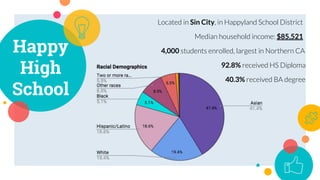
Happy
High
School
Located in Sin City, in Happyland School District
Median household income: $85,521
4,000 students enrolled, largest in Northern CA
92.8% received HS Diploma
40.3% received BA degree
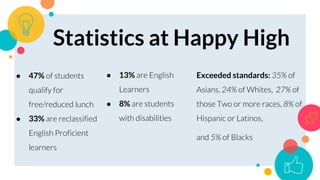
● 13% are English
Learners
● 8% are students
with disabilities
● 47% of students
qualify for
free/reduced lunch
● 33% are reclassified
English Proficient
learners
Exceeded standards: 35% of
Asians, 24% of Whites, 27% of
those Two or more races, 8% of
Hispanic or Latinos,
and 5% of Blacks
Statistics at Happy High
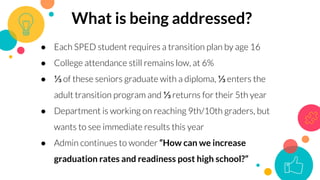
What is being addressed?
● Each SPED student requires a transition plan by age 16
● College attendance still remains low, at 6%
● ⅓ of these seniors graduate with a diploma, ⅓ enters the
adult transition program and ⅓ returns for their 5th year
● Department is working on reaching 9th/10th graders, but
wants to see immediate results this year
● Admin continues to wonder “How can we increase
graduation rates and readiness post high school?”
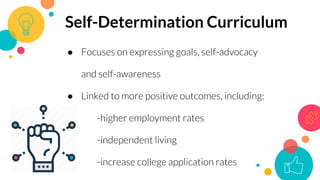
● Focuses on expressing goals, self-advocacy
and self-awareness
● Linked to more positive outcomes, including:
-higher employment rates
-independent living
-increase college application rates
Self-Determination Curriculum
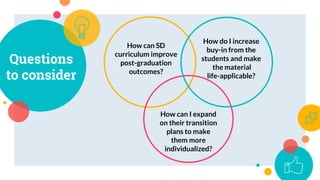
Questions
to consider
How do I increase
buy-in from the
students and make
the material
life-applicable?
How can SD
curriculum improve
post-graduation
outcomes?
How can I expand
on their transition
plans to make
them more
individualized?
Phase One: Initiating Conversations
and Identifying Challenges
● Inquired with the house principal and supervisor about current
needs. Given the large population, they asked that I present
my own idea because everyone has their own agenda
● Aside from their transition plan, students in SPED do not receive
individualized curriculum to help serve their needs and interests
● Department of Rehabilitation (DOR) grant exhausted
10
Phase Two: Engaged Inquiry
● When speaking with the two SDC teachers, I learned more about
the DOR position that was filled
● Career education, transitional living skills, goal setting
● Foremost need was coordinating field trip to Chabot College
● Can I coincide this material with self-determination curriculum? Yes!
Phase Three: Collaborative Actions
● Consulted with DOR specialist about field trip/resources
● Sent home field trip and intervention permission slips home together
● Coordinating field trip proved to be a big stepping stone in working
collaboratively with SPED and seemed to gain their trust
● Received IRB approval in February
● Transportation fare prep
● First group next week!
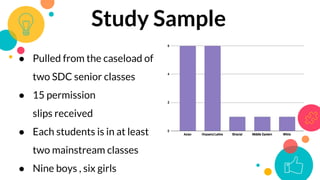
Study Sample
● Pulled from the caseload of
two SDC senior classes
● 15 permission
slips received
● Each students is in at least
two mainstream classes
● Nine boys , six girls
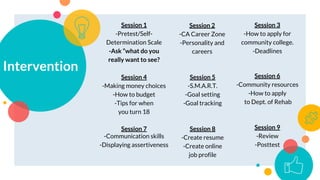
Intervention
Session 1
-Pretest/Self-
Determination Scale
-Ask “what do you
really want to see?
Session 2
-CA Career Zone
-Personality and
careers
Session 3
-How to apply for
community college.
-Deadlines
Session 4
-Making money choices
-How to budget
-Tips for when
you turn 18
Session 5
-S.M.A.R.T.
-Goal setting
-Goal tracking
Session 6
-Community resources
-How to apply
to Dept. of Rehab
Session 7
-Communication skills
-Displaying assertiveness
Session 8
-Create resume
-Create online
job profile
Session 9
-Review
-Posttest
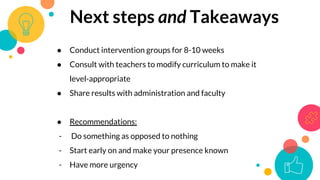
Next steps and Takeaways
● Conduct intervention groups for 8-10 weeks
● Consult with teachers to modify curriculum to make it
level-appropriate
● Share results with administration and faculty
● Recommendations:
- Do something as opposed to nothing
- Start early on and make your presence known
- Have more urgency
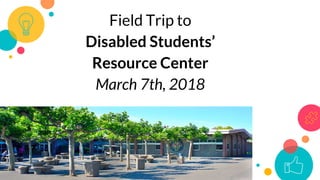
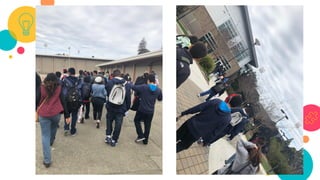
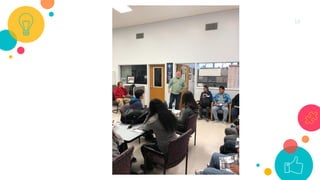
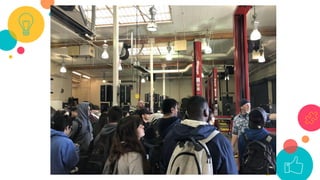
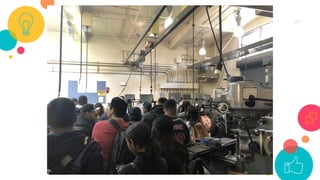
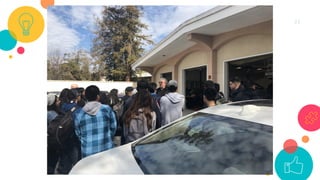
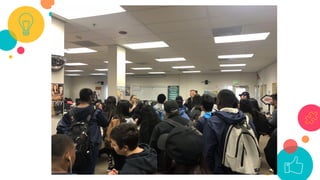
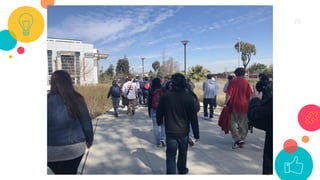
Field Trip to
Disabled Students’
Resource Center
March 7th, 2018
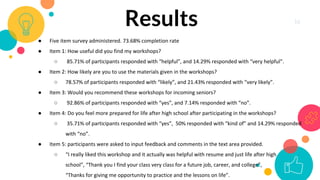
16Results
●
●
○
●
○
●
○
●
○
●
○
17
18
20
21
23
American Counseling Association. (2015). Multicultural and Social Justice Counseling Competencies. Retrieved from
https://www.counseling.org/docs/default- source/competencies/multicultural-and-social-justice-counseling-
competencies.pdf?sfvrsn=8573422c_20
California Department of Education. (2013). 2012-2013 School accountability report card for
James Logan High School. Retrieve from http://sarconline.org/
Cobb, B., Lehmann, ]., Newman-Conchar, R., & Alwell, M. (2009). Self-determination for students with disabilities: A narrative metasynthesis. Career
Development for Exceptional Individuals, 32, 108-114. doi:10.1177/0885728809336654'
Lee, Y., Wehmeyer, M. L., Palmer, S. B., Williams-Diehm, K., Davies, D. K., & Stock, S. E. (2011). The effect of student-directed transition
planning with a computer-based reading support program on the self-determination of students with disabilities. The Journal of Special
Education, 45(2), 104-117. doi:10.1177/0022466909358916
Ludema, J. D. & Fry, R. E. (2008). The practice of appreciative inquiry. In P. Reason & H.
Bradbury (Eds.), The SAGE handbook of action research: Participative inquiry and
practice (pp. 280-296). Thousand Oaks, CA: SAGE Publications Inc.
Martin, J. E., Van Dycke, J. L., Greene, B. A., Gardner, J. E., Christensen, W. R., Woods, L. L. & Lovett, D. L. (2006). Direct observation of
teacher-directed secondary IEP meetings: Establishing the need for self-determination and student participation instruction.
Exceptional Children, 72, 187-200. http://journals.sagepub.com/doi/abs/10.1177/001440290607200204
Shogren, K. A., Plotner, A. J., Palmer, S. B., Wehmeyer, M. L., & Paek, Y. (2014). Impact of Self-Determined Learning Model of Instruction on
teacher perceptions of student capacity and opportunity for self-determination. Education And Training In Autism And Developmental
Disabilities, 49(3), 440-448. https://eric.ed.gov/?id=EJ1034372
Wehmeyer, M.L., & Kelchner, K. (1995). The Arc’s Self-Determination Scale. Retrieved from http://files.eric.ed.gov/fulltext/ED441322.pdf
Wehmeyer M. L., Lawrence M., Kelchner K., Palmer S., Garner N., Soukup J. (2004). Whose Future Is It Anyway? A student-directed transition
planning process. Retrieved from http://files.eric.ed.gov/fulltext/ED414660.pdf
Wehmeyer M. L., Palmer S. B., Agran M., Mithaug D., Martin J. (2000). Promoting causal agency: The Self-Determined Learning Model of Instruction.
Exceptional Children, 66, 439–453.
Wolman, J., Campeau, P., Dubois, P., Mithaug, D., & Stolarski, V. (1994). AIR Self-
Determination Scale and User Guide. Retrieved from:
http://www.ou.edu/zarrow/AIR%20User%20Guide.pdf
U.S. Census Bureau. (2010). State and county QuickFacts. Retrieved from
https://www.census.gov/2010census/popmap/ipmtext.php?fl=06:0681204
References

Action research presentation

  • 1.
    Exploring the Implementationof Self-Determination Curriculum on Students with Disabilities: An Appreciative Participatory Inquiry Process By: Victoria C. Tanaka
  • 2.
    “ “Knowledge is notseen as something that a person has, but as something that people do together.” “Lifescaping and future forming move research away from being a descriptive summary… but toward...becoming an engaged creative and continuous process… (Lewis & Winkleman, 2017).
  • 3.
    Methodology ● Participatory InquiryProcess (PIP) and Appreciative Inquiry Process (AI) ● Engage in lifescaping and future forming change ● Cultivate learning power and strength based practices ● Leads a community towards eco-relational change ● Provides insight into intersectionality in order to facilitate change ● Four phases in the continuous process, which is non-linear in nature
  • 4.
    Happy High School Located in SinCity, in Happyland School District Median household income: $85,521 4,000 students enrolled, largest in Northern CA 92.8% received HS Diploma 40.3% received BA degree
  • 5.
    ● 13% areEnglish Learners ● 8% are students with disabilities ● 47% of students qualify for free/reduced lunch ● 33% are reclassified English Proficient learners Exceeded standards: 35% of Asians, 24% of Whites, 27% of those Two or more races, 8% of Hispanic or Latinos, and 5% of Blacks Statistics at Happy High
  • 6.
    What is beingaddressed? ● Each SPED student requires a transition plan by age 16 ● College attendance still remains low, at 6% ● ⅓ of these seniors graduate with a diploma, ⅓ enters the adult transition program and ⅓ returns for their 5th year ● Department is working on reaching 9th/10th graders, but wants to see immediate results this year ● Admin continues to wonder “How can we increase graduation rates and readiness post high school?”
  • 7.
    ● Focuses onexpressing goals, self-advocacy and self-awareness ● Linked to more positive outcomes, including: -higher employment rates -independent living -increase college application rates Self-Determination Curriculum
  • 8.
    Questions to consider How doI increase buy-in from the students and make the material life-applicable? How can SD curriculum improve post-graduation outcomes? How can I expand on their transition plans to make them more individualized?
  • 9.
    Phase One: InitiatingConversations and Identifying Challenges ● Inquired with the house principal and supervisor about current needs. Given the large population, they asked that I present my own idea because everyone has their own agenda ● Aside from their transition plan, students in SPED do not receive individualized curriculum to help serve their needs and interests ● Department of Rehabilitation (DOR) grant exhausted
  • 10.
    10 Phase Two: EngagedInquiry ● When speaking with the two SDC teachers, I learned more about the DOR position that was filled ● Career education, transitional living skills, goal setting ● Foremost need was coordinating field trip to Chabot College ● Can I coincide this material with self-determination curriculum? Yes!
  • 11.
    Phase Three: CollaborativeActions ● Consulted with DOR specialist about field trip/resources ● Sent home field trip and intervention permission slips home together ● Coordinating field trip proved to be a big stepping stone in working collaboratively with SPED and seemed to gain their trust ● Received IRB approval in February ● Transportation fare prep ● First group next week!
  • 12.
    Study Sample ● Pulledfrom the caseload of two SDC senior classes ● 15 permission slips received ● Each students is in at least two mainstream classes ● Nine boys , six girls
  • 13.
    Intervention Session 1 -Pretest/Self- Determination Scale -Ask“what do you really want to see? Session 2 -CA Career Zone -Personality and careers Session 3 -How to apply for community college. -Deadlines Session 4 -Making money choices -How to budget -Tips for when you turn 18 Session 5 -S.M.A.R.T. -Goal setting -Goal tracking Session 6 -Community resources -How to apply to Dept. of Rehab Session 7 -Communication skills -Displaying assertiveness Session 8 -Create resume -Create online job profile Session 9 -Review -Posttest
  • 14.
    Next steps andTakeaways ● Conduct intervention groups for 8-10 weeks ● Consult with teachers to modify curriculum to make it level-appropriate ● Share results with administration and faculty ● Recommendations: - Do something as opposed to nothing - Start early on and make your presence known - Have more urgency
  • 15.
    Field Trip to DisabledStudents’ Resource Center March 7th, 2018
  • 16.
  • 17.
  • 18.
  • 20.
  • 21.
  • 23.
  • 24.
    American Counseling Association.(2015). Multicultural and Social Justice Counseling Competencies. Retrieved from https://www.counseling.org/docs/default- source/competencies/multicultural-and-social-justice-counseling- competencies.pdf?sfvrsn=8573422c_20 California Department of Education. (2013). 2012-2013 School accountability report card for James Logan High School. Retrieve from http://sarconline.org/ Cobb, B., Lehmann, ]., Newman-Conchar, R., & Alwell, M. (2009). Self-determination for students with disabilities: A narrative metasynthesis. Career Development for Exceptional Individuals, 32, 108-114. doi:10.1177/0885728809336654' Lee, Y., Wehmeyer, M. L., Palmer, S. B., Williams-Diehm, K., Davies, D. K., & Stock, S. E. (2011). The effect of student-directed transition planning with a computer-based reading support program on the self-determination of students with disabilities. The Journal of Special Education, 45(2), 104-117. doi:10.1177/0022466909358916 Ludema, J. D. & Fry, R. E. (2008). The practice of appreciative inquiry. In P. Reason & H. Bradbury (Eds.), The SAGE handbook of action research: Participative inquiry and practice (pp. 280-296). Thousand Oaks, CA: SAGE Publications Inc. Martin, J. E., Van Dycke, J. L., Greene, B. A., Gardner, J. E., Christensen, W. R., Woods, L. L. & Lovett, D. L. (2006). Direct observation of teacher-directed secondary IEP meetings: Establishing the need for self-determination and student participation instruction. Exceptional Children, 72, 187-200. http://journals.sagepub.com/doi/abs/10.1177/001440290607200204 Shogren, K. A., Plotner, A. J., Palmer, S. B., Wehmeyer, M. L., & Paek, Y. (2014). Impact of Self-Determined Learning Model of Instruction on teacher perceptions of student capacity and opportunity for self-determination. Education And Training In Autism And Developmental Disabilities, 49(3), 440-448. https://eric.ed.gov/?id=EJ1034372 Wehmeyer, M.L., & Kelchner, K. (1995). The Arc’s Self-Determination Scale. Retrieved from http://files.eric.ed.gov/fulltext/ED441322.pdf Wehmeyer M. L., Lawrence M., Kelchner K., Palmer S., Garner N., Soukup J. (2004). Whose Future Is It Anyway? A student-directed transition planning process. Retrieved from http://files.eric.ed.gov/fulltext/ED414660.pdf Wehmeyer M. L., Palmer S. B., Agran M., Mithaug D., Martin J. (2000). Promoting causal agency: The Self-Determined Learning Model of Instruction. Exceptional Children, 66, 439–453. Wolman, J., Campeau, P., Dubois, P., Mithaug, D., & Stolarski, V. (1994). AIR Self- Determination Scale and User Guide. Retrieved from: http://www.ou.edu/zarrow/AIR%20User%20Guide.pdf U.S. Census Bureau. (2010). State and county QuickFacts. Retrieved from https://www.census.gov/2010census/popmap/ipmtext.php?fl=06:0681204 References