Budgets
What is a Budget ?


A budget is a financial plan of future costs and
  revenues for a specific period in the future.
What are the purposes of Budgeting ?
   To compare budgeted costs with actual costs at the
    same level of activity
   To help in controlling costs
   To plan product levels
   To compare like with like
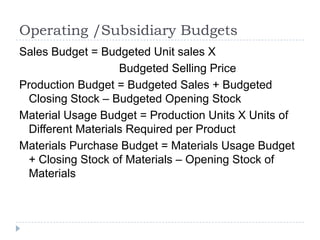
Operating /Subsidiary Budgets
Sales Budget = Budgeted Unit sales X
                   Budgeted Selling Price
Production Budget = Budgeted Sales + Budgeted
 Closing Stock – Budgeted Opening Stock
Material Usage Budget = Production Units X Units of
 Different Materials Required per Product
Materials Purchase Budget = Materials Usage Budget
 + Closing Stock of Materials – Opening Stock of
 Materials
Principal Budgets


1.   Cash Budget
2.   Master Budget
3.   Flexible Budget (Higher Level only)
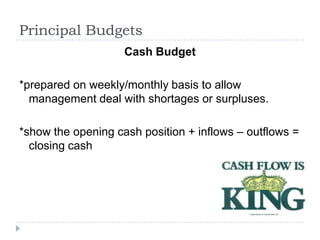
Principal Budgets
                    Cash Budget

*prepared on weekly/monthly basis to allow
  management deal with shortages or surpluses.

*show the opening cash position + inflows – outflows =
  closing cash
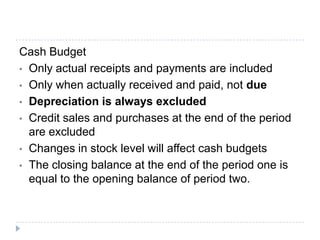
Cash Budget
• Only actual receipts and payments are included
• Only when actually received and paid, not due
• Depreciation is always excluded
• Credit sales and purchases at the end of the period
  are excluded
• Changes in stock level will affect cash budgets
• The closing balance at the end of the period one is
  equal to the opening balance of period two.
Principal Budgets
                   Master Budget

*Includes all subsidiary budgets

*Consists of budgeted profit and loss account and
  budgeted balance sheet

*If manufacturing firm a budgeted manufacturing
   account and budgeted trading account will be also
   prepared
Principal Budgets
          Flexible Budgets ( Higher Level )

*adjusting the original budget to the actual level of
  activity so that comparisons can be made

*separate costs into fixed costs and variable costs
  using the high low method
Exam Tips
   Order you Prepare Budgets
    sales, production, materials usage , material
    purchases

Can be asked in 3 parts
 A schedule of receipts
 A schedule of payments
 A cash budget
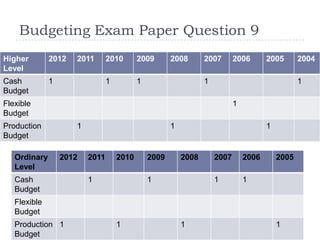
Budgeting Exam Paper Question 9
Higher        2012   2011       2010       2009       2008       2007       2006       2005       2004
Level
Cash          1                 1          1                     1                                1
Budget
Flexible                                                                    1
Budget
Production           1                                1                                1
Budget

   Ordinary       2012   2011       2010       2009       2008       2007       2006       2005
   Level
   Cash                  1                     1                     1          1
   Budget
   Flexible
   Budget
   Production 1                     1                     1                                1
   Budget

Powerpoint on budgets

  • 1.
  • 2.
    What is aBudget ? A budget is a financial plan of future costs and revenues for a specific period in the future.
  • 3.
    What are thepurposes of Budgeting ?  To compare budgeted costs with actual costs at the same level of activity  To help in controlling costs  To plan product levels  To compare like with like
  • 4.
    Operating /Subsidiary Budgets SalesBudget = Budgeted Unit sales X Budgeted Selling Price Production Budget = Budgeted Sales + Budgeted Closing Stock – Budgeted Opening Stock Material Usage Budget = Production Units X Units of Different Materials Required per Product Materials Purchase Budget = Materials Usage Budget + Closing Stock of Materials – Opening Stock of Materials
  • 5.
    Principal Budgets 1. Cash Budget 2. Master Budget 3. Flexible Budget (Higher Level only)
  • 6.
    Principal Budgets Cash Budget *prepared on weekly/monthly basis to allow management deal with shortages or surpluses. *show the opening cash position + inflows – outflows = closing cash
  • 7.
    Cash Budget • Onlyactual receipts and payments are included • Only when actually received and paid, not due • Depreciation is always excluded • Credit sales and purchases at the end of the period are excluded • Changes in stock level will affect cash budgets • The closing balance at the end of the period one is equal to the opening balance of period two.
  • 8.
    Principal Budgets Master Budget *Includes all subsidiary budgets *Consists of budgeted profit and loss account and budgeted balance sheet *If manufacturing firm a budgeted manufacturing account and budgeted trading account will be also prepared
  • 9.
    Principal Budgets Flexible Budgets ( Higher Level ) *adjusting the original budget to the actual level of activity so that comparisons can be made *separate costs into fixed costs and variable costs using the high low method
  • 10.
    Exam Tips  Order you Prepare Budgets sales, production, materials usage , material purchases Can be asked in 3 parts  A schedule of receipts  A schedule of payments  A cash budget
  • 11.
    Budgeting Exam PaperQuestion 9 Higher 2012 2011 2010 2009 2008 2007 2006 2005 2004 Level Cash 1 1 1 1 1 Budget Flexible 1 Budget Production 1 1 1 Budget Ordinary 2012 2011 2010 2009 2008 2007 2006 2005 Level Cash 1 1 1 1 Budget Flexible Budget Production 1 1 1 1 Budget