A refreshers guide to
bookkeeping
Wesleigh O’Hagan, ACA, PGDE, BAAF
“We can't go over it.
We can't go under it.
Oh no!
We've got to go through it!”
(excerpt from We're Going on a Bear Hunt by Michael Rosen & Helen
Oxenbury)
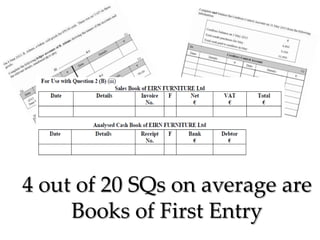
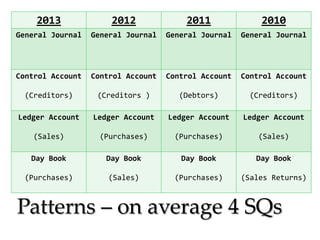
4 out of 20 SQs on average are
Books of First Entry
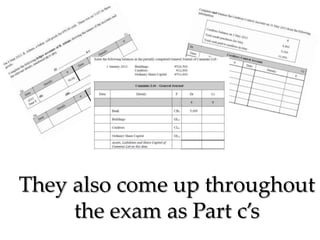
They also come up throughout
the exam as Part c’s
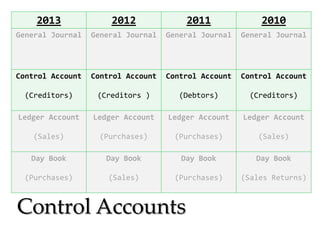
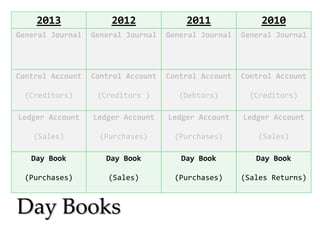
2013

2012

2011

2010

General Journal

General Journal

General Journal

General Journal

Control Account

Control Account

Control Account

Control Account

(Creditors)

(Creditors )

(Debtors)

(Creditors)

Ledger Account

Ledger Account

Ledger Account

Ledger Account

(Sales)

(Purchases)

(Purchases)

(Sales)

Day Book

Day Book

Day Book

Day Book

(Purchases)

(Sales)

(Purchases)

(Sales Returns)

Patterns – on average 4 SQs
Lets take the first steps….
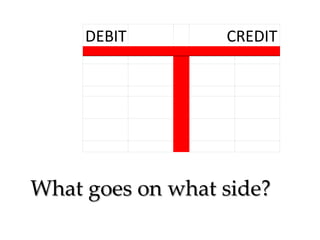
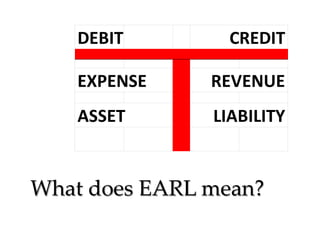
DEBIT

CREDIT

What goes on what side?
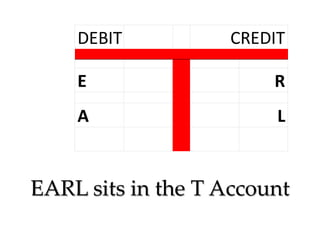
DEBIT

CREDIT

E

R

A

L

EARL sits in the T Account
DEBIT

CREDIT

EXPENSE

REVENUE

ASSET

LIABILITY

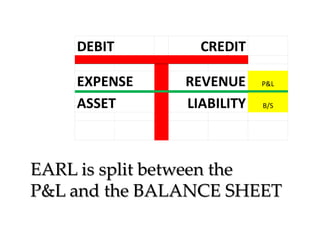
What does EARL mean?
DEBIT
EXPENSE
ASSET

CREDIT
REVENUE
LIABILITY

P&L
B/S

EARL is split between the
P&L and the BALANCE SHEET
Revenue is income that a
business earns usually from
SALES
It also includes other income
items like rent
received, commission
received etc.

Revenue?
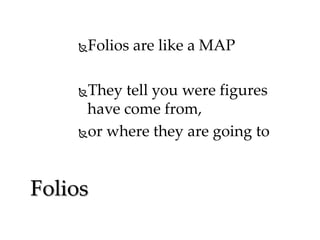
Folios
Folios are like a MAP



They tell you were figures
have come from,
or where they are going to


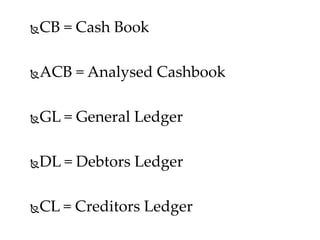
Folios
CB = Cash Book



ACB = Analysed Cashbook



GL = General Ledger



DL = Debtors Ledger



CL = Creditors Ledger


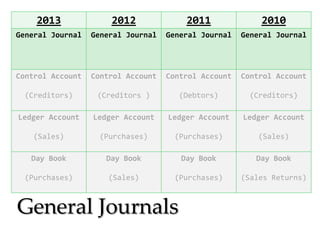
2013

2012

2011

2010

General Journal

General Journal

General Journal

General Journal

Control Account

Control Account

Control Account

Control Account

(Creditors)

(Creditors )

(Debtors)

(Creditors)

Ledger Account

Ledger Account

Ledger Account

Ledger Account

(Sales)

(Purchases)

(Purchases)

(Sales)

Day Book

Day Book

Day Book

Day Book

(Purchases)

(Sales)

(Purchases)

(Sales Returns)

General Journals
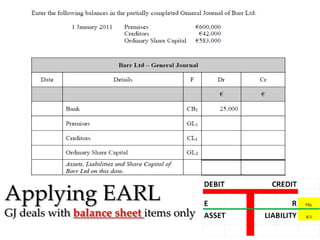
Applying EARL
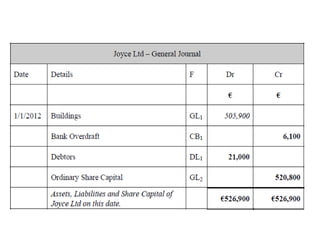
GJ deals with balance sheet items only
Applying EARL
GJ deals with balance sheet items only
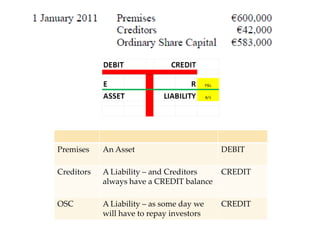
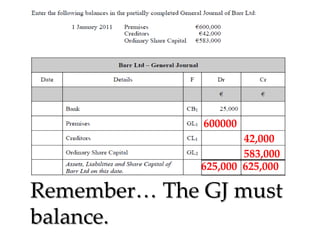
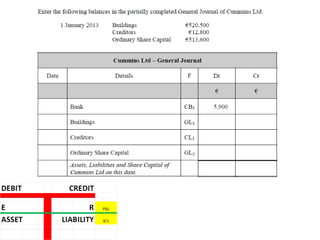
Premises

An Asset

DEBIT

Creditors

A Liability – and Creditors
always have a CREDIT balance

CREDIT

OSC

A Liability – as some day we
will have to repay investors

CREDIT
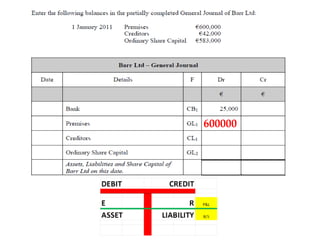
600000
600000

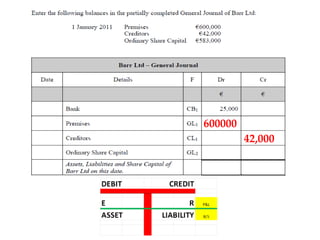
42,000
600000

42,000
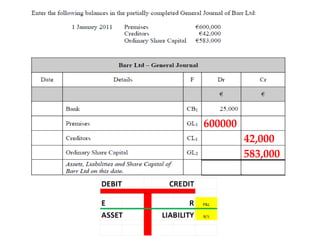
583,000
600000

42,000
583,000
625,000 625,000

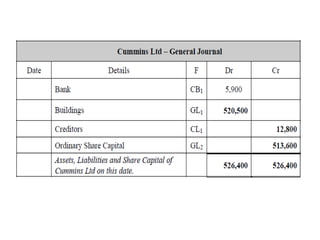
Remember… The GJ must
balance.
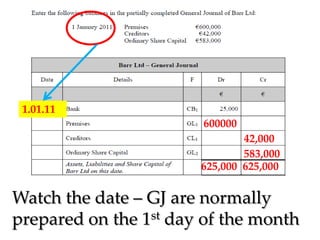
1.01.11
600000

42,000
583,000
625,000 625,000

Watch the date – GJ are normally
prepared on the 1st day of the month
600000

42,000
583,000
625,000 625,000

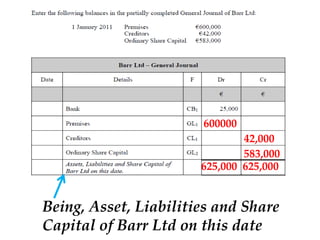
Being, Asset, Liabilities and Share
Capital of Barr Ltd on this date
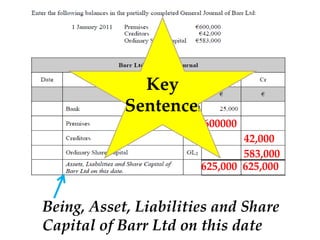
Key
Sentence!
600000

42,000
583,000
625,000 625,000

Being, Asset, Liabilities and Share
Capital of Barr Ltd on this date
General Journal
Worksheet
2013

2012

2011

2010

General Journal

General Journal

General Journal

General Journal

Control Account

Control Account

Control Account

Control Account

(Creditors)

(Creditors )

(Debtors)

(Creditors)

Ledger Account

Ledger Account

Ledger Account

Ledger Account

(Sales)

(Purchases)

(Purchases)

(Sales)

Day Book

Day Book

Day Book

Day Book

(Purchases)

(Sales)

(Purchases)

(Sales Returns)

Control Accounts


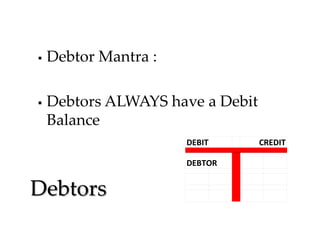
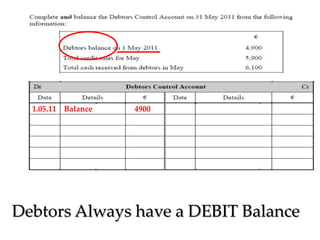
Debtor Mantra :



Debtors ALWAYS have a Debit
Balance
DEBIT
DEBTOR

Debtors

CREDIT


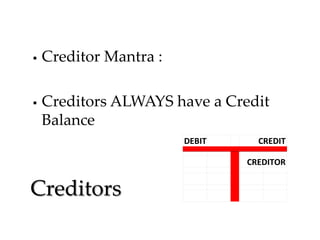
Creditor Mantra :



Creditors ALWAYS have a Credit
Balance
DEBIT

CREDIT
CREDITOR

Creditors
What about the remaining
items?


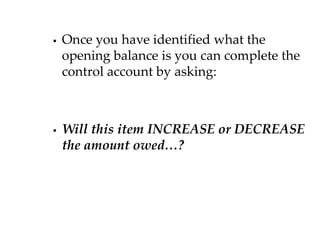
Once you have identified what the
opening balance is you can complete the
control account by asking:



Will this item INCREASE or DECREASE
the amount owed…?


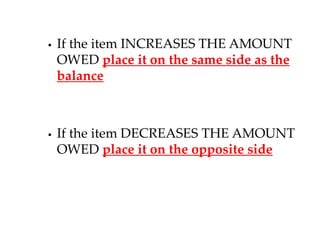
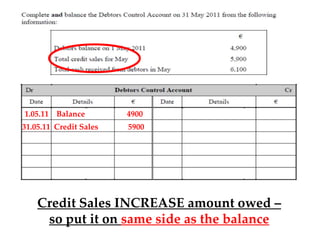
If the item INCREASES THE AMOUNT
OWED place it on the same side as the
balance



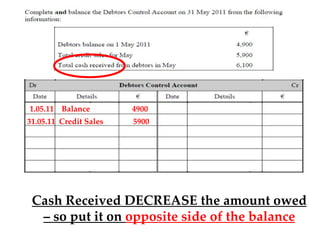
If the item DECREASES THE AMOUNT
OWED place it on the opposite side
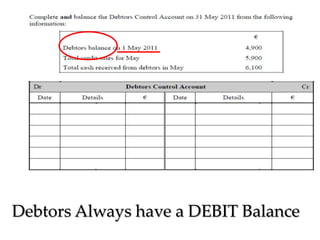
Debtors Always have a DEBIT Balance
1.05.11 Balance

4900

Debtors Always have a DEBIT Balance
1.05.11 Balance

4900

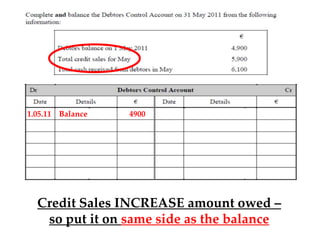
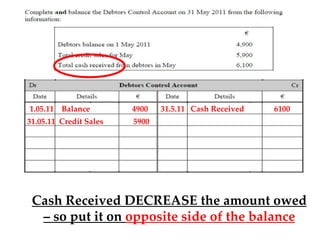
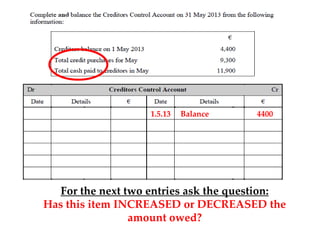
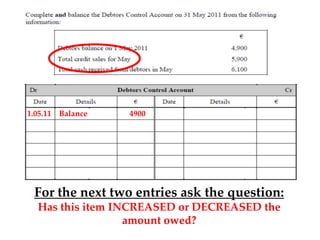
For the next two entries ask the question:
Has this item INCREASED or DECREASED the
amount owed?
1.05.11 Balance

4900

Credit Sales INCREASE amount owed –
so put it on same side as the balance
1.05.11 Balance
31.05.11 Credit Sales

4900
5900

Credit Sales INCREASE amount owed –
so put it on same side as the balance
1.05.11 Balance
31.05.11 Credit Sales

4900
5900

Cash Received DECREASE the amount owed
– so put it on opposite side of the balance
1.05.11 Balance
31.05.11 Credit Sales

4900

31.5.11 Cash Received

6100

5900

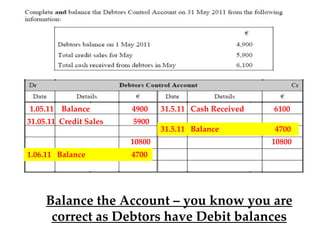
Cash Received DECREASE the amount owed
– so put it on opposite side of the balance
1.05.11 Balance
31.05.11 Credit Sales

4900
5900
10800

1.06.11 Balance

31.5.11 Cash Received

6100

31.5.11 Balance

4700
10800

4700

Balance the Account – you know you are
correct as Debtors have Debit balances
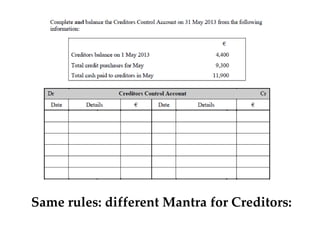
Same rules: different Mantra for Creditors:
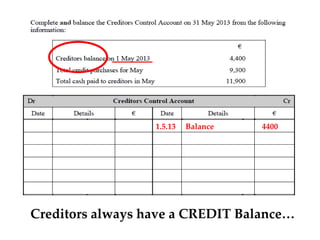
1.5.13

Balance

4400

Creditors always have a CREDIT Balance…
1.5.13

Balance

4400

For the next two entries ask the question:
Has this item INCREASED or DECREASED the
amount owed?
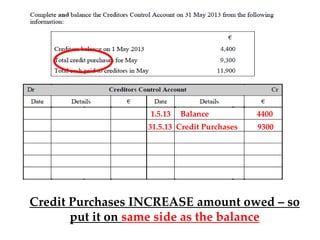
1.5.13

Balance

4400

31.5.13 Credit Purchases

9300

Credit Purchases INCREASE amount owed – so
put it on same side as the balance
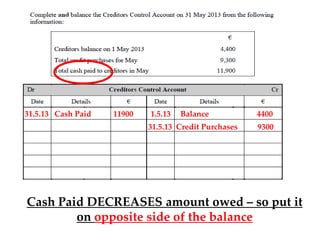
31.5.13 Cash Paid

11900

1.5.13

Balance

4400

31.5.13 Credit Purchases

9300

Cash Paid DECREASES amount owed – so put it
on opposite side of the balance
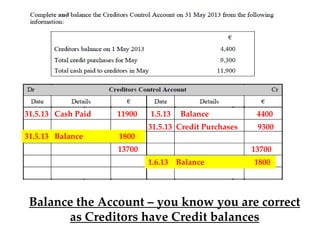
31.5.13 Cash Paid

Balance

4400

31.5.13 Credit Purchases
31.5.13 Balance

11900

1.5.13

9300

1800
13700

13700
1.6.13 Balance

1800

Balance the Account – you know you are correct
as Creditors have Credit balances
Control Accounts
Worksheet
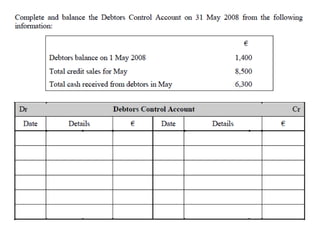
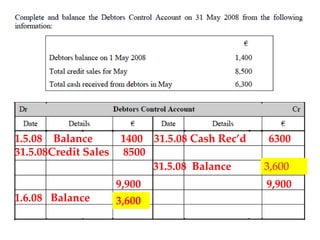
1.5.08 Balance
31.5.08Credit Sales

1400 31.5.08 Cash Rec’d
8500
31.5.08 Balance
9,900

1.6.08 Balance

3,600

6300
3,600
9,900
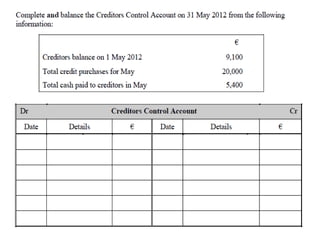
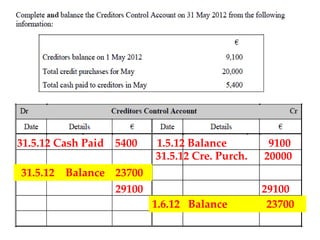
31.5.12 Cash Paid
31.5.12

5400

1.5.12 Balance
31.5.12 Cre. Purch.

Balance 23700
29100
1.6.12 Balance

9100
20000
29100
23700
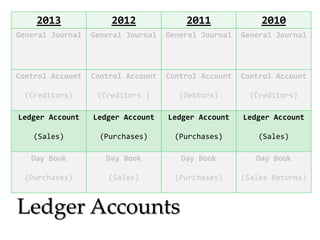
2013

2012

2011

2010

General Journal

General Journal

General Journal

General Journal

Control Account

Control Account

Control Account

Control Account

(Creditors)

(Creditors )

(Debtors)

(Creditors)

Ledger Account

Ledger Account

Ledger Account

Ledger Account

(Sales)

(Purchases)

(Purchases)

(Sales)

Day Book

Day Book

Day Book

Day Book

(Purchases)

(Sales)

(Purchases)

(Sales Returns)

Ledger Accounts
In attempting the question
you must firstly ask if you
purchased or if you sold
something
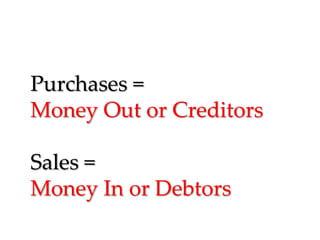
Purchases =
Money Out or Creditors
Sales =
Money In or Debtors
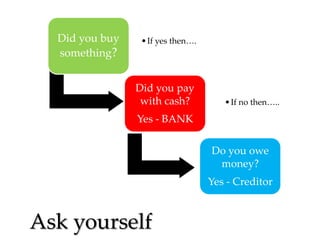
Scenario 1 : Purchases
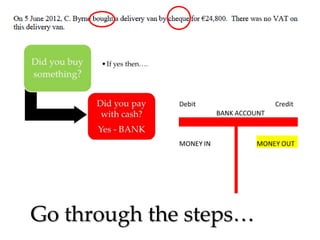
Did you buy
something?

• If yes then….

Did you pay
with cash?

• If no then…..

Yes - BANK
Do you owe
money?
Yes - Creditor

Ask yourself


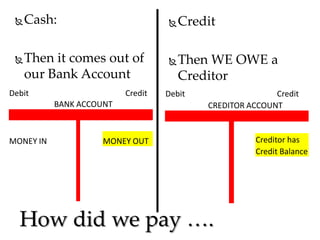
Cash:



Then it comes out of
our Bank Account



Debit

Credit
BANK ACCOUNT

MONEY IN

Credit



Then WE OWE a
Creditor

Debit

Credit
CREDITOR ACCOUNT

MONEY OUT

How did we pay ….

Creditor has
Credit Balance
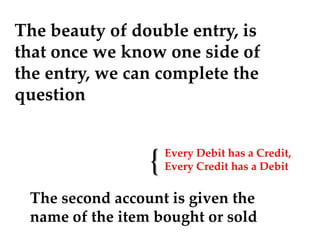
The beauty of double entry, is
that once we know one side of
the entry, we can complete the
question

{

Every Debit has a Credit,
Every Credit has a Debit

The second account is given the
name of the item bought or sold
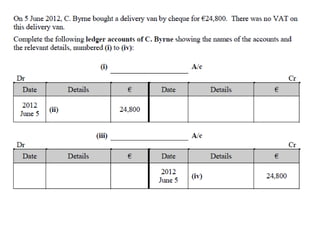
Go through the steps…
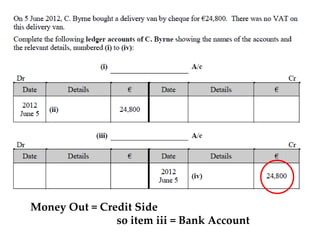
Money Out = Credit Side
so item iii = Bank Account
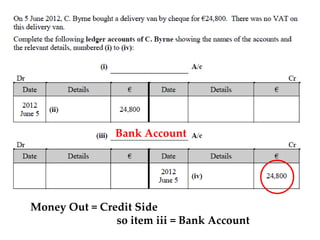
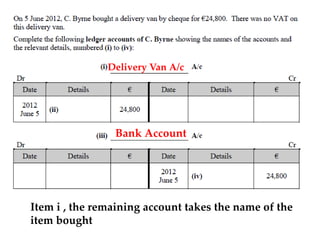
Bank Account

Money Out = Credit Side
so item iii = Bank Account
Delivery Van A/c

Bank Account

Item i , the remaining account takes the name of the
item bought
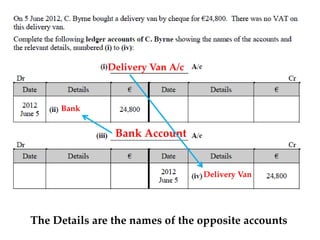
Delivery Van A/c

Bank

Bank Account

Delivery Van

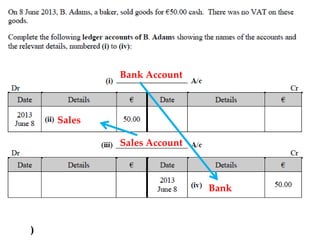
The Details are the names of the opposite accounts
Scenario 2 : Sales
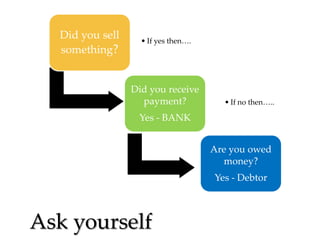
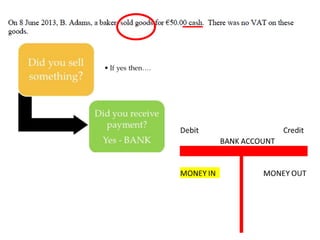
Did you sell
something?

• If yes then….

Did you receive
payment?

• If no then…..

Yes - BANK
Are you owed
money?
Yes - Debtor

Ask yourself


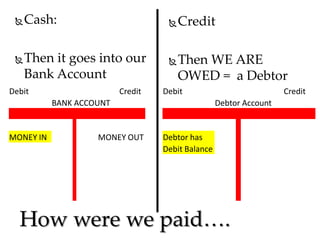
Cash:



Then it goes into our
Bank Account



Debit

Credit

Credit



Then WE ARE
OWED = a Debtor

Debit

BANK ACCOUNT

MONEY IN

MONEY OUT

Credit
Debtor Account

Debtor has
Debit Balance

How were we paid….
Bank Account

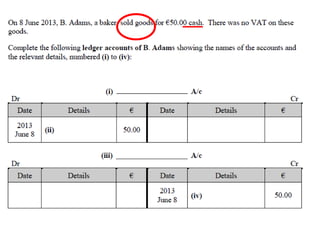
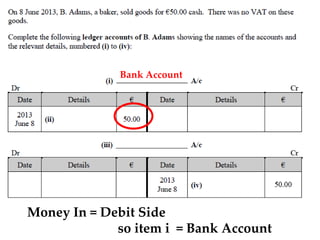
Money In = Debit Side
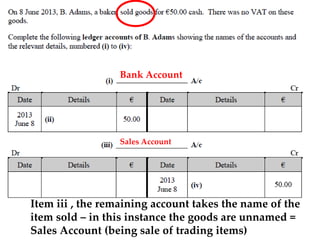
so item i = Bank Account
Bank Account

Sales Account

Item iii , the remaining account takes the name of the
item sold – in this instance the goods are unnamed =
Sales Account (being sale of trading items)
Bank Account

Sales
Sales Account

Bank

)
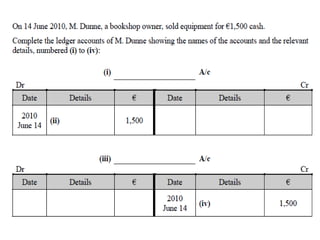
Ledger Account
Worksheet
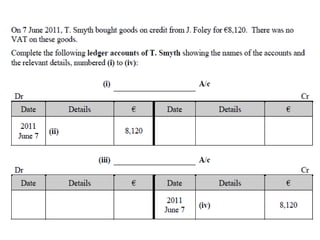
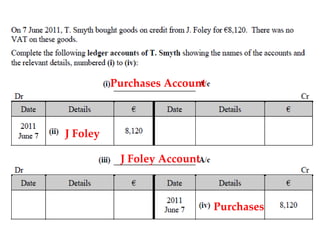
Purchases Account

J Foley
J Foley Account

Purchases
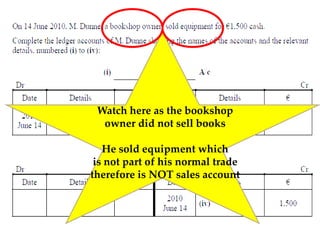
Watch here as the bookshop
owner did not sell books
He sold equipment which
is not part of his normal trade
therefore is NOT sales account
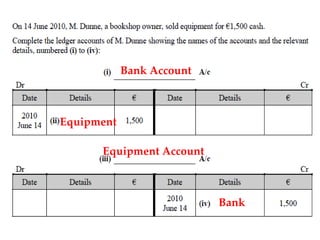
Bank Account

Equipment
Equipment Account

Bank
2013

2012

2011

2010

General Journal

General Journal

General Journal

General Journal

Control Account

Control Account

Control Account

Control Account

(Creditors)

(Creditors )

(Debtors)

(Creditors)

Ledger Account

Ledger Account

Ledger Account

Ledger Account

(Sales)

(Purchases)

(Purchases)

(Sales)

Day Book

Day Book

Day Book

Day Book

(Purchases)

(Sales)

(Purchases)

(Sales Returns)

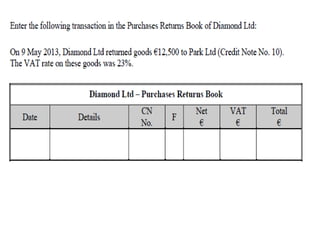
Day Books
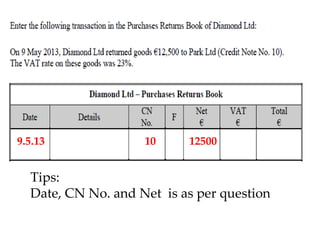
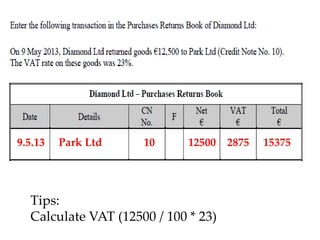
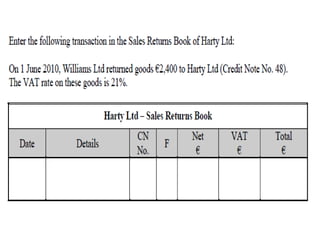
9.5.13

10

12500

Tips:
Date, CN No. and Net is as per question
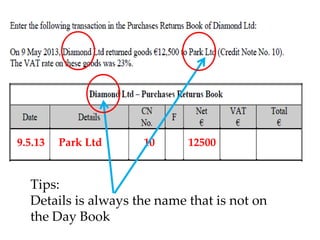
9.5.13

Park Ltd

10

12500

Tips:
Details is always the name that is not on
the Day Book
9.5.13

Park Ltd

10

12500

Tips:
Calculate VAT (12500 / 100 * 23)

2875

15375
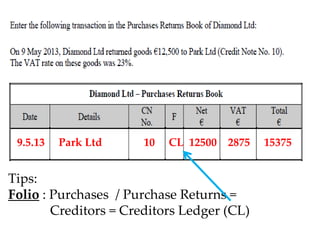
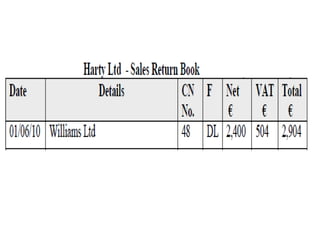
9.5.13

Park Ltd

10

CL 12500

2875

Tips:
Folio : Purchases / Purchase Returns =
Creditors = Creditors Ledger (CL)

15375
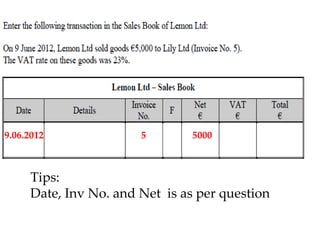
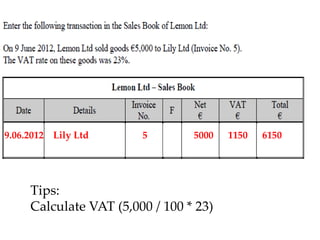
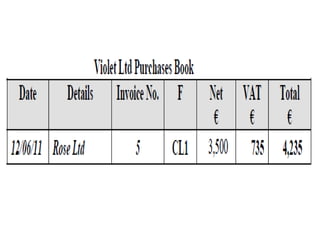
9.06.2012

5

5000

Tips:
Date, Inv No. and Net is as per question
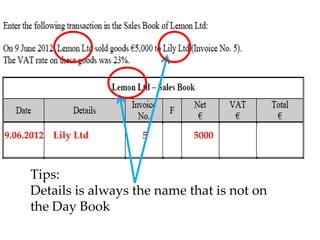
9.06.2012 Lily Ltd

5

5000

Tips:
Details is always the name that is not on
the Day Book
9.06.2012 Lily Ltd

5

5000

Tips:
Calculate VAT (5,000 / 100 * 23)

1150

6150
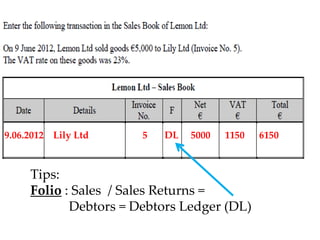
9.06.2012 Lily Ltd

5

DL

5000

1150

Tips:
Folio : Sales / Sales Returns =
Debtors = Debtors Ledger (DL)

6150
Day Books
Worksheet
Thank you

Any questions?

wohagan@donabatecc.ie
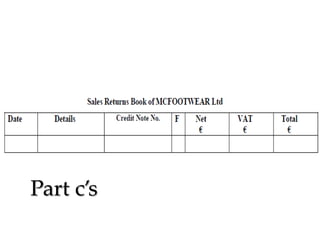
Part c’s
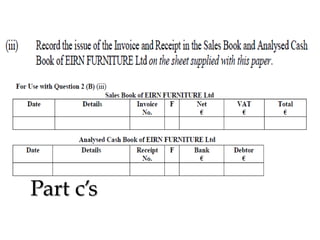
Part c’s

An introduction to bookkeeping final