Powering Ahead
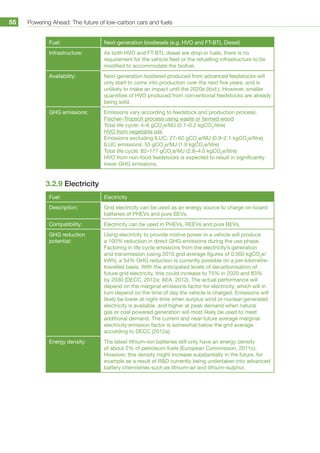
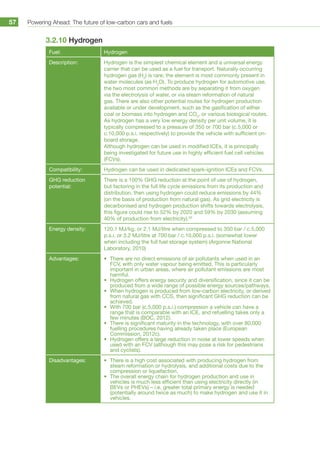
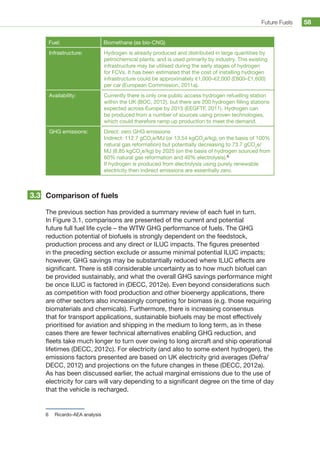
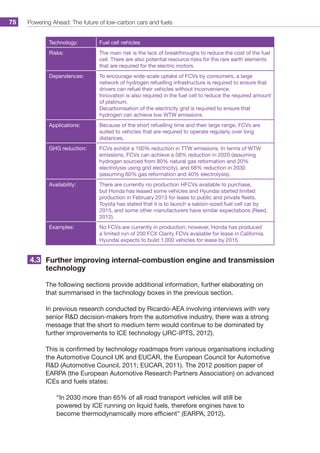
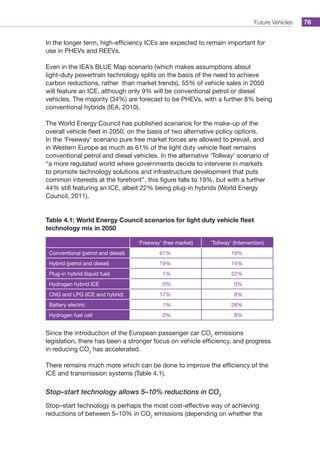
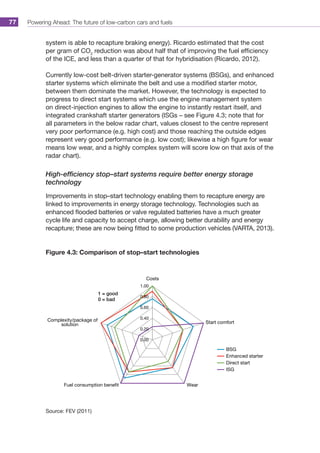
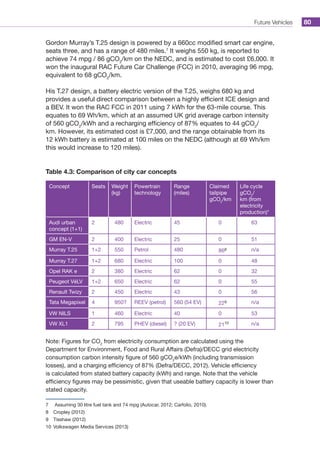
The future of low-carbon cars and fuels
Duncan Kay, Nikolas Hill and Dan Newman
Ricardo-AEA
April 2013
b
The Royal Automobile Club Foundation for Motoring is a transport policy
and research organisation which explores the economic, mobility, safety and
environmental issues relating to roads and their users. The Foundation publishes
independent and authoritative research with which it promotes informed debate
and advocates policy in the interest of the responsible motorist.
RAC Foundation
89–91 Pall Mall
London
SW1Y 5HS
Tel no: 020 7747 3445
www.racfoundation.org
Registered Charity No. 1002705
April 2013 © Copyright Royal Automobile Club Foundation for Motoring Ltd
The UK Petroleum Industry Association (UKPIA) represents the interests of nine
member companies engaged in the UK oil refining and downstream industry on
a range of common issues relating to refining, distribution and marketing of oil
products, in non-competitive areas.
UKPIA’s role is to inform its members of proposed legislation and related
developments, and to help form and advocate the industry’s position.
UKPIA is also an authoritative source of information or reference on the UK
downstream industry.
c
Powering Ahead
The future of low-carbon cars and fuels
Duncan Kay, Nikolas Hill and Dan Newman
Ricardo-AEA
April 2013
i
About the Authors
Duncan Kay is a senior technical consultant for Ricardo-AEA and has a
background of 16 years’ experience in the automotive sector, working as a
research and development engineer developing new technologies to improve
fuel economy and reduce emissions from passenger cars. Since leaving the
industry he has spent the last 5 years advising and consulting on a wide
range of transport issues, particularly analysis of the automotive industry and
transport greenhouse gas emissions reduction. Duncan has led studies for the
Low Carbon Vehicle Partnership, the European Environment Agency and the
European Commission amongst others. In 2012, he completed a study for the
Joint Research Council of the European Commission examining the role of
research and development in maintaining the competitiveness of the European
automotive industry.
Nik Hill is Ricardo-AEA’s Knowledge Leader for Transport Technology and
Fuels and has over 13 years of experience of consultancy project work on
transportation issues for a range of public and private sector clients. He has
particular expertise in transport emissions, low-carbon vehicle technologies
and fuels, and in developing models to simulate future emissions trajectories.
Nik’s expertise includes assessing the energy and environmental impacts of
transport, including model development, life cycle analysis and the economic
evaluation of future vehicle technologies and fuels. Nik has led a number of
influential projects for the UK government and European Commission in recent
years, one of which was a high-profile European Commission project to identify
and analyse potential options for a long-term policy framework to reduce
transport greenhouse gas emissions out to 2050.
Dan Newman is a consultant for Ricardo-AEA with over two years of
experience on sustainable transport projects for both governments and the
private sector. Dan has particular expertise in battery/hybrid electric vehicles
and natural gas fuelled vehicles. He has been involved in a range of work for
the European Commission and has recently been instrumental in investigating
the effect of environmental regulations and standards on vehicle prices over
the past 15 years. Dan has led tasks assessing the impact of information
communications technology (ICT) of the large-scale deployment of battery
electric vehicles for the European Commission, and has modelled how natural
gas can contribute to achieving cost-effective greenhouse gas emissions
reductions across the European transportation sector.
ii
Acknowledgements
The authors would like to thank Prof. Stephen Glaister of the RAC
Foundation and Nick Vandervell of the UK Petroleum Industry Association for
commissioning this work and providing valuable input and advice. Particular
thanks are also due to Luca Lytton for his useful comments and efforts in
the design and preparation of this report and to other members of the RAC
Foundation (David Quarmby and Philip Gomm) and UKPIA (Nunzia Florio,
Hugh Tucker and Chris Hunt), as well as Ben Kennington for his excellent and
thorough proofreading of the final draft.
iii
Contents
Viewpoint	viii
Executive summary	 xii
The Challenge	 1
1.1 Introduction	 1
1.2 Meeting UK greenhouse gas reduction targets	 2
1.3 Road transport’s contribution globally	 6
1.4 Europe and the UK’s role	 8
The Policy Context	 11
2.1 Introduction	 11
2.2 European transport and fuel policy	 12
2.3 Existing UK policy framework	 20
2.4 Future policy changes	 35
2.5 Conclusions	 41
Future Fuels	 43
3.1 Introduction	 43
3.2 Review of fuels	 45
3.3 Comparison of fuels	 58
Future Vehicles	 63
4.1 Overview	 64
4.2 Review of vehicle technologies	 67
4.3 Further improving internal-combustion engine and transmission technology 75
4.4 Weight, drag and rolling resistance reduction	 78
4.5 Powertrain electrification	 83
4.6 Real-world emissions and driving style	 91
4.7 Comparison of technologies	 92
Predicted Market Shares of Future Technologies and Fuels	 97
5.1 Predicted market shares of future technologies	 101
5.2 Predicted future mix of fuels	 112
1
2
3
4
5
iv
5.3 Assessment of the key sensitivities	 117
5.4 Analysis of the wider factors affecting uptake	 119
5.5 Evolution or revolution?	 125
Conclusions and Future Potential	 127
References	133
6
6
v
List of Abbreviations
ACEA European Automobile Manufacturers’ Association (‘Association des
Constructeurs Européens d’Automobiles’)
AFV alternative fuel vehicle
BEV battery electric vehicle
BRIC Brazil, Russia, India and China
B7 diesel with a FAME content of up to 7% by volume
B10 diesel with a FAME content of up to 10% by volume
B30 diesel with a FAME content of up to 30% by volume
Bio-CNG bio-compressed natural gas, biomethane
BSG belt-driven starter-generator
BSI British Standards Institute
CARS21 Competitive Automotive Regulatory System for the 21st century
CCC Committee on Climate Change
CCS carbon capture and storage
CEN European Committee for Standardisation (‘Comité Européen de Normalisation’)
CFRP carbon-fibre-reinforced plastics
CNG compressed natural gas
CO2
carbon dioxide
CO2
e carbon dioxide equivalent
CTL coal to liquid
DECC Department of Energy  Climate Change
Defra Department for Environment, Food and Rural Affairs
DfT Department for Transport
E5 petrol with up to 5% ethanol by volume
E10 petrol with up to 10% ethanol by volume
E85 petrol with up to 85% ethanol by volume
E100 pure bioethanol
EARPA European Automotive Research Partners Association
EGR exhaust gas recirculation
ERTRAC European Road Transport Research Advisory Council
ETP European Technology Platform
EUCAR European Council for Automotive RD
EUROBAT Association of European Storage Battery Manufacturers
EV electric vehicle
FAME fatty acid methyl ester (first-generation biodiesel)
vi
FCC Future Car Challenge
FCV fuel cell vehicle
FT-BTL ‘Fischer–Tropsch biomass to liquid’ – refers to both the process and the
resultant diesel fuel
GHG greenhouse gas
GTL gas to liquid
HCCI homogenous charge compression ignition
HEV hybrid electric vehicle
HFCV hydrogen fuel cell vehicle
HGV heavy goods vehicle
HMRC HM Revenue  Customs
HVO hydrotreated vegetable oil
ICE internal-combustion engine
IEA International Energy Agency
IFS Institute for Fiscal Studies
ILUC indirect land-use change
IMF International Monetary Fund
IPCC Intergovernmental Panel on Climate Change
JRC Joint Research Council (of the European Commission)
LCVIP Low Carbon Vehicles Innovation Platform
LCVPPP Low Carbon Vehicle Public Procurement Programme
LDV light-duty vehicle
LBM liquid biomethane
LiPF6 lithium hexafluorophosphate, used in battery chemistry
LFP lithium–iron phosphate, used in battery chemistry
LMO lithium–manganese oxide, used in battery chemistry
LMP lithium–metal polymer, used in battery chemistry
LNG liquefied natural gas
LPG liquefied petroleum gas
LTO lithium–titanate oxide, used in battery chemistry
MJ megajoules
MPV multipurpose vehicle
NCA lithium–nickel cobalt aluminium oxide, used in battery chemistry
NEDC New European Drive Cycle
NiCd nickel–cadmium, used in battery chemistry
NiMH nickel–metal hydride, used in battery chemistry
NMC lithium–nickel manganese cobalt oxide, used in battery chemistry
vii
OECD Organisation for Economic Co-operation and Development
OEM original equipment manufacturer
OLEV Office for Low Emission Vehicles
PEM polymer electrolyte membrane
PEMS portable emissions measurement system
PFCC Polymer Fuel Cells Challenge
PHEV plug-in hybrid electric vehicle
PICG Plug-in Car Grant
PIP Plugged-in Places
RD research and development
RED Renewable Energy Directive
REEV range-extended electric vehicle
RPI Retail Prices Index
RTFC Renewable Transport Fuel Certificates
RTFO Renewable Transport Fuels Obligation
SMMT Society of Motor Manufacturers and Traders
SULTAN SUstainabLe TrANsport illustrative scenario tool
TMO transition metal oxide, used in battery chemistry
TPMS tyre pressure monitoring systems
TSB Technology Strategy Board
TTW tank-to-wheel
TWh terawatt-hours
ULCVDP Ultra Low Carbon Vehicle Demonstrator Programme
UNFCCC United Nations Framework Convention on Climate Change
VCA Vehicle Certification Agency
VED Vehicle Excise Duty
WBCSD World Business Council for Sustainable Development
WLTP Worldwide harmonized Light vehicles Test Procedure
WTT well-to-tank
WTW well-to-wheel
viii
Viewpoint
In 2007, HM Treasury published the seminal King Review of low-carbon cars.1
Its aim was to “undertake an independent review to examine the vehicle and
fuel technologies which over the next 25 years could help to decarbonise road
transport, particularly cars”.
Much has happened in the low-carbon vehicle sphere in the six years that
have now passed: conventional new car carbon dioxide (CO2
) emissions
have decreased by almost 20%, from 164.9 g/km in 2007 to 133.1 g/km in
2012; vehicle manufacturers are now offering an increasing range of electric
vehicles, into which the government is pouring money; and, more recently, the
government launched a ‘UKH2 Mobility’ platform setting out a plan for the roll-
out of hydrogen vehicles from 2015 onwards.
To understand where expert thinking has got to, we commissioned
environment and energy consultancy Ricardo-AEA to examine the relative
merits of the major fuels and powertrains in delivering the UK’s greenhouse
gas reduction targets over the coming decades. We also wanted to know what
each technology’s market potential was. To achieve these research goals,
the authors reviewed a wide range of market take-up scenarios from leading
consultancies and other stakeholders around the world. While the average of
expert opinion can be a pretty good estimate of what may happen, any market
projection, of course, only paints a picture of what could happen. No one can
predict with certainty what will happen: all forecasts have to make assumptions
about what the world may look like in the future.
This report suggests that there will be a multitude of options for consumers
to choose between, both in terms of fuels and powertrains: petrol, diesel,
natural gas, plug-in hybrids, fuel cell vehicles – and others besides. Each has
its own strengths and weaknesses, and will be used in a different application.
The report also demonstrates that this range of fuels and powertrains can
be used in various combinations, which is good news because it means that
the transport system will be more resilient – for example, in terms of oil price
shocks – and that there are many benefits to be realised across different
technologies, such as making vehicles lighter and more aerodynamic.
The most important finding is that conventionally powered petrol and
diesel cars will remain with us for a long time yet, and that the lion’s share
of emissions reductions in the short to medium term will come from their
improvement through, for example, engine downsizing with turbocharging.
All the signs are that they will continue to be the dominant form of powertrain
1	 The King Review was published in two parts: the first was published in 2007 and examined the
potential for CO2
reduction in all the main fuels and powertrains; the second, published in 2008, made a
series of (policy) recommendations for achieving the UK’s carbon reduction targets for road transport over
the long term.
ix
until at least 2030: according to the average market projections, about 60%
of vehicles in 2030 are likely to be powered, either in part or in full, by internal-
combustion engines. Even in the 2050 scenarios the report anticipates
that some cars will still feature an internal-combustion engine, although these
are expected to be almost exclusively full hybrids, plug-in hybrids and range-
extended electric vehicles driven mainly in electric mode.
Electric vehicles remain a controversial subject. Advocates will say that their
market share has increased by hundreds of percentage points over the last
years, and that this trend will continue. Critics will reply that this still only
represents a small fraction of the market. But what do we actually mean by
‘electric vehicles’ anyway? The term is most often loosely applied to mean plug-
in hybrid electric vehicles, range-extended electric vehicles and pure/battery
electric vehicles. However, these technologies are quite different in their degree
of electrification, and these differences lead to significant implications for
their optimal application, costs of ownership and operation, as well as overall
usefulness. Thus, while plug-in and range-extended hybrids could be described
as ‘the best of both worlds’ and seem to make more sense as a mass-market
proposition, pure electric vehicles appear to be less promising. Whatever
people’s feelings about all these plug-in vehicles, the projections reviewed in
this report show that by 2020 they are likely to account for anything between
5% and 15% of new car sales, and for between 20% and 50% by 2030.
Much of the limited utility of pure electric vehicles today comes down to simple
physics: in terms of energy density, liquid fuels are still dozens of times better
than electricity stored in batteries. Even though electric vehicles are now a
practical proposition – evidenced by the fact that some people, albeit few, are
buying and using them – big question marks still remain over how they will
perform after several years in terms of day-to-day wear and battery rundown.
Central to all of this is battery technology. The future mass-market success
of electric vehicles is highly dependent on breakthroughs in this field, both to
increase energy density and to reduce cost, which are essentially two sides
of the same coin. While there may be innovative ways of avoiding merely
increasing battery size – battery swapping, more frequent trickle charging,
rapid charging – all of these come with their own problems.
And then there is their future greenhouse gas reduction potential, which
relies largely on decarbonisation of the grid. Although this is strongly implied
by the Climate Change Act 2008, it cannot be accepted as a given because
of the vast investment required and the potential competition for low-
carbon electricity from other sectors like heating homes. There are ongoing
discussions in the context of the UK Energy Bill – a proposed legislative
framework for delivering secure, affordable and low-carbon energy, which at
the time of writing is at report stage prior to its third reading – as to whether it
should include a decarbonisation target for power generation by 2030. Whether
such a target will be set, and if so at what level, is yet to be determined.
x
Similar arguments apply to hydrogen fuel cell vehicles, which are not only
costly but require both expensive infrastructure for market adoption and ‘clean’
hydrogen to realise greenhouse gas savings. While the recently launched UKH2
Mobility platform does not guarantee any take-up by the market, it does show
that the government is interested in these vehicles.
There appears to be a false perception that investment in electric vehicles
comes at the expense of encouraging improvements to the internal-combustion
engine. However, the two technologies are at quite different stages of
market development: while conventional vehicles are very well established,
electric vehicles are only at their infancy. They therefore require different
types of government policy. Conventional vehicles need strict but achievable
environmental standards while, in theory at least, electric vehicles need supply-
push (subsidies for the industry) and demand-pull (consumer incentives such as
purchase grants) policies. However, whether the degree of public investment in
electric vehicles is appropriate, given their current prospects as a viable form of
transport for ordinary people, is another matter, and the subject of considerable
debate. If there is any kind of trade-off, it could be said to lie between electric
vehicles, particularly pure electrics, and hydrogen fuel cell vehicles. But even
here the two technologies are at different market stages – compared to electric
vehicles, hydrogen vehicles are far from being a mass-market proposition.
Ultimately, it is not clear which technology will ‘win’ in the long term. The
common consensus in the industry, supported by the market projections
reviewed in this report, is that there will not be a single, dominant technology
or fuel in the way that there has been over the last century with the monopoly
of the internal-combustion engine, but that there will be a range of solutions for
different transport applications.
For policymakers this presents a challenge, as it will be difficult for them to
decide what policies they should adopt, let alone when and in what form.
The case of biofuels shows that decision-makers sometimes get it wrong.
In October 2012, the European Commission published proposals to amend
the Renewable Energy Directive2
by capping the share of ‘first-generation’
biofuels – that is, those derived from food crops – to half of the possible 10%
by energy to meet the EU’s 2020 targets for renewable road transport fuels.
This change of policy caused outrage among the biofuels industry, since these
biofuels already account for 4.7% of total fuels, and the industry has huge sunk
investments which, effectively, would be wasted if the amending Directive were
passed. This example clearly illustrates the need for decision-makers to keep
policies under review in the light of new technology and other developments.
It is very clear to us that government policies should be technology-neutral; the
emphasis should be on using fiscal and regulatory levers, and other policies,
2	 Directive 2009/28/EC: http://eur-lex.europa.eu/LexUriServ/LexUriServ.do?uri=Oj:L:2009:140:0016:00
62:en:PDF
xi
to incentivise both the demand and the supply of low-carbon vehicles in the
market place. The record so far has demonstrated how effective this can be.
The automotive industry, with the associated huge research and development
effort going on, should lead the evolution and the bringing to market of the
different technologies, to which consumers will respond. However, we do
recognise that government has a role in supporting fledgling research (through,
for example, the successful programmes of the Technology Strategy Board).
And from time to time there are consequential policy issues (as in the case of
biofuels) which cannot be avoided.
Overall, we believe that this report has made a valuable contribution to the
discussion on the road ahead for all types of low-carbon vehicles. Only time will
tell what exactly we will be driving in the next couple of decades. Whatever it is,
it will be low-carbon and very efficient. And, it is to be hoped, also exciting.
On the basis of the evidence in this report, we make the following
recommendations:
•	 Regulation based on tailpipe emissions is increasingly no longer fit
for purpose and must be changed to be based on well-to-wheel, and
ultimately even life cycle, emissions.
•	 Government should push strongly for a move away from the current
‘New European Drive Cycle’ (NEDC) test cycle, towards the ‘Worldwide
harmonized Light vehicles Test Procedure’ (WLTP) cycle to capture
tailpipe emissions and fuel consumption more accurately, as the
discrepancy between stated and real-world performance is wide, and
confusing for consumers. This must be introduced in tandem with
tightening the entire vehicle type approval test.
•	 The 2025 new car CO2
target should be set at a maximum of 70 g/
km from the tailpipe, with a preferred target of 60 g/km. Regulation
must be carefully designed to capture well-to-wheel (or even life cycle)
emissions, whilst spreading the burden on vehicle manufacturers in an
equitable manner.
•	 Government should take a technology-neutral approach to the
encouragement of low-carbon vehicles. It should focus on the use of
fiscal, regulatory and other policy levers to drive both the demand and
supply of such vehicles, leaving the automotive industry to lead the
evolution, and the bringing to market, of the various technologies.
•	 Government must deal with the ‘ILUC issue’ – indirect land-use
change, in other words secondary and often unanticipated negative
environmental impacts – if it wants to seriously consider biofuels and
avoid any potential negative indirect consequences.
RAC Foundation
UK Petroleum Industry Association
xii
Executive summary
Introduction
This report examines how the challenge of achieving the UK’s legally binding
commitment to a substantial reduction in greenhouse gas (GHG) emissions by
2050 is likely to affect the cars and fuels we will use over the next 20 years.
In 2008, Professor Dame Julia King set out her recommendations for action to
reduce carbon dioxide (CO2
) emissions from the passenger car sector in the
King Review of low-carbon cars. Since then policies and initiatives to promote
the uptake of lower-carbon cars have been introduced at both European and
national levels, and manufacturers and fuel suppliers have worked to develop
lower-carbon options for consumers.
Policy context
In 2008, the UK became the first country in the world to introduce a law
committing the government to cut GHG emissions: the Climate Change Act
2008. This requires an 80% reduction in GHG emissions by 2050 relative to a
baseline of 1990.
Transport is responsible for 21% of UK GHG emissions by source, with cars
accounting for 55% of that share or 12% of the total.
Later this year the European Commission is expected to confirm that new
cars sold in Europe should emit an average of 95 gCO2
/km or less by 2020.
Consultation will also be held until 2014 regarding a new target for 2025.
Alongside this, the Commission has introduced directives governing renewable
energy and vehicle fuels, which require that at least 10% of transport fuels by
volume (excluding aviation fuels) must originate from renewable sources by
2020. It had been expected that the vast majority of this would be met through
the use of biofuels. However, there are continuing concerns about the true level
of biofuel GHG savings, particularly for first-generation biofuels, once ‘indirect
land-use changes’ (ILUCs) have been taken into account. As a result, in
October 2012, the Commission announced proposals to amend the Renewable
Energy Directive so that no more than half of the 10%-by-energy target can be
met through the use of first-generation crop-based biofuels. Given that current
production volumes of alternative next-generation biofuels are relatively small,
and that uptake levels of plug-in electric vehicles using renewable electricity
may well provide only a limited contribution, it is not clear how this target will
be reached by 2020.
xiii
The UK has introduced a range of policies to encourage uptake of lower-
emission vehicles. Vehicle Excise Duty (VED) and company car tax have been
progressively revised to strengthen incentives to choose low-CO2
options. The
UK’s colour-coded vehicle fuel economy labelling system is designed to make
it easier for consumers to choose more fuel-efficient models. In 2010, a new
‘first-year rate’ of VED was introduced to provide a stronger signal at the point
of purchase, with rates for the highest-CO2
vehicles now set at over £1,000.
The Plug-in Car Grant scheme provides 25% (capped at £5,000) towards the
cost of eligible plug-in cars (and 20% – capped at £8,000 – for plug-in vans).
The Plugged-in Places scheme has seen over 2,800 charging points installed,
in eight areas of the country.
Together these policies appear to be having the desired effect. According
to the SMMT (Society of Motor Manufacturers and Traders), the average
tailpipe CO2
emission figure for cars sold in the UK in 2012 was 133.1 g/km,
representing a fall of almost 23% over the last decade.
Maintaining this good rate of progress in the reduction of carbon emissions
from cars will require that future policies continue to drive technological
progress. Perhaps the most important decision facing policymakers is what
level to set as the target for CO2
emissions in 2025. The European Commission
has announced that it will explore a level of 70 g/km, and is expected to seek
stakeholders’ views on both this and a target for vans sometime in 2013. Some
environmental groups feel that the 2020 target of 95 g/km lacks ambition, and
are already pushing for 60 g/km by 2025.
Alongside this is the problem of a growing gap between the type-approval
fuel economy figures obtained using the official test cycle (the NEDC – New
European Drive Cycle) and those that drivers achieve in the real world. It has
been noted that some of the largest differences are for the vehicles with the
lowest official CO2
figures, meaning that consumers who choose the most
‘environmentally friendly’ option may be the most disappointed by their
vehicle’s actual fuel economy.
The Commission aims to address this by introducing the new ‘Worldwide
harmonized Light duty vehicles Test Procedure’ (WLTP), which is considered
to be more representative of real-world driving conditions. The WLTP is being
developed under the UNECE (UN Economic Commission for Europe) for global
application. Alongside this, changes are also planned to the way that emissions
tests are conducted.
In the longer term there is an increasing need to consider not merely the
CO2
emissions from vehicle exhausts, but the whole life cycle environmental
impacts of vehicles. For pure electric vehicles, referred to here as battery
electric vehicles (BEVs), it does not make sense for legislation to relate solely to
tailpipe emissions, since there are none. However, there are certainly emissions
xiv
associated with the production of the electricity needed to power the vehicle.
Equally, BEVs’ manufacturing emissions are currently significantly higher than
those of a comparable conventional vehicle (owing primarily to the batteries).
Future fuels and vehicle technologies
In the past, conventional petrol- and diesel-fuelled internal-combustion engines
(ICEs) were the dominant technology. But a much wider range of technologies
and fuels is already becoming available, and these will become ever more
common in the coming years.
Chapters 3 and 4 of this report investigate, respectively, the future potential of
a range of fuels and of powertrain technologies and other aspects of vehicle
technology that improve efficiency. For each option the chapters set out, and
where possible quantify, their characteristics in terms of GHG reductions,
advantages and disadvantages, infrastructure requirements, availability, and
cost. A high-level summary of the findings is presented here:
Petrol and diesel: Conventional petrol- and diesel-powered cars accounted
for virtually all (99%) of new cars sold in the UK in 2012. The diesel engine’s
higher efficiency offers a reduction in life cycle GHG emissions per km of about
14% compared to an equivalent petrol vehicle, although technologies such
as petrol direct-injection in combination with downsizing and turbocharging
might reduce this advantage. Petrol engines produce lower NOx
and particulate
emissions, although the Euro standards on air pollutants will narrow the
gap between petrol and diesel vehicles. However, the additional exhaust
aftertreatment needed for diesel vehicles to meet these standards may further
erode their fuel economy advantage.
LPG (liquefied petroleum gas) / CNG (compressed natural gas): Gas-
powered vehicles account for only a tiny fraction of new car sales in the
UK. Many manufacturers offer natural gas vehicles in other countries, and
aftermarket conversions are available here. Life cycle CO2
emissions for CNG
are up to 24% lower than for a comparable petrol car. For LPG the figure
is about 14%. LPG- and CNG-powered vehicles also produce lower NOx
emissions and very low particulate emissions. However, the lack of refuelling
infrastructure, and the reduced range compared to petrol or diesel, continue to
constitute barriers to their uptake.
First-generation biofuels: There is a range of first-generation crop-based
biofuels currently available. Bioethanol and biodiesel are already used by
motorists, in that forecourt petrol and diesel contains a c.5% blend of biofuel.
High-blend strength biofuels (e.g. E85 – petrol with an ethanol content of 85%)
are not available to the mass market in the UK. The GHG savings for first-
generation biofuels vary considerably according to the feedstock used, the
manufacturing process, and in particular issues of ILUC. Some are calculated
xv
to result in GHG emissions that are actually higher than those of fossil fuels.
However, the use of biomethane (a purified form of biogas) can result in life cycle
GHG emissions savings of over 70–80% compared to petrol. Biogas is typically
produced from waste biomass or manure, meaning that there are little or no
emissions caused by ILUC. The disadvantages of biomethane are much the
same as those of CNG.
Next-generation biofuels: Next-generation biofuels are made using more
advanced processes, and usually from non-crop biomass such as stems,
leaves and husks, or grasses or woody energy crops, or possibly waste wood.
They are therefore less likely to result in competition with food. There are
several alternative processes used to create next-generation biofuels. The
GHG savings vary significantly depending on the feedstock and the production
process; however, they are typically much greater than for first-generation
biofuels, partly because they largely avoid the issue of ILUC. However, current
production volumes are low, and next-generation biofuels may not make a
significant contribution to meeting carbon reduction targets until after 2020.
A further issue is that in the future they might need to be prioritised for use in
aviation and shipping, sectors in which there are fewer technical alternatives to
liquid fuels for GHG reduction.
Hybrid and electric vehicles: The increasing electrification of powertrains
is widely regarded as the most likely route to achieving GHG reduction
targets for passenger cars. The progression in technology is expected to be
from widespread use of stop–start (so-called ‘micro hybrid’) technology, to
a growing market share for hybrid electric vehicles (HEVs or ‘full hybrids’),
through to plug-in hybrid electric vehicles (PHEVs) and range-extended electric
vehicles (REEVs), and ultimately BEVs. Hybrid technology (non-plug-in) is
currently gaining market share and can reduce GHG emissions by 15–25%.
Currently the average fuel life cycle GHG saving for a BEV over its full life is
calculated to be over 50% under UK conditions – that is, with the current mix
of grid electricity generation. This could increase to 75% in 2020 and to 83%
by 2030 with the anticipated decarbonisation of grid electricity. However, BEVs
face major challenges in gaining market share because of their high prices
and limited range. Breakthroughs in technology, particularly in the cost and
performance of batteries, are required before PHEVs and BEVs can achieve
significant market share.
Hydrogen fuel cell vehicles: Renewably produced hydrogen used in fuel cell
vehicles (FCVs) offers amongst the largest potential GHG reduction possible
(next to BEVs). FCVs also offer the benefit of a range comparable to conventional
vehicles. However, they face a number of barriers. They are currently substantially
more expensive than conventional vehicles, or even BEVs, as a result of fuel cell
costs. There are also very few locations where they can be refuelled. Their actual
GHG savings are dependent on the source of the hydrogen. Typically they are
expected to achieve around 70% savings in 2030, assuming hydrogen sourced
from a mix of natural gas reformation and electrolysis.
xvi
In summary, each of these options involves trade-offs between GHG savings,
cost, range and required refuelling infrastructure. However, one area which
will benefit all these options is that of improving vehicle energy efficiency
through reduced weight and reduced drag. A greater focus on the use
of ultra-lightweight body structures and achieving the lowest possible drag
coefficient and frontal area, together with reducing rolling resistance, can
substantially reduce the overall energy requirement. This is particularly
beneficial for BEVs, where drag and rolling resistance represent the majority
of the energy losses. Reducing these losses can allow a smaller battery or fuel
cell to be used, reducing costs.
Predicted future market shares of vehicle technologies
In order to understand the likely growth in market shares for the different
car technologies available, 14 separate studies were analysed, and their
predictions – and the underlying assumptions – were compared. It is important
to note that some studies attempt to forecast on the basis of existing trends,
whereas others ‘backcast’ from a future scenario. These two methods can
result in significantly differing results.
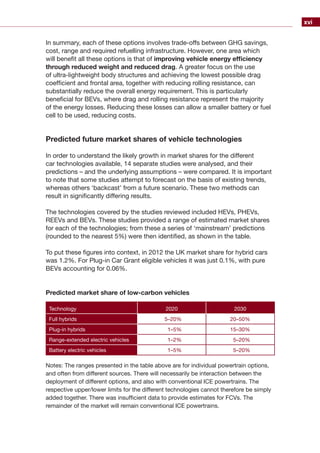
The technologies covered by the studies reviewed included HEVs, PHEVs,
REEVs and BEVs. These studies provided a range of estimated market shares
for each of the technologies; from these a series of ‘mainstream’ predictions
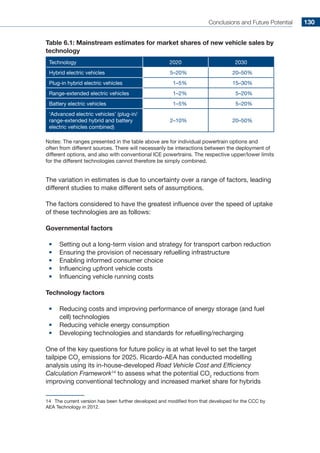
(rounded to the nearest 5%) were then identified, as shown in the table.
To put these figures into context, in 2012 the UK market share for hybrid cars
was 1.2%. For Plug-in Car Grant eligible vehicles it was just 0.1%, with pure
BEVs accounting for 0.06%.
Predicted market share of low-carbon vehicles
Technology 2020 2030
Full hybrids 5–20% 20–50%
Plug-in hybrids 1–5% 15–30%
Range-extended electric vehicles 1–2% 5–20%
Battery electric vehicles 1–5% 5–20%
Notes: The ranges presented in the table above are for individual powertrain options,
and often from different sources. There will necessarily be interaction between the
deployment of different options, and also with conventional ICE powertrains. The
respective upper/lower limits for the different technologies cannot therefore be simply
added together. There was insufficient data to provide estimates for FCVs. The
remainder of the market will remain conventional ICE powertrains.
xvii
Each of the studies from which these average figures are taken makes a set of
assumptions regarding certain key sensitivities. The factors which appear to
have the strongest influence over the predictions are, firstly, future government
policy, and, secondly, the likely speed with which breakthroughs in technology,
particularly with respect to batteries and fuel cells, will be achieved.
Predicted future market shares of fuels
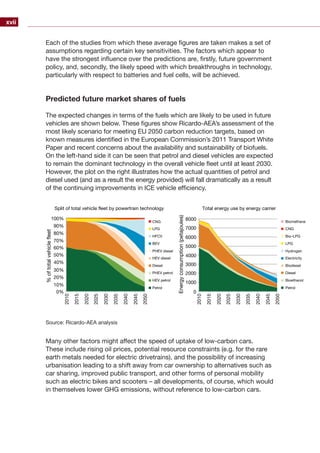
The expected changes in terms of the fuels which are likely to be used in future
vehicles are shown below. These figures show Ricardo-AEA’s assessment of the
most likely scenario for meeting EU 2050 carbon reduction targets, based on
known measures identified in the European Commission’s 2011 Transport White
Paper and recent concerns about the availability and sustainability of biofuels.
On the left-hand side it can be seen that petrol and diesel vehicles are expected
to remain the dominant technology in the overall vehicle fleet until at least 2030.
However, the plot on the right illustrates how the actual quantities of petrol and
diesel used (and as a result the energy provided) will fall dramatically as a result
of the continuing improvements in ICE vehicle efficiency.
0% 0
1000
2000
3000
4000
5000
6000
7000
8000
10%
20%
30%
40%
50%
60%
70%
80%
90%
100%
CNG Biomethane
LPG CNG
HFCV Bio–LPG
BEV LPG
PHEV diesel
PHEV petrol
HEV petrol
Petrol
HEV diesel
Diesel
Hydrogen
Diesel
Bioethanol
Petrol
Electricity
Biodiesel
2010
2015
2020
2025
2030
2035
2040
2045
2050
2010
2015
2020
2025
2030
2035
2040
2045
2050
Split of total vehicle fleet by powertrain technology Total energy use by energy carrier
%oftotalvehiclefleet
Energyconsumption(petajoules)
Source: Ricardo-AEA analysis
Many other factors might affect the speed of uptake of low-carbon cars.
These include rising oil prices, potential resource constraints (e.g. for the rare
earth metals needed for electric drivetrains), and the possibility of increasing
urbanisation leading to a shift away from car ownership to alternatives such as
car sharing, improved public transport, and other forms of personal mobility
such as electric bikes and scooters – all developments, of course, which would
in themselves lower GHG emissions, without reference to low-carbon cars.
xviii
Conclusions
In the near future, the expectation is that conventional petrol and diesel
vehicles will continue to dominate personal transport, with advances in fuel
economy being achieved by means of innovations in engine technology
combined with a greater focus on improving vehicle efficiency through reduced
weight and drag. At the same time, technologies such as stop–start systems
are expected to become commonplace, and full hybrid technology will
continue to increase its market share.
In the medium term, if breakthroughs in battery technology deliver the
necessary performance improvements and cost reductions, there will be
increasing electrification of powertrains. Increasing numbers of vehicles will
offer an ‘electric-only’ drive mode, and the numbers of plug-in hybrid models
available will increase. BEVs will start to gain market share too, as consumer
confidence in electric powertrain technologies increases.
In the longer term, the likely mix of technologies is extremely difficult to
predict. The speed with which PHEVs and BEVs (including fuel cell vehicles)
will achieve significant market shares is highly dependent on their total cost of
ownership in comparison to that of more conventional alternatives. This is, in
turn, dependent on factors such as oil prices, further battery and fuel cell cost
reductions, and government policies.
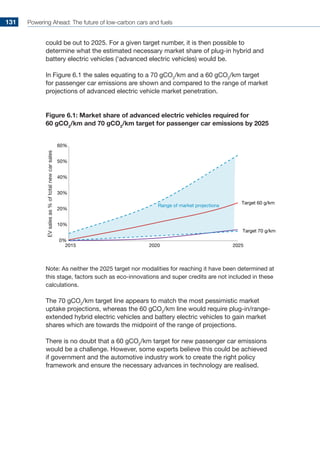
In the meantime the key question facing policymakers at present is at what
level to set the target for tailpipe CO2
emissions in 2025. Our analysis suggests
that to achieve a 70 g/km target may require the new vehicle market share for
PHEVs and BEVs to reach around 5% by 2025, in combination with further
improvements to conventional and hybrid powertrain vehicles. This matches
the most pessimistic market uptake projections of such vehicle types. A 60 g/
km target would likely require PHEVs and BEVs to gain market shares which
are towards the midpoint of the range of current projections.
There is no doubt that meeting a target of 60 g/km would be a challenge.
However, some experts believe that this could be achieved, were government
and the automotive industry to work to create the right policy framework and to
try and ensure that the necessary advances in technology are realised.
1.	The Challenge
Powering Ahead: The future of low-carbon cars and fuels1
Introduction
This report examines how addressing the
challenge of achieving an 80% reduction in
greenhouse gas (GHG) emissions by 2050
is likely to affect the cars and fuels that we
use over the next twenty years. It reviews the
range of different vehicle and fuel technologies,
examining their comparative advantages and
disadvantages. It also reviews predictions for
their likely market shares through to 2030.
1.1
The Challenge 22
It is now six years since Professor Dame Julia King set out her recommendations
for action to reduce carbon dioxide emissions from the passenger car sector in
the King Review of low-carbon cars (King, 2007). In that time there have been
many changes: policies have been introduced designed to promote the uptake
of lower-carbon cars; regulations have come into force to drive down the ‘tailpipe
emissions’ (i.e. those generated directly from the use of the fuel in the vehicle) of
new cars; and new vehicle technologies have come to market. As a result, the
average level of CO2
emissions for new cars sold in the UK in 2012 was almost
23% lower than in 2002 (SMMT, 2013a).
Much of the progress so far has been achieved through comparatively low-
cost improvements to conventional technologies – indeed, some has been due
simply to the continuing growth in the proportion of diesel vehicles and a shift
to smaller vehicles. Looking to the future there remain many questions. Can
this rate of progress be maintained? Which new technologies and fuels will
become commonplace over the next twenty-five years?
This report synthesises the vast array of literature that has been written on the
subject of low-carbon cars and aims to present a clear explanation of the range
of fuels and technologies that might be seen on the road in the future. It also
examines whether they are likely to be niche, low-volume products or can be
expected to grow to dominate the market.
However, it is first important to re-examine the reasons why we need low-
carbon vehicles (LCVs) and fuels.
Meeting UK greenhouse gas reduction targets
1.2.1 Global scientific position on climate change
The primary organisation charged with compiling and summarising scientific
analysis of climate change is the Intergovernmental Panel on Climate Change
1.2
Powering Ahead: The future of low-carbon cars and fuels3
(IPCC). Its Fourth Assessment Report, published in 2007, concluded that
“warming of the climate system is unequivocal” and stated that:
“most of the observed increase in global average temperatures
since the mid-20th
century is very likely due to the observed
increase in anthropogenic [caused by human activity] GHG
concentrations” (IPCC, 2007).
It should be noted that despite the widely reported criticism of the report and
the discovery of some minor errors, these conclusions still stand.
Scientific studies since 2007 indicate that the situation appears to be
worsening. In May 2009, ahead of the UNFCCC (United Nations Framework
Convention on Climate Change) negotiations at Copenhagen, a joint statement
from science academics stated that:
“climate change is happening even faster than previously
estimated; global CO2
emissions since 2000 have been higher
than even the highest predictions, Arctic sea ice has been melting
at rates much faster than predicted, and the rise in the sea level
has become more rapid” (G8+5 Academies, 2009).
The IPCC’s Fifth Assessment Report will review the more recent scientific
evidence for climate change and draw conclusions based on this. It is due for
finalisation in 2014.
1.2.2 UK policy on climate change
The King Review of low-carbon cars was published the year after Sir Nicholas
Stern’s influential report on the economics of climate change (HM Treasury,
2006). The Stern Review recommended that strong, early action should be
taken to address climate change.
In 2008, the UK became the first country in the world to introduce a law
committing the government to cut GHG emissions. The Climate Change Act
2008 requires an 80% reduction by 2050 relative to a baseline of 1990.
The Department of Energy  Climate Change (DECC) reports on UK GHG
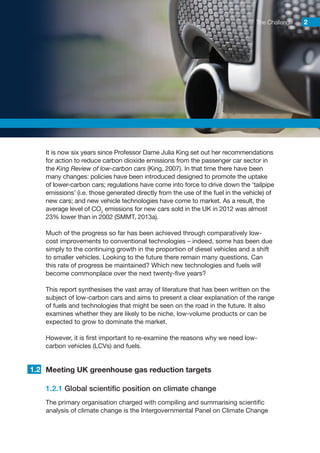
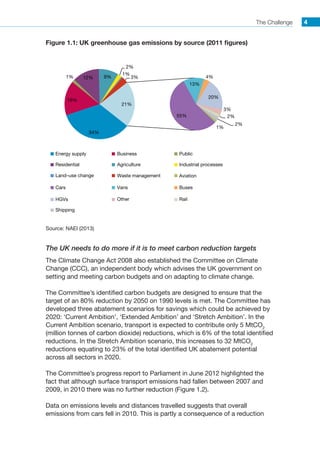
emissions. Data for 2011 shows transport to be responsible for 21% of
these emissions, with cars accounting for 55% of that share (Figure 1.1). The
dominant GHG is carbon dioxide (CO2
), and road transport accounts for 24%
of the UK’s total CO2
emissions (NAEI, 2013).
The Challenge 4
Figure 1.1: UK greenhouse gas emissions by source (2011 figures)
Energy supply
Agriculture
Aviation
HGVs
Business
Industrial processes
Cars
Other
Public
Land–use change
Vans
Rail
Residential
Waste management
Buses
Shipping
1%
1%
1%
12% 9%
2%
4%
3%
2%
2%
3%
21%
55%
13%
20%
34%
16%
Source: NAEI (2013)
The UK needs to do more if it is to meet carbon reduction targets
The Climate Change Act 2008 also established the Committee on Climate
Change (CCC), an independent body which advises the UK government on
setting and meeting carbon budgets and on adapting to climate change.
The Committee’s identified carbon budgets are designed to ensure that the
target of an 80% reduction by 2050 on 1990 levels is met. The Committee has
developed three abatement scenarios for savings which could be achieved by
2020: ‘Current Ambition’, ‘Extended Ambition’ and ‘Stretch Ambition’. In the
Current Ambition scenario, transport is expected to contribute only 5 MtCO2
(million tonnes of carbon dioxide) reductions, which is 6% of the total identified
reductions. In the Stretch Ambition scenario, this increases to 32 MtCO2
reductions equating to 23% of the total identified UK abatement potential
across all sectors in 2020.
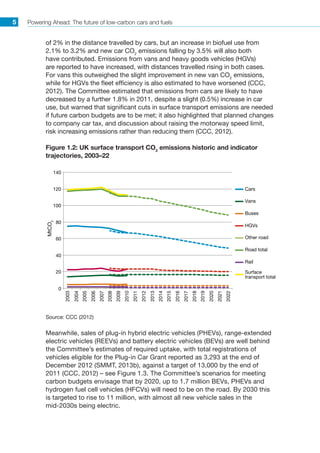
The Committee’s progress report to Parliament in June 2012 highlighted the
fact that although surface transport emissions had fallen between 2007 and
2009, in 2010 there was no further reduction (Figure 1.2).
Data on emissions levels and distances travelled suggests that overall
emissions from cars fell in 2010. This is partly a consequence of a reduction
Powering Ahead: The future of low-carbon cars and fuels5
of 2% in the distance travelled by cars, but an increase in biofuel use from
2.1% to 3.2% and new car CO2
emissions falling by 3.5% will also both
have contributed. Emissions from vans and heavy goods vehicles (HGVs)
are reported to have increased, with distances travelled rising in both cases.
For vans this outweighed the slight improvement in new van CO2
emissions,
while for HGVs the fleet efficiency is also estimated to have worsened (CCC,
2012). The Committee estimated that emissions from cars are likely to have
decreased by a further 1.8% in 2011, despite a slight (0.5%) increase in car
use, but warned that significant cuts in surface transport emissions are needed
if future carbon budgets are to be met; it also highlighted that planned changes
to company car tax, and discussion about raising the motorway speed limit,
risk increasing emissions rather than reducing them (CCC, 2012).
Figure 1.2: UK surface transport CO2
emissions historic and indicator
trajectories, 2003–22
0
20
40
60
80
100
120
140
Cars
Vans
Buses
HGVs
Other road
Road total
Rail
Surface
transport total
2003
2004
2005
2006
2007
2008
2009
2010
2011
2012
2013
2014
2015
2016
2017
2018
2019
2020
2021
2022
MtCO2
Source: CCC (2012)
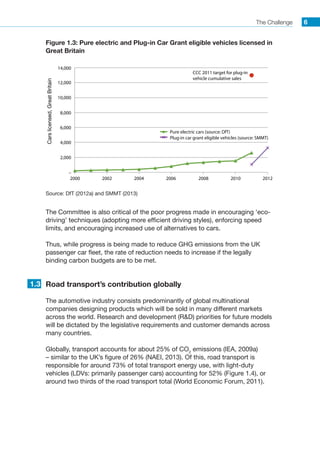
Meanwhile, sales of plug-in hybrid electric vehicles (PHEVs), range-extended
electric vehicles (REEVs) and battery electric vehicles (BEVs) are well behind
the Committee’s estimates of required uptake, with total registrations of
vehicles eligible for the Plug-in Car Grant reported as 3,293 at the end of
December 2012 (SMMT, 2013b), against a target of 13,000 by the end of
2011 (CCC, 2012) – see Figure 1.3. The Committee’s scenarios for meeting
carbon budgets envisage that by 2020, up to 1.7 million BEVs, PHEVs and
hydrogen fuel cell vehicles (HFCVs) will need to be on the road. By 2030 this
is targeted to rise to 11 million, with almost all new vehicle sales in the
mid-2030s being electric.
The Challenge 6
Figure 1.3: Pure electric and Plug-in Car Grant eligible vehicles licensed in
Great BritainCarslicensed,GreatBritain
–
2000 2002 2004
Pure electric cars (source: DfT)
CCC 2011 target for plug-in
vehicle cumulative sales
Plug-in car grant eligible vehicles (source: SMMT)
2006 2008 2010 2012
4,000
2,000
6,000
8,000
10,000
12,000
14,000
Source: DfT (2012a) and SMMT (2013)
The Committee is also critical of the poor progress made in encouraging ‘eco-
driving’ techniques (adopting more efficient driving styles), enforcing speed
limits, and encouraging increased use of alternatives to cars.
Thus, while progress is being made to reduce GHG emissions from the UK
passenger car fleet, the rate of reduction needs to increase if the legally
binding carbon budgets are to be met.
Road transport’s contribution globally
The automotive industry consists predominantly of global multinational
companies designing products which will be sold in many different markets
across the world. Research and development (RD) priorities for future models
will be dictated by the legislative requirements and customer demands across
many countries.
Globally, transport accounts for about 25% of CO2
emissions (IEA, 2009a)
– similar to the UK’s figure of 26% (NAEI, 2013). Of this, road transport is
responsible for around 73% of total transport energy use, with light-duty
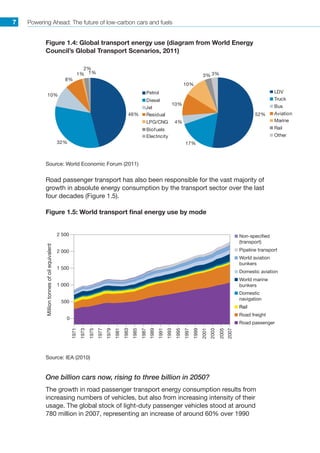
vehicles (LDVs: primarily passenger cars) accounting for 52% (Figure 1.4), or
around two thirds of the road transport total (World Economic Forum, 2011).
1.3
Powering Ahead: The future of low-carbon cars and fuels7
Figure 1.4: Global transport energy use (diagram from World Energy
Council’s Global Transport Scenarios, 2011)
46%
32%
10%
8%
1%
2%
1%
Petrol
Diesel
Jet
Residual
LPG/CNG
Biofuels
Electricity
52%
17%
4%
10%
10%
3% 3%
LDV
Truck
Bus
Aviation
Marine
Rail
Other
Source: World Economic Forum (2011)
Road passenger transport has also been responsible for the vast majority of
growth in absolute energy consumption by the transport sector over the last
four decades (Figure 1.5).
Figure 1.5: World transport final energy use by mode
0
1971
1973
1975
1977
1979
1981
1983
1985
1987
1989
1991
1993
1995
1997
1999
2001
2003
2005
2007
500
1 000
1 500
2 000
2 500
Milliontonnesofoilequivalent
Non-specified
(transport)
Pipeline transport
World aviation
bunkers
Domestic aviation
World marine
bunkers
Domestic
navigation
Rail
Road freight
Road passenger
Source: IEA (2010)
One billion cars now, rising to three billion in 2050?
The growth in road passenger transport energy consumption results from
increasing numbers of vehicles, but also from increasing intensity of their
usage. The global stock of light-duty passenger vehicles stood at around
780 million in 2007, representing an increase of around 60% over 1990
The Challenge 8
numbers; in 2012 it has been estimated that this figure could top one billion
(Elmer, 2012).
The International Energy Agency’s (IEA) World Energy Outlook 2012 estimates
that the passenger vehicle fleet will be almost 1.7 billion vehicles by 2035
(Lucas, 2011). The IMF (International Monetary Fund) has estimated that
three billion cars will be on the world’s roads by 2050 (IMF, 2008). Most of this
growth will be in countries outside the OECD (Organisation for Economic Co-
operation and Development) in which both population and GDP growth will be
strongest, particularly the BRIC countries (Brazil, Russia, India and China) –
these are expected to account for 83% of future market growth (Roland Berger,
2011). If car ownership and use in non-OECD countries continues to develop
in the same way as it did in the OECD, then car use outside the OECD would
be around 3.6 times as high in 2050 as it was in 2010 (International Transport
Forum, 2012).
While the IMF estimates the personal income levels to purchase three billion
cars will be reached, such levels of growth call into question the sustainability
of the sector. Problems of congestion may mean that the attraction of personal
car ownership declines, particularly when combined with rising fuel costs.
From an environmental perspective, without a substantial shift away from
conventional internal-combustion engine (ICE) vehicles, not only would global
transport GHG emissions grow substantially, but issues such as oil reserves,
energy security, and air pollution would have to be faced far sooner than
otherwise. Even with the introduction of ultra-low-carbon vehicle technologies,
there still remain questions over resource constraints.
There is thus an urgent need to develop highly efficient, low-emission
passenger cars, and to find ways to manufacture them within environmental
limits.
Europe and the UK’s role
While the strongest growth in future car sales is likely to be outside Europe,
many consider it unlikely that markets such as China and India will see the
strongest take-up of future low-carbon car technologies and fuels. Instead, the
growth in these markets is expected to be primarily in low-cost conventional
technologies. For example despite China’s aggressive promotion of electric
vehicle technologies, only 0.06% of car sales in China were hybrids in 2010,
compared to 0.7% in Europe, 2.5% in the USA and 11% in Japan.
Europe is expected by many to lead the world in the take-up of hybrid and
electric vehicle technologies. This is a key role – vehicle manufacturers
need market demand in developed markets such as Europe, Japan and the
USA in order to be able to invest in the substantial RD required for these
technologies.
1.4
Powering Ahead: The future of low-carbon cars and fuels9
However, take-up of advanced technologies such as BEVs has been low so
far. In addition, passenger car ownership and use in many OECD countries
appears to be reaching saturation levels, and in some major markets – such
as Japan, France, Italy, the UK, and the USA – levels of personal car use
have started to decline, leading some commentators to refer to ‘peak car’
(Schipper  Millard-Ball, 2011). More detailed analysis of the situation in the
UK suggests that this phenomenon needs careful interpretation, with strong
variations between different geographic regions and sections of society. For
example, in London, which benefits from perhaps the best public transport
systems in the UK, car use has declined markedly, but for other regions it is
increasing, particularly when company car mileage is excluded (Le Vine 
Jones, 2012). Nevertheless, while a decline in use may help reduce greenhouse
gas emissions in OECD countries, it could make it difficult for automotive
OEMs (original equipment manufacturers) to justify investment in what may be
stagnant or declining markets.
If policymakers wish to achieve the carbon reduction targets set out, it will be
essential to ensure that there is sufficient support available to allow the market
for these new technologies to grow. This policy context is explored in the next
section.
The Challenge 10
2.	The Policy Context
Powering Ahead: The future of low-carbon cars and fuels1111
Introduction
The growth in UK sales of new low-carbon
cars, and the fuels needed to run them, will be
strongly influenced by government policies both
at a national and a European level.
At a national level, the UK’s Climate Change Act
2008 has already been discussed and remains
a strong high-level driver of change, but many
other more detailed actions have been put in
place to promote take-up of low-carbon cars
since the King Review was published in 2007.
However, it is important first to understand the
key role played by European transport policy,
and its impact on the UK.
2.1
The Policy Context 12
European transport and fuel policy
The key policy document for transport in Europe is the 2011 Transport White
Paper, which has the aim of “growing transport and supporting mobility while
reaching the 60% emission reduction target [by 2050]” (European Commission,
2011f). This includes objectives of:
•	 halving the use of ‘conventionally fuelled’ cars in urban transport by 2030
and phasing them out in cities by 2050;
•	 halving road casualties by 2020 and moving close to zero casualties by
2050;
•	 reducing oil dependency;
•	 improving air quality in cities.
The White Paper states:
“The race for sustainable mobility is a global one. Delayed action
and timid introduction of new technologies could condemn the EU
transport industry to irreversible decline. The EU’s transport sector
faces growing competition in fast developing world transport
markets” (European Commission, 2011f: 5).
It goes on to say:
“The synergies with other sustainability objectives such as the
reduction of oil dependence, the competitiveness of Europe’s
automotive industry as well as health benefits, especially improved
air quality in cities, make a compelling case for the EU to step up
its efforts to accelerate the development and early deployment of
clean vehicles” (ibid.).
The European Commission’s strategy for the automotive sector is informed and
guided by a number of bodies, including:
2.2
Powering Ahead: The future of low-carbon cars and fuels13
CARS21 (the Competitive Automotive Regulatory System for the 21st
century)
has as its aim “to make recommendations for the short-, medium-, and long-
term public policy and regulatory framework of the European automotive
industry.”
European Green Cars Initiative – a Public-Private Partnership formed to
“support RD on technologies and infrastructures that are essential for
achieving breakthroughs in the use of renewable and non-polluting energy
sources, safety and traffic fluidity.”
ERTRAC (the European Road Transport Research Advisory Council) – this
body is supported and recognised by the European Commission as the
European Technology Platform for Road Transport, and on its website it states
that its aim is “to develop a shared vision and to ensure a timely, coordinated
and efficient implementation of Research in Europe, with the objective to
tackle the societal challenges of road transport and to enhance the European
Competitiveness”.
In November 2012, the European Commission published CARS 2020,
its action plan for the automotive sector (European Commission, 2012b).
This emphasises a broad approach to reducing CO2
emissions from the
automotive sector, focusing not merely on powertrain technology, but also on
complementary measures such as alternative fuels, driver behaviour, and other
technological improvements such as improved aerodynamics. It reaffirms the
Commission’s commitment to 2020 CO2
targets for cars and vans, including
the use of eco-innovation provisions and ‘super credits’ for low-CO2
vehicles
(whereby cars that emit less than 35 gCO2
/km count as 1.3 vehicles), and
announces a broad consultation on post-2020 targets. This is expected to lead
to goals for 2025 and 2030 being announced by the end of 2014.
The Policy Context 1414
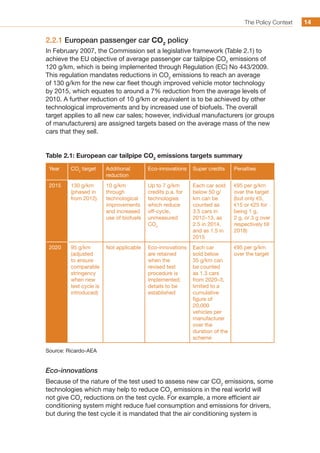
2.2.1 European passenger car CO2
policy
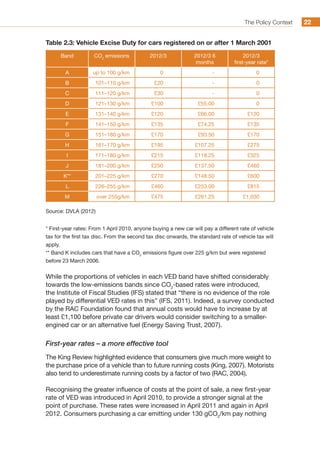
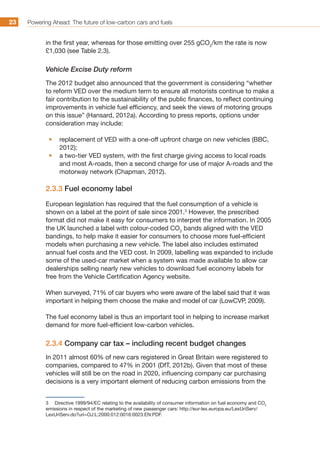
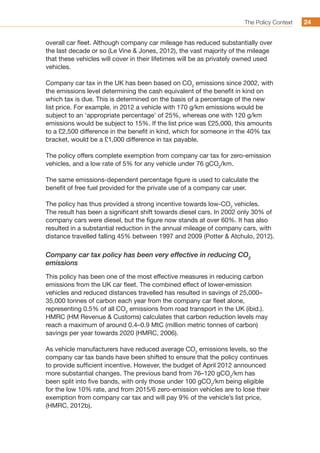
In February 2007, the Commission set a legislative framework (Table 2.1) to
achieve the EU objective of average passenger car tailpipe CO2
emissions of
120 g/km, which is being implemented through Regulation (EC) No 443/2009.
This regulation mandates reductions in CO2
emissions to reach an average
of 130 g/km for the new car fleet though improved vehicle motor technology
by 2015, which equates to around a 7% reduction from the average levels of
2010. A further reduction of 10 g/km or equivalent is to be achieved by other
technological improvements and by increased use of biofuels. The overall
target applies to all new car sales; however, individual manufacturers (or groups
of manufacturers) are assigned targets based on the average mass of the new
cars that they sell.
Table 2.1: European car tailpipe CO2
emissions targets summary
Year CO2
target Additional
reduction
Eco-innovations Super credits Penalties
2015 130 g/km
(phased in
from 2012).
10 g/km
through
technological
improvements
and increased
use of biofuels
Up to 7 g/km
credits p.a. for
technologies
which reduce
off-cycle,
unmeasured
CO2
Each car sold
below 50 g/
km can be
counted as
3.5 cars in
2012–13, as
2.5 in 2014,
and as 1.5 in
2015
€95 per g/km
over the target
(but only €5,
€15 or €25 for
being 1 g,
2 g, or 3 g over
respectively till
2018)
2020 95 g/km
(adjusted
to ensure
comparable
stringency
when new
test cycle is
introduced)
Not applicable Eco-innovations
are retained
when the
revised test
procedure is
implemented;
details to be
established
Each car
sold below
35 g/km can
be counted
as 1.3 cars
from 2020–3,
limited to a
cumulative
figure of
20,000
vehicles per
manufacturer
over the
duration of the
scheme
€95 per g/km
over the target
Source: Ricardo-AEA
Eco-innovations
Because of the nature of the test used to assess new car CO2
emissions, some
technologies which may help to reduce CO2
emissions in the real world will
not give CO2
reductions on the test cycle. For example, a more efficient air
conditioning system might reduce fuel consumption and emissions for drivers,
but during the test cycle it is mandated that the air conditioning system is
Powering Ahead: The future of low-carbon cars and fuels15
switched off. Manufacturers can be granted emissions credits equivalent to a
maximum emissions saving of 7 gCO2
/km per year for their fleet if they equip
vehicles with innovative technologies, based on independently verified data
(European Commission, 2012g).
Super credits
Super credits give manufacturers additional credit for selling very low-CO2
vehicles. Currently each vehicle sold below 50 g/km can be counted as 3.5
vehicles when calculating a manufacturer’s average fleet emissions. It is
argued that this incentivises manufacturers to introduce innovative very low-
CO2
technologies. Others have pointed out that the system can provide a
way for manufacturers who do this to continue to sell more high-CO2
vehicles
(Transport  Environment, 2012).
Limit value curve and the importance of the slope
The ‘limit value curve’ is actually a straight line which defines the relationship
between the CO2
emissions target and the mass of a vehicle. Manufacturers
of heavier cars are allowed higher emissions limits than those of lighter ones.
This is in recognition of the fact that it is important that a wide range of vehicle
types is available to meet people’s needs. Weight is used as a ‘proxy’ for utility,
as a larger vehicle with more carrying capacity will generally be heavier, and is
therefore likely to use more energy and produce higher CO2
emissions.
For the 2015 target, the slope of this line is set such that the CO2
emissions
target for a manufacturer is increased by 4.57 g/km for each 100 kg additional
vehicle weight. It is important that this allowance does not incentivise
manufacturers to increase vehicle weight, so the slope of this relationship must
be shallow enough to avoid this.
Additional legislation to reduce greenhouse gas emissions from cars
The Commission has also introduced other legislation aimed at reducing GHG
emissions from passenger cars. Regulation (EC) No 661/2009 mandates that
all new passenger cars offered for sale must have tyre pressure monitoring
systems (TPMS) and gear shift indicator lights from 1 November 2014. Low
rolling resistance tyres must also be fitted, although these are to be phased
in from November 2014 to November 2018. Together the Department for
Transport (DfT) expects these to have the potential to reduce fuel consumption
by 20% by 2020 (DfT, 2010b). Regulation (EC) No 1222/2009 requires tyre
labels to be fitted indicating their performance level for rolling resistance, grip
and noise on a scale of A to G. This will help inform consumer choice, and is
hoped to encourage use of low rolling resistance tyres on all cars.
Regulations to reduce tailpipe CO2
emissions from vans were introduced in
May 2011. These set targets of 175 g/km in 2014, falling to 147 g/km by 2020.
The Policy Context 1616
The new 95 gCO2
/km target for 2020
In July 2012, the European Commission issued a proposal for a regulation
which set out how it plans to define calculations to reach the 2020 target
of 95 gCO2
/km (European Commission, 2012e). This proposal is now being
reviewed by the European Parliament and Council of Ministers. The proposal
continues to use a mass-based target, whereby heavier vehicles are given
more lenient targets than lighter ones. This is despite criticism of this approach
by those who argue that it tends to discourage manufacturers from reducing
vehicle weight, whereas adopting a ‘footprint’-based approach would lessen
this effect (Transport  Environment, 2008; 2011). However, the ‘slope’ of
the limit value curve has been flattened to 3.33 gCO2
/km for each 100 kg of
additional vehicle weight, which should help to discourage any tendency to
increase weight.
The system of eco-innovations is being continued, and super credits are to
be reintroduced from 2020 to 2023, but for cars below 35 gCO2
/km – where
previously the threshold was 50 gCO2
/km.
2.2.2 European fuel directives
European Directives also affect the quality and nature of the fuels available in
the UK. For example, since 2009 all fuels have had a sulphur content of less
than 10 ppm (parts per million). The development of tightly specified, high-
quality fuels has allowed manufacturers in turn to develop engine technologies
– particularly those related to the combustion system and fuel injection – which
are optimised to suit these fuels. This has enabled the introduction of direct-
injection engines and also reduced emissions of conventional pollutants from
the existing fleet of vehicles.
Powering Ahead: The future of low-carbon cars and fuels17
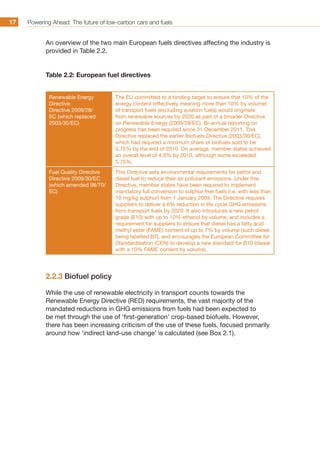
An overview of the two main European fuels directives affecting the industry is
provided in Table 2.2.
Table 2.2: European fuel directives
Renewable Energy
Directive
Directive 2009/28/
EC (which replaced
2003/30/EC)
The EU committed to a binding target to ensure that 10% of the
energy content (effectively meaning more than 10% by volume)
of transport fuels (excluding aviation fuels) would originate
from renewable sources by 2020 as part of a broader Directive
on Renewable Energy (2009/28/EC). Bi-annual reporting on
progress has been required since 31 December 2011. This
Directive replaced the earlier Biofuels Directive (2003/30/EC),
which had required a minimum share of biofuels sold to be
5.75% by the end of 2010. On average, member states achieved
an overall level of 4.9% by 2010, although some exceeded
5.75%.
Fuel Quality Directive
Directive 2009/30/EC
(which amended 98/70/
EC)
This Directive sets environmental requirements for petrol and
diesel fuel to reduce their air pollutant emissions. Under this
Directive, member states have been required to implement
mandatory full conversion to sulphur-free fuels (i.e. with less than
10 mg/kg sulphur) from 1 January 2009. The Directive requires
suppliers to deliver a 6% reduction in life cycle GHG emissions
from transport fuels by 2020. It also introduces a new petrol
grade (E10) with up to 10% ethanol by volume, and includes a
requirement for suppliers to ensure that diesel has a fatty acid
methyl ester (FAME) content of up to 7% by volume (such diesel
being labelled B7), and encourages the European Committee for
Standardisation (CEN) to develop a new standard for B10 (diesel
with a 10% FAME content by volume).
2.2.3 Biofuel policy
While the use of renewable electricity in transport counts towards the
Renewable Energy Directive (RED) requirements, the vast majority of the
mandated reductions in GHG emissions from fuels had been expected to
be met through the use of ‘first-generation’ crop-based biofuels. However,
there has been increasing criticism of the use of these fuels, focused primarily
around how ‘indirect land-use change’ is calculated (see Box 2.1).
The Policy Context 1818
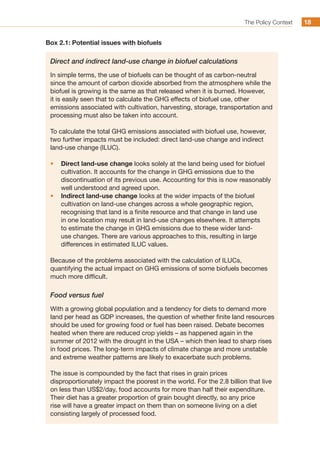
Box 2.1: Potential issues with biofuels
Direct and indirect land-use change in biofuel calculations
In simple terms, the use of biofuels can be thought of as carbon-neutral
since the amount of carbon dioxide absorbed from the atmosphere while the
biofuel is growing is the same as that released when it is burned. However,
it is easily seen that to calculate the GHG effects of biofuel use, other
emissions associated with cultivation, harvesting, storage, transportation and
processing must also be taken into account.
To calculate the total GHG emissions associated with biofuel use, however,
two further impacts must be included: direct land-use change and indirect
land-use change (ILUC).
•	 Direct land-use change looks solely at the land being used for biofuel
cultivation. It accounts for the change in GHG emissions due to the
discontinuation of its previous use. Accounting for this is now reasonably
well understood and agreed upon.
•	 Indirect land-use change looks at the wider impacts of the biofuel
cultivation on land-use changes across a whole geographic region,
recognising that land is a finite resource and that change in land use
in one location may result in land-use changes elsewhere. It attempts
to estimate the change in GHG emissions due to these wider land-
use changes. There are various approaches to this, resulting in large
differences in estimated ILUC values.
Because of the problems associated with the calculation of ILUCs,
quantifying the actual impact on GHG emissions of some biofuels becomes
much more difficult.
Food versus fuel
With a growing global population and a tendency for diets to demand more
land per head as GDP increases, the question of whether finite land resources
should be used for growing food or fuel has been raised. Debate becomes
heated when there are reduced crop yields – as happened again in the
summer of 2012 with the drought in the USA – which then lead to sharp rises
in food prices. The long-term impacts of climate change and more unstable
and extreme weather patterns are likely to exacerbate such problems.
The issue is compounded by the fact that rises in grain prices
disproportionately impact the poorest in the world. For the 2.8 billion that live
on less than US$2/day, food accounts for more than half their expenditure.
Their diet has a greater proportion of grain bought directly, so any price
rise will have a greater impact on them than on someone living on a diet
consisting largely of processed food.
Powering Ahead: The future of low-carbon cars and fuels19
There is disagreement about the extent to which biofuel production
contributes to food price rises, but with finite resources and increasing
demand there is no doubt that there is an effect. It is also important to note
that policies to protect against deforestation (or even promote reforestation –
which the IPCC recommends as a very cost-effective way of reducing GHG
emissions) will inevitably lead to increased competition, between food and
biofuels, for the remaining land. This may also act to push food prices higher.
As a result of the uncertainty regarding the GHG impacts of first-generation
biofuels, on 17 October 2012 the European Commission issued a proposal for
a 5% limit on the use of biofuels from food crops allowed in transport through
to 2020, and the ending of all public subsidies for crop-based biofuels after the
current legislation expires in 2020 (European Commission, 2012d).
Since Europe has already achieved about a 4.7% share of renewable energy in the
transport sector, mostly through use of crop-based biofuels, this limits any further
expansion of production and may result in financial losses to the biofuel industry.
The Commission will also investigate ILUC impacts, with the aim of including
them in sustainability criteria – but not until at least 2021. It is hoped that
these changes will encourage production of ‘next-generation’ biofuels with
no, or low, ILUC emissions. These are being developed from non-crop-based
biomass such as woody crops, agricultural and municipal residues or waste,
and algae.
2.2.4 Biofuel compatibility
Existing fuel sold by filling stations already contains up to 5% biofuel
blends, and is compatible with vehicles without any need for modification.
However, use of high-percentage-biofuel blends requires that engines, and
fuel and exhaust systems, are suitably designed and specified, otherwise
problems may arise. Biofuels can have substantially different characteristics
to standard mineral fuels with regard to volatility, viscosity and stability over
time. With biodiesel, the characteristics can also vary depending on the
feedstock and processes used to produce it, making it particularly difficult for
vehicle manufacturers to ensure that their new vehicle test and development
procedures cover all potential issues. However, ACEA, the European
Automobile Manufacturers’ Association (‘Association des Constructeurs
Européens d’Automobiles’), has supported measures to increase biofuels,
and manufacturers have worked to ensure that their vehicles are compatible
with the E10 petrol and B7 diesel that has become available on the market in
accordance with the Fuel Quality Directive. All new diesel cars are compatible
with B7 diesel fuel, and the vast majority of petrol models are compatible with
E10 (ACEA, 2012b). Many next-generation biofuels do not suffer from these
compatibility issues, as the production processes used result in fuels which
have almost identical characteristics to conventional mineral fuels. These are
known as ‘drop-in’ fuels since they can act as direct replacements.
The Policy Context 2020
Existing UK policy framework
When the DfT published its low-carbon transport strategy (DfT, 2009), it
identified three main themes for carbon reduction:
•	 supporting a shift to new technologies and cleaner fuels;
•	 promoting lower-carbon choices; and
•	 using market mechanisms to encourage a shift to lower-carbon transport.
The first of these themes was expected to deliver over 91% of the total carbon
reduction, primarily through European legislation – the regulations on new car
and van CO2
reduction and renewable transport fuels described in section 2.2.
These have been transcribed into legislation in the UK and remain the most
significant factor in reducing carbon emissions from passenger cars.
The UK Transport Carbon Reduction Delivery Plan (DfT, 2010b) reviews each of
the key actions which are being taken to achieve these reductions, identifying
how and when they are implemented, at the same time establishing measures
to track progress. The actual tracking of progress is carried out by the CCC,
which publishes annual progress reports.
2.3
Powering Ahead: The future of low-carbon cars and fuels21
2.3.1 Tailpipe CO2
-related policies
The introduction of tailpipe targets for the average CO2
emissions from new
sales of cars and vans has been a fundamental mechanism for the introduction
of new vehicle technologies and fuels which aim to reduce carbon emissions.
As can be seen in Figure 2.1, since the European Commission set out the
legislative framework for this policy in 2007, the pace of reductions has
increased such that UK new car CO2
emissions are ahead of the target
trajectory.
The CO2
intensity of new vans has also fallen from slightly, from 196 g/km in
2010 to 195 g/km in 2011. This is significantly higher than the 2020 target for
vans of 147 g/km; however, the pace of reduction is expected to increase now
that the legislation is in place.
Despite the good progress in new car CO2
reduction, the 2020 target is still
described by ACEA (2012a) as “extremely challenging”.
Figure 2.1: Average UK new car tailpipe CO2
emissions
165
158
150 144
161
160
155
0
20
40
60
80
100
120
140
160
180
200
1997
gCO2/km
1998
1999
2000
2001
2002
2003
2004
2005
2006
2007
2008
2009
2010
Outturn
Indicator trajectory
Source: CCC (2012)
2.3.2 Vehicle Excise Duty
Vehicle Excise Duty (VED) has been based on CO2
emissions since 2001. The
system has been gradually reformed to increase incentives for the purchase
and manufacture of lower-carbon cars since then. The 2012 budget raised VED
rates again in April 2012 for all cars in emissions band D and above, as shown
in Table 2.3.
The Policy Context 2222
Table 2.3: Vehicle Excise Duty for cars registered on or after 1 March 2001
Band CO2
emissions 2012/3 2012/3 6
months
2012/3
first-year rate*
A up to 100 g/km 0 - 0
B 101–110 g/km £20 - 0
C 111–120 g/km £30 - 0
D 121–130 g/km £100 £55.00 0
E 131–140 g/km £120 £66.00 £120
F 141–150 g/km £135 £74.25 £135
G 151–160 g/km £170 £93.50 £170
H 161–170 g/km £195 £107.25 £275
I 171–180 g/km £215 £118.25 £325
J 181–200 g/km £250 £137.50 £460
K** 201–225 g/km £270 £148.50 £600
L 226–255 g/km £460 £253.00 £815
M over 255g/km £475 £261.25 £1,030
Source: DVLA (2012)
* First-year rates: From 1 April 2010, anyone buying a new car will pay a different rate of vehicle
tax for the first tax disc. From the second tax disc onwards, the standard rate of vehicle tax will
apply.
** Band K includes cars that have a CO2
emissions figure over 225 g/km but were registered
before 23 March 2006.
While the proportions of vehicles in each VED band have shifted considerably
towards the low-emissions bands since CO2
-based rates were introduced,
the Institute of Fiscal Studies (IFS) stated that “there is no evidence of the role
played by differential VED rates in this” (IFS, 2011). Indeed, a survey conducted
by the RAC Foundation found that annual costs would have to increase by at
least £1,100 before private car drivers would consider switching to a smaller-
engined car or an alternative fuel (Energy Saving Trust, 2007).
First-year rates – a more effective tool
The King Review highlighted evidence that consumers give much more weight to
the purchase price of a vehicle than to future running costs (King, 2007). Motorists
also tend to underestimate running costs by a factor of two (RAC, 2004).
Recognising the greater influence of costs at the point of sale, a new first-year
rate of VED was introduced in April 2010, to provide a stronger signal at the
point of purchase. These rates were increased in April 2011 and again in April
2012. Consumers purchasing a car emitting under 130 gCO2
/km pay nothing
Powering Ahead: The future of low-carbon cars and fuels23
in the first year, whereas for those emitting over 255 gCO2
/km the rate is now
£1,030 (see Table 2.3).
Vehicle Excise Duty reform
The 2012 budget also announced that the government is considering “whether
to reform VED over the medium term to ensure all motorists continue to make a
fair contribution to the sustainability of the public finances, to reflect continuing
improvements in vehicle fuel efficiency, and seek the views of motoring groups
on this issue” (Hansard, 2012a). According to press reports, options under
consideration may include:
•	 replacement of VED with a one-off upfront charge on new vehicles (BBC,
2012);
•	 a two-tier VED system, with the first charge giving access to local roads
and most A-roads, then a second charge for use of major A-roads and the
motorway network (Chapman, 2012).
2.3.3 Fuel economy label
European legislation has required that the fuel consumption of a vehicle is
shown on a label at the point of sale since 2001.3
However, the prescribed
format did not make it easy for consumers to interpret the information. In 2005
the UK launched a label with colour-coded CO2
bands aligned with the VED
bandings, to help make it easier for consumers to choose more fuel-efficient
models when purchasing a new vehicle. The label also includes estimated
annual fuel costs and the VED cost. In 2009, labelling was expanded to include
some of the used-car market when a system was made available to allow car
dealerships selling nearly new vehicles to download fuel economy labels for
free from the Vehicle Certification Agency website.
When surveyed, 71% of car buyers who were aware of the label said that it was
important in helping them choose the make and model of car (LowCVP, 2009).
The fuel economy label is thus an important tool in helping to increase market
demand for more fuel-efficient low-carbon vehicles.
2.3.4 Company car tax – including recent budget changes
In 2011 almost 60% of new cars registered in Great Britain were registered to
companies, compared to 47% in 2001 (DfT, 2012b). Given that most of these
vehicles will still be on the road in 2020, influencing company car purchasing
decisions is a very important element of reducing carbon emissions from the
3	 Directive 1999/94/EC relating to the availability of consumer information on fuel economy and CO2
emissions in respect of the marketing of new passenger cars: http://eur-lex.europa.eu/LexUriServ/
LexUriServ.do?uri=OJ:L:2000:012:0016:0023:EN:PDF.
The Policy Context 2424
overall car fleet. Although company car mileage has reduced substantially over
the last decade or so (Le Vine  Jones, 2012), the vast majority of the mileage
that these vehicles will cover in their lifetimes will be as privately owned used
vehicles.
Company car tax in the UK has been based on CO2
emissions since 2002, with
the emissions level determining the cash equivalent of the benefit in kind on
which tax is due. This is determined on the basis of a percentage of the new
list price. For example, in 2012 a vehicle with 170 g/km emissions would be
subject to an ‘appropriate percentage’ of 25%, whereas one with 120 g/km
emissions would be subject to 15%. If the list price was £25,000, this amounts
to a £2,500 difference in the benefit in kind, which for someone in the 40% tax
bracket, would be a £1,000 difference in tax payable.
The policy offers complete exemption from company car tax for zero-emission
vehicles, and a low rate of 5% for any vehicle under 76 gCO2
/km.
The same emissions-dependent percentage figure is used to calculate the
benefit of free fuel provided for the private use of a company car user.
The policy has thus provided a strong incentive towards low-CO2
vehicles.
The result has been a significant shift towards diesel cars. In 2002 only 30% of
company cars were diesel, but the figure now stands at over 60%. It has also
resulted in a substantial reduction in the annual mileage of company cars, with
distance travelled falling 45% between 1997 and 2009 (Potter  Atchulo, 2012).
Company car tax policy has been very effective in reducing CO2
emissions
This policy has been one of the most effective measures in reducing carbon
emissions from the UK car fleet. The combined effect of lower-emission
vehicles and reduced distances travelled has resulted in savings of 25,000–
35,000 tonnes of carbon each year from the company car fleet alone,
representing 0.5% of all CO2
emissions from road transport in the UK (ibid.).
HMRC (HM Revenue  Customs) calculates that carbon reduction levels may
reach a maximum of around 0.4–0.9 MtC (million metric tonnes of carbon)
savings per year towards 2020 (HMRC, 2006).
As vehicle manufacturers have reduced average CO2
emissions levels, so the
company car tax bands have been shifted to ensure that the policy continues
to provide sufficient incentive. However, the budget of April 2012 announced
more substantial changes. The previous band from 76–120 gCO2
/km has
been split into five bands, with only those under 100 gCO2
/km being eligible
for the low 10% rate, and from 2015/6 zero-emission vehicles are to lose their
exemption from company car tax and will pay 9% of the vehicle’s list price,
(HMRC, 2012b).
Powering Ahead: The future of low-carbon cars and fuels25
Despite the substantial tax concessions offered for ultra-low-carbon
technologies, the policy has so far done little to promote their uptake. This
is perhaps because currently available BEVs do not meet business usage
requirements, given the longer distances covered.
The recent changes may be expected to benefit hybrid electric vehicles (HEVs)
and PHEVs most, given that some recently launched models now achieve
significantly lower CO2
emissions than conventional diesel equivalents, while
having only slightly higher list prices (Potter  Atchulo, 2012). As an example,
Volvo has stated that it expects 80% of total sales for its V60 PHEV to be to
the company car market (Volvo, 2011).
2.3.5 Fuel duty
Fuel duty provides by far the largest component of taxation on motorists,
generating some £27 billion revenue in 2011/12, in comparison to £5.8 billion
for VED (Hansard, 2012b).
Currently, duty rates for unleaded petrol, diesel, biodiesel and bioethanol are all
set at the same level of £0.5795 per litre, with a planned 3.02p rise to £0.6097
in September 2013. Natural gas and biogas are set at 0.247 £/kg which
provides a significant incentive for their use.
Biofuels (biodiesel and bioethanol) produced from biomass or waste cooking
oil that were intended for use as road fuel had previously received a 20 pence
per litre reduction on the fuel duty rate. This reduction was stopped for
biomass-derived fuels on 1 April 2010, and for biodiesel from waste cooking oil
on 31 March 2012 (HMRC, 2012a).
The Policy Context 2626
Box 2.2: Effect of fuel duty rebate on biodiesel from used cooking oil
Biodiesel from used cooking oil
Used cooking oil can be processed to create biodiesel. This is an effective
way of diverting what would otherwise be a waste stream to produce a
low-carbon fuel. The oil might otherwise be poured down the drain, causing
blockages and increased costs to utility companies.
Recognising this, a 20 pence per litre reduction on the fuel duty rate was
put in place. As a result, several businesses invested heavily in processing
and refuelling infrastructure to support collection of used cooking oil from
businesses and its conversion into biodiesel.
Data collected by the DfT on biofuel feedstocks showed that production
volumes of biodiesel from used cooking oil increased dramatically, and
it jumped from being the seventh most common feedstock in 2009/10 to
the largest single feedstock accounting for 30% of total biofuel supply
in 2010/11 (DfT, 2011). While this increased demand was met partly by
diverting UK waste oil streams, it also resulted in a substantial increase
in imported waste oil. Figures for the first quarter of 2012/13 show used
cooking oil from the USA as the most widely reported source for biodiesel
(DfT, 2012e). Removal of the 20 pence duty reduction in April 2012 may
mean that biodiesel suppliers who use this feedstock find it harder to
attract customers. Figures obtained from one UK producer show a 60%
drop in production volumes since the change. However, under the UK’s
Renewable Transport Fuels Obligation, biofuels from waste count double
(see section 2.3.6), and if the European Commission caps use of crop-based
biofuels then this may increase demand for biodiesel from used cooking oil.
Since the amount of fuel duty paid will increase with both increased distance
travelled and increased fuel consumption per mile, it is often argued that fuel
duty is a fair and effective way of taxing motoring. More fuel burned means
more carbon emissions, and more air pollution, but also higher tax paid,
aligning with the principle of ‘the polluter pays’.
However, there are other negative social impacts, or ‘externalities’, such as
congestion, road deaths and injuries, noise and so on, which have a much
weaker link to fuel use.
Increases in the price of fuel have been shown to result in a modest reduction
in its consumption (Glaister  Graham, 2000). It can thus be expected that
increases in fuel duty, and hence in pump prices, would tend to result in
reduced total vehicle distances travelled.
Powering Ahead: The future of low-carbon cars and fuels27
Fuel duty escalator – attempting to give a clearer long-term signal
The concept of a fuel duty escalator – a system by which fuel duty is planned
to be increased at a rate higher than general inflation – was introduced by
the Conservative government in 1993. It aimed to reduce pollution from road
transport to help tackle climate change. It also gave a clear indicator and
created more certainty about the rising costs of road transport in the future. It
was set at an annual increase of 3% ahead of inflation, later rising to 5%. The
Labour government increased the rate to 6% in 1997. However, following large-
scale protests regarding the price of fuel in 2000, the policy was scrapped.
One of the problems of the policy was that it did not take into account
fluctuations in the price of oil. Recognising this, the coalition government
introduced the concept of a ‘fair fuel stabiliser’ system in the 2011 budget.
Under this system, fuel duty is set to rise by RPI (Retail Prices Index) inflation
plus one penny per litre each year until 2014/5, but if oil prices are high, then
the rise is by RPI only. The system came into effect in March 2012 with a
‘trigger’ price for oil of £45 (US$75) per barrel.
However, the policy has again met with widespread criticism and has been
politically difficult to maintain. For example a 3 pence per litre rise in fuel
duty was announced in autumn 2011 for 1 January 2012. This was then
deferred to 1 August 2012, and then in June 2012 another deferral was
announced, this time to 1 January 2013. The chancellor’s Autumn Statement
on 5 December 2012 announced that the rise would be pushed back again to
1 September 2013 (HM Treasury, 2012).
Fuel duty is not an environmental tax
In 2010 the government promised to increase the share of total revenues
coming from environmental taxes. However, in order to assess this, it was first
necessary to define what is and is not an environmental tax. In July 2012, the
government published its definition, classifying environmental taxes as “those
that meet all of the following three principles:
1.	 the tax is explicitly linked to the government’s environmental objectives;
and
2.	 the primary objective of the tax is to encourage environmentally positive
behaviour change; and
3.	 the tax is structured in relation to environmental objectives – for example,
the more polluting the behaviour, the greater the tax levied” (Hansard,
2012b).
It also specified which taxes are considered to meet these principles. Fuel
duty was not included, nor was VED, although it was accepted that both have
secondary environmental benefits.
The Policy Context 2828
Research conducted by the IFS for the RAC Foundation suggests that the
setting of fuel duty rates is a politicised process in which there has been
significant inconsistency, with announced future changes frequently delayed or
cancelled (Johnson et al., 2012).
This uncertainty can cause difficulties both for consumers and businesses
when making new vehicle purchase decisions. While future fuel prices can
never be certain, owing to fluctuations in oil price, additional uncertainty due
to government policy on fuel duty makes it harder to calculate the benefits of
paying a higher purchase price for a more fuel-efficient vehicle.
2.3.6 Biofuels
In the UK, the 2003 European Biofuels Directive4
eventually led to the
introduction of the Renewable Transport Fuels Obligation (RTFO) which came
into force in 2008. This obligates fossil fuel suppliers to produce evidence
demonstrating that a target percentage of the fuel supplied for road transport
in the UK comes from renewable sources and is sustainable. If this target is not
met, a substitute amount of money must be paid.
Following the RED, the target is now for biofuel supply to reach 5% of total
road transport fuel supplied by volume by April 2013. Because of ongoing
uncertainty as to the volumes of biofuels that might be sourced sustainably,
there are currently no plans for further UK targets. The RTFO was amended
to implement the sustainability criteria for biofuels specified in the RED in
December 2011. These include minimum GHG savings of 35% initially, rising
to 50% in 2017 and 60% in 2018. These figures may change in the future
following the European Commission’s proposals published on 17 October 2012
mentioned in section 2.2.3 above. Fuel suppliers are also required to
demonstrate that the cultivation of feedstock for their fuels does not damage
areas of high carbon stocks or high biodiversity. Renewable Transport Fuel
Certificates (RTFCs) are awarded once data has been independently verified.
One RTFC is awarded per litre of biofuel, or kilogram of biomethane, supplied.
Biofuels made from waste products such as cooking oil are given double
rewards, as are fuels derived from lignocellulosic and non-edible cellulosic
material. RTFCs may be traded between scheme participants, but at the end
of the year suppliers must redeem the appropriate amount of RTFCs or pay a
‘buy-out’ price per litre of obligation (DfT, 2012f).
2.3.7 Ultra-low-emission vehicles
In 2009 the DfT established the Office for Low Emission Vehicles (OLEV)
to support work to encourage people to buy and drive ultra-low-emission
vehicles.
4	 Directive 2003/30/EC on the promotion of the use of biofuels or other renewable fuels for transport:
http://eur-lex.europa.eu/LexUriServ/LexUriServ.do?uri=OJ:L:2003:123:0042:0042:EN:PDF.
Powering Ahead: The future of low-carbon cars and fuels29
Over £400 million has been used to fund actions to progress this, allocated to:
•	 the Plug-in Car and Van Grants;
•	 the Plugged-in Places (PIP) scheme;
•	 Making the Connection – the government’s plug-in vehicle infrastructure
strategy (OLEV, 2011); and
•	 Low-carbon vehicle industry support.
Each of these is reviewed in more detail here.
The Plug-in Car and Van Grants
Since January 2011, motorists purchasing an ultra-low emissions car have
been eligible to receive a grant of 25% towards the cost, up to a maximum of
£5,000, provided it meets set criteria. These include direct emissions below
75 gCO2
/km and a minimum range of 10 miles for a PHEV and 70 miles for
a pure electric vehicle (EV). The full list of criteria is published on the UK
government website under Plug-in Car Grant guidance (DfT, 2010a). As of
31 December 2012, there were eleven models of car which met these criteria,
and 3,021 people had claimed grants.
The Plug-in Van Grant was introduced in February 2012. Van buyers
purchasing a qualifying ultra-low emissions van can receive a grant of 20%
towards the cost of the vehicle, up to a maximum of £8,000. The vehicle must
have a gross weight of 3.5 tonnes or less, and emissions of below 75 gCO2
/km.
Fully electric vans must have a minimum range of 60 miles between charges;
PHEVs must be able to travel 10 miles.
The Policy Context 3030
As of 31 December 2012, there were seven models of van available through the
scheme and 215 claims had been made.
The Plugged-in Places scheme
The PIP scheme has made available £30 million of match-funding to consortia
of businesses and public sector partners to install EV charging points. It is
operating in eight areas:
•	 East England
•	 Greater Manchester
•	 London
•	 Midlands
•	 Milton Keynes
•	 North East England
•	 Northern Ireland
•	 Scotland
The PIP scheme is expected to help raise the profile of low-carbon transport
amongst local transport providers, encourage private-sector involvement with
infrastructure installation, and help test recharging equipment. It also aims
to create a better understanding of how people use EVs, including when and
where they charge them. By the end of 2012, the scheme had installed over
2,800 charge points, primarily in London and the North East.
However, many private organisations are also installing charge points and it
has been estimated that when these are included, there may be a total of over
3,000 across the UK (ibid.).
The plug-in vehicle infrastructure strategy
The plug-in vehicle infrastructure strategy, Making the Connection, was
launched in June 2011. It set out the framework for the development of
recharging infrastructure to support plug-in vehicle owners and industry in
the UK. It predicts tens of thousands of plug-in vehicles on the roads in the
UK by 2015, and highlights that independent forecasts suggest hundreds
of thousands of plug-in vehicles could be on the road by 2020. (To put this
in context, it should be noted that even 300,000 vehicles would still only
represent just over 1% of the total UK car fleet.)
The strategy focuses on enabling recharging facilities to be established in three
key areas:
Recharging at home – where the majority of plug-in vehicle recharging is
expected to take place.
Powering Ahead: The future of low-carbon cars and fuels31
Recharging at work – particularly useful for employees for whom home
recharging is not practical or sufficient.
Recharging in public places – targeted at key destinations such as
supermarkets, retail centres and car parks, together with some on-street
infrastructure, particularly for residents without off-street parking.
The strategy also included the introduction of the National Charge Point Registry
– a system to allow charging point manufacturers and operators to make
information on their infrastructure, including location, available in one place.
Both the Plug-in Car Grant and the PIP policy have come under scrutiny from
the Transport Select Committee. In September 2012 it published a report which
concluded that government must do more to show that its plug-in vehicle
strategy represents good use of public money. It pointed out that only a small
number of motorists had so far benefited from the schemes, and that there is
a risk that the government is subsidising second cars for affluent households
(House of Commons Transport Committee, 2012).
An update to the plug-in vehicle infrastructure strategy is expected in 2013,
which will include a wider assessment of the market take-up (OLEV, 2011).
Low-carbon vehicle industry support
Support for RD into low-carbon vehicle technologies is provided through
the Technology Strategy Board’s (TSB) Low Carbon Vehicles Innovation
Platform. The platform was launched in September 2007 and delivers a wide
range of research projects targeted at low- and ultra-low-carbon vehicle
technologies. It is designed to promote low-carbon vehicle research, design,
development and demonstration in the UK.
The Low Carbon Vehicle Public Procurement Programme (LCVPPP) was
set up in 2007 to help stimulate the market for lower-carbon vehicles. The
LCVPPP provides funding to support the trial of over 200 electric and low-
emission vans in a range of public fleets. In November 2011, a second phase
of the programme was announced with further funding of up to £1.7 million
being made available for any public fleet buyers to purchase a further 500 low-
carbon vans from the procurement framework.
The Ultra Low Carbon Vehicle Demonstrator Programme (ULCVDP) was
launched in 2009 by the TSB with £25 million funding being made available
for business-led demonstration projects of vehicles with tailpipe emissions
of 50 gCO2
/km or less and a significant zero-tailpipe-emissions-only range.
It includes 19 vehicle manufacturers, between them supplying 340 ultra-low-
carbon vehicles, and is believed to be Europe’s largest coordinated real-world
trial of low-carbon vehicles.
The Policy Context 3232
In September 2011 a report was published summarising the findings to date
(TSB, 2011). The results showed participants quickly feeling at ease with the
vehicles, and concerns about – the fear of running out of battery charge and being
stranded – falling substantially after only three months. Despite the majority feeling
that the vehicles meet their daily needs, increased range is still a key desire.
In addition, a new government and cross-industry programme, UKH2Mobility,
was launched in January 2012. The programme aims to evaluate the potential
for hydrogen as a fuel for ultra-low-carbon vehicles in the UK, developing an
action plan for an anticipated rollout to consumers from 2015 (ITM Power, 2013).
2.3.8 Policy trade-offs and synergies
Low-carbon cars and air quality
In general it might be thought that policies to promote low-carbon cars and
fuels would naturally have air quality benefits and vice versa. However, the
relationship can be more complex.
Policies such as company car tax and VED have resulted in a markedly higher
market share for diesel vehicles. In 2011 diesel cars outsold petrol for the first
time in the UK, accounting for 50.3% of new car sales; 31% of the total parc is
now diesel. While this has led to reductions in CO2
emissions, it has increased
NOx
, NO2
and particulate emissions relative to the situation before this shift,
where petrol cars represented a larger share of the fleet. The increasing use of
diesel vehicles has been described as an important factor contributing to the
air quality challenges faced by many cities in Europe (European Environment
Agency, 2012). However, it should be noted that diesel-powered heavy duty
vehicles contribute disproportionately more to overall air pollution levels than
passenger cars do.
Equally, measures to reduce air pollution, such as diesel particulate filters, can
also negatively impact fuel consumption, increasing CO2
emissions (AQEG,
2005). Meeting Euro VI emissions limits may also increase fuel consumption of
heavy duty vehicles.
BEVs could substantially improve local urban air quality in areas where they
achieve a high fleet penetration. However, in the short term at least, total
emissions of NOx
, SO2
and particulate matter can be increased overall if
the electricity is generated using coal power plants, although most of these
emissions will occur away from highly populated areas where negative impacts
are greatest. This effect will also decline with the introduction of newer and
cleaner plants, and emissions of air pollutants will generally decrease as the
switch to renewable energy sources gains momentum. Uptake of vehicles that
incorporate regenerative braking, such as hybrid and pure electric vehicles, will
also reduce non-exhaust emissions relating to tyre and brake wear (AEA/TNO/
CE Delft, 2012).
Powering Ahead: The future of low-carbon cars and fuels33
The problem of falling motoring taxation revenues
Reducing real-world CO2
emissions from passenger cars means reducing the
amount of petrol and diesel used, which in turn reduces fuel duty revenues.
Moreover, since VED is based on CO2
emissions, revenues from this, too, will
fall unless there are further increases in the rates charged.
As vehicle fuel efficiency improves, it has been calculated that total revenue
from motoring taxation (fuel duty and VED) is set to drop by £13 billion a year
by 2029 (to £25 billion, from £38 billion in 2010) (Johnson et al., 2012).
In the longer term if there is a wide-scale switch to BEVs, this raises the
question of how fuel duty should be replaced. Electricity prices will include
an implicit carbon charge, but they do not include any duty relating to other
motoring externalities.
While the amount of fuel duty paid increases with increased car use, there exists
only a very weak link between this increase and one of the principle ‘externalities’
of motoring, namely congestion. EVs contribute to congestion in exactly the
same way as conventional ones – in fact, their higher purchase price, combined
with their much lower fuel costs, and incentives such as free parking and
reserved recharging bays, may act to encourage increased car usage.
The Policy Context 3434
Road pricing – a solution to the problem of falling fuel duty and rising
congestion?
Many economists have argued over a number of years that a national system
of road pricing should be introduced. This is a view which is supported by the
RAC Foundation itself – see, for example, Keeping the Nation Moving (RAC
Foundation, 2011). If charges could be varied according to time of day and
location, they could then be applied directly to tackle congestion regardless of
the vehicle technology.
The IFS wrote:
“The Committee on Climate Change (2008) has estimated that
additional action to improve vehicle fuel efficiency could reduce
revenues from fuel duty by £2.5 billion annually by 2020, on top of
reductions to be expected anyway as cars become more efficient.
The Committee envisages a future after that in which technology
drives petrol and diesel cars off the roads almost entirely. In that
world, no tax will be levied on driving, yet the main externality—
congestion—will remain, and indeed is likely to grow. In addition,
governments are unlikely to view the loss of £27 billion of fuel duty
revenues with equanimity. Developing other forms of charging,
preferably congestion charging, is a matter not just of economic
efficiency. It is also likely to be viewed as a matter of fiscal
necessity” (IFS, 2011).
If a road pricing scheme were to be introduced, then it would be important to
ensure that incentives for the use of the most efficient vehicle technologies
and fuels remained. For example, if such a scheme replaced some or all of
the existing fuel duty and VED charges, then the charges for use of the road
network would need to be lower for more efficient vehicles in order to maintain
an equivalent incentive for their purchase.
However, while the coalition government has introduced a charge for lorries to
use the UK road network (DfT, 2012d), it has specifically ruled out tolls or road
user charges on existing roads at least for this parliament. The DfT is, however,
consulting on how barrier-free or ‘free-flow’ road user charging schemes can
be enforced (DfT, 2012g).
Other sources of funding for road networks are being investigated
In March 2012, the Prime Minister asked the DfT and HM Treasury to carry
out a feasibility study to review new ownership and financing models for the
strategic road network. This review is considering a range of options on how
best to secure investment in the network to increase capacity and boost
economic growth.
Powering Ahead: The future of low-carbon cars and fuels35
The study was expected to publish a consultation by the end of 2012; however,
this has yet to appear as at the time of writing. It remains to be seen whether
these investigations will result in any major changes to the current taxes and
charges which motorists pay.
Future policy changes
Looking to the near future there are a number of policy landscape changes
which will impact the future of low-carbon cars and fuels. Many of these are
at a European level and revolve around the future targets for reducing CO2
emissions and how these should be set and measured.
2.4.1 Post-2020 CO2
targets
In order to provide certainty for vehicle manufacturers, the European
Commission recognises the need for longer-term targets to be set out. In
this way vehicle manufacturers are able to plan their RD accordingly. In its
proposal to amend existing regulations on CO2
emissions from LDVs of July
2012, the Commission notes: “As industry benefits from indications of the
regulatory regime that would apply beyond 2020, the proposal includes a
further review to take place by, at the latest, 31 December 2014” (European
Commission, 2012e).
The Commission has said it intends to issue a communication in 2013 in order
to carry out a consultation on the form and stringency of post-2020 CO2
targets
for LDVs. The date for a future target is expected to be 2025. The European
Commission has announced it will explore a level of 70 gCO2
/km by 2025 and
is expected to seek stakeholders’ views on post-2020 emissions targets for
new cars and vans during 2013.
The feasibility of a 70 gCO2
/km target for passenger cars will be explored in the
conclusion of this report – see Chapter 6.
2.4.2 Changing the vehicle test cycle
The existing test
The current test cycle used for establishing the approved emissions and fuel
economy figures for production vehicles is the New European Drive Cycle
(NEDC), which was first introduced in its current form in 1990.
The cycle lasts just under 20 minutes (1,180 seconds) and consists of four
repeated urban drive cycles each lasting 195 seconds, followed by one ‘extra-
urban’ section lasting 400 seconds. Urban drive cycles have an average
speed of 12 mph (approximately; the speeds are specified in kph), reaching
a maximum speed of 31 mph (50 kph) for 12 seconds. The extra-urban
2.4
The Policy Context 3636
section averages 39 mph, reaching a maximum speed of 75 mph (120 kph) for
10 seconds – see Figure 2.2. The test is performed using a ‘cold’ vehicle at a
temperature of 20–30°C, and all ancillary loads are turned off (air conditioning,
lights, rear window heater and so on).
Figure 2.2: New European Drive Cycle
0
0
20
40
60
80
100
120
200 400 600
Time (seconds)
800 1000 1200
Speed(kph)
Source: JRC-IES (2010)
Criticism of the existing test
Since the NEDC test is used to assess both the emissions and fuel economy
performance of all passenger cars against the legislated limits, it is crucial that
it produces results which are representative of real-world driving conditions.
However, real-world driving tends to involve far more changes in speed, and
faster accelerations; moreover, ambient temperatures will often be lower
than 20–30°C, and drivers may be using lights, power-steering, heating or air
conditioning. There are also a number of flexibilities in the exact test set-up
available to manufacturers.
Real-world fuel consumption and CO2
emissions can be over 20%
higher
As a result of these differences between real-world vehicle usage and the
formal test procedure, drivers may find their real-world fuel consumption to be
significantly higher than the official figures. Research indicates that for 2001
model year vehicles, real-world fuel consumption figures averaged about 8%
higher, but for 2010 model year vehicles, this figure had increased to 21%. The
Powering Ahead: The future of low-carbon cars and fuels37
researchers also noted that the gap appeared to have widened particularly
rapidly since 2007 (ICCT, 2012).
The issue of this difference between the official type-approval fuel economy
figure and what drivers are likely to see in the real world has also been reported
in magazine testing, where road test results have sometimes shown even larger
differences (What Car?, 2006; Auto Express, 2008).
Some of the ‘greenest’ cars are furthest from their official CO2
figures
Significantly, some of the largest differences are those for the vehicles with
the lowest official CO2
figures, meaning that consumers who opt for what is
often marketed as the most ‘environmentally friendly’ option may be the most
disappointed by the vehicle’s actual fuel economy. For example, Autocar test
results reported in a study by Ricardo showed hybrids as having 32–35%
higher CO2
emissions in realistic driving than the official figures (Ricardo, 2011).
As a result, motorists are increasingly resorting to online websites which
provide alternative fuel consumption figures based on magazine testing or
owners’ own reported figures.
There is evidence that other important emissions for both climate change and
air pollution such as NOx
are also occurring at higher levels under real-world
conditions than type-approval test results would suggest (JRC-IE, 2011).
A new worldwide test cycle
A new worldwide test procedure is currently being developed which will
replace the NEDC (as well as test procedures currently used in Japan and the
USA). The work is being conducted under guidelines from the United Nations
Economic Commission for Europe, World Forum for Harmonization of Vehicle
Regulations. Known as the ‘Worldwide harmonized Light vehicles Test Cycle’
(WLTC), it is expected to be finalised in 2013–14.
The Policy Context 3838
Figure 2.3: Worldwide harmonized Light vehicle Test Cycle
0
20
40
60
80
100
120
140
0 200 400 600 800 1000 1200 1400 1600 1800
Speed(kph)
Time (seconds)
Source: UNECE (2013)
As can be seen in Figure 2.3, the proposed test cycle has much more
‘transient’ operation, with more aggressive acceleration and more time spent
at higher speeds.
New test procedures
In addition to using a new test cycle, the European Commission is currently
examining two alternative test procedures for LDVs aimed at making results
more representative of real-world driving. The aim is for these to be applicable
from the mandatory Euro 6 dates (2014–15) onwards for type-approval and
in-service conformity testing. The two alternative approaches are an on-
road emissions test using a portable emissions measurement system and a
laboratory procedure based on a randomised cycle derived from components
of the WLTC. A choice between these two different approaches is expected to
be made in 2013.
The Commission is also expected to propose a statistical model to weigh
measured real-world emissions data and assess it against limit values (i.e.
maximum permitted emission levels) used for type-approval.
It has also been reported that manufacturers may have to publish two fuel
consumption figures – a best case, based on a vehicle with no passengers or
ancillary loads, and a worst case, based on a fully occupied vehicle and with all
ancillaries being used (Yarrow, 2012).
Powering Ahead: The future of low-carbon cars and fuels39
2.4.3 Moving to a life cycle emissions approach
While the use of a new test cycle and procedures to ensure that type-approval
fuel economy and emissions are more representative of real-world conditions is
important, there is a further issue.
Current legislation is focused on tailpipe emissions and does not take into
account the ‘life cycle’ environmental impacts of vehicle use. These include the:
•	 manufacture of the vehicle;
•	 disposal of the vehicle; and
•	 generation and supply of the fuel.
As tailpipe CO2
reduces, the importance of moving to a life cycle
approach increases
As vehicle fuel economy and efficiency improves, the importance of these life
cycle impacts becomes proportionally greater. Traditionally for conventional
vehicles, manufacture and disposal has been estimated to account for 15% of
total life cycle CO2
emissions, while 85% is attributed to the ‘in-use’ tailpipe
emissions (SMMT, 2013d). However, these proportions are changing for newer
vehicles, and differences in the assumptions about the boundaries used to
define life cycle calculations can introduce further variations.
As fuel consumption improves, the in-use proportion naturally declines,
especially if the fuel consumption improvements are being achieved through
the use of additional technologies which increase the manufacturing impacts.
For BEVs it does not make sense for legislation to relate solely to tailpipe
emissions, as there are none. However, there are certainly emissions
associated with the production of the electricity needed to power the vehicle.
Equally, EVs’ manufacturing emissions are calculated to be significantly higher
than those for a conventional vehicle (owing primarily to the batteries).
Despite this, new technologies such as HEVs, PHEVs and BEVs are calculated
to have significantly lower overall life cycle GHG emissions than a conventional
petrol vehicle. In Figure 2.4 it can be seen that for the baseline petrol vehicle,
the in-use fossil fuel usage is calculated to contribute 73% of the total life
cycle emissions. For a petrol PHEV, this figure has reduced to 39%, while the
production phase has increased from 23% to 35% of the total. Nevertheless,
its overall life cycle emissions amount to only around 80% of the baseline
petrol vehicle.
The recommendations of the study from which this figure was taken were
that a new CO2
metric based on the GHG emissions emitted during vehicle
production should be considered, together with targets aimed at reducing life
cycle CO2
. These targets could include:
The Policy Context 4040
•	 a cap on production CO2
, dependent on vehicle segment;
•	 a reduction target for production or life cycle CO2
, compared to an
appropriate baseline; and
•	 a maximum ‘payback period’ for trading increased embedded emissions
against reductions in tailpipe/well-to-wheel CO2
emissions.
Figure 2.4: Life cycle CO2
e emissions for various medium-sized vehicle
technologies in 2015
0 5,000 10,000 15,000 20,000 25,000 30,000
Petrol
HEV (petrol)
PHEV (petrol)
REEV (petrol)
Pure EV
HFCV
Life cycle CO2 emissions (kgCO2e)
Production Fossil Biofuel Electricity Disposal
23%
31%
35%
36%
46%
31%
73%
66%
39%
28%
52%
68%
23%
33%
Source: Ricardo (2011)
Notes: Vehicle specifications are based on Ricardo roadmap projections for 2015. Assumed
lifetime mileage is 150,000 km and assumed fuels are E10 and B7. Electricity carbon intensity
is assumed to be 500 gCO2
/kWh. Assumed industry hydrogen carbon intensity is 99.7 gCO2
e/
MJfuel
. Further detail on assumptions is provided in Appendix 2 of the original report. ‘CO2
e’
refers to CO2
equivalent, a measure to express the global warming potential of non-CO2
greenhouse gases (such as methane) relative to CO2
.
The European Commission has funded research to support the process
of assessing the environmental impact of each life cycle phase of electric
Powering Ahead: The future of low-carbon cars and fuels41
vehicles. The eLCAr (E-Mobility Life Cycle Assessment Recommendations)
supplies tailored guidelines derived from the ILCD (International Reference Life
Cycle Data System) Handbook from the European Joint Research Centre.5
The IEA has also recognised the importance of establishing an agreed
methodology and task 19 of their Hybrid and Electric vehicle implementing
agreement is Life Cycle Assessment of EVs (IEA, 2013).
Conclusions
It is clear that policies have been put in place aimed at promoting the uptake of
low-carbon cars and fuels. Largely as a result of this, total CO2
emissions from
cars in the UK have been falling gradually since 2004. However, the current
trajectories of these reductions are not sufficient to meet UK carbon budget
commitments.
It is also reasonable to believe that the reductions made so far are likely to
have been achieved through easier, lower-cost actions, and that continuing this
rate of progress will become progressively more difficult and expensive.
Policymakers are therefore continuing to develop a policy framework and
set targets intended to maintain or increase rates of progress. The next
two chapters examine which fuels and vehicle technologies are available to
manufacturers to meet these targets.
5	 www.elcar-project.eu
2.5
The Policy Context 4242
3.	Future Fuels
Powering Ahead: The future of low-carbon cars and fuels43
Introduction
Currently, motoring is dominated by the use
of mineral oil in the form of petrol and diesel.
Indeed, 95% of all our transport is fuelled by oil
(European Commission, 2011b). It is perhaps
useful to recall that this was not always the
case. For example, in the USA in 1899–1900,
electric cars outsold the two main competing
technologies – steam-driven cars and petrol-
powered ICE vehicles. Electric cars were quieter,
smoother, less polluting, and easier to drive and
use than their rivals as they did not require gear
changes or hand-cranking to start (Kendall,
2008). In London, in 1907–9, the London
Electrobus Company ran a fleet of 20 electric
buses, with batteries which could be swapped
out and replaced with fresh ones at the depot in
three minutes (The Economist, 2007).
3.1
Future Fuels 44
However, superior range and lower costs – particularly with Henry Ford’s
introduction of the mass production line – soon led to the dominance of the
ICE for motor vehicles. Even then the use of oil-derived fuel was only one
of the options being explored. Henry Ford had plans for his Model-T cars to
run on ethanol made from corn, and Rudolf Diesel’s new ‘Diesel engine’ was
demonstrated at the 1900 Paris Exposition running on peanut oil.
Today, after more than a century of dominance by oil-derived petrol and diesel,
our entire road transport system and refuelling infrastructure has developed
around this paradigm. However, the need to reduce carbon emissions and
air pollution, as well as the desire for increased energy security/resilience, is
driving an exploration of the alternatives once again.
This chapter will review the fuels which are expected to be the most commonly
used in our cars in the years through to 2025 and beyond. Starting with
conventional petrol and diesel, but also covering biofuels, liquefied petroleum
gas (LPG), compressed natural gas (CNG), electricity and hydrogen, each
option is examined to assess its potential to contribute to a low-carbon
motoring future (which also depends on the powertrain technology used), with
a description of its advantages, disadvantages, infrastructure requirements and
availability. Finally, the different options are compared side by side.
The following definitions are used throughout this chapter in relation to the
emissions resulting from the use of different transport fuels and other energy
carriers.
Direct
emissions
Direct emissions are also referred to as ‘tank-to-wheel’ (TTW) or ‘tailpipe’
emissions. They refer to the emissions generated directly from the use of the
fuel in the vehicle, i.e. in its combustion stage.
Indirect
emissions
Indirect emissions are also referred to as ‘well-to-tank’ (WTT) emissions, or
‘upstream’ emissions. These are the total emissions generated in the various
stages of the life cycle of the fuel prior to combustion, i.e. from extraction of
the primary fuel (e.g. oil), fuel production/refining and distribution.
Powering Ahead: The future of low-carbon cars and fuels45
Life cycle
emissions
In relation to fuels, life cycle emissions are the total emissions generated
in all of the various stages of the life cycle of the fuel, including extraction,
production, distribution and combustion. Fuel life cycle emissions are
therefore equal to the sum of direct (TTW) and indirect (WTT) emissions, and
are also known as ‘well-to-wheel’ (WTW) emissions.
In relation to vehicle technologies, life cycle emissions not only include direct
and indirect emissions from fuel use, but also emissions associated with
manufacturing and scrapping. However, as discussed in section 2.4.3, there
is no agreed approach to measuring these additional emissions. In this report,
the term ‘life cycle’ is therefore limited in scope to fuel life cycle emissions and
used interchangeably with ‘well-to-wheel’ (WTW) emissions.
Note that for biofuels, direct emissions of CO2
are defined as being zero for biofuels
as the same amount of CO2
is absorbed in the growth of the feedstock from which the
biofuel is produced (Defra/DECC, 2012).
Review of fuels
The following tables provide a review of the key fuels (or energy carriers)
expected to be used in future vehicles in the years through to 2050. Each fuel
is considered in turn, providing summary information on key aspects, including
energy density, GHG reduction potential, advantages/disadvantages, and any
infrastructure or availability considerations.
Figures for fossil fuel properties and CO2
savings potential, as well as
projections for future figures, are based on published data from the UK
government (Defra/DECC, 2012; DECC, 2011a).
For electricity, these are based on current factors for electricity from Defra/
DECC (2012) including upstream emissions, projected forward using DECC
projections for UK electricity grid decarbonisation (DECC, 2012a). These result
in life cycle grid carbon intensity figures as shown in Table 3.1. These figures
include transmission losses and upstream emissions from the production of
primary fuels used in electricity generation (i.e. coal, natural gas, oil, etc.).
Losses from charging are also factored separately into the final emission
factors for vehicles using grid electricity (cf. AEA, 2012).
Table 3.1: UK grid electricity life cycle carbon intensity assumptions
2010 2015 2020 2025 2030 2040 2050
gCO2
/MJ 155.5 152.4 68.4 61.0 37.1 17.5 8.3
gCO2
/
kWh
560 549 246 220 134 63 30
Since ‘direct emissions’ for biofuels are defined as zero, only life cycle
GHG emissions figures are given. These are presented as ranges based
on both ‘typical’ and ‘default’ figures from European Commission RED
3.2
Future Fuels 46
Annex V (European Commission, 2009). ILUC figures are those published by
the European Commission in October 2012 (European Commission, 2012d).
Reduction potentials for biofuels are calculated by comparing emissions to UK
values for petrol or diesel.
Where comparisons are provided between different fuels and powertrain types,
these are based on the overall vehicle technology assessment summarised in
section 4.2.
Future time series projections on how the GHG emissions performance of
different fuels might evolve to 2025 and to 2050 are presented as comparisons
in section 3.3.
3.2.1 Petrol
Fuel: Petrol
Description: Petrol (or gasoline) is a refined hydrocarbon that is produced from
the fractional distillation of crude oil. It is the primary fuel used in
spark-ignition engines. Note that unleaded petrol at UK filling stations
is blended with up to 5% bioethanol. From 2013 it is expected that
regulations will permit up to 10%. However, the figures presented
here are for pure petrol.
Compatibility: Petrol can be used in conventional spark-ignition ICEs.
GHG reduction
potential:
Reductions in direct emissions from use of petrol can only be
achieved by blending with biofuels. Limited improvements in indirect
emissions from upstream activities could be made (e.g. reductions in
gas flaring from oil rigs).
Energy density: 44.7 MJ/kg or 32.9 MJ/litre
Advantages: •	 Petrol is one of the two dominant fuels currently being used by
cars in the UK. It has a high energy density, meaning that many
miles can be covered on one tank full, and it is widely accepted by
the general public.
•	 In comparison to diesel, combustion of petrol produces lower NOx
and particulate emissions.
Disadvantages: •	 The only scope for reducing GHG emissions is through reduction
of indirect emissions from fuel processing.
•	 Exhaust emissions from combustion of petrol contribute to poor air
quality.
•	 Extraction of crude oil can be environmentally damaging, and in
the longer term there is concern that supplies may be constrained.
Infrastructure: Petrol is currently refined worldwide to meet today’s transportation
needs. It has been, and still is, the default fuel for spark-ignition
engines in the UK. Refuelling infrastructure is widespread, with over
9,000 refuelling stations in the UK.
Availability: The continuing availability of petrol is dependent on the availability
and refining of crude oil, both in the UK and abroad.
GHG emissions: Direct: 70.4 gCO2
e/MJ or 2.31 kgCO2
e/litre
Indirect: 14.1 gCO2
e/MJ or 0.46 kgCO2
e/litre
Total life cycle: 84.5 gCO2
e/MJ or 2.78 kgCO2
e/litre
Powering Ahead: The future of low-carbon cars and fuels47
3.2.2 Diesel
Fuel: Diesel
Description: Diesel fuel is a refined hydrocarbon that is produced from the
fractional distillation of crude oil. It is the primary fuel used in
compression ignition engines. Note that diesel at UK filling stations is
blended with up to 7% biodiesel.
Compatibility: Diesel can be used in conventional compression ignition ICEs.
GHG reduction
potential:
Diesel offers about a 14% reduction in life cycle GHG emissions per
km compared to the equivalent petrol vehicle, because of the higher
efficiency of compression ignition engines. Limited improvements are
also possible in upstream fuel production activities.
Energy density: 42.9 MJ/kg or 35.0 MJ/litre
Advantages: Diesel fuel is the second of the dominant fuels currently being used
by cars in the UK. It has slightly more energy per litre than petrol, and
diesel engines are generally more efficient than petrol engines, so
diesel can provide a longer range for a given fuel tank size.
Disadvantages: •	 As the source of diesel fuel is crude oil, there is no scope to
reduce direct emissions per unit energy, and the only scope for a
reduction is via the indirect emissions from fuel processing.
•	 Diesel engines also produce significantly more emissions of
NOx
and particulate air pollutants than petrol engines, although
particulate filters and after-treatment systems have reduced this.
•	 Extraction of crude oil can be environmentally damaging, and in
the longer term there is concern that supplies may be constrained.
Infrastructure: Infrastructure currently exists to refine and deliver diesel fuel to over
9,000 public refuelling stations throughout the UK, and is expected to
be in place for years to come.
Availability: The continuing availability of diesel fuel is dependent on the
availability and refining of crude oil, both in the UK and abroad.
GHG emissions: Direct: 74.3 gCO2
e/MJ or 2.68 kgCO2
e/litre
Indirect: 15.7 gCO2
e/MJ or 0.56 kgCO2
e/litre
Total life cycle: 90.0 gCO2
e/MJ or 3.24 kgCO2
e/litre
Future Fuels 48
3.2.3 Liquefied petroleum gas
Fuel: Liquefied petroleum gas
Description: LPG, or autogas as it is often known, is a mixture of liquefied
propane and butane (c.95% propane in the UK; a lower proportion,
and varying significantly, in other parts of Europe). Propane and
butane are extracted from hydrocarbons such as natural gas, shale
gas or crude oil. The fuel is stored on board the vehicle as a liquid in
pressurised cylinders.
Compatibility: LPG can be used in conventional spark-ignition ICEs. The additional
space requirements for gas storage tanks mean it is unlikely it would
be used for (plug-in) hybrids, as they must also package a battery
and an electric powertrain.
GHG reduction
potential:
LPG offers a 14% reduction in life cycle GHG emissions per km
compared to the equivalent petrol vehicle, and roughly equivalent
WTW GHG emissions to a diesel vehicle. This is mostly a result of the
reduced proportion of carbon atoms for a given energy content, and
fewer emissions resulting from refining processes, which means that
LPG produces 14% less CO2
per MJ than petrol and 20% less than
diesel (Defra/DECC, 2012).
Energy density: 45.9 MJ/kg or 24.0 MJ/litre (somewhat lower when including the full
fuel storage system)
Advantages: LPG can help reduce air pollution as it produces very little soot and
offers lower NOx
emissions than petrol. It has much lower NOx
and
particulate emissions than diesel. However, recent improvements to
conventional diesel and petrol vehicles have eroded this advantage.
Disadvantages: The same quantity of energy in LPG takes up a larger volume than
that of diesel or petrol. LPG also has to be stored within pressurised
cylindrical tanks which are bigger and weigh more than conventional
diesel or petrol tanks, and are more expensive. There are few vehicle
manufacturers producing dedicated LPG vehicles within the UK.
Aftermarket conversion costs range from £850 to £2,000, depending
on the size of engine.
Infrastructure: There is an existing LPG infrastructure within the UK with over 1,400
public LPG refuelling sites, mostly housed within existing refuelling
forecourts (UK LPG, 2012). This corresponds to approximately 15% of
public refuelling stations in the UK. The cost of individual filling station
installations ranges from about £16,000 for a basic unit with dispenser
to £100,000 for a station with remote underground tanks and a
dispenser incorporated in a petrol forecourt (Autogas-Network, 2011).
Availability: LPG for automotive use represents approximately 6% of the total
butane and propane consumption within the UK (DECC, 2012d).
Given that the fuel is produced as a by-product of natural gas
(including shale gas) and crude oil extraction, this fuel will continue to
be available while these sources are extracted.
GHG emissions: Direct: 63.8 gCO2
e/MJ or 1.53 kgCO2
e/litre
Indirect: 7.99 gCO2
e/MJ or 0.19 kgCO2
e/litre
Total life cycle: 71.8 gCO2
e/MJ or 1.72 kgCO2
e/litre
Powering Ahead: The future of low-carbon cars and fuels49
3.2.4 Compressed natural gas
Fuel: Compressed natural gas
Description: Natural gas is a naturally occurring hydrocarbon gas that consists
mainly of fossil-fuel-derived methane produced as a byproduct of
crude oil or extracted directly from natural gas fields.
Typically the fuel is stored on board the vehicle as CNG at 200 bar
(2,900 p.s.i.) in pressurised cylinders.
Compatibility: CNG can be used in conventional spark-ignition ICEs. The additional
space requirements for gas storage tanks mean it is unlikely it would
be used for (plug-in) hybrids, as they must also package a battery
and an electric powertrain.
GHG reduction
potential:
WTW CO2
emissions are up to 24% lower than for a comparable
petrol car and could be up to 7% lower than for a diesel Euro 5 car
(European Commission, 2011c).
Energy density: 47.7 MJ/kg, or 8.3 MJ/litre at 200 bar (2,900 p.s.i.) pressure
(somewhat lower when including the full fuel storage system)
Advantages: •	 Natural gas can be used in spark-ignition engines with
modifications of a minor nature. Apart from the GHG reduction
potential, using CNG has air quality benefits due to very low NOx
and practically zero particulate matter emissions.
•	 The technology for using CNG in cars is mature, with countries
across Europe using them already – notably Italy, which has over
785,000 CNG cars and vans on the road (NGVA, 2012).
Disadvantages: •	 CNG has a high energy content per kilogram, but a low energy
content per litre. Even with high compression levels, CNG vehicles
require cylindrical storage tanks that can weigh four times as much
as an equivalent full diesel storage tank (AEA, 2009).
•	 Because CNG is a fossil fuel, there is no further potential for
reduction in direct GHG emissions beyond current levels.
Infrastructure: The UK already has a widely distributed piped natural gas
infrastructure servicing residential and commercial properties, but
there is minimal specific refuelling infrastructure for the use of CNG in
automotive applications.
CNG refuelling infrastructure could either use the existing piped
natural gas network if appropriate, or fuelling stations could receive
liquefied natural gas (LNG) via a road tanker which can then be
regasified. The UK currently has very few publicly accessible CNG
refuelling stations (CNG Services, 2012). One alternative is to have a
slow-fill system installed at home.
Availability: Although existing automotive CNG refuelling facilities are minimal,
natural gas itself is a widely available fuel within the UK and is
the primary fuel for residential heating and electricity generation.
Looking to the future, developments with LNG and unconventional
gas sources such as shale gas have opened up new sources of
supply that will help to ensure security of supply for many years. The
exact impact of shale gas is still unclear owing to the early stage of
production, but it has been estimated that UK shale gas reserves
could supply 10% of UK demand for over a hundred years (Institute
of Directors, 2012). However, if use of CNG in road vehicles were to
increase substantially, this could create competition for the resource
with other sectors.
GHG emissions: Direct: 57.1 gCO2
e/MJ or 2.72 kgCO2
e/kg
Indirect: 8.9 gCO2
e/MJ or 0.42 kgCO2
e/kg
Total life cycle: 65.9 gCO2
e/MJ or 3.15 kgCO2
e/kg
Future Fuels 50
3.2.5 Biomethane/biogas
Fuel: Biomethane (as bio-CNG)
Description: Biomethane is methane gas that is produced by biological means,
such as sewage treatment, the anaerobic digestion of organic
feedstock, or the gasification of lignocellulosic biomass. Sources
can include slurry or manure, food waste, industrial food processing
and specific energy crops (such as silage). The term biomethane
is generally used to distinguish the purified product (up to 98%
methane) used for transport (or other) applications from biogas (e.g.
from landfill or sewage treatment), which can typically contain 40%
CO2
.
Biomethane is chemically similar to fossil natural gas (though usually
with a much higher proportion of methane) and can be either used
directly or injected into the natural gas grid for distribution.
Compatibility: Biomethane can be used in conventional spark-ignition ICEs. The
additional space requirements for gas storage tanks mean it is
unlikely it would be used for (plug-in) hybrids, as they must also
package a battery and an electric powertrain.
GHG reduction
potential:
GHG savings from the use of biomethane can be high – typically
between 73% and 86% as compared to petrol. It is often produced
from waste biomass or manure, meaning there are little or no land-
use change emissions (see Box 2.1), and the collection and use of
biomass/manure as a fuel can reduce methane emissions.
Energy density: 49.0 MJ/kg, or 8.3 MJ/litre at 200 bar (2,900 p.s.i.) pressure
(somewhat lower when including the full fuel storage system)
Advantages: •	 Because biomethane is produced from renewable sources such as
food waste and manure, it can achieve substantial GHG savings
compared with petrol and diesel fuels.
•	 Use of biomethane in transport creates little or no land-use change
emissions and does not compete with food production.
•	 Biomethane can be used in spark-ignition engines with only minor
modifications.
Disadvantages: •	 Biomethane’s disadvantages are much the same as for CNG
(except those associated with being a fossil fuel). It has low energy
content per litre, and vehicles require cylindrical storage tanks that
can weigh four times as much as an equivalent full diesel storage
tank (AEA, 2009).
Infrastructure: There are three approaches to use of biomethane in transport:
1.	provide biomethane refuelling facilities at the location of its
production (however, for anaerobic digestion, this is often in rural
areas);
2.	inject biomethane into the national gas grid and refuel vehicles
from grid-connected refuelling facilities; however, a ‘green gas
certification scheme’ is needed to claim the 65–77% GHG savings,
as the vehicle is refuelled using standard gas from the national grid
(Renewable Energy Association, 2012); and
3.	liquefy the biomethane and distribute to refuelling facilities via
tanker lorries; this results in somewhat reduced GHG savings
due to the liquefaction and transportation energy requirements.
Currently, owing to limited supplies, the liquid biomethane is mixed
with LNG.
All three approaches are currently in use for commercial vehicles. If
biomethane use increases, facilities may become available for private
motorists.
Powering Ahead: The future of low-carbon cars and fuels51
Fuel: Biomethane (as bio-CNG)
Availability: National Grid has estimated that biomethane production in 2020
could reach 56 TWh per year (terawatt-hours per year), equivalent to
5% of the total UK gas demand, and up to 18% on the basis of an
idealised ‘stretch’ scenario (National Grid, 2009) It is estimated that
anaerobic digestion alone could provide up to 37 TWh per year by
2030 (DECC, 2011a).
GHG emissions: Emissions vary according to feedstock and production process.
Emissions excluding ILUC: 12–23 gCO2
e/MJ (0.6–1.1 kgCO2
e/kg)
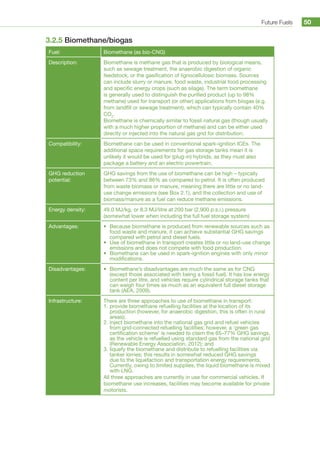
ILUC emissions: 0 gCO2
e/MJ (0 kgCO2
e/kg)

Total life cycle: 12–23 gCO2
e/MJ (0.6–1.1 kgCO2
e/kg)
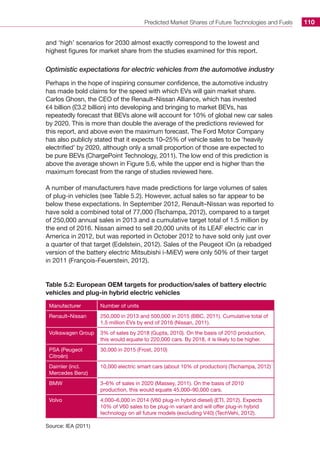
3.2.6 Bioethanol
Fuel: Bioethanol
Description: Bioethanol is ethanol that is produced from crops such as corn or
sugar cane through conventional fermentation processes. In this
case it is a first-generation, crop-based biofuel. However, advanced
or next-generation ‘cellulosic bioethanol’ can be produced from
feedstocks such as miscanthus, switchgrass, and forestry and
agricultural residues through cellulolysis or gasification processes.
Bioethanol can be used as a fuel in its pure form (E100) but is more
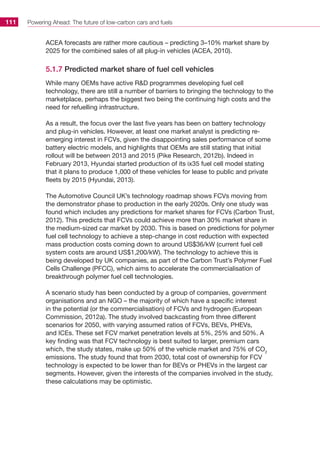
commonly blended with petrol in blends of 5% (E5), 10% (E10) and
up to 85% (E85, which requires a ‘flex-fuel’ vehicle). Bioethanol is
chemically identical to ethanol produced by other means (about 5%
of world ethanol production is not bioethanol, instead it is petroleum
derived – through catalytic hydration of ethylene). Current UK
unleaded petrol contains up to 5% bioethanol.
Compatibility: Bioethanol can be used in conventional spark-ignition ICEs.
GHG reduction
potential:
The GHG reduction potential of first-generation crop-based
bioethanol will vary significantly depending on the feedstock and the
production process.
Savings can range from 3% to 56% when ILUC is included (17% to
72% if excluded). Typically sugar beet or sugar cane crops give the
highest savings, but most UK-produced bioethanol is from wheat,
which can still generate savings of up to 55% if the most efficient
production processes are used.
Next-generation cellulosic bioethanol yields significantly higher GHG
savings, the exact amount depending on which feedstock is used:
savings range from 70% for farmed wood to 87% for straw. These
feedstocks are thought to have no or low ILUC effects.
Energy density: 26.8 MJ/kg or 21.3 MJ/litre (pure bioethanol, E100)
Advantages: •	 For low blends of bioethanol with petrol, there is no requirement
for additional infrastructure or vehicle changes.
•	 The feedstocks for next-generation cellulosic bioethanol do not
generally require land that would otherwise be used for food.
•	 High-blend bioethanol has a higher octane rating than petrol and
a high heat of vaporisation, allowing higher boost in turbocharged
or supercharged engines, or a higher compression ratio in a
dedicated E85 application. As a result, higher specific power can
be achieved. It is therefore well suited to downsized turbo direct-
injection engines.
Future Fuels 52
Fuel: Bioethanol
Disadvantages: •	 Higher strength blends of bioethanol (e.g. E85) require a specific
flex-fuel vehicle with a modified engine control system.
•	 Pipeline transportation of the fuel is problematic as a result of its
corrosive nature and propensity to absorb water and impurities.
•	 Bioethanol has a 33% lower energy density than petrol, which will
result in reduced driving range and potentially higher fuel bills at
higher percentage blends.
•	 The effect of ILUC can significantly reduce the GHG savings of
bioethanol, and the large amount of arable land required to grow
the crops could decrease biodiversity through the destruction of
natural habitats.
•	 There are concerns that the use of bioethanol produced from food
crops, or on land that could otherwise be used for food, could
result in increased global food prices.
Infrastructure: Low-blend strengths of bioethanol can be dispensed via the current
refuelling infrastructure without modifications, but adding new
E85 dispensing capacity to a refuelling station can cost £95,000–
£120,000 (AEA, 2011a). It also requires facilities to supply and
distribute this fuel alongside the unleaded 95 and super unleaded
petrol grades. To date there are very few high-blend bioethanol
dispensing stations in the UK.
Availability: By 2020, bioethanol availability could potentially allow for a 10%
blend in petrol fuel (by volume) (AEA, 2011b). The supply of such
higher blends is already allowed under EU law and available in some
countries. The British Standards Institute (BSI) is expected to publish
a revised petrol specification (BS EN 228) in early 2013 which will
allow fuel suppliers to sell up to 10% ethanol-blended (E10) petrol in
the UK.
Cellulosic bioethanol currently makes up only a small proportion of
total bioethanol production.
GHG emissions: Emissions vary according to feedstock and production process.
First-generation crop-based bioethanol
Emissions excluding ILUC: 24–70 gCO2
e/MJ (0.5–1.5 kgCO2
e/litre)
ILUC emissions: 12–13 gCO2
e/MJ (0.26–0.28 kgCO2
e/litre)
Total life cycle: 36–83 gCO2
e/MJ (0.8–1.8 kgCO2
e/litre)
Next-generation cellulosic ethanol
Total life cycle: 11–25 gCO2
e/MJ (0.23–0.53 kgCO2
e/litre)
3.2.7 Biodiesel (first-generation FAME)
Fuel: First-generation biodiesel
Description: First-generation biodiesel (FAME – fatty acid methyl ester) can be
produced through esterification of a wide variety of vegetable oils
and animal fats such as rapeseed oil, palm oil, soybean oil and
tallow. Biodiesel is generally blended with a crude-oil-derived diesel
and is sold as a blend, such as B7 or B30 – which represent biodiesel
blends with a maximum of 7% and 30% ester respectively. Current
UK diesel already contains up to 7% biodiesel.
Compatibility: Biodiesel can be used in conventional compression ignition ICEs
without modification in low blends. Higher blends up to 100%
may be used, but can cause problems, particularly for newer/more
sophisticated engine systems.
Powering Ahead: The future of low-carbon cars and fuels53
Fuel: First-generation biodiesel
GHG reduction
potential:
If FAME biodiesel is produced from waste vegetable oils such as
used cooking oil, GHG savings are very high – up to 89% – mainly
because there are no ILUC impacts.
However, crop-based first-generation FAME biodiesel actually results
in higher GHG emissions than use of fossil diesel when ILUC impacts
are taken into account, unless methane capture is used at the oil mill.
Savings are at best 3%, and at worst palm oil biodiesel can result in
37% higher GHG emissions. (This range would become savings of
24% to 64% if the ILUC impact were to be excluded.)
Energy density: 37.2 MJ/kg or 33.1 MJ/litre
Advantages: •	 Biodiesel made from used cooking oil diverts a waste stream
which can otherwise cause disposal problems, and results in very
high GHG savings.
•	 Blends of up to 7% biodiesel can be used directly by vehicles
without any modification to the refuelling infrastructure or vehicle
engines.
•	 Biodiesel is biodegradable, non-toxic and free of sulphur and
aromatics.
Disadvantages: •	 The impacts of ILUC result in crop-based first-generation biodiesel
having higher GHG emissions than fossil diesel (unless methane
capture processes are used, in which case small savings may be
obtained).
•	 The large amount of arable land required to grow crops could
decrease biodiversity through the destruction of natural habitats.
•	 There are concerns that first-generation biodiesel produced from
food crops, or on land that could otherwise be used for food (e.g.
palm oil), could result in increased global food prices.
•	 First-generation biodiesel is mildly corrosive and can degrade
while in storage tanks. When this degraded fuel is burned in an
engine, it can corrode engine parts and leave deposits that plug
pumps and other mechanisms.
Infrastructure: No new infrastructure is required for low blends of biodiesel, for
example 7%, but adding new B30 refuelling stations could cost
£75,000–£100,000 each (AEA, 2011a).
Availability: By 2020, there is the potential for first-generation biodiesel to provide
a B7 blend in diesel fuel. This would use 70% of the biodiesel supply,
leaving the rest to be used for depot refuelling of captive fleets, such
as trucks or buses (AEA, 2011b).
GHG emissions: Emissions vary according to feedstock and production process.
Crop-based biodiesel
Emissions excluding ILUC: 32–68 gCO2
e/MJ (1.1–2.3 kgCO2
e/litre).
ILUC emissions: 55 gCO2
e/MJ (1.8 kgCO2
e/litre)
Total life cycle: 87–123 gCO2
e/MJ (2.9–4.1 kgCO2
e/litre)
Biodiesel from waste vegetable oil
Total life cycle: 10–14 gCO2
e/MJ (0.33–0.46 kgCO2
e/litre)
Future Fuels 54
3.2.8 Next-generation biodiesels
Fuel: Next-generation biodiesels (e.g. HVO and FT-BTL Diesel)
Description: Next-generation – or so-called ‘advanced’ second- and third-
generation – biodiesels can be produced using two very different
processes and a variety of feedstocks. They result in fuels which
have properties much closer to conventional mineral diesel than first-
generation FAME biodiesel. For this reason they are often referred to
as ‘renewable diesel fuels’ to distinguish them.
Hydrotreated vegetable oil (HVO) is produced using a process which
can be applied to oils from a wide variety of feedstocks – from
food crops such as rape, sunflower and palm to waste animal fats,
jatropha and algae oils. (Algal biofuels are sometimes known as ‘third
generation’.) HVO is currently the most common process for next-
generation biodiesel production.
The Fischer–Tropsch process is a series of chemical reactions which
can be used to convert biomass to liquid diesel (both the process
and the resultant diesel being referred to as ‘FT-BTL’). Feedstocks
can be woody energy crops, waste wood or forestry residues.
Compatibility: Next-generation biodiesel can be used in conventional compression
ignition ICEs in up to 100% blend strengths.
GHG reduction
potential:
The GHG reduction potential of next-generation biodiesel will vary
significantly depending on the feedstock and the production process.
Using the Fischer–Tropsch process on farmed or waste wood results
in GHG savings of 93–96%.
HVO can result in a much wider range of savings. When using food
oils such as rape, sunflower and palm, the savings are somewhat
better than for FAME biodiesel, but can still result in higher GHG
emissions than fossil diesel when ILUC is accounted for. At best,
sunflower oil achieves 3–7% savings, and palm oil with use of
methane capture can result in 9% savings. However, some palm oil
processes can result in 30% higher GHG emissions than fossil diesel.
Figures for HVO from Jatropha, animal fats and algae are not
available from the European Commission RED Annex V. However,
they might be expected to be significantly better.
Energy density: 44.0 MJ/kg or 34.3 MJ/litre
Advantages: •	 Next-generation biodiesel fuels are drop-in replacements for
diesel fuel, i.e. compatible up to 100% blends with current diesel
engines. This removes the need for changes to the refuelling
infrastructure and vehicles.
•	 There are no specific storage stability issues or deposit formation
problems.
•	 Next-generation biodiesel production processes can use
feedstocks which can substantially reduce ILUC impacts and
competition with food crops.
Disadvantages: •	 Next-generation biodiesel production processes are more
expensive than those for first-generation biodiesel.
•	 While HVO is now in commercial production, volumes are low
compared to first-generation biodiesel.
•	 The FT-BTL technology is currently at the pre-commercialisation
stage, and it is unlikely that this method will produce significant
quantities of fuel until the 2020s (AEA, 2011b).
Powering Ahead: The future of low-carbon cars and fuels55
Fuel: Next-generation biodiesels (e.g. HVO and FT-BTL Diesel)
Infrastructure: As both HVO and FT-BTL diesel are drop-in fuels, there is no
requirement for the vehicle fleet or the refuelling infrastructure to be
modified to accommodate the biofuel.
Availability: Next-generation biodiesel produced from advanced feedstocks will
only start to come into production over the next five years, and is
unlikely to make an impact until the 2020s (ibid.). However, smaller
quantities of HVO produced from conventional feedstocks are already
being sold.
GHG emissions: Emissions vary according to feedstock and production process.
Fischer–Tropsch process using waste or farmed wood
Total life cycle: 4–6 gCO2
e/MJ (0.1–0.2 kgCO2
/litre)
HVO from vegetable oils
Emissions excluding ILUC: 27–62 gCO2
e/MJ (0.9–2.1 kgCO2
e/litre)
ILUC emissions: 55 gCO2
e/MJ (1.9 kgCO2
e/litre)
Total life cycle: 82–117 gCO2
e/MJ (2.8–4.0 kgCO2
e/litre)
HVO from non-food feedstocks is expected to result in significantly
lower GHG emissions.
3.2.9 Electricity
Fuel: Electricity
Description: Grid electricity can be used as an energy source to charge on-board
batteries of PHEVs and pure BEVs.
Compatibility: Electricity can be used in PHEVs, REEVs and pure BEVs.
GHG reduction
potential:
Using electricity to provide motive power in a vehicle will produce
a 100% reduction in direct GHG emissions during the use phase.
Factoring in life cycle emissions from the electricity’s generation
and transmission (using 2010 grid average figures of 0.560 kgCO2
e/
kWh), a 54% GHG reduction is currently possible on a per-kilometre-
travelled basis. With the anticipated levels of decarbonisation of
future grid electricity, this could increase to 75% in 2020 and 83%
by 2030 (DECC, 2012a; AEA, 2012). The actual performance will
depend on the marginal emissions factor for electricity, which will in
turn depend on the time of day the vehicle is charged. Emissions will
likely be lower at night-time when surplus wind or nuclear-generated
electricity is available, and higher at peak demand when natural
gas or coal powered generation will most likely be used to meet
additional demand. The current and near-future average marginal
electricity emission factor is somewhat below the grid average
according to DECC (2012a).
Energy density: The latest lithium–ion batteries still only have an energy density
of about 2% of petroleum fuels (European Commission, 2011c).
However, this density might increase substantially in the future, for
example as a result of RD currently being undertaken into advanced
battery chemistries such as lithium–air and lithium–sulphur.
Future Fuels 56
Fuel: Electricity
Advantages: •	 There are no direct emissions of air pollutants – particularly
important in urban areas, where these emissions are most harmful.
•	 Electricity offers energy security and diversification, since it can be
generated from a wide range of possible primary energy sources.
•	 There exists the potential for extremely low GHG emissions per
unit of energy through the decarbonisation of grid electricity. This
is anticipated to be achieved by increasing uptake of renewable
energy sources, nuclear energy, and the use of carbon capture and
storage (CCS) with fossil-fuelled power stations.
•	 Off-peak vehicle charging has the potential to make use of surplus
low-carbon electricity (e.g. from wind at night) using existing
generating capacity.
•	 Electricity offers a large reduction in noise at lower speeds
(although this may pose a risk for pedestrians and cyclists).
Disadvantages: •	 The current technology for the charging of batteries is considerably
slower than the equivalent hydrocarbon refuelling. For instance,
slow-charging of a Nissan LEAF via a home unit could take six to
ten hours (for a full charge), and even quick charging (up to 80% to
protect the battery) could take 30 minutes (Nissan, 2012).
•	 Owners of vehicles without access to off-street parking will have to
rely on public charging infrastructure, which could be problematic
during the early stages of EV deployment because of the scarcity
of public charging stations.
Infrastructure: The existing UK electricity infrastructure provides users with a very
efficient system for generation, transmission and distribution of
electricity to consumers. However, some local distribution grids
would need upgrading in the case of a significant switch to EVs.
Additional infrastructure is also required to install charging points
at the home of BEV or PHEV owners, as well as public charging
stations. Smart grid infrastructure would need to be created to
manage the large numbers of EVs that might be charging, to balance
the timing of a range of demands on the grid in an efficient way.
Currently it is not completely clear what the optimal mix of slow-
charging (for example in residential areas or workplaces), fast-
charging (for example at conventional refuelling stations), or
contactless charging and battery-swap stations will be. This will be
determined by practical considerations, such as the rate of technical
improvement in battery technology (leading, for example, to range
improvements), but also aspects such as range anxiety and changes
to the way the public use transport. Frequently fast-charging the
battery will also reduce its effective lifetime in the case of most
typical/conventional lithium–ion battery technologies.
Availability: Electricity is widely available across the UK and can be produced
from a wide variety of increasingly renewable sources. However, there
will increasingly be competition for low-carbon electricity from other
sectors as they become increasingly electrified.
GHG emissions: Direct: zero emissions
Indirect: Current emissions from power generation are approximately
155 gCO2
e/MJ (560 gCO2
e/kWh); however, this is anticipated to
reduce to 68 gCO2
e/MJ (245 gCO2
e/kWh) by 2020, and to 37 gCO2
e/
MJ (133 gCO2
e/kWh) by 2030 (DECC, 2012a).
Emissions resulting from the use in the vehicle will also be somewhat
higher due to recharging losses, which are currently estimated at
around 13%, but may reduce to as little as 8% by 2050 (AEA, 2012).
Note that these figures are averages. Actual GHG emissions will vary
according to the mix of generation technologies being used by the grid
at the time of vehicle charging (i.e. the marginal emissions factor).
Powering Ahead: The future of low-carbon cars and fuels57
3.2.10 Hydrogen
Fuel: Hydrogen
Description: Hydrogen is the simplest chemical element and a universal energy
carrier that can be used as a fuel for transport. Naturally occurring
hydrogen gas (H2
) is rare; the element is most commonly present in
water molecules (as H2
O). To produce hydrogen for automotive use,
the two most common methods are by separating it from oxygen
via the electrolysis of water, or via steam reformation of natural
gas. There are also other potential routes for hydrogen production
available or under development, such as the gasification of either
coal or biomass into hydrogen and CO2
, or various biological routes.
As hydrogen has a very low energy density per unit volume, it is
typically compressed to a pressure of 350 or 700 bar (c.5,000 or
c.10,000 p.s.i. respectively) to provide the vehicle with sufficient on-
board storage.
Although hydrogen can be used in modified ICEs, it is principally
being investigated for future use in highly efficient fuel cell vehicles
(FCVs).
Compatibility: Hydrogen can be used in dedicated spark-ignition ICEs and FCVs.
GHG reduction
potential:
There is a 100% GHG reduction at the point of use of hydrogen,
but factoring in the full life cycle emissions from its production and
distribution, then using hydrogen could reduce emissions by 44%
(on the basis of production from natural gas). As grid electricity is
decarbonised and hydrogen production shifts towards electrolysis,
this figure could rise to 52% by 2020 and 59% by 2030 (assuming
40% of production from electricity).93
Energy density: 120.1 MJ/kg, or 2.1 MJ/litre when compressed to 350 bar / c.5,000
p.s.i. or 3.2 MJ/litre at 700 bar / c.10,000 p.s.i. (somewhat lower
when including the full fuel storage system) (Argonne National
Laboratory, 2010)
Advantages: •	 There are no direct emissions of air pollutants when used in an
FCV, with only water vapour being emitted. This is particularly
important in urban areas, where air pollutant emissions are most
harmful.
•	 Hydrogen offers energy security and diversification, since it can be
produced from a wide range of possible energy sources/pathways.
•	 When hydrogen is produced from low-carbon electricity, or derived
from natural gas with CCS, then significant GHG reduction can be
achieved.
•	 With 700 bar (c.5,000 p.s.i.) compression a vehicle can have a
range that is comparable with an ICE, and refuelling takes only a
few minutes (BOC, 2012).
•	 There is significant maturity in the technology, with over 80,000
fuelling procedures having already taken place (European
Commission, 2012c).
•	 Hydrogen offers a large reduction in noise at lower speeds when
used with an FCV (although this may pose a risk for pedestrians
and cyclists).
Disadvantages: •	 There is a high cost associated with producing hydrogen from
steam reformation or hydrolysis, and additional costs due to the
compression or liquefaction.
•	 The overall energy chain for hydrogen production and use in
vehicles is much less efficient than using electricity directly (in
BEVs or PHEVs) – i.e. greater total primary energy is needed
(potentially around twice as much) to make hydrogen and use it in
vehicles.
Future Fuels 58
Fuel: Biomethane (as bio-CNG)
Infrastructure: Hydrogen is already produced and distributed in large quantities by
petrochemical plants, and is used primarily by industry. This existing
infrastructure may be utilised during the early stages of hydrogen
for FCVs. It has been estimated that the cost of installing hydrogen
infrastructure could be approximately €1,000–€2,000 (£800–£1,600)
per car (European Commission, 2011a).
Availability: Currently there is only one public access hydrogen refuelling station
within the UK (BOC, 2012), but there are 200 hydrogen filling stations
expected across Europe by 2015 (EEGFTF, 2011). Hydrogen can
be produced from a number of sources using proven technologies,
which could therefore ramp up production to meet the demand.
GHG emissions: Direct: zero GHG emissions
Indirect: 112.7 gCO2
e/MJ (or 13.54 kgCO2
e/kg), on the basis of 100%
natural gas reformation) but potentially decreasing to 73.7 gCO2
e/
MJ (8.85 kgCO2
e/kg) by 2025 (on the basis of hydrogen sourced from
60% natural gas reformation and 40% electrolysis).6
If hydrogen is produced from electrolysis using purely renewable
electricity then indirect emissions are essentially zero.
Comparison of fuels
The previous section has provided a summary review of each fuel in turn.
In Figure 3.1, comparisons are presented of the current and potential
future full fuel life cycle – the WTW GHG performance of fuels. The GHG
reduction potential of biofuels is strongly dependent on the feedstock,
production process and any direct or ILUC impacts. The figures presented
in the preceding section exclude or assume minimal potential ILUC impacts;
however, GHG savings may be substantially reduced where ILUC effects are
significant. There is still considerable uncertainty as to how much biofuel can
be provided sustainably, and what the overall GHG savings performance might
be once ILUC is factored in (DECC, 2012e). Even beyond considerations such
as competition with food production and other bioenergy applications, there
are other sectors also increasingly competing for biomass (e.g. those requiring
biomaterials and chemicals). Furthermore, there is increasing consensus
that for transport applications, sustainable biofuels may be most effectively
prioritised for aviation and shipping in the medium to long term, as in these
cases there are fewer technical alternatives enabling GHG reduction, and
fleets take much longer to turn over owing to long aircraft and ship operational
lifetimes (DECC, 2012c). For electricity (and also to some extent hydrogen), the
emissions factors presented are based on UK electricity grid averages (Defra/
DECC, 2012) and projections on the future changes in these (DECC, 2012a).
As has been discussed earlier, the actual marginal emissions due to the use of
electricity for cars will vary depending to a significant degree on the time of day
that the vehicle is recharged.
6	 Ricardo-AEA analysis	
3.3
Powering Ahead: The future of low-carbon cars and fuels59
Figure 3.1: Comparison of life cycle GHG emissions of various fuels (well-
to-wheel)
84
39
11
90
34
4
66
17
12
73
156
61
8
113
74
9
0 25 50 75 100 125 150 175
Petrol
Bioethanol (current ave.)
Bioethanol (best)
Diesel
Biodiesel (current ave.)
Biodiesel (best)
Natural gas
Biomethane (current ave.)
Biomethane (best)
LPG
Electricity
Electricity 2025
Electricity 2050
Hydrogen
Hydrogen 2025
Hydrogen 2050
Baseline
Best / long term
GHG emissions, gCO2e/MJ
Current / near future
Source: Ricardo-AEA analysis
Notes: The GHG reduction potential of biofuels is strongly dependent on the feedstock,
production process and any direct or ILUC impacts. The figures presented here are for the best
case with minimal ILUC, but GHG savings may be substantially reduced where ILUC effects
are significant. Emission factors for electricity exclude charging losses, which have been
estimated to be around 13% in 2010, but may reduce to as little as 8% by 2050 (AEA, 2012).
Emission factors for electricity are also dependent on source, the time of day for recharging (for
example, it will be higher at times of peak demand when gas or coal generation will be used to
meet marginal demand, and lower at night when surplus wind or nuclear electricity is available)
– the current and future forecast UK grid averages are presented here.
From a practical perspective, Figure 3.2 also provides a comparison of the
energy densities of different fuels once their respective onboard storage
systems are taken into account. This illustrates the challenge facing alternative
fuels such as hydrogen and electricity, even factoring in the significantly higher
inherent efficiency of EVs and FCVs (i.e. taking into account that they are
two to three times more efficient than conventional petrol and diesel cars).
For gaseous fuels, the larger, heavier storage tanks required in comparison
to diesel and gasoline are a significant handicap. For hydrogen, a technology
breakthrough is also needed to reduce the cost of the storage system.
Finally, Table 3.1 provides a semi-quantitative summary assessment of the
relative strengths and weaknesses of different fuels against key criteria.
Future Fuels 60
Figure 3.2: Comparison of on-board energy density for various transport
fuels including storage system
0
5 10 15 20 25 30 35 40
10
5
15
20
25
30
Net gravimetric energy density (MJ/kg)
Netvolumetricenergydensity(MJ/l)
Petrol
Diesel
E85
Ethanol
M85
Methanol
L H2
700 bar H2
Batteries
200 bar methane
Source: Pearson et al. (2010)
Powering Ahead: The future of low-carbon cars and fuels61
Table 3.1: Summary comparison of the relative performance of various
transport fuels against key criteria
Fuel Energy
density
GHG saving*
(now /future)
Air
quality
Infra-
structure
Availability
(current)
Future
resources**
Petrol +++ --- -- +++ +++ --
Diesel +++ -- --- +++ +++ --
Natural gas - - + - + -
LPG - -- - ++ ++ -
Electricity --- ++ / +++ +++ + -- +++
Hydrogen -- + / +++ +++ --- --- ++
Biodiesel
(first-gen.)
+++ + --- ++ + -
Biodiesel
(advanced)
+++ ++ --- +++ -- +
Bioethanol ++ + / ++ -- ++ + +
Biomethane - ++ - + - +
Source: Ricardo-AEA
Notes:
+++ highly positive;---highly negative
*	 Factoring in the much higher relative efficiency of electric powertrains.
**	 Considering both future long-term resource availability/sustainability (including
competition with other sectors) and overall energy chain efficiency.
Future Fuels 62
4.	Future Vehicles
Powering Ahead: The future of low-carbon cars and fuels63
In this chapter the vehicle technologies which
are expected to be the most important in
the years through to 2025 and beyond are
reviewed. There are still many things that can
be done to further improve the efficiency of
petrol and diesel powertrains, and to ensure,
through the use of lightweight construction,
reduced aerodynamic drag and improved
rolling resistance, that future cars need less
energy to propel them. Then there is the
potential for further development of hybrid
technology and the recently introduced plug-
in hybrid options. Electric vehicles, sometimes
incorporating small range-extending internal-
combustion engines, are covered; and
ultimately there are fuel cell vehicles.
Future Vehicles 64
In section 4.2 each option is examined to assess its potential to contribute
to a low-carbon motoring future, and a description is provided of its costs,
advantages/disadvantages, any risks or dependences relevant to the effective
introduction of the technology into the marketplace, applications, GHG
reduction potential, and availability. Finally the different options are compared
side by side, and the key area of battery technology is explored in depth.
However, the big question – to which everyone would like to know the answer
– is: which of these technologies and fuels will prove to be the most successful
in the marketplace and when?
Since the King Review was published in 2007, there has been a wealth of
literature published on this subject. Opinions, estimates and modelling of the
likely future mix of technologies have resulted in widely differing conclusions.
Section 4.1 provides an initial look at the likely technology pathways for
future cars. However, the predicted market shares for different technologies,
the sensitivities which may affect market shares and timings, and the likely
resulting fuel mix are explored later, in Chapter 5.
Overview
While there may be widely differing views on the speed of market take-up for
different technologies, an analysis of the literature suggests there is a general
consensus regarding the technology pathways themselves.
The UK Automotive Council consulted with OEMs operating in the UK and
produced a commonly agreed technology roadmap, shown in Figure 4.1.
Alongside the roadmap, the Automotive Council has also developed a useful
summary of the RD activities that are needed to deliver these technologies in
the short, medium and long term (Figure 4.2).
4.1
Powering Ahead: The future of low-carbon cars and fuels65
Uncertainty over timeframes due to the energy storage breakthroughs
required
As the roadmap highlights, the pathway of powertrain electrification – moving
from full hybrid technologies, to plug-in hybrid, and onwards to mass-market
BEVs and FCVs – will require breakthroughs in the area of energy storage in
terms of both cost and performance.
The primary reason for the wide variation in estimates for the speed of market
uptake of these technologies is uncertainty regarding when – and, indeed,
whether – these breakthroughs can be achieved.
Nevertheless, there is widespread agreement, not just from the Automotive
Council roadmap but from other sources too, that future technology
development will fall into three key areas:
1.	 further improving ICE and transmission technology;
2.	 weight, drag and rolling resistance reduction; and
3.	 powertrain electrification.
Each of these three areas will be reviewed in turn, and the likely timeframes
for developments in each summarised in sections 4.3 to 4.5 of this chapter;
section 4.6 then looks at emissions in the real world and the impact of driving
style. First, however, section 4.2 provides overall summary information on each
of the main car powertrain options.
Future Vehicles 66
Figure 4.1: Automotive Council UK OEM Consensus Passenger Car
Technology Roadmap
EU fleet average CO2
targets (g/km)
2000 2010 2020 2030 2040 ...
Demonstrators
Demonstrators
Niche EVs
Charging infrastructure
H2 infrastructure
Fuel cell vehicle
Energy storage breakthrough
Full hybrid
Micro/mild hybrid
Vehicle weight and drag reduction
ICE and transmission innovations (petrol/diesel/gas/renewables/H2)
Fuel cell  H2 supply/storage breakthrough
Plug-In hybrid
Mass-market EV technology
130 95 TBD
Source: Automotive Council (2011)
Figure 4.2: Automotive Council common research agenda
Source: TSB (2010)
SHORT TERM
5–10 years from production
MEDIUM TERM
7–15 years from production
LONG TERM
10–20 years from production
INDUSTRY UNIVERSITIES
Propulsion •	ICE optimisation
•	Boost systems for downsizing
•	Flexible valve/actuation for
engines/transmissions
•	Low-cost compact e-motors
•	Higher efficiency ICEs
•	Capacitive boost systems
•	All electric actuation systems
•	Optimised range extender engine
•	Lower cost e-motor
•	Heat energy recovery (e.g E-turbine)
•	Super high-efficiency motors
(superconducting)
•	New ICE with 70%+ thermal
efficiency
•	Advanced heat energy recovery
(e.g. thermoelectric)
•	Motor/fuel cell materials
Energy
storage
•	Improved quality / durability 200+
Wh/kg  $800/kWh cost battery
systems
•	Low-cost power electronics
•	Next gen batteries 300+ Wh/kg and
$500/kWh cost
•	Flexible power elec. modules
•	Other forms of energy recovery
(mechanical/chemical etc)
•	3rd
gen batteries 400+ Wh/kg 
$200/kWh cost
•	New low-cost solid state power
conversion systems
•	Hydrogen storage technology
Vehicle
Efficiency
•	Lightweight structures and interiors
•	Low rolling resistance tyres /
brakes
•	New vehicle classes and
configurations
•	Comination of function to reduce
weight / cost
•	Minimised weight / losses
•	Flexible re-configurable multi-utility
vehicle concepts
•	50% weight reduction from 2008
•	Advanced aerodynamic concepts
System
Control
•	Information enabled control
(Topology, V2V, V21, traffic etc.)
•	Optimised vehicle energy mgmt.
•	Intelligent thermal management
•	Advanced information enabled
control
•	Intelligent P/T and HVAC mgmt.
•	Autonomous P/T and vehicle
control interated with active safety
Energy +
Fuel
Supply
•	Optimised 1st
gen biofuels
processes
•	New 2nd
gen biofuel processes
•	Intelligent energy / re-fuelling
infrastructure (e.g. fast charge)
•	Industrial scale demonstration of
new 2nd
gen biofuel processes
•	3rd
gen biofuel processes
•	2nd
gen industrial scale biofuel
production infrastructure
Processes
+ Tools
•	Process + delivery tool
development and connectivity
•	Auto-optimisation methods using
virtual systems
•	Artificial intelligence to deliver
complex multi-criteria system
optimisation
Powering Ahead: The future of low-carbon cars and fuels67
Review of vehicle technologies
The following tables provide a review of the key technologies expected to
be used in future vehicles in the years through to 2050. Each technology is
considered in turn, providing summary information on key aspects including
costs, advantages/disadvantages, any risks or dependences relevant to the
effective introduction of the technology into the marketplace, applications,
GHG reduction potential, and availability.
In general, figures used for cost and expected CO2
savings potential are based
on a version of the Road Vehicle Cost and Efficiency Calculation Framework
produced by AEA Technology for CCC (AEA, 2012), that has been further
developed and updated with more recent information by Ricardo-AEA. This
ensures that figures are comparable across different technologies, and
represent nominal vehicles of equivalent size/performance.
In general, costs and performance are presented for the current situation in
the tables below. Future projections on how these figures might evolve to 2025
and to 2050 (owing, for example, to increased production volumes, technology
improvements, or changes in materials costs) are presented as comparisons
across different powertrain types at the end of section 4.7.
4.2.1 Further development of internal-combustion engine
technologies
Technology: Further development of internal-combustion engine powertrain
technologies
Description: Technologies to improve the efficiency of spark and compression
ignition engines and transmissions, and hence decrease the energy
consumption per km: stop–start; downsizing and turbocharging; petrol
direct-injection; dual-clutch transmissions and variable valve actuation
and lift – these are some of the technologies that can offer the greatest
GHG reduction potential.
Cost: The cost will vary between the different technologies, and will also
vary for different engine sizes. However, the following are 2010 cost
estimates for a implementing the technologies on a medium-sized car
(European Commission, 2011e):
•	 stop–start – £170 (£320 for systems with regenerative braking);
•	 strong downsizing (45% cylinder reduction) with turbocharging –
£480;
•	 petrol direct-injection (stratified charge) – £400;
•	 petrol variable value actuation and lift – £224.
According to several recent studies, the average extra cost per vehicle
(compared to costs in 2010) for achieving the European new car CO2
target for 2020 of 95 g/km using primarily advanced ICE powertrain
technologies has been estimated to be up to £800 (€1,000) (ibid.).
Fuel cost/km (for
an average-sized
car):
£0.107/km for petrol (£1,605 p.a., based on 15,000 km p.a.)
£0.083/km for diesel (£1,245 p.a., based on 15,000 km p.a.)
£0.071/km for LPG (£1,065 p.a., based on 15,000 km p.a.)
£0.049/km for CNG (£735 p.a., based on 15,000 km p.a.) (Ricardo-
AEA, 2012)
4.2
Future Vehicles 68
Technology: Further development of internal-combustion engine powertrain
technologies
Advantages: •	 Implementing engine technologies can be some of the most cost-
effective reduction measures and can be achieved in the short term.
•	 These technologies do not require any additional changes to the
refuelling infrastructure, and can be implemented on many existing
vehicles’ models.
•	 The ICE is an established technology with consumers, who are
comfortable purchasing the product.
Disadvantages: •	 Although combining these engine technologies delivers significant
emissions reductions, to achieve the very substantial long-term
emissions reduction targets, supplementary vehicle technologies
and low-carbon fuels will be required.
Risks: –
Dependences: –
Applications: These ICE technologies can be applied to the whole fleet of standard
spark and compression ignition engined cars, as well as to (plug-in)
hybrids.
GHG reduction: The GHG reduction potential varies according to the particular engine
technology, but the some of the major technology options are:
•	 stop–start – 5–10% reduction (higher value for systems with
regenerative braking);
•	 strong downsizing (45% cylinder reduction) with turbocharging –
16% reduction;
•	 petrol variable valve actuation and lift – 10% reduction;
•	 petrol direct-injection (stratified charge) – 9% reduction.
Calculations based on known technological options in combination
could achieve a reduction of up to 71% for petrol engines (to 69 gCO2
/
km for the average-sized car, excluding biofuel) and 66% (to 67 gCO2
/
km excluding biofuel) for diesel engines on a real-world basis (Ricardo-
AEA, 2012). Emissions can also potentially be further reduced through
the use of sustainable biofuels, as discussed in Chapter 3.
Availability: Most of these technologies are ready for deployment now; however,
others are still under development (e.g. HCCI – homogenous charge
compression ignition) but are expected to be ready for market
deployment in the next ten to fifteen years.
Examples: The Audi A3 1.2 TFSI S tronic has implemented downsizing, petrol
direct-injection, and variable valve actuation and lift (European
Commission, 2011e).
The 2012 Ford Focus 1.0 EcoBoost, a direct-injection, turbocharged
engine, is an example of the potential for downsizing, with the lower
power version achieving 109 gCO2
km on the official test cycle (Ford,
2012).
4.2.2 Non-powertrain technologies
Technology: Non-powertrain technologies (e.g. lightweighting, aerodynamics and
rolling resistance)
Description: Non-powertrain technologies consist mainly of weight reduction,
reducing aerodynamic drag, and lowering rolling resistance.
Powering Ahead: The future of low-carbon cars and fuels69
Technology: Non-powertrain technologies (e.g. lightweighting, aerodynamics and
rolling resistance)
Cost: The costs of these technologies will vary according to the specific
vehicle, but current cost estimates are (European Commission, 2011e):
•	 weight reduction: 10% – £130; 20% – £320; 30% – £800;
•	 improved aerodynamics – £40;
•	 active aerodynamics – £50;
•	 low rolling resistance tyres – £30.
Fuel cost/km: N/A
Advantages: •	 Non-powertrain technologies can be implemented for all vehicle
types, spreading cost and risk of development across a greater
number of vehicles, and reducing unit costs. For example, Lotus has
concluded that by 2020, a 38% weight reduction might be achieved
with only a 3% increase in production cost (World Economic Forum,
2011).
•	 Such technologies are particularly beneficial for BEVs and FCVs.
Given that drag and rolling resistance represent the great majority of
the energy losses, these technologies provide further opportunities
to downsize batteries/fuel cells and reduce costs.
Disadvantages: •	 These technologies will assist in reducing GHG emissions, but by
themselves will not enable cars to achieve their GHG reduction
targets. Supplemental vehicle technologies, such as biofuels and/or
electric drive, need to be implemented.
Risks: The low (or negative) cost of a significant proportion of the potential for
weight reduction is dependent on smart design. Material substitution
is a significantly higher-cost alternative, in which there is more limited
potential owing to aesthetic and other limitations.
Weight reduction must not impair safety. Increasing the typical
difference in weight between difference classes of vehicles (e.g. HGVs
and cars) may increase safety risks.
Dependences: –
Applications: These technologies can be applied to cars with various powertrains,
but are particularly beneficial for BEVs and FCVs, where drag and
rolling resistance represent much higher proportions of overall energy
losses.
GHG reduction: 10% weight reduction ≡ 2% GHG reduction
20% weight reduction ≡ 6% GHG reduction
30% weight reduction ≡ 12% GHG reduction
Improved aerodynamics ≡ 2% GHG reduction
Advanced aerodynamics ≡ an additional 1% GHG reduction
Low rolling resistance tyres ≡ 3% GHG reduction (European
Commission, 2011e)
Availability: These technologies are already being applied by manufacturers to
a certain extent in some vehicle models. Higher degrees of weight
reduction will require the use of currently expensive materials
substitution and advanced design processes that may take ten to
twenty years or longer to become cost-effective in mainstream vehicles
compared to alternatives.
Examples: Lightweight: smart fortwo (c.750 kg); Citroën C1 (800 kg); Toyota iQ
(c.845 kg)
Low drag coefficient: Mercedes E220 Coupé (0.24); Toyota Prius (0.25);
Peugeot 508 (0.26)
Future Vehicles 70
4.2.3 Hybrid electric vehicles
Technology: Mild  full hybrid electric vehicles
Description: Mild hybrid vehicles include a small electric motor and a battery larger
than the standard one used in a regular vehicle. The motor can provide
extra power during acceleration and recover energy during braking,
but is not sufficiently powerful to enable the vehicle to be driven under
electric power alone.
Full hybrids have a larger battery and motor than mild hybrids, thus
enabling the vehicle to be driven for a few miles using electric power
alone if required. The greater flexibility of a full hybrid allows the vehicle
more scope to operate its engine only when that is the most efficient
method of powering the vehicle (Hybrid Center, 2010).
Cost: The current cost premiums for a medium-sized HEV are: mild hybrid
c.£1,000; full hybrid c.£2,400 (European Commission, 2011e). The
majority of the additional cost is due to the battery, which is expected
to halve in cost in the next ten years.
Fuel cost/km (for
an average-sized
car):
£0.078/km for a full petrol hybrid and £0.066/km for full diesel hybrid
(£1,170 and £990 p.a. respectively, based on 15,000 km p.a.) (Ricardo-
AEA, 2012)
Advantages: •	 HEVs can offer significant increases in fuel efficiency and decreases
in GHG emissions, particularly when used in urban environments,
where they can also reduce emissions of other air pollutants
compared to conventional vehicles.
•	 HEVs can reduce the noise levels within urban environments.
Disadvantages: •	 HEVs have an increased environmental footprint resulting from the
production of the electric motor and battery. This reduces to a small
degree some of the emissions savings that arise from improved fuel
efficiency.
Risks: There are potential resource risks for the rare earth elements that are
required for the electric motors, and materials for batteries.
Dependences: –
Applications: Mild and full hybrid technologies can be implemented on all car sizes,
but they are best suited to cars operating in the urban environment,
and packaging is more challenging on smaller cars.
GHG reduction: Mild hybrids can reduce emissions typically by 15% and full hybrids by
25% (European Commission, 2011e).
Emissions can also potentially be
further reduced through the use of sustainable biofuels, as discussed in
Chapter 3.
Availability: There are an increasing number of mild and full hybrid vehicle models
available and on the road today, with a number of OEMs looking to
produce more models.
Examples: Toyota Prius, Honda Insight, Honda Jazz Hybrid, Lexus CT 200h,
Porsche Cayenne S Hybrid, Peugeot 508 HYbrid4, Mercedes E300
BlueTEC Hybrid (Lucas, 2008)
Powering Ahead: The future of low-carbon cars and fuels71
4.2.4 Plug-in (i.e. parallel) hybrid electric vehicles
Technology: Plug-in (i.e. parallel) hybrid electric vehicles
Description: A PHEV is a vehicle with a plug-in battery-powered electric motor and
an ICE, arranged such that either can provide power to the wheels.
A larger battery allows electric-only operation for shorter journeys
(typically of around 10 miles). When the battery is depleted, the vehicle
switches back to ICE operation but retains the benefits of full hybrid
capability. Typically up to 30% of an average UK driver’s annual
mileage can be in full battery electric mode for vehicles of this type.
Cost: Approximately £7,800 manufacturing cost premium over a conventional
ICE, with this anticipated to reduce to £3,000 by 2020 (Ricardo-AEA,
2012).
Fuel cost/km (for
an average-sized
car):
£0.063/km for petrol and £0.054/km for diesel (£945 and £810 p.a.
respectively, based on 15,000 km p.a.)
Advantages: •	 PHEVs can combine the benefit of running on electric mode for short
distances (e.g. the daily commute), while also having the range and
short refuelling benefits of a petrol or diesel vehicle.
•	 While the car is operating in electric mode, it produces no direct air
quality pollutants and reduces noise pollution.
•	 When used in conjunction with low-carbon electricity, PHEVs can
lead to a high GHG emissions reduction.
Disadvantages: •	 PHEV purchase prices are significantly more than those of equivalent
ICEs.
•	 PHEVs can be heavier than conventional vehicles because of the
requirement to house the ICE, an electric motor and a large battery.
This can lead to reduced cabin or load capacity within the vehicle
and can increase vehicle energy consumption.
•	 PHEVs have an increased emissions footprint, due primarily to the
production of the larger battery. However, net overall emissions over
the entire life of the vehicle are still significantly reduced.
Risks: There are potential resource risks for the rare earth elements that are
required for the electric motors, and materials for batteries.
Dependences: •	 Many households do not have off-street parking, so additional on-
street residential or workplace recharging infrastructure would be
required to facilitate uptake in these cases.
•	 There is a need for reducing battery cost (and weight) through
technology innovation, to bring prices closer to alternatives and
improve performance.
Applications: These vehicles are suitable for most drivers who undertake a significant
number of shorter trips (such as a daily commute), but who also need
the range and utility of a conventional ICE car.
GHG reduction: The potential for petrol PHEVs is for up to 33% net life cycle emissions
reduction, which could rise to 37% reduction in 2020 as a result of
the decarbonisation of electricity (Ricardo-AEA, 2012). Emissions can
potentially be further reduced through the use of sustainable biofuels,
as discussed in Chapter 3.
Availability: These vehicles are currently available to purchase from some of the
mainstream OEMs.
Examples: Volvo V60, Toyota Prius Plug-in Hybrid
Future Vehicles 72
4.2.5 Range-extended (i.e. series) hybrid electric vehicles
Technology: Range-extended electric vehicles
Description: A REEV receives its drive exclusively from an electric motor (of which
there may be more than one), but has an ICE-powered generator on
board capable of continuously recharging the battery. The battery alone
can typically provide a range of 25–50 miles. After that the ICE can
generally provide a range equivalent to a conventional ICE vehicle. This
arrangement is sometimes known as a ‘series PHEV’. Typically up to
60% of an average UK drivers’ mileage can be in full battery electric
mode for vehicles of this type.
Cost: An additional £11,000 manufacturing cost compared with a
conventional ICE, with this premium reducing to £4,500 by 2020.
Fuel cost/km (for
an average-sized
car):
£0.048/km for petrol and £0.043/km for diesel (£715 and £645 p.a.
respectively, based on 15,000 km p.a.)
Advantages: •	 REEVs have significant all-electric range that will allow for most of
a regular motorist’s mileage (typically over 60%) to be electric, and
also share the benefits of longer range when running on petrol or
diesel vehicle beyond this.
•	 While the car is operating in electric mode, it produces no direct air
quality pollutants and reduces noise pollution at low speeds.
•	 When used in conjunction with low-carbon electricity and biofuels, a
large GHG reduction can be achieved.
Disadvantages: •	 The upfront purchase price is high compared with ICE cars.
•	 A REEV can have embedded GHG emissions from manufacturing
that are as much as 34% higher than its ICE equivalent (Ricardo,
2011), due primarily to the battery. However, net overall emissions
over the entire life of the vehicle are still significantly reduced.
Risks: There are potential resource risks for the rare earth elements that are
required for the electric motors, and materials for batteries.
Dependences: There is a need for reducing battery cost (and weight) through
technology innovation, to bring prices closer to alternatives and
improve performance.
Applications: The longer all-electric range of REEVs, combined with the petrol or
diesel extender, make such vehicles ideally suited to regular everyday
use on shorter journeys, as well as giving them the range and utility of
a conventional ICE car for longer journeys when needed.
GHG reduction: REEVs can exhibit a 43% GHG reduction compared with conventional
ICEs, which will increase to 47% by 2020 with the decarbonisation
of electricity (Ricardo-AEA, 2012). Emissions can also potentially be
further reduced through the use of sustainable biofuels, as discussed in
Chapter 3.
Availability: REEVs are now available from General Motors and Fisker, with other
OEMs also planning to provide these types of vehicles.
Examples: Vauxhall Ampera / Chevrolet Volt, Fisker Karma
Powering Ahead: The future of low-carbon cars and fuels73
4.2.6 Pure battery electric vehicles
Technology: Pure battery electric vehicles
Description: A BEV is powered solely by a battery charged from mains electricity.
Alternative descriptions include: all-electric, fully electric or simply
electric vehicle.
Cost: Medium-sized BEVs (such as the Nissan LEAF) can cost £14,000 more
than their petrol or diesel equivalent, with the majority of this additional
cost being due to the battery. As a result of technical innovation and
increases in production volumes, the cost premium of BEVs is likely to
decrease over time to £5,600 by 2020 and to £2,700 by 2030 (Ricardo-
AEA, 2012).
Fuel cost/km (for
an average-sized
car):
Approximately £0.033/km (£500 p.a., based on 15,000 km p.a.)
Advantages: •	 BEVs emit zero tailpipe GHGs and air quality pollutants.
•	 They reduce noise pollution.
•	 They have simpler driver controls (typically no gear-shifting is
required).
•	 At a national level, large deployment of BEVs could reduce the UK’s
dependency on imported energy.
•	 When used in conjunction with low-carbon electricity, a large
reduction in GHG emissions is possible.
•	 BEVs have low per-kilometre running costs.
•	 BEVs require less costly maintenance than ICE cars, owing to the
reduction in moving parts, the reduced needs for fluid changes, and
less brake wear.
Disadvantages: •	 The large purchase cost of a BEV compared to petrol, diesel or
hybrid vehicles is the biggest disadvantage of this technology.
•	 Compared with petrol or diesel vehicles, current BEVs currently
have a limited range (typically 100 miles, but ranging from 50–250
before recharging is required). This range can be even more limited
in extreme hot or cold conditions.
•	 The embedded GHG emissions as a result of the vehicle
manufacture can be twice those of a conventional ICE vehicle
(Ricardo, 2011). However, net overall emissions over the entire life of
the vehicle are still significantly reduced.
•	 Actual real-world battery durability over the lifetime of the vehicle is
a relative unknown. However, to qualify for the Plug-in Car Grant,
vehicles must have a three-year battery and electric drivetrain
warranty, with an option to extend the battery warranty for an extra
two years.
•	 Emergency response personnel need to be trained to understand
the potential risks in dealing with an EV associated with the
possibility of high current discharges.
Risks: There are potential resource risks for the rare earth elements that are
required for the electric motors, and materials for batteries.
Dependences: To encourage wide-scale uptake of BEVs by consumers, a large
network of public charging infrastructure is required to ensure that
drivers can (and also reassure them that they can) charge their vehicles
away from their homes. The infrastructure actually required will depend
on the EVs’ range and what users expect from them.
Smart vehicle charging needs to be enabled to ensure that BEVs can
plug into the grid without negatively impacting grid capacity.
Decarbonisation of the electricity grid is required to ensure that BEVs
can achieve extremely low WTW emissions.
Future Vehicles 74
Technology: Pure battery electric vehicles
Applications: Currently, BEVs are best suited to urban environments, where shorter
journeys are experienced in stop–start conditions, and drivers have
convenient access to charging infrastructure. However, in the future
it is expected that manufacturers will introduce BEVs with a greater
driving range that will enable a wider range of applications.
GHG reduction: Compared to current petrol equivalents, BEVs yield a 100% reduction
in TTW emissions, but factoring in WTW emissions the figure is a 56%
reduction, based on the grid average. This could rise to 67% by 2020
as a result of electricity decarbonisation. Depending on the time of day
for EV charging (and mix of generation capacity), the GHG savings may
be higher or lower depending on the marginal generation type (i.e. for
the electricity used to provide the additional energy needed for EVs).
Overnight charging is likely to lead to greater GHG savings (owing to
surplus renewable wind electricity generation or nuclear base-load).
However, charging nearer peak demand hours in the daytime is likely
to result in significantly reduced savings, as gas or coal power stations
are used more.
Availability: BEVs are starting to come into the marketplace from the major OEMs,
but limitations in available models, high purchase prices and range
concerns are likely to result in relatively low deployment levels over the
next ten years.
Examples: Nissan LEAF, Mitsubishi i-MiEV / Peugeot iOn / Citroën C-Zero,
Renault Fluence Z.E., Renault ZOE, smart fortwo electric drive
4.2.7 Fuel cell vehicles
Technology: Fuel cell vehicles
Description: FCVs are powered by electrical energy obtained from stored hydrogen,
methane or methanol which is converted into electricity using a
fuel cell. Most commentators are expecting hydrogen polymer
electrolyte membrane fuel cells to be the focus, therefore the following
assessment focuses on HFCVs.
Cost: FCVs are not in production at present, and the current premium over an
ICE car is estimated at c.£70,000. However, this cost premium is due
to reduce over time, with an estimate of just £3,000 premium by 2030
(AEA, 2011; Ricardo-AEA, 2012).
Fuel cost/km (for
an average-sized
car):
£0.033/km (£500 p.a., based on 15,000 km p.a.; estimate based on
hydrogen produced from natural gas)
Advantages: •	 No air quality pollutants are emitted during the use phase, with water
vapour being the only product of the reaction.
•	 FCVs produce little noise pollution at slow speeds.
•	 When hydrogen is produced from electrolysis of renewable energy,
FCVs have the potential to produce ultra-low life cycle emissions.
Disadvantages: •	 FCVs are not currently being mass manufactured by OEMs, and
modelling shows that these vehicles are not going to be cost-
competitive at the point of purchase for another twenty to thirty
years (AEA, 2011; Ricardo-AEA, 2012).
•	 On-board hydrogen storage in highly compressed fuel tanks (or
other means) is still significantly heavier / larger in volume than
conventional fuel storage.
Powering Ahead: The future of low-carbon cars and fuels75
Technology: Fuel cell vehicles
Risks: The main risk is the lack of breakthroughs to reduce the cost of the fuel
cell. There are also potential resource risks for the rare earth elements
that are required for the electric motors.
Dependences: To encourage wide-scale uptake of FCVs by consumers, a large
network of hydrogen refuelling infrastructure is required to ensure that
drivers can refuel their vehicles without inconvenience.
Innovation is also required in the fuel cell to reduce the required amount
of platinum.
Decarbonisation of the electricity grid is required to ensure that
hydrogen can achieve low WTW emissions.
Applications: Because of the short refuelling time and their large range, FCVs are
suited to vehicles that are required to operate regularly over long
distances.
GHG reduction: FCVs exhibit a 100% reduction in TTW emissions. In terms of WTW
emissions, FCVs can achieve a 58% reduction in 2020 (assuming
hydrogen sourced from 80% natural gas reformation and 20%
electrolysis using grid electricity), and 68% reduction in 2030
(assuming 60% gas reformation and 40% electrolysis).
Availability: There are currently no production HFCVs available to purchase,
but Honda has leased some vehicles and Hyundai started limited
production in February 2013 for lease to public and private fleets.
Toyota has stated that it is to launch a saloon-sized fuel cell car by
2015, and some other manufacturers have similar expectations (Reed,
2012).
Examples: No FCVs are currently in production; however, Honda has produced
a limited run of 200 FCX Clarity FCVs available for lease in California.
Hyundai expects to build 1,000 vehicles for lease by 2015.
Further improving internal-combustion engine and transmission
technology
The following sections provide additional information, further elaborating on
that summarised in the technology boxes in the previous section.
In previous research conducted by Ricardo-AEA involving interviews with very
senior RD decision-makers from the automotive industry, there was a strong
message that the short to medium term would continue to be dominated by
further improvements to ICE technology (JRC-IPTS, 2012).
This is confirmed by technology roadmaps from various organisations including
the Automotive Council UK and EUCAR, the European Council for Automotive
RD (Automotive Council, 2011; EUCAR, 2011). The 2012 position paper of
EARPA (the European Automotive Research Partners Association) on advanced
ICEs and fuels states:
“In 2030 more than 65% of all road transport vehicles will still be
powered by ICE running on liquid fuels, therefore engines have to
become thermodynamically more efficient” (EARPA, 2012).
4.3
Future Vehicles 76
In the longer term, high-efficiency ICEs are expected to remain important for
use in PHEVs and REEVs.
Even in the IEA’s BLUE Map scenario (which makes assumptions about
light-duty powertrain technology splits on the basis of the need to achieve
carbon reductions, rather than market trends), 55% of vehicle sales in 2050
will feature an ICE, although only 9% will be conventional petrol or diesel
vehicles. The majority (34%) are forecast to be PHEVs, with a further 8% being
conventional hybrids (IEA, 2010).
The World Energy Council has published scenarios for the make-up of the
overall vehicle fleet in 2050, on the basis of two alternative policy options.
In the ‘Freeway’ scenario pure free market forces are allowed to prevail, and
in Western Europe as much as 61% of the light duty vehicle fleet remains
conventional petrol and diesel vehicles. In the alternative ‘Tollway’ scenario of
“a more regulated world where governments decide to intervene in markets
to promote technology solutions and infrastructure development that puts
common interests at the forefront”, this figure falls to 19%, but with a further
44% still featuring an ICE, albeit 22% being plug-in hybrids (World Energy
Council, 2011).
Table 4.1: World Energy Council scenarios for light duty vehicle fleet
technology mix in 2050
‘Freeway’ (free market) ‘Tollway’ (Intervention)
Conventional (petrol and diesel) 61% 19%
Hybrid (petrol and diesel) 19% 14%
Plug-in hybrid (liquid fuel) 1% 22%
Hydrogen hybrid ICE 0% 0%
CNG and LPG (ICE and hybrid) 17% 8%
Battery electric 1% 28%
Hydrogen fuel cell 0% 8%
Since the introduction of the European passenger car CO2
emissions
legislation, there has been a stronger focus on vehicle efficiency, and progress
in reducing CO2
has accelerated.
There remains much more which can be done to improve the efficiency of the
ICE and transmission systems (Table 4.1).
Stop–start technology allows 5–10% reductions in CO2
Stop–start technology is perhaps the most cost-effective way of achieving
reductions of between 5–10% in CO2
emissions (depending on whether the
Powering Ahead: The future of low-carbon cars and fuels77
system is able to recapture braking energy). Ricardo estimated that the cost
per gram of CO2
reduction was about half that of improving the fuel efficiency
of the ICE, and less than a quarter of that for hybridisation (Ricardo, 2012).
Currently low-cost belt-driven starter-generator systems (BSGs), and enhanced
starter systems which eliminate the belt and use a modified starter motor,
between them dominate the market. However, the technology is expected to
progress to direct start systems which use the engine management system
on direct-injection engines to allow the engine to instantly restart itself, and
integrated crankshaft starter generators (ISGs – see Figure 4.3; note that for
all parameters in the below radar chart, values closest to the centre represent
very poor performance (e.g. high cost) and those reaching the outside edges
represent very good performance (e.g. low cost); likewise a high figure for wear
means low wear, and a highly complex system will score low on that axis of the
radar chart).
High-efficiency stop–start systems require better energy storage
technology
Improvements in stop–start technology enabling them to recapture energy are
linked to improvements in energy storage technology. Technologies such as
enhanced flooded batteries or valve regulated batteries have a much greater
cycle life and capacity to accept charge, allowing better durability and energy
recapture; these are now being fitted to some production vehicles (VARTA, 2013).
Figure 4.3: Comparison of stop–start technologies
0.00
0.20
0.40
0.60
0.80
1.00
Costs
Start comfort
WearFuel consumption benefit
Complexity/package of
solution
BSG
Enhanced starter
Direct start
ISG
1 = good
0 = bad
Source: FEV (2011)
Future Vehicles 78
Ultimately ultra-capacitors offer unlimited cycle life and very high energy
density. They provide much greater efficiency in regenerative braking systems,
since they can charge and release energy at a vastly greater rate and at higher
efficiency than battery technologies. At the moment existing battery-based
regenerative systems only capture/release 33–50% overall of the energy from
braking (this percentage increases with more gradual braking/acceleration),
and are currently expensive.
Table 4.2: Internal-combustion engine and transmission system
technologies and timeframes (excluding hybrid/electrification measures)
Short/medium term
(2012–17)
Longer term
(2017–25)
Combustion engine
technologies
Engine downsizing enabled by:
•	 turbocharging
•	 supercharging
•	 direct-injection
Fully variable valve actuation
Improved fuel injection systems:
•	 multi-strike injection
•	 rate shaping
•	 increased pressures
Low speed torque assist:
•	 variable geometry
turbochargers
•	 electric super/turbochargers
Improved thermal management:
•	 advanced coolant management
•	 exhaust heat recovery
Friction reduction
Advanced/alternative combustion
systems:
•	 high EGR (exhaust gas
recirculation) stratified
•	 lean stratified (with lean NOx
trap aftertreatment)
•	 laser ignition systems
•	 controlled auto-ignition
•	 split cycle / Atkinson cycle /
Miller cycle
•	 micro-turbines and other
concepts suited to range-
extender applications / multi-
fuel options
Cylinder de-activation
Variable compression ratio
Transmission
technologies
Longer final drive ratios (‘down-
speeding’)
6-to-8-speed gearboxes
Dual-clutch transmissions
Planetary gearboxes
Source: Based on roadmap information from Ricardo-AEA (2012), EARPA (2012) and EUCAR
(2011)
Weight, drag and rolling resistance reduction
All vehicles, regardless of powertrain type, can be made more efficient through
reducing weight, aerodynamic drag and rolling resistance. However, the benefit
of such improvements for electrically powered vehicles is particularly strong.
Electric powertrains are highly efficient, and as a result weight, drag and rolling
resistance account for a much larger proportion of the total efficiency losses.
Reducing these losses may also allow the battery size to be reduced for a
given range, in turn further reducing vehicle weight and cost.
4.4
Powering Ahead: The future of low-carbon cars and fuels79
4.4.1 Weight reduction
Weight reduction is the area with perhaps the greatest potential. As Gordon
Murray, the ex-Formula 1 designer who is currently developing radical new city
car concepts has said: “Lightweight is the most powerful tool we have in our
armoury in the fight against emissions and fuel consumption.”
The average mass of new cars sold in Europe increased by nearly 9% between
2001 and 2007 (from 1,268 to 1,378 kg), but has, since 2007, remained
relatively constant. It has been calculated that if mass had stayed constant at
2001 levels, new car average CO2
emissions in 2010 would have been 5 gCO2
/
km lower (ICCT, 2011). Reducing vehicle mass is important for all vehicles, but
particularly for those used in areas with high levels of stop–start activity.
Initially, weight reductions are likely to be achieved through a greater focus
on minimising vehicle weight in the design process in areas such as seating,
glazing and interior components, in combination with further increases in
the use of high-strength steels and aluminium in the vehicle body structures.
Simplification of assemblies to reduce the number of components can also
achieve weight reductions. The ‘aggregation of marginal gains’ – a phrase
coined by David Brailsford, director of British Cycling – is as applicable to
reducing automotive mass as it is to Olympic cycling.
However, the increased focus on improving fuel economy and reducing CO2
emissions has led to further demand for lightweight materials innovation, with
research focused on (European Commission, 2011d):
•	 carbon fibres, natural/glass fibres;
•	 high-strength steels and aluminium;
•	 magnesium technologies; and
•	 hybrid materials and bioplastics.
Carbon-fibre-reinforced plastics (CFRPs) are already starting to be introduced.
CFRP is the planned material for body components on BMW’s forthcoming i3
battery electric and i8 hybrid vehicles, where it is reported to achieve a weight
saving of 50% over steel and 30% over aluminium (Green Car Congress, 2011;
BMW-i, 2013).
Other manufacturers are looking at alternatives to carbon fibre because of
its cost and energy-intensive production processes. Audi is examining using
basalt-fibre, and even waste plant-based fibres (Stanford, 2011).
The ultimate potential for weight reduction is likely to be seen in dedicated
ultra-light city cars. The Renault Twizy gives a current production example
of what is possible for a two-seater EV, weighing just 450 kg. Many other
manufacturers have developed small, lightweight one-, two-, or three-seater
prototypes to demonstrate the potential of these vehicles (see Table 4.3).
Future Vehicles 80
Gordon Murray’s T.25 design is powered by a 660cc modified smart car engine,
seats three, and has a range of 480 miles.7
It weighs 550 kg, is reported to
achieve 74 mpg / 86 gCO2
/km on the NEDC, and is estimated to cost £6,000. It
won the inaugural RAC Future Car Challenge (FCC) in 2010, averaging 96 mpg,
equivalent to 68 gCO2
/km.
His T.27 design, a battery electric version of the T.25, weighs 680 kg and
provides a useful direct comparison between a highly efficient ICE design and
a BEV. It won the RAC FCC in 2011 using 7 kWh for the 63-mile course. This
equates to 69 Wh/km, which at an assumed UK grid average carbon intensity
of 560 gCO2
/kWh and a recharging efficiency of 87% equates to 44 gCO2
/
km. However, its estimated cost is £7,000, and the range obtainable from its
12 kWh battery is estimated at 100 miles on the NEDC (although at 69 Wh/km
this would increase to 120 miles).
Table 4.3: Comparison of city car concepts
Concept Seats Weight
(kg)
Powertrain
technology
Range
(miles)
Claimed
tailpipe
gCO2
/km
Life cycle
gCO2
/
km (from
electricity
production)*
Audi urban
concept (1+1)
2 480 Electric 45 0 63
GM EN-V 2 400 Electric 25 0 51
Murray T.25 1+2 550 Petrol 480 868 n/a
Murray T.27 1+2 680 Electric 100 0 48
Opel RAK e 2 380 Electric 62 0 32
Peugeot VéLV 1+2 650 Electric 62 0 55
Renault Twizy 2 450 Electric 43 0 56
Tata Megapixel 4 950? REEV (petrol) 560 (54 EV) 229 n/a
VW NILS 1 460 Electric 40 0 53
VW XL1 2 795 PHEV (diesel) ? (20 EV) 2110 n/a
Note: Figures for CO2
from electricity consumption are calculated using the
Department for Environment, Food and Rural Affairs (Defra)/DECC grid electricity
consumption carbon intensity figure of 560 gCO2
e/kWh (including transmission
losses), and a charging efficiency of 87% (Defra/DECC, 2012). Vehicle efficiency
is calculated from stated battery capacity (kWh) and range. Note that the vehicle
efficiency figures may be pessimistic, given that useable battery capacity is lower than
stated capacity.
7	 Assuming 30 litre fuel tank and 74 mpg (Autocar, 2012; Carfolio, 2010).
8	 Cropley (2012)
9	 Tisshaw (2012)
10	 Volkswagen Media Services (2013)
Powering Ahead: The future of low-carbon cars and fuels81
The designers of the Edison2, winner of the Automotive X PRIZE (for “cars that
achieved at least 100 MPGe in real-world driving”), initially assumed that they
would use a hybrid or full electric powertrain. However, when designing a very
light four-seater vehicle, they found that optimal energy efficiency was achieved
with a conventional drivetrain rather than hybrid or electric, the benefits of
regenerative braking being outweighed by the additional weight of the hybrid
system’s battery and electric motor (Edison2, 2010). The vehicle weighs about
450 kg and has achieved fuel economy of 110 mpg-e (132 mpg in UK gallons)
and emissions as low as 82.6 gCO2
per mile (51 gCO2
/km) (Edison2, 2012).
The Automotive Council UK notes that the longer-term (ten to twenty years
from production) potential for improving vehicle efficiency includes achieving
a 50% weight reduction from 2008 levels, and the introduction of flexible re-
configurable multi-utility vehicle concepts (TSB, 2010).
When considering lightweight materials, it should be noted that lighter weight
materials such as aluminium and carbon fibre can have a significantly higher
carbon footprint than steel. While it is very likely the increased manufacturing
emissions would be more than compensated for by reduced in-use carbon
emissions, this further reinforces the need to move to a full vehicle life cycle
emissions approach.
Future Vehicles 82
4.4.2 Aerodynamic drag reduction
Some modern production cars are now being designed to achieve very low
coefficients of aerodynamic drag. For example the Mercedes E220 Coupé
has a drag coefficient of 0.24 – the lowest of any series production vehicle
(Daimler, 2009). The Toyota Prius Plug-in achieves 0.25, as does the standard
Prius (Toyota, 2011a; 2011b). Given the fuel economy benefits, it is likely that
more manufacturers will increase their focus on achieving similarly low drag
coefficients.
While achieving these figures can require expensive detailed wind tunnel
test work, it is unlikely to mean a significant increase in vehicle retail prices.
Relatively low-cost measures to reduce drag include reducing the ride height,
smoothing the under body, and fitting smooth wheel covers. More expensive
measures such as active grille shutters which close at higher speeds have been
introduced on some Opel/Vauxhall11
and Ford models, resulting in a claimed
2% reduction in CO2
(Ford, 2011b). However, average passenger car frontal
areas have increased approximately 10% between 1995 and 2010, which may
have offset reductions in drag coefficient.
Ultimately drag factors as low as 0.15 are possible for a four-seater vehicle,
as demonstrated by the design of the Automotive X PRIZE winner, Edison2;
however, the compromises to conventional styling and packaging may be
unacceptable to today’s consumers.12
4.4.3 Rolling resistance reduction
The primary way in which rolling resistance can be reduced is through the use
of low rolling resistance tyres kept at the correct tyre pressures. Recognising
this, the European Commission has mandated the introduction of both low
rolling resistance tyres and TPMS (tyre pressure monitoring systems) for all
new passenger cars starting from 2014, as described in section 2.2.1. In the
past there was a trade-off between fuel economy, safety, noise and longevity.
However, according to manufacturers, low rolling resistance is often achieved
through changes to the tyre wall and carcass, rather than the tread itself.
A TPMS alerts the driver if the tyre pressure falls below 80% of the normal
value. According to the European Commission (2007), they are expected to
achieve a 2.5% reduction in carbon emissions, while for passenger cars, low
rolling resistance tyres are expected to achieve a further 3%. These figures
are substantially lower than the DfT’s estimate of up to 20% reductions in
fuel consumption by 2020 (DfT, 2010b). The further European Commission
regulation requiring tyre labelling should help consumers to purchase the most
fuel-efficient tyres when replacements are needed, although it is yet to be seen
how consumers will respond.
11	 http://media.opel.com/media/intl/en/opel/news.detail.html/content/Pages/news/intl/en/2011/
OPEL/01_12_astra_ecoFLEX_start-stop.html
12	 Progresive Automotive X-Prize website available at www.progressiveautoxprize.org.
Powering Ahead: The future of low-carbon cars and fuels83
Powertrain electrification
Since the publication of the King Review in 2007, one area of low-carbon car
technology has had more focus than any other – that of electrification. As
ERTRAC states in the introduction to its electrification roadmap: “Within the
last years electrified mobility has been given first priority in the US, Japan,
China, Korea and EU” (ERTRAC, 2012).
It is important to recognise the various stages of powertrain electrification.
EUCAR summarised these as shown in Figure 4.4.
This progression is in agreement with the Automotive Council’s roadmap,
and is widely accepted elsewhere. The contention is in the timing for these
developments. As a recent report from the European Commission’s Joint
Research Council (JRC) stated, for EVs it is a “when-question, not if-question”
(JRC-IPTS, 2010).
Figure 4.4: Electrification of the powertrain
Micro hybrid/ Mild hybrid Full hybrid
(HEV)
Plug-in hybrid
(PHEV)
Range extender
(REEV)
Battery vehicle
(BEV)
+ + + +
+
Fuel cell
(FCV) 1)
Electric vehicle
1)  2020Internal combustion engine
Boost
Electric motor
+ power generator
Electric
range
2 km
stop–start
20–80km
50–120km
80–200km
400–600km
+ + +
+
Source: Steiger (2013)
Note: ‘Boost’ refers to the ability of the electric powertrain components to boost the
performance of the internal-combustion engine (which is not possible in a stop–start system).
ERTRAC’s electrification roadmap identifies four key milestones as shown in
Figure 4.5 These set out how the technology pathway is expected to progress
over time, and are summarised as follows:
•	 Milestone 1: Introduction (2012): Adaptation and conversion of existing
vehicle models into PHEV and electric cars, with the first vehicles often
used in niche applications such as, for example: taxis, car-sharing
systems, delivery services and other captive fleets.
4.5
Future Vehicles 84
•	 Milestone 2: Intermediate (2016): Dedicated second-generation EVs are
developed, providing efficiency gains for all consumers, advanced system
integration, and high-performance energy storage systems. An enlarged
charging infrastructure linking various cities and regions will develop in
parallel.
•	 Milestone 3: Mass Production (2020): Mass production of dedicated PHEV
and EVs may be fully established in Europe. Batteries have approximately
doubled lifetime and energy density compared to 2009 lithium–ion
technology, at about 30% of the cost. Other systems need to be highly
integrated and cheap, and on the market in high volumes to enable vehicle
sales without subsidies. Grid integration providing advanced levels of
convenience through, for example, contactless and quick charging at high
efficiencies (and potentially also bidirectional energy flow between the
vehicle and the grid).
•	 Milestone 4: Fully Revised Electric Vehicle Concept (2025): The
exploitation of the full potential of electric cars requires total revision
of the automobile concept. This will lead to step changes in energy
efficiency and cost, and greatly contribute to the availability of EVs at the
cost of an ICE vehicle without incentives. Third-generation EVs will be
based on dedicated integrated platforms with distinctly improved energy
recovery, and batteries with enhanced vehicle-to-grid, and fast-charging
capabilities. Contactless charging may be widely available, with multi-
fuel range extenders as a solution for enhancing the options provided
by an EV. Full integration into the multimodal transport is required for
establishing customer acceptance and new use cases.
Powering Ahead: The future of low-carbon cars and fuels85
Figure 4.5: Milestones for European electrification of road transport
Source: ERTRAC (2012)
4.5.1 Battery technology
The main factor determining the speed of progress for powertrain electrification
is battery – or energy storage – technology. Battery technology is a key
determinant of the overall cost and performance of plug-in vehicles. Improving
battery technology and reducing cost is widely accepted as one of the most
important, if not the most important factor in how speedily these vehicles gain
market share. Breakthroughs are needed in four areas:
•	 reducing the cost;
•	 increasing the specific energy (enabling improved vehicle range/
performance for a given battery weight);
•	 improving usable operational lifetime; and
•	 reducing recharging times.
At the same time, manufacturers must ensure the highest levels of safety, as the
potential damage to the image of EVs from a high-profile failure is substantial.
This is a significant challenge, given the instability of many lithium–ion
chemistries, which are the main focus for current plug-in vehicles (Canis, 2011).
However, over the years many different types of battery have been used. Five of
the most common alternatives to lithium–ion batteries are shown in Table 4.4.
2010
10,0
20,0
Milestone 1
Milestone 2
Milestone 3
Milestone 4
Mio
Introduction
adapting
existing
vehicles
Intermediate
2nd
-gen EV
updated
powertrain
Mass production
3rd
-gen EV
fully revised EV
concept
Mass production
dedicated EV
accumulated
5m by 2020
2012 2014 2016 2018 2020 2025
AccumulatednumberofEVs/PHEVsontheroadintheEU
Future Vehicles 86
Table 4.4: Previously and currently used alternatives to lithium–ion
Chemistry Principal
advantages
Principal drawbacks Car and van
applications
Lead–acid Low-cost, mature
technology
Very well-developed
recovery and
recycling systems
Comparatively
benign
environmental
impacts
Poor specific energy
and power
Peugeot 106
Electrique (1995)
and early Citroën
vans; UK milk
floats; advanced
lead–acid batteries
currently being
developed for stop–
start technology
(LaMonica, 2012)
Zebra (molten
NaAlCl4
or NaNiCl2
)
Attractive specific
energy
Low material cost
and plentiful supply
Relatively poor
specific power
High operating
temperature (245°C)
Low cycle efficiency
Modec van (2007),
Th!nk City (2011),
IVECO daily (2009)
Nickel–cadmium (NiCd) Long cycle life
Robust
Withstand low
temperatures
Lower specific
energy than NiMH
(see next row)
Toxicity of cadmium
Trolleybuses / light
rail; used by PSA
Peugeot Citroën in
the past
Nickel–metal hydride
(NiMH)
High specific energy
(compared with
lead–acid)
Long cycle life
High self-discharge
Lower specific
energy  power
than lithium–ion
GM EV1, RAV-4 EV,
Toyota Prius (1st
, 2nd
and 3rd
generation)
Lithium– metal polymer
(LMP or Li–poly)
(Similar to other
lithium–ion
performance)
No liquid or gel
Can be almost any
shape
Potential for fast
recharging
Safer than most
other lithium–ion
chemistries
Lower specific
energy than best
lithium–ion
Greater life cycle
degradation rate
Require careful
charging: high
instability if
overcharged
Ford Focus
Electric, Pininfarina
BLUECAR (used
in Paris Autolib’
scheme; also
known as B0 or
B Zero), Hyundai
Sonata hybrid
(Brown, 2011); used
to set EV distance
record in Audi A2
(Yoney, 2010)
Source: Ricardo-AEA
The relative characteristics of lead–acid, Zebra (labelled NaNiCl2
), NiCd,
NiMH and LMP battery chemistries in comparison to lithium–ion are shown in
Figure 4.6. This clearly illustrates the specific power and energy advantage that
lithium–ion technologies possess in comparison to these other chemistries,
helping to explain why this has become the dominant technology at present.
Powering Ahead: The future of low-carbon cars and fuels87
Figure 4.6: Specific power versus specific energy of various battery
technologies
Li–ion high power
Specificpower,W/kgatcelllevel
1
10
100
1 000
10 000
100 000
Super capacitors
Lead acid
spirally wound
200 6040 80 120100
Specific energy, Wh/kg at cell level
140 180160 200
Li–ion very high power
Li–ion
high
energy
Ni–Cd
Ni–MH
Na / NiCl2
LiM–Polymer
Lead acid
Source: IEA (2011)
Lithium–ion batteries
There are many different types of lithium–ion battery, depending on the exact
combination of materials used for the anode and cathode. Different chemistries
have different advantages and disadvantages, and no single one of them
outperforms its rivals on all measures.
The most prevalent chemistry for electronic goods such as mobile phones,
laptops and cameras is lithium cobalt oxide, owing to its high capacity. This
chemistry was used in the Tesla Roadster; however, it is not generally used for
automotive applications owing to inherent safety risks, especially if damaged
(BCG, 2009). For the automotive sector, safety and cycle life are likely to be
more important than absolute capacity.
Details of the advantages and disadvantages of different lithium–ion
technologies, with examples of applications, are shown in Table 4.5.
Future Vehicles 88
Table 4.5: Lithium–ion battery chemistries
Chemistry Principal advantages Principal drawbacks Current use
Lithium–
nickel cobalt
aluminium
oxide (NCA)
•	 High specific power
and energy
•	 Excellent lifespan
•	 Expensive
•	 Requires careful
consideration of
safety aspects
Tesla Model S (longest
range of current EVs –
265 miles)
Lithium–
nickel
manganese
cobalt oxide
(NMC)
•	 High specific energy
•	 Good specific power
•	 The lowest self-
heating rate of Li–ion
chemistries
•	 Designing to increase
specific power
reduces specific
energy and vice
versa
•	 Only average lifespan
Rolls-Royce Phantom
Experimental Electric
(Johnson Matthey,
2013)
Lithium–
manganese
oxide (LMO)
•	 Materials are low-
cost
•	 Materials are
environmentally
friendly
•	 Similar performance
levels to conventional
lithium–ion
•	 Early versions
showed poor cycle
life, especially at high
temperatures
•	 Reports of battery
degradation concerns
due to high ambient
temperatures from
Nissan LEAF owners
in Arizona (LeSage,
2010)
Nissan LEAF, Vauxhall
Ampera / Chevrolet
Volt, Renault Twizy /
Zoe / Fluence / Kangoo
(Edison, 2011)
Lithium–
titanate
oxide (LTO)
•	 Can be fast-charged
•	 Excellent safety
•	 Excellent lifespan
•	 Low-discharge
characteristics
•	 Lower specific
energy than
other lithium–ion
chemistries
•	 Expensive
Honda Fit EV,
Mitsubishi i-MiEV /
Peugeot iOn / Citroën
C-Zero
Lithium–iron
phosphate
(LFP)
•	 Thermal/chemical
stability
•	 Longer cycle life
•	 High current rating
•	 Lower materials cost
•	 Lower specific
energy than
other lithium–ion
chemistries
•	 High self-discharge
rates
•	 Cold temperature
reduces performance
•	 Calendar life is poor
above 30°C
Smith Electric Vehicles,
Fisker Karma, CODA
sedan (US EV model),
BYD (Chinese OEM)
A number of new lithium–ion technologies are being researched. An overview
of some of the possible battery chemistries which may come to market in the
future are listed in Table 4.6, along with their advantages and disadvantages.
Of these, lithium–sulphur holds perhaps the most promise in the short to
medium term, with lithium–air having greater potential, but expected to be ten
to twenty years from commercialisation (Battery University, 2011).
One technological development, which is helping to address some of the
barriers faced in new battery chemistries, is nanotechnology. This can be used
to increase the surface area of individual electrode particles, allowing battery
charge and discharge rates to be improved. Nanotechnology could also be
used to help reduce battery weight.
Powering Ahead: The future of low-carbon cars and fuels89
Another possible option to improve the performance of lithium–ion batteries
is the use of semi-solid flow cells. Here, the anode and cathode are made up
of particles suspended in a liquid electrolyte and separated by a thin porous
membrane. By splitting storage and discharge functions into two separate
physical structures, it is expected that the battery can be made more efficient.
Researchers claim this new design could halve the size and cost of an EV
battery. Semi-solid flow cells could also allow a battery to be recharged by
pumping out the depleted liquid in exchange for a fully charged replacement
(Chandler, 2011).
Ultra-capacitors
Ultra-capacitors (sometimes also referred to as super-capacitors) have the
potential to allow manufacturers to use smaller, lighter and cheaper batteries.
Ultra-capacitors perform well in terms of specific power and cycle life, but
have very low energy density that limits storage to around 5% of the energy
that lithium–ion batteries can hold. Alone, they are suitable for high-power,
low-range duty cycles, for example in urban buses, which are able to take
advantage of the rapid charging times (of the order of seconds). When fitted
alongside a battery, they could extend the life cycle by up to five times by
levelling out high power demands. Other advantages include reduced battery
currents, reduced battery cycling range and lower cooling requirements
(Pesaran et al., 2009). However, these systems require complex control
strategies and need electronics for each installation.
Future Vehicles 90
Table 4.6: Possible future energy storage technologies
Chemistry Principal advantages Principal drawbacks
Lithium–
ion with
transition
metal oxide
(TMO)
cathode
•	 Higher specific energy than
conventional chemistries
•	 Chemistry imposes fundamental
limit on specific energy that other
technologies may surpass
Lithium–
imide
electrolyte
(replacing
LiPF6)
•	 Higher specific energy than
lithium–ion
•	 Significantly more robust to
temperature and moisture
•	 Longer cycle and calendar life
•	 Lithium–imide is highly corrosive
to aluminium, commonly used as
the cathode (however, this issue
can be overcome)
Zinc–
polymer
•	 Inexpensive materials
•	 Lightweight materials
•	 Environmentally friendly materials
•	 Safe
•	 Still in research phase
•	 Not as high theoretical energy
density as other options
Zinc–air •	 Very high specific energy
(theoretical limit: 1,085 Wh/kg)
•	 Not electrically rechargeable –
must be recharged mechanically
by replacing zinc electrodes
•	 Low specific power
Lithium–
sulphur
•	 Very high specific energy
(theoretical limit: 2,600 Wh/kg)
•	 Abundant availability of sulphur
•	 Poor stability at high temperatures
•	 Cycle life issues
•	 More durable versions may be
high-cost
Lithium–air •	 Extremely high specific energy
(theoretical limit: 5,200+ Wh/kg)
•	 Still in research phase
•	 Recharging is currently the primary
barrier
•	 Peak power issues
•	 (nanotechnology or the use of
catalysts could help address these
issues)
Battery costs
The battery of a plug-in EV is estimated to cost €6,000 to €16,000 (£4,800 to
£12,800) (ACEA, 2011a) although this has been predicted to halve in the next
decade, and in the longer term to decrease to around €3,000 to €4,000 (£2,400
to £3,200) (Reiner et al., 2009).
A more recent report for the CCC estimated current costs at c.US$800/
kWh (£480/kWh). This is predicted to reduce to US$318/kWh (£190/kWh) by
2020 and US$212/kWh (£125/kWh) by 2030 for a medium-sized vehicle in
the baseline scenario (Element Energy, 2012). This is within range of the IEA’s
reference value of US$300/kWh (£180/kWh) by 2020 to achieve its BLUE Map
scenario.
The Association of European Storage Battery Manufacturers (EUROBAT)
set out a 15-year RD roadmap with an achievable goal for battery costs at
Powering Ahead: The future of low-carbon cars and fuels91
the end of that programme. EUROBAT’s target is for €200/kWh (£160/kWh)
by 2020. The United States Advanced Battery Consortium has defined a
“minimum goal for commercialisation” of US$150/kWh (£90/kWh); and the
Japanese Ministry of Economy, Trade and Industry is reported to have a target
of US$50/kWh (£30/kWh) (CCC, 2010).
Since a large percentage of the total battery cost is associated with the
necessary raw materials and their required processing, achieving these cost
reductions will be dependent primarily on finding ways of increasing the
energy density achieved alongside other ways of achieving component cost
reductions. Figure 4.7 suggests that energy density would need to increase
by 65% to reduce costs to €260/kWh (£210/kWh). The CCC’s estimate for
€250/kWh (£200/kWh) by 2020 assumes that specific energy of battery packs
increases from today’s figures of around 100 Wh/kg to 150 Wh/kg in 2020 and
185 Wh/kg from 2025.
Figure 4.7: Battery pack costs in €/kWh
Cost 2010
Battery
assembly
13
156
9
4 260
28
18
54
76
84+2% p.a.
p.a. -2%
(net)
p.a. -5%
(net)
70%
(total)
p.a. -3%
(net)
Other
components
Cell
manufacturing
Active
materials
processing
Raw
material
Raw
material cost
Improved
materials
processing
Cell
manufacturing
efficiency
Other
component
cost reductions
Battery
assembly
efficiency
Increase of
specific
energy: +65%
Cost 2020
Raw material -40%
Active materials -40%
Cell manuf. -40%
Other comp. -20%
Battery assembly -25%
580
50
110
150
155
115
56
36
51
25 28
60
88
Source: Roland Berger (2010)
Real-world emissions and driving style
In section 2.4.2 the difference was highlighted between real-world fuel economy
and CO2
emissions, and the type-approval figures for the same. While some of
this difference may be due to the regulations of the test cycle, driving style can
also have a substantial impact on fuel economy and CO2
emissions.
The test cycle features gentle acceleration and constant cruise speeds. Drivers
who accelerate more aggressively, and brake more frequently will increase
fuel consumption by as much as 37% (Wengraf, 2012). Studies suggest that
adopting ‘eco-driving’ techniques typically reduces fuel consumption and CO2
4.6
Future Vehicles 92
emissions by about 10%, although the figures obtained in research studies are
highly variable and range from 2% to 35% (ibid.). It should also be noted that
drivers who have been taught eco-driving techniques may well slip back into a
less-efficient style of driving over time, with one study finding the benefit falling
to 3% one year after an eco-driving course had been undertaken (European
Commission, 2006).
Vehicle manufacturers can help drivers to maintain fuel-efficient driving styles
by providing feedback through the instrument panel. For example, in 2012 it
became mandatory for all new vehicles in Europe to be fitted with a gear shift
indicator light.
While diesel vehicle fuel economy is less sensitive to driving style than petrol,
vehicles running on electric energy are much more sensitive. This is due to the
fact that electric drivetrains are so much more efficient than ICEs.
Electric vehicles are far more sensitive to driving style
Whereas driving style, if considered to range from very aggressive to very
economical, may affect the range of an ICE vehicle by a factor of up to
50%, for a BEV this figure could be 1,000%. Ricardo Engineering’s quarterly
magazine stated in early 2009 that
“an aggressive driving style and higher speeds can increase
an EV’s rate of energy consumption by a factor of up to ten,
dramatically reducing the driving range available on each full
charge of the batteries” (Ricardo, 2009).
Equally, the use of auxiliary functions such as heating and cooling systems
on EVs will have a proportionally much greater impact on available range as
compared to conventional vehicles, in which drivers are often unaware that fuel
consumption and range is affected at all.
Comparison of technologies
The previous section has reviewed each technology individually. In Figures 4.8
to 4.12, comparisons are presented of the current and potential future costs,
energy consumption and GHG performance of different powertrain types.
Future figures have been estimated on the basis of a combination of near-term
objectives (e.g. the 95 gCO2
/km target for new cars in 2020), and the aim of
maximising future CO2
reductions from all powertrains in the medium to long
term. The estimates for WTW emissions are based on the projected changes to
different fuels, as summarised in section 3.2 above.
Figures 4.8 and Figure 4.10 illustrate the impact of factoring in both real-world
effects (as discussed in section 4.6) and also account for emissions from
4.7
Powering Ahead: The future of low-carbon cars and fuels93
the production and distribution of fuels (which is particularly important for
electricity generation and hydrogen production). The figures show that there is
still a very considerable potential for future improvement to conventional ICE
cars (which include stop–start and regenerative braking technologies in the
analysis, but not mild or full hybridisation). If motivated by strong targets for
CO2
reductions, levels might reach as low as 48 gCO2
/km by 2050 for petrol
ICEs on a test-cycle basis (69 gCO2
/km on a real-world basis). However, in
order to achieve long-term national GHG reduction objectives (of 80% by
2050), passenger cars will likely need to almost completely decarbonise,
which will require the use of predominantly electrified powertrains (meaning
that FCVs are also likely to be included). Figure 4.11 provides a summary
comparison of estimated marginal manufacturing costs of different powertrains
– i.e. how much more it will cost to make these vehicles compared to the cost
of manufacturing a 2010-vintage petrol ICE car. This figure shows that the
differential between ICEs and alternative powertrains is anticipated to reduce
very significantly over the next decade, with the biggest differential potentially
reducing to under £1,500 by 2050. In later periods these additional costs would
be expected to be recovered within the first few years, even for moderate
amounts of annual driving, through fuel cost savings – which are illustrated in
Figure 4.12 (based on 15,000 km/9,300 miles p.a.).
Figure 4.8: Comparison of estimated average energy consumption in real-
world conditions for various powertrains from 2010 to 2050
0.00
0.50
1.00
1.50
2.00
2.50
3.00
PetrolICE
DieselICE
PetrolHEV
DieselHEV
PetrolPHEV
DieselPHEV
PetrolREEV
DieselREEV
BEV
FCEV
H2FCPHEV
H2FCREEV
NGICE
LPGICE
Energyconsumption(MJ/km)
2010 2025 2050
Source: Ricardo-AEA (2012)
Notes: Estimates are based on an objective of maximising CO2
reductions from new vehicles,
with the setting of tighter new car CO2
reduction targets beyond current 2020 objectives in the
future.
Future Vehicles 94
Figure 4.9: Comparison of estimated average regulatory test-cycle-based
CO2
emissions for various powertrains from 2010 to 2050
0
20
40
60
80
100
120
140
160
180
PetrolICE
DieselICE
PetrolHEV
DieselHEV
PetrolPHEV
DieselPHEV
PetrolREEV
DieselREEV
BEV
FCEV
H2FCPHEV
H2FCREEV
NGICE
LPGICE
2010 2025 2050
DirectCO2emissions(g/km)
Source: Ricardo-AEA (2012)
Notes: Estimates are based on 0% biofuel content and an objective of maximising CO2
reductions from new vehicles, with the setting of tighter new car CO2
reduction targets beyond
current 2020 objectives in the future.
Powering Ahead: The future of low-carbon cars and fuels95
Figure 4.10: Comparison of estimated average well-to-wheel greenhouse
gas emissions in real-world conditions for various powertrains from 2010
to 2050
0
50
100
150
200
250
PetrolICE
DieselICE
PetrolHEV
DieselHEV
PetrolPHEV
DieselPHEV
PetrolREEV
DieselREEV
BEV
FCEV
H2FCPHEV
H2FCREEV
NGICE
LPGICE
2010 2025 2050
WTWGHGemissions(gCO2e/km)
Source: Ricardo-AEA (2012)
Notes: Estimates are based on 0% biofuel content and an objective of maximising CO2
reductions from new vehicles, with the setting of tighter new car CO2
reduction targets
beyond current 2020 objectives in the future. Figures exclude potential savings for vehicles
using biofuels owing to significant uncertainty in their performance and future volumes.
Assumes average grid electricity (including upstream emissions from primary fuel production)
at 0.590 kgCO2
e/kWh, 0.231 kgCO2
e/kWh and 0.031 kgCO2
e/kWh for 2010, 2025 and 2050,
respectively.
Future Vehicles 96
Figure 4.11: Comparison of estimated marginal manufacturing costs for
various powertrains from 2010 to 2050, at 2010 prices
0
2,000
4,000
6,000
8,000
10,000
12,000
14,000
PetrolICE
DieselICE
PetrolHEV
DieselHEV
PetrolPHEV
DieselPHEV
PetrolREEV
DieselREEV
BEV
FCEV
H2FCPHEV
H2FCREEV
NGICE
LPGICE
£67,365
2010 2025 2050
Marginalcapitalcost
(against2010petrolICE)(£)
Source: Ricardo-AEA (2012)
Notes: Estimates are based on an objective of maximising CO2
reductions from new vehicles,
with the setting of tighter new car CO2
reduction targets beyond current 2020 objectives in the
future.
Figure 4.12: Comparison of estimated annual fuel costs for various
powertrains from 2010 to 2050, at 2010 prices
0
200
400
600
800
1,000
1,200
1,400
1,600
PetrolICE
DieselICE
PetrolHEV
DieselHEV
PetrolPHEV
DieselPHEV
PetrolREEV
DieselREEV
BEV
FCEV
H2FCPHEV
H2FCREEV
NGICE
LPGICE
Fuelcost(£/year)
2010 2025 2050
Source: Ricardo-AEA (2012)
Notes: Estimates are based on an objective of maximising CO2
reductions from new vehicles,
with the setting of tighter new car CO2
reduction targets beyond current 2020 objectives in the
future.
5.	Predicted Market
Shares of Future
Technologies and Fuels
Powering Ahead: The future of low-carbon cars and fuels97
When discussing the various different future
market projections that are available in the
literature, it is important to understand the
different types of projection available. Widely
differing results can be obtained according to
the nature of the projections or forecasts, and
the methods and assumptions used.
Predicted Market Shares of Future Technologies and Fuels 98
•	 Future market demand forecasts: These are generally produced by
industry analysts, and are used by companies to help them plan and
manage their product portfolio. They generally predict the market sales,
share or size of different product types. There is a range of techniques
which can be used to do this, but they rely principally on projecting existing
trends into the future in combination with some expertise or detailed
understanding of the existing marketplace. In relation to the automotive
sector, forecasts are likely to be more accurate if they take account of
underlying economic growth trends. Future market demand forecasts are
commonly used to make projections five to ten years into the future.
•	 Backcasting / scenario planning: As the name suggests, ‘backcasting’
consists of starting from a desired future position and working backwards
towards the current situation in order to establish what would need to
happen in order for this to be achieved. Backcasting is more commonly
used by governments and policymakers to establish what policy measures
or programmes may be necessary to achieve future targets. Backcasting
techniques are often used in relation to desirable future scenarios which may
be twenty to fifty years away, and may also be known as scenario planning.
An example of backcasting is the IEA’s BLUE Map scenario. This scenario
reflects the IPCC targets for a reduction of energy-related CO2
emissions to half
their 2005 levels by 2050, with transport expected to contribute to this overall
reduction by cutting CO2
emissions levels in 2050 to 30% below 2005 levels.
Backcasting from this scenario, IEA has generated an EV Technology Roadmap
(IEA, 2011) which recommends setting sales targets for EVs and PHEVs. It sets
two targets:
•	 at least five million EV and PHEV combined global sales per year or more,
if possible, by 2020; and
•	 a combined EV/PHEV sales share of at least 50% of LDV sales worldwide
by 2050.
Powering Ahead: The future of low-carbon cars and fuels99
The roadmap goes on to recommend coordinated national strategies to make
EVs cost-competitive and to introduce infrastructure rollout strategies. It also
recognises the importance of a focus on improving battery technology. A key
point made in this roadmap is that in order to reach the deployment targets
set out, sales per model must rise rapidly to reach scale economies, but the
number of models introduced must also rise rapidly.
However, almost all the other studies reviewed in this section (a list of which
can be found in Table 5.1) were found to use a mixture of forecasting and
backcasting. They generally attempt to forecast future market shares, but
included in the assumptions are policy levers and other instruments which may
be expected to be put in place with a view to achieving 2050 carbon reduction
targets. The majority also use different scenarios to examine the influence of a
range of factors.
Three of the studies are predictions for global market shares, but the majority
are focused on Europe. Two look only at the German new car market, while
only one is related specifically to the UK market.
Predicted Market Shares of Future Technologies and Fuels 100
Table 5.1: Sources for market share predictions, showing geographic
region
Source Title Geographic
region
ACEA (2010) The Future of Electric Cars – The Automotive
Industry Perspective (speech at San Sebastian at the
Informal Competitiveness Council)
Europe
AEA (2009) Market outlook to 2022 for battery electric vehicles
and plug-in hybrid electric vehicles
UK
AT Kearney (2012) Powertrain 2025 – A global study on the passenger
car powertrain market towards 2025
Europe
CE Delft (2011) Impact of Electric Vehicles Europe
CLEPA (2012) Member communication Europe
European
Commission (2012a)
Action plan for the EU automotive industry in 2020 Europe
IEA (2010) Technology Roadmap – Electric and plug-in hybrid
electric vehicles
Global
JRC-IPTS (2010) Plug-in Hybrid and Battery Electric Vehicles – Market
penetration scenarios of electric drive vehicles
Europe
McKinsey (2009) Roads toward a low-carbon future: Reducing CO2
emissions from passenger vehicles in the global road
transportation system
Global
PRTM (2010) Plugging Into the Electric Car Opportunity Global
Oliver Wyman
(2009)
Power play with electric cars Europe
Roland Berger
(2009–11)
Powertrain 2020 report: The Future Drives Electric
(2009)
Electro-mobility: Challenges and opportunities for
Europe (2010)
Automotive Landscape 2025: Opportunities and
challenges ahead (2011)
Europe
Öko-Institut (2012) Transport and Climate Change – Scenarios in the
context of long-term environmental and energy
policy objectives
Germany
Shell (2009) Shell Passenger Car Scenarios up to 2030 Germany
In the following report sections, market share predictions from this wide range
of sources are examined and compared. Section 5.3 analyses what the key
sensitivities are which lead to variations in these forecasts.
To put the results of these studies in context, it is important to bear in mind the
current mix of technologies in the UK new car market. Data from the SMMT
(Society of Motor Manufacturers and Traders) for 2012 new car sales in the UK
indicates that between them, conventional petrol and diesel cars account for
98.6% of the market (diesel market share is now 50.8%, with petrol at 47.8%)
(SMMT, 2013a). HEVs accounted for 1.2% of the market, while vehicles eligible
Powering Ahead: The future of low-carbon cars and fuels101
for the Plug-in Car Grant amounted to just 0.1%. The market share of cars
powered by natural gas or biofuel actually fell from 0.05% in 2011 to 0.03% in
2012.
Comparing the figures for pure electric car sales to the number of vehicles
which qualified for the government’s Plug-in Car Grant indicates that almost
half of all the qualifying plug-in vehicles were PHEVs/REEVs (SMMT, 2013b).
Currently in the UK these are the Chevrolet Volt / Vauxhall Ampera and the
Toyota Prius Plug-in. This is despite the Toyota only becoming available in July
2012 and the Volt/Ampera in April of the same year.
Predicted market shares of future technologies
For each technology, ‘mainstream’ estimates are provided. These are intended
to give the reader the approximate range of the majority of estimates rounded
to the nearest 5%, ignoring outliers that may result from more extreme
assumptions.
5.1.1 Predicted market share of more efficient conventional ICE
vehicles
When examining the technology pathways, it is clear that for the near future
at least, there is still significant further potential for improving the efficiency of
conventional ICE vehicles. Of course the market share of ICE vehicles (whether
petrol-, diesel- or gas-powered) will be determined by whatever combined
market share HEVs, PHEVs, REEVs and BEVs manage to achieve. Given the
uncertainties over their growth rates, the predicted market share for ICEs is
equally uncertain.
Stop–start systems are expected to be fitted to 50% of new cars in the
near future
Sales of stop–start systems have been predicted to have a compound annual
growth rate of 32% up to 2020, with global annual sales predicted to reach
37 million vehicles (almost 40% of the total market) (Pike Research, 2012a). In
Europe it is predicted that more than 50% of new vehicles will have stop–start
as standard after 2013 (FEV, 2011). One battery supplier predicts this figure to
rise to 70% by 2015 (VARTA, 2012).
5.1.2 Predicted market share of hybrids
Mainstream estimates – hybrid electric vehicles
2020 5% to 20%
2030 20% to 50%
5.1
Predicted Market Shares of Future Technologies and Fuels 102
First introduced into mass production by Toyota with the first-generation Prius
in 1997, hybrid technology is now firmly established in the marketplace. In
Japan, the Prius became the best-selling car in 2009, and hybrids have an
11% market share. In the first quarter of 2012 the Prius was reported to be
the third best-selling car in the world (Ohnsman  Hagiwara, 2012). Globally,
hybrid technology will achieve greater market share as it becomes available on
a wider range of vehicle types. As well as bringing out upmarket Lexus hybrids
and expanding the Prius range to include a seven-seater, Toyota has now
introduced hybrid versions of the Auris and Yaris. In September 2012, Toyota
announced it plans to launch 21 new hybrid models by the end of 2015, and
that it expects annual sales of its hybrid vehicles to be at least one million units
a year in the period 2013–15 (Toyota, 2012). This equates to about 15% of
Toyota’s car production.
In Europe, petrol HEVs’ market shares are generally less than 1% (see
Figure 5.1). The exception is the Netherlands, where hybrid vehicles qualify for
a substantial bonus/registration tax reduction introduced in mid-2006, which
has boosted sales (IEA, 2012). The UK has the second-largest hybrid market
share at 1.2% of new car sales in 2011, equating to 23,047 vehicles (DfT,
2012b).
Figure 5.1: Petrol hybrid electric vehicles’ market shares in European new
car sales, by member state
0%
1%
2%
3%
4%
5%
2001 2002 2003 2004 2005 2006 2007 2008 2009 2010
Newpassengercars–marketshareofpetrolHEVs
Netherlands
United Kingdom
Other
Spain
Belgium
EU-27
France
Austria
Germany
Italy
EU-12
Source: ICCT (2012)
Powering Ahead: The future of low-carbon cars and fuels103
Perhaps because hybrid technology is already more established, there appears
to be less literature available examining future market predictions than exists
for plug-in EVs. Nevertheless, several private-sector analysts have published
studies with figures for predicted market share – often giving a range according
to different scenarios (see Figure 5.2).
For 2015, predictions are cautious, with 3% seen as a ‘high’ scenario. By 2020,
AT Kearney suggests that ‘mild’ and ‘strong’ hybrids together will account
for as much as 27% of sales in Europe. Their study makes the point that they
expect this to decline to 19% by 2025 on the basis of their predictions for more
advanced technologies such as PHEVs to gain market share.
PRTM (2010) suggests an even higher market share for hybrids in 2020, of
41%. This seems highly unlikely, especially as the figure is given as a global
estimate, and the higher cost of hybrid technology in strong growth markets
such as China and India is likely to limit market share. As a result, this has been
shown as an outlier.
Other studies provide different scenarios illustrating the impact of different
assumptions. This can be useful, although the ranges can be very wide. For
example, one study gave three different scenarios with estimated hybrid
global market shares in 2030 of 28%, 23% and less than 1% (McKinsey,
2009). This third scenario, in which ICE powertrains continue to maintain 99%
market share through to 2030, resulted in global passenger car CO2
emissions
declining by only 11% in 2030 relative to 2006, and is not included here (or
shown in the graph), as it was not considered realistic.
Predicted Market Shares of Future Technologies and Fuels 104
Figure 5.2: Predicted market shares for hybrid electric vehicles
JRC, 2010 'low'
JRC, 2010 'high'
CE Delft, 2011, 'ICE breakthrough'
CE Delft, 2011, 'most likely'
CE Delft, 2011, 'EV breakthrough'
IEA, 2010, 'BLUE Map' (global)
Roland Berger, 2010, 'High'
Oliver Wyman, 2009, 'Power play'
Roland Berger, 2011, Automotive
Landscape 2025 - 'Optimistic'
PRTM, 2010 (global)
ACEA low (PHEV/BEV/REEV), 2010
ACEA high (PHEV/BEV/REEV), 2010
McKinsey, 2009, 'Mixed technology'
McKinsey, 2009, 'Hybrid  Electric'
AEA, 2009, 'Prolonged recession'
AEA, 2009, 'Green recovery'
AEA, 2009, 'Green recovery
+ upfront support'
AEA, 2009, 'Green recovery
+ upfront support but more
advanced diesel'
European Commission, 2012
AT Kearney, 2012
CLEPA (low)
CLEPA (high)
Shell, 2009, 'alternative'
Öko-Institut, 2012
Minimum
Maximum
Average
Shell, 2009, 'trend'
2010 2012 2014 2016 2018 2020 2022 2024 2026 2028 2030
0%
5%
10%
15%
20%
25%
30%
35%
40%
45%
50%
Sales(%total)
The wide range of predictions illustrates the very large uncertainties involved and
the importance of the underlying assumptions, which are explored in section 5.3.
It should be noted that the ‘maximum’ figures for the years 2025 and 2030
presented in Figure 5.2 may be high, as they come from a study in which it is not
clear whether PHEVs are being included in the general heading ‘hybrids’.
5.1.3 Predicted market share of plug-in hybrids
Mainstream estimates – plug-in hybrid electric vehicles
2020 1% to 5%
2030 15% to 30%
When discussing PHEVs it is important to note the distinction between
‘parallel’ plug-ins and ‘series’ plug-ins. For the purposes of this report, series
PHEVs are referred to as ‘range-extended electric vehicles’ (REEVs). However,
many of the sources for predicted market shares refer simply to PHEVs,
making it unclear whether some of these figures include REEVs.
Powering Ahead: The future of low-carbon cars and fuels105
For PHEVs there is a much wider range of estimated market shares available,
with no fewer than 16 different figures for the year 2020, originating from nine
separate studies (cf. Figure 5.3).
All but three of these estimates lie in the range of 1–6% for the year 2020.
The JRC’s ‘high’ scenario predicts 11.4% on the basis of aggressive rollout
of recharging infrastructure (ahead of existing national plans) in combination
with fast reductions in battery costs (€200/kWh or c.£160/kWh by 2030). AT
Kearney’s study forecasts a 14% share on the basis of interviews with OEMs,
suppliers and governments/associations, supported by total cost-of-ownership
calculations and desk research. The study assumes a 75 gCO2
/km target for
2025 in Europe, tax exemptions for EVs and PHEVs, and some electric-drive
only zones being put in place.
Roland Berger’s ‘The Future Drives Electric’ scenario predicts a 15% market
share for Western Europe assuming higher oil prices, accelerated reduction of
battery cell costs to €200/kWh (£160/kWh), stronger government support, and
a broader product range on offer from the OEMs.
Figure 5.3: Predicted market shares for plug-in hybrid electric vehicles
JRC, 2010 'low'
JRC, 2010 'high'
CE Delft, 2011, 'ICE breakthrough'
CE Delft, 2011, 'most likely'
CE Delft, 2011, 'EV breakthrough'
IEA, 2010, 'BLUE Map' (global)
Roland Berger, 2010, 'High'
Oliver Wyman, 2009, 'Power play'
Roland Berger, 2011, Automotive
Landscape 2025 - 'Optimistic'
PRTM, 2010 (global)
ACEA low (PHEV/BEV/REEV), 2010
ACEA high (PHEV/BEV/REEV), 2010
McKinsey, 2009, 'Mixed technology'
McKinsey, 2009, 'Hybrid  Electric'
AEA, 2009, 'Prolonged recession'
AEA, 2009, 'Green recovery'
AEA, 2009, 'Green recovery
+ upfront support'
AEA, 2009, 'Green recovery
+ upfront support but more
advanced diesel'
European Commission, 2012
AT Kearney, 2012
CLEPA (low)
CLEPA (high)
Shell, 2009, 'alternative'
Öko-Institut, 2012
Minimum
Maximum
Average
Shell, 2009, 'trend'
2010 2012 2014 2016 2018 2020 2022 2024 2026 2028 2030
0%
5%
10%
15%
20%
25%
30%
35%
40%
45%
50%
Sales(%total)
Predicted Market Shares of Future Technologies and Fuels 106
By 2030, the range of predictions has broadened substantially from as low
as 13% to as high as 44%. Both these figures come from the CE Delft (2011)
study for the European Commission. The low estimate comes from the ‘ICE
breakthrough’ scenario, in which significant CO2
efficiency improvements can
be made to ICE technology at reasonable cost, while technological progress
and cost reduction in battery technology is slower than expected. The high
estimate, named ‘EV breakthrough’, envisages, from 2015 onwards, a rapid
decrease of battery cost and increase of battery lifetime.
5.1.4 Predicted market share of range-extended electric vehicles
Mainstream estimates – range-extended electric vehicles
2020 1% to 2%
2030 5% to 20%
Note: Only five studies specified figures specifically for REEVs.
As described in the previous section, some studies do not differentiate between
PHEVs and REEVs. However, five studies did give figures specifically for REEVs
(series PHEVs). In general, the predictions, shown in Figure 5.4, are significantly
lower than those for PHEVs, and much more in line with those for BEVs.
Powering Ahead: The future of low-carbon cars and fuels107
Figure 5.4: Predicted market shares for range-extended electric vehicles
JRC, 2010 'low'
JRC, 2010 'high'
CE Delft, 2011, 'ICE breakthrough'
CE Delft, 2011, 'most likely'
CE Delft, 2011, 'EV breakthrough'
IEA, 2010, 'BLUE Map' (global)
Roland Berger, 2010, 'High'
Oliver Wyman, 2009, 'Power play'
Roland Berger, 2011, Automotive
Landscape 2025 - 'Optimistic'
PRTM, 2010 (global)
ACEA low (PHEV/BEV/REEV), 2010
ACEA high (PHEV/BEV/REEV), 2010
McKinsey, 2009, 'Mixed technology'
McKinsey, 2009, 'Hybrid  Electric'
AEA, 2009, 'Prolonged recession'
AEA, 2009, 'Green recovery'
AEA, 2009, 'Green recovery
+ upfront support'
AEA, 2009, 'Green recovery
+ upfront support but more
advanced diesel'
European Commission, 2012
AT Kearney, 2012
CLEPA (low)
CLEPA (high)
Shell, 2009, 'alternative'
Öko-Institut, 2012
Minimum
Maximum
Average
Shell, 2009, 'trend'
2010 2012 2014 2016 2018 2020 2022 2024 2026 2028 2030
0%
5%
10%
15%
20%
25%
30%
35%
40%
45%
50%
Sales(%total)
5.1.5 Predicted market share of battery electric vehicles
Mainstream estimates – battery electric vehicles
2020 1% to 5%
2030 5% to 20%
The predicted share for pure EVs from the same range of studies was reviewed.
There were more forecasts available for pure EVs than for any other technology
option, which is a measure of the amount of attention that has been paid to
this technology. For the year 2020, 15 of the 17 forecasts were of a market
share of 5% or less (see Figure 5.5). AT Kearney’s forecast is for 7% and is
based on the assumptions given in the previous section; this figure matches
a memo released by the European Commission in November 2012 (European
Commission, 2012a) which states:
Predicted Market Shares of Future Technologies and Fuels 108
“While electric vehicles sales in EU in 2011 reached only 11,000 units,
electro-mobility is firmly on track and it is expected that by 2020,
registrations of vehicles with traditional combustion engines will fall
while the registrations of electric vehicles will increase its share to 7%.”
By 2030 the spread of forecasts has widened to a minimum of 1.9% and
a maximum of 29%. Both these figures come from the JRC’s Market
penetration scenarios of electric drive vehicles (JRC-IPTS, 2010) and represent
a combination of two variables – recharging infrastructure and battery
technology. In the low forecast, recharging infrastructure provision is assumed
to match published national plans, with less than 20% of residences having
recharging facilities by 2030. Battery costs are assumed to reduce to just over
€300/kWh (£240/kWh) by 2030, with the useable state-of-charge window (a
measure of the energy available to drive the vehicle compared to the battery’s
overall rated capacity) and battery calendar life staying constant at 70% and
10 years respectively. In the high forecast, almost 70% of residences have
recharging by 2030, and battery cost has come down to just over €200/kWh
(£160/kWh) by 2030, with useable state of charge going up to 85% while
calendar life rises to 15 years.
Figure 5.5: Predicted market shares for battery electric vehicles
JRC, 2010 'low'
JRC, 2010 'high'
CE Delft, 2011, 'ICE breakthrough'
CE Delft, 2011, 'most likely'
CE Delft, 2011, 'EV breakthrough'
IEA, 2010, 'BLUE Map' (global)
Roland Berger, 2010, 'High'
Oliver Wyman, 2009, 'Power play'
Roland Berger, 2011, Automotive
Landscape 2025 - 'Optimistic'
PRTM, 2010 (global)
ACEA low (PHEV/BEV/REEV), 2010
ACEA high (PHEV/BEV/REEV), 2010
McKinsey, 2009, 'Mixed technology'
McKinsey, 2009, 'Hybrid  Electric'
AEA, 2009, 'Prolonged recession'
AEA, 2009, 'Green recovery'
AEA, 2009, 'Green recovery
+ upfront support'
AEA, 2009, 'Green recovery
+ upfront support but more
advanced diesel'
European Commission, 2012
AT Kearney, 2012
CLEPA (low)
CLEPA (high)
Shell, 2009, 'alternative'
Öko-Institut, 2012
Minimum
Maximum
Average
Shell, 2009, 'trend'
2010 2012 2014 2016 2018 2020 2022 2024 2026 2028 2030
0%
5%
10%
15%
20%
25%
30%
35%
40%
45%
50%
Sales(%total)
Powering Ahead: The future of low-carbon cars and fuels109
5.1.6 Combined predicted market share of ‘advanced electric
vehicles’ (plug-in hybrid and battery electric vehicles)
Mainstream estimates – advanced electric vehicles
2020 2% to 10%
2030 20% to 50%
All the studies reported examined a range of technologies. Market share
predictions for one will naturally have been influenced by another. In most
studies, the greatest emphasis is placed on the need to move to plug-in EVs.
In Figure 5.6, forecasts for PHEVs and BEVs from the studies are combined to
illustrate their predicted total market share.
Figure 5.6: Predicted market shares for advanced electric vehicles
JRC, 2010 'low'
JRC, 2010 'high'
CE Delft, 2011, 'ICE breakthrough'
CE Delft, 2011, 'most likely'
CE Delft, 2011, 'EV breakthrough'
IEA, 2010, 'BLUE Map' (global)
Roland Berger, 2010, 'High'
Oliver Wyman, 2009, 'Power play'
Roland Berger, 2011, Automotive
Landscape 2025 - 'Optimistic'
PRTM, 2010 (global)
ACEA low (PHEV/BEV/REEV), 2010
ACEA high (PHEV/BEV/REEV), 2010
McKinsey, 2009, 'Mixed technology'
McKinsey, 2009, 'Hybrid  Electric'
AEA, 2009, 'Prolonged recession'
AEA, 2009, 'Green recovery'
AEA, 2009, 'Green recovery
+ upfront support'
AEA, 2009, 'Green recovery
+ upfront support but more
advanced diesel'
European Commission, 2012
AT Kearney, 2012
CLEPA (low)
CLEPA (high)
Shell, 2009, 'alternative'
Öko-Institut, 2012
Minimum
Maximum
Average
Shell, 2009, 'trend'
2010 2012 2014 2016 2018 2020 2022 2024 2026 2028 2030
0%
5%
10%
15%
20%
25%
30%
35%
40%
45%
50%
Sales(%total)
CCC 'Medium'
CCC 'Low'
CCC target
CCC 'High'
To achieve the UK’s targets the CCC recommends the government should aim
for EVs and PHEVs together to achieve a market share of 16% by 2020 (CCC,
2010). This is higher than all the forecasts other than Roland Berger’s ‘The
Future Drives Electric’ scenario and AT Kearney’s study. The Committee’s ‘low’
Predicted Market Shares of Future Technologies and Fuels 110
and ‘high’ scenarios for 2030 almost exactly correspond to the lowest and
highest figures for market share from the studies examined for this report.
Optimistic expectations for electric vehicles from the automotive industry
Perhaps in the hope of inspiring consumer confidence, the automotive industry
has made bold claims for the speed with which EVs will gain market share.
Carlos Ghosn, the CEO of the Renault–Nissan Alliance, which has invested
€4 billion (£3.2 billion) into developing and bringing to market BEVs, has
repeatedly forecast that BEVs alone will account for 10% of global new car sales
by 2020. This is more than double the average of the predictions reviewed for
this report, and above even the maximum forecast. The Ford Motor Company
has also publicly stated that it expects 10–25% of vehicle sales to be ‘heavily
electrified’ by 2020, although only a small proportion of those are expected to
be pure BEVs (ChargePoint Technology, 2011). The low end of this prediction is
above the average shown in Figure 5.6, while the upper end is higher than the
maximum forecast from the range of studies reviewed here.
A number of manufacturers have made predictions for large volumes of sales
of plug-in vehicles (see Table 5.2). However, actual sales so far appear to be
below these expectations. In September 2012, Renault–Nissan was reported to
have sold a combined total of 77,000 (Tschampa, 2012), compared to a target
of 250,000 annual sales in 2013 and a cumulative target total of 1.5 million by
the end of 2016. Nissan aimed to sell 20,000 units of its LEAF electric car in
America in 2012, but was reported in October 2012 to have sold only just over
a quarter of that target (Edelstein, 2012). Sales of the Peugeot iOn (a rebadged
version of the battery electric Mitsubishi i-MiEV) were only 50% of their target
in 2011 (François-Feuerstein, 2012).
Table 5.2: European OEM targets for production/sales of battery electric
vehicles and plug-in hybrid electric vehicles
Manufacturer Number of units
Renault–Nissan 250,000 in 2013 and 500,000 in 2015 (BBC, 2011). Cumulative total of
1.5 million EVs by end of 2016 (Nissan, 2011).
Volkswagen Group 3% of sales by 2018 (Gupta, 2010). On the basis of 2010 production,
this would equate to 220,000 cars. By 2018, it is likely to be higher.
PSA (Peugeot
Citroën)
30,000 in 2015 (Frost, 2010)
Daimler (incl.
Mercedes Benz)
10,000 electric smart cars (about 10% of production) (Tschampa, 2012)
BMW 3–6% of sales in 2020 (Massey, 2011). On the basis of 2010
production, this would equate 45,000–90,000 cars.
Volvo 4,000–6,000 in 2014 (V60 plug-in hybrid diesel) (ETI, 2012). Expects
10% of V60 sales to be plug-in variant and will offer plug-in hybrid
technology on all future models (excluding V40) (TechVehi, 2012).
Source: IEA (2011)
Powering Ahead: The future of low-carbon cars and fuels111
ACEA forecasts are rather more cautious – predicting 3–10% market share by
2025 for the combined sales of all plug-in vehicles (ACEA, 2010).
5.1.7 Predicted market share of fuel cell vehicles
While many OEMs have active RD programmes developing fuel cell
technology, there are still a number of barriers to bringing the technology to the
marketplace, perhaps the biggest two being the continuing high costs and the
need for refuelling infrastructure.
As a result, the focus over the last five years has been on battery technology
and plug-in vehicles. However, at least one market analyst is predicting re-
emerging interest in FCVs, given the disappointing sales performance of some
battery electric models, and highlights that OEMs are still stating that initial
rollout will be between 2013 and 2015 (Pike Research, 2012b). Indeed in
February 2013, Hyundai started production of its ix35 fuel cell model stating
that it plans to produce 1,000 of these vehicles for lease to public and private
fleets by 2015 (Hyundai, 2013).
The Automotive Council UK’s technology roadmap shows FCVs moving from
the demonstrator phase to production in the early 2020s. Only one study was
found which includes any predictions for market shares for FCVs (Carbon Trust,
2012). This predicts that FCVs could achieve more than 30% market share in
the medium-sized car market by 2030. This is based on predictions for polymer
fuel cell technology to achieve a step-change in cost reduction with expected
mass production costs coming down to around US$36/kW (current fuel cell
system costs are around US$1,200/kW). The technology to achieve this is
being developed by UK companies, as part of the Carbon Trust’s Polymer Fuel
Cells Challenge (PFCC), which aims to accelerate the commercialisation of
breakthrough polymer fuel cell technologies.
A scenario study has been conducted by a group of companies, government
organisations and an NGO – the majority of which have a specific interest
in the potential (or the commercialisation) of FCVs and hydrogen (European
Commission, 2012a). The study involved backcasting from three different
scenarios for 2050, with varying assumed ratios of FCVs, BEVs, PHEVs,
and ICEs. These set FCV market penetration levels at 5%, 25% and 50%. A
key finding was that FCV technology is best suited to larger, premium cars
which, the study states, make up 50% of the vehicle market and 75% of CO2
emissions. The study found that from 2030, total cost of ownership for FCV
technology is expected to be lower than for BEVs or PHEVs in the largest car
segments. However, given the interests of the companies involved in the study,
these calculations may be optimistic.
Predicted Market Shares of Future Technologies and Fuels 112
The study (European Commission, 2012a: 9) concludes that:
“The emerging [fuel cell vehicle] market (2010–20) requires close value
chain synchronisation and external stimulus in order to overcome the
first-mover risk of building hydrogen retail infrastructure. While the
initial investment is relatively low, the risk is high and therefore greatly
reduced if many companies invest, coordinated by governments
and supported by dedicated legislation and funding. With the
market established, subsequent investment (2020–30) will present
a significantly reduced risk and by 2030 any potentially remaining
economic gap is expected to be directly passed on to the consumer.”
In August 2012, a review of the current status for fuel cell deployment in LDVs
found that FCVs should be seen as complementary to BEVs and PHEVs
(Fuel Cell Today, 2012). It states that BEVs are best realised as smaller cars in
applications that require a continuous range of less than 125 miles, and that
given the limited range of BEVS, FCVs offer the only zero-emissions option for
larger cars travelling longer distances.
Predicted future mix of fuels
The mix of fuels which will power our cars in the future will of course be
determined by the mix of powertrain technologies in use, with the one
exception being the use of biofuels, which can be a direct replacement for
liquid fossil fuels in ICEs. The use of food crop-based biofuels is now being
limited as a result of concerns about the limited GHG reductions achieved,
and wider environmental and social issues (as described in Box 2.1). However,
next-generation advanced biofuels are being developed which address these
issues and can provide high-quality direct replacements for fossil fuels.
As section 5.1 has shown, there are wide variations in the predictions for the
speed with which electrification of powertrains will take place. In this section,
four different scenarios are examined from two different sources:
1.	 IEA’s baseline and BLUE Map global scenarios for 2050;
2.	 Ricardo-AEA’s proprietary modelling of ‘business as usual’ and ‘low
biofuel’ scenarios for Europe to 2050.
5.2.1 Future mix of fuels for IEA baseline and BLUE Map
scenarios
IEA’s BLUE Map scenario backcasts from the IPCC targets for a 50% reduction
of energy-related CO2
emissions by 2050 on 2005 levels. Transport is expected
to contribute to this overall reduction by cutting CO2
emissions levels in 2050
to 30% below 2005 levels.
5.2
Powering Ahead: The future of low-carbon cars and fuels113
The BLUE Map scenario reflects the uptake of technologies and alternative
fuels across transport modes that are economic at a carbon price of up to
US$175 per tonne of CO2
e saved by 2050. New powertrain technologies such
as hybrids, EVs and FCVs start to penetrate the LDV and truck markets. Strong
energy efficiency gains are realised for all modes. Very low-GHG alternative
fuels – such as hydrogen, electricity and advanced sustainable biofuels –
achieve large market shares.
A comparison of the baseline and BLUE Map scenarios for LDV sales is shown
in Figure 5.7. The percentage market shares for PHEVs and BEVs are close to
the average of the various predictions examined in this chapter.
Figure 5.7: IEA Baseline and ‘BLUE Map’ scenarios for global light-duty
vehicle sales
0
20
2000 2010 2020 2030 2040 2050 2000 2010 2020 2030 2040 2050
40
60
80
100
120
140
160
180
200
0
20
40
60
80
100
120
140
160
180
200
Millionsales/yr
Baseline BLUE Map
Hydrogen fuel cell
Hydrogen hybrid ICE
Electricity
CNG and LPG
Plug-in hybrid diesel
Plug-in hybrid gasoline
Hybrid diesel
Hybrid gasoline
Diesel
Gasoline
Source: IEA (2010)
The IEA’s calculations of resulting fuel mix show the results for all forms of
transport, including aviation; however, as can be seen in Figure 5.8, energy
consumption is dominated by petrol and diesel use. In the baseline scenario,
energy use increases strongly from 2007, through 2030 to 2050, with petrol
and diesel retaining about a two-thirds share of the total.
By comparison, in the BLUE Map scenario, by 2050, petrol and diesel’s
combined share of total transport energy consumption has dropped to just
over one third, with biofuels making up a much larger proportion of the total.
Growth in use of hydrogen and electricity is substantial, but they still account
for a relatively small proportion of the total, with approximately 7% and 13%
shares respectively.
Predicted Market Shares of Future Technologies and Fuels 114
It should be noted that owing to the very high efficiency of electric powertrains,
the relative share of total UK energy consumption of electricity by these
vehicles remains less than might be expected purely from looking at the
numbers of EVs (and also PHEVs).
The King Review highlighted that even if the entire UK passenger car and taxi
fleet was converted to battery electric technology, their electricity consumption
would equate to only 16% of total demand (King, 2007: 35). Given that much
of the recharging necessary could take place overnight when demand is low,
then the additional impact in terms of required generating capacity might be
relatively low.
Figure 5.8: IEA Baseline and BLUE Map energy use by fuel type globally
Hydrogen
Biofuels
Electricity
CNG and LPG
GTL and CTL
1 000
2 000
3 000
4 000
5 000
6 000
Baseline Baseline High
Baseline
BLUE
Shifts
BLUE
Map
BLUE
Map /
Shifts
2007 20502030
Milliontonnesofoilequivalent
Heavy fuel oil
Jet fuel
Diesel
Gasoline
Source: IEA (2010)
Note: CNG = compressed natural gas, LPG = liquefied petroleum gas, GTL = gas to liquid, CTL
= coal to liquid.
5.2.2 Future mix of fuels for Ricardo-AEA baseline and low-biofuel
scenarios
The Ricardo-AEA team has developed a model of the European vehicle fleet
(the SULTAN – SUstainabLe TrANsport – illustrative scenario tool) in order to
explore transport decarbonisation scenarios for the European Commission
through to 2050 (AEA, 2009). The model uses data on potential future
technology costs and efficiency, and has been used to explore the impacts
of scenarios concerned with the likely future mix of vehicle technologies and
fuels. The baseline (business as usual) scenario developed under the most
recent project (AEA/TNO/CE Delft, 2012) can be compared to what is now
considered the most likely alternative scenario to meet the 2050 reduction
target for the EU transport sector’s GHG emissions. Note: in both cases the
Powering Ahead: The future of low-carbon cars and fuels115
vehicle technology splits shown are for the total fleet, not the market
share of new car sales.
In the baseline (business as usual) scenario, 84% of fuel energy in 2050
would be from fossil petrol and diesel, and carbon reduction targets
would not be met
The baseline scenario already includes the 2020 regulatory CO2
targets for new
cars (95 gCO2
/km) and vans (147 gCO2
/km). Despite this, plug-in technologies
are not predicted to achieve any significant market share. Only hybrid vehicle
sales increase, growing to account for 18% of the total vehicle fleet by 2050.
As a result of these fuel efficiency improvements and technology shifts,
consumption of fossil petrol and diesel has gone down by 39%, but between
them they retain an 84% share of energy use in 2050 (Figure 5.9).
Figure 5.9: Baseline scenario – vehicle fleet and energy carrier splits
Biomethane
CNG
Bio–LPG
LPG
Hydrogen
Diesel
Bioethanol
Petrol
Electricity
Biodiesel
2010
2015
2020
2025
2030
2035
2040
2045
2050
Total energy use by energy carrier
Energyconsumption(petajoules)
0
1000
2000
3000
4000
5000
6000
7000
8000
%oftotalvehiclefleet
0%
10%
20%
30%
40%
50%
60%
70%
80%
90%
100%
CNG
LPG
HFCV
BEV
PHEV diesel
PHEV petrol
HEV petrol
Petrol
HEV diesel
Diesel
2010
2015
2020
2025
2030
2035
2040
2045
2050
Split of total vehicle fleet by powertrain technology
Source: AEA (2012)
In the most likely scenario to meet 2050 carbon reduction targets, fossil petrol
and diesel’s share of energy consumption falls to 42% in 2050.
In the European Commission’s original plans for transport carbon reduction, a
significant share was anticipated to be achieved through the use of biofuels.
Subsequently, the low-biofuel 2050 scenario (see Figure 5.10) was developed
to illustrate what increased deployment of other technologies would be
necessary in the event that GHG savings from biofuels were lower than
originally expected (either through significantly reduced levels of deployment,
or realised GHG savings per unit of fuel). As explained in section 2.2.3, in
October 2012 the European Commission announced a 5% limit on the use of
biofuels from food crops allowed in transport by 2020 and the ending of all
public subsidies for crop-based biofuels after the current legislation expires
Predicted Market Shares of Future Technologies and Fuels 116
in 2020. In addition, recent analysis presented in the DfT/DECC/Defra Biofuel
Strategy has suggested sustainable bioenergy may be able to provide only up
to 10–12% of the UK’s future energy needs (DECC, 2012e).
As discussed earlier in section 3.3, there is also increasing consensus that – in
addition to competition for biomass in other sectors reducing overall availability
– for transport applications, sustainable biofuels may be most effectively
prioritised for aviation and shipping in the medium to long term. So the low-
biofuel scenario is now considered the most representative scenario for
meeting 2050 carbon reduction targets. In this scenario, the biofuel substitution
rates for conventional fuels are relatively low for road transport (up to 10–12%),
as in this scenario the available sustainable biofuel supply is focused more on
aviation and shipping (with up to 40%, 25% substitution respectively by 2050).
The trajectories for technology splits in this scenario indicate that by 2030
hybrids might account for 13% of the total vehicle fleet, PHEVs 8%, and BEVs
and FCVs 2% each. To achieve this, would require that the new car sales share
for conventional petrol and diesel vehicles reduces by over 50% between 2020
and 2030.
The result of this would be that overall energy consumption in 2050 is
dramatically lower. As a result, although fossil petrol and diesel’s share of the
total energy consumption in 2050 is still 42%, there has been an 89% reduction
in their use. Ricardo-AEA has also modelled a ‘maximum technology uptake’
scenario, which illustrates what might be considered to be the maximum feasible
rate of uptake for new low-carbon technologies if action is taken early. This
results in petrol and diesel’s combined share in 2050 being 35%.
Figure 5.10: Low-biofuel scenario – vehicle fleet and energy carrier splits
0% 0
1000
2000
3000
4000
5000
6000
7000
8000
10%
20%
30%
40%
50%
60%
70%
80%
90%
100%
CNG Biomethane
LPG CNG
HFCV Bio–LPG
BEV LPG
PHEV diesel
PHEV petrol
HEV petrol
Petrol
HEV diesel
Diesel
Hydrogen
Diesel
Bioethanol
Petrol
Electricity
Biodiesel
2010
2015
2020
2025
2030
2035
2040
2045
2050
2010
2015
2020
2025
2030
2035
2040
2045
2050
Split of total vehicle fleet by powertrain technology Total energy use by energy carrier
%oftotalvehiclefleet
Energyconsumption(petajoules)
Source: AEA (2012)
Powering Ahead: The future of low-carbon cars and fuels117
Assessment of the key sensitivities
In analysing the studies used to provide market share predictions, it was found
that a range of factors had been taken into account in the development of
different scenarios. These included:
•	 government incentives / upfront support / policy / legislation (particularly
future vehicle CO2
legislation);
•	 ability to achieve CO2
reductions using conventional ICE technologies;
•	 battery cost (and lifetime / useable state of charge);
•	 recharging infrastructure;
•	 recharging time;
•	 energy prices – particularly the price of oil, but also costs of alternatives;
•	 total cost of ownership;
•	 availability of new vehicle models/range;
•	 consumer interest and demand;
•	 new business models; and
•	 wider economic issues – recession / green growth.
Because of the variations in assumptions between different studies, it is
not possible to objectively assess which of these factors have the greatest
influence over the likely future mix of vehicle technologies and fuels can be
difficult. However, there are two main themes which will determine the future:
government policy and legislation, and breakthroughs in technologies and
fuels. These are now examined in more detail.
5.3.1 Government policy and legislation
This is the area which can have the biggest influence on the future mix of low-
carbon vehicles and fuels. Government legislation and policy sets the framework
within which both manufacturers and consumers operate. Government has the
ability to influence the prices and availability of different vehicle and fuel options
through a variety of means. While policymakers are constrained by political and
fiscal considerations, they nevertheless control the levers which must be used to
ensure that carbon reduction targets are met. These include:
a.	 Setting out a long-term vision and strategy for transport carbon
reduction – providing a strategy and a clear roadmap for how transport
carbon reduction targets will be met.
b.	 Ensuring the provision of necessary refuelling infrastructure –
coordinating and planning the provision of the necessary refuelling or
recharging infrastructure required to achieve that vision.
c.	 Enabling informed consumer choice – ensuring that consumers have
access to the information needed to make informed decisions.
d.	 Influencing upfront vehicle costs – introducing policies, such as first-year
VED rates and plug-in vehicle grants, which may influence consumer choice.
5.3
Predicted Market Shares of Future Technologies and Fuels 118
e.	 Influencing vehicle running costs – structuring policies such as fuel duty
rates, taxes on electricity use, VED rates, congestion charging or other road
charging schemes to strongly encourage that new lower-carbon vehicle
technologies and fuels are taken up in the marketplace; for example,
policies which create zones where only vehicles capable of operating in a
‘zero-emissions’ mode are allowed access might create stronger demand
for such vehicles.
5.3.2 Breakthroughs in technologies and fuels
The second area is under the control of vehicle manufacturers and fuel
suppliers. Government can set out the vision, and the framework of policy and
legislation, but it is industry which must deliver the products. Industry must
continuously invest in the necessary RD to bring low-carbon cars and fuels to
the marketplace, together with the technologies necessary to refuel them. The
research challenges which will have the greatest influence on future low-carbon
cars and fuels are:
a.	 Reducing costs and improving performance of energy storage (and fuel
cell) technologies – reducing the costs and increasing the performance
and longevity of batteries and fuel cells in particular, but also developing
alternative energy storage systems such as ultra-capacitors and flywheels.
There are wide variations in predictions of the speed with which battery
costs will reduce, and this is a key sensitivity.
b.	 Reducing vehicle energy consumption – focusing on minimising the
energy needs of new vehicle designs, particularly through reducing vehicle
weight, but also through improving aerodynamics and reducing rolling
resistance. While this improves the efficiency of all vehicles, it is particularly
beneficial for EVs, as these factors account for the majority of their overall
energy losses.
c.	 Developing technologies and standards for refuelling/recharging
– a large-scale switch away from fossil petrol and diesel will require
development of new technologies to make the use of alternatives as easy
and convenient as possible. EV owners must have confidence that they can
locate facilities and recharge their vehicles wherever they go, and billing
systems must be in place to allow this. Fast-charging and contactless
charging both make EV ownership easier and more convenient. Growth in
sales of HFCVs will be critically dependent on the provision of sufficient
hydrogen refuelling infrastructure.
Uptake of low-carbon cars will be determined primarily by ‘value for
money’, which in turn is influenced substantially by government policy
Ultimately when businesses or private individuals make new car purchase
decisions, there are a range of factors involved. Decisions can be influenced
by image and emotions, particularly for private buyers, but to a large extent
the decision is one of value for money. When UK respondents were asked
Powering Ahead: The future of low-carbon cars and fuels119
what the principal reason for being more likely to buy an electric, plug-in/
range-extended hybrid or hydrogen car would be, 49% said if “they were
less expensive to buy than they are now”, and 30% if “I knew that they were
cheaper to run than an ordinary car” (RAC, 2011). Only about 9% of European
car buyers would purchase an environmentally friendly car if they had to pay
more over the life of the vehicle (BCG, 2011).
The automotive industry is the largest private investor in RD in Europe,
investing a total of over €26 billion (c.£20 billion) every year (ACEA, 2011b).
Much of this will be aimed at reducing the costs and improving the
performance of low-carbon car technology.
However, government policies have the largest potential influence over both the
vehicle choices available and the ‘value for money’ equation for new car buyers,
as set out in Chapter 2. Government policies can influence upfront purchase
costs and running costs to a much greater extent than the industry itself.
Analysis of the wider factors affecting uptake
While government policies and technological breakthroughs are certainly two
of the most important factors which will determine the likely future mix of low-
carbon cars and fuels, there are many other considerations which will play a
role. Some of the more important ones are reviewed here.
5.4.1 Economic and resource factors
Declining incomes make low-carbon technologies less affordable, and reduce
fleet turnover rates.
The current economic recession will be reducing the disposable income
available for the purchase of new vehicles, whether company cars or privately
owned. This can have two concurrent effects:
•	 reducing the affordability of more expensive low-carbon technologies; and
•	 reducing the frequency with which private individuals and companies
replace their cars.
Both of these factors may hinder the rate of reduction of the GHG intensity
of emissions from the UK car fleet. In 2011, UK car sales fell to their lowest
level since 1994. However, impacts on overall GHG emissions may be offset
by a reduction in car use, as individuals and companies seek to reduce their
outgoing costs. Of particular note in this respect is the fact that the distance
travelled in company cars has fallen 45% between 1997 and 2009 (Potter 
Atchulo, 2012).
5.4
Predicted Market Shares of Future Technologies and Fuels 120
Low-carbon car policy needs to consider fairness issues
Historically, the amount that people travel has increased with increasing GDP.
Much of the increase in total UK car mileage has come as a result of car
ownership becoming more affordable for more people. The highest growth in
car ownership is now among households in the lowest income group (Bayliss,
2009). However, with rising fuel and insurance costs, the poorest fifth of
households now have to spend between 17% and 25% of their income to
run a car (Social Exclusion Unit, 2003). The lack of practical alternatives to
car ownership due to inadequate and expensive public transport, and hostile
walking and cycling environments, has been reported to be forcing millions of
people to choose between debt and social exclusion (Sustrans, 2012).
This may be exacerbated by policies designed to discourage the use of less
fuel-efficient vehicles, which are often the more affordable, older vehicles.
At the same time, policies such as the Plug-in Car Grant may be effectively
subsidising the wealthiest households to purchase an electric car as their
second vehicle.
Powering Ahead: The future of low-carbon cars and fuels121
Policies to promote uptake of low-carbon cars may be unaffordable
In April 2009, the government committed £230 million to the Plug-in Car
Grant, giving up to £5,000 discounts to purchasers of ultra-low-emission cars.
However, this equates to only 50,000–125,000 vehicles, or 2–5% of a single
year of UK new car sales. The question is whether this will be sufficient to allow
plug-in vehicle sales to increase further without continuing support.
The CCC estimated that £800 million would be needed in price support
before EVs and PHEVs would break even in comparison to conventional cars
(CCC, 2009). They also estimated that the costs of the charging infrastructure
necessary to support 1.7 million EVs and PHEVs/REEVs in 2020 could amount
to around £1.4 billion. Given the current administration’s focus on deficit
reduction, it is unlikely that such funds would be made available.
Ultimately, for low-carbon cars and fuels to see widespread uptake they must
be affordable in comparison to alternatives.
Rising oil prices might not speed take-up of plug-in vehicles
Rising oil prices might be expected to help speed the take-up of low-carbon
cars. However, the principle effect is often political pressure to reduce fuel duty,
since the total tax take (including VAT) on fuel sales accounts for about 60% of
the cost of fuel to motorists. Reducing fuel duty directly reduces the revenue
stream available to the government for funding policies, such as the Plug-in
Car Grant and PIP programmes, to promote the uptake of low-carbon cars.
Since private individuals who are currently buying plug-in vehicles will tend to
come from wealthier households, it is also questionable to what extent their
decisions are influenced by concerns of rising fuel prices or the availability of
government grants (House of Commons Transport Committee, 2012).
Nevertheless, consumer priorities do appear to have shifted in favour of
smaller, more fuel-efficient vehicles. While there will be a variety of reasons for
this, the fact that most people expect fuel prices to continue on a long-term
rising trend will certainly be a factor.
Resource constraints will drive research into recycling and alternative
materials
Current generation batteries and electric powertrains rely on the availability
of certain key elements. There is already evidence that China, to take the
most prominent example, has sought to protect certain mineral reserves for
its own industry rather than export to other countries, with rare earth metals
being a high-profile example. One study highlights that dysprosium, a key
element needed for high-efficiency electric motors, has experienced explosive
price increases in recent years (PwC, 2011). In a survey, 73% of automotive
companies perceived minerals and metals scarcity as a “pressing problem”,
Predicted Market Shares of Future Technologies and Fuels 122
with 64% experiencing “unstable supply”. The British Geological Survey ‘risk
list’ in 2011 identified 52 critical minerals or metals, and China was the leading
supplier for 27 of these (BGS, 2011).
Resource constraints will therefore drive part of the research agenda for
future low-carbon cars, bringing pressure to bear to both improve recycling
technologies and enable a search for alternatives (Allwood  Cullen, 2011).
Such constraints might also inform the construction of new business models
in which there is a greater emphasis on retaining ownership or control of the
product over its entire life cycle. Resource constraints are also likely to be part
of the reason why, at a technological level, there may be greater diversity in
cars in the future.
5.4.2 Consumer and market factors
Higher upfront purchase costs are a major barrier to uptake for low-
carbon cars
Cars featuring low-carbon technologies are often more expensive than
less-efficient alternatives. Even if this additional upfront cost is more than
compensated for by lower running costs over the vehicle’s lifetime, this may
not be enough to persuade consumers to pay the extra. While there is no
doubt that consumers do care about fuel costs and do value fuel economy,
particularly when fuel prices are rising, the question is how much over the
odds they are willing to pay initially to make long-term savings in this area.
A review of 28 studies on this subject was inconclusive, but recent in-depth
survey evidence suggests that consumer behaviour does not follow a rational
economic model (US EPA, 2010).
New business models such as battery leasing or car sharing may need
to be adopted
The automotive industry may need to find alternative business models
to overcome the problem of higher upfront cost. For example, Renault’s
approach of leasing the battery for their EV range of vehicles results in the
vehicle purchase price being very similar to that of an equivalent ICE vehicle.
It also reduces risk for the consumer, as Renault will guarantee the condition
and maintenance of the batteries. However, it remains to be seen whether
consumers will willingly adopt this concept, which means that they no longer
own a large part of the value of the vehicle.
Another approach is moving away from vehicle ownership altogether. Vehicle
manufacturers are exploring car-sharing schemes. Daimler runs the Car2go
scheme using smart cars. Initially trialled in Ulm, Germany, and Austin, Texas
in the USA, it has now expanded to cover ten locations.13
The most recent
addition uses the electric version of the smart fortwo vehicle in Amsterdam
(Daimler, 2011).
13	 car2go website available at: www.car2go.com.
Powering Ahead: The future of low-carbon cars and fuels123
Peugeot’s Mu concept allows consumers to become members and have
access to the full range of Peugeot mobility options, from scooters, to the new
battery electric Peugeot iOn, through to a seven-seater MPV (multipurpose
vehicle). However, it should be noted that this new approach is only available at
selected dealerships directly owned by PSA Peugeot Citroën group rather than
franchised outlets – evidence that manufacturers are keen to maintain control
while experimenting with these options (Wells  Nieuwenhuis, 2011).
However, car club schemes could pose a threat to vehicle sales. Levels of car
ownership in the UK already appear to be saturating at around 470 cars per
1,000 population. Meanwhile, alternatives to car ownership such as leasing and
membership of car clubs have seen strong growth. There were almost half a
million car-sharing members across Europe in 2009, and this figure is expected
to grow to somewhere between 1.5 million and 5.5 million by 2015 (Frost 
Sullivan, 2010). In surveys of car club members, it has been found that each car
club car replaces up to 20 privately owned cars (if vehicles which would have
been purchased if a car club car was not available are included) (Carplus, 2011).
Range anxiety and charging requirements are second only to cost in
barriers to uptake of low-carbon cars
Aside from high initial purchase costs, the other big barrier to uptake for
pure EVs is range anxiety. In the RAC Motorists Survey, greater availability of
charging points, and vehicles with a longer range, were ranked as the second
and third most important factors (after cost) respectively for increasing the
likelihood of purchasing an alternative fuel car (RAC, 2011). An international
study found that while 85% of the UK drivers questioned said their average
weekday mileage would be 50 miles, 70% would require a minimum range
of at least 100 miles before they would consider buying or leasing an EV.
On average, range expectations (what the consumer wants from a vehicle)
exceeded reality (what the same consumer actually needs in daily use) by a
factor of between two and three (Deloitte, 2011).
However, familiarity with plug-in vehicle technology may reduce range anxiety.
In the UK ULCVDP, prior to the trial 100% of private drivers said they would be
more concerned about reaching their destination with an EV than they would
with their normal car. After three months, this dropped to 65%. Both before and
after the trial, a high proportion (85% and 86% respectively) of private drivers
expected to reach destinations reliably in the EV (TSB, 2011).
Increasing urbanisation may lead people to turn to alternatives to cars
A further factor which could influence uptake of low-carbon cars is competition
from alternatives. As the UK population continues to increase, more and
more people will be living in urban areas, rather than suburban or rural parts.
In towns and cities, space is at a premium, and there is increasing pressure
to achieve higher living densities to accommodate growing populations
Predicted Market Shares of Future Technologies and Fuels 124
and reduce environmental impacts. There has long been a proposed direct
relationship between increasing population density and reduced car or fuel
usage (Newman  Kenworthy, 1989).
Some argue that EVs will be essential to improve air quality and reduce
noise pollution in these cities. However, EVs are no more space-efficient
than conventional ones. They also require the availability of dedicated
recharging facilities, usually for several hours at a time – often a particular
problem for those living in apartments. Public transport, walking and cycling
are all substantially more space-efficient, and can also deliver air quality
improvements, GHG emissions reductions, and reduced noise pollution.
New technology may make public transport more attractive
ICT technologies are increasingly being deployed to make public transport
more attractive. Journey planning tools, real-time service information and
personalised updates (with advanced warnings of any disruption) all help
address some of the traditional barriers. These services are ever more widely
available via smartphones, giving individuals control of their travel options.
Integrated smart ticketing, which operates across different public transport
systems, and contactless payment schemes increase convenience and reduce
revenue loss from unpaid fares. The increasingly widespread availability of Wi-
Fi on public transport allows journey time to be productive time. Technology
is also improving public transport’s environmental impact and reducing
running costs, with hybrid and full electric buses becoming available, together
with advanced driverless metro and tram systems. Personal Rapid Transit
systems – self-guided, automated pods with four to six seats serving multiple
destinations – can even start to rival the flexibility of private car use while
having substantially lower energy consumption.
Powering Ahead: The future of low-carbon cars and fuels125
New personal mobility options offer alternatives to cars
While many vehicle manufacturers have been looking at developing ultra-
lightweight city cars (see section 4.4.1), some have gone further still. For the
most part these developments centre on the use of lightweight electric mobility
devices of limited performance and range, being used as additions to or
substitutes for cars. Such non-cars include urban mobility assistance scooters,
electric bicycles and scooters, and fold-away ‘last mile’ commuter vehicles.
These options may be offered in combination with a more traditional vehicle
which has stowage space that has been specifically designed to transport
them. Several examples of this ‘dual mode’ option have already been seen in
prototypes (Hanlon, 2012).
Evolution or revolution?
Mainstream thinking from those within and those most close to the automotive
industry is that there will be a gradual evolution of technology. However, there
are some people, including those with a background in the automotive sector,
who see the possibility of a much more radical revolution.
The evolutionary view is that the future car market will be dominated by
offerings from traditional OEMs who will use their knowledge and experience,
and their understanding of customer desires, together with economies of
scale, to develop cost-effective new models with gradually increasing use
of electrification in the powertrain. The traditional OEMs’ control of powerful
brands and marketing strategies will give them a strong advantage over
any new market entrants, who will struggle to compete. Electric and plug-in
hybrid options will initially be adapted from conventional vehicles, or at least
based on the same platforms. This will allow them to be produced in existing
production facilities and primarily using known technologies. This approach
will allow flexibility for OEMs to match production volumes of plug-in vehicles
to demand, with plug-in options being manufactured on the same production
line as conventional alternatives (the approach already being used by GM with
the Chevrolet Volt/Vauxhall Ampera, and Renault with the Fluence). As battery
and other costs reduce, demand and volumes will increase and there is likely to
be a gradual transition towards newer technologies and vehicle designs, which
can take advantage of the design flexibilities offered by electric and plug-in
vehicle architectures.
The alternative revolutionary view is that the opportunities offered by pure EVs
will lead to radical changes in the passenger car market and potentially rapid
sales growth of novel new pure-EV concepts – primarily in the small or city car
segment. New market entrants will emerge who bring radical fresh thinking
and approaches to both vehicle design and manufacturing. They will be able
to fully exploit the new design freedoms offered by electric powertrains. Ultra-
light, compact and manoeuvrable pure-EV designs will be ideally suited to the
increasing numbers of people living in cities, particularly because of their low
5.5
Predicted Market Shares of Future Technologies and Fuels 126
air pollution and noise characteristics. As a result of their small size, innovative
body structures, and use of new materials, the ultra-light weight of these new
designs will reduce their energy consumption, and vehicles designed specifically
for city use will not require a long range. As a result, battery size – and hence
vehicle cost – will be able to be substantially reduced. The vehicles will be highly
integrated and connected to mobile smart devices – particularly appealing to
younger consumers. Much of the technical expertise needed to design and
develop these vehicles will lie outside the traditional skill sets of existing OEMs,
and the high barriers to entry associated with designing and developing ICEs
which meet emissions regulations are eliminated in a pure electric design,
potentially allowing new entrants to establish significant market shares.
Existing major OEMs have very large capital investments in conventional
vehicle designs and technologies, particularly expertise and investment in the
design and manufacture of ICE technology, so the evolutionary path would be
expected to be their preference.
The reality is that the future is likely to contain elements of both these
scenarios.
6.	Conclusions and
Future Potential
Powering Ahead: The future of low-carbon cars and fuels127127
Much has changed since the first part of the
King Review was published in 2007. Concerns
about the impacts of climate change and
the need to reduce carbon emissions have
grown stronger. The UK has introduced the
Climate Change Act 2008, legally obliging the
UK government to meet its carbon reduction
targets. The Committee on Climate Change
has been established to monitor progress
towards these targets and advise on suitable
approaches, and government has put in place
policies designed to bring UK emissions in line
with the necessary target reduction trajectories.
Conclusions and Future Potential 128128
Continuing to develop the necessary policy framework is crucial
Transport is a key sector for carbon reduction, and historically has been the
only sector where carbon emissions were rising, driven primarily by car and van
use. Many of the policies to achieve transport carbon reduction are determined
at a European level. The introduction of tailpipe CO2
reduction targets has
been a crucial element in focusing the automotive industry on achieving
carbon reduction, in particular the agreement on a 95 gCO2
/km target for 2020.
European biofuel policies stimulated the market for biofuel supply, but have
encountered controversy; the savings originally expected from first-generation
biofuels now look unlikely to be achieved. However, next-generation biofuels
are under development and may still hold substantial promise.
At a UK level, key policy interventions have included:
•	 the reform of company car tax, which has led to substantial reductions in
both the CO2
emissions levels of company cars and in the number of miles
travelled by company car;
•	 the increased differentials in Vehicle Excise Duty, and particularly the
introduction of a first-year rate;
•	 the widespread adoption of car fuel economy labelling, with easily
understood colour coding; and the introduction of used-car labelling,
helping to ensure that consumers make informed choices; and
•	 the formation of the Office for Low Emission Vehicles and the introduction
of the Plug-in Car Grant and Plugged-in Places programmes.
However, it is crucial that policy continues to be developed to ensure that
progress continues. There are a number of issues which future European policy
is already being developed to address:
•	 the role of biofuels – ensuring that the expected carbon reduction benefits
are achieved without adverse social or environmental consequences;
Powering Ahead: The future of low-carbon cars and fuels129
•	 the widening gap between the fuel consumption and CO2
emissions
figures from type-approval testing and those achieved by motorists in the
real world; and
•	 the need to move to a full life cycle emissions assessment for vehicles and
fuels, allowing consumers to compare the overall environmental impacts
of different fuel and technology options.
For the UK government there is also the significant concern of falling revenues
from fuel duty, and how the shortfall should be replaced. Whatever course
of action is taken, it will be important to ensure that it incentivises continuing
reduction of carbon emissions from personal car use.
Government must recognise that in controlling the combination of legislation
and policies acting on the automotive industry, and on motorists in general, it
has the single biggest influence on the future of low-carbon cars and fuels.
Technological developments are also essential
While progress towards lower-carbon cars has certainly been made over the
last five years, if it is to continue to achieve the necessary carbon reductions,
it will need to accelerate. At the same time, the challenge is becoming greater,
as the reductions made so far are likely to have been achieved through easier,
lower-cost actions, meaning that continuing this rate of progress will become
progressively more difficult.
The automotive and fuel industries must continue to meet the challenge to
develop new technologies and fuels which will enable the carbon reductions
that policymakers are striving to achieve.
Initially this is expected to continue to be dominated by further improving
the efficiency of conventional petrol and diesel vehicles. The focus is likely
to be engine downsizing and boosting, further improvements to fuel injection
systems, widespread use of fully variable valve systems, and potentially
variable compression ratios. One technology which is expected to see
widespread deployment is that of stop–start systems, the more sophisticated
of which will allow recapture of braking energy.
At the same time, alternatives to conventional petrol and diesel vehicles are
expected to grow their market shares. There is general agreement on the
technology roadmap, from hybrids, to plug-in hybrids, to range-extended
electric vehicles, to pure electric vehicles (whether they be battery or,
eventually, fuel cell). However, there are wide variations in predictions of how
quickly these technologies will gain market share. A review of the literature
indicates mainstream estimates as shown in Table 6.1.
Conclusions and Future Potential 130
Table 6.1: Mainstream estimates for market shares of new vehicle sales by
technology
Technology 2020 2030
Hybrid electric vehicles 5–20% 20–50%
Plug-in hybrid electric vehicles 1–5% 15–30%
Range-extended electric vehicles 1–2% 5–20%
Battery electric vehicles 1–5% 5–20%
‘Advanced electric vehicles’ (plug-in/
range-extended hybrid and battery
electric vehicles combined)
2–10% 20–50%
Notes: The ranges presented in the table above are for individual powertrain options and
often from different sources. There will necessarily be interactions between the deployment of
different options, and also with conventional ICE powertrains. The respective upper/lower limits
for the different technologies cannot therefore be simply combined.
The variation in estimates is due to uncertainty over a range of factors, leading
different studies to make different sets of assumptions.
The factors considered to have the greatest influence over the speed of uptake
of these technologies are as follows:
Governmental factors
•	 Setting out a long-term vision and strategy for transport carbon reduction
•	 Ensuring the provision of necessary refuelling infrastructure
•	 Enabling informed consumer choice
•	 Influencing upfront vehicle costs
•	 Influencing vehicle running costs
Technology factors
•	 Reducing costs and improving performance of energy storage (and fuel
cell) technologies
•	 Reducing vehicle energy consumption
•	 Developing technologies and standards for refuelling/recharging
One of the key questions for future policy is at what level to set the target
tailpipe CO2
emissions for 2025. Ricardo-AEA has conducted modelling
analysis using its in-house-developed Road Vehicle Cost and Efficiency
Calculation Framework14
to assess what the potential CO2
reductions from
improving conventional technology and increased market share for hybrids
14	 The current version has been further developed and modified from that developed for the CCC by
AEA Technology in 2012.
Powering Ahead: The future of low-carbon cars and fuels131
could be out to 2025. For a given target number, it is then possible to
determine what the estimated necessary market share of plug-in hybrid and
battery electric vehicles (‘advanced electric vehicles) would be.
In Figure 6.1 the sales equating to a 70 gCO2
/km and a 60 gCO2
/km target
for passenger car emissions are shown and compared to the range of market
projections of advanced electric vehicle market penetration.
Figure 6.1: Market share of advanced electric vehicles required for
60 gCO2
/km and 70 gCO2
/km target for passenger car emissions by 2025
Target 70 g/km
Target 60 g/km
0%
10%
20%
30%
40%
50%
60%
2015 2020 2025
Range of market projections
EVsalesas%oftotalnewcarsales
Note: As neither the 2025 target nor modalities for reaching it have been determined at
this stage, factors such as eco-innovations and super credits are not included in these
calculations.
The 70 gCO2
/km target line appears to match the most pessimistic market
uptake projections, whereas the 60 gCO2
/km line would require plug-in/range-
extended hybrid electric vehicles and battery electric vehicles to gain market
shares which are towards the midpoint of the range of projections.
There is no doubt that a 60 gCO2
/km target for new passenger car emissions
would be a challenge. However, some experts believe this could be achieved
if government and the automotive industry work to create the right policy
framework and ensure the necessary advances in technology are realised.
Conclusions and Future Potential 132
Powering Ahead: The future of low-carbon cars and fuels133
References
ACEA (Association des Constructeurs Européens d’Automobiles – European
Automobile Manufacturer’s Association) (2010). The Future of Electric Cars –
The Automotive Industry Perspective. Retrieved 25 February 2013 from www.
acea.be/images/uploads/files/20100211_Speech_Dieter_Zetsche.pdf.
ACEA (2011a). Frequently asked Questions on E-mobility. Retrieved
5 February 2013 from www.acea.be/news/news_detail/frequently_asked_
questions_on_e-mobility/.
ACEA (2011b). The Automobile Industry Pocket Guide. Retrieved
14 March 2013 from www.acea.be/images/uploads/files/20110921_Pocket_
Guide_3rd_edition.pdf./
ACEA (2012a). Tough CO2
targets for auto industry in difficult economic times.
Retrieved 23 January 2013 from www.acea.be/news/news_detail/tough_co2
_
targets_for_auto_industry_in_difficult_economic_times.
ACEA (2012b). Vehicle compatibility with new fuel standard E10 for petrol.
Retrieved 23 January 2013 from www.acea.be/news/news_detail/vehicle_
compatibility_with_new_fuel_standard/.
AEA (AEA Technology plc) (2009). EU Transport GHG: Route to 2050:
Alternative Energy Carriers and Powertrains to Reduce GHG from Transport
(Paper 2). AEA Technology plc. Retrieved 5 February 2013 from www.
eutransportghg2050.eu/cms/assets/EU-Transport-GHG-2050-Paper-2-Alt-
energy-carriers-and-powertrains-21-12-09-FINAL.pdf.
AEA (2011a). Assessment of the existing UK infrastructure capacity and vehicle
fleet capability for the use of biofuels. Final Draft Report to the Department
for Transport. Retrieved 5 February 2013 from http://assets.dft.gov.uk/
publications/biofuels/biofuels-infrastructure-vehicle-report.pdf.
AEA (2011b). Scenarios for the cost effective deployment of biofuel in the UK
road transport sector in 2020: Biofuels Modes Project 3. Final Draft Report to
the Department for Transport. Retrieved 5 February 2013 from http://assets.dft.
gov.uk/publications/biofuels/modes-3.pdf.
AEA (2012). A review of the efficiency and cost assumptions for road transport
vehicles to 2050. Report for the Committee on Climate Change. Retrieved
20 March 2013 from http://archive.theccc.org.uk/aws/ED57444%20-%20
CCC%20RoadV%20Cost-Eff%20to%202050%20FINAL%2025Apr12.pdf.
AEA/TNO/CE Delft (2012). EU Transport GHG: Routes to 2050: Development
of a better understanding of the scale of co-benefits associated with transport
sector GHG reduction policies. Task 1 paper produced as part of a contract
7
References 134
between European Commission Directorate-General Climate Action and AEA
Technology plc. Retrieved 16 July 2012 from www.eutransportghg2050.eu.
Allwood, J.  Cullen, J. (2011). Sustainable materials – with both eyes open:
Future buildings, vehicles, products and equipment – made efficiently and
made with less new material. Cambridge: UIT. Retrieved 14 March 2013 from
www.uit.co.uk/B-SMWBEO/HomePage.
AQEG (Air Quality Expert Group) (2005). Particulate Matter in the United
Kingdom. Air Quality Expert Group. Defra, London, UK. Retrieved 2 July 2012
from http://archive.defra.gov.uk/environment/quality/air/airquality/publications/
particulate-matter/documents/pm-summary.pdf.
Argonne National Laboratory (2010). Technical Assessment of Compressed
Hydrogen Storage Tank Systems for Automotive Applications. Retrieved
5 February 2013 from www1.eere.energy.gov/hydrogenandfuelcells/pdfs/
compressedtank_storage.pdf.
AT Kearney (2012). Powertrain 2025: A global study on the passenger car
powertrain market towards 2025. Retrieved 8 April 2013 from www.atkearney.
de/content/misc/wrapper.php/id/51682/area/schweiz/name/pdf_at_kearney_
powertrain_2025_study_summary_13409664302948.pdf.
Auto Express (2008). Ford Focus ECOnetic vs rivals – Specifications. Retrieved
4 February 2013 from www.autoexpress.co.uk/ford/focus/40562/ford-focus-
econetic-vs-rivals-specifications.
Autogas-Network (2011). EU Future of Transport Fuels Report. Retrieved
5 February 2013 from http://autogasnetwork.wordpress.com/2011/01/27/eu-
future-of-transport-fuels-report.
Automotive Council UK (2011). UK OEM Consensus Passenger Car Technology
Roadmap. Retrieved 5 February 2013 www.automotivecouncil.co.uk/wp-
content/uploads/2011/07/UK-OEM-Pass-Car-Roadmap.pdf.
Battery University (2011). Weird and Wonderful Batteries. Retrieved
5 February 2013 from http://batteryuniversity.com/learn/article/weird_and_
wonderful_batteries.
Bayliss, D. (2009). Low income motoring in Great Britain. RAC Foundation.
Retrieved 26 March 2013 from www.racfoundation.org/assets/rac_foundation/
content/downloadables/low_income_motoring-bayliss-280909.pdf.
BBC (2011). Renault targets developing markets for sales growth. Retrieved
5 February 2013 from www.bbc.co.uk/news/mobile/business-12415202.
Powering Ahead: The future of low-carbon cars and fuels135
BBC (2012). Treasury seeks views on future of Vehicle Excise Duty. Retrieved
23 January 2013 from www.bbc.co.uk/news/uk-politics-18277311.
BCG (The Boston Consulting Group) (2009). Batteries for electric cars.
Retrieved 5 February 2013 from www.bcg.com/documents/file36615.pdf.
BCG (2011). Powering Autos to 2020: The Era of the Electric Car. Retrieved
14 March 2013 from www.bcg.com/documents/file80920.pdf.
BGS (British Geological Survey) (2011). British Geological Survey Risk List.
Retrieved 14 March 2013 from www.bgs.ac.uk/mineralsuk/statistics/riskList.
html.www.bgs.ac.uk/mineralsuk/statistics/riskList.html.
BMW-i (2013). BMW I Concept. – BMW i. Born Electric. Concept. Retrieved
5 February 2013 from www.bmw-i.co.uk/en_gb/concept/#purpose-built-
design-the-lifedrive-concept.
BOC (2012). BOC and Hyundai conduct UK’s first 700 bar hydrogen refuelling.
Retrieved 5 February 2013 from www.boconline.co.uk/en/news-and-media/
press_releases/news2012-07-13.html.
Brown, W. (2011). 2011 Hyundai Sonata Hybrid: Hi, tech. Bye, performance.
The Washington Post. Retrieved 5 February 2013 from: www.washingtonpost.
com/business/2011/08/18/gIQAWh0uPJ_story.html.
Canis, B. (2011). Battery Manufacturing for Hybrid and Electric Vehicles: Policy
Issues. Retrieved 5 February 2013 from www.fas.org/sgp/crs/misc/R41709.pdf.
Carbon Trust (2012). Polymer Fuel Cells – Cost reduction and market potential.
Retrieved 14 March 2013 from www.carbontrust.com/about-us/press/2012/09/
the-futures-bright-for-fuel-cells.
Carfolio (2010). 2010 Gordon Murray Design T.25. Retrieved 5 February 2013
from www.carfolio.com/specifications/models/car/?car=216480.
Carplus (2011). Annual survey of car clubs 2010/2011. Retrieved
14 March 2013 from www.trl.co.uk/online_store/reports_publications/
trl_reports/cat_sustainability/report_carplus_annual_survey_of_car_
clubs_20102011.htm.
CCC (Committee on Climate Change) (2009). Meeting Carbon Budgets –
The need for a step change. Retrieved 14 March 2013 from http://hmccc.
s3.amazonaws.com/21667%20CCC%20Report%20AW%20WEB.pdf.
CCC (2010). The Fourth Carbon Budget – Reducing emissions through the
2020s. Retrieved 5 February 2013 from www.theccc.org.uk/publication/the-
fourth-carbon-budget-reducing-emissions-through-the-2020s-2/.
References 136
CCC (2012). Meeting Carbon Budgets: 2012 Progress Report to Parliament.
Retrieved 18 January 2013 from www.theccc.org.uk/publication/meeting-the-
carbon-budgets-2012-progress-report-to-parliament/.
CE Delft (2011). Impact of Electric Vehicles. Retrieved 8 April 2013 from www.
cedelft.eu/publicatie/impact_of_electric_vehicles/1153.
Chandler, D. L. (2011). New battery design could give electric vehicles
a jolt. MIT News. Retrieved 5 February 2013 from http://web.mit.edu/
newsoffice/2011/flow-batteries-0606.html.
Chapman, J. (2012). Pay more tax to drive on motorway: Two-tier system
could mean only rich motorists use fast routes with poorer drivers forced on
to B-roads. Mail Online. Retrieved 28 January 2013 from www.dailymail.co.uk/
news/article-2224349/Pay-tax-drive-motorway-Two-tier-mean-rich-motorists-
use-fast-routes.html.#ixzz2JwkG9oyC.
ChargePoint Technology (2011). Ford’s electrification strategy. Interview
with Dr Andreas Schamel, Head of Ford of Europe’s Research Centre,
Aachen, April 2011. Retrieved 5 February 2013 from www.youtube.com/
watch?v=OsnCKtAxmH8.
CLEPA (Comité de Liaison Européen des Fabricants d’Equipements et de
Pièces Aautomobiles – European Association of Automotive Suppliers) (2012).
Position paper on the revision of Regulation (EC) No 443/2009. European
Association of Automotive Suppliers.
CNG Services (2012). House of Commons Peak Oil: Dual fuel CNG – diesel
trucks, the high pressure gas grid and shale gas. Reducing oil imports
and helping the UK to meet 2020 renewable energy targets. Retrieved
5 February 2013 from www.cngservices.co.uk/assets/Presentations-2/House-
Of-Commons-Peak-Oil-CNG-dual-fuel-trucks-and-high-pressure-gas-grid-17-
Jan-2012-FINAL.pdf.
Cropley, S. (2012). Exclusive first drive review of the revolutionary three-
seater T25 from acclaimed F1 designer Gordon Murray. Autocar. Retrieved
5 February 2013 from www.autocar.co.uk/car-review/murray/t25/first-drives/
murray-t25.
Daimler (2009). The new Mercedes-Benz E-Class Coupé:Excitement can be this
efficient. Retrieved 5 February 2013 from http://media.daimler.com/dcmedia/
0-921-1177816-1-1201526-1-0-0-1201726-0-1-11702-614216-0-
1-0-0-0-0-0.html.
Daimler (2011). Electrifying Start: Car2go mobilizes Amsterdam.
Retrieved 14 March 2013 from http://media.daimler.com/
dcmedia/0-921-1193661-1-1435639-1-0-0-0-0-0-13466-0-0-1-0-0-0-0-0.html.
Powering Ahead: The future of low-carbon cars and fuels137
DECC (Department of Energy and Climate Change) (2011a). Analysis of
Characteristics and Growth assumptions regarding Ad Biogas combustion
for heat, electricity and transport and biomethane production and injection to
the grid. Retrieved 5 February 2013 from www.decc.gov.uk/assets/decc/11/
meeting-energy-demand/renewable-energy/2711-skm-enviros-report-rhi.pdf.
DECC (2012a). IAG Guidance for Policy Appraisals. Tables supporting
the October 2012 version of the appraisal guidance, last revised on
8 November 2012. Retrieved December 2012 from www.decc.gov.uk/en/
content/cms/about/ec_social_res/iag_guidance/iag_guidance.aspx.
DECC (2012b). 2010 UK Greenhouse Gas Emissions, Final figures. Retrieved
18 January 2013 from www.decc.gov.uk/assets/decc/11/stats/climate-
change/4282-statistical-release-2010-uk-greenhouse-gas-emissi.pdf.
DECC (2012c). Assessment of the appropriate uses of bioenergy feedstocks in
the UK energy market. A report for DECC and Committee on Climate Change
by Redpoint Energy and Ecofys. Retrieved 5 February 2013 from www.decc.
gov.uk/assets/decc/11/meeting-energy-demand/bio-energy/5128-assessment-
of-the-appropriate-uses-of-bioenergy-fe.pdf.
DECC (2012d). Petroleum: Chapter 3, Digest of United Kingdom Energy
Statistics (DUKES). Retrieved 5 February 2013 from www.decc.gov.uk/assets/
decc/11/stats/publications/dukes/5953-dukes-2012-chapter-3-energy.pdf.
DECC (2012e). UK Bioenergy Strategy. Retrieved 5 February 2013 from www.
decc.gov.uk/assets/decc/11/meeting-energy-demand/bio-energy/5142-
bioenergy-strategy-.pdf.
DECC (2012f). Using evidence and analysis to inform energy and climate
change policies. Retrieved 5 February 2013 from www.decc.gov.uk/en/content/
cms/about/ec_social_res/iag_guidance/iag_guidance.aspx.
Defra/DECC (Department for Environment, Food and Rural Affairs/Department
of Energy and Climate Change) (2012). 2012 Guidelines to Defra / DECC’s GHG
Conversion Factors for Company Reporting. Retrieved 5 February 2013 from
www.defra.gov.uk/publications/files/pb13773-ghg-conversion-factors-2012.
pdf.
Deloitte (2011). Unplugged: Electric vehicle realities versus consumer
expectations. Retrieved 18 March 2013 from www.deloitte.com/assets/
Dcom-Global/Local%20Assets/Documents/Manufacturing/dttl_Unplugged_
Global%20EV_09_21_11.pdf.
Deloitte (2012). Study of the UK petroleum retail market. DECC. Retrieved
28 January 2013 from www.gov.uk/government/publications/study-of-the-uk-
petroleum-retail-market.
References 138
DfT (Department for Transport) (2009). Low Carbon Transport: A Greener
Future. A Carbon Reduction Strategy for Transport. Retrieved 25 February 2013
from http://webarchive.nationalarchives.gov.uk/+/http:/www.dft.gov.uk/pgr/
sustainable/carbonreduction/low-carbon.pdf.
DfT (2010a). Plug-in Car Grant. Retrieved 28 January 2013 from www.gov.uk/
government/publications/plug-in-car-grant.
DfT (2010b). Transport Carbon Reduction Delivery Plan. Retrieved
25 February 2013 from http://webarchive.nationalarchives.gov.
uk/20100512222416/www.dft.gov.uk/pgr/sustainable/climatechangeplans/pdf/
delivery-plan.pdf.
DfT (2011). Biofuel statistics year to April 2011. Retrieved 5 March 2013 from
www.gov.uk/government/publications/biofuels-statistics-quarterly-year-to-
april-2011.
DfT (2012a). Cars licensed by propulsion / fuel type, Great Britain, annually:
1994 to 2011. Table VEH0203. Retrieved 27 March 2013 from http://assets.dft.
gov.uk/statistics/tables/veh0203.xls
DfT (2012b). Cars registered for the first time by keepership, Great Britain,
annually: 2001 to 2011. Table VEH0252. Retrieved 18 March 2013 from www.
gov.uk/government/statistical-data-sets/veh02-licensed-cars.
DfT (2012c). Cars registered for the first time by propulsion / fuel type, Great
Britain, annually: 2001 to 2011. Table VEH0253. Retrieved 18 March 2013 from
www.gov.uk/government/statistical-data-sets/veh02-licensed-cars.
DfT (2012d). Delivering charging for heavy goods vehicles: The Government’s
plans following consultation. Retrieved 4 February 2013 from www.gov.uk/
government/uploads/system/uploads/attachment_data/file/2827/delivering-
charging-report.pdf.
DfT (2012e). Renewable Transport Fuel Obligation statistics: obligation period
5, 2012/13, report 1. Statistical Release. Retrieved 28 January 2013 from www.
gov.uk/government/uploads/system/uploads/attachment_data/file/16078/rtfo-
2012-13-year-five-report-one.pdf.
DfT (2012f). Renewable Transport Fuels Obligation. Retrieved 28 January 2013
from www.gov.uk/renewable-transport-fuels-obligation.
DfT (2012g). The Road User Charging Scheme (Enforcement)(England)
Regulations. Consultation Document (DfT-2012-18). Retrieved 4 February 2013
from www.gov.uk/government/uploads/system/uploads/attachment_data/
file/7952/consultation-document.pdf.
Powering Ahead: The future of low-carbon cars and fuels139
DVLA (Driver and Vehicle Licensing Agency) (2012). Rates of vehicle tax.
Retrieved 27 March 2013 from www.dft.gov.uk/dvla/~/media/pdf/leaflets/v149.
ashx.
EARPA (European Automotive Research Partners Association) (2012). EARPA
Position Paper: Advanced internal combustion engines and fuels importance for
European road transport research and horizon 2012. Retrieved 5 February 2013
from www.earpa.eu/ENGINE/FILES/EARPA/INTRANET/UPLOAD/POSITION_
PAPERS/position_paper_Advanced%20Combustion%20Engines%20%20
Fuels.pdf.
Edelstein, S. (2012). Nissan Leaf fails to meet sales goals. Digital Trends.
Retrieved 5 February 2013 from www.digitaltrends.com/cars/nissan-leaf-fails-
to-meet-sales-goals/.
Edison (2011). WP1.2 Interview with Renault HQ, 2011. Retrieved
18 March 2013 from www.edison-net.dk/Dissemination/Reports/Report_002.
aspx.
Edison2 (2010). Exploration in a new direction. Retrieved 5 February 2013 from
www.edison2.com/storage/Edison2%20Energy%20Analysis%20Vertical_v2.jpg.
Edison2 (2012). Facts and figures. Retrieved 5 February 2013 from www.
edison2.com/facts-and-figures.
Element Energy (2012). Cost and performance of EV batteries. Report for
the Committee on Climate Change. Retrieved 5 February 2013 from http://
hmccc.s3.amazonaws.com/IAS/CCC%20battery%20cost_%20Element%20
Energy%20report_March2012_Public.pdf.
Elmer, S. (2012). 1-billion-cars-driving-by-end-of-2012-possible-ihs-says.
Retrieved 21 January 2013 from www.autoguide.com/auto-news/2012/09/1-
billion-cars-driving-by-end-of-2012-possible-ihs-says.html.
EEGFTF (European Expert Group on Future Transport Fuels) (2011).
Infrastructure for Alternative Fuels. Retrieved 26 March 2013 from http://
ec.europa.eu/transport/themes/urban/cts/doc/2011-12-2nd-future-transport-
fuels-report.pdf.
ERTRAC (European Road Transport Research Advisory Council) (2012).
Electrification of Road Transport (2nd Edition). Retrieved 5 February 2013 from
www.ertrac.org/pictures/downloadmanager/1/52/electrification_roadmap_
june2012_62.pdf.
Energy Saving Trust (2007). Modelling the impact of VED: A new approach.
Retrieved 23 January 2013 from www.lowcvp.org.uk/assets/reports/EST%20
Vehicle%20Excise%20Duty%20Study%202007%20FINAL.pdf.
References 140
ETI (Engine Technology International) (2012). Volvo ramps up assembly of
the world’s first diesel plug-in hybrid. Retrieved 5 February 2013 from www.
enginetechnologyinternational.com/news.php?NewsID=44672.
EUCAR (European Council for Automotive RD) (2011). Challenges and
priorities for automotive RD. Retrieved 5 February 2013 from www.eucar.be/
publications/Challenges%20and%20Priorities.
European Commission (2006). Review and analysis of the potential and costs
of technological and other measures to reduces CO2
-emissions from passenger
cars. Retrieved 5 February 2013 from http://ec.europa.eu/enterprise/sectors/
automotive/files/projects/report_co2_reduction_en.pdf.
European Commission (2007). Results of the review of the Community Strategy
to reduce CO2
emissions from passenger cars and light-commercial vehicles
Impact Assessment. Retrieved 18 March 2013 from http://eur-lex.europa.eu/
LexUriServ/LexUriServ.do?uri=SEC:2007:0060:FIN:EN:PDF.
European Commission (2009). Directive 2009/28/EC of the European
Parliament and of the Council on the promotion of the use of energy from
renewable sources and amending and subsequently repealing Directives
2001/77/EC and 2003/30/EC. Official Journal of the European Union. Retrieved
5 February 2013 from http://eur-lex.europa.eu/LexUriServ/LexUriServ.do?uri=O
j:L:2009:140:0016:0062:en:PDF.
European Commission (2011a). A portfolio of power-trains for Europe: a fact-
based analysis. The role of Battery Electric Vehicles, Plug-in Hybrids and Fuel
Cell Electric Vehicles. Retrieved 5 February 2013 from http://ec.europa.eu/
research/fch/pdf/a_portfolio_of_power_trains_for_europe_a_fact_based__
analysis.pdf.
European Commission (2011b). Roadmap to a Single European Transport
Area – Towards a competitive and resource efficient transport system.
Accompanying document to the White Paper. Retrieved 4 February 2013 from
http://eur-lex.europa.eu/LexUriServ/LexUriServ.do?uri=SEC:2011:0358:FIN:EN
:PDF.
European Commission (2011c). Future Transport Fuels. Report of the
European Expert Group on Future Transport Fuels January 2011. Retrieved
5 February 2013 from http://ec.europa.eu/transport/themes/urban/cts/
doc/2011-01-25-future-transport-fuels-report.pdf.
European Commission (2011d). Study on the Competitiveness of the European
Companies and Resource Efficiency. Retrieved 5 February 2013 from http://
ec.europa.eu/enterprise/policies/sustainable-business/files/competitiveness_
of_european_companies_150711_en.pdf.
Powering Ahead: The future of low-carbon cars and fuels141
European Commission (2011e). Support for the revision of Regulation (EC)
No 443/2009 on CO2
emissions from cars. Service request #1 for Framework
Contract on Vehicle Emissions. Retrieved 5 February 2013 from http://
ec.europa.eu/clima/policies/transport/vehicles/cars/docs/study_car_2011_
en.pdf.
European Commission (2011f). White paper on transport: Roadmap to a
single European transport area –Towards a competitive and Resource Efficient
transport system – brochure. Retrieved 21 January 2013 from http://ec.europa.
eu/transport/strategies/doc/2011_white_paper/white-paper-illustrated-
brochure_en.pdf.
European Commission (2012a). Action plan for the EU automotive industry in
2020. Retrieved 5 February 2013 from http://europa.eu/rapid/press-release_
MEMO-12-845_en.htm.
European Commission (2012b). CARS 2020: for a strong, competitive and
sustainable European car industry. Press release. Retrieved 26 March 2013
from http://europa.eu/rapid/press-release_IP-12-1187_en.htm.
European Commission (2012c). Clean transport, Urban transport: Future
transport fuels. Retrieved 5 February 2013 from http://ec.europa.eu/transport/
themes/urban/cts/future-transport-fuels_en.htm.
European Commission (2012d). Proposal for a Directive of the European
Parliament and of the Council amending Directive 98/70/EC relating to
the quality of petrol and diesel fuels and amending Directive 2009/28/EC
on the promotion of the use of energy from renewable sources. Retrieved
23 January 2013 from http://ec.europa.eu/clima/policies/transport/fuel/docs/
com_2012_595_en.pdf.
European Commission (2012e). Proposal for a Regulation amending Regulation
(EC) No 443/2009 to define the modalities for teaching the 2020 target to
reduce CO2
emissions from new passenger cars. Retrieved 4 February 2013
from http://eur-lex.europa.eu/LexUriServ/LexUriServ.do?uri=COM:2012:0393:F
IN:EN:PDF.
European Commission (2012f). Proposal for a Regulation of the European
Parliament and of the Council amending Regulation (EC) No 443/2009 to define
the modalities for reaching the 2020 target to reduce CO2
emissions from new
passenger cars. Retrieved 23 January 2013 from http://eur-lex.europa.eu/
LexUriServ/LexUriServ.do?uri=COM:2012:0393:FIN:en:PDF.
European Commission (2012g). Reducing CO2
emissions from passenger cars.
Retrieved 26 March 2013 from http://ec.europa.eu/clima/policies/transport/
vehicles/cars/index_en.htm.
References 142
European Commission Enterprise and Industry, Automotive sector website.
Retrieved 21 January 2013 from http://ec.europa.eu/enterprise/sectors/
automotive/files/com-2012-636_en.pdf.
European Environment Agency (2012). The contribution of transport to
air quality – TERM 2012: Transport indicators tracking progress towards
environmental targets in Europe, page 37. Retrieved 18 March 2013 from www.
eea.europa.eu/publications/transport-and-air-quality-term-2012.
FEV (2011). In-market Application of Start-Stop Systems in European Market:
Final Report. Retrieved 5 February 2013 from www.theicct.org/sites/default/
files/FEV_LDV%20EU%20Technology%20Cost%20Analysis_StartStop%20
Overview.pdf.
Ford (2011). Streamlined all-new Ford Focus significantly reduces aerodynamic
drag, adding fuel efficiency. Retrieved 5 February 2013 from http://media.ford.
com/article_display.cfm?article_id=33939.
Ford (2012). UK-developed high-tech Ford 1.0-litre EcoBoost engine launched
by Mulally. Retrieved 5 February 2013 from www.ford.co.uk/FordFleet/
NewsAndReviews/FordForBusiness/2012/January/Ecoboost-Engine.
François-Feuerstein, I. (2012). PSA suspend ses achats de voitures
électriques auprès de Mitsubishi [PSA suspends its purchases of electric cars
at Mitsubishi]. LesEchos. Retrieved 5 February 2013 from http://archives.
lesechos.fr/archives/2012/lesechos.fr/08/07/0202207988420.htm.
Frost, L. (2010). Peugeot Citroen Bets on Vehicle-Lease Programs to Power
Electric-Car Sales. Bloomberg. Retrieved 5 February 2013 from www.
bloomberg.com/news/2010-09-06/peugeot-citroen-plans-to-boost-electric-
car-demand-with-leasing-programs.html.
Frost  Sullivan (2010). Sustainable and Innovative Personal Transport
Solutions – Strategic Analysis of Carsharing Market in Europe.
Retrieved 25 February 2013 from www.frost.com/sublib/display-report.
do?id=M4FA-01-00-00-00.
Fuel Cell Today (2012). Fuel Cell Electric Vehicles: The Road Ahead. Retrieved
14 March 2013 from www.fuelcelltoday.com/media/1711108/fuel_cell_electric_
vehicles_-_the_road_ahead_v2.pdf.
G8+5 Academies (2009). G8+5 Academies’ joint statement: Climate change
and the transformation of energy technologies for a low carbon future.
Retrieved 17 January 2013 from www.nationalacademies.org/includes/
G8+5energy-climate09.pdf.
Powering Ahead: The future of low-carbon cars and fuels143
Glaister, S.  Graham, D. (2000). The effect of fuel prices on motorists. AA
Motoring Policy Unit and the United Kingdom Petroleum Industry Association,
Basingstoke.
Green Car Congress (2011). BMW showcases new carbon fiber reinforced
plastic production process with M3 CRT; process to produce components
for i3 electric and i8 PHEV models. Retrieved 5 February 2013 from www.
greencarcongress.com/2011/06/bmw-showcases-new-carbon-fiber-
reinforced-plastic-production-process-with-m3-crt-process-to-produce-.html.
Gupta, P. (2010). Volkswagen says 3 percent of sales to be electric cars.
Reuters. Retrieved 5 February 2013 from www.reuters.com/article/2010/07/20/
retire-us-volkswagen-idUSTRE66J08Y20100720.
Hanlon, M. (2012). Dual-mode transport – the trend continues.
Gizmag. Retrieved 14 March 2013 from www.gizmag.com/dual-
mode-transport/22284/?utm_source=Gizmag+Subscribersutm_
campaign=01ade0eaea-UA-2235360-4utm_medium=email.
Hansard (2012a). Written Answers. Retrieved 23 January 2013 from www.
publications.parliament.uk/pa/ld201213/ldhansrd/text/121106w0001.htm.
Hansard (2012b). Written Ministerial Statements. Retrieved 28 January 2013
from www.publications.parliament.uk/pa/cm201213/cmhansrd/cm120716/
wmstext/120716m0001.htm.
HM Treasury (2006). Stern Review on the Economics of Climate Change.
Retrieved 17 January 2013 from http://webarchive.nationalarchives.gov.uk/+/
http:/www.hm-treasury.gov.uk/sternreview_index.htm.
HM Treasury (2012). Autumn Statement 2012. Retrieved 28 January 2013 from
www.hm-treasury.gov.uk/as2012_index.htm.
HMRC (HM Revenue  Customs) (2006). Report on the Evaluation of the
Company Car Tax Reform: Stage 2. Retrieved 28 January 2013 from http://
webarchive.nationalarchives.gov.uk/20091222074811/www.hmrc.gov.uk/cars/
stage-2-evaluation.pdf.
HMRC (2012a). Fuel duty – your legal responsibilities if you produce, sell or
deal in hydrocarbon oils, biodiesel, bioethanol, other fuel substitutes or fuel
additives. Retrieved 28 January 2013 from www.gov.uk/fuel-duty.
HMRC (2012b). Forthcoming changes to the car benefit rules. Retrieved
28 January 2013 from www.hmrc.gov.uk/cars/rule-changes.htm.
House of Commons Transport Committee (2012). Plug-in vehicles, plugged
in policy? Fourth Report of Session 2012–13. Volume I: Report, together with
References 144
formal minutes, oral and written evidence. Retrieved 14 March 2013 from www.
publications.parliament.uk/pa/cm201213/cmselect/cmtran/239/239.pdf.
Hybrid Center (2010). Hybrids Under the Hood (Part 1). Retrieved
5 February 2013 from www.hybridcenter.org/hybrid-center-how-hybrid-cars-
work-under-the-hood.html.
Hyundai (2013). Hyundai celebrates world’s first assembly line production of
zero-emissions fuel cell vehicles. Press release. Retrieved 20 March 2013 from
www.hyundaipressoffice.co.uk/release/379/#.
ICCT (International Council on Clean Transportation) (2011). European Vehicle
Market Statistics. Pocketbook, 2011 Edition. Retrieved 5 February 2013
from www.theicct.org/sites/default/files/publications/Pocketbook_LowRes_
withNotes-1.pdf.
ICCT (2012). Discrepancies between type approval and “real-world” fuel
consumption and CO2
values. Retrieved 4 February 2013 from www.
theicct.org/sites/default/files/publications/ICCT_EU_fuelconsumption2_
workingpaper_2012.pdf.
IEA (International Energy Agency) (2009a). Transport, Energy and CO2
, 2009.
Retrieved 18 March 2013 from www.iea.org/publications/freepublications/
publication/transport2009.pdf.
IEA (2009b). Energy Statistics of OECD Countries and Energy Statistics of Non-
OECD Countries. Organisation for Economic Co-operation and Development.
Retrieved 18 March 2013 from www.iea.org/Textbase/stats/index.asp.
IEA (2010). Energy Technology Perspectives. Retrieved 5 February 2013 from
www.iea.org/media/etp2010.pdf.
IEA (2011). Technology Roadmap: Electric and plug-in hybrid electric vehicles.
Retrieved 5 February 2013 from www.iea.org/publications/freepublications/
publication/EV_PHEV_Roadmap.pdf.
IEA (2012). The Netherlands – Policies and Legislation. Hybrid  Electric Vehicle
Implementing Agreement. Retrieved 16 April 2013 from www.ieahev.org/by-
country/the-netherlands-policy-and-legislation/.
IEA (2013). Life Cycle Assessment of EVs, Task 19. Retrieved 26 March 2013
from www.ieahev.org/tasks/task-19-life-cycle-assessment-of-evs.
IFS (Institute for Fiscal Studies) (2011). Tax by Design. Chapter 12: Taxes on
Motoring. Retrieved 23 January 2013 from www.ifs.org.uk/mirrleesreview/
design/ch12.pdf.
Powering Ahead: The future of low-carbon cars and fuels145
IMF (International Monetary Fund) (2008). World Economic Outlook, April 2008.
Housing and the Business Cycle. Retrieved 21 January 2013 from www.imf.org/
external/pubs/ft/weo/2008/01/pdf/text.pdf.
Institute of Directors (2012). Infrastructure for business: Executive Summary
for Britain’s shale gas potential. Retrieved 5 February 2013 from www.iod.com/
Influencing/Policy-papers/Infrastructure/Britains-shale-gas-potential.
International Transport Forum (2012). Transport Outlook 2012: Seamless
Transport for Greener Growth. Retrieved 21 January 2013 from www.
internationaltransportforum.org/Pub/pdf/12Outlook.pdf.
IPCC (Intergovernmental Panel on Climate Change) (2007). Climate Change
2007: Synthesis report. Retrieved 26 March 2013 from www.ipcc.ch/pdf/
assessment-report/ar4/syr/ar4_syr.pdf.
ITM Power (2013). UKH2Mobility: New government and cross-industry
programme to make hydrogen powered travel in the UK a reality. Retrieved
4 February 2013 from www.itm-power.com/project/ukh2mobility.
Johnson Matthey (2013). Case study: Rolls-Royce Motor Cars. Retrieved
5 February 2013 from www.axeon.com/getdoc/f26cfce9-4029-4ab7-beb2-
08a5fd18ceed/Case-study--Rolls-Royce.aspx.
Johnson, P., Leicester, A.  Stoye, G. (2012). Fuel for Thought: The what, why
and how of motoring taxation. RAC Foundation. Retrieved 18 March 2013 from
www.racfoundation.org/assets/rac_foundation/content/downloadables/fuel_
for_thought-johnson_et_al-150512.pdf.
JRC-IE (Joint Research Centre – Institute for Energy) (2011). Analyzing on-road
emissions of light-duty vehicles with Portable Emission Measurement Systems
(PEMS). Retrieved 4 February 2013 from http://ec.europa.eu/clima/policies/
transport/vehicles/docs/2011_pems_jrc_62639_en.pdf.
JRC-IES (Joint Research Centre – Institute for Environment and Sustainability).
(2010). Regulated emissions of a Euro 5 passenger car measured over different
driving cycles. Retrieved 27 March 2013 from www.unece.org/fileadmin/DAM/
trans/doc/2010/wp29grpe/WLTP-DHC-04-03e.pdf.
JRC-IPTS (Joint Research Centre – Institute for Prospective Technological
Studies) (2010a). Is Europe in the Driver’s Seat? The Competitiveness of the
European Automotive Embedded Systems Industry. Retrieved 5 February 2013
from http://ftp.jrc.es/EURdoc/JRC61541.pdf.
References 146
JRC-IPTS (Joint Research Centre – Institute for Prospective Technological
Studies) (2010). Plug-in Hybrid and Battery Electric Vehicles. Market
penetration scenarios of electric drive vehicles. Retrieved 5 February 2013 from
http://ftp.jrc.es/EURdoc/JRC58748_TN.pdf.
JRC-IPTS (2012). Assessing the RD and economic performance of key
industries: the automotive sector. Retrieved 25 March 2013 from www.ricardo-
aea.com/cms/assessing-the-r-and-d-and-economic-performance-of-key-
industries-the-automotive-sector/.
Kendall, G. (2008). Plugged In: The end of the oil age. WWF. Retrieved
25 February 2013 from http://awsassets.panda.org/downloads/plugged_in_
full_report___final.pdf.
King, J. (2007). The King Review of low-carbon cars. Part I: the potential
for CO2
reduction, paragraph 5.11. Retrieved 18 March 2013 from http://
webarchive.nationalarchives.gov.uk/+/www.hm-treasury.gov.uk/media/9/5/
pbr_csr07_king840.pdf.
LaMonica, M. (2012). New lead-acid battery angles for micro hybrids. CNET.
Retrieved 5 February 2013 from http://news.cnet.com/8301-11386_3-
57353187-76/new-lead-acid-battery-angles-for-micro-hybrids/.
LeSage, J. (2010). Nissan Andy Palmer discusses Leaf-battery-degradation
crisis. Autobloggreen. Retrieved 5 February 2013 from http://green.autoblog.
com/2012/10/10/nissan-andy-palmer-leaf-battery-degradation-crisis-
video/#continued.
Le Vine, S.  Jones, P. (2012). On the Move: Making sense of car and train
traffic in Britain. RAC Foundation. Retrieved 28 January 2013 from www.
racfoundation.org/research/mobility/on-the-move-main-research-page.
LowCVP (Low Carbon Vehicle Partnership) (2009). LowCVP survey: Most car
buyers aware of fuel economy label for the first time – scheme to be extended
to nearly new cars. Retrieved 28 January 2013 from www.lowcvp.org.uk/
news/1183/bulletin.
Lucas, P. (2008). Hybrid cars: a guide. The Green Car website. Retrieved
5 February 2013 from www.thegreencarwebsite.co.uk/blog/index.php/hybrid-
cars/#available.
Lucas, P. (2011). Passenger car fleet to double by 2035. Retrieved
21 January 2013 from www.thegreencarwebsite.co.uk/blog/index.
php/2011/11/15/passenger-car-fleet-to-double-by-2035.
Powering Ahead: The future of low-carbon cars and fuels147
Massey, R. (2011). BMW reveals its shark-like electric car. Mail Online.
Retrieved 5 February 2013 from www.dailymail.co.uk/motoring/
article-2026240/BMW-reveals-shark-like-electric-car.html.
McKinsey (2009). Roads towards a low-carbon future: Reducing CO2
Emissions
from passenger vehicles in the global road transportation system. Retrieved
5 February 2013 from http://documents.eu-japan.eu/seminars/europe/other/
co2
_reduction/dinkel_report.pdf.
NAEI (National Atmospheric Emissions Inventory) (2013). UK Greenhouse Gas
Emissions. Retrieved 26 March 2013 from https://www.gov.uk/government/
uploads/system/uploads/attachment_data/file/73149/2011inventorydatatables.
xlsx.
National Grid (2009). The potential for Renewable Gas in the UK. Retrieved
5 February 2013 from www.nationalgrid.com/NR/rdonlyres/9122AEBA-5E50-
43CA-81E5-8FD98C2CA4EC/32182/renewablegasWPfinal2.pdf.
Newman, P.  Kenworthy, J. (1989). Cities and Automobile Dependence: An
International Sourcebook. Gower, England.
NGVA (Natural  bio Gas Vehicle Association) (2012). Italy. Retrieved
26 March 2013 from www.ngvaeurope.eu/italy.
Nissan (2011). Nissan Announces New mid-term Environmental Plan.
Retrieved 5 February 2013 from www.nissan-global.com/EN/NEWS/2011/_
STORY/111024-01-e.html.
Nissan (2012). The innovative Nissan Leaf – Nissan electric vehicles. Retrieved
5 February 2013 from www.nissan.co.uk/vehicles/electric-vehicles/electric-leaf/
leaf.html.
OFT (Office of Fair Trading) (2012.) OFT issues call for information into petrol
and diesel prices. Retrieved 30 November 2012 from: http://oft.gov.uk/news-
and-updates/press/2012/76-12#.ULkMT-QrWGN.
Ohnsman, A.  Hagiwara, Y. (2012). Toyota Prius Escapes Niche to Surge
Into Global Top Three. Bloomberg. Retrieved 5 February 2013 from www.
bloomberg.com/news/2012-05-29/toyota-prius-escapes-niche-to-surge-into-
global-top-three.html.
Öko-Institut (2012). Transport and Climate Change: Scenarios in the context of
long-term environmental and energy policy objectives. Retrieved 8 April 2013
from www.oeko.de/oekodoc/1597/2012-453-de.pdf.
OLEV (Office for Low Emission Vehicles) (2011). Making the Connection: The
Plug-In Vehicle Infrastructure Strategy. Retrieved 28 January 2013 from http://
References 148
assets.dft.gov.uk/publications/making-the-connection-the-plug-in-vehicle-
infrastructure-strategy/plug-in-vehicle-infrastructure-strategy.pdf.
Oliver Wyman (2007). 2015 Car Innovation – A comprehensive study on
innovation in the automotive industry. Retrieved 21 January 2013 from www.
oliverwyman.com/pdf_files/CarInnovation2015_engl.pdf.
Oliver Wyman (2009). E-Mobility 2025: Power play with electric cars.
Management summary. Retrieved 8 April 2013 from www.inrets.fr/fileadmin/
recherche/transversal/pfi/PFI_VE/pdf/ManSum_E-Mobility_2025_e.pdf.
Opel (2011). Opel Astra ecoFLEX now with Start/Stop and only 104 g/km CO2
.
Retrieved 18 March 2013 from http://media.opel.com/media/intl/en/opel/news.
detail.html./content/Pages/news/intl/en/2011/OPEL/01_12_astra_ecoFLEX_
start-stop.html.
Pearson, R., Turner, J.  Pitcher, G. (2010). Fueling the future: Carbon-neutral
fuels from air, water, and renewable energy. Lotus Engineering. Retrieved
5 February 2013 from http://81.29.73.156/~eeegrdev99/uploads/DOCS/778-
20100726131932.pdf.
Pesaran, A., Gonder, J.  Keyser, M. (2009). Ultracapacitor Applications and
Evaluation for Hybrid Electric Vehicles. National Renewable Energy Laboratory.
Retrieved 5 February 2013 from www.nrel.gov/vehiclesandfuels/energystorage/
pdfs/45596.pdf.
Pike Research (2012a). Stop-Start Vehicles. Micro Hybrid Technologies,
Batteries, and Ultracapacitors: Global Market Analysis and Forecasts. Retrieved
5 February 2013 from www.pikeresearch.com/research/stop-start-vehicles.
Pike Research (2012b). The Fuel Cell and Hydrogen Industries: Ten Trends to
Watch in 2012 and Beyond. Retrieved 14 March 2013 from www.pikeresearch.
com/wordpress/wp-content/uploads/2012/02/FC10T-12-Pike-Research.pdf.
Potter, S.  Atchulo, A. (2012). The role of company car taxation to promote
low carbon vehicle technologies. Universities’ Transport Studies Group Annual
Conference, 4-6 January 2012, Aberdeen. The Open University Research
Online. Retrieved 28 January 2013 from http://oro.open.ac.uk/31501/1/Potter_
and_Atchulo.pdf.
Potter, S.  Atchulo, A. (2013). A review of ten years of CO2
-based company
car taxation: impact and potential. Universities Transport Studies Group
Annual Conference, 3-5 January 2013, Oxford (forthcoming). The Open
University Research Online. Retrieved 28 January 2013 from http://
oro.open.ac.uk/35517/1/__penelope_MCSUsers_Staff_sp23_10.%20
CONFERENCES%20and%20MEETINGS_1.%20TRANSPORT_
UTSG_2013%20UTSG_Potter%20and%20Atchulo_2013.pdf.
Powering Ahead: The future of low-carbon cars and fuels149
Progressive Automotive X-Prize website. Retrieved 25 March 2013 from www.
progressiveautoxprize.org.
PRTM (2010). Plugging Into the Electric Car Opportunity. What the new
business landscape will look like-and how to get ahead. PRTM Insight First
Quarter. Retrieved 5 February 2013 from www.prtm.com/uploadedFiles/
Strategic_Viewpoint/Articles/Article_Content/PRTM_Plugging_Into_Electric_
Car_Opportunity.pdf.?n=639
PwC (2011). Minerals and metals scarcity in manufacturing: the ticking time
bomb. Retrieved 14 March 2013 from www.pwc.com/gx/en/sustainability/
research-insights/metal-minerals-scarcity.jhtml.
RAC (2004). Report on Motoring 2004. Feltham: RAC.
RAC (2011). Report on Motoring 2011. Retrieved 14 March 2013 from www.
rac.co.uk/advice/reports-on-motoring/rac-report-on-motoring-2011.
RAC Foundation (2011). Keeping the Nation Moving: Time to face the facts.
Retrieved 4 February 2013 from www.racfoundation.org/assets/rac_foundation/
content/downloadables/keeping_the_nation_moving_final_report.pdf.
Reed, J. (2012). Toyota commits to Hydrogen-powered cars. Financial Times.
Retrieved 5 February 2013 from www.ft.com/cms/s/0/c66d6bfc-67aa-11e1-
978e-00144feabdc0.html.#axzz2ECN7oNwd.
Reiner, R., Cartalos, O., Evrigenis, A.  Viljamaa, K. (2009). Challenges for a
European Market for Electric Vehicles. Report for the European Parliament’s
Committee on Industry, Research and Energy. Retrieved 5 February 2013 from
www.europarl.europa.eu/document/activities/cont/201106/20110629ATT22885
/20110629ATT22885EN.pdf.
Renewable Energy Association (2012). The green gas certification scheme,
2012. Retrieved 5 February 2013 from www.greengas.org.uk.
Ricardo (2009). Engineering Quarterly Magazine Q1. Retrieved 5 February 2013
from https://ricardo.com/Documents/RQ%20pdf/RQ%202009/RQ_Q1_2009.
pdf.
Ricardo (2011). Preparing for a Life Cycle CO2
Measure. A report to inform
the debate by identifying and establishing the viability of assessing vehicles’
life cycle CO2
e footprint. Retrieved 5 February 2013 from www.lowcvp.org.
uk/assets/reports/RD11_124801_5%20-%20LowCVP%20-%20Life%20
Cycle%20CO2
%20Measure%20-%20Final%20Report.pdf.
Ricardo (2012). EV Cost Trade Offs Managing the Balance – A White Paper.
Retrieved 5 February 2013 from www.ricardo.com/PageFiles/19358/
References 150
Vehicle%20Electrification%20Cost%20Trade%20Offs%20-Managing%20
the%20Balance%20White%20Paper.pdf.
Ricardo-AEA (Ricardo-AEA Ltd) (2012). Analysis from a further development
of the calculation framework developed in work carried out by AEA
Technology plc (2012) for CCC. Retrieved 5 February 2013 from http://hmccc.
s3.amazonaws.com/ED57444%20-%20CCC%20RoadV%20Cost-Eff%20
to%202050%20FINAL%2025Apr12.pdf.
Roland Berger (2009). Powertrain 2020: The future drives electric. Retrieved
8 April 2013 from www.rolandberger.com/media/publications/2009-09-15-rbsc-
pub-Powertrain_2020_The_Future_Drives_Electric.html.
Roland Berger (2010). Electro-mobility: Challenges and opportunities for
Europe. Retrieved 5 February 2013 from www.anticipationofchange.eu/index.
php?id=501amp;type=0amp;juSecure=1amp;locationData=501%3Atx_da
m%3A4826amp;juHash=f13a5341d2aca3eae5b85fc6b906baf0422e8f7b.
Roland Berger (2011). Automotive landscape 2025 – Opportunities and
challenges ahead. Retrieved 21 January 2013 from www.rolandberger.com/
media/pdf/Roland_Berger_Automotive_Landscape_2025_20110228.pdf.
Schipper, L.  Millard-Ball, A. (2011). Are We Reaching Peak Travel? Trends in
Passenger Transport in Eight Industrialized Countries. Transport Reviews: A
Transnational Transdisciplinary Journal, 31(3): 357-378.
Shell (2009). Shell Passenger Car Scenarios up to 2030. Retrieved 8 April 2013
from www.shell.de/content/dam/shell/static/deu/downloads/publications-
2009shellmobilityscenariossummaryen.pdf.
SMMT (Society of Motor Manufacturers and Traders) (2013a). 2012 new car
market tops two million units, a four-year high. Retrieved 17 January 2013
from www.smmt.co.uk/2013/01/2012-new-car-market-tops-two-million-units-
hitting-four-year-high.
SMMT (2013b). December 2012-EV and AFV registrations. Retrieved
5 February 2013 from www.smmt.co.uk/2013/01/december-2012-
%E2%80%93-ev-and-afv-registrations.
SMMT (2013c). Electric and Alternatively-Fuelled Vehicle registration figures
for December and the year-to-date (full year 2012). Retrieved 21 January 2013
from www.smmt.co.uk/2013/01/december-2012-%E2%80%93-ev-and-afv-
registrations.
SMMT (2013d). Environment QA. Retrieved 4 February 2013 from www.smmt.
co.uk/industry-topics/environment/qa.
Powering Ahead: The future of low-carbon cars and fuels151
Social Exclusion Unit (2003). Making the Connections: Final report on transport
and social exclusion. Retrieved 26 March 2013 from http://assets.dft.gov.uk/
statistics/series/accessibility/making-the-connections.pdf.
Stanford, J. (2011). Audi attacks BMW’s carbon-fibre eco car. GoAuto.com.
Retrieved 5 February 2013 from www.goauto.com.au/mellor/mellor.nsf/story2/
A971B8128B6974B4CA25790D001C9C6D.
Steiger, W. (2013). RD for Sustainable Road Transport. ERTRAC presentation
given at 10th
CONCAWE Symposium. Retrieved 27 March 2013 from http://
asecap2012.com/be-bruga/asecap2012/files/proceedings/3.%20W.%20
STEIGER.pdf.
Sustrans (2012). Tackling transport poverty in England. Retrieved
14 March 2013 from www.sustrans.org.uk/assets/files/Press/Transport%20
Poverty%20England%20FINAL%20web.pdf.
TechVehi (2012). Volvo’s electric strategy detailed by France’s CEO (VAE – V60
Plug-in and 2012 Paris Auto Show). Retrieved 5 February 2013 from www.
technologicvehicles.com/en/actualite-mobilite-verte/1729/volvo-et-lelectrique-
entretien-avec-pascal-be.
The Economist (2007). What is this that roareth thus? Transport: The untold
story of a failed attempt to introduce electric buses in London a century ago
offers a cautionary technological tale. Retrieved 4 February 2013 from www.
economist.com/node/9719105?story_id=9719105.
Tisshaw, M. (2012). UK-developed Tata Megapixel takes home bow at
Goodwood. Autocar website. Retrieved 26 March 2013 from www.autocar.
co.uk/car-news/goodwood-festival-speed-2012/uk-developed-tata-megapixel-
takes-home-bow-goodwood.
Transport  Environment (2008). Background Briefing: Weight vs Footprint.
Retrieved 23 January 2013 from www.transportenvironment.org/publications/
background-briefing-weight-vs-footprint.
Transport  Environment (2011). How Clean Are Europe’s Cars? An analysis of
carmaker progress towards EU CO2
targets in 2010. Retrieved 23 January 2013
from www.transportenvironment.org/sites/te/files/media/2011_09_car_
company_co2
_report_final.pdf.
Transport  Environment (2012). Ultralow carbon vehicles and supercredits –
Briefing Note. Retrieved 21 January 2013 from www.transportenvironment.
org/sites/te/files/publications/2012%2011%20Ultralow%20carbon%20
vehicles%20and%20supercredits.pdf.
References 152
Toyata (2011a). Toyota Introduces 2012 Prius Plug-in Hybrid. Retrieved
5 February 2013 from http://pressroom.toyota.com/releases/toyota+introduces
+2012+prius+plug-in+hybrid.htm.
Toyota (2011b). Toyota Prius Product Information. Retrieved 5 February 2013
from http://pressroom.toyota.com/article_download.cfm?article_id=2849.
Toyota (2012). TMC Announces Status of Its Environmental Technology
Development, Future Plans 21 Hybrids to be Launched by End of 2015, Newly
Developed “eQ” EV Revealed. Retrieved 5 February 2013 from www2.toyota.
co.jp/en/news/12/09/0924.pdf.
TSB (Technology Strategy Board) (2010). Automotive technologies: The UK’s
current capability. Retrieved 5 February 2013 from www.innovateuk.org/_
assets/pdf/corporate-publications/automotive%20technologies%20uk%20
current%20capability_final_010610.pdf.
TSB (2011). Initial findings from the ultra low carbon vehicle demonstrator
programme. Retrieved 14 March 2013 from www.innovateuk.org/_assets/pdf/
press-releases/ulcv_reportaug11.pdf.
Tschampa, D. (2012). Daimler Drives German Catchup to Electric Powered
Renault. Bloomberg. Retrieved 5 February 2013 from www.bloomberg.com/
news/2012-09-25/daimler-drives-german-catchup-to-electric-powered-renault.
html.
UK LPG (2013). The trade association for the LPG industry in the UK. Retrieved
5 February 2013 from www.uklpg.org/exceptional-energy/where-is-lpg-used.
UNECE (United Nations Economic Commission for Europe) (2013). Current
status of WLTP-WHC  Mode Construction. Presentation given at informal
UNECE WLTP group. Retrieved 26 March 2013 from https://www2.unece.org/
wiki/download/attachments/5801079/WLTP-DHC-16-02e.ppt.
US EPA (United States Environmental Protection Agency) (2010). How
Consumers Value Fuel Economy: A Literature Review. Retrieved 14 March 2013
from www.epa.gov/oms/climate/regulations/420r10008.pdf.
VARTA (2012). The future of vehicle technologies. Retrieved 5 February 2013
from www.varta-startstop.com/index.php?id=336.
VARTA (2013). Varta website. Retrieved 5 February 2013 from www.varta-
automotive.com/index.php?id=352.
Powering Ahead: The future of low-carbon cars and fuels153
Volkswagen Media Services (2013). Launch of the 1-litre fuel economy car from
Volkswagen. Retrieved 26 March 2013 from https://www.volkswagen-media-
services.com/medias_publish/ms/content/en/pressemitteilungen/2013/02/21/
launch_of_the_1-litre.standard.gid-oeffentlichkeit.html.
Volvo (2011). Latest Volvo News: The Volvo V60 Plug-in Hybrid – the most
technically-advanced Volvo model ever. Retrieved 28 January 2013 from www.
volvocars.com/uk/top/about/news-events/pages/default.aspx?itemid=135.
Wells, P.  Nieuwenhuis, P. (2011). Transition Failure: Understanding continuity
in the automotive industry. Technological Forecasting and Social Change, 79(9):
1681–92.
Wengraf, I. (2012). Easy on the Gas: The effectiveness of eco-driving. RAC
Foundation. Retrieved 18 March 2013 from www.racfoundation.org/assets/rac_
foundation/content/downloadables/easy_on_the_gas-wengraf-aug2012.pdf.
What Car? (2006). Putting the ‘Con’ into fuel economy – How we did the tests.
Retrieved 4 February 2013 from www.whatcar.com/car-news/putting-the-con-
into-fuel-economy/how-we-did-the-tests/221542.
World Economic Forum (2011). Repowering Transport: Project White
Paper. Retrieved 18 January 2013 from www3.weforum.org/docs/WEF_
RepoweringTransport_ProjectWhitePaper_2011.pdf.
World Energy Council (2011). Global Transport Scenarios to 2050. Retrieved
5 February 2013 from www.worldenergy.org/documents/wec_transport_
scenarios_2050.pdf.
Yarrow, R. (2012). New mpg tests on way. Auto Express. Retrieved
4 February 2013 from www.autoexpress.co.uk/car-news/35501/new-mpg-
tests-way.
Yoney, D. (2010). Converted Audi A2 claims new electric vehicle distance
record: 372 miles. Autobloggreen. Retrieved 5 February 2013 from http://green.
autoblog.com/2010/10/27/converted-audi-a2-claims-new-electric-vehicle-
distance-record-3.
References 154
The UK Petroleum Industry Association (UKPIA) represents the interests of nine member
companies engaged in the UK oil refining and downstream industry on a range of common
issues relating to refining, distribution and marketing of oil products, in non-competitive areas.
UKPIA’s role is to inform its members of proposed legislation and related developments, and to
help form and advocate the industry’s position.
UKPIA is also an authoritative source of information or reference on the UK downstream industry.
The Royal Automobile Club Foundation for Motoring is a transport policy and research
organisation which explores the economic, mobility, safety and environmental issues relating
to roads and their users. The Foundation publishes independent and authoritative research
with which it promotes informed debate and advocates policy in the interest of the responsible
motorist.
RAC Foundation
89–91 Pall Mall
London
SW1Y 5HS
Tel no: 020 7747 3445
www.racfoundation.org
Registered Charity No. 1002705
April 2013 © Copyright Royal Automobile Club Foundation for Motoring Ltd
Designed and Printed by
The Javelin Partnership Ltd.
Tel: 0118 907 3494
Produced on paper from a managed
sustainable source which is FSC certified
as containing 50% recycled waste.

Powering Ahead

  • 1.
    Powering Ahead The futureof low-carbon cars and fuels Duncan Kay, Nikolas Hill and Dan Newman Ricardo-AEA April 2013
  • 2.
    b The Royal AutomobileClub Foundation for Motoring is a transport policy and research organisation which explores the economic, mobility, safety and environmental issues relating to roads and their users. The Foundation publishes independent and authoritative research with which it promotes informed debate and advocates policy in the interest of the responsible motorist. RAC Foundation 89–91 Pall Mall London SW1Y 5HS Tel no: 020 7747 3445 www.racfoundation.org Registered Charity No. 1002705 April 2013 © Copyright Royal Automobile Club Foundation for Motoring Ltd The UK Petroleum Industry Association (UKPIA) represents the interests of nine member companies engaged in the UK oil refining and downstream industry on a range of common issues relating to refining, distribution and marketing of oil products, in non-competitive areas. UKPIA’s role is to inform its members of proposed legislation and related developments, and to help form and advocate the industry’s position. UKPIA is also an authoritative source of information or reference on the UK downstream industry.
  • 3.
    c Powering Ahead The futureof low-carbon cars and fuels Duncan Kay, Nikolas Hill and Dan Newman Ricardo-AEA April 2013
  • 4.
    i About the Authors DuncanKay is a senior technical consultant for Ricardo-AEA and has a background of 16 years’ experience in the automotive sector, working as a research and development engineer developing new technologies to improve fuel economy and reduce emissions from passenger cars. Since leaving the industry he has spent the last 5 years advising and consulting on a wide range of transport issues, particularly analysis of the automotive industry and transport greenhouse gas emissions reduction. Duncan has led studies for the Low Carbon Vehicle Partnership, the European Environment Agency and the European Commission amongst others. In 2012, he completed a study for the Joint Research Council of the European Commission examining the role of research and development in maintaining the competitiveness of the European automotive industry. Nik Hill is Ricardo-AEA’s Knowledge Leader for Transport Technology and Fuels and has over 13 years of experience of consultancy project work on transportation issues for a range of public and private sector clients. He has particular expertise in transport emissions, low-carbon vehicle technologies and fuels, and in developing models to simulate future emissions trajectories. Nik’s expertise includes assessing the energy and environmental impacts of transport, including model development, life cycle analysis and the economic evaluation of future vehicle technologies and fuels. Nik has led a number of influential projects for the UK government and European Commission in recent years, one of which was a high-profile European Commission project to identify and analyse potential options for a long-term policy framework to reduce transport greenhouse gas emissions out to 2050. Dan Newman is a consultant for Ricardo-AEA with over two years of experience on sustainable transport projects for both governments and the private sector. Dan has particular expertise in battery/hybrid electric vehicles and natural gas fuelled vehicles. He has been involved in a range of work for the European Commission and has recently been instrumental in investigating the effect of environmental regulations and standards on vehicle prices over the past 15 years. Dan has led tasks assessing the impact of information communications technology (ICT) of the large-scale deployment of battery electric vehicles for the European Commission, and has modelled how natural gas can contribute to achieving cost-effective greenhouse gas emissions reductions across the European transportation sector.
  • 5.
    ii Acknowledgements The authors wouldlike to thank Prof. Stephen Glaister of the RAC Foundation and Nick Vandervell of the UK Petroleum Industry Association for commissioning this work and providing valuable input and advice. Particular thanks are also due to Luca Lytton for his useful comments and efforts in the design and preparation of this report and to other members of the RAC Foundation (David Quarmby and Philip Gomm) and UKPIA (Nunzia Florio, Hugh Tucker and Chris Hunt), as well as Ben Kennington for his excellent and thorough proofreading of the final draft.
  • 6.
    iii Contents Viewpoint viii Executive summary xii TheChallenge 1 1.1 Introduction 1 1.2 Meeting UK greenhouse gas reduction targets 2 1.3 Road transport’s contribution globally 6 1.4 Europe and the UK’s role 8 The Policy Context 11 2.1 Introduction 11 2.2 European transport and fuel policy 12 2.3 Existing UK policy framework 20 2.4 Future policy changes 35 2.5 Conclusions 41 Future Fuels 43 3.1 Introduction 43 3.2 Review of fuels 45 3.3 Comparison of fuels 58 Future Vehicles 63 4.1 Overview 64 4.2 Review of vehicle technologies 67 4.3 Further improving internal-combustion engine and transmission technology 75 4.4 Weight, drag and rolling resistance reduction 78 4.5 Powertrain electrification 83 4.6 Real-world emissions and driving style 91 4.7 Comparison of technologies 92 Predicted Market Shares of Future Technologies and Fuels 97 5.1 Predicted market shares of future technologies 101 5.2 Predicted future mix of fuels 112 1 2 3 4 5
  • 7.
    iv 5.3 Assessment ofthe key sensitivities 117 5.4 Analysis of the wider factors affecting uptake 119 5.5 Evolution or revolution? 125 Conclusions and Future Potential 127 References 133 6 6
  • 8.
    v List of Abbreviations ACEAEuropean Automobile Manufacturers’ Association (‘Association des Constructeurs Européens d’Automobiles’) AFV alternative fuel vehicle BEV battery electric vehicle BRIC Brazil, Russia, India and China B7 diesel with a FAME content of up to 7% by volume B10 diesel with a FAME content of up to 10% by volume B30 diesel with a FAME content of up to 30% by volume Bio-CNG bio-compressed natural gas, biomethane BSG belt-driven starter-generator BSI British Standards Institute CARS21 Competitive Automotive Regulatory System for the 21st century CCC Committee on Climate Change CCS carbon capture and storage CEN European Committee for Standardisation (‘Comité Européen de Normalisation’) CFRP carbon-fibre-reinforced plastics CNG compressed natural gas CO2 carbon dioxide CO2 e carbon dioxide equivalent CTL coal to liquid DECC Department of Energy Climate Change Defra Department for Environment, Food and Rural Affairs DfT Department for Transport E5 petrol with up to 5% ethanol by volume E10 petrol with up to 10% ethanol by volume E85 petrol with up to 85% ethanol by volume E100 pure bioethanol EARPA European Automotive Research Partners Association EGR exhaust gas recirculation ERTRAC European Road Transport Research Advisory Council ETP European Technology Platform EUCAR European Council for Automotive RD EUROBAT Association of European Storage Battery Manufacturers EV electric vehicle FAME fatty acid methyl ester (first-generation biodiesel)
  • 9.
    vi FCC Future CarChallenge FCV fuel cell vehicle FT-BTL ‘Fischer–Tropsch biomass to liquid’ – refers to both the process and the resultant diesel fuel GHG greenhouse gas GTL gas to liquid HCCI homogenous charge compression ignition HEV hybrid electric vehicle HFCV hydrogen fuel cell vehicle HGV heavy goods vehicle HMRC HM Revenue Customs HVO hydrotreated vegetable oil ICE internal-combustion engine IEA International Energy Agency IFS Institute for Fiscal Studies ILUC indirect land-use change IMF International Monetary Fund IPCC Intergovernmental Panel on Climate Change JRC Joint Research Council (of the European Commission) LCVIP Low Carbon Vehicles Innovation Platform LCVPPP Low Carbon Vehicle Public Procurement Programme LDV light-duty vehicle LBM liquid biomethane LiPF6 lithium hexafluorophosphate, used in battery chemistry LFP lithium–iron phosphate, used in battery chemistry LMO lithium–manganese oxide, used in battery chemistry LMP lithium–metal polymer, used in battery chemistry LNG liquefied natural gas LPG liquefied petroleum gas LTO lithium–titanate oxide, used in battery chemistry MJ megajoules MPV multipurpose vehicle NCA lithium–nickel cobalt aluminium oxide, used in battery chemistry NEDC New European Drive Cycle NiCd nickel–cadmium, used in battery chemistry NiMH nickel–metal hydride, used in battery chemistry NMC lithium–nickel manganese cobalt oxide, used in battery chemistry
  • 10.
    vii OECD Organisation forEconomic Co-operation and Development OEM original equipment manufacturer OLEV Office for Low Emission Vehicles PEM polymer electrolyte membrane PEMS portable emissions measurement system PFCC Polymer Fuel Cells Challenge PHEV plug-in hybrid electric vehicle PICG Plug-in Car Grant PIP Plugged-in Places RD research and development RED Renewable Energy Directive REEV range-extended electric vehicle RPI Retail Prices Index RTFC Renewable Transport Fuel Certificates RTFO Renewable Transport Fuels Obligation SMMT Society of Motor Manufacturers and Traders SULTAN SUstainabLe TrANsport illustrative scenario tool TMO transition metal oxide, used in battery chemistry TPMS tyre pressure monitoring systems TSB Technology Strategy Board TTW tank-to-wheel TWh terawatt-hours ULCVDP Ultra Low Carbon Vehicle Demonstrator Programme UNFCCC United Nations Framework Convention on Climate Change VCA Vehicle Certification Agency VED Vehicle Excise Duty WBCSD World Business Council for Sustainable Development WLTP Worldwide harmonized Light vehicles Test Procedure WTT well-to-tank WTW well-to-wheel
  • 11.
    viii Viewpoint In 2007, HMTreasury published the seminal King Review of low-carbon cars.1 Its aim was to “undertake an independent review to examine the vehicle and fuel technologies which over the next 25 years could help to decarbonise road transport, particularly cars”. Much has happened in the low-carbon vehicle sphere in the six years that have now passed: conventional new car carbon dioxide (CO2 ) emissions have decreased by almost 20%, from 164.9 g/km in 2007 to 133.1 g/km in 2012; vehicle manufacturers are now offering an increasing range of electric vehicles, into which the government is pouring money; and, more recently, the government launched a ‘UKH2 Mobility’ platform setting out a plan for the roll- out of hydrogen vehicles from 2015 onwards. To understand where expert thinking has got to, we commissioned environment and energy consultancy Ricardo-AEA to examine the relative merits of the major fuels and powertrains in delivering the UK’s greenhouse gas reduction targets over the coming decades. We also wanted to know what each technology’s market potential was. To achieve these research goals, the authors reviewed a wide range of market take-up scenarios from leading consultancies and other stakeholders around the world. While the average of expert opinion can be a pretty good estimate of what may happen, any market projection, of course, only paints a picture of what could happen. No one can predict with certainty what will happen: all forecasts have to make assumptions about what the world may look like in the future. This report suggests that there will be a multitude of options for consumers to choose between, both in terms of fuels and powertrains: petrol, diesel, natural gas, plug-in hybrids, fuel cell vehicles – and others besides. Each has its own strengths and weaknesses, and will be used in a different application. The report also demonstrates that this range of fuels and powertrains can be used in various combinations, which is good news because it means that the transport system will be more resilient – for example, in terms of oil price shocks – and that there are many benefits to be realised across different technologies, such as making vehicles lighter and more aerodynamic. The most important finding is that conventionally powered petrol and diesel cars will remain with us for a long time yet, and that the lion’s share of emissions reductions in the short to medium term will come from their improvement through, for example, engine downsizing with turbocharging. All the signs are that they will continue to be the dominant form of powertrain 1 The King Review was published in two parts: the first was published in 2007 and examined the potential for CO2 reduction in all the main fuels and powertrains; the second, published in 2008, made a series of (policy) recommendations for achieving the UK’s carbon reduction targets for road transport over the long term.
  • 12.
    ix until at least2030: according to the average market projections, about 60% of vehicles in 2030 are likely to be powered, either in part or in full, by internal- combustion engines. Even in the 2050 scenarios the report anticipates that some cars will still feature an internal-combustion engine, although these are expected to be almost exclusively full hybrids, plug-in hybrids and range- extended electric vehicles driven mainly in electric mode. Electric vehicles remain a controversial subject. Advocates will say that their market share has increased by hundreds of percentage points over the last years, and that this trend will continue. Critics will reply that this still only represents a small fraction of the market. But what do we actually mean by ‘electric vehicles’ anyway? The term is most often loosely applied to mean plug- in hybrid electric vehicles, range-extended electric vehicles and pure/battery electric vehicles. However, these technologies are quite different in their degree of electrification, and these differences lead to significant implications for their optimal application, costs of ownership and operation, as well as overall usefulness. Thus, while plug-in and range-extended hybrids could be described as ‘the best of both worlds’ and seem to make more sense as a mass-market proposition, pure electric vehicles appear to be less promising. Whatever people’s feelings about all these plug-in vehicles, the projections reviewed in this report show that by 2020 they are likely to account for anything between 5% and 15% of new car sales, and for between 20% and 50% by 2030. Much of the limited utility of pure electric vehicles today comes down to simple physics: in terms of energy density, liquid fuels are still dozens of times better than electricity stored in batteries. Even though electric vehicles are now a practical proposition – evidenced by the fact that some people, albeit few, are buying and using them – big question marks still remain over how they will perform after several years in terms of day-to-day wear and battery rundown. Central to all of this is battery technology. The future mass-market success of electric vehicles is highly dependent on breakthroughs in this field, both to increase energy density and to reduce cost, which are essentially two sides of the same coin. While there may be innovative ways of avoiding merely increasing battery size – battery swapping, more frequent trickle charging, rapid charging – all of these come with their own problems. And then there is their future greenhouse gas reduction potential, which relies largely on decarbonisation of the grid. Although this is strongly implied by the Climate Change Act 2008, it cannot be accepted as a given because of the vast investment required and the potential competition for low- carbon electricity from other sectors like heating homes. There are ongoing discussions in the context of the UK Energy Bill – a proposed legislative framework for delivering secure, affordable and low-carbon energy, which at the time of writing is at report stage prior to its third reading – as to whether it should include a decarbonisation target for power generation by 2030. Whether such a target will be set, and if so at what level, is yet to be determined.
  • 13.
    x Similar arguments applyto hydrogen fuel cell vehicles, which are not only costly but require both expensive infrastructure for market adoption and ‘clean’ hydrogen to realise greenhouse gas savings. While the recently launched UKH2 Mobility platform does not guarantee any take-up by the market, it does show that the government is interested in these vehicles. There appears to be a false perception that investment in electric vehicles comes at the expense of encouraging improvements to the internal-combustion engine. However, the two technologies are at quite different stages of market development: while conventional vehicles are very well established, electric vehicles are only at their infancy. They therefore require different types of government policy. Conventional vehicles need strict but achievable environmental standards while, in theory at least, electric vehicles need supply- push (subsidies for the industry) and demand-pull (consumer incentives such as purchase grants) policies. However, whether the degree of public investment in electric vehicles is appropriate, given their current prospects as a viable form of transport for ordinary people, is another matter, and the subject of considerable debate. If there is any kind of trade-off, it could be said to lie between electric vehicles, particularly pure electrics, and hydrogen fuel cell vehicles. But even here the two technologies are at different market stages – compared to electric vehicles, hydrogen vehicles are far from being a mass-market proposition. Ultimately, it is not clear which technology will ‘win’ in the long term. The common consensus in the industry, supported by the market projections reviewed in this report, is that there will not be a single, dominant technology or fuel in the way that there has been over the last century with the monopoly of the internal-combustion engine, but that there will be a range of solutions for different transport applications. For policymakers this presents a challenge, as it will be difficult for them to decide what policies they should adopt, let alone when and in what form. The case of biofuels shows that decision-makers sometimes get it wrong. In October 2012, the European Commission published proposals to amend the Renewable Energy Directive2 by capping the share of ‘first-generation’ biofuels – that is, those derived from food crops – to half of the possible 10% by energy to meet the EU’s 2020 targets for renewable road transport fuels. This change of policy caused outrage among the biofuels industry, since these biofuels already account for 4.7% of total fuels, and the industry has huge sunk investments which, effectively, would be wasted if the amending Directive were passed. This example clearly illustrates the need for decision-makers to keep policies under review in the light of new technology and other developments. It is very clear to us that government policies should be technology-neutral; the emphasis should be on using fiscal and regulatory levers, and other policies, 2 Directive 2009/28/EC: http://eur-lex.europa.eu/LexUriServ/LexUriServ.do?uri=Oj:L:2009:140:0016:00 62:en:PDF
  • 14.
    xi to incentivise boththe demand and the supply of low-carbon vehicles in the market place. The record so far has demonstrated how effective this can be. The automotive industry, with the associated huge research and development effort going on, should lead the evolution and the bringing to market of the different technologies, to which consumers will respond. However, we do recognise that government has a role in supporting fledgling research (through, for example, the successful programmes of the Technology Strategy Board). And from time to time there are consequential policy issues (as in the case of biofuels) which cannot be avoided. Overall, we believe that this report has made a valuable contribution to the discussion on the road ahead for all types of low-carbon vehicles. Only time will tell what exactly we will be driving in the next couple of decades. Whatever it is, it will be low-carbon and very efficient. And, it is to be hoped, also exciting. On the basis of the evidence in this report, we make the following recommendations: • Regulation based on tailpipe emissions is increasingly no longer fit for purpose and must be changed to be based on well-to-wheel, and ultimately even life cycle, emissions. • Government should push strongly for a move away from the current ‘New European Drive Cycle’ (NEDC) test cycle, towards the ‘Worldwide harmonized Light vehicles Test Procedure’ (WLTP) cycle to capture tailpipe emissions and fuel consumption more accurately, as the discrepancy between stated and real-world performance is wide, and confusing for consumers. This must be introduced in tandem with tightening the entire vehicle type approval test. • The 2025 new car CO2 target should be set at a maximum of 70 g/ km from the tailpipe, with a preferred target of 60 g/km. Regulation must be carefully designed to capture well-to-wheel (or even life cycle) emissions, whilst spreading the burden on vehicle manufacturers in an equitable manner. • Government should take a technology-neutral approach to the encouragement of low-carbon vehicles. It should focus on the use of fiscal, regulatory and other policy levers to drive both the demand and supply of such vehicles, leaving the automotive industry to lead the evolution, and the bringing to market, of the various technologies. • Government must deal with the ‘ILUC issue’ – indirect land-use change, in other words secondary and often unanticipated negative environmental impacts – if it wants to seriously consider biofuels and avoid any potential negative indirect consequences. RAC Foundation UK Petroleum Industry Association
  • 15.
    xii Executive summary Introduction This reportexamines how the challenge of achieving the UK’s legally binding commitment to a substantial reduction in greenhouse gas (GHG) emissions by 2050 is likely to affect the cars and fuels we will use over the next 20 years. In 2008, Professor Dame Julia King set out her recommendations for action to reduce carbon dioxide (CO2 ) emissions from the passenger car sector in the King Review of low-carbon cars. Since then policies and initiatives to promote the uptake of lower-carbon cars have been introduced at both European and national levels, and manufacturers and fuel suppliers have worked to develop lower-carbon options for consumers. Policy context In 2008, the UK became the first country in the world to introduce a law committing the government to cut GHG emissions: the Climate Change Act 2008. This requires an 80% reduction in GHG emissions by 2050 relative to a baseline of 1990. Transport is responsible for 21% of UK GHG emissions by source, with cars accounting for 55% of that share or 12% of the total. Later this year the European Commission is expected to confirm that new cars sold in Europe should emit an average of 95 gCO2 /km or less by 2020. Consultation will also be held until 2014 regarding a new target for 2025. Alongside this, the Commission has introduced directives governing renewable energy and vehicle fuels, which require that at least 10% of transport fuels by volume (excluding aviation fuels) must originate from renewable sources by 2020. It had been expected that the vast majority of this would be met through the use of biofuels. However, there are continuing concerns about the true level of biofuel GHG savings, particularly for first-generation biofuels, once ‘indirect land-use changes’ (ILUCs) have been taken into account. As a result, in October 2012, the Commission announced proposals to amend the Renewable Energy Directive so that no more than half of the 10%-by-energy target can be met through the use of first-generation crop-based biofuels. Given that current production volumes of alternative next-generation biofuels are relatively small, and that uptake levels of plug-in electric vehicles using renewable electricity may well provide only a limited contribution, it is not clear how this target will be reached by 2020.
  • 16.
    xiii The UK hasintroduced a range of policies to encourage uptake of lower- emission vehicles. Vehicle Excise Duty (VED) and company car tax have been progressively revised to strengthen incentives to choose low-CO2 options. The UK’s colour-coded vehicle fuel economy labelling system is designed to make it easier for consumers to choose more fuel-efficient models. In 2010, a new ‘first-year rate’ of VED was introduced to provide a stronger signal at the point of purchase, with rates for the highest-CO2 vehicles now set at over £1,000. The Plug-in Car Grant scheme provides 25% (capped at £5,000) towards the cost of eligible plug-in cars (and 20% – capped at £8,000 – for plug-in vans). The Plugged-in Places scheme has seen over 2,800 charging points installed, in eight areas of the country. Together these policies appear to be having the desired effect. According to the SMMT (Society of Motor Manufacturers and Traders), the average tailpipe CO2 emission figure for cars sold in the UK in 2012 was 133.1 g/km, representing a fall of almost 23% over the last decade. Maintaining this good rate of progress in the reduction of carbon emissions from cars will require that future policies continue to drive technological progress. Perhaps the most important decision facing policymakers is what level to set as the target for CO2 emissions in 2025. The European Commission has announced that it will explore a level of 70 g/km, and is expected to seek stakeholders’ views on both this and a target for vans sometime in 2013. Some environmental groups feel that the 2020 target of 95 g/km lacks ambition, and are already pushing for 60 g/km by 2025. Alongside this is the problem of a growing gap between the type-approval fuel economy figures obtained using the official test cycle (the NEDC – New European Drive Cycle) and those that drivers achieve in the real world. It has been noted that some of the largest differences are for the vehicles with the lowest official CO2 figures, meaning that consumers who choose the most ‘environmentally friendly’ option may be the most disappointed by their vehicle’s actual fuel economy. The Commission aims to address this by introducing the new ‘Worldwide harmonized Light duty vehicles Test Procedure’ (WLTP), which is considered to be more representative of real-world driving conditions. The WLTP is being developed under the UNECE (UN Economic Commission for Europe) for global application. Alongside this, changes are also planned to the way that emissions tests are conducted. In the longer term there is an increasing need to consider not merely the CO2 emissions from vehicle exhausts, but the whole life cycle environmental impacts of vehicles. For pure electric vehicles, referred to here as battery electric vehicles (BEVs), it does not make sense for legislation to relate solely to tailpipe emissions, since there are none. However, there are certainly emissions
  • 17.
    xiv associated with theproduction of the electricity needed to power the vehicle. Equally, BEVs’ manufacturing emissions are currently significantly higher than those of a comparable conventional vehicle (owing primarily to the batteries). Future fuels and vehicle technologies In the past, conventional petrol- and diesel-fuelled internal-combustion engines (ICEs) were the dominant technology. But a much wider range of technologies and fuels is already becoming available, and these will become ever more common in the coming years. Chapters 3 and 4 of this report investigate, respectively, the future potential of a range of fuels and of powertrain technologies and other aspects of vehicle technology that improve efficiency. For each option the chapters set out, and where possible quantify, their characteristics in terms of GHG reductions, advantages and disadvantages, infrastructure requirements, availability, and cost. A high-level summary of the findings is presented here: Petrol and diesel: Conventional petrol- and diesel-powered cars accounted for virtually all (99%) of new cars sold in the UK in 2012. The diesel engine’s higher efficiency offers a reduction in life cycle GHG emissions per km of about 14% compared to an equivalent petrol vehicle, although technologies such as petrol direct-injection in combination with downsizing and turbocharging might reduce this advantage. Petrol engines produce lower NOx and particulate emissions, although the Euro standards on air pollutants will narrow the gap between petrol and diesel vehicles. However, the additional exhaust aftertreatment needed for diesel vehicles to meet these standards may further erode their fuel economy advantage. LPG (liquefied petroleum gas) / CNG (compressed natural gas): Gas- powered vehicles account for only a tiny fraction of new car sales in the UK. Many manufacturers offer natural gas vehicles in other countries, and aftermarket conversions are available here. Life cycle CO2 emissions for CNG are up to 24% lower than for a comparable petrol car. For LPG the figure is about 14%. LPG- and CNG-powered vehicles also produce lower NOx emissions and very low particulate emissions. However, the lack of refuelling infrastructure, and the reduced range compared to petrol or diesel, continue to constitute barriers to their uptake. First-generation biofuels: There is a range of first-generation crop-based biofuels currently available. Bioethanol and biodiesel are already used by motorists, in that forecourt petrol and diesel contains a c.5% blend of biofuel. High-blend strength biofuels (e.g. E85 – petrol with an ethanol content of 85%) are not available to the mass market in the UK. The GHG savings for first- generation biofuels vary considerably according to the feedstock used, the manufacturing process, and in particular issues of ILUC. Some are calculated
  • 18.
    xv to result inGHG emissions that are actually higher than those of fossil fuels. However, the use of biomethane (a purified form of biogas) can result in life cycle GHG emissions savings of over 70–80% compared to petrol. Biogas is typically produced from waste biomass or manure, meaning that there are little or no emissions caused by ILUC. The disadvantages of biomethane are much the same as those of CNG. Next-generation biofuels: Next-generation biofuels are made using more advanced processes, and usually from non-crop biomass such as stems, leaves and husks, or grasses or woody energy crops, or possibly waste wood. They are therefore less likely to result in competition with food. There are several alternative processes used to create next-generation biofuels. The GHG savings vary significantly depending on the feedstock and the production process; however, they are typically much greater than for first-generation biofuels, partly because they largely avoid the issue of ILUC. However, current production volumes are low, and next-generation biofuels may not make a significant contribution to meeting carbon reduction targets until after 2020. A further issue is that in the future they might need to be prioritised for use in aviation and shipping, sectors in which there are fewer technical alternatives to liquid fuels for GHG reduction. Hybrid and electric vehicles: The increasing electrification of powertrains is widely regarded as the most likely route to achieving GHG reduction targets for passenger cars. The progression in technology is expected to be from widespread use of stop–start (so-called ‘micro hybrid’) technology, to a growing market share for hybrid electric vehicles (HEVs or ‘full hybrids’), through to plug-in hybrid electric vehicles (PHEVs) and range-extended electric vehicles (REEVs), and ultimately BEVs. Hybrid technology (non-plug-in) is currently gaining market share and can reduce GHG emissions by 15–25%. Currently the average fuel life cycle GHG saving for a BEV over its full life is calculated to be over 50% under UK conditions – that is, with the current mix of grid electricity generation. This could increase to 75% in 2020 and to 83% by 2030 with the anticipated decarbonisation of grid electricity. However, BEVs face major challenges in gaining market share because of their high prices and limited range. Breakthroughs in technology, particularly in the cost and performance of batteries, are required before PHEVs and BEVs can achieve significant market share. Hydrogen fuel cell vehicles: Renewably produced hydrogen used in fuel cell vehicles (FCVs) offers amongst the largest potential GHG reduction possible (next to BEVs). FCVs also offer the benefit of a range comparable to conventional vehicles. However, they face a number of barriers. They are currently substantially more expensive than conventional vehicles, or even BEVs, as a result of fuel cell costs. There are also very few locations where they can be refuelled. Their actual GHG savings are dependent on the source of the hydrogen. Typically they are expected to achieve around 70% savings in 2030, assuming hydrogen sourced from a mix of natural gas reformation and electrolysis.
  • 19.
    xvi In summary, eachof these options involves trade-offs between GHG savings, cost, range and required refuelling infrastructure. However, one area which will benefit all these options is that of improving vehicle energy efficiency through reduced weight and reduced drag. A greater focus on the use of ultra-lightweight body structures and achieving the lowest possible drag coefficient and frontal area, together with reducing rolling resistance, can substantially reduce the overall energy requirement. This is particularly beneficial for BEVs, where drag and rolling resistance represent the majority of the energy losses. Reducing these losses can allow a smaller battery or fuel cell to be used, reducing costs. Predicted future market shares of vehicle technologies In order to understand the likely growth in market shares for the different car technologies available, 14 separate studies were analysed, and their predictions – and the underlying assumptions – were compared. It is important to note that some studies attempt to forecast on the basis of existing trends, whereas others ‘backcast’ from a future scenario. These two methods can result in significantly differing results. The technologies covered by the studies reviewed included HEVs, PHEVs, REEVs and BEVs. These studies provided a range of estimated market shares for each of the technologies; from these a series of ‘mainstream’ predictions (rounded to the nearest 5%) were then identified, as shown in the table. To put these figures into context, in 2012 the UK market share for hybrid cars was 1.2%. For Plug-in Car Grant eligible vehicles it was just 0.1%, with pure BEVs accounting for 0.06%. Predicted market share of low-carbon vehicles Technology 2020 2030 Full hybrids 5–20% 20–50% Plug-in hybrids 1–5% 15–30% Range-extended electric vehicles 1–2% 5–20% Battery electric vehicles 1–5% 5–20% Notes: The ranges presented in the table above are for individual powertrain options, and often from different sources. There will necessarily be interaction between the deployment of different options, and also with conventional ICE powertrains. The respective upper/lower limits for the different technologies cannot therefore be simply added together. There was insufficient data to provide estimates for FCVs. The remainder of the market will remain conventional ICE powertrains.
  • 20.
    xvii Each of thestudies from which these average figures are taken makes a set of assumptions regarding certain key sensitivities. The factors which appear to have the strongest influence over the predictions are, firstly, future government policy, and, secondly, the likely speed with which breakthroughs in technology, particularly with respect to batteries and fuel cells, will be achieved. Predicted future market shares of fuels The expected changes in terms of the fuels which are likely to be used in future vehicles are shown below. These figures show Ricardo-AEA’s assessment of the most likely scenario for meeting EU 2050 carbon reduction targets, based on known measures identified in the European Commission’s 2011 Transport White Paper and recent concerns about the availability and sustainability of biofuels. On the left-hand side it can be seen that petrol and diesel vehicles are expected to remain the dominant technology in the overall vehicle fleet until at least 2030. However, the plot on the right illustrates how the actual quantities of petrol and diesel used (and as a result the energy provided) will fall dramatically as a result of the continuing improvements in ICE vehicle efficiency. 0% 0 1000 2000 3000 4000 5000 6000 7000 8000 10% 20% 30% 40% 50% 60% 70% 80% 90% 100% CNG Biomethane LPG CNG HFCV Bio–LPG BEV LPG PHEV diesel PHEV petrol HEV petrol Petrol HEV diesel Diesel Hydrogen Diesel Bioethanol Petrol Electricity Biodiesel 2010 2015 2020 2025 2030 2035 2040 2045 2050 2010 2015 2020 2025 2030 2035 2040 2045 2050 Split of total vehicle fleet by powertrain technology Total energy use by energy carrier %oftotalvehiclefleet Energyconsumption(petajoules) Source: Ricardo-AEA analysis Many other factors might affect the speed of uptake of low-carbon cars. These include rising oil prices, potential resource constraints (e.g. for the rare earth metals needed for electric drivetrains), and the possibility of increasing urbanisation leading to a shift away from car ownership to alternatives such as car sharing, improved public transport, and other forms of personal mobility such as electric bikes and scooters – all developments, of course, which would in themselves lower GHG emissions, without reference to low-carbon cars.
  • 21.
    xviii Conclusions In the nearfuture, the expectation is that conventional petrol and diesel vehicles will continue to dominate personal transport, with advances in fuel economy being achieved by means of innovations in engine technology combined with a greater focus on improving vehicle efficiency through reduced weight and drag. At the same time, technologies such as stop–start systems are expected to become commonplace, and full hybrid technology will continue to increase its market share. In the medium term, if breakthroughs in battery technology deliver the necessary performance improvements and cost reductions, there will be increasing electrification of powertrains. Increasing numbers of vehicles will offer an ‘electric-only’ drive mode, and the numbers of plug-in hybrid models available will increase. BEVs will start to gain market share too, as consumer confidence in electric powertrain technologies increases. In the longer term, the likely mix of technologies is extremely difficult to predict. The speed with which PHEVs and BEVs (including fuel cell vehicles) will achieve significant market shares is highly dependent on their total cost of ownership in comparison to that of more conventional alternatives. This is, in turn, dependent on factors such as oil prices, further battery and fuel cell cost reductions, and government policies. In the meantime the key question facing policymakers at present is at what level to set the target for tailpipe CO2 emissions in 2025. Our analysis suggests that to achieve a 70 g/km target may require the new vehicle market share for PHEVs and BEVs to reach around 5% by 2025, in combination with further improvements to conventional and hybrid powertrain vehicles. This matches the most pessimistic market uptake projections of such vehicle types. A 60 g/ km target would likely require PHEVs and BEVs to gain market shares which are towards the midpoint of the range of current projections. There is no doubt that meeting a target of 60 g/km would be a challenge. However, some experts believe that this could be achieved, were government and the automotive industry to work to create the right policy framework and to try and ensure that the necessary advances in technology are realised.
  • 22.
    1. The Challenge Powering Ahead:The future of low-carbon cars and fuels1 Introduction This report examines how addressing the challenge of achieving an 80% reduction in greenhouse gas (GHG) emissions by 2050 is likely to affect the cars and fuels that we use over the next twenty years. It reviews the range of different vehicle and fuel technologies, examining their comparative advantages and disadvantages. It also reviews predictions for their likely market shares through to 2030. 1.1
  • 23.
    The Challenge 22 Itis now six years since Professor Dame Julia King set out her recommendations for action to reduce carbon dioxide emissions from the passenger car sector in the King Review of low-carbon cars (King, 2007). In that time there have been many changes: policies have been introduced designed to promote the uptake of lower-carbon cars; regulations have come into force to drive down the ‘tailpipe emissions’ (i.e. those generated directly from the use of the fuel in the vehicle) of new cars; and new vehicle technologies have come to market. As a result, the average level of CO2 emissions for new cars sold in the UK in 2012 was almost 23% lower than in 2002 (SMMT, 2013a). Much of the progress so far has been achieved through comparatively low- cost improvements to conventional technologies – indeed, some has been due simply to the continuing growth in the proportion of diesel vehicles and a shift to smaller vehicles. Looking to the future there remain many questions. Can this rate of progress be maintained? Which new technologies and fuels will become commonplace over the next twenty-five years? This report synthesises the vast array of literature that has been written on the subject of low-carbon cars and aims to present a clear explanation of the range of fuels and technologies that might be seen on the road in the future. It also examines whether they are likely to be niche, low-volume products or can be expected to grow to dominate the market. However, it is first important to re-examine the reasons why we need low- carbon vehicles (LCVs) and fuels. Meeting UK greenhouse gas reduction targets 1.2.1 Global scientific position on climate change The primary organisation charged with compiling and summarising scientific analysis of climate change is the Intergovernmental Panel on Climate Change 1.2
  • 24.
    Powering Ahead: Thefuture of low-carbon cars and fuels3 (IPCC). Its Fourth Assessment Report, published in 2007, concluded that “warming of the climate system is unequivocal” and stated that: “most of the observed increase in global average temperatures since the mid-20th century is very likely due to the observed increase in anthropogenic [caused by human activity] GHG concentrations” (IPCC, 2007). It should be noted that despite the widely reported criticism of the report and the discovery of some minor errors, these conclusions still stand. Scientific studies since 2007 indicate that the situation appears to be worsening. In May 2009, ahead of the UNFCCC (United Nations Framework Convention on Climate Change) negotiations at Copenhagen, a joint statement from science academics stated that: “climate change is happening even faster than previously estimated; global CO2 emissions since 2000 have been higher than even the highest predictions, Arctic sea ice has been melting at rates much faster than predicted, and the rise in the sea level has become more rapid” (G8+5 Academies, 2009). The IPCC’s Fifth Assessment Report will review the more recent scientific evidence for climate change and draw conclusions based on this. It is due for finalisation in 2014. 1.2.2 UK policy on climate change The King Review of low-carbon cars was published the year after Sir Nicholas Stern’s influential report on the economics of climate change (HM Treasury, 2006). The Stern Review recommended that strong, early action should be taken to address climate change. In 2008, the UK became the first country in the world to introduce a law committing the government to cut GHG emissions. The Climate Change Act 2008 requires an 80% reduction by 2050 relative to a baseline of 1990. The Department of Energy Climate Change (DECC) reports on UK GHG emissions. Data for 2011 shows transport to be responsible for 21% of these emissions, with cars accounting for 55% of that share (Figure 1.1). The dominant GHG is carbon dioxide (CO2 ), and road transport accounts for 24% of the UK’s total CO2 emissions (NAEI, 2013).
  • 25.
    The Challenge 4 Figure 1.1:UK greenhouse gas emissions by source (2011 figures) Energy supply Agriculture Aviation HGVs Business Industrial processes Cars Other Public Land–use change Vans Rail Residential Waste management Buses Shipping 1% 1% 1% 12% 9% 2% 4% 3% 2% 2% 3% 21% 55% 13% 20% 34% 16% Source: NAEI (2013) The UK needs to do more if it is to meet carbon reduction targets The Climate Change Act 2008 also established the Committee on Climate Change (CCC), an independent body which advises the UK government on setting and meeting carbon budgets and on adapting to climate change. The Committee’s identified carbon budgets are designed to ensure that the target of an 80% reduction by 2050 on 1990 levels is met. The Committee has developed three abatement scenarios for savings which could be achieved by 2020: ‘Current Ambition’, ‘Extended Ambition’ and ‘Stretch Ambition’. In the Current Ambition scenario, transport is expected to contribute only 5 MtCO2 (million tonnes of carbon dioxide) reductions, which is 6% of the total identified reductions. In the Stretch Ambition scenario, this increases to 32 MtCO2 reductions equating to 23% of the total identified UK abatement potential across all sectors in 2020. The Committee’s progress report to Parliament in June 2012 highlighted the fact that although surface transport emissions had fallen between 2007 and 2009, in 2010 there was no further reduction (Figure 1.2). Data on emissions levels and distances travelled suggests that overall emissions from cars fell in 2010. This is partly a consequence of a reduction
  • 26.
    Powering Ahead: Thefuture of low-carbon cars and fuels5 of 2% in the distance travelled by cars, but an increase in biofuel use from 2.1% to 3.2% and new car CO2 emissions falling by 3.5% will also both have contributed. Emissions from vans and heavy goods vehicles (HGVs) are reported to have increased, with distances travelled rising in both cases. For vans this outweighed the slight improvement in new van CO2 emissions, while for HGVs the fleet efficiency is also estimated to have worsened (CCC, 2012). The Committee estimated that emissions from cars are likely to have decreased by a further 1.8% in 2011, despite a slight (0.5%) increase in car use, but warned that significant cuts in surface transport emissions are needed if future carbon budgets are to be met; it also highlighted that planned changes to company car tax, and discussion about raising the motorway speed limit, risk increasing emissions rather than reducing them (CCC, 2012). Figure 1.2: UK surface transport CO2 emissions historic and indicator trajectories, 2003–22 0 20 40 60 80 100 120 140 Cars Vans Buses HGVs Other road Road total Rail Surface transport total 2003 2004 2005 2006 2007 2008 2009 2010 2011 2012 2013 2014 2015 2016 2017 2018 2019 2020 2021 2022 MtCO2 Source: CCC (2012) Meanwhile, sales of plug-in hybrid electric vehicles (PHEVs), range-extended electric vehicles (REEVs) and battery electric vehicles (BEVs) are well behind the Committee’s estimates of required uptake, with total registrations of vehicles eligible for the Plug-in Car Grant reported as 3,293 at the end of December 2012 (SMMT, 2013b), against a target of 13,000 by the end of 2011 (CCC, 2012) – see Figure 1.3. The Committee’s scenarios for meeting carbon budgets envisage that by 2020, up to 1.7 million BEVs, PHEVs and hydrogen fuel cell vehicles (HFCVs) will need to be on the road. By 2030 this is targeted to rise to 11 million, with almost all new vehicle sales in the mid-2030s being electric.
  • 27.
    The Challenge 6 Figure 1.3:Pure electric and Plug-in Car Grant eligible vehicles licensed in Great BritainCarslicensed,GreatBritain – 2000 2002 2004 Pure electric cars (source: DfT) CCC 2011 target for plug-in vehicle cumulative sales Plug-in car grant eligible vehicles (source: SMMT) 2006 2008 2010 2012 4,000 2,000 6,000 8,000 10,000 12,000 14,000 Source: DfT (2012a) and SMMT (2013) The Committee is also critical of the poor progress made in encouraging ‘eco- driving’ techniques (adopting more efficient driving styles), enforcing speed limits, and encouraging increased use of alternatives to cars. Thus, while progress is being made to reduce GHG emissions from the UK passenger car fleet, the rate of reduction needs to increase if the legally binding carbon budgets are to be met. Road transport’s contribution globally The automotive industry consists predominantly of global multinational companies designing products which will be sold in many different markets across the world. Research and development (RD) priorities for future models will be dictated by the legislative requirements and customer demands across many countries. Globally, transport accounts for about 25% of CO2 emissions (IEA, 2009a) – similar to the UK’s figure of 26% (NAEI, 2013). Of this, road transport is responsible for around 73% of total transport energy use, with light-duty vehicles (LDVs: primarily passenger cars) accounting for 52% (Figure 1.4), or around two thirds of the road transport total (World Economic Forum, 2011). 1.3
  • 28.
    Powering Ahead: Thefuture of low-carbon cars and fuels7 Figure 1.4: Global transport energy use (diagram from World Energy Council’s Global Transport Scenarios, 2011) 46% 32% 10% 8% 1% 2% 1% Petrol Diesel Jet Residual LPG/CNG Biofuels Electricity 52% 17% 4% 10% 10% 3% 3% LDV Truck Bus Aviation Marine Rail Other Source: World Economic Forum (2011) Road passenger transport has also been responsible for the vast majority of growth in absolute energy consumption by the transport sector over the last four decades (Figure 1.5). Figure 1.5: World transport final energy use by mode 0 1971 1973 1975 1977 1979 1981 1983 1985 1987 1989 1991 1993 1995 1997 1999 2001 2003 2005 2007 500 1 000 1 500 2 000 2 500 Milliontonnesofoilequivalent Non-specified (transport) Pipeline transport World aviation bunkers Domestic aviation World marine bunkers Domestic navigation Rail Road freight Road passenger Source: IEA (2010) One billion cars now, rising to three billion in 2050? The growth in road passenger transport energy consumption results from increasing numbers of vehicles, but also from increasing intensity of their usage. The global stock of light-duty passenger vehicles stood at around 780 million in 2007, representing an increase of around 60% over 1990
  • 29.
    The Challenge 8 numbers;in 2012 it has been estimated that this figure could top one billion (Elmer, 2012). The International Energy Agency’s (IEA) World Energy Outlook 2012 estimates that the passenger vehicle fleet will be almost 1.7 billion vehicles by 2035 (Lucas, 2011). The IMF (International Monetary Fund) has estimated that three billion cars will be on the world’s roads by 2050 (IMF, 2008). Most of this growth will be in countries outside the OECD (Organisation for Economic Co- operation and Development) in which both population and GDP growth will be strongest, particularly the BRIC countries (Brazil, Russia, India and China) – these are expected to account for 83% of future market growth (Roland Berger, 2011). If car ownership and use in non-OECD countries continues to develop in the same way as it did in the OECD, then car use outside the OECD would be around 3.6 times as high in 2050 as it was in 2010 (International Transport Forum, 2012). While the IMF estimates the personal income levels to purchase three billion cars will be reached, such levels of growth call into question the sustainability of the sector. Problems of congestion may mean that the attraction of personal car ownership declines, particularly when combined with rising fuel costs. From an environmental perspective, without a substantial shift away from conventional internal-combustion engine (ICE) vehicles, not only would global transport GHG emissions grow substantially, but issues such as oil reserves, energy security, and air pollution would have to be faced far sooner than otherwise. Even with the introduction of ultra-low-carbon vehicle technologies, there still remain questions over resource constraints. There is thus an urgent need to develop highly efficient, low-emission passenger cars, and to find ways to manufacture them within environmental limits. Europe and the UK’s role While the strongest growth in future car sales is likely to be outside Europe, many consider it unlikely that markets such as China and India will see the strongest take-up of future low-carbon car technologies and fuels. Instead, the growth in these markets is expected to be primarily in low-cost conventional technologies. For example despite China’s aggressive promotion of electric vehicle technologies, only 0.06% of car sales in China were hybrids in 2010, compared to 0.7% in Europe, 2.5% in the USA and 11% in Japan. Europe is expected by many to lead the world in the take-up of hybrid and electric vehicle technologies. This is a key role – vehicle manufacturers need market demand in developed markets such as Europe, Japan and the USA in order to be able to invest in the substantial RD required for these technologies. 1.4
  • 30.
    Powering Ahead: Thefuture of low-carbon cars and fuels9 However, take-up of advanced technologies such as BEVs has been low so far. In addition, passenger car ownership and use in many OECD countries appears to be reaching saturation levels, and in some major markets – such as Japan, France, Italy, the UK, and the USA – levels of personal car use have started to decline, leading some commentators to refer to ‘peak car’ (Schipper Millard-Ball, 2011). More detailed analysis of the situation in the UK suggests that this phenomenon needs careful interpretation, with strong variations between different geographic regions and sections of society. For example, in London, which benefits from perhaps the best public transport systems in the UK, car use has declined markedly, but for other regions it is increasing, particularly when company car mileage is excluded (Le Vine Jones, 2012). Nevertheless, while a decline in use may help reduce greenhouse gas emissions in OECD countries, it could make it difficult for automotive OEMs (original equipment manufacturers) to justify investment in what may be stagnant or declining markets. If policymakers wish to achieve the carbon reduction targets set out, it will be essential to ensure that there is sufficient support available to allow the market for these new technologies to grow. This policy context is explored in the next section.
  • 31.
  • 32.
    2. The Policy Context PoweringAhead: The future of low-carbon cars and fuels1111 Introduction The growth in UK sales of new low-carbon cars, and the fuels needed to run them, will be strongly influenced by government policies both at a national and a European level. At a national level, the UK’s Climate Change Act 2008 has already been discussed and remains a strong high-level driver of change, but many other more detailed actions have been put in place to promote take-up of low-carbon cars since the King Review was published in 2007. However, it is important first to understand the key role played by European transport policy, and its impact on the UK. 2.1
  • 33.
    The Policy Context12 European transport and fuel policy The key policy document for transport in Europe is the 2011 Transport White Paper, which has the aim of “growing transport and supporting mobility while reaching the 60% emission reduction target [by 2050]” (European Commission, 2011f). This includes objectives of: • halving the use of ‘conventionally fuelled’ cars in urban transport by 2030 and phasing them out in cities by 2050; • halving road casualties by 2020 and moving close to zero casualties by 2050; • reducing oil dependency; • improving air quality in cities. The White Paper states: “The race for sustainable mobility is a global one. Delayed action and timid introduction of new technologies could condemn the EU transport industry to irreversible decline. The EU’s transport sector faces growing competition in fast developing world transport markets” (European Commission, 2011f: 5). It goes on to say: “The synergies with other sustainability objectives such as the reduction of oil dependence, the competitiveness of Europe’s automotive industry as well as health benefits, especially improved air quality in cities, make a compelling case for the EU to step up its efforts to accelerate the development and early deployment of clean vehicles” (ibid.). The European Commission’s strategy for the automotive sector is informed and guided by a number of bodies, including: 2.2
  • 34.
    Powering Ahead: Thefuture of low-carbon cars and fuels13 CARS21 (the Competitive Automotive Regulatory System for the 21st century) has as its aim “to make recommendations for the short-, medium-, and long- term public policy and regulatory framework of the European automotive industry.” European Green Cars Initiative – a Public-Private Partnership formed to “support RD on technologies and infrastructures that are essential for achieving breakthroughs in the use of renewable and non-polluting energy sources, safety and traffic fluidity.” ERTRAC (the European Road Transport Research Advisory Council) – this body is supported and recognised by the European Commission as the European Technology Platform for Road Transport, and on its website it states that its aim is “to develop a shared vision and to ensure a timely, coordinated and efficient implementation of Research in Europe, with the objective to tackle the societal challenges of road transport and to enhance the European Competitiveness”. In November 2012, the European Commission published CARS 2020, its action plan for the automotive sector (European Commission, 2012b). This emphasises a broad approach to reducing CO2 emissions from the automotive sector, focusing not merely on powertrain technology, but also on complementary measures such as alternative fuels, driver behaviour, and other technological improvements such as improved aerodynamics. It reaffirms the Commission’s commitment to 2020 CO2 targets for cars and vans, including the use of eco-innovation provisions and ‘super credits’ for low-CO2 vehicles (whereby cars that emit less than 35 gCO2 /km count as 1.3 vehicles), and announces a broad consultation on post-2020 targets. This is expected to lead to goals for 2025 and 2030 being announced by the end of 2014.
  • 35.
    The Policy Context1414 2.2.1 European passenger car CO2 policy In February 2007, the Commission set a legislative framework (Table 2.1) to achieve the EU objective of average passenger car tailpipe CO2 emissions of 120 g/km, which is being implemented through Regulation (EC) No 443/2009. This regulation mandates reductions in CO2 emissions to reach an average of 130 g/km for the new car fleet though improved vehicle motor technology by 2015, which equates to around a 7% reduction from the average levels of 2010. A further reduction of 10 g/km or equivalent is to be achieved by other technological improvements and by increased use of biofuels. The overall target applies to all new car sales; however, individual manufacturers (or groups of manufacturers) are assigned targets based on the average mass of the new cars that they sell. Table 2.1: European car tailpipe CO2 emissions targets summary Year CO2 target Additional reduction Eco-innovations Super credits Penalties 2015 130 g/km (phased in from 2012). 10 g/km through technological improvements and increased use of biofuels Up to 7 g/km credits p.a. for technologies which reduce off-cycle, unmeasured CO2 Each car sold below 50 g/ km can be counted as 3.5 cars in 2012–13, as 2.5 in 2014, and as 1.5 in 2015 €95 per g/km over the target (but only €5, €15 or €25 for being 1 g, 2 g, or 3 g over respectively till 2018) 2020 95 g/km (adjusted to ensure comparable stringency when new test cycle is introduced) Not applicable Eco-innovations are retained when the revised test procedure is implemented; details to be established Each car sold below 35 g/km can be counted as 1.3 cars from 2020–3, limited to a cumulative figure of 20,000 vehicles per manufacturer over the duration of the scheme €95 per g/km over the target Source: Ricardo-AEA Eco-innovations Because of the nature of the test used to assess new car CO2 emissions, some technologies which may help to reduce CO2 emissions in the real world will not give CO2 reductions on the test cycle. For example, a more efficient air conditioning system might reduce fuel consumption and emissions for drivers, but during the test cycle it is mandated that the air conditioning system is
  • 36.
    Powering Ahead: Thefuture of low-carbon cars and fuels15 switched off. Manufacturers can be granted emissions credits equivalent to a maximum emissions saving of 7 gCO2 /km per year for their fleet if they equip vehicles with innovative technologies, based on independently verified data (European Commission, 2012g). Super credits Super credits give manufacturers additional credit for selling very low-CO2 vehicles. Currently each vehicle sold below 50 g/km can be counted as 3.5 vehicles when calculating a manufacturer’s average fleet emissions. It is argued that this incentivises manufacturers to introduce innovative very low- CO2 technologies. Others have pointed out that the system can provide a way for manufacturers who do this to continue to sell more high-CO2 vehicles (Transport Environment, 2012). Limit value curve and the importance of the slope The ‘limit value curve’ is actually a straight line which defines the relationship between the CO2 emissions target and the mass of a vehicle. Manufacturers of heavier cars are allowed higher emissions limits than those of lighter ones. This is in recognition of the fact that it is important that a wide range of vehicle types is available to meet people’s needs. Weight is used as a ‘proxy’ for utility, as a larger vehicle with more carrying capacity will generally be heavier, and is therefore likely to use more energy and produce higher CO2 emissions. For the 2015 target, the slope of this line is set such that the CO2 emissions target for a manufacturer is increased by 4.57 g/km for each 100 kg additional vehicle weight. It is important that this allowance does not incentivise manufacturers to increase vehicle weight, so the slope of this relationship must be shallow enough to avoid this. Additional legislation to reduce greenhouse gas emissions from cars The Commission has also introduced other legislation aimed at reducing GHG emissions from passenger cars. Regulation (EC) No 661/2009 mandates that all new passenger cars offered for sale must have tyre pressure monitoring systems (TPMS) and gear shift indicator lights from 1 November 2014. Low rolling resistance tyres must also be fitted, although these are to be phased in from November 2014 to November 2018. Together the Department for Transport (DfT) expects these to have the potential to reduce fuel consumption by 20% by 2020 (DfT, 2010b). Regulation (EC) No 1222/2009 requires tyre labels to be fitted indicating their performance level for rolling resistance, grip and noise on a scale of A to G. This will help inform consumer choice, and is hoped to encourage use of low rolling resistance tyres on all cars. Regulations to reduce tailpipe CO2 emissions from vans were introduced in May 2011. These set targets of 175 g/km in 2014, falling to 147 g/km by 2020.
  • 37.
    The Policy Context1616 The new 95 gCO2 /km target for 2020 In July 2012, the European Commission issued a proposal for a regulation which set out how it plans to define calculations to reach the 2020 target of 95 gCO2 /km (European Commission, 2012e). This proposal is now being reviewed by the European Parliament and Council of Ministers. The proposal continues to use a mass-based target, whereby heavier vehicles are given more lenient targets than lighter ones. This is despite criticism of this approach by those who argue that it tends to discourage manufacturers from reducing vehicle weight, whereas adopting a ‘footprint’-based approach would lessen this effect (Transport Environment, 2008; 2011). However, the ‘slope’ of the limit value curve has been flattened to 3.33 gCO2 /km for each 100 kg of additional vehicle weight, which should help to discourage any tendency to increase weight. The system of eco-innovations is being continued, and super credits are to be reintroduced from 2020 to 2023, but for cars below 35 gCO2 /km – where previously the threshold was 50 gCO2 /km. 2.2.2 European fuel directives European Directives also affect the quality and nature of the fuels available in the UK. For example, since 2009 all fuels have had a sulphur content of less than 10 ppm (parts per million). The development of tightly specified, high- quality fuels has allowed manufacturers in turn to develop engine technologies – particularly those related to the combustion system and fuel injection – which are optimised to suit these fuels. This has enabled the introduction of direct- injection engines and also reduced emissions of conventional pollutants from the existing fleet of vehicles.
  • 38.
    Powering Ahead: Thefuture of low-carbon cars and fuels17 An overview of the two main European fuels directives affecting the industry is provided in Table 2.2. Table 2.2: European fuel directives Renewable Energy Directive Directive 2009/28/ EC (which replaced 2003/30/EC) The EU committed to a binding target to ensure that 10% of the energy content (effectively meaning more than 10% by volume) of transport fuels (excluding aviation fuels) would originate from renewable sources by 2020 as part of a broader Directive on Renewable Energy (2009/28/EC). Bi-annual reporting on progress has been required since 31 December 2011. This Directive replaced the earlier Biofuels Directive (2003/30/EC), which had required a minimum share of biofuels sold to be 5.75% by the end of 2010. On average, member states achieved an overall level of 4.9% by 2010, although some exceeded 5.75%. Fuel Quality Directive Directive 2009/30/EC (which amended 98/70/ EC) This Directive sets environmental requirements for petrol and diesel fuel to reduce their air pollutant emissions. Under this Directive, member states have been required to implement mandatory full conversion to sulphur-free fuels (i.e. with less than 10 mg/kg sulphur) from 1 January 2009. The Directive requires suppliers to deliver a 6% reduction in life cycle GHG emissions from transport fuels by 2020. It also introduces a new petrol grade (E10) with up to 10% ethanol by volume, and includes a requirement for suppliers to ensure that diesel has a fatty acid methyl ester (FAME) content of up to 7% by volume (such diesel being labelled B7), and encourages the European Committee for Standardisation (CEN) to develop a new standard for B10 (diesel with a 10% FAME content by volume). 2.2.3 Biofuel policy While the use of renewable electricity in transport counts towards the Renewable Energy Directive (RED) requirements, the vast majority of the mandated reductions in GHG emissions from fuels had been expected to be met through the use of ‘first-generation’ crop-based biofuels. However, there has been increasing criticism of the use of these fuels, focused primarily around how ‘indirect land-use change’ is calculated (see Box 2.1).
  • 39.
    The Policy Context1818 Box 2.1: Potential issues with biofuels Direct and indirect land-use change in biofuel calculations In simple terms, the use of biofuels can be thought of as carbon-neutral since the amount of carbon dioxide absorbed from the atmosphere while the biofuel is growing is the same as that released when it is burned. However, it is easily seen that to calculate the GHG effects of biofuel use, other emissions associated with cultivation, harvesting, storage, transportation and processing must also be taken into account. To calculate the total GHG emissions associated with biofuel use, however, two further impacts must be included: direct land-use change and indirect land-use change (ILUC). • Direct land-use change looks solely at the land being used for biofuel cultivation. It accounts for the change in GHG emissions due to the discontinuation of its previous use. Accounting for this is now reasonably well understood and agreed upon. • Indirect land-use change looks at the wider impacts of the biofuel cultivation on land-use changes across a whole geographic region, recognising that land is a finite resource and that change in land use in one location may result in land-use changes elsewhere. It attempts to estimate the change in GHG emissions due to these wider land- use changes. There are various approaches to this, resulting in large differences in estimated ILUC values. Because of the problems associated with the calculation of ILUCs, quantifying the actual impact on GHG emissions of some biofuels becomes much more difficult. Food versus fuel With a growing global population and a tendency for diets to demand more land per head as GDP increases, the question of whether finite land resources should be used for growing food or fuel has been raised. Debate becomes heated when there are reduced crop yields – as happened again in the summer of 2012 with the drought in the USA – which then lead to sharp rises in food prices. The long-term impacts of climate change and more unstable and extreme weather patterns are likely to exacerbate such problems. The issue is compounded by the fact that rises in grain prices disproportionately impact the poorest in the world. For the 2.8 billion that live on less than US$2/day, food accounts for more than half their expenditure. Their diet has a greater proportion of grain bought directly, so any price rise will have a greater impact on them than on someone living on a diet consisting largely of processed food.
  • 40.
    Powering Ahead: Thefuture of low-carbon cars and fuels19 There is disagreement about the extent to which biofuel production contributes to food price rises, but with finite resources and increasing demand there is no doubt that there is an effect. It is also important to note that policies to protect against deforestation (or even promote reforestation – which the IPCC recommends as a very cost-effective way of reducing GHG emissions) will inevitably lead to increased competition, between food and biofuels, for the remaining land. This may also act to push food prices higher. As a result of the uncertainty regarding the GHG impacts of first-generation biofuels, on 17 October 2012 the European Commission issued a proposal for a 5% limit on the use of biofuels from food crops allowed in transport through to 2020, and the ending of all public subsidies for crop-based biofuels after the current legislation expires in 2020 (European Commission, 2012d). Since Europe has already achieved about a 4.7% share of renewable energy in the transport sector, mostly through use of crop-based biofuels, this limits any further expansion of production and may result in financial losses to the biofuel industry. The Commission will also investigate ILUC impacts, with the aim of including them in sustainability criteria – but not until at least 2021. It is hoped that these changes will encourage production of ‘next-generation’ biofuels with no, or low, ILUC emissions. These are being developed from non-crop-based biomass such as woody crops, agricultural and municipal residues or waste, and algae. 2.2.4 Biofuel compatibility Existing fuel sold by filling stations already contains up to 5% biofuel blends, and is compatible with vehicles without any need for modification. However, use of high-percentage-biofuel blends requires that engines, and fuel and exhaust systems, are suitably designed and specified, otherwise problems may arise. Biofuels can have substantially different characteristics to standard mineral fuels with regard to volatility, viscosity and stability over time. With biodiesel, the characteristics can also vary depending on the feedstock and processes used to produce it, making it particularly difficult for vehicle manufacturers to ensure that their new vehicle test and development procedures cover all potential issues. However, ACEA, the European Automobile Manufacturers’ Association (‘Association des Constructeurs Européens d’Automobiles’), has supported measures to increase biofuels, and manufacturers have worked to ensure that their vehicles are compatible with the E10 petrol and B7 diesel that has become available on the market in accordance with the Fuel Quality Directive. All new diesel cars are compatible with B7 diesel fuel, and the vast majority of petrol models are compatible with E10 (ACEA, 2012b). Many next-generation biofuels do not suffer from these compatibility issues, as the production processes used result in fuels which have almost identical characteristics to conventional mineral fuels. These are known as ‘drop-in’ fuels since they can act as direct replacements.
  • 41.
    The Policy Context2020 Existing UK policy framework When the DfT published its low-carbon transport strategy (DfT, 2009), it identified three main themes for carbon reduction: • supporting a shift to new technologies and cleaner fuels; • promoting lower-carbon choices; and • using market mechanisms to encourage a shift to lower-carbon transport. The first of these themes was expected to deliver over 91% of the total carbon reduction, primarily through European legislation – the regulations on new car and van CO2 reduction and renewable transport fuels described in section 2.2. These have been transcribed into legislation in the UK and remain the most significant factor in reducing carbon emissions from passenger cars. The UK Transport Carbon Reduction Delivery Plan (DfT, 2010b) reviews each of the key actions which are being taken to achieve these reductions, identifying how and when they are implemented, at the same time establishing measures to track progress. The actual tracking of progress is carried out by the CCC, which publishes annual progress reports. 2.3
  • 42.
    Powering Ahead: Thefuture of low-carbon cars and fuels21 2.3.1 Tailpipe CO2 -related policies The introduction of tailpipe targets for the average CO2 emissions from new sales of cars and vans has been a fundamental mechanism for the introduction of new vehicle technologies and fuels which aim to reduce carbon emissions. As can be seen in Figure 2.1, since the European Commission set out the legislative framework for this policy in 2007, the pace of reductions has increased such that UK new car CO2 emissions are ahead of the target trajectory. The CO2 intensity of new vans has also fallen from slightly, from 196 g/km in 2010 to 195 g/km in 2011. This is significantly higher than the 2020 target for vans of 147 g/km; however, the pace of reduction is expected to increase now that the legislation is in place. Despite the good progress in new car CO2 reduction, the 2020 target is still described by ACEA (2012a) as “extremely challenging”. Figure 2.1: Average UK new car tailpipe CO2 emissions 165 158 150 144 161 160 155 0 20 40 60 80 100 120 140 160 180 200 1997 gCO2/km 1998 1999 2000 2001 2002 2003 2004 2005 2006 2007 2008 2009 2010 Outturn Indicator trajectory Source: CCC (2012) 2.3.2 Vehicle Excise Duty Vehicle Excise Duty (VED) has been based on CO2 emissions since 2001. The system has been gradually reformed to increase incentives for the purchase and manufacture of lower-carbon cars since then. The 2012 budget raised VED rates again in April 2012 for all cars in emissions band D and above, as shown in Table 2.3.
  • 43.
    The Policy Context2222 Table 2.3: Vehicle Excise Duty for cars registered on or after 1 March 2001 Band CO2 emissions 2012/3 2012/3 6 months 2012/3 first-year rate* A up to 100 g/km 0 - 0 B 101–110 g/km £20 - 0 C 111–120 g/km £30 - 0 D 121–130 g/km £100 £55.00 0 E 131–140 g/km £120 £66.00 £120 F 141–150 g/km £135 £74.25 £135 G 151–160 g/km £170 £93.50 £170 H 161–170 g/km £195 £107.25 £275 I 171–180 g/km £215 £118.25 £325 J 181–200 g/km £250 £137.50 £460 K** 201–225 g/km £270 £148.50 £600 L 226–255 g/km £460 £253.00 £815 M over 255g/km £475 £261.25 £1,030 Source: DVLA (2012) * First-year rates: From 1 April 2010, anyone buying a new car will pay a different rate of vehicle tax for the first tax disc. From the second tax disc onwards, the standard rate of vehicle tax will apply. ** Band K includes cars that have a CO2 emissions figure over 225 g/km but were registered before 23 March 2006. While the proportions of vehicles in each VED band have shifted considerably towards the low-emissions bands since CO2 -based rates were introduced, the Institute of Fiscal Studies (IFS) stated that “there is no evidence of the role played by differential VED rates in this” (IFS, 2011). Indeed, a survey conducted by the RAC Foundation found that annual costs would have to increase by at least £1,100 before private car drivers would consider switching to a smaller- engined car or an alternative fuel (Energy Saving Trust, 2007). First-year rates – a more effective tool The King Review highlighted evidence that consumers give much more weight to the purchase price of a vehicle than to future running costs (King, 2007). Motorists also tend to underestimate running costs by a factor of two (RAC, 2004). Recognising the greater influence of costs at the point of sale, a new first-year rate of VED was introduced in April 2010, to provide a stronger signal at the point of purchase. These rates were increased in April 2011 and again in April 2012. Consumers purchasing a car emitting under 130 gCO2 /km pay nothing
  • 44.
    Powering Ahead: Thefuture of low-carbon cars and fuels23 in the first year, whereas for those emitting over 255 gCO2 /km the rate is now £1,030 (see Table 2.3). Vehicle Excise Duty reform The 2012 budget also announced that the government is considering “whether to reform VED over the medium term to ensure all motorists continue to make a fair contribution to the sustainability of the public finances, to reflect continuing improvements in vehicle fuel efficiency, and seek the views of motoring groups on this issue” (Hansard, 2012a). According to press reports, options under consideration may include: • replacement of VED with a one-off upfront charge on new vehicles (BBC, 2012); • a two-tier VED system, with the first charge giving access to local roads and most A-roads, then a second charge for use of major A-roads and the motorway network (Chapman, 2012). 2.3.3 Fuel economy label European legislation has required that the fuel consumption of a vehicle is shown on a label at the point of sale since 2001.3 However, the prescribed format did not make it easy for consumers to interpret the information. In 2005 the UK launched a label with colour-coded CO2 bands aligned with the VED bandings, to help make it easier for consumers to choose more fuel-efficient models when purchasing a new vehicle. The label also includes estimated annual fuel costs and the VED cost. In 2009, labelling was expanded to include some of the used-car market when a system was made available to allow car dealerships selling nearly new vehicles to download fuel economy labels for free from the Vehicle Certification Agency website. When surveyed, 71% of car buyers who were aware of the label said that it was important in helping them choose the make and model of car (LowCVP, 2009). The fuel economy label is thus an important tool in helping to increase market demand for more fuel-efficient low-carbon vehicles. 2.3.4 Company car tax – including recent budget changes In 2011 almost 60% of new cars registered in Great Britain were registered to companies, compared to 47% in 2001 (DfT, 2012b). Given that most of these vehicles will still be on the road in 2020, influencing company car purchasing decisions is a very important element of reducing carbon emissions from the 3 Directive 1999/94/EC relating to the availability of consumer information on fuel economy and CO2 emissions in respect of the marketing of new passenger cars: http://eur-lex.europa.eu/LexUriServ/ LexUriServ.do?uri=OJ:L:2000:012:0016:0023:EN:PDF.
  • 45.
    The Policy Context2424 overall car fleet. Although company car mileage has reduced substantially over the last decade or so (Le Vine Jones, 2012), the vast majority of the mileage that these vehicles will cover in their lifetimes will be as privately owned used vehicles. Company car tax in the UK has been based on CO2 emissions since 2002, with the emissions level determining the cash equivalent of the benefit in kind on which tax is due. This is determined on the basis of a percentage of the new list price. For example, in 2012 a vehicle with 170 g/km emissions would be subject to an ‘appropriate percentage’ of 25%, whereas one with 120 g/km emissions would be subject to 15%. If the list price was £25,000, this amounts to a £2,500 difference in the benefit in kind, which for someone in the 40% tax bracket, would be a £1,000 difference in tax payable. The policy offers complete exemption from company car tax for zero-emission vehicles, and a low rate of 5% for any vehicle under 76 gCO2 /km. The same emissions-dependent percentage figure is used to calculate the benefit of free fuel provided for the private use of a company car user. The policy has thus provided a strong incentive towards low-CO2 vehicles. The result has been a significant shift towards diesel cars. In 2002 only 30% of company cars were diesel, but the figure now stands at over 60%. It has also resulted in a substantial reduction in the annual mileage of company cars, with distance travelled falling 45% between 1997 and 2009 (Potter Atchulo, 2012). Company car tax policy has been very effective in reducing CO2 emissions This policy has been one of the most effective measures in reducing carbon emissions from the UK car fleet. The combined effect of lower-emission vehicles and reduced distances travelled has resulted in savings of 25,000– 35,000 tonnes of carbon each year from the company car fleet alone, representing 0.5% of all CO2 emissions from road transport in the UK (ibid.). HMRC (HM Revenue Customs) calculates that carbon reduction levels may reach a maximum of around 0.4–0.9 MtC (million metric tonnes of carbon) savings per year towards 2020 (HMRC, 2006). As vehicle manufacturers have reduced average CO2 emissions levels, so the company car tax bands have been shifted to ensure that the policy continues to provide sufficient incentive. However, the budget of April 2012 announced more substantial changes. The previous band from 76–120 gCO2 /km has been split into five bands, with only those under 100 gCO2 /km being eligible for the low 10% rate, and from 2015/6 zero-emission vehicles are to lose their exemption from company car tax and will pay 9% of the vehicle’s list price, (HMRC, 2012b).
  • 46.
    Powering Ahead: Thefuture of low-carbon cars and fuels25 Despite the substantial tax concessions offered for ultra-low-carbon technologies, the policy has so far done little to promote their uptake. This is perhaps because currently available BEVs do not meet business usage requirements, given the longer distances covered. The recent changes may be expected to benefit hybrid electric vehicles (HEVs) and PHEVs most, given that some recently launched models now achieve significantly lower CO2 emissions than conventional diesel equivalents, while having only slightly higher list prices (Potter Atchulo, 2012). As an example, Volvo has stated that it expects 80% of total sales for its V60 PHEV to be to the company car market (Volvo, 2011). 2.3.5 Fuel duty Fuel duty provides by far the largest component of taxation on motorists, generating some £27 billion revenue in 2011/12, in comparison to £5.8 billion for VED (Hansard, 2012b). Currently, duty rates for unleaded petrol, diesel, biodiesel and bioethanol are all set at the same level of £0.5795 per litre, with a planned 3.02p rise to £0.6097 in September 2013. Natural gas and biogas are set at 0.247 £/kg which provides a significant incentive for their use. Biofuels (biodiesel and bioethanol) produced from biomass or waste cooking oil that were intended for use as road fuel had previously received a 20 pence per litre reduction on the fuel duty rate. This reduction was stopped for biomass-derived fuels on 1 April 2010, and for biodiesel from waste cooking oil on 31 March 2012 (HMRC, 2012a).
  • 47.
    The Policy Context2626 Box 2.2: Effect of fuel duty rebate on biodiesel from used cooking oil Biodiesel from used cooking oil Used cooking oil can be processed to create biodiesel. This is an effective way of diverting what would otherwise be a waste stream to produce a low-carbon fuel. The oil might otherwise be poured down the drain, causing blockages and increased costs to utility companies. Recognising this, a 20 pence per litre reduction on the fuel duty rate was put in place. As a result, several businesses invested heavily in processing and refuelling infrastructure to support collection of used cooking oil from businesses and its conversion into biodiesel. Data collected by the DfT on biofuel feedstocks showed that production volumes of biodiesel from used cooking oil increased dramatically, and it jumped from being the seventh most common feedstock in 2009/10 to the largest single feedstock accounting for 30% of total biofuel supply in 2010/11 (DfT, 2011). While this increased demand was met partly by diverting UK waste oil streams, it also resulted in a substantial increase in imported waste oil. Figures for the first quarter of 2012/13 show used cooking oil from the USA as the most widely reported source for biodiesel (DfT, 2012e). Removal of the 20 pence duty reduction in April 2012 may mean that biodiesel suppliers who use this feedstock find it harder to attract customers. Figures obtained from one UK producer show a 60% drop in production volumes since the change. However, under the UK’s Renewable Transport Fuels Obligation, biofuels from waste count double (see section 2.3.6), and if the European Commission caps use of crop-based biofuels then this may increase demand for biodiesel from used cooking oil. Since the amount of fuel duty paid will increase with both increased distance travelled and increased fuel consumption per mile, it is often argued that fuel duty is a fair and effective way of taxing motoring. More fuel burned means more carbon emissions, and more air pollution, but also higher tax paid, aligning with the principle of ‘the polluter pays’. However, there are other negative social impacts, or ‘externalities’, such as congestion, road deaths and injuries, noise and so on, which have a much weaker link to fuel use. Increases in the price of fuel have been shown to result in a modest reduction in its consumption (Glaister Graham, 2000). It can thus be expected that increases in fuel duty, and hence in pump prices, would tend to result in reduced total vehicle distances travelled.
  • 48.
    Powering Ahead: Thefuture of low-carbon cars and fuels27 Fuel duty escalator – attempting to give a clearer long-term signal The concept of a fuel duty escalator – a system by which fuel duty is planned to be increased at a rate higher than general inflation – was introduced by the Conservative government in 1993. It aimed to reduce pollution from road transport to help tackle climate change. It also gave a clear indicator and created more certainty about the rising costs of road transport in the future. It was set at an annual increase of 3% ahead of inflation, later rising to 5%. The Labour government increased the rate to 6% in 1997. However, following large- scale protests regarding the price of fuel in 2000, the policy was scrapped. One of the problems of the policy was that it did not take into account fluctuations in the price of oil. Recognising this, the coalition government introduced the concept of a ‘fair fuel stabiliser’ system in the 2011 budget. Under this system, fuel duty is set to rise by RPI (Retail Prices Index) inflation plus one penny per litre each year until 2014/5, but if oil prices are high, then the rise is by RPI only. The system came into effect in March 2012 with a ‘trigger’ price for oil of £45 (US$75) per barrel. However, the policy has again met with widespread criticism and has been politically difficult to maintain. For example a 3 pence per litre rise in fuel duty was announced in autumn 2011 for 1 January 2012. This was then deferred to 1 August 2012, and then in June 2012 another deferral was announced, this time to 1 January 2013. The chancellor’s Autumn Statement on 5 December 2012 announced that the rise would be pushed back again to 1 September 2013 (HM Treasury, 2012). Fuel duty is not an environmental tax In 2010 the government promised to increase the share of total revenues coming from environmental taxes. However, in order to assess this, it was first necessary to define what is and is not an environmental tax. In July 2012, the government published its definition, classifying environmental taxes as “those that meet all of the following three principles: 1. the tax is explicitly linked to the government’s environmental objectives; and 2. the primary objective of the tax is to encourage environmentally positive behaviour change; and 3. the tax is structured in relation to environmental objectives – for example, the more polluting the behaviour, the greater the tax levied” (Hansard, 2012b). It also specified which taxes are considered to meet these principles. Fuel duty was not included, nor was VED, although it was accepted that both have secondary environmental benefits.
  • 49.
    The Policy Context2828 Research conducted by the IFS for the RAC Foundation suggests that the setting of fuel duty rates is a politicised process in which there has been significant inconsistency, with announced future changes frequently delayed or cancelled (Johnson et al., 2012). This uncertainty can cause difficulties both for consumers and businesses when making new vehicle purchase decisions. While future fuel prices can never be certain, owing to fluctuations in oil price, additional uncertainty due to government policy on fuel duty makes it harder to calculate the benefits of paying a higher purchase price for a more fuel-efficient vehicle. 2.3.6 Biofuels In the UK, the 2003 European Biofuels Directive4 eventually led to the introduction of the Renewable Transport Fuels Obligation (RTFO) which came into force in 2008. This obligates fossil fuel suppliers to produce evidence demonstrating that a target percentage of the fuel supplied for road transport in the UK comes from renewable sources and is sustainable. If this target is not met, a substitute amount of money must be paid. Following the RED, the target is now for biofuel supply to reach 5% of total road transport fuel supplied by volume by April 2013. Because of ongoing uncertainty as to the volumes of biofuels that might be sourced sustainably, there are currently no plans for further UK targets. The RTFO was amended to implement the sustainability criteria for biofuels specified in the RED in December 2011. These include minimum GHG savings of 35% initially, rising to 50% in 2017 and 60% in 2018. These figures may change in the future following the European Commission’s proposals published on 17 October 2012 mentioned in section 2.2.3 above. Fuel suppliers are also required to demonstrate that the cultivation of feedstock for their fuels does not damage areas of high carbon stocks or high biodiversity. Renewable Transport Fuel Certificates (RTFCs) are awarded once data has been independently verified. One RTFC is awarded per litre of biofuel, or kilogram of biomethane, supplied. Biofuels made from waste products such as cooking oil are given double rewards, as are fuels derived from lignocellulosic and non-edible cellulosic material. RTFCs may be traded between scheme participants, but at the end of the year suppliers must redeem the appropriate amount of RTFCs or pay a ‘buy-out’ price per litre of obligation (DfT, 2012f). 2.3.7 Ultra-low-emission vehicles In 2009 the DfT established the Office for Low Emission Vehicles (OLEV) to support work to encourage people to buy and drive ultra-low-emission vehicles. 4 Directive 2003/30/EC on the promotion of the use of biofuels or other renewable fuels for transport: http://eur-lex.europa.eu/LexUriServ/LexUriServ.do?uri=OJ:L:2003:123:0042:0042:EN:PDF.
  • 50.
    Powering Ahead: Thefuture of low-carbon cars and fuels29 Over £400 million has been used to fund actions to progress this, allocated to: • the Plug-in Car and Van Grants; • the Plugged-in Places (PIP) scheme; • Making the Connection – the government’s plug-in vehicle infrastructure strategy (OLEV, 2011); and • Low-carbon vehicle industry support. Each of these is reviewed in more detail here. The Plug-in Car and Van Grants Since January 2011, motorists purchasing an ultra-low emissions car have been eligible to receive a grant of 25% towards the cost, up to a maximum of £5,000, provided it meets set criteria. These include direct emissions below 75 gCO2 /km and a minimum range of 10 miles for a PHEV and 70 miles for a pure electric vehicle (EV). The full list of criteria is published on the UK government website under Plug-in Car Grant guidance (DfT, 2010a). As of 31 December 2012, there were eleven models of car which met these criteria, and 3,021 people had claimed grants. The Plug-in Van Grant was introduced in February 2012. Van buyers purchasing a qualifying ultra-low emissions van can receive a grant of 20% towards the cost of the vehicle, up to a maximum of £8,000. The vehicle must have a gross weight of 3.5 tonnes or less, and emissions of below 75 gCO2 /km. Fully electric vans must have a minimum range of 60 miles between charges; PHEVs must be able to travel 10 miles.
  • 51.
    The Policy Context3030 As of 31 December 2012, there were seven models of van available through the scheme and 215 claims had been made. The Plugged-in Places scheme The PIP scheme has made available £30 million of match-funding to consortia of businesses and public sector partners to install EV charging points. It is operating in eight areas: • East England • Greater Manchester • London • Midlands • Milton Keynes • North East England • Northern Ireland • Scotland The PIP scheme is expected to help raise the profile of low-carbon transport amongst local transport providers, encourage private-sector involvement with infrastructure installation, and help test recharging equipment. It also aims to create a better understanding of how people use EVs, including when and where they charge them. By the end of 2012, the scheme had installed over 2,800 charge points, primarily in London and the North East. However, many private organisations are also installing charge points and it has been estimated that when these are included, there may be a total of over 3,000 across the UK (ibid.). The plug-in vehicle infrastructure strategy The plug-in vehicle infrastructure strategy, Making the Connection, was launched in June 2011. It set out the framework for the development of recharging infrastructure to support plug-in vehicle owners and industry in the UK. It predicts tens of thousands of plug-in vehicles on the roads in the UK by 2015, and highlights that independent forecasts suggest hundreds of thousands of plug-in vehicles could be on the road by 2020. (To put this in context, it should be noted that even 300,000 vehicles would still only represent just over 1% of the total UK car fleet.) The strategy focuses on enabling recharging facilities to be established in three key areas: Recharging at home – where the majority of plug-in vehicle recharging is expected to take place.
  • 52.
    Powering Ahead: Thefuture of low-carbon cars and fuels31 Recharging at work – particularly useful for employees for whom home recharging is not practical or sufficient. Recharging in public places – targeted at key destinations such as supermarkets, retail centres and car parks, together with some on-street infrastructure, particularly for residents without off-street parking. The strategy also included the introduction of the National Charge Point Registry – a system to allow charging point manufacturers and operators to make information on their infrastructure, including location, available in one place. Both the Plug-in Car Grant and the PIP policy have come under scrutiny from the Transport Select Committee. In September 2012 it published a report which concluded that government must do more to show that its plug-in vehicle strategy represents good use of public money. It pointed out that only a small number of motorists had so far benefited from the schemes, and that there is a risk that the government is subsidising second cars for affluent households (House of Commons Transport Committee, 2012). An update to the plug-in vehicle infrastructure strategy is expected in 2013, which will include a wider assessment of the market take-up (OLEV, 2011). Low-carbon vehicle industry support Support for RD into low-carbon vehicle technologies is provided through the Technology Strategy Board’s (TSB) Low Carbon Vehicles Innovation Platform. The platform was launched in September 2007 and delivers a wide range of research projects targeted at low- and ultra-low-carbon vehicle technologies. It is designed to promote low-carbon vehicle research, design, development and demonstration in the UK. The Low Carbon Vehicle Public Procurement Programme (LCVPPP) was set up in 2007 to help stimulate the market for lower-carbon vehicles. The LCVPPP provides funding to support the trial of over 200 electric and low- emission vans in a range of public fleets. In November 2011, a second phase of the programme was announced with further funding of up to £1.7 million being made available for any public fleet buyers to purchase a further 500 low- carbon vans from the procurement framework. The Ultra Low Carbon Vehicle Demonstrator Programme (ULCVDP) was launched in 2009 by the TSB with £25 million funding being made available for business-led demonstration projects of vehicles with tailpipe emissions of 50 gCO2 /km or less and a significant zero-tailpipe-emissions-only range. It includes 19 vehicle manufacturers, between them supplying 340 ultra-low- carbon vehicles, and is believed to be Europe’s largest coordinated real-world trial of low-carbon vehicles.
  • 53.
    The Policy Context3232 In September 2011 a report was published summarising the findings to date (TSB, 2011). The results showed participants quickly feeling at ease with the vehicles, and concerns about – the fear of running out of battery charge and being stranded – falling substantially after only three months. Despite the majority feeling that the vehicles meet their daily needs, increased range is still a key desire. In addition, a new government and cross-industry programme, UKH2Mobility, was launched in January 2012. The programme aims to evaluate the potential for hydrogen as a fuel for ultra-low-carbon vehicles in the UK, developing an action plan for an anticipated rollout to consumers from 2015 (ITM Power, 2013). 2.3.8 Policy trade-offs and synergies Low-carbon cars and air quality In general it might be thought that policies to promote low-carbon cars and fuels would naturally have air quality benefits and vice versa. However, the relationship can be more complex. Policies such as company car tax and VED have resulted in a markedly higher market share for diesel vehicles. In 2011 diesel cars outsold petrol for the first time in the UK, accounting for 50.3% of new car sales; 31% of the total parc is now diesel. While this has led to reductions in CO2 emissions, it has increased NOx , NO2 and particulate emissions relative to the situation before this shift, where petrol cars represented a larger share of the fleet. The increasing use of diesel vehicles has been described as an important factor contributing to the air quality challenges faced by many cities in Europe (European Environment Agency, 2012). However, it should be noted that diesel-powered heavy duty vehicles contribute disproportionately more to overall air pollution levels than passenger cars do. Equally, measures to reduce air pollution, such as diesel particulate filters, can also negatively impact fuel consumption, increasing CO2 emissions (AQEG, 2005). Meeting Euro VI emissions limits may also increase fuel consumption of heavy duty vehicles. BEVs could substantially improve local urban air quality in areas where they achieve a high fleet penetration. However, in the short term at least, total emissions of NOx , SO2 and particulate matter can be increased overall if the electricity is generated using coal power plants, although most of these emissions will occur away from highly populated areas where negative impacts are greatest. This effect will also decline with the introduction of newer and cleaner plants, and emissions of air pollutants will generally decrease as the switch to renewable energy sources gains momentum. Uptake of vehicles that incorporate regenerative braking, such as hybrid and pure electric vehicles, will also reduce non-exhaust emissions relating to tyre and brake wear (AEA/TNO/ CE Delft, 2012).
  • 54.
    Powering Ahead: Thefuture of low-carbon cars and fuels33 The problem of falling motoring taxation revenues Reducing real-world CO2 emissions from passenger cars means reducing the amount of petrol and diesel used, which in turn reduces fuel duty revenues. Moreover, since VED is based on CO2 emissions, revenues from this, too, will fall unless there are further increases in the rates charged. As vehicle fuel efficiency improves, it has been calculated that total revenue from motoring taxation (fuel duty and VED) is set to drop by £13 billion a year by 2029 (to £25 billion, from £38 billion in 2010) (Johnson et al., 2012). In the longer term if there is a wide-scale switch to BEVs, this raises the question of how fuel duty should be replaced. Electricity prices will include an implicit carbon charge, but they do not include any duty relating to other motoring externalities. While the amount of fuel duty paid increases with increased car use, there exists only a very weak link between this increase and one of the principle ‘externalities’ of motoring, namely congestion. EVs contribute to congestion in exactly the same way as conventional ones – in fact, their higher purchase price, combined with their much lower fuel costs, and incentives such as free parking and reserved recharging bays, may act to encourage increased car usage.
  • 55.
    The Policy Context3434 Road pricing – a solution to the problem of falling fuel duty and rising congestion? Many economists have argued over a number of years that a national system of road pricing should be introduced. This is a view which is supported by the RAC Foundation itself – see, for example, Keeping the Nation Moving (RAC Foundation, 2011). If charges could be varied according to time of day and location, they could then be applied directly to tackle congestion regardless of the vehicle technology. The IFS wrote: “The Committee on Climate Change (2008) has estimated that additional action to improve vehicle fuel efficiency could reduce revenues from fuel duty by £2.5 billion annually by 2020, on top of reductions to be expected anyway as cars become more efficient. The Committee envisages a future after that in which technology drives petrol and diesel cars off the roads almost entirely. In that world, no tax will be levied on driving, yet the main externality— congestion—will remain, and indeed is likely to grow. In addition, governments are unlikely to view the loss of £27 billion of fuel duty revenues with equanimity. Developing other forms of charging, preferably congestion charging, is a matter not just of economic efficiency. It is also likely to be viewed as a matter of fiscal necessity” (IFS, 2011). If a road pricing scheme were to be introduced, then it would be important to ensure that incentives for the use of the most efficient vehicle technologies and fuels remained. For example, if such a scheme replaced some or all of the existing fuel duty and VED charges, then the charges for use of the road network would need to be lower for more efficient vehicles in order to maintain an equivalent incentive for their purchase. However, while the coalition government has introduced a charge for lorries to use the UK road network (DfT, 2012d), it has specifically ruled out tolls or road user charges on existing roads at least for this parliament. The DfT is, however, consulting on how barrier-free or ‘free-flow’ road user charging schemes can be enforced (DfT, 2012g). Other sources of funding for road networks are being investigated In March 2012, the Prime Minister asked the DfT and HM Treasury to carry out a feasibility study to review new ownership and financing models for the strategic road network. This review is considering a range of options on how best to secure investment in the network to increase capacity and boost economic growth.
  • 56.
    Powering Ahead: Thefuture of low-carbon cars and fuels35 The study was expected to publish a consultation by the end of 2012; however, this has yet to appear as at the time of writing. It remains to be seen whether these investigations will result in any major changes to the current taxes and charges which motorists pay. Future policy changes Looking to the near future there are a number of policy landscape changes which will impact the future of low-carbon cars and fuels. Many of these are at a European level and revolve around the future targets for reducing CO2 emissions and how these should be set and measured. 2.4.1 Post-2020 CO2 targets In order to provide certainty for vehicle manufacturers, the European Commission recognises the need for longer-term targets to be set out. In this way vehicle manufacturers are able to plan their RD accordingly. In its proposal to amend existing regulations on CO2 emissions from LDVs of July 2012, the Commission notes: “As industry benefits from indications of the regulatory regime that would apply beyond 2020, the proposal includes a further review to take place by, at the latest, 31 December 2014” (European Commission, 2012e). The Commission has said it intends to issue a communication in 2013 in order to carry out a consultation on the form and stringency of post-2020 CO2 targets for LDVs. The date for a future target is expected to be 2025. The European Commission has announced it will explore a level of 70 gCO2 /km by 2025 and is expected to seek stakeholders’ views on post-2020 emissions targets for new cars and vans during 2013. The feasibility of a 70 gCO2 /km target for passenger cars will be explored in the conclusion of this report – see Chapter 6. 2.4.2 Changing the vehicle test cycle The existing test The current test cycle used for establishing the approved emissions and fuel economy figures for production vehicles is the New European Drive Cycle (NEDC), which was first introduced in its current form in 1990. The cycle lasts just under 20 minutes (1,180 seconds) and consists of four repeated urban drive cycles each lasting 195 seconds, followed by one ‘extra- urban’ section lasting 400 seconds. Urban drive cycles have an average speed of 12 mph (approximately; the speeds are specified in kph), reaching a maximum speed of 31 mph (50 kph) for 12 seconds. The extra-urban 2.4
  • 57.
    The Policy Context3636 section averages 39 mph, reaching a maximum speed of 75 mph (120 kph) for 10 seconds – see Figure 2.2. The test is performed using a ‘cold’ vehicle at a temperature of 20–30°C, and all ancillary loads are turned off (air conditioning, lights, rear window heater and so on). Figure 2.2: New European Drive Cycle 0 0 20 40 60 80 100 120 200 400 600 Time (seconds) 800 1000 1200 Speed(kph) Source: JRC-IES (2010) Criticism of the existing test Since the NEDC test is used to assess both the emissions and fuel economy performance of all passenger cars against the legislated limits, it is crucial that it produces results which are representative of real-world driving conditions. However, real-world driving tends to involve far more changes in speed, and faster accelerations; moreover, ambient temperatures will often be lower than 20–30°C, and drivers may be using lights, power-steering, heating or air conditioning. There are also a number of flexibilities in the exact test set-up available to manufacturers. Real-world fuel consumption and CO2 emissions can be over 20% higher As a result of these differences between real-world vehicle usage and the formal test procedure, drivers may find their real-world fuel consumption to be significantly higher than the official figures. Research indicates that for 2001 model year vehicles, real-world fuel consumption figures averaged about 8% higher, but for 2010 model year vehicles, this figure had increased to 21%. The
  • 58.
    Powering Ahead: Thefuture of low-carbon cars and fuels37 researchers also noted that the gap appeared to have widened particularly rapidly since 2007 (ICCT, 2012). The issue of this difference between the official type-approval fuel economy figure and what drivers are likely to see in the real world has also been reported in magazine testing, where road test results have sometimes shown even larger differences (What Car?, 2006; Auto Express, 2008). Some of the ‘greenest’ cars are furthest from their official CO2 figures Significantly, some of the largest differences are those for the vehicles with the lowest official CO2 figures, meaning that consumers who opt for what is often marketed as the most ‘environmentally friendly’ option may be the most disappointed by the vehicle’s actual fuel economy. For example, Autocar test results reported in a study by Ricardo showed hybrids as having 32–35% higher CO2 emissions in realistic driving than the official figures (Ricardo, 2011). As a result, motorists are increasingly resorting to online websites which provide alternative fuel consumption figures based on magazine testing or owners’ own reported figures. There is evidence that other important emissions for both climate change and air pollution such as NOx are also occurring at higher levels under real-world conditions than type-approval test results would suggest (JRC-IE, 2011). A new worldwide test cycle A new worldwide test procedure is currently being developed which will replace the NEDC (as well as test procedures currently used in Japan and the USA). The work is being conducted under guidelines from the United Nations Economic Commission for Europe, World Forum for Harmonization of Vehicle Regulations. Known as the ‘Worldwide harmonized Light vehicles Test Cycle’ (WLTC), it is expected to be finalised in 2013–14.
  • 59.
    The Policy Context3838 Figure 2.3: Worldwide harmonized Light vehicle Test Cycle 0 20 40 60 80 100 120 140 0 200 400 600 800 1000 1200 1400 1600 1800 Speed(kph) Time (seconds) Source: UNECE (2013) As can be seen in Figure 2.3, the proposed test cycle has much more ‘transient’ operation, with more aggressive acceleration and more time spent at higher speeds. New test procedures In addition to using a new test cycle, the European Commission is currently examining two alternative test procedures for LDVs aimed at making results more representative of real-world driving. The aim is for these to be applicable from the mandatory Euro 6 dates (2014–15) onwards for type-approval and in-service conformity testing. The two alternative approaches are an on- road emissions test using a portable emissions measurement system and a laboratory procedure based on a randomised cycle derived from components of the WLTC. A choice between these two different approaches is expected to be made in 2013. The Commission is also expected to propose a statistical model to weigh measured real-world emissions data and assess it against limit values (i.e. maximum permitted emission levels) used for type-approval. It has also been reported that manufacturers may have to publish two fuel consumption figures – a best case, based on a vehicle with no passengers or ancillary loads, and a worst case, based on a fully occupied vehicle and with all ancillaries being used (Yarrow, 2012).
  • 60.
    Powering Ahead: Thefuture of low-carbon cars and fuels39 2.4.3 Moving to a life cycle emissions approach While the use of a new test cycle and procedures to ensure that type-approval fuel economy and emissions are more representative of real-world conditions is important, there is a further issue. Current legislation is focused on tailpipe emissions and does not take into account the ‘life cycle’ environmental impacts of vehicle use. These include the: • manufacture of the vehicle; • disposal of the vehicle; and • generation and supply of the fuel. As tailpipe CO2 reduces, the importance of moving to a life cycle approach increases As vehicle fuel economy and efficiency improves, the importance of these life cycle impacts becomes proportionally greater. Traditionally for conventional vehicles, manufacture and disposal has been estimated to account for 15% of total life cycle CO2 emissions, while 85% is attributed to the ‘in-use’ tailpipe emissions (SMMT, 2013d). However, these proportions are changing for newer vehicles, and differences in the assumptions about the boundaries used to define life cycle calculations can introduce further variations. As fuel consumption improves, the in-use proportion naturally declines, especially if the fuel consumption improvements are being achieved through the use of additional technologies which increase the manufacturing impacts. For BEVs it does not make sense for legislation to relate solely to tailpipe emissions, as there are none. However, there are certainly emissions associated with the production of the electricity needed to power the vehicle. Equally, EVs’ manufacturing emissions are calculated to be significantly higher than those for a conventional vehicle (owing primarily to the batteries). Despite this, new technologies such as HEVs, PHEVs and BEVs are calculated to have significantly lower overall life cycle GHG emissions than a conventional petrol vehicle. In Figure 2.4 it can be seen that for the baseline petrol vehicle, the in-use fossil fuel usage is calculated to contribute 73% of the total life cycle emissions. For a petrol PHEV, this figure has reduced to 39%, while the production phase has increased from 23% to 35% of the total. Nevertheless, its overall life cycle emissions amount to only around 80% of the baseline petrol vehicle. The recommendations of the study from which this figure was taken were that a new CO2 metric based on the GHG emissions emitted during vehicle production should be considered, together with targets aimed at reducing life cycle CO2 . These targets could include:
  • 61.
    The Policy Context4040 • a cap on production CO2 , dependent on vehicle segment; • a reduction target for production or life cycle CO2 , compared to an appropriate baseline; and • a maximum ‘payback period’ for trading increased embedded emissions against reductions in tailpipe/well-to-wheel CO2 emissions. Figure 2.4: Life cycle CO2 e emissions for various medium-sized vehicle technologies in 2015 0 5,000 10,000 15,000 20,000 25,000 30,000 Petrol HEV (petrol) PHEV (petrol) REEV (petrol) Pure EV HFCV Life cycle CO2 emissions (kgCO2e) Production Fossil Biofuel Electricity Disposal 23% 31% 35% 36% 46% 31% 73% 66% 39% 28% 52% 68% 23% 33% Source: Ricardo (2011) Notes: Vehicle specifications are based on Ricardo roadmap projections for 2015. Assumed lifetime mileage is 150,000 km and assumed fuels are E10 and B7. Electricity carbon intensity is assumed to be 500 gCO2 /kWh. Assumed industry hydrogen carbon intensity is 99.7 gCO2 e/ MJfuel . Further detail on assumptions is provided in Appendix 2 of the original report. ‘CO2 e’ refers to CO2 equivalent, a measure to express the global warming potential of non-CO2 greenhouse gases (such as methane) relative to CO2 . The European Commission has funded research to support the process of assessing the environmental impact of each life cycle phase of electric
  • 62.
    Powering Ahead: Thefuture of low-carbon cars and fuels41 vehicles. The eLCAr (E-Mobility Life Cycle Assessment Recommendations) supplies tailored guidelines derived from the ILCD (International Reference Life Cycle Data System) Handbook from the European Joint Research Centre.5 The IEA has also recognised the importance of establishing an agreed methodology and task 19 of their Hybrid and Electric vehicle implementing agreement is Life Cycle Assessment of EVs (IEA, 2013). Conclusions It is clear that policies have been put in place aimed at promoting the uptake of low-carbon cars and fuels. Largely as a result of this, total CO2 emissions from cars in the UK have been falling gradually since 2004. However, the current trajectories of these reductions are not sufficient to meet UK carbon budget commitments. It is also reasonable to believe that the reductions made so far are likely to have been achieved through easier, lower-cost actions, and that continuing this rate of progress will become progressively more difficult and expensive. Policymakers are therefore continuing to develop a policy framework and set targets intended to maintain or increase rates of progress. The next two chapters examine which fuels and vehicle technologies are available to manufacturers to meet these targets. 5 www.elcar-project.eu 2.5
  • 63.
  • 64.
    3. Future Fuels Powering Ahead:The future of low-carbon cars and fuels43 Introduction Currently, motoring is dominated by the use of mineral oil in the form of petrol and diesel. Indeed, 95% of all our transport is fuelled by oil (European Commission, 2011b). It is perhaps useful to recall that this was not always the case. For example, in the USA in 1899–1900, electric cars outsold the two main competing technologies – steam-driven cars and petrol- powered ICE vehicles. Electric cars were quieter, smoother, less polluting, and easier to drive and use than their rivals as they did not require gear changes or hand-cranking to start (Kendall, 2008). In London, in 1907–9, the London Electrobus Company ran a fleet of 20 electric buses, with batteries which could be swapped out and replaced with fresh ones at the depot in three minutes (The Economist, 2007). 3.1
  • 65.
    Future Fuels 44 However,superior range and lower costs – particularly with Henry Ford’s introduction of the mass production line – soon led to the dominance of the ICE for motor vehicles. Even then the use of oil-derived fuel was only one of the options being explored. Henry Ford had plans for his Model-T cars to run on ethanol made from corn, and Rudolf Diesel’s new ‘Diesel engine’ was demonstrated at the 1900 Paris Exposition running on peanut oil. Today, after more than a century of dominance by oil-derived petrol and diesel, our entire road transport system and refuelling infrastructure has developed around this paradigm. However, the need to reduce carbon emissions and air pollution, as well as the desire for increased energy security/resilience, is driving an exploration of the alternatives once again. This chapter will review the fuels which are expected to be the most commonly used in our cars in the years through to 2025 and beyond. Starting with conventional petrol and diesel, but also covering biofuels, liquefied petroleum gas (LPG), compressed natural gas (CNG), electricity and hydrogen, each option is examined to assess its potential to contribute to a low-carbon motoring future (which also depends on the powertrain technology used), with a description of its advantages, disadvantages, infrastructure requirements and availability. Finally, the different options are compared side by side. The following definitions are used throughout this chapter in relation to the emissions resulting from the use of different transport fuels and other energy carriers. Direct emissions Direct emissions are also referred to as ‘tank-to-wheel’ (TTW) or ‘tailpipe’ emissions. They refer to the emissions generated directly from the use of the fuel in the vehicle, i.e. in its combustion stage. Indirect emissions Indirect emissions are also referred to as ‘well-to-tank’ (WTT) emissions, or ‘upstream’ emissions. These are the total emissions generated in the various stages of the life cycle of the fuel prior to combustion, i.e. from extraction of the primary fuel (e.g. oil), fuel production/refining and distribution.
  • 66.
    Powering Ahead: Thefuture of low-carbon cars and fuels45 Life cycle emissions In relation to fuels, life cycle emissions are the total emissions generated in all of the various stages of the life cycle of the fuel, including extraction, production, distribution and combustion. Fuel life cycle emissions are therefore equal to the sum of direct (TTW) and indirect (WTT) emissions, and are also known as ‘well-to-wheel’ (WTW) emissions. In relation to vehicle technologies, life cycle emissions not only include direct and indirect emissions from fuel use, but also emissions associated with manufacturing and scrapping. However, as discussed in section 2.4.3, there is no agreed approach to measuring these additional emissions. In this report, the term ‘life cycle’ is therefore limited in scope to fuel life cycle emissions and used interchangeably with ‘well-to-wheel’ (WTW) emissions. Note that for biofuels, direct emissions of CO2 are defined as being zero for biofuels as the same amount of CO2 is absorbed in the growth of the feedstock from which the biofuel is produced (Defra/DECC, 2012). Review of fuels The following tables provide a review of the key fuels (or energy carriers) expected to be used in future vehicles in the years through to 2050. Each fuel is considered in turn, providing summary information on key aspects, including energy density, GHG reduction potential, advantages/disadvantages, and any infrastructure or availability considerations. Figures for fossil fuel properties and CO2 savings potential, as well as projections for future figures, are based on published data from the UK government (Defra/DECC, 2012; DECC, 2011a). For electricity, these are based on current factors for electricity from Defra/ DECC (2012) including upstream emissions, projected forward using DECC projections for UK electricity grid decarbonisation (DECC, 2012a). These result in life cycle grid carbon intensity figures as shown in Table 3.1. These figures include transmission losses and upstream emissions from the production of primary fuels used in electricity generation (i.e. coal, natural gas, oil, etc.). Losses from charging are also factored separately into the final emission factors for vehicles using grid electricity (cf. AEA, 2012). Table 3.1: UK grid electricity life cycle carbon intensity assumptions 2010 2015 2020 2025 2030 2040 2050 gCO2 /MJ 155.5 152.4 68.4 61.0 37.1 17.5 8.3 gCO2 / kWh 560 549 246 220 134 63 30 Since ‘direct emissions’ for biofuels are defined as zero, only life cycle GHG emissions figures are given. These are presented as ranges based on both ‘typical’ and ‘default’ figures from European Commission RED 3.2
  • 67.
    Future Fuels 46 AnnexV (European Commission, 2009). ILUC figures are those published by the European Commission in October 2012 (European Commission, 2012d). Reduction potentials for biofuels are calculated by comparing emissions to UK values for petrol or diesel. Where comparisons are provided between different fuels and powertrain types, these are based on the overall vehicle technology assessment summarised in section 4.2. Future time series projections on how the GHG emissions performance of different fuels might evolve to 2025 and to 2050 are presented as comparisons in section 3.3. 3.2.1 Petrol Fuel: Petrol Description: Petrol (or gasoline) is a refined hydrocarbon that is produced from the fractional distillation of crude oil. It is the primary fuel used in spark-ignition engines. Note that unleaded petrol at UK filling stations is blended with up to 5% bioethanol. From 2013 it is expected that regulations will permit up to 10%. However, the figures presented here are for pure petrol. Compatibility: Petrol can be used in conventional spark-ignition ICEs. GHG reduction potential: Reductions in direct emissions from use of petrol can only be achieved by blending with biofuels. Limited improvements in indirect emissions from upstream activities could be made (e.g. reductions in gas flaring from oil rigs). Energy density: 44.7 MJ/kg or 32.9 MJ/litre Advantages: • Petrol is one of the two dominant fuels currently being used by cars in the UK. It has a high energy density, meaning that many miles can be covered on one tank full, and it is widely accepted by the general public. • In comparison to diesel, combustion of petrol produces lower NOx and particulate emissions. Disadvantages: • The only scope for reducing GHG emissions is through reduction of indirect emissions from fuel processing. • Exhaust emissions from combustion of petrol contribute to poor air quality. • Extraction of crude oil can be environmentally damaging, and in the longer term there is concern that supplies may be constrained. Infrastructure: Petrol is currently refined worldwide to meet today’s transportation needs. It has been, and still is, the default fuel for spark-ignition engines in the UK. Refuelling infrastructure is widespread, with over 9,000 refuelling stations in the UK. Availability: The continuing availability of petrol is dependent on the availability and refining of crude oil, both in the UK and abroad. GHG emissions: Direct: 70.4 gCO2 e/MJ or 2.31 kgCO2 e/litre Indirect: 14.1 gCO2 e/MJ or 0.46 kgCO2 e/litre Total life cycle: 84.5 gCO2 e/MJ or 2.78 kgCO2 e/litre
  • 68.
    Powering Ahead: Thefuture of low-carbon cars and fuels47 3.2.2 Diesel Fuel: Diesel Description: Diesel fuel is a refined hydrocarbon that is produced from the fractional distillation of crude oil. It is the primary fuel used in compression ignition engines. Note that diesel at UK filling stations is blended with up to 7% biodiesel. Compatibility: Diesel can be used in conventional compression ignition ICEs. GHG reduction potential: Diesel offers about a 14% reduction in life cycle GHG emissions per km compared to the equivalent petrol vehicle, because of the higher efficiency of compression ignition engines. Limited improvements are also possible in upstream fuel production activities. Energy density: 42.9 MJ/kg or 35.0 MJ/litre Advantages: Diesel fuel is the second of the dominant fuels currently being used by cars in the UK. It has slightly more energy per litre than petrol, and diesel engines are generally more efficient than petrol engines, so diesel can provide a longer range for a given fuel tank size. Disadvantages: • As the source of diesel fuel is crude oil, there is no scope to reduce direct emissions per unit energy, and the only scope for a reduction is via the indirect emissions from fuel processing. • Diesel engines also produce significantly more emissions of NOx and particulate air pollutants than petrol engines, although particulate filters and after-treatment systems have reduced this. • Extraction of crude oil can be environmentally damaging, and in the longer term there is concern that supplies may be constrained. Infrastructure: Infrastructure currently exists to refine and deliver diesel fuel to over 9,000 public refuelling stations throughout the UK, and is expected to be in place for years to come. Availability: The continuing availability of diesel fuel is dependent on the availability and refining of crude oil, both in the UK and abroad. GHG emissions: Direct: 74.3 gCO2 e/MJ or 2.68 kgCO2 e/litre Indirect: 15.7 gCO2 e/MJ or 0.56 kgCO2 e/litre Total life cycle: 90.0 gCO2 e/MJ or 3.24 kgCO2 e/litre
  • 69.
    Future Fuels 48 3.2.3Liquefied petroleum gas Fuel: Liquefied petroleum gas Description: LPG, or autogas as it is often known, is a mixture of liquefied propane and butane (c.95% propane in the UK; a lower proportion, and varying significantly, in other parts of Europe). Propane and butane are extracted from hydrocarbons such as natural gas, shale gas or crude oil. The fuel is stored on board the vehicle as a liquid in pressurised cylinders. Compatibility: LPG can be used in conventional spark-ignition ICEs. The additional space requirements for gas storage tanks mean it is unlikely it would be used for (plug-in) hybrids, as they must also package a battery and an electric powertrain. GHG reduction potential: LPG offers a 14% reduction in life cycle GHG emissions per km compared to the equivalent petrol vehicle, and roughly equivalent WTW GHG emissions to a diesel vehicle. This is mostly a result of the reduced proportion of carbon atoms for a given energy content, and fewer emissions resulting from refining processes, which means that LPG produces 14% less CO2 per MJ than petrol and 20% less than diesel (Defra/DECC, 2012). Energy density: 45.9 MJ/kg or 24.0 MJ/litre (somewhat lower when including the full fuel storage system) Advantages: LPG can help reduce air pollution as it produces very little soot and offers lower NOx emissions than petrol. It has much lower NOx and particulate emissions than diesel. However, recent improvements to conventional diesel and petrol vehicles have eroded this advantage. Disadvantages: The same quantity of energy in LPG takes up a larger volume than that of diesel or petrol. LPG also has to be stored within pressurised cylindrical tanks which are bigger and weigh more than conventional diesel or petrol tanks, and are more expensive. There are few vehicle manufacturers producing dedicated LPG vehicles within the UK. Aftermarket conversion costs range from £850 to £2,000, depending on the size of engine. Infrastructure: There is an existing LPG infrastructure within the UK with over 1,400 public LPG refuelling sites, mostly housed within existing refuelling forecourts (UK LPG, 2012). This corresponds to approximately 15% of public refuelling stations in the UK. The cost of individual filling station installations ranges from about £16,000 for a basic unit with dispenser to £100,000 for a station with remote underground tanks and a dispenser incorporated in a petrol forecourt (Autogas-Network, 2011). Availability: LPG for automotive use represents approximately 6% of the total butane and propane consumption within the UK (DECC, 2012d). Given that the fuel is produced as a by-product of natural gas (including shale gas) and crude oil extraction, this fuel will continue to be available while these sources are extracted. GHG emissions: Direct: 63.8 gCO2 e/MJ or 1.53 kgCO2 e/litre Indirect: 7.99 gCO2 e/MJ or 0.19 kgCO2 e/litre Total life cycle: 71.8 gCO2 e/MJ or 1.72 kgCO2 e/litre
  • 70.
    Powering Ahead: Thefuture of low-carbon cars and fuels49 3.2.4 Compressed natural gas Fuel: Compressed natural gas Description: Natural gas is a naturally occurring hydrocarbon gas that consists mainly of fossil-fuel-derived methane produced as a byproduct of crude oil or extracted directly from natural gas fields. Typically the fuel is stored on board the vehicle as CNG at 200 bar (2,900 p.s.i.) in pressurised cylinders. Compatibility: CNG can be used in conventional spark-ignition ICEs. The additional space requirements for gas storage tanks mean it is unlikely it would be used for (plug-in) hybrids, as they must also package a battery and an electric powertrain. GHG reduction potential: WTW CO2 emissions are up to 24% lower than for a comparable petrol car and could be up to 7% lower than for a diesel Euro 5 car (European Commission, 2011c). Energy density: 47.7 MJ/kg, or 8.3 MJ/litre at 200 bar (2,900 p.s.i.) pressure (somewhat lower when including the full fuel storage system) Advantages: • Natural gas can be used in spark-ignition engines with modifications of a minor nature. Apart from the GHG reduction potential, using CNG has air quality benefits due to very low NOx and practically zero particulate matter emissions. • The technology for using CNG in cars is mature, with countries across Europe using them already – notably Italy, which has over 785,000 CNG cars and vans on the road (NGVA, 2012). Disadvantages: • CNG has a high energy content per kilogram, but a low energy content per litre. Even with high compression levels, CNG vehicles require cylindrical storage tanks that can weigh four times as much as an equivalent full diesel storage tank (AEA, 2009). • Because CNG is a fossil fuel, there is no further potential for reduction in direct GHG emissions beyond current levels. Infrastructure: The UK already has a widely distributed piped natural gas infrastructure servicing residential and commercial properties, but there is minimal specific refuelling infrastructure for the use of CNG in automotive applications. CNG refuelling infrastructure could either use the existing piped natural gas network if appropriate, or fuelling stations could receive liquefied natural gas (LNG) via a road tanker which can then be regasified. The UK currently has very few publicly accessible CNG refuelling stations (CNG Services, 2012). One alternative is to have a slow-fill system installed at home. Availability: Although existing automotive CNG refuelling facilities are minimal, natural gas itself is a widely available fuel within the UK and is the primary fuel for residential heating and electricity generation. Looking to the future, developments with LNG and unconventional gas sources such as shale gas have opened up new sources of supply that will help to ensure security of supply for many years. The exact impact of shale gas is still unclear owing to the early stage of production, but it has been estimated that UK shale gas reserves could supply 10% of UK demand for over a hundred years (Institute of Directors, 2012). However, if use of CNG in road vehicles were to increase substantially, this could create competition for the resource with other sectors. GHG emissions: Direct: 57.1 gCO2 e/MJ or 2.72 kgCO2 e/kg Indirect: 8.9 gCO2 e/MJ or 0.42 kgCO2 e/kg Total life cycle: 65.9 gCO2 e/MJ or 3.15 kgCO2 e/kg
  • 71.
    Future Fuels 50 3.2.5Biomethane/biogas Fuel: Biomethane (as bio-CNG) Description: Biomethane is methane gas that is produced by biological means, such as sewage treatment, the anaerobic digestion of organic feedstock, or the gasification of lignocellulosic biomass. Sources can include slurry or manure, food waste, industrial food processing and specific energy crops (such as silage). The term biomethane is generally used to distinguish the purified product (up to 98% methane) used for transport (or other) applications from biogas (e.g. from landfill or sewage treatment), which can typically contain 40% CO2 . Biomethane is chemically similar to fossil natural gas (though usually with a much higher proportion of methane) and can be either used directly or injected into the natural gas grid for distribution. Compatibility: Biomethane can be used in conventional spark-ignition ICEs. The additional space requirements for gas storage tanks mean it is unlikely it would be used for (plug-in) hybrids, as they must also package a battery and an electric powertrain. GHG reduction potential: GHG savings from the use of biomethane can be high – typically between 73% and 86% as compared to petrol. It is often produced from waste biomass or manure, meaning there are little or no land- use change emissions (see Box 2.1), and the collection and use of biomass/manure as a fuel can reduce methane emissions. Energy density: 49.0 MJ/kg, or 8.3 MJ/litre at 200 bar (2,900 p.s.i.) pressure (somewhat lower when including the full fuel storage system) Advantages: • Because biomethane is produced from renewable sources such as food waste and manure, it can achieve substantial GHG savings compared with petrol and diesel fuels. • Use of biomethane in transport creates little or no land-use change emissions and does not compete with food production. • Biomethane can be used in spark-ignition engines with only minor modifications. Disadvantages: • Biomethane’s disadvantages are much the same as for CNG (except those associated with being a fossil fuel). It has low energy content per litre, and vehicles require cylindrical storage tanks that can weigh four times as much as an equivalent full diesel storage tank (AEA, 2009). Infrastructure: There are three approaches to use of biomethane in transport: 1. provide biomethane refuelling facilities at the location of its production (however, for anaerobic digestion, this is often in rural areas); 2. inject biomethane into the national gas grid and refuel vehicles from grid-connected refuelling facilities; however, a ‘green gas certification scheme’ is needed to claim the 65–77% GHG savings, as the vehicle is refuelled using standard gas from the national grid (Renewable Energy Association, 2012); and 3. liquefy the biomethane and distribute to refuelling facilities via tanker lorries; this results in somewhat reduced GHG savings due to the liquefaction and transportation energy requirements. Currently, owing to limited supplies, the liquid biomethane is mixed with LNG. All three approaches are currently in use for commercial vehicles. If biomethane use increases, facilities may become available for private motorists.
  • 72.
    Powering Ahead: Thefuture of low-carbon cars and fuels51 Fuel: Biomethane (as bio-CNG) Availability: National Grid has estimated that biomethane production in 2020 could reach 56 TWh per year (terawatt-hours per year), equivalent to 5% of the total UK gas demand, and up to 18% on the basis of an idealised ‘stretch’ scenario (National Grid, 2009) It is estimated that anaerobic digestion alone could provide up to 37 TWh per year by 2030 (DECC, 2011a). GHG emissions: Emissions vary according to feedstock and production process. Emissions excluding ILUC: 12–23 gCO2 e/MJ (0.6–1.1 kgCO2 e/kg) ILUC emissions: 0 gCO2 e/MJ (0 kgCO2 e/kg) Total life cycle: 12–23 gCO2 e/MJ (0.6–1.1 kgCO2 e/kg) 3.2.6 Bioethanol Fuel: Bioethanol Description: Bioethanol is ethanol that is produced from crops such as corn or sugar cane through conventional fermentation processes. In this case it is a first-generation, crop-based biofuel. However, advanced or next-generation ‘cellulosic bioethanol’ can be produced from feedstocks such as miscanthus, switchgrass, and forestry and agricultural residues through cellulolysis or gasification processes. Bioethanol can be used as a fuel in its pure form (E100) but is more commonly blended with petrol in blends of 5% (E5), 10% (E10) and up to 85% (E85, which requires a ‘flex-fuel’ vehicle). Bioethanol is chemically identical to ethanol produced by other means (about 5% of world ethanol production is not bioethanol, instead it is petroleum derived – through catalytic hydration of ethylene). Current UK unleaded petrol contains up to 5% bioethanol. Compatibility: Bioethanol can be used in conventional spark-ignition ICEs. GHG reduction potential: The GHG reduction potential of first-generation crop-based bioethanol will vary significantly depending on the feedstock and the production process. Savings can range from 3% to 56% when ILUC is included (17% to 72% if excluded). Typically sugar beet or sugar cane crops give the highest savings, but most UK-produced bioethanol is from wheat, which can still generate savings of up to 55% if the most efficient production processes are used. Next-generation cellulosic bioethanol yields significantly higher GHG savings, the exact amount depending on which feedstock is used: savings range from 70% for farmed wood to 87% for straw. These feedstocks are thought to have no or low ILUC effects. Energy density: 26.8 MJ/kg or 21.3 MJ/litre (pure bioethanol, E100) Advantages: • For low blends of bioethanol with petrol, there is no requirement for additional infrastructure or vehicle changes. • The feedstocks for next-generation cellulosic bioethanol do not generally require land that would otherwise be used for food. • High-blend bioethanol has a higher octane rating than petrol and a high heat of vaporisation, allowing higher boost in turbocharged or supercharged engines, or a higher compression ratio in a dedicated E85 application. As a result, higher specific power can be achieved. It is therefore well suited to downsized turbo direct- injection engines.
  • 73.
    Future Fuels 52 Fuel:Bioethanol Disadvantages: • Higher strength blends of bioethanol (e.g. E85) require a specific flex-fuel vehicle with a modified engine control system. • Pipeline transportation of the fuel is problematic as a result of its corrosive nature and propensity to absorb water and impurities. • Bioethanol has a 33% lower energy density than petrol, which will result in reduced driving range and potentially higher fuel bills at higher percentage blends. • The effect of ILUC can significantly reduce the GHG savings of bioethanol, and the large amount of arable land required to grow the crops could decrease biodiversity through the destruction of natural habitats. • There are concerns that the use of bioethanol produced from food crops, or on land that could otherwise be used for food, could result in increased global food prices. Infrastructure: Low-blend strengths of bioethanol can be dispensed via the current refuelling infrastructure without modifications, but adding new E85 dispensing capacity to a refuelling station can cost £95,000– £120,000 (AEA, 2011a). It also requires facilities to supply and distribute this fuel alongside the unleaded 95 and super unleaded petrol grades. To date there are very few high-blend bioethanol dispensing stations in the UK. Availability: By 2020, bioethanol availability could potentially allow for a 10% blend in petrol fuel (by volume) (AEA, 2011b). The supply of such higher blends is already allowed under EU law and available in some countries. The British Standards Institute (BSI) is expected to publish a revised petrol specification (BS EN 228) in early 2013 which will allow fuel suppliers to sell up to 10% ethanol-blended (E10) petrol in the UK. Cellulosic bioethanol currently makes up only a small proportion of total bioethanol production. GHG emissions: Emissions vary according to feedstock and production process. First-generation crop-based bioethanol Emissions excluding ILUC: 24–70 gCO2 e/MJ (0.5–1.5 kgCO2 e/litre) ILUC emissions: 12–13 gCO2 e/MJ (0.26–0.28 kgCO2 e/litre) Total life cycle: 36–83 gCO2 e/MJ (0.8–1.8 kgCO2 e/litre) Next-generation cellulosic ethanol Total life cycle: 11–25 gCO2 e/MJ (0.23–0.53 kgCO2 e/litre) 3.2.7 Biodiesel (first-generation FAME) Fuel: First-generation biodiesel Description: First-generation biodiesel (FAME – fatty acid methyl ester) can be produced through esterification of a wide variety of vegetable oils and animal fats such as rapeseed oil, palm oil, soybean oil and tallow. Biodiesel is generally blended with a crude-oil-derived diesel and is sold as a blend, such as B7 or B30 – which represent biodiesel blends with a maximum of 7% and 30% ester respectively. Current UK diesel already contains up to 7% biodiesel. Compatibility: Biodiesel can be used in conventional compression ignition ICEs without modification in low blends. Higher blends up to 100% may be used, but can cause problems, particularly for newer/more sophisticated engine systems.
  • 74.
    Powering Ahead: Thefuture of low-carbon cars and fuels53 Fuel: First-generation biodiesel GHG reduction potential: If FAME biodiesel is produced from waste vegetable oils such as used cooking oil, GHG savings are very high – up to 89% – mainly because there are no ILUC impacts. However, crop-based first-generation FAME biodiesel actually results in higher GHG emissions than use of fossil diesel when ILUC impacts are taken into account, unless methane capture is used at the oil mill. Savings are at best 3%, and at worst palm oil biodiesel can result in 37% higher GHG emissions. (This range would become savings of 24% to 64% if the ILUC impact were to be excluded.) Energy density: 37.2 MJ/kg or 33.1 MJ/litre Advantages: • Biodiesel made from used cooking oil diverts a waste stream which can otherwise cause disposal problems, and results in very high GHG savings. • Blends of up to 7% biodiesel can be used directly by vehicles without any modification to the refuelling infrastructure or vehicle engines. • Biodiesel is biodegradable, non-toxic and free of sulphur and aromatics. Disadvantages: • The impacts of ILUC result in crop-based first-generation biodiesel having higher GHG emissions than fossil diesel (unless methane capture processes are used, in which case small savings may be obtained). • The large amount of arable land required to grow crops could decrease biodiversity through the destruction of natural habitats. • There are concerns that first-generation biodiesel produced from food crops, or on land that could otherwise be used for food (e.g. palm oil), could result in increased global food prices. • First-generation biodiesel is mildly corrosive and can degrade while in storage tanks. When this degraded fuel is burned in an engine, it can corrode engine parts and leave deposits that plug pumps and other mechanisms. Infrastructure: No new infrastructure is required for low blends of biodiesel, for example 7%, but adding new B30 refuelling stations could cost £75,000–£100,000 each (AEA, 2011a). Availability: By 2020, there is the potential for first-generation biodiesel to provide a B7 blend in diesel fuel. This would use 70% of the biodiesel supply, leaving the rest to be used for depot refuelling of captive fleets, such as trucks or buses (AEA, 2011b). GHG emissions: Emissions vary according to feedstock and production process. Crop-based biodiesel Emissions excluding ILUC: 32–68 gCO2 e/MJ (1.1–2.3 kgCO2 e/litre). ILUC emissions: 55 gCO2 e/MJ (1.8 kgCO2 e/litre) Total life cycle: 87–123 gCO2 e/MJ (2.9–4.1 kgCO2 e/litre) Biodiesel from waste vegetable oil Total life cycle: 10–14 gCO2 e/MJ (0.33–0.46 kgCO2 e/litre)
  • 75.
    Future Fuels 54 3.2.8Next-generation biodiesels Fuel: Next-generation biodiesels (e.g. HVO and FT-BTL Diesel) Description: Next-generation – or so-called ‘advanced’ second- and third- generation – biodiesels can be produced using two very different processes and a variety of feedstocks. They result in fuels which have properties much closer to conventional mineral diesel than first- generation FAME biodiesel. For this reason they are often referred to as ‘renewable diesel fuels’ to distinguish them. Hydrotreated vegetable oil (HVO) is produced using a process which can be applied to oils from a wide variety of feedstocks – from food crops such as rape, sunflower and palm to waste animal fats, jatropha and algae oils. (Algal biofuels are sometimes known as ‘third generation’.) HVO is currently the most common process for next- generation biodiesel production. The Fischer–Tropsch process is a series of chemical reactions which can be used to convert biomass to liquid diesel (both the process and the resultant diesel being referred to as ‘FT-BTL’). Feedstocks can be woody energy crops, waste wood or forestry residues. Compatibility: Next-generation biodiesel can be used in conventional compression ignition ICEs in up to 100% blend strengths. GHG reduction potential: The GHG reduction potential of next-generation biodiesel will vary significantly depending on the feedstock and the production process. Using the Fischer–Tropsch process on farmed or waste wood results in GHG savings of 93–96%. HVO can result in a much wider range of savings. When using food oils such as rape, sunflower and palm, the savings are somewhat better than for FAME biodiesel, but can still result in higher GHG emissions than fossil diesel when ILUC is accounted for. At best, sunflower oil achieves 3–7% savings, and palm oil with use of methane capture can result in 9% savings. However, some palm oil processes can result in 30% higher GHG emissions than fossil diesel. Figures for HVO from Jatropha, animal fats and algae are not available from the European Commission RED Annex V. However, they might be expected to be significantly better. Energy density: 44.0 MJ/kg or 34.3 MJ/litre Advantages: • Next-generation biodiesel fuels are drop-in replacements for diesel fuel, i.e. compatible up to 100% blends with current diesel engines. This removes the need for changes to the refuelling infrastructure and vehicles. • There are no specific storage stability issues or deposit formation problems. • Next-generation biodiesel production processes can use feedstocks which can substantially reduce ILUC impacts and competition with food crops. Disadvantages: • Next-generation biodiesel production processes are more expensive than those for first-generation biodiesel. • While HVO is now in commercial production, volumes are low compared to first-generation biodiesel. • The FT-BTL technology is currently at the pre-commercialisation stage, and it is unlikely that this method will produce significant quantities of fuel until the 2020s (AEA, 2011b).
  • 76.
    Powering Ahead: Thefuture of low-carbon cars and fuels55 Fuel: Next-generation biodiesels (e.g. HVO and FT-BTL Diesel) Infrastructure: As both HVO and FT-BTL diesel are drop-in fuels, there is no requirement for the vehicle fleet or the refuelling infrastructure to be modified to accommodate the biofuel. Availability: Next-generation biodiesel produced from advanced feedstocks will only start to come into production over the next five years, and is unlikely to make an impact until the 2020s (ibid.). However, smaller quantities of HVO produced from conventional feedstocks are already being sold. GHG emissions: Emissions vary according to feedstock and production process. Fischer–Tropsch process using waste or farmed wood Total life cycle: 4–6 gCO2 e/MJ (0.1–0.2 kgCO2 /litre) HVO from vegetable oils Emissions excluding ILUC: 27–62 gCO2 e/MJ (0.9–2.1 kgCO2 e/litre) ILUC emissions: 55 gCO2 e/MJ (1.9 kgCO2 e/litre) Total life cycle: 82–117 gCO2 e/MJ (2.8–4.0 kgCO2 e/litre) HVO from non-food feedstocks is expected to result in significantly lower GHG emissions. 3.2.9 Electricity Fuel: Electricity Description: Grid electricity can be used as an energy source to charge on-board batteries of PHEVs and pure BEVs. Compatibility: Electricity can be used in PHEVs, REEVs and pure BEVs. GHG reduction potential: Using electricity to provide motive power in a vehicle will produce a 100% reduction in direct GHG emissions during the use phase. Factoring in life cycle emissions from the electricity’s generation and transmission (using 2010 grid average figures of 0.560 kgCO2 e/ kWh), a 54% GHG reduction is currently possible on a per-kilometre- travelled basis. With the anticipated levels of decarbonisation of future grid electricity, this could increase to 75% in 2020 and 83% by 2030 (DECC, 2012a; AEA, 2012). The actual performance will depend on the marginal emissions factor for electricity, which will in turn depend on the time of day the vehicle is charged. Emissions will likely be lower at night-time when surplus wind or nuclear-generated electricity is available, and higher at peak demand when natural gas or coal powered generation will most likely be used to meet additional demand. The current and near-future average marginal electricity emission factor is somewhat below the grid average according to DECC (2012a). Energy density: The latest lithium–ion batteries still only have an energy density of about 2% of petroleum fuels (European Commission, 2011c). However, this density might increase substantially in the future, for example as a result of RD currently being undertaken into advanced battery chemistries such as lithium–air and lithium–sulphur.
  • 77.
    Future Fuels 56 Fuel:Electricity Advantages: • There are no direct emissions of air pollutants – particularly important in urban areas, where these emissions are most harmful. • Electricity offers energy security and diversification, since it can be generated from a wide range of possible primary energy sources. • There exists the potential for extremely low GHG emissions per unit of energy through the decarbonisation of grid electricity. This is anticipated to be achieved by increasing uptake of renewable energy sources, nuclear energy, and the use of carbon capture and storage (CCS) with fossil-fuelled power stations. • Off-peak vehicle charging has the potential to make use of surplus low-carbon electricity (e.g. from wind at night) using existing generating capacity. • Electricity offers a large reduction in noise at lower speeds (although this may pose a risk for pedestrians and cyclists). Disadvantages: • The current technology for the charging of batteries is considerably slower than the equivalent hydrocarbon refuelling. For instance, slow-charging of a Nissan LEAF via a home unit could take six to ten hours (for a full charge), and even quick charging (up to 80% to protect the battery) could take 30 minutes (Nissan, 2012). • Owners of vehicles without access to off-street parking will have to rely on public charging infrastructure, which could be problematic during the early stages of EV deployment because of the scarcity of public charging stations. Infrastructure: The existing UK electricity infrastructure provides users with a very efficient system for generation, transmission and distribution of electricity to consumers. However, some local distribution grids would need upgrading in the case of a significant switch to EVs. Additional infrastructure is also required to install charging points at the home of BEV or PHEV owners, as well as public charging stations. Smart grid infrastructure would need to be created to manage the large numbers of EVs that might be charging, to balance the timing of a range of demands on the grid in an efficient way. Currently it is not completely clear what the optimal mix of slow- charging (for example in residential areas or workplaces), fast- charging (for example at conventional refuelling stations), or contactless charging and battery-swap stations will be. This will be determined by practical considerations, such as the rate of technical improvement in battery technology (leading, for example, to range improvements), but also aspects such as range anxiety and changes to the way the public use transport. Frequently fast-charging the battery will also reduce its effective lifetime in the case of most typical/conventional lithium–ion battery technologies. Availability: Electricity is widely available across the UK and can be produced from a wide variety of increasingly renewable sources. However, there will increasingly be competition for low-carbon electricity from other sectors as they become increasingly electrified. GHG emissions: Direct: zero emissions Indirect: Current emissions from power generation are approximately 155 gCO2 e/MJ (560 gCO2 e/kWh); however, this is anticipated to reduce to 68 gCO2 e/MJ (245 gCO2 e/kWh) by 2020, and to 37 gCO2 e/ MJ (133 gCO2 e/kWh) by 2030 (DECC, 2012a). Emissions resulting from the use in the vehicle will also be somewhat higher due to recharging losses, which are currently estimated at around 13%, but may reduce to as little as 8% by 2050 (AEA, 2012). Note that these figures are averages. Actual GHG emissions will vary according to the mix of generation technologies being used by the grid at the time of vehicle charging (i.e. the marginal emissions factor).
  • 78.
    Powering Ahead: Thefuture of low-carbon cars and fuels57 3.2.10 Hydrogen Fuel: Hydrogen Description: Hydrogen is the simplest chemical element and a universal energy carrier that can be used as a fuel for transport. Naturally occurring hydrogen gas (H2 ) is rare; the element is most commonly present in water molecules (as H2 O). To produce hydrogen for automotive use, the two most common methods are by separating it from oxygen via the electrolysis of water, or via steam reformation of natural gas. There are also other potential routes for hydrogen production available or under development, such as the gasification of either coal or biomass into hydrogen and CO2 , or various biological routes. As hydrogen has a very low energy density per unit volume, it is typically compressed to a pressure of 350 or 700 bar (c.5,000 or c.10,000 p.s.i. respectively) to provide the vehicle with sufficient on- board storage. Although hydrogen can be used in modified ICEs, it is principally being investigated for future use in highly efficient fuel cell vehicles (FCVs). Compatibility: Hydrogen can be used in dedicated spark-ignition ICEs and FCVs. GHG reduction potential: There is a 100% GHG reduction at the point of use of hydrogen, but factoring in the full life cycle emissions from its production and distribution, then using hydrogen could reduce emissions by 44% (on the basis of production from natural gas). As grid electricity is decarbonised and hydrogen production shifts towards electrolysis, this figure could rise to 52% by 2020 and 59% by 2030 (assuming 40% of production from electricity).93 Energy density: 120.1 MJ/kg, or 2.1 MJ/litre when compressed to 350 bar / c.5,000 p.s.i. or 3.2 MJ/litre at 700 bar / c.10,000 p.s.i. (somewhat lower when including the full fuel storage system) (Argonne National Laboratory, 2010) Advantages: • There are no direct emissions of air pollutants when used in an FCV, with only water vapour being emitted. This is particularly important in urban areas, where air pollutant emissions are most harmful. • Hydrogen offers energy security and diversification, since it can be produced from a wide range of possible energy sources/pathways. • When hydrogen is produced from low-carbon electricity, or derived from natural gas with CCS, then significant GHG reduction can be achieved. • With 700 bar (c.5,000 p.s.i.) compression a vehicle can have a range that is comparable with an ICE, and refuelling takes only a few minutes (BOC, 2012). • There is significant maturity in the technology, with over 80,000 fuelling procedures having already taken place (European Commission, 2012c). • Hydrogen offers a large reduction in noise at lower speeds when used with an FCV (although this may pose a risk for pedestrians and cyclists). Disadvantages: • There is a high cost associated with producing hydrogen from steam reformation or hydrolysis, and additional costs due to the compression or liquefaction. • The overall energy chain for hydrogen production and use in vehicles is much less efficient than using electricity directly (in BEVs or PHEVs) – i.e. greater total primary energy is needed (potentially around twice as much) to make hydrogen and use it in vehicles.
  • 79.
    Future Fuels 58 Fuel:Biomethane (as bio-CNG) Infrastructure: Hydrogen is already produced and distributed in large quantities by petrochemical plants, and is used primarily by industry. This existing infrastructure may be utilised during the early stages of hydrogen for FCVs. It has been estimated that the cost of installing hydrogen infrastructure could be approximately €1,000–€2,000 (£800–£1,600) per car (European Commission, 2011a). Availability: Currently there is only one public access hydrogen refuelling station within the UK (BOC, 2012), but there are 200 hydrogen filling stations expected across Europe by 2015 (EEGFTF, 2011). Hydrogen can be produced from a number of sources using proven technologies, which could therefore ramp up production to meet the demand. GHG emissions: Direct: zero GHG emissions Indirect: 112.7 gCO2 e/MJ (or 13.54 kgCO2 e/kg), on the basis of 100% natural gas reformation) but potentially decreasing to 73.7 gCO2 e/ MJ (8.85 kgCO2 e/kg) by 2025 (on the basis of hydrogen sourced from 60% natural gas reformation and 40% electrolysis).6 If hydrogen is produced from electrolysis using purely renewable electricity then indirect emissions are essentially zero. Comparison of fuels The previous section has provided a summary review of each fuel in turn. In Figure 3.1, comparisons are presented of the current and potential future full fuel life cycle – the WTW GHG performance of fuels. The GHG reduction potential of biofuels is strongly dependent on the feedstock, production process and any direct or ILUC impacts. The figures presented in the preceding section exclude or assume minimal potential ILUC impacts; however, GHG savings may be substantially reduced where ILUC effects are significant. There is still considerable uncertainty as to how much biofuel can be provided sustainably, and what the overall GHG savings performance might be once ILUC is factored in (DECC, 2012e). Even beyond considerations such as competition with food production and other bioenergy applications, there are other sectors also increasingly competing for biomass (e.g. those requiring biomaterials and chemicals). Furthermore, there is increasing consensus that for transport applications, sustainable biofuels may be most effectively prioritised for aviation and shipping in the medium to long term, as in these cases there are fewer technical alternatives enabling GHG reduction, and fleets take much longer to turn over owing to long aircraft and ship operational lifetimes (DECC, 2012c). For electricity (and also to some extent hydrogen), the emissions factors presented are based on UK electricity grid averages (Defra/ DECC, 2012) and projections on the future changes in these (DECC, 2012a). As has been discussed earlier, the actual marginal emissions due to the use of electricity for cars will vary depending to a significant degree on the time of day that the vehicle is recharged. 6 Ricardo-AEA analysis 3.3
  • 80.
    Powering Ahead: Thefuture of low-carbon cars and fuels59 Figure 3.1: Comparison of life cycle GHG emissions of various fuels (well- to-wheel) 84 39 11 90 34 4 66 17 12 73 156 61 8 113 74 9 0 25 50 75 100 125 150 175 Petrol Bioethanol (current ave.) Bioethanol (best) Diesel Biodiesel (current ave.) Biodiesel (best) Natural gas Biomethane (current ave.) Biomethane (best) LPG Electricity Electricity 2025 Electricity 2050 Hydrogen Hydrogen 2025 Hydrogen 2050 Baseline Best / long term GHG emissions, gCO2e/MJ Current / near future Source: Ricardo-AEA analysis Notes: The GHG reduction potential of biofuels is strongly dependent on the feedstock, production process and any direct or ILUC impacts. The figures presented here are for the best case with minimal ILUC, but GHG savings may be substantially reduced where ILUC effects are significant. Emission factors for electricity exclude charging losses, which have been estimated to be around 13% in 2010, but may reduce to as little as 8% by 2050 (AEA, 2012). Emission factors for electricity are also dependent on source, the time of day for recharging (for example, it will be higher at times of peak demand when gas or coal generation will be used to meet marginal demand, and lower at night when surplus wind or nuclear electricity is available) – the current and future forecast UK grid averages are presented here. From a practical perspective, Figure 3.2 also provides a comparison of the energy densities of different fuels once their respective onboard storage systems are taken into account. This illustrates the challenge facing alternative fuels such as hydrogen and electricity, even factoring in the significantly higher inherent efficiency of EVs and FCVs (i.e. taking into account that they are two to three times more efficient than conventional petrol and diesel cars). For gaseous fuels, the larger, heavier storage tanks required in comparison to diesel and gasoline are a significant handicap. For hydrogen, a technology breakthrough is also needed to reduce the cost of the storage system. Finally, Table 3.1 provides a semi-quantitative summary assessment of the relative strengths and weaknesses of different fuels against key criteria.
  • 81.
    Future Fuels 60 Figure 3.2:Comparison of on-board energy density for various transport fuels including storage system 0 5 10 15 20 25 30 35 40 10 5 15 20 25 30 Net gravimetric energy density (MJ/kg) Netvolumetricenergydensity(MJ/l) Petrol Diesel E85 Ethanol M85 Methanol L H2 700 bar H2 Batteries 200 bar methane Source: Pearson et al. (2010)
  • 82.
    Powering Ahead: Thefuture of low-carbon cars and fuels61 Table 3.1: Summary comparison of the relative performance of various transport fuels against key criteria Fuel Energy density GHG saving* (now /future) Air quality Infra- structure Availability (current) Future resources** Petrol +++ --- -- +++ +++ -- Diesel +++ -- --- +++ +++ -- Natural gas - - + - + - LPG - -- - ++ ++ - Electricity --- ++ / +++ +++ + -- +++ Hydrogen -- + / +++ +++ --- --- ++ Biodiesel (first-gen.) +++ + --- ++ + - Biodiesel (advanced) +++ ++ --- +++ -- + Bioethanol ++ + / ++ -- ++ + + Biomethane - ++ - + - + Source: Ricardo-AEA Notes: +++ highly positive;---highly negative * Factoring in the much higher relative efficiency of electric powertrains. ** Considering both future long-term resource availability/sustainability (including competition with other sectors) and overall energy chain efficiency.
  • 83.
  • 84.
    4. Future Vehicles Powering Ahead:The future of low-carbon cars and fuels63 In this chapter the vehicle technologies which are expected to be the most important in the years through to 2025 and beyond are reviewed. There are still many things that can be done to further improve the efficiency of petrol and diesel powertrains, and to ensure, through the use of lightweight construction, reduced aerodynamic drag and improved rolling resistance, that future cars need less energy to propel them. Then there is the potential for further development of hybrid technology and the recently introduced plug- in hybrid options. Electric vehicles, sometimes incorporating small range-extending internal- combustion engines, are covered; and ultimately there are fuel cell vehicles.
  • 85.
    Future Vehicles 64 Insection 4.2 each option is examined to assess its potential to contribute to a low-carbon motoring future, and a description is provided of its costs, advantages/disadvantages, any risks or dependences relevant to the effective introduction of the technology into the marketplace, applications, GHG reduction potential, and availability. Finally the different options are compared side by side, and the key area of battery technology is explored in depth. However, the big question – to which everyone would like to know the answer – is: which of these technologies and fuels will prove to be the most successful in the marketplace and when? Since the King Review was published in 2007, there has been a wealth of literature published on this subject. Opinions, estimates and modelling of the likely future mix of technologies have resulted in widely differing conclusions. Section 4.1 provides an initial look at the likely technology pathways for future cars. However, the predicted market shares for different technologies, the sensitivities which may affect market shares and timings, and the likely resulting fuel mix are explored later, in Chapter 5. Overview While there may be widely differing views on the speed of market take-up for different technologies, an analysis of the literature suggests there is a general consensus regarding the technology pathways themselves. The UK Automotive Council consulted with OEMs operating in the UK and produced a commonly agreed technology roadmap, shown in Figure 4.1. Alongside the roadmap, the Automotive Council has also developed a useful summary of the RD activities that are needed to deliver these technologies in the short, medium and long term (Figure 4.2). 4.1
  • 86.
    Powering Ahead: Thefuture of low-carbon cars and fuels65 Uncertainty over timeframes due to the energy storage breakthroughs required As the roadmap highlights, the pathway of powertrain electrification – moving from full hybrid technologies, to plug-in hybrid, and onwards to mass-market BEVs and FCVs – will require breakthroughs in the area of energy storage in terms of both cost and performance. The primary reason for the wide variation in estimates for the speed of market uptake of these technologies is uncertainty regarding when – and, indeed, whether – these breakthroughs can be achieved. Nevertheless, there is widespread agreement, not just from the Automotive Council roadmap but from other sources too, that future technology development will fall into three key areas: 1. further improving ICE and transmission technology; 2. weight, drag and rolling resistance reduction; and 3. powertrain electrification. Each of these three areas will be reviewed in turn, and the likely timeframes for developments in each summarised in sections 4.3 to 4.5 of this chapter; section 4.6 then looks at emissions in the real world and the impact of driving style. First, however, section 4.2 provides overall summary information on each of the main car powertrain options.
  • 87.
    Future Vehicles 66 Figure 4.1:Automotive Council UK OEM Consensus Passenger Car Technology Roadmap EU fleet average CO2 targets (g/km) 2000 2010 2020 2030 2040 ... Demonstrators Demonstrators Niche EVs Charging infrastructure H2 infrastructure Fuel cell vehicle Energy storage breakthrough Energy storage breakthrough Full hybrid Micro/mild hybrid Vehicle weight and drag reduction ICE and transmission innovations (petrol/diesel/gas/renewables/H2) Fuel cell H2 supply/storage breakthrough Plug-In hybrid Mass-market EV technology 130 95 TBD Source: Automotive Council (2011) Figure 4.2: Automotive Council common research agenda Source: TSB (2010) SHORT TERM 5–10 years from production MEDIUM TERM 7–15 years from production LONG TERM 10–20 years from production INDUSTRY UNIVERSITIES Propulsion • ICE optimisation • Boost systems for downsizing • Flexible valve/actuation for engines/transmissions • Low-cost compact e-motors • Higher efficiency ICEs • Capacitive boost systems • All electric actuation systems • Optimised range extender engine • Lower cost e-motor • Heat energy recovery (e.g E-turbine) • Super high-efficiency motors (superconducting) • New ICE with 70%+ thermal efficiency • Advanced heat energy recovery (e.g. thermoelectric) • Motor/fuel cell materials Energy storage • Improved quality / durability 200+ Wh/kg $800/kWh cost battery systems • Low-cost power electronics • Next gen batteries 300+ Wh/kg and $500/kWh cost • Flexible power elec. modules • Other forms of energy recovery (mechanical/chemical etc) • 3rd gen batteries 400+ Wh/kg $200/kWh cost • New low-cost solid state power conversion systems • Hydrogen storage technology Vehicle Efficiency • Lightweight structures and interiors • Low rolling resistance tyres / brakes • New vehicle classes and configurations • Comination of function to reduce weight / cost • Minimised weight / losses • Flexible re-configurable multi-utility vehicle concepts • 50% weight reduction from 2008 • Advanced aerodynamic concepts System Control • Information enabled control (Topology, V2V, V21, traffic etc.) • Optimised vehicle energy mgmt. • Intelligent thermal management • Advanced information enabled control • Intelligent P/T and HVAC mgmt. • Autonomous P/T and vehicle control interated with active safety Energy + Fuel Supply • Optimised 1st gen biofuels processes • New 2nd gen biofuel processes • Intelligent energy / re-fuelling infrastructure (e.g. fast charge) • Industrial scale demonstration of new 2nd gen biofuel processes • 3rd gen biofuel processes • 2nd gen industrial scale biofuel production infrastructure Processes + Tools • Process + delivery tool development and connectivity • Auto-optimisation methods using virtual systems • Artificial intelligence to deliver complex multi-criteria system optimisation
  • 88.
    Powering Ahead: Thefuture of low-carbon cars and fuels67 Review of vehicle technologies The following tables provide a review of the key technologies expected to be used in future vehicles in the years through to 2050. Each technology is considered in turn, providing summary information on key aspects including costs, advantages/disadvantages, any risks or dependences relevant to the effective introduction of the technology into the marketplace, applications, GHG reduction potential, and availability. In general, figures used for cost and expected CO2 savings potential are based on a version of the Road Vehicle Cost and Efficiency Calculation Framework produced by AEA Technology for CCC (AEA, 2012), that has been further developed and updated with more recent information by Ricardo-AEA. This ensures that figures are comparable across different technologies, and represent nominal vehicles of equivalent size/performance. In general, costs and performance are presented for the current situation in the tables below. Future projections on how these figures might evolve to 2025 and to 2050 (owing, for example, to increased production volumes, technology improvements, or changes in materials costs) are presented as comparisons across different powertrain types at the end of section 4.7. 4.2.1 Further development of internal-combustion engine technologies Technology: Further development of internal-combustion engine powertrain technologies Description: Technologies to improve the efficiency of spark and compression ignition engines and transmissions, and hence decrease the energy consumption per km: stop–start; downsizing and turbocharging; petrol direct-injection; dual-clutch transmissions and variable valve actuation and lift – these are some of the technologies that can offer the greatest GHG reduction potential. Cost: The cost will vary between the different technologies, and will also vary for different engine sizes. However, the following are 2010 cost estimates for a implementing the technologies on a medium-sized car (European Commission, 2011e): • stop–start – £170 (£320 for systems with regenerative braking); • strong downsizing (45% cylinder reduction) with turbocharging – £480; • petrol direct-injection (stratified charge) – £400; • petrol variable value actuation and lift – £224. According to several recent studies, the average extra cost per vehicle (compared to costs in 2010) for achieving the European new car CO2 target for 2020 of 95 g/km using primarily advanced ICE powertrain technologies has been estimated to be up to £800 (€1,000) (ibid.). Fuel cost/km (for an average-sized car): £0.107/km for petrol (£1,605 p.a., based on 15,000 km p.a.) £0.083/km for diesel (£1,245 p.a., based on 15,000 km p.a.) £0.071/km for LPG (£1,065 p.a., based on 15,000 km p.a.) £0.049/km for CNG (£735 p.a., based on 15,000 km p.a.) (Ricardo- AEA, 2012) 4.2
  • 89.
    Future Vehicles 68 Technology:Further development of internal-combustion engine powertrain technologies Advantages: • Implementing engine technologies can be some of the most cost- effective reduction measures and can be achieved in the short term. • These technologies do not require any additional changes to the refuelling infrastructure, and can be implemented on many existing vehicles’ models. • The ICE is an established technology with consumers, who are comfortable purchasing the product. Disadvantages: • Although combining these engine technologies delivers significant emissions reductions, to achieve the very substantial long-term emissions reduction targets, supplementary vehicle technologies and low-carbon fuels will be required. Risks: – Dependences: – Applications: These ICE technologies can be applied to the whole fleet of standard spark and compression ignition engined cars, as well as to (plug-in) hybrids. GHG reduction: The GHG reduction potential varies according to the particular engine technology, but the some of the major technology options are: • stop–start – 5–10% reduction (higher value for systems with regenerative braking); • strong downsizing (45% cylinder reduction) with turbocharging – 16% reduction; • petrol variable valve actuation and lift – 10% reduction; • petrol direct-injection (stratified charge) – 9% reduction. Calculations based on known technological options in combination could achieve a reduction of up to 71% for petrol engines (to 69 gCO2 / km for the average-sized car, excluding biofuel) and 66% (to 67 gCO2 / km excluding biofuel) for diesel engines on a real-world basis (Ricardo- AEA, 2012). Emissions can also potentially be further reduced through the use of sustainable biofuels, as discussed in Chapter 3. Availability: Most of these technologies are ready for deployment now; however, others are still under development (e.g. HCCI – homogenous charge compression ignition) but are expected to be ready for market deployment in the next ten to fifteen years. Examples: The Audi A3 1.2 TFSI S tronic has implemented downsizing, petrol direct-injection, and variable valve actuation and lift (European Commission, 2011e). The 2012 Ford Focus 1.0 EcoBoost, a direct-injection, turbocharged engine, is an example of the potential for downsizing, with the lower power version achieving 109 gCO2 km on the official test cycle (Ford, 2012). 4.2.2 Non-powertrain technologies Technology: Non-powertrain technologies (e.g. lightweighting, aerodynamics and rolling resistance) Description: Non-powertrain technologies consist mainly of weight reduction, reducing aerodynamic drag, and lowering rolling resistance.
  • 90.
    Powering Ahead: Thefuture of low-carbon cars and fuels69 Technology: Non-powertrain technologies (e.g. lightweighting, aerodynamics and rolling resistance) Cost: The costs of these technologies will vary according to the specific vehicle, but current cost estimates are (European Commission, 2011e): • weight reduction: 10% – £130; 20% – £320; 30% – £800; • improved aerodynamics – £40; • active aerodynamics – £50; • low rolling resistance tyres – £30. Fuel cost/km: N/A Advantages: • Non-powertrain technologies can be implemented for all vehicle types, spreading cost and risk of development across a greater number of vehicles, and reducing unit costs. For example, Lotus has concluded that by 2020, a 38% weight reduction might be achieved with only a 3% increase in production cost (World Economic Forum, 2011). • Such technologies are particularly beneficial for BEVs and FCVs. Given that drag and rolling resistance represent the great majority of the energy losses, these technologies provide further opportunities to downsize batteries/fuel cells and reduce costs. Disadvantages: • These technologies will assist in reducing GHG emissions, but by themselves will not enable cars to achieve their GHG reduction targets. Supplemental vehicle technologies, such as biofuels and/or electric drive, need to be implemented. Risks: The low (or negative) cost of a significant proportion of the potential for weight reduction is dependent on smart design. Material substitution is a significantly higher-cost alternative, in which there is more limited potential owing to aesthetic and other limitations. Weight reduction must not impair safety. Increasing the typical difference in weight between difference classes of vehicles (e.g. HGVs and cars) may increase safety risks. Dependences: – Applications: These technologies can be applied to cars with various powertrains, but are particularly beneficial for BEVs and FCVs, where drag and rolling resistance represent much higher proportions of overall energy losses. GHG reduction: 10% weight reduction ≡ 2% GHG reduction 20% weight reduction ≡ 6% GHG reduction 30% weight reduction ≡ 12% GHG reduction Improved aerodynamics ≡ 2% GHG reduction Advanced aerodynamics ≡ an additional 1% GHG reduction Low rolling resistance tyres ≡ 3% GHG reduction (European Commission, 2011e) Availability: These technologies are already being applied by manufacturers to a certain extent in some vehicle models. Higher degrees of weight reduction will require the use of currently expensive materials substitution and advanced design processes that may take ten to twenty years or longer to become cost-effective in mainstream vehicles compared to alternatives. Examples: Lightweight: smart fortwo (c.750 kg); Citroën C1 (800 kg); Toyota iQ (c.845 kg) Low drag coefficient: Mercedes E220 Coupé (0.24); Toyota Prius (0.25); Peugeot 508 (0.26)
  • 91.
    Future Vehicles 70 4.2.3Hybrid electric vehicles Technology: Mild full hybrid electric vehicles Description: Mild hybrid vehicles include a small electric motor and a battery larger than the standard one used in a regular vehicle. The motor can provide extra power during acceleration and recover energy during braking, but is not sufficiently powerful to enable the vehicle to be driven under electric power alone. Full hybrids have a larger battery and motor than mild hybrids, thus enabling the vehicle to be driven for a few miles using electric power alone if required. The greater flexibility of a full hybrid allows the vehicle more scope to operate its engine only when that is the most efficient method of powering the vehicle (Hybrid Center, 2010). Cost: The current cost premiums for a medium-sized HEV are: mild hybrid c.£1,000; full hybrid c.£2,400 (European Commission, 2011e). The majority of the additional cost is due to the battery, which is expected to halve in cost in the next ten years. Fuel cost/km (for an average-sized car): £0.078/km for a full petrol hybrid and £0.066/km for full diesel hybrid (£1,170 and £990 p.a. respectively, based on 15,000 km p.a.) (Ricardo- AEA, 2012) Advantages: • HEVs can offer significant increases in fuel efficiency and decreases in GHG emissions, particularly when used in urban environments, where they can also reduce emissions of other air pollutants compared to conventional vehicles. • HEVs can reduce the noise levels within urban environments. Disadvantages: • HEVs have an increased environmental footprint resulting from the production of the electric motor and battery. This reduces to a small degree some of the emissions savings that arise from improved fuel efficiency. Risks: There are potential resource risks for the rare earth elements that are required for the electric motors, and materials for batteries. Dependences: – Applications: Mild and full hybrid technologies can be implemented on all car sizes, but they are best suited to cars operating in the urban environment, and packaging is more challenging on smaller cars. GHG reduction: Mild hybrids can reduce emissions typically by 15% and full hybrids by 25% (European Commission, 2011e). Emissions can also potentially be further reduced through the use of sustainable biofuels, as discussed in Chapter 3. Availability: There are an increasing number of mild and full hybrid vehicle models available and on the road today, with a number of OEMs looking to produce more models. Examples: Toyota Prius, Honda Insight, Honda Jazz Hybrid, Lexus CT 200h, Porsche Cayenne S Hybrid, Peugeot 508 HYbrid4, Mercedes E300 BlueTEC Hybrid (Lucas, 2008)
  • 92.
    Powering Ahead: Thefuture of low-carbon cars and fuels71 4.2.4 Plug-in (i.e. parallel) hybrid electric vehicles Technology: Plug-in (i.e. parallel) hybrid electric vehicles Description: A PHEV is a vehicle with a plug-in battery-powered electric motor and an ICE, arranged such that either can provide power to the wheels. A larger battery allows electric-only operation for shorter journeys (typically of around 10 miles). When the battery is depleted, the vehicle switches back to ICE operation but retains the benefits of full hybrid capability. Typically up to 30% of an average UK driver’s annual mileage can be in full battery electric mode for vehicles of this type. Cost: Approximately £7,800 manufacturing cost premium over a conventional ICE, with this anticipated to reduce to £3,000 by 2020 (Ricardo-AEA, 2012). Fuel cost/km (for an average-sized car): £0.063/km for petrol and £0.054/km for diesel (£945 and £810 p.a. respectively, based on 15,000 km p.a.) Advantages: • PHEVs can combine the benefit of running on electric mode for short distances (e.g. the daily commute), while also having the range and short refuelling benefits of a petrol or diesel vehicle. • While the car is operating in electric mode, it produces no direct air quality pollutants and reduces noise pollution. • When used in conjunction with low-carbon electricity, PHEVs can lead to a high GHG emissions reduction. Disadvantages: • PHEV purchase prices are significantly more than those of equivalent ICEs. • PHEVs can be heavier than conventional vehicles because of the requirement to house the ICE, an electric motor and a large battery. This can lead to reduced cabin or load capacity within the vehicle and can increase vehicle energy consumption. • PHEVs have an increased emissions footprint, due primarily to the production of the larger battery. However, net overall emissions over the entire life of the vehicle are still significantly reduced. Risks: There are potential resource risks for the rare earth elements that are required for the electric motors, and materials for batteries. Dependences: • Many households do not have off-street parking, so additional on- street residential or workplace recharging infrastructure would be required to facilitate uptake in these cases. • There is a need for reducing battery cost (and weight) through technology innovation, to bring prices closer to alternatives and improve performance. Applications: These vehicles are suitable for most drivers who undertake a significant number of shorter trips (such as a daily commute), but who also need the range and utility of a conventional ICE car. GHG reduction: The potential for petrol PHEVs is for up to 33% net life cycle emissions reduction, which could rise to 37% reduction in 2020 as a result of the decarbonisation of electricity (Ricardo-AEA, 2012). Emissions can potentially be further reduced through the use of sustainable biofuels, as discussed in Chapter 3. Availability: These vehicles are currently available to purchase from some of the mainstream OEMs. Examples: Volvo V60, Toyota Prius Plug-in Hybrid
  • 93.
    Future Vehicles 72 4.2.5Range-extended (i.e. series) hybrid electric vehicles Technology: Range-extended electric vehicles Description: A REEV receives its drive exclusively from an electric motor (of which there may be more than one), but has an ICE-powered generator on board capable of continuously recharging the battery. The battery alone can typically provide a range of 25–50 miles. After that the ICE can generally provide a range equivalent to a conventional ICE vehicle. This arrangement is sometimes known as a ‘series PHEV’. Typically up to 60% of an average UK drivers’ mileage can be in full battery electric mode for vehicles of this type. Cost: An additional £11,000 manufacturing cost compared with a conventional ICE, with this premium reducing to £4,500 by 2020. Fuel cost/km (for an average-sized car): £0.048/km for petrol and £0.043/km for diesel (£715 and £645 p.a. respectively, based on 15,000 km p.a.) Advantages: • REEVs have significant all-electric range that will allow for most of a regular motorist’s mileage (typically over 60%) to be electric, and also share the benefits of longer range when running on petrol or diesel vehicle beyond this. • While the car is operating in electric mode, it produces no direct air quality pollutants and reduces noise pollution at low speeds. • When used in conjunction with low-carbon electricity and biofuels, a large GHG reduction can be achieved. Disadvantages: • The upfront purchase price is high compared with ICE cars. • A REEV can have embedded GHG emissions from manufacturing that are as much as 34% higher than its ICE equivalent (Ricardo, 2011), due primarily to the battery. However, net overall emissions over the entire life of the vehicle are still significantly reduced. Risks: There are potential resource risks for the rare earth elements that are required for the electric motors, and materials for batteries. Dependences: There is a need for reducing battery cost (and weight) through technology innovation, to bring prices closer to alternatives and improve performance. Applications: The longer all-electric range of REEVs, combined with the petrol or diesel extender, make such vehicles ideally suited to regular everyday use on shorter journeys, as well as giving them the range and utility of a conventional ICE car for longer journeys when needed. GHG reduction: REEVs can exhibit a 43% GHG reduction compared with conventional ICEs, which will increase to 47% by 2020 with the decarbonisation of electricity (Ricardo-AEA, 2012). Emissions can also potentially be further reduced through the use of sustainable biofuels, as discussed in Chapter 3. Availability: REEVs are now available from General Motors and Fisker, with other OEMs also planning to provide these types of vehicles. Examples: Vauxhall Ampera / Chevrolet Volt, Fisker Karma
  • 94.
    Powering Ahead: Thefuture of low-carbon cars and fuels73 4.2.6 Pure battery electric vehicles Technology: Pure battery electric vehicles Description: A BEV is powered solely by a battery charged from mains electricity. Alternative descriptions include: all-electric, fully electric or simply electric vehicle. Cost: Medium-sized BEVs (such as the Nissan LEAF) can cost £14,000 more than their petrol or diesel equivalent, with the majority of this additional cost being due to the battery. As a result of technical innovation and increases in production volumes, the cost premium of BEVs is likely to decrease over time to £5,600 by 2020 and to £2,700 by 2030 (Ricardo- AEA, 2012). Fuel cost/km (for an average-sized car): Approximately £0.033/km (£500 p.a., based on 15,000 km p.a.) Advantages: • BEVs emit zero tailpipe GHGs and air quality pollutants. • They reduce noise pollution. • They have simpler driver controls (typically no gear-shifting is required). • At a national level, large deployment of BEVs could reduce the UK’s dependency on imported energy. • When used in conjunction with low-carbon electricity, a large reduction in GHG emissions is possible. • BEVs have low per-kilometre running costs. • BEVs require less costly maintenance than ICE cars, owing to the reduction in moving parts, the reduced needs for fluid changes, and less brake wear. Disadvantages: • The large purchase cost of a BEV compared to petrol, diesel or hybrid vehicles is the biggest disadvantage of this technology. • Compared with petrol or diesel vehicles, current BEVs currently have a limited range (typically 100 miles, but ranging from 50–250 before recharging is required). This range can be even more limited in extreme hot or cold conditions. • The embedded GHG emissions as a result of the vehicle manufacture can be twice those of a conventional ICE vehicle (Ricardo, 2011). However, net overall emissions over the entire life of the vehicle are still significantly reduced. • Actual real-world battery durability over the lifetime of the vehicle is a relative unknown. However, to qualify for the Plug-in Car Grant, vehicles must have a three-year battery and electric drivetrain warranty, with an option to extend the battery warranty for an extra two years. • Emergency response personnel need to be trained to understand the potential risks in dealing with an EV associated with the possibility of high current discharges. Risks: There are potential resource risks for the rare earth elements that are required for the electric motors, and materials for batteries. Dependences: To encourage wide-scale uptake of BEVs by consumers, a large network of public charging infrastructure is required to ensure that drivers can (and also reassure them that they can) charge their vehicles away from their homes. The infrastructure actually required will depend on the EVs’ range and what users expect from them. Smart vehicle charging needs to be enabled to ensure that BEVs can plug into the grid without negatively impacting grid capacity. Decarbonisation of the electricity grid is required to ensure that BEVs can achieve extremely low WTW emissions.
  • 95.
    Future Vehicles 74 Technology:Pure battery electric vehicles Applications: Currently, BEVs are best suited to urban environments, where shorter journeys are experienced in stop–start conditions, and drivers have convenient access to charging infrastructure. However, in the future it is expected that manufacturers will introduce BEVs with a greater driving range that will enable a wider range of applications. GHG reduction: Compared to current petrol equivalents, BEVs yield a 100% reduction in TTW emissions, but factoring in WTW emissions the figure is a 56% reduction, based on the grid average. This could rise to 67% by 2020 as a result of electricity decarbonisation. Depending on the time of day for EV charging (and mix of generation capacity), the GHG savings may be higher or lower depending on the marginal generation type (i.e. for the electricity used to provide the additional energy needed for EVs). Overnight charging is likely to lead to greater GHG savings (owing to surplus renewable wind electricity generation or nuclear base-load). However, charging nearer peak demand hours in the daytime is likely to result in significantly reduced savings, as gas or coal power stations are used more. Availability: BEVs are starting to come into the marketplace from the major OEMs, but limitations in available models, high purchase prices and range concerns are likely to result in relatively low deployment levels over the next ten years. Examples: Nissan LEAF, Mitsubishi i-MiEV / Peugeot iOn / Citroën C-Zero, Renault Fluence Z.E., Renault ZOE, smart fortwo electric drive 4.2.7 Fuel cell vehicles Technology: Fuel cell vehicles Description: FCVs are powered by electrical energy obtained from stored hydrogen, methane or methanol which is converted into electricity using a fuel cell. Most commentators are expecting hydrogen polymer electrolyte membrane fuel cells to be the focus, therefore the following assessment focuses on HFCVs. Cost: FCVs are not in production at present, and the current premium over an ICE car is estimated at c.£70,000. However, this cost premium is due to reduce over time, with an estimate of just £3,000 premium by 2030 (AEA, 2011; Ricardo-AEA, 2012). Fuel cost/km (for an average-sized car): £0.033/km (£500 p.a., based on 15,000 km p.a.; estimate based on hydrogen produced from natural gas) Advantages: • No air quality pollutants are emitted during the use phase, with water vapour being the only product of the reaction. • FCVs produce little noise pollution at slow speeds. • When hydrogen is produced from electrolysis of renewable energy, FCVs have the potential to produce ultra-low life cycle emissions. Disadvantages: • FCVs are not currently being mass manufactured by OEMs, and modelling shows that these vehicles are not going to be cost- competitive at the point of purchase for another twenty to thirty years (AEA, 2011; Ricardo-AEA, 2012). • On-board hydrogen storage in highly compressed fuel tanks (or other means) is still significantly heavier / larger in volume than conventional fuel storage.
  • 96.
    Powering Ahead: Thefuture of low-carbon cars and fuels75 Technology: Fuel cell vehicles Risks: The main risk is the lack of breakthroughs to reduce the cost of the fuel cell. There are also potential resource risks for the rare earth elements that are required for the electric motors. Dependences: To encourage wide-scale uptake of FCVs by consumers, a large network of hydrogen refuelling infrastructure is required to ensure that drivers can refuel their vehicles without inconvenience. Innovation is also required in the fuel cell to reduce the required amount of platinum. Decarbonisation of the electricity grid is required to ensure that hydrogen can achieve low WTW emissions. Applications: Because of the short refuelling time and their large range, FCVs are suited to vehicles that are required to operate regularly over long distances. GHG reduction: FCVs exhibit a 100% reduction in TTW emissions. In terms of WTW emissions, FCVs can achieve a 58% reduction in 2020 (assuming hydrogen sourced from 80% natural gas reformation and 20% electrolysis using grid electricity), and 68% reduction in 2030 (assuming 60% gas reformation and 40% electrolysis). Availability: There are currently no production HFCVs available to purchase, but Honda has leased some vehicles and Hyundai started limited production in February 2013 for lease to public and private fleets. Toyota has stated that it is to launch a saloon-sized fuel cell car by 2015, and some other manufacturers have similar expectations (Reed, 2012). Examples: No FCVs are currently in production; however, Honda has produced a limited run of 200 FCX Clarity FCVs available for lease in California. Hyundai expects to build 1,000 vehicles for lease by 2015. Further improving internal-combustion engine and transmission technology The following sections provide additional information, further elaborating on that summarised in the technology boxes in the previous section. In previous research conducted by Ricardo-AEA involving interviews with very senior RD decision-makers from the automotive industry, there was a strong message that the short to medium term would continue to be dominated by further improvements to ICE technology (JRC-IPTS, 2012). This is confirmed by technology roadmaps from various organisations including the Automotive Council UK and EUCAR, the European Council for Automotive RD (Automotive Council, 2011; EUCAR, 2011). The 2012 position paper of EARPA (the European Automotive Research Partners Association) on advanced ICEs and fuels states: “In 2030 more than 65% of all road transport vehicles will still be powered by ICE running on liquid fuels, therefore engines have to become thermodynamically more efficient” (EARPA, 2012). 4.3
  • 97.
    Future Vehicles 76 Inthe longer term, high-efficiency ICEs are expected to remain important for use in PHEVs and REEVs. Even in the IEA’s BLUE Map scenario (which makes assumptions about light-duty powertrain technology splits on the basis of the need to achieve carbon reductions, rather than market trends), 55% of vehicle sales in 2050 will feature an ICE, although only 9% will be conventional petrol or diesel vehicles. The majority (34%) are forecast to be PHEVs, with a further 8% being conventional hybrids (IEA, 2010). The World Energy Council has published scenarios for the make-up of the overall vehicle fleet in 2050, on the basis of two alternative policy options. In the ‘Freeway’ scenario pure free market forces are allowed to prevail, and in Western Europe as much as 61% of the light duty vehicle fleet remains conventional petrol and diesel vehicles. In the alternative ‘Tollway’ scenario of “a more regulated world where governments decide to intervene in markets to promote technology solutions and infrastructure development that puts common interests at the forefront”, this figure falls to 19%, but with a further 44% still featuring an ICE, albeit 22% being plug-in hybrids (World Energy Council, 2011). Table 4.1: World Energy Council scenarios for light duty vehicle fleet technology mix in 2050 ‘Freeway’ (free market) ‘Tollway’ (Intervention) Conventional (petrol and diesel) 61% 19% Hybrid (petrol and diesel) 19% 14% Plug-in hybrid (liquid fuel) 1% 22% Hydrogen hybrid ICE 0% 0% CNG and LPG (ICE and hybrid) 17% 8% Battery electric 1% 28% Hydrogen fuel cell 0% 8% Since the introduction of the European passenger car CO2 emissions legislation, there has been a stronger focus on vehicle efficiency, and progress in reducing CO2 has accelerated. There remains much more which can be done to improve the efficiency of the ICE and transmission systems (Table 4.1). Stop–start technology allows 5–10% reductions in CO2 Stop–start technology is perhaps the most cost-effective way of achieving reductions of between 5–10% in CO2 emissions (depending on whether the
  • 98.
    Powering Ahead: Thefuture of low-carbon cars and fuels77 system is able to recapture braking energy). Ricardo estimated that the cost per gram of CO2 reduction was about half that of improving the fuel efficiency of the ICE, and less than a quarter of that for hybridisation (Ricardo, 2012). Currently low-cost belt-driven starter-generator systems (BSGs), and enhanced starter systems which eliminate the belt and use a modified starter motor, between them dominate the market. However, the technology is expected to progress to direct start systems which use the engine management system on direct-injection engines to allow the engine to instantly restart itself, and integrated crankshaft starter generators (ISGs – see Figure 4.3; note that for all parameters in the below radar chart, values closest to the centre represent very poor performance (e.g. high cost) and those reaching the outside edges represent very good performance (e.g. low cost); likewise a high figure for wear means low wear, and a highly complex system will score low on that axis of the radar chart). High-efficiency stop–start systems require better energy storage technology Improvements in stop–start technology enabling them to recapture energy are linked to improvements in energy storage technology. Technologies such as enhanced flooded batteries or valve regulated batteries have a much greater cycle life and capacity to accept charge, allowing better durability and energy recapture; these are now being fitted to some production vehicles (VARTA, 2013). Figure 4.3: Comparison of stop–start technologies 0.00 0.20 0.40 0.60 0.80 1.00 Costs Start comfort WearFuel consumption benefit Complexity/package of solution BSG Enhanced starter Direct start ISG 1 = good 0 = bad Source: FEV (2011)
  • 99.
    Future Vehicles 78 Ultimatelyultra-capacitors offer unlimited cycle life and very high energy density. They provide much greater efficiency in regenerative braking systems, since they can charge and release energy at a vastly greater rate and at higher efficiency than battery technologies. At the moment existing battery-based regenerative systems only capture/release 33–50% overall of the energy from braking (this percentage increases with more gradual braking/acceleration), and are currently expensive. Table 4.2: Internal-combustion engine and transmission system technologies and timeframes (excluding hybrid/electrification measures) Short/medium term (2012–17) Longer term (2017–25) Combustion engine technologies Engine downsizing enabled by: • turbocharging • supercharging • direct-injection Fully variable valve actuation Improved fuel injection systems: • multi-strike injection • rate shaping • increased pressures Low speed torque assist: • variable geometry turbochargers • electric super/turbochargers Improved thermal management: • advanced coolant management • exhaust heat recovery Friction reduction Advanced/alternative combustion systems: • high EGR (exhaust gas recirculation) stratified • lean stratified (with lean NOx trap aftertreatment) • laser ignition systems • controlled auto-ignition • split cycle / Atkinson cycle / Miller cycle • micro-turbines and other concepts suited to range- extender applications / multi- fuel options Cylinder de-activation Variable compression ratio Transmission technologies Longer final drive ratios (‘down- speeding’) 6-to-8-speed gearboxes Dual-clutch transmissions Planetary gearboxes Source: Based on roadmap information from Ricardo-AEA (2012), EARPA (2012) and EUCAR (2011) Weight, drag and rolling resistance reduction All vehicles, regardless of powertrain type, can be made more efficient through reducing weight, aerodynamic drag and rolling resistance. However, the benefit of such improvements for electrically powered vehicles is particularly strong. Electric powertrains are highly efficient, and as a result weight, drag and rolling resistance account for a much larger proportion of the total efficiency losses. Reducing these losses may also allow the battery size to be reduced for a given range, in turn further reducing vehicle weight and cost. 4.4
  • 100.
    Powering Ahead: Thefuture of low-carbon cars and fuels79 4.4.1 Weight reduction Weight reduction is the area with perhaps the greatest potential. As Gordon Murray, the ex-Formula 1 designer who is currently developing radical new city car concepts has said: “Lightweight is the most powerful tool we have in our armoury in the fight against emissions and fuel consumption.” The average mass of new cars sold in Europe increased by nearly 9% between 2001 and 2007 (from 1,268 to 1,378 kg), but has, since 2007, remained relatively constant. It has been calculated that if mass had stayed constant at 2001 levels, new car average CO2 emissions in 2010 would have been 5 gCO2 / km lower (ICCT, 2011). Reducing vehicle mass is important for all vehicles, but particularly for those used in areas with high levels of stop–start activity. Initially, weight reductions are likely to be achieved through a greater focus on minimising vehicle weight in the design process in areas such as seating, glazing and interior components, in combination with further increases in the use of high-strength steels and aluminium in the vehicle body structures. Simplification of assemblies to reduce the number of components can also achieve weight reductions. The ‘aggregation of marginal gains’ – a phrase coined by David Brailsford, director of British Cycling – is as applicable to reducing automotive mass as it is to Olympic cycling. However, the increased focus on improving fuel economy and reducing CO2 emissions has led to further demand for lightweight materials innovation, with research focused on (European Commission, 2011d): • carbon fibres, natural/glass fibres; • high-strength steels and aluminium; • magnesium technologies; and • hybrid materials and bioplastics. Carbon-fibre-reinforced plastics (CFRPs) are already starting to be introduced. CFRP is the planned material for body components on BMW’s forthcoming i3 battery electric and i8 hybrid vehicles, where it is reported to achieve a weight saving of 50% over steel and 30% over aluminium (Green Car Congress, 2011; BMW-i, 2013). Other manufacturers are looking at alternatives to carbon fibre because of its cost and energy-intensive production processes. Audi is examining using basalt-fibre, and even waste plant-based fibres (Stanford, 2011). The ultimate potential for weight reduction is likely to be seen in dedicated ultra-light city cars. The Renault Twizy gives a current production example of what is possible for a two-seater EV, weighing just 450 kg. Many other manufacturers have developed small, lightweight one-, two-, or three-seater prototypes to demonstrate the potential of these vehicles (see Table 4.3).
  • 101.
    Future Vehicles 80 GordonMurray’s T.25 design is powered by a 660cc modified smart car engine, seats three, and has a range of 480 miles.7 It weighs 550 kg, is reported to achieve 74 mpg / 86 gCO2 /km on the NEDC, and is estimated to cost £6,000. It won the inaugural RAC Future Car Challenge (FCC) in 2010, averaging 96 mpg, equivalent to 68 gCO2 /km. His T.27 design, a battery electric version of the T.25, weighs 680 kg and provides a useful direct comparison between a highly efficient ICE design and a BEV. It won the RAC FCC in 2011 using 7 kWh for the 63-mile course. This equates to 69 Wh/km, which at an assumed UK grid average carbon intensity of 560 gCO2 /kWh and a recharging efficiency of 87% equates to 44 gCO2 / km. However, its estimated cost is £7,000, and the range obtainable from its 12 kWh battery is estimated at 100 miles on the NEDC (although at 69 Wh/km this would increase to 120 miles). Table 4.3: Comparison of city car concepts Concept Seats Weight (kg) Powertrain technology Range (miles) Claimed tailpipe gCO2 /km Life cycle gCO2 / km (from electricity production)* Audi urban concept (1+1) 2 480 Electric 45 0 63 GM EN-V 2 400 Electric 25 0 51 Murray T.25 1+2 550 Petrol 480 868 n/a Murray T.27 1+2 680 Electric 100 0 48 Opel RAK e 2 380 Electric 62 0 32 Peugeot VéLV 1+2 650 Electric 62 0 55 Renault Twizy 2 450 Electric 43 0 56 Tata Megapixel 4 950? REEV (petrol) 560 (54 EV) 229 n/a VW NILS 1 460 Electric 40 0 53 VW XL1 2 795 PHEV (diesel) ? (20 EV) 2110 n/a Note: Figures for CO2 from electricity consumption are calculated using the Department for Environment, Food and Rural Affairs (Defra)/DECC grid electricity consumption carbon intensity figure of 560 gCO2 e/kWh (including transmission losses), and a charging efficiency of 87% (Defra/DECC, 2012). Vehicle efficiency is calculated from stated battery capacity (kWh) and range. Note that the vehicle efficiency figures may be pessimistic, given that useable battery capacity is lower than stated capacity. 7 Assuming 30 litre fuel tank and 74 mpg (Autocar, 2012; Carfolio, 2010). 8 Cropley (2012) 9 Tisshaw (2012) 10 Volkswagen Media Services (2013)
  • 102.
    Powering Ahead: Thefuture of low-carbon cars and fuels81 The designers of the Edison2, winner of the Automotive X PRIZE (for “cars that achieved at least 100 MPGe in real-world driving”), initially assumed that they would use a hybrid or full electric powertrain. However, when designing a very light four-seater vehicle, they found that optimal energy efficiency was achieved with a conventional drivetrain rather than hybrid or electric, the benefits of regenerative braking being outweighed by the additional weight of the hybrid system’s battery and electric motor (Edison2, 2010). The vehicle weighs about 450 kg and has achieved fuel economy of 110 mpg-e (132 mpg in UK gallons) and emissions as low as 82.6 gCO2 per mile (51 gCO2 /km) (Edison2, 2012). The Automotive Council UK notes that the longer-term (ten to twenty years from production) potential for improving vehicle efficiency includes achieving a 50% weight reduction from 2008 levels, and the introduction of flexible re- configurable multi-utility vehicle concepts (TSB, 2010). When considering lightweight materials, it should be noted that lighter weight materials such as aluminium and carbon fibre can have a significantly higher carbon footprint than steel. While it is very likely the increased manufacturing emissions would be more than compensated for by reduced in-use carbon emissions, this further reinforces the need to move to a full vehicle life cycle emissions approach.
  • 103.
    Future Vehicles 82 4.4.2Aerodynamic drag reduction Some modern production cars are now being designed to achieve very low coefficients of aerodynamic drag. For example the Mercedes E220 Coupé has a drag coefficient of 0.24 – the lowest of any series production vehicle (Daimler, 2009). The Toyota Prius Plug-in achieves 0.25, as does the standard Prius (Toyota, 2011a; 2011b). Given the fuel economy benefits, it is likely that more manufacturers will increase their focus on achieving similarly low drag coefficients. While achieving these figures can require expensive detailed wind tunnel test work, it is unlikely to mean a significant increase in vehicle retail prices. Relatively low-cost measures to reduce drag include reducing the ride height, smoothing the under body, and fitting smooth wheel covers. More expensive measures such as active grille shutters which close at higher speeds have been introduced on some Opel/Vauxhall11 and Ford models, resulting in a claimed 2% reduction in CO2 (Ford, 2011b). However, average passenger car frontal areas have increased approximately 10% between 1995 and 2010, which may have offset reductions in drag coefficient. Ultimately drag factors as low as 0.15 are possible for a four-seater vehicle, as demonstrated by the design of the Automotive X PRIZE winner, Edison2; however, the compromises to conventional styling and packaging may be unacceptable to today’s consumers.12 4.4.3 Rolling resistance reduction The primary way in which rolling resistance can be reduced is through the use of low rolling resistance tyres kept at the correct tyre pressures. Recognising this, the European Commission has mandated the introduction of both low rolling resistance tyres and TPMS (tyre pressure monitoring systems) for all new passenger cars starting from 2014, as described in section 2.2.1. In the past there was a trade-off between fuel economy, safety, noise and longevity. However, according to manufacturers, low rolling resistance is often achieved through changes to the tyre wall and carcass, rather than the tread itself. A TPMS alerts the driver if the tyre pressure falls below 80% of the normal value. According to the European Commission (2007), they are expected to achieve a 2.5% reduction in carbon emissions, while for passenger cars, low rolling resistance tyres are expected to achieve a further 3%. These figures are substantially lower than the DfT’s estimate of up to 20% reductions in fuel consumption by 2020 (DfT, 2010b). The further European Commission regulation requiring tyre labelling should help consumers to purchase the most fuel-efficient tyres when replacements are needed, although it is yet to be seen how consumers will respond. 11 http://media.opel.com/media/intl/en/opel/news.detail.html/content/Pages/news/intl/en/2011/ OPEL/01_12_astra_ecoFLEX_start-stop.html 12 Progresive Automotive X-Prize website available at www.progressiveautoxprize.org.
  • 104.
    Powering Ahead: Thefuture of low-carbon cars and fuels83 Powertrain electrification Since the publication of the King Review in 2007, one area of low-carbon car technology has had more focus than any other – that of electrification. As ERTRAC states in the introduction to its electrification roadmap: “Within the last years electrified mobility has been given first priority in the US, Japan, China, Korea and EU” (ERTRAC, 2012). It is important to recognise the various stages of powertrain electrification. EUCAR summarised these as shown in Figure 4.4. This progression is in agreement with the Automotive Council’s roadmap, and is widely accepted elsewhere. The contention is in the timing for these developments. As a recent report from the European Commission’s Joint Research Council (JRC) stated, for EVs it is a “when-question, not if-question” (JRC-IPTS, 2010). Figure 4.4: Electrification of the powertrain Micro hybrid/ Mild hybrid Full hybrid (HEV) Plug-in hybrid (PHEV) Range extender (REEV) Battery vehicle (BEV) + + + + + Fuel cell (FCV) 1) Electric vehicle 1) 2020Internal combustion engine Boost Electric motor + power generator Electric range 2 km stop–start 20–80km 50–120km 80–200km 400–600km + + + + Source: Steiger (2013) Note: ‘Boost’ refers to the ability of the electric powertrain components to boost the performance of the internal-combustion engine (which is not possible in a stop–start system). ERTRAC’s electrification roadmap identifies four key milestones as shown in Figure 4.5 These set out how the technology pathway is expected to progress over time, and are summarised as follows: • Milestone 1: Introduction (2012): Adaptation and conversion of existing vehicle models into PHEV and electric cars, with the first vehicles often used in niche applications such as, for example: taxis, car-sharing systems, delivery services and other captive fleets. 4.5
  • 105.
    Future Vehicles 84 • Milestone 2: Intermediate (2016): Dedicated second-generation EVs are developed, providing efficiency gains for all consumers, advanced system integration, and high-performance energy storage systems. An enlarged charging infrastructure linking various cities and regions will develop in parallel. • Milestone 3: Mass Production (2020): Mass production of dedicated PHEV and EVs may be fully established in Europe. Batteries have approximately doubled lifetime and energy density compared to 2009 lithium–ion technology, at about 30% of the cost. Other systems need to be highly integrated and cheap, and on the market in high volumes to enable vehicle sales without subsidies. Grid integration providing advanced levels of convenience through, for example, contactless and quick charging at high efficiencies (and potentially also bidirectional energy flow between the vehicle and the grid). • Milestone 4: Fully Revised Electric Vehicle Concept (2025): The exploitation of the full potential of electric cars requires total revision of the automobile concept. This will lead to step changes in energy efficiency and cost, and greatly contribute to the availability of EVs at the cost of an ICE vehicle without incentives. Third-generation EVs will be based on dedicated integrated platforms with distinctly improved energy recovery, and batteries with enhanced vehicle-to-grid, and fast-charging capabilities. Contactless charging may be widely available, with multi- fuel range extenders as a solution for enhancing the options provided by an EV. Full integration into the multimodal transport is required for establishing customer acceptance and new use cases.
  • 106.
    Powering Ahead: Thefuture of low-carbon cars and fuels85 Figure 4.5: Milestones for European electrification of road transport Source: ERTRAC (2012) 4.5.1 Battery technology The main factor determining the speed of progress for powertrain electrification is battery – or energy storage – technology. Battery technology is a key determinant of the overall cost and performance of plug-in vehicles. Improving battery technology and reducing cost is widely accepted as one of the most important, if not the most important factor in how speedily these vehicles gain market share. Breakthroughs are needed in four areas: • reducing the cost; • increasing the specific energy (enabling improved vehicle range/ performance for a given battery weight); • improving usable operational lifetime; and • reducing recharging times. At the same time, manufacturers must ensure the highest levels of safety, as the potential damage to the image of EVs from a high-profile failure is substantial. This is a significant challenge, given the instability of many lithium–ion chemistries, which are the main focus for current plug-in vehicles (Canis, 2011). However, over the years many different types of battery have been used. Five of the most common alternatives to lithium–ion batteries are shown in Table 4.4. 2010 10,0 20,0 Milestone 1 Milestone 2 Milestone 3 Milestone 4 Mio Introduction adapting existing vehicles Intermediate 2nd -gen EV updated powertrain Mass production 3rd -gen EV fully revised EV concept Mass production dedicated EV accumulated 5m by 2020 2012 2014 2016 2018 2020 2025 AccumulatednumberofEVs/PHEVsontheroadintheEU
  • 107.
    Future Vehicles 86 Table 4.4:Previously and currently used alternatives to lithium–ion Chemistry Principal advantages Principal drawbacks Car and van applications Lead–acid Low-cost, mature technology Very well-developed recovery and recycling systems Comparatively benign environmental impacts Poor specific energy and power Peugeot 106 Electrique (1995) and early Citroën vans; UK milk floats; advanced lead–acid batteries currently being developed for stop– start technology (LaMonica, 2012) Zebra (molten NaAlCl4 or NaNiCl2 ) Attractive specific energy Low material cost and plentiful supply Relatively poor specific power High operating temperature (245°C) Low cycle efficiency Modec van (2007), Th!nk City (2011), IVECO daily (2009) Nickel–cadmium (NiCd) Long cycle life Robust Withstand low temperatures Lower specific energy than NiMH (see next row) Toxicity of cadmium Trolleybuses / light rail; used by PSA Peugeot Citroën in the past Nickel–metal hydride (NiMH) High specific energy (compared with lead–acid) Long cycle life High self-discharge Lower specific energy power than lithium–ion GM EV1, RAV-4 EV, Toyota Prius (1st , 2nd and 3rd generation) Lithium– metal polymer (LMP or Li–poly) (Similar to other lithium–ion performance) No liquid or gel Can be almost any shape Potential for fast recharging Safer than most other lithium–ion chemistries Lower specific energy than best lithium–ion Greater life cycle degradation rate Require careful charging: high instability if overcharged Ford Focus Electric, Pininfarina BLUECAR (used in Paris Autolib’ scheme; also known as B0 or B Zero), Hyundai Sonata hybrid (Brown, 2011); used to set EV distance record in Audi A2 (Yoney, 2010) Source: Ricardo-AEA The relative characteristics of lead–acid, Zebra (labelled NaNiCl2 ), NiCd, NiMH and LMP battery chemistries in comparison to lithium–ion are shown in Figure 4.6. This clearly illustrates the specific power and energy advantage that lithium–ion technologies possess in comparison to these other chemistries, helping to explain why this has become the dominant technology at present.
  • 108.
    Powering Ahead: Thefuture of low-carbon cars and fuels87 Figure 4.6: Specific power versus specific energy of various battery technologies Li–ion high power Specificpower,W/kgatcelllevel 1 10 100 1 000 10 000 100 000 Super capacitors Lead acid spirally wound 200 6040 80 120100 Specific energy, Wh/kg at cell level 140 180160 200 Li–ion very high power Li–ion high energy Ni–Cd Ni–MH Na / NiCl2 LiM–Polymer Lead acid Source: IEA (2011) Lithium–ion batteries There are many different types of lithium–ion battery, depending on the exact combination of materials used for the anode and cathode. Different chemistries have different advantages and disadvantages, and no single one of them outperforms its rivals on all measures. The most prevalent chemistry for electronic goods such as mobile phones, laptops and cameras is lithium cobalt oxide, owing to its high capacity. This chemistry was used in the Tesla Roadster; however, it is not generally used for automotive applications owing to inherent safety risks, especially if damaged (BCG, 2009). For the automotive sector, safety and cycle life are likely to be more important than absolute capacity. Details of the advantages and disadvantages of different lithium–ion technologies, with examples of applications, are shown in Table 4.5.
  • 109.
    Future Vehicles 88 Table 4.5:Lithium–ion battery chemistries Chemistry Principal advantages Principal drawbacks Current use Lithium– nickel cobalt aluminium oxide (NCA) • High specific power and energy • Excellent lifespan • Expensive • Requires careful consideration of safety aspects Tesla Model S (longest range of current EVs – 265 miles) Lithium– nickel manganese cobalt oxide (NMC) • High specific energy • Good specific power • The lowest self- heating rate of Li–ion chemistries • Designing to increase specific power reduces specific energy and vice versa • Only average lifespan Rolls-Royce Phantom Experimental Electric (Johnson Matthey, 2013) Lithium– manganese oxide (LMO) • Materials are low- cost • Materials are environmentally friendly • Similar performance levels to conventional lithium–ion • Early versions showed poor cycle life, especially at high temperatures • Reports of battery degradation concerns due to high ambient temperatures from Nissan LEAF owners in Arizona (LeSage, 2010) Nissan LEAF, Vauxhall Ampera / Chevrolet Volt, Renault Twizy / Zoe / Fluence / Kangoo (Edison, 2011) Lithium– titanate oxide (LTO) • Can be fast-charged • Excellent safety • Excellent lifespan • Low-discharge characteristics • Lower specific energy than other lithium–ion chemistries • Expensive Honda Fit EV, Mitsubishi i-MiEV / Peugeot iOn / Citroën C-Zero Lithium–iron phosphate (LFP) • Thermal/chemical stability • Longer cycle life • High current rating • Lower materials cost • Lower specific energy than other lithium–ion chemistries • High self-discharge rates • Cold temperature reduces performance • Calendar life is poor above 30°C Smith Electric Vehicles, Fisker Karma, CODA sedan (US EV model), BYD (Chinese OEM) A number of new lithium–ion technologies are being researched. An overview of some of the possible battery chemistries which may come to market in the future are listed in Table 4.6, along with their advantages and disadvantages. Of these, lithium–sulphur holds perhaps the most promise in the short to medium term, with lithium–air having greater potential, but expected to be ten to twenty years from commercialisation (Battery University, 2011). One technological development, which is helping to address some of the barriers faced in new battery chemistries, is nanotechnology. This can be used to increase the surface area of individual electrode particles, allowing battery charge and discharge rates to be improved. Nanotechnology could also be used to help reduce battery weight.
  • 110.
    Powering Ahead: Thefuture of low-carbon cars and fuels89 Another possible option to improve the performance of lithium–ion batteries is the use of semi-solid flow cells. Here, the anode and cathode are made up of particles suspended in a liquid electrolyte and separated by a thin porous membrane. By splitting storage and discharge functions into two separate physical structures, it is expected that the battery can be made more efficient. Researchers claim this new design could halve the size and cost of an EV battery. Semi-solid flow cells could also allow a battery to be recharged by pumping out the depleted liquid in exchange for a fully charged replacement (Chandler, 2011). Ultra-capacitors Ultra-capacitors (sometimes also referred to as super-capacitors) have the potential to allow manufacturers to use smaller, lighter and cheaper batteries. Ultra-capacitors perform well in terms of specific power and cycle life, but have very low energy density that limits storage to around 5% of the energy that lithium–ion batteries can hold. Alone, they are suitable for high-power, low-range duty cycles, for example in urban buses, which are able to take advantage of the rapid charging times (of the order of seconds). When fitted alongside a battery, they could extend the life cycle by up to five times by levelling out high power demands. Other advantages include reduced battery currents, reduced battery cycling range and lower cooling requirements (Pesaran et al., 2009). However, these systems require complex control strategies and need electronics for each installation.
  • 111.
    Future Vehicles 90 Table 4.6:Possible future energy storage technologies Chemistry Principal advantages Principal drawbacks Lithium– ion with transition metal oxide (TMO) cathode • Higher specific energy than conventional chemistries • Chemistry imposes fundamental limit on specific energy that other technologies may surpass Lithium– imide electrolyte (replacing LiPF6) • Higher specific energy than lithium–ion • Significantly more robust to temperature and moisture • Longer cycle and calendar life • Lithium–imide is highly corrosive to aluminium, commonly used as the cathode (however, this issue can be overcome) Zinc– polymer • Inexpensive materials • Lightweight materials • Environmentally friendly materials • Safe • Still in research phase • Not as high theoretical energy density as other options Zinc–air • Very high specific energy (theoretical limit: 1,085 Wh/kg) • Not electrically rechargeable – must be recharged mechanically by replacing zinc electrodes • Low specific power Lithium– sulphur • Very high specific energy (theoretical limit: 2,600 Wh/kg) • Abundant availability of sulphur • Poor stability at high temperatures • Cycle life issues • More durable versions may be high-cost Lithium–air • Extremely high specific energy (theoretical limit: 5,200+ Wh/kg) • Still in research phase • Recharging is currently the primary barrier • Peak power issues • (nanotechnology or the use of catalysts could help address these issues) Battery costs The battery of a plug-in EV is estimated to cost €6,000 to €16,000 (£4,800 to £12,800) (ACEA, 2011a) although this has been predicted to halve in the next decade, and in the longer term to decrease to around €3,000 to €4,000 (£2,400 to £3,200) (Reiner et al., 2009). A more recent report for the CCC estimated current costs at c.US$800/ kWh (£480/kWh). This is predicted to reduce to US$318/kWh (£190/kWh) by 2020 and US$212/kWh (£125/kWh) by 2030 for a medium-sized vehicle in the baseline scenario (Element Energy, 2012). This is within range of the IEA’s reference value of US$300/kWh (£180/kWh) by 2020 to achieve its BLUE Map scenario. The Association of European Storage Battery Manufacturers (EUROBAT) set out a 15-year RD roadmap with an achievable goal for battery costs at
  • 112.
    Powering Ahead: Thefuture of low-carbon cars and fuels91 the end of that programme. EUROBAT’s target is for €200/kWh (£160/kWh) by 2020. The United States Advanced Battery Consortium has defined a “minimum goal for commercialisation” of US$150/kWh (£90/kWh); and the Japanese Ministry of Economy, Trade and Industry is reported to have a target of US$50/kWh (£30/kWh) (CCC, 2010). Since a large percentage of the total battery cost is associated with the necessary raw materials and their required processing, achieving these cost reductions will be dependent primarily on finding ways of increasing the energy density achieved alongside other ways of achieving component cost reductions. Figure 4.7 suggests that energy density would need to increase by 65% to reduce costs to €260/kWh (£210/kWh). The CCC’s estimate for €250/kWh (£200/kWh) by 2020 assumes that specific energy of battery packs increases from today’s figures of around 100 Wh/kg to 150 Wh/kg in 2020 and 185 Wh/kg from 2025. Figure 4.7: Battery pack costs in €/kWh Cost 2010 Battery assembly 13 156 9 4 260 28 18 54 76 84+2% p.a. p.a. -2% (net) p.a. -5% (net) 70% (total) p.a. -3% (net) Other components Cell manufacturing Active materials processing Raw material Raw material cost Improved materials processing Cell manufacturing efficiency Other component cost reductions Battery assembly efficiency Increase of specific energy: +65% Cost 2020 Raw material -40% Active materials -40% Cell manuf. -40% Other comp. -20% Battery assembly -25% 580 50 110 150 155 115 56 36 51 25 28 60 88 Source: Roland Berger (2010) Real-world emissions and driving style In section 2.4.2 the difference was highlighted between real-world fuel economy and CO2 emissions, and the type-approval figures for the same. While some of this difference may be due to the regulations of the test cycle, driving style can also have a substantial impact on fuel economy and CO2 emissions. The test cycle features gentle acceleration and constant cruise speeds. Drivers who accelerate more aggressively, and brake more frequently will increase fuel consumption by as much as 37% (Wengraf, 2012). Studies suggest that adopting ‘eco-driving’ techniques typically reduces fuel consumption and CO2 4.6
  • 113.
    Future Vehicles 92 emissionsby about 10%, although the figures obtained in research studies are highly variable and range from 2% to 35% (ibid.). It should also be noted that drivers who have been taught eco-driving techniques may well slip back into a less-efficient style of driving over time, with one study finding the benefit falling to 3% one year after an eco-driving course had been undertaken (European Commission, 2006). Vehicle manufacturers can help drivers to maintain fuel-efficient driving styles by providing feedback through the instrument panel. For example, in 2012 it became mandatory for all new vehicles in Europe to be fitted with a gear shift indicator light. While diesel vehicle fuel economy is less sensitive to driving style than petrol, vehicles running on electric energy are much more sensitive. This is due to the fact that electric drivetrains are so much more efficient than ICEs. Electric vehicles are far more sensitive to driving style Whereas driving style, if considered to range from very aggressive to very economical, may affect the range of an ICE vehicle by a factor of up to 50%, for a BEV this figure could be 1,000%. Ricardo Engineering’s quarterly magazine stated in early 2009 that “an aggressive driving style and higher speeds can increase an EV’s rate of energy consumption by a factor of up to ten, dramatically reducing the driving range available on each full charge of the batteries” (Ricardo, 2009). Equally, the use of auxiliary functions such as heating and cooling systems on EVs will have a proportionally much greater impact on available range as compared to conventional vehicles, in which drivers are often unaware that fuel consumption and range is affected at all. Comparison of technologies The previous section has reviewed each technology individually. In Figures 4.8 to 4.12, comparisons are presented of the current and potential future costs, energy consumption and GHG performance of different powertrain types. Future figures have been estimated on the basis of a combination of near-term objectives (e.g. the 95 gCO2 /km target for new cars in 2020), and the aim of maximising future CO2 reductions from all powertrains in the medium to long term. The estimates for WTW emissions are based on the projected changes to different fuels, as summarised in section 3.2 above. Figures 4.8 and Figure 4.10 illustrate the impact of factoring in both real-world effects (as discussed in section 4.6) and also account for emissions from 4.7
  • 114.
    Powering Ahead: Thefuture of low-carbon cars and fuels93 the production and distribution of fuels (which is particularly important for electricity generation and hydrogen production). The figures show that there is still a very considerable potential for future improvement to conventional ICE cars (which include stop–start and regenerative braking technologies in the analysis, but not mild or full hybridisation). If motivated by strong targets for CO2 reductions, levels might reach as low as 48 gCO2 /km by 2050 for petrol ICEs on a test-cycle basis (69 gCO2 /km on a real-world basis). However, in order to achieve long-term national GHG reduction objectives (of 80% by 2050), passenger cars will likely need to almost completely decarbonise, which will require the use of predominantly electrified powertrains (meaning that FCVs are also likely to be included). Figure 4.11 provides a summary comparison of estimated marginal manufacturing costs of different powertrains – i.e. how much more it will cost to make these vehicles compared to the cost of manufacturing a 2010-vintage petrol ICE car. This figure shows that the differential between ICEs and alternative powertrains is anticipated to reduce very significantly over the next decade, with the biggest differential potentially reducing to under £1,500 by 2050. In later periods these additional costs would be expected to be recovered within the first few years, even for moderate amounts of annual driving, through fuel cost savings – which are illustrated in Figure 4.12 (based on 15,000 km/9,300 miles p.a.). Figure 4.8: Comparison of estimated average energy consumption in real- world conditions for various powertrains from 2010 to 2050 0.00 0.50 1.00 1.50 2.00 2.50 3.00 PetrolICE DieselICE PetrolHEV DieselHEV PetrolPHEV DieselPHEV PetrolREEV DieselREEV BEV FCEV H2FCPHEV H2FCREEV NGICE LPGICE Energyconsumption(MJ/km) 2010 2025 2050 Source: Ricardo-AEA (2012) Notes: Estimates are based on an objective of maximising CO2 reductions from new vehicles, with the setting of tighter new car CO2 reduction targets beyond current 2020 objectives in the future.
  • 115.
    Future Vehicles 94 Figure 4.9:Comparison of estimated average regulatory test-cycle-based CO2 emissions for various powertrains from 2010 to 2050 0 20 40 60 80 100 120 140 160 180 PetrolICE DieselICE PetrolHEV DieselHEV PetrolPHEV DieselPHEV PetrolREEV DieselREEV BEV FCEV H2FCPHEV H2FCREEV NGICE LPGICE 2010 2025 2050 DirectCO2emissions(g/km) Source: Ricardo-AEA (2012) Notes: Estimates are based on 0% biofuel content and an objective of maximising CO2 reductions from new vehicles, with the setting of tighter new car CO2 reduction targets beyond current 2020 objectives in the future.
  • 116.
    Powering Ahead: Thefuture of low-carbon cars and fuels95 Figure 4.10: Comparison of estimated average well-to-wheel greenhouse gas emissions in real-world conditions for various powertrains from 2010 to 2050 0 50 100 150 200 250 PetrolICE DieselICE PetrolHEV DieselHEV PetrolPHEV DieselPHEV PetrolREEV DieselREEV BEV FCEV H2FCPHEV H2FCREEV NGICE LPGICE 2010 2025 2050 WTWGHGemissions(gCO2e/km) Source: Ricardo-AEA (2012) Notes: Estimates are based on 0% biofuel content and an objective of maximising CO2 reductions from new vehicles, with the setting of tighter new car CO2 reduction targets beyond current 2020 objectives in the future. Figures exclude potential savings for vehicles using biofuels owing to significant uncertainty in their performance and future volumes. Assumes average grid electricity (including upstream emissions from primary fuel production) at 0.590 kgCO2 e/kWh, 0.231 kgCO2 e/kWh and 0.031 kgCO2 e/kWh for 2010, 2025 and 2050, respectively.
  • 117.
    Future Vehicles 96 Figure 4.11:Comparison of estimated marginal manufacturing costs for various powertrains from 2010 to 2050, at 2010 prices 0 2,000 4,000 6,000 8,000 10,000 12,000 14,000 PetrolICE DieselICE PetrolHEV DieselHEV PetrolPHEV DieselPHEV PetrolREEV DieselREEV BEV FCEV H2FCPHEV H2FCREEV NGICE LPGICE £67,365 2010 2025 2050 Marginalcapitalcost (against2010petrolICE)(£) Source: Ricardo-AEA (2012) Notes: Estimates are based on an objective of maximising CO2 reductions from new vehicles, with the setting of tighter new car CO2 reduction targets beyond current 2020 objectives in the future. Figure 4.12: Comparison of estimated annual fuel costs for various powertrains from 2010 to 2050, at 2010 prices 0 200 400 600 800 1,000 1,200 1,400 1,600 PetrolICE DieselICE PetrolHEV DieselHEV PetrolPHEV DieselPHEV PetrolREEV DieselREEV BEV FCEV H2FCPHEV H2FCREEV NGICE LPGICE Fuelcost(£/year) 2010 2025 2050 Source: Ricardo-AEA (2012) Notes: Estimates are based on an objective of maximising CO2 reductions from new vehicles, with the setting of tighter new car CO2 reduction targets beyond current 2020 objectives in the future.
  • 118.
    5. Predicted Market Shares ofFuture Technologies and Fuels Powering Ahead: The future of low-carbon cars and fuels97 When discussing the various different future market projections that are available in the literature, it is important to understand the different types of projection available. Widely differing results can be obtained according to the nature of the projections or forecasts, and the methods and assumptions used.
  • 119.
    Predicted Market Sharesof Future Technologies and Fuels 98 • Future market demand forecasts: These are generally produced by industry analysts, and are used by companies to help them plan and manage their product portfolio. They generally predict the market sales, share or size of different product types. There is a range of techniques which can be used to do this, but they rely principally on projecting existing trends into the future in combination with some expertise or detailed understanding of the existing marketplace. In relation to the automotive sector, forecasts are likely to be more accurate if they take account of underlying economic growth trends. Future market demand forecasts are commonly used to make projections five to ten years into the future. • Backcasting / scenario planning: As the name suggests, ‘backcasting’ consists of starting from a desired future position and working backwards towards the current situation in order to establish what would need to happen in order for this to be achieved. Backcasting is more commonly used by governments and policymakers to establish what policy measures or programmes may be necessary to achieve future targets. Backcasting techniques are often used in relation to desirable future scenarios which may be twenty to fifty years away, and may also be known as scenario planning. An example of backcasting is the IEA’s BLUE Map scenario. This scenario reflects the IPCC targets for a reduction of energy-related CO2 emissions to half their 2005 levels by 2050, with transport expected to contribute to this overall reduction by cutting CO2 emissions levels in 2050 to 30% below 2005 levels. Backcasting from this scenario, IEA has generated an EV Technology Roadmap (IEA, 2011) which recommends setting sales targets for EVs and PHEVs. It sets two targets: • at least five million EV and PHEV combined global sales per year or more, if possible, by 2020; and • a combined EV/PHEV sales share of at least 50% of LDV sales worldwide by 2050.
  • 120.
    Powering Ahead: Thefuture of low-carbon cars and fuels99 The roadmap goes on to recommend coordinated national strategies to make EVs cost-competitive and to introduce infrastructure rollout strategies. It also recognises the importance of a focus on improving battery technology. A key point made in this roadmap is that in order to reach the deployment targets set out, sales per model must rise rapidly to reach scale economies, but the number of models introduced must also rise rapidly. However, almost all the other studies reviewed in this section (a list of which can be found in Table 5.1) were found to use a mixture of forecasting and backcasting. They generally attempt to forecast future market shares, but included in the assumptions are policy levers and other instruments which may be expected to be put in place with a view to achieving 2050 carbon reduction targets. The majority also use different scenarios to examine the influence of a range of factors. Three of the studies are predictions for global market shares, but the majority are focused on Europe. Two look only at the German new car market, while only one is related specifically to the UK market.
  • 121.
    Predicted Market Sharesof Future Technologies and Fuels 100 Table 5.1: Sources for market share predictions, showing geographic region Source Title Geographic region ACEA (2010) The Future of Electric Cars – The Automotive Industry Perspective (speech at San Sebastian at the Informal Competitiveness Council) Europe AEA (2009) Market outlook to 2022 for battery electric vehicles and plug-in hybrid electric vehicles UK AT Kearney (2012) Powertrain 2025 – A global study on the passenger car powertrain market towards 2025 Europe CE Delft (2011) Impact of Electric Vehicles Europe CLEPA (2012) Member communication Europe European Commission (2012a) Action plan for the EU automotive industry in 2020 Europe IEA (2010) Technology Roadmap – Electric and plug-in hybrid electric vehicles Global JRC-IPTS (2010) Plug-in Hybrid and Battery Electric Vehicles – Market penetration scenarios of electric drive vehicles Europe McKinsey (2009) Roads toward a low-carbon future: Reducing CO2 emissions from passenger vehicles in the global road transportation system Global PRTM (2010) Plugging Into the Electric Car Opportunity Global Oliver Wyman (2009) Power play with electric cars Europe Roland Berger (2009–11) Powertrain 2020 report: The Future Drives Electric (2009) Electro-mobility: Challenges and opportunities for Europe (2010) Automotive Landscape 2025: Opportunities and challenges ahead (2011) Europe Öko-Institut (2012) Transport and Climate Change – Scenarios in the context of long-term environmental and energy policy objectives Germany Shell (2009) Shell Passenger Car Scenarios up to 2030 Germany In the following report sections, market share predictions from this wide range of sources are examined and compared. Section 5.3 analyses what the key sensitivities are which lead to variations in these forecasts. To put the results of these studies in context, it is important to bear in mind the current mix of technologies in the UK new car market. Data from the SMMT (Society of Motor Manufacturers and Traders) for 2012 new car sales in the UK indicates that between them, conventional petrol and diesel cars account for 98.6% of the market (diesel market share is now 50.8%, with petrol at 47.8%) (SMMT, 2013a). HEVs accounted for 1.2% of the market, while vehicles eligible
  • 122.
    Powering Ahead: Thefuture of low-carbon cars and fuels101 for the Plug-in Car Grant amounted to just 0.1%. The market share of cars powered by natural gas or biofuel actually fell from 0.05% in 2011 to 0.03% in 2012. Comparing the figures for pure electric car sales to the number of vehicles which qualified for the government’s Plug-in Car Grant indicates that almost half of all the qualifying plug-in vehicles were PHEVs/REEVs (SMMT, 2013b). Currently in the UK these are the Chevrolet Volt / Vauxhall Ampera and the Toyota Prius Plug-in. This is despite the Toyota only becoming available in July 2012 and the Volt/Ampera in April of the same year. Predicted market shares of future technologies For each technology, ‘mainstream’ estimates are provided. These are intended to give the reader the approximate range of the majority of estimates rounded to the nearest 5%, ignoring outliers that may result from more extreme assumptions. 5.1.1 Predicted market share of more efficient conventional ICE vehicles When examining the technology pathways, it is clear that for the near future at least, there is still significant further potential for improving the efficiency of conventional ICE vehicles. Of course the market share of ICE vehicles (whether petrol-, diesel- or gas-powered) will be determined by whatever combined market share HEVs, PHEVs, REEVs and BEVs manage to achieve. Given the uncertainties over their growth rates, the predicted market share for ICEs is equally uncertain. Stop–start systems are expected to be fitted to 50% of new cars in the near future Sales of stop–start systems have been predicted to have a compound annual growth rate of 32% up to 2020, with global annual sales predicted to reach 37 million vehicles (almost 40% of the total market) (Pike Research, 2012a). In Europe it is predicted that more than 50% of new vehicles will have stop–start as standard after 2013 (FEV, 2011). One battery supplier predicts this figure to rise to 70% by 2015 (VARTA, 2012). 5.1.2 Predicted market share of hybrids Mainstream estimates – hybrid electric vehicles 2020 5% to 20% 2030 20% to 50% 5.1
  • 123.
    Predicted Market Sharesof Future Technologies and Fuels 102 First introduced into mass production by Toyota with the first-generation Prius in 1997, hybrid technology is now firmly established in the marketplace. In Japan, the Prius became the best-selling car in 2009, and hybrids have an 11% market share. In the first quarter of 2012 the Prius was reported to be the third best-selling car in the world (Ohnsman Hagiwara, 2012). Globally, hybrid technology will achieve greater market share as it becomes available on a wider range of vehicle types. As well as bringing out upmarket Lexus hybrids and expanding the Prius range to include a seven-seater, Toyota has now introduced hybrid versions of the Auris and Yaris. In September 2012, Toyota announced it plans to launch 21 new hybrid models by the end of 2015, and that it expects annual sales of its hybrid vehicles to be at least one million units a year in the period 2013–15 (Toyota, 2012). This equates to about 15% of Toyota’s car production. In Europe, petrol HEVs’ market shares are generally less than 1% (see Figure 5.1). The exception is the Netherlands, where hybrid vehicles qualify for a substantial bonus/registration tax reduction introduced in mid-2006, which has boosted sales (IEA, 2012). The UK has the second-largest hybrid market share at 1.2% of new car sales in 2011, equating to 23,047 vehicles (DfT, 2012b). Figure 5.1: Petrol hybrid electric vehicles’ market shares in European new car sales, by member state 0% 1% 2% 3% 4% 5% 2001 2002 2003 2004 2005 2006 2007 2008 2009 2010 Newpassengercars–marketshareofpetrolHEVs Netherlands United Kingdom Other Spain Belgium EU-27 France Austria Germany Italy EU-12 Source: ICCT (2012)
  • 124.
    Powering Ahead: Thefuture of low-carbon cars and fuels103 Perhaps because hybrid technology is already more established, there appears to be less literature available examining future market predictions than exists for plug-in EVs. Nevertheless, several private-sector analysts have published studies with figures for predicted market share – often giving a range according to different scenarios (see Figure 5.2). For 2015, predictions are cautious, with 3% seen as a ‘high’ scenario. By 2020, AT Kearney suggests that ‘mild’ and ‘strong’ hybrids together will account for as much as 27% of sales in Europe. Their study makes the point that they expect this to decline to 19% by 2025 on the basis of their predictions for more advanced technologies such as PHEVs to gain market share. PRTM (2010) suggests an even higher market share for hybrids in 2020, of 41%. This seems highly unlikely, especially as the figure is given as a global estimate, and the higher cost of hybrid technology in strong growth markets such as China and India is likely to limit market share. As a result, this has been shown as an outlier. Other studies provide different scenarios illustrating the impact of different assumptions. This can be useful, although the ranges can be very wide. For example, one study gave three different scenarios with estimated hybrid global market shares in 2030 of 28%, 23% and less than 1% (McKinsey, 2009). This third scenario, in which ICE powertrains continue to maintain 99% market share through to 2030, resulted in global passenger car CO2 emissions declining by only 11% in 2030 relative to 2006, and is not included here (or shown in the graph), as it was not considered realistic.
  • 125.
    Predicted Market Sharesof Future Technologies and Fuels 104 Figure 5.2: Predicted market shares for hybrid electric vehicles JRC, 2010 'low' JRC, 2010 'high' CE Delft, 2011, 'ICE breakthrough' CE Delft, 2011, 'most likely' CE Delft, 2011, 'EV breakthrough' IEA, 2010, 'BLUE Map' (global) Roland Berger, 2010, 'High' Oliver Wyman, 2009, 'Power play' Roland Berger, 2011, Automotive Landscape 2025 - 'Optimistic' PRTM, 2010 (global) ACEA low (PHEV/BEV/REEV), 2010 ACEA high (PHEV/BEV/REEV), 2010 McKinsey, 2009, 'Mixed technology' McKinsey, 2009, 'Hybrid Electric' AEA, 2009, 'Prolonged recession' AEA, 2009, 'Green recovery' AEA, 2009, 'Green recovery + upfront support' AEA, 2009, 'Green recovery + upfront support but more advanced diesel' European Commission, 2012 AT Kearney, 2012 CLEPA (low) CLEPA (high) Shell, 2009, 'alternative' Öko-Institut, 2012 Minimum Maximum Average Shell, 2009, 'trend' 2010 2012 2014 2016 2018 2020 2022 2024 2026 2028 2030 0% 5% 10% 15% 20% 25% 30% 35% 40% 45% 50% Sales(%total) The wide range of predictions illustrates the very large uncertainties involved and the importance of the underlying assumptions, which are explored in section 5.3. It should be noted that the ‘maximum’ figures for the years 2025 and 2030 presented in Figure 5.2 may be high, as they come from a study in which it is not clear whether PHEVs are being included in the general heading ‘hybrids’. 5.1.3 Predicted market share of plug-in hybrids Mainstream estimates – plug-in hybrid electric vehicles 2020 1% to 5% 2030 15% to 30% When discussing PHEVs it is important to note the distinction between ‘parallel’ plug-ins and ‘series’ plug-ins. For the purposes of this report, series PHEVs are referred to as ‘range-extended electric vehicles’ (REEVs). However, many of the sources for predicted market shares refer simply to PHEVs, making it unclear whether some of these figures include REEVs.
  • 126.
    Powering Ahead: Thefuture of low-carbon cars and fuels105 For PHEVs there is a much wider range of estimated market shares available, with no fewer than 16 different figures for the year 2020, originating from nine separate studies (cf. Figure 5.3). All but three of these estimates lie in the range of 1–6% for the year 2020. The JRC’s ‘high’ scenario predicts 11.4% on the basis of aggressive rollout of recharging infrastructure (ahead of existing national plans) in combination with fast reductions in battery costs (€200/kWh or c.£160/kWh by 2030). AT Kearney’s study forecasts a 14% share on the basis of interviews with OEMs, suppliers and governments/associations, supported by total cost-of-ownership calculations and desk research. The study assumes a 75 gCO2 /km target for 2025 in Europe, tax exemptions for EVs and PHEVs, and some electric-drive only zones being put in place. Roland Berger’s ‘The Future Drives Electric’ scenario predicts a 15% market share for Western Europe assuming higher oil prices, accelerated reduction of battery cell costs to €200/kWh (£160/kWh), stronger government support, and a broader product range on offer from the OEMs. Figure 5.3: Predicted market shares for plug-in hybrid electric vehicles JRC, 2010 'low' JRC, 2010 'high' CE Delft, 2011, 'ICE breakthrough' CE Delft, 2011, 'most likely' CE Delft, 2011, 'EV breakthrough' IEA, 2010, 'BLUE Map' (global) Roland Berger, 2010, 'High' Oliver Wyman, 2009, 'Power play' Roland Berger, 2011, Automotive Landscape 2025 - 'Optimistic' PRTM, 2010 (global) ACEA low (PHEV/BEV/REEV), 2010 ACEA high (PHEV/BEV/REEV), 2010 McKinsey, 2009, 'Mixed technology' McKinsey, 2009, 'Hybrid Electric' AEA, 2009, 'Prolonged recession' AEA, 2009, 'Green recovery' AEA, 2009, 'Green recovery + upfront support' AEA, 2009, 'Green recovery + upfront support but more advanced diesel' European Commission, 2012 AT Kearney, 2012 CLEPA (low) CLEPA (high) Shell, 2009, 'alternative' Öko-Institut, 2012 Minimum Maximum Average Shell, 2009, 'trend' 2010 2012 2014 2016 2018 2020 2022 2024 2026 2028 2030 0% 5% 10% 15% 20% 25% 30% 35% 40% 45% 50% Sales(%total)
  • 127.
    Predicted Market Sharesof Future Technologies and Fuels 106 By 2030, the range of predictions has broadened substantially from as low as 13% to as high as 44%. Both these figures come from the CE Delft (2011) study for the European Commission. The low estimate comes from the ‘ICE breakthrough’ scenario, in which significant CO2 efficiency improvements can be made to ICE technology at reasonable cost, while technological progress and cost reduction in battery technology is slower than expected. The high estimate, named ‘EV breakthrough’, envisages, from 2015 onwards, a rapid decrease of battery cost and increase of battery lifetime. 5.1.4 Predicted market share of range-extended electric vehicles Mainstream estimates – range-extended electric vehicles 2020 1% to 2% 2030 5% to 20% Note: Only five studies specified figures specifically for REEVs. As described in the previous section, some studies do not differentiate between PHEVs and REEVs. However, five studies did give figures specifically for REEVs (series PHEVs). In general, the predictions, shown in Figure 5.4, are significantly lower than those for PHEVs, and much more in line with those for BEVs.
  • 128.
    Powering Ahead: Thefuture of low-carbon cars and fuels107 Figure 5.4: Predicted market shares for range-extended electric vehicles JRC, 2010 'low' JRC, 2010 'high' CE Delft, 2011, 'ICE breakthrough' CE Delft, 2011, 'most likely' CE Delft, 2011, 'EV breakthrough' IEA, 2010, 'BLUE Map' (global) Roland Berger, 2010, 'High' Oliver Wyman, 2009, 'Power play' Roland Berger, 2011, Automotive Landscape 2025 - 'Optimistic' PRTM, 2010 (global) ACEA low (PHEV/BEV/REEV), 2010 ACEA high (PHEV/BEV/REEV), 2010 McKinsey, 2009, 'Mixed technology' McKinsey, 2009, 'Hybrid Electric' AEA, 2009, 'Prolonged recession' AEA, 2009, 'Green recovery' AEA, 2009, 'Green recovery + upfront support' AEA, 2009, 'Green recovery + upfront support but more advanced diesel' European Commission, 2012 AT Kearney, 2012 CLEPA (low) CLEPA (high) Shell, 2009, 'alternative' Öko-Institut, 2012 Minimum Maximum Average Shell, 2009, 'trend' 2010 2012 2014 2016 2018 2020 2022 2024 2026 2028 2030 0% 5% 10% 15% 20% 25% 30% 35% 40% 45% 50% Sales(%total) 5.1.5 Predicted market share of battery electric vehicles Mainstream estimates – battery electric vehicles 2020 1% to 5% 2030 5% to 20% The predicted share for pure EVs from the same range of studies was reviewed. There were more forecasts available for pure EVs than for any other technology option, which is a measure of the amount of attention that has been paid to this technology. For the year 2020, 15 of the 17 forecasts were of a market share of 5% or less (see Figure 5.5). AT Kearney’s forecast is for 7% and is based on the assumptions given in the previous section; this figure matches a memo released by the European Commission in November 2012 (European Commission, 2012a) which states:
  • 129.
    Predicted Market Sharesof Future Technologies and Fuels 108 “While electric vehicles sales in EU in 2011 reached only 11,000 units, electro-mobility is firmly on track and it is expected that by 2020, registrations of vehicles with traditional combustion engines will fall while the registrations of electric vehicles will increase its share to 7%.” By 2030 the spread of forecasts has widened to a minimum of 1.9% and a maximum of 29%. Both these figures come from the JRC’s Market penetration scenarios of electric drive vehicles (JRC-IPTS, 2010) and represent a combination of two variables – recharging infrastructure and battery technology. In the low forecast, recharging infrastructure provision is assumed to match published national plans, with less than 20% of residences having recharging facilities by 2030. Battery costs are assumed to reduce to just over €300/kWh (£240/kWh) by 2030, with the useable state-of-charge window (a measure of the energy available to drive the vehicle compared to the battery’s overall rated capacity) and battery calendar life staying constant at 70% and 10 years respectively. In the high forecast, almost 70% of residences have recharging by 2030, and battery cost has come down to just over €200/kWh (£160/kWh) by 2030, with useable state of charge going up to 85% while calendar life rises to 15 years. Figure 5.5: Predicted market shares for battery electric vehicles JRC, 2010 'low' JRC, 2010 'high' CE Delft, 2011, 'ICE breakthrough' CE Delft, 2011, 'most likely' CE Delft, 2011, 'EV breakthrough' IEA, 2010, 'BLUE Map' (global) Roland Berger, 2010, 'High' Oliver Wyman, 2009, 'Power play' Roland Berger, 2011, Automotive Landscape 2025 - 'Optimistic' PRTM, 2010 (global) ACEA low (PHEV/BEV/REEV), 2010 ACEA high (PHEV/BEV/REEV), 2010 McKinsey, 2009, 'Mixed technology' McKinsey, 2009, 'Hybrid Electric' AEA, 2009, 'Prolonged recession' AEA, 2009, 'Green recovery' AEA, 2009, 'Green recovery + upfront support' AEA, 2009, 'Green recovery + upfront support but more advanced diesel' European Commission, 2012 AT Kearney, 2012 CLEPA (low) CLEPA (high) Shell, 2009, 'alternative' Öko-Institut, 2012 Minimum Maximum Average Shell, 2009, 'trend' 2010 2012 2014 2016 2018 2020 2022 2024 2026 2028 2030 0% 5% 10% 15% 20% 25% 30% 35% 40% 45% 50% Sales(%total)
  • 130.
    Powering Ahead: Thefuture of low-carbon cars and fuels109 5.1.6 Combined predicted market share of ‘advanced electric vehicles’ (plug-in hybrid and battery electric vehicles) Mainstream estimates – advanced electric vehicles 2020 2% to 10% 2030 20% to 50% All the studies reported examined a range of technologies. Market share predictions for one will naturally have been influenced by another. In most studies, the greatest emphasis is placed on the need to move to plug-in EVs. In Figure 5.6, forecasts for PHEVs and BEVs from the studies are combined to illustrate their predicted total market share. Figure 5.6: Predicted market shares for advanced electric vehicles JRC, 2010 'low' JRC, 2010 'high' CE Delft, 2011, 'ICE breakthrough' CE Delft, 2011, 'most likely' CE Delft, 2011, 'EV breakthrough' IEA, 2010, 'BLUE Map' (global) Roland Berger, 2010, 'High' Oliver Wyman, 2009, 'Power play' Roland Berger, 2011, Automotive Landscape 2025 - 'Optimistic' PRTM, 2010 (global) ACEA low (PHEV/BEV/REEV), 2010 ACEA high (PHEV/BEV/REEV), 2010 McKinsey, 2009, 'Mixed technology' McKinsey, 2009, 'Hybrid Electric' AEA, 2009, 'Prolonged recession' AEA, 2009, 'Green recovery' AEA, 2009, 'Green recovery + upfront support' AEA, 2009, 'Green recovery + upfront support but more advanced diesel' European Commission, 2012 AT Kearney, 2012 CLEPA (low) CLEPA (high) Shell, 2009, 'alternative' Öko-Institut, 2012 Minimum Maximum Average Shell, 2009, 'trend' 2010 2012 2014 2016 2018 2020 2022 2024 2026 2028 2030 0% 5% 10% 15% 20% 25% 30% 35% 40% 45% 50% Sales(%total) CCC 'Medium' CCC 'Low' CCC target CCC 'High' To achieve the UK’s targets the CCC recommends the government should aim for EVs and PHEVs together to achieve a market share of 16% by 2020 (CCC, 2010). This is higher than all the forecasts other than Roland Berger’s ‘The Future Drives Electric’ scenario and AT Kearney’s study. The Committee’s ‘low’
  • 131.
    Predicted Market Sharesof Future Technologies and Fuels 110 and ‘high’ scenarios for 2030 almost exactly correspond to the lowest and highest figures for market share from the studies examined for this report. Optimistic expectations for electric vehicles from the automotive industry Perhaps in the hope of inspiring consumer confidence, the automotive industry has made bold claims for the speed with which EVs will gain market share. Carlos Ghosn, the CEO of the Renault–Nissan Alliance, which has invested €4 billion (£3.2 billion) into developing and bringing to market BEVs, has repeatedly forecast that BEVs alone will account for 10% of global new car sales by 2020. This is more than double the average of the predictions reviewed for this report, and above even the maximum forecast. The Ford Motor Company has also publicly stated that it expects 10–25% of vehicle sales to be ‘heavily electrified’ by 2020, although only a small proportion of those are expected to be pure BEVs (ChargePoint Technology, 2011). The low end of this prediction is above the average shown in Figure 5.6, while the upper end is higher than the maximum forecast from the range of studies reviewed here. A number of manufacturers have made predictions for large volumes of sales of plug-in vehicles (see Table 5.2). However, actual sales so far appear to be below these expectations. In September 2012, Renault–Nissan was reported to have sold a combined total of 77,000 (Tschampa, 2012), compared to a target of 250,000 annual sales in 2013 and a cumulative target total of 1.5 million by the end of 2016. Nissan aimed to sell 20,000 units of its LEAF electric car in America in 2012, but was reported in October 2012 to have sold only just over a quarter of that target (Edelstein, 2012). Sales of the Peugeot iOn (a rebadged version of the battery electric Mitsubishi i-MiEV) were only 50% of their target in 2011 (François-Feuerstein, 2012). Table 5.2: European OEM targets for production/sales of battery electric vehicles and plug-in hybrid electric vehicles Manufacturer Number of units Renault–Nissan 250,000 in 2013 and 500,000 in 2015 (BBC, 2011). Cumulative total of 1.5 million EVs by end of 2016 (Nissan, 2011). Volkswagen Group 3% of sales by 2018 (Gupta, 2010). On the basis of 2010 production, this would equate to 220,000 cars. By 2018, it is likely to be higher. PSA (Peugeot Citroën) 30,000 in 2015 (Frost, 2010) Daimler (incl. Mercedes Benz) 10,000 electric smart cars (about 10% of production) (Tschampa, 2012) BMW 3–6% of sales in 2020 (Massey, 2011). On the basis of 2010 production, this would equate 45,000–90,000 cars. Volvo 4,000–6,000 in 2014 (V60 plug-in hybrid diesel) (ETI, 2012). Expects 10% of V60 sales to be plug-in variant and will offer plug-in hybrid technology on all future models (excluding V40) (TechVehi, 2012). Source: IEA (2011)
  • 132.
    Powering Ahead: Thefuture of low-carbon cars and fuels111 ACEA forecasts are rather more cautious – predicting 3–10% market share by 2025 for the combined sales of all plug-in vehicles (ACEA, 2010). 5.1.7 Predicted market share of fuel cell vehicles While many OEMs have active RD programmes developing fuel cell technology, there are still a number of barriers to bringing the technology to the marketplace, perhaps the biggest two being the continuing high costs and the need for refuelling infrastructure. As a result, the focus over the last five years has been on battery technology and plug-in vehicles. However, at least one market analyst is predicting re- emerging interest in FCVs, given the disappointing sales performance of some battery electric models, and highlights that OEMs are still stating that initial rollout will be between 2013 and 2015 (Pike Research, 2012b). Indeed in February 2013, Hyundai started production of its ix35 fuel cell model stating that it plans to produce 1,000 of these vehicles for lease to public and private fleets by 2015 (Hyundai, 2013). The Automotive Council UK’s technology roadmap shows FCVs moving from the demonstrator phase to production in the early 2020s. Only one study was found which includes any predictions for market shares for FCVs (Carbon Trust, 2012). This predicts that FCVs could achieve more than 30% market share in the medium-sized car market by 2030. This is based on predictions for polymer fuel cell technology to achieve a step-change in cost reduction with expected mass production costs coming down to around US$36/kW (current fuel cell system costs are around US$1,200/kW). The technology to achieve this is being developed by UK companies, as part of the Carbon Trust’s Polymer Fuel Cells Challenge (PFCC), which aims to accelerate the commercialisation of breakthrough polymer fuel cell technologies. A scenario study has been conducted by a group of companies, government organisations and an NGO – the majority of which have a specific interest in the potential (or the commercialisation) of FCVs and hydrogen (European Commission, 2012a). The study involved backcasting from three different scenarios for 2050, with varying assumed ratios of FCVs, BEVs, PHEVs, and ICEs. These set FCV market penetration levels at 5%, 25% and 50%. A key finding was that FCV technology is best suited to larger, premium cars which, the study states, make up 50% of the vehicle market and 75% of CO2 emissions. The study found that from 2030, total cost of ownership for FCV technology is expected to be lower than for BEVs or PHEVs in the largest car segments. However, given the interests of the companies involved in the study, these calculations may be optimistic.
  • 133.
    Predicted Market Sharesof Future Technologies and Fuels 112 The study (European Commission, 2012a: 9) concludes that: “The emerging [fuel cell vehicle] market (2010–20) requires close value chain synchronisation and external stimulus in order to overcome the first-mover risk of building hydrogen retail infrastructure. While the initial investment is relatively low, the risk is high and therefore greatly reduced if many companies invest, coordinated by governments and supported by dedicated legislation and funding. With the market established, subsequent investment (2020–30) will present a significantly reduced risk and by 2030 any potentially remaining economic gap is expected to be directly passed on to the consumer.” In August 2012, a review of the current status for fuel cell deployment in LDVs found that FCVs should be seen as complementary to BEVs and PHEVs (Fuel Cell Today, 2012). It states that BEVs are best realised as smaller cars in applications that require a continuous range of less than 125 miles, and that given the limited range of BEVS, FCVs offer the only zero-emissions option for larger cars travelling longer distances. Predicted future mix of fuels The mix of fuels which will power our cars in the future will of course be determined by the mix of powertrain technologies in use, with the one exception being the use of biofuels, which can be a direct replacement for liquid fossil fuels in ICEs. The use of food crop-based biofuels is now being limited as a result of concerns about the limited GHG reductions achieved, and wider environmental and social issues (as described in Box 2.1). However, next-generation advanced biofuels are being developed which address these issues and can provide high-quality direct replacements for fossil fuels. As section 5.1 has shown, there are wide variations in the predictions for the speed with which electrification of powertrains will take place. In this section, four different scenarios are examined from two different sources: 1. IEA’s baseline and BLUE Map global scenarios for 2050; 2. Ricardo-AEA’s proprietary modelling of ‘business as usual’ and ‘low biofuel’ scenarios for Europe to 2050. 5.2.1 Future mix of fuels for IEA baseline and BLUE Map scenarios IEA’s BLUE Map scenario backcasts from the IPCC targets for a 50% reduction of energy-related CO2 emissions by 2050 on 2005 levels. Transport is expected to contribute to this overall reduction by cutting CO2 emissions levels in 2050 to 30% below 2005 levels. 5.2
  • 134.
    Powering Ahead: Thefuture of low-carbon cars and fuels113 The BLUE Map scenario reflects the uptake of technologies and alternative fuels across transport modes that are economic at a carbon price of up to US$175 per tonne of CO2 e saved by 2050. New powertrain technologies such as hybrids, EVs and FCVs start to penetrate the LDV and truck markets. Strong energy efficiency gains are realised for all modes. Very low-GHG alternative fuels – such as hydrogen, electricity and advanced sustainable biofuels – achieve large market shares. A comparison of the baseline and BLUE Map scenarios for LDV sales is shown in Figure 5.7. The percentage market shares for PHEVs and BEVs are close to the average of the various predictions examined in this chapter. Figure 5.7: IEA Baseline and ‘BLUE Map’ scenarios for global light-duty vehicle sales 0 20 2000 2010 2020 2030 2040 2050 2000 2010 2020 2030 2040 2050 40 60 80 100 120 140 160 180 200 0 20 40 60 80 100 120 140 160 180 200 Millionsales/yr Baseline BLUE Map Hydrogen fuel cell Hydrogen hybrid ICE Electricity CNG and LPG Plug-in hybrid diesel Plug-in hybrid gasoline Hybrid diesel Hybrid gasoline Diesel Gasoline Source: IEA (2010) The IEA’s calculations of resulting fuel mix show the results for all forms of transport, including aviation; however, as can be seen in Figure 5.8, energy consumption is dominated by petrol and diesel use. In the baseline scenario, energy use increases strongly from 2007, through 2030 to 2050, with petrol and diesel retaining about a two-thirds share of the total. By comparison, in the BLUE Map scenario, by 2050, petrol and diesel’s combined share of total transport energy consumption has dropped to just over one third, with biofuels making up a much larger proportion of the total. Growth in use of hydrogen and electricity is substantial, but they still account for a relatively small proportion of the total, with approximately 7% and 13% shares respectively.
  • 135.
    Predicted Market Sharesof Future Technologies and Fuels 114 It should be noted that owing to the very high efficiency of electric powertrains, the relative share of total UK energy consumption of electricity by these vehicles remains less than might be expected purely from looking at the numbers of EVs (and also PHEVs). The King Review highlighted that even if the entire UK passenger car and taxi fleet was converted to battery electric technology, their electricity consumption would equate to only 16% of total demand (King, 2007: 35). Given that much of the recharging necessary could take place overnight when demand is low, then the additional impact in terms of required generating capacity might be relatively low. Figure 5.8: IEA Baseline and BLUE Map energy use by fuel type globally Hydrogen Biofuels Electricity CNG and LPG GTL and CTL 1 000 2 000 3 000 4 000 5 000 6 000 Baseline Baseline High Baseline BLUE Shifts BLUE Map BLUE Map / Shifts 2007 20502030 Milliontonnesofoilequivalent Heavy fuel oil Jet fuel Diesel Gasoline Source: IEA (2010) Note: CNG = compressed natural gas, LPG = liquefied petroleum gas, GTL = gas to liquid, CTL = coal to liquid. 5.2.2 Future mix of fuels for Ricardo-AEA baseline and low-biofuel scenarios The Ricardo-AEA team has developed a model of the European vehicle fleet (the SULTAN – SUstainabLe TrANsport – illustrative scenario tool) in order to explore transport decarbonisation scenarios for the European Commission through to 2050 (AEA, 2009). The model uses data on potential future technology costs and efficiency, and has been used to explore the impacts of scenarios concerned with the likely future mix of vehicle technologies and fuels. The baseline (business as usual) scenario developed under the most recent project (AEA/TNO/CE Delft, 2012) can be compared to what is now considered the most likely alternative scenario to meet the 2050 reduction target for the EU transport sector’s GHG emissions. Note: in both cases the
  • 136.
    Powering Ahead: Thefuture of low-carbon cars and fuels115 vehicle technology splits shown are for the total fleet, not the market share of new car sales. In the baseline (business as usual) scenario, 84% of fuel energy in 2050 would be from fossil petrol and diesel, and carbon reduction targets would not be met The baseline scenario already includes the 2020 regulatory CO2 targets for new cars (95 gCO2 /km) and vans (147 gCO2 /km). Despite this, plug-in technologies are not predicted to achieve any significant market share. Only hybrid vehicle sales increase, growing to account for 18% of the total vehicle fleet by 2050. As a result of these fuel efficiency improvements and technology shifts, consumption of fossil petrol and diesel has gone down by 39%, but between them they retain an 84% share of energy use in 2050 (Figure 5.9). Figure 5.9: Baseline scenario – vehicle fleet and energy carrier splits Biomethane CNG Bio–LPG LPG Hydrogen Diesel Bioethanol Petrol Electricity Biodiesel 2010 2015 2020 2025 2030 2035 2040 2045 2050 Total energy use by energy carrier Energyconsumption(petajoules) 0 1000 2000 3000 4000 5000 6000 7000 8000 %oftotalvehiclefleet 0% 10% 20% 30% 40% 50% 60% 70% 80% 90% 100% CNG LPG HFCV BEV PHEV diesel PHEV petrol HEV petrol Petrol HEV diesel Diesel 2010 2015 2020 2025 2030 2035 2040 2045 2050 Split of total vehicle fleet by powertrain technology Source: AEA (2012) In the most likely scenario to meet 2050 carbon reduction targets, fossil petrol and diesel’s share of energy consumption falls to 42% in 2050. In the European Commission’s original plans for transport carbon reduction, a significant share was anticipated to be achieved through the use of biofuels. Subsequently, the low-biofuel 2050 scenario (see Figure 5.10) was developed to illustrate what increased deployment of other technologies would be necessary in the event that GHG savings from biofuels were lower than originally expected (either through significantly reduced levels of deployment, or realised GHG savings per unit of fuel). As explained in section 2.2.3, in October 2012 the European Commission announced a 5% limit on the use of biofuels from food crops allowed in transport by 2020 and the ending of all public subsidies for crop-based biofuels after the current legislation expires
  • 137.
    Predicted Market Sharesof Future Technologies and Fuels 116 in 2020. In addition, recent analysis presented in the DfT/DECC/Defra Biofuel Strategy has suggested sustainable bioenergy may be able to provide only up to 10–12% of the UK’s future energy needs (DECC, 2012e). As discussed earlier in section 3.3, there is also increasing consensus that – in addition to competition for biomass in other sectors reducing overall availability – for transport applications, sustainable biofuels may be most effectively prioritised for aviation and shipping in the medium to long term. So the low- biofuel scenario is now considered the most representative scenario for meeting 2050 carbon reduction targets. In this scenario, the biofuel substitution rates for conventional fuels are relatively low for road transport (up to 10–12%), as in this scenario the available sustainable biofuel supply is focused more on aviation and shipping (with up to 40%, 25% substitution respectively by 2050). The trajectories for technology splits in this scenario indicate that by 2030 hybrids might account for 13% of the total vehicle fleet, PHEVs 8%, and BEVs and FCVs 2% each. To achieve this, would require that the new car sales share for conventional petrol and diesel vehicles reduces by over 50% between 2020 and 2030. The result of this would be that overall energy consumption in 2050 is dramatically lower. As a result, although fossil petrol and diesel’s share of the total energy consumption in 2050 is still 42%, there has been an 89% reduction in their use. Ricardo-AEA has also modelled a ‘maximum technology uptake’ scenario, which illustrates what might be considered to be the maximum feasible rate of uptake for new low-carbon technologies if action is taken early. This results in petrol and diesel’s combined share in 2050 being 35%. Figure 5.10: Low-biofuel scenario – vehicle fleet and energy carrier splits 0% 0 1000 2000 3000 4000 5000 6000 7000 8000 10% 20% 30% 40% 50% 60% 70% 80% 90% 100% CNG Biomethane LPG CNG HFCV Bio–LPG BEV LPG PHEV diesel PHEV petrol HEV petrol Petrol HEV diesel Diesel Hydrogen Diesel Bioethanol Petrol Electricity Biodiesel 2010 2015 2020 2025 2030 2035 2040 2045 2050 2010 2015 2020 2025 2030 2035 2040 2045 2050 Split of total vehicle fleet by powertrain technology Total energy use by energy carrier %oftotalvehiclefleet Energyconsumption(petajoules) Source: AEA (2012)
  • 138.
    Powering Ahead: Thefuture of low-carbon cars and fuels117 Assessment of the key sensitivities In analysing the studies used to provide market share predictions, it was found that a range of factors had been taken into account in the development of different scenarios. These included: • government incentives / upfront support / policy / legislation (particularly future vehicle CO2 legislation); • ability to achieve CO2 reductions using conventional ICE technologies; • battery cost (and lifetime / useable state of charge); • recharging infrastructure; • recharging time; • energy prices – particularly the price of oil, but also costs of alternatives; • total cost of ownership; • availability of new vehicle models/range; • consumer interest and demand; • new business models; and • wider economic issues – recession / green growth. Because of the variations in assumptions between different studies, it is not possible to objectively assess which of these factors have the greatest influence over the likely future mix of vehicle technologies and fuels can be difficult. However, there are two main themes which will determine the future: government policy and legislation, and breakthroughs in technologies and fuels. These are now examined in more detail. 5.3.1 Government policy and legislation This is the area which can have the biggest influence on the future mix of low- carbon vehicles and fuels. Government legislation and policy sets the framework within which both manufacturers and consumers operate. Government has the ability to influence the prices and availability of different vehicle and fuel options through a variety of means. While policymakers are constrained by political and fiscal considerations, they nevertheless control the levers which must be used to ensure that carbon reduction targets are met. These include: a. Setting out a long-term vision and strategy for transport carbon reduction – providing a strategy and a clear roadmap for how transport carbon reduction targets will be met. b. Ensuring the provision of necessary refuelling infrastructure – coordinating and planning the provision of the necessary refuelling or recharging infrastructure required to achieve that vision. c. Enabling informed consumer choice – ensuring that consumers have access to the information needed to make informed decisions. d. Influencing upfront vehicle costs – introducing policies, such as first-year VED rates and plug-in vehicle grants, which may influence consumer choice. 5.3
  • 139.
    Predicted Market Sharesof Future Technologies and Fuels 118 e. Influencing vehicle running costs – structuring policies such as fuel duty rates, taxes on electricity use, VED rates, congestion charging or other road charging schemes to strongly encourage that new lower-carbon vehicle technologies and fuels are taken up in the marketplace; for example, policies which create zones where only vehicles capable of operating in a ‘zero-emissions’ mode are allowed access might create stronger demand for such vehicles. 5.3.2 Breakthroughs in technologies and fuels The second area is under the control of vehicle manufacturers and fuel suppliers. Government can set out the vision, and the framework of policy and legislation, but it is industry which must deliver the products. Industry must continuously invest in the necessary RD to bring low-carbon cars and fuels to the marketplace, together with the technologies necessary to refuel them. The research challenges which will have the greatest influence on future low-carbon cars and fuels are: a. Reducing costs and improving performance of energy storage (and fuel cell) technologies – reducing the costs and increasing the performance and longevity of batteries and fuel cells in particular, but also developing alternative energy storage systems such as ultra-capacitors and flywheels. There are wide variations in predictions of the speed with which battery costs will reduce, and this is a key sensitivity. b. Reducing vehicle energy consumption – focusing on minimising the energy needs of new vehicle designs, particularly through reducing vehicle weight, but also through improving aerodynamics and reducing rolling resistance. While this improves the efficiency of all vehicles, it is particularly beneficial for EVs, as these factors account for the majority of their overall energy losses. c. Developing technologies and standards for refuelling/recharging – a large-scale switch away from fossil petrol and diesel will require development of new technologies to make the use of alternatives as easy and convenient as possible. EV owners must have confidence that they can locate facilities and recharge their vehicles wherever they go, and billing systems must be in place to allow this. Fast-charging and contactless charging both make EV ownership easier and more convenient. Growth in sales of HFCVs will be critically dependent on the provision of sufficient hydrogen refuelling infrastructure. Uptake of low-carbon cars will be determined primarily by ‘value for money’, which in turn is influenced substantially by government policy Ultimately when businesses or private individuals make new car purchase decisions, there are a range of factors involved. Decisions can be influenced by image and emotions, particularly for private buyers, but to a large extent the decision is one of value for money. When UK respondents were asked
  • 140.
    Powering Ahead: Thefuture of low-carbon cars and fuels119 what the principal reason for being more likely to buy an electric, plug-in/ range-extended hybrid or hydrogen car would be, 49% said if “they were less expensive to buy than they are now”, and 30% if “I knew that they were cheaper to run than an ordinary car” (RAC, 2011). Only about 9% of European car buyers would purchase an environmentally friendly car if they had to pay more over the life of the vehicle (BCG, 2011). The automotive industry is the largest private investor in RD in Europe, investing a total of over €26 billion (c.£20 billion) every year (ACEA, 2011b). Much of this will be aimed at reducing the costs and improving the performance of low-carbon car technology. However, government policies have the largest potential influence over both the vehicle choices available and the ‘value for money’ equation for new car buyers, as set out in Chapter 2. Government policies can influence upfront purchase costs and running costs to a much greater extent than the industry itself. Analysis of the wider factors affecting uptake While government policies and technological breakthroughs are certainly two of the most important factors which will determine the likely future mix of low- carbon cars and fuels, there are many other considerations which will play a role. Some of the more important ones are reviewed here. 5.4.1 Economic and resource factors Declining incomes make low-carbon technologies less affordable, and reduce fleet turnover rates. The current economic recession will be reducing the disposable income available for the purchase of new vehicles, whether company cars or privately owned. This can have two concurrent effects: • reducing the affordability of more expensive low-carbon technologies; and • reducing the frequency with which private individuals and companies replace their cars. Both of these factors may hinder the rate of reduction of the GHG intensity of emissions from the UK car fleet. In 2011, UK car sales fell to their lowest level since 1994. However, impacts on overall GHG emissions may be offset by a reduction in car use, as individuals and companies seek to reduce their outgoing costs. Of particular note in this respect is the fact that the distance travelled in company cars has fallen 45% between 1997 and 2009 (Potter Atchulo, 2012). 5.4
  • 141.
    Predicted Market Sharesof Future Technologies and Fuels 120 Low-carbon car policy needs to consider fairness issues Historically, the amount that people travel has increased with increasing GDP. Much of the increase in total UK car mileage has come as a result of car ownership becoming more affordable for more people. The highest growth in car ownership is now among households in the lowest income group (Bayliss, 2009). However, with rising fuel and insurance costs, the poorest fifth of households now have to spend between 17% and 25% of their income to run a car (Social Exclusion Unit, 2003). The lack of practical alternatives to car ownership due to inadequate and expensive public transport, and hostile walking and cycling environments, has been reported to be forcing millions of people to choose between debt and social exclusion (Sustrans, 2012). This may be exacerbated by policies designed to discourage the use of less fuel-efficient vehicles, which are often the more affordable, older vehicles. At the same time, policies such as the Plug-in Car Grant may be effectively subsidising the wealthiest households to purchase an electric car as their second vehicle.
  • 142.
    Powering Ahead: Thefuture of low-carbon cars and fuels121 Policies to promote uptake of low-carbon cars may be unaffordable In April 2009, the government committed £230 million to the Plug-in Car Grant, giving up to £5,000 discounts to purchasers of ultra-low-emission cars. However, this equates to only 50,000–125,000 vehicles, or 2–5% of a single year of UK new car sales. The question is whether this will be sufficient to allow plug-in vehicle sales to increase further without continuing support. The CCC estimated that £800 million would be needed in price support before EVs and PHEVs would break even in comparison to conventional cars (CCC, 2009). They also estimated that the costs of the charging infrastructure necessary to support 1.7 million EVs and PHEVs/REEVs in 2020 could amount to around £1.4 billion. Given the current administration’s focus on deficit reduction, it is unlikely that such funds would be made available. Ultimately, for low-carbon cars and fuels to see widespread uptake they must be affordable in comparison to alternatives. Rising oil prices might not speed take-up of plug-in vehicles Rising oil prices might be expected to help speed the take-up of low-carbon cars. However, the principle effect is often political pressure to reduce fuel duty, since the total tax take (including VAT) on fuel sales accounts for about 60% of the cost of fuel to motorists. Reducing fuel duty directly reduces the revenue stream available to the government for funding policies, such as the Plug-in Car Grant and PIP programmes, to promote the uptake of low-carbon cars. Since private individuals who are currently buying plug-in vehicles will tend to come from wealthier households, it is also questionable to what extent their decisions are influenced by concerns of rising fuel prices or the availability of government grants (House of Commons Transport Committee, 2012). Nevertheless, consumer priorities do appear to have shifted in favour of smaller, more fuel-efficient vehicles. While there will be a variety of reasons for this, the fact that most people expect fuel prices to continue on a long-term rising trend will certainly be a factor. Resource constraints will drive research into recycling and alternative materials Current generation batteries and electric powertrains rely on the availability of certain key elements. There is already evidence that China, to take the most prominent example, has sought to protect certain mineral reserves for its own industry rather than export to other countries, with rare earth metals being a high-profile example. One study highlights that dysprosium, a key element needed for high-efficiency electric motors, has experienced explosive price increases in recent years (PwC, 2011). In a survey, 73% of automotive companies perceived minerals and metals scarcity as a “pressing problem”,
  • 143.
    Predicted Market Sharesof Future Technologies and Fuels 122 with 64% experiencing “unstable supply”. The British Geological Survey ‘risk list’ in 2011 identified 52 critical minerals or metals, and China was the leading supplier for 27 of these (BGS, 2011). Resource constraints will therefore drive part of the research agenda for future low-carbon cars, bringing pressure to bear to both improve recycling technologies and enable a search for alternatives (Allwood Cullen, 2011). Such constraints might also inform the construction of new business models in which there is a greater emphasis on retaining ownership or control of the product over its entire life cycle. Resource constraints are also likely to be part of the reason why, at a technological level, there may be greater diversity in cars in the future. 5.4.2 Consumer and market factors Higher upfront purchase costs are a major barrier to uptake for low- carbon cars Cars featuring low-carbon technologies are often more expensive than less-efficient alternatives. Even if this additional upfront cost is more than compensated for by lower running costs over the vehicle’s lifetime, this may not be enough to persuade consumers to pay the extra. While there is no doubt that consumers do care about fuel costs and do value fuel economy, particularly when fuel prices are rising, the question is how much over the odds they are willing to pay initially to make long-term savings in this area. A review of 28 studies on this subject was inconclusive, but recent in-depth survey evidence suggests that consumer behaviour does not follow a rational economic model (US EPA, 2010). New business models such as battery leasing or car sharing may need to be adopted The automotive industry may need to find alternative business models to overcome the problem of higher upfront cost. For example, Renault’s approach of leasing the battery for their EV range of vehicles results in the vehicle purchase price being very similar to that of an equivalent ICE vehicle. It also reduces risk for the consumer, as Renault will guarantee the condition and maintenance of the batteries. However, it remains to be seen whether consumers will willingly adopt this concept, which means that they no longer own a large part of the value of the vehicle. Another approach is moving away from vehicle ownership altogether. Vehicle manufacturers are exploring car-sharing schemes. Daimler runs the Car2go scheme using smart cars. Initially trialled in Ulm, Germany, and Austin, Texas in the USA, it has now expanded to cover ten locations.13 The most recent addition uses the electric version of the smart fortwo vehicle in Amsterdam (Daimler, 2011). 13 car2go website available at: www.car2go.com.
  • 144.
    Powering Ahead: Thefuture of low-carbon cars and fuels123 Peugeot’s Mu concept allows consumers to become members and have access to the full range of Peugeot mobility options, from scooters, to the new battery electric Peugeot iOn, through to a seven-seater MPV (multipurpose vehicle). However, it should be noted that this new approach is only available at selected dealerships directly owned by PSA Peugeot Citroën group rather than franchised outlets – evidence that manufacturers are keen to maintain control while experimenting with these options (Wells Nieuwenhuis, 2011). However, car club schemes could pose a threat to vehicle sales. Levels of car ownership in the UK already appear to be saturating at around 470 cars per 1,000 population. Meanwhile, alternatives to car ownership such as leasing and membership of car clubs have seen strong growth. There were almost half a million car-sharing members across Europe in 2009, and this figure is expected to grow to somewhere between 1.5 million and 5.5 million by 2015 (Frost Sullivan, 2010). In surveys of car club members, it has been found that each car club car replaces up to 20 privately owned cars (if vehicles which would have been purchased if a car club car was not available are included) (Carplus, 2011). Range anxiety and charging requirements are second only to cost in barriers to uptake of low-carbon cars Aside from high initial purchase costs, the other big barrier to uptake for pure EVs is range anxiety. In the RAC Motorists Survey, greater availability of charging points, and vehicles with a longer range, were ranked as the second and third most important factors (after cost) respectively for increasing the likelihood of purchasing an alternative fuel car (RAC, 2011). An international study found that while 85% of the UK drivers questioned said their average weekday mileage would be 50 miles, 70% would require a minimum range of at least 100 miles before they would consider buying or leasing an EV. On average, range expectations (what the consumer wants from a vehicle) exceeded reality (what the same consumer actually needs in daily use) by a factor of between two and three (Deloitte, 2011). However, familiarity with plug-in vehicle technology may reduce range anxiety. In the UK ULCVDP, prior to the trial 100% of private drivers said they would be more concerned about reaching their destination with an EV than they would with their normal car. After three months, this dropped to 65%. Both before and after the trial, a high proportion (85% and 86% respectively) of private drivers expected to reach destinations reliably in the EV (TSB, 2011). Increasing urbanisation may lead people to turn to alternatives to cars A further factor which could influence uptake of low-carbon cars is competition from alternatives. As the UK population continues to increase, more and more people will be living in urban areas, rather than suburban or rural parts. In towns and cities, space is at a premium, and there is increasing pressure to achieve higher living densities to accommodate growing populations
  • 145.
    Predicted Market Sharesof Future Technologies and Fuels 124 and reduce environmental impacts. There has long been a proposed direct relationship between increasing population density and reduced car or fuel usage (Newman Kenworthy, 1989). Some argue that EVs will be essential to improve air quality and reduce noise pollution in these cities. However, EVs are no more space-efficient than conventional ones. They also require the availability of dedicated recharging facilities, usually for several hours at a time – often a particular problem for those living in apartments. Public transport, walking and cycling are all substantially more space-efficient, and can also deliver air quality improvements, GHG emissions reductions, and reduced noise pollution. New technology may make public transport more attractive ICT technologies are increasingly being deployed to make public transport more attractive. Journey planning tools, real-time service information and personalised updates (with advanced warnings of any disruption) all help address some of the traditional barriers. These services are ever more widely available via smartphones, giving individuals control of their travel options. Integrated smart ticketing, which operates across different public transport systems, and contactless payment schemes increase convenience and reduce revenue loss from unpaid fares. The increasingly widespread availability of Wi- Fi on public transport allows journey time to be productive time. Technology is also improving public transport’s environmental impact and reducing running costs, with hybrid and full electric buses becoming available, together with advanced driverless metro and tram systems. Personal Rapid Transit systems – self-guided, automated pods with four to six seats serving multiple destinations – can even start to rival the flexibility of private car use while having substantially lower energy consumption.
  • 146.
    Powering Ahead: Thefuture of low-carbon cars and fuels125 New personal mobility options offer alternatives to cars While many vehicle manufacturers have been looking at developing ultra- lightweight city cars (see section 4.4.1), some have gone further still. For the most part these developments centre on the use of lightweight electric mobility devices of limited performance and range, being used as additions to or substitutes for cars. Such non-cars include urban mobility assistance scooters, electric bicycles and scooters, and fold-away ‘last mile’ commuter vehicles. These options may be offered in combination with a more traditional vehicle which has stowage space that has been specifically designed to transport them. Several examples of this ‘dual mode’ option have already been seen in prototypes (Hanlon, 2012). Evolution or revolution? Mainstream thinking from those within and those most close to the automotive industry is that there will be a gradual evolution of technology. However, there are some people, including those with a background in the automotive sector, who see the possibility of a much more radical revolution. The evolutionary view is that the future car market will be dominated by offerings from traditional OEMs who will use their knowledge and experience, and their understanding of customer desires, together with economies of scale, to develop cost-effective new models with gradually increasing use of electrification in the powertrain. The traditional OEMs’ control of powerful brands and marketing strategies will give them a strong advantage over any new market entrants, who will struggle to compete. Electric and plug-in hybrid options will initially be adapted from conventional vehicles, or at least based on the same platforms. This will allow them to be produced in existing production facilities and primarily using known technologies. This approach will allow flexibility for OEMs to match production volumes of plug-in vehicles to demand, with plug-in options being manufactured on the same production line as conventional alternatives (the approach already being used by GM with the Chevrolet Volt/Vauxhall Ampera, and Renault with the Fluence). As battery and other costs reduce, demand and volumes will increase and there is likely to be a gradual transition towards newer technologies and vehicle designs, which can take advantage of the design flexibilities offered by electric and plug-in vehicle architectures. The alternative revolutionary view is that the opportunities offered by pure EVs will lead to radical changes in the passenger car market and potentially rapid sales growth of novel new pure-EV concepts – primarily in the small or city car segment. New market entrants will emerge who bring radical fresh thinking and approaches to both vehicle design and manufacturing. They will be able to fully exploit the new design freedoms offered by electric powertrains. Ultra- light, compact and manoeuvrable pure-EV designs will be ideally suited to the increasing numbers of people living in cities, particularly because of their low 5.5
  • 147.
    Predicted Market Sharesof Future Technologies and Fuels 126 air pollution and noise characteristics. As a result of their small size, innovative body structures, and use of new materials, the ultra-light weight of these new designs will reduce their energy consumption, and vehicles designed specifically for city use will not require a long range. As a result, battery size – and hence vehicle cost – will be able to be substantially reduced. The vehicles will be highly integrated and connected to mobile smart devices – particularly appealing to younger consumers. Much of the technical expertise needed to design and develop these vehicles will lie outside the traditional skill sets of existing OEMs, and the high barriers to entry associated with designing and developing ICEs which meet emissions regulations are eliminated in a pure electric design, potentially allowing new entrants to establish significant market shares. Existing major OEMs have very large capital investments in conventional vehicle designs and technologies, particularly expertise and investment in the design and manufacture of ICE technology, so the evolutionary path would be expected to be their preference. The reality is that the future is likely to contain elements of both these scenarios.
  • 148.
    6. Conclusions and Future Potential PoweringAhead: The future of low-carbon cars and fuels127127 Much has changed since the first part of the King Review was published in 2007. Concerns about the impacts of climate change and the need to reduce carbon emissions have grown stronger. The UK has introduced the Climate Change Act 2008, legally obliging the UK government to meet its carbon reduction targets. The Committee on Climate Change has been established to monitor progress towards these targets and advise on suitable approaches, and government has put in place policies designed to bring UK emissions in line with the necessary target reduction trajectories.
  • 149.
    Conclusions and FuturePotential 128128 Continuing to develop the necessary policy framework is crucial Transport is a key sector for carbon reduction, and historically has been the only sector where carbon emissions were rising, driven primarily by car and van use. Many of the policies to achieve transport carbon reduction are determined at a European level. The introduction of tailpipe CO2 reduction targets has been a crucial element in focusing the automotive industry on achieving carbon reduction, in particular the agreement on a 95 gCO2 /km target for 2020. European biofuel policies stimulated the market for biofuel supply, but have encountered controversy; the savings originally expected from first-generation biofuels now look unlikely to be achieved. However, next-generation biofuels are under development and may still hold substantial promise. At a UK level, key policy interventions have included: • the reform of company car tax, which has led to substantial reductions in both the CO2 emissions levels of company cars and in the number of miles travelled by company car; • the increased differentials in Vehicle Excise Duty, and particularly the introduction of a first-year rate; • the widespread adoption of car fuel economy labelling, with easily understood colour coding; and the introduction of used-car labelling, helping to ensure that consumers make informed choices; and • the formation of the Office for Low Emission Vehicles and the introduction of the Plug-in Car Grant and Plugged-in Places programmes. However, it is crucial that policy continues to be developed to ensure that progress continues. There are a number of issues which future European policy is already being developed to address: • the role of biofuels – ensuring that the expected carbon reduction benefits are achieved without adverse social or environmental consequences;
  • 150.
    Powering Ahead: Thefuture of low-carbon cars and fuels129 • the widening gap between the fuel consumption and CO2 emissions figures from type-approval testing and those achieved by motorists in the real world; and • the need to move to a full life cycle emissions assessment for vehicles and fuels, allowing consumers to compare the overall environmental impacts of different fuel and technology options. For the UK government there is also the significant concern of falling revenues from fuel duty, and how the shortfall should be replaced. Whatever course of action is taken, it will be important to ensure that it incentivises continuing reduction of carbon emissions from personal car use. Government must recognise that in controlling the combination of legislation and policies acting on the automotive industry, and on motorists in general, it has the single biggest influence on the future of low-carbon cars and fuels. Technological developments are also essential While progress towards lower-carbon cars has certainly been made over the last five years, if it is to continue to achieve the necessary carbon reductions, it will need to accelerate. At the same time, the challenge is becoming greater, as the reductions made so far are likely to have been achieved through easier, lower-cost actions, meaning that continuing this rate of progress will become progressively more difficult. The automotive and fuel industries must continue to meet the challenge to develop new technologies and fuels which will enable the carbon reductions that policymakers are striving to achieve. Initially this is expected to continue to be dominated by further improving the efficiency of conventional petrol and diesel vehicles. The focus is likely to be engine downsizing and boosting, further improvements to fuel injection systems, widespread use of fully variable valve systems, and potentially variable compression ratios. One technology which is expected to see widespread deployment is that of stop–start systems, the more sophisticated of which will allow recapture of braking energy. At the same time, alternatives to conventional petrol and diesel vehicles are expected to grow their market shares. There is general agreement on the technology roadmap, from hybrids, to plug-in hybrids, to range-extended electric vehicles, to pure electric vehicles (whether they be battery or, eventually, fuel cell). However, there are wide variations in predictions of how quickly these technologies will gain market share. A review of the literature indicates mainstream estimates as shown in Table 6.1.
  • 151.
    Conclusions and FuturePotential 130 Table 6.1: Mainstream estimates for market shares of new vehicle sales by technology Technology 2020 2030 Hybrid electric vehicles 5–20% 20–50% Plug-in hybrid electric vehicles 1–5% 15–30% Range-extended electric vehicles 1–2% 5–20% Battery electric vehicles 1–5% 5–20% ‘Advanced electric vehicles’ (plug-in/ range-extended hybrid and battery electric vehicles combined) 2–10% 20–50% Notes: The ranges presented in the table above are for individual powertrain options and often from different sources. There will necessarily be interactions between the deployment of different options, and also with conventional ICE powertrains. The respective upper/lower limits for the different technologies cannot therefore be simply combined. The variation in estimates is due to uncertainty over a range of factors, leading different studies to make different sets of assumptions. The factors considered to have the greatest influence over the speed of uptake of these technologies are as follows: Governmental factors • Setting out a long-term vision and strategy for transport carbon reduction • Ensuring the provision of necessary refuelling infrastructure • Enabling informed consumer choice • Influencing upfront vehicle costs • Influencing vehicle running costs Technology factors • Reducing costs and improving performance of energy storage (and fuel cell) technologies • Reducing vehicle energy consumption • Developing technologies and standards for refuelling/recharging One of the key questions for future policy is at what level to set the target tailpipe CO2 emissions for 2025. Ricardo-AEA has conducted modelling analysis using its in-house-developed Road Vehicle Cost and Efficiency Calculation Framework14 to assess what the potential CO2 reductions from improving conventional technology and increased market share for hybrids 14 The current version has been further developed and modified from that developed for the CCC by AEA Technology in 2012.
  • 152.
    Powering Ahead: Thefuture of low-carbon cars and fuels131 could be out to 2025. For a given target number, it is then possible to determine what the estimated necessary market share of plug-in hybrid and battery electric vehicles (‘advanced electric vehicles) would be. In Figure 6.1 the sales equating to a 70 gCO2 /km and a 60 gCO2 /km target for passenger car emissions are shown and compared to the range of market projections of advanced electric vehicle market penetration. Figure 6.1: Market share of advanced electric vehicles required for 60 gCO2 /km and 70 gCO2 /km target for passenger car emissions by 2025 Target 70 g/km Target 60 g/km 0% 10% 20% 30% 40% 50% 60% 2015 2020 2025 Range of market projections EVsalesas%oftotalnewcarsales Note: As neither the 2025 target nor modalities for reaching it have been determined at this stage, factors such as eco-innovations and super credits are not included in these calculations. The 70 gCO2 /km target line appears to match the most pessimistic market uptake projections, whereas the 60 gCO2 /km line would require plug-in/range- extended hybrid electric vehicles and battery electric vehicles to gain market shares which are towards the midpoint of the range of projections. There is no doubt that a 60 gCO2 /km target for new passenger car emissions would be a challenge. However, some experts believe this could be achieved if government and the automotive industry work to create the right policy framework and ensure the necessary advances in technology are realised.
  • 153.
  • 154.
    Powering Ahead: Thefuture of low-carbon cars and fuels133 References ACEA (Association des Constructeurs Européens d’Automobiles – European Automobile Manufacturer’s Association) (2010). The Future of Electric Cars – The Automotive Industry Perspective. Retrieved 25 February 2013 from www. acea.be/images/uploads/files/20100211_Speech_Dieter_Zetsche.pdf. ACEA (2011a). Frequently asked Questions on E-mobility. Retrieved 5 February 2013 from www.acea.be/news/news_detail/frequently_asked_ questions_on_e-mobility/. ACEA (2011b). The Automobile Industry Pocket Guide. Retrieved 14 March 2013 from www.acea.be/images/uploads/files/20110921_Pocket_ Guide_3rd_edition.pdf./ ACEA (2012a). Tough CO2 targets for auto industry in difficult economic times. Retrieved 23 January 2013 from www.acea.be/news/news_detail/tough_co2 _ targets_for_auto_industry_in_difficult_economic_times. ACEA (2012b). Vehicle compatibility with new fuel standard E10 for petrol. Retrieved 23 January 2013 from www.acea.be/news/news_detail/vehicle_ compatibility_with_new_fuel_standard/. AEA (AEA Technology plc) (2009). EU Transport GHG: Route to 2050: Alternative Energy Carriers and Powertrains to Reduce GHG from Transport (Paper 2). AEA Technology plc. Retrieved 5 February 2013 from www. eutransportghg2050.eu/cms/assets/EU-Transport-GHG-2050-Paper-2-Alt- energy-carriers-and-powertrains-21-12-09-FINAL.pdf. AEA (2011a). Assessment of the existing UK infrastructure capacity and vehicle fleet capability for the use of biofuels. Final Draft Report to the Department for Transport. Retrieved 5 February 2013 from http://assets.dft.gov.uk/ publications/biofuels/biofuels-infrastructure-vehicle-report.pdf. AEA (2011b). Scenarios for the cost effective deployment of biofuel in the UK road transport sector in 2020: Biofuels Modes Project 3. Final Draft Report to the Department for Transport. Retrieved 5 February 2013 from http://assets.dft. gov.uk/publications/biofuels/modes-3.pdf. AEA (2012). A review of the efficiency and cost assumptions for road transport vehicles to 2050. Report for the Committee on Climate Change. Retrieved 20 March 2013 from http://archive.theccc.org.uk/aws/ED57444%20-%20 CCC%20RoadV%20Cost-Eff%20to%202050%20FINAL%2025Apr12.pdf. AEA/TNO/CE Delft (2012). EU Transport GHG: Routes to 2050: Development of a better understanding of the scale of co-benefits associated with transport sector GHG reduction policies. Task 1 paper produced as part of a contract 7
  • 155.
    References 134 between EuropeanCommission Directorate-General Climate Action and AEA Technology plc. Retrieved 16 July 2012 from www.eutransportghg2050.eu. Allwood, J. Cullen, J. (2011). Sustainable materials – with both eyes open: Future buildings, vehicles, products and equipment – made efficiently and made with less new material. Cambridge: UIT. Retrieved 14 March 2013 from www.uit.co.uk/B-SMWBEO/HomePage. AQEG (Air Quality Expert Group) (2005). Particulate Matter in the United Kingdom. Air Quality Expert Group. Defra, London, UK. Retrieved 2 July 2012 from http://archive.defra.gov.uk/environment/quality/air/airquality/publications/ particulate-matter/documents/pm-summary.pdf. Argonne National Laboratory (2010). Technical Assessment of Compressed Hydrogen Storage Tank Systems for Automotive Applications. Retrieved 5 February 2013 from www1.eere.energy.gov/hydrogenandfuelcells/pdfs/ compressedtank_storage.pdf. AT Kearney (2012). Powertrain 2025: A global study on the passenger car powertrain market towards 2025. Retrieved 8 April 2013 from www.atkearney. de/content/misc/wrapper.php/id/51682/area/schweiz/name/pdf_at_kearney_ powertrain_2025_study_summary_13409664302948.pdf. Auto Express (2008). Ford Focus ECOnetic vs rivals – Specifications. Retrieved 4 February 2013 from www.autoexpress.co.uk/ford/focus/40562/ford-focus- econetic-vs-rivals-specifications. Autogas-Network (2011). EU Future of Transport Fuels Report. Retrieved 5 February 2013 from http://autogasnetwork.wordpress.com/2011/01/27/eu- future-of-transport-fuels-report. Automotive Council UK (2011). UK OEM Consensus Passenger Car Technology Roadmap. Retrieved 5 February 2013 www.automotivecouncil.co.uk/wp- content/uploads/2011/07/UK-OEM-Pass-Car-Roadmap.pdf. Battery University (2011). Weird and Wonderful Batteries. Retrieved 5 February 2013 from http://batteryuniversity.com/learn/article/weird_and_ wonderful_batteries. Bayliss, D. (2009). Low income motoring in Great Britain. RAC Foundation. Retrieved 26 March 2013 from www.racfoundation.org/assets/rac_foundation/ content/downloadables/low_income_motoring-bayliss-280909.pdf. BBC (2011). Renault targets developing markets for sales growth. Retrieved 5 February 2013 from www.bbc.co.uk/news/mobile/business-12415202.
  • 156.
    Powering Ahead: Thefuture of low-carbon cars and fuels135 BBC (2012). Treasury seeks views on future of Vehicle Excise Duty. Retrieved 23 January 2013 from www.bbc.co.uk/news/uk-politics-18277311. BCG (The Boston Consulting Group) (2009). Batteries for electric cars. Retrieved 5 February 2013 from www.bcg.com/documents/file36615.pdf. BCG (2011). Powering Autos to 2020: The Era of the Electric Car. Retrieved 14 March 2013 from www.bcg.com/documents/file80920.pdf. BGS (British Geological Survey) (2011). British Geological Survey Risk List. Retrieved 14 March 2013 from www.bgs.ac.uk/mineralsuk/statistics/riskList. html.www.bgs.ac.uk/mineralsuk/statistics/riskList.html. BMW-i (2013). BMW I Concept. – BMW i. Born Electric. Concept. Retrieved 5 February 2013 from www.bmw-i.co.uk/en_gb/concept/#purpose-built- design-the-lifedrive-concept. BOC (2012). BOC and Hyundai conduct UK’s first 700 bar hydrogen refuelling. Retrieved 5 February 2013 from www.boconline.co.uk/en/news-and-media/ press_releases/news2012-07-13.html. Brown, W. (2011). 2011 Hyundai Sonata Hybrid: Hi, tech. Bye, performance. The Washington Post. Retrieved 5 February 2013 from: www.washingtonpost. com/business/2011/08/18/gIQAWh0uPJ_story.html. Canis, B. (2011). Battery Manufacturing for Hybrid and Electric Vehicles: Policy Issues. Retrieved 5 February 2013 from www.fas.org/sgp/crs/misc/R41709.pdf. Carbon Trust (2012). Polymer Fuel Cells – Cost reduction and market potential. Retrieved 14 March 2013 from www.carbontrust.com/about-us/press/2012/09/ the-futures-bright-for-fuel-cells. Carfolio (2010). 2010 Gordon Murray Design T.25. Retrieved 5 February 2013 from www.carfolio.com/specifications/models/car/?car=216480. Carplus (2011). Annual survey of car clubs 2010/2011. Retrieved 14 March 2013 from www.trl.co.uk/online_store/reports_publications/ trl_reports/cat_sustainability/report_carplus_annual_survey_of_car_ clubs_20102011.htm. CCC (Committee on Climate Change) (2009). Meeting Carbon Budgets – The need for a step change. Retrieved 14 March 2013 from http://hmccc. s3.amazonaws.com/21667%20CCC%20Report%20AW%20WEB.pdf. CCC (2010). The Fourth Carbon Budget – Reducing emissions through the 2020s. Retrieved 5 February 2013 from www.theccc.org.uk/publication/the- fourth-carbon-budget-reducing-emissions-through-the-2020s-2/.
  • 157.
    References 136 CCC (2012).Meeting Carbon Budgets: 2012 Progress Report to Parliament. Retrieved 18 January 2013 from www.theccc.org.uk/publication/meeting-the- carbon-budgets-2012-progress-report-to-parliament/. CE Delft (2011). Impact of Electric Vehicles. Retrieved 8 April 2013 from www. cedelft.eu/publicatie/impact_of_electric_vehicles/1153. Chandler, D. L. (2011). New battery design could give electric vehicles a jolt. MIT News. Retrieved 5 February 2013 from http://web.mit.edu/ newsoffice/2011/flow-batteries-0606.html. Chapman, J. (2012). Pay more tax to drive on motorway: Two-tier system could mean only rich motorists use fast routes with poorer drivers forced on to B-roads. Mail Online. Retrieved 28 January 2013 from www.dailymail.co.uk/ news/article-2224349/Pay-tax-drive-motorway-Two-tier-mean-rich-motorists- use-fast-routes.html.#ixzz2JwkG9oyC. ChargePoint Technology (2011). Ford’s electrification strategy. Interview with Dr Andreas Schamel, Head of Ford of Europe’s Research Centre, Aachen, April 2011. Retrieved 5 February 2013 from www.youtube.com/ watch?v=OsnCKtAxmH8. CLEPA (Comité de Liaison Européen des Fabricants d’Equipements et de Pièces Aautomobiles – European Association of Automotive Suppliers) (2012). Position paper on the revision of Regulation (EC) No 443/2009. European Association of Automotive Suppliers. CNG Services (2012). House of Commons Peak Oil: Dual fuel CNG – diesel trucks, the high pressure gas grid and shale gas. Reducing oil imports and helping the UK to meet 2020 renewable energy targets. Retrieved 5 February 2013 from www.cngservices.co.uk/assets/Presentations-2/House- Of-Commons-Peak-Oil-CNG-dual-fuel-trucks-and-high-pressure-gas-grid-17- Jan-2012-FINAL.pdf. Cropley, S. (2012). Exclusive first drive review of the revolutionary three- seater T25 from acclaimed F1 designer Gordon Murray. Autocar. Retrieved 5 February 2013 from www.autocar.co.uk/car-review/murray/t25/first-drives/ murray-t25. Daimler (2009). The new Mercedes-Benz E-Class Coupé:Excitement can be this efficient. Retrieved 5 February 2013 from http://media.daimler.com/dcmedia/ 0-921-1177816-1-1201526-1-0-0-1201726-0-1-11702-614216-0- 1-0-0-0-0-0.html. Daimler (2011). Electrifying Start: Car2go mobilizes Amsterdam. Retrieved 14 March 2013 from http://media.daimler.com/ dcmedia/0-921-1193661-1-1435639-1-0-0-0-0-0-13466-0-0-1-0-0-0-0-0.html.
  • 158.
    Powering Ahead: Thefuture of low-carbon cars and fuels137 DECC (Department of Energy and Climate Change) (2011a). Analysis of Characteristics and Growth assumptions regarding Ad Biogas combustion for heat, electricity and transport and biomethane production and injection to the grid. Retrieved 5 February 2013 from www.decc.gov.uk/assets/decc/11/ meeting-energy-demand/renewable-energy/2711-skm-enviros-report-rhi.pdf. DECC (2012a). IAG Guidance for Policy Appraisals. Tables supporting the October 2012 version of the appraisal guidance, last revised on 8 November 2012. Retrieved December 2012 from www.decc.gov.uk/en/ content/cms/about/ec_social_res/iag_guidance/iag_guidance.aspx. DECC (2012b). 2010 UK Greenhouse Gas Emissions, Final figures. Retrieved 18 January 2013 from www.decc.gov.uk/assets/decc/11/stats/climate- change/4282-statistical-release-2010-uk-greenhouse-gas-emissi.pdf. DECC (2012c). Assessment of the appropriate uses of bioenergy feedstocks in the UK energy market. A report for DECC and Committee on Climate Change by Redpoint Energy and Ecofys. Retrieved 5 February 2013 from www.decc. gov.uk/assets/decc/11/meeting-energy-demand/bio-energy/5128-assessment- of-the-appropriate-uses-of-bioenergy-fe.pdf. DECC (2012d). Petroleum: Chapter 3, Digest of United Kingdom Energy Statistics (DUKES). Retrieved 5 February 2013 from www.decc.gov.uk/assets/ decc/11/stats/publications/dukes/5953-dukes-2012-chapter-3-energy.pdf. DECC (2012e). UK Bioenergy Strategy. Retrieved 5 February 2013 from www. decc.gov.uk/assets/decc/11/meeting-energy-demand/bio-energy/5142- bioenergy-strategy-.pdf. DECC (2012f). Using evidence and analysis to inform energy and climate change policies. Retrieved 5 February 2013 from www.decc.gov.uk/en/content/ cms/about/ec_social_res/iag_guidance/iag_guidance.aspx. Defra/DECC (Department for Environment, Food and Rural Affairs/Department of Energy and Climate Change) (2012). 2012 Guidelines to Defra / DECC’s GHG Conversion Factors for Company Reporting. Retrieved 5 February 2013 from www.defra.gov.uk/publications/files/pb13773-ghg-conversion-factors-2012. pdf. Deloitte (2011). Unplugged: Electric vehicle realities versus consumer expectations. Retrieved 18 March 2013 from www.deloitte.com/assets/ Dcom-Global/Local%20Assets/Documents/Manufacturing/dttl_Unplugged_ Global%20EV_09_21_11.pdf. Deloitte (2012). Study of the UK petroleum retail market. DECC. Retrieved 28 January 2013 from www.gov.uk/government/publications/study-of-the-uk- petroleum-retail-market.
  • 159.
    References 138 DfT (Departmentfor Transport) (2009). Low Carbon Transport: A Greener Future. A Carbon Reduction Strategy for Transport. Retrieved 25 February 2013 from http://webarchive.nationalarchives.gov.uk/+/http:/www.dft.gov.uk/pgr/ sustainable/carbonreduction/low-carbon.pdf. DfT (2010a). Plug-in Car Grant. Retrieved 28 January 2013 from www.gov.uk/ government/publications/plug-in-car-grant. DfT (2010b). Transport Carbon Reduction Delivery Plan. Retrieved 25 February 2013 from http://webarchive.nationalarchives.gov. uk/20100512222416/www.dft.gov.uk/pgr/sustainable/climatechangeplans/pdf/ delivery-plan.pdf. DfT (2011). Biofuel statistics year to April 2011. Retrieved 5 March 2013 from www.gov.uk/government/publications/biofuels-statistics-quarterly-year-to- april-2011. DfT (2012a). Cars licensed by propulsion / fuel type, Great Britain, annually: 1994 to 2011. Table VEH0203. Retrieved 27 March 2013 from http://assets.dft. gov.uk/statistics/tables/veh0203.xls DfT (2012b). Cars registered for the first time by keepership, Great Britain, annually: 2001 to 2011. Table VEH0252. Retrieved 18 March 2013 from www. gov.uk/government/statistical-data-sets/veh02-licensed-cars. DfT (2012c). Cars registered for the first time by propulsion / fuel type, Great Britain, annually: 2001 to 2011. Table VEH0253. Retrieved 18 March 2013 from www.gov.uk/government/statistical-data-sets/veh02-licensed-cars. DfT (2012d). Delivering charging for heavy goods vehicles: The Government’s plans following consultation. Retrieved 4 February 2013 from www.gov.uk/ government/uploads/system/uploads/attachment_data/file/2827/delivering- charging-report.pdf. DfT (2012e). Renewable Transport Fuel Obligation statistics: obligation period 5, 2012/13, report 1. Statistical Release. Retrieved 28 January 2013 from www. gov.uk/government/uploads/system/uploads/attachment_data/file/16078/rtfo- 2012-13-year-five-report-one.pdf. DfT (2012f). Renewable Transport Fuels Obligation. Retrieved 28 January 2013 from www.gov.uk/renewable-transport-fuels-obligation. DfT (2012g). The Road User Charging Scheme (Enforcement)(England) Regulations. Consultation Document (DfT-2012-18). Retrieved 4 February 2013 from www.gov.uk/government/uploads/system/uploads/attachment_data/ file/7952/consultation-document.pdf.
  • 160.
    Powering Ahead: Thefuture of low-carbon cars and fuels139 DVLA (Driver and Vehicle Licensing Agency) (2012). Rates of vehicle tax. Retrieved 27 March 2013 from www.dft.gov.uk/dvla/~/media/pdf/leaflets/v149. ashx. EARPA (European Automotive Research Partners Association) (2012). EARPA Position Paper: Advanced internal combustion engines and fuels importance for European road transport research and horizon 2012. Retrieved 5 February 2013 from www.earpa.eu/ENGINE/FILES/EARPA/INTRANET/UPLOAD/POSITION_ PAPERS/position_paper_Advanced%20Combustion%20Engines%20%20 Fuels.pdf. Edelstein, S. (2012). Nissan Leaf fails to meet sales goals. Digital Trends. Retrieved 5 February 2013 from www.digitaltrends.com/cars/nissan-leaf-fails- to-meet-sales-goals/. Edison (2011). WP1.2 Interview with Renault HQ, 2011. Retrieved 18 March 2013 from www.edison-net.dk/Dissemination/Reports/Report_002. aspx. Edison2 (2010). Exploration in a new direction. Retrieved 5 February 2013 from www.edison2.com/storage/Edison2%20Energy%20Analysis%20Vertical_v2.jpg. Edison2 (2012). Facts and figures. Retrieved 5 February 2013 from www. edison2.com/facts-and-figures. Element Energy (2012). Cost and performance of EV batteries. Report for the Committee on Climate Change. Retrieved 5 February 2013 from http:// hmccc.s3.amazonaws.com/IAS/CCC%20battery%20cost_%20Element%20 Energy%20report_March2012_Public.pdf. Elmer, S. (2012). 1-billion-cars-driving-by-end-of-2012-possible-ihs-says. Retrieved 21 January 2013 from www.autoguide.com/auto-news/2012/09/1- billion-cars-driving-by-end-of-2012-possible-ihs-says.html. EEGFTF (European Expert Group on Future Transport Fuels) (2011). Infrastructure for Alternative Fuels. Retrieved 26 March 2013 from http:// ec.europa.eu/transport/themes/urban/cts/doc/2011-12-2nd-future-transport- fuels-report.pdf. ERTRAC (European Road Transport Research Advisory Council) (2012). Electrification of Road Transport (2nd Edition). Retrieved 5 February 2013 from www.ertrac.org/pictures/downloadmanager/1/52/electrification_roadmap_ june2012_62.pdf. Energy Saving Trust (2007). Modelling the impact of VED: A new approach. Retrieved 23 January 2013 from www.lowcvp.org.uk/assets/reports/EST%20 Vehicle%20Excise%20Duty%20Study%202007%20FINAL.pdf.
  • 161.
    References 140 ETI (EngineTechnology International) (2012). Volvo ramps up assembly of the world’s first diesel plug-in hybrid. Retrieved 5 February 2013 from www. enginetechnologyinternational.com/news.php?NewsID=44672. EUCAR (European Council for Automotive RD) (2011). Challenges and priorities for automotive RD. Retrieved 5 February 2013 from www.eucar.be/ publications/Challenges%20and%20Priorities. European Commission (2006). Review and analysis of the potential and costs of technological and other measures to reduces CO2 -emissions from passenger cars. Retrieved 5 February 2013 from http://ec.europa.eu/enterprise/sectors/ automotive/files/projects/report_co2_reduction_en.pdf. European Commission (2007). Results of the review of the Community Strategy to reduce CO2 emissions from passenger cars and light-commercial vehicles Impact Assessment. Retrieved 18 March 2013 from http://eur-lex.europa.eu/ LexUriServ/LexUriServ.do?uri=SEC:2007:0060:FIN:EN:PDF. European Commission (2009). Directive 2009/28/EC of the European Parliament and of the Council on the promotion of the use of energy from renewable sources and amending and subsequently repealing Directives 2001/77/EC and 2003/30/EC. Official Journal of the European Union. Retrieved 5 February 2013 from http://eur-lex.europa.eu/LexUriServ/LexUriServ.do?uri=O j:L:2009:140:0016:0062:en:PDF. European Commission (2011a). A portfolio of power-trains for Europe: a fact- based analysis. The role of Battery Electric Vehicles, Plug-in Hybrids and Fuel Cell Electric Vehicles. Retrieved 5 February 2013 from http://ec.europa.eu/ research/fch/pdf/a_portfolio_of_power_trains_for_europe_a_fact_based__ analysis.pdf. European Commission (2011b). Roadmap to a Single European Transport Area – Towards a competitive and resource efficient transport system. Accompanying document to the White Paper. Retrieved 4 February 2013 from http://eur-lex.europa.eu/LexUriServ/LexUriServ.do?uri=SEC:2011:0358:FIN:EN :PDF. European Commission (2011c). Future Transport Fuels. Report of the European Expert Group on Future Transport Fuels January 2011. Retrieved 5 February 2013 from http://ec.europa.eu/transport/themes/urban/cts/ doc/2011-01-25-future-transport-fuels-report.pdf. European Commission (2011d). Study on the Competitiveness of the European Companies and Resource Efficiency. Retrieved 5 February 2013 from http:// ec.europa.eu/enterprise/policies/sustainable-business/files/competitiveness_ of_european_companies_150711_en.pdf.
  • 162.
    Powering Ahead: Thefuture of low-carbon cars and fuels141 European Commission (2011e). Support for the revision of Regulation (EC) No 443/2009 on CO2 emissions from cars. Service request #1 for Framework Contract on Vehicle Emissions. Retrieved 5 February 2013 from http:// ec.europa.eu/clima/policies/transport/vehicles/cars/docs/study_car_2011_ en.pdf. European Commission (2011f). White paper on transport: Roadmap to a single European transport area –Towards a competitive and Resource Efficient transport system – brochure. Retrieved 21 January 2013 from http://ec.europa. eu/transport/strategies/doc/2011_white_paper/white-paper-illustrated- brochure_en.pdf. European Commission (2012a). Action plan for the EU automotive industry in 2020. Retrieved 5 February 2013 from http://europa.eu/rapid/press-release_ MEMO-12-845_en.htm. European Commission (2012b). CARS 2020: for a strong, competitive and sustainable European car industry. Press release. Retrieved 26 March 2013 from http://europa.eu/rapid/press-release_IP-12-1187_en.htm. European Commission (2012c). Clean transport, Urban transport: Future transport fuels. Retrieved 5 February 2013 from http://ec.europa.eu/transport/ themes/urban/cts/future-transport-fuels_en.htm. European Commission (2012d). Proposal for a Directive of the European Parliament and of the Council amending Directive 98/70/EC relating to the quality of petrol and diesel fuels and amending Directive 2009/28/EC on the promotion of the use of energy from renewable sources. Retrieved 23 January 2013 from http://ec.europa.eu/clima/policies/transport/fuel/docs/ com_2012_595_en.pdf. European Commission (2012e). Proposal for a Regulation amending Regulation (EC) No 443/2009 to define the modalities for teaching the 2020 target to reduce CO2 emissions from new passenger cars. Retrieved 4 February 2013 from http://eur-lex.europa.eu/LexUriServ/LexUriServ.do?uri=COM:2012:0393:F IN:EN:PDF. European Commission (2012f). Proposal for a Regulation of the European Parliament and of the Council amending Regulation (EC) No 443/2009 to define the modalities for reaching the 2020 target to reduce CO2 emissions from new passenger cars. Retrieved 23 January 2013 from http://eur-lex.europa.eu/ LexUriServ/LexUriServ.do?uri=COM:2012:0393:FIN:en:PDF. European Commission (2012g). Reducing CO2 emissions from passenger cars. Retrieved 26 March 2013 from http://ec.europa.eu/clima/policies/transport/ vehicles/cars/index_en.htm.
  • 163.
    References 142 European CommissionEnterprise and Industry, Automotive sector website. Retrieved 21 January 2013 from http://ec.europa.eu/enterprise/sectors/ automotive/files/com-2012-636_en.pdf. European Environment Agency (2012). The contribution of transport to air quality – TERM 2012: Transport indicators tracking progress towards environmental targets in Europe, page 37. Retrieved 18 March 2013 from www. eea.europa.eu/publications/transport-and-air-quality-term-2012. FEV (2011). In-market Application of Start-Stop Systems in European Market: Final Report. Retrieved 5 February 2013 from www.theicct.org/sites/default/ files/FEV_LDV%20EU%20Technology%20Cost%20Analysis_StartStop%20 Overview.pdf. Ford (2011). Streamlined all-new Ford Focus significantly reduces aerodynamic drag, adding fuel efficiency. Retrieved 5 February 2013 from http://media.ford. com/article_display.cfm?article_id=33939. Ford (2012). UK-developed high-tech Ford 1.0-litre EcoBoost engine launched by Mulally. Retrieved 5 February 2013 from www.ford.co.uk/FordFleet/ NewsAndReviews/FordForBusiness/2012/January/Ecoboost-Engine. François-Feuerstein, I. (2012). PSA suspend ses achats de voitures électriques auprès de Mitsubishi [PSA suspends its purchases of electric cars at Mitsubishi]. LesEchos. Retrieved 5 February 2013 from http://archives. lesechos.fr/archives/2012/lesechos.fr/08/07/0202207988420.htm. Frost, L. (2010). Peugeot Citroen Bets on Vehicle-Lease Programs to Power Electric-Car Sales. Bloomberg. Retrieved 5 February 2013 from www. bloomberg.com/news/2010-09-06/peugeot-citroen-plans-to-boost-electric- car-demand-with-leasing-programs.html. Frost Sullivan (2010). Sustainable and Innovative Personal Transport Solutions – Strategic Analysis of Carsharing Market in Europe. Retrieved 25 February 2013 from www.frost.com/sublib/display-report. do?id=M4FA-01-00-00-00. Fuel Cell Today (2012). Fuel Cell Electric Vehicles: The Road Ahead. Retrieved 14 March 2013 from www.fuelcelltoday.com/media/1711108/fuel_cell_electric_ vehicles_-_the_road_ahead_v2.pdf. G8+5 Academies (2009). G8+5 Academies’ joint statement: Climate change and the transformation of energy technologies for a low carbon future. Retrieved 17 January 2013 from www.nationalacademies.org/includes/ G8+5energy-climate09.pdf.
  • 164.
    Powering Ahead: Thefuture of low-carbon cars and fuels143 Glaister, S. Graham, D. (2000). The effect of fuel prices on motorists. AA Motoring Policy Unit and the United Kingdom Petroleum Industry Association, Basingstoke. Green Car Congress (2011). BMW showcases new carbon fiber reinforced plastic production process with M3 CRT; process to produce components for i3 electric and i8 PHEV models. Retrieved 5 February 2013 from www. greencarcongress.com/2011/06/bmw-showcases-new-carbon-fiber- reinforced-plastic-production-process-with-m3-crt-process-to-produce-.html. Gupta, P. (2010). Volkswagen says 3 percent of sales to be electric cars. Reuters. Retrieved 5 February 2013 from www.reuters.com/article/2010/07/20/ retire-us-volkswagen-idUSTRE66J08Y20100720. Hanlon, M. (2012). Dual-mode transport – the trend continues. Gizmag. Retrieved 14 March 2013 from www.gizmag.com/dual- mode-transport/22284/?utm_source=Gizmag+Subscribersutm_ campaign=01ade0eaea-UA-2235360-4utm_medium=email. Hansard (2012a). Written Answers. Retrieved 23 January 2013 from www. publications.parliament.uk/pa/ld201213/ldhansrd/text/121106w0001.htm. Hansard (2012b). Written Ministerial Statements. Retrieved 28 January 2013 from www.publications.parliament.uk/pa/cm201213/cmhansrd/cm120716/ wmstext/120716m0001.htm. HM Treasury (2006). Stern Review on the Economics of Climate Change. Retrieved 17 January 2013 from http://webarchive.nationalarchives.gov.uk/+/ http:/www.hm-treasury.gov.uk/sternreview_index.htm. HM Treasury (2012). Autumn Statement 2012. Retrieved 28 January 2013 from www.hm-treasury.gov.uk/as2012_index.htm. HMRC (HM Revenue Customs) (2006). Report on the Evaluation of the Company Car Tax Reform: Stage 2. Retrieved 28 January 2013 from http:// webarchive.nationalarchives.gov.uk/20091222074811/www.hmrc.gov.uk/cars/ stage-2-evaluation.pdf. HMRC (2012a). Fuel duty – your legal responsibilities if you produce, sell or deal in hydrocarbon oils, biodiesel, bioethanol, other fuel substitutes or fuel additives. Retrieved 28 January 2013 from www.gov.uk/fuel-duty. HMRC (2012b). Forthcoming changes to the car benefit rules. Retrieved 28 January 2013 from www.hmrc.gov.uk/cars/rule-changes.htm. House of Commons Transport Committee (2012). Plug-in vehicles, plugged in policy? Fourth Report of Session 2012–13. Volume I: Report, together with
  • 165.
    References 144 formal minutes,oral and written evidence. Retrieved 14 March 2013 from www. publications.parliament.uk/pa/cm201213/cmselect/cmtran/239/239.pdf. Hybrid Center (2010). Hybrids Under the Hood (Part 1). Retrieved 5 February 2013 from www.hybridcenter.org/hybrid-center-how-hybrid-cars- work-under-the-hood.html. Hyundai (2013). Hyundai celebrates world’s first assembly line production of zero-emissions fuel cell vehicles. Press release. Retrieved 20 March 2013 from www.hyundaipressoffice.co.uk/release/379/#. ICCT (International Council on Clean Transportation) (2011). European Vehicle Market Statistics. Pocketbook, 2011 Edition. Retrieved 5 February 2013 from www.theicct.org/sites/default/files/publications/Pocketbook_LowRes_ withNotes-1.pdf. ICCT (2012). Discrepancies between type approval and “real-world” fuel consumption and CO2 values. Retrieved 4 February 2013 from www. theicct.org/sites/default/files/publications/ICCT_EU_fuelconsumption2_ workingpaper_2012.pdf. IEA (International Energy Agency) (2009a). Transport, Energy and CO2 , 2009. Retrieved 18 March 2013 from www.iea.org/publications/freepublications/ publication/transport2009.pdf. IEA (2009b). Energy Statistics of OECD Countries and Energy Statistics of Non- OECD Countries. Organisation for Economic Co-operation and Development. Retrieved 18 March 2013 from www.iea.org/Textbase/stats/index.asp. IEA (2010). Energy Technology Perspectives. Retrieved 5 February 2013 from www.iea.org/media/etp2010.pdf. IEA (2011). Technology Roadmap: Electric and plug-in hybrid electric vehicles. Retrieved 5 February 2013 from www.iea.org/publications/freepublications/ publication/EV_PHEV_Roadmap.pdf. IEA (2012). The Netherlands – Policies and Legislation. Hybrid Electric Vehicle Implementing Agreement. Retrieved 16 April 2013 from www.ieahev.org/by- country/the-netherlands-policy-and-legislation/. IEA (2013). Life Cycle Assessment of EVs, Task 19. Retrieved 26 March 2013 from www.ieahev.org/tasks/task-19-life-cycle-assessment-of-evs. IFS (Institute for Fiscal Studies) (2011). Tax by Design. Chapter 12: Taxes on Motoring. Retrieved 23 January 2013 from www.ifs.org.uk/mirrleesreview/ design/ch12.pdf.
  • 166.
    Powering Ahead: Thefuture of low-carbon cars and fuels145 IMF (International Monetary Fund) (2008). World Economic Outlook, April 2008. Housing and the Business Cycle. Retrieved 21 January 2013 from www.imf.org/ external/pubs/ft/weo/2008/01/pdf/text.pdf. Institute of Directors (2012). Infrastructure for business: Executive Summary for Britain’s shale gas potential. Retrieved 5 February 2013 from www.iod.com/ Influencing/Policy-papers/Infrastructure/Britains-shale-gas-potential. International Transport Forum (2012). Transport Outlook 2012: Seamless Transport for Greener Growth. Retrieved 21 January 2013 from www. internationaltransportforum.org/Pub/pdf/12Outlook.pdf. IPCC (Intergovernmental Panel on Climate Change) (2007). Climate Change 2007: Synthesis report. Retrieved 26 March 2013 from www.ipcc.ch/pdf/ assessment-report/ar4/syr/ar4_syr.pdf. ITM Power (2013). UKH2Mobility: New government and cross-industry programme to make hydrogen powered travel in the UK a reality. Retrieved 4 February 2013 from www.itm-power.com/project/ukh2mobility. Johnson Matthey (2013). Case study: Rolls-Royce Motor Cars. Retrieved 5 February 2013 from www.axeon.com/getdoc/f26cfce9-4029-4ab7-beb2- 08a5fd18ceed/Case-study--Rolls-Royce.aspx. Johnson, P., Leicester, A. Stoye, G. (2012). Fuel for Thought: The what, why and how of motoring taxation. RAC Foundation. Retrieved 18 March 2013 from www.racfoundation.org/assets/rac_foundation/content/downloadables/fuel_ for_thought-johnson_et_al-150512.pdf. JRC-IE (Joint Research Centre – Institute for Energy) (2011). Analyzing on-road emissions of light-duty vehicles with Portable Emission Measurement Systems (PEMS). Retrieved 4 February 2013 from http://ec.europa.eu/clima/policies/ transport/vehicles/docs/2011_pems_jrc_62639_en.pdf. JRC-IES (Joint Research Centre – Institute for Environment and Sustainability). (2010). Regulated emissions of a Euro 5 passenger car measured over different driving cycles. Retrieved 27 March 2013 from www.unece.org/fileadmin/DAM/ trans/doc/2010/wp29grpe/WLTP-DHC-04-03e.pdf. JRC-IPTS (Joint Research Centre – Institute for Prospective Technological Studies) (2010a). Is Europe in the Driver’s Seat? The Competitiveness of the European Automotive Embedded Systems Industry. Retrieved 5 February 2013 from http://ftp.jrc.es/EURdoc/JRC61541.pdf.
  • 167.
    References 146 JRC-IPTS (JointResearch Centre – Institute for Prospective Technological Studies) (2010). Plug-in Hybrid and Battery Electric Vehicles. Market penetration scenarios of electric drive vehicles. Retrieved 5 February 2013 from http://ftp.jrc.es/EURdoc/JRC58748_TN.pdf. JRC-IPTS (2012). Assessing the RD and economic performance of key industries: the automotive sector. Retrieved 25 March 2013 from www.ricardo- aea.com/cms/assessing-the-r-and-d-and-economic-performance-of-key- industries-the-automotive-sector/. Kendall, G. (2008). Plugged In: The end of the oil age. WWF. Retrieved 25 February 2013 from http://awsassets.panda.org/downloads/plugged_in_ full_report___final.pdf. King, J. (2007). The King Review of low-carbon cars. Part I: the potential for CO2 reduction, paragraph 5.11. Retrieved 18 March 2013 from http:// webarchive.nationalarchives.gov.uk/+/www.hm-treasury.gov.uk/media/9/5/ pbr_csr07_king840.pdf. LaMonica, M. (2012). New lead-acid battery angles for micro hybrids. CNET. Retrieved 5 February 2013 from http://news.cnet.com/8301-11386_3- 57353187-76/new-lead-acid-battery-angles-for-micro-hybrids/. LeSage, J. (2010). Nissan Andy Palmer discusses Leaf-battery-degradation crisis. Autobloggreen. Retrieved 5 February 2013 from http://green.autoblog. com/2012/10/10/nissan-andy-palmer-leaf-battery-degradation-crisis- video/#continued. Le Vine, S. Jones, P. (2012). On the Move: Making sense of car and train traffic in Britain. RAC Foundation. Retrieved 28 January 2013 from www. racfoundation.org/research/mobility/on-the-move-main-research-page. LowCVP (Low Carbon Vehicle Partnership) (2009). LowCVP survey: Most car buyers aware of fuel economy label for the first time – scheme to be extended to nearly new cars. Retrieved 28 January 2013 from www.lowcvp.org.uk/ news/1183/bulletin. Lucas, P. (2008). Hybrid cars: a guide. The Green Car website. Retrieved 5 February 2013 from www.thegreencarwebsite.co.uk/blog/index.php/hybrid- cars/#available. Lucas, P. (2011). Passenger car fleet to double by 2035. Retrieved 21 January 2013 from www.thegreencarwebsite.co.uk/blog/index. php/2011/11/15/passenger-car-fleet-to-double-by-2035.
  • 168.
    Powering Ahead: Thefuture of low-carbon cars and fuels147 Massey, R. (2011). BMW reveals its shark-like electric car. Mail Online. Retrieved 5 February 2013 from www.dailymail.co.uk/motoring/ article-2026240/BMW-reveals-shark-like-electric-car.html. McKinsey (2009). Roads towards a low-carbon future: Reducing CO2 Emissions from passenger vehicles in the global road transportation system. Retrieved 5 February 2013 from http://documents.eu-japan.eu/seminars/europe/other/ co2 _reduction/dinkel_report.pdf. NAEI (National Atmospheric Emissions Inventory) (2013). UK Greenhouse Gas Emissions. Retrieved 26 March 2013 from https://www.gov.uk/government/ uploads/system/uploads/attachment_data/file/73149/2011inventorydatatables. xlsx. National Grid (2009). The potential for Renewable Gas in the UK. Retrieved 5 February 2013 from www.nationalgrid.com/NR/rdonlyres/9122AEBA-5E50- 43CA-81E5-8FD98C2CA4EC/32182/renewablegasWPfinal2.pdf. Newman, P. Kenworthy, J. (1989). Cities and Automobile Dependence: An International Sourcebook. Gower, England. NGVA (Natural bio Gas Vehicle Association) (2012). Italy. Retrieved 26 March 2013 from www.ngvaeurope.eu/italy. Nissan (2011). Nissan Announces New mid-term Environmental Plan. Retrieved 5 February 2013 from www.nissan-global.com/EN/NEWS/2011/_ STORY/111024-01-e.html. Nissan (2012). The innovative Nissan Leaf – Nissan electric vehicles. Retrieved 5 February 2013 from www.nissan.co.uk/vehicles/electric-vehicles/electric-leaf/ leaf.html. OFT (Office of Fair Trading) (2012.) OFT issues call for information into petrol and diesel prices. Retrieved 30 November 2012 from: http://oft.gov.uk/news- and-updates/press/2012/76-12#.ULkMT-QrWGN. Ohnsman, A. Hagiwara, Y. (2012). Toyota Prius Escapes Niche to Surge Into Global Top Three. Bloomberg. Retrieved 5 February 2013 from www. bloomberg.com/news/2012-05-29/toyota-prius-escapes-niche-to-surge-into- global-top-three.html. Öko-Institut (2012). Transport and Climate Change: Scenarios in the context of long-term environmental and energy policy objectives. Retrieved 8 April 2013 from www.oeko.de/oekodoc/1597/2012-453-de.pdf. OLEV (Office for Low Emission Vehicles) (2011). Making the Connection: The Plug-In Vehicle Infrastructure Strategy. Retrieved 28 January 2013 from http://
  • 169.
    References 148 assets.dft.gov.uk/publications/making-the-connection-the-plug-in-vehicle- infrastructure-strategy/plug-in-vehicle-infrastructure-strategy.pdf. Oliver Wyman(2007). 2015 Car Innovation – A comprehensive study on innovation in the automotive industry. Retrieved 21 January 2013 from www. oliverwyman.com/pdf_files/CarInnovation2015_engl.pdf. Oliver Wyman (2009). E-Mobility 2025: Power play with electric cars. Management summary. Retrieved 8 April 2013 from www.inrets.fr/fileadmin/ recherche/transversal/pfi/PFI_VE/pdf/ManSum_E-Mobility_2025_e.pdf. Opel (2011). Opel Astra ecoFLEX now with Start/Stop and only 104 g/km CO2 . Retrieved 18 March 2013 from http://media.opel.com/media/intl/en/opel/news. detail.html./content/Pages/news/intl/en/2011/OPEL/01_12_astra_ecoFLEX_ start-stop.html. Pearson, R., Turner, J. Pitcher, G. (2010). Fueling the future: Carbon-neutral fuels from air, water, and renewable energy. Lotus Engineering. Retrieved 5 February 2013 from http://81.29.73.156/~eeegrdev99/uploads/DOCS/778- 20100726131932.pdf. Pesaran, A., Gonder, J. Keyser, M. (2009). Ultracapacitor Applications and Evaluation for Hybrid Electric Vehicles. National Renewable Energy Laboratory. Retrieved 5 February 2013 from www.nrel.gov/vehiclesandfuels/energystorage/ pdfs/45596.pdf. Pike Research (2012a). Stop-Start Vehicles. Micro Hybrid Technologies, Batteries, and Ultracapacitors: Global Market Analysis and Forecasts. Retrieved 5 February 2013 from www.pikeresearch.com/research/stop-start-vehicles. Pike Research (2012b). The Fuel Cell and Hydrogen Industries: Ten Trends to Watch in 2012 and Beyond. Retrieved 14 March 2013 from www.pikeresearch. com/wordpress/wp-content/uploads/2012/02/FC10T-12-Pike-Research.pdf. Potter, S. Atchulo, A. (2012). The role of company car taxation to promote low carbon vehicle technologies. Universities’ Transport Studies Group Annual Conference, 4-6 January 2012, Aberdeen. The Open University Research Online. Retrieved 28 January 2013 from http://oro.open.ac.uk/31501/1/Potter_ and_Atchulo.pdf. Potter, S. Atchulo, A. (2013). A review of ten years of CO2 -based company car taxation: impact and potential. Universities Transport Studies Group Annual Conference, 3-5 January 2013, Oxford (forthcoming). The Open University Research Online. Retrieved 28 January 2013 from http:// oro.open.ac.uk/35517/1/__penelope_MCSUsers_Staff_sp23_10.%20 CONFERENCES%20and%20MEETINGS_1.%20TRANSPORT_ UTSG_2013%20UTSG_Potter%20and%20Atchulo_2013.pdf.
  • 170.
    Powering Ahead: Thefuture of low-carbon cars and fuels149 Progressive Automotive X-Prize website. Retrieved 25 March 2013 from www. progressiveautoxprize.org. PRTM (2010). Plugging Into the Electric Car Opportunity. What the new business landscape will look like-and how to get ahead. PRTM Insight First Quarter. Retrieved 5 February 2013 from www.prtm.com/uploadedFiles/ Strategic_Viewpoint/Articles/Article_Content/PRTM_Plugging_Into_Electric_ Car_Opportunity.pdf.?n=639 PwC (2011). Minerals and metals scarcity in manufacturing: the ticking time bomb. Retrieved 14 March 2013 from www.pwc.com/gx/en/sustainability/ research-insights/metal-minerals-scarcity.jhtml. RAC (2004). Report on Motoring 2004. Feltham: RAC. RAC (2011). Report on Motoring 2011. Retrieved 14 March 2013 from www. rac.co.uk/advice/reports-on-motoring/rac-report-on-motoring-2011. RAC Foundation (2011). Keeping the Nation Moving: Time to face the facts. Retrieved 4 February 2013 from www.racfoundation.org/assets/rac_foundation/ content/downloadables/keeping_the_nation_moving_final_report.pdf. Reed, J. (2012). Toyota commits to Hydrogen-powered cars. Financial Times. Retrieved 5 February 2013 from www.ft.com/cms/s/0/c66d6bfc-67aa-11e1- 978e-00144feabdc0.html.#axzz2ECN7oNwd. Reiner, R., Cartalos, O., Evrigenis, A. Viljamaa, K. (2009). Challenges for a European Market for Electric Vehicles. Report for the European Parliament’s Committee on Industry, Research and Energy. Retrieved 5 February 2013 from www.europarl.europa.eu/document/activities/cont/201106/20110629ATT22885 /20110629ATT22885EN.pdf. Renewable Energy Association (2012). The green gas certification scheme, 2012. Retrieved 5 February 2013 from www.greengas.org.uk. Ricardo (2009). Engineering Quarterly Magazine Q1. Retrieved 5 February 2013 from https://ricardo.com/Documents/RQ%20pdf/RQ%202009/RQ_Q1_2009. pdf. Ricardo (2011). Preparing for a Life Cycle CO2 Measure. A report to inform the debate by identifying and establishing the viability of assessing vehicles’ life cycle CO2 e footprint. Retrieved 5 February 2013 from www.lowcvp.org. uk/assets/reports/RD11_124801_5%20-%20LowCVP%20-%20Life%20 Cycle%20CO2 %20Measure%20-%20Final%20Report.pdf. Ricardo (2012). EV Cost Trade Offs Managing the Balance – A White Paper. Retrieved 5 February 2013 from www.ricardo.com/PageFiles/19358/
  • 171.
    References 150 Vehicle%20Electrification%20Cost%20Trade%20Offs%20-Managing%20 the%20Balance%20White%20Paper.pdf. Ricardo-AEA (Ricardo-AEALtd) (2012). Analysis from a further development of the calculation framework developed in work carried out by AEA Technology plc (2012) for CCC. Retrieved 5 February 2013 from http://hmccc. s3.amazonaws.com/ED57444%20-%20CCC%20RoadV%20Cost-Eff%20 to%202050%20FINAL%2025Apr12.pdf. Roland Berger (2009). Powertrain 2020: The future drives electric. Retrieved 8 April 2013 from www.rolandberger.com/media/publications/2009-09-15-rbsc- pub-Powertrain_2020_The_Future_Drives_Electric.html. Roland Berger (2010). Electro-mobility: Challenges and opportunities for Europe. Retrieved 5 February 2013 from www.anticipationofchange.eu/index. php?id=501amp;type=0amp;juSecure=1amp;locationData=501%3Atx_da m%3A4826amp;juHash=f13a5341d2aca3eae5b85fc6b906baf0422e8f7b. Roland Berger (2011). Automotive landscape 2025 – Opportunities and challenges ahead. Retrieved 21 January 2013 from www.rolandberger.com/ media/pdf/Roland_Berger_Automotive_Landscape_2025_20110228.pdf. Schipper, L. Millard-Ball, A. (2011). Are We Reaching Peak Travel? Trends in Passenger Transport in Eight Industrialized Countries. Transport Reviews: A Transnational Transdisciplinary Journal, 31(3): 357-378. Shell (2009). Shell Passenger Car Scenarios up to 2030. Retrieved 8 April 2013 from www.shell.de/content/dam/shell/static/deu/downloads/publications- 2009shellmobilityscenariossummaryen.pdf. SMMT (Society of Motor Manufacturers and Traders) (2013a). 2012 new car market tops two million units, a four-year high. Retrieved 17 January 2013 from www.smmt.co.uk/2013/01/2012-new-car-market-tops-two-million-units- hitting-four-year-high. SMMT (2013b). December 2012-EV and AFV registrations. Retrieved 5 February 2013 from www.smmt.co.uk/2013/01/december-2012- %E2%80%93-ev-and-afv-registrations. SMMT (2013c). Electric and Alternatively-Fuelled Vehicle registration figures for December and the year-to-date (full year 2012). Retrieved 21 January 2013 from www.smmt.co.uk/2013/01/december-2012-%E2%80%93-ev-and-afv- registrations. SMMT (2013d). Environment QA. Retrieved 4 February 2013 from www.smmt. co.uk/industry-topics/environment/qa.
  • 172.
    Powering Ahead: Thefuture of low-carbon cars and fuels151 Social Exclusion Unit (2003). Making the Connections: Final report on transport and social exclusion. Retrieved 26 March 2013 from http://assets.dft.gov.uk/ statistics/series/accessibility/making-the-connections.pdf. Stanford, J. (2011). Audi attacks BMW’s carbon-fibre eco car. GoAuto.com. Retrieved 5 February 2013 from www.goauto.com.au/mellor/mellor.nsf/story2/ A971B8128B6974B4CA25790D001C9C6D. Steiger, W. (2013). RD for Sustainable Road Transport. ERTRAC presentation given at 10th CONCAWE Symposium. Retrieved 27 March 2013 from http:// asecap2012.com/be-bruga/asecap2012/files/proceedings/3.%20W.%20 STEIGER.pdf. Sustrans (2012). Tackling transport poverty in England. Retrieved 14 March 2013 from www.sustrans.org.uk/assets/files/Press/Transport%20 Poverty%20England%20FINAL%20web.pdf. TechVehi (2012). Volvo’s electric strategy detailed by France’s CEO (VAE – V60 Plug-in and 2012 Paris Auto Show). Retrieved 5 February 2013 from www. technologicvehicles.com/en/actualite-mobilite-verte/1729/volvo-et-lelectrique- entretien-avec-pascal-be. The Economist (2007). What is this that roareth thus? Transport: The untold story of a failed attempt to introduce electric buses in London a century ago offers a cautionary technological tale. Retrieved 4 February 2013 from www. economist.com/node/9719105?story_id=9719105. Tisshaw, M. (2012). UK-developed Tata Megapixel takes home bow at Goodwood. Autocar website. Retrieved 26 March 2013 from www.autocar. co.uk/car-news/goodwood-festival-speed-2012/uk-developed-tata-megapixel- takes-home-bow-goodwood. Transport Environment (2008). Background Briefing: Weight vs Footprint. Retrieved 23 January 2013 from www.transportenvironment.org/publications/ background-briefing-weight-vs-footprint. Transport Environment (2011). How Clean Are Europe’s Cars? An analysis of carmaker progress towards EU CO2 targets in 2010. Retrieved 23 January 2013 from www.transportenvironment.org/sites/te/files/media/2011_09_car_ company_co2 _report_final.pdf. Transport Environment (2012). Ultralow carbon vehicles and supercredits – Briefing Note. Retrieved 21 January 2013 from www.transportenvironment. org/sites/te/files/publications/2012%2011%20Ultralow%20carbon%20 vehicles%20and%20supercredits.pdf.
  • 173.
    References 152 Toyata (2011a).Toyota Introduces 2012 Prius Plug-in Hybrid. Retrieved 5 February 2013 from http://pressroom.toyota.com/releases/toyota+introduces +2012+prius+plug-in+hybrid.htm. Toyota (2011b). Toyota Prius Product Information. Retrieved 5 February 2013 from http://pressroom.toyota.com/article_download.cfm?article_id=2849. Toyota (2012). TMC Announces Status of Its Environmental Technology Development, Future Plans 21 Hybrids to be Launched by End of 2015, Newly Developed “eQ” EV Revealed. Retrieved 5 February 2013 from www2.toyota. co.jp/en/news/12/09/0924.pdf. TSB (Technology Strategy Board) (2010). Automotive technologies: The UK’s current capability. Retrieved 5 February 2013 from www.innovateuk.org/_ assets/pdf/corporate-publications/automotive%20technologies%20uk%20 current%20capability_final_010610.pdf. TSB (2011). Initial findings from the ultra low carbon vehicle demonstrator programme. Retrieved 14 March 2013 from www.innovateuk.org/_assets/pdf/ press-releases/ulcv_reportaug11.pdf. Tschampa, D. (2012). Daimler Drives German Catchup to Electric Powered Renault. Bloomberg. Retrieved 5 February 2013 from www.bloomberg.com/ news/2012-09-25/daimler-drives-german-catchup-to-electric-powered-renault. html. UK LPG (2013). The trade association for the LPG industry in the UK. Retrieved 5 February 2013 from www.uklpg.org/exceptional-energy/where-is-lpg-used. UNECE (United Nations Economic Commission for Europe) (2013). Current status of WLTP-WHC Mode Construction. Presentation given at informal UNECE WLTP group. Retrieved 26 March 2013 from https://www2.unece.org/ wiki/download/attachments/5801079/WLTP-DHC-16-02e.ppt. US EPA (United States Environmental Protection Agency) (2010). How Consumers Value Fuel Economy: A Literature Review. Retrieved 14 March 2013 from www.epa.gov/oms/climate/regulations/420r10008.pdf. VARTA (2012). The future of vehicle technologies. Retrieved 5 February 2013 from www.varta-startstop.com/index.php?id=336. VARTA (2013). Varta website. Retrieved 5 February 2013 from www.varta- automotive.com/index.php?id=352.
  • 174.
    Powering Ahead: Thefuture of low-carbon cars and fuels153 Volkswagen Media Services (2013). Launch of the 1-litre fuel economy car from Volkswagen. Retrieved 26 March 2013 from https://www.volkswagen-media- services.com/medias_publish/ms/content/en/pressemitteilungen/2013/02/21/ launch_of_the_1-litre.standard.gid-oeffentlichkeit.html. Volvo (2011). Latest Volvo News: The Volvo V60 Plug-in Hybrid – the most technically-advanced Volvo model ever. Retrieved 28 January 2013 from www. volvocars.com/uk/top/about/news-events/pages/default.aspx?itemid=135. Wells, P. Nieuwenhuis, P. (2011). Transition Failure: Understanding continuity in the automotive industry. Technological Forecasting and Social Change, 79(9): 1681–92. Wengraf, I. (2012). Easy on the Gas: The effectiveness of eco-driving. RAC Foundation. Retrieved 18 March 2013 from www.racfoundation.org/assets/rac_ foundation/content/downloadables/easy_on_the_gas-wengraf-aug2012.pdf. What Car? (2006). Putting the ‘Con’ into fuel economy – How we did the tests. Retrieved 4 February 2013 from www.whatcar.com/car-news/putting-the-con- into-fuel-economy/how-we-did-the-tests/221542. World Economic Forum (2011). Repowering Transport: Project White Paper. Retrieved 18 January 2013 from www3.weforum.org/docs/WEF_ RepoweringTransport_ProjectWhitePaper_2011.pdf. World Energy Council (2011). Global Transport Scenarios to 2050. Retrieved 5 February 2013 from www.worldenergy.org/documents/wec_transport_ scenarios_2050.pdf. Yarrow, R. (2012). New mpg tests on way. Auto Express. Retrieved 4 February 2013 from www.autoexpress.co.uk/car-news/35501/new-mpg- tests-way. Yoney, D. (2010). Converted Audi A2 claims new electric vehicle distance record: 372 miles. Autobloggreen. Retrieved 5 February 2013 from http://green. autoblog.com/2010/10/27/converted-audi-a2-claims-new-electric-vehicle- distance-record-3.
  • 175.
  • 176.
    The UK PetroleumIndustry Association (UKPIA) represents the interests of nine member companies engaged in the UK oil refining and downstream industry on a range of common issues relating to refining, distribution and marketing of oil products, in non-competitive areas. UKPIA’s role is to inform its members of proposed legislation and related developments, and to help form and advocate the industry’s position. UKPIA is also an authoritative source of information or reference on the UK downstream industry. The Royal Automobile Club Foundation for Motoring is a transport policy and research organisation which explores the economic, mobility, safety and environmental issues relating to roads and their users. The Foundation publishes independent and authoritative research with which it promotes informed debate and advocates policy in the interest of the responsible motorist. RAC Foundation 89–91 Pall Mall London SW1Y 5HS Tel no: 020 7747 3445 www.racfoundation.org Registered Charity No. 1002705 April 2013 © Copyright Royal Automobile Club Foundation for Motoring Ltd Designed and Printed by The Javelin Partnership Ltd. Tel: 0118 907 3494 Produced on paper from a managed sustainable source which is FSC certified as containing 50% recycled waste.