Exploiting the Power of New
Technologies to Address
Current Industry Issues
Technology has transformed our
lives and the industries that serve us.
Advances in digital technologies, and
the continued proliferation of game-
changing forces such as the Internet
and smartphones, have led to new
global giants and resulted in major
transformations in the retail, travel and
hospitality, and music industry.
Like other industries that have been
radically affected, Utilities companies
are for the 1st time facing technology
disruptors that are already having
a profound effect on the industry.
Renewable energy, “The Internet of
Things”, Data and Data Analytics,
intelligent battery technologies and
mobile applications are all transforming
the way customers interact with
services and the way in which they
are provided.
Huge, global players in the technology
industry, like Google, Intel and Apple
— and many more giant industry
equipment suppliers — have entered
the market and are rapidly changing the
competitive landscape creating both
risk and opportunity for utilities.
Capgemini u2es Transformation
Enabling Utilities to Transform Themselves into a New Kind of Energy
Services Company
u2es
Utilities    the way we see it
2 Capgemini u2es Transformation
DISTRIBUTED ENERGY TRANSFORMS
THE INDUSTRY
Customers Become Power Producers
With New Needs and Behaviors
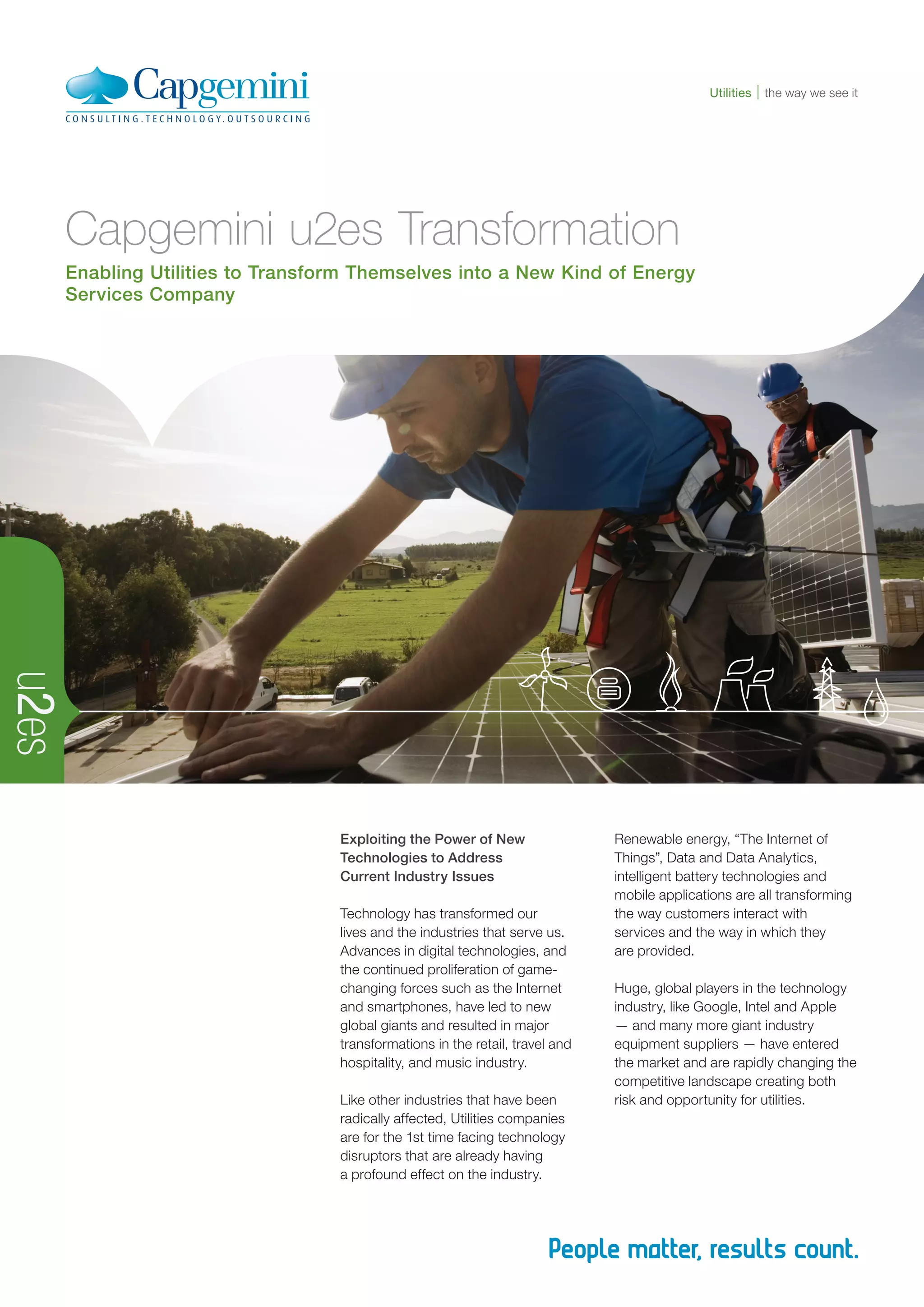
Not so long ago, critics of renewable power were able to point
to its intermittent nature as a key limitation. Today, however,
significant improvement in PV panel efficiency, new battery
storage technology and smart energy control applications
have made it possible for utility customers to significantly
reduce their reliance on energy from their current supplier. New
business models from well-funded solar energy companies
have accelerated renewable adoption. Many major solar players
will install a full solar system for a customer for free, thereby
eliminating customer upfront cost, reducing price per kWh cost
and their reliance on a utility — as long as they sign a long-term
power purchase agreement, which is typically 15-20 years.
For these reasons and others, in an 18 month period including
most of 2013, more solar was installed in the U.S. than in the
last 30 years. Improvements in battery storage technologies
promise to accelerate this trend further. Suddenly, customers
have become power producers with new needs, new usage
patterns and new behaviors.
Government Incentives Accelerate
Renewable Energy Adoption
Governments around the world have jumped on the renewable
energy bandwagon by offering energy efficiency incentives to
business and residential customers to switch to renewables. In
addition, significant policy changes have been implemented to
drive renewable conversion. In Germany, the German Energy
Sources Act has been a major driver of renewable energy
growth from 6.5% to 24% between 2000-2014. Germany has a
goal to achieve 80% electricity consumption from renewables
by 2050. In America, in December 2014, President Obama
signed a Presidential Memorandum requiring that federal
agencies increase their use of renewable energy use from 7.5%
to 20% by the year 2020. In China, 2014 renewable energy
investments were by far the largest in the world — over 5.5
times as much as was invested there than in Germany.
Climate Change Concerns Impact Utility Generation
Climate change continues to be a major driver of energy
policy makers around the world. In June 2014, the U.S.
Environmental Protection Agency announced new rules to cut
carbon emissions by 40% compared to 2005 levels by 2030.
In November 2014, the leaders of China and the U.S. signed
an ambitious joint plan to reduce carbon emissions as a way
of getting other nations around the world to cut greenhouse
gas emissions. As part of this agreement, the United States
set a new target to reduce carbon pollution by 26-28% below
2005 levels by 2025. China announced that it is committed
to peak its CO2
emissions around 2030 while striving to peak
early, and boost its share of non-fossil fuel energy to around
20%. Other countries around the world have also taken action
to fight climate change and improve our environment. As a
result, utilities are faced with evaluating the long-term impact of
declining dependence on fossil fuels produced by plants put in
place years ago.
Poor Financials Threaten Utilities
This shift to renewables and other factors has had severe
revenue impact for some utilities. In Europe, major utilities have
posted record losses. As customers move to renewables,
wholesale prices decline — sometimes becoming negative
— and customers that haven’t moved to renewables are left
paying increasing surcharges to pay for an aging infrastructure
of more expensive coal, natural gas and other plants. This
in turn provides an even greater incentive for customers
to embrace renewable energy and leaves a shrinking pool
of customers. At the same time, since renewable energy
typically only meets a portion of customers needs, customers
still require utilities to provide reliable energy. While rate
decoupling policies have enabled utilities in some parts of the
world to better manage reduced demand, over time it may
become increasingly difficult to pass on the costs of providing
service to a shrinking pool of customers.
Insights & Data
become mainstream
3
NEW OPPORTUNITIES APPEAR FOR UTILITIES
Smart Buildings Create New Opportunity
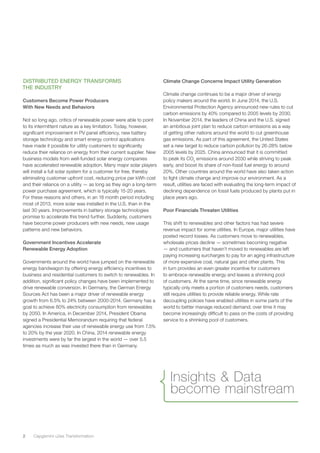
New technology is transforming factories, homes and offices
around the world. New wi-fi enabled smart LED lighting
and thermostats are enabling businesses and residences
to be more energy efficient. Internet connected security
cameras are making customers more secure and sensors
attached to everything — HVAC, furnaces, hot water heaters,
presses, mills and lathes to name just a few — are increasing
equipment performance. Conference rooms are becoming
smarter by adding intelligent lighting, occupancy sensors and
software apps that show when a conference room is in use,
whether the lights are on or off and what the temperature,
and humidity is. Parking lots are adding sensors to detect
when a spot is available or occupied and mobile apps and
intelligent signs allow a user to find an open spot easily.
Distributed energy sources are carefully monitored, power
generated, consumed and tracked within a facility and energy
efficiency optimized. New Data, data analytics and trends
analytics capabilities allow all of these things to be constantly
monitored and performance improvements made. Intel, Cisco,
Google and many others are driving industry IoT adoption. All of
this is happening today and presents tremendous opportunities
for utilities.
Insights & Data Become Mainstream
All of these internet connected sensors, cameras, smoke
detectors, thermostats and other devices are producing
massive amounts of data. Being able to acquire, analyze and
make sense of that data and then using it to optimize current
and future performance is a key ingredient for Utilities and their
customer’s future success. This means providing new services
to customers that allow them to be able to understand how
and when they are using energy. This gives them the ability to
benchmark a building against other buildings in their portfolio
or against industry norms, to identify poorly performing
buildings, to obtain recommendations for energy conservation
and then receiving real-time tracking of energy use reductions
as those recommendations are implemented. Tracking how
machines and equipment are performing in their facilities
and how to improve performance or being able to identify
equipment likely to soon fail, makes businesses more efficient
and adds value. Providing future trend analytics and predictions
will be essential. Connecting weather forecasting information,
cost information by region, city or neighborhood and using
real-time data and historical data to predict future energy
use and facilities operations information will be value drivers
in the new energy economy. Even monitoring and tracking
conference room and parking availability and providing security
solutions will provide new value to customers and new revenue
to Utilities.
Partnerships with Solar Providers
Many solar providers are eager to work with utilities to partner
on solar deployments. In this model, a utility markets and
sells PV systems to it’s customers, a 3rd party solar company
installs the system and the customer signs a Power Purchase
Agreement (PPA) directly with the utility offsetting the cost.
This reduces revenue loss and maintains the customer base
while allowing a customer to better balance fossil fuel power
generation with distributed energy power generation. This
requires regulatory changes in some areas that prevent utility
direct sales today, but is becoming viewed as increasingly
necessary by some Public Utility Commissions (PUC’s).
Partnerships with Other Utilities and
Private Power Producers
To support increased renewable energy generation, utilities
have begun to partner with each other to finance solar and
wind farm projects and by signing low cost agreements with
private power producers. This trend is likely to accelerate
over time due to its economic benefit and its ability to provide
increased renewable energy generation to meet customer
needs and other favorable business variables.
TRANSFORMING INTO AN ENERGY
SERVICES PROVIDER
With change comes opportunity. Today’s utilities can embrace
the forces revolutionizing the utility industry to defend against
greater competition, offer new and innovative services to their
existing customers, and greatly improve their operations or
cost to serve. But to do this requires a transformation from
utility company to being an energy partner as an energy
services company.
We call this u2es Transformation – transformation from a
utility company into an energy services company.
We can help you to shape a future position for your company
in the markets, define a transformation strategy, prioritize your
specific needs, provide the right technologies and business
partners to implement that transformation and operate the
new operational and business models. Our approach is value-
based: Capgemini is committed in delivering proven benefits
across the value chain: top line, bottom line and related KPIs.
Utilities    the way we see it
4 Capgemini u2es Transformation
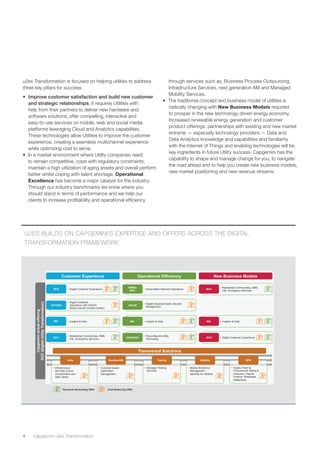
U2ES BUILDS ON CAPGEMINI’S EXPERTISE AND OFFERS ACROSS THE DIGITAL
TRANSFORMATION FRAMEWORK
u2es Transformation is focused on helping utilities to address
three key pillars for success:
• Improve customer satisfaction and build new customer
and strategic relationships; it requires Utilities with
help from their partners to deliver new hardware and
software solutions, offer compelling, interactive and
easy-to-use services on mobile, web and social media
platforms leveraging Cloud and Analytics capabilities.
These technologies allow Utilities to improve the customer
experience, creating a seamless multichannel experience
while optimizing cost to serve.
• In a market environment where Utility companies need
to remain competitive, cope with regulatory constraints,
maintain a high utilization of aging assets and overall perform
better whilst coping with talent shortage, Operational
Excellence has become a major catalyst for the industry.
Through our industry benchmarks we know where you
should stand in terms of performance and we help our
clients to increase profitability and operational efficiency
through services such as, Business Process Outsourcing,
Infrastructure Services, next generation AM and Managed
Mobility Services.
• The traditional concept and business model of utilities is
radically changing with New Business Models required
to prosper in the new technology driven energy economy.
Increased renewable energy generation and customer
product offerings, partnerships with existing and new market
entrants — especially technology providers — Data and
Data Analytics knowledge and capabilities and familiarity
with the Internet of Things and enabling technologies will be
key ingredients in future Utility success. Capgemini has the
capability to shape and manage change for you, to navigate
the road ahead and to help you create new business models,
new market positioning and new revenue streams.
Customer Experience
Cost Reducing OfferRevenue Generating Offer
Operational Efficiency New Business Models
Capgeminiactualoffering
DUT(DigitalUtilityTransformation)
DCX Digital Customer Experience
SMNO/
M2C
Smart Meter Network Operations
Residential Communities, SMB,
C&I, Emergency Services
EIoT
ACCESS
Digital Customer
Operations with ODIGO
(Multi-channel Contact Center)
DiALM
Digital industrial Asset Lifecycle
Management
Insights & DataI&D Insights & DataI&D Insights & DataI&D
Digital Customer ExperienceDCXEIoT
Residential Communities, SMB,
C&I, Emergency Services
UtilityPath
Preconfigured Utility
Technology
Supply Chain &
Procurement, Billing &
Collection, Payroll,
Finance, Wholesale
Settlement)
BPO
Mobile Workforce
Management
(Mobility for Utilities)
Mobility
Outcome based
Application
Management
NextGenAM
Infrastructure
Services (Cloud
Orchestration and
data Lakes)
Infra
Managed Testing
Services
Testing
Transversal Solutions
© 2016 Capgemini. All rights reserved. Rightshore®
is
a trademark belonging to Capgemini. The information
contained in this document is proprietary.
For more details contact:
Philippe Vié
philippe.vie@capgemini.com
About Capgemini
Now with 180,000 people in over 40 countries, Capgemini is one of the world’s
foremost providers of consulting, technology and outsourcing services. The
Group reported 2015 global revenues of EUR 11.9 billion.
Together with its clients, Capgemini creates and delivers business, technology
and digital solutions that fit their needs, enabling them to achieve innovation
and competitiveness. A deeply multicultural organization, Capgemini has
developed its own way of working, the Collaborative Business ExperienceTM,
and draws on Rightshore®
, its worldwide delivery model.
Capgemini’s Global Utilities Sector serves the top Utilities worldwide and
draws on a network of more than 12,000 dedicated sector consultants. More
on industry specific solutions is available at www.capgemini.com/utilities.
DELIVERING GREATER
VALUE THROUGH U2ES
TRANSFORMATION
The Utility of tomorrow will be a new kind of energy
company – a producer, gatherer and exchanger
of information, products and services that can
significantly impact the efficiency of commercial and
industrial businesses and lives of consumers.
Capgemini u2es can help your enterprise go from
“u” to “es” – transform from a utility company into
an energy services company ready to embrace the
potential of your industry and deliver the results your
customers expect, your communities demand, and
your company deserves. Get ahead of the future with
u2es Transformation from Capgemini.
Through u2es Transformation we can help you improve the
customer experience, ensure operational excellence, focusing
on reducing the cost to serve / cost to acquire and create the
new services your customers demand.
Engage with Capgemini
Capgemini is here to help you, with our industry knowledge, a
team of experts will work with your leaders to give you;
• An upfront assessment of your opportunities and a business
case supporting a transformation
• A more detailed roadmap and business case (4 to 6 weeks
engagement) to shape the transformation with a clear
Capgemini commitment on your results
• Delivery of swift and sustainable results
Utilities the way we see it

Capgemini Report - Energy Transformations

  • 1.
    Exploiting the Powerof New Technologies to Address Current Industry Issues Technology has transformed our lives and the industries that serve us. Advances in digital technologies, and the continued proliferation of game- changing forces such as the Internet and smartphones, have led to new global giants and resulted in major transformations in the retail, travel and hospitality, and music industry. Like other industries that have been radically affected, Utilities companies are for the 1st time facing technology disruptors that are already having a profound effect on the industry. Renewable energy, “The Internet of Things”, Data and Data Analytics, intelligent battery technologies and mobile applications are all transforming the way customers interact with services and the way in which they are provided. Huge, global players in the technology industry, like Google, Intel and Apple — and many more giant industry equipment suppliers — have entered the market and are rapidly changing the competitive landscape creating both risk and opportunity for utilities. Capgemini u2es Transformation Enabling Utilities to Transform Themselves into a New Kind of Energy Services Company u2es Utilities    the way we see it
  • 2.
    2 Capgemini u2esTransformation DISTRIBUTED ENERGY TRANSFORMS THE INDUSTRY Customers Become Power Producers With New Needs and Behaviors Not so long ago, critics of renewable power were able to point to its intermittent nature as a key limitation. Today, however, significant improvement in PV panel efficiency, new battery storage technology and smart energy control applications have made it possible for utility customers to significantly reduce their reliance on energy from their current supplier. New business models from well-funded solar energy companies have accelerated renewable adoption. Many major solar players will install a full solar system for a customer for free, thereby eliminating customer upfront cost, reducing price per kWh cost and their reliance on a utility — as long as they sign a long-term power purchase agreement, which is typically 15-20 years. For these reasons and others, in an 18 month period including most of 2013, more solar was installed in the U.S. than in the last 30 years. Improvements in battery storage technologies promise to accelerate this trend further. Suddenly, customers have become power producers with new needs, new usage patterns and new behaviors. Government Incentives Accelerate Renewable Energy Adoption Governments around the world have jumped on the renewable energy bandwagon by offering energy efficiency incentives to business and residential customers to switch to renewables. In addition, significant policy changes have been implemented to drive renewable conversion. In Germany, the German Energy Sources Act has been a major driver of renewable energy growth from 6.5% to 24% between 2000-2014. Germany has a goal to achieve 80% electricity consumption from renewables by 2050. In America, in December 2014, President Obama signed a Presidential Memorandum requiring that federal agencies increase their use of renewable energy use from 7.5% to 20% by the year 2020. In China, 2014 renewable energy investments were by far the largest in the world — over 5.5 times as much as was invested there than in Germany. Climate Change Concerns Impact Utility Generation Climate change continues to be a major driver of energy policy makers around the world. In June 2014, the U.S. Environmental Protection Agency announced new rules to cut carbon emissions by 40% compared to 2005 levels by 2030. In November 2014, the leaders of China and the U.S. signed an ambitious joint plan to reduce carbon emissions as a way of getting other nations around the world to cut greenhouse gas emissions. As part of this agreement, the United States set a new target to reduce carbon pollution by 26-28% below 2005 levels by 2025. China announced that it is committed to peak its CO2 emissions around 2030 while striving to peak early, and boost its share of non-fossil fuel energy to around 20%. Other countries around the world have also taken action to fight climate change and improve our environment. As a result, utilities are faced with evaluating the long-term impact of declining dependence on fossil fuels produced by plants put in place years ago. Poor Financials Threaten Utilities This shift to renewables and other factors has had severe revenue impact for some utilities. In Europe, major utilities have posted record losses. As customers move to renewables, wholesale prices decline — sometimes becoming negative — and customers that haven’t moved to renewables are left paying increasing surcharges to pay for an aging infrastructure of more expensive coal, natural gas and other plants. This in turn provides an even greater incentive for customers to embrace renewable energy and leaves a shrinking pool of customers. At the same time, since renewable energy typically only meets a portion of customers needs, customers still require utilities to provide reliable energy. While rate decoupling policies have enabled utilities in some parts of the world to better manage reduced demand, over time it may become increasingly difficult to pass on the costs of providing service to a shrinking pool of customers. Insights & Data become mainstream
  • 3.
    3 NEW OPPORTUNITIES APPEARFOR UTILITIES Smart Buildings Create New Opportunity New technology is transforming factories, homes and offices around the world. New wi-fi enabled smart LED lighting and thermostats are enabling businesses and residences to be more energy efficient. Internet connected security cameras are making customers more secure and sensors attached to everything — HVAC, furnaces, hot water heaters, presses, mills and lathes to name just a few — are increasing equipment performance. Conference rooms are becoming smarter by adding intelligent lighting, occupancy sensors and software apps that show when a conference room is in use, whether the lights are on or off and what the temperature, and humidity is. Parking lots are adding sensors to detect when a spot is available or occupied and mobile apps and intelligent signs allow a user to find an open spot easily. Distributed energy sources are carefully monitored, power generated, consumed and tracked within a facility and energy efficiency optimized. New Data, data analytics and trends analytics capabilities allow all of these things to be constantly monitored and performance improvements made. Intel, Cisco, Google and many others are driving industry IoT adoption. All of this is happening today and presents tremendous opportunities for utilities. Insights & Data Become Mainstream All of these internet connected sensors, cameras, smoke detectors, thermostats and other devices are producing massive amounts of data. Being able to acquire, analyze and make sense of that data and then using it to optimize current and future performance is a key ingredient for Utilities and their customer’s future success. This means providing new services to customers that allow them to be able to understand how and when they are using energy. This gives them the ability to benchmark a building against other buildings in their portfolio or against industry norms, to identify poorly performing buildings, to obtain recommendations for energy conservation and then receiving real-time tracking of energy use reductions as those recommendations are implemented. Tracking how machines and equipment are performing in their facilities and how to improve performance or being able to identify equipment likely to soon fail, makes businesses more efficient and adds value. Providing future trend analytics and predictions will be essential. Connecting weather forecasting information, cost information by region, city or neighborhood and using real-time data and historical data to predict future energy use and facilities operations information will be value drivers in the new energy economy. Even monitoring and tracking conference room and parking availability and providing security solutions will provide new value to customers and new revenue to Utilities. Partnerships with Solar Providers Many solar providers are eager to work with utilities to partner on solar deployments. In this model, a utility markets and sells PV systems to it’s customers, a 3rd party solar company installs the system and the customer signs a Power Purchase Agreement (PPA) directly with the utility offsetting the cost. This reduces revenue loss and maintains the customer base while allowing a customer to better balance fossil fuel power generation with distributed energy power generation. This requires regulatory changes in some areas that prevent utility direct sales today, but is becoming viewed as increasingly necessary by some Public Utility Commissions (PUC’s). Partnerships with Other Utilities and Private Power Producers To support increased renewable energy generation, utilities have begun to partner with each other to finance solar and wind farm projects and by signing low cost agreements with private power producers. This trend is likely to accelerate over time due to its economic benefit and its ability to provide increased renewable energy generation to meet customer needs and other favorable business variables. TRANSFORMING INTO AN ENERGY SERVICES PROVIDER With change comes opportunity. Today’s utilities can embrace the forces revolutionizing the utility industry to defend against greater competition, offer new and innovative services to their existing customers, and greatly improve their operations or cost to serve. But to do this requires a transformation from utility company to being an energy partner as an energy services company. We call this u2es Transformation – transformation from a utility company into an energy services company. We can help you to shape a future position for your company in the markets, define a transformation strategy, prioritize your specific needs, provide the right technologies and business partners to implement that transformation and operate the new operational and business models. Our approach is value- based: Capgemini is committed in delivering proven benefits across the value chain: top line, bottom line and related KPIs. Utilities    the way we see it
  • 4.
    4 Capgemini u2esTransformation U2ES BUILDS ON CAPGEMINI’S EXPERTISE AND OFFERS ACROSS THE DIGITAL TRANSFORMATION FRAMEWORK u2es Transformation is focused on helping utilities to address three key pillars for success: • Improve customer satisfaction and build new customer and strategic relationships; it requires Utilities with help from their partners to deliver new hardware and software solutions, offer compelling, interactive and easy-to-use services on mobile, web and social media platforms leveraging Cloud and Analytics capabilities. These technologies allow Utilities to improve the customer experience, creating a seamless multichannel experience while optimizing cost to serve. • In a market environment where Utility companies need to remain competitive, cope with regulatory constraints, maintain a high utilization of aging assets and overall perform better whilst coping with talent shortage, Operational Excellence has become a major catalyst for the industry. Through our industry benchmarks we know where you should stand in terms of performance and we help our clients to increase profitability and operational efficiency through services such as, Business Process Outsourcing, Infrastructure Services, next generation AM and Managed Mobility Services. • The traditional concept and business model of utilities is radically changing with New Business Models required to prosper in the new technology driven energy economy. Increased renewable energy generation and customer product offerings, partnerships with existing and new market entrants — especially technology providers — Data and Data Analytics knowledge and capabilities and familiarity with the Internet of Things and enabling technologies will be key ingredients in future Utility success. Capgemini has the capability to shape and manage change for you, to navigate the road ahead and to help you create new business models, new market positioning and new revenue streams. Customer Experience Cost Reducing OfferRevenue Generating Offer Operational Efficiency New Business Models Capgeminiactualoffering DUT(DigitalUtilityTransformation) DCX Digital Customer Experience SMNO/ M2C Smart Meter Network Operations Residential Communities, SMB, C&I, Emergency Services EIoT ACCESS Digital Customer Operations with ODIGO (Multi-channel Contact Center) DiALM Digital industrial Asset Lifecycle Management Insights & DataI&D Insights & DataI&D Insights & DataI&D Digital Customer ExperienceDCXEIoT Residential Communities, SMB, C&I, Emergency Services UtilityPath Preconfigured Utility Technology Supply Chain & Procurement, Billing & Collection, Payroll, Finance, Wholesale Settlement) BPO Mobile Workforce Management (Mobility for Utilities) Mobility Outcome based Application Management NextGenAM Infrastructure Services (Cloud Orchestration and data Lakes) Infra Managed Testing Services Testing Transversal Solutions
  • 5.
    © 2016 Capgemini.All rights reserved. Rightshore® is a trademark belonging to Capgemini. The information contained in this document is proprietary. For more details contact: Philippe Vié philippe.vie@capgemini.com About Capgemini Now with 180,000 people in over 40 countries, Capgemini is one of the world’s foremost providers of consulting, technology and outsourcing services. The Group reported 2015 global revenues of EUR 11.9 billion. Together with its clients, Capgemini creates and delivers business, technology and digital solutions that fit their needs, enabling them to achieve innovation and competitiveness. A deeply multicultural organization, Capgemini has developed its own way of working, the Collaborative Business ExperienceTM, and draws on Rightshore® , its worldwide delivery model. Capgemini’s Global Utilities Sector serves the top Utilities worldwide and draws on a network of more than 12,000 dedicated sector consultants. More on industry specific solutions is available at www.capgemini.com/utilities. DELIVERING GREATER VALUE THROUGH U2ES TRANSFORMATION The Utility of tomorrow will be a new kind of energy company – a producer, gatherer and exchanger of information, products and services that can significantly impact the efficiency of commercial and industrial businesses and lives of consumers. Capgemini u2es can help your enterprise go from “u” to “es” – transform from a utility company into an energy services company ready to embrace the potential of your industry and deliver the results your customers expect, your communities demand, and your company deserves. Get ahead of the future with u2es Transformation from Capgemini. Through u2es Transformation we can help you improve the customer experience, ensure operational excellence, focusing on reducing the cost to serve / cost to acquire and create the new services your customers demand. Engage with Capgemini Capgemini is here to help you, with our industry knowledge, a team of experts will work with your leaders to give you; • An upfront assessment of your opportunities and a business case supporting a transformation • A more detailed roadmap and business case (4 to 6 weeks engagement) to shape the transformation with a clear Capgemini commitment on your results • Delivery of swift and sustainable results Utilities the way we see it