Download to read offline
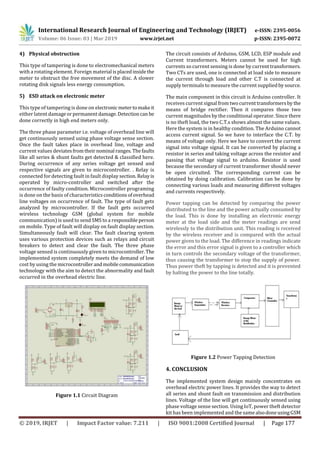
![International Research Journal of Engineering and Technology (IRJET) e-ISSN: 2395-0056
Volume: 06 Issue: 03 | Mar 2019 www.irjet.net p-ISSN: 2395-0072
© 2019, IRJET | Impact Factor value: 7.211 | ISO 9001:2008 Certified Journal | Page 175
Power Theft and Fault Detection using IoT Technology
Rohit Tatte1, Mayuri Chaudhari2, Minal Khrabe3, Pranjali Lokhnade4,
Pranjali Muneshwar5, Dhanshree Yenorkar6
1,2,3,4,5,6Student, Dept. of Electrical Engg., Datta Meghe Institute of Engineering Technology & Research, Wardha
---------------------------------------------------------------------***----------------------------------------------------------------------
Abstract - Generation, transmission and distribution of
electrical energy involve many operational losses. We can
defined the losses in generation technically but distribution
and transmission losses cannot be precisely quantified with
the sending end information. This illustrates the involvement
of nontechnical parameter in transmission and distribution of
electricity. Moreover technical losses occur naturally and are
caused because of power dissipation in transmission lines,
transformers, and other power system components. Technical
losses in Transmission & Distribution are computed with the
information about total load and the total energy bill. While
technology in the raising slopes, we should also note the
increasing immoral activities. The system prevents the illegal
usage of electricity. At this point of technological development
the problem of illegal usage of electricity can be solved
without any human control using IoT. With the
implementation of this system will save large amount of
electricity, and there by electricity will be available for more
number of consumer then earlier, in highly populated country
such as India, China. Power theft can be definedastheusageof
the electrical power without any legal contract with the
supplier.
Key Words: Power Theft, Fault Detection, IoT,
1. INTRODUCTION
Theft of electricity is the criminal practice of
stealing electrical power. It is a crime and is punishable by
fines and/or incarceration. It belongs to the non-technical
losses. In recent days power theft which causes lot of loss to
electricity boards is the biggest problem. In countries like
India, these situations are more often, if we can prevent
these thefts we can save lot of power. To detect an
unauthorized tapping on distribution lines electrical power
theft detection system is used. Distribution network of
electrical power supply system is the main implementation
part of this system. It is not possible for existing system to
identify the exact location of tapping. Our system finds out
on which electrical line there is a tapping. This is a real time
system. In moderately developing nation in development of
nation power sector provides one of the most important
input. The consumption of electricity in India isincreasingat
much faster rate. Therefore a need has aroused to generate,
transmit & distributeelectric powerat mosteconomical way.
[3] Electrical power system is been divided into generation,
transmission & distribution. Losses in transmission system
are much lower than losses in distributionsideandalsofault
are not frequent in distribution side.
Most of the losses are caused by fault and theft in
distribution system. In this paper thefocusisonsinglephase
to ground fault in power line. When single phase to ground
fault occurs, it becomes significanttodetectfaultquicklyand
with accuracy. It becomes challenging for the power
company to detect and repair the fault asquicklyaspossible.
Protection systems are designed to identify the location of
faults and isolate only the faulted section in order not to
damage the whole equipment in power system. In the
proposed concept with the use of wireless sensor network
exact location of fault can be diagnosed. There by providing
optimum operation of electric power. The objective of this
paper is to provide with a simple way to detect the fault and
show the exact location of occurred fault which will
ultimately lead to optimum operation of the whole system
and to improve the reliability of distribution network.
Electrical networks, machines and equipment’s are often
subjected to various types of faults while they are in
operation. When a fault occurs, the characteristic values
(such as impedance) of the machines may change from
existing values to different values till the fault is cleared.
There may be lot of probabilities of faults to appear in the
power system network, including lighting, wind, tree falling
on lines, apparatus failure, etc.
The fault inception also involves in insulation failures and
conducting path failures whichresultsshortcircuitandopen
circuit of conductors. Under normal or safe operating
conditions, the electric equipment’s in a power system
network operate at normal voltageandcurrentratings.Once
the fault takes place in a circuit or device, voltage and
current values deviates from their nominal ranges. Usually
power system networks are protected with switchgear
protection equipment’s suchas circuitbreakersandrelaysin
order to limit the loss of service due to the electrical failures
after the occurrence of fault. The design of systems to detect
and interrupt power system faults is the main objective of
power-system protection. The main types of faults are
symmetric and asymmetric.
2. RELATED WORK
2.1 Internet of Things (IoT)
The Internet of Things (IoT) envisions a near future and is a
recent communication paradigm, in which the objects of
everyday life are equipped with microcontrollers,
transceivers forcommunication,andsuitableprotocol stacks](https://image.slidesharecdn.com/irjet-v6i332-190803101955/85/IRJET-Power-Theft-and-Fault-Detection-using-IoT-Technology-1-320.jpg)
![International Research Journal of Engineering and Technology (IRJET) e-ISSN: 2395-0056
Volume: 06 Issue: 03 | Mar 2019 www.irjet.net p-ISSN: 2395-0072
© 2019, IRJET | Impact Factor value: 7.211 | ISO 9001:2008 Certified Journal | Page 175
Power Theft and Fault Detection using IoT Technology
Rohit Tatte1, Mayuri Chaudhari2, Minal Khrabe3, Pranjali Lokhnade4,
Pranjali Muneshwar5, Dhanshree Yenorkar6
1,2,3,4,5,6Student, Dept. of Electrical Engg., Datta Meghe Institute of Engineering Technology & Research, Wardha
---------------------------------------------------------------------***----------------------------------------------------------------------
Abstract - Generation, transmission and distribution of
electrical energy involve many operational losses. We can
defined the losses in generation technically but distribution
and transmission losses cannot be precisely quantified with
the sending end information. This illustrates the involvement
of nontechnical parameter in transmission and distribution of
electricity. Moreover technical losses occur naturally and are
caused because of power dissipation in transmission lines,
transformers, and other power system components. Technical
losses in Transmission & Distribution are computed with the
information about total load and the total energy bill. While
technology in the raising slopes, we should also note the
increasing immoral activities. The system prevents the illegal
usage of electricity. At this point of technological development
the problem of illegal usage of electricity can be solved
without any human control using IoT. With the
implementation of this system will save large amount of
electricity, and there by electricity will be available for more
number of consumer then earlier, in highly populated country
such as India, China. Power theft can be definedastheusageof
the electrical power without any legal contract with the
supplier.
Key Words: Power Theft, Fault Detection, IoT,
1. INTRODUCTION
Theft of electricity is the criminal practice of
stealing electrical power. It is a crime and is punishable by
fines and/or incarceration. It belongs to the non-technical
losses. In recent days power theft which causes lot of loss to
electricity boards is the biggest problem. In countries like
India, these situations are more often, if we can prevent
these thefts we can save lot of power. To detect an
unauthorized tapping on distribution lines electrical power
theft detection system is used. Distribution network of
electrical power supply system is the main implementation
part of this system. It is not possible for existing system to
identify the exact location of tapping. Our system finds out
on which electrical line there is a tapping. This is a real time
system. In moderately developing nation in development of
nation power sector provides one of the most important
input. The consumption of electricity in India isincreasingat
much faster rate. Therefore a need has aroused to generate,
transmit & distributeelectric powerat mosteconomical way.
[3] Electrical power system is been divided into generation,
transmission & distribution. Losses in transmission system
are much lower than losses in distributionsideandalsofault
are not frequent in distribution side.
Most of the losses are caused by fault and theft in
distribution system. In this paper thefocusisonsinglephase
to ground fault in power line. When single phase to ground
fault occurs, it becomes significanttodetectfaultquicklyand
with accuracy. It becomes challenging for the power
company to detect and repair the fault asquicklyaspossible.
Protection systems are designed to identify the location of
faults and isolate only the faulted section in order not to
damage the whole equipment in power system. In the
proposed concept with the use of wireless sensor network
exact location of fault can be diagnosed. There by providing
optimum operation of electric power. The objective of this
paper is to provide with a simple way to detect the fault and
show the exact location of occurred fault which will
ultimately lead to optimum operation of the whole system
and to improve the reliability of distribution network.
Electrical networks, machines and equipment’s are often
subjected to various types of faults while they are in
operation. When a fault occurs, the characteristic values
(such as impedance) of the machines may change from
existing values to different values till the fault is cleared.
There may be lot of probabilities of faults to appear in the
power system network, including lighting, wind, tree falling
on lines, apparatus failure, etc.
The fault inception also involves in insulation failures and
conducting path failures whichresultsshortcircuitandopen
circuit of conductors. Under normal or safe operating
conditions, the electric equipment’s in a power system
network operate at normal voltageandcurrentratings.Once
the fault takes place in a circuit or device, voltage and
current values deviates from their nominal ranges. Usually
power system networks are protected with switchgear
protection equipment’s suchas circuitbreakersandrelaysin
order to limit the loss of service due to the electrical failures
after the occurrence of fault. The design of systems to detect
and interrupt power system faults is the main objective of
power-system protection. The main types of faults are
symmetric and asymmetric.
2. RELATED WORK
2.1 Internet of Things (IoT)
The Internet of Things (IoT) envisions a near future and is a
recent communication paradigm, in which the objects of
everyday life are equipped with microcontrollers,
transceivers forcommunication,andsuitableprotocol stacks](https://image.slidesharecdn.com/irjet-v6i332-190803101955/75/IRJET-Power-Theft-and-Fault-Detection-using-IoT-Technology-1-2048.jpg)
![International Research Journal of Engineering and Technology (IRJET) e-ISSN: 2395-0056
Volume: 06 Issue: 03 | Mar 2019 www.irjet.net p-ISSN: 2395-0072
© 2019, IRJET | Impact Factor value: 7.211 | ISO 9001:2008 Certified Journal | Page 176
that will make them able to communicate with one another
and with the users, becoming an integral partoftheInternet.
This system aims at making the Internet even more
immersive and pervasive. Also by enabling easy access and
interaction the internet of things will fosterthedevelopment
of a number of applications that make use of the potentially
enormous amount and variety of data generated by such
objects to provide new services to citizens, companies, and
public administrations by using variety of devices such as,
for instance, home appliances, surveillance cameras,
monitoring sensors, actuators, displays, vehicles, and so on,
Our System indeed finds application inmany manydomains,
such as automation in homes, industrial, medical aids,
mobile healthcare, elderly assistance, intelligent energy
management and smart grids, automotive, traffic
management, etc. However, such a heterogeneous field of
application makes the identification of solutions capable of
satisfying the requirements of all possible application
scenarios a formidable challenge. This difficulty has led to
the proliferation of different and, sometimes, incompatible
proposals for the practical realization of IoT systems.
Therefore, from a system perspective, the realization of an
IoT network, together with the required backend network
services and devices, still lacks an established best practice
because of its novelty and complexity. In addition to the
technical difficulties, the adoptionoftheIoTparadigmisalso
hindered by the lack of a clear and widely accepted business
model that can attract investments to promote the
deployment of these technologies.
Below, it is provided a glossary defining the Internet of
Things:
Internet of Things: A network of internet-
connected objects able to collect and exchange data
using embedded sensors.
Internet of Things device: Any stand-alone
internet-connected device that can be monitored
and/or controlled from a remote location.
Internet of Things ecosystem: All thecomponents
that enable businesses, governments, and
consumers to connect to theirIoTdevices,including
remotes,dashboards,networks,gateways,analytics,
data storage, and security.
Entity: Includes businesses, governments, and
consumers.
Physical layer: The hardware that makes an IoT
device, including sensors and networking gear.
Network layer: Responsible for transmitting the
data collected by the physical layer to different
devices.
Application layer: This includes the protocols and
interfaces that devices use to identify and
communicate with each other.
Remotes: Enable entities that utilize IoT devices to
connect with and control them using a dashboard,
such as a mobile application. They include
smartphones, tablets, PCs, smart watches,
connected TVs, and nontraditional remotes.
Dashboard: Displays information about the IoT
ecosystem to users and enables them to control
their IoT ecosystem. It is generally housed on a
remote.
Analytics: Software systems that analyze the data
generated by IoT devices. The analysis can be used
for a variety of scenarios, such as predictive
maintenance.
Data storage: Where data from IoT devices is
stored.
Networks: The internet communication layer that
enables the entitytocommunicatewiththeirdevice,
and sometimes enables devices to communicate
with each other.
3. WORKING PRINCIPLE
There are various types of electrical power theft, including
Tapping a line or bypassing the energy meter.Accordingtoa
study[citation needed], 80% of worldwide theft occurs in private
dwellings and 20% on commercial and industrial premises.
The various types of electrical power theft include:
1) Direct hooking from line
What's known as "Cable Hooking" is the most used method.
80% of global power theft is by direct tapping from the line.
The consumer taps into a power line from a point ahead of
the energy meter. This energy consumption is unmeasured
and procured with or without switches.
2) Bypassing the energy meter
In this method, the input terminal and outputterminal of the
energy meter is short-circuited, preventing the energy from
registration in the energy meter.[3]
3) Injecting foreign element into the energy meter
Meters are manipulated via a remote by installing a circuit
inside the meter so that the meter can be slowed down at
any time. This kind of modification can evade external
inspection attempts because the meter is always correct
unless the remote is turned on.](https://image.slidesharecdn.com/irjet-v6i332-190803101955/85/IRJET-Power-Theft-and-Fault-Detection-using-IoT-Technology-2-320.jpg)
![International Research Journal of Engineering and Technology (IRJET) e-ISSN: 2395-0056
Volume: 06 Issue: 03 | Mar 2019 www.irjet.net p-ISSN: 2395-0072
© 2019, IRJET | Impact Factor value: 7.211 | ISO 9001:2008 Certified Journal | Page 178
for the purpose of backup protection. Using IoT, power theft
detector kit has been implemented and the same also done
using GSM for the purpose of backup protection.
REFERENCES
[1] Ashwini Yenegur, Basawaraj.S.Mathpati “An algorithm
for fault node recovery of wireless sensor network”
Volume: 03 Special Issue:03|May-2014|NCRIET-2014.
[2] He Yi Li Chang-binWu Ai-guo MengQing-yu“Researchof
Phase-to-ground Fault Location inTheDistributionLine
Based on Wireless Sensor Networks”.
[3] S. Tamronglak, S. E Horowitz, A. G. Phadke, J. S. Thorp
“Anatomy of power system blackouts: preventive
relaying strategies” IEEE Transactions on Power
Delivery, Vol. 11, No. 2, April 1996.
[4] L. Atzori, A. Iera, and G. Morabito, “The internet of
things: A survey,” Comput. Netw., vol. 54, no. 15, pp.
2787–2805, 2010.
[5] P. Bellavista, G. Cardone, A. Corradi, and L. Foschini,
“Convergence of MANET and WSN in IoT urban
scenarios,” IEEE Sens. J., vol. 13, no. 10, pp. 3558–3567,
Oct. 2013.
[6] A. Laya, V. I. Bratu, and J. Markendahl, “Who is investing
in machine-to machine communications?” in Proc. 24th
Eur. Reg. ITS Conf., Florence, Italy, Oct. 2013, pp. 20–23.
[7] H. Schaffers, N. Komninos, M. Pallot, B. Trousse, M.
Nilsson, and A. Oliveira, “Smart cities and the future
internet: Towards cooperation frameworks for open
innovation,” The Future Internet, Lect. Notes Comput.
Sci., vol. 6656, pp. 431–446, 2011.
[8] D. Cuff, M. Hansen, and J. Kang, “Urban sensing: Out of
the woods,” Commun. ACM, vol. 51, no. 3, pp. 24–33,
Mar. 2008.
[9] Ms.Devjani Banerjee, Prof Dr.Mrs.N.R.Kulkarni , “T hree
Phase Parameter Data Logging and Fault Detection
Using GSM T echnology”, International Journal of
Scientific and Research Publications, Volume 3, Issue 2,
February 2013 1 ISSN 2250-3153.
[10] P.A. Gulbhile, J.R. Rana, B.T . Deshmukh, “ Review for
overhead line fault detection using GSM technology”,
International Journal ofAdvancedResearchinElectrical,
Electronics and Intrumentation Engineering,Volume5,
Issue12, December 2016 ISSN 2278-8875.
[11] C. Zhang and L. Zhou, "220kv Transmission Line Fault
Diagnosis and Analysis," 2012 Second International
Conference on Intelligent System Design and
Engineering Application, Sanya,Hainan,2012,pp.1343-
1345.
[12] S. Singh and D. N. Vishwakarma, "Intelligent techniques
for fault diagnosis intransmissionlines —Anoverview,"
2015 International ConferenceonRecentDevelopments
in Control, Automation and Power Engineering
(RDCAPE), Noida, 2015, pp. 280-285.
[13] Joe-Air Jiang, Jun-Zhe Yang, Ying-Hong Lin, Chih-Wen
Liu, Member, IEEE, and Jih-Chen Ma, “An Adaptive PMU
Based Fault](https://image.slidesharecdn.com/irjet-v6i332-190803101955/85/IRJET-Power-Theft-and-Fault-Detection-using-IoT-Technology-4-320.jpg)

This document discusses using IoT technology to detect power theft and faults in electrical distribution systems. It begins with an abstract that outlines the goals of detecting power theft and faults quickly and accurately. It then provides background on IoT and discusses how an IoT-based system could work, using sensors to monitor voltage and current on distribution lines and detect deviations that indicate faults or theft. If a fault or theft is detected, the system would send an SMS notification. The document concludes that such a system could help reduce losses from power theft and more quickly detect and locate faults, improving reliability for consumers.


