Submitted To – Mrs. Shruti Jaltare Mam
• Prudential Reasons
1. It avoids conflicts between different social groups. The
absence of power sharing can result in division of the
country.
2. Imposing will of the majority on the minority might
appear to be an attractive option but it can be counter
productive and can come in way of national integration
as it happened in Sri Lanka
3. The tyranny of the majority brings ruins both to the
minority and the majority (as in Sri Lanka)
• Moral Reasons
1. Power sharing is the very essence of democracy.
In an ideal democracy as many people as
possible should get a chance to enjoy power.
2. People are affected by all the policies of
democratic politics and they have to live with
the effects. Hence citizens need share in power.
3. A legitimate govt. is one where citizens, through
participation, acquire stake in power.
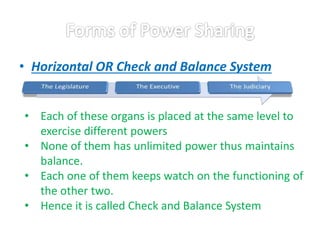
• Horizontal OR Check and Balance System
• Each of these organs is placed at the same level to
exercise different powers
• None of them has unlimited power thus maintains
balance.
• Each one of them keeps watch on the functioning of
the other two.
• Hence it is called Check and Balance System
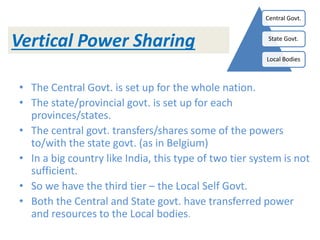
• The Central Govt. is set up for the whole nation.
• The state/provincial govt. is set up for each
provinces/states.
• The central govt. transfers/shares some of the powers
to/with the state govt. (as in Belgium)
• In a big country like India, this type of two tier system is not
sufficient.
• So we have the third tier – the Local Self Govt.
• Both the Central and State govt. have transferred power
and resources to the Local bodies.
Central Govt.
State Govt.
Local Bodies
Vertical Power Sharing
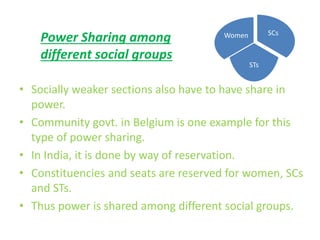
• Socially weaker sections also have to have share in
power.
• Community govt. in Belgium is one example for this
type of power sharing.
• In India, it is done by way of reservation.
• Constituencies and seats are reserved for women, SCs
and STs.
• Thus power is shared among different social groups.
Power Sharing among
different social groups
SCs
STs
Women
Power Sharing among
Political parties, pressure
groups and movements
• No political party enjoys power for ever.
• It is for the people to decide who should be in power.
• With the emergence of coalition govt. many parties
share power at the same time.
• Pressure groups and movements have share in power by
exerting pressure on the govt.
• They exert pressure by various means and get policies
framed in their favour.
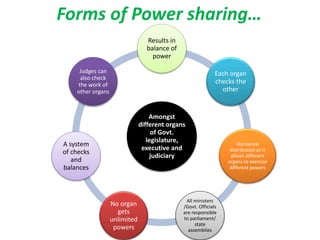
Forms of Power sharing…
Amongst
different organs
of Govt.
legislature,
executive and
judiciary
Results in
balance of
power
Each organ
checks the
other
Horizontal
distribution as it
allows different
organs to exercise
different powers
All ministers
/Govt. Officials
are responsible
to parliament/
state
assemblies
No organ
gets
unlimited
powers
A system
of checks
and
balances
Judges can
also check
the work of
other organs
Forms of Power sharing…
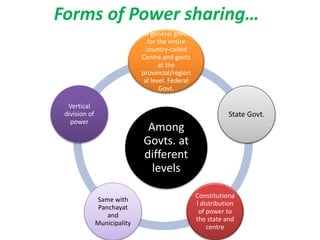
Among
Govts. at
different
levels
A general govt.
for the entire
country-called
Centre and govts
at the
provincial/region
al level. Federal
Govt.
State Govt.
Constitutiona
l distribution
of power to
the state and
centre
Same with
Panchayat
and
Municipality
Vertical
division of
power
Forms of Power sharing…
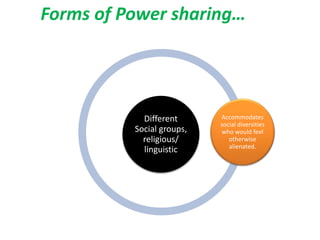
Different
Social groups,
religious/
linguistic
Accommodates
social diversities
who would feel
otherwise
alienated.
Political parties,
pressure groups
and movements
influence those
in power
Influence of
interest groups-
businessmen,
industrialists,
farmers and
industrial
workers.
Formation of
coalition
Govt.when
different parties
form alliances
Forms of Power sharing…
Group Members
• Mayank
• Prabhat
• Shubham
• Riya
• Surbhi
• Mahak
• Prachi
power sharing

power sharing

  • 1.
    Submitted To –Mrs. Shruti Jaltare Mam
  • 2.
    • Prudential Reasons 1.It avoids conflicts between different social groups. The absence of power sharing can result in division of the country. 2. Imposing will of the majority on the minority might appear to be an attractive option but it can be counter productive and can come in way of national integration as it happened in Sri Lanka 3. The tyranny of the majority brings ruins both to the minority and the majority (as in Sri Lanka)
  • 3.
    • Moral Reasons 1.Power sharing is the very essence of democracy. In an ideal democracy as many people as possible should get a chance to enjoy power. 2. People are affected by all the policies of democratic politics and they have to live with the effects. Hence citizens need share in power. 3. A legitimate govt. is one where citizens, through participation, acquire stake in power.
  • 4.
    • Horizontal ORCheck and Balance System • Each of these organs is placed at the same level to exercise different powers • None of them has unlimited power thus maintains balance. • Each one of them keeps watch on the functioning of the other two. • Hence it is called Check and Balance System
  • 5.
    • The CentralGovt. is set up for the whole nation. • The state/provincial govt. is set up for each provinces/states. • The central govt. transfers/shares some of the powers to/with the state govt. (as in Belgium) • In a big country like India, this type of two tier system is not sufficient. • So we have the third tier – the Local Self Govt. • Both the Central and State govt. have transferred power and resources to the Local bodies. Central Govt. State Govt. Local Bodies Vertical Power Sharing
  • 6.
    • Socially weakersections also have to have share in power. • Community govt. in Belgium is one example for this type of power sharing. • In India, it is done by way of reservation. • Constituencies and seats are reserved for women, SCs and STs. • Thus power is shared among different social groups. Power Sharing among different social groups SCs STs Women
  • 7.
    Power Sharing among Politicalparties, pressure groups and movements • No political party enjoys power for ever. • It is for the people to decide who should be in power. • With the emergence of coalition govt. many parties share power at the same time. • Pressure groups and movements have share in power by exerting pressure on the govt. • They exert pressure by various means and get policies framed in their favour.
  • 8.
    Forms of Powersharing… Amongst different organs of Govt. legislature, executive and judiciary Results in balance of power Each organ checks the other Horizontal distribution as it allows different organs to exercise different powers All ministers /Govt. Officials are responsible to parliament/ state assemblies No organ gets unlimited powers A system of checks and balances Judges can also check the work of other organs
  • 9.
    Forms of Powersharing… Among Govts. at different levels A general govt. for the entire country-called Centre and govts at the provincial/region al level. Federal Govt. State Govt. Constitutiona l distribution of power to the state and centre Same with Panchayat and Municipality Vertical division of power
  • 10.
    Forms of Powersharing… Different Social groups, religious/ linguistic Accommodates social diversities who would feel otherwise alienated.
  • 11.
    Political parties, pressure groups andmovements influence those in power Influence of interest groups- businessmen, industrialists, farmers and industrial workers. Formation of coalition Govt.when different parties form alliances Forms of Power sharing…
  • 12.
    Group Members • Mayank •Prabhat • Shubham • Riya • Surbhi • Mahak • Prachi