ARS REVISION NOTES 1
Power-sharing
The case of Belgium-
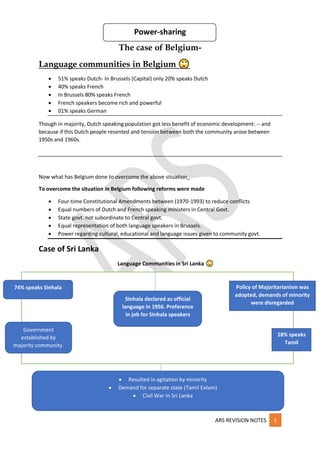
Language communities in Belgium
• 51% speaks Dutch- In Brussels (Capital) only 20% speaks Dutch
• 40% speaks French
• In Brussels 80% speaks French
• French speakers become rich and powerful
• 01% speaks German
Though in majority, Dutch speaking population got less benefit of economic development: -- and
because if this Dutch people resented and tension between both the community arose between
1950s and 1960s.
Now what has Belgium done to overcome the above situation_
To overcome the situation in Belgium following reforms were made
• Four-time Constitutional Amendments between (1970-1993) to reduce conflicts
• Equal numbers of Dutch and French speaking ministers in Central Govt.
• State govt. not subordinate to Central govt.
• Equal representation of both language speakers in Brussels.
• Power regarding cultural, educational and language issues given to community govt.
Case of Sri Lanka
Language Communities in Sri Lanka
74% speaks Sinhala
• Resulted in agitation by minority
• Demand for separate state (Tamil Eelam)
• Civil War In Sri Lanka
74% speaks Sinhala
Sinhala declared as official
language in 1956. Preference
in job for Sinhala speakers
Policy of Majoritarianism was
adopted, demands of minority
were disregarded
Government
established by
majority community.
18% speaks
Tamil
ARS REVISION NOTES 2
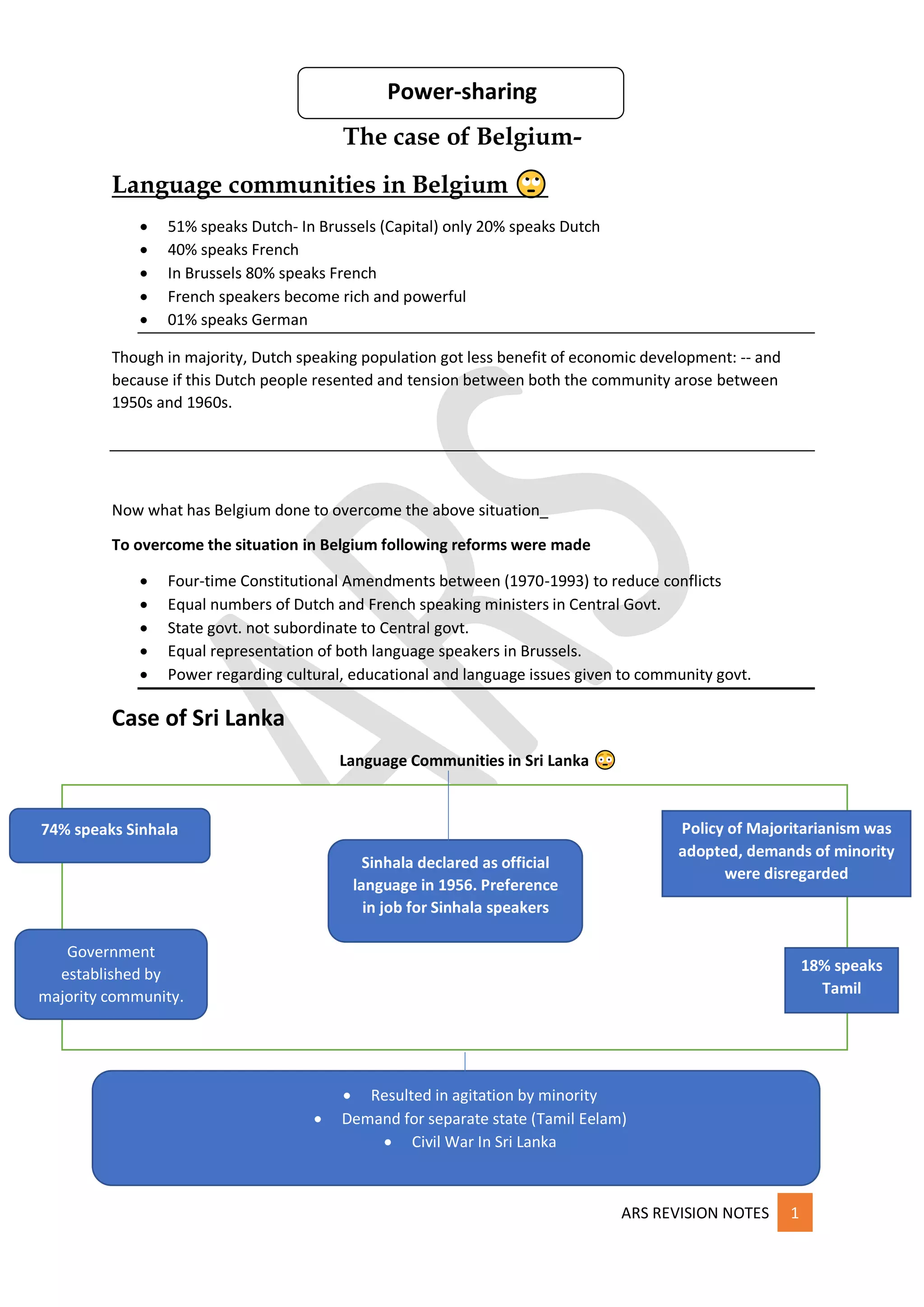
Horizontal division of
Power
•Power sharaed among
different organs of the
govt.
•the different organs of
the govt. are Legislature
Executive,Judiciary
•When power is shared
among differend organs
of govt is called
Horixontal distribution
of power
•This arrangement is
called a system of checks
and balances. e.g- the
judges are appointes by
execitive, but they can
check the functioning of
Executive or Laws made
by the Legialature.
Vertical Distribution of
Power
•When power is shared
among different levels of
govt.
•for example- power is
shared among central
govt, state govt and
local/ regional govt.
•This type of power
sharing is also called as
Federal Division of
Power
Among different social
groups
•such as the religios and
linguistic groups.
•this type of arrangement
is meant to give space in
the government and
administration to diverse
social groups who
otherwise would feel
alienated.
Among political parties,
pressure groups and
movements
•when power is shared
among different political
parties to give
competition so that
power does not remain
in one hand.
•Coalision govt is when
two or more political
partiesmake alliance to
form govt. that type of
govt is called coalition
govt.
•In democracy we alos
find interests groups
such as those of
buusinessman, traders,
farmers.
What is power-sharing?
- When the power does not vest only in one organ but shared among others organs or level
of govt. it is known as power-sharing.
- Why it desirable?
- It is desirable because of two broad reason
a) Prudential- It stresses that power sharing will bring out better outcomes. Reduces
conflict between social groups, ensure political stability and order. Tyranny of the
majority is not only oppressive for the minority community, sometimes it brings ruin
to the majority class itself.
b) Moral Reason- It emphasis that the very act of power-sharing is valuable. It believes
power sharing is very spirit of democracy. It strengthens democracy by allowing
people to participate in governance.
Forms of power -sharing
Important Keywords:
Civil War- A violent conflict b/w opposing groups within a country that becomes so intense
that it appears like a war.
Prudential- Based on prudence, or on careful calculation of gains and losses. Prudential
decisions are usually contrasted with decisions based purely on moral considerations.
Tyranny- Arbitrary or unrestrained exercise of power; despotic abuse of authority.
Checks and balance- a system in which each organ of the govt. checks the others. It results
in a balance of power among various institutions and ensures that none of the organs can
exercise unlimited power.
ARS REVISION NOTES 3
Majoritarianism- It is a concept which signifies a belief that the majority community should
be able to rule a country in whichever way it wants, by disregarding the wishes and needs of
the minority.
Or Majoritarianism is an idea that the numerical majority of the population should have the
final say in determining the outcome of a decision.
Legislature- It is a law-making organ of the government.
Ravi Raj Kamal
Master of Arts in Political Science
Follow at. twitter.com/raviraj_like

Power Sharing

  • 1.
    ARS REVISION NOTES1 Power-sharing The case of Belgium- Language communities in Belgium • 51% speaks Dutch- In Brussels (Capital) only 20% speaks Dutch • 40% speaks French • In Brussels 80% speaks French • French speakers become rich and powerful • 01% speaks German Though in majority, Dutch speaking population got less benefit of economic development: -- and because if this Dutch people resented and tension between both the community arose between 1950s and 1960s. Now what has Belgium done to overcome the above situation_ To overcome the situation in Belgium following reforms were made • Four-time Constitutional Amendments between (1970-1993) to reduce conflicts • Equal numbers of Dutch and French speaking ministers in Central Govt. • State govt. not subordinate to Central govt. • Equal representation of both language speakers in Brussels. • Power regarding cultural, educational and language issues given to community govt. Case of Sri Lanka Language Communities in Sri Lanka 74% speaks Sinhala • Resulted in agitation by minority • Demand for separate state (Tamil Eelam) • Civil War In Sri Lanka 74% speaks Sinhala Sinhala declared as official language in 1956. Preference in job for Sinhala speakers Policy of Majoritarianism was adopted, demands of minority were disregarded Government established by majority community. 18% speaks Tamil
  • 2.
    ARS REVISION NOTES2 Horizontal division of Power •Power sharaed among different organs of the govt. •the different organs of the govt. are Legislature Executive,Judiciary •When power is shared among differend organs of govt is called Horixontal distribution of power •This arrangement is called a system of checks and balances. e.g- the judges are appointes by execitive, but they can check the functioning of Executive or Laws made by the Legialature. Vertical Distribution of Power •When power is shared among different levels of govt. •for example- power is shared among central govt, state govt and local/ regional govt. •This type of power sharing is also called as Federal Division of Power Among different social groups •such as the religios and linguistic groups. •this type of arrangement is meant to give space in the government and administration to diverse social groups who otherwise would feel alienated. Among political parties, pressure groups and movements •when power is shared among different political parties to give competition so that power does not remain in one hand. •Coalision govt is when two or more political partiesmake alliance to form govt. that type of govt is called coalition govt. •In democracy we alos find interests groups such as those of buusinessman, traders, farmers. What is power-sharing? - When the power does not vest only in one organ but shared among others organs or level of govt. it is known as power-sharing. - Why it desirable? - It is desirable because of two broad reason a) Prudential- It stresses that power sharing will bring out better outcomes. Reduces conflict between social groups, ensure political stability and order. Tyranny of the majority is not only oppressive for the minority community, sometimes it brings ruin to the majority class itself. b) Moral Reason- It emphasis that the very act of power-sharing is valuable. It believes power sharing is very spirit of democracy. It strengthens democracy by allowing people to participate in governance. Forms of power -sharing Important Keywords: Civil War- A violent conflict b/w opposing groups within a country that becomes so intense that it appears like a war. Prudential- Based on prudence, or on careful calculation of gains and losses. Prudential decisions are usually contrasted with decisions based purely on moral considerations. Tyranny- Arbitrary or unrestrained exercise of power; despotic abuse of authority. Checks and balance- a system in which each organ of the govt. checks the others. It results in a balance of power among various institutions and ensures that none of the organs can exercise unlimited power.
  • 3.
    ARS REVISION NOTES3 Majoritarianism- It is a concept which signifies a belief that the majority community should be able to rule a country in whichever way it wants, by disregarding the wishes and needs of the minority. Or Majoritarianism is an idea that the numerical majority of the population should have the final say in determining the outcome of a decision. Legislature- It is a law-making organ of the government. Ravi Raj Kamal Master of Arts in Political Science Follow at. twitter.com/raviraj_like