Power Sharing In India
By
Anshul Vats
4
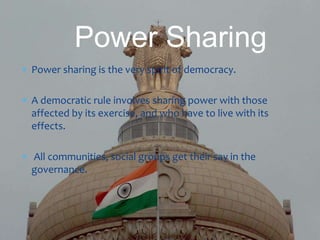
 Power sharing is the very spirit of democracy.
 A democratic rule involves sharing power with those
affected by its exercise, and who have to live with its
effects.
 All communities, social groups get their say in the
governance.
Power Sharing
 People of India elect their representative through direct
franchise.
 After that, people’s representatives elect the
government to make or amend rules & regulations and
to carry out day to day functioning of governance.
Power Sharing in India
 In a democracy, through institutions of self-governance,
people rule themselves.
 In a good democratic government, everyone has a voice in the
shaping of public policies.
 In a democracy, political power should be distributed among
as many citizens as possible.

Power Sharing in India
 Power sharing helps in reducing the conflict between
various social groups. Hence, power sharing is necessary
for maintaining social harmony and peace.
 Power sharing helps in avoiding the tyranny of majority.
The tyranny of majority not only destroys the minority
social groups but also the majority social group.
Need Of Power Sharing
 People’s voice forms the basis of a democratic
government. Hence, power sharing is essential to
respect the spirit of democracy.
 Avoiding conflict in society and preventing majority
tyranny are considered as prudential reasons for power
sharing. Maintaining the spirit of democracy is
considered as the moral reason for power sharing.
Need Of Power Sharing
1. Horizontal distribution of power
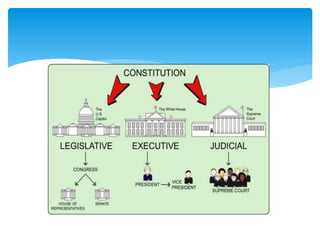
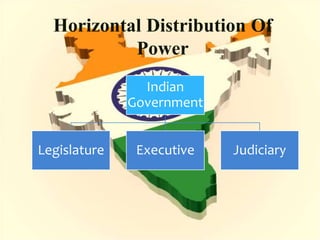
 Power is shared among different organs of government,
such as the legislature, executive and judiciary. This is
called horizontal distribution of power.
 It allows different organs of government placed at the
same level to exercise different powers.
Forms Of Power Sharing In
India
 This ensures that no organ exercises unlimited powers.
 Each organ is checked by the other, which results in a
balance of power among various institutions. This
arrangement is also called a system of checks and
balances.
Horizontal distribution of power
 The executive enjoys official power but is answerable to
the legislature.
 The legislature has the right to make or amend laws but
it is answerable to the people.
 The judiciary is independent and ensures that the law of
the land is obeyed by legislature and executive.
Horizontal distribution of power
Indian
Government
Legislature Executive Judiciary
Horizontal Distribution Of
Power
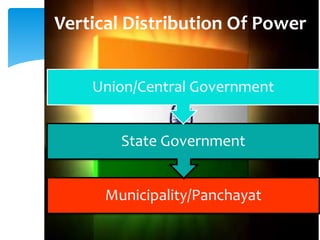
 Power can be shared among governments at different
levels. This is called Vertical Distribution of Power.
 A general government like this is usually called federal
government. In India, it is referred to as the Central or
Union Government.
2. Federal Government
 In India the governments at the provincial or regional
level are called State Government.
 The same principle can be extended to levels of
government lower than the State government, such at
the Municipality and Panchayat.
Federal Government
Municipality/Panchayat
State Government
Union/Central Government
Vertical Distribution Of Power
 Different social groups, such as the religious and
linguistic groups may also share power.
 In a diverse country; like India; there are various social,
linguistic and caste groups and power is shared among
each group.
3. Community Government
 This type of arrangement is meant to give space in the
government and administration to diverse social
groups who otherwise would feel alienated from the
government.
 For example: People from the minority communities,
OBCs, and SC & ST are given reservation so that there
could be adequate representation for them in the
government machinery.
Community Government
 Power sharing among various political parties is more
apparent for most of the people. Usually the largest
political party or the largest political coalition becomes
the ruling party. The other parties form the opposition.
 While opposition is not in power, it is responsible for
seeing to it that the ruling party functions as per the
wishes of the people.
4. Coalition Government
 Pressure groups also get their share in power. For
example; the trade unions, ASSOCHAM, students’ union,
etc. get some power by certain mechanisms.
 Representatives of these associations become part of
many decision making bodies and thus enjoy their share
of power.
Coalition Government
Thank You


Power sharing in india

  • 1.
    Power Sharing InIndia By Anshul Vats 4
  • 2.
     Power sharingis the very spirit of democracy.  A democratic rule involves sharing power with those affected by its exercise, and who have to live with its effects.  All communities, social groups get their say in the governance. Power Sharing
  • 3.
     People ofIndia elect their representative through direct franchise.  After that, people’s representatives elect the government to make or amend rules & regulations and to carry out day to day functioning of governance. Power Sharing in India
  • 4.
     In ademocracy, through institutions of self-governance, people rule themselves.  In a good democratic government, everyone has a voice in the shaping of public policies.  In a democracy, political power should be distributed among as many citizens as possible. Power Sharing in India
  • 5.
     Power sharinghelps in reducing the conflict between various social groups. Hence, power sharing is necessary for maintaining social harmony and peace.  Power sharing helps in avoiding the tyranny of majority. The tyranny of majority not only destroys the minority social groups but also the majority social group. Need Of Power Sharing
  • 6.
     People’s voiceforms the basis of a democratic government. Hence, power sharing is essential to respect the spirit of democracy.  Avoiding conflict in society and preventing majority tyranny are considered as prudential reasons for power sharing. Maintaining the spirit of democracy is considered as the moral reason for power sharing. Need Of Power Sharing
  • 7.
    1. Horizontal distributionof power  Power is shared among different organs of government, such as the legislature, executive and judiciary. This is called horizontal distribution of power.  It allows different organs of government placed at the same level to exercise different powers. Forms Of Power Sharing In India
  • 8.
     This ensuresthat no organ exercises unlimited powers.  Each organ is checked by the other, which results in a balance of power among various institutions. This arrangement is also called a system of checks and balances. Horizontal distribution of power
  • 9.
     The executiveenjoys official power but is answerable to the legislature.  The legislature has the right to make or amend laws but it is answerable to the people.  The judiciary is independent and ensures that the law of the land is obeyed by legislature and executive. Horizontal distribution of power
  • 11.
  • 12.
     Power canbe shared among governments at different levels. This is called Vertical Distribution of Power.  A general government like this is usually called federal government. In India, it is referred to as the Central or Union Government. 2. Federal Government
  • 13.
     In Indiathe governments at the provincial or regional level are called State Government.  The same principle can be extended to levels of government lower than the State government, such at the Municipality and Panchayat. Federal Government
  • 14.
  • 15.
     Different socialgroups, such as the religious and linguistic groups may also share power.  In a diverse country; like India; there are various social, linguistic and caste groups and power is shared among each group. 3. Community Government
  • 16.
     This typeof arrangement is meant to give space in the government and administration to diverse social groups who otherwise would feel alienated from the government.  For example: People from the minority communities, OBCs, and SC & ST are given reservation so that there could be adequate representation for them in the government machinery. Community Government
  • 17.
     Power sharingamong various political parties is more apparent for most of the people. Usually the largest political party or the largest political coalition becomes the ruling party. The other parties form the opposition.  While opposition is not in power, it is responsible for seeing to it that the ruling party functions as per the wishes of the people. 4. Coalition Government
  • 18.
     Pressure groupsalso get their share in power. For example; the trade unions, ASSOCHAM, students’ union, etc. get some power by certain mechanisms.  Representatives of these associations become part of many decision making bodies and thus enjoy their share of power. Coalition Government
  • 19.