DWIVEDI’S PRODUCTION
Democracy in Athens
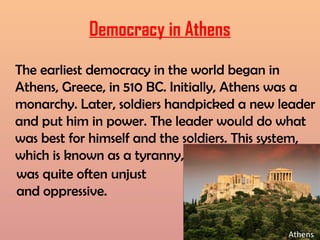
The earliest democracy in the world began in
Athens, Greece, in 510 BC. Initially, Athens was a
monarchy. Later, soldiers handpicked a new leader
and put him in power. The leader would do what
was best for himself and the soldiers. This system,
which is known as a tyranny,
was quite often unjust
and oppressive.
Athens
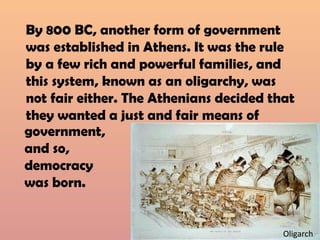
By 800 BC, another form of government
was established in Athens. It was the rule
by a few rich and powerful families, and
this system, known as an oligarchy, was
not fair either. The Athenians decided that
they wanted a just and fair means of
Oligarch
government,
and so,
democracy
was born.
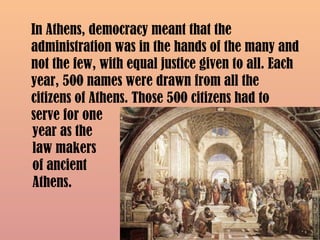
In Athens, democracy meant that the
administration was in the hands of the many and
not the few, with equal justice given to all. Each
year, 500 names were drawn from all the
citizens of Athens. Those 500 citizens had to
serve for one
year as the
law makers
of ancient
Athens.
Direct Democracy
Direct democracy is a form of government
in which the citizens make policies and
laws themselves. All citizens are required
to vote on any new law. This was the
system followed in ancient Athens.
Need for the Transition from Direct
Democracy to Indirect Democracy
In a state, especially one having high
population, it is not possible for each and
every citizen to get involved in this law
making process each time. The process
would become very time consuming and
hence governance will become inefficient.
So it became necessary to elect some
representatives which can take care of the
issues citizens.
Indirect Democracy
Indirect democracy is a form of
government in which the citizens elect
representatives to make laws and
policies on their behalf, but the
ultimate power lies with the citizens.
Elections are held after a fixed number
of years to elect the representatives.
Most of the democracies in the world
today follow indirect democracy.
However, when the opinion of all the
citizens is required for some key issue,
a referendum is held.
Referendum
A direct vote in which an entire electorate
is asked to either accept or reject a
particular proposal is known as a
referendum. This may be the adoption of a
new constitution, a law or a specific
governmental policy.
For example, in 1975, a referendum, the
first of its kind, was held asking the
electorate whether Britain should be part
of the Common Market.
In other words, though democratic nations
are now adopting indirect democracy to
be more efficient in providing effective
governance, direct democracy in form of
referendum is used to get the opinion of
all citizens as and when required.
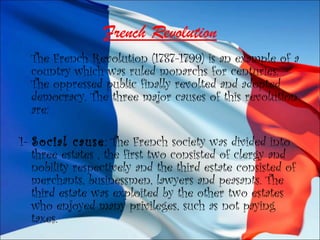
French Revolution
The French Revolution (1787-1799) is an example of a
country which was ruled monarchs for centuries.
The oppressed public finally revolted and adopted
democracy. The three major causes of this revolution
are:
1- Social cause: The French society was divided into
three estates , the first two consisted of clergy and
nobility respectively and the third estate consisted of
merchants, businessmen, lawyers and peasants. The
third estate was exploited by the other two estates
who enjoyed many privileges, such as not paying
taxes.
2- Economic cause: The third estate had to pay
all the taxes imposed by the king as the other
estates were exempted from it. The prices of
bread rose which was the main staple diet of the
people and there was subsistence crisis.
3- Immediate cause: Rumors spread that the king
will order his troops to attack Paris (as the people
were revolting), therefore, 4000 - 5000 people
gathered and formed people's militia.
The French Revolution led to the end of
monarchy in France. The society was no longer
based on privileges. The declaration of the Rights
of Man brought about the idea of equality and
freedom to France and a democratic form of
government inspired by the American Revolution
was established.
Democracy: Most Desirable
Form of Government
There are many factors why more and more nations
are now preferring democractic form of government.
The factors which contribute in making democracy
the most favourable form of government are:
• Democracy is a more accountable form of
government
• The government works for the welfare of the
majority
• Fundamental rights are guaranteed to each and
every citizen
• Government is responsible to the people
• Government is elected by the people
• Democracy ensures liberty and equality
• Government is usually stable
• Democracy improves the quality of decision making
• Democracy provides a method to deal with
differences and conflicts
• Democracy guarantees freedom to all citizens
Democracy: Political, Social and
Economic Dimensions
In order to be a democracy, a
State must ensure political,
social and economic equality.
Political Equality
Political equality refers to granting equal
citizenship to all members of the state. Equal
citizenship brings with it certain basic rights
such as the right to vote, freedom of expression,
movement and association and freedom of belief.
These rights are necessary to enable citizens to
develop themselves and participate in the affairs
of the state.
Social Equality
Social equality ensures that each citizen gets
equal opportunities, irrespective of caste, gender,
religion etc. For this, it is necessary to minimize
the effects of social and economic inequalities
and guarantee certain minimum conditions of
life to all the citizens, such as adequate health
care, opportunity for proper education, adequate
nourishment and a minimum wage.
Economic Equality
Economic inequality exists in a society if there are
significant differences in wealth, property or
income between individuals or classes. Most
democracies try to make equal opportunities
available to people with the belief that this would
give those who have talent and determination the
chance to improve their condition. This would
reduce the gap between the rich and the poor.
Case study: IndIa
Why did India Choose to be a
Democracy?
The long experience of authoritarian rule
under the colonial state convinced Indians
that free India should be a democracy in
which everyone should be treated equally
and be allowed to participate in
government. They should not be forced to
obey rules/laws that they have very little
role in making.
Key Concerns while Adopting a
Democratic form of Government
India is a nation where people from various
cultures and religions reside. They have
different lifestyles and speak different
languages. Thus the constitution had to be
formed in such a way that there is unity
among all citizens, and each citizen is
represented, with no discrimination
whatsoever.
Key Features of the Indian
Democracy
1- Federalism – This refers to the existence
of more than one level of government in the
country. In India, we have governments at
the local level, state level and at the centre.
This is done so that issues of local, state
and national level can be countered and the
needs of the people of various regions are
looked after.
2- Parliamentary Form of Government –
People in India have a direct role in
electing representatives. Elections are based
on Universal Adult Franchise, i.e. every
citizen of India above the age of 18 has the
right to vote, irrespective of caste, gender,
religion etc.
3- Separation of Powers – According to the
Constitution, there are three levels of state.
These are the legislature (law makers), the
executive (those who implement the laws) and
the judiciary (system of courts). In order to
prevent the misuse of power by one branch of
the State, each organ exercises different
powers. Thus each organ acts as a check on
the other organs of the State, ensuring the
balance of power between all three.
4- Fundamental Rights – They are the
rights given to each and every citizen of
India which help to protect citizens from
the arbitrary and absolute exercise of power
by the State or other citizens.
5- Secularism – This ensures that India
does not officially promote any one religion
as the State religion. This helps in
avoiding discrimination on the basis of
religion. However, India intervenes in
religious matters in order to end a social
practice that violates the fundamental rights
of citizens such as untouchability, unequal
distribution of inherited property between
sons and daughters, child marriage etc.
Thank You
DWIVEDI’S PRODUCTION

Phasesofdemocracy

  • 1.
  • 2.
    Democracy in Athens Theearliest democracy in the world began in Athens, Greece, in 510 BC. Initially, Athens was a monarchy. Later, soldiers handpicked a new leader and put him in power. The leader would do what was best for himself and the soldiers. This system, which is known as a tyranny, was quite often unjust and oppressive. Athens
  • 3.
    By 800 BC,another form of government was established in Athens. It was the rule by a few rich and powerful families, and this system, known as an oligarchy, was not fair either. The Athenians decided that they wanted a just and fair means of Oligarch government, and so, democracy was born.
  • 4.
    In Athens, democracymeant that the administration was in the hands of the many and not the few, with equal justice given to all. Each year, 500 names were drawn from all the citizens of Athens. Those 500 citizens had to serve for one year as the law makers of ancient Athens.
  • 5.
    Direct Democracy Direct democracyis a form of government in which the citizens make policies and laws themselves. All citizens are required to vote on any new law. This was the system followed in ancient Athens.
  • 6.
    Need for theTransition from Direct Democracy to Indirect Democracy In a state, especially one having high population, it is not possible for each and every citizen to get involved in this law making process each time. The process would become very time consuming and hence governance will become inefficient. So it became necessary to elect some representatives which can take care of the issues citizens.
  • 7.
    Indirect Democracy Indirect democracyis a form of government in which the citizens elect representatives to make laws and policies on their behalf, but the ultimate power lies with the citizens. Elections are held after a fixed number of years to elect the representatives. Most of the democracies in the world today follow indirect democracy. However, when the opinion of all the citizens is required for some key issue, a referendum is held.
  • 8.
    Referendum A direct votein which an entire electorate is asked to either accept or reject a particular proposal is known as a referendum. This may be the adoption of a new constitution, a law or a specific governmental policy. For example, in 1975, a referendum, the first of its kind, was held asking the electorate whether Britain should be part of the Common Market.
  • 9.
    In other words,though democratic nations are now adopting indirect democracy to be more efficient in providing effective governance, direct democracy in form of referendum is used to get the opinion of all citizens as and when required.
  • 10.
    French Revolution The FrenchRevolution (1787-1799) is an example of a country which was ruled monarchs for centuries. The oppressed public finally revolted and adopted democracy. The three major causes of this revolution are: 1- Social cause: The French society was divided into three estates , the first two consisted of clergy and nobility respectively and the third estate consisted of merchants, businessmen, lawyers and peasants. The third estate was exploited by the other two estates who enjoyed many privileges, such as not paying taxes.
  • 11.
    2- Economic cause:The third estate had to pay all the taxes imposed by the king as the other estates were exempted from it. The prices of bread rose which was the main staple diet of the people and there was subsistence crisis. 3- Immediate cause: Rumors spread that the king will order his troops to attack Paris (as the people were revolting), therefore, 4000 - 5000 people gathered and formed people's militia.
  • 12.
    The French Revolutionled to the end of monarchy in France. The society was no longer based on privileges. The declaration of the Rights of Man brought about the idea of equality and freedom to France and a democratic form of government inspired by the American Revolution was established.
  • 13.
    Democracy: Most Desirable Formof Government There are many factors why more and more nations are now preferring democractic form of government. The factors which contribute in making democracy the most favourable form of government are: • Democracy is a more accountable form of government • The government works for the welfare of the majority • Fundamental rights are guaranteed to each and every citizen
  • 14.
    • Government isresponsible to the people • Government is elected by the people • Democracy ensures liberty and equality • Government is usually stable • Democracy improves the quality of decision making • Democracy provides a method to deal with differences and conflicts • Democracy guarantees freedom to all citizens
  • 15.
    Democracy: Political, Socialand Economic Dimensions In order to be a democracy, a State must ensure political, social and economic equality.
  • 16.
    Political Equality Political equalityrefers to granting equal citizenship to all members of the state. Equal citizenship brings with it certain basic rights such as the right to vote, freedom of expression, movement and association and freedom of belief. These rights are necessary to enable citizens to develop themselves and participate in the affairs of the state.
  • 17.
    Social Equality Social equalityensures that each citizen gets equal opportunities, irrespective of caste, gender, religion etc. For this, it is necessary to minimize the effects of social and economic inequalities and guarantee certain minimum conditions of life to all the citizens, such as adequate health care, opportunity for proper education, adequate nourishment and a minimum wage.
  • 18.
    Economic Equality Economic inequalityexists in a society if there are significant differences in wealth, property or income between individuals or classes. Most democracies try to make equal opportunities available to people with the belief that this would give those who have talent and determination the chance to improve their condition. This would reduce the gap between the rich and the poor.
  • 19.
  • 20.
    Why did IndiaChoose to be a Democracy? The long experience of authoritarian rule under the colonial state convinced Indians that free India should be a democracy in which everyone should be treated equally and be allowed to participate in government. They should not be forced to obey rules/laws that they have very little role in making.
  • 21.
    Key Concerns whileAdopting a Democratic form of Government India is a nation where people from various cultures and religions reside. They have different lifestyles and speak different languages. Thus the constitution had to be formed in such a way that there is unity among all citizens, and each citizen is represented, with no discrimination whatsoever.
  • 22.
    Key Features ofthe Indian Democracy 1- Federalism – This refers to the existence of more than one level of government in the country. In India, we have governments at the local level, state level and at the centre. This is done so that issues of local, state and national level can be countered and the needs of the people of various regions are looked after.
  • 23.
    2- Parliamentary Formof Government – People in India have a direct role in electing representatives. Elections are based on Universal Adult Franchise, i.e. every citizen of India above the age of 18 has the right to vote, irrespective of caste, gender, religion etc.
  • 24.
    3- Separation ofPowers – According to the Constitution, there are three levels of state. These are the legislature (law makers), the executive (those who implement the laws) and the judiciary (system of courts). In order to prevent the misuse of power by one branch of the State, each organ exercises different powers. Thus each organ acts as a check on the other organs of the State, ensuring the balance of power between all three.
  • 25.
    4- Fundamental Rights– They are the rights given to each and every citizen of India which help to protect citizens from the arbitrary and absolute exercise of power by the State or other citizens.
  • 26.
    5- Secularism –This ensures that India does not officially promote any one religion as the State religion. This helps in avoiding discrimination on the basis of religion. However, India intervenes in religious matters in order to end a social practice that violates the fundamental rights of citizens such as untouchability, unequal distribution of inherited property between sons and daughters, child marriage etc.
  • 27.