International Journal of Power Electronics and Drive System (IJPEDS)
Vol. 6, No. 3, September 2015, pp. 415~422
ISSN: 2088-8694  415
Journal homepage: http://iaesjournal.com/online/index.php/IJPEDS
Power Quality Enhancement Using the Interline Power Flow
Controller
Abdelkader Benslimane, Chelleli Benachiba
Department of Electrical Engineering, Univercity of Bechar, Algeria
Article Info ABSTRACT
Article history:
Received Nov 24, 2014
Revised Jun 21, 2015
Accepted Jul 19, 2015
Interline power flow controller (IPFC) is one of the latest generation Flexible
AC Transmission system (FACTS). It is able to control simultaneously the
power flow of multiple transmission lines. This paper presents a study of the
impact the IPFC on profile of voltage, real and reactive power flow in
transmission line in power system. The results without and with IPFC are
compared in terms of voltage and active power flows to demonstrate the
performance of the IPFC model.
Keyword:
FACTS
Interline power flow controller
IPFC
Multiple transmission lines
Power quality
Transmission system
Copyright © 2015 Institute of Advanced Engineering and Science.
All rights reserved.
Corresponding Author:
Abdelkader Benslimane
Power quality
Interline Power Flow Controller (IPFC)
Distribution system, FACTs
Email: Kadaslima@yahoo.fr
1. INTRODUCTION
The most powerful and versatile FACTS devices is Interline Power Flow Controller (IPFC). It is
capable to control at the same time the active and reactive power flow in the transmission line. It is a new
member of FACTS controller which is conceived for the compensation and power flow management of
multi-line transmission system [1-4].
Interline Power Flow Controller is one of the latest FACTS controller used to control power flow of
multiple transmission line [5]. The simplest IPFC consists of two back-to-back, dc-to-ac converters namely
Static Synchronous Series Compensators (SSSC), which are connected in series with two transmission lines
through series coupling transformers, and the dc terminals of the converters are connected together via a
common dc link as shown in Figure 1. This paper investigates the performance of IPFC in a power system
network with a detailed mathematical model of IPFC which will be referred as IPFC power injection model
as already presented. This model is helpful in understanding the impact of the IPFC on the power system in
the steady state. Further, the IPFC injection model can easily be incorporated in the steady state power flow
model and the proposed model is used to demonstrate the capabilities of IPFC. This paper shows also that the
IPFC has the possibility of regulating voltage bus, active and reactive power flow, and minimizing the power
losses simultaneously.
2. EQUIVALENT CIRCUIT OF IPFC
In its general form the IPFC employs a number of dc to ac each providing series compensation for a
different line. In other words, the IPFC comprises a number of Static Synchronous Series Compensators
 ISSN: 2088-8694
IJPEDS Vol. 6, No. 3, September 2015 : 415 – 422
416
(SSSC) [4]. The IPFC obtained by combing two or more series-connected converters working together
extends the concept of power flow control beyond what is achievable with the known one converter series
FACTS devices –SSSC. A simplest IPFC, with three FACTS buses – i, j and k shown functionally in Figure
1, is used to illustrate the basic operation principle [6-7]. The IPFC consists of two converters being series-
connected with two transmission lines via transformers. It can control three power system quantities -
independent three power flows of the two lines. It can be seen that the sending-ends of the two transmission
lines are series connected with the FACTS buses j and k, respectively.
Figure 1. Equivalent circuit of two converters IPFC
Figure 2. Power injection model of two converters IPFC
An equivalent circuit of the IPFC with two controllable series injected voltage sources is shown in
Figure 2 [8-9]. The real power can be exchanged between or among the series converters via the common DC
link while the sum of the real power exchange should be zero. Suppose in Figure 2, the series transformer
impedance is , and the controllable injected voltage source is ∠ (n = j, k). Active and
reactive power flows of the FACTS branches leaving buses i, j, kare given by:
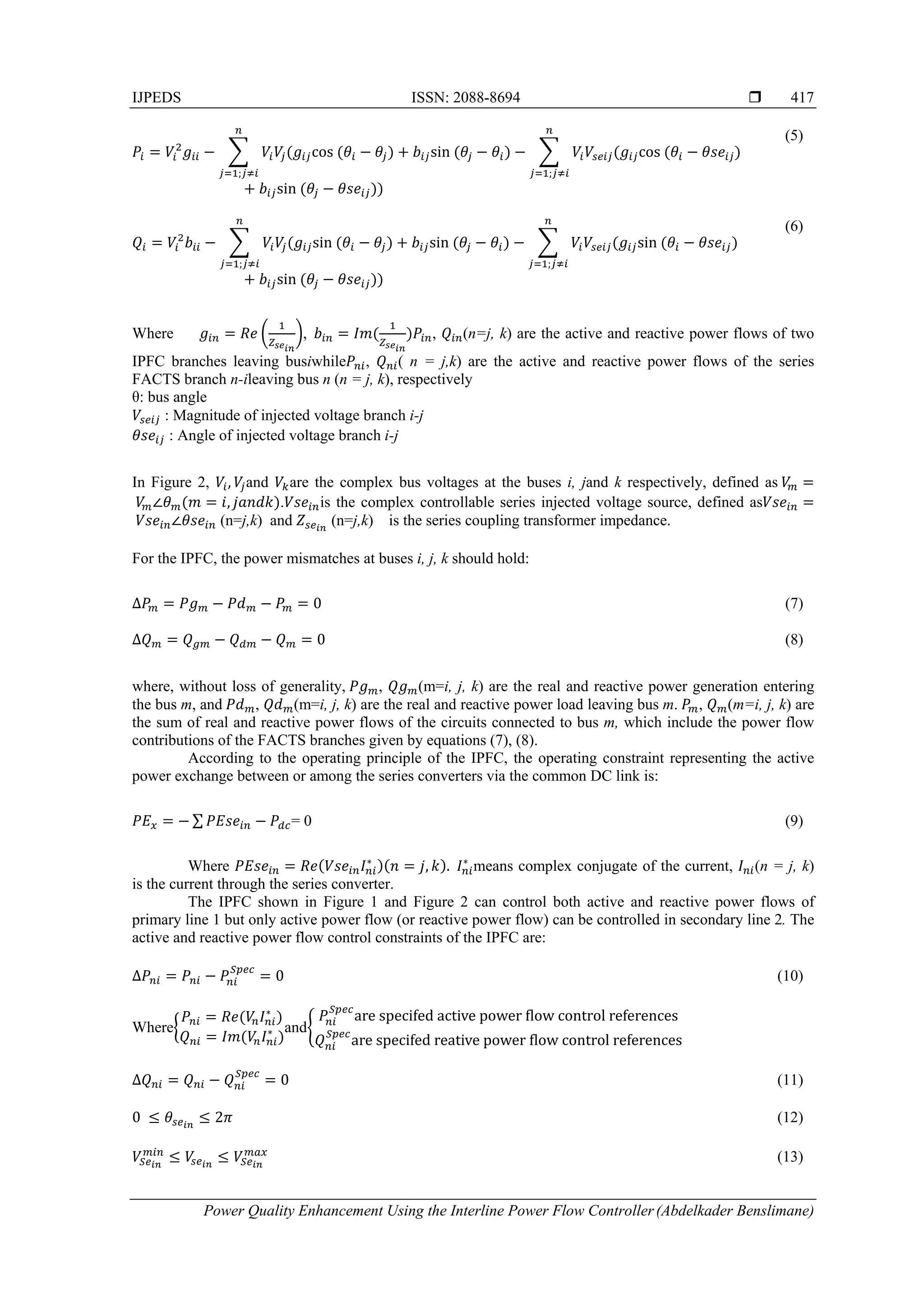
cos sin (1)
sin cos (2)
sin cos
sin	 )
(3)
sin
cos	
(4)
jQP ijij

jQP ikik

Zseij
Zseik
0ij
 dcsese PPEPE ik
Vseij
Vseik
jQP jiji

jQP kiki

Iji
Iki
Vj
Vk
Vi
IJPEDS ISSN: 2088-8694 
Power Quality Enhancement Using the Interline Power Flow Controller(Abdelkader Benslimane)
417
cos	
;
sin cos	
;
sin	
(5)
sin	
;
sin sin	
;
sin	
(6)
Where ,		 , (n=j, k) are the active and reactive power flows of two
IPFC branches leaving busiwhile , ( n = j,k) are the active and reactive power flows of the series
FACTS branch n-ileaving bus n (n = j, k), respectively
θ: bus angle
: Magnitude of injected voltage branch i-j
: Angle of injected voltage branch i-j
In Figure 2, , and are the complex bus voltages at the buses i, jand k respectively, defined as	
	 ∠ , . is the complex controllable series injected voltage source, defined as
	 ∠ (n=j,k) and (n=j,k) is the series coupling transformer impedance.
For the IPFC, the power mismatches at buses i, j, k should hold:
∆ 0 (7)
∆ 0 (8)
where, without loss of generality,	 , (m=i, j, k) are the real and reactive power generation entering
the bus m, and	 , (m=i, j, k) are the real and reactive power load leaving bus m.	 , (m=i, j, k) are
the sum of real and reactive power flows of the circuits connected to bus m, which include the power flow
contributions of the FACTS branches given by equations (7), (8).
According to the operating principle of the IPFC, the operating constraint representing the active
power exchange between or among the series converters via the common DC link is:
∑ = 0 (9)
Where ∗
, .		 ∗
means complex conjugate of the current, (n = j, k)
is the current through the series converter.
The IPFC shown in Figure 1 and Figure 2 can control both active and reactive power flows of
primary line 1 but only active power flow (or reactive power flow) can be controlled in secondary line 2. The
active and reactive power flow control constraints of the IPFC are:
∆ 0 (10)
Where
∗
∗ and
are	specifed	active	power	 low	control	references
are	specifed	reative	power	 low	control	references
∆ 0 (11)
0	 2 (12)
(13)
 ISSN: 2088-8694
IJPEDS Vol. 6, No. 3, September 2015 : 415 – 422
418
(14)
Where
	is	the	maximum	limit	of	the	power	exchange	of
series	converter	with	the	DC	link
∗ ∗
	is	the	current	rating	of	the	serie	converter
(n=j,k) (15)
3. MODELING OF IPFC IN NEWTON POWER FLOW
Suppose for the IPFC branches i-j, the active and reactive power flows and can be controlled
to power flow control references and by the series converter i-j while for the IPFC branches i-k
only on the active power flow and reactive power flow can be controlled by the series converter i-k, and in
the meantime the active power exchange between the two series converters should be balanced. In addition,
active and reactive power balance at buses i, j, k should also be maintained. Taking into account all these
power flow control constraints and bus power mismatch constraints, the compact form of Newton power flow
equation with incorporation of the IPFC may be written as:
0 0 0 0
0 0 0 0
0 0 0 0
0 0 0 0
0 0 0 0
0 0 0 0
0 0 0 0
∗
∆
∆
∆
∆
∆
∆
∆
∆
∆
∆
			 ∆
∆
∆
∆
∆
∆
(16)
Hence ∆ , ∆ ,∆ ,∆ ,∆ , ∆ are the active and reactive power mismatches at buses i, j, k respectively.
, , ,	 ,	 , are the sum of active and reactive power flows leaving the buses i, j, k respectively. In
this formulation, the terms of the first four rows of the system jacobian matrix correspond to the IPFC power
flow control and active power exchange balance constraints [10].
4. SIMULATION RESULTS
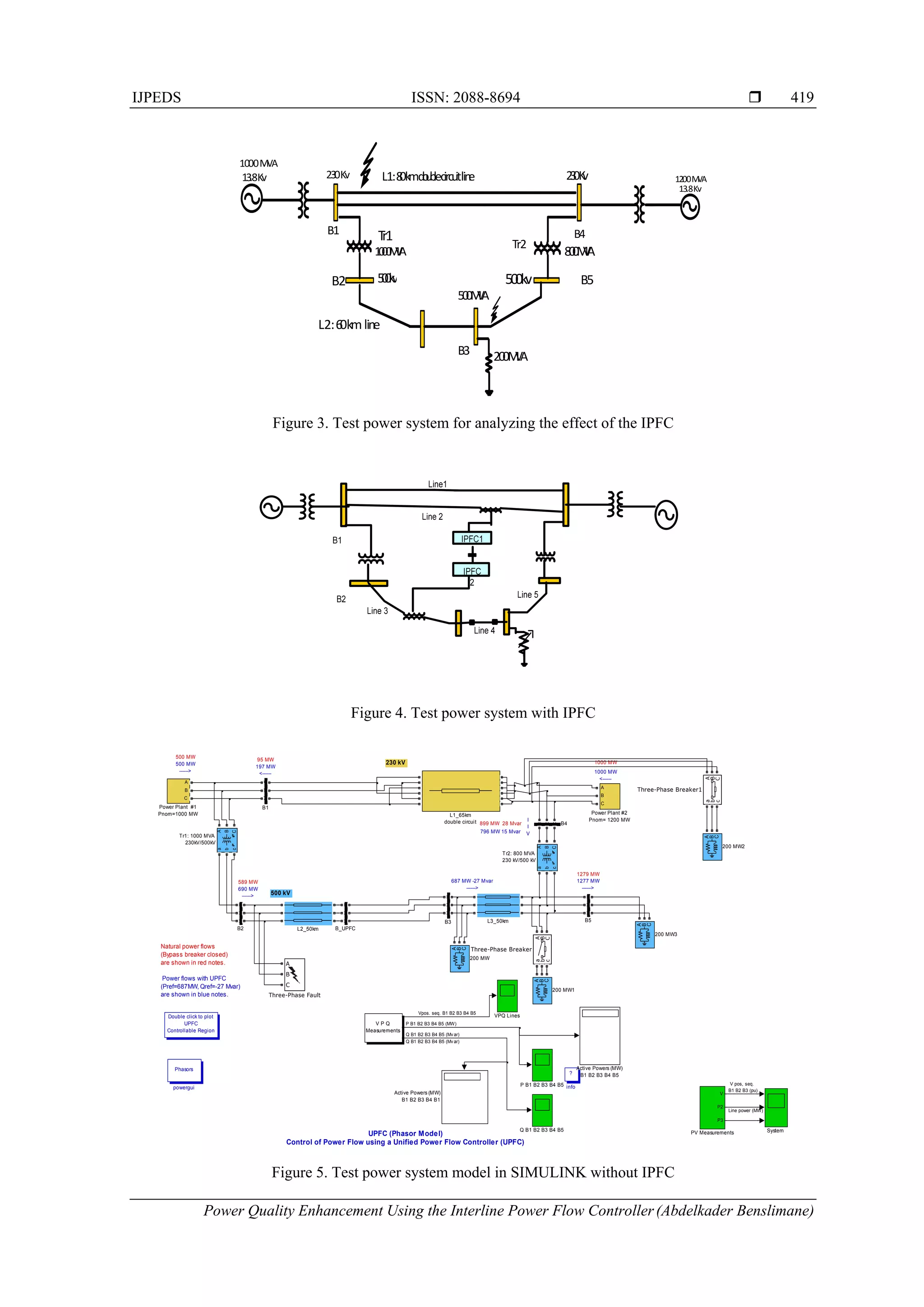
The simulation is done using matlab and the results are presented. Model of 06 nodes (02 nodes
generator) with IPFC is shown in Figure 3. The main objective of this contribution is to evaluate the impact
of the IPFC on the voltage level, and both active and reactive losses. The Figure 4 shows the location of the
IPFC in the network at the bus B4.
.
IJPEDS ISSN: 2088-8694 
Power Quality Enhancement Using the Interline Power Flow Controller(Abdelkader Benslimane)
419
Figure 3. Test power system for analyzing the effect of the IPFC
Figure 4. Test power system with IPFC
Figure 5. Test power system model in SIMULINK without IPFC
L 1:80 km  double circuit line
1000 MVA
230 Kv 
B1  B4Tr1
1000MVA
B2  500kv
500MVA
13.8 Kv 
L 2 : 60 km   line 
B3
Tr2
800MVA
500kv
230 Kv 1200 MVA 
B5
13.8 Kv 
200MVA
1000 MW
<------
I
I
V
197 MW
<------
1277 MW
------>
500 MW
------>
690 MW
------>
687 MW -27 Mvar
------>
230 kV
UPFC (Phasor Model)
Control of Power Flow using a Unified Power Flow Controller (UPFC)
796 MW 15 Mvar
95 MW
500 MW
1000 MW
589 MW
1279 MW
899 MW 28 Mvar
Natural power flows
(Bypass breaker closed)
are shown in red notes.
Power flows with UPFC
(Pref=687MW, Qref=-27 Mvar)
are shown in blue notes.
500 kV
Phasors
powergui
?
info
VPQ Lines
V P Q
Measurements
A
B
C
a
b
c
Tr2: 800 MVA
230 kV/500 kV
A
B
C
a
b
c
Tr1: 1000 MVA
230kV/500kV
A
B
C
A
B
C
Three-Phase Fault
A
B
C
a
b
c
Three-Phase Breaker1
A
B
C
a
b
c
Three-Phase Breaker
System
Double click to plot
UPFC
Controllable Region
Q B1 B2 B3 B4 B5
A
B
C
Power Plant #2
Pnom= 1200 MW
A
B
C
Power Plant #1
Pnom=1000 MW
V
P2
P3
PV Measurements
P B1 B2 B3 B4 B5
L3_50km
L2_50km
L1_65km
double circuit
A
B
C
a
b
c
B_UPFC
A
B
C
a
b
c
B5
A
B
C
a
b
c
B4
A
B
C
a
b
c
B3
A
B
C
a
b
c
B2
A
B
C
a
b
c
B1
Active Powers (MW)
B1 B2 B3 B4 B5
Active Powers (MW)
B1 B2 B3 B4 B1
A
B
C
200 MW3
A
B
C
200 MW2
A
B
C
200 MW1
A
B
C
200 MW
Q B1 B2 B3 B4 B5 (Mv ar)
P B1 B2 B3 B4 B5 (MW)
Vpos. seq. B1 B2 B3 B4 B5
V pos, seq.
B1 B2 B3 (pu)
Line power (MW)
 ISSN: 2088-8694
IJPEDS Vol. 6, No. 3, September 2015 : 415 – 422
420
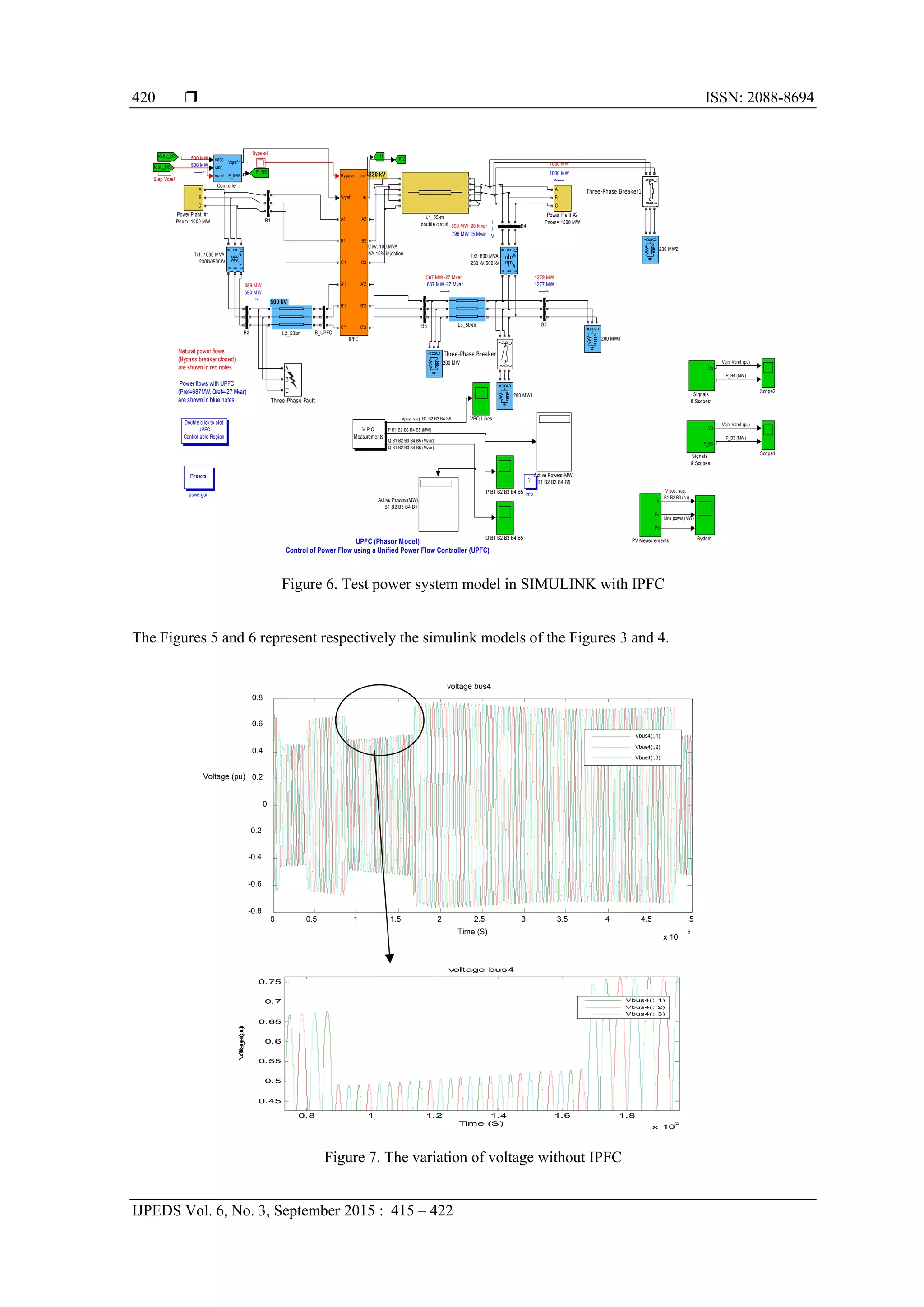
Figure 6. Test power system model in SIMULINK with IPFC
The Figures 5 and 6 represent respectively the simulink models of the Figures 3 and 4.
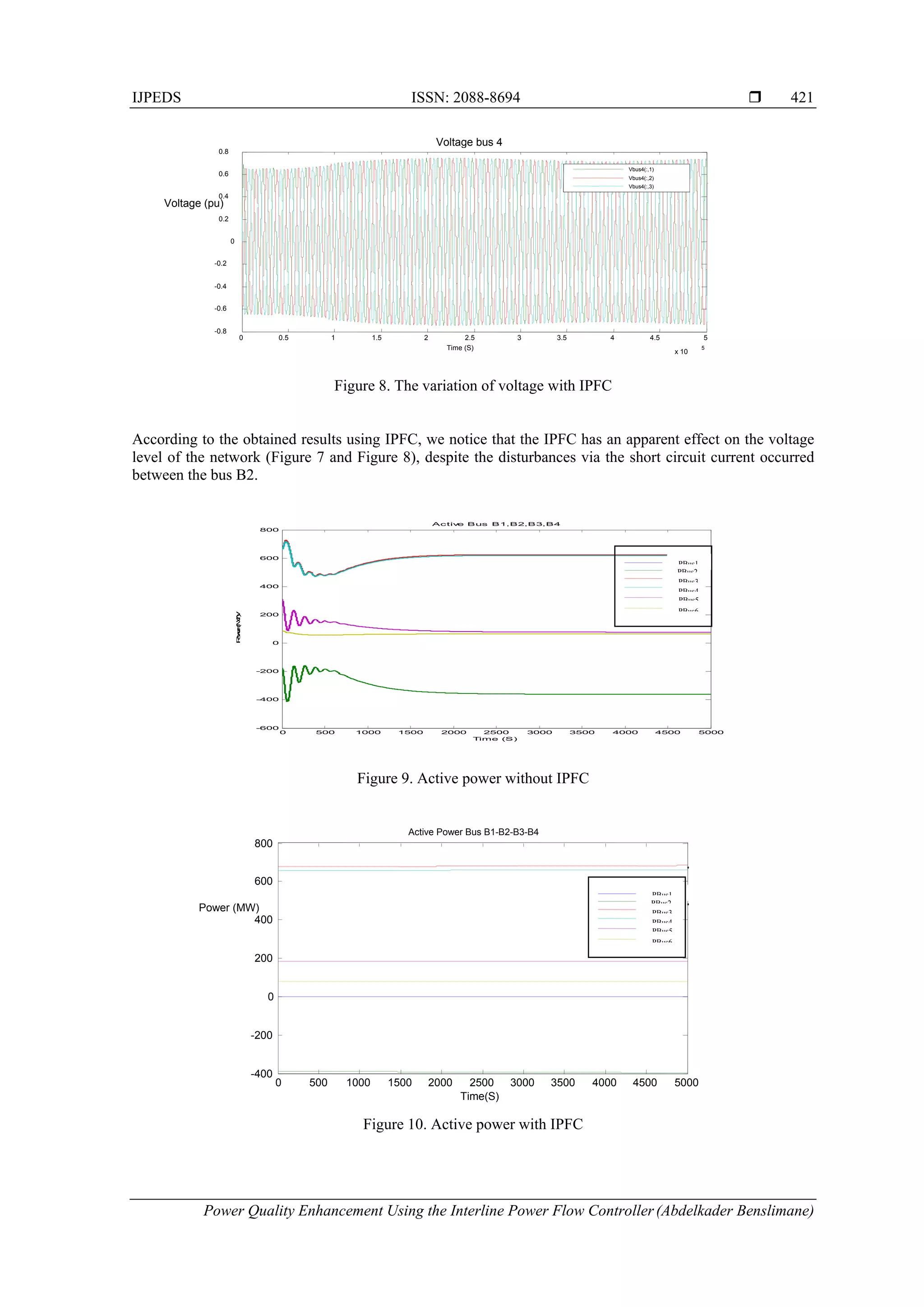
Figure 7. The variation of voltage without IPFC
Shunt 500 kV, 100 MVA
Series 100 MVA,10% injection
1000 MW
<------
I
I
V
1277 MW
------>
500 MW
------>
690 MW
------>
687 MW -27 Mvar
------>
230 kV
UPFC (Phasor Model)
Control of Power Flow using a Unified Power Flow Controller (UPFC)
796 MW 15 Mvar
500 MW
1000 MW
589 MW
587 MW -27 Mvar 1279 MW
899 MW 28 Mvar
Natural power flows
(Bypass breaker closed)
are shown in red notes.
Power flows with UPFC
(Pref=687MW, Qref=-27 Mvar)
are shown in blue notes.
500 kV
Phasors
powergui
?
info
VPQ Lines
V P Q
Measurements
A
B
C
a
b
c
Tr2: 800 MVA
230 kV/500 kV
A
B
C
a
b
c
Tr1: 1000 MVA
230kV/500kV
A
B
C
A
B
C
Three-Phase Fault
A
B
C
a
b
c
Three-Phase Breaker1
A
B
C
a
b
c
Three-Phase Breaker
System
Double click to plot
UPFC
Controllable Region
Step Vqref
Vq
Signals
& Scopes1
Vq
P_B3
Signals
& Scopes
Scope2
Scope1
Q B1 B2 B3 B4 B5
A
B
C
Power Plant #2
Pnom= 1200 MW
A
B
C
Power Plant #1
Pnom=1000 MW
V
P2
P3
PV Measurements
P B1 B2 B3 B4 B5
L3_50km
L2_50km
L1_65km
double circuit
Iabc_B3
Vabc_B3
Bypass
Vqref
m1
m
A1
B1
C1
A'1
B'1
C'1
A2
B2
C2
A'2
B'2
C'2
IPFC
P_B5
m1 m2Vabc
Iabc
Vqref
Vqref*
P_MW
Controller
Bypass1
A
B
C
a
b
c
B_UPFC
A
B
C
a
b
c
B5
A
B
C
a
b
c
B4
A
B
C
a
b
c
B3
A
B
C
a
b
c
B2
A
B
C
a
b
c
B1
Active Powers (MW)
B1 B2 B3 B4 B5
Active Powers (MW)
B1 B2 B3 B4 B1
A
B
C
200 MW3
A
B
C
200 MW2
A
B
C
200 MW1
A
B
C
200 MW
Q B1 B2 B3 B4 B5 (Mvar)
P B1 B2 B3 B4 B5 (MW)
Vpos. seq. B1 B2 B3 B4 B5
Vqinj Vqref (pu)
P_B3 (MW)
Vqinj Vqref (pu)
P_B4 (MW)
V pos, seq.
B1 B2 B3 (pu)
Line power (MW)
0.8 1 1.2 1.4 1.6 1.8
x 10
5
0.45
0.5
0.55
0.6
0.65
0.7
0.75
Time (S)
Voltage(pu)
voltage bus4
Vbus4(:,1)
Vbus4(:,2)
Vbus4(:,3)
0 0.5 1 1.5 2 2.5 3 3.5 4 4.5 5
x 10
5
-0.8
-0.6
-0.4
-0.2
0
0.2
0.4
0.6
0.8
Time (S)
Voltage (pu)
voltage bus4
Vbus4(:,1)
Vbus4(:,2)
Vbus4(:,3)
IJPEDS ISSN: 2088-8694 
Power Quality Enhancement Using the Interline Power Flow Controller(Abdelkader Benslimane)
421
Figure 8. The variation of voltage with IPFC
According to the obtained results using IPFC, we notice that the IPFC has an apparent effect on the voltage
level of the network (Figure 7 and Figure 8), despite the disturbances via the short circuit current occurred
between the bus B2.
Figure 9. Active power without IPFC
Figure 10. Active power with IPFC
0 500 1000 1500 2000 2500 3000 3500 4000 4500 5000
-400
-200
0
200
400
600
800
Time(S)
Power (MW)
Active Power Bus B1-B2-B3-B4


PBus1
PBus2
PBus3
PBus4
PBus5
PBus6
0 0.5 1 1.5 2 2.5 3 3.5 4 4.5 5
x 10
5
-0.8
-0.6
-0.4
-0.2
0
0.2
0.4
0.6
0.8
Time (S)
Voltage (pu)
Voltage bus 4
Vbus4(:,1)
Vbus4(:,2)
Vbus4(:,3)
0 500 1000 1500 2000 2500 3000 3500 4000 4500 5000
-600
-400
-200
0
200
400
600
800
Active Bus B1,B2,B3,B4
Time (S)
Power(MW)
PBus1
PBus2
PBus3
PBus4
PBus5
PBus6
 ISSN: 2088-8694
IJPEDS Vol. 6, No. 3, September 2015 : 415 – 422
422
The power flow is maintained constant due to the insertion of the IPFC as is shown respectively on Figure 9
and 10 despite the disturbance.
5. CONCLUSION
The IPFC throughout the obtained has showe that is capable to control the power flow in multiline
systems. It is used to improve the power quality by the imbalance which maintains the level voltage in the
normalized range its action has a positive impact on the both active and reactive losses.
REFERENCES
[1] Indra Prakash Mishra, Sanjiv Kumar, “Control of Active and Reactive Power Flow in Multiple Lines through
Interline Power Flow Controller (IPFC)”, International Journal of Emerging Technology and Advanced
Engineering, ISSN 2250-2459, Volume 2, Issue 11, November 2012 .
[2] A.V. NareshBabu, S. Sivanagaraju, Ch Padmanabharaju and T. Ramana “Multi-Line Power Flow Control using
Interline Power Flow Controller (IPFC) in Power Transmission Systems”, World Academy of Science, Engineering
and Technology, vol 39 2010.
[3] Charan Sekhar, and Ashwani Kumar, "Congestion Management in Hybrid Electricity Markets with FACTS
Devices with Loadability Limits", International Journal of Electrical and Computer Engineering (IJECE), Vol. 2,
No. 1, pp.75-89, 2012.
[4] Prakash Burade and Jagdish Helonde, “Optimal Location of FACTS Device on Enhancing System Security”, in
International Journal of Electrical and Computer Engineering (IJECE), Vol. 2, No. 3, June 2012, pp. 309-316.
[5] Rajshekarsinagham, K. Vijay Kumar, “Role of Inteline Power Flow Controller for Voltage Quality”, IJAEEE
(international journal of advances in electrical and electronic Engineering), Volume 1 Number 2.
[6] X.P. Zhang, “Modelling of the interline power flow controller and the generalized unified power flow controller in
Newton power flow”, IEE proc-GenerTransm Distrib, Volume 150 No 3, May 2003.
[7] VSN Narasimbha Raju B.N.CH.V., Chakravarthi Improvement of Power System Stability Using IPFC and UPFC
Controllers. Volume 3, Issue 2, August 2013.
[8] Xiao-Ping Zhang and Christian Rehtanz “Flexible AC Transmission systems: Modelling and Control”, Sringer –
Verlag Berlin Heidelberg 2012.
[9] P. Mary Jeyaseeli, R. Gabriel Germans, “Impact of IPFC on Distance Protection of Multiline Transmission System,
JIRSET, Volume 3, Issue 3, March 2014.
[10] Yankuizhang, Yan Zhang, and Chen Chen, “A Novel Power Injection Model of IPFC for Power Flow Analysis
Inclusive of Practical Constraints”, IEEE Transation on power systems, Vol. 21, No. 4 November 2006.

Power Quality Enhancement Using the Interline Power Flow Controller

  • 1.
    International Journal ofPower Electronics and Drive System (IJPEDS) Vol. 6, No. 3, September 2015, pp. 415~422 ISSN: 2088-8694  415 Journal homepage: http://iaesjournal.com/online/index.php/IJPEDS Power Quality Enhancement Using the Interline Power Flow Controller Abdelkader Benslimane, Chelleli Benachiba Department of Electrical Engineering, Univercity of Bechar, Algeria Article Info ABSTRACT Article history: Received Nov 24, 2014 Revised Jun 21, 2015 Accepted Jul 19, 2015 Interline power flow controller (IPFC) is one of the latest generation Flexible AC Transmission system (FACTS). It is able to control simultaneously the power flow of multiple transmission lines. This paper presents a study of the impact the IPFC on profile of voltage, real and reactive power flow in transmission line in power system. The results without and with IPFC are compared in terms of voltage and active power flows to demonstrate the performance of the IPFC model. Keyword: FACTS Interline power flow controller IPFC Multiple transmission lines Power quality Transmission system Copyright © 2015 Institute of Advanced Engineering and Science. All rights reserved. Corresponding Author: Abdelkader Benslimane Power quality Interline Power Flow Controller (IPFC) Distribution system, FACTs Email: Kadaslima@yahoo.fr 1. INTRODUCTION The most powerful and versatile FACTS devices is Interline Power Flow Controller (IPFC). It is capable to control at the same time the active and reactive power flow in the transmission line. It is a new member of FACTS controller which is conceived for the compensation and power flow management of multi-line transmission system [1-4]. Interline Power Flow Controller is one of the latest FACTS controller used to control power flow of multiple transmission line [5]. The simplest IPFC consists of two back-to-back, dc-to-ac converters namely Static Synchronous Series Compensators (SSSC), which are connected in series with two transmission lines through series coupling transformers, and the dc terminals of the converters are connected together via a common dc link as shown in Figure 1. This paper investigates the performance of IPFC in a power system network with a detailed mathematical model of IPFC which will be referred as IPFC power injection model as already presented. This model is helpful in understanding the impact of the IPFC on the power system in the steady state. Further, the IPFC injection model can easily be incorporated in the steady state power flow model and the proposed model is used to demonstrate the capabilities of IPFC. This paper shows also that the IPFC has the possibility of regulating voltage bus, active and reactive power flow, and minimizing the power losses simultaneously. 2. EQUIVALENT CIRCUIT OF IPFC In its general form the IPFC employs a number of dc to ac each providing series compensation for a different line. In other words, the IPFC comprises a number of Static Synchronous Series Compensators
  • 2.
     ISSN: 2088-8694 IJPEDSVol. 6, No. 3, September 2015 : 415 – 422 416 (SSSC) [4]. The IPFC obtained by combing two or more series-connected converters working together extends the concept of power flow control beyond what is achievable with the known one converter series FACTS devices –SSSC. A simplest IPFC, with three FACTS buses – i, j and k shown functionally in Figure 1, is used to illustrate the basic operation principle [6-7]. The IPFC consists of two converters being series- connected with two transmission lines via transformers. It can control three power system quantities - independent three power flows of the two lines. It can be seen that the sending-ends of the two transmission lines are series connected with the FACTS buses j and k, respectively. Figure 1. Equivalent circuit of two converters IPFC Figure 2. Power injection model of two converters IPFC An equivalent circuit of the IPFC with two controllable series injected voltage sources is shown in Figure 2 [8-9]. The real power can be exchanged between or among the series converters via the common DC link while the sum of the real power exchange should be zero. Suppose in Figure 2, the series transformer impedance is , and the controllable injected voltage source is ∠ (n = j, k). Active and reactive power flows of the FACTS branches leaving buses i, j, kare given by: cos sin (1) sin cos (2) sin cos sin ) (3) sin cos (4) jQP ijij  jQP ikik  Zseij Zseik 0ij  dcsese PPEPE ik Vseij Vseik jQP jiji  jQP kiki  Iji Iki Vj Vk Vi
  • 3.
    IJPEDS ISSN: 2088-8694 Power Quality Enhancement Using the Interline Power Flow Controller(Abdelkader Benslimane) 417 cos ; sin cos ; sin (5) sin ; sin sin ; sin (6) Where , , (n=j, k) are the active and reactive power flows of two IPFC branches leaving busiwhile , ( n = j,k) are the active and reactive power flows of the series FACTS branch n-ileaving bus n (n = j, k), respectively θ: bus angle : Magnitude of injected voltage branch i-j : Angle of injected voltage branch i-j In Figure 2, , and are the complex bus voltages at the buses i, jand k respectively, defined as ∠ , . is the complex controllable series injected voltage source, defined as ∠ (n=j,k) and (n=j,k) is the series coupling transformer impedance. For the IPFC, the power mismatches at buses i, j, k should hold: ∆ 0 (7) ∆ 0 (8) where, without loss of generality, , (m=i, j, k) are the real and reactive power generation entering the bus m, and , (m=i, j, k) are the real and reactive power load leaving bus m. , (m=i, j, k) are the sum of real and reactive power flows of the circuits connected to bus m, which include the power flow contributions of the FACTS branches given by equations (7), (8). According to the operating principle of the IPFC, the operating constraint representing the active power exchange between or among the series converters via the common DC link is: ∑ = 0 (9) Where ∗ , . ∗ means complex conjugate of the current, (n = j, k) is the current through the series converter. The IPFC shown in Figure 1 and Figure 2 can control both active and reactive power flows of primary line 1 but only active power flow (or reactive power flow) can be controlled in secondary line 2. The active and reactive power flow control constraints of the IPFC are: ∆ 0 (10) Where ∗ ∗ and are specifed active power low control references are specifed reative power low control references ∆ 0 (11) 0 2 (12) (13)
  • 4.
     ISSN: 2088-8694 IJPEDSVol. 6, No. 3, September 2015 : 415 – 422 418 (14) Where is the maximum limit of the power exchange of series converter with the DC link ∗ ∗ is the current rating of the serie converter (n=j,k) (15) 3. MODELING OF IPFC IN NEWTON POWER FLOW Suppose for the IPFC branches i-j, the active and reactive power flows and can be controlled to power flow control references and by the series converter i-j while for the IPFC branches i-k only on the active power flow and reactive power flow can be controlled by the series converter i-k, and in the meantime the active power exchange between the two series converters should be balanced. In addition, active and reactive power balance at buses i, j, k should also be maintained. Taking into account all these power flow control constraints and bus power mismatch constraints, the compact form of Newton power flow equation with incorporation of the IPFC may be written as: 0 0 0 0 0 0 0 0 0 0 0 0 0 0 0 0 0 0 0 0 0 0 0 0 0 0 0 0 ∗ ∆ ∆ ∆ ∆ ∆ ∆ ∆ ∆ ∆ ∆ ∆ ∆ ∆ ∆ ∆ ∆ (16) Hence ∆ , ∆ ,∆ ,∆ ,∆ , ∆ are the active and reactive power mismatches at buses i, j, k respectively. , , , , , are the sum of active and reactive power flows leaving the buses i, j, k respectively. In this formulation, the terms of the first four rows of the system jacobian matrix correspond to the IPFC power flow control and active power exchange balance constraints [10]. 4. SIMULATION RESULTS The simulation is done using matlab and the results are presented. Model of 06 nodes (02 nodes generator) with IPFC is shown in Figure 3. The main objective of this contribution is to evaluate the impact of the IPFC on the voltage level, and both active and reactive losses. The Figure 4 shows the location of the IPFC in the network at the bus B4. .
  • 5.
    IJPEDS ISSN: 2088-8694 Power Quality Enhancement Using the Interline Power Flow Controller(Abdelkader Benslimane) 419 Figure 3. Test power system for analyzing the effect of the IPFC Figure 4. Test power system with IPFC Figure 5. Test power system model in SIMULINK without IPFC L 1:80 km  double circuit line 1000 MVA 230 Kv  B1  B4Tr1 1000MVA B2  500kv 500MVA 13.8 Kv  L 2 : 60 km   line  B3 Tr2 800MVA 500kv 230 Kv 1200 MVA  B5 13.8 Kv  200MVA 1000 MW <------ I I V 197 MW <------ 1277 MW ------> 500 MW ------> 690 MW ------> 687 MW -27 Mvar ------> 230 kV UPFC (Phasor Model) Control of Power Flow using a Unified Power Flow Controller (UPFC) 796 MW 15 Mvar 95 MW 500 MW 1000 MW 589 MW 1279 MW 899 MW 28 Mvar Natural power flows (Bypass breaker closed) are shown in red notes. Power flows with UPFC (Pref=687MW, Qref=-27 Mvar) are shown in blue notes. 500 kV Phasors powergui ? info VPQ Lines V P Q Measurements A B C a b c Tr2: 800 MVA 230 kV/500 kV A B C a b c Tr1: 1000 MVA 230kV/500kV A B C A B C Three-Phase Fault A B C a b c Three-Phase Breaker1 A B C a b c Three-Phase Breaker System Double click to plot UPFC Controllable Region Q B1 B2 B3 B4 B5 A B C Power Plant #2 Pnom= 1200 MW A B C Power Plant #1 Pnom=1000 MW V P2 P3 PV Measurements P B1 B2 B3 B4 B5 L3_50km L2_50km L1_65km double circuit A B C a b c B_UPFC A B C a b c B5 A B C a b c B4 A B C a b c B3 A B C a b c B2 A B C a b c B1 Active Powers (MW) B1 B2 B3 B4 B5 Active Powers (MW) B1 B2 B3 B4 B1 A B C 200 MW3 A B C 200 MW2 A B C 200 MW1 A B C 200 MW Q B1 B2 B3 B4 B5 (Mv ar) Q B1 B2 B3 B4 B5 (Mv ar) P B1 B2 B3 B4 B5 (MW) Vpos. seq. B1 B2 B3 B4 B5 V pos, seq. B1 B2 B3 (pu) Line power (MW)
  • 6.
     ISSN: 2088-8694 IJPEDSVol. 6, No. 3, September 2015 : 415 – 422 420 Figure 6. Test power system model in SIMULINK with IPFC The Figures 5 and 6 represent respectively the simulink models of the Figures 3 and 4. Figure 7. The variation of voltage without IPFC Shunt 500 kV, 100 MVA Series 100 MVA,10% injection 1000 MW <------ I I V 1277 MW ------> 500 MW ------> 690 MW ------> 687 MW -27 Mvar ------> 230 kV UPFC (Phasor Model) Control of Power Flow using a Unified Power Flow Controller (UPFC) 796 MW 15 Mvar 500 MW 1000 MW 589 MW 587 MW -27 Mvar 1279 MW 899 MW 28 Mvar Natural power flows (Bypass breaker closed) are shown in red notes. Power flows with UPFC (Pref=687MW, Qref=-27 Mvar) are shown in blue notes. 500 kV Phasors powergui ? info VPQ Lines V P Q Measurements A B C a b c Tr2: 800 MVA 230 kV/500 kV A B C a b c Tr1: 1000 MVA 230kV/500kV A B C A B C Three-Phase Fault A B C a b c Three-Phase Breaker1 A B C a b c Three-Phase Breaker System Double click to plot UPFC Controllable Region Step Vqref Vq Signals & Scopes1 Vq P_B3 Signals & Scopes Scope2 Scope1 Q B1 B2 B3 B4 B5 A B C Power Plant #2 Pnom= 1200 MW A B C Power Plant #1 Pnom=1000 MW V P2 P3 PV Measurements P B1 B2 B3 B4 B5 L3_50km L2_50km L1_65km double circuit Iabc_B3 Vabc_B3 Bypass Vqref m1 m A1 B1 C1 A'1 B'1 C'1 A2 B2 C2 A'2 B'2 C'2 IPFC P_B5 m1 m2Vabc Iabc Vqref Vqref* P_MW Controller Bypass1 A B C a b c B_UPFC A B C a b c B5 A B C a b c B4 A B C a b c B3 A B C a b c B2 A B C a b c B1 Active Powers (MW) B1 B2 B3 B4 B5 Active Powers (MW) B1 B2 B3 B4 B1 A B C 200 MW3 A B C 200 MW2 A B C 200 MW1 A B C 200 MW Q B1 B2 B3 B4 B5 (Mvar) Q B1 B2 B3 B4 B5 (Mvar) P B1 B2 B3 B4 B5 (MW) Vpos. seq. B1 B2 B3 B4 B5 Vqinj Vqref (pu) P_B3 (MW) Vqinj Vqref (pu) P_B4 (MW) V pos, seq. B1 B2 B3 (pu) Line power (MW) 0.8 1 1.2 1.4 1.6 1.8 x 10 5 0.45 0.5 0.55 0.6 0.65 0.7 0.75 Time (S) Voltage(pu) voltage bus4 Vbus4(:,1) Vbus4(:,2) Vbus4(:,3) 0 0.5 1 1.5 2 2.5 3 3.5 4 4.5 5 x 10 5 -0.8 -0.6 -0.4 -0.2 0 0.2 0.4 0.6 0.8 Time (S) Voltage (pu) voltage bus4 Vbus4(:,1) Vbus4(:,2) Vbus4(:,3)
  • 7.
    IJPEDS ISSN: 2088-8694 Power Quality Enhancement Using the Interline Power Flow Controller(Abdelkader Benslimane) 421 Figure 8. The variation of voltage with IPFC According to the obtained results using IPFC, we notice that the IPFC has an apparent effect on the voltage level of the network (Figure 7 and Figure 8), despite the disturbances via the short circuit current occurred between the bus B2. Figure 9. Active power without IPFC Figure 10. Active power with IPFC 0 500 1000 1500 2000 2500 3000 3500 4000 4500 5000 -400 -200 0 200 400 600 800 Time(S) Power (MW) Active Power Bus B1-B2-B3-B4   PBus1 PBus2 PBus3 PBus4 PBus5 PBus6 0 0.5 1 1.5 2 2.5 3 3.5 4 4.5 5 x 10 5 -0.8 -0.6 -0.4 -0.2 0 0.2 0.4 0.6 0.8 Time (S) Voltage (pu) Voltage bus 4 Vbus4(:,1) Vbus4(:,2) Vbus4(:,3) 0 500 1000 1500 2000 2500 3000 3500 4000 4500 5000 -600 -400 -200 0 200 400 600 800 Active Bus B1,B2,B3,B4 Time (S) Power(MW) PBus1 PBus2 PBus3 PBus4 PBus5 PBus6
  • 8.
     ISSN: 2088-8694 IJPEDSVol. 6, No. 3, September 2015 : 415 – 422 422 The power flow is maintained constant due to the insertion of the IPFC as is shown respectively on Figure 9 and 10 despite the disturbance. 5. CONCLUSION The IPFC throughout the obtained has showe that is capable to control the power flow in multiline systems. It is used to improve the power quality by the imbalance which maintains the level voltage in the normalized range its action has a positive impact on the both active and reactive losses. REFERENCES [1] Indra Prakash Mishra, Sanjiv Kumar, “Control of Active and Reactive Power Flow in Multiple Lines through Interline Power Flow Controller (IPFC)”, International Journal of Emerging Technology and Advanced Engineering, ISSN 2250-2459, Volume 2, Issue 11, November 2012 . [2] A.V. NareshBabu, S. Sivanagaraju, Ch Padmanabharaju and T. Ramana “Multi-Line Power Flow Control using Interline Power Flow Controller (IPFC) in Power Transmission Systems”, World Academy of Science, Engineering and Technology, vol 39 2010. [3] Charan Sekhar, and Ashwani Kumar, "Congestion Management in Hybrid Electricity Markets with FACTS Devices with Loadability Limits", International Journal of Electrical and Computer Engineering (IJECE), Vol. 2, No. 1, pp.75-89, 2012. [4] Prakash Burade and Jagdish Helonde, “Optimal Location of FACTS Device on Enhancing System Security”, in International Journal of Electrical and Computer Engineering (IJECE), Vol. 2, No. 3, June 2012, pp. 309-316. [5] Rajshekarsinagham, K. Vijay Kumar, “Role of Inteline Power Flow Controller for Voltage Quality”, IJAEEE (international journal of advances in electrical and electronic Engineering), Volume 1 Number 2. [6] X.P. Zhang, “Modelling of the interline power flow controller and the generalized unified power flow controller in Newton power flow”, IEE proc-GenerTransm Distrib, Volume 150 No 3, May 2003. [7] VSN Narasimbha Raju B.N.CH.V., Chakravarthi Improvement of Power System Stability Using IPFC and UPFC Controllers. Volume 3, Issue 2, August 2013. [8] Xiao-Ping Zhang and Christian Rehtanz “Flexible AC Transmission systems: Modelling and Control”, Sringer – Verlag Berlin Heidelberg 2012. [9] P. Mary Jeyaseeli, R. Gabriel Germans, “Impact of IPFC on Distance Protection of Multiline Transmission System, JIRSET, Volume 3, Issue 3, March 2014. [10] Yankuizhang, Yan Zhang, and Chen Chen, “A Novel Power Injection Model of IPFC for Power Flow Analysis Inclusive of Practical Constraints”, IEEE Transation on power systems, Vol. 21, No. 4 November 2006.