The ILO and
     Core Labour Standards


      ICTU Global Solidarity
Training Course, Dublin, June 2010
International Labour Organization
               • UN agency for the world of
                 work and promotion of social
                 justice within and between
                 member States (www.ilo.org)
               • Operates in unique tripartite
                 framework consisting of
                 governments and social partners
                 (ACTRAV and ACT/EMP)
               • Promotes opportunities for men
                 and women to obtain decent and
                 productive work in conditions
                 of freedom, equity, security and
                 human dignity
               • Current membership of 183
                 countries
Declaration of Philadelphia
• Adopted in 1944 to redefine aims and purpose of the ILO
• Embodies 4 key principles
• “Labour is not a commodity”
• “Freedom of expression and association are essential to
  sustained socio-economic progress”
• “Poverty anywhere constitutes danger to prosperity
  everywhere”
• “Everyone has the right to pursue material well-being and
  spiritual development in conditions of freedom, dignity,
  economic security and equal opportunity”
• Principles continue to underpin the ILO’s Decent Work
  Agenda today
Enhanced profile of the ILO
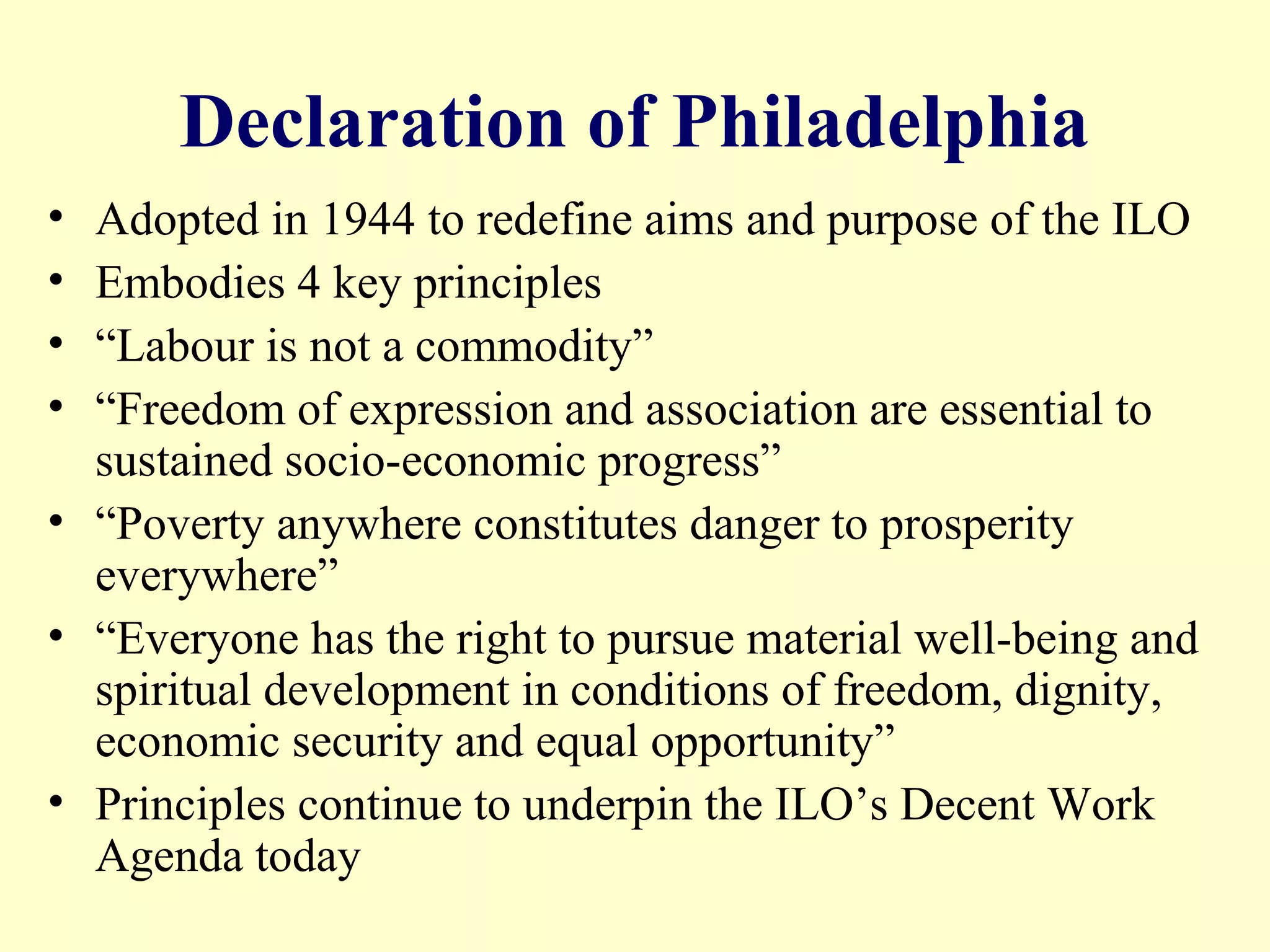
            • Growth of regional and global
              economic integration
              (globalisation) and proliferation
              of trade agreements, framework
              agreements, social auditing, etc.
              have generated greater interest,
              needs and expectations of core
              labour standards
            • Led to subsequent enhancement
              of profile of the ILO
            • Needs and expectations of
              workers in 21st century are as
              great as they ever were and ILO
              has key role to play in their
              protection
ILO and Tripartism
• Key characteristic distinguishes ILO from other UN agencies
• Governments and social partners have equal voice in shaping
  policies and programmes – but two social partners
• ILO promotes social dialogue in member States
• Tripartism reflected in structures as each member State can
  send 4 delegates to annual International Labour Conference: 2
  from government, 1 worker and 1 employer – can speak and
  vote independently
• ILC sets broad policy platform of ILO and every 2 years sets
  biennial work programme and budget financed by member
  States
• Key item on agenda of ILC in 2010 and 2011 is creation of
  new convention and/or recommendation for domestic work
Governance and structures
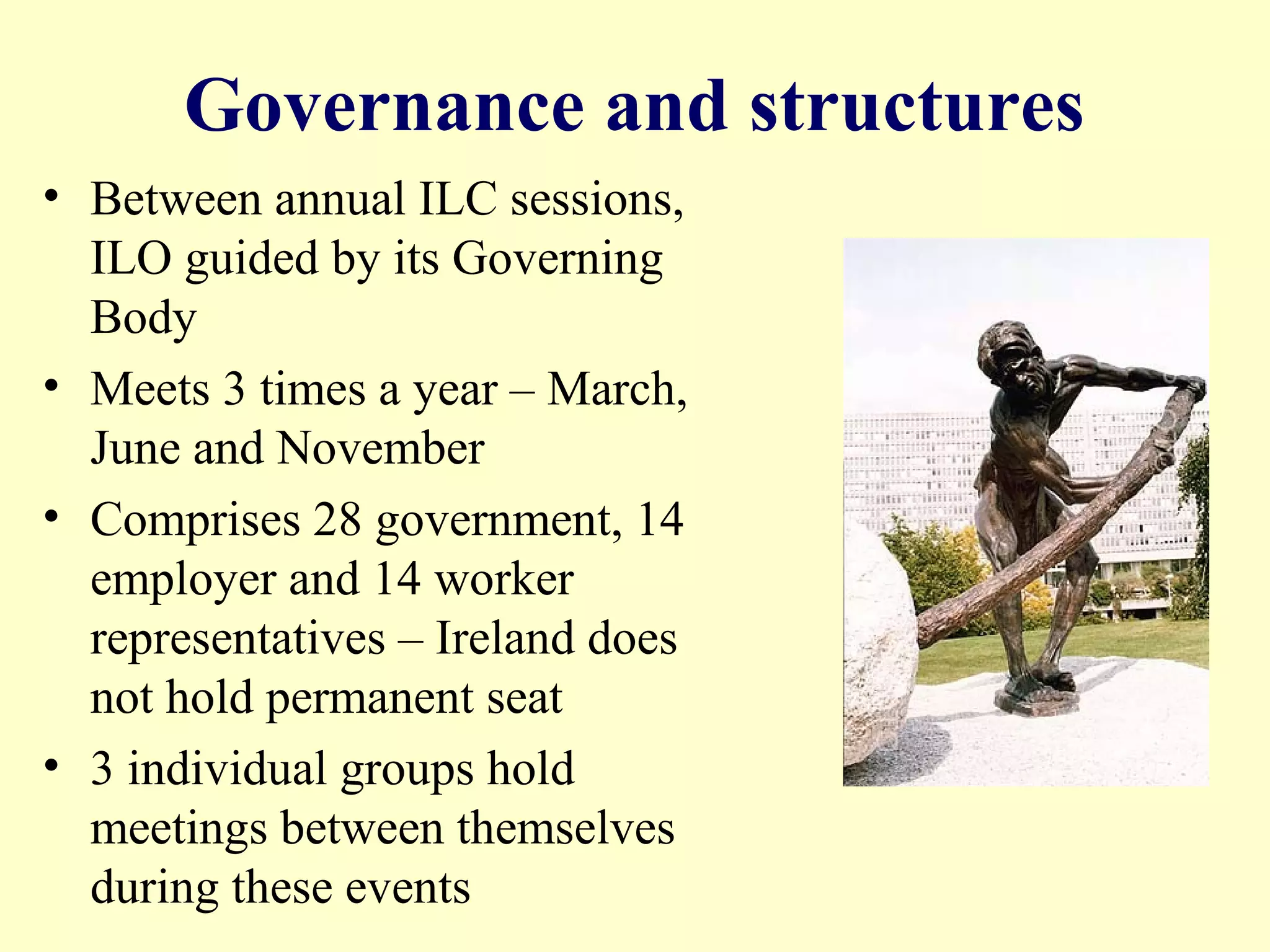
• Between annual ILC sessions,
  ILO guided by its Governing
  Body
• Meets 3 times a year – March,
  June and November
• Comprises 28 government, 14
  employer and 14 worker
  representatives – Ireland does
  not hold permanent seat
• 3 individual groups hold
  meetings between themselves
  during these events
Governance and structures
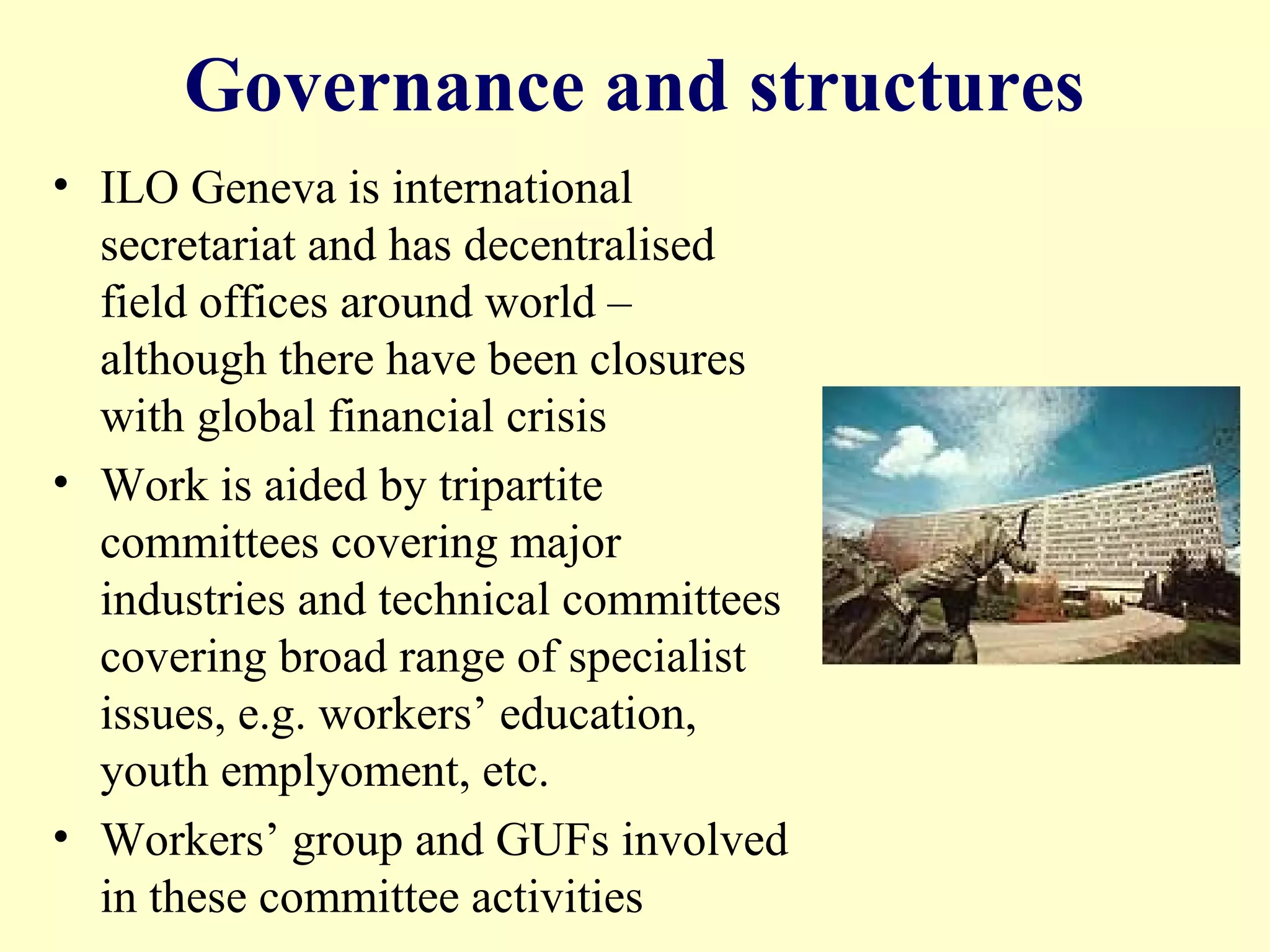
• ILO Geneva is international
  secretariat and has decentralised
  field offices around world –
  although there have been closures
  with global financial crisis
• Work is aided by tripartite
  committees covering major
  industries and technical committees
  covering broad range of specialist
  issues, e.g. workers’ education,
  youth emplyoment, etc.
• Workers’ group and GUFs involved
  in these committee activities
Strategic millennium objectives
4 strategic objectives guide ILO programme and budget:
1. To promote and realize standards and fundamental
   principles and rights at work
2. To create greater opportunities for women and men to
   secure decent employment and income
3. To enhance coverage and effectiveness of social
   protection for all
4. To strengthen tripartism and social dialogue
• Decent work is heart of ILO’s current goals and work
   for economic and social progress
• Underpins everything ILO does and stands for and
   promoted through national country programmes
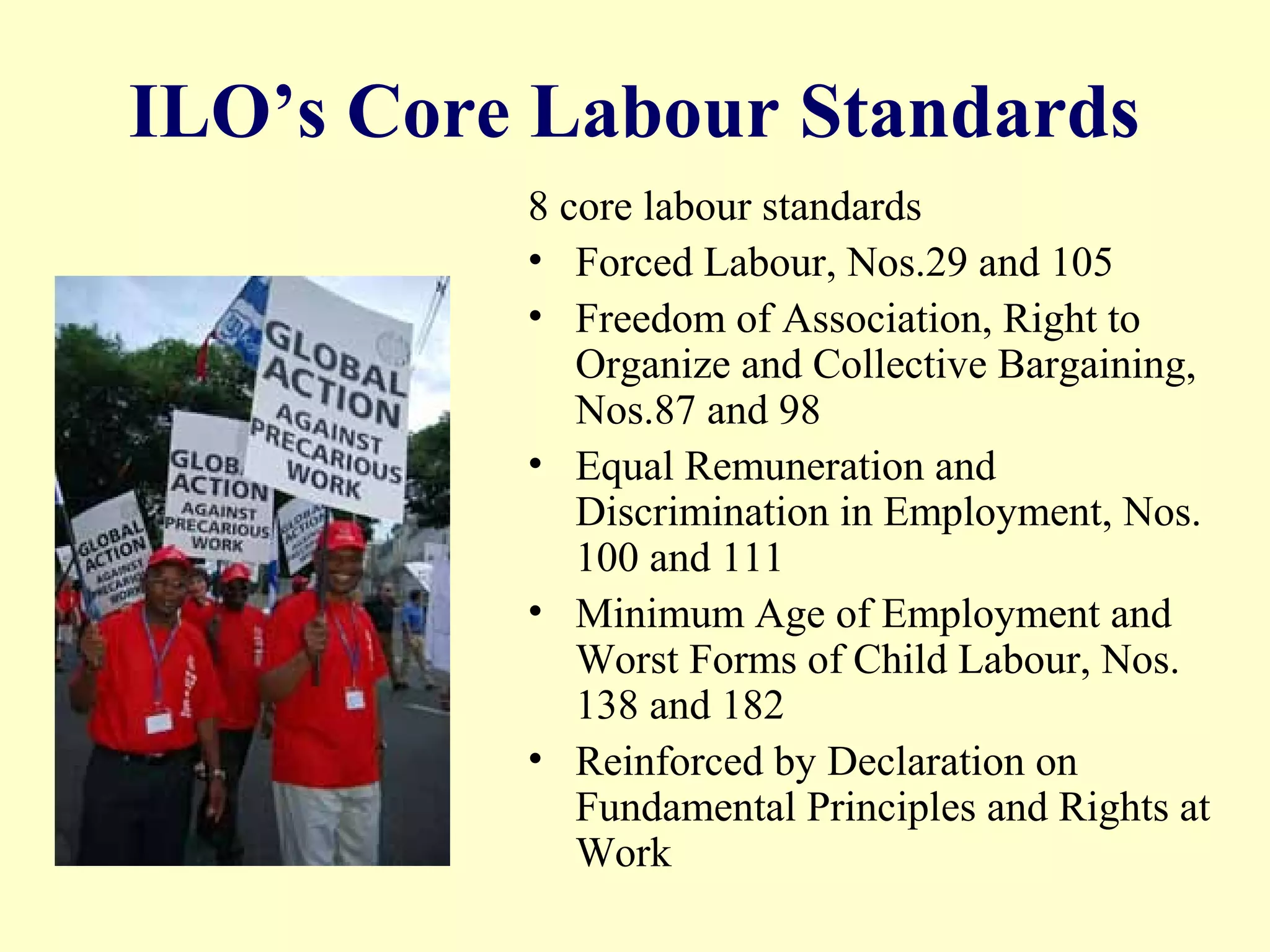
ILO’s Core Labour Standards
          8 core labour standards
          • Forced Labour, Nos.29 and 105
          • Freedom of Association, Right to
             Organize and Collective Bargaining,
             Nos.87 and 98
          • Equal Remuneration and
             Discrimination in Employment, Nos.
             100 and 111
          • Minimum Age of Employment and
             Worst Forms of Child Labour, Nos.
             138 and 182
          • Reinforced by Declaration on
             Fundamental Principles and Rights at
             Work
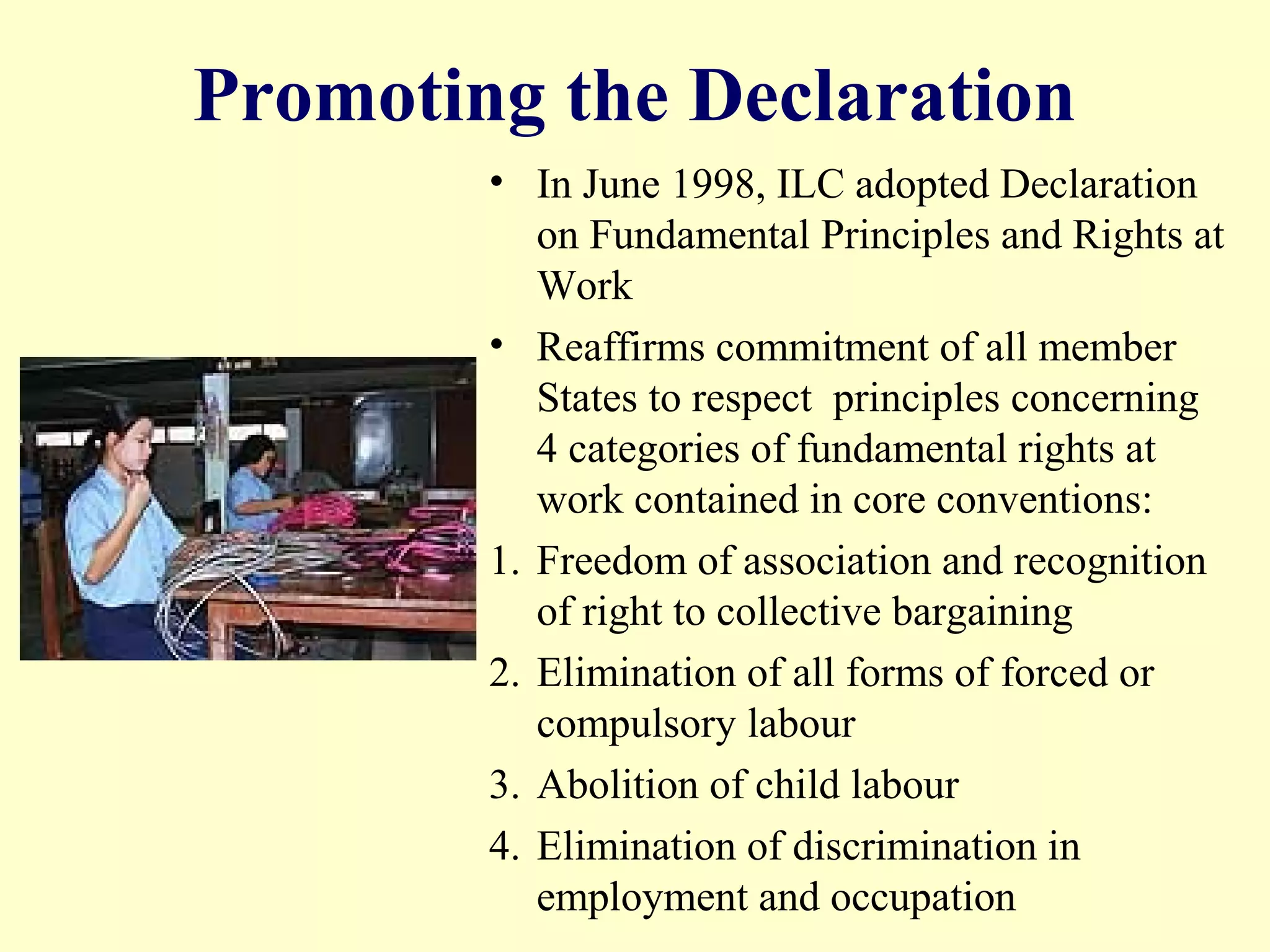
Promoting the Declaration
        • In June 1998, ILC adopted Declaration
           on Fundamental Principles and Rights at
           Work
        • Reaffirms commitment of all member
           States to respect principles concerning
           4 categories of fundamental rights at
           work contained in core conventions:
        1. Freedom of association and recognition
           of right to collective bargaining
        2. Elimination of all forms of forced or
           compulsory labour
        3. Abolition of child labour
        4. Elimination of discrimination in
           employment and occupation
Characteristics of Declaration
•   Declaration addressed concerns about globalisation and social consequences
    of trade liberalisation
•   Landmark was WTO Ministerial Conference in Singapore 1996 where
    renewed commitment made to internationally recognised core labour
    standards and ILO acknowledged as competent body to deal with and set
    standards
•   Declaration underscores that all member States obliged to respect
    fundamental principles whether or not have ratified relevant ILO conventions
•   ILO obliged to assist member States in their attempt to fulfill requirements of
    Declaration
•   As part of follow-up, ILO produces annual review of countries which have
    not ratified one or more of conventions relating to 4 categories of
    fundamental rights
•   In addition, ILO produces annual global report on one of 4 categories of
    fundamental rights
•   2010 will be Child Labour: Accelerating progress towards 2016
Supervisory Mechanisms
• Application of ILO conventions monitored by
  central supervisory machinery that assesses
  progress and identifies areas for improvement
• Provides technical support and assistance to
  assist member States in fulfilling
  responsibilities
• Submit reports every 5 years, except for core
  conventions where is every 2
• Tripartite approach so social partners,
  including trade unions, invited to participate
  in process
• Reports studied by Committee of Experts
  which publishes its own annual report for
  Tripartite Committee meeting during annual
  conference
• Complaints procedure in place in cases of
  violations of conventions
Flagship programmes
•   International Programme on the Elimination of Child Labour (IPEC)
•   Promoting the Declaration
•   Gender promotion and equality
•   Crisis response and reconstruction
•   Skills, knowledge and employability
•   Boosting employment through SME development
•   Safety & health at work and environment
•   Socio-economic security
•   Strengthening tripartism and social dialogue
•   Labour law and labour administration
•   Decent work
•   Indigenous rights (only international convention for indigenous peoples)
•   Global Agenda for Employment
•   Multinational Enterprise Programme
•   HIV/AIDS and the world of work
•   Regional programmes focus on issues of regional concern
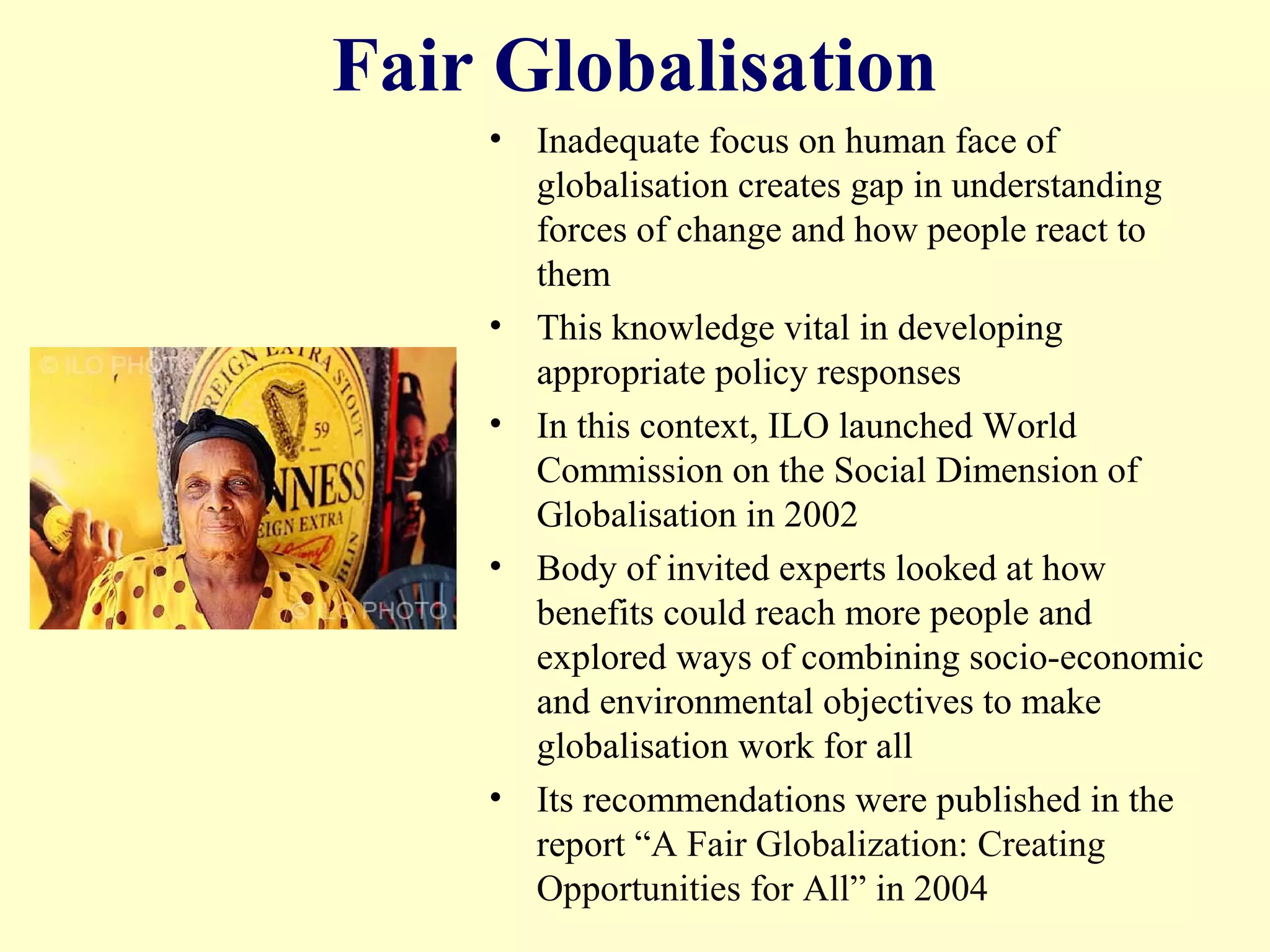
Fair Globalisation
    • Inadequate focus on human face of
      globalisation creates gap in understanding
      forces of change and how people react to
      them
    • This knowledge vital in developing
      appropriate policy responses
    • In this context, ILO launched World
      Commission on the Social Dimension of
      Globalisation in 2002
    • Body of invited experts looked at how
      benefits could reach more people and
      explored ways of combining socio-economic
      and environmental objectives to make
      globalisation work for all
    • Its recommendations were published in the
      report “A Fair Globalization: Creating
      Opportunities for All” in 2004
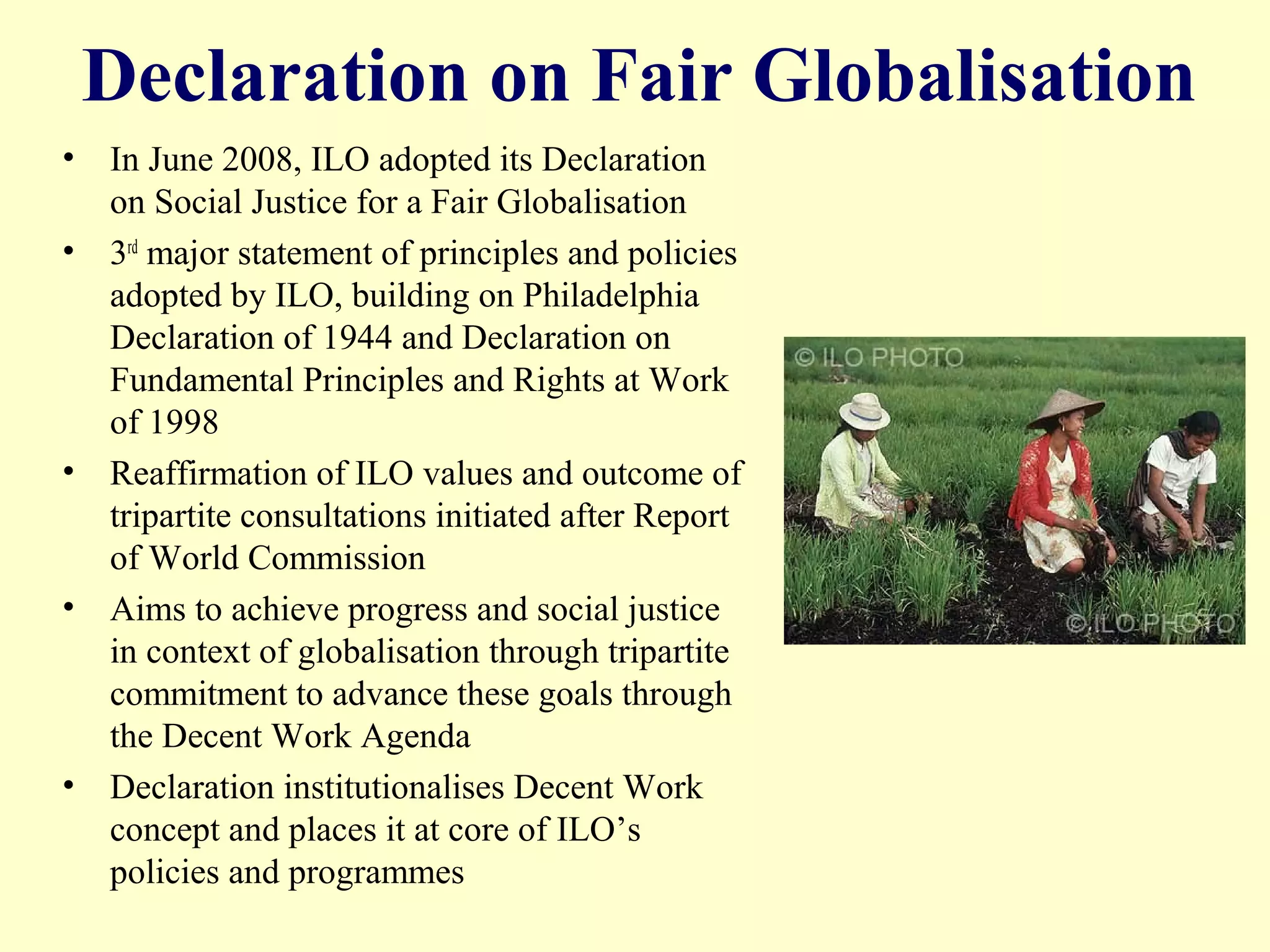
Declaration on Fair Globalisation
•   In June 2008, ILO adopted its Declaration
    on Social Justice for a Fair Globalisation
•   3rd major statement of principles and policies
    adopted by ILO, building on Philadelphia
    Declaration of 1944 and Declaration on
    Fundamental Principles and Rights at Work
    of 1998
•   Reaffirmation of ILO values and outcome of
    tripartite consultations initiated after Report
    of World Commission
•   Aims to achieve progress and social justice
    in context of globalisation through tripartite
    commitment to advance these goals through
    the Decent Work Agenda
•   Declaration institutionalises Decent Work
    concept and places it at core of ILO’s
    policies and programmes
Global Jobs Pact
• Faced with prospect of prolonged global increase in unemployment,
  poverty and inequality and continued challenges for enterprises, in
  June 2009 ILC unanimously adopted “Global Jobs Pact”
• Global policy instrument to address social and employment impact
  of international financial and economic crisis
• Promotes productive recovery centred on investments, employment
  and social protection
• Guided by Decent Work Agenda and commitments in 2008
  Declaration on Social Justice for a Fair Globalisation
• Emphasises that respecting fundamental principles and rights at
  work, strengthening social protection, promoting gender equality and
  encouraging participation and social dialogue are critical to recovery
  and development
• Pact is about promoting jobs and protecting people
Green Jobs Initiative
  • Joint initiative of United Nations Environment
    Programme (UNEP), ILO, International
    Employers’ Organisation (IOE) and
    International Trade Union Confederation
    (ITUC) to assess, analyse and promote creation
    of decent jobs in context of vital environmental
    policies
  • Collects data and good practices on green jobs
    creation and has produced comprehensive study
    on impact of emerging green economy on world
    of work
  • Next phase will involve assistance in policy
    formulation and implementation through
    macro-economic and sectoral assessment of
    potential green jobs creation
Flagship publications
• Annual World Employment Report: provides up-to-date
  information and analysis on major trends in world of work
• 4 volume ILO Encyclopaedia of Occupational Health and Safety:
  currently in 4th edition
• Yearbook of Labour Statistics: key source of statistical
  information on employment issues
• Key Indicators of Labour Market (KILM): provides analyses
  from Yearbook and other international references, available
  online as well
• International Labour Review: features current policy analysis on
  employment and labour issues
• Two quarterlies: Labour Education and World of Work

Power point ilo_and_core_labour_standards

  • 1.
    The ILO and Core Labour Standards ICTU Global Solidarity Training Course, Dublin, June 2010
  • 2.
    International Labour Organization • UN agency for the world of work and promotion of social justice within and between member States (www.ilo.org) • Operates in unique tripartite framework consisting of governments and social partners (ACTRAV and ACT/EMP) • Promotes opportunities for men and women to obtain decent and productive work in conditions of freedom, equity, security and human dignity • Current membership of 183 countries
  • 3.
    Declaration of Philadelphia •Adopted in 1944 to redefine aims and purpose of the ILO • Embodies 4 key principles • “Labour is not a commodity” • “Freedom of expression and association are essential to sustained socio-economic progress” • “Poverty anywhere constitutes danger to prosperity everywhere” • “Everyone has the right to pursue material well-being and spiritual development in conditions of freedom, dignity, economic security and equal opportunity” • Principles continue to underpin the ILO’s Decent Work Agenda today
  • 4.
    Enhanced profile ofthe ILO • Growth of regional and global economic integration (globalisation) and proliferation of trade agreements, framework agreements, social auditing, etc. have generated greater interest, needs and expectations of core labour standards • Led to subsequent enhancement of profile of the ILO • Needs and expectations of workers in 21st century are as great as they ever were and ILO has key role to play in their protection
  • 5.
    ILO and Tripartism •Key characteristic distinguishes ILO from other UN agencies • Governments and social partners have equal voice in shaping policies and programmes – but two social partners • ILO promotes social dialogue in member States • Tripartism reflected in structures as each member State can send 4 delegates to annual International Labour Conference: 2 from government, 1 worker and 1 employer – can speak and vote independently • ILC sets broad policy platform of ILO and every 2 years sets biennial work programme and budget financed by member States • Key item on agenda of ILC in 2010 and 2011 is creation of new convention and/or recommendation for domestic work
  • 6.
    Governance and structures •Between annual ILC sessions, ILO guided by its Governing Body • Meets 3 times a year – March, June and November • Comprises 28 government, 14 employer and 14 worker representatives – Ireland does not hold permanent seat • 3 individual groups hold meetings between themselves during these events
  • 7.
    Governance and structures •ILO Geneva is international secretariat and has decentralised field offices around world – although there have been closures with global financial crisis • Work is aided by tripartite committees covering major industries and technical committees covering broad range of specialist issues, e.g. workers’ education, youth emplyoment, etc. • Workers’ group and GUFs involved in these committee activities
  • 8.
    Strategic millennium objectives 4strategic objectives guide ILO programme and budget: 1. To promote and realize standards and fundamental principles and rights at work 2. To create greater opportunities for women and men to secure decent employment and income 3. To enhance coverage and effectiveness of social protection for all 4. To strengthen tripartism and social dialogue • Decent work is heart of ILO’s current goals and work for economic and social progress • Underpins everything ILO does and stands for and promoted through national country programmes
  • 9.
    ILO’s Core LabourStandards 8 core labour standards • Forced Labour, Nos.29 and 105 • Freedom of Association, Right to Organize and Collective Bargaining, Nos.87 and 98 • Equal Remuneration and Discrimination in Employment, Nos. 100 and 111 • Minimum Age of Employment and Worst Forms of Child Labour, Nos. 138 and 182 • Reinforced by Declaration on Fundamental Principles and Rights at Work
  • 10.
    Promoting the Declaration • In June 1998, ILC adopted Declaration on Fundamental Principles and Rights at Work • Reaffirms commitment of all member States to respect principles concerning 4 categories of fundamental rights at work contained in core conventions: 1. Freedom of association and recognition of right to collective bargaining 2. Elimination of all forms of forced or compulsory labour 3. Abolition of child labour 4. Elimination of discrimination in employment and occupation
  • 11.
    Characteristics of Declaration • Declaration addressed concerns about globalisation and social consequences of trade liberalisation • Landmark was WTO Ministerial Conference in Singapore 1996 where renewed commitment made to internationally recognised core labour standards and ILO acknowledged as competent body to deal with and set standards • Declaration underscores that all member States obliged to respect fundamental principles whether or not have ratified relevant ILO conventions • ILO obliged to assist member States in their attempt to fulfill requirements of Declaration • As part of follow-up, ILO produces annual review of countries which have not ratified one or more of conventions relating to 4 categories of fundamental rights • In addition, ILO produces annual global report on one of 4 categories of fundamental rights • 2010 will be Child Labour: Accelerating progress towards 2016
  • 12.
    Supervisory Mechanisms • Applicationof ILO conventions monitored by central supervisory machinery that assesses progress and identifies areas for improvement • Provides technical support and assistance to assist member States in fulfilling responsibilities • Submit reports every 5 years, except for core conventions where is every 2 • Tripartite approach so social partners, including trade unions, invited to participate in process • Reports studied by Committee of Experts which publishes its own annual report for Tripartite Committee meeting during annual conference • Complaints procedure in place in cases of violations of conventions
  • 13.
    Flagship programmes • International Programme on the Elimination of Child Labour (IPEC) • Promoting the Declaration • Gender promotion and equality • Crisis response and reconstruction • Skills, knowledge and employability • Boosting employment through SME development • Safety & health at work and environment • Socio-economic security • Strengthening tripartism and social dialogue • Labour law and labour administration • Decent work • Indigenous rights (only international convention for indigenous peoples) • Global Agenda for Employment • Multinational Enterprise Programme • HIV/AIDS and the world of work • Regional programmes focus on issues of regional concern
  • 14.
    Fair Globalisation • Inadequate focus on human face of globalisation creates gap in understanding forces of change and how people react to them • This knowledge vital in developing appropriate policy responses • In this context, ILO launched World Commission on the Social Dimension of Globalisation in 2002 • Body of invited experts looked at how benefits could reach more people and explored ways of combining socio-economic and environmental objectives to make globalisation work for all • Its recommendations were published in the report “A Fair Globalization: Creating Opportunities for All” in 2004
  • 15.
    Declaration on FairGlobalisation • In June 2008, ILO adopted its Declaration on Social Justice for a Fair Globalisation • 3rd major statement of principles and policies adopted by ILO, building on Philadelphia Declaration of 1944 and Declaration on Fundamental Principles and Rights at Work of 1998 • Reaffirmation of ILO values and outcome of tripartite consultations initiated after Report of World Commission • Aims to achieve progress and social justice in context of globalisation through tripartite commitment to advance these goals through the Decent Work Agenda • Declaration institutionalises Decent Work concept and places it at core of ILO’s policies and programmes
  • 16.
    Global Jobs Pact •Faced with prospect of prolonged global increase in unemployment, poverty and inequality and continued challenges for enterprises, in June 2009 ILC unanimously adopted “Global Jobs Pact” • Global policy instrument to address social and employment impact of international financial and economic crisis • Promotes productive recovery centred on investments, employment and social protection • Guided by Decent Work Agenda and commitments in 2008 Declaration on Social Justice for a Fair Globalisation • Emphasises that respecting fundamental principles and rights at work, strengthening social protection, promoting gender equality and encouraging participation and social dialogue are critical to recovery and development • Pact is about promoting jobs and protecting people
  • 17.
    Green Jobs Initiative • Joint initiative of United Nations Environment Programme (UNEP), ILO, International Employers’ Organisation (IOE) and International Trade Union Confederation (ITUC) to assess, analyse and promote creation of decent jobs in context of vital environmental policies • Collects data and good practices on green jobs creation and has produced comprehensive study on impact of emerging green economy on world of work • Next phase will involve assistance in policy formulation and implementation through macro-economic and sectoral assessment of potential green jobs creation
  • 18.
    Flagship publications • AnnualWorld Employment Report: provides up-to-date information and analysis on major trends in world of work • 4 volume ILO Encyclopaedia of Occupational Health and Safety: currently in 4th edition • Yearbook of Labour Statistics: key source of statistical information on employment issues • Key Indicators of Labour Market (KILM): provides analyses from Yearbook and other international references, available online as well • International Labour Review: features current policy analysis on employment and labour issues • Two quarterlies: Labour Education and World of Work