
INTERNATIONAL LABOR ORGANIZATION
(ILO)
Presented by:
Shabbir Ahmad
Faizan Farid
Zahoor Ahmad
Presented to:
Engr. M. Zeeshan Ahad
INTERNATIONAL LABOR ORGANIZATION
 Establish in1919 as a part of league of nation
 Only international body that survived even after 2nd
World war.
 Become specialized agency of UN in 1946
 Aims at world peace through social justice
 Draw attentions on various problems like:
Working conditions, Unemployment, industrial
accidents, problems f women and children.
CONTI……………
 It is tripartite body : representative of employer,
labor and govt.
 Till now 183 nations are member of ILO.
 Is is a specialised agency “associated” to the
UN
 Up to 1945: all UN members were also ILO Members
automatically
 After 1945: UN members must to accept ILO
constitution
 Not UN member must to be accepted by qualified
majority of the ILO Conference
PRINCIPLE OF TRIPARTISM
 Active interaction among the governments, workers
and employers as representative, equal and
independent social partners.
 Representatives of workers and employers to
participate on an equal footing with those of
governments in all discussions and decision-
making.
5
OBJECTIVES OF ILO
 The ILO has four principle strategic objectives
 to promote and realize standards and fundamental
principles and rights at work;
 to create greater opportunities for women and men
to secure decent employment;
 to enhance the coverage and effectiveness of
social protection for all;
 to strengthen tripartism and social dialogue.
ROLES OF ILO
 Full employment and raising standard of living
 Ensure employment in which employees get
satisfaction
 Training and transfer facilities of labor migration for
employment and settlement
 Policies with wages, hour and condition of work
 Life protection and health of workers
CONTI………..
 Provision of adequate nutrition, housing.
 Effective recognition of the right collective
bargaining
 Assurance of equality of education and vocational
opportunity
WORK OF ILO
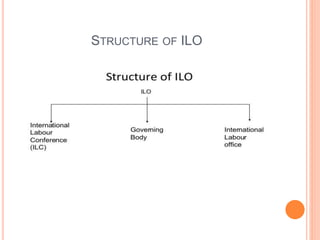
 The ILO accomplishes its work through three main
bodies
1. The International labor Conference,
2. the Governing body
3. and the Office
which comprise governments', employers' and
workers' representatives.
CONTI…………………
 The work of the Governing Body and of the Office is
aided by tripartite committees covering major
industries.
 It is also supported by committees of experts on
such matters as vocational training, management
development, occupational safety and health,
industrial relations, workers’ education, and special
problems of women and young workers.
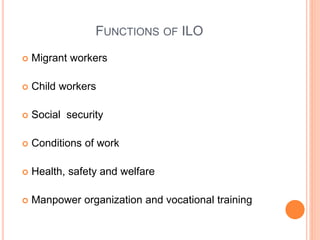
FUNCTIONS OF ILO
 Migrant workers
 Child workers
 Social security
 Conditions of work
 Health, safety and welfare
 Manpower organization and vocational training
STRUCTURE OF ILO
INTERNATIONAL LABOUR
CONFERENCE
 STRUCTURE
Annual – over 4,000 delegates
Each country represented by 2 Govt, 1 Workers, 1
Employers (A RIGHT PROPORTION?)
 FUNCTIONS
 Adoption of International standards
 Supervision of the application of ratified
conventions
 Examination of the report of the Director General
13
CONTI………..
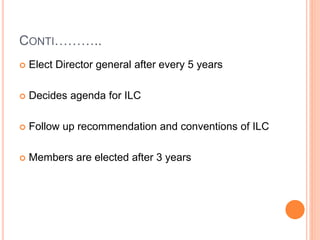
 Elect Director general after every 5 years
 Decides agenda for ILC
 Follow up recommendation and conventions of ILC
 Members are elected after 3 years
INTERNATIONAL LABOUR
OFFICE
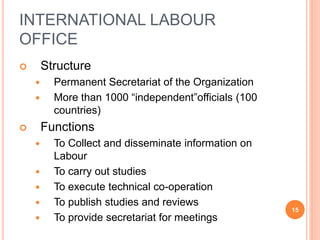
 Structure
 Permanent Secretariat of the Organization
 More than 1000 “independent”officials (100
countries)
 Functions
 To Collect and disseminate information on
Labour
 To carry out studies
 To execute technical co-operation
 To publish studies and reviews
 To provide secretariat for meetings
15
INTERNATIONAL LABOR OFFICE
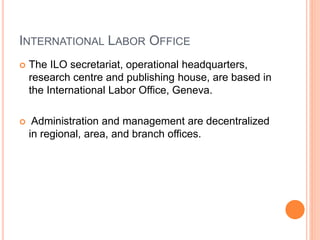
 The ILO secretariat, operational headquarters,
research centre and publishing house, are based in
the International Labor Office, Geneva.
 Administration and management are decentralized
in regional, area, and branch offices.
GOVERNING BODY
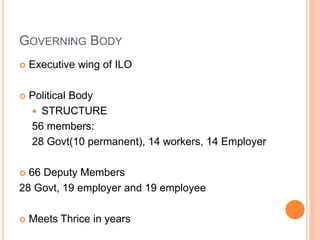
 Executive wing of ILO
 Political Body
 STRUCTURE
56 members:
28 Govt(10 permanent), 14 workers, 14 Employer
 66 Deputy Members
28 Govt, 19 employer and 19 employee
 Meets Thrice in years
GOVERNING BODY
FUNCTIONS
 Set the agenda of the ILC
 Select the Director General of the ILO
 Draw up the programme and the budget of the
Organization
18
INTERNATIONAL LABOR OFFICE
 Focal point for ILO activities under supervision of
Governing Body
 Headed by Director General
 Headquarter Geneva
 Office also contain a research and documentation
center
 Responsible to collect and distribute labor
information and social problems
PROGRAM AND BUDGET
 The Program and Budget of the Organization which sets
out the strategic objectives and expected outcomes for
the Organization’s work is approved every two years by
the International Labor Conference.
MEANS OF ACTION
 SETTING OF LABOUR STANDARDS
 Conventions, Recommandations, but also resolutions,
and guidelines
 TECHNICAL CO-OPERATION
 To lend organizational and financial support to
developing countries
 RESEARCH AND DISSEMINATION OF
INFORMATION
21
FUNDAMENTAL PRINCIPALS
 Labor is not a commodity
 Freedom of expression and association is
necessary.
 Poverty act as a danger for prosperity.
 War against want required to be carry on. Workers
and employee enjoy equal status in free discussion.
CORE LABOUR STANDARDS
 Freedom of association and the effective
recognition of the right to collective
bargaining
 Elimination of all forms of forced or
compulsory labour
 Effective abolition of child labour
 Elimination of discrimination in respect of
employment and occupation.
(Declaration of Fundamental Principles and Rights, 1998)
23
 ILO Minimum Age Convention, No. 138 (1973) “The
Minimum Age…shall be not less than the age of
completion of compulsory schooling ….”
ILO Conventions on child labour (1/2)
 ILO Worst Forms of Child Labour Convention, No.
182 (1999): “Each Member shall, …ensure access
to free basic education, and, wherever possible and
appropriate, vocational training, for all children
removed from the worst forms of child labour…”
ILO Conventions on child labour (2/2)
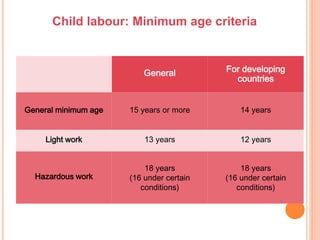
General For developing
countries
General minimum age 15 years or more 14 years
Light work 13 years 12 years
Hazardous work
18 years
(16 under certain
conditions)
18 years
(16 under certain
conditions)
Child labour: Minimum age criteria
THANKS-
THE-END

International labor organization (ilo)

  • 2.
    INTERNATIONAL LABOR ORGANIZATION (ILO) Presentedby: Shabbir Ahmad Faizan Farid Zahoor Ahmad Presented to: Engr. M. Zeeshan Ahad
  • 3.
    INTERNATIONAL LABOR ORGANIZATION Establish in1919 as a part of league of nation  Only international body that survived even after 2nd World war.  Become specialized agency of UN in 1946  Aims at world peace through social justice  Draw attentions on various problems like: Working conditions, Unemployment, industrial accidents, problems f women and children.
  • 4.
    CONTI……………  It istripartite body : representative of employer, labor and govt.  Till now 183 nations are member of ILO.  Is is a specialised agency “associated” to the UN  Up to 1945: all UN members were also ILO Members automatically  After 1945: UN members must to accept ILO constitution  Not UN member must to be accepted by qualified majority of the ILO Conference
  • 5.
    PRINCIPLE OF TRIPARTISM Active interaction among the governments, workers and employers as representative, equal and independent social partners.  Representatives of workers and employers to participate on an equal footing with those of governments in all discussions and decision- making. 5
  • 6.
    OBJECTIVES OF ILO The ILO has four principle strategic objectives  to promote and realize standards and fundamental principles and rights at work;  to create greater opportunities for women and men to secure decent employment;  to enhance the coverage and effectiveness of social protection for all;  to strengthen tripartism and social dialogue.
  • 7.
    ROLES OF ILO Full employment and raising standard of living  Ensure employment in which employees get satisfaction  Training and transfer facilities of labor migration for employment and settlement  Policies with wages, hour and condition of work  Life protection and health of workers
  • 8.
    CONTI………..  Provision ofadequate nutrition, housing.  Effective recognition of the right collective bargaining  Assurance of equality of education and vocational opportunity
  • 9.
    WORK OF ILO The ILO accomplishes its work through three main bodies 1. The International labor Conference, 2. the Governing body 3. and the Office which comprise governments', employers' and workers' representatives.
  • 10.
    CONTI…………………  The workof the Governing Body and of the Office is aided by tripartite committees covering major industries.  It is also supported by committees of experts on such matters as vocational training, management development, occupational safety and health, industrial relations, workers’ education, and special problems of women and young workers.
  • 11.
    FUNCTIONS OF ILO Migrant workers  Child workers  Social security  Conditions of work  Health, safety and welfare  Manpower organization and vocational training
  • 12.
  • 13.
    INTERNATIONAL LABOUR CONFERENCE  STRUCTURE Annual– over 4,000 delegates Each country represented by 2 Govt, 1 Workers, 1 Employers (A RIGHT PROPORTION?)  FUNCTIONS  Adoption of International standards  Supervision of the application of ratified conventions  Examination of the report of the Director General 13
  • 14.
    CONTI………..  Elect Directorgeneral after every 5 years  Decides agenda for ILC  Follow up recommendation and conventions of ILC  Members are elected after 3 years
  • 15.
    INTERNATIONAL LABOUR OFFICE  Structure Permanent Secretariat of the Organization  More than 1000 “independent”officials (100 countries)  Functions  To Collect and disseminate information on Labour  To carry out studies  To execute technical co-operation  To publish studies and reviews  To provide secretariat for meetings 15
  • 16.
    INTERNATIONAL LABOR OFFICE The ILO secretariat, operational headquarters, research centre and publishing house, are based in the International Labor Office, Geneva.  Administration and management are decentralized in regional, area, and branch offices.
  • 17.
    GOVERNING BODY  Executivewing of ILO  Political Body  STRUCTURE 56 members: 28 Govt(10 permanent), 14 workers, 14 Employer  66 Deputy Members 28 Govt, 19 employer and 19 employee  Meets Thrice in years
  • 18.
    GOVERNING BODY FUNCTIONS  Setthe agenda of the ILC  Select the Director General of the ILO  Draw up the programme and the budget of the Organization 18
  • 19.
    INTERNATIONAL LABOR OFFICE Focal point for ILO activities under supervision of Governing Body  Headed by Director General  Headquarter Geneva  Office also contain a research and documentation center  Responsible to collect and distribute labor information and social problems
  • 20.
    PROGRAM AND BUDGET The Program and Budget of the Organization which sets out the strategic objectives and expected outcomes for the Organization’s work is approved every two years by the International Labor Conference.
  • 21.
    MEANS OF ACTION SETTING OF LABOUR STANDARDS  Conventions, Recommandations, but also resolutions, and guidelines  TECHNICAL CO-OPERATION  To lend organizational and financial support to developing countries  RESEARCH AND DISSEMINATION OF INFORMATION 21
  • 22.
    FUNDAMENTAL PRINCIPALS  Laboris not a commodity  Freedom of expression and association is necessary.  Poverty act as a danger for prosperity.  War against want required to be carry on. Workers and employee enjoy equal status in free discussion.
  • 23.
    CORE LABOUR STANDARDS Freedom of association and the effective recognition of the right to collective bargaining  Elimination of all forms of forced or compulsory labour  Effective abolition of child labour  Elimination of discrimination in respect of employment and occupation. (Declaration of Fundamental Principles and Rights, 1998) 23
  • 24.
     ILO MinimumAge Convention, No. 138 (1973) “The Minimum Age…shall be not less than the age of completion of compulsory schooling ….” ILO Conventions on child labour (1/2)
  • 25.
     ILO WorstForms of Child Labour Convention, No. 182 (1999): “Each Member shall, …ensure access to free basic education, and, wherever possible and appropriate, vocational training, for all children removed from the worst forms of child labour…” ILO Conventions on child labour (2/2)
  • 26.
    General For developing countries Generalminimum age 15 years or more 14 years Light work 13 years 12 years Hazardous work 18 years (16 under certain conditions) 18 years (16 under certain conditions) Child labour: Minimum age criteria
  • 27.