COLLECTIVE BARGANING
INTRODUCTION :-
         Other than the continuing argument about the
appropriate education for nurses, collective bargaining is
the most controversial and divisive(disagreement) issue
in nursing. Some believe that collective bargaining
reduces the professionalism of nursing; others view it as a
mechanism to prevent employers from exploiting nurses.
It has been seen as a complex legal issue, but dealt with
by attorney(legal matters/lawyer) and other experts
specifically trained to handle the problem it presents
MEANING;-
       Collective bargaining is a process between employers
 and employees to reach an agreement regarding the rights and
 duties of people at work.
           Collective bargaining aims to reach a collective
 agreement which usually sets out issues such as employees
 pay, working hours, training, health and safety, and rights to
 participate in workplace or company affairs.

DEFINITION:-
      Collective bargaining is an agreement between a single
 employer or an association of employers on the one hand and
 a labour union on the other, which regulates the terms and
 conditions of employment. (Tudwig Teller)
OBJECTIVES OF COLLECTIVE BARGAINING
 Collective bargaining has benefits not only for the present, but also
  for the future.
The objectives of collective bargaining are:
 1. To provide an opportunity to the workers, to voice their problems
  on issues related to employment.
 2. To facilitate reaching a solution that is acceptable to all the parties
  involves.
 3. To resolve all conflicts and disputes in a mutually agreeable
  manner.
 4. To prevent any conflict/disputes in the future through mutually
  signed contracts.
 5. To develop a conductive atmosphere to foster good organizations
  relations.
 6. To provide stable and peaceful organization (hospital) relations.
 7. To enhance the productivity of the organization by preventing
  strikes lock – out ect.
CHARACTERSTICS OF COLLECTIVE BARGAINING


   It is a group process, wherein one group, representing the employers, and the
    other, representing the employees, sit together to negotiate terms of
    employment.

   2. Negotiations form an important aspect of the process of collective bargaining
    i.e., there is considerable scope for discussion, compromise or mutual give and
    take in collective bargaining.

   3. Collective bargaining is a formalized process by which employers and
    independent trade unions negotiate terms and conditions of employment and the
    ways in which certain employment-related issues are to be regulated at
    national, organizational and workplace levels
   Collective bargaining is a process in the sense that it consists of a number of steps. It
    begins with the presentation of the charter of demands and ends with reaching an
    agreement, which would serve as the basic law governing labor management relations
    over a period of time in an enterprise. Moreover, it is flexible process and not fixed or
    static. Mutual trust and understanding serve as the by products of harmonious
    relations between the two parties.


   5. It a bipartite process. This means there are always two parties involved in the
    process of collective bargaining. The negotiations generally take place between the
    employees and the management. It is a form of participation.


   6. Collective bargaining is a complementary process i.e. each party needs something
    that the other party has; labor can increase productivity and management can pay
    better for their efforts.
   7. Collective bargaining tends to improve the relations between
    workers and the union on the one hand and the employer on the
    other.
   8. Collective Bargaining is continuous process. It enables industrial
    democracy to be effective. It uses cooperation and consensus for
    settling disputes rather than conflict and confrontation.
   9. Collective bargaining takes into account day to day
    changes, policies, potentialities, capacities and interests
Principles of collective
         bargaining
 For union and management:-
-CB should be an education as well as a bargaining processes.
-There must be mutual confidence and good faith and a desire to
  make collective bargaining effective in practices.
-There should be an honest and responsible leadership for only this
  kind of leadership will make collective bargaining effective and
  meaningful
For the management
   Management must develop and consistently follow a realistic
    labour policy which should be accepted and carried out by its
    representatives.
   Management must grant recognition to the trade union without
    any reservations and accept it as a constructive force in the
    organization
   Management should not wait for the trade union to bring
    employee grievance to its notice but should rather create the
    condition employee can approach
   Management should deal only with one trade union in the
    organization
For trade union :-
     - Trade union leaders should be appreciate the economic
implication of collective bargaining for their demands are
generally met from the income and resources of the organisation
     - Trade union should resort to strikes only when all the other
methods of the settlement of a dispute have failed
      -trade union leaders should not imagine that their only
function is to secure higher wages ,shorter hours of work and better
working conditions for their members
National labour relations act

   It is here declared to be the policy of the united states to eliminate
    the causes of certain substantial obstructions to the free flow of
    commerce by encouraging the practice and procedure of collective
    bargainning….
         For the purpose of negotiating the terms and conditions of
    workers employment or the other mutual aid or protection .”

Legal frame work for collective bargaining
Employee have the right to :-
 Form to join or to assist a labour organisation of their
  choice ,
 Bargain collectively through that labour organisation
 Engage in concerted activities an mutual aid
  rafrain(avoid doing) from any of the activities .
Protects employees by defining and prohibiting unfair
  labour organisation
 Discriminating against employees for engaging in or
  refraining from union activities.
 Refusing to bargain with the union that is the lawful
  representative of its employees.
Governance and collective bargaining :-
         the board of regents is prohibited from bargaining on
diminution(become a less ) of tenure (form of right),statuary
governance rights and academic freedom


  Supervisor –dominance
      It shall be an unfair labor practice for an employer to dominate or
      interfere with the formation or administration of any labour
      organisation or contribute financial or other support to it.

  Professional –supervisor –manager
   A decision reached by the supreme court in February 1980 may
    provide opportunities for new challenges by hospital administrators
   As nurses continue to emphasize their rightful place as professional
    member of the health care team
To Organize Or Not


   As Registered Nurse become more knowledgeable about
    collective bargaining activities they will be faced with a
    variety of decisions. the first decision is whether to
    organize. if nurses are seeking improvement in
    wages, hours and working conditions and have found
    nursing and hospital administrators unwilling to listen
    ,then collective bargaining may be the best alternative
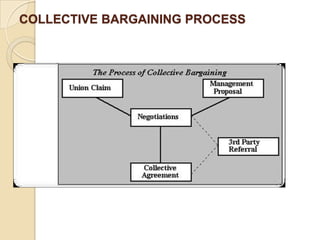
COLLECTIVE BARGAINING PROCESS
Collective bargaining generally includes negotiations between the
two parties (employees‘ representatives and employer‘s
representatives). Collective bargaining consists of negotiations
between an employer and a group of employees that determine the
conditions of employment. Often employees are represented in the
bargaining by a union or other labor organization. The result of
collective bargaining procedure is called the collective bargaining
agreement (CBA). Collective agreements may be in the form of
procedural agreements or substantive agreements. Procedural
agreements deal with the relationship between workers and
management and the procedures to be adopted for resolving
individual or group disputes.
Collective bargaining process comprises of five core
            steps:


   1.Prepare: This phase involves composition of a negotiation team. The
    negotiation team should consist of representatives of both the parties
    with adequate knowledge and skills for negotiation.


   2. Discuss, the parties decide the ground rules that will guide the
    negotiations.
   Propose:, this phase could be described as brainstorming‘. The exchange
    of messages takes place and opinion of both the parties is sought.

   4. Bargain:. This stage comprises the time when what ifs‘ and supposals‘
    are set forth and the drafting of agreements take place.

   5. Settlement:. This stage is described as consisting of effective joint
    implementation of the agreement through shared visions, strategic
    planning and negotiated change.

Collective barganing

  • 1.
  • 2.
    COLLECTIVE BARGANING INTRODUCTION :- Other than the continuing argument about the appropriate education for nurses, collective bargaining is the most controversial and divisive(disagreement) issue in nursing. Some believe that collective bargaining reduces the professionalism of nursing; others view it as a mechanism to prevent employers from exploiting nurses. It has been seen as a complex legal issue, but dealt with by attorney(legal matters/lawyer) and other experts specifically trained to handle the problem it presents
  • 3.
    MEANING;- Collective bargaining is a process between employers and employees to reach an agreement regarding the rights and duties of people at work. Collective bargaining aims to reach a collective agreement which usually sets out issues such as employees pay, working hours, training, health and safety, and rights to participate in workplace or company affairs. DEFINITION:- Collective bargaining is an agreement between a single employer or an association of employers on the one hand and a labour union on the other, which regulates the terms and conditions of employment. (Tudwig Teller)
  • 4.
    OBJECTIVES OF COLLECTIVEBARGAINING  Collective bargaining has benefits not only for the present, but also for the future. The objectives of collective bargaining are:  1. To provide an opportunity to the workers, to voice their problems on issues related to employment.  2. To facilitate reaching a solution that is acceptable to all the parties involves.  3. To resolve all conflicts and disputes in a mutually agreeable manner.  4. To prevent any conflict/disputes in the future through mutually signed contracts.  5. To develop a conductive atmosphere to foster good organizations relations.  6. To provide stable and peaceful organization (hospital) relations.  7. To enhance the productivity of the organization by preventing strikes lock – out ect.
  • 5.
    CHARACTERSTICS OF COLLECTIVEBARGAINING  It is a group process, wherein one group, representing the employers, and the other, representing the employees, sit together to negotiate terms of employment.  2. Negotiations form an important aspect of the process of collective bargaining i.e., there is considerable scope for discussion, compromise or mutual give and take in collective bargaining.  3. Collective bargaining is a formalized process by which employers and independent trade unions negotiate terms and conditions of employment and the ways in which certain employment-related issues are to be regulated at national, organizational and workplace levels
  • 6.
    Collective bargaining is a process in the sense that it consists of a number of steps. It begins with the presentation of the charter of demands and ends with reaching an agreement, which would serve as the basic law governing labor management relations over a period of time in an enterprise. Moreover, it is flexible process and not fixed or static. Mutual trust and understanding serve as the by products of harmonious relations between the two parties.  5. It a bipartite process. This means there are always two parties involved in the process of collective bargaining. The negotiations generally take place between the employees and the management. It is a form of participation.  6. Collective bargaining is a complementary process i.e. each party needs something that the other party has; labor can increase productivity and management can pay better for their efforts.
  • 7.
    7. Collective bargaining tends to improve the relations between workers and the union on the one hand and the employer on the other.  8. Collective Bargaining is continuous process. It enables industrial democracy to be effective. It uses cooperation and consensus for settling disputes rather than conflict and confrontation.  9. Collective bargaining takes into account day to day changes, policies, potentialities, capacities and interests
  • 8.
    Principles of collective bargaining  For union and management:- -CB should be an education as well as a bargaining processes. -There must be mutual confidence and good faith and a desire to make collective bargaining effective in practices. -There should be an honest and responsible leadership for only this kind of leadership will make collective bargaining effective and meaningful
  • 9.
    For the management  Management must develop and consistently follow a realistic labour policy which should be accepted and carried out by its representatives.  Management must grant recognition to the trade union without any reservations and accept it as a constructive force in the organization  Management should not wait for the trade union to bring employee grievance to its notice but should rather create the condition employee can approach  Management should deal only with one trade union in the organization
  • 10.
    For trade union:- - Trade union leaders should be appreciate the economic implication of collective bargaining for their demands are generally met from the income and resources of the organisation - Trade union should resort to strikes only when all the other methods of the settlement of a dispute have failed -trade union leaders should not imagine that their only function is to secure higher wages ,shorter hours of work and better working conditions for their members
  • 11.
    National labour relationsact  It is here declared to be the policy of the united states to eliminate the causes of certain substantial obstructions to the free flow of commerce by encouraging the practice and procedure of collective bargainning….  For the purpose of negotiating the terms and conditions of workers employment or the other mutual aid or protection .” 
  • 12.
    Legal frame workfor collective bargaining Employee have the right to :-  Form to join or to assist a labour organisation of their choice ,  Bargain collectively through that labour organisation  Engage in concerted activities an mutual aid rafrain(avoid doing) from any of the activities . Protects employees by defining and prohibiting unfair labour organisation  Discriminating against employees for engaging in or refraining from union activities.  Refusing to bargain with the union that is the lawful representative of its employees.
  • 13.
    Governance and collectivebargaining :- the board of regents is prohibited from bargaining on diminution(become a less ) of tenure (form of right),statuary governance rights and academic freedom Supervisor –dominance  It shall be an unfair labor practice for an employer to dominate or interfere with the formation or administration of any labour organisation or contribute financial or other support to it. Professional –supervisor –manager  A decision reached by the supreme court in February 1980 may provide opportunities for new challenges by hospital administrators  As nurses continue to emphasize their rightful place as professional member of the health care team
  • 14.
    To Organize OrNot  As Registered Nurse become more knowledgeable about collective bargaining activities they will be faced with a variety of decisions. the first decision is whether to organize. if nurses are seeking improvement in wages, hours and working conditions and have found nursing and hospital administrators unwilling to listen ,then collective bargaining may be the best alternative
  • 15.
  • 16.
    Collective bargaining generallyincludes negotiations between the two parties (employees‘ representatives and employer‘s representatives). Collective bargaining consists of negotiations between an employer and a group of employees that determine the conditions of employment. Often employees are represented in the bargaining by a union or other labor organization. The result of collective bargaining procedure is called the collective bargaining agreement (CBA). Collective agreements may be in the form of procedural agreements or substantive agreements. Procedural agreements deal with the relationship between workers and management and the procedures to be adopted for resolving individual or group disputes.
  • 17.
    Collective bargaining processcomprises of five core steps:  1.Prepare: This phase involves composition of a negotiation team. The negotiation team should consist of representatives of both the parties with adequate knowledge and skills for negotiation.  2. Discuss, the parties decide the ground rules that will guide the negotiations.
  • 18.
    Propose:, this phase could be described as brainstorming‘. The exchange of messages takes place and opinion of both the parties is sought.  4. Bargain:. This stage comprises the time when what ifs‘ and supposals‘ are set forth and the drafting of agreements take place.  5. Settlement:. This stage is described as consisting of effective joint implementation of the agreement through shared visions, strategic planning and negotiated change.