CHAPTER 6:
THE FOUNDING OF
GEORGIA
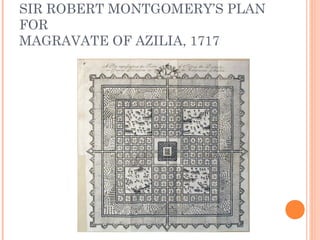
SIR ROBERT MONTGOMERY’S PLAN
FOR
MAGRAVATE OF AZILIA, 1717
THE COLONY OF GEORGIA’S 3
PURPOSES ACCORDING TO ITS
CHARTER OF 1732
1. Charity: relieve unemployment in Britain
2. Economics: To provide England goods to protect
in the system of mercantilism
3. Defense: buffer between Carolinas & Spanish
(Catholic) Florida
THE 4TH
(UNSTATED) REASON
4. Religion: provide a home for persecuted British
Protestants
PROTESTANTS vs. CATHOLICS
England Spain
Anglican Church Catholic Church
Georgia Florida
THE TRUSTEES:
 21 in all
 Trustee: man placed in a position of trust on
behalf of other people; Georgia’s 21 trustees did
not benefit personally (income, land, or
government office) from their position
 Principal Officials:
 Thomas Causton: Keeper of the Trustees’ Store:
Manager of the “Colonial Wal-Mart”; maintained a
huge warehouse in Savannah where colonists
purchased food, clothing, supplies and guarantted
amounts of meat and flour. (Powerful man: made $
by degen. the food)
 William Stephens: Secretary of Trustees: sent
detailed reports of Savannah’s happenings back to
JAMES E. OGLETHORPE
 James Edward Oglethorpe is credited with founding Georgia. The first group of British settlers landed at the site of the
planned town, then known as Yamacraw Bluff, on the Savannah River, and Oglethorpe led them sixteen miles inland
from the Atlantic Ocean on February 12, 1733.
UNIVERSITY OF NORTH CAROLINA. “DOCUMENTING THE
AMERICAN SOUTH.
DOCSOUTH.UNC.EDU/SOUTHLIT/OGLETHORPE/OGLETTP.JP
G (ACCESSED JANUARY 23, 2009).
GEORGIA’S BOUNDARIES
 1732:
 Northern Boundary: Savannah River
 Southern Boundary: Altamaha River
 Area also claimed by Spain & France!!
GEORGIA AS TRUSTEE COLONY:
ARTISTIC RENDITIONS
 Everyone coming to the colony was
expected to work.
 Colonists were expected to live and work
under the rules and supervision of the
trustees.
 Georgia’s native peoples were shown as
being friends of the English colonists.
 Boats were shown carrying goods for
trade, possibly with the Indians.
 Success in bringing European civilization
to the wilderness can be seen.
(Architecture, etc.)
ARTISTIC RENDITION:
EARLY EBENEZER
TRUSTEES’ SEAL
 “NON SIBI SED ALILIS” : “Not for ourselves but
others”
ATTRACTING COLONISTS
 Sermons, pamphlets, speeches & newspapers
appeal for monetary contributions & colonists
 Application process for potential colonists
 Trustees looked for hardworking, down-on-their luck people to
send on charity
 Colonists sent on charity received: land, seed, tools, weapons
and food to support them until the 1st
harvest.
 35 Families
 Carpenters, tailors, bankers, merchants & other
skilled pople
THE 1ST
COLONISTS SAIL TO
GEORGIA
 November 1732 on the ship Anne
 57 day journey
 Landed in Charles Town
 Oglethorpe scouts for a settlement site & finds a
place nearby a village of Yamacraw Indians
JOHN & MARY MUSGROVE:
TRADERS & TRANSLATORS
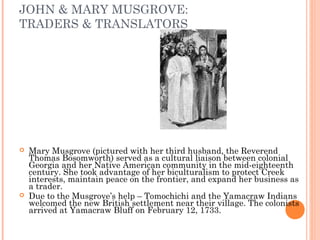
 Mary Musgrove (pictured with her third husband, the Reverend
Thomas Bosomworth) served as a cultural liaison between colonial
Georgia and her Native American community in the mid-eighteenth
century. She took advantage of her biculturalism to protect Creek
interests, maintain peace on the frontier, and expand her business as
a trader.
 Due to the Musgrove’s help – Tomochichi and the Yamacraw Indians
welcomed the new British settlement near their village. The colonists
arrived at Yamacraw Bluff on February 12, 1733.
TOMOCHICHI
 As the principal mediator between the native population and the new English
settlers during the first years of Georgia's settlement, Tomochichi (left)
contributed much to the establishment of peaceful relations between the two
groups and to the ultimate success of Georgia. His nephew, Toonahowi, is seated
on the right in this engraving, circa 1734-35, by John Faber Jr.
 A large granite boulder with a decorative copper plate was installed in Savannah's
Wright Square, southeast of the original grave marker, on April 21, 1899. The
plate is inscribed to "the mico of the Yamacraws, the companion of Oglethorpe,
and the ally of the colony of Georgia."
THE SETTLEMENT OF SAVANNAH
 The colonists lived in tents while they cleared and tamed the
land.
 “Squared” Plan:
 Open public squares to serve as neighborhood centers
 4 lots facing each square set aside for public bldgs.
 40 60 X 90 house lots around each square, organized into
4 groups of 10.
GEORGIA’S 1ST
CRISIS
 Dysentery & Disease: water-borne (river water)
 ¼ Colonists died, including the town doctor.
 Remedy: a town well was dug.
 Other colonists soon arrive: Lutheran
Salzburgers, Germans, Italians, Swiss
 By the end of the 1st
year there were over 50
houses in Savannah and many public buildings.
GROWING PAINS
 The main 3 regulations of the Trustees, which
Georgia colonists oppose:
1. Restrictions on Land Ownership
2. Ban on Slavery
3. Prohibitions on Rum & Hard Liquors
RESTRICTIONS ON LAND
OWNERSHIP & INHERITANCE
 Trustees’ Goal: Prevent the development of a rich
upper class
 Each Male Adult on Charity received:
 50 acres of land (5 city acres, 45 country acres)
 Each Male Adult who paid his own way received:
 50 acres of land for themselves
 + 50 additional acres for each servant
 500 acres maximum
 Land was not redistributed if land was unsuitable for
farming.
 Colonists could not re-sell land.
 Inheritance: Each land grant had to have an adult male to
protect it. If a landowner died without a male heir, land
was returned to the Trustees’.
 Prohibition on Slavery:
 All of the surrounding colonies allowed slavery.
 Prohibition on Rum:
 English beer was allowed.
 Thomas Causon, Keeper of the Trustees Store is
known for watering-down beer before selling it to
colonists.
BUILDING FORTS
 1734: Oglethorpe returned to England to brief
Parliament. Tomochichi and his nephew
Tooanahowi, and a delegation of Creek Indians
accompany him.
 Oglethorpe:
 Requests for additional government funding for the
Georgia Colony
 “Sells” the need for Georgia as a buffer colony
between the Spanish and the French (not haven for
the poor)
 Parliament agreed to fund the construction of
forts along the GA coast.
GEORGIA’S FIRST FORT
 North of the mouth of the Altamaha River at
Georgia’s southern boundary. (Darien)
 Constructed by 150 Scottish Highlanders
 http://
www.gpb.org/georgiastories/story/scottish_highlanders
FORT FREDERICA
 Fort #2
 Dec. 1735: Oglethorpe and 257 colonists sail from
England to build Frederica at St.Simon’s Island
 While the Spanish were frightened at the
increasing number of British forts under
construction, a peace treaty was reached between
Oglethorpe and the Spanish Governor of Florida,
Moral de Sanchez.
FORT FREDERICA
 Designed to defend the southern frontier from the continued
presence of Spanish colonials in the American Southeast, Fort
Frederica on St. Simons Island served as the British military
headquarters in colonial America.
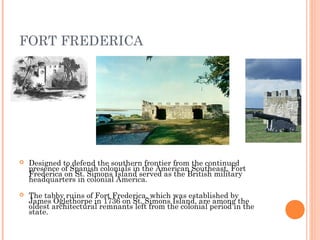
 The tabby ruins of Fort Frederica, which was established by
James Oglethorpe in 1736 on St. Simons Island, are among the
oldest architectural remnants left from the colonial period in the
state.
GEORGIA STORIES:
“Daily Life in Georgia:
 http://
www.gpb.org/georgiastories/stories/daily_life_in_georgia
 “Expectation vs. Reality”
 http://www.gpb.org/georgiastories/story/expectations_versus_real
 Relations with Spain continue to worsen
 1736 : Oglethorpe returns to England to appeal to
Parliament for additional funding and military
support.
 Rumor of an envoy of Spanish militia sent to Cuba
from Spain
 Continental relations in Europe between Spain and
England continue to decline.
 October1737: Oglethorpe is promoted to colonel
in the British army
 Raises a regiment of 600 soldiers; Ready to sail to
Fort Frederica in Spring 1738
 In charge of all British forces in GA and SC
WAR WITH SPAIN
Continent Americas
1739: Britain declares war on
Spain
Oglethorpe prepares British forces to
invade Florida and destroy St.
Augustine
1740 Oglethorpe leads an invasion force
and captures Fort Diego, then moves on
to Fort Mose.
Fort Mose’s defenders fell back to
St.Augustine
Oglethorpe marches toward St.
Augustine and British forces staying
behind are attacked at Fort. Mose
68 British dead, 34 taken prisoner =
Oglethorpe turns back to St. Simons
Island
 June 1742: Spanish ships appear on the
horizon off the Georgia coast; British
defenders fall back to Fort Frederica.
 July 7, 1742:
 Spanish forces come within 1 mile of Fort
Frederica.
 Oglethorpe’s rangers surprise the enemy
open fire from the woods and the Spanish
turn back.
 Oglethorpe pursues the Spanish = Battle of
Bloody Marsh
 Spanish attempt to capture Fort Frederica
is thwarted.
 Spanish withdraw to St. Augustine
 Oglethorpe is promoted to general in the
British army
WAR WITH SPAIN:
BATTLE OF BLOODY MARSH

 1743: Oglethorpe returns to England
 Personal funds repaid by British Parliament
 Met and married Elizabeth Wright
 Continues for one decade as a member of Parliament
 Activity on the Board of Trustees declines.
THE COLONY DECLINES
 Colonists begin to give up & return to England or
move to other communities
 Crop failures
 Discord between colonists
 Oglethorpe’s return to England
 1750: Ban on Slavery is dropped
 1752: Trustees give control of the colony to the
British Crown
1752 GEORGIA BECOMES A ROYAL
COLONY
 Under direct control of the British Government
 1754: Royal Governor John Reynolds
 Georgia was to have it’s own bicameral
legislature
 Upper House:
 Advise the governor
 Members appointed
 Suffrage: only white males owning 500+ acres of land
 Lower House (Commons House of Assembly):
 Gave colonists an opportunity at self-government
 Members were elected
 Suffrage: white males owning 50+ acres of land
 Laws of the Commons House of Assembly could be vetoed
by the Royal Governor or the King
 1754-1756: John Reynolds: popular & non-
effective
 1756-1759: Governor Henry Ellis replaces
Reynolds
 Ellis is unhappy in Georgia, particularly with the
summer heat.
 1759: Sir James Wright replaces Ellis as Royal
Gov.
 Georgia’s ablest and most concerned governor
1758: THE ANGLICAN CHURCH IS
DECLARED AS THE OFFICIAL
CHURCH OF GEORGIA
 Decision made by the royal Assembly
 Colony is divided into 8 parishes (districts)
 Residents voted for church wardens
 Residents paid taxes to support the church and help the
poor
 Political functions
FRENCH & INDIAN WAR
THE SEVEN YEARS WAR
 1754: Great Britain & France engage in war
 Began in North America
 (many) Indians & French vs. British = Colonists on
the side of Britain called the war the “French &
Indian War”
 War spreads to Europe, then to India
 Spain is not involved until later
 1762: Spain & France ask Britain for peace
 Treaty of Paris 1763
 Spain loses Florida
 France loses land east of the Mississippi River (Except New
Orleans)
 Britain loses lad west of the Mississippi River (MS River
becomes Georgia’s western boundary)
THE PROCLAMATION OF 1763
 What should Britain do with her holdings in
North America?
 How should Britain handle Indian uprisings
(because of the increasing number of white
settlements)?
 How could the British government shift the cost
of operating the colony to the colonists?
 King George III announces the Proclamation of
1763:
 Britain creates 4 new colonies: Quebec, Grenada,
East Florida & West Florida
 Georgia’s Southern Boundary: St. Mary’s River
 All lands West of the Appalachian Mts. Reserved for
Indians
HTTP://WWW.LIBS.UGA.EDU/DARCHI
VE/HARGRETT/MAPS/1763S6.JPG
 1764: Georgia’s boundary changed to include
land north of West and East Florida, Alabama,
and Mississippi that were once part of Georgia.
THE COLONY PROSPERS
 Spanish & French no longer pose a threat to GA.
 Creek Indians cede 2 million acres of land to
Georgia.
 Georgia surveys new land and adopts the
Headright System.
 New settlers arrive from Europe and other
colonies
 New land in the south (land west of the Appalachians
belonged to Indians)
1766 1776
10,000 white inhabitants 50,000 white inhabitants
8,000 black inhabitants 25,000 black inhabitants
HEADRIGHT SYSTEM
 A plan developed after the French & Indian War
to distribute newly acquired land open for
settlement.
 The “Head” of each family was given 100 acres +
50 acres for each additional family member,
indentured servant or slave.
 Costs to each family: land survey & recording
fees
ST. AUGUSTINE
HAGRETT RARE COLLECTRION
SAVANNAH
 In December 1778, British troops under Lieutenant Colonel Archibald
Campbell captured Savannah as part of their campaign to restore the
colony of Georgia to British rule. This drawing details the town of
Savannah at the time of the British invasion.

Chapter+6+ppt

  • 1.
  • 2.
    SIR ROBERT MONTGOMERY’SPLAN FOR MAGRAVATE OF AZILIA, 1717
  • 3.
    THE COLONY OFGEORGIA’S 3 PURPOSES ACCORDING TO ITS CHARTER OF 1732 1. Charity: relieve unemployment in Britain 2. Economics: To provide England goods to protect in the system of mercantilism 3. Defense: buffer between Carolinas & Spanish (Catholic) Florida
  • 4.
    THE 4TH (UNSTATED) REASON 4.Religion: provide a home for persecuted British Protestants PROTESTANTS vs. CATHOLICS England Spain Anglican Church Catholic Church Georgia Florida
  • 5.
    THE TRUSTEES:  21in all  Trustee: man placed in a position of trust on behalf of other people; Georgia’s 21 trustees did not benefit personally (income, land, or government office) from their position  Principal Officials:  Thomas Causton: Keeper of the Trustees’ Store: Manager of the “Colonial Wal-Mart”; maintained a huge warehouse in Savannah where colonists purchased food, clothing, supplies and guarantted amounts of meat and flour. (Powerful man: made $ by degen. the food)  William Stephens: Secretary of Trustees: sent detailed reports of Savannah’s happenings back to
  • 6.
    JAMES E. OGLETHORPE James Edward Oglethorpe is credited with founding Georgia. The first group of British settlers landed at the site of the planned town, then known as Yamacraw Bluff, on the Savannah River, and Oglethorpe led them sixteen miles inland from the Atlantic Ocean on February 12, 1733.
  • 7.
    UNIVERSITY OF NORTHCAROLINA. “DOCUMENTING THE AMERICAN SOUTH. DOCSOUTH.UNC.EDU/SOUTHLIT/OGLETHORPE/OGLETTP.JP G (ACCESSED JANUARY 23, 2009).
  • 8.
    GEORGIA’S BOUNDARIES  1732: Northern Boundary: Savannah River  Southern Boundary: Altamaha River  Area also claimed by Spain & France!!
  • 9.
    GEORGIA AS TRUSTEECOLONY: ARTISTIC RENDITIONS  Everyone coming to the colony was expected to work.  Colonists were expected to live and work under the rules and supervision of the trustees.  Georgia’s native peoples were shown as being friends of the English colonists.  Boats were shown carrying goods for trade, possibly with the Indians.  Success in bringing European civilization to the wilderness can be seen. (Architecture, etc.)
  • 10.
  • 11.
    TRUSTEES’ SEAL  “NONSIBI SED ALILIS” : “Not for ourselves but others”
  • 12.
    ATTRACTING COLONISTS  Sermons,pamphlets, speeches & newspapers appeal for monetary contributions & colonists  Application process for potential colonists  Trustees looked for hardworking, down-on-their luck people to send on charity  Colonists sent on charity received: land, seed, tools, weapons and food to support them until the 1st harvest.  35 Families  Carpenters, tailors, bankers, merchants & other skilled pople
  • 13.
    THE 1ST COLONISTS SAILTO GEORGIA  November 1732 on the ship Anne  57 day journey  Landed in Charles Town  Oglethorpe scouts for a settlement site & finds a place nearby a village of Yamacraw Indians
  • 17.
    JOHN & MARYMUSGROVE: TRADERS & TRANSLATORS  Mary Musgrove (pictured with her third husband, the Reverend Thomas Bosomworth) served as a cultural liaison between colonial Georgia and her Native American community in the mid-eighteenth century. She took advantage of her biculturalism to protect Creek interests, maintain peace on the frontier, and expand her business as a trader.  Due to the Musgrove’s help – Tomochichi and the Yamacraw Indians welcomed the new British settlement near their village. The colonists arrived at Yamacraw Bluff on February 12, 1733.
  • 18.
    TOMOCHICHI  As theprincipal mediator between the native population and the new English settlers during the first years of Georgia's settlement, Tomochichi (left) contributed much to the establishment of peaceful relations between the two groups and to the ultimate success of Georgia. His nephew, Toonahowi, is seated on the right in this engraving, circa 1734-35, by John Faber Jr.  A large granite boulder with a decorative copper plate was installed in Savannah's Wright Square, southeast of the original grave marker, on April 21, 1899. The plate is inscribed to "the mico of the Yamacraws, the companion of Oglethorpe, and the ally of the colony of Georgia."
  • 19.
    THE SETTLEMENT OFSAVANNAH  The colonists lived in tents while they cleared and tamed the land.  “Squared” Plan:  Open public squares to serve as neighborhood centers  4 lots facing each square set aside for public bldgs.  40 60 X 90 house lots around each square, organized into 4 groups of 10.
  • 21.
    GEORGIA’S 1ST CRISIS  Dysentery& Disease: water-borne (river water)  ¼ Colonists died, including the town doctor.  Remedy: a town well was dug.  Other colonists soon arrive: Lutheran Salzburgers, Germans, Italians, Swiss  By the end of the 1st year there were over 50 houses in Savannah and many public buildings.
  • 22.
    GROWING PAINS  Themain 3 regulations of the Trustees, which Georgia colonists oppose: 1. Restrictions on Land Ownership 2. Ban on Slavery 3. Prohibitions on Rum & Hard Liquors
  • 23.
    RESTRICTIONS ON LAND OWNERSHIP& INHERITANCE  Trustees’ Goal: Prevent the development of a rich upper class  Each Male Adult on Charity received:  50 acres of land (5 city acres, 45 country acres)  Each Male Adult who paid his own way received:  50 acres of land for themselves  + 50 additional acres for each servant  500 acres maximum  Land was not redistributed if land was unsuitable for farming.  Colonists could not re-sell land.  Inheritance: Each land grant had to have an adult male to protect it. If a landowner died without a male heir, land was returned to the Trustees’.
  • 24.
     Prohibition onSlavery:  All of the surrounding colonies allowed slavery.  Prohibition on Rum:  English beer was allowed.  Thomas Causon, Keeper of the Trustees Store is known for watering-down beer before selling it to colonists.
  • 25.
    BUILDING FORTS  1734:Oglethorpe returned to England to brief Parliament. Tomochichi and his nephew Tooanahowi, and a delegation of Creek Indians accompany him.  Oglethorpe:  Requests for additional government funding for the Georgia Colony  “Sells” the need for Georgia as a buffer colony between the Spanish and the French (not haven for the poor)  Parliament agreed to fund the construction of forts along the GA coast.
  • 26.
    GEORGIA’S FIRST FORT North of the mouth of the Altamaha River at Georgia’s southern boundary. (Darien)  Constructed by 150 Scottish Highlanders  http:// www.gpb.org/georgiastories/story/scottish_highlanders
  • 27.
    FORT FREDERICA  Fort#2  Dec. 1735: Oglethorpe and 257 colonists sail from England to build Frederica at St.Simon’s Island  While the Spanish were frightened at the increasing number of British forts under construction, a peace treaty was reached between Oglethorpe and the Spanish Governor of Florida, Moral de Sanchez.
  • 28.
    FORT FREDERICA  Designedto defend the southern frontier from the continued presence of Spanish colonials in the American Southeast, Fort Frederica on St. Simons Island served as the British military headquarters in colonial America.  The tabby ruins of Fort Frederica, which was established by James Oglethorpe in 1736 on St. Simons Island, are among the oldest architectural remnants left from the colonial period in the state.
  • 29.
    GEORGIA STORIES: “Daily Lifein Georgia:  http:// www.gpb.org/georgiastories/stories/daily_life_in_georgia  “Expectation vs. Reality”  http://www.gpb.org/georgiastories/story/expectations_versus_real
  • 30.
     Relations withSpain continue to worsen  1736 : Oglethorpe returns to England to appeal to Parliament for additional funding and military support.  Rumor of an envoy of Spanish militia sent to Cuba from Spain  Continental relations in Europe between Spain and England continue to decline.  October1737: Oglethorpe is promoted to colonel in the British army  Raises a regiment of 600 soldiers; Ready to sail to Fort Frederica in Spring 1738  In charge of all British forces in GA and SC
  • 31.
    WAR WITH SPAIN ContinentAmericas 1739: Britain declares war on Spain Oglethorpe prepares British forces to invade Florida and destroy St. Augustine 1740 Oglethorpe leads an invasion force and captures Fort Diego, then moves on to Fort Mose. Fort Mose’s defenders fell back to St.Augustine Oglethorpe marches toward St. Augustine and British forces staying behind are attacked at Fort. Mose 68 British dead, 34 taken prisoner = Oglethorpe turns back to St. Simons Island
  • 32.
     June 1742:Spanish ships appear on the horizon off the Georgia coast; British defenders fall back to Fort Frederica.  July 7, 1742:  Spanish forces come within 1 mile of Fort Frederica.  Oglethorpe’s rangers surprise the enemy open fire from the woods and the Spanish turn back.  Oglethorpe pursues the Spanish = Battle of Bloody Marsh  Spanish attempt to capture Fort Frederica is thwarted.  Spanish withdraw to St. Augustine  Oglethorpe is promoted to general in the British army
  • 33.
    WAR WITH SPAIN: BATTLEOF BLOODY MARSH 
  • 34.
     1743: Oglethorpereturns to England  Personal funds repaid by British Parliament  Met and married Elizabeth Wright  Continues for one decade as a member of Parliament  Activity on the Board of Trustees declines.
  • 35.
    THE COLONY DECLINES Colonists begin to give up & return to England or move to other communities  Crop failures  Discord between colonists  Oglethorpe’s return to England  1750: Ban on Slavery is dropped  1752: Trustees give control of the colony to the British Crown
  • 36.
    1752 GEORGIA BECOMESA ROYAL COLONY  Under direct control of the British Government  1754: Royal Governor John Reynolds  Georgia was to have it’s own bicameral legislature  Upper House:  Advise the governor  Members appointed  Suffrage: only white males owning 500+ acres of land  Lower House (Commons House of Assembly):  Gave colonists an opportunity at self-government  Members were elected  Suffrage: white males owning 50+ acres of land  Laws of the Commons House of Assembly could be vetoed by the Royal Governor or the King
  • 37.
     1754-1756: JohnReynolds: popular & non- effective  1756-1759: Governor Henry Ellis replaces Reynolds  Ellis is unhappy in Georgia, particularly with the summer heat.  1759: Sir James Wright replaces Ellis as Royal Gov.  Georgia’s ablest and most concerned governor
  • 38.
    1758: THE ANGLICANCHURCH IS DECLARED AS THE OFFICIAL CHURCH OF GEORGIA  Decision made by the royal Assembly  Colony is divided into 8 parishes (districts)  Residents voted for church wardens  Residents paid taxes to support the church and help the poor  Political functions
  • 39.
    FRENCH & INDIANWAR THE SEVEN YEARS WAR  1754: Great Britain & France engage in war  Began in North America  (many) Indians & French vs. British = Colonists on the side of Britain called the war the “French & Indian War”  War spreads to Europe, then to India  Spain is not involved until later  1762: Spain & France ask Britain for peace  Treaty of Paris 1763  Spain loses Florida  France loses land east of the Mississippi River (Except New Orleans)  Britain loses lad west of the Mississippi River (MS River becomes Georgia’s western boundary)
  • 40.
    THE PROCLAMATION OF1763  What should Britain do with her holdings in North America?  How should Britain handle Indian uprisings (because of the increasing number of white settlements)?  How could the British government shift the cost of operating the colony to the colonists?  King George III announces the Proclamation of 1763:  Britain creates 4 new colonies: Quebec, Grenada, East Florida & West Florida  Georgia’s Southern Boundary: St. Mary’s River  All lands West of the Appalachian Mts. Reserved for Indians
  • 41.
  • 42.
     1764: Georgia’sboundary changed to include land north of West and East Florida, Alabama, and Mississippi that were once part of Georgia.
  • 43.
    THE COLONY PROSPERS Spanish & French no longer pose a threat to GA.  Creek Indians cede 2 million acres of land to Georgia.  Georgia surveys new land and adopts the Headright System.  New settlers arrive from Europe and other colonies  New land in the south (land west of the Appalachians belonged to Indians) 1766 1776 10,000 white inhabitants 50,000 white inhabitants 8,000 black inhabitants 25,000 black inhabitants
  • 44.
    HEADRIGHT SYSTEM  Aplan developed after the French & Indian War to distribute newly acquired land open for settlement.  The “Head” of each family was given 100 acres + 50 acres for each additional family member, indentured servant or slave.  Costs to each family: land survey & recording fees
  • 45.
  • 46.
    SAVANNAH  In December1778, British troops under Lieutenant Colonel Archibald Campbell captured Savannah as part of their campaign to restore the colony of Georgia to British rule. This drawing details the town of Savannah at the time of the British invasion.

Editor's Notes

  • #34 Once formal hostilities began in 1739 between the Spanish and English over the land between South Carolina and Florida, shipping on the Atlantic Ocean suffered frequent interruption from acts of piracy by both sides. These skirmishes escalated into the War of Jenkins' Ear and the Battle of Bloody Marsh. In the 1742 Battle of Bloody Marsh on St. Simons Island, General Oglethorpe's soldiers defeated Spanish forces in what was the only Spanish invasion of Georgia during the War of Jenkins' Ear. The battle earned its name from its location rather than from the number of casualties, which were minimal. Once formal hostilities began in 1739 between the Spanish and English over the land between South Carolina and Florida, shipping on the Atlantic Ocean suffered frequent interruption from acts of piracy by both sides. These skirmishes escalated into the War of Jenkins' Ear and the Battle of Bloody Marsh. In the 1742 Battle of Bloody Marsh on St. Simons Island, General Oglethorpe's soldiers defeated Spanish forces in what was the only Spanish invasion of Georgia during the War of Jenkins' Ear. The battle earned its name from its location rather than from the number of casualties, which were minimal.