Industry: Mankind’s use of
God’s Resources

One part of the Creation Mandate to
Adam is control over every animal
and every plant. God intended
Adam to be the caretaker of the
world that He had created. God
intends for man to make the world
more productive and more beautiful.

Industry
Industry – often described as man’s “hard
work” to make a living.
Industry is either primary, secondary, or
tertiary.

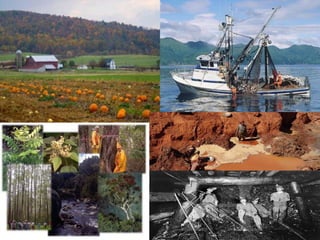
The most basic form of industry--
Taking materials from the earth that
are needed for food, clothes and
shelter.
Agriculture Fishing Forestry
Mining
Primary


Primary industry does not change
the form of natural resources.
EX: Grain & Cows
NOT
Flour & Hamburgers

In the past….
Subsistence farmers – They grew
enough to meet their own needs.
They also made their own
clothing, furniture and homes.
Farming

Some subsistence farmers actually
raised a cash crop such as rice or
corn to sell. This income usually does
NOT provide enough food for the
household.

…Later…
Agriculture revolution allowed farmers
to produce more – Commercial farmers -
raised large cash crops for profit and
others were able to pursue other trades
and
professions…..teaching, manufacturing, a
rtists…

Drought
Disease
Insect plagues
Weather
Erosion
Challenges:

Irrigation
Insecticides
Crop breeding
Modern techniques:

Nomadic Herding – common in rugged
mountains and dry areas where regular
farming is difficult.
Nomads move constantly in search of
fresh pastures.
Animal Husbandry

Many nomadic people became raiders
and conquerors.
Huns – Central Asia
Sioux – North America
Masai – East Africa
Made clothing and shelter from animal
skins
In the 18th century, Europeans
developed ranching. Landowners
let their cattle roam on big tracts
of land. In America, ranchers let
their cattle run free on “open
range” owned by the
government (no one had claim
on the land).

Fishing, forestry and mining
extract natural resources.
Fishing provides food.
Forestry provides wood for
homes, furniture and paper.
Fishing and Forestry

Seafood is the world’s second largest
export commodity, oil is the first.
Two varieties of seafood;
Fish
Seaweed

Two methods of obtaining the
seafood:
Capture – Gathered in the wild
Aquaculture – cultivation in a
controlled environment

China produces the greatest
amount of fish.
Japan consumes the largest
amount of fish.

Seafood is produced primarily
for food, but some is used to
obtain extracts used to make
fertilizers, animal food
additives, fuels, cosmetics and
wastewater treatments.

The seafood industry has come
under fire from conservation groups.
It is important to meet man’s
needs, and still protect the
environment and all species who live
in it.

Products:
Fruit – nuts, food products
Leaves - furniture polish, car wax,
crayons, lipstick, medicine,
fragrances
…
Forestry

Branches: chemicals, plastics, paper
products
Bark: medicine, mulch, dyes, shoe
polish
Trunk: furniture, musical
instruments, plywood, baseball
bats, charcoal.
…

Sap: adhesives, ice cream, hair
spray, soaps, cough
syrups, cough drops, shampoo
Stumps: wood
resin, turpentine, pine
cleaners, laundry
detergents, sports drinks.
…

Mining has surpassed
agriculture, fishing and forestry –
modern countries spend a large
amount of money on
metals, nonmetal minerals and fossil
fuels.
Mining

Solid crystals that occur
naturally and have a
definite chemical
composition.
Found in the earth’s crust.
Minerals

Metals are the most important mineral.
Properties: shiny, malleable, ductile, and
conductive.
* malleable – able to be hammered
into sheets
* ductile – able to be drawn into wire
* conductive – able to conduct
electricity
Metals

The first metal worker
was Tubal-cain, a
descendant of Cain
(Genesis 4:22)

Archeologists sometimes divide
ancient civilizations into 3 periods
that reflect man’s increasing skill
with metals:
Stone/copper
Bronze
Iron Age

Three types of metal
Precious
Common
Alloys

Precious metals such as
gold, silver, and platinum are more
valuable than other metal
products.
They are considered precious because
of their beauty, durability, and
trade value.

Common metals are mined in
great quantity from the earth’s
surface. Three have been used
since ancient times:
Copper Lead Iron

Copper is a native metal, like silver
and gold that can be found in pure
nuggets.
Once used to make weapons, but it is
very soft.
Most common current use is in the
electric industry.

Lead is extracted from an ore
called galena.
Lead was originally used by
artists to make statues.
It is now the main ingredient in
car batteries.

Aluminum is a fourth common metal
that was too difficult to separate
from its natural form of bauxite.
It is light weight and resistant to
corrosion – therefore ideal for
cars, aircraft and other machines.

The other six common metals are
chrome, manganese, zinc, nickel,
tin and tungsten are not usually
used by themselves, but
combined with one or more of
the first metals.

Alloys are formed when other
metals are combined.
Copper and tin form bronze.
Copper and zinc make brass.

Steel is the most important alloy. It is
formed by combining iron with the
carbon in coal.
Nearly all of the world’s iron ore is
now turned into steel.

Limestone – used to make
cement, mortar and concrete.
Sulfur – used to make
gunpowder and to process
petroleum and steel, to produce
fertilizer, to vulcanize rubber and
to make matches.
Non-Metal Minerals

Other minerals….
Clay, sand, granite, marble, slate,
sandstone, salt, and graphite.
Uranium was used to make the
first atomic bomb.
Nonmetal Minerals cont…

Coal, petroleum, and natural gas are not
minerals but the remains of living things.
The floodwaters trapped plants and
animals beneath layers of sedimentary
rock. The pressure changed the organic
matter into fossil fuels.
Fossil Fuels

Coal is solid rock that occurs in various
levels of quality.
Burned for heat - once used in making
coke - a necessary ingredient in steel.
Coal

Petroleum is a liquid fossil fuel.
Pitch, used by Noah, was a form
of petroleum.

Natural gas is a fossil fuel found in
gaseous form.
Fuel for furnaces, water
heaters, dryers and ovens.

Taking raw materials
and changing them into
useful form.
Two Types:
Construction & Manufacturing
Secondary

Construction
Cain built the first city – we are
uncertain what materials he used.
The first great structure mentioned is
the tower of Babel, made of brick
and mortar.

Manufacturing
Manufacturing originally meant “to
make by hand”.
Manufacturing now refers to big
business and machines that turn
raw materials into new products
on a massive scale.

Industrial Revolution – period of
radical change in modern industry.
Began in the textile industry.

Technology – the application of
science to industry.
Key breakthrough – harnessing
electricity .
Allowed industry to move away
from rivers and place factories
anywhere.
“second revolution”

Computer age.
Robotics and computers make
industry so efficient that fewer
workers are needed.
People are now free to find jobs “off
the farm and factory”…
“third revolution”

Nondurable manufacturing –
produces products that last less than
a year.
food, fuels, chemicals, tobacco
products, and more consumable
products.

Durable manufacturing – makes
products that last more than a year.
Furniture, housing materials,
machines and other equipment

Service industry – Approximately 80% of
America’s workers are employed in this type of
industry.
The more developed a country becomes, the
more of its workers move to tertiary industries.
Tertiary Industries

Infrastructure – basic energy and
equipment needs of all industries
Divided into three types:
Utilities transportation
communication

Utilities –
electricity, gas, water, trash
collection and sewage disposal
services.
90% of the world’s energy comes
from fossil fuels.

Water, land and
air.
Modes of Transportation

Print and electronic
Communication

Wholesale or retail
Trade

Finance – modern banking
– insurance – real estate –
investments
Finance

Maids, mechanics, nurses, teachers, z
ookeepers, engineers, lawyers, resea
rchers, computer programmers, and
repair technicians.
General Services

The fifth form of tertiary industry.
Policemen, lawmakers, judges, burea
ucrats, clerks, soldiers….
Government

The study of the process by
which people and countries
make choices regarding their
resources, development and
distribution of those
resources, goods and services.
Economics

The Creator owns all of the earth’s
resources. Man is merely His
steward.
Decisions for the use of His
resources should be considered in
light of that fact.

Governments of the world are
generally classified as
capitalist, socialist, or mixed
economies.

Most of the western countries
follow a system of capitalism.
This means that private
individuals or corporations build
most industry and risk their own
capital.
Capitalists

Capital – Money and equipment necessary to
build industries.
Free market – anyone can start a business and
attempt to make a profit.
Entrepreneurs – people who take a risk to start
a business.

The government owns the major
industries and promises to make
decisions for the good of everyone. The
government controls all aspects of the
business.
Socialism

Communism is the most extreme form of
socialism. The government owns
everything.

Most of the socialist governments
that collapsed in the late 80’s and
early 90’s have attempted to combine
both economies. Private citizens can
own property and businesses, but
the government closely regulates
their choices.
Mixed Economies

Wealth is the ability to produce new
things.
The most common way to measure the
wealth of a country is the Gross Domestic
Product (GPD).

The GPD is the monetary value
of ALL the goods and services
produced for sale within a
country’s borders over the course
of a year.

A more meaningful measure is a per
capita GPD.
This is the average value of products
produced by each person in the
country.

A high per capita GPD does not
mean that a country has a lot of
industry or that the average
worker makes a lot of money.

Development – the
effective use of raw
materials, labor, and
capital.

Countries with productive
economies can afford to buy
weapons and influence neighbors
with their money. The leaders of
these eight countries – Group 8 or G8
- meet in a different country every
year to resolve economic and
political disputes.

The G8 countries are developed countries
with a wide variety of industry.
China and several other big nations are
not included in the G8. They have a high
GDP, but they are considered
“developing countries.”

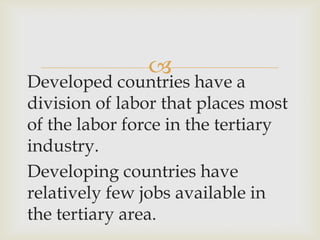
Developed countries have a
division of labor that places most
of the labor force in the tertiary
industry.
Developing countries have
relatively few jobs available in
the tertiary area.

For a government to be a fair and
stable, it must be good.
In Proverbs, God states that rulers
who obey His law will enjoy stability
and peace. (Proverbs 16:12; 20:28;
25:5; 28:2; 29:4,14)

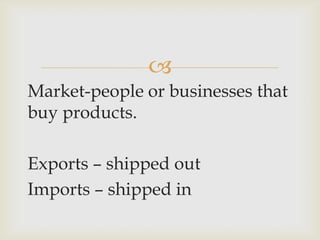
Market-people or businesses that
buy products.
Exports – shipped out
Imports – shipped in

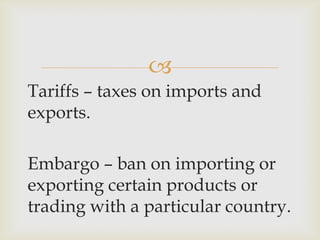
Tariffs – taxes on imports and
exports.
Embargo – ban on importing or
exporting certain products or
trading with a particular country.

Protectionism – the belief that the
government should restrict foreign
imports because they take away domestic
jobs.
Free trade – imposing no or low
tariffs…retailers have the freedom to sell
any product the consumers want.

Geography chapter 3

  • 1.
    Industry: Mankind’s useof God’s Resources
  • 2.
     One part ofthe Creation Mandate to Adam is control over every animal and every plant. God intended Adam to be the caretaker of the world that He had created. God intends for man to make the world more productive and more beautiful.
  • 3.
     Industry Industry – oftendescribed as man’s “hard work” to make a living. Industry is either primary, secondary, or tertiary.
  • 4.
     The most basicform of industry-- Taking materials from the earth that are needed for food, clothes and shelter. Agriculture Fishing Forestry Mining Primary
  • 5.
  • 6.
     Primary industry doesnot change the form of natural resources. EX: Grain & Cows NOT Flour & Hamburgers
  • 7.
     In the past…. Subsistencefarmers – They grew enough to meet their own needs. They also made their own clothing, furniture and homes. Farming
  • 8.
     Some subsistence farmersactually raised a cash crop such as rice or corn to sell. This income usually does NOT provide enough food for the household.
  • 9.
     …Later… Agriculture revolution allowedfarmers to produce more – Commercial farmers - raised large cash crops for profit and others were able to pursue other trades and professions…..teaching, manufacturing, a rtists…
  • 10.
  • 11.
  • 12.
     Nomadic Herding –common in rugged mountains and dry areas where regular farming is difficult. Nomads move constantly in search of fresh pastures. Animal Husbandry
  • 13.
     Many nomadic peoplebecame raiders and conquerors. Huns – Central Asia Sioux – North America Masai – East Africa Made clothing and shelter from animal skins
  • 14.
    In the 18thcentury, Europeans developed ranching. Landowners let their cattle roam on big tracts of land. In America, ranchers let their cattle run free on “open range” owned by the government (no one had claim on the land).
  • 15.
     Fishing, forestry andmining extract natural resources. Fishing provides food. Forestry provides wood for homes, furniture and paper. Fishing and Forestry
  • 16.
     Seafood is theworld’s second largest export commodity, oil is the first. Two varieties of seafood; Fish Seaweed
  • 17.
     Two methods ofobtaining the seafood: Capture – Gathered in the wild Aquaculture – cultivation in a controlled environment
  • 18.
     China produces thegreatest amount of fish. Japan consumes the largest amount of fish.
  • 19.
     Seafood is producedprimarily for food, but some is used to obtain extracts used to make fertilizers, animal food additives, fuels, cosmetics and wastewater treatments.
  • 20.
     The seafood industryhas come under fire from conservation groups. It is important to meet man’s needs, and still protect the environment and all species who live in it.
  • 21.
     Products: Fruit – nuts,food products Leaves - furniture polish, car wax, crayons, lipstick, medicine, fragrances … Forestry
  • 22.
     Branches: chemicals, plastics,paper products Bark: medicine, mulch, dyes, shoe polish Trunk: furniture, musical instruments, plywood, baseball bats, charcoal. …
  • 23.
     Sap: adhesives, icecream, hair spray, soaps, cough syrups, cough drops, shampoo Stumps: wood resin, turpentine, pine cleaners, laundry detergents, sports drinks. …
  • 24.
     Mining has surpassed agriculture,fishing and forestry – modern countries spend a large amount of money on metals, nonmetal minerals and fossil fuels. Mining
  • 25.
     Solid crystals thatoccur naturally and have a definite chemical composition. Found in the earth’s crust. Minerals
  • 26.
     Metals are themost important mineral. Properties: shiny, malleable, ductile, and conductive. * malleable – able to be hammered into sheets * ductile – able to be drawn into wire * conductive – able to conduct electricity Metals
  • 27.
     The first metalworker was Tubal-cain, a descendant of Cain (Genesis 4:22)
  • 28.
     Archeologists sometimes divide ancientcivilizations into 3 periods that reflect man’s increasing skill with metals: Stone/copper Bronze Iron Age
  • 29.
     Three types ofmetal Precious Common Alloys
  • 30.
     Precious metals suchas gold, silver, and platinum are more valuable than other metal products. They are considered precious because of their beauty, durability, and trade value.
  • 31.
     Common metals aremined in great quantity from the earth’s surface. Three have been used since ancient times: Copper Lead Iron
  • 32.
     Copper is anative metal, like silver and gold that can be found in pure nuggets. Once used to make weapons, but it is very soft. Most common current use is in the electric industry.
  • 33.
     Lead is extractedfrom an ore called galena. Lead was originally used by artists to make statues. It is now the main ingredient in car batteries.
  • 34.
     Aluminum is afourth common metal that was too difficult to separate from its natural form of bauxite. It is light weight and resistant to corrosion – therefore ideal for cars, aircraft and other machines.
  • 35.
     The other sixcommon metals are chrome, manganese, zinc, nickel, tin and tungsten are not usually used by themselves, but combined with one or more of the first metals.
  • 36.
     Alloys are formedwhen other metals are combined. Copper and tin form bronze. Copper and zinc make brass.
  • 37.
     Steel is themost important alloy. It is formed by combining iron with the carbon in coal. Nearly all of the world’s iron ore is now turned into steel.
  • 38.
     Limestone – usedto make cement, mortar and concrete. Sulfur – used to make gunpowder and to process petroleum and steel, to produce fertilizer, to vulcanize rubber and to make matches. Non-Metal Minerals
  • 39.
     Other minerals…. Clay, sand,granite, marble, slate, sandstone, salt, and graphite. Uranium was used to make the first atomic bomb. Nonmetal Minerals cont…
  • 40.
     Coal, petroleum, andnatural gas are not minerals but the remains of living things. The floodwaters trapped plants and animals beneath layers of sedimentary rock. The pressure changed the organic matter into fossil fuels. Fossil Fuels
  • 41.
     Coal is solidrock that occurs in various levels of quality. Burned for heat - once used in making coke - a necessary ingredient in steel. Coal
  • 42.
     Petroleum is aliquid fossil fuel. Pitch, used by Noah, was a form of petroleum.
  • 43.
     Natural gas isa fossil fuel found in gaseous form. Fuel for furnaces, water heaters, dryers and ovens.
  • 44.
     Taking raw materials andchanging them into useful form. Two Types: Construction & Manufacturing Secondary
  • 45.
     Construction Cain built thefirst city – we are uncertain what materials he used. The first great structure mentioned is the tower of Babel, made of brick and mortar.
  • 46.
     Manufacturing Manufacturing originally meant“to make by hand”. Manufacturing now refers to big business and machines that turn raw materials into new products on a massive scale.
  • 47.
     Industrial Revolution –period of radical change in modern industry. Began in the textile industry.
  • 48.
     Technology – theapplication of science to industry. Key breakthrough – harnessing electricity . Allowed industry to move away from rivers and place factories anywhere. “second revolution”
  • 49.
     Computer age. Robotics andcomputers make industry so efficient that fewer workers are needed. People are now free to find jobs “off the farm and factory”… “third revolution”
  • 50.
     Nondurable manufacturing – producesproducts that last less than a year. food, fuels, chemicals, tobacco products, and more consumable products.
  • 51.
     Durable manufacturing –makes products that last more than a year. Furniture, housing materials, machines and other equipment
  • 52.
     Service industry –Approximately 80% of America’s workers are employed in this type of industry. The more developed a country becomes, the more of its workers move to tertiary industries. Tertiary Industries
  • 53.
     Infrastructure – basicenergy and equipment needs of all industries Divided into three types: Utilities transportation communication
  • 54.
     Utilities – electricity, gas,water, trash collection and sewage disposal services. 90% of the world’s energy comes from fossil fuels.
  • 55.
  • 56.
  • 57.
  • 58.
     Finance – modernbanking – insurance – real estate – investments Finance
  • 59.
     Maids, mechanics, nurses,teachers, z ookeepers, engineers, lawyers, resea rchers, computer programmers, and repair technicians. General Services
  • 60.
     The fifth formof tertiary industry. Policemen, lawmakers, judges, burea ucrats, clerks, soldiers…. Government
  • 61.
     The study ofthe process by which people and countries make choices regarding their resources, development and distribution of those resources, goods and services. Economics
  • 62.
     The Creator ownsall of the earth’s resources. Man is merely His steward. Decisions for the use of His resources should be considered in light of that fact.
  • 63.
     Governments of theworld are generally classified as capitalist, socialist, or mixed economies.
  • 64.
     Most of thewestern countries follow a system of capitalism. This means that private individuals or corporations build most industry and risk their own capital. Capitalists
  • 65.
     Capital – Moneyand equipment necessary to build industries. Free market – anyone can start a business and attempt to make a profit. Entrepreneurs – people who take a risk to start a business.
  • 66.
     The government ownsthe major industries and promises to make decisions for the good of everyone. The government controls all aspects of the business. Socialism
  • 67.
     Communism is themost extreme form of socialism. The government owns everything.
  • 68.
     Most of thesocialist governments that collapsed in the late 80’s and early 90’s have attempted to combine both economies. Private citizens can own property and businesses, but the government closely regulates their choices. Mixed Economies
  • 69.
     Wealth is theability to produce new things. The most common way to measure the wealth of a country is the Gross Domestic Product (GPD).
  • 70.
     The GPD isthe monetary value of ALL the goods and services produced for sale within a country’s borders over the course of a year.
  • 71.
     A more meaningfulmeasure is a per capita GPD. This is the average value of products produced by each person in the country.
  • 72.
     A high percapita GPD does not mean that a country has a lot of industry or that the average worker makes a lot of money.
  • 73.
     Development – the effectiveuse of raw materials, labor, and capital.
  • 74.
     Countries with productive economiescan afford to buy weapons and influence neighbors with their money. The leaders of these eight countries – Group 8 or G8 - meet in a different country every year to resolve economic and political disputes.
  • 75.
     The G8 countriesare developed countries with a wide variety of industry. China and several other big nations are not included in the G8. They have a high GDP, but they are considered “developing countries.”
  • 76.
     Developed countries havea division of labor that places most of the labor force in the tertiary industry. Developing countries have relatively few jobs available in the tertiary area.
  • 77.
     For a governmentto be a fair and stable, it must be good. In Proverbs, God states that rulers who obey His law will enjoy stability and peace. (Proverbs 16:12; 20:28; 25:5; 28:2; 29:4,14)
  • 78.
     Market-people or businessesthat buy products. Exports – shipped out Imports – shipped in
  • 79.
     Tariffs – taxeson imports and exports. Embargo – ban on importing or exporting certain products or trading with a particular country.
  • 80.
     Protectionism – thebelief that the government should restrict foreign imports because they take away domestic jobs. Free trade – imposing no or low tariffs…retailers have the freedom to sell any product the consumers want.