Quarter 1 Week
3
Subtitle
2 11/10/2024 Add a footer
Learning Objectives:
The learners shall be able to :
1. Explain how substance changes its state from solid to liquid to gas
by analyzing particle behavior and the influence of temperature;
and
2. Demonstrate understanding of changes of state: solid liquid
vapor and vice versa
3 11/10/2024 Add a footer
Short review: Kinetic Molecular Theory
What is the kinetic molecular theory?
The kinetic-molecular theory explains the states of
matter, and is based on the idea that matter is
composed of tiny particles that are always in
motion. This theory helps explain observable
properties and behaviors of solids, liquids,
and gases.
What are the movements of particles in solid? In liquid? In gas?
In solids, particles vibrate in fixed positions, while in
liquids, they move more freely but are still close
together. And in gases, particles move rapidly and
4 11/10/2024 Add a footer
Short review: Kinetic Molecular Theory
5 11/10/2024 Add a footer
Unlocking Content Vocabulary
Instruction:
1. Each group will take turns selecting a vocabulary term
from the table.
2. Without revealing the term, one from your group will
read the definition aloud to your teammates.
3. The group must then discuss and decide which term
from the table matches the given definition.
4. Once a match is chosen, your group will turn over the
selected card to reveal the vocabulary term.
5. If the match is correct, your group earns a point. If
incorrect, return the card to its original position. No
point is awarded.
6 11/10/2024 Add a footer
Discussion:
1. Which terms did you find challenging?
7 11/10/2024 Add a footer
Particle – a small portion of matter
Solid - firm and stable in shape
Liquid – a substance that flows freely
but is of constant volume, having a
consistency like that of water or oil
Gas – a substance which has no fixed
shape and no fixed volume
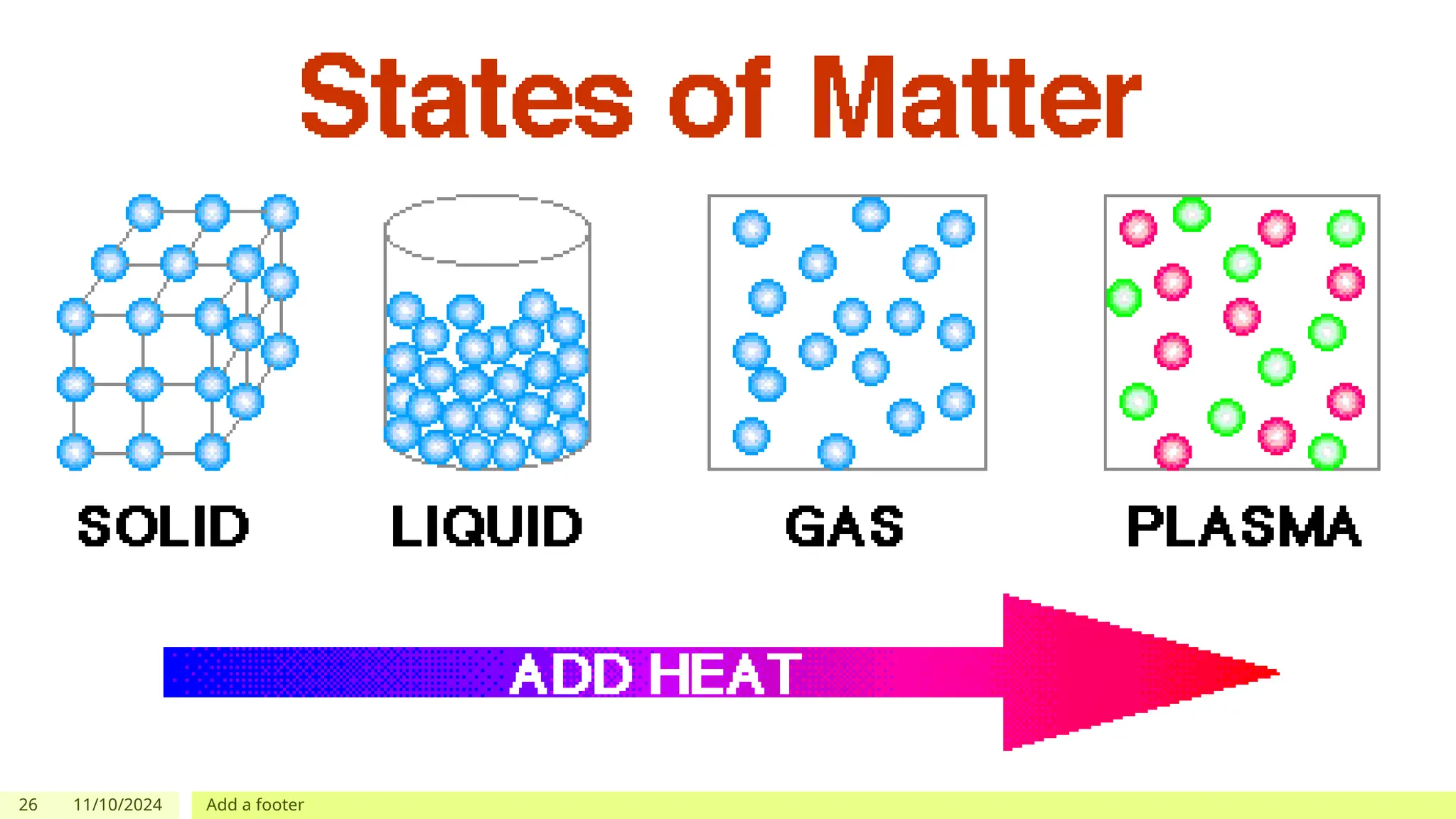
Plasma – a gas-like substance consisting
of particles such as positive ion and
electrons
8 11/10/2024 Add a footer
Discussion:
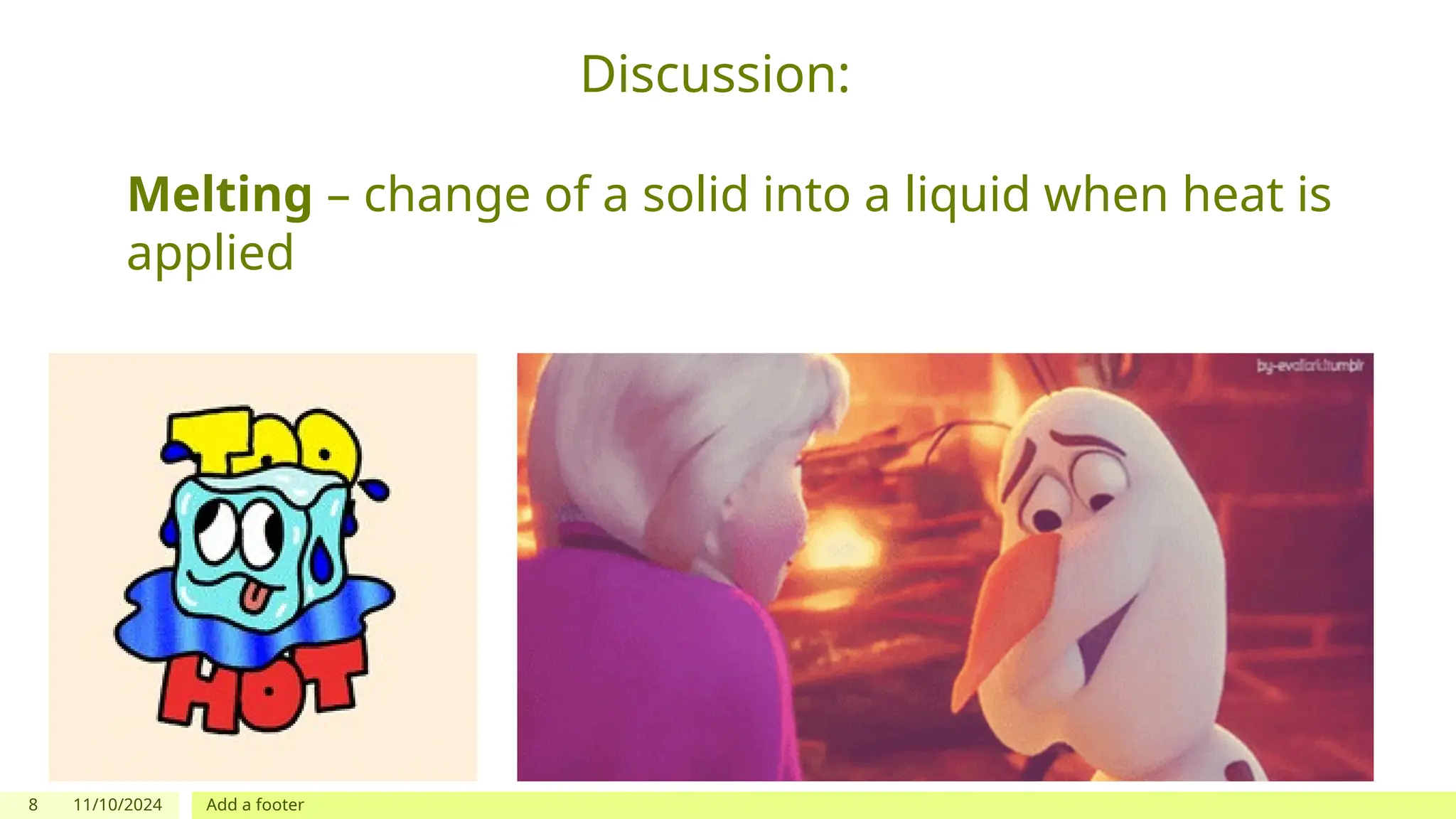
Melting – change of a solid into a liquid when heat is
applied
9 11/10/2024 Add a footer
Discussion:
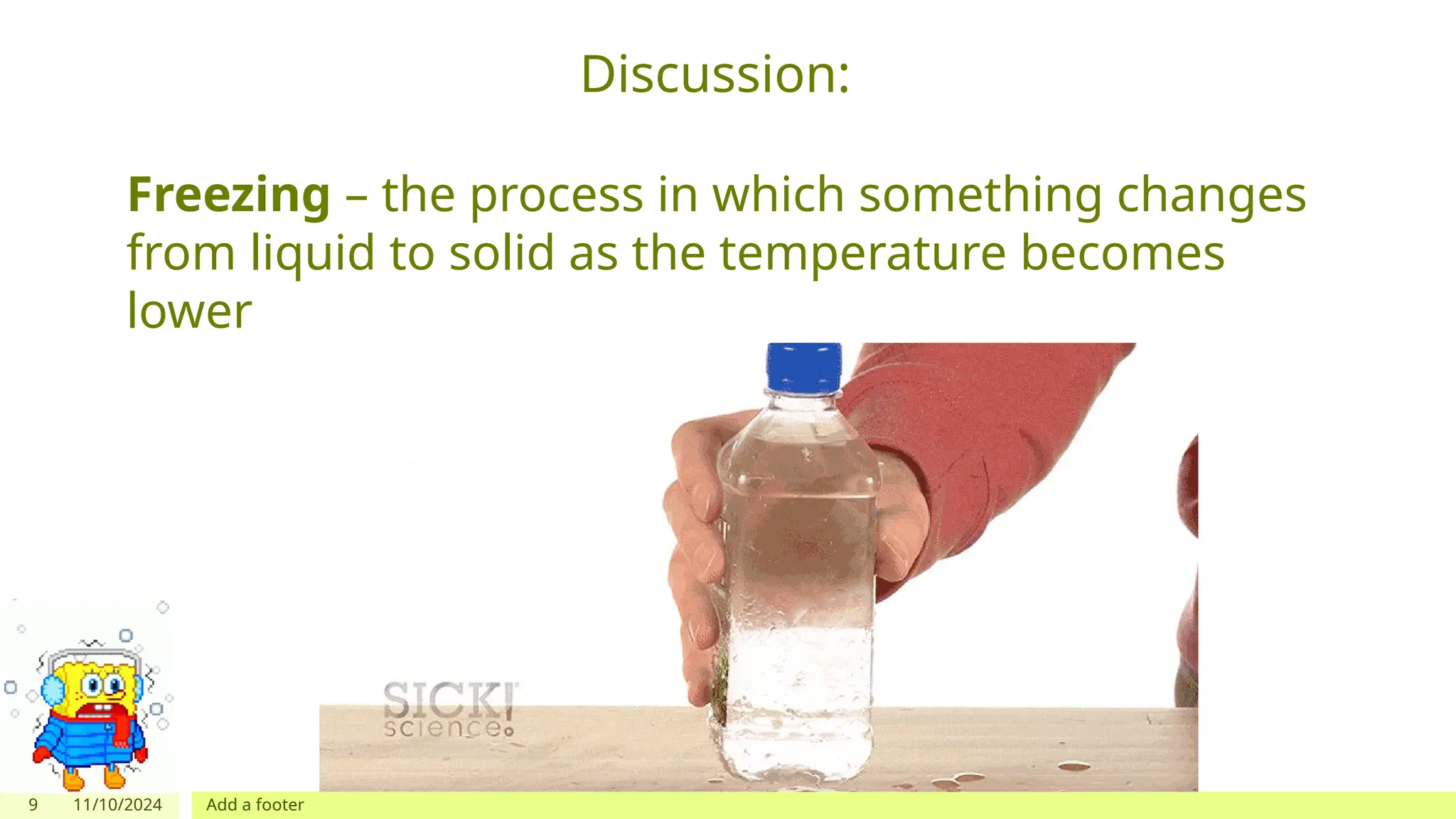
Freezing – the process in which something changes
from liquid to solid as the temperature becomes
lower
10 11/10/2024 Add a footer
Discussion:
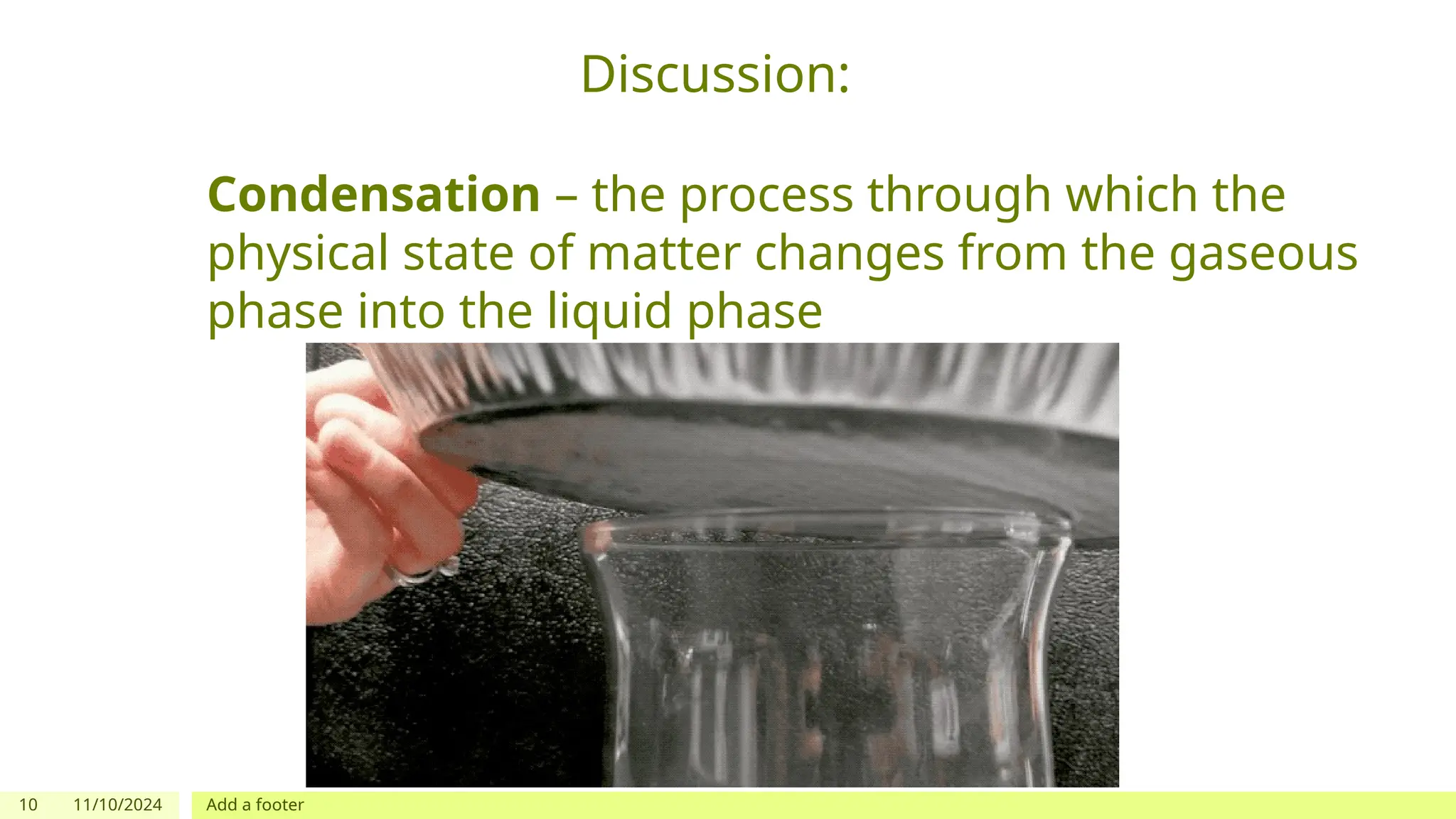
Condensation – the process through which the
physical state of matter changes from the gaseous
phase into the liquid phase
11 11/10/2024 Add a footer
Discussion:
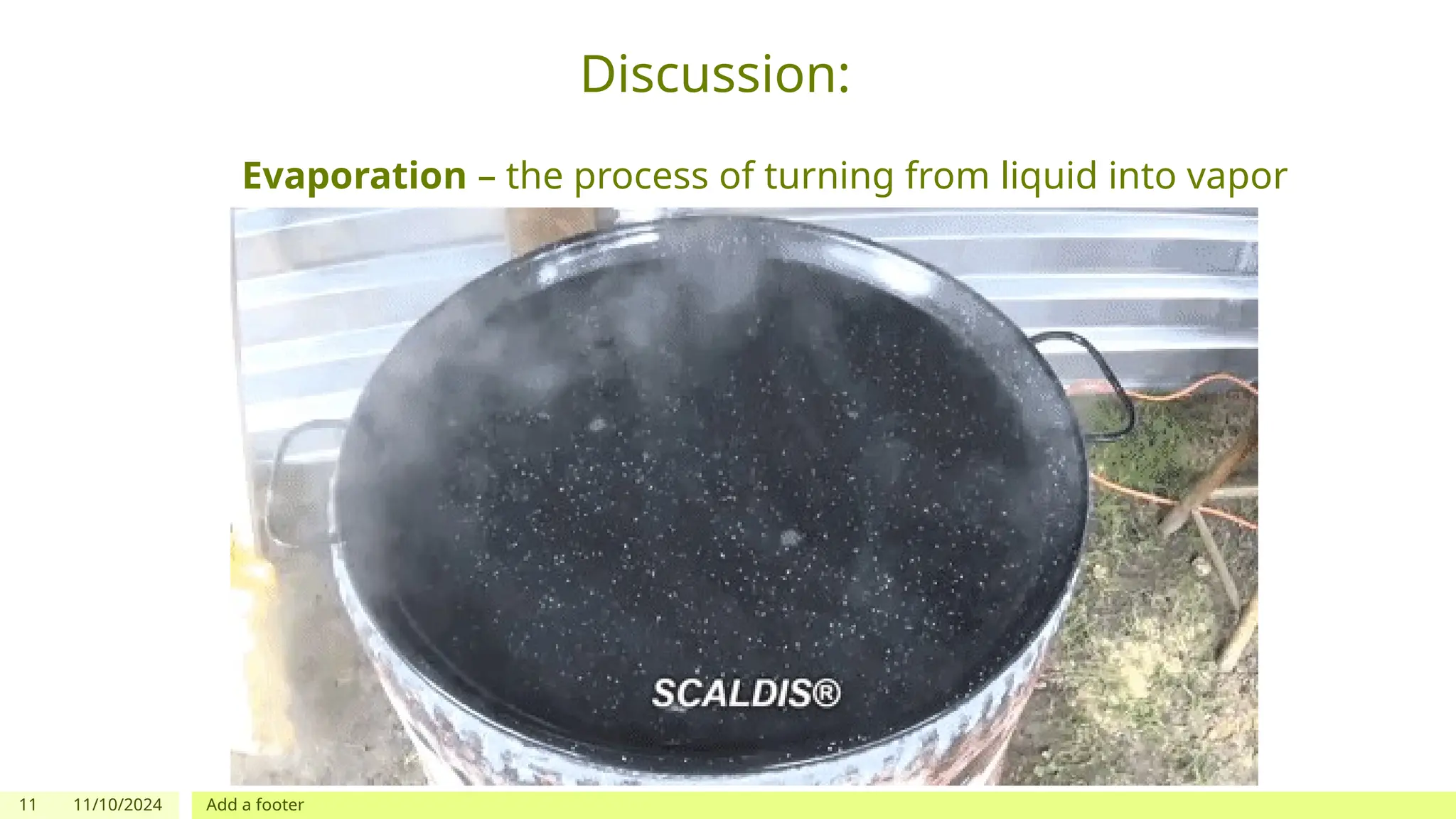
Evaporation – the process of turning from liquid into vapor
12 11/10/2024 Add a footer
Discussion:
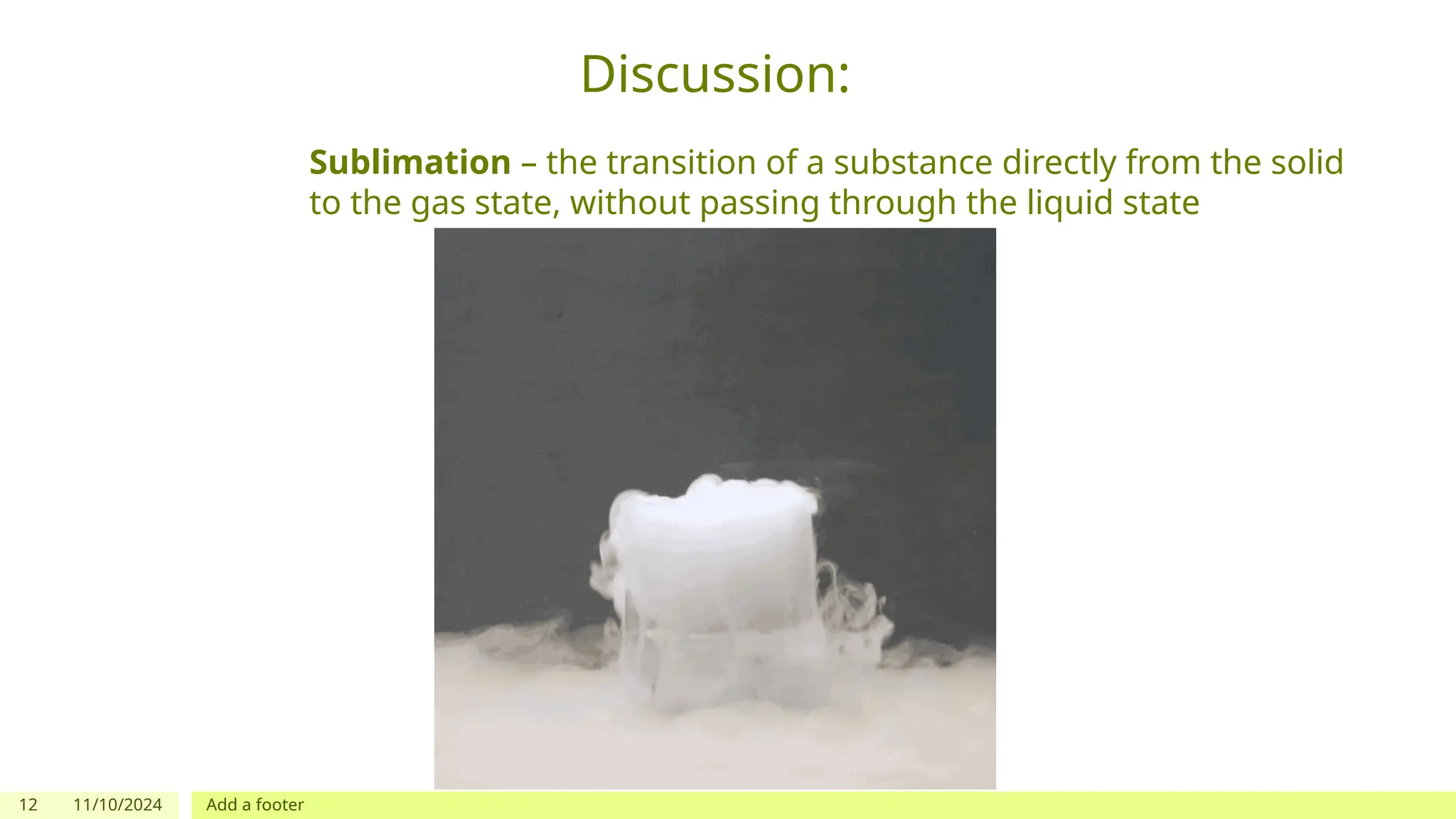
Sublimation – the transition of a substance directly from the solid
to the gas state, without passing through the liquid state
13 11/10/2024 Add a footer
Discussion:
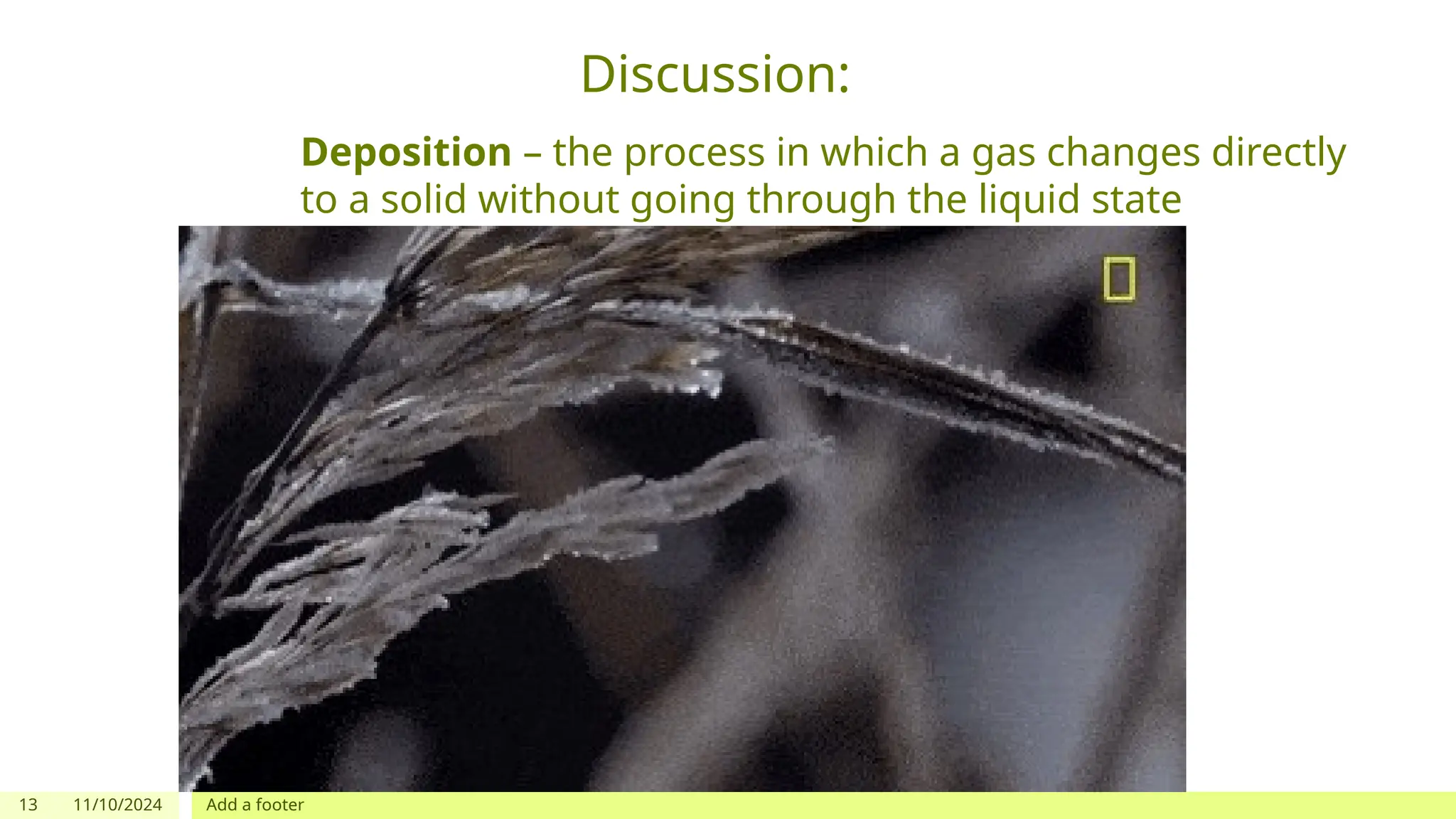
Deposition – the process in which a gas changes directly
to a solid without going through the liquid state
14 11/10/2024 Add a footer
Discussion:
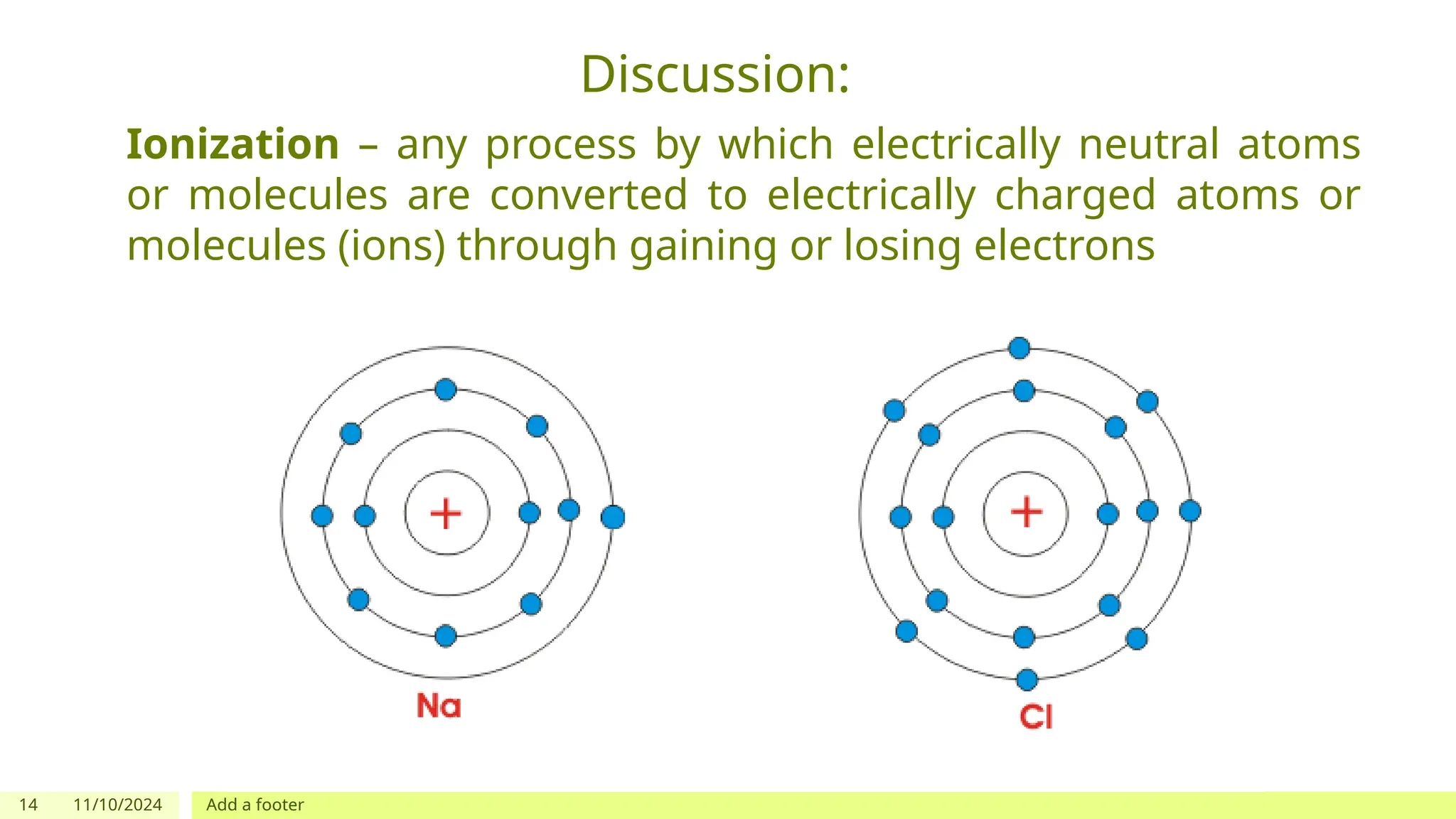
Ionization – any process by which electrically neutral atoms
or molecules are converted to electrically charged atoms or
molecules (ions) through gaining or losing electrons
Explicitation
16 11/10/2024 Add a footer
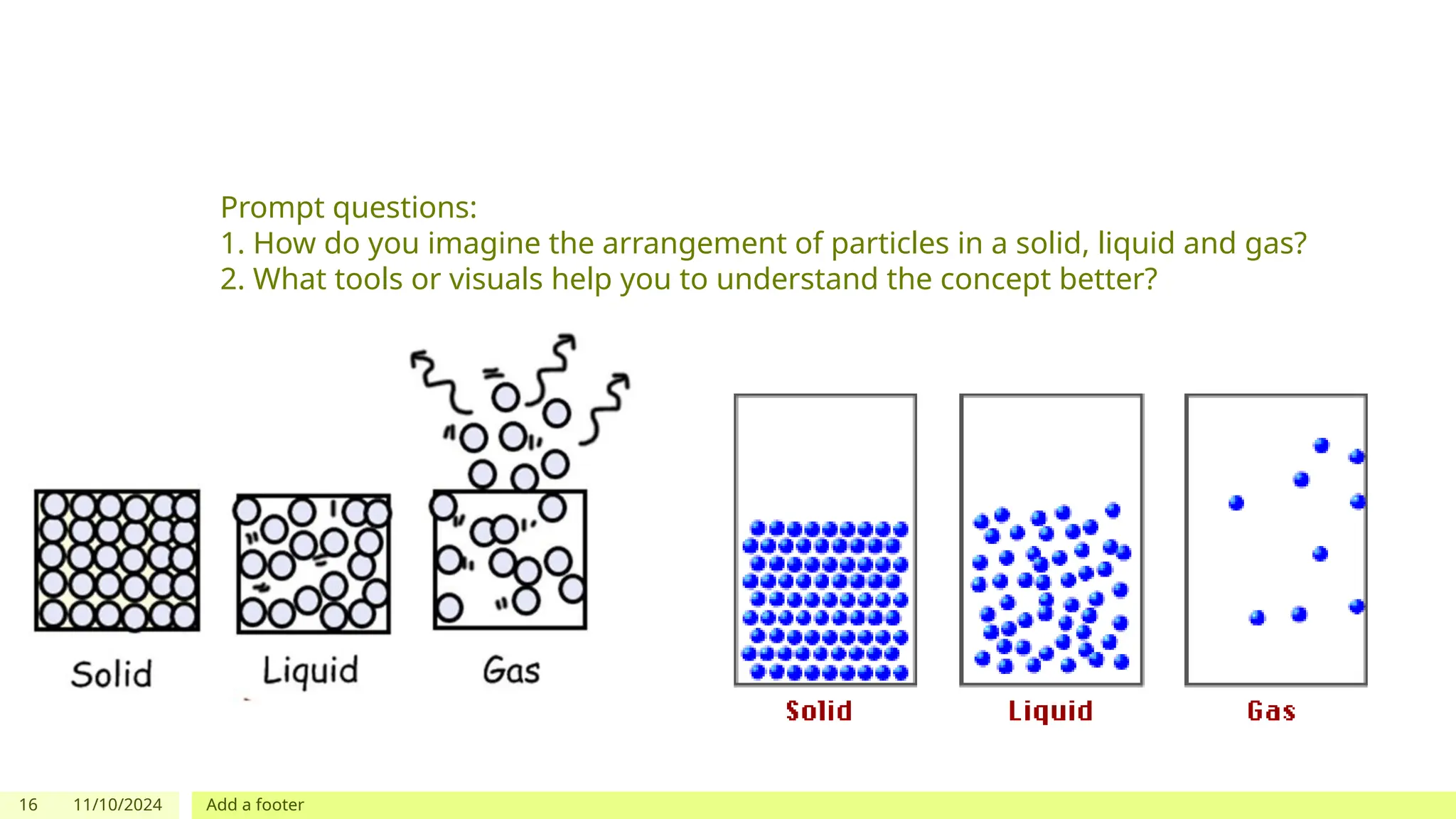
Prompt questions:
1. How do you imagine the arrangement of particles in a solid, liquid and gas?
2. What tools or visuals help you to understand the concept better?
Changes of State:
Solid to Liquid to
Gas
18 11/10/2024 Add a footer
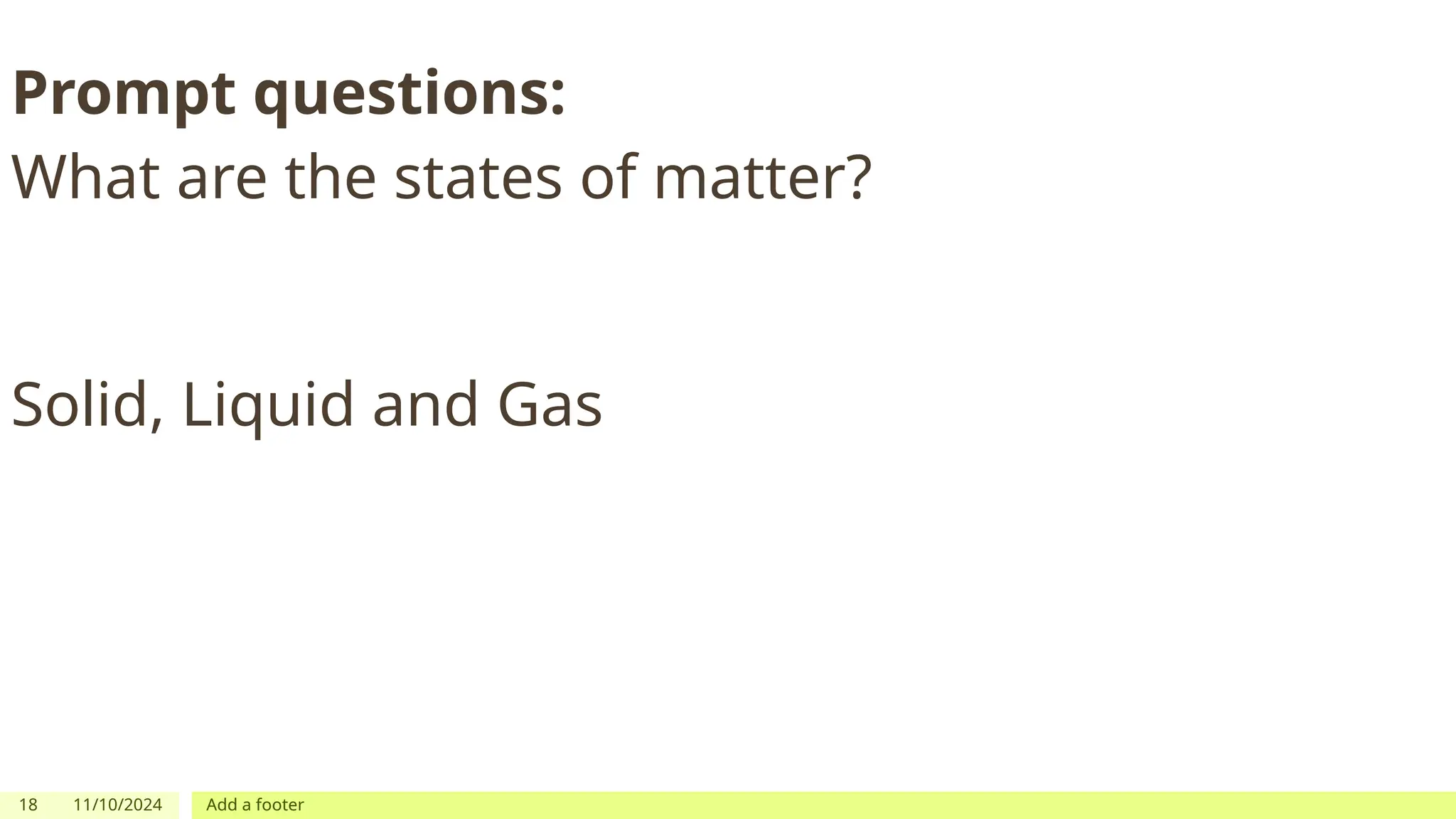
Prompt questions:
What are the states of matter?
Solid, Liquid and Gas
19 11/10/2024 Add a footer
Prompt questions:
How do particles behave in solids? Liquids?
Gases?
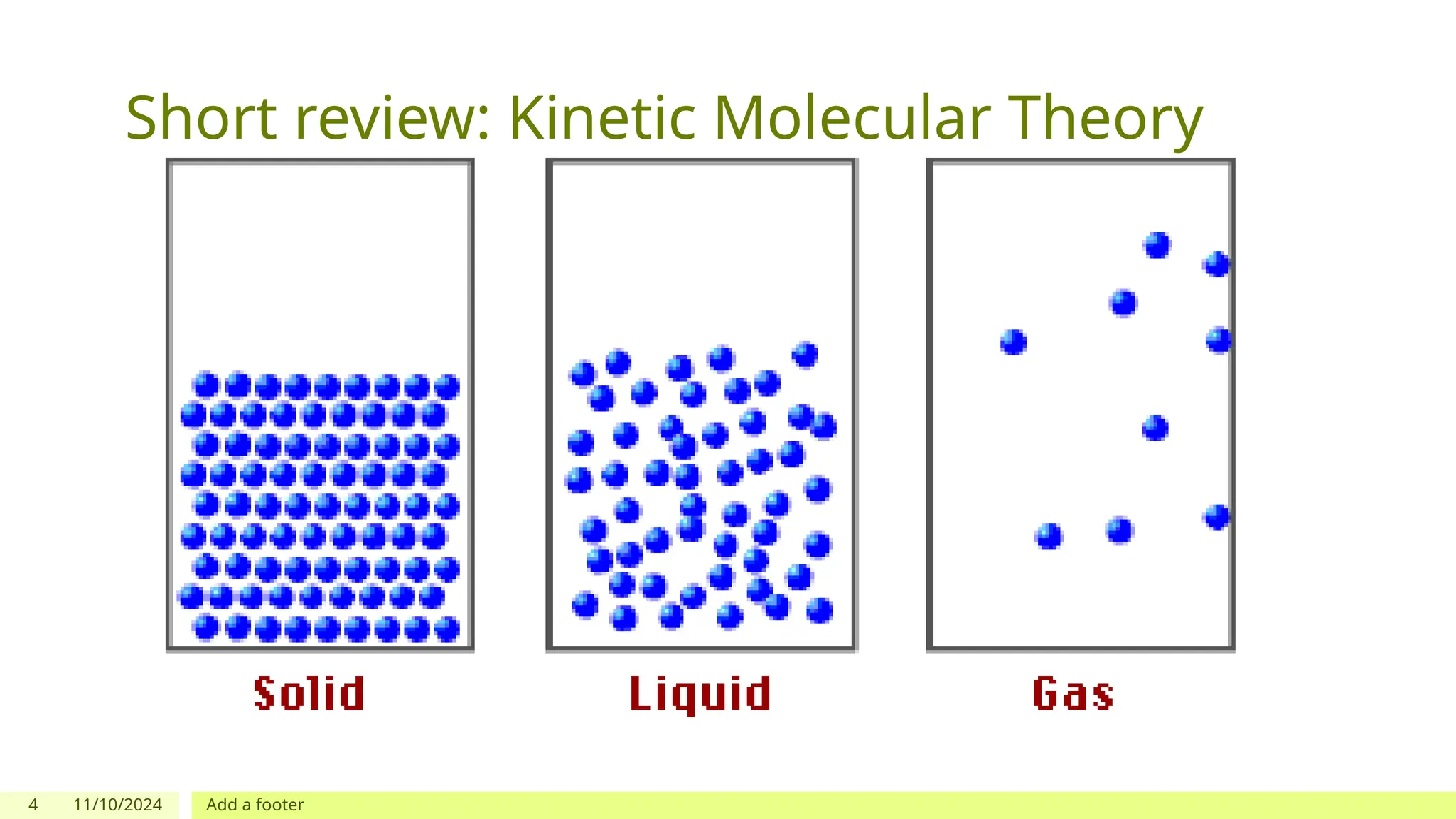
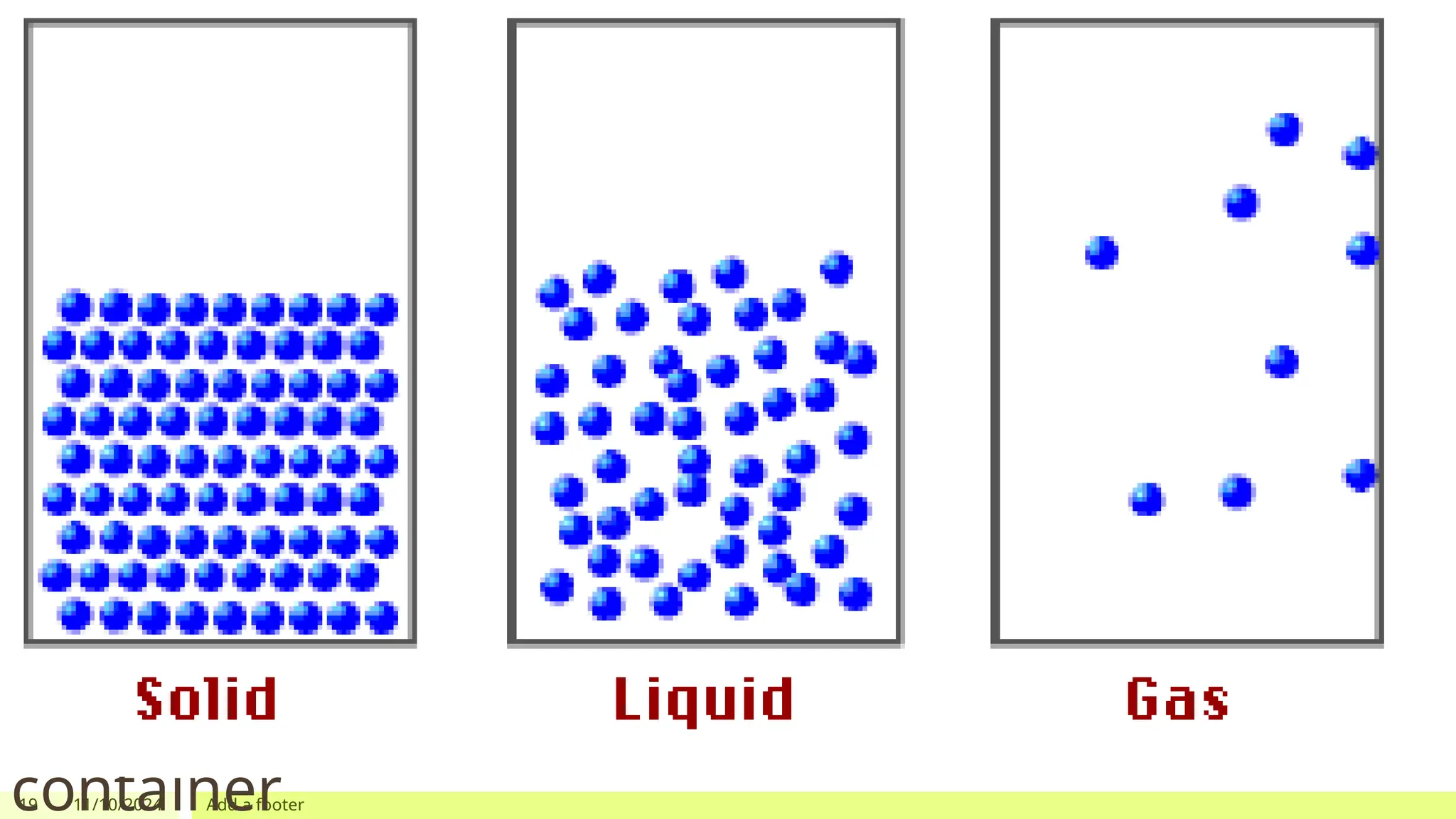
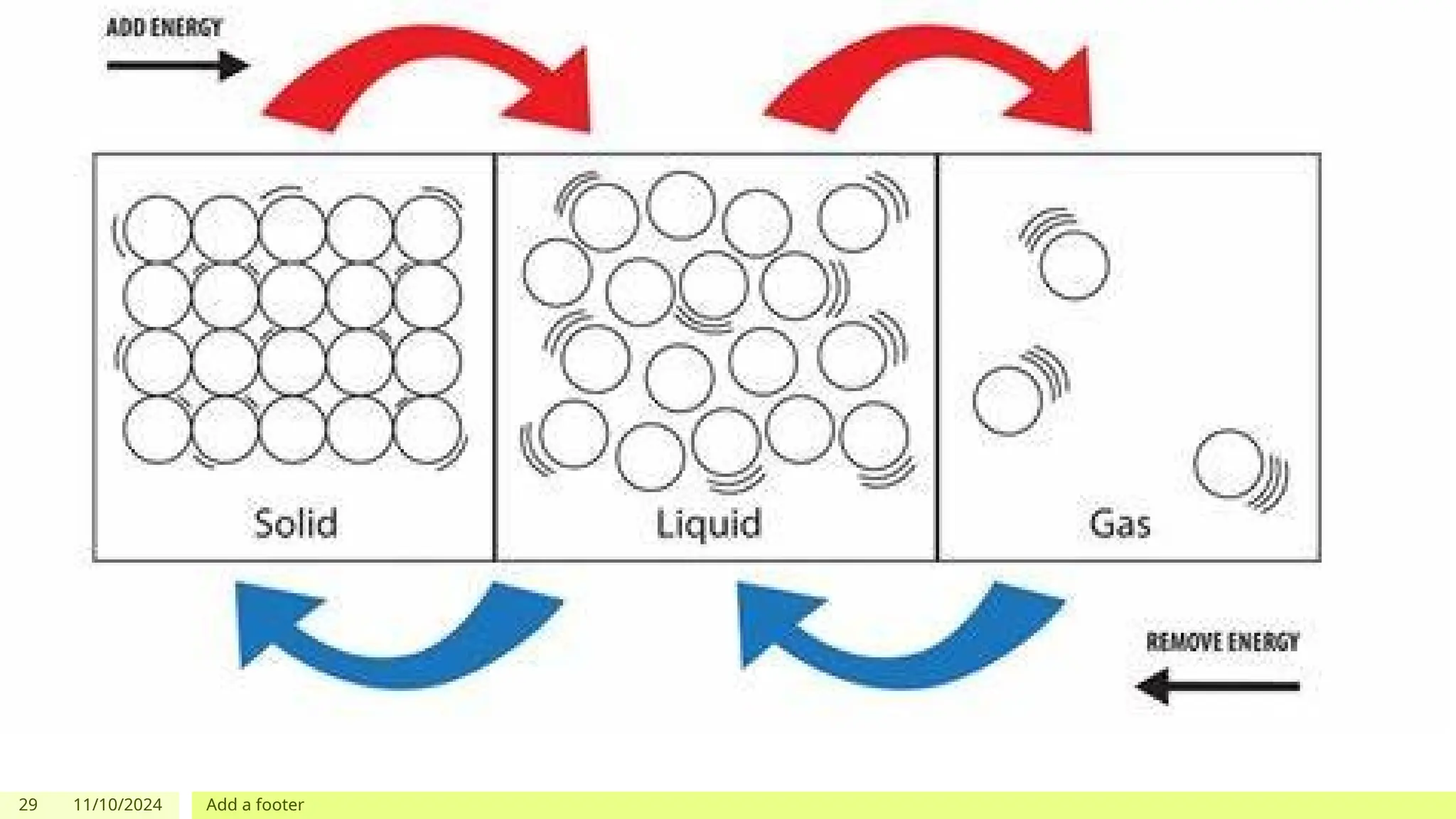
In solid, the particles pack together as tightly as
possible in a neat and ordered arrangement
In liquid, particles are quite close together and
move with random motion throughout the
container
In gas, move rapidly in all directions, frequently
colliding with each other and the side of the
container
20 11/10/2024 Add a footer
Prompt questions:
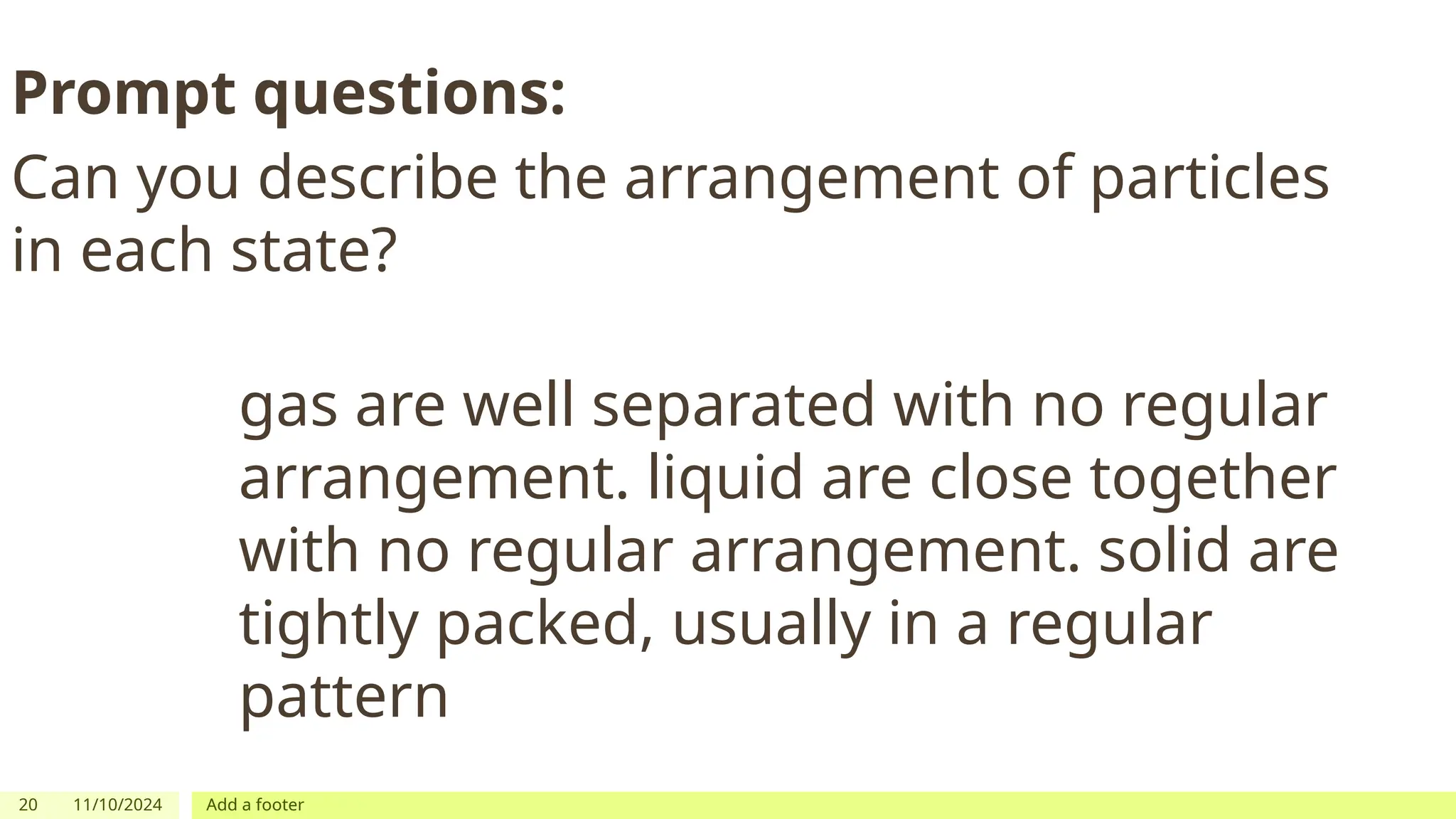
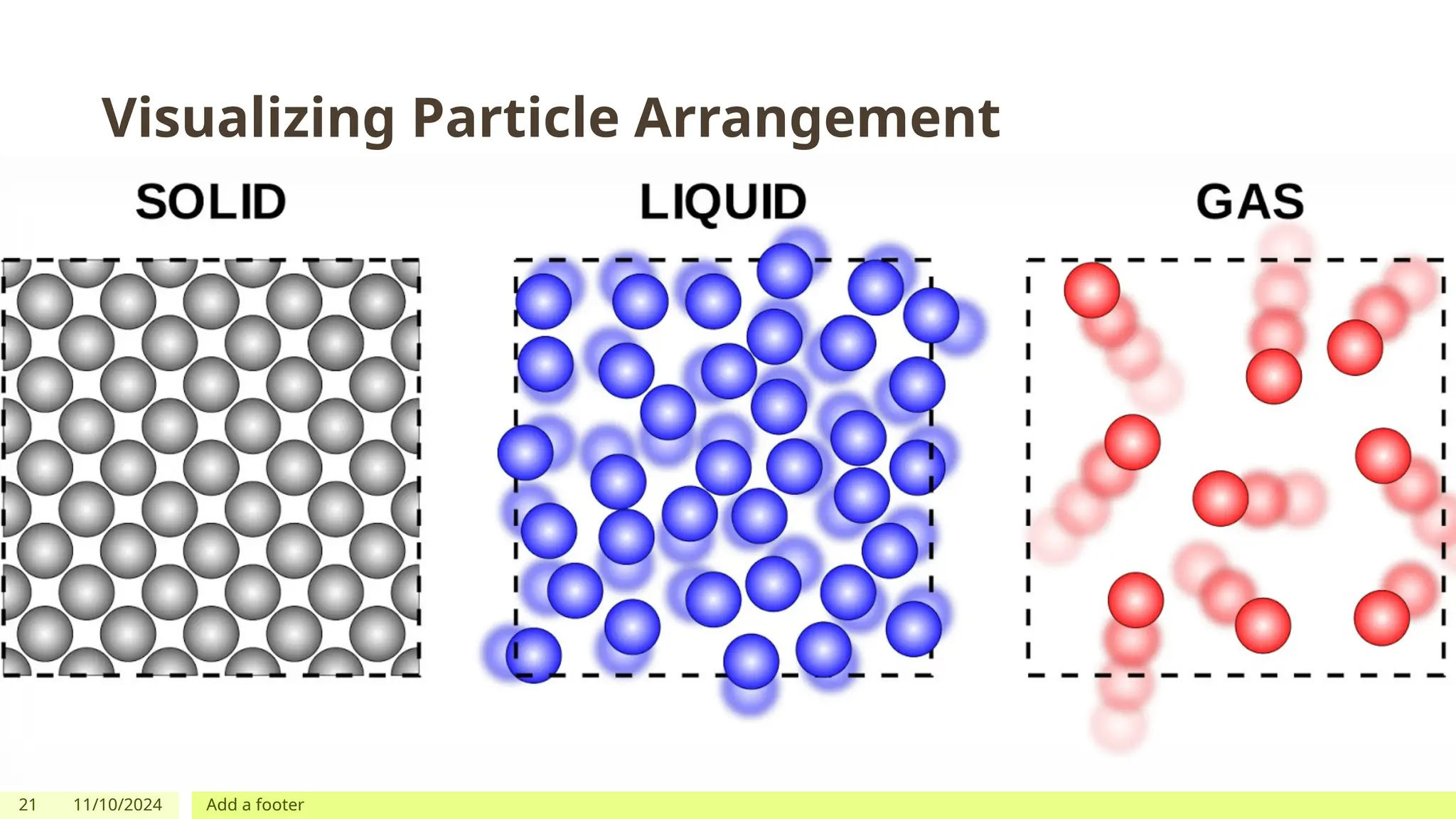
Can you describe the arrangement of particles
in each state?
gas are well separated with no regular
arrangement. liquid are close together
with no regular arrangement. solid are
tightly packed, usually in a regular
pattern
21 11/10/2024 Add a footer
Visualizing Particle Arrangement
22 11/10/2024 Add a footer
Key
concepts:
Solid: Particles are tightly packed together in a
rigid structure, with minimal movement.
Imagine marbles jammed close together in a
box.
Liquid: Particles are still close but have some
freedom of movement, allowing them to slide
past each other. Think of marbles in a bowl,
able to move and change positions.
Gas: Particles are spread out far apart with the
most freedom of movement. Imagine marbles
23 11/10/2024 Add a footer
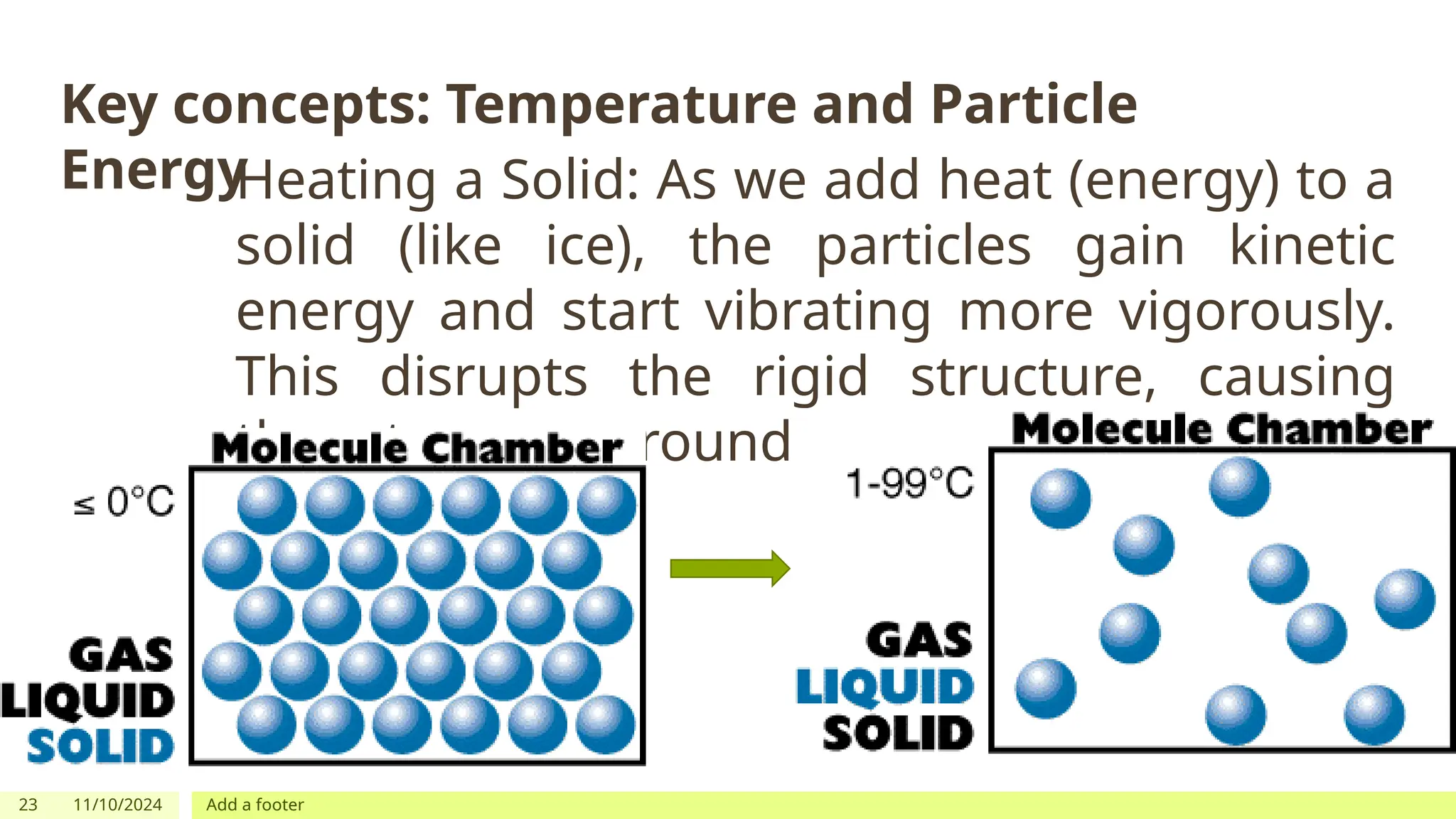
Key concepts: Temperature and Particle
Energy
Heating a Solid: As we add heat (energy) to a
solid (like ice), the particles gain kinetic
energy and start vibrating more vigorously.
This disrupts the rigid structure, causing
them to move around more.
24 11/10/2024 Add a footer
Key concepts: Temperature and Particle
Energy
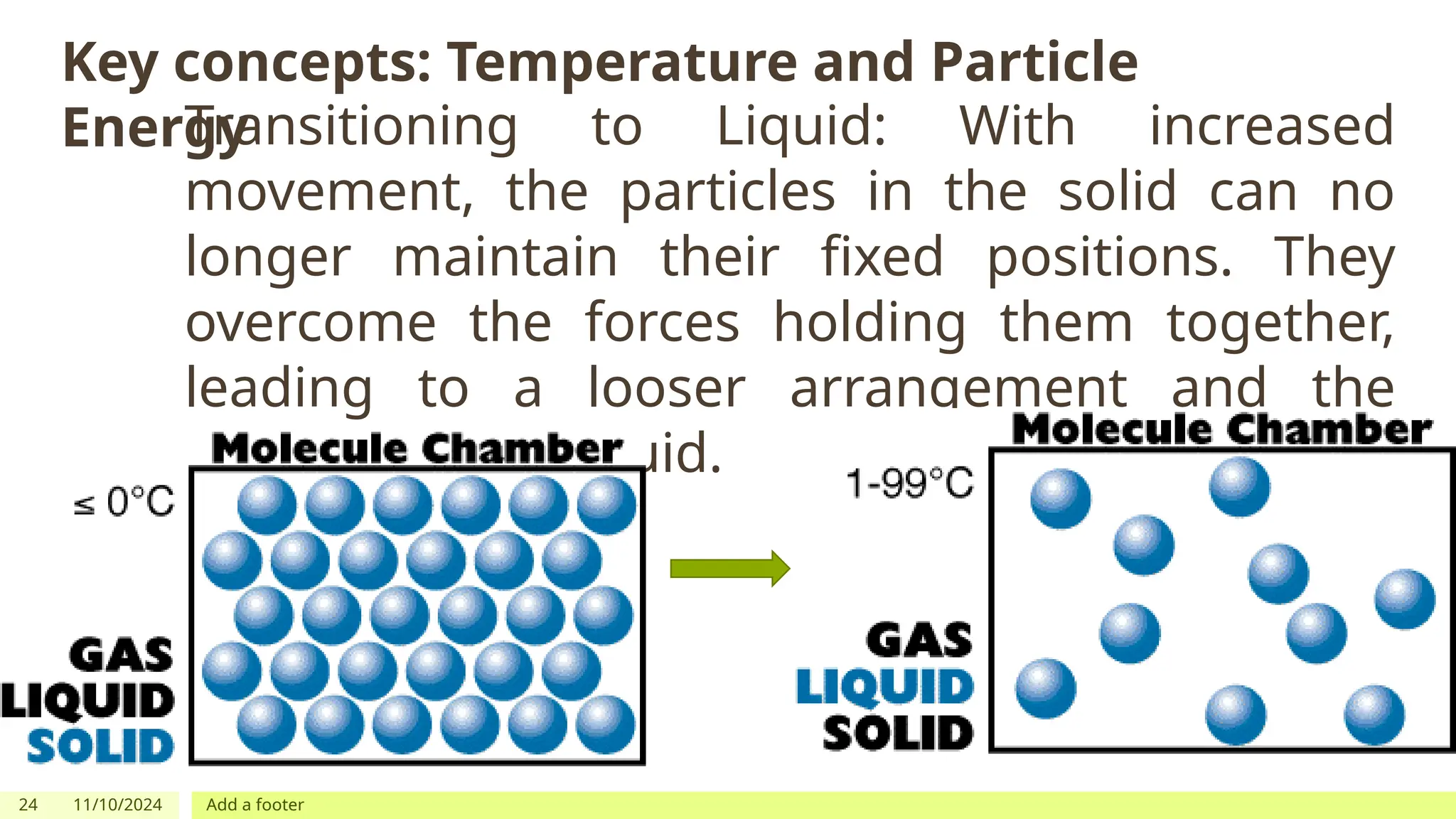
Transitioning to Liquid: With increased
movement, the particles in the solid can no
longer maintain their fixed positions. They
overcome the forces holding them together,
leading to a looser arrangement and the
formation of a liquid.
25 11/10/2024 Add a footer
Key concepts: Temperature and Particle
Energy
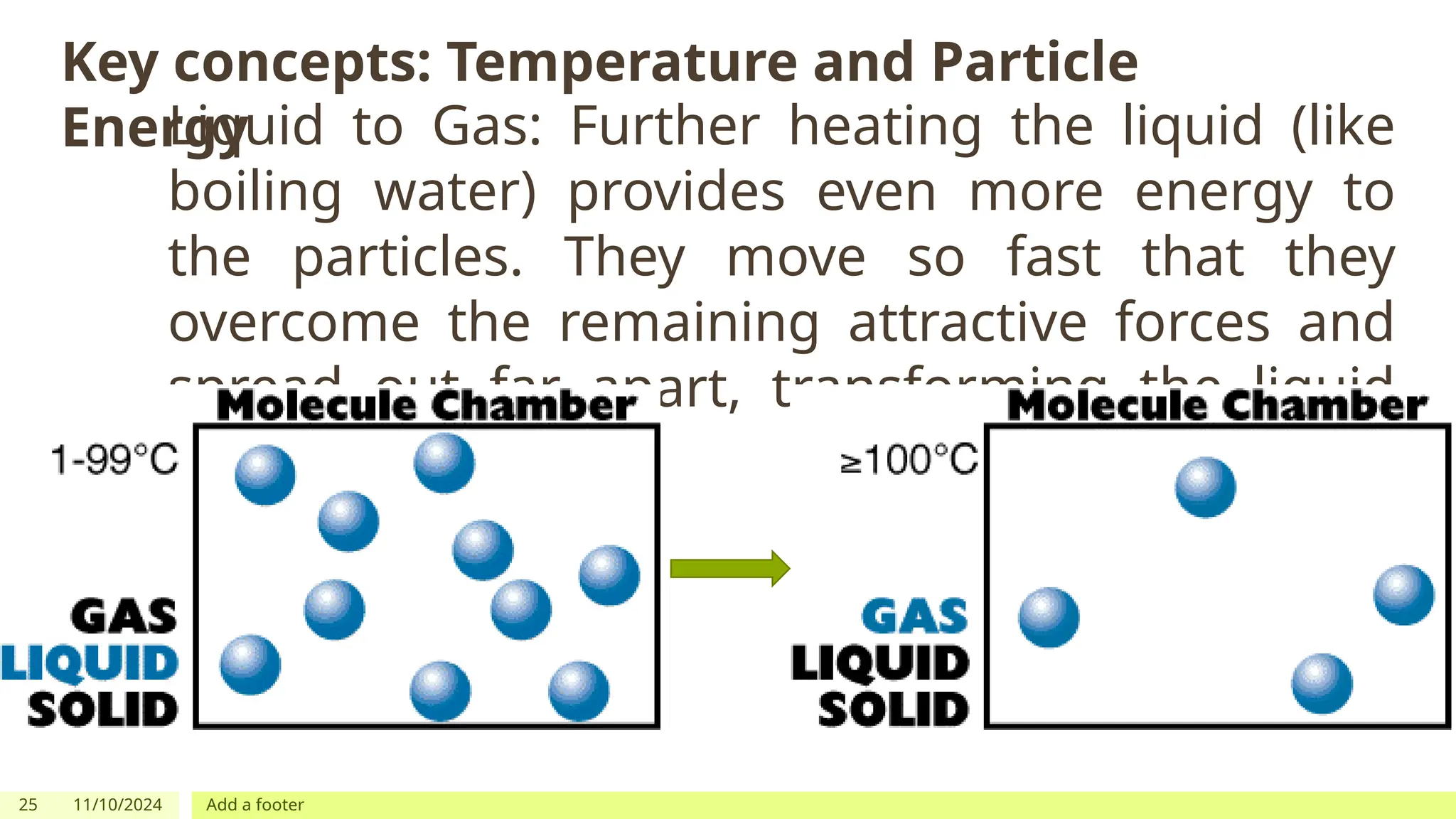
Liquid to Gas: Further heating the liquid (like
boiling water) provides even more energy to
the particles. They move so fast that they
overcome the remaining attractive forces and
spread out far apart, transforming the liquid
into a gas.
26 11/10/2024 Add a footer
27 11/10/2024 Add a footer
Liquid to solid (Freezing)
Can you think of examples of freezing in everyday
life?
What happens to the particles during freezing?
How does the temperature affect the freezing
process?
28 11/10/2024 Add a footer
Gas to liquid (Condensation)
Where do we often see condensation occurring?
What factors contribute to condensation?
29 11/10/2024 Add a footer
Click icon to add picture
30 11/10/2024 Add a footer
Key Points for Freezing:
Freezing is the process in which a liquid
changes into a solid state when cooled.
It is the reverse process of melting, involving
the removal of thermal energy from the
substance.
During freezing, the particles in the liquid
slow down and arrange themselves into a
solid structure
31 11/10/2024 Add a footer
Key Points for Condensation:
Condensation is the process in which a
gas changes into a liquid state when
cooled.
It occurs when gas particles lose energy
and come together to form liquid
droplets.
Condensation commonly occurs when
warm, moist air cools down, such as
when warm air meets a cooler surface
32 11/10/2024 Add a footer
Formative Assessment
Prepare ¼ sheet of paper
33 11/10/2024 Add a footer
1.Which of the following
states of matter has
particles arranged most
closely together?
a) Solid
b) b) Liquid
c) c) Gas
d) d) All of the above
34 11/10/2024 Add a footer
2. According to Kinetic
Molecular Theory, what
happens to the particles in
a substance as its
temperature increases?
a)They move faster.
b)They move slower.
c)They stop moving.
d)Their arrangement
doesn't change.
35 11/10/2024 Add a footer
3. What do you call the
process of changing a
solid into liquid by
heating it?
a)Melting
b)Freezing
c)Evaporation
d)Condensation
36 11/10/2024 Add a footer
4. In which state of matter
do particles have the most
freedom of movement?
a) Solid
b) Liquid
c) Gas
d) All of the above have the
same freedom of
37 11/10/2024 Add a footer
Click icon to add picture
5. What term describes the
process of a liquid
changing into a gas at its
surface?
a) Melting
b) Freezing
c) Evaporation
d) Condensation
38 11/10/2024 Add a footer
Click icon to add picture
6. What happens to the
particles of a substance
during melting?
a) Gain energy and move
faster.
b)Lose energy and move
slower.
c) Don't change their energy
or arrangement.
39 11/10/2024 Add a footer
Click icon to add picture
7. Which of the following
is NOT a factor affecting
condensation?
a) Pressure
b) Temperature
c) The color of the
surface
d) Presence of water
vapor in the air
40 11/10/2024 Add a footer
Click icon to add picture
8. What is the opposite
process of freezing?
a) Boiling
b) Melting
c) Evaporation
d) Condensation
41 11/10/2024 Add a footer
Click icon to add picture
9. What happens to the
particles as a gas cool down
and condenses?
a) Gain energy and move
faster.
b) Gain energy and move
slower.
c) Lose energy and move
closer together.
d) Lose energy but maintain
42 11/10/2024 Add a footer
10. What process is
involved in
everyday fog
formation?
a) Melting
b) Boiling
c) Evaporation
d) Condensation

Quarter one Week three Changes of state of Liquid, Solid and Gas

  • 1.
  • 2.
    2 11/10/2024 Adda footer Learning Objectives: The learners shall be able to : 1. Explain how substance changes its state from solid to liquid to gas by analyzing particle behavior and the influence of temperature; and 2. Demonstrate understanding of changes of state: solid liquid vapor and vice versa
  • 3.
    3 11/10/2024 Adda footer Short review: Kinetic Molecular Theory What is the kinetic molecular theory? The kinetic-molecular theory explains the states of matter, and is based on the idea that matter is composed of tiny particles that are always in motion. This theory helps explain observable properties and behaviors of solids, liquids, and gases. What are the movements of particles in solid? In liquid? In gas? In solids, particles vibrate in fixed positions, while in liquids, they move more freely but are still close together. And in gases, particles move rapidly and
  • 4.
    4 11/10/2024 Adda footer Short review: Kinetic Molecular Theory
  • 5.
    5 11/10/2024 Adda footer Unlocking Content Vocabulary Instruction: 1. Each group will take turns selecting a vocabulary term from the table. 2. Without revealing the term, one from your group will read the definition aloud to your teammates. 3. The group must then discuss and decide which term from the table matches the given definition. 4. Once a match is chosen, your group will turn over the selected card to reveal the vocabulary term. 5. If the match is correct, your group earns a point. If incorrect, return the card to its original position. No point is awarded.
  • 6.
    6 11/10/2024 Adda footer Discussion: 1. Which terms did you find challenging?
  • 7.
    7 11/10/2024 Adda footer Particle – a small portion of matter Solid - firm and stable in shape Liquid – a substance that flows freely but is of constant volume, having a consistency like that of water or oil Gas – a substance which has no fixed shape and no fixed volume Plasma – a gas-like substance consisting of particles such as positive ion and electrons
  • 8.
    8 11/10/2024 Adda footer Discussion: Melting – change of a solid into a liquid when heat is applied
  • 9.
    9 11/10/2024 Adda footer Discussion: Freezing – the process in which something changes from liquid to solid as the temperature becomes lower
  • 10.
    10 11/10/2024 Adda footer Discussion: Condensation – the process through which the physical state of matter changes from the gaseous phase into the liquid phase
  • 11.
    11 11/10/2024 Adda footer Discussion: Evaporation – the process of turning from liquid into vapor
  • 12.
    12 11/10/2024 Adda footer Discussion: Sublimation – the transition of a substance directly from the solid to the gas state, without passing through the liquid state
  • 13.
    13 11/10/2024 Adda footer Discussion: Deposition – the process in which a gas changes directly to a solid without going through the liquid state
  • 14.
    14 11/10/2024 Adda footer Discussion: Ionization – any process by which electrically neutral atoms or molecules are converted to electrically charged atoms or molecules (ions) through gaining or losing electrons
  • 15.
  • 16.
    16 11/10/2024 Adda footer Prompt questions: 1. How do you imagine the arrangement of particles in a solid, liquid and gas? 2. What tools or visuals help you to understand the concept better?
  • 17.
    Changes of State: Solidto Liquid to Gas
  • 18.
    18 11/10/2024 Adda footer Prompt questions: What are the states of matter? Solid, Liquid and Gas
  • 19.
    19 11/10/2024 Adda footer Prompt questions: How do particles behave in solids? Liquids? Gases? In solid, the particles pack together as tightly as possible in a neat and ordered arrangement In liquid, particles are quite close together and move with random motion throughout the container In gas, move rapidly in all directions, frequently colliding with each other and the side of the container
  • 20.
    20 11/10/2024 Adda footer Prompt questions: Can you describe the arrangement of particles in each state? gas are well separated with no regular arrangement. liquid are close together with no regular arrangement. solid are tightly packed, usually in a regular pattern
  • 21.
    21 11/10/2024 Adda footer Visualizing Particle Arrangement
  • 22.
    22 11/10/2024 Adda footer Key concepts: Solid: Particles are tightly packed together in a rigid structure, with minimal movement. Imagine marbles jammed close together in a box. Liquid: Particles are still close but have some freedom of movement, allowing them to slide past each other. Think of marbles in a bowl, able to move and change positions. Gas: Particles are spread out far apart with the most freedom of movement. Imagine marbles
  • 23.
    23 11/10/2024 Adda footer Key concepts: Temperature and Particle Energy Heating a Solid: As we add heat (energy) to a solid (like ice), the particles gain kinetic energy and start vibrating more vigorously. This disrupts the rigid structure, causing them to move around more.
  • 24.
    24 11/10/2024 Adda footer Key concepts: Temperature and Particle Energy Transitioning to Liquid: With increased movement, the particles in the solid can no longer maintain their fixed positions. They overcome the forces holding them together, leading to a looser arrangement and the formation of a liquid.
  • 25.
    25 11/10/2024 Adda footer Key concepts: Temperature and Particle Energy Liquid to Gas: Further heating the liquid (like boiling water) provides even more energy to the particles. They move so fast that they overcome the remaining attractive forces and spread out far apart, transforming the liquid into a gas.
  • 26.
  • 27.
    27 11/10/2024 Adda footer Liquid to solid (Freezing) Can you think of examples of freezing in everyday life? What happens to the particles during freezing? How does the temperature affect the freezing process?
  • 28.
    28 11/10/2024 Adda footer Gas to liquid (Condensation) Where do we often see condensation occurring? What factors contribute to condensation?
  • 29.
    29 11/10/2024 Adda footer Click icon to add picture
  • 30.
    30 11/10/2024 Adda footer Key Points for Freezing: Freezing is the process in which a liquid changes into a solid state when cooled. It is the reverse process of melting, involving the removal of thermal energy from the substance. During freezing, the particles in the liquid slow down and arrange themselves into a solid structure
  • 31.
    31 11/10/2024 Adda footer Key Points for Condensation: Condensation is the process in which a gas changes into a liquid state when cooled. It occurs when gas particles lose energy and come together to form liquid droplets. Condensation commonly occurs when warm, moist air cools down, such as when warm air meets a cooler surface
  • 32.
    32 11/10/2024 Adda footer Formative Assessment Prepare ¼ sheet of paper
  • 33.
    33 11/10/2024 Adda footer 1.Which of the following states of matter has particles arranged most closely together? a) Solid b) b) Liquid c) c) Gas d) d) All of the above
  • 34.
    34 11/10/2024 Adda footer 2. According to Kinetic Molecular Theory, what happens to the particles in a substance as its temperature increases? a)They move faster. b)They move slower. c)They stop moving. d)Their arrangement doesn't change.
  • 35.
    35 11/10/2024 Adda footer 3. What do you call the process of changing a solid into liquid by heating it? a)Melting b)Freezing c)Evaporation d)Condensation
  • 36.
    36 11/10/2024 Adda footer 4. In which state of matter do particles have the most freedom of movement? a) Solid b) Liquid c) Gas d) All of the above have the same freedom of
  • 37.
    37 11/10/2024 Adda footer Click icon to add picture 5. What term describes the process of a liquid changing into a gas at its surface? a) Melting b) Freezing c) Evaporation d) Condensation
  • 38.
    38 11/10/2024 Adda footer Click icon to add picture 6. What happens to the particles of a substance during melting? a) Gain energy and move faster. b)Lose energy and move slower. c) Don't change their energy or arrangement.
  • 39.
    39 11/10/2024 Adda footer Click icon to add picture 7. Which of the following is NOT a factor affecting condensation? a) Pressure b) Temperature c) The color of the surface d) Presence of water vapor in the air
  • 40.
    40 11/10/2024 Adda footer Click icon to add picture 8. What is the opposite process of freezing? a) Boiling b) Melting c) Evaporation d) Condensation
  • 41.
    41 11/10/2024 Adda footer Click icon to add picture 9. What happens to the particles as a gas cool down and condenses? a) Gain energy and move faster. b) Gain energy and move slower. c) Lose energy and move closer together. d) Lose energy but maintain
  • 42.
    42 11/10/2024 Adda footer 10. What process is involved in everyday fog formation? a) Melting b) Boiling c) Evaporation d) Condensation