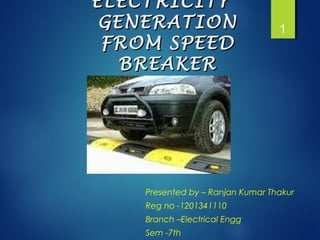
ELECTRICITYELECTRICITY
GENERATIONGENERATION
FROM SPEEDFROM SPEED
BREAKERBREAKER
Presented by – Ranjan Kumar Thakur
Reg no -1201341110
Branch –Electrical Engg
Sem -7th
1
Content:
 introduction
 objective
 methods of operation
 Rack-pinion arrangement method
 Piezoelectric method
 Conclusion
2
Introduction:
 Is anyone happy with current situation of
electricity in India?
 A step has been taken which will reduce the
crises of electricity . For this the of use the
road are considered to generate power?
 So, electricity can be generated using
vehicle’s weight such as potential energy as
input.
 In this method in general potential energy is
converted into electrical energy.
3
OBJECTIVE:
 The objective for doing this step is to reduce
the crises of electricity. why we only depend
upon any thermal power plant ,or hydro power
plants etc.
 To generate power at low cost.
 As per 1megawatt generation, it impose Rs 10
million but from other source such as hydro
and thermal ,the cost is 8 times higher.
4
Methods for operation :
 In general Simple energy conversion from
Mechanical to Electrical is carried out.
 To generate electricity using the vehicle
weight (potential energy) as input
 Here two methods are considered which
has simple mechanisms
I. Rack- Pinion mechanism
II. Piezoelectric effect
5
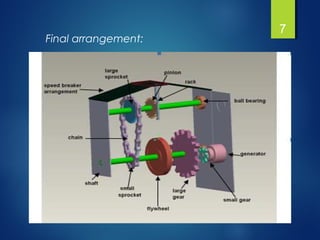
Rack- Pinion mechanism
Terminology :
 Gear – it is used to transform rotational enegy
to other output gear.
 Sprocket – it transfer rotary motion between
two shaft.
 flywheel – it is used to store rotational energy.
when there is requirement, it release the stored
energy.
 rack and pinion – it is used to transform
between rotary motion and translatary.
6
Final arrangement:
7
Construction of generator:
 Initial experiments- DC motor as Generator
 How is electricity generated?
 Basic principle of generation of electricity.
8
Results:
 When 100 vehicles of each 1000 kg weight
passes for one minute, by this process we can
generate 1kw of energy.
 Maximum gear losses– 3 to 5%
 Efficiency up to 95-96%
9
Advantage :
 Non polluting source of energy.
 Less installation and maintenance cost.
 Very economical and easy to install.
 It can be designed for heavy vehicles so
that more electricity can be generated.
10
Drawback :
 Selecting suitable generator.
 Selection of springs.
 For lighter load it is not efficient.
 extra cost on conversion of D.C to A.C
i.e. first storing in dc battery then invert to
ac as per demand.
 Achieving proper balance of speed and
torque.
11
using Piezoelectric materials
 The word piezo is derived from a Greek
word piezien which means squeeze or
press.
 when a mechanical stress is applied to
material (crystal or some ceramics ) by
the property of piezoelectricity, it
produces a potential difference across it.
12
Principle:-
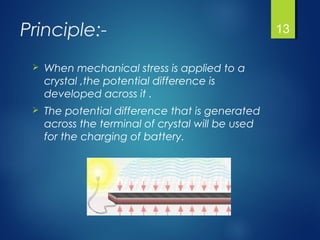
 When mechanical stress is applied to a
crystal ,the potential difference is
developed across it .
 The potential difference that is generated
across the terminal of crystal will be used
for the charging of battery.
13
Results:-
The output voltage is directly proportional
to the applied mechanical stress i.e. in
general weight of vehicle.
 analytical investigation gives that when a
1c.m^3 of piezo crystal on which 2KN of
load is applied , the output voltage will be
about 12.5KV.
Efficiency is 65-75%
It is demonstrated that a 40MAH battery
can be charged within a half an hour.
14
Advantage:-
 Very light weight and small in size.
 Free from pollution
 Ultra low noise
 Cost effective it is so because the cost of
one crystal of (50*35*2)mm is RS 24-25.
 Wide temperature range.
15
Drawback
 It can sustain maximum up to 30Mpa of
applied pressure after which it may
break.
 It is not for bulky loaded vehicle.
 It generates low power.
16
Future scope :
 Such can be designed for heavy
vehicles, thus increasing input stress and
ultimately more output voltage .
 More suitable and compact mechanisms
to enhance efficiency.
 it can be used in every car parking ,
footstep , in shoes, bus stand and many
more places etc.
17
Conclusion:-
 The existing source of energy such as
coal, oil etc. is not sufficient for ever
increasing the demand of energy.
 The crises of electricity will be somehow
reduced and dependency on power
plants also diminished.
 This is one path of exploring the possibility
of energy.
18
Reference:-
www.wiki.com
www.ijert.com
www.ijesit.com
19
20

power generation through speed breaker

  • 1.
    ELECTRICITYELECTRICITY GENERATIONGENERATION FROM SPEEDFROM SPEED BREAKERBREAKER Presentedby – Ranjan Kumar Thakur Reg no -1201341110 Branch –Electrical Engg Sem -7th 1
  • 2.
    Content:  introduction  objective methods of operation  Rack-pinion arrangement method  Piezoelectric method  Conclusion 2
  • 3.
    Introduction:  Is anyonehappy with current situation of electricity in India?  A step has been taken which will reduce the crises of electricity . For this the of use the road are considered to generate power?  So, electricity can be generated using vehicle’s weight such as potential energy as input.  In this method in general potential energy is converted into electrical energy. 3
  • 4.
    OBJECTIVE:  The objectivefor doing this step is to reduce the crises of electricity. why we only depend upon any thermal power plant ,or hydro power plants etc.  To generate power at low cost.  As per 1megawatt generation, it impose Rs 10 million but from other source such as hydro and thermal ,the cost is 8 times higher. 4
  • 5.
    Methods for operation:  In general Simple energy conversion from Mechanical to Electrical is carried out.  To generate electricity using the vehicle weight (potential energy) as input  Here two methods are considered which has simple mechanisms I. Rack- Pinion mechanism II. Piezoelectric effect 5
  • 6.
    Rack- Pinion mechanism Terminology:  Gear – it is used to transform rotational enegy to other output gear.  Sprocket – it transfer rotary motion between two shaft.  flywheel – it is used to store rotational energy. when there is requirement, it release the stored energy.  rack and pinion – it is used to transform between rotary motion and translatary. 6
  • 7.
  • 8.
    Construction of generator: Initial experiments- DC motor as Generator  How is electricity generated?  Basic principle of generation of electricity. 8
  • 9.
    Results:  When 100vehicles of each 1000 kg weight passes for one minute, by this process we can generate 1kw of energy.  Maximum gear losses– 3 to 5%  Efficiency up to 95-96% 9
  • 10.
    Advantage :  Nonpolluting source of energy.  Less installation and maintenance cost.  Very economical and easy to install.  It can be designed for heavy vehicles so that more electricity can be generated. 10
  • 11.
    Drawback :  Selectingsuitable generator.  Selection of springs.  For lighter load it is not efficient.  extra cost on conversion of D.C to A.C i.e. first storing in dc battery then invert to ac as per demand.  Achieving proper balance of speed and torque. 11
  • 12.
    using Piezoelectric materials The word piezo is derived from a Greek word piezien which means squeeze or press.  when a mechanical stress is applied to material (crystal or some ceramics ) by the property of piezoelectricity, it produces a potential difference across it. 12
  • 13.
    Principle:-  When mechanicalstress is applied to a crystal ,the potential difference is developed across it .  The potential difference that is generated across the terminal of crystal will be used for the charging of battery. 13
  • 14.
    Results:- The output voltageis directly proportional to the applied mechanical stress i.e. in general weight of vehicle.  analytical investigation gives that when a 1c.m^3 of piezo crystal on which 2KN of load is applied , the output voltage will be about 12.5KV. Efficiency is 65-75% It is demonstrated that a 40MAH battery can be charged within a half an hour. 14
  • 15.
    Advantage:-  Very lightweight and small in size.  Free from pollution  Ultra low noise  Cost effective it is so because the cost of one crystal of (50*35*2)mm is RS 24-25.  Wide temperature range. 15
  • 16.
    Drawback  It cansustain maximum up to 30Mpa of applied pressure after which it may break.  It is not for bulky loaded vehicle.  It generates low power. 16
  • 17.
    Future scope : Such can be designed for heavy vehicles, thus increasing input stress and ultimately more output voltage .  More suitable and compact mechanisms to enhance efficiency.  it can be used in every car parking , footstep , in shoes, bus stand and many more places etc. 17
  • 18.
    Conclusion:-  The existingsource of energy such as coal, oil etc. is not sufficient for ever increasing the demand of energy.  The crises of electricity will be somehow reduced and dependency on power plants also diminished.  This is one path of exploring the possibility of energy. 18
  • 19.
  • 20.