PEOPLE AS RESOURCE
Made by – Sarthak Agarwal
Roll no. – 07
Class – IX A
OVERVIEW
'People as Resource' is a way of referring to a country’s working people
in terms of their existing productive skills and abilities. Looking at the
population from this productive aspect emphasises its ability to
contribute to the creation of the Gross National Product. Like other
resources population also is a resource — a 'human resource'. This is
the positive side of a large population that is often overlooked when
we look only at the negative side, considering only the problems of
providing the population with food, education and access to health
facilities. When the existing 'human resource' is further developed by
becoming more educated and healthy, we call it 'human capital
formation' that adds to the productive power of the country just like
'physical capital formation'.
HUMAN RESOURCE
People who are part of a workforce is called human resource. Not only
do the more educated and the healthier people gain through higher
incomes, society also gains in other indirect ways because the
advantages of a more educated or a healthier population spreads to
those also who themselves were not directly educated or given health
care. In fact, human capital is in one way superior to other resources
like land and physical capital: human resource can make use of land
and capital. Land and capital cannot become useful on its own! For
many decades in India, a large population has been considered a
liability rather than an asset.
ECONOMIC ACTIVITIES
•PRIMARY ACTIVITIES
•SECONDARY ACTIVITIES
•TERITIORY ACTIVITIES
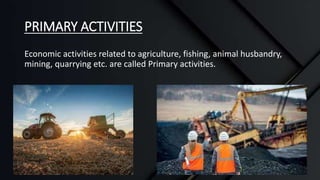
PRIMARY ACTIVITIES
Economic activities related to agriculture, fishing, animal husbandry,
mining, quarrying etc. are called Primary activities.
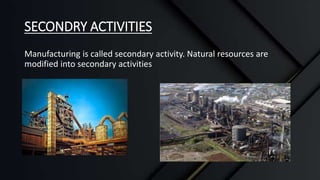
SECONDRY ACTIVITIES
Manufacturing is called secondary activity. Natural resources are
modified into secondary activities
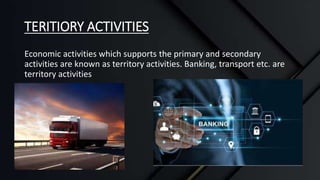
TERITIORY ACTIVITIES
Economic activities which supports the primary and secondary
activities are known as territory activities. Banking, transport etc. are
territory activities
MARKET ACTIVITIES
When some product or service is produced to be sold in a market,
known as market activities
NON MARKETING ACTIVITIES
Non market activities are those activities which do not include any
financial transactions and done without any intention of earning
money or profit. Examples of such activities are household work done
by a housewife, crops grown by a farmer for his own family, tuitions
given by a teacher to his own child etc.
ECONOMIC ACTIVITIES BY MEN AND WOMEN
The various activities have been classified into three main sectors i.e.,
primary, secondary and tertiary. Primary sector includes agriculture, forestry,
animal husbandry, fishing, poultry farming, mining and quarrying.
Manufacturing is included in the secondary sector. Trade, transport,
communication, banking, education, health, tourism, services, insurance,
etc. are included in the tertiary sector. The activities in this sector result in
the production of goods and services. These activities add value to the
national income. These activities are called economic activities. Economic
activities have two parts — market activities and non-market activities.
Market activities involve remuneration to anyone who performs i.e., activity
performed for pay or profit. These include production of goods or services,
including government service. Non-market activities are the production for
self-consumption. These can be consumption and processing of primary
product and own account production of fixed assets.
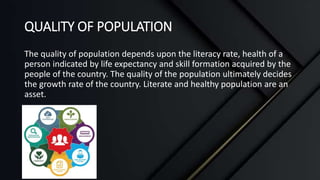
QUALITY OF POPULATION
The quality of population depends upon the literacy rate, health of a
person indicated by life expectancy and skill formation acquired by the
people of the country. The quality of the population ultimately decides
the growth rate of the country. Literate and healthy population are an
asset.
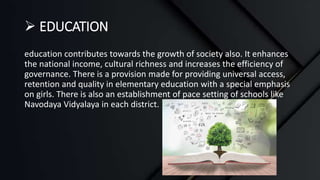
 EDUCATION
education contributes towards the growth of society also. It enhances
the national income, cultural richness and increases the efficiency of
governance. There is a provision made for providing universal access,
retention and quality in elementary education with a special emphasis
on girls. There is also an establishment of pace setting of schools like
Navodaya Vidyalaya in each district.
NUMBER OF INSTITUTIONS OF HIGHER
EDUCATION, ENROLMENT AND FACULTY
HEALTH
The health of a person helps him to realise his/her potential and the
ability to fight illness. He/She will not be able to maximise his/her
output to the overall growth of the organisation. Indeed; health is an
indispensable basis for realising one’s well-being.
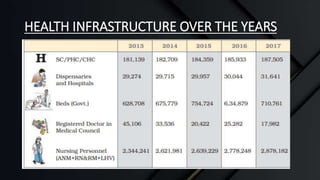
HEALTH INFRASTRUCTURE OVER THE YEARS
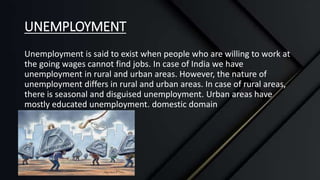
UNEMPLOYMENT
Unemployment is said to exist when people who are willing to work at
the going wages cannot find jobs. In case of India we have
unemployment in rural and urban areas. However, the nature of
unemployment differs in rural and urban areas. In case of rural areas,
there is seasonal and disguised unemployment. Urban areas have
mostly educated unemployment. domestic domain
SEASONAL UNEMPLOYMENT
DISGUESED UNEMPLOYMENT
SEASONAL UNEMPLOYMENT
Seasonal unemployment happens when people are not able to find
jobs during some months of the year. People dependant upon
agriculture usually face such kind of problem. There are certain busy
seasons when sowing, harvesting, weeding and threshing is done.
Certain months do not provide much work to the people dependant on
agriculture.
DISGUESED UNEMPLOYMENT
disguised unemployment people appear to be employed. They have
agricultural plot where they find work. This usually happens among
family members engaged in agricultural activity. The work requires the
service of five people but engages eight people. Three people are extra.
These three people also work in the same plot as the others. The
contribution made by the three extra people does not add to the
contribution made by the five people. If three people are removed the
productivity of the field will not decline. The field requires the service
of five people and the three extra people are disguised unemployed.
SUMMARY
You have seen how inputs like education and health helped in making
people an asset for the economy. The chapter also discusses about the
economic activities undertaken in the three sectors of the economy.
We also study about the problem associated with unemployment.
Finally the chapter ends with the story of a village which formally had
no job but later had plenty

People as resource

  • 1.
    PEOPLE AS RESOURCE Madeby – Sarthak Agarwal Roll no. – 07 Class – IX A
  • 2.
    OVERVIEW 'People as Resource'is a way of referring to a country’s working people in terms of their existing productive skills and abilities. Looking at the population from this productive aspect emphasises its ability to contribute to the creation of the Gross National Product. Like other resources population also is a resource — a 'human resource'. This is the positive side of a large population that is often overlooked when we look only at the negative side, considering only the problems of providing the population with food, education and access to health facilities. When the existing 'human resource' is further developed by becoming more educated and healthy, we call it 'human capital formation' that adds to the productive power of the country just like 'physical capital formation'.
  • 3.
    HUMAN RESOURCE People whoare part of a workforce is called human resource. Not only do the more educated and the healthier people gain through higher incomes, society also gains in other indirect ways because the advantages of a more educated or a healthier population spreads to those also who themselves were not directly educated or given health care. In fact, human capital is in one way superior to other resources like land and physical capital: human resource can make use of land and capital. Land and capital cannot become useful on its own! For many decades in India, a large population has been considered a liability rather than an asset.
  • 4.
  • 5.
    PRIMARY ACTIVITIES Economic activitiesrelated to agriculture, fishing, animal husbandry, mining, quarrying etc. are called Primary activities.
  • 6.
    SECONDRY ACTIVITIES Manufacturing iscalled secondary activity. Natural resources are modified into secondary activities
  • 7.
    TERITIORY ACTIVITIES Economic activitieswhich supports the primary and secondary activities are known as territory activities. Banking, transport etc. are territory activities
  • 8.
    MARKET ACTIVITIES When someproduct or service is produced to be sold in a market, known as market activities
  • 9.
    NON MARKETING ACTIVITIES Nonmarket activities are those activities which do not include any financial transactions and done without any intention of earning money or profit. Examples of such activities are household work done by a housewife, crops grown by a farmer for his own family, tuitions given by a teacher to his own child etc.
  • 10.
    ECONOMIC ACTIVITIES BYMEN AND WOMEN The various activities have been classified into three main sectors i.e., primary, secondary and tertiary. Primary sector includes agriculture, forestry, animal husbandry, fishing, poultry farming, mining and quarrying. Manufacturing is included in the secondary sector. Trade, transport, communication, banking, education, health, tourism, services, insurance, etc. are included in the tertiary sector. The activities in this sector result in the production of goods and services. These activities add value to the national income. These activities are called economic activities. Economic activities have two parts — market activities and non-market activities. Market activities involve remuneration to anyone who performs i.e., activity performed for pay or profit. These include production of goods or services, including government service. Non-market activities are the production for self-consumption. These can be consumption and processing of primary product and own account production of fixed assets.
  • 11.
    QUALITY OF POPULATION Thequality of population depends upon the literacy rate, health of a person indicated by life expectancy and skill formation acquired by the people of the country. The quality of the population ultimately decides the growth rate of the country. Literate and healthy population are an asset.
  • 12.
     EDUCATION education contributestowards the growth of society also. It enhances the national income, cultural richness and increases the efficiency of governance. There is a provision made for providing universal access, retention and quality in elementary education with a special emphasis on girls. There is also an establishment of pace setting of schools like Navodaya Vidyalaya in each district.
  • 13.
    NUMBER OF INSTITUTIONSOF HIGHER EDUCATION, ENROLMENT AND FACULTY
  • 14.
    HEALTH The health ofa person helps him to realise his/her potential and the ability to fight illness. He/She will not be able to maximise his/her output to the overall growth of the organisation. Indeed; health is an indispensable basis for realising one’s well-being.
  • 15.
  • 16.
    UNEMPLOYMENT Unemployment is saidto exist when people who are willing to work at the going wages cannot find jobs. In case of India we have unemployment in rural and urban areas. However, the nature of unemployment differs in rural and urban areas. In case of rural areas, there is seasonal and disguised unemployment. Urban areas have mostly educated unemployment. domestic domain
  • 17.
    SEASONAL UNEMPLOYMENT DISGUESED UNEMPLOYMENT SEASONALUNEMPLOYMENT Seasonal unemployment happens when people are not able to find jobs during some months of the year. People dependant upon agriculture usually face such kind of problem. There are certain busy seasons when sowing, harvesting, weeding and threshing is done. Certain months do not provide much work to the people dependant on agriculture.
  • 18.
    DISGUESED UNEMPLOYMENT disguised unemploymentpeople appear to be employed. They have agricultural plot where they find work. This usually happens among family members engaged in agricultural activity. The work requires the service of five people but engages eight people. Three people are extra. These three people also work in the same plot as the others. The contribution made by the three extra people does not add to the contribution made by the five people. If three people are removed the productivity of the field will not decline. The field requires the service of five people and the three extra people are disguised unemployed.
  • 19.
    SUMMARY You have seenhow inputs like education and health helped in making people an asset for the economy. The chapter also discusses about the economic activities undertaken in the three sectors of the economy. We also study about the problem associated with unemployment. Finally the chapter ends with the story of a village which formally had no job but later had plenty