Membrane Potential
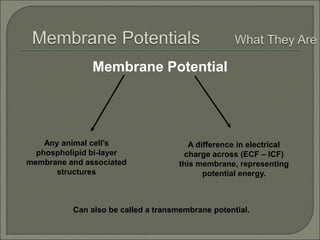
Any animal cell’s
phospholipid bi-layer
membrane and associated
structures
A difference in electrical
charge across (ECF – ICF)
this membrane, representing
potential energy.
Can also be called a transmembrane potential.
 Requires a selectively permeable membrane
• Due to membrane components
 Force involved is electrochemical
• “Electro” due to the charges of the ions on either side
of the membrane
• “chemical” due to the number and types of ions on
either side of the membrane
• Main components?
 Na+ & K+
 Cl-
 A- negatively charged anions
 H+ (proton gradient) – specialized use
 Ion Concentrations (millimoles/liter)
Ion ECF ICF Eion at 37 C Permeability
Na+ 150 15 +60mV .04
K+ 5 150 -90mV 1
Ca2+ 1 .0001 +122mV negligible
Cl- 108 10 -63mV negligible
So, if we take those numbers and look graphically at what
happens between Na+, K+ and A-…
ECF
ICF
Concentration
gradient
for
K
+
Electrical
gradient
for
K
+
Concentration
gradient
for
Na
+
Electrical
gradient
for
Na
+
A-
K+
EK = -90mV
Na+
ENa = +60mV
- - - - - - - - - - - - - - - - - -
+ + + + + + + + + + + + + + + + + + +
[K+]=5 mmole/L [Na+]=150 mmole/L
[K+]=150 mmole/L
[Na+]=15 mmole/L
 The cell membrane is about 40 times less permeable to
Na+ than K+, putting the resting potential closer to EK+
(which is -90mV)
 The equilibrium potentials of K+, Na+, Cl- and A- result in
a membrane potential of -70mV
• This determined by the Goldman-Hodgkin-Katz equation
This equation boils down to – the resting membrane
potential is calculated by the combined effects of
concentration gradients times membrane permeability for
each ion, and really just concerning Na and K.
Vm = 61 log
PK+[K+]o + PNa+[Na+]o
PK+[K+]i + PNa+[Na+]i
Here’s How it Works…
Vm = 61 log
PK+[K+]o + PNa+[Na+]o
PK+[K+]i + PNa+[Na+]i
PK+ = permeability for Potassium = 1
PNa+ = permeability for Sodium = .04
[K+]o = concentration of Potassium outside the cell = 5
[K+]i = concentraiton of Potassium inside the cell = 150
[Na+]o = concentration of Sodium outside the cell = 150
[Na+]i = concentration of Sodium inside the cell = 15
Vm = 61 log
1(5) + .04(150)
1(150) + .04(15)
= 61 log
5 + 6
150 + .6
= 61 log
11
150.6
Vm = 61(log of .073) = 61 (-1.37) = -69mV +1mV (for the
Na+/K+ pump effect) = -70mV
 Without energy, the membrane potential would
eventually be destroyed as
• K+ leaks out the cell due to membrane leakage
channels
 There are just more of the K+ leakage channels than Na+, giving
us the difference in membrane permeability
• Na+ leaks in due to membrane leakage channels
 Na+/K+ ATPase (Sodium-Potassium Pump)
restores the balance pumping Na+ out and K+
back in.
 Resting membrane potential
• Just described at -70mV
 Threshold membrane potential
• The electrical change that causes specialized channels to cycle
through open/close confirmations
• This occurs in mot excitable tissues at -55mV
 Action potentials
• This is a change in the membrane potential due to rapid influxes
and effluxes of ions (Na+ and K+)
• Causes adjacent cell membrane to undergo same rapid change
• Continues on to end of the membrane
• Used for communication
 Graded potentials
• Change in membrane potential that is variable based on the rate
of and location of stimuli on the membrane
• Used for integration
NERVE AND MUSCLE
VOLTAGE GATED CHANNELS
DEPOLARIZATION LESS THAN
THRESHOLD IS GRADED
DEPOLARIZATION BEYOND
THRESHOLD LEADS TO ACTION
POTENTIAL
ACTION POTENTIAL IS ALL OR NONE
CELL
BODY
DENDRITES
AXON
AXON
HILLOCK
AXON
TERMINALS
THE MEMBRANE USES VOLTAGE
GATED CHANNELS TO SWITCH FROM
A POTASSIUM DOMINATED TO A
SODIUM DOMINATED POTENTIAL
IT THEN INACTIVATES AND RETURNS
TO THE RESTING STATE
THE RESPONSE IS “ALL OR NONE”
FOR EACH CONCENTRATION
DIFFERENCE ACROSS THE
MEMBRANE THERE IS AN ELECTRIC
POTENTIAL DIFFERENCE WHICH
WILL PRODUCE EQUILIBRIUM.
AT EQUILIBRIUM NO
NET ION FLOW OCCURS
+ -
CONCENTRATION
POTENTIAL
K+ K+
IN
Na+
Na+
+
-
CONCENTRATION
POTENTIAL
IN
OUT
AT REST THE POTASSIUM CHANNELS
ARE MORE OPEN AND THE
POTASSIUM IONS MAKE THE INSIDE
OF THE CELL NEGATIVE
THE SODIUM CHANNELS ARE MORE
CLOSED AND THE SODIUM MOVES
SLOWER
 DEPOLARIZATION EXCEEDS THRESHOLD
 SODIUM CHANNELS OPEN
 MEMBRANE POTENTIAL SHIFTS FROM
POTASSIUM CONTROLLED (-90 MV) TO
SODIUM CONTROLLED (+60 MV)
 AS MEMBRANE POTENTIAL REACHES THE
SODIUM POTENTIAL, THE SODIUM
CHANNELS CLOSE AND ARE INACTIVATED
 POTASSIUM CHANNELS OPEN TO
REPOLARIZE THE MEMBRANE
 THE MEMBRANE DEPOLARIZES AND THEN THE
MEMBRANE POTENTIAL APPROACHES THE
SODIUM EQUILIBRIUM POTENTIAL
 THIS RADICAL CHANGE IN MEMBRANE POTENTIAL
CAUSES THE SODIUM CHANNELS TO CLOSE
(INACTIVATION) AND THE POTASSIUM CHANNELS
TO OPEN REPOLARIZING THE MEMBRANE
 THERE IS A SLIGHT OVERSHOOT
(HYPERPOLARIZATION) DUE TO THE POTASSIUM
CHANNELS BEING MORE OPEN
A RECEPTOR’S RESPONSE TO A
STIMULUS IS GRADED
IF THRESHOLD IS EXCEEDED, THE
ACTION POTENTIAL RESULTING IS
ALL OR NONE
Membrane_Potentials_2021-46887.ppt

Membrane_Potentials_2021-46887.ppt

  • 1.
    Membrane Potential Any animalcell’s phospholipid bi-layer membrane and associated structures A difference in electrical charge across (ECF – ICF) this membrane, representing potential energy. Can also be called a transmembrane potential.
  • 2.
     Requires aselectively permeable membrane • Due to membrane components  Force involved is electrochemical • “Electro” due to the charges of the ions on either side of the membrane • “chemical” due to the number and types of ions on either side of the membrane • Main components?  Na+ & K+  Cl-  A- negatively charged anions  H+ (proton gradient) – specialized use
  • 3.
     Ion Concentrations(millimoles/liter) Ion ECF ICF Eion at 37 C Permeability Na+ 150 15 +60mV .04 K+ 5 150 -90mV 1 Ca2+ 1 .0001 +122mV negligible Cl- 108 10 -63mV negligible
  • 4.
    So, if wetake those numbers and look graphically at what happens between Na+, K+ and A-… ECF ICF Concentration gradient for K + Electrical gradient for K + Concentration gradient for Na + Electrical gradient for Na + A- K+ EK = -90mV Na+ ENa = +60mV - - - - - - - - - - - - - - - - - - + + + + + + + + + + + + + + + + + + + [K+]=5 mmole/L [Na+]=150 mmole/L [K+]=150 mmole/L [Na+]=15 mmole/L
  • 6.
     The cellmembrane is about 40 times less permeable to Na+ than K+, putting the resting potential closer to EK+ (which is -90mV)  The equilibrium potentials of K+, Na+, Cl- and A- result in a membrane potential of -70mV • This determined by the Goldman-Hodgkin-Katz equation This equation boils down to – the resting membrane potential is calculated by the combined effects of concentration gradients times membrane permeability for each ion, and really just concerning Na and K. Vm = 61 log PK+[K+]o + PNa+[Na+]o PK+[K+]i + PNa+[Na+]i
  • 7.
    Here’s How itWorks… Vm = 61 log PK+[K+]o + PNa+[Na+]o PK+[K+]i + PNa+[Na+]i PK+ = permeability for Potassium = 1 PNa+ = permeability for Sodium = .04 [K+]o = concentration of Potassium outside the cell = 5 [K+]i = concentraiton of Potassium inside the cell = 150 [Na+]o = concentration of Sodium outside the cell = 150 [Na+]i = concentration of Sodium inside the cell = 15 Vm = 61 log 1(5) + .04(150) 1(150) + .04(15) = 61 log 5 + 6 150 + .6 = 61 log 11 150.6 Vm = 61(log of .073) = 61 (-1.37) = -69mV +1mV (for the Na+/K+ pump effect) = -70mV
  • 8.
     Without energy,the membrane potential would eventually be destroyed as • K+ leaks out the cell due to membrane leakage channels  There are just more of the K+ leakage channels than Na+, giving us the difference in membrane permeability • Na+ leaks in due to membrane leakage channels  Na+/K+ ATPase (Sodium-Potassium Pump) restores the balance pumping Na+ out and K+ back in.
  • 9.
     Resting membranepotential • Just described at -70mV  Threshold membrane potential • The electrical change that causes specialized channels to cycle through open/close confirmations • This occurs in mot excitable tissues at -55mV  Action potentials • This is a change in the membrane potential due to rapid influxes and effluxes of ions (Na+ and K+) • Causes adjacent cell membrane to undergo same rapid change • Continues on to end of the membrane • Used for communication  Graded potentials • Change in membrane potential that is variable based on the rate of and location of stimuli on the membrane • Used for integration
  • 10.
    NERVE AND MUSCLE VOLTAGEGATED CHANNELS DEPOLARIZATION LESS THAN THRESHOLD IS GRADED DEPOLARIZATION BEYOND THRESHOLD LEADS TO ACTION POTENTIAL ACTION POTENTIAL IS ALL OR NONE
  • 11.
  • 12.
    THE MEMBRANE USESVOLTAGE GATED CHANNELS TO SWITCH FROM A POTASSIUM DOMINATED TO A SODIUM DOMINATED POTENTIAL IT THEN INACTIVATES AND RETURNS TO THE RESTING STATE THE RESPONSE IS “ALL OR NONE”
  • 13.
    FOR EACH CONCENTRATION DIFFERENCEACROSS THE MEMBRANE THERE IS AN ELECTRIC POTENTIAL DIFFERENCE WHICH WILL PRODUCE EQUILIBRIUM. AT EQUILIBRIUM NO NET ION FLOW OCCURS
  • 14.
  • 15.
  • 16.
    AT REST THEPOTASSIUM CHANNELS ARE MORE OPEN AND THE POTASSIUM IONS MAKE THE INSIDE OF THE CELL NEGATIVE THE SODIUM CHANNELS ARE MORE CLOSED AND THE SODIUM MOVES SLOWER
  • 17.
     DEPOLARIZATION EXCEEDSTHRESHOLD  SODIUM CHANNELS OPEN  MEMBRANE POTENTIAL SHIFTS FROM POTASSIUM CONTROLLED (-90 MV) TO SODIUM CONTROLLED (+60 MV)  AS MEMBRANE POTENTIAL REACHES THE SODIUM POTENTIAL, THE SODIUM CHANNELS CLOSE AND ARE INACTIVATED  POTASSIUM CHANNELS OPEN TO REPOLARIZE THE MEMBRANE
  • 18.
     THE MEMBRANEDEPOLARIZES AND THEN THE MEMBRANE POTENTIAL APPROACHES THE SODIUM EQUILIBRIUM POTENTIAL  THIS RADICAL CHANGE IN MEMBRANE POTENTIAL CAUSES THE SODIUM CHANNELS TO CLOSE (INACTIVATION) AND THE POTASSIUM CHANNELS TO OPEN REPOLARIZING THE MEMBRANE  THERE IS A SLIGHT OVERSHOOT (HYPERPOLARIZATION) DUE TO THE POTASSIUM CHANNELS BEING MORE OPEN
  • 19.
    A RECEPTOR’S RESPONSETO A STIMULUS IS GRADED IF THRESHOLD IS EXCEEDED, THE ACTION POTENTIAL RESULTING IS ALL OR NONE