Chapter 2
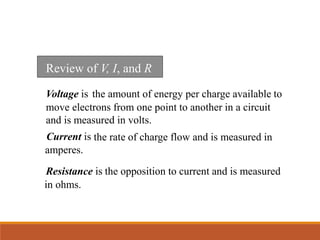
Voltage is
Review of V, I, and R
the amount of energy per charge available to
move electrons from one point to another in a circuit
and is measured in volts.
Current is the rate of charge flow and is measured in
amperes.
Resistance is the opposition to current and is measured
in ohms.
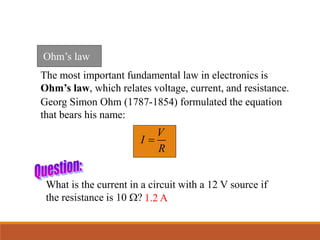
The most important fundamental law in electronics is
Ohm’s law, which relates voltage, current, and resistance.
Georg Simon Ohm (1787-1854) formulated the equation
that bears his name:
V
I
R

What is the current in a circuit with a 12 V source if
the resistance is 10 W? 1.2 A
Ohm’s law
Ohm’s law
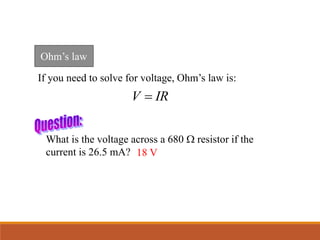
If you need to solve for voltage, Ohm’s law is:
What is the voltage across a 680 W resistor if the
current is 26.5 mA? 18 V
V IR

Ohm’s law
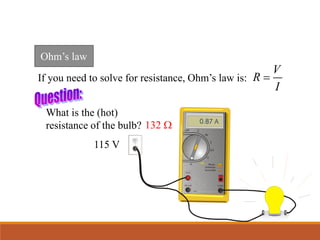
If you need to solve for resistance, Ohm’s law is:
V
R
I

115 V
V
1 s
1 s
40 mA
10 A
COM
R
ange
Autorange
T
ouch/Hold
Fused
OFF V
V
Hz
mV
A
What is the (hot)
resistance of the bulb? 132 W
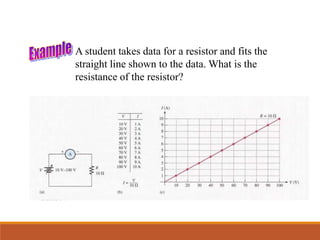
A student takes data for a resistor and fits the
straight line shown to the data. What is the
resistance of the resistor?
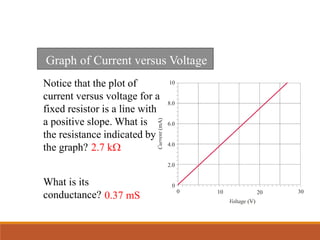
Graph of Current versus Voltage
Voltage (V)
Current
(mA)
0 10 20 30
0
2.0
4.0
6.0
8.0
10
Notice that the plot of
current versus voltage for a
fixed resistor is a line with
a positive slope. What is
the resistance indicated by
the graph? 2.7 kW
What is its
conductance? 0.37 mS
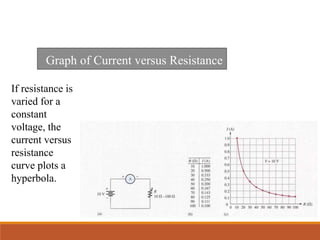
Graph of Current versus Resistance
If resistance is
varied for a
constant
voltage, the
current versus
resistance
curve plots a
hyperbola.
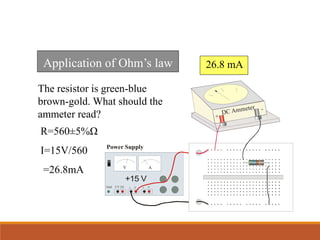
Application of Ohm’s law
The resistor is green-blue
brown-gold. What should the
ammeter read?
26.8 mA
Power Supply
+15 V
- + - +
5 V 2A
DC Ammeter
+
-
Gnd
V A
R=560±5%Ω
I=15V/560
=26.8mA
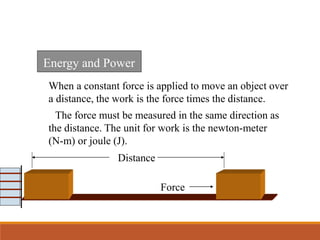
The force must be measured in the same direction as
the distance. The unit for work is the newton-meter
(N-m) or joule (J).
Energy and Power
When a constant force is applied to move an object over
a distance, the work is the force times the distance.
Force
Distance
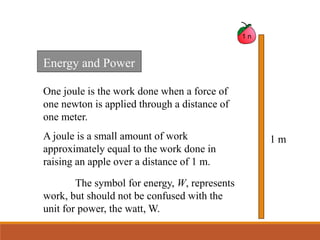
One joule is the work done when a force of
one newton is applied through a distance of
one meter.
A joule is a small amount of work
approximately equal to the work done in
raising an apple over a distance of 1 m.
1 n
1 m
The symbol for energy, W, represents
work, but should not be confused with the
unit for power, the watt, W.
Energy and Power
Energy is closely related to work. Energy is the ability
to do work. As such, it is measured in the same units as
work, namely the newton-meter (N-m) or joule (J).
Energy and Power
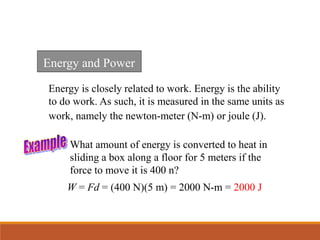
What amount of energy is converted to heat in
sliding a box along a floor for 5 meters if the
force to move it is 400 n?
W = Fd = (400 N)(5 m) = 2000 N-m = 2000 J
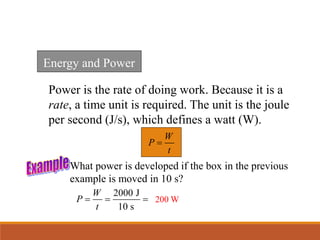
Power is the rate of doing work. Because it is a
rate, a time unit is required. The unit is the joule
per second (J/s), which defines a watt (W).
Energy and Power
What power is developed if the box in the previous
example is moved in 10 s?
W
P
t

2000 J
10 s
W
P
t
   200 W
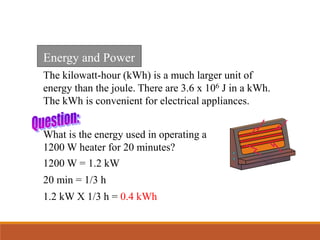
The kilowatt-hour (kWh) is a much larger unit of
energy than the joule. There are 3.6 x 10⁶ J in a kWh.
The kWh is convenient for electrical appliances.
What is the energy used in operating a
1200 W heater for 20 minutes?
1200 W = 1.2 kW
20 min = 1/3 h
1.2 kW X 1/3 h = 0.4 kWh
Energy and Power
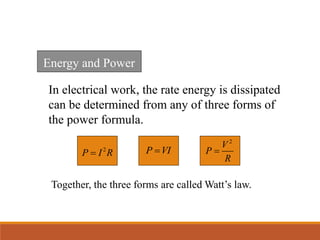
In electrical work, the rate energy is dissipated
can be determined from any of three forms of
the power formula.
Energy and Power
2
P I R
 P VI

2
V
P
R

Together, the three forms are called Watt’s law.
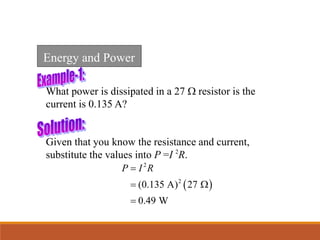
What power is dissipated in a 27 W resistor is the
current is 0.135 A?
 
2
2
(0.135 A) 27
0.49 W
P I R

 W

Given that you know the resistance and current,
substitute the values into P =I 2
R.
Energy and Power
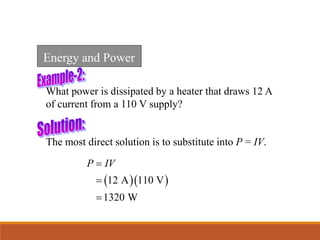
What power is dissipated by a heater that draws 12 A
of current from a 110 V supply?
  
12 A 110 V
1320 W
P IV



The most direct solution is to substitute into P = IV.
Energy and Power
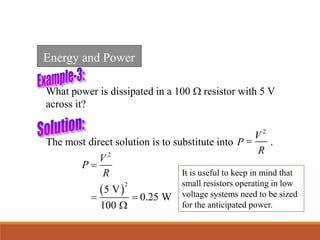
What power is dissipated in a 100 W resistor with 5 V
across it?
 
2
2
5 V
0.25 W
100
V
P
R

 
W
The most direct solution is to substitute into .
2
V
P
R

It is useful to keep in mind that
small resistors operating in low
voltage systems need to be sized
for the anticipated power.
Energy and Power
Resistor failures
Resistor failures are unusual except when they have
been subjected to excessive heat. Look for
discoloration (sometimes the color bands appear
burned). Test with an ohmmeter by disconnecting one
end from the circuit to isolate it and verify the
resistance. Correct the cause of the heating problem
(larger wattage resistor?, wrong value?).
Normal Overheated
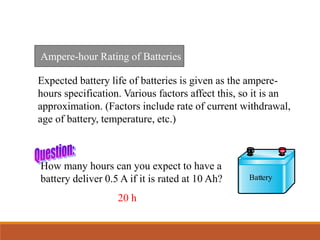
Ampere-hour Rating of Batteries
Expected battery life of batteries is given as the ampere-
hours specification. Various factors affect this, so it is an
approximation. (Factors include rate of current withdrawal,
age of battery, temperature, etc.)
How many hours can you expect to have a
battery deliver 0.5 A if it is rated at 10 Ah?
20 h
Battery

Chapter 2.ppt

  • 1.
  • 2.
    Voltage is Review ofV, I, and R the amount of energy per charge available to move electrons from one point to another in a circuit and is measured in volts. Current is the rate of charge flow and is measured in amperes. Resistance is the opposition to current and is measured in ohms.
  • 3.
    The most importantfundamental law in electronics is Ohm’s law, which relates voltage, current, and resistance. Georg Simon Ohm (1787-1854) formulated the equation that bears his name: V I R  What is the current in a circuit with a 12 V source if the resistance is 10 W? 1.2 A Ohm’s law
  • 4.
    Ohm’s law If youneed to solve for voltage, Ohm’s law is: What is the voltage across a 680 W resistor if the current is 26.5 mA? 18 V V IR 
  • 5.
    Ohm’s law If youneed to solve for resistance, Ohm’s law is: V R I  115 V V 1 s 1 s 40 mA 10 A COM R ange Autorange T ouch/Hold Fused OFF V V Hz mV A What is the (hot) resistance of the bulb? 132 W
  • 6.
    A student takesdata for a resistor and fits the straight line shown to the data. What is the resistance of the resistor?
  • 7.
    Graph of Currentversus Voltage Voltage (V) Current (mA) 0 10 20 30 0 2.0 4.0 6.0 8.0 10 Notice that the plot of current versus voltage for a fixed resistor is a line with a positive slope. What is the resistance indicated by the graph? 2.7 kW What is its conductance? 0.37 mS
  • 8.
    Graph of Currentversus Resistance If resistance is varied for a constant voltage, the current versus resistance curve plots a hyperbola.
  • 9.
    Application of Ohm’slaw The resistor is green-blue brown-gold. What should the ammeter read? 26.8 mA Power Supply +15 V - + - + 5 V 2A DC Ammeter + - Gnd V A R=560±5%Ω I=15V/560 =26.8mA
  • 10.
    The force mustbe measured in the same direction as the distance. The unit for work is the newton-meter (N-m) or joule (J). Energy and Power When a constant force is applied to move an object over a distance, the work is the force times the distance. Force Distance
  • 11.
    One joule isthe work done when a force of one newton is applied through a distance of one meter. A joule is a small amount of work approximately equal to the work done in raising an apple over a distance of 1 m. 1 n 1 m The symbol for energy, W, represents work, but should not be confused with the unit for power, the watt, W. Energy and Power
  • 12.
    Energy is closelyrelated to work. Energy is the ability to do work. As such, it is measured in the same units as work, namely the newton-meter (N-m) or joule (J). Energy and Power What amount of energy is converted to heat in sliding a box along a floor for 5 meters if the force to move it is 400 n? W = Fd = (400 N)(5 m) = 2000 N-m = 2000 J
  • 13.
    Power is therate of doing work. Because it is a rate, a time unit is required. The unit is the joule per second (J/s), which defines a watt (W). Energy and Power What power is developed if the box in the previous example is moved in 10 s? W P t  2000 J 10 s W P t    200 W
  • 14.
    The kilowatt-hour (kWh)is a much larger unit of energy than the joule. There are 3.6 x 10⁶ J in a kWh. The kWh is convenient for electrical appliances. What is the energy used in operating a 1200 W heater for 20 minutes? 1200 W = 1.2 kW 20 min = 1/3 h 1.2 kW X 1/3 h = 0.4 kWh Energy and Power
  • 15.
    In electrical work,the rate energy is dissipated can be determined from any of three forms of the power formula. Energy and Power 2 P I R  P VI  2 V P R  Together, the three forms are called Watt’s law.
  • 16.
    What power isdissipated in a 27 W resistor is the current is 0.135 A?   2 2 (0.135 A) 27 0.49 W P I R   W  Given that you know the resistance and current, substitute the values into P =I 2 R. Energy and Power
  • 17.
    What power isdissipated by a heater that draws 12 A of current from a 110 V supply?    12 A 110 V 1320 W P IV    The most direct solution is to substitute into P = IV. Energy and Power
  • 18.
    What power isdissipated in a 100 W resistor with 5 V across it?   2 2 5 V 0.25 W 100 V P R    W The most direct solution is to substitute into . 2 V P R  It is useful to keep in mind that small resistors operating in low voltage systems need to be sized for the anticipated power. Energy and Power
  • 19.
    Resistor failures Resistor failuresare unusual except when they have been subjected to excessive heat. Look for discoloration (sometimes the color bands appear burned). Test with an ohmmeter by disconnecting one end from the circuit to isolate it and verify the resistance. Correct the cause of the heating problem (larger wattage resistor?, wrong value?). Normal Overheated
  • 20.
    Ampere-hour Rating ofBatteries Expected battery life of batteries is given as the ampere- hours specification. Various factors affect this, so it is an approximation. (Factors include rate of current withdrawal, age of battery, temperature, etc.) How many hours can you expect to have a battery deliver 0.5 A if it is rated at 10 Ah? 20 h Battery