POST PARTUM HAEMORRHAGE

- A Challenge To Safe Motherhood
WEL COME TO

Taj Mahal
Taj Mahal-One of the seven wonders of the world, One
of the Greatest monuments, dedicated to the memory of
“Queen Mumtaz” who died in child birth, by her
husband “Emperor Sahajahan”, is a testimony and a
grim reminder of the tragedy of maternal mortality, that
can befall any women in childbirth.
Mar 5, 2014

PPH- Prof.S.N.panda & Dr.A.Patnaik

2
Obstetric Haemorrhage
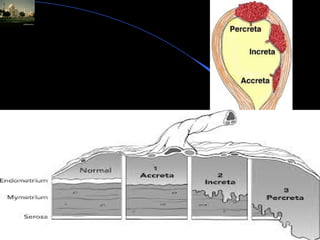
--- Ranks as the First cause of maternal mortality
accounting for 25 – 50 % of maternal deaths

POST ARTUM HAEMORRHAGE
though preventable, accounts for the
majority of the cases of obstetric
haemorrhage, the other causes being
– antepartum haemorrhage, abortion,
ectopic pregnancy and ruptured
uterus.
Mar 5, 2014

PPH- Prof.S.N.panda & Dr.A.Patnaik

3
POST PARTUM HAEMORRHAGE
. . . the most common and severe type of
obstetric haemmorrhage, is an enigma
even to the present day obstetrician as it
is sudden, often unpredicted, assessed
subjectively and can be catastrophic.
The clinical picture changes so rapidly
that unless timely action is taken
maternal death occurs within a short
period.
Mar 5, 2014

PPH- Prof.S.N.panda & Dr.A.Patnaik

4
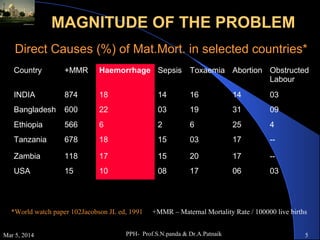
MAGNITUDE OF THE PROBLEM
Direct Causes (%) of Mat.Mort. in selected countries*
Country

+MMR

Haemorrhage Sepsis

Toxaemia Abortion Obstructed
Labour

INDIA

874

18

14

16

14

03

Bangladesh

600

22

03

19

31

09

Ethiopia

566

6

2

6

25

4

Tanzania

678

18

15

03

17

--

Zambia

118

17

15

20

17

--

USA

15

10

08

17

06

03

*World watch paper 102Jacobson JL ed, 1991
Mar 5, 2014

+MMR – Maternal Mortality Rate / 100000 live births

PPH- Prof.S.N.panda & Dr.A.Patnaik

5
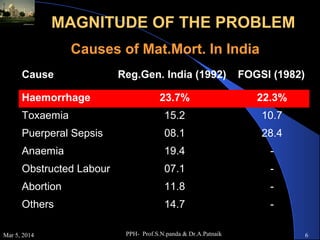
MAGNITUDE OF THE PROBLEM
Causes of Mat.Mort. In India
Cause

Reg.Gen. India (1992)

FOGSI (1982)

23.7%

22.3%

Toxaemia

15.2

10.7

Puerperal Sepsis

08.1

28.4

Anaemia

19.4

-

Obstructed Labour

07.1

-

Abortion

11.8

-

Others

14.7

-

Haemorrhage

Mar 5, 2014

PPH- Prof.S.N.panda & Dr.A.Patnaik

6
MAGNITUDE OF THE PROBLEM
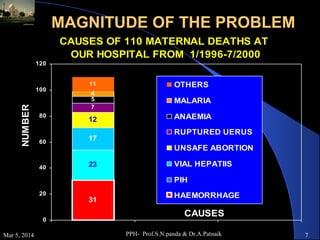
CAUSES OF 110 MATERNAL DEATHS AT
OUR HOSPITAL FROM 1/1996-7/2000
120

NUMBER

100

80

11

OTHERS

4
5
7

MALARIA

12

ANAEMIA

60

17

40

23

RUPTURED UERUS
UNSAFE ABORTION
VIAL HEPATIIS
PIH

20

0

Mar 5, 2014

31

HAEMORRHAGE

CAUSES
PPH- Prof.S.N.panda & Dr.A.Patnaik

7
MAGNITUDE OF THE PROBLEM
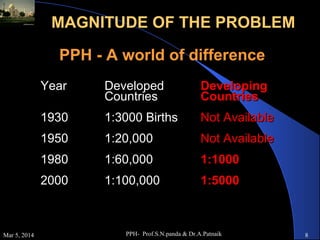
PPH - A world of difference
Year

Developing
Countries

1930

1:3000 Births

Not Available

1950

1:20,000

Not Available

1980

1:60,000

1:1000

2000

Mar 5, 2014

Developed
Countries

1:100,000

1:5000

PPH- Prof.S.N.panda & Dr.A.Patnaik

8
POST PARTUM HAEMORRHAGE
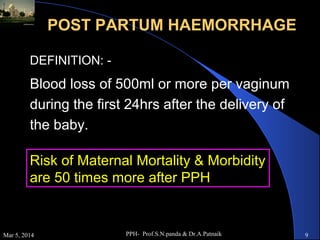
DEFINITION: -

Blood loss of 500ml or more per vaginum
during the first 24hrs after the delivery of
the baby.
Risk of Maternal Mortality & Morbidity
are 50 times more after PPH

Mar 5, 2014

PPH- Prof.S.N.panda & Dr.A.Patnaik

9
ASSESSMENT OF BLOOD LOSS
AFTER DELIVERY
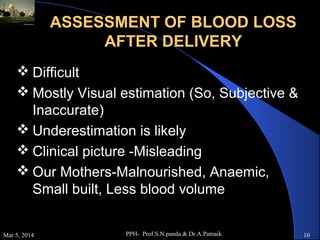
 Difficult
 Mostly Visual estimation (So, Subjective &
Inaccurate)
 Underestimation is likely
 Clinical picture -Misleading
 Our Mothers-Malnourished, Anaemic,
Small built, Less blood volume
Mar 5, 2014

PPH- Prof.S.N.panda & Dr.A.Patnaik

10
MECHANISM OF HAEMOSTASIS
AFTER DELIVERY

• Uterine contraction & retraction
• Platelet aggregation → clot
formation

Mar 5, 2014

PPH- Prof.S.N.panda & Dr.A.Patnaik

11
Why PPH ?
1. Uterine atony (80%)
2. Retained Placenta
3. Trauma to genital tract
4. Coagulation disorders
5. Uterine inversion
Mar 5, 2014

PPH- Prof.S.N.panda & Dr.A.Patnaik

12
1. UTERINE ATONY
RISK FACTORS

 Over distension of uterus
 Induction of labour
 Prolonged / precipitate labour
 Anaesthesia (halogeneted) & analgesia
 Tocolytics (Tocolytics (also called anti-contraction medications or
labor repressants) are medications used to suppress premature labor )

 APH
 Grand multiparity
 Mismanagement of 3rd stage of Labour
 Full bladder
Mar 5, 2014

PPH- Prof.S.N.panda & Dr.A.Patnaik

13
2. RETAINED PLACENTA
Simple adhesion
Morbid adhesion>Accreta, Increta &
Percreta

3. TRAUMATIC
 Large episiotomy & extensions
 Tears & lacerations of perineum, vagina
or cervix
 Haematoma
 Uterine rupture
Mar 5, 2014

PPH- Prof.S.N.panda & Dr.A.Patnaik

14
Mar 5, 2014

PPH- Prof.S.N.panda & Dr.A.Patnaik

15
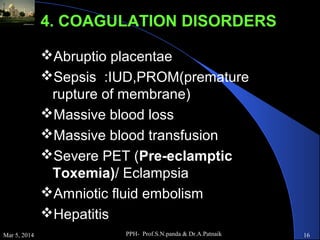
4. COAGULATION DISORDERS
Abruptio placentae
Sepsis :IUD,PROM(premature
rupture of membrane)
Massive blood loss
Massive blood transfusion
Severe PET (Pre-eclamptic
Toxemia)/ Eclampsia
Amniotic fluid embolism
Hepatitis
Mar 5, 2014

PPH- Prof.S.N.panda & Dr.A.Patnaik

16
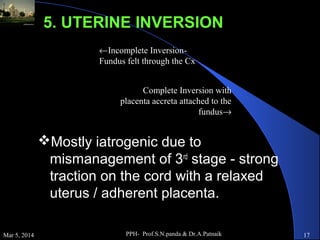
5. UTERINE INVERSION
←Incomplete InversionFundus felt through the Cx
Complete Inversion with
placenta accreta attached to the
fundus→

Mostly iatrogenic due to
mismanagement of 3rd stage - strong
traction on the cord with a relaxed
uterus / adherent placenta.
Mar 5, 2014

PPH- Prof.S.N.panda & Dr.A.Patnaik

17
SYMPTOMS & SIGNS
Blood loss Systolic BP Signs & Symptoms
(% B Vol)

( mm of Hg)

10-15

Normal

postural hypotension

15-30

slight fall

↑PR, thirst, weakness

30-40

60-80

pallor,oliguria,
confusion

40+

40-60

anuria, air hunger,
coma, death

Mar 5, 2014

PPH- Prof.S.N.panda & Dr.A.Patnaik

18
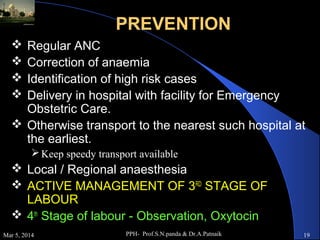
PREVENTION
Regular ANC
Correction of anaemia
Identification of high risk cases
Delivery in hospital with facility for Emergency
Obstetric Care.
 Otherwise transport to the nearest such hospital at
the earliest.





 Keep speedy transport available

 Local / Regional anaesthesia
 ACTIVE MANAGEMENT OF 3RD STAGE OF
LABOUR
 4th Stage of labour - Observation, Oxytocin
Mar 5, 2014

PPH- Prof.S.N.panda & Dr.A.Patnaik

19
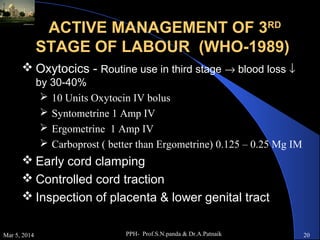
ACTIVE MANAGEMENT OF 3RD
STAGE OF LABOUR (WHO-1989)
 Oxytocics - Routine use in third stage → blood loss ↓
by 30-40%
 10 Units Oxytocin IV bolus
 Syntometrine 1 Amp IV
 Ergometrine 1 Amp IV
 Carboprost ( better than Ergometrine) 0.125 – 0.25 Mg IM

 Early cord clamping
 Controlled cord traction
 Inspection of placenta & lower genital tract
Mar 5, 2014

PPH- Prof.S.N.panda & Dr.A.Patnaik

20
MANAGEMENT OF PPH
 TEAM- Obstetrician,
Anesthesiologist, Haematologist and
Blood Bank
 Correction of hypovolaemia
 Ascertain origin of bleeding
 Ensure uterine contraction
 Surgical management
 Management of special situation
Mar 5, 2014

PPH- Prof.S.N.panda & Dr.A.Patnaik

21
MANAGEMENT OF PPH
CORRECTION OF HYPOVOLEMIA
 Large bore IV line (two)
 Crystalloids (RL)-3ml / ml of
blood loss
 Urine output (desired) –30ml / hr
 Whole blood / pack cell

Mar 5, 2014

PPH- Prof.S.N.panda & Dr.A.Patnaik

22
MANAGEMENT OF PPH
ENSURE UTERINE CONTRACTION
 Palpate fundus
 Uterine massage
 Bimanual compression
 Compression of Aorta against
sacral promontory
 Foleys catheters
Mar 5, 2014

PPH- Prof.S.N.panda & Dr.A.Patnaik

23
MANAGEMENT OF PPH
OXYTOCICS
 Oxytocin:
 Bolus of 10 units IV followed by Continuous
Infusion 100 mu / min

 Ergometrine 0.2 - 0.5mg IV
 Prostaglandins Carboprost- 0.25mg start, Rpt.15-30 min,
Maximum 2.0mg, Route-IM / intramyometrial
 Sulprostone- 400-600 micro gm
Mar 5, 2014

PPH- Prof.S.N.panda & Dr.A.Patnaik

24
MANAGEMENT OF PPH
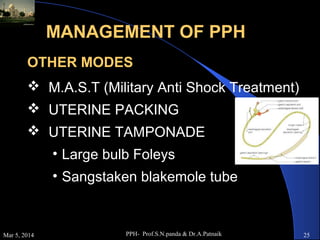
OTHER MODES
 M.A.S.T (Military Anti Shock Treatment)
 UTERINE PACKING
 UTERINE TAMPONADE
• Large bulb Foleys
• Sangstaken blakemole tube

Mar 5, 2014

PPH- Prof.S.N.panda & Dr.A.Patnaik

25
MANAGEMENT OF PPH
SURGICAL TREATMENT
Depends on
 Extent & cause of haemorrhage
 General condition of patient
 Future reproduction
 Experience & skill
Mar 5, 2014

PPH- Prof.S.N.panda & Dr.A.Patnaik

26
MANAGEMENT OF PPH
SURGICAL TREATMENT
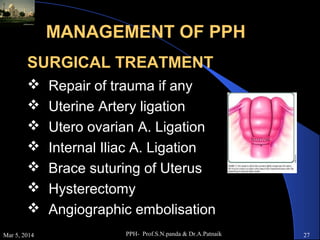







Mar 5, 2014

Repair of trauma if any
Uterine Artery ligation
Utero ovarian A. Ligation
Internal Iliac A. Ligation
Brace suturing of Uterus
Hysterectomy
Angiographic embolisation
PPH- Prof.S.N.panda & Dr.A.Patnaik

27
MANAGEMENT OF PPH
RETAINED PLACENTA
 EUA(examination Under
Anaesthesia & Manual Removal
 If Placenta accretaObservation
Cytotoxic drugs- Methotrexate
Hysterectomy

Mar 5, 2014

PPH- Prof.S.N.panda & Dr.A.Patnaik

28
MANAGEMENT OF PPH
ACUTE INVERSION OF UTERUS
 Manual replacementUnder GA / Uterine relaxant

 Hydrostatic method
 Surgical method ( Usually delayed
procedure)
Mar 5, 2014

PPH- Prof.S.N.panda & Dr.A.Patnaik

29
MANAGEMENT OF PPH
MANAGEMENT OF DIC
 Fresh blood transfusion
 Blood products
Cryoprecipitate
Fresh frozen plasma
Platelet concentrate
Mar 5, 2014

PPH- Prof.S.N.panda & Dr.A.Patnaik

30
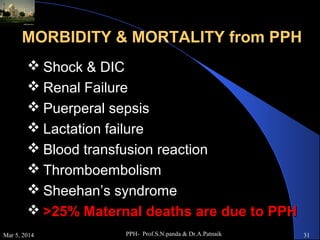
MORBIDITY & MORTALITY from PPH
 Shock & DIC
 Renal Failure
 Puerperal sepsis
 Lactation failure
 Blood transfusion reaction
 Thromboembolism
 Sheehan’s syndrome
 >25% Maternal deaths are due to PPH
Mar 5, 2014

PPH- Prof.S.N.panda & Dr.A.Patnaik

31
Intelligent anticipation, skilled supervision,
prompt detection and effective institution
of therapy can prevent disastrous
consequences of PPH.

Mar 5, 2014

PPH- Prof.S.N.panda & Dr.A.Patnaik

32
Mar 5, 2014

PPH- Prof.S.N.panda & Dr.A.Patnaik

33

Post partum haemorrhage

  • 1.
    POST PARTUM HAEMORRHAGE -A Challenge To Safe Motherhood
  • 2.
    WEL COME TO TajMahal Taj Mahal-One of the seven wonders of the world, One of the Greatest monuments, dedicated to the memory of “Queen Mumtaz” who died in child birth, by her husband “Emperor Sahajahan”, is a testimony and a grim reminder of the tragedy of maternal mortality, that can befall any women in childbirth. Mar 5, 2014 PPH- Prof.S.N.panda & Dr.A.Patnaik 2
  • 3.
    Obstetric Haemorrhage --- Ranksas the First cause of maternal mortality accounting for 25 – 50 % of maternal deaths POST ARTUM HAEMORRHAGE though preventable, accounts for the majority of the cases of obstetric haemorrhage, the other causes being – antepartum haemorrhage, abortion, ectopic pregnancy and ruptured uterus. Mar 5, 2014 PPH- Prof.S.N.panda & Dr.A.Patnaik 3
  • 4.
    POST PARTUM HAEMORRHAGE .. . the most common and severe type of obstetric haemmorrhage, is an enigma even to the present day obstetrician as it is sudden, often unpredicted, assessed subjectively and can be catastrophic. The clinical picture changes so rapidly that unless timely action is taken maternal death occurs within a short period. Mar 5, 2014 PPH- Prof.S.N.panda & Dr.A.Patnaik 4
  • 5.
    MAGNITUDE OF THEPROBLEM Direct Causes (%) of Mat.Mort. in selected countries* Country +MMR Haemorrhage Sepsis Toxaemia Abortion Obstructed Labour INDIA 874 18 14 16 14 03 Bangladesh 600 22 03 19 31 09 Ethiopia 566 6 2 6 25 4 Tanzania 678 18 15 03 17 -- Zambia 118 17 15 20 17 -- USA 15 10 08 17 06 03 *World watch paper 102Jacobson JL ed, 1991 Mar 5, 2014 +MMR – Maternal Mortality Rate / 100000 live births PPH- Prof.S.N.panda & Dr.A.Patnaik 5
  • 6.
    MAGNITUDE OF THEPROBLEM Causes of Mat.Mort. In India Cause Reg.Gen. India (1992) FOGSI (1982) 23.7% 22.3% Toxaemia 15.2 10.7 Puerperal Sepsis 08.1 28.4 Anaemia 19.4 - Obstructed Labour 07.1 - Abortion 11.8 - Others 14.7 - Haemorrhage Mar 5, 2014 PPH- Prof.S.N.panda & Dr.A.Patnaik 6
  • 7.
    MAGNITUDE OF THEPROBLEM CAUSES OF 110 MATERNAL DEATHS AT OUR HOSPITAL FROM 1/1996-7/2000 120 NUMBER 100 80 11 OTHERS 4 5 7 MALARIA 12 ANAEMIA 60 17 40 23 RUPTURED UERUS UNSAFE ABORTION VIAL HEPATIIS PIH 20 0 Mar 5, 2014 31 HAEMORRHAGE CAUSES PPH- Prof.S.N.panda & Dr.A.Patnaik 7
  • 8.
    MAGNITUDE OF THEPROBLEM PPH - A world of difference Year Developing Countries 1930 1:3000 Births Not Available 1950 1:20,000 Not Available 1980 1:60,000 1:1000 2000 Mar 5, 2014 Developed Countries 1:100,000 1:5000 PPH- Prof.S.N.panda & Dr.A.Patnaik 8
  • 9.
    POST PARTUM HAEMORRHAGE DEFINITION:- Blood loss of 500ml or more per vaginum during the first 24hrs after the delivery of the baby. Risk of Maternal Mortality & Morbidity are 50 times more after PPH Mar 5, 2014 PPH- Prof.S.N.panda & Dr.A.Patnaik 9
  • 10.
    ASSESSMENT OF BLOODLOSS AFTER DELIVERY  Difficult  Mostly Visual estimation (So, Subjective & Inaccurate)  Underestimation is likely  Clinical picture -Misleading  Our Mothers-Malnourished, Anaemic, Small built, Less blood volume Mar 5, 2014 PPH- Prof.S.N.panda & Dr.A.Patnaik 10
  • 11.
    MECHANISM OF HAEMOSTASIS AFTERDELIVERY • Uterine contraction & retraction • Platelet aggregation → clot formation Mar 5, 2014 PPH- Prof.S.N.panda & Dr.A.Patnaik 11
  • 12.
    Why PPH ? 1.Uterine atony (80%) 2. Retained Placenta 3. Trauma to genital tract 4. Coagulation disorders 5. Uterine inversion Mar 5, 2014 PPH- Prof.S.N.panda & Dr.A.Patnaik 12
  • 13.
    1. UTERINE ATONY RISKFACTORS  Over distension of uterus  Induction of labour  Prolonged / precipitate labour  Anaesthesia (halogeneted) & analgesia  Tocolytics (Tocolytics (also called anti-contraction medications or labor repressants) are medications used to suppress premature labor )  APH  Grand multiparity  Mismanagement of 3rd stage of Labour  Full bladder Mar 5, 2014 PPH- Prof.S.N.panda & Dr.A.Patnaik 13
  • 14.
    2. RETAINED PLACENTA Simpleadhesion Morbid adhesion>Accreta, Increta & Percreta 3. TRAUMATIC  Large episiotomy & extensions  Tears & lacerations of perineum, vagina or cervix  Haematoma  Uterine rupture Mar 5, 2014 PPH- Prof.S.N.panda & Dr.A.Patnaik 14
  • 15.
    Mar 5, 2014 PPH-Prof.S.N.panda & Dr.A.Patnaik 15
  • 16.
    4. COAGULATION DISORDERS Abruptioplacentae Sepsis :IUD,PROM(premature rupture of membrane) Massive blood loss Massive blood transfusion Severe PET (Pre-eclamptic Toxemia)/ Eclampsia Amniotic fluid embolism Hepatitis Mar 5, 2014 PPH- Prof.S.N.panda & Dr.A.Patnaik 16
  • 17.
    5. UTERINE INVERSION ←IncompleteInversionFundus felt through the Cx Complete Inversion with placenta accreta attached to the fundus→ Mostly iatrogenic due to mismanagement of 3rd stage - strong traction on the cord with a relaxed uterus / adherent placenta. Mar 5, 2014 PPH- Prof.S.N.panda & Dr.A.Patnaik 17
  • 18.
    SYMPTOMS & SIGNS Bloodloss Systolic BP Signs & Symptoms (% B Vol) ( mm of Hg) 10-15 Normal postural hypotension 15-30 slight fall ↑PR, thirst, weakness 30-40 60-80 pallor,oliguria, confusion 40+ 40-60 anuria, air hunger, coma, death Mar 5, 2014 PPH- Prof.S.N.panda & Dr.A.Patnaik 18
  • 19.
    PREVENTION Regular ANC Correction ofanaemia Identification of high risk cases Delivery in hospital with facility for Emergency Obstetric Care.  Otherwise transport to the nearest such hospital at the earliest.      Keep speedy transport available  Local / Regional anaesthesia  ACTIVE MANAGEMENT OF 3RD STAGE OF LABOUR  4th Stage of labour - Observation, Oxytocin Mar 5, 2014 PPH- Prof.S.N.panda & Dr.A.Patnaik 19
  • 20.
    ACTIVE MANAGEMENT OF3RD STAGE OF LABOUR (WHO-1989)  Oxytocics - Routine use in third stage → blood loss ↓ by 30-40%  10 Units Oxytocin IV bolus  Syntometrine 1 Amp IV  Ergometrine 1 Amp IV  Carboprost ( better than Ergometrine) 0.125 – 0.25 Mg IM  Early cord clamping  Controlled cord traction  Inspection of placenta & lower genital tract Mar 5, 2014 PPH- Prof.S.N.panda & Dr.A.Patnaik 20
  • 21.
    MANAGEMENT OF PPH TEAM- Obstetrician, Anesthesiologist, Haematologist and Blood Bank  Correction of hypovolaemia  Ascertain origin of bleeding  Ensure uterine contraction  Surgical management  Management of special situation Mar 5, 2014 PPH- Prof.S.N.panda & Dr.A.Patnaik 21
  • 22.
    MANAGEMENT OF PPH CORRECTIONOF HYPOVOLEMIA  Large bore IV line (two)  Crystalloids (RL)-3ml / ml of blood loss  Urine output (desired) –30ml / hr  Whole blood / pack cell Mar 5, 2014 PPH- Prof.S.N.panda & Dr.A.Patnaik 22
  • 23.
    MANAGEMENT OF PPH ENSUREUTERINE CONTRACTION  Palpate fundus  Uterine massage  Bimanual compression  Compression of Aorta against sacral promontory  Foleys catheters Mar 5, 2014 PPH- Prof.S.N.panda & Dr.A.Patnaik 23
  • 24.
    MANAGEMENT OF PPH OXYTOCICS Oxytocin:  Bolus of 10 units IV followed by Continuous Infusion 100 mu / min  Ergometrine 0.2 - 0.5mg IV  Prostaglandins Carboprost- 0.25mg start, Rpt.15-30 min, Maximum 2.0mg, Route-IM / intramyometrial  Sulprostone- 400-600 micro gm Mar 5, 2014 PPH- Prof.S.N.panda & Dr.A.Patnaik 24
  • 25.
    MANAGEMENT OF PPH OTHERMODES  M.A.S.T (Military Anti Shock Treatment)  UTERINE PACKING  UTERINE TAMPONADE • Large bulb Foleys • Sangstaken blakemole tube Mar 5, 2014 PPH- Prof.S.N.panda & Dr.A.Patnaik 25
  • 26.
    MANAGEMENT OF PPH SURGICALTREATMENT Depends on  Extent & cause of haemorrhage  General condition of patient  Future reproduction  Experience & skill Mar 5, 2014 PPH- Prof.S.N.panda & Dr.A.Patnaik 26
  • 27.
    MANAGEMENT OF PPH SURGICALTREATMENT        Mar 5, 2014 Repair of trauma if any Uterine Artery ligation Utero ovarian A. Ligation Internal Iliac A. Ligation Brace suturing of Uterus Hysterectomy Angiographic embolisation PPH- Prof.S.N.panda & Dr.A.Patnaik 27
  • 28.
    MANAGEMENT OF PPH RETAINEDPLACENTA  EUA(examination Under Anaesthesia & Manual Removal  If Placenta accretaObservation Cytotoxic drugs- Methotrexate Hysterectomy Mar 5, 2014 PPH- Prof.S.N.panda & Dr.A.Patnaik 28
  • 29.
    MANAGEMENT OF PPH ACUTEINVERSION OF UTERUS  Manual replacementUnder GA / Uterine relaxant  Hydrostatic method  Surgical method ( Usually delayed procedure) Mar 5, 2014 PPH- Prof.S.N.panda & Dr.A.Patnaik 29
  • 30.
    MANAGEMENT OF PPH MANAGEMENTOF DIC  Fresh blood transfusion  Blood products Cryoprecipitate Fresh frozen plasma Platelet concentrate Mar 5, 2014 PPH- Prof.S.N.panda & Dr.A.Patnaik 30
  • 31.
    MORBIDITY & MORTALITYfrom PPH  Shock & DIC  Renal Failure  Puerperal sepsis  Lactation failure  Blood transfusion reaction  Thromboembolism  Sheehan’s syndrome  >25% Maternal deaths are due to PPH Mar 5, 2014 PPH- Prof.S.N.panda & Dr.A.Patnaik 31
  • 32.
    Intelligent anticipation, skilledsupervision, prompt detection and effective institution of therapy can prevent disastrous consequences of PPH. Mar 5, 2014 PPH- Prof.S.N.panda & Dr.A.Patnaik 32
  • 33.
    Mar 5, 2014 PPH-Prof.S.N.panda & Dr.A.Patnaik 33