POSTPARTUM
HAEMORRHAGE

  DR SUKANDA JAILI
  O&G DEPARTMENT
        SGH
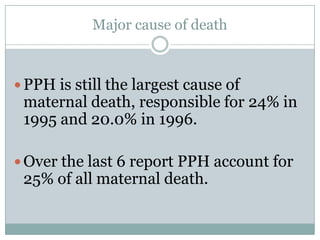
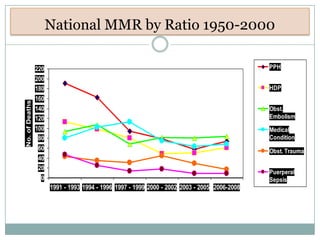
Major cause of death


 PPH is still the largest cause of
 maternal death, responsible for 24% in
 1995 and 20.0% in 1996.

 Over the last 6 report PPH account for
 25% of all maternal death.
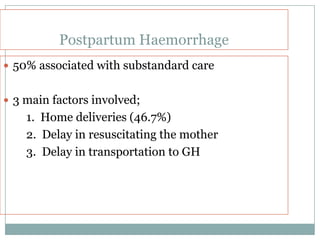
Postpartum Haemorrhage
 50% associated with substandard care


 3 main factors involved;
    1. Home deliveries (46.7%)
    2. Delay in resuscitating the mother
    3. Delay in transportation to GH
National MMR by Ratio 1950-2000

                220                                                                           PPH
                200
                180                                                                           HDP
                160
No. of Deaths


                140                                                                           Obst.
                120                                                                           Embolism
                100                                                                           Medical
                 80                                                                           Condition
                 60                                                                           Obst. Trauma
                 40
                 20
                                                                                              Puerperal
                  0                                                                           Sepsis
                      1991 - 1993 1994 - 1996 1997 - 1999 2000 - 2002 2003 - 2005 2006-2008
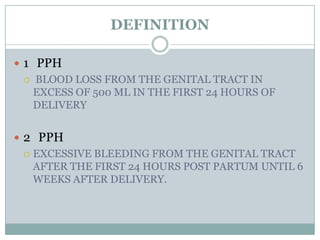
DEFINITION

 1 PPH
   BLOOD LOSS FROM THE GENITAL TRACT IN
    EXCESS OF 500 ML IN THE FIRST 24 HOURS OF
    DELIVERY


 2 PPH
   EXCESSIVE BLEEDING FROM THE GENITAL TRACT
    AFTER THE FIRST 24 HOURS POST PARTUM UNTIL 6
    WEEKS AFTER DELIVERY.
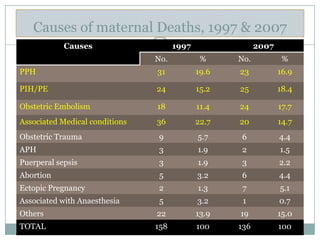
Causes of maternal Deaths, 1997 & 2007
            Causes                    1997                2007
                                No.           %     No.           %
PPH                             31           19.6   23           16.9

PIH/PE                          24           15.2   25           18.4

Obstetric Embolism              18           11.4   24           17.7
Associated Medical conditions   36           22.7   20           14.7
Obstetric Trauma                9            5.7    6            4.4
APH                             3            1.9    2            1.5
Puerperal sepsis                3            1.9    3            2.2
Abortion                         5           3.2    6            4.4
Ectopic Pregnancy               2            1.3     7           5.1
Associated with Anaesthesia      5           3.2     1           0.7
Others                          22           13.9   19           15.0
TOTAL                           158          100    136          100
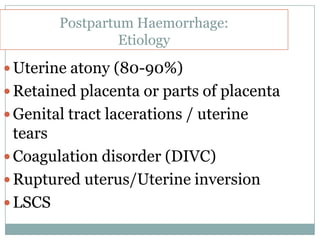
Postpartum Haemorrhage:
                 Etiology
 Uterine atony (80-90%)
 Retained placenta or parts of placenta
 Genital tract lacerations / uterine
  tears
 Coagulation disorder (DIVC)
 Ruptured uterus/Uterine inversion
 LSCS
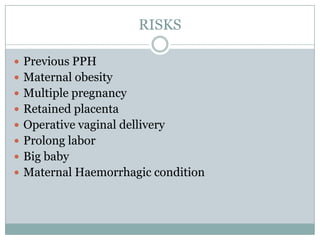
RISKS

 Previous PPH
 Maternal obesity
 Multiple pregnancy
 Retained placenta
 Operative vaginal dellivery
 Prolong labor
 Big baby
 Maternal Haemorrhagic condition
Postpartum Haemorrhage:
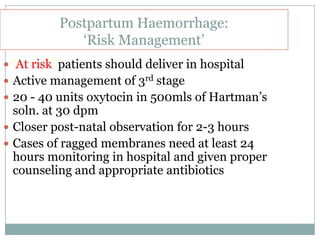
             ‘Risk Management’
 ‘At risk’ patients should deliver in hospital
 Active management of 3rd stage
 20 - 40 units oxytocin in 500mls of Hartman’s
  soln. at 30 dpm
 Closer post-natal observation for 2-3 hours
 Cases of ragged membranes need at least 24
  hours monitoring in hospital and given proper
  counseling and appropriate antibiotics
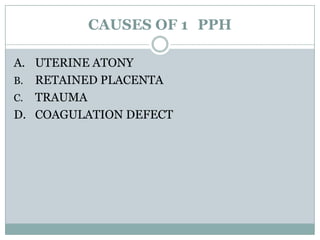
CAUSES OF 1 PPH

A. UTERINE ATONY
B. RETAINED PLACENTA
C. TRAUMA
D. COAGULATION DEFECT
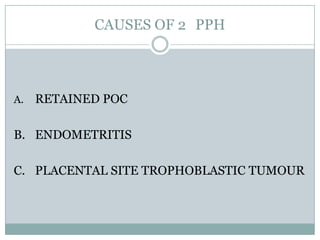
CAUSES OF 2 PPH


A.   RETAINED POC

B. ENDOMETRITIS

C. PLACENTAL SITE TROPHOBLASTIC TUMOUR
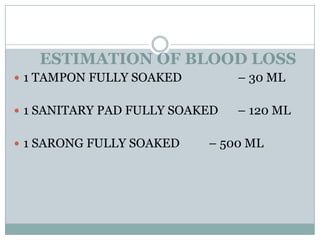
ESTIMATION OF BLOOD LOSS
 1 TAMPON FULLY SOAKED         – 30 ML

 1 SANITARY PAD FULLY SOAKED   – 120 ML

 1 SARONG FULLY SOAKED    – 500 ML
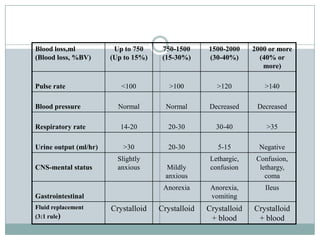
Blood loss,ml           Up to 750     750-1500     1500-2000     2000 or more
(Blood loss, %BV)      (Up to 15%)    (15-30%)     (30-40%)        (40% or
                                                                    more)

Pulse rate                <100          >100          >120          >140

Blood pressure           Normal        Normal      Decreased      Decreased

Respiratory rate          14-20        20-30          30-40          >35

Urine output (ml/hr)       >30         20-30          5-15         Negative
                         Slightly                   Lethargic,    Confusion,
CNS-mental status        anxious       Mildly       confusion      lethargy,
                                       anxious                       coma
                                      Anorexia      Anorexia,       Ileus
Gastrointestinal                                    vomiting
Fluid replacement      Crystalloid   Crystalloid   Crystalloid   Crystalloid
(3:1 rule)                                          + blood       + blood
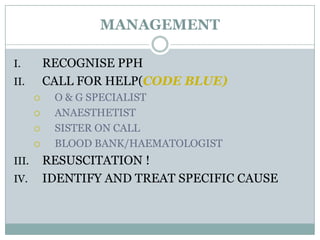
MANAGEMENT

I.         RECOGNISE PPH
II.        CALL FOR HELP(CODE BLUE)
           O & G SPECIALIST
           ANAESTHETIST
           SISTER ON CALL
           BLOOD BANK/HAEMATOLOGIST
III.       RESUSCITATION !
IV.        IDENTIFY AND TREAT SPECIFIC CAUSE
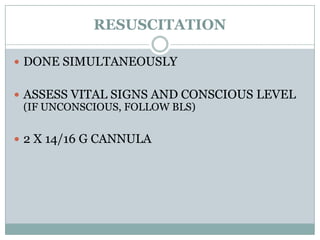
RESUSCITATION

 DONE SIMULTANEOUSLY


 ASSESS VITAL SIGNS AND CONSCIOUS LEVEL
  (IF UNCONSCIOUS, FOLLOW BLS)


 2 X 14/16 G CANNULA
RESUSCITATION


 TAKE 20 ML OF BLOOD FOR

  GXM 4 UNITS PC
  FBC
  COAGULATION SCREENING
  ELECTROLYTES
RESUSCITATION
 INFUSE FLUIDS (COLLOID/CRYSTALLOID)


 MAINTAIN CIRCULATORY VOLUME WHILE
 WAITING FOR BLOOD

 IN DIRE STATES, USE GROUP SPECIFIC
 BLOOD OR UNMATCHED O RH –VE BLOOD
RESUSCITATION
 RUNNERS – SN/ HO/ MO


 CONSIDER CENTRAL LINES


 CBD FOR HOURLY MONITORING


 OXYGEN
RESUSCITATION


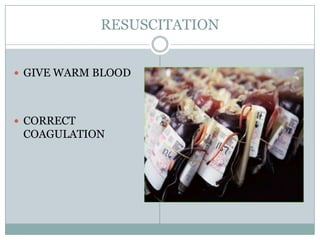
 GIVE WARM BLOOD


 CORRECT
 COAGULATION
 STABILIZING AND
 INITIAL
 RESUSCITATION MUST
 BE DONE FIRST 1
 GOLDEN HOUR

 IN DH DECISION FOR
 REFERRAL MUST BE
 MADE EARLY
 DURING
 TRANSPORTATION
    MONITORING
    RESUSCITATION
    TEMPORARY MEASURE
    COMMUNICATION
UTERINE ATONY

 MASSAGE UTERUS


 OXYTOCIN INFUSION (40 UNITS IN 500 ML NS
 AT 20 – 30 DPM)

 ERGOMETRINE IV/IM 0.5 MG


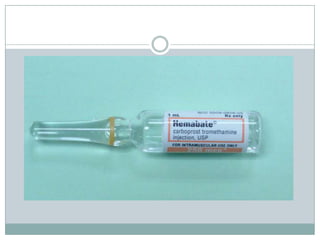
 CARBOPROST (HAEMABATE) IM 250 UG
UTERINE ATONY


 BIMANUAL COMPRESSION


 UTERINE PACKING


 AORTIC COMPRESSION
RETAINED PLACENTA
 RESUSCITATION!
 DO NOT CONTINUE WITH CCT WITH SUCH
    PATIENT
   OXYTOCIN SHOULD BE GIVEN
   MRP IN OT UNDER GA WITH ANAESTHETIC
    BACK UP FOR RESUSCITATION
   LOOK FOR GENITAL TRACT TRAUMA
   START OXYTOCIN INFUSION AFTER MRP
   ANTIBIOTICS
UTERINE ATONY
   SURGICAL TREATMENT


 CONSERVATIVE MEASURES
   BRACE SUTURING – B LYNCH

   INTERNAL ILIAC LIGATION

 HYSTERECTOMY
MORBIDLY ADHERENT
          PLACENTA


 IN CASES OF ACCRETA, IF NO BLEEDING, MAY
  TREAT CONSERVATIVELY WITH MEDICATION
 OTHERWISE, REQUIRE LAPAROTOMY 
  HYSTERECTOMY
GENITAL TRACT INJURY


 INJURY TO
   EPISIOTOMY

   VAGINA

   CERVIX

   UTERUS

   EXTENSION TO BROAD LIGAMENTS
GENITAL TRACT INJURY

 RISK FACTORS
   INSTRUMENTAL DELIVERY

   BIG BABY

   SHOULDER DYSTOCIA

   PRECIPITATE LABOUR
GENITAL TRACT INJURY

 EXAMINATION – BEST UNDER ANAESTHESIA IN
  OT
 ‘WALK THE CERVIX’
 HIGH INDEX OF SUSPICION OF EXTENSION TO
  BROAD LIGAMENTS AND UTERUS IF
  LACERATION INVOLVING CERVIX AND
  FORNICES
 ANTIBIOTICS
GENITAL TRACT INJURY
        - UTERINE RUPTURE


 HIGH INDEX OF SUSPICION
   PREVIOUS SCAR

   DIFFICULT DELIVERY (INTERNAL PODALIC VERSION)

   GRANDMULTIPARA

   OBSTRUCTED LABOUR
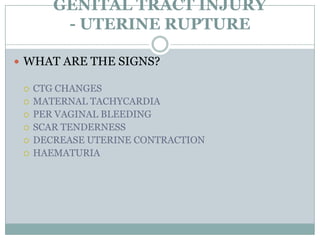
GENITAL TRACT INJURY
         - UTERINE RUPTURE

 WHAT ARE THE SIGNS?

    CTG CHANGES
    MATERNAL TACHYCARDIA
    PER VAGINAL BLEEDING
    SCAR TENDERNESS
    DECREASE UTERINE CONTRACTION
    HAEMATURIA
RESUSCITATION

 WELL DOCUMENTED


 ORGANIZED


 EARY REFERRAL


 COMMUNICATION
SECONDARY PPH

 USUALLY PRESENTS IN THE 2ND AND 3RD WEEK POST
 PARTUM

 HVS FOR CULTURE

 START ANTIBIOTICS

 IF DIAGNOSIS OF RETAINED POC, FOR EXPERIENCED
 PERSONNEL TO PERFORM EVACUATION – HIGH RISK
 OF PERFORATION

 DIFFICULT TO DIFFERENTIATE POC AND BLOOD
 CLOT BY US IN 1ST 2 WEEKS POSTPARTUM
MONITORING

 ICU/ HDU MONITORING
 VITAL SIGN MONITORING EVERY 15 MINUTES
  - BP, PR, RR, SA O2, CVP
 FLUID RESUSCITATION DOCUMENTED
 URINE OUTPUT
 ON GOING HAEMORRHAGE NOTED
    DRAIN, PAD
 RESULTS TRACED STAT
 INFORM PATIENT AND RELATIVES
Case illustration

 A 35 year old Malay lady in her 4th pregnancy, had
 a history of PPH in her previous pregnancies. She
 was diagnosed to have pre eclampsia during this
 pregnancy and was on oral antihypertensive
 medication. At 38 weeks of gestation she was
 admitted to a private facility and was induced with
 prostaglandins.
 The labour was uneventful and she delivered a 3.9kg
 baby. There was massive bleeding after her delivery.
 Exploration did not reveal any retained products.
 The uterus remained atonic despite repeated
 injections of ergometrine and an oxytocin infusion.
 No blood or blood products were available.
 She was transferred to a general hospital for further
 resuscitation but arrived in a moribund state and
 succumbed soon after.
Case illustration

 A 30 year Malay lady in her third pregnancy at 38
 weeks of gestation came in labour at a district
 hospital. Her antenatal period had been uneventful.
 She delivered vaginally at 7.02pm. Active
 management of 3rd stage instituted and the placenta
 was delivered via CCT. Her delivery was conducted
 by a staff nurse.
 After the placenta was delivered it was noted that
 there was active bleeding from the vagina. A green
 branula was inserted and the on-call doctor was
 informed. Over the phone the doctor ordered for
 uterine massage to be done, to give patient iv
 ergometrine 0.5mg and iv Pitocin 40 unit in
 500mls NS started while awaiting for him to come.
 On examination, the patient was alert, the blood
 pressure was normal but the pulse rate was 96b/min.
 Abdominal examination done showed that the uterus
 was contracted.Despite that the patient was still
 actively bleeding. Another iv line was inserted and
 blood was sent for FBC, GXM and PT/PTT. She was
 given NS running fast.
 Another doctor was called to help manage the patient.
  Further examination showed a cervical laceration which the
  doctor tried to repair but failed. The patient continued to
  bleed, so vaginal packing was done and she was planned for
  transferred to the general hospital.The placenta was also
  re-examine for it’s completeness. By this time, the patient’s
  blood loss was about 1 L. the patient was conscious but
  lethargic, her BP was 90/60mmHg and PR was 110b/min.
 While awaiting for arrangements for transfer to the referral
  center to be made, another 2 iv lines inserted and she was
  rapidly infused with NS and later transfused with blood. A
  Foley’s catheter was inserted to monitor urine output and
  her vital signs was monitored every 15 minutes.
 She arrived at the general hospital at 10.20pm
 accompanied by a doctor and 2 staff. Upon arrival
 the estimated blood loss was about 2L and she had
 4 iv lines (all green). 2 unit of blood has already
 been transfused plus the crystalloids and the 3rd
 and 4th unit of blood transfusion was still in
 progress.
 Examination upon arrival showed very pale patient,
 drowsy but still responding to call, the BP was
 80/40mmHg and the PR was 130b/min. The uterus
 was contracted and she was still actively bleeding
 from the vagina.
 EUA was done and the cervical laceration was
 sutured. Despite that patient continued to bleed. A
 laparotomy was done and it showed that there was
 another cervical laceration which extended up to the
 lower segment of the uterus. As it was not able to be
 repaired, a hysterectomy was performed.
 Post operatively she was managed for 2 days in ICU.
 The estimated blood loss through out was 5.4L and
 she was transfused a total of 21 unit of blood and 4
 cycles of DIVC regime. She was discharged well on
 day 6 post delivery.
THANK YOU

Postpartum Haemorrhage

  • 1.
    POSTPARTUM HAEMORRHAGE DRSUKANDA JAILI O&G DEPARTMENT SGH
  • 2.
    Major cause ofdeath  PPH is still the largest cause of maternal death, responsible for 24% in 1995 and 20.0% in 1996.  Over the last 6 report PPH account for 25% of all maternal death.
  • 3.
    Postpartum Haemorrhage  50%associated with substandard care  3 main factors involved; 1. Home deliveries (46.7%) 2. Delay in resuscitating the mother 3. Delay in transportation to GH
  • 4.
    National MMR byRatio 1950-2000 220 PPH 200 180 HDP 160 No. of Deaths 140 Obst. 120 Embolism 100 Medical 80 Condition 60 Obst. Trauma 40 20 Puerperal 0 Sepsis 1991 - 1993 1994 - 1996 1997 - 1999 2000 - 2002 2003 - 2005 2006-2008
  • 5.
    DEFINITION  1 PPH  BLOOD LOSS FROM THE GENITAL TRACT IN EXCESS OF 500 ML IN THE FIRST 24 HOURS OF DELIVERY  2 PPH  EXCESSIVE BLEEDING FROM THE GENITAL TRACT AFTER THE FIRST 24 HOURS POST PARTUM UNTIL 6 WEEKS AFTER DELIVERY.
  • 6.
    Causes of maternalDeaths, 1997 & 2007 Causes 1997 2007 No. % No. % PPH 31 19.6 23 16.9 PIH/PE 24 15.2 25 18.4 Obstetric Embolism 18 11.4 24 17.7 Associated Medical conditions 36 22.7 20 14.7 Obstetric Trauma 9 5.7 6 4.4 APH 3 1.9 2 1.5 Puerperal sepsis 3 1.9 3 2.2 Abortion 5 3.2 6 4.4 Ectopic Pregnancy 2 1.3 7 5.1 Associated with Anaesthesia 5 3.2 1 0.7 Others 22 13.9 19 15.0 TOTAL 158 100 136 100
  • 7.
    Postpartum Haemorrhage: Etiology  Uterine atony (80-90%)  Retained placenta or parts of placenta  Genital tract lacerations / uterine tears  Coagulation disorder (DIVC)  Ruptured uterus/Uterine inversion  LSCS
  • 8.
    RISKS  Previous PPH Maternal obesity  Multiple pregnancy  Retained placenta  Operative vaginal dellivery  Prolong labor  Big baby  Maternal Haemorrhagic condition
  • 9.
    Postpartum Haemorrhage: ‘Risk Management’  ‘At risk’ patients should deliver in hospital  Active management of 3rd stage  20 - 40 units oxytocin in 500mls of Hartman’s soln. at 30 dpm  Closer post-natal observation for 2-3 hours  Cases of ragged membranes need at least 24 hours monitoring in hospital and given proper counseling and appropriate antibiotics
  • 10.
    CAUSES OF 1PPH A. UTERINE ATONY B. RETAINED PLACENTA C. TRAUMA D. COAGULATION DEFECT
  • 11.
    CAUSES OF 2PPH A. RETAINED POC B. ENDOMETRITIS C. PLACENTAL SITE TROPHOBLASTIC TUMOUR
  • 12.
    ESTIMATION OF BLOODLOSS  1 TAMPON FULLY SOAKED – 30 ML  1 SANITARY PAD FULLY SOAKED – 120 ML  1 SARONG FULLY SOAKED – 500 ML
  • 13.
    Blood loss,ml Up to 750 750-1500 1500-2000 2000 or more (Blood loss, %BV) (Up to 15%) (15-30%) (30-40%) (40% or more) Pulse rate <100 >100 >120 >140 Blood pressure Normal Normal Decreased Decreased Respiratory rate 14-20 20-30 30-40 >35 Urine output (ml/hr) >30 20-30 5-15 Negative Slightly Lethargic, Confusion, CNS-mental status anxious Mildly confusion lethargy, anxious coma Anorexia Anorexia, Ileus Gastrointestinal vomiting Fluid replacement Crystalloid Crystalloid Crystalloid Crystalloid (3:1 rule) + blood + blood
  • 14.
    MANAGEMENT I. RECOGNISE PPH II. CALL FOR HELP(CODE BLUE)  O & G SPECIALIST  ANAESTHETIST  SISTER ON CALL  BLOOD BANK/HAEMATOLOGIST III. RESUSCITATION ! IV. IDENTIFY AND TREAT SPECIFIC CAUSE
  • 15.
    RESUSCITATION  DONE SIMULTANEOUSLY ASSESS VITAL SIGNS AND CONSCIOUS LEVEL (IF UNCONSCIOUS, FOLLOW BLS)  2 X 14/16 G CANNULA
  • 16.
    RESUSCITATION  TAKE 20ML OF BLOOD FOR  GXM 4 UNITS PC  FBC  COAGULATION SCREENING  ELECTROLYTES
  • 17.
    RESUSCITATION  INFUSE FLUIDS(COLLOID/CRYSTALLOID)  MAINTAIN CIRCULATORY VOLUME WHILE WAITING FOR BLOOD  IN DIRE STATES, USE GROUP SPECIFIC BLOOD OR UNMATCHED O RH –VE BLOOD
  • 18.
    RESUSCITATION  RUNNERS –SN/ HO/ MO  CONSIDER CENTRAL LINES  CBD FOR HOURLY MONITORING  OXYGEN
  • 19.
    RESUSCITATION  GIVE WARMBLOOD  CORRECT COAGULATION
  • 20.
     STABILIZING AND INITIAL RESUSCITATION MUST BE DONE FIRST 1 GOLDEN HOUR  IN DH DECISION FOR REFERRAL MUST BE MADE EARLY
  • 21.
     DURING TRANSPORTATION  MONITORING  RESUSCITATION  TEMPORARY MEASURE  COMMUNICATION
  • 22.
    UTERINE ATONY  MASSAGEUTERUS  OXYTOCIN INFUSION (40 UNITS IN 500 ML NS AT 20 – 30 DPM)  ERGOMETRINE IV/IM 0.5 MG  CARBOPROST (HAEMABATE) IM 250 UG
  • 24.
    UTERINE ATONY  BIMANUALCOMPRESSION  UTERINE PACKING  AORTIC COMPRESSION
  • 25.
    RETAINED PLACENTA  RESUSCITATION! DO NOT CONTINUE WITH CCT WITH SUCH PATIENT  OXYTOCIN SHOULD BE GIVEN  MRP IN OT UNDER GA WITH ANAESTHETIC BACK UP FOR RESUSCITATION  LOOK FOR GENITAL TRACT TRAUMA  START OXYTOCIN INFUSION AFTER MRP  ANTIBIOTICS
  • 26.
    UTERINE ATONY SURGICAL TREATMENT  CONSERVATIVE MEASURES  BRACE SUTURING – B LYNCH  INTERNAL ILIAC LIGATION  HYSTERECTOMY
  • 27.
    MORBIDLY ADHERENT PLACENTA  IN CASES OF ACCRETA, IF NO BLEEDING, MAY TREAT CONSERVATIVELY WITH MEDICATION  OTHERWISE, REQUIRE LAPAROTOMY  HYSTERECTOMY
  • 28.
    GENITAL TRACT INJURY INJURY TO  EPISIOTOMY  VAGINA  CERVIX  UTERUS  EXTENSION TO BROAD LIGAMENTS
  • 29.
    GENITAL TRACT INJURY RISK FACTORS  INSTRUMENTAL DELIVERY  BIG BABY  SHOULDER DYSTOCIA  PRECIPITATE LABOUR
  • 30.
    GENITAL TRACT INJURY EXAMINATION – BEST UNDER ANAESTHESIA IN OT  ‘WALK THE CERVIX’  HIGH INDEX OF SUSPICION OF EXTENSION TO BROAD LIGAMENTS AND UTERUS IF LACERATION INVOLVING CERVIX AND FORNICES  ANTIBIOTICS
  • 31.
    GENITAL TRACT INJURY - UTERINE RUPTURE  HIGH INDEX OF SUSPICION  PREVIOUS SCAR  DIFFICULT DELIVERY (INTERNAL PODALIC VERSION)  GRANDMULTIPARA  OBSTRUCTED LABOUR
  • 32.
    GENITAL TRACT INJURY - UTERINE RUPTURE  WHAT ARE THE SIGNS?  CTG CHANGES  MATERNAL TACHYCARDIA  PER VAGINAL BLEEDING  SCAR TENDERNESS  DECREASE UTERINE CONTRACTION  HAEMATURIA
  • 33.
    RESUSCITATION  WELL DOCUMENTED ORGANIZED  EARY REFERRAL  COMMUNICATION
  • 34.
    SECONDARY PPH  USUALLYPRESENTS IN THE 2ND AND 3RD WEEK POST PARTUM  HVS FOR CULTURE  START ANTIBIOTICS  IF DIAGNOSIS OF RETAINED POC, FOR EXPERIENCED PERSONNEL TO PERFORM EVACUATION – HIGH RISK OF PERFORATION  DIFFICULT TO DIFFERENTIATE POC AND BLOOD CLOT BY US IN 1ST 2 WEEKS POSTPARTUM
  • 35.
    MONITORING  ICU/ HDUMONITORING  VITAL SIGN MONITORING EVERY 15 MINUTES - BP, PR, RR, SA O2, CVP  FLUID RESUSCITATION DOCUMENTED  URINE OUTPUT  ON GOING HAEMORRHAGE NOTED  DRAIN, PAD  RESULTS TRACED STAT  INFORM PATIENT AND RELATIVES
  • 36.
    Case illustration  A35 year old Malay lady in her 4th pregnancy, had a history of PPH in her previous pregnancies. She was diagnosed to have pre eclampsia during this pregnancy and was on oral antihypertensive medication. At 38 weeks of gestation she was admitted to a private facility and was induced with prostaglandins.
  • 37.
     The labourwas uneventful and she delivered a 3.9kg baby. There was massive bleeding after her delivery. Exploration did not reveal any retained products. The uterus remained atonic despite repeated injections of ergometrine and an oxytocin infusion. No blood or blood products were available.
  • 38.
     She wastransferred to a general hospital for further resuscitation but arrived in a moribund state and succumbed soon after.
  • 39.
    Case illustration  A30 year Malay lady in her third pregnancy at 38 weeks of gestation came in labour at a district hospital. Her antenatal period had been uneventful. She delivered vaginally at 7.02pm. Active management of 3rd stage instituted and the placenta was delivered via CCT. Her delivery was conducted by a staff nurse.
  • 40.
     After theplacenta was delivered it was noted that there was active bleeding from the vagina. A green branula was inserted and the on-call doctor was informed. Over the phone the doctor ordered for uterine massage to be done, to give patient iv ergometrine 0.5mg and iv Pitocin 40 unit in 500mls NS started while awaiting for him to come.
  • 41.
     On examination,the patient was alert, the blood pressure was normal but the pulse rate was 96b/min. Abdominal examination done showed that the uterus was contracted.Despite that the patient was still actively bleeding. Another iv line was inserted and blood was sent for FBC, GXM and PT/PTT. She was given NS running fast.
  • 42.
     Another doctorwas called to help manage the patient. Further examination showed a cervical laceration which the doctor tried to repair but failed. The patient continued to bleed, so vaginal packing was done and she was planned for transferred to the general hospital.The placenta was also re-examine for it’s completeness. By this time, the patient’s blood loss was about 1 L. the patient was conscious but lethargic, her BP was 90/60mmHg and PR was 110b/min.
  • 43.
     While awaitingfor arrangements for transfer to the referral center to be made, another 2 iv lines inserted and she was rapidly infused with NS and later transfused with blood. A Foley’s catheter was inserted to monitor urine output and her vital signs was monitored every 15 minutes.
  • 44.
     She arrivedat the general hospital at 10.20pm accompanied by a doctor and 2 staff. Upon arrival the estimated blood loss was about 2L and she had 4 iv lines (all green). 2 unit of blood has already been transfused plus the crystalloids and the 3rd and 4th unit of blood transfusion was still in progress.
  • 45.
     Examination uponarrival showed very pale patient, drowsy but still responding to call, the BP was 80/40mmHg and the PR was 130b/min. The uterus was contracted and she was still actively bleeding from the vagina.
  • 46.
     EUA wasdone and the cervical laceration was sutured. Despite that patient continued to bleed. A laparotomy was done and it showed that there was another cervical laceration which extended up to the lower segment of the uterus. As it was not able to be repaired, a hysterectomy was performed.
  • 47.
     Post operativelyshe was managed for 2 days in ICU. The estimated blood loss through out was 5.4L and she was transfused a total of 21 unit of blood and 4 cycles of DIVC regime. She was discharged well on day 6 post delivery.
  • 48.