Modernism Vs. Postmodernism
Modernism/Modernity Postmodern/Postmodernity
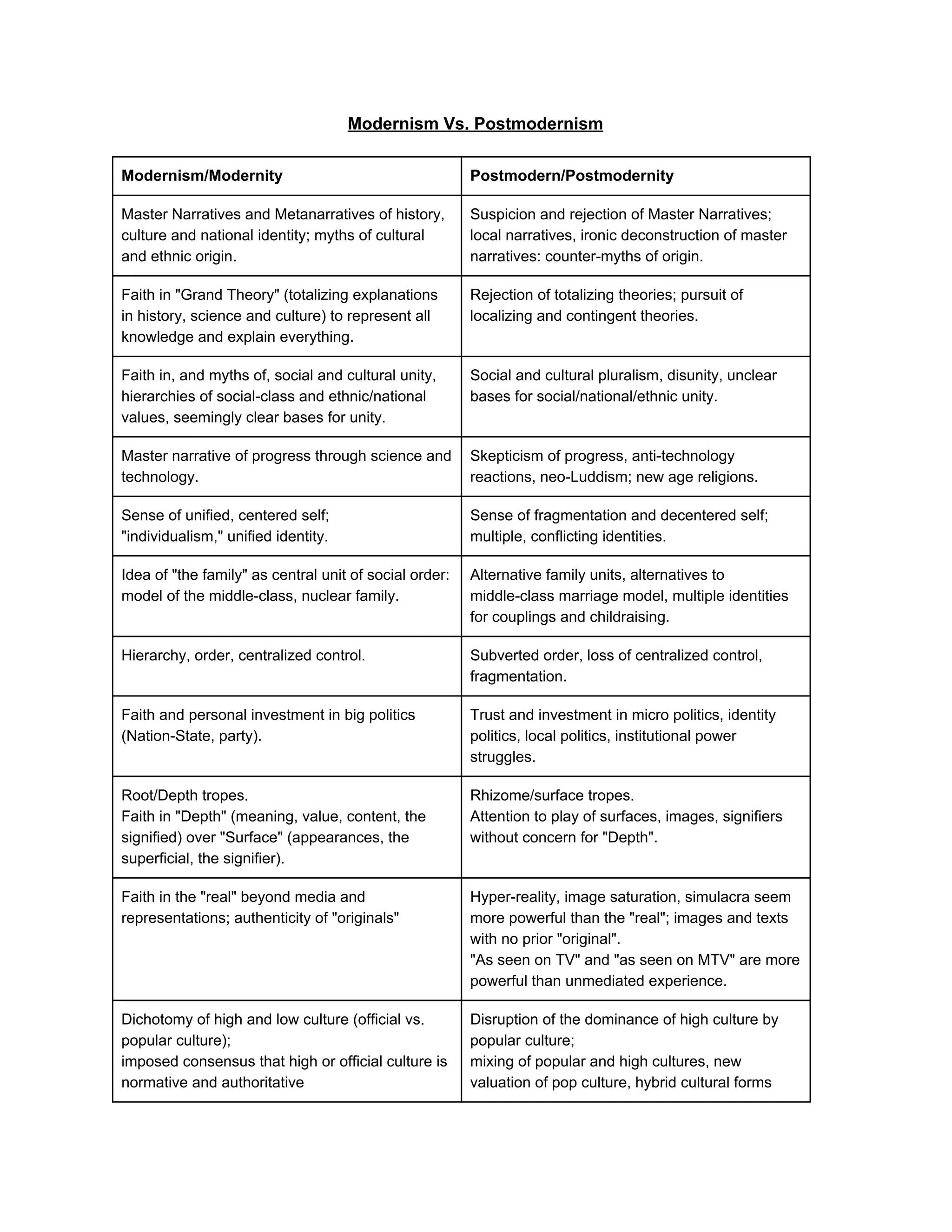
Master Narratives and Metanarratives of history,
culture and national identity; myths of cultural
and ethnic origin.
Suspicion and rejection of Master Narratives;
local narratives, ironic deconstruction of master
narratives: counter-myths of origin.
Faith in "Grand Theory" (totalizing explanations
in history, science and culture) to represent all
knowledge and explain everything.
Rejection of totalizing theories; pursuit of
localizing and contingent theories.
Faith in, and myths of, social and cultural unity,
hierarchies of social-class and ethnic/national
values, seemingly clear bases for unity.
Social and cultural pluralism, disunity, unclear
bases for social/national/ethnic unity.
Master narrative of progress through science and
technology.
Skepticism of progress, anti-technology
reactions, neo-Luddism; new age religions.
Sense of unified, centered self;
"individualism," unified identity.
Sense of fragmentation and decentered self;
multiple, conflicting identities.
Idea of "the family" as central unit of social order:
model of the middle-class, nuclear family.
Alternative family units, alternatives to
middle-class marriage model, multiple identities
for couplings and childraising.
Hierarchy, order, centralized control. Subverted order, loss of centralized control,
fragmentation.
Faith and personal investment in big politics
(Nation-State, party).
Trust and investment in micro politics, identity
politics, local politics, institutional power
struggles.
Root/Depth tropes.
Faith in "Depth" (meaning, value, content, the
signified) over "Surface" (appearances, the
superficial, the signifier).
Rhizome/surface tropes.
Attention to play of surfaces, images, signifiers
without concern for "Depth".
Faith in the "real" beyond media and
representations; authenticity of "originals"
Hyper-reality, image saturation, simulacra seem
more powerful than the "real"; images and texts
with no prior "original".
"As seen on TV" and "as seen on MTV" are more
powerful than unmediated experience.
Dichotomy of high and low culture (official vs.
popular culture);
imposed consensus that high or official culture is
normative and authoritative
Disruption of the dominance of high culture by
popular culture;
mixing of popular and high cultures, new
valuation of pop culture, hybrid cultural forms
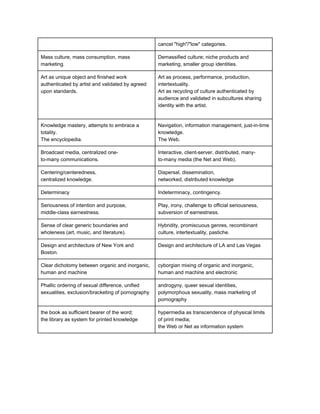
cancel "high"/"low" categories.
Mass culture, mass consumption, mass
marketing.
Demassified culture; niche products and
marketing, smaller group identities.
Art as unique object and finished work
authenticated by artist and validated by agreed
upon standards.
Art as process, performance, production,
intertextuality.
Art as recycling of culture authenticated by
audience and validated in subcultures sharing
identity with the artist.
Knowledge mastery, attempts to embrace a
totality.
The encyclopedia.
Navigation, information management, just-in-time
knowledge.
The Web.
Broadcast media, centralized one-
to-many communications.
Interactive, client-server, distributed, many-
to-many media (the Net and Web).
Centering/centeredness,
centralized knowledge.
Dispersal, dissemination,
networked, distributed knowledge
Determinacy Indeterminacy, contingency.
Seriousness of intention and purpose,
middle-class earnestness.
Play, irony, challenge to official seriousness,
subversion of earnestness.
Sense of clear generic boundaries and
wholeness (art, music, and literature).
Hybridity, promiscuous genres, recombinant
culture, intertextuality, pastiche.
Design and architecture of New York and
Boston.
Design and architecture of LA and Las Vegas
Clear dichotomy between organic and inorganic,
human and machine
cyborgian mixing of organic and inorganic,
human and machine and electronic
Phallic ordering of sexual difference, unified
sexualities, exclusion/bracketing of pornography
androgyny, queer sexual identities,
polymorphous sexuality, mass marketing of
pornography
the book as sufficient bearer of the word;
the library as system for printed knowledge
hypermedia as transcendence of physical limits
of print media;
the Web or Net as information system

Modernism vs. Postmodernism

  • 1.
    Modernism Vs. Postmodernism Modernism/ModernityPostmodern/Postmodernity Master Narratives and Metanarratives of history, culture and national identity; myths of cultural and ethnic origin. Suspicion and rejection of Master Narratives; local narratives, ironic deconstruction of master narratives: counter-myths of origin. Faith in "Grand Theory" (totalizing explanations in history, science and culture) to represent all knowledge and explain everything. Rejection of totalizing theories; pursuit of localizing and contingent theories. Faith in, and myths of, social and cultural unity, hierarchies of social-class and ethnic/national values, seemingly clear bases for unity. Social and cultural pluralism, disunity, unclear bases for social/national/ethnic unity. Master narrative of progress through science and technology. Skepticism of progress, anti-technology reactions, neo-Luddism; new age religions. Sense of unified, centered self; "individualism," unified identity. Sense of fragmentation and decentered self; multiple, conflicting identities. Idea of "the family" as central unit of social order: model of the middle-class, nuclear family. Alternative family units, alternatives to middle-class marriage model, multiple identities for couplings and childraising. Hierarchy, order, centralized control. Subverted order, loss of centralized control, fragmentation. Faith and personal investment in big politics (Nation-State, party). Trust and investment in micro politics, identity politics, local politics, institutional power struggles. Root/Depth tropes. Faith in "Depth" (meaning, value, content, the signified) over "Surface" (appearances, the superficial, the signifier). Rhizome/surface tropes. Attention to play of surfaces, images, signifiers without concern for "Depth". Faith in the "real" beyond media and representations; authenticity of "originals" Hyper-reality, image saturation, simulacra seem more powerful than the "real"; images and texts with no prior "original". "As seen on TV" and "as seen on MTV" are more powerful than unmediated experience. Dichotomy of high and low culture (official vs. popular culture); imposed consensus that high or official culture is normative and authoritative Disruption of the dominance of high culture by popular culture; mixing of popular and high cultures, new valuation of pop culture, hybrid cultural forms
  • 2.
    cancel "high"/"low" categories. Massculture, mass consumption, mass marketing. Demassified culture; niche products and marketing, smaller group identities. Art as unique object and finished work authenticated by artist and validated by agreed upon standards. Art as process, performance, production, intertextuality. Art as recycling of culture authenticated by audience and validated in subcultures sharing identity with the artist. Knowledge mastery, attempts to embrace a totality. The encyclopedia. Navigation, information management, just-in-time knowledge. The Web. Broadcast media, centralized one- to-many communications. Interactive, client-server, distributed, many- to-many media (the Net and Web). Centering/centeredness, centralized knowledge. Dispersal, dissemination, networked, distributed knowledge Determinacy Indeterminacy, contingency. Seriousness of intention and purpose, middle-class earnestness. Play, irony, challenge to official seriousness, subversion of earnestness. Sense of clear generic boundaries and wholeness (art, music, and literature). Hybridity, promiscuous genres, recombinant culture, intertextuality, pastiche. Design and architecture of New York and Boston. Design and architecture of LA and Las Vegas Clear dichotomy between organic and inorganic, human and machine cyborgian mixing of organic and inorganic, human and machine and electronic Phallic ordering of sexual difference, unified sexualities, exclusion/bracketing of pornography androgyny, queer sexual identities, polymorphous sexuality, mass marketing of pornography the book as sufficient bearer of the word; the library as system for printed knowledge hypermedia as transcendence of physical limits of print media; the Web or Net as information system