Graph-Based Navigation of
a Box Office Prediction System

Mat Kelly, Michael L. Nelson, and Michele C. Weigle
{mkelly,mln,mweigle}@cs.odu.edu
Department of Computer Science, Old Dominion University, Norfolk, Virginia USA
Motivation
• Big Data makes computationally complex prediction heuristics necessary
• Pre-filtering of relevant data allows at-a-glance consumability
• Graph layout allows navigation of data, creative data encoding and relationship representation

What Is It?
• Node & Link Based Abstraction of Big Data
• Applicable to a Variety of Hierarchical Datasets
– Demo shows VAST Challenge example (Movie Data → Box Office Prediction)

Data Acquisition & Sanitation
1. Data from IMDB .list files (unwieldy), IMDBAPI.org (unofficial), and web scraping (disallowed)
2. Programmatically saved to whitespace delimited text files for re-use in the vis

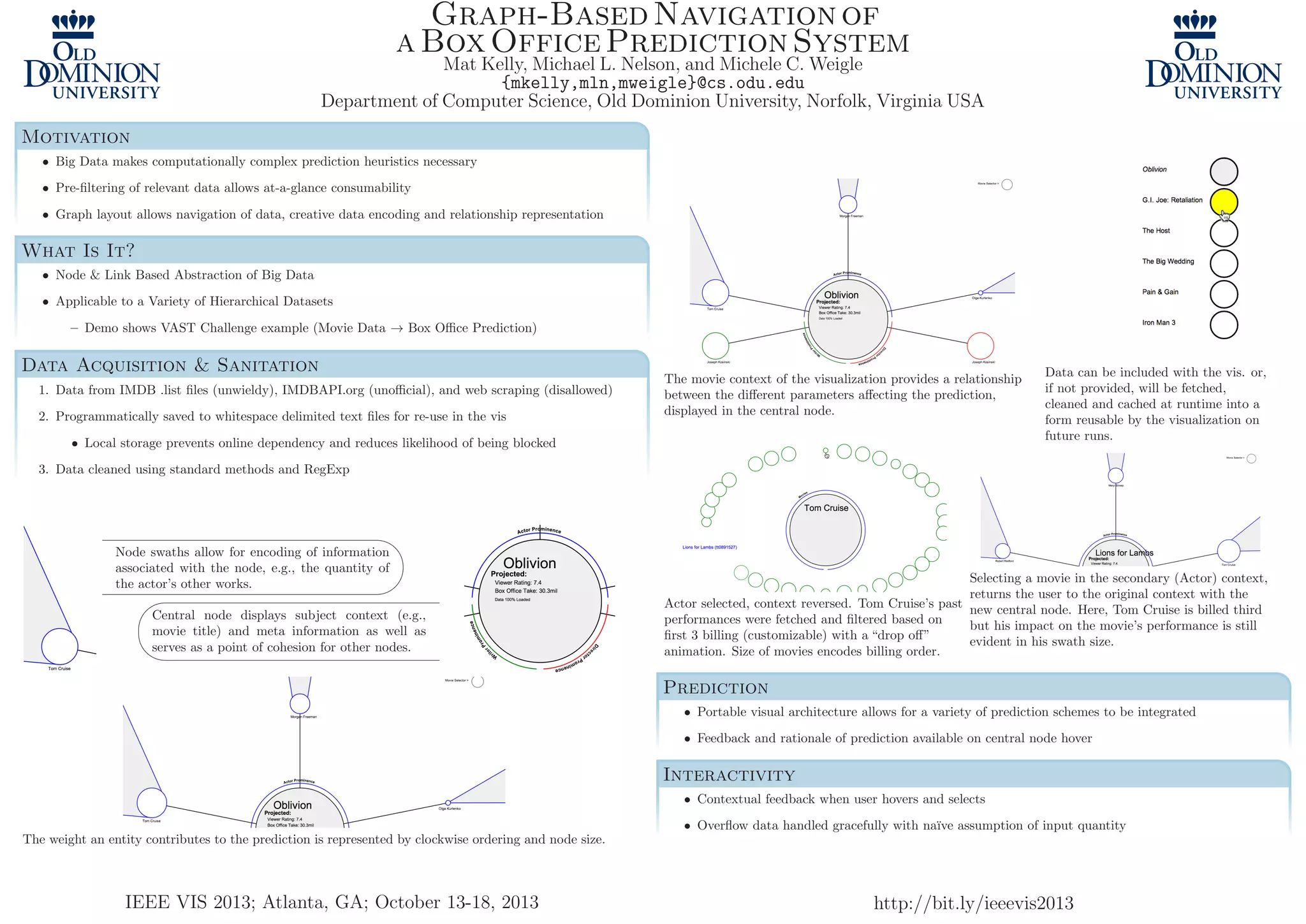
The movie context of the visualization provides a relationship
between the different parameters affecting the prediction,
displayed in the central node.

• Local storage prevents online dependency and reduces likelihood of being blocked

Data can be included with the vis. or,
if not provided, will be fetched,
cleaned and cached at runtime into a
form reusable by the visualization on
future runs.

3. Data cleaned using standard methods and RegExp

Node swaths allow for encoding of information
associated with the node, e.g., the quantity of
the actor’s other works.
Central node displays subject context (e.g.,
movie title) and meta information as well as
serves as a point of cohesion for other nodes.

Selecting a movie in the secondary (Actor) context,
returns the user to the original context with the
Actor selected, context reversed. Tom Cruise’s past new central node. Here, Tom Cruise is billed third
performances were fetched and filtered based on
but his impact on the movie’s performance is still
first 3 billing (customizable) with a “drop off”
evident in his swath size.
animation. Size of movies encodes billing order.

Prediction
• Portable visual architecture allows for a variety of prediction schemes to be integrated
• Feedback and rationale of prediction available on central node hover

Interactivity
• Contextual feedback when user hovers and selects
• Overflow data handled gracefully with na¨ assumption of input quantity
ıve
The weight an entity contributes to the prediction is represented by clockwise ordering and node size.

IEEE VIS 2013; Atlanta, GA; October 13-18, 2013

http://bit.ly/ieeevis2013

IEEE VIS 2013 Graph-Based Navigation of a Box Office Prediction System

  • 1.
    Graph-Based Navigation of aBox Office Prediction System Mat Kelly, Michael L. Nelson, and Michele C. Weigle {mkelly,mln,mweigle}@cs.odu.edu Department of Computer Science, Old Dominion University, Norfolk, Virginia USA Motivation • Big Data makes computationally complex prediction heuristics necessary • Pre-filtering of relevant data allows at-a-glance consumability • Graph layout allows navigation of data, creative data encoding and relationship representation What Is It? • Node & Link Based Abstraction of Big Data • Applicable to a Variety of Hierarchical Datasets – Demo shows VAST Challenge example (Movie Data → Box Office Prediction) Data Acquisition & Sanitation 1. Data from IMDB .list files (unwieldy), IMDBAPI.org (unofficial), and web scraping (disallowed) 2. Programmatically saved to whitespace delimited text files for re-use in the vis The movie context of the visualization provides a relationship between the different parameters affecting the prediction, displayed in the central node. • Local storage prevents online dependency and reduces likelihood of being blocked Data can be included with the vis. or, if not provided, will be fetched, cleaned and cached at runtime into a form reusable by the visualization on future runs. 3. Data cleaned using standard methods and RegExp Node swaths allow for encoding of information associated with the node, e.g., the quantity of the actor’s other works. Central node displays subject context (e.g., movie title) and meta information as well as serves as a point of cohesion for other nodes. Selecting a movie in the secondary (Actor) context, returns the user to the original context with the Actor selected, context reversed. Tom Cruise’s past new central node. Here, Tom Cruise is billed third performances were fetched and filtered based on but his impact on the movie’s performance is still first 3 billing (customizable) with a “drop off” evident in his swath size. animation. Size of movies encodes billing order. Prediction • Portable visual architecture allows for a variety of prediction schemes to be integrated • Feedback and rationale of prediction available on central node hover Interactivity • Contextual feedback when user hovers and selects • Overflow data handled gracefully with na¨ assumption of input quantity ıve The weight an entity contributes to the prediction is represented by clockwise ordering and node size. IEEE VIS 2013; Atlanta, GA; October 13-18, 2013 http://bit.ly/ieeevis2013