Advanced Machine Learning Practical Applications and Use cases
Conference Notes on some interesting practical applications.
Implementation approaches are explained in related videos and slides.
Video Links
~ Data Science Summit 2016
~ ML Conf 2016 ( slides - http://www.slideshare.net/SessionsEvents/presentations )
— Advanced Recommender Applications
~ Deep Personalization Techniques by Amazon - https://www.youtube.com/watch?
v=MMu0nDA-nog , https://www.youtube.com/watch?
v=ofaPq5aRKZ0&index=10&list=PLrbAIdPI69Pi88waiIv8gZ3agEU_hBaVM
~ (Advanced Recommender for Marketing) https://www.youtube.com/watch?
v=2DHNwpu_jKg
~ (Graph Reco Algo by Teachers-payTeachers) https://www.youtube.com/watch?
v=oFXVbvVqHpY
~ (Stitch-Fix Synthesize human-machine capabilities)
https://www.youtube.com/watch?v=flLCO6An6xI
~ (Community Detection) https://www.youtube.com/watch?v=uS6ifgdp86w
~ (Explain the Recommendations) https://www.youtube.com/watch?v=ABweFa7Y6aA
— Product Ranking
~ Amazon Search — https://www.youtube.com/watch?v=NLrhmn-
EZ88&list=PLrbAIdPI69Pi88waiIv8gZ3agEU_hBaVM&index=6
— Natural Language Understanding
~ (NLP & ElasticSearch) https://www.youtube.com/watch?v=L0zQh-ii3sI
~ (Walmart Labs Product Review) https://www.youtube.com/watch?
v=GYhb6sb4YYk&index=17&list=PLrbAIdPI69Pi88waiIv8gZ3agEU_hBaVM ~
~ (Medical Data Analysis) https://www.youtube.com/watch?v=QwN1U6nlA5E
— Digital Marketing
~ (AOL - AdLearn Platform) https://www.youtube.com/watch?v=vJh6Nd7tCok
— Personalized Content Blending
- Pinterest Usecase
- https://www.youtube.com/watch?v=mN6MrzL1i78 ,
- https://www.youtube.com/watch?
v=QcW1tOHybak&list=PLrbAIdPI69Pi88waiIv8gZ3agEU_hBaVM&index=7
— Anomaly and Pattern Detection from multi-dimensional time-series
~ https://www.youtube.com/watch?v=UxJB_5PyKTI
~ (Intel IoT) https://www.youtube.com/watch?v=DD_BbAb9RhM
—
— Deep Learning Apps
~ Image Similarity - https://www.youtube.com/watch?v=DJnLfaG6xZE
~ Question Answering System - https://www.youtube.com/watch?v=aHuLDhh3Rxw
~ https://www.youtube.com/watch?v=GxZUdZMPGpQ
~ Spoken Lab - https://www.youtube.com/watch?v=bDJtSqyKHyA
— Deep Reinforcement Learning
~ Dialog Systems - https://www.youtube.com/watch?
v=s-8WkKhHYqA&list=PLrbAIdPI69Pi88waiIv8gZ3agEU_hBaVM&index=3
(A) Deep Personalization Techniques
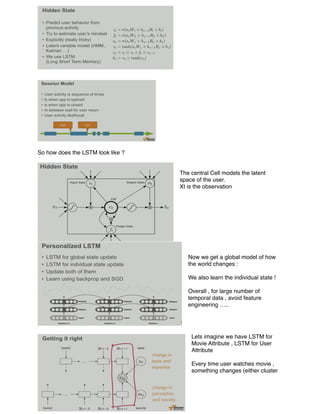
Traditional Factorial Models usually involve estimating parameters:
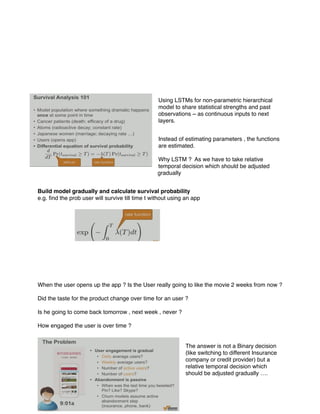
Using LSTMs for non-parametric hierarchical
model to share statistical strengths and past
observations ~ as continuous inputs to next
layers.
Instead of estimating parameters , the functions
are estimated.
Why LSTM ? As we have to take relative
temporal decision which should be adjusted
gradually
Build model gradually and calculate survival probability
e.g. find the prob user will survive till time t without using an app
When the user opens up the app ? Is the User really going to like the movie 2 weeks from now ?
Did the taste for the product change over time for an user ?
Is he going to come back tomorrow , next week , never ?
How engaged the user is over time ?
The answer is not a Binary decision
(like switching to different Insurance
company or credit provider) but a
relative temporal decision which
should be adjusted gradually ….
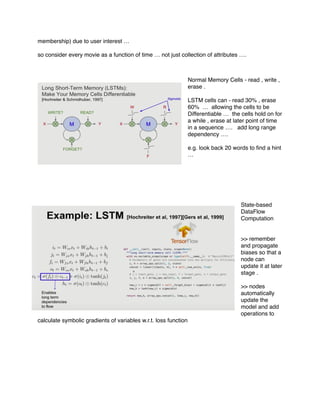
So how does the LSTM look like ?
The central Cell models the latent
space of the user.
Xt is the observation
Now we get a global model of how
the world changes :
We also learn the individual state !
Overall , for large number of
temporal data , avoid feature
engineering …..
Lets imagine we have LSTM for
Movie Attribute , LSTM for User
Attribute
Every time user watches movie ,
something changes (either cluster
membership) due to user interest …
so consider every movie as a function of time … not just collection of attributes ….
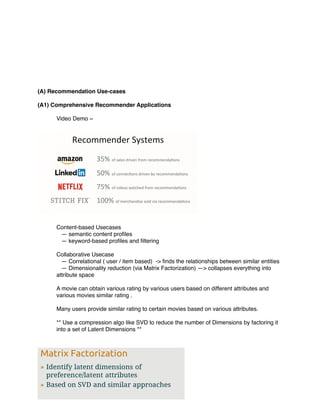
Normal Memory Cells - read , write ,
erase .
LSTM cells can - read 30% , erase
60% … allowing the cells to be
Differentiable … the cells hold on for
a while , erase at later point of time
in a sequence …. add long range
dependency ….
e.g. look back 20 words to find a hint
…
State-based
DataFlow
Computation
>> remember
and propagate
biases so that a
node can
update it at later
stage .
>> nodes
automatically
update the
model and add
operations to
calculate symbolic gradients of variables w.r.t. loss function
(A) Recommendation Use-cases
(A1) Comprehensive Recommender Applications
Video Demo ~
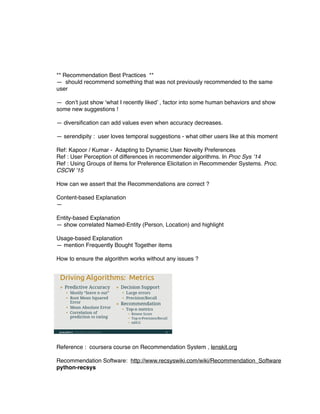
Content-based Usecases
— semantic content profiles
— keyword-based profiles and filtering
Collaborative Usecase
— Correlational ( user / item based) -> finds the relationships between similar entities
— Dimensionality reduction (via Matrix Factorization) —> collapses everything into
attribute space
A movie can obtain various rating by various users based on different attributes and
various movies similar rating .
Many users provide similar rating to certain movies based on various attributes.
** Use a compression algo like SVD to reduce the number of Dimensions by factoring it
into a set of Latent Dimensions **
** Recommendation Best Practices **
— should recommend something that was not previously recommended to the same
user
— don’t just show ‘what I recently liked’ , factor into some human behaviors and show
some new suggestions !
— diversification can add values even when accuracy decreases.
— serendipity : user loves temporal suggestions - what other users like at this moment
Ref: Kapoor / Kumar - Adapting to Dynamic User Novelty Preferences
Ref : User Perception of differences in recommender algorithms. In Proc Sys ’14
Ref : Using Groups of Items for Preference Elicitation in Recommender Systems. Proc.
CSCW ’15
How can we assert that the Recommendations are correct ?
Content-based Explanation
—
Entity-based Explanation
— show correlated Named-Entity (Person, Location) and highlight
Usage-based Explanation
— mention Frequently Bought Together items
How to ensure the algorithm works without any issues ?
Reference : coursera course on Recommendation System , lenskit.org
Recommendation Software: http://www.recsyswiki.com/wiki/Recommendation_Software
python-recsys
Datasets : http://grouplens.org/datasets/movielens/ , http://www.recsyswiki.com/wiki/
Recommendation_Datasets
http://arek-paterek.com/predict.pdf , http://arek-paterek.com/book/ ,
https://www.youtube.com/watch?v=E9XTOnEgqRY
(A2) Recommendation Usecase from Stich-Fix
Video demo ~ — Active Learning and Human-in-the-Loop —
https://www.youtube.com/watch?v=hUx9-8L_qeM
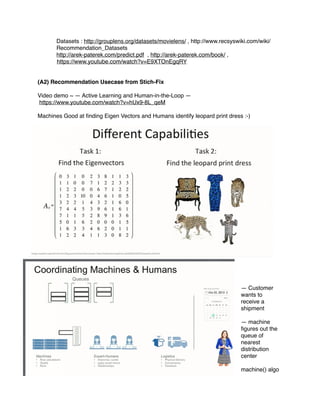
Machines Good at finding Eigen Vectors and Humans identify leopard print dress :-)
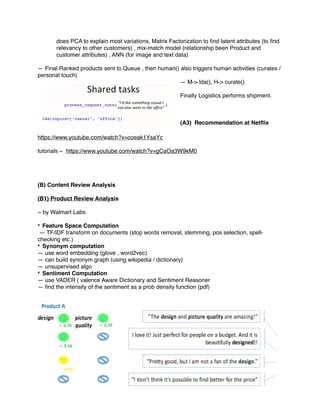
— Customer
wants to
receive a
shipment
— machine
figures out the
queue of
nearest
distribution
center
machine() algo
does PCA to explain most variations, Matrix Factorization to find latent attributes (to find
relevancy to other customers) , mix-match model (relationship been Product and
customer attributes) , ANN (for image and text data)
— Final Ranked products sent to Queue , then human() also triggers human activities (curates /
personal touch)
— M-> lda(), H-> curate()
Finally Logistics performs shipment.
(A3) Recommendation at Netflix
https://www.youtube.com/watch?v=coeak1YsaYc
tutorials ~ https://www.youtube.com/watch?v=gCaOa3W9kM0
(B) Content Review Analysis
(B1) Product Review Analysis
~ by Walmart Labs
* Feature Space Computation
— TF/IDF transform on documents (stop words removal, stemming, pos selection, spell-
checking etc.)
* Synonym computation
— use word embedding (glove , word2vec)
— can build synonym graph (using wikipedia / dictionary)
— unsupervised algo
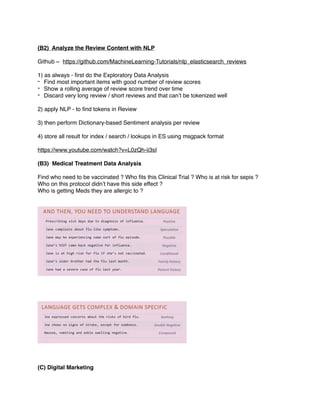
* Sentiment Computation
— use VADER ( valence Aware Dictionary and Sentiment Reasoner
— find the intensity of the sentiment as a prob density function (pdf)
(B2) Analyze the Review Content with NLP
Github ~ https://github.com/MachineLearning-Tutorials/nlp_elasticsearch_reviews
1) as always - first do the Exploratory Data Analysis
- Find most important items with good number of review scores
- Show a rolling average of review score trend over time
- Discard very long review / short reviews and that can’t be tokenized well
2) apply NLP - to find tokens in Review
3) then perform Dictionary-based Sentiment analysis per review
4) store all result for index / search / lookups in ES using msgpack format
https://www.youtube.com/watch?v=L0zQh-ii3sI
(B3) Medical Treatment Data Analysis
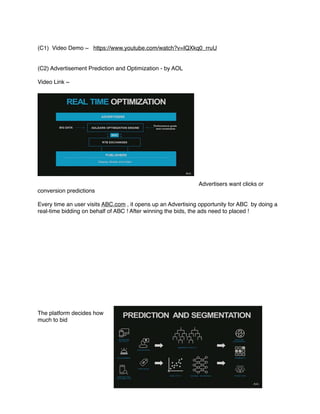
Find who need to be vaccinated ? Who fits this Clinical Trial ? Who is at risk for sepis ?
Who on this protocol didn’t have this side effect ?
Who is getting Meds they are allergic to ?
(C) Digital Marketing
(C1) Video Demo ~ https://www.youtube.com/watch?v=IQXkq0_rruU
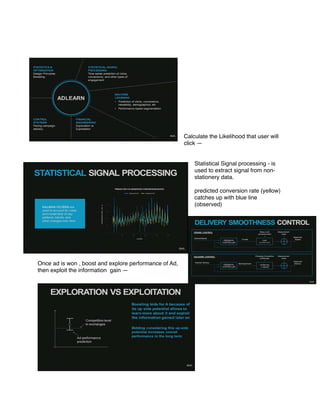
(C2) Advertisement Prediction and Optimization - by AOL
Video Link ~
Advertisers want clicks or
conversion predictions
Every time an user visits ABC.com , it opens up an Advertising opportunity for ABC by doing a
real-time bidding on behalf of ABC ! After winning the bids, the ads need to placed !
The platform decides how
much to bid
Calculate the Likelihood that user will
click —
Statistical Signal processing - is
used to extract signal from non-
stationery data.
predicted conversion rate (yellow)
catches up with blue line
(observed)
Once ad is won , boost and explore performance of Ad,
then exploit the information gain —
Classical Operations Research theory (Multi-Arm bandits Theory) is applied ~ to ~ find the
Values associated to information gained when showing a specific AD is estimated using
techniques similar to option valuation !!!!
(D) Personalized Content Blending - A Complex combination of Usecases
Pinterest Video Link ~ https://www.youtube.com/watch?v=mN6MrzL1i78
Data : Large Bipartitie Graph of 10B+ pins and 800M+ collections of Pinterest
UseCases :
Pin and Board Recommendations
New-user interest Recommendations
User action prediction (drives Ads and monetization)
Email timings, frequency, content (Notifications)
Which pins are related to given pins
Pin Rankings (common topics)
Interesting Problems:
Product Comprehension
- optimize the business metric - WAU28
- (weekly active user after 28 days360 Recommendation
A brand new user comes :
> How to keep him engaged ?
> what topics to recommend ?
> let him select a list of interests
>
Given a pin what interest it belong to ?
How to translate text images into different languages ?
How to add captions to images ?
How to identify a cluster of buyers and send a product recommendations email to the cluster ?
conventional collaborative filtering will not solve the problem ….
— not optimized to find clusters
— coeffs are hard to interpret
— lack of distance measurement
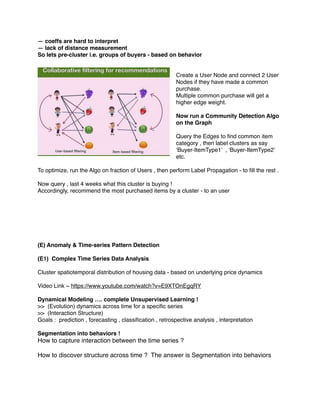
So lets pre-cluster i.e. groups of buyers - based on behavior
Create a User Node and connect 2 User
Nodes if they have made a common
purchase.
Multiple common purchase will get a
higher edge weight.
Now run a Community Detection Algo
on the Graph
Query the Edges to find common item
category , then label clusters as say
‘Buyer-ItemType1’ , ‘Buyer-ItemType2’
etc.
To optimize, run the Algo on fraction of Users , then perform Label Propagation - to fill the rest .
Now query , last 4 weeks what this cluster is buying !
Accordingly, recommend the most purchased items by a cluster - to an user
(E) Anomaly & Time-series Pattern Detection
(E1) Complex Time Series Data Analysis
Cluster spatiotemporal distribution of housing data - based on underlying price dynamics
Video Link ~ https://www.youtube.com/watch?v=E9XTOnEgqRY
Dynamical Modeling …. complete Unsupervised Learning !
>> (Evolution) dynamics across time for a specific series
>> (Interaction Structure)
Goals : prediction , forecasting , classification , retrospective analysis , interpretation
Segmentation into behaviors !
How to capture interaction between the time series ?
How to discover structure across time ? The answer is Segmentation into behaviors
How do we perform Segmentation ? - first approach is ‘Learned HMM’ to learn the
parameters associated with the model.
Learning of parameters using HMM ….
How many behaviors are present ? - Bayesian nonparametrics - help build the infinite
set of behaviors and then narrow down into small set .
Find the ‘shared segments’ e.g. ‘Volatility regimes in financial time series’ and ‘Speech
segmentation’ …..
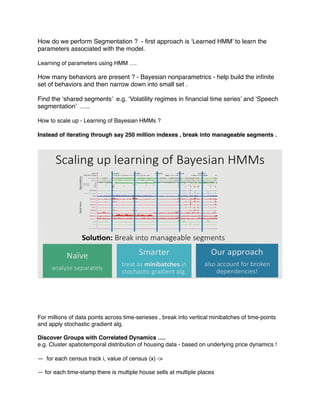
How to scale up - Learning of Bayesian HMMs ?
Instead of iterating through say 250 million indexes , break into manageable segments .
For millions of data points across time-serieses , break into vertical minibatches of time-points
and apply stochastic gradient alg.
Discover Groups with Correlated Dynamics ….
e.g. Cluster spatiotemporal distribution of housing data - based on underlying price dynamics !
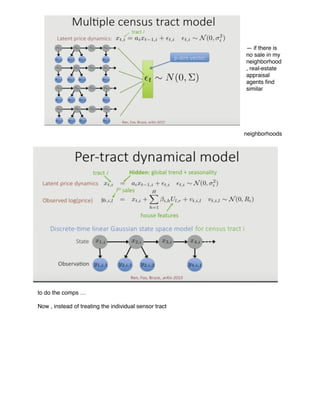
— for each census track i, value of census (x) ->
— for each time-stamp there is multiple house sells at multiple places
— if there is
no sale in my
neighborhood
, real-estate
appraisal
agents find
similar
neighborhoods
to do the comps …
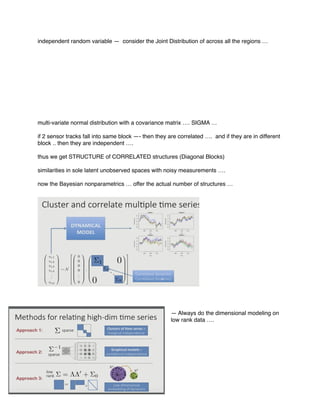
Now , instead of treating the individual sensor tract
independent random variable — consider the Joint Distribution of across all the regions …
multi-variate normal distribution with a covariance matrix …. SIGMA …
if 2 sensor tracks fall into same block —- then they are correlated …. and if they are in different
block .. then they are independent ….
thus we get STRUCTURE of CORRELATED structures (Diagonal Blocks)
similarities in sole latent unobserved spaces with noisy measurements ….
now the Bayesian nonparametrics … offer the actual number of structures …
— Always do the dimensional modeling on
low rank data ….
High Dimensional Time-Series Analysis
Example : Daily returns of global stock indices — using time series graph — assume temporal
dependence ….
Transform X(t) time-series into Fourier Coeffs
Machine Learning Work Shop - Bayesian Nonparametrics for Complex Dynamical
models : https://www.youtube.com/watch?v=qo7BGf-I06I&spfreload=5
Bayesian Dynamic Modeling: Sharing Information Across Time and Space :
https://www.youtube.com/watch?v=LVPikT58meg
(E2) Forecasting Timeseries data
Machine Learning for Time Series Data in Python :
https://www.youtube.com/watch?v=ZgHGCfwExw0
Time Series Forecasting : https://www.youtube.com/watch?v=msFkHl7P28k&spfreload=5
ARIMA Models : https://www.youtube.com/watch?v=Aw77aMLj9uM , basics : https://
www.youtube.com/watch?v=HIWXdHlDSFs
MIT Courseware : https://www.youtube.com/watch?v=uBeM1FUk4Ps
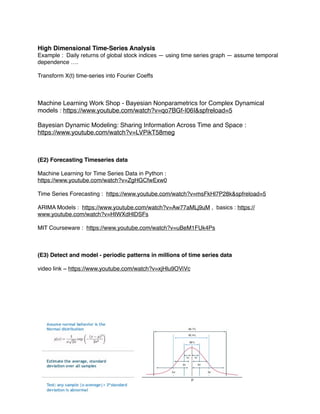
(E3) Detect and model - periodic patterns in millions of time series data
video link ~ https://www.youtube.com/watch?v=xjHlu9OViVc
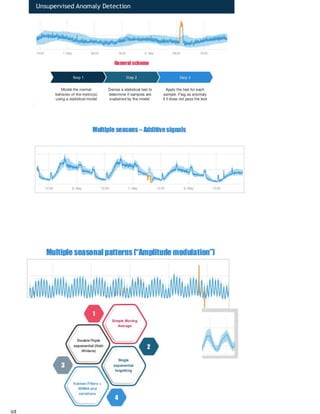
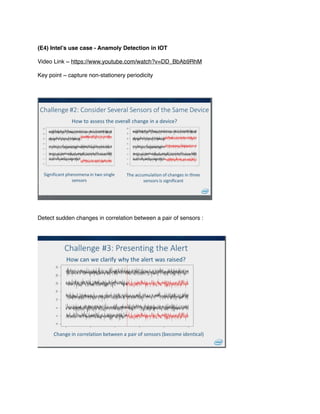
(E4) Intel’s use case - Anamoly Detection in IOT
Video Link ~ https://www.youtube.com/watch?v=DD_BbAb9RhM
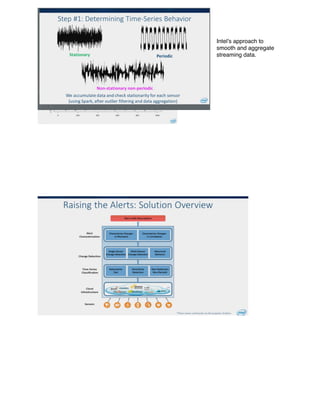
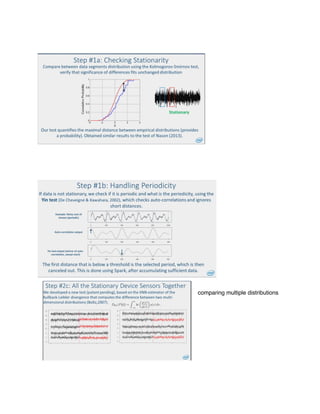
Key point ~ capture non-stationery periodicity
Detect sudden changes in correlation between a pair of sensors :
Intel’s approach to
smooth and aggregate
streaming data.
comparing multiple distributions
(F) Deep Learning
Applications
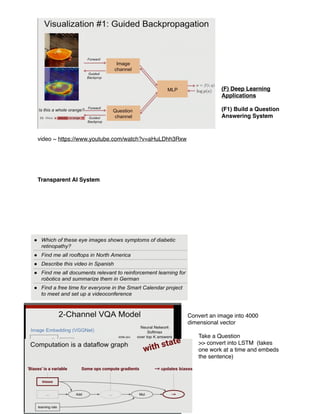
(F1) Build a Question
Answering System
video ~ https://www.youtube.com/watch?v=aHuLDhh3Rxw
Transparent AI System
Convert an image into 4000
dimensional vector
Take a Question
>> convert into LSTM (takes
one work at a time and embeds
the sentence)
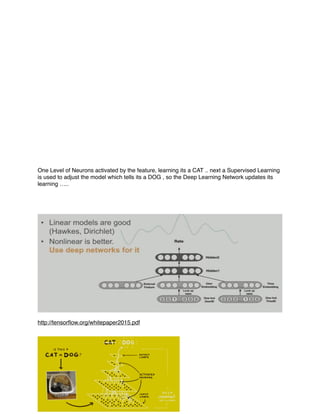
One Level of Neurons activated by the feature, learning its a CAT .. next a Supervised Learning
is used to adjust the model which tells its a DOG , so the Deep Learning Network updates its
learning …..
http://tensorflow.org/whitepaper2015.pdf
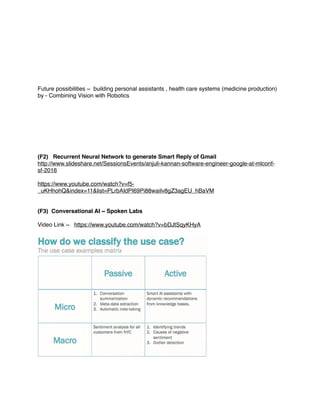
Future possibilities ~ building personal assistants , health care systems (medicine production)
by - Combining Vision with Robotics
(F2) Recurrent Neural Network to generate Smart Reply of Gmail
http://www.slideshare.net/SessionsEvents/anjuli-kannan-software-engineer-google-at-mlconf-
sf-2016
https://www.youtube.com/watch?v=f5-
_uKHhohQ&index=11&list=PLrbAIdPI69Pi88waiIv8gZ3agEU_hBaVM
(F3) Conversational AI ~ Spoken Labs
Video Link ~ https://www.youtube.com/watch?v=bDJtSqyKHyA
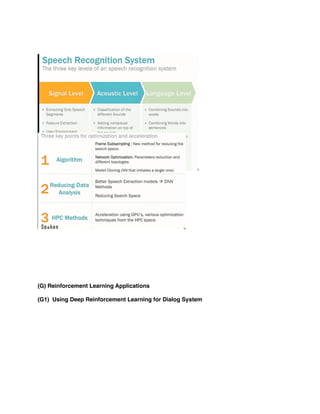
(G) Reinforcement Learning Applications
(G1) Using Deep Reinforcement Learning for Dialog System
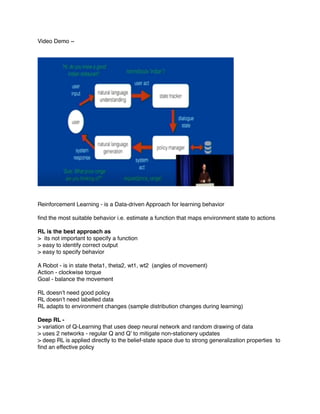
Video Demo ~
Reinforcement Learning - is a Data-driven Approach for learning behavior
find the most suitable behavior i.e. estimate a function that maps environment state to actions
RL is the best approach as
> its not important to specify a function
> easy to identify correct output
> easy to specify behavior
A Robot - is in state theta1, theta2, wt1, wt2 (angles of movement)
Action - clockwise torque
Goal - balance the movement
RL doesn’t need good policy
RL doesn’t need labelled data
RL adapts to environment changes (sample distribution changes during learning)
Deep RL -
> variation of Q-Learning that uses deep neural network and random drawing of data
> uses 2 networks - regular Q and Q’ to mitigate non-stationery updates
> deep RL is applied directly to the belief-state space due to strong generalization properties to
find an effective policy
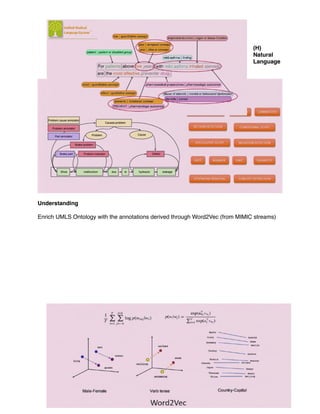
(H)
Natural
Language
Understanding
Enrich UMLS Ontology with the annotations derived through Word2Vec (from MIMIC streams)
(I) Applying Neural Turing Machine
these are differentiable turning machines (sharp functions made
smooth , trains with back propagation)
-learns simple algorithms (copy, repeat, recognize simple formal
language)
-generalizes quickly (specially for Language Modeling)
-Note : LSTM
Special techniques like - Gradient Clipping , Loss Clipping and
Adam’s Optimizer are used.
Grand Unified Theory of Machine Learning
— Representation :
probabilistic logic >> Markov Logic Network
Formula : present the model as combination of first-order logics and bayesian network
Weights :
— Evaluation :
> find the Hyposthesis with highest posterior probability
> whats the objective function —
say business wants to optimize ROI (objective function)
— Optimization :
> discover best formula (Genetic Programming)
> learn the weights of the formula (Bacprops)
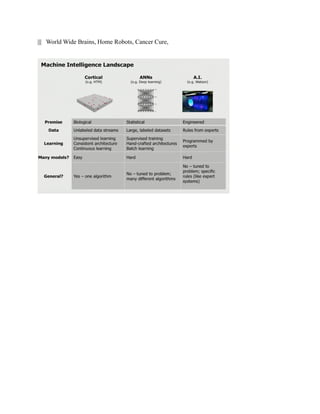
||| World Wide Brains, Home Robots, Cancer Cure,

Machine learning advanced applications

  • 1.
    Advanced Machine LearningPractical Applications and Use cases Conference Notes on some interesting practical applications. Implementation approaches are explained in related videos and slides. Video Links ~ Data Science Summit 2016 ~ ML Conf 2016 ( slides - http://www.slideshare.net/SessionsEvents/presentations ) — Advanced Recommender Applications ~ Deep Personalization Techniques by Amazon - https://www.youtube.com/watch? v=MMu0nDA-nog , https://www.youtube.com/watch? v=ofaPq5aRKZ0&index=10&list=PLrbAIdPI69Pi88waiIv8gZ3agEU_hBaVM ~ (Advanced Recommender for Marketing) https://www.youtube.com/watch? v=2DHNwpu_jKg ~ (Graph Reco Algo by Teachers-payTeachers) https://www.youtube.com/watch? v=oFXVbvVqHpY ~ (Stitch-Fix Synthesize human-machine capabilities) https://www.youtube.com/watch?v=flLCO6An6xI ~ (Community Detection) https://www.youtube.com/watch?v=uS6ifgdp86w ~ (Explain the Recommendations) https://www.youtube.com/watch?v=ABweFa7Y6aA — Product Ranking ~ Amazon Search — https://www.youtube.com/watch?v=NLrhmn- EZ88&list=PLrbAIdPI69Pi88waiIv8gZ3agEU_hBaVM&index=6 — Natural Language Understanding ~ (NLP & ElasticSearch) https://www.youtube.com/watch?v=L0zQh-ii3sI ~ (Walmart Labs Product Review) https://www.youtube.com/watch? v=GYhb6sb4YYk&index=17&list=PLrbAIdPI69Pi88waiIv8gZ3agEU_hBaVM ~ ~ (Medical Data Analysis) https://www.youtube.com/watch?v=QwN1U6nlA5E — Digital Marketing ~ (AOL - AdLearn Platform) https://www.youtube.com/watch?v=vJh6Nd7tCok — Personalized Content Blending - Pinterest Usecase - https://www.youtube.com/watch?v=mN6MrzL1i78 , - https://www.youtube.com/watch? v=QcW1tOHybak&list=PLrbAIdPI69Pi88waiIv8gZ3agEU_hBaVM&index=7 — Anomaly and Pattern Detection from multi-dimensional time-series ~ https://www.youtube.com/watch?v=UxJB_5PyKTI
  • 2.
    ~ (Intel IoT)https://www.youtube.com/watch?v=DD_BbAb9RhM — — Deep Learning Apps ~ Image Similarity - https://www.youtube.com/watch?v=DJnLfaG6xZE ~ Question Answering System - https://www.youtube.com/watch?v=aHuLDhh3Rxw ~ https://www.youtube.com/watch?v=GxZUdZMPGpQ ~ Spoken Lab - https://www.youtube.com/watch?v=bDJtSqyKHyA — Deep Reinforcement Learning ~ Dialog Systems - https://www.youtube.com/watch? v=s-8WkKhHYqA&list=PLrbAIdPI69Pi88waiIv8gZ3agEU_hBaVM&index=3 (A) Deep Personalization Techniques Traditional Factorial Models usually involve estimating parameters:
  • 3.
    Using LSTMs fornon-parametric hierarchical model to share statistical strengths and past observations ~ as continuous inputs to next layers. Instead of estimating parameters , the functions are estimated. Why LSTM ? As we have to take relative temporal decision which should be adjusted gradually Build model gradually and calculate survival probability e.g. find the prob user will survive till time t without using an app When the user opens up the app ? Is the User really going to like the movie 2 weeks from now ? Did the taste for the product change over time for an user ? Is he going to come back tomorrow , next week , never ? How engaged the user is over time ? The answer is not a Binary decision (like switching to different Insurance company or credit provider) but a relative temporal decision which should be adjusted gradually ….
  • 4.
    So how doesthe LSTM look like ? The central Cell models the latent space of the user. Xt is the observation Now we get a global model of how the world changes : We also learn the individual state ! Overall , for large number of temporal data , avoid feature engineering ….. Lets imagine we have LSTM for Movie Attribute , LSTM for User Attribute Every time user watches movie , something changes (either cluster
  • 5.
    membership) due touser interest … so consider every movie as a function of time … not just collection of attributes …. Normal Memory Cells - read , write , erase . LSTM cells can - read 30% , erase 60% … allowing the cells to be Differentiable … the cells hold on for a while , erase at later point of time in a sequence …. add long range dependency …. e.g. look back 20 words to find a hint … State-based DataFlow Computation >> remember and propagate biases so that a node can update it at later stage . >> nodes automatically update the model and add operations to calculate symbolic gradients of variables w.r.t. loss function
  • 6.
    (A) Recommendation Use-cases (A1)Comprehensive Recommender Applications Video Demo ~ Content-based Usecases — semantic content profiles — keyword-based profiles and filtering Collaborative Usecase — Correlational ( user / item based) -> finds the relationships between similar entities — Dimensionality reduction (via Matrix Factorization) —> collapses everything into attribute space A movie can obtain various rating by various users based on different attributes and various movies similar rating . Many users provide similar rating to certain movies based on various attributes. ** Use a compression algo like SVD to reduce the number of Dimensions by factoring it into a set of Latent Dimensions **
  • 7.
    ** Recommendation BestPractices ** — should recommend something that was not previously recommended to the same user — don’t just show ‘what I recently liked’ , factor into some human behaviors and show some new suggestions ! — diversification can add values even when accuracy decreases. — serendipity : user loves temporal suggestions - what other users like at this moment Ref: Kapoor / Kumar - Adapting to Dynamic User Novelty Preferences Ref : User Perception of differences in recommender algorithms. In Proc Sys ’14 Ref : Using Groups of Items for Preference Elicitation in Recommender Systems. Proc. CSCW ’15 How can we assert that the Recommendations are correct ? Content-based Explanation — Entity-based Explanation — show correlated Named-Entity (Person, Location) and highlight Usage-based Explanation — mention Frequently Bought Together items How to ensure the algorithm works without any issues ? Reference : coursera course on Recommendation System , lenskit.org Recommendation Software: http://www.recsyswiki.com/wiki/Recommendation_Software python-recsys
  • 8.
    Datasets : http://grouplens.org/datasets/movielens/, http://www.recsyswiki.com/wiki/ Recommendation_Datasets http://arek-paterek.com/predict.pdf , http://arek-paterek.com/book/ , https://www.youtube.com/watch?v=E9XTOnEgqRY (A2) Recommendation Usecase from Stich-Fix Video demo ~ — Active Learning and Human-in-the-Loop — https://www.youtube.com/watch?v=hUx9-8L_qeM Machines Good at finding Eigen Vectors and Humans identify leopard print dress :-) — Customer wants to receive a shipment — machine figures out the queue of nearest distribution center machine() algo
  • 9.
    does PCA toexplain most variations, Matrix Factorization to find latent attributes (to find relevancy to other customers) , mix-match model (relationship been Product and customer attributes) , ANN (for image and text data) — Final Ranked products sent to Queue , then human() also triggers human activities (curates / personal touch) — M-> lda(), H-> curate() Finally Logistics performs shipment. (A3) Recommendation at Netflix https://www.youtube.com/watch?v=coeak1YsaYc tutorials ~ https://www.youtube.com/watch?v=gCaOa3W9kM0 (B) Content Review Analysis (B1) Product Review Analysis ~ by Walmart Labs * Feature Space Computation — TF/IDF transform on documents (stop words removal, stemming, pos selection, spell- checking etc.) * Synonym computation — use word embedding (glove , word2vec) — can build synonym graph (using wikipedia / dictionary) — unsupervised algo * Sentiment Computation — use VADER ( valence Aware Dictionary and Sentiment Reasoner — find the intensity of the sentiment as a prob density function (pdf)
  • 10.
    (B2) Analyze theReview Content with NLP Github ~ https://github.com/MachineLearning-Tutorials/nlp_elasticsearch_reviews 1) as always - first do the Exploratory Data Analysis - Find most important items with good number of review scores - Show a rolling average of review score trend over time - Discard very long review / short reviews and that can’t be tokenized well 2) apply NLP - to find tokens in Review 3) then perform Dictionary-based Sentiment analysis per review 4) store all result for index / search / lookups in ES using msgpack format https://www.youtube.com/watch?v=L0zQh-ii3sI (B3) Medical Treatment Data Analysis Find who need to be vaccinated ? Who fits this Clinical Trial ? Who is at risk for sepis ? Who on this protocol didn’t have this side effect ? Who is getting Meds they are allergic to ? (C) Digital Marketing
  • 11.
    (C1) Video Demo~ https://www.youtube.com/watch?v=IQXkq0_rruU (C2) Advertisement Prediction and Optimization - by AOL Video Link ~ Advertisers want clicks or conversion predictions Every time an user visits ABC.com , it opens up an Advertising opportunity for ABC by doing a real-time bidding on behalf of ABC ! After winning the bids, the ads need to placed ! The platform decides how much to bid
  • 12.
    Calculate the Likelihoodthat user will click — Statistical Signal processing - is used to extract signal from non- stationery data. predicted conversion rate (yellow) catches up with blue line (observed) Once ad is won , boost and explore performance of Ad, then exploit the information gain —
  • 13.
    Classical Operations Researchtheory (Multi-Arm bandits Theory) is applied ~ to ~ find the Values associated to information gained when showing a specific AD is estimated using techniques similar to option valuation !!!! (D) Personalized Content Blending - A Complex combination of Usecases Pinterest Video Link ~ https://www.youtube.com/watch?v=mN6MrzL1i78 Data : Large Bipartitie Graph of 10B+ pins and 800M+ collections of Pinterest UseCases : Pin and Board Recommendations New-user interest Recommendations User action prediction (drives Ads and monetization) Email timings, frequency, content (Notifications) Which pins are related to given pins Pin Rankings (common topics) Interesting Problems: Product Comprehension - optimize the business metric - WAU28 - (weekly active user after 28 days360 Recommendation A brand new user comes : > How to keep him engaged ? > what topics to recommend ? > let him select a list of interests > Given a pin what interest it belong to ? How to translate text images into different languages ? How to add captions to images ? How to identify a cluster of buyers and send a product recommendations email to the cluster ? conventional collaborative filtering will not solve the problem …. — not optimized to find clusters
  • 14.
    — coeffs arehard to interpret — lack of distance measurement So lets pre-cluster i.e. groups of buyers - based on behavior Create a User Node and connect 2 User Nodes if they have made a common purchase. Multiple common purchase will get a higher edge weight. Now run a Community Detection Algo on the Graph Query the Edges to find common item category , then label clusters as say ‘Buyer-ItemType1’ , ‘Buyer-ItemType2’ etc. To optimize, run the Algo on fraction of Users , then perform Label Propagation - to fill the rest . Now query , last 4 weeks what this cluster is buying ! Accordingly, recommend the most purchased items by a cluster - to an user (E) Anomaly & Time-series Pattern Detection (E1) Complex Time Series Data Analysis Cluster spatiotemporal distribution of housing data - based on underlying price dynamics Video Link ~ https://www.youtube.com/watch?v=E9XTOnEgqRY Dynamical Modeling …. complete Unsupervised Learning ! >> (Evolution) dynamics across time for a specific series >> (Interaction Structure) Goals : prediction , forecasting , classification , retrospective analysis , interpretation Segmentation into behaviors ! How to capture interaction between the time series ? How to discover structure across time ? The answer is Segmentation into behaviors
  • 15.
    How do weperform Segmentation ? - first approach is ‘Learned HMM’ to learn the parameters associated with the model. Learning of parameters using HMM …. How many behaviors are present ? - Bayesian nonparametrics - help build the infinite set of behaviors and then narrow down into small set . Find the ‘shared segments’ e.g. ‘Volatility regimes in financial time series’ and ‘Speech segmentation’ ….. How to scale up - Learning of Bayesian HMMs ? Instead of iterating through say 250 million indexes , break into manageable segments . For millions of data points across time-serieses , break into vertical minibatches of time-points and apply stochastic gradient alg. Discover Groups with Correlated Dynamics …. e.g. Cluster spatiotemporal distribution of housing data - based on underlying price dynamics ! — for each census track i, value of census (x) -> — for each time-stamp there is multiple house sells at multiple places
  • 16.
    — if thereis no sale in my neighborhood , real-estate appraisal agents find similar neighborhoods to do the comps … Now , instead of treating the individual sensor tract
  • 17.
    independent random variable— consider the Joint Distribution of across all the regions … multi-variate normal distribution with a covariance matrix …. SIGMA … if 2 sensor tracks fall into same block —- then they are correlated …. and if they are in different block .. then they are independent …. thus we get STRUCTURE of CORRELATED structures (Diagonal Blocks) similarities in sole latent unobserved spaces with noisy measurements …. now the Bayesian nonparametrics … offer the actual number of structures … — Always do the dimensional modeling on low rank data ….
  • 18.
    High Dimensional Time-SeriesAnalysis Example : Daily returns of global stock indices — using time series graph — assume temporal dependence …. Transform X(t) time-series into Fourier Coeffs Machine Learning Work Shop - Bayesian Nonparametrics for Complex Dynamical models : https://www.youtube.com/watch?v=qo7BGf-I06I&spfreload=5 Bayesian Dynamic Modeling: Sharing Information Across Time and Space : https://www.youtube.com/watch?v=LVPikT58meg (E2) Forecasting Timeseries data Machine Learning for Time Series Data in Python : https://www.youtube.com/watch?v=ZgHGCfwExw0 Time Series Forecasting : https://www.youtube.com/watch?v=msFkHl7P28k&spfreload=5 ARIMA Models : https://www.youtube.com/watch?v=Aw77aMLj9uM , basics : https:// www.youtube.com/watch?v=HIWXdHlDSFs MIT Courseware : https://www.youtube.com/watch?v=uBeM1FUk4Ps (E3) Detect and model - periodic patterns in millions of time series data video link ~ https://www.youtube.com/watch?v=xjHlu9OViVc
  • 20.
    (E4) Intel’s usecase - Anamoly Detection in IOT Video Link ~ https://www.youtube.com/watch?v=DD_BbAb9RhM Key point ~ capture non-stationery periodicity Detect sudden changes in correlation between a pair of sensors :
  • 21.
    Intel’s approach to smoothand aggregate streaming data.
  • 22.
  • 23.
    (F) Deep Learning Applications (F1)Build a Question Answering System video ~ https://www.youtube.com/watch?v=aHuLDhh3Rxw Transparent AI System Convert an image into 4000 dimensional vector Take a Question >> convert into LSTM (takes one work at a time and embeds the sentence)
  • 24.
    One Level ofNeurons activated by the feature, learning its a CAT .. next a Supervised Learning is used to adjust the model which tells its a DOG , so the Deep Learning Network updates its learning ….. http://tensorflow.org/whitepaper2015.pdf
  • 25.
    Future possibilities ~building personal assistants , health care systems (medicine production) by - Combining Vision with Robotics (F2) Recurrent Neural Network to generate Smart Reply of Gmail http://www.slideshare.net/SessionsEvents/anjuli-kannan-software-engineer-google-at-mlconf- sf-2016 https://www.youtube.com/watch?v=f5- _uKHhohQ&index=11&list=PLrbAIdPI69Pi88waiIv8gZ3agEU_hBaVM (F3) Conversational AI ~ Spoken Labs Video Link ~ https://www.youtube.com/watch?v=bDJtSqyKHyA
  • 26.
    (G) Reinforcement LearningApplications (G1) Using Deep Reinforcement Learning for Dialog System
  • 27.
    Video Demo ~ ReinforcementLearning - is a Data-driven Approach for learning behavior find the most suitable behavior i.e. estimate a function that maps environment state to actions RL is the best approach as > its not important to specify a function > easy to identify correct output > easy to specify behavior A Robot - is in state theta1, theta2, wt1, wt2 (angles of movement) Action - clockwise torque Goal - balance the movement RL doesn’t need good policy RL doesn’t need labelled data RL adapts to environment changes (sample distribution changes during learning) Deep RL - > variation of Q-Learning that uses deep neural network and random drawing of data > uses 2 networks - regular Q and Q’ to mitigate non-stationery updates > deep RL is applied directly to the belief-state space due to strong generalization properties to find an effective policy
  • 28.
    (H) Natural Language Understanding Enrich UMLS Ontologywith the annotations derived through Word2Vec (from MIMIC streams)
  • 29.
    (I) Applying NeuralTuring Machine these are differentiable turning machines (sharp functions made smooth , trains with back propagation) -learns simple algorithms (copy, repeat, recognize simple formal language) -generalizes quickly (specially for Language Modeling) -Note : LSTM Special techniques like - Gradient Clipping , Loss Clipping and Adam’s Optimizer are used. Grand Unified Theory of Machine Learning — Representation : probabilistic logic >> Markov Logic Network Formula : present the model as combination of first-order logics and bayesian network Weights : — Evaluation : > find the Hyposthesis with highest posterior probability > whats the objective function — say business wants to optimize ROI (objective function) — Optimization : > discover best formula (Genetic Programming) > learn the weights of the formula (Bacprops)
  • 30.
    ||| World WideBrains, Home Robots, Cancer Cure,