Graph-Based Clustering
Yi-Hsiu Lin
2016-8-29
Key Points
Graph-based Clustering
Survey Papers
Applications & Future works
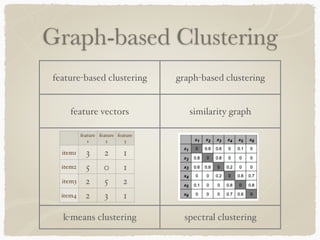
Graph-based Clustering
feature-based clustering graph-based clustering
feature vectors similarity graph
k-means clustering spectral clustering
feature
1
feature
2
feature
3
item1 3 2 1
item2 5 0 1
item3 2 5 2
item4 2 3 1
Advantages
It can be used with virtually any data type as long
as appropriate similarity functions are defined
Similarity function itself make sure that points
which are considered to be “very similar” by the
function are also closely related in the application the
data comes from
High dimensional scenario - noise effects of locally
irrelevant attributes - reduce the high-dimensionality
of the feature space via a similarity metric
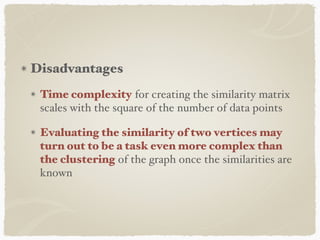
Disadvantages
Time complexity for creating the similarity matrix
scales with the square of the number of data points
Evaluating the similarity of two vertices may
turn out to be a task even more complex than
the clustering of the graph once the similarities are
known
Similarity measure
similarity measure (2007)
cosine similarity
Gaussian similarity
Jaccard similarity
Similarity measure
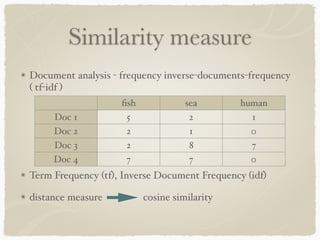
Document analysis - frequency inverse-documents-frequency
( tf-idf )
Term Frequency (tf), Inverse Document Frequency (idf)
distance measure cosine similarity
fish sea human
Doc 1 5 2 1
Doc 2 2 1 0
Doc 3 2 8 7
Doc 4 7 7 0
Survey Papers
Spectral clustering (1973)
Modularity (2006)
SymNMF (2012)
Fuzzy Modularity (2013)
SoF (2015)
Structured Stochastic Doubly Matrix (2016)
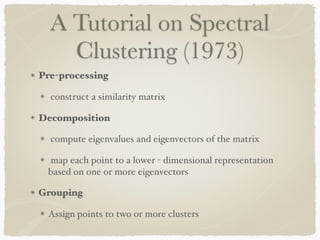
A Tutorial on Spectral
Clustering (1973)
Pre-processing
construct a similarity matrix
Decomposition
compute eigenvalues and eigenvectors of the matrix
map each point to a lower - dimensional representation
based on one or more eigenvectors
Grouping
Assign points to two or more clusters
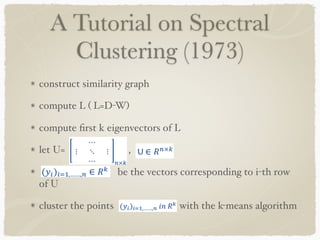
A Tutorial on Spectral
Clustering (1973)
construct similarity graph
compute L ( L=D-W)
compute first k eigenvectors of L
let U= ,
be the vectors corresponding to i-th row
of U
cluster the points with the k-means algorithm
Modularity and community structure in
networks(2006)
A Soft Modularity Function For Detecting Fuzzy
Communities in Social Networks (2013)
Modularity : (Evaluate the clustering results)
(the number of edges falling within groups) - (the
expected number in an equivalent network with edges
placed at random)
Modularity Matrix :
Fuzzy Modularity :
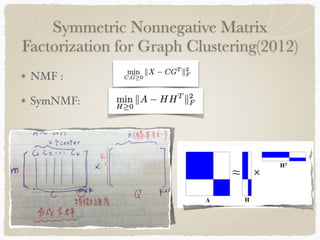
Symmetric Nonnegative Matrix
Factorization for Graph Clustering(2012)
NMF :
SymNMF:
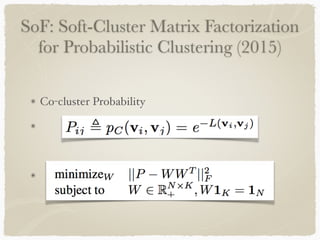
SoF: Soft-Cluster Matrix Factorization
for Probabilistic Clustering (2015)
Co-cluster Probability
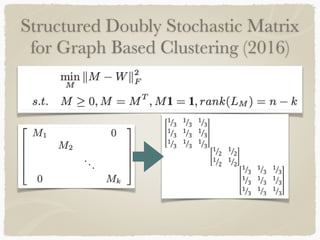
Structured Doubly Stochastic Matrix
for Graph Based Clustering (2016)
Time Complexity
Space Complexity
Future works
Soft/Fuzzy Clustering
The data objects has membership weight that is between
0 to 1, thus data points can potentially belong to multiple
clusters — Natural Grouping
Applications
Documents with multiple theme
Marketing
Recommendation system
Applications & Future works
Algorithms
the affinity measure
the normalization of the affinity matrix
the particular clustering algorithm
How to determine the number of cluster ?
How to deal with high quantity of data ?
How to deal with directed graph ?
Applications & Future works
Social networks
epidemic network
transportation
position
Applications & Future works
Reference
Similarity-Based Clustering: Recent Developments and Biomedical Applications - Thomas Villmann,M.
Biehl,Barbara Hammer
Graph clustering - Satu Elisa Schaeffer∗ Laboratory for Theoretical Computer Science, Helsinki University
of Technology TKK, P.O. Box 5400, FI-02015 TKK, Finland
Symmetric Nonnegative Matrix Factorization for Graph Clustering - Da Kuang∗ Chris Ding† Haesun Park
SoF: Soft-Cluster Matrix Factorization for Probabilistic Clustering - Han Zhao† , Pascal Poupart† , Yongfeng
Zhang§ and Martin Lysy‡
A Soft Modularity Function For Detecting Fuzzy Communities in Social Networks - Timothy C. Havens
Modularity and community structure in networks - M. E. J. Newman*
ATutorial on Spectral Clustering - Ulrike von Luxburg
Survey Graph clustering - Satu Elisa Schaeffer
Structured Doubly Stochastic Matrix for Graph Based Clustering

Graph based Clustering

  • 1.
  • 2.
    Key Points Graph-based Clustering SurveyPapers Applications & Future works
  • 3.
    Graph-based Clustering feature-based clusteringgraph-based clustering feature vectors similarity graph k-means clustering spectral clustering feature 1 feature 2 feature 3 item1 3 2 1 item2 5 0 1 item3 2 5 2 item4 2 3 1
  • 4.
    Advantages It can beused with virtually any data type as long as appropriate similarity functions are defined Similarity function itself make sure that points which are considered to be “very similar” by the function are also closely related in the application the data comes from High dimensional scenario - noise effects of locally irrelevant attributes - reduce the high-dimensionality of the feature space via a similarity metric
  • 5.
    Disadvantages Time complexity forcreating the similarity matrix scales with the square of the number of data points Evaluating the similarity of two vertices may turn out to be a task even more complex than the clustering of the graph once the similarities are known
  • 6.
    Similarity measure similarity measure(2007) cosine similarity Gaussian similarity Jaccard similarity
  • 7.
    Similarity measure Document analysis- frequency inverse-documents-frequency ( tf-idf ) Term Frequency (tf), Inverse Document Frequency (idf) distance measure cosine similarity fish sea human Doc 1 5 2 1 Doc 2 2 1 0 Doc 3 2 8 7 Doc 4 7 7 0
  • 8.
    Survey Papers Spectral clustering(1973) Modularity (2006) SymNMF (2012) Fuzzy Modularity (2013) SoF (2015) Structured Stochastic Doubly Matrix (2016)
  • 9.
    A Tutorial onSpectral Clustering (1973) Pre-processing construct a similarity matrix Decomposition compute eigenvalues and eigenvectors of the matrix map each point to a lower - dimensional representation based on one or more eigenvectors Grouping Assign points to two or more clusters
  • 10.
    A Tutorial onSpectral Clustering (1973) construct similarity graph compute L ( L=D-W) compute first k eigenvectors of L let U= , be the vectors corresponding to i-th row of U cluster the points with the k-means algorithm
  • 11.
    Modularity and communitystructure in networks(2006) A Soft Modularity Function For Detecting Fuzzy Communities in Social Networks (2013) Modularity : (Evaluate the clustering results) (the number of edges falling within groups) - (the expected number in an equivalent network with edges placed at random) Modularity Matrix : Fuzzy Modularity :
  • 12.
    Symmetric Nonnegative Matrix Factorizationfor Graph Clustering(2012) NMF : SymNMF:
  • 13.
    SoF: Soft-Cluster MatrixFactorization for Probabilistic Clustering (2015) Co-cluster Probability
  • 14.
    Structured Doubly StochasticMatrix for Graph Based Clustering (2016)
  • 15.
  • 16.
  • 17.
  • 18.
    Soft/Fuzzy Clustering The dataobjects has membership weight that is between 0 to 1, thus data points can potentially belong to multiple clusters — Natural Grouping Applications Documents with multiple theme Marketing Recommendation system
  • 19.
    Applications & Futureworks Algorithms the affinity measure the normalization of the affinity matrix the particular clustering algorithm How to determine the number of cluster ? How to deal with high quantity of data ? How to deal with directed graph ?
  • 20.
    Applications & Futureworks Social networks epidemic network transportation position
  • 21.
  • 23.
    Reference Similarity-Based Clustering: RecentDevelopments and Biomedical Applications - Thomas Villmann,M. Biehl,Barbara Hammer Graph clustering - Satu Elisa Schaeffer∗ Laboratory for Theoretical Computer Science, Helsinki University of Technology TKK, P.O. Box 5400, FI-02015 TKK, Finland Symmetric Nonnegative Matrix Factorization for Graph Clustering - Da Kuang∗ Chris Ding† Haesun Park SoF: Soft-Cluster Matrix Factorization for Probabilistic Clustering - Han Zhao† , Pascal Poupart† , Yongfeng Zhang§ and Martin Lysy‡ A Soft Modularity Function For Detecting Fuzzy Communities in Social Networks - Timothy C. Havens Modularity and community structure in networks - M. E. J. Newman* ATutorial on Spectral Clustering - Ulrike von Luxburg Survey Graph clustering - Satu Elisa Schaeffer Structured Doubly Stochastic Matrix for Graph Based Clustering