Facilitation of the A Posteriori
Replication of Web Published
Satellite Imagery
Mat Kelly
Web Science and Digital Libraries Research Lab
Old Dominion University
mkelly@cs.odu.edu
Virginia Space Grant Consortium Student Research Conference
NASA Langley Research Center
April 17, 2015
Outline
• Background & Motivation
• Target Data & Technologies Used
• How It All Fits Together
• Results
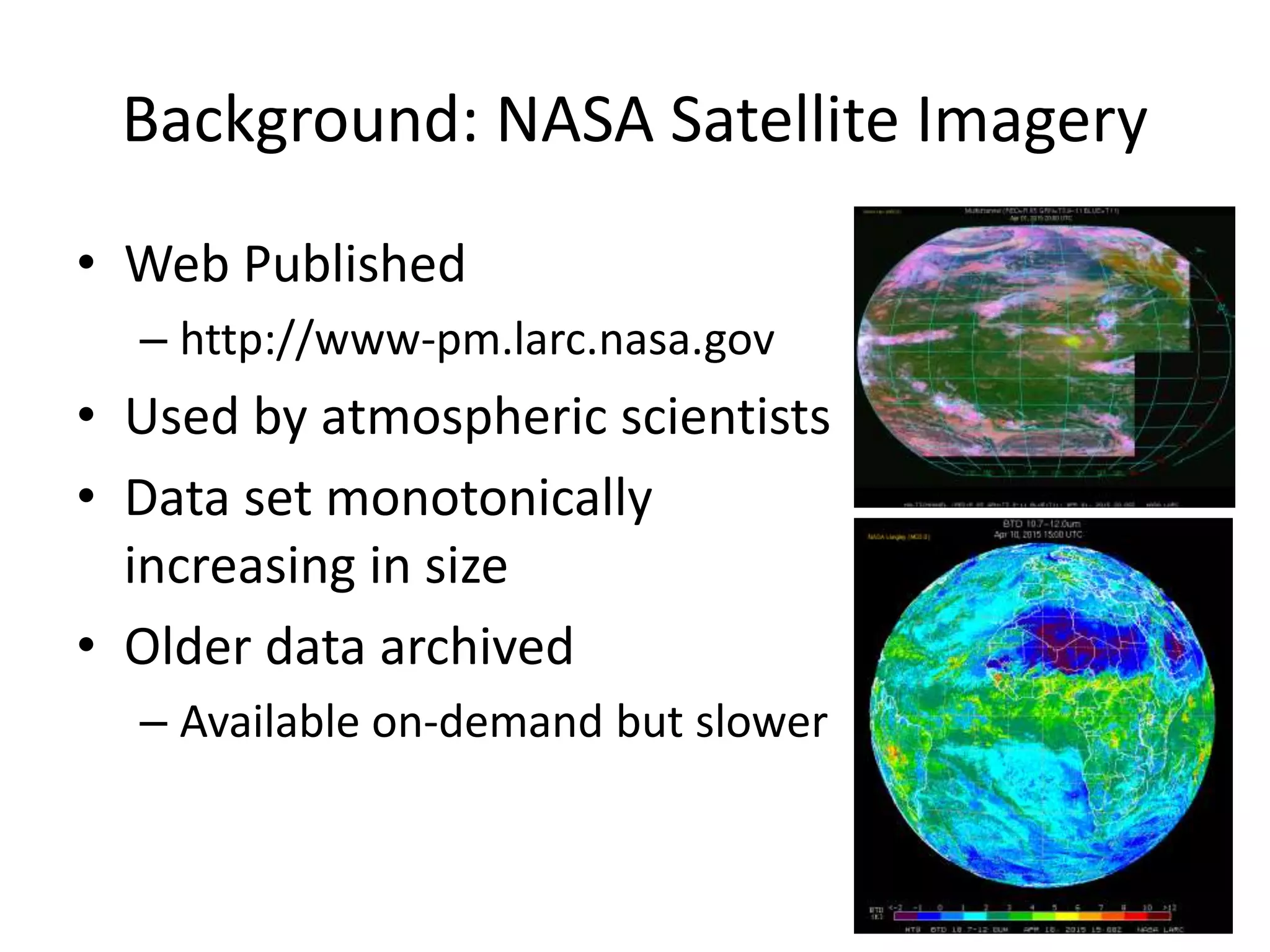
Background: NASA Satellite Imagery
• Web Published
– http://www-pm.larc.nasa.gov
• Used by atmospheric scientists
• Data set monotonically
increasing in size
• Older data archived
– Available on-demand but slower
Main Issue
• Data is centrally located
– Single point of failure
• Data is public domain
– Duplication by users is no issue
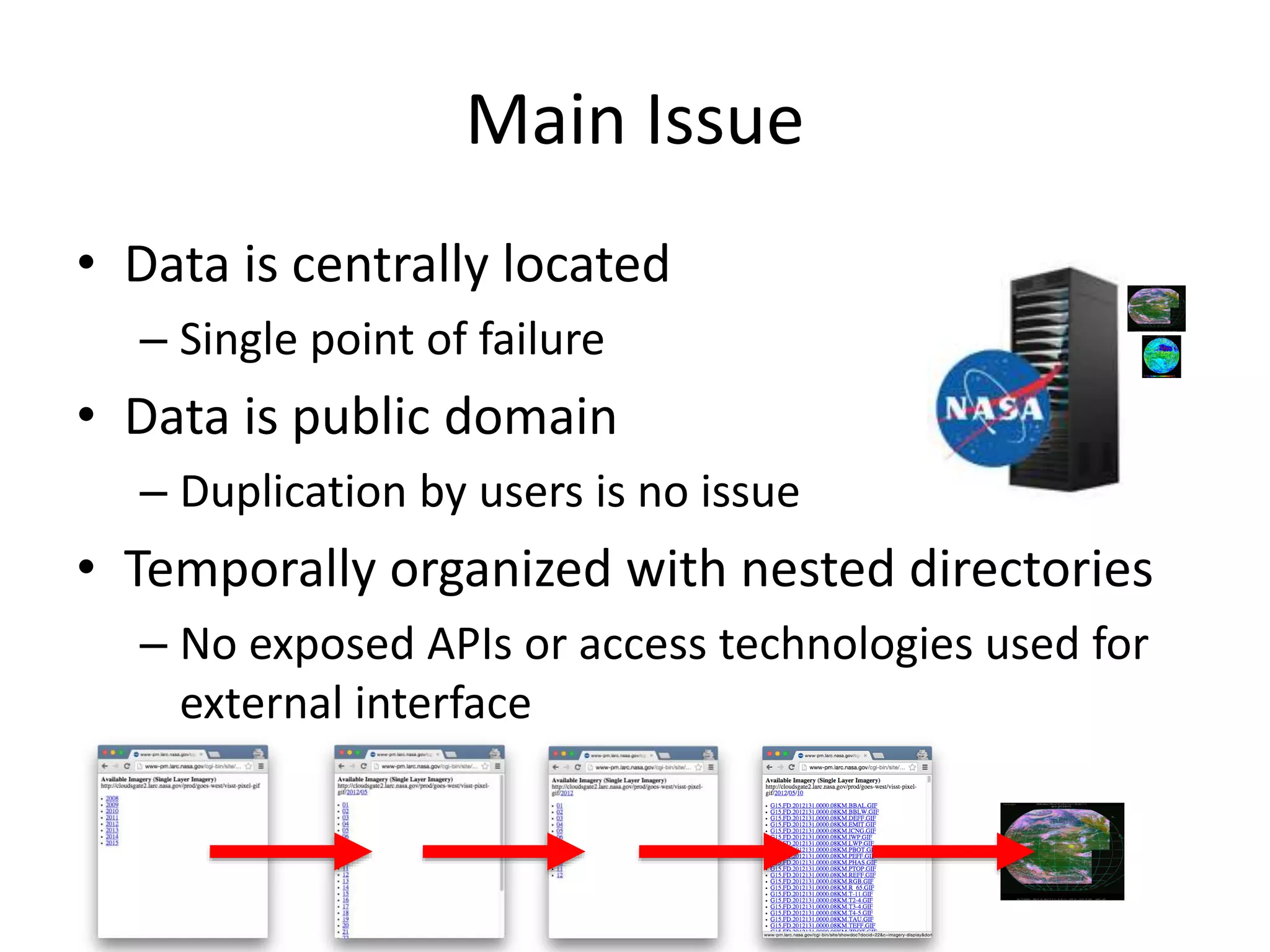
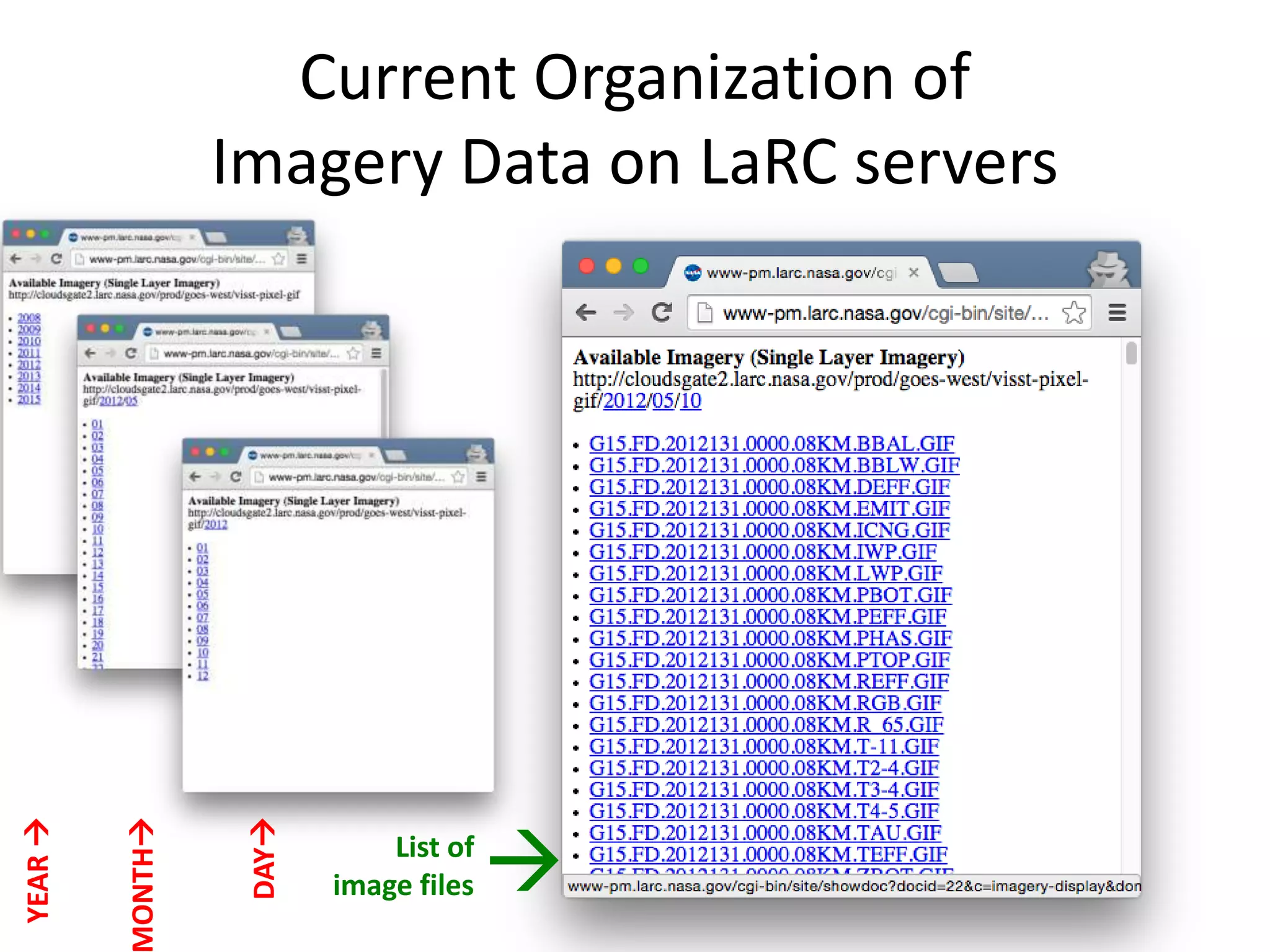
• Temporally organized with nested directories
– No exposed APIs or access technologies used for
external interface
The Objective
the title explained
Facilitation of the
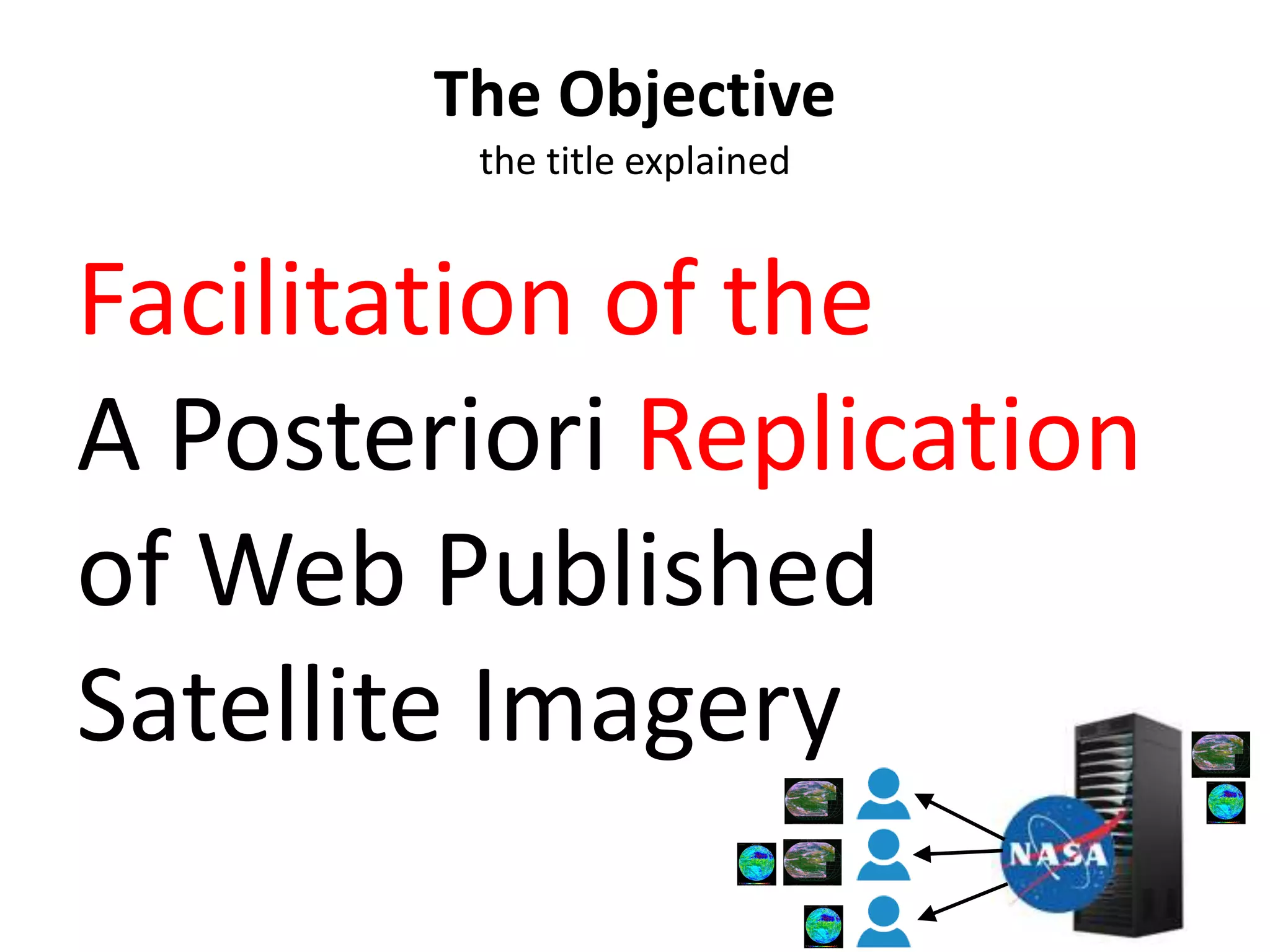
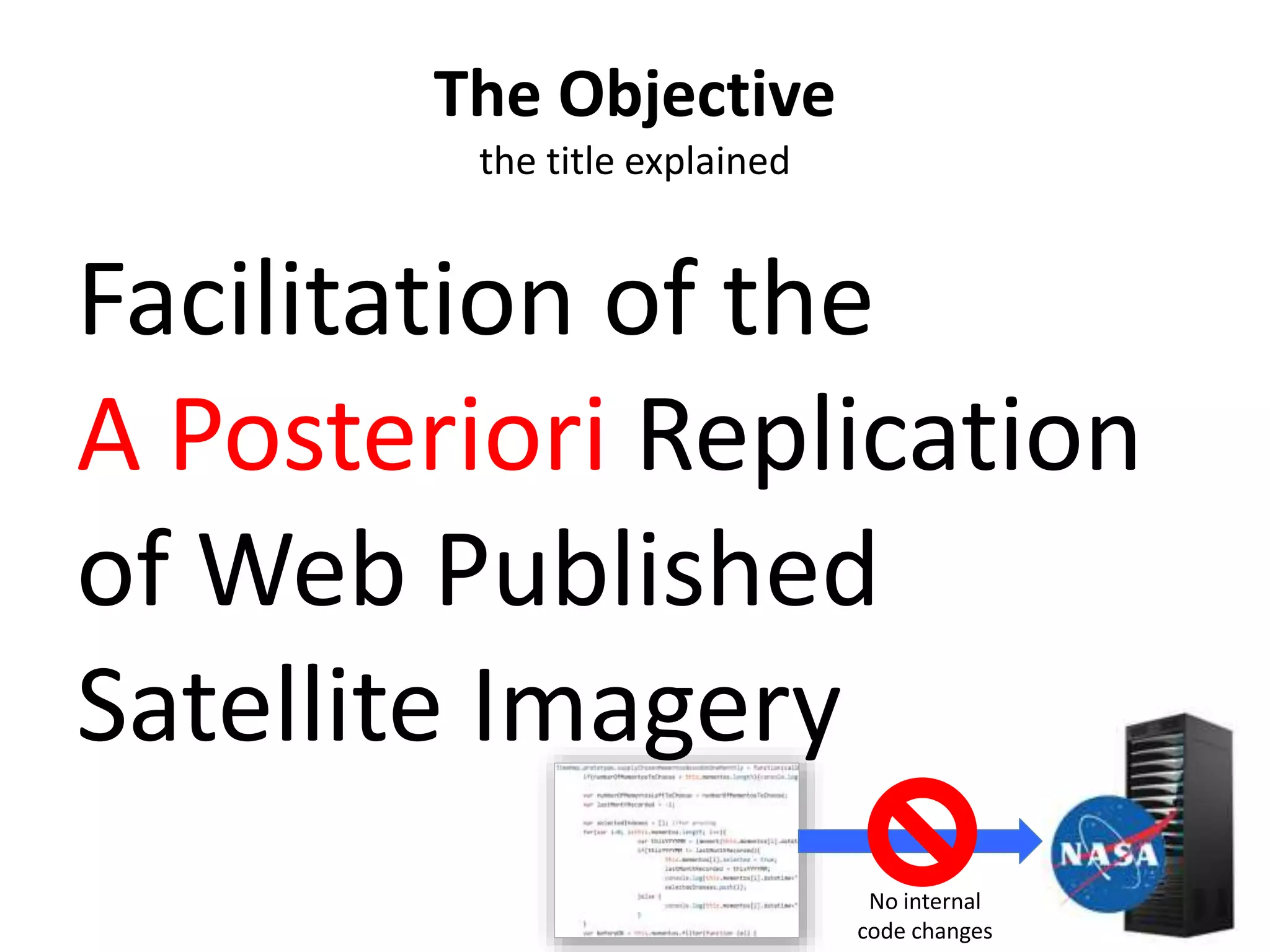
A Posteriori Replication
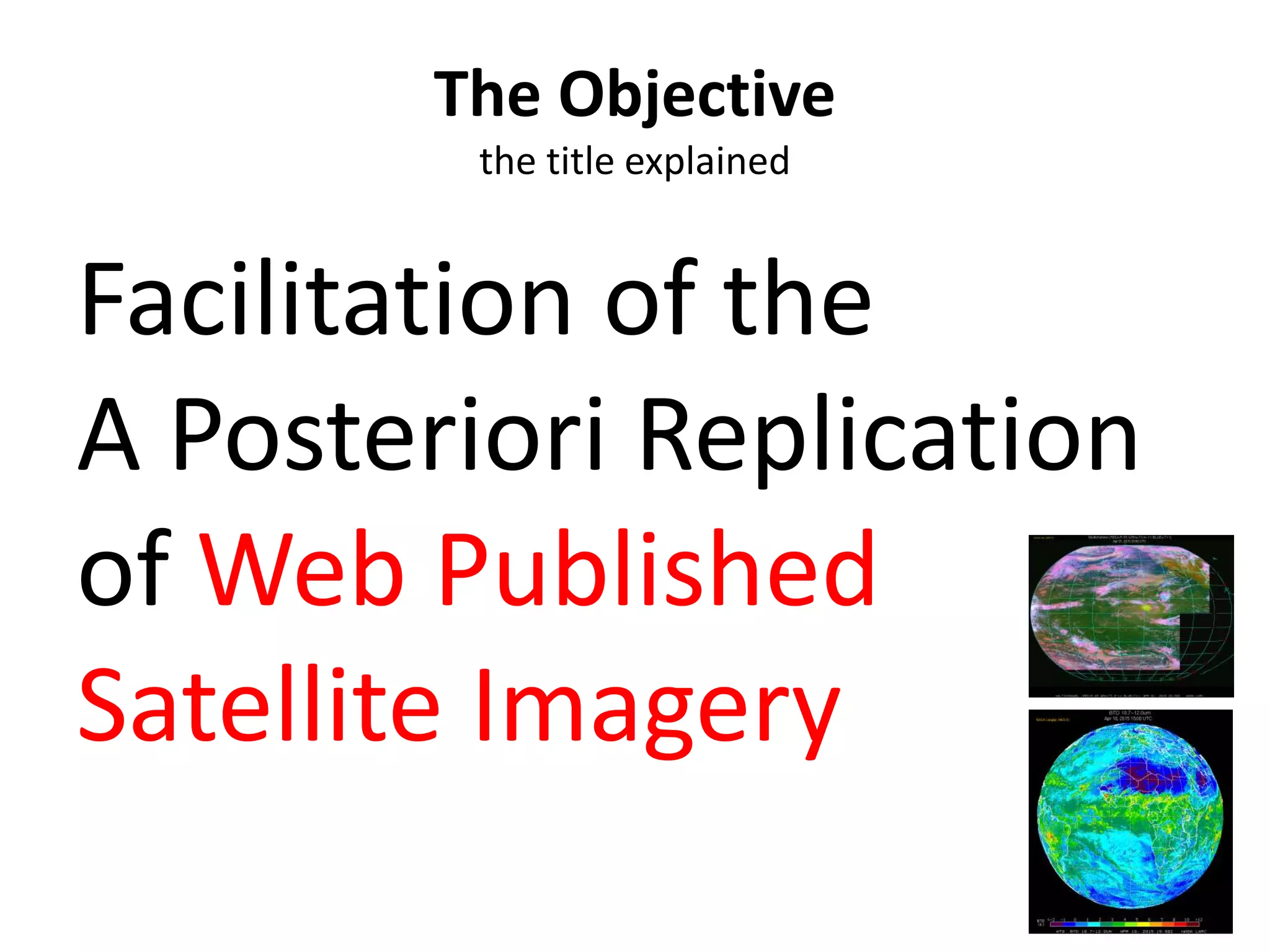
of Web Published
Satellite Imagery
Facilitation of the
A Posteriori Replication
of Web Published
Satellite Imagery
The Objective
the title explained
Facilitation of the
A Posteriori Replication
of Web Published
Satellite Imagery
The Objective
the title explained
Facilitation of the
A Posteriori Replication
of Web Published
Satellite Imagery
No internal
code changes
The Objective
the title explained
Outline
• Background & Motivation
• Target Data & Technologies Used
• How It All Fits Together
• Results
Current Organization of
Imagery Data on LaRC servers
YEAR
ONTH
DAY
List of
image files 
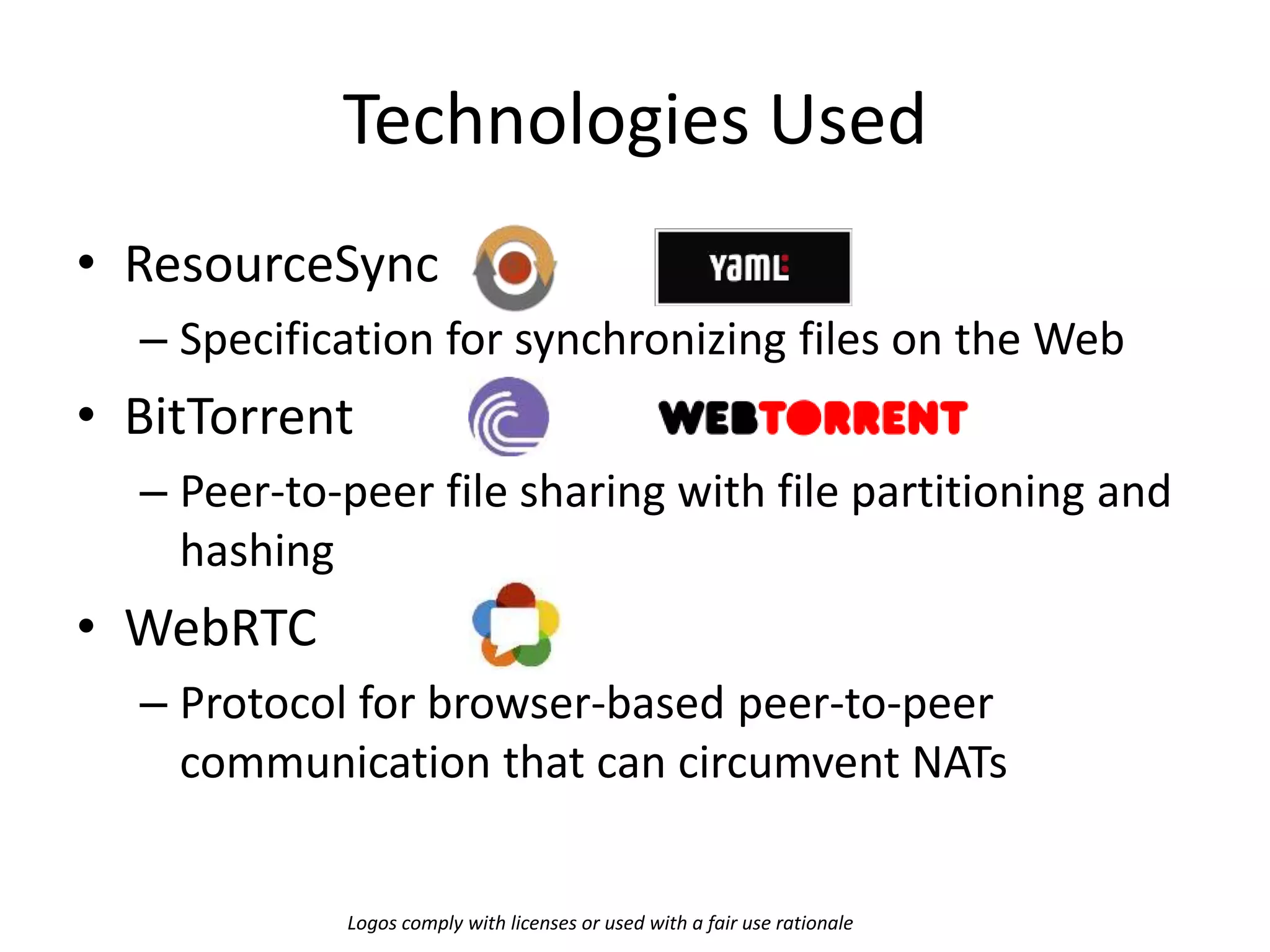
Technologies Used
• ResourceSync
– Specification for synchronizing files on the Web
• BitTorrent
– Peer-to-peer file sharing with file partitioning and
hashing
• WebRTC
– Protocol for browser-based peer-to-peer
communication that can circumvent NATs
Logos comply with licenses or used with a fair use rationale
Outline
• Background & Motivation
• Target Data & Technologies Used
• How It All Fits Together
• Results
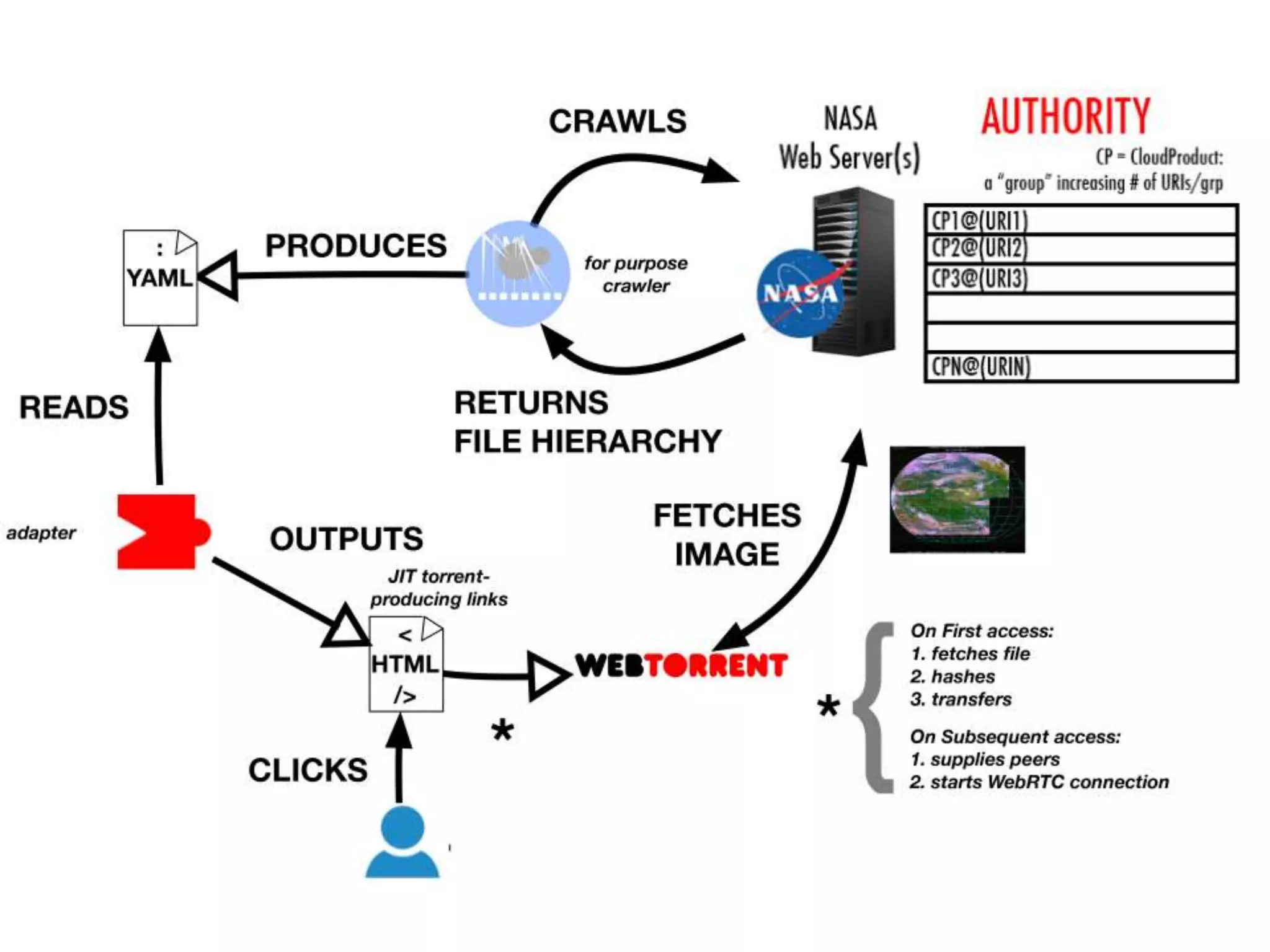
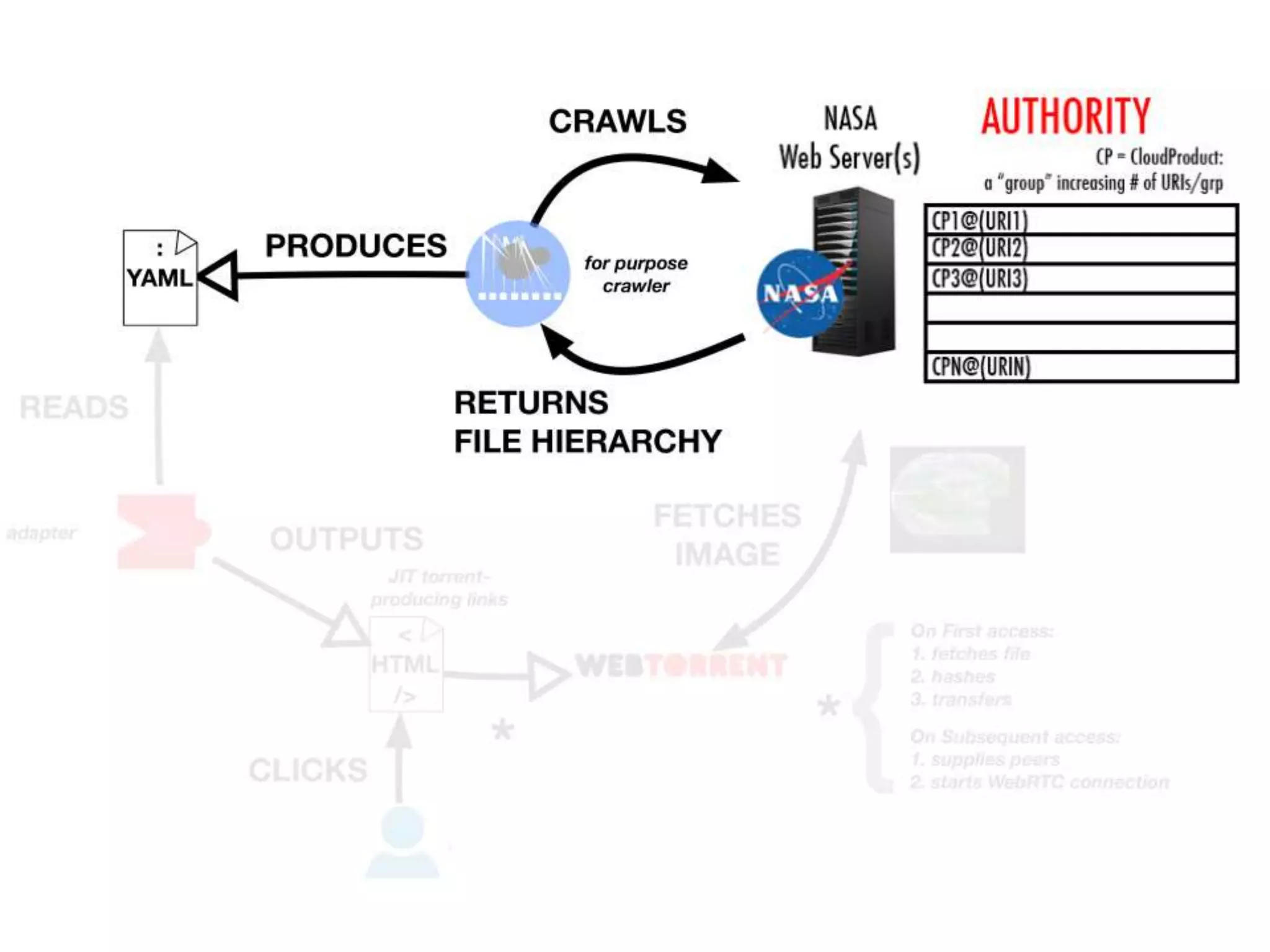
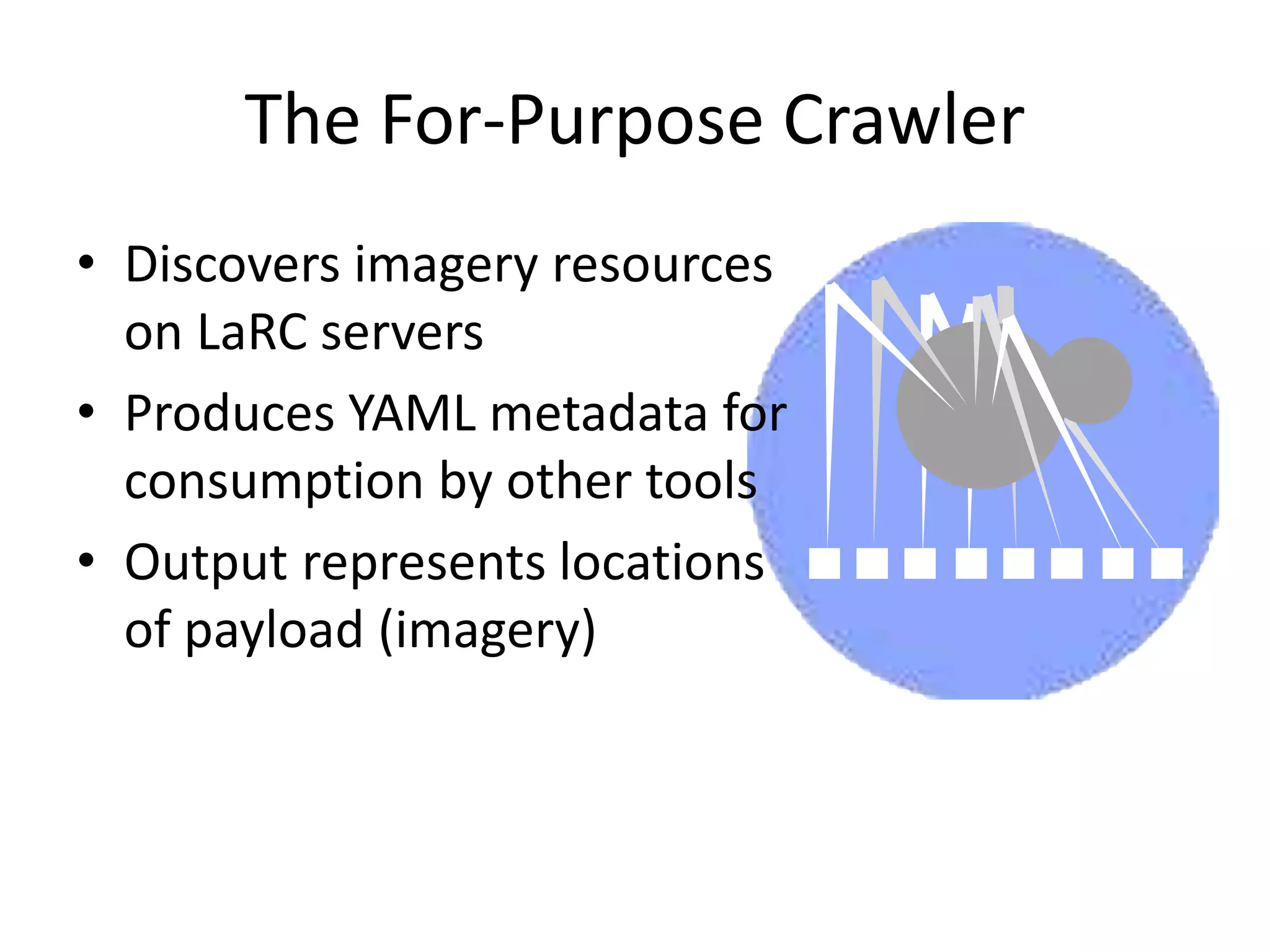
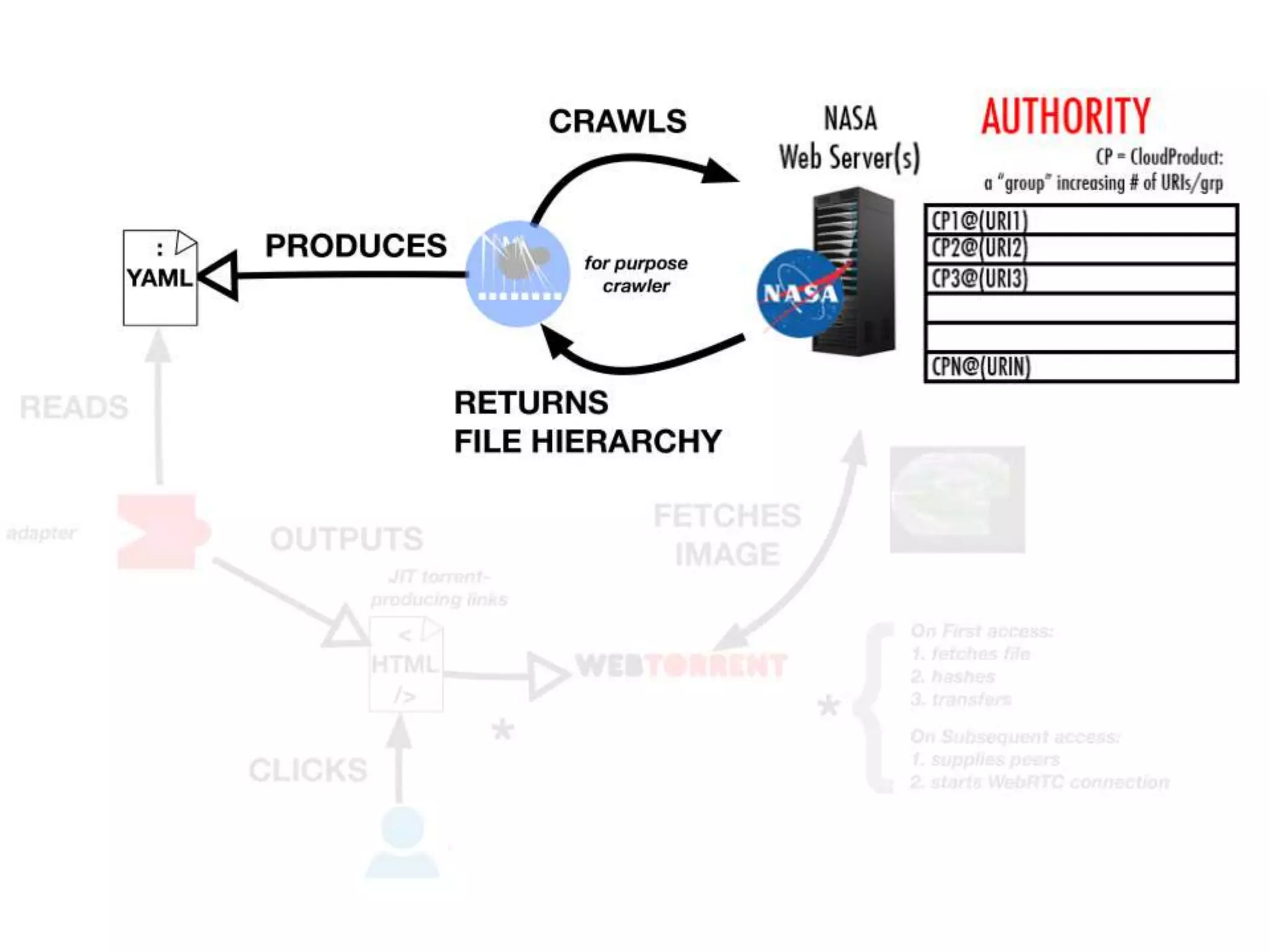
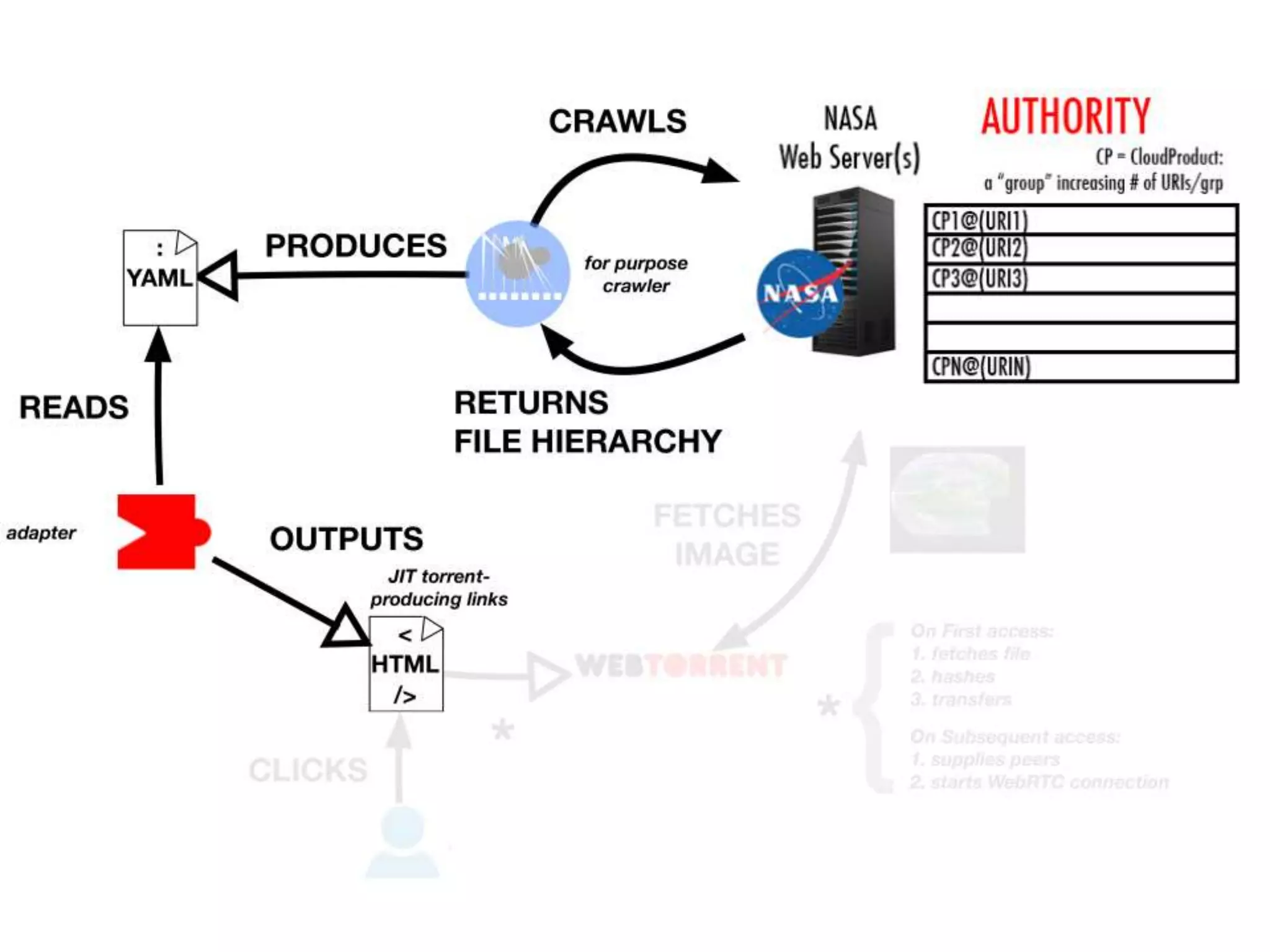
The For-Purpose Crawler
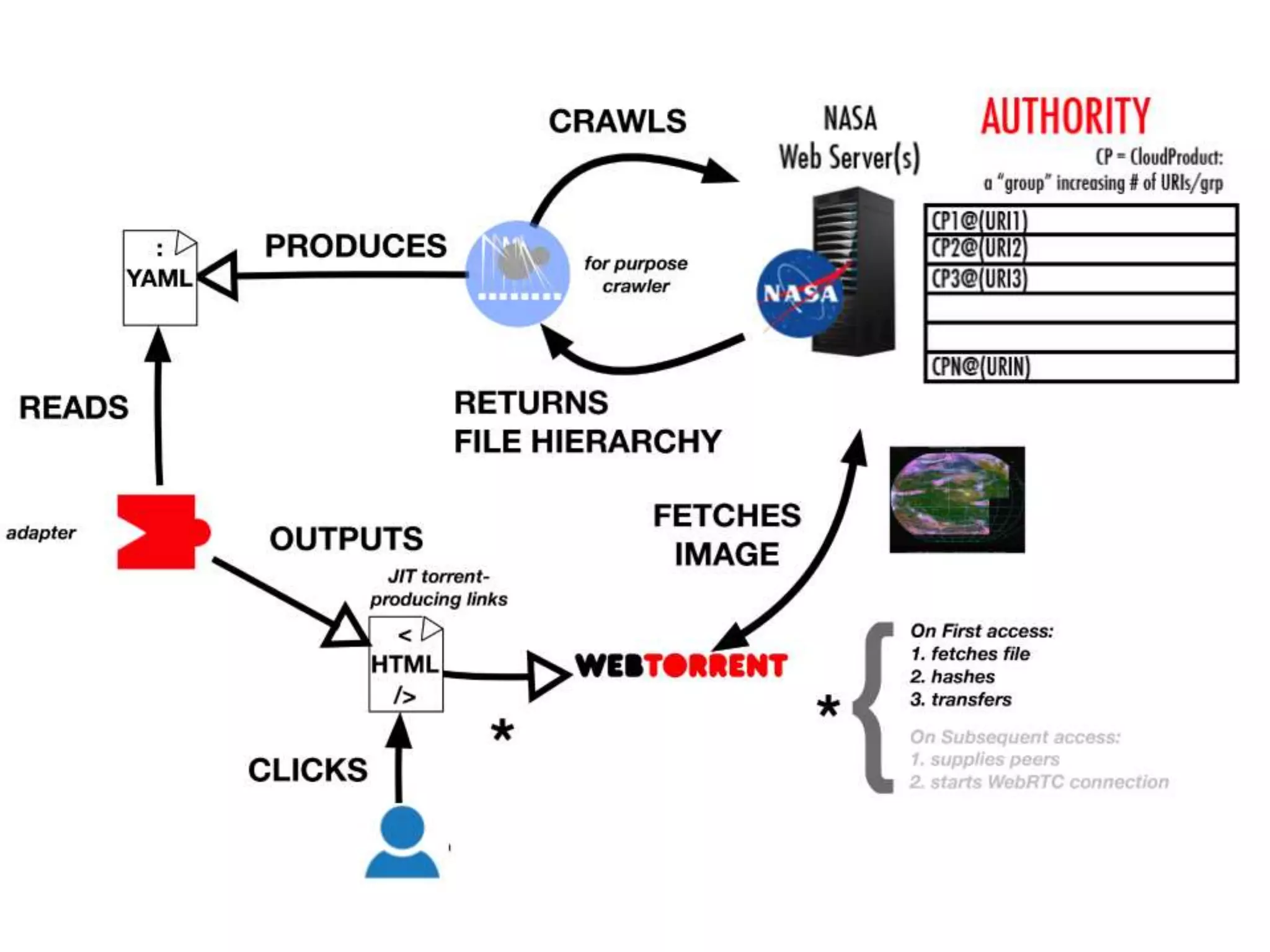
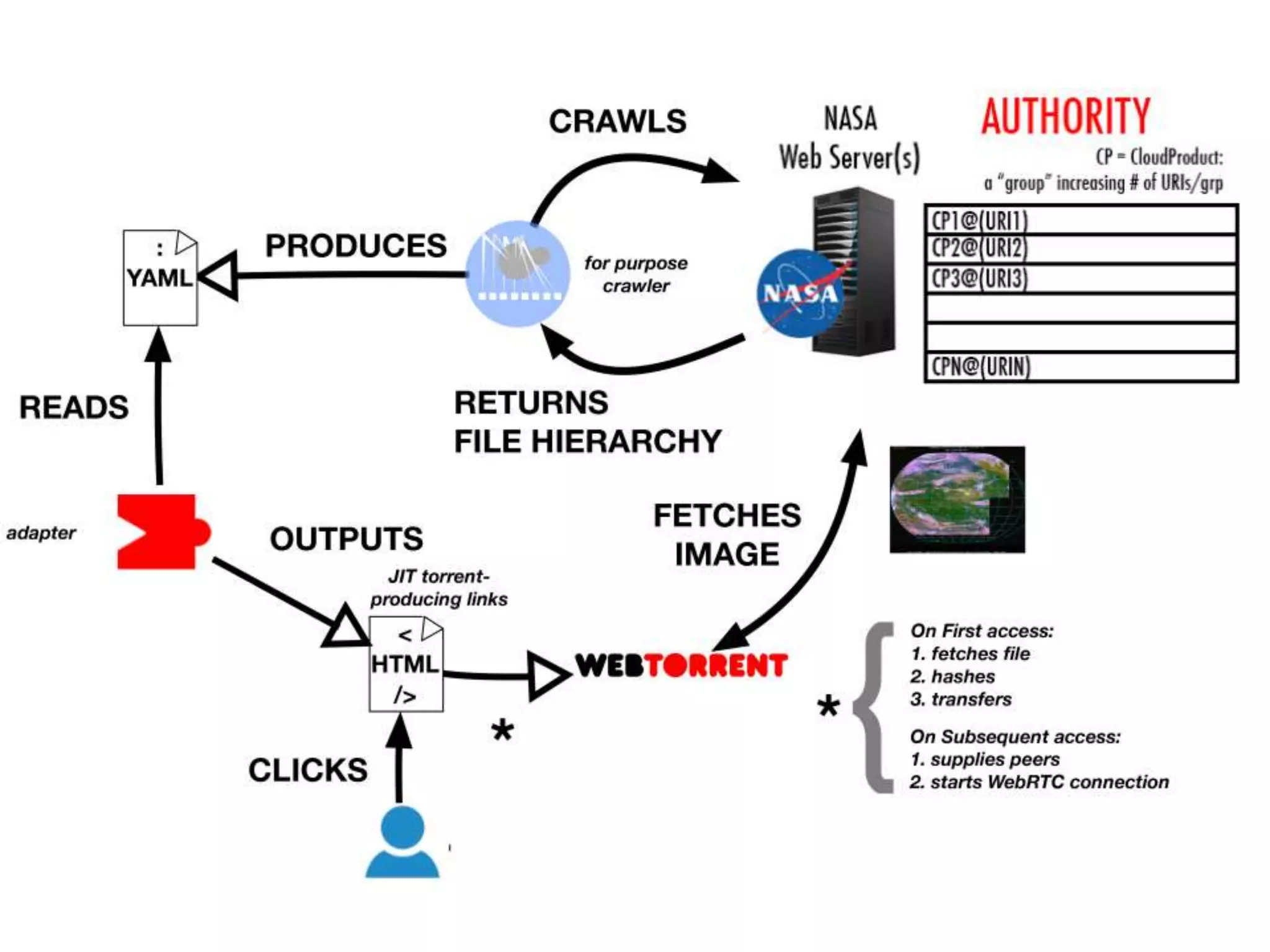
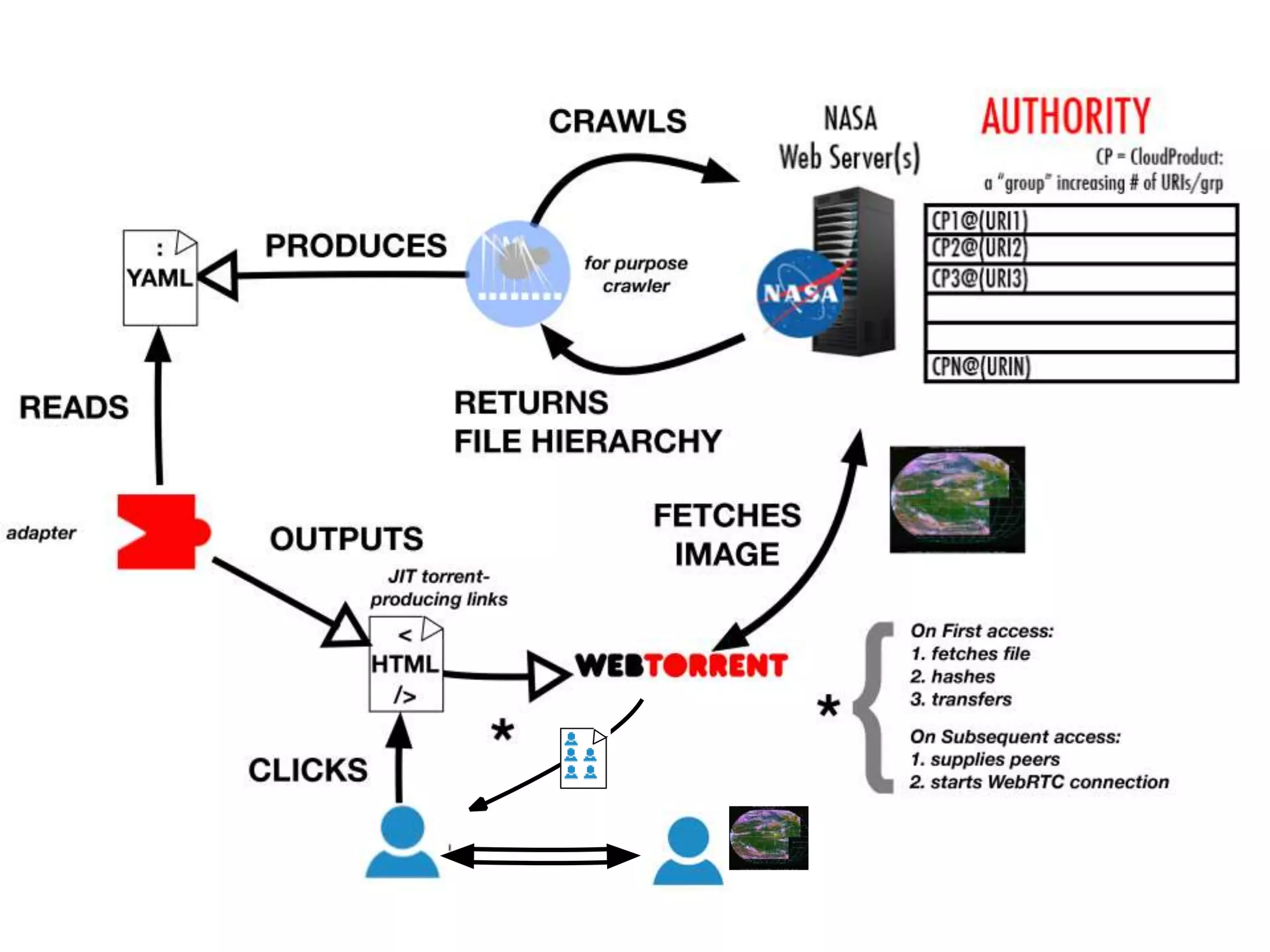
• Discovers imagery resources
on LaRC servers
• Produces YAML metadata for
consumption by other tools
• Output represents locations
of payload (imagery)
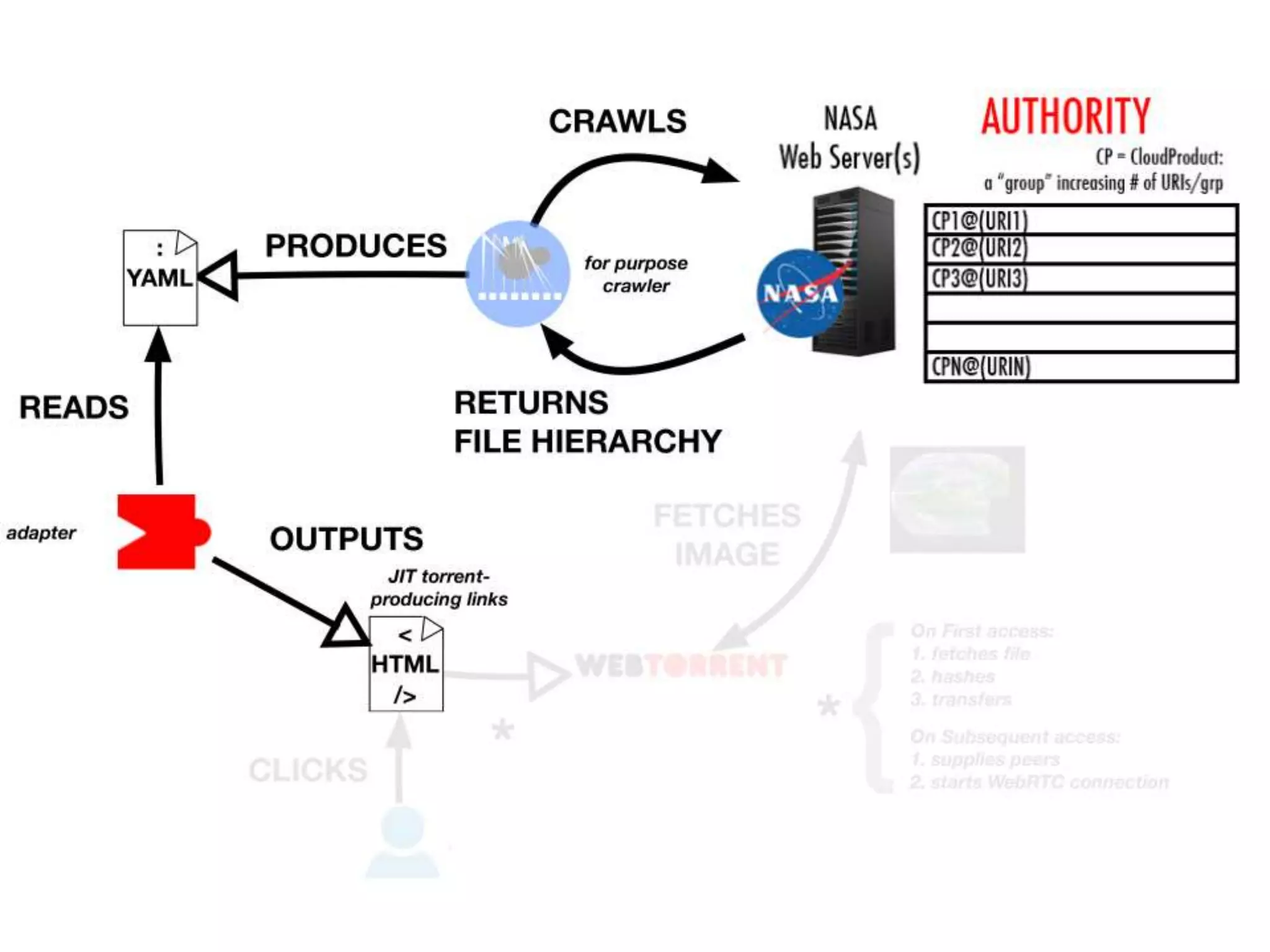
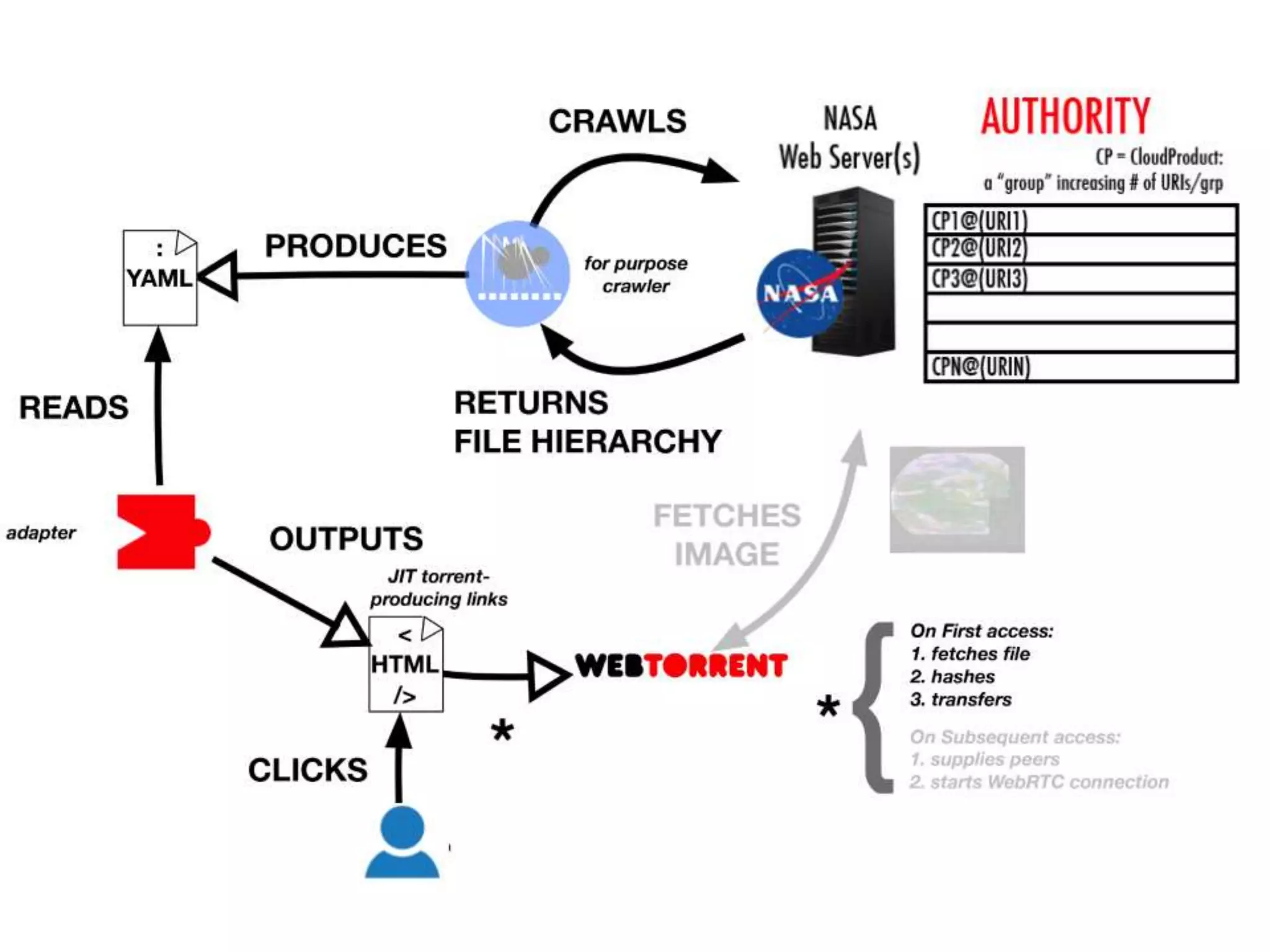
Consuming the Metadata
• Adapter software converts human-readable
YAML to HTML-style directives
• Directives invoke webtorrent when selected
• Intermediary YAML allows for extensible data
set
– Important as new data is generated and crawled
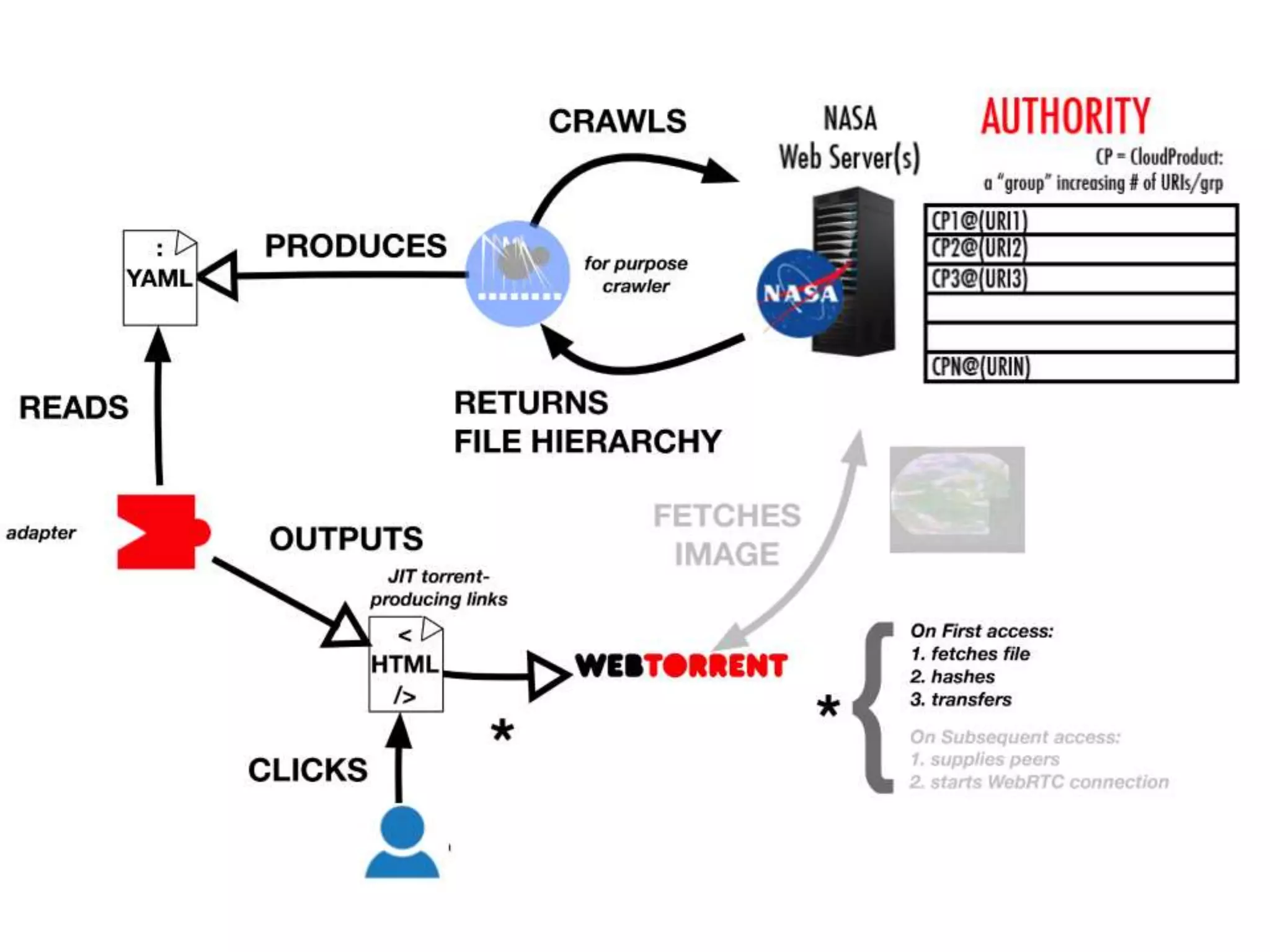
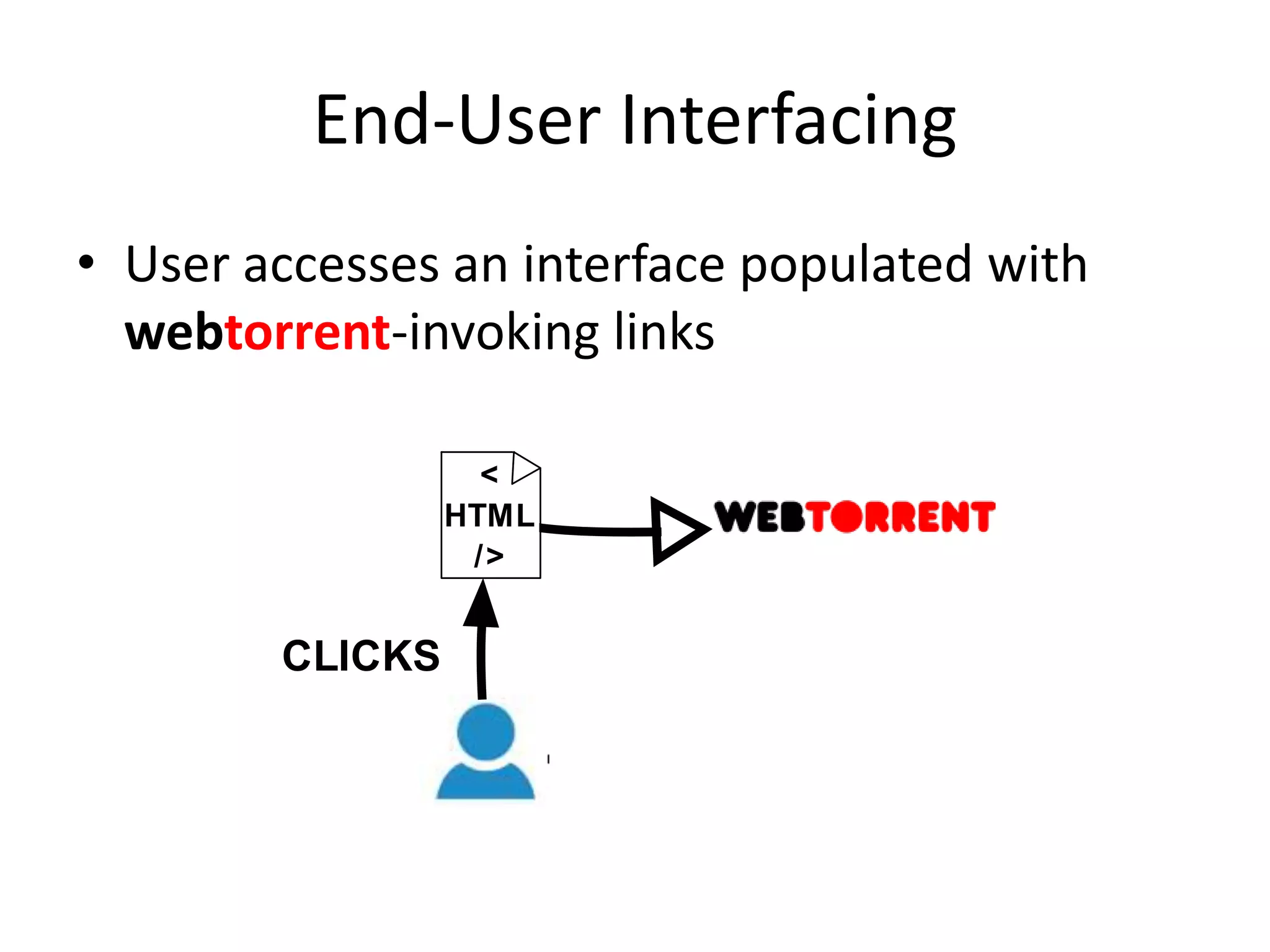
End-User Interfacing
• User accesses an interface populated with
webtorrent-invoking links
<
HTML
/>
CLICKS
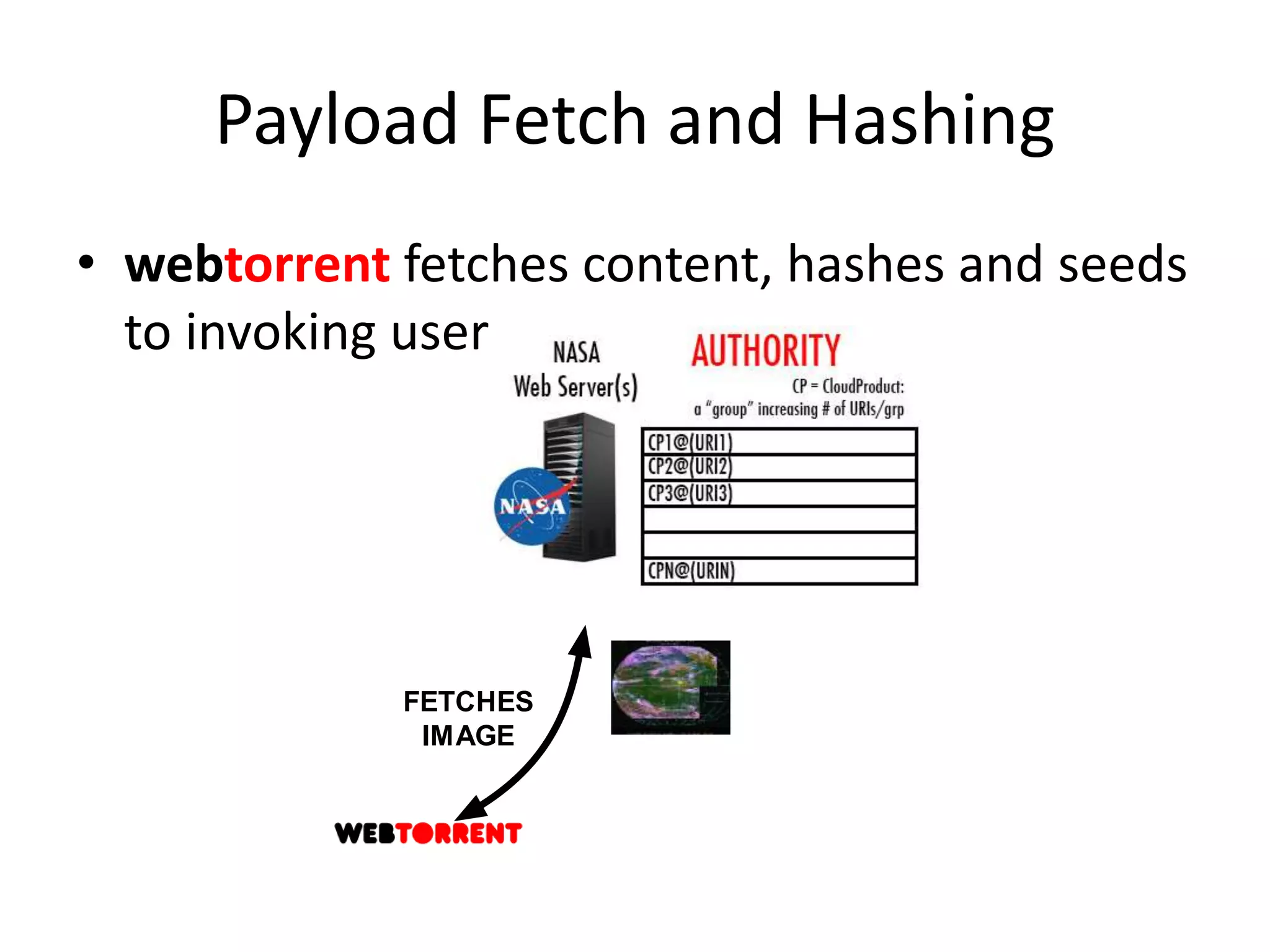
FETCHES
IMAGE
Payload Fetch and Hashing
• webtorrent fetches content, hashes and seeds
to invoking user
Payload Fetch and Hashing
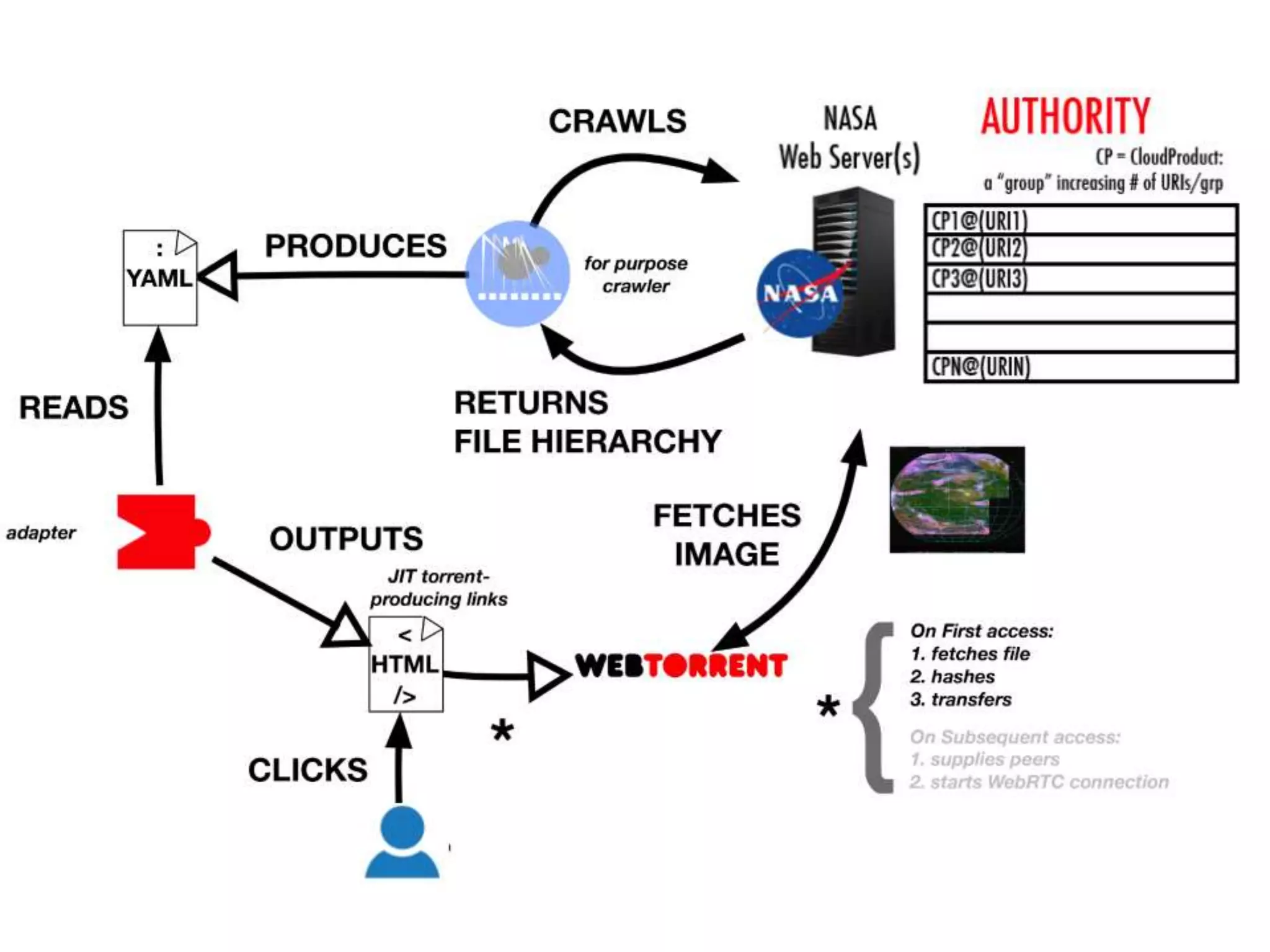
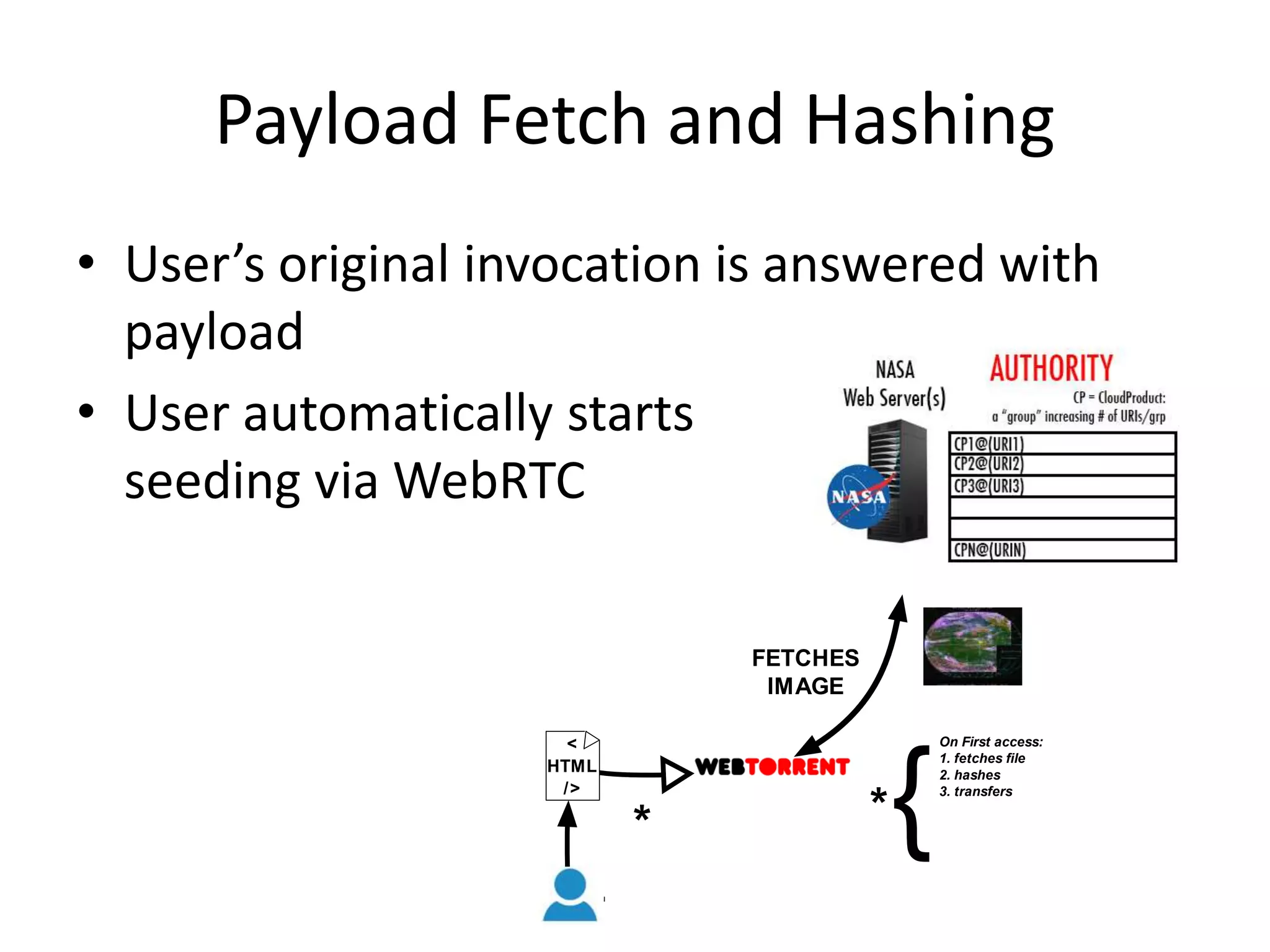
• User’s original invocation is answered with
payload
• User automatically starts
seeding via WebRTC
<
HTML
/>
On First access:
1. fetches file
2. hashes
3. transfers
** {
FETCHES
IMAGE
Payload Fetch and Hashing
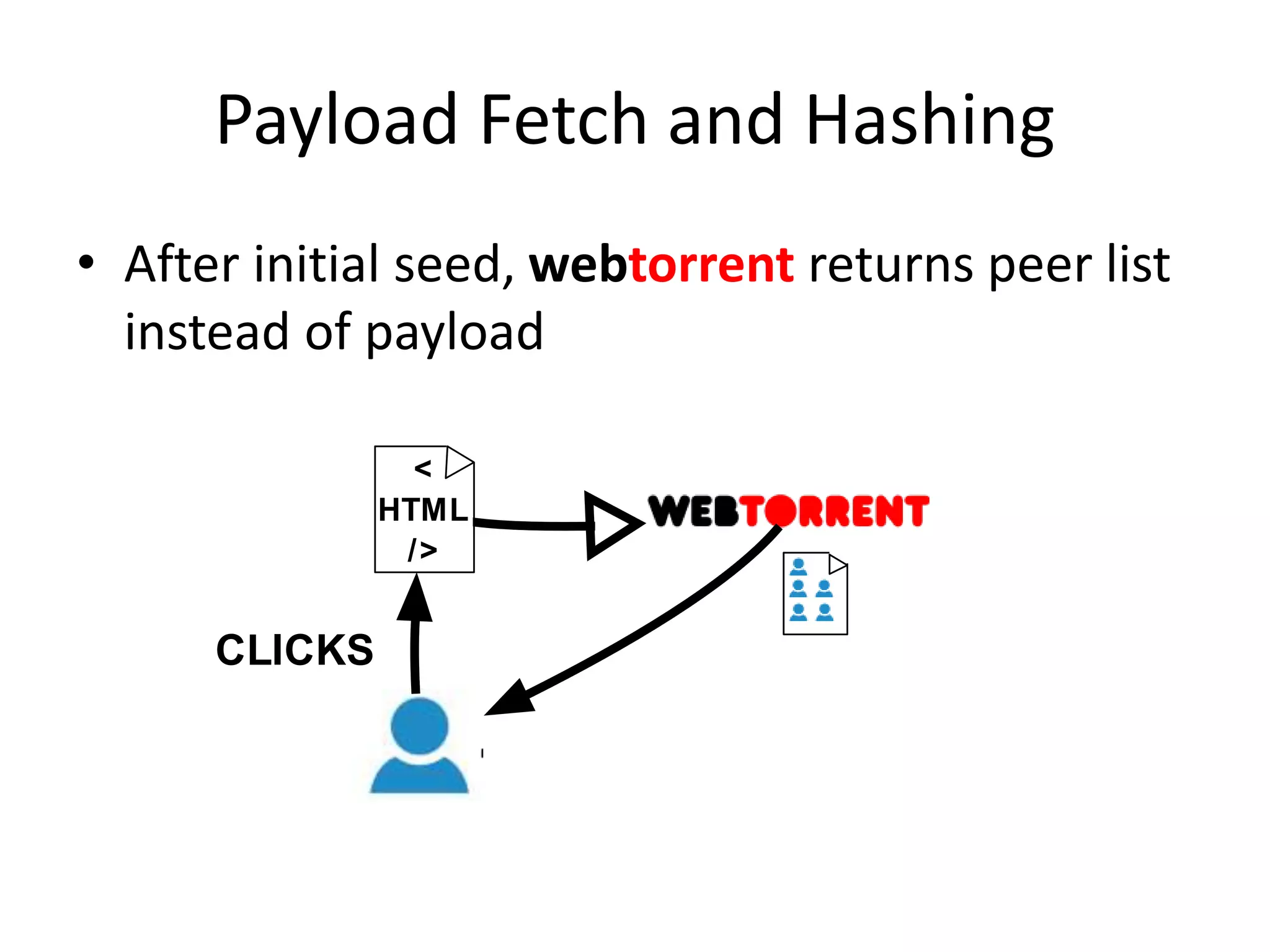
• After initial seed, webtorrent returns peer list
instead of payload
<
HTML
/>
CLICKS
Payload Fetch and Hashing
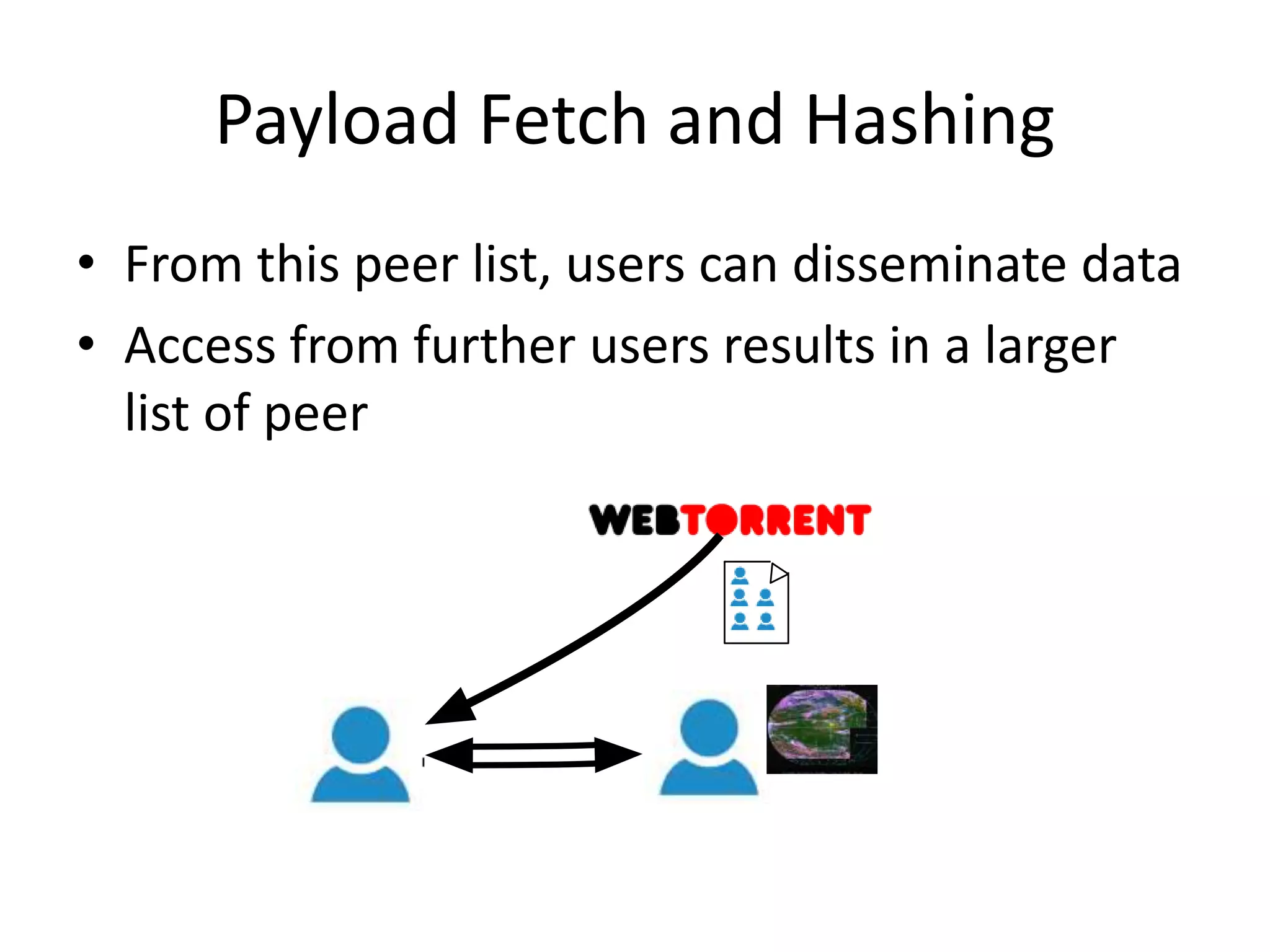
• From this peer list, users can disseminate data
• Access from further users results in a larger
list of peer
Outline
• Background & Motivation
• Target Data & Technologies Used
• How It All Fits Together
• Results
Evaluation
• Proof-of-concept constructed
• Temporally expensive but effective crawler
operation
• No means of evaluating NASA load
– A Posteriori: this is out-of-scope
Conclusions / Future Work
• Simpler cases functioned well for proof-of-
concept
• Reliance on single source of data mitigated
• ResourceSync concepts but not technology
not integrated
• YAML not exercised to potential
Facilitation of the A Posteriori
Replication of Web Published
Satellite Imagery
Mat Kelly
Web Science and Digital Libraries Research Lab
Old Dominion University
mkelly@cs.odu.edu
Virginia Space Grant Consortium Student Research Conference
NASA Langley Research Center
April 17, 2015

Facilitation of the A Posteriori Replication of Web Published Satellite Imagery

  • 1.
    Facilitation of theA Posteriori Replication of Web Published Satellite Imagery Mat Kelly Web Science and Digital Libraries Research Lab Old Dominion University mkelly@cs.odu.edu Virginia Space Grant Consortium Student Research Conference NASA Langley Research Center April 17, 2015
  • 2.
    Outline • Background &Motivation • Target Data & Technologies Used • How It All Fits Together • Results
  • 3.
    Background: NASA SatelliteImagery • Web Published – http://www-pm.larc.nasa.gov • Used by atmospheric scientists • Data set monotonically increasing in size • Older data archived – Available on-demand but slower
  • 4.
    Main Issue • Datais centrally located – Single point of failure • Data is public domain – Duplication by users is no issue • Temporally organized with nested directories – No exposed APIs or access technologies used for external interface
  • 5.
    The Objective the titleexplained Facilitation of the A Posteriori Replication of Web Published Satellite Imagery
  • 6.
    Facilitation of the APosteriori Replication of Web Published Satellite Imagery The Objective the title explained
  • 7.
    Facilitation of the APosteriori Replication of Web Published Satellite Imagery The Objective the title explained
  • 8.
    Facilitation of the APosteriori Replication of Web Published Satellite Imagery No internal code changes The Objective the title explained
  • 9.
    Outline • Background &Motivation • Target Data & Technologies Used • How It All Fits Together • Results
  • 10.
    Current Organization of ImageryData on LaRC servers YEAR ONTH DAY List of image files 
  • 11.
    Technologies Used • ResourceSync –Specification for synchronizing files on the Web • BitTorrent – Peer-to-peer file sharing with file partitioning and hashing • WebRTC – Protocol for browser-based peer-to-peer communication that can circumvent NATs Logos comply with licenses or used with a fair use rationale
  • 12.
    Outline • Background &Motivation • Target Data & Technologies Used • How It All Fits Together • Results
  • 15.
    The For-Purpose Crawler •Discovers imagery resources on LaRC servers • Produces YAML metadata for consumption by other tools • Output represents locations of payload (imagery)
  • 18.
    Consuming the Metadata •Adapter software converts human-readable YAML to HTML-style directives • Directives invoke webtorrent when selected • Intermediary YAML allows for extensible data set – Important as new data is generated and crawled
  • 21.
    End-User Interfacing • Useraccesses an interface populated with webtorrent-invoking links < HTML /> CLICKS
  • 24.
    FETCHES IMAGE Payload Fetch andHashing • webtorrent fetches content, hashes and seeds to invoking user
  • 25.
    Payload Fetch andHashing • User’s original invocation is answered with payload • User automatically starts seeding via WebRTC < HTML /> On First access: 1. fetches file 2. hashes 3. transfers ** { FETCHES IMAGE
  • 28.
    Payload Fetch andHashing • After initial seed, webtorrent returns peer list instead of payload < HTML /> CLICKS
  • 29.
    Payload Fetch andHashing • From this peer list, users can disseminate data • Access from further users results in a larger list of peer
  • 31.
    Outline • Background &Motivation • Target Data & Technologies Used • How It All Fits Together • Results
  • 32.
    Evaluation • Proof-of-concept constructed •Temporally expensive but effective crawler operation • No means of evaluating NASA load – A Posteriori: this is out-of-scope
  • 33.
    Conclusions / FutureWork • Simpler cases functioned well for proof-of- concept • Reliance on single source of data mitigated • ResourceSync concepts but not technology not integrated • YAML not exercised to potential
  • 34.
    Facilitation of theA Posteriori Replication of Web Published Satellite Imagery Mat Kelly Web Science and Digital Libraries Research Lab Old Dominion University mkelly@cs.odu.edu Virginia Space Grant Consortium Student Research Conference NASA Langley Research Center April 17, 2015