FIRST EPISODE PSYCHOSIS
“Detecting an illness early is of
value only if effective treatment
is readily available”
- Falloon 1998
In next 30 minutes..
• History
• Concepts
• Prodrome, DUP,ARMS.
• Neurobiology of onset of FEP
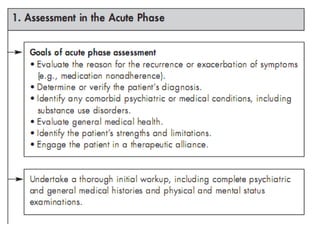
• Assessment
• Management
• Guidelines
DUNEDIN PROSPECTIVE STUDY
• Minor quasi-psychotic symptoms are more likely to
be manifested by children who are destined to
develop schizophrenia later as early as 11 yrs of age
• Follow up of 15 yrs
• Strength/frequency progresses prodrome
• 25% of children who endorsed 2 or more of 5
questions qualified for a diagnosis of Schizophrenia
@26yrs (vs 2% Odds 16.1)
Poulton 2000 Archives of Gen. Psy.
HISTORY
• Entangled with Schizophrenia
• Diagnostic dilemmas in FEP
• Focus on established psychosis
• Focus on chronic patients
• Shifting focus on drug naïve patients
• Arrival of S G A
FEP – EVOLUTION
• Johnston and Crow – Northwick Park
Study – B J P 1986
• EPPIC – Melbourne
• TIPS – Denmark
• EIS- Birmingham UK
• EPP and PEPP –Canada
• Hong Kong and Singapore
CURRENT SCENARIO
• IEPA – Newcastle Declaration – 2002
(Edwards and Mc Gorry)
• Public health importance
• Advocacy
• NHS has recognized it as one of the three
priority areas – 50 Early Intervention
Services have started in UK
• Scenario in INDIA ?
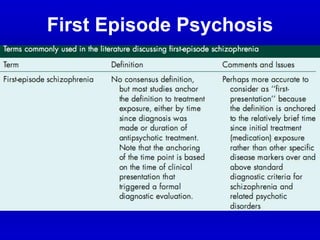
FEP?
• Include all non- organic psychosis
• Polymorphic presentation
• Embrace or at least tolerate diagnostic uncertainties
• F23  20,21,22,25,29,31
• Pre-psychotic stages – PMP,UHR, ARMS, Prodrome
• Watchful expectancy but NOT masterly inactivity!
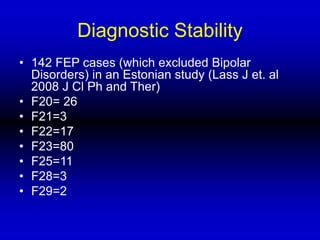
Diagnostic Stability
• 142 FEP cases (which excluded Bipolar
Disorders) in an Estonian study (Lass J et. al
2008 J Cl Ph and Ther)
• F20= 26
• F21=3
• F22=17
• F23=80
• F25=11
• F28=3
• F29=2
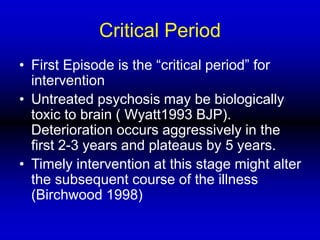
Critical Period
• First Episode is the “critical period” for
intervention
• Untreated psychosis may be biologically
toxic to brain ( Wyatt1993 BJP).
Deterioration occurs aggressively in the
first 2-3 years and plateaus by 5 years.
• Timely intervention at this stage might alter
the subsequent course of the illness
(Birchwood 1998)
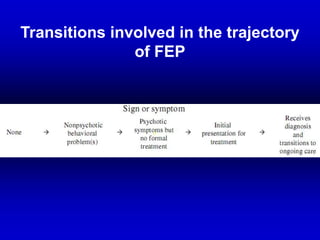
Transitions involved in the trajectory
of FEP
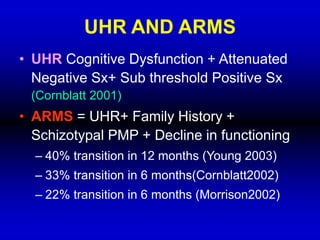
UHR AND ARMS
• UHR Cognitive Dysfunction + Attenuated
Negative Sx+ Sub threshold Positive Sx
(Cornblatt 2001)
• ARMS = UHR+ Family History +
Schizotypal PMP + Decline in functioning
– 40% transition in 12 months (Young 2003)
– 33% transition in 6 months(Cornblatt2002)
– 22% transition in 6 months (Morrison2002)
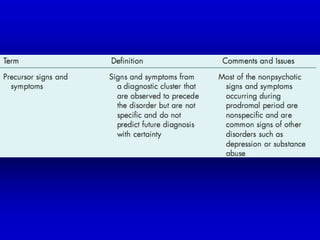
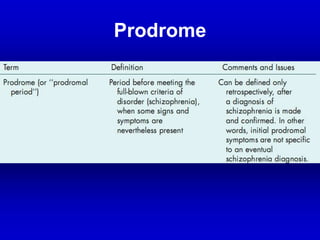
Prodrome
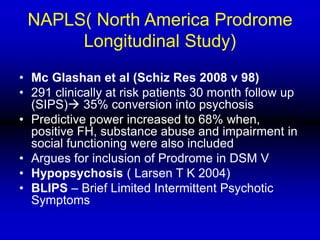
NAPLS( North America Prodrome
Longitudinal Study)
• Mc Glashan et al (Schiz Res 2008 v 98)
• 291 clinically at risk patients 30 month follow up
(SIPS) 35% conversion into psychosis
• Predictive power increased to 68% when,
positive FH, substance abuse and impairment in
social functioning were also included
• Argues for inclusion of Prodrome in DSM V
• Hypopsychosis ( Larsen T K 2004)
• BLIPS – Brief Limited Intermittent Psychotic
Symptoms
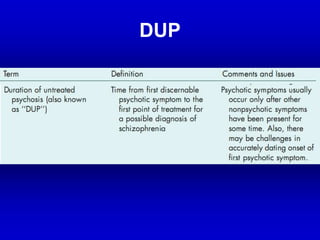
DUP
DUP and outcome of FEP
• Worse outcome when DUP> 3/12
• In schizophrenic spectrum subgroup, DUP
> 1 year
• Beyond this watershed deficits endure
• DUP has emerged as an independent
predictor for short, medium and long term
outcome
• An 8 year prospective study (MG Harris –
Melbourne – Schiz Res 2005)
First Episode Psychosis
UHR/ARMS FEP
• AFFECTIVE SYMPTOMS-
DEPRESSION, SOCIAL ANXIETY
• ANXIETY FACILITATES DEVELOPMENT
OF ABERRANT COGNITIVE SCHEMES
AND BELIEFS
• INFLUENCE ANOMALOUS
EXPERIENCE & MAINTENANCE OF
DELUSIONS
(Freeman & Garety 2003)
Social Factors FEP
• URBAN BIRTH & UPBRINGING
• MIGRATION
• SOCIAL ADVERSITIES
– SOCIAL ISOLATION  SENSITIZATION OF
DA SYSTEM (Boydell 2004)
– GOING DOWN IN SOCIAL HEIRARCHY 
HYPERDOPAMINERGIC
STATE(Morgan2002)
DOPAMINERGIC SENSITIZATION BY
PSYCHOACTIVE DRUGS
• REPEATED EXPOSURE  SENSITIZATION
• GENETICALLY AND DEVELOPMENTALLY VULNERABLE individuals
are prone.
• POLYMORPHISM IN COMT GENE INCREASES THE RISK OF
PSYCHOSIS INDUCED BY CANNABIS ( Caspi 2005)
• MESO-LIMBIC – CORTICAL – STRIATAL CIRCUITS ARE PRONE TO
SENSITIZATION
(Liebermann 2001 Biol. Psychiatry)
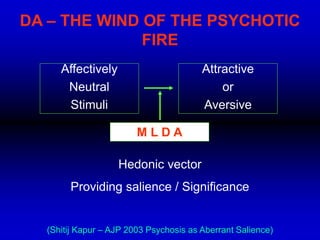
DA – THE WIND OF THE PSYCHOTIC
FIRE
Affectively
Neutral
Stimuli
Attractive
or
Aversive
M L D A
Hedonic vector
Providing salience / Significance
(Shitij Kapur – AJP 2003 Psychosis as Aberrant Salience)
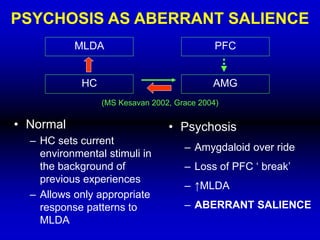
PSYCHOSIS AS ABERRANT SALIENCE
MLDA PFC
HC AMG
(MS Kesavan 2002, Grace 2004)
• Normal
– HC sets current
environmental stimuli in
the background of
previous experiences
– Allows only appropriate
response patterns to
MLDA
• Psychosis
– Amygdaloid over ride
– Loss of PFC ‘ break’
– ↑MLDA
– ABERRANT SALIENCE
Psycho(neurobio)logy of Delusional
Reasoning
• MEANINGFULCONNECTIONS ARE
ESTABLISHED BETWEEN COINCIDENT
EXTERNAL EVENTS/PERCEPTIONS
AND THOUGHTS /EVENTS/
RECOLLECTIONS IN CONSCIOUSNESS
(Hemsley 1993)
• HC  MLDA system, heightened DA
transmission formation of “meaningful
connections”
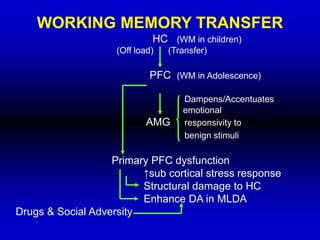
WORKING MEMORY TRANSFER
HC (WM in children)
(Off load) (Transfer)
PFC (WM in Adolescence)
Dampens/Accentuates
emotional
AMG responsivity to
benign stimuli
Primary PFC dysfunction
↑sub cortical stress response
Structural damage to HC
Enhance DA in MLDA
Drugs & Social Adversity
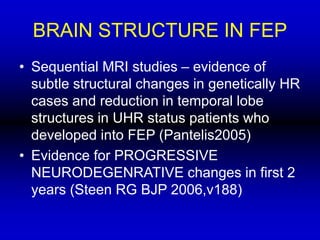
BRAIN STRUCTURE IN FEP
• Sequential MRI studies – evidence of
subtle structural changes in genetically HR
cases and reduction in temporal lobe
structures in UHR status patients who
developed into FEP (Pantelis2005)
• Evidence for PROGRESSIVE
NEURODEGENRATIVE changes in first 2
years (Steen RG BJP 2006,v188)
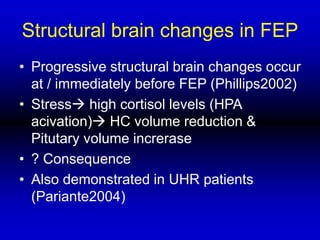
Structural brain changes in FEP
• Progressive structural brain changes occur
at / immediately before FEP (Phillips2002)
• Stress high cortisol levels (HPA
acivation) HC volume reduction &
Pitutary volume increrase
• ? Consequence
• Also demonstrated in UHR patients
(Pariante2004)
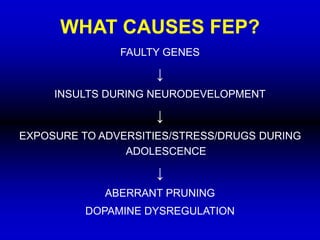
WHAT CAUSES FEP?
FAULTY GENES
↓
INSULTS DURING NEURODEVELOPMENT
↓
EXPOSURE TO ADVERSITIES/STRESS/DRUGS DURING
ADOLESCENCE
↓
ABERRANT PRUNING
DOPAMINE DYSREGULATION
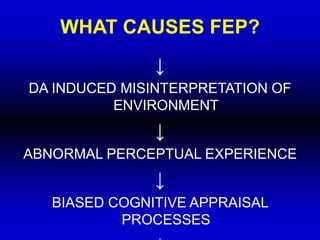
WHAT CAUSES FEP?
↓
DA INDUCED MISINTERPRETATION OF
ENVIRONMENT
↓
ABNORMAL PERCEPTUAL EXPERIENCE
↓
BIASED COGNITIVE APPRAISAL
PROCESSES
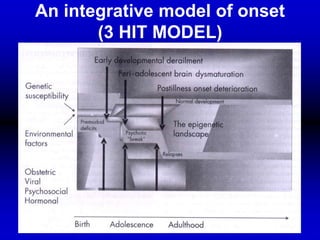
An integrative model of onset
(3 HIT MODEL)
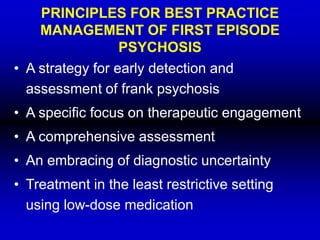
PRINCIPLES FOR BEST PRACTICE
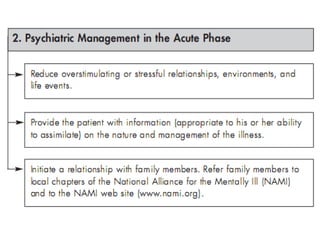
MANAGEMENT OF FIRST EPISODE
PSYCHOSIS
• A strategy for early detection and
assessment of frank psychosis
• A specific focus on therapeutic engagement
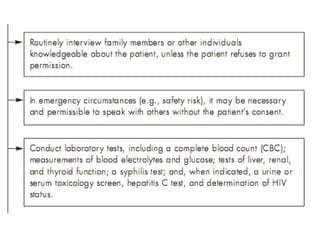
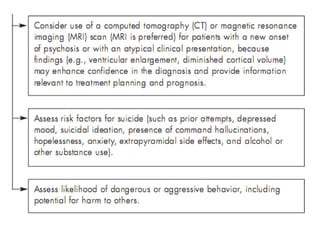
• A comprehensive assessment
• An embracing of diagnostic uncertainty
• Treatment in the least restrictive setting
using low-dose medication
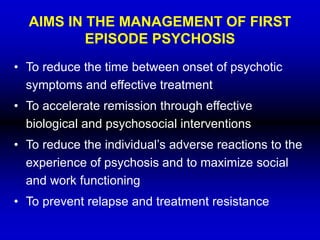
AIMS IN THE MANAGEMENT OF FIRST
EPISODE PSYCHOSIS
• To reduce the time between onset of psychotic
symptoms and effective treatment
• To accelerate remission through effective
biological and psychosocial interventions
• To reduce the individual’s adverse reactions to the
experience of psychosis and to maximize social
and work functioning
• To prevent relapse and treatment resistance
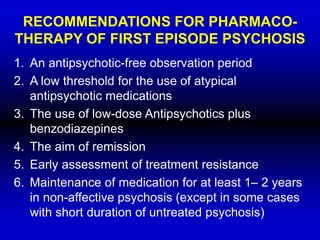
RECOMMENDATIONS FOR PHARMACO-
THERAPY OF FIRST EPISODE PSYCHOSIS
1. An antipsychotic-free observation period
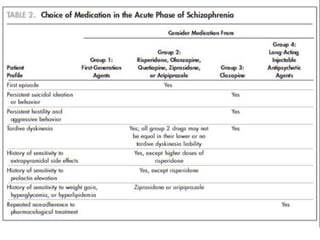
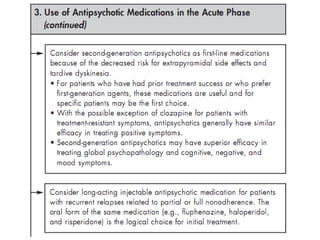
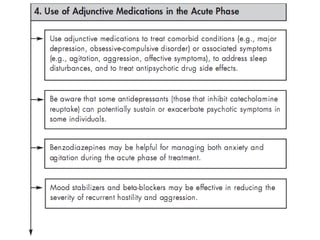
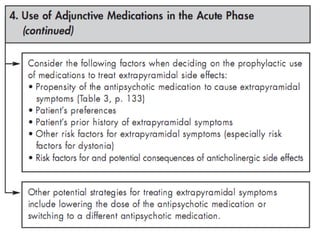
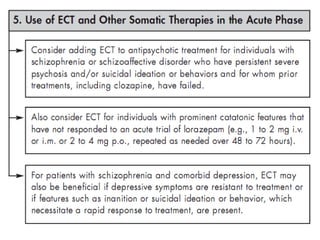
2. A low threshold for the use of atypical
antipsychotic medications
3. The use of low-dose Antipsychotics plus
benzodiazepines
4. The aim of remission
5. Early assessment of treatment resistance
6. Maintenance of medication for at least 1– 2 years
in non-affective psychosis (except in some cases
with short duration of untreated psychosis)
NICE Guidelines (UK)
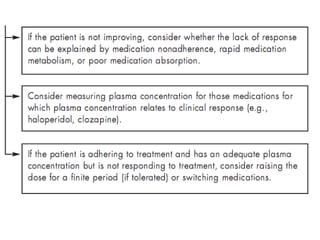
• Low dose Atypical AP
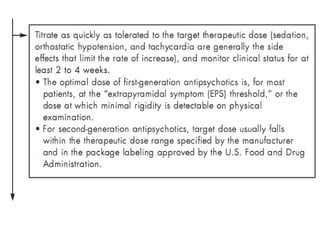
• Do Not use loading dose
• Conventional AP 300- 1000mg/day of CPZ
equivalent
• Avoid polypharmacy except when
switching
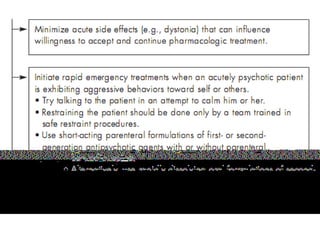
• For rapid tranquillization, i/m Lorazepam,
HPL and OLZ
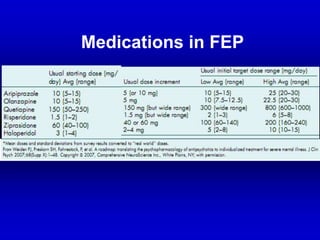
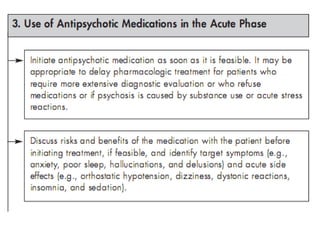
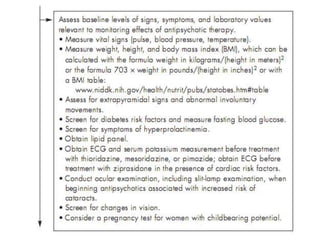
Medications in FEP
Psychosocial treatments in FEP
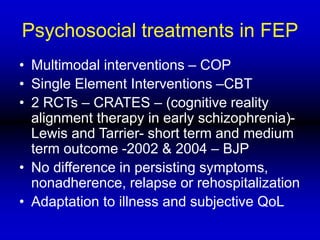
• Multimodal interventions – COP
• Single Element Interventions –CBT
• 2 RCTs – CRATES – (cognitive reality
alignment therapy in early schizophrenia)-
Lewis and Tarrier- short term and medium
term outcome -2002 & 2004 – BJP
• No difference in persisting symptoms,
nonadherence, relapse or rehospitalization
• Adaptation to illness and subjective QoL
CBT in Prodrome / ARMS
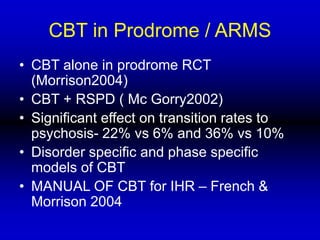
• CBT alone in prodrome RCT
(Morrison2004)
• CBT + RSPD ( Mc Gorry2002)
• Significant effect on transition rates to
psychosis- 22% vs 6% and 36% vs 10%
• Disorder specific and phase specific
models of CBT
• MANUAL OF CBT for IHR – French &
Morrison 2004
Take Home
• It is crucial to identify psychosis even in the
prodrome
• The neurobiological mechanisms of onset of
psychosis integrates biology and cognitive
psychology
• Bringing down the DUP can have beneficial
outcome in the short and long course
• Guidelines for pharmacological and
psychosocial treatments need to be developed
and followed for optimal care of FEP
• Need to develop dedicated services for FEP
Suggested reading
1.What causes the onset of Psychosis?
(M R Broome et al Schiz Res 79(2005)
2.Management of FEP
(E Spencer, M Birchwood Adv Psych Treatment (2001)vol7)
3.Understanding and Treating FES
(Peter J Weiden, Peter f Buckley PCNA 30(2007)
4. Neurodevelopmental theory of Schizophrenia (MS Kesavan et al in
APA Text Book of Schizophrenia 2006 Ed J A Lieberman)
5. Psychosocial treatment of FEP: A research update
( David P Lenn et al AJP 2005 (162)
6. Pharmacological treatment of FES
(Robinson DG Schiz Bulletin 2005)
FIRST EPISODE PSYCHOSIS.ppt

FIRST EPISODE PSYCHOSIS.ppt

  • 1.
  • 2.
    “Detecting an illnessearly is of value only if effective treatment is readily available” - Falloon 1998
  • 3.
    In next 30minutes.. • History • Concepts • Prodrome, DUP,ARMS. • Neurobiology of onset of FEP • Assessment • Management • Guidelines
  • 4.
    DUNEDIN PROSPECTIVE STUDY •Minor quasi-psychotic symptoms are more likely to be manifested by children who are destined to develop schizophrenia later as early as 11 yrs of age • Follow up of 15 yrs • Strength/frequency progresses prodrome • 25% of children who endorsed 2 or more of 5 questions qualified for a diagnosis of Schizophrenia @26yrs (vs 2% Odds 16.1) Poulton 2000 Archives of Gen. Psy.
  • 5.
    HISTORY • Entangled withSchizophrenia • Diagnostic dilemmas in FEP • Focus on established psychosis • Focus on chronic patients • Shifting focus on drug naïve patients • Arrival of S G A
  • 6.
    FEP – EVOLUTION •Johnston and Crow – Northwick Park Study – B J P 1986 • EPPIC – Melbourne • TIPS – Denmark • EIS- Birmingham UK • EPP and PEPP –Canada • Hong Kong and Singapore
  • 7.
    CURRENT SCENARIO • IEPA– Newcastle Declaration – 2002 (Edwards and Mc Gorry) • Public health importance • Advocacy • NHS has recognized it as one of the three priority areas – 50 Early Intervention Services have started in UK • Scenario in INDIA ?
  • 8.
    FEP? • Include allnon- organic psychosis • Polymorphic presentation • Embrace or at least tolerate diagnostic uncertainties • F23  20,21,22,25,29,31 • Pre-psychotic stages – PMP,UHR, ARMS, Prodrome • Watchful expectancy but NOT masterly inactivity!
  • 9.
    Diagnostic Stability • 142FEP cases (which excluded Bipolar Disorders) in an Estonian study (Lass J et. al 2008 J Cl Ph and Ther) • F20= 26 • F21=3 • F22=17 • F23=80 • F25=11 • F28=3 • F29=2
  • 10.
    Critical Period • FirstEpisode is the “critical period” for intervention • Untreated psychosis may be biologically toxic to brain ( Wyatt1993 BJP). Deterioration occurs aggressively in the first 2-3 years and plateaus by 5 years. • Timely intervention at this stage might alter the subsequent course of the illness (Birchwood 1998)
  • 11.
    Transitions involved inthe trajectory of FEP
  • 13.
    UHR AND ARMS •UHR Cognitive Dysfunction + Attenuated Negative Sx+ Sub threshold Positive Sx (Cornblatt 2001) • ARMS = UHR+ Family History + Schizotypal PMP + Decline in functioning – 40% transition in 12 months (Young 2003) – 33% transition in 6 months(Cornblatt2002) – 22% transition in 6 months (Morrison2002)
  • 14.
  • 15.
    NAPLS( North AmericaProdrome Longitudinal Study) • Mc Glashan et al (Schiz Res 2008 v 98) • 291 clinically at risk patients 30 month follow up (SIPS) 35% conversion into psychosis • Predictive power increased to 68% when, positive FH, substance abuse and impairment in social functioning were also included • Argues for inclusion of Prodrome in DSM V • Hypopsychosis ( Larsen T K 2004) • BLIPS – Brief Limited Intermittent Psychotic Symptoms
  • 16.
  • 17.
    DUP and outcomeof FEP • Worse outcome when DUP> 3/12 • In schizophrenic spectrum subgroup, DUP > 1 year • Beyond this watershed deficits endure • DUP has emerged as an independent predictor for short, medium and long term outcome • An 8 year prospective study (MG Harris – Melbourne – Schiz Res 2005)
  • 18.
  • 19.
    UHR/ARMS FEP • AFFECTIVESYMPTOMS- DEPRESSION, SOCIAL ANXIETY • ANXIETY FACILITATES DEVELOPMENT OF ABERRANT COGNITIVE SCHEMES AND BELIEFS • INFLUENCE ANOMALOUS EXPERIENCE & MAINTENANCE OF DELUSIONS (Freeman & Garety 2003)
  • 20.
    Social Factors FEP •URBAN BIRTH & UPBRINGING • MIGRATION • SOCIAL ADVERSITIES – SOCIAL ISOLATION  SENSITIZATION OF DA SYSTEM (Boydell 2004) – GOING DOWN IN SOCIAL HEIRARCHY  HYPERDOPAMINERGIC STATE(Morgan2002)
  • 21.
    DOPAMINERGIC SENSITIZATION BY PSYCHOACTIVEDRUGS • REPEATED EXPOSURE  SENSITIZATION • GENETICALLY AND DEVELOPMENTALLY VULNERABLE individuals are prone. • POLYMORPHISM IN COMT GENE INCREASES THE RISK OF PSYCHOSIS INDUCED BY CANNABIS ( Caspi 2005) • MESO-LIMBIC – CORTICAL – STRIATAL CIRCUITS ARE PRONE TO SENSITIZATION (Liebermann 2001 Biol. Psychiatry)
  • 22.
    DA – THEWIND OF THE PSYCHOTIC FIRE Affectively Neutral Stimuli Attractive or Aversive M L D A Hedonic vector Providing salience / Significance (Shitij Kapur – AJP 2003 Psychosis as Aberrant Salience)
  • 23.
    PSYCHOSIS AS ABERRANTSALIENCE MLDA PFC HC AMG (MS Kesavan 2002, Grace 2004) • Normal – HC sets current environmental stimuli in the background of previous experiences – Allows only appropriate response patterns to MLDA • Psychosis – Amygdaloid over ride – Loss of PFC ‘ break’ – ↑MLDA – ABERRANT SALIENCE
  • 24.
    Psycho(neurobio)logy of Delusional Reasoning •MEANINGFULCONNECTIONS ARE ESTABLISHED BETWEEN COINCIDENT EXTERNAL EVENTS/PERCEPTIONS AND THOUGHTS /EVENTS/ RECOLLECTIONS IN CONSCIOUSNESS (Hemsley 1993) • HC  MLDA system, heightened DA transmission formation of “meaningful connections”
  • 25.
    WORKING MEMORY TRANSFER HC(WM in children) (Off load) (Transfer) PFC (WM in Adolescence) Dampens/Accentuates emotional AMG responsivity to benign stimuli Primary PFC dysfunction ↑sub cortical stress response Structural damage to HC Enhance DA in MLDA Drugs & Social Adversity
  • 26.
    BRAIN STRUCTURE INFEP • Sequential MRI studies – evidence of subtle structural changes in genetically HR cases and reduction in temporal lobe structures in UHR status patients who developed into FEP (Pantelis2005) • Evidence for PROGRESSIVE NEURODEGENRATIVE changes in first 2 years (Steen RG BJP 2006,v188)
  • 27.
    Structural brain changesin FEP • Progressive structural brain changes occur at / immediately before FEP (Phillips2002) • Stress high cortisol levels (HPA acivation) HC volume reduction & Pitutary volume increrase • ? Consequence • Also demonstrated in UHR patients (Pariante2004)
  • 28.
    WHAT CAUSES FEP? FAULTYGENES ↓ INSULTS DURING NEURODEVELOPMENT ↓ EXPOSURE TO ADVERSITIES/STRESS/DRUGS DURING ADOLESCENCE ↓ ABERRANT PRUNING DOPAMINE DYSREGULATION
  • 29.
    WHAT CAUSES FEP? ↓ DAINDUCED MISINTERPRETATION OF ENVIRONMENT ↓ ABNORMAL PERCEPTUAL EXPERIENCE ↓ BIASED COGNITIVE APPRAISAL PROCESSES
  • 30.
    An integrative modelof onset (3 HIT MODEL)
  • 31.
    PRINCIPLES FOR BESTPRACTICE MANAGEMENT OF FIRST EPISODE PSYCHOSIS • A strategy for early detection and assessment of frank psychosis • A specific focus on therapeutic engagement • A comprehensive assessment • An embracing of diagnostic uncertainty • Treatment in the least restrictive setting using low-dose medication
  • 32.
    AIMS IN THEMANAGEMENT OF FIRST EPISODE PSYCHOSIS • To reduce the time between onset of psychotic symptoms and effective treatment • To accelerate remission through effective biological and psychosocial interventions • To reduce the individual’s adverse reactions to the experience of psychosis and to maximize social and work functioning • To prevent relapse and treatment resistance
  • 37.
    RECOMMENDATIONS FOR PHARMACO- THERAPYOF FIRST EPISODE PSYCHOSIS 1. An antipsychotic-free observation period 2. A low threshold for the use of atypical antipsychotic medications 3. The use of low-dose Antipsychotics plus benzodiazepines 4. The aim of remission 5. Early assessment of treatment resistance 6. Maintenance of medication for at least 1– 2 years in non-affective psychosis (except in some cases with short duration of untreated psychosis)
  • 38.
    NICE Guidelines (UK) •Low dose Atypical AP • Do Not use loading dose • Conventional AP 300- 1000mg/day of CPZ equivalent • Avoid polypharmacy except when switching • For rapid tranquillization, i/m Lorazepam, HPL and OLZ
  • 39.
  • 52.
    Psychosocial treatments inFEP • Multimodal interventions – COP • Single Element Interventions –CBT • 2 RCTs – CRATES – (cognitive reality alignment therapy in early schizophrenia)- Lewis and Tarrier- short term and medium term outcome -2002 & 2004 – BJP • No difference in persisting symptoms, nonadherence, relapse or rehospitalization • Adaptation to illness and subjective QoL
  • 53.
    CBT in Prodrome/ ARMS • CBT alone in prodrome RCT (Morrison2004) • CBT + RSPD ( Mc Gorry2002) • Significant effect on transition rates to psychosis- 22% vs 6% and 36% vs 10% • Disorder specific and phase specific models of CBT • MANUAL OF CBT for IHR – French & Morrison 2004
  • 54.
    Take Home • Itis crucial to identify psychosis even in the prodrome • The neurobiological mechanisms of onset of psychosis integrates biology and cognitive psychology • Bringing down the DUP can have beneficial outcome in the short and long course • Guidelines for pharmacological and psychosocial treatments need to be developed and followed for optimal care of FEP • Need to develop dedicated services for FEP
  • 55.
    Suggested reading 1.What causesthe onset of Psychosis? (M R Broome et al Schiz Res 79(2005) 2.Management of FEP (E Spencer, M Birchwood Adv Psych Treatment (2001)vol7) 3.Understanding and Treating FES (Peter J Weiden, Peter f Buckley PCNA 30(2007) 4. Neurodevelopmental theory of Schizophrenia (MS Kesavan et al in APA Text Book of Schizophrenia 2006 Ed J A Lieberman) 5. Psychosocial treatment of FEP: A research update ( David P Lenn et al AJP 2005 (162) 6. Pharmacological treatment of FES (Robinson DG Schiz Bulletin 2005)