Diana Glendinning, Ph.D.
Department of Neuroscience and Cell Biology
Rutgers, Robert Wood Johnson Medical School
Anthony Tobia, MD
Department of Psychiatry
Rutgers, Robert Wood Johnson Medical School
Mei T. Liu, Pharm.D., BCPP
Department of Psychiatry, Jersey City Medical Center
Neurobiology, Diagnosis and Treatment of
Post-traumatic Stress Disorder and TBI in
Veterans
1-	Describe	the	brain	regions	and	mechanisms		
					associated	with	the	PTSD.	
2-	List	the	primary	features	and	diagnosis	of	PTSD.	
3-	Discuss	pharmaceu?cal	and	therapeu?c		
					interven?ons	for	PTSD.	
Learning	Objec?ves
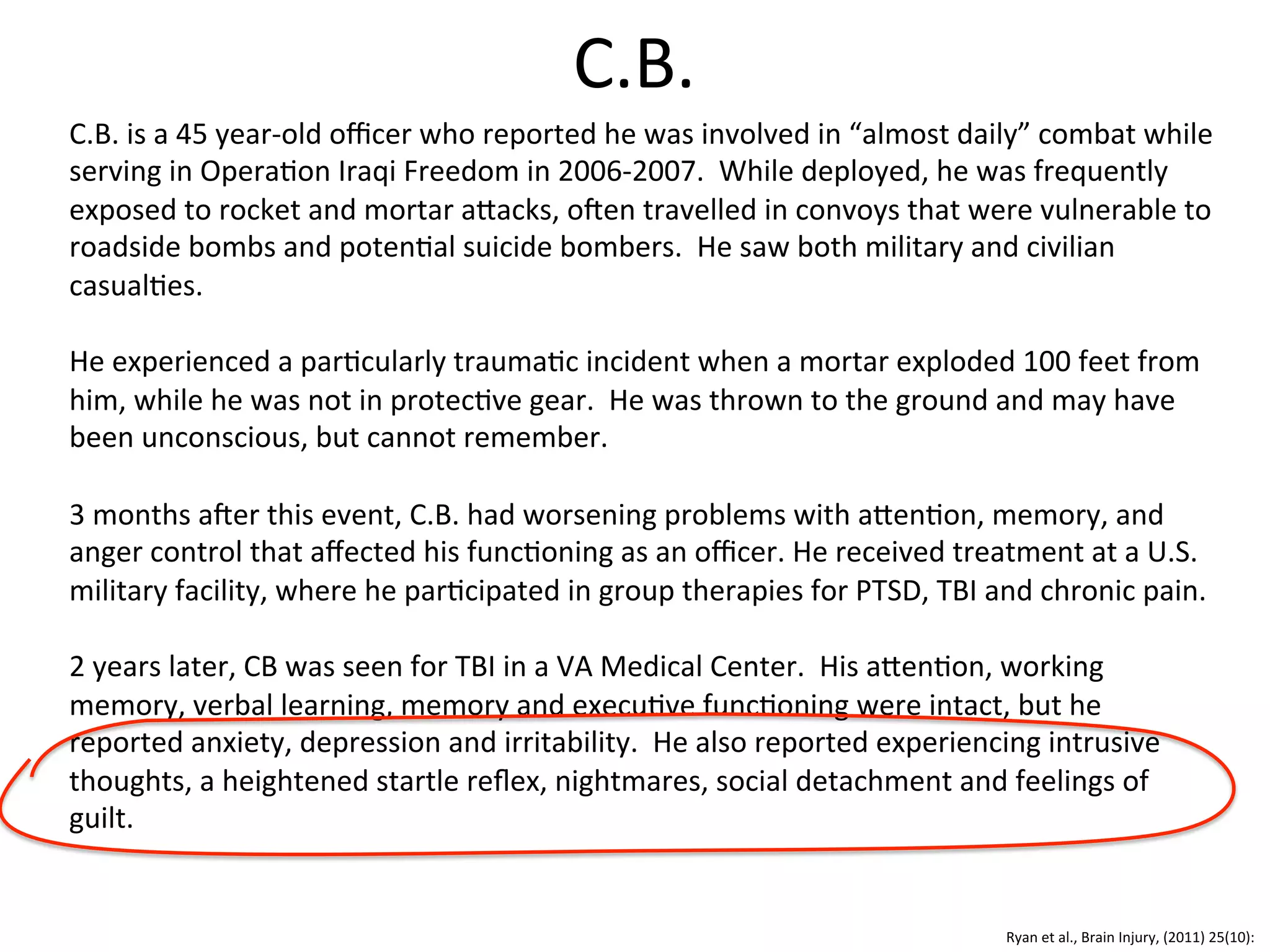
C.B.	is	a	45	year-old	officer	who	reported	he	was	involved	in	“almost	daily”	combat	while	
serving	in	Opera?on	Iraqi	Freedom	in	2006-2007.		While	deployed,	he	was	frequently	
exposed	to	rocket	and	mortar	aUacks,	oVen	travelled	in	convoys	that	were	vulnerable	to	
roadside	bombs	and	poten?al	suicide	bombers.		He	saw	both	military	and	civilian	
casual?es.	
	
He	experienced	a	par?cularly	trauma?c	incident	when	a	mortar	exploded	100	feet	from	
him,	while	he	was	not	in	protec?ve	gear.		He	was	thrown	to	the	ground	and	may	have	
been	unconscious,	but	cannot	remember.	
	
3	months	aVer	this	event,	C.B.	had	worsening	problems	with	aUen?on,	memory,	and	
anger	control	that	affected	his	func?oning	as	an	officer.	He	received	treatment	at	a	U.S.	
military	facility,	where	he	par?cipated	in	group	therapies	for	PTSD,	TBI	and	chronic	pain.				
	
2	years	later,	CB	was	seen	for	TBI	in	a	VA	Medical	Center.		His	aUen?on,	working	
memory,	verbal	learning,	memory	and	execu?ve	func?oning	were	intact,	but	he	
reported	anxiety,	depression	and	irritability.		He	also	reported	experiencing	intrusive	
thoughts,	a	heightened	startle	reflex,	nightmares,	social	detachment	and	feelings	of	
guilt.	
C.B.	
Ryan	et	al.,	Brain	Injury,	(2011)	25(10):
Pathological	anxiety	that	usually	occurs	aVer	an	individual	
experiences	or	witnesses	severe	trauma	that	cons?tutes	a	
threat	to	the	physical	integrity	or	life	of	the	individual	or	of	
another	person.	
Characteris?cs:	
Persistent	re-experiencing	of	a	trauma?c	event:	intrusive	
thoughts,	nightmares,	flashbacks,	in	presence	of	reminders	
of	the	trauma?c	event.	
	Avoidance	of	anything	associated	with	the	trauma?c	event		
	Hyperarousal,	with	irritability,	sleep	disturbances	
	Nega?ve	thoughts,	mood	or	feelings	
What	is	PTSD?
Post-traumatic Stress Disorder
An estimated 7.7 million U.S. adults have PTSD during
any given year. This may arise from any type of
traumatic experience.
Lifetime prevalence of 8-10%
Females are at higher risk for PTSD (10% vs. 5%)
PTSD can occur at any age
Trauma history increases vulnerability
Individual history increases vulnerability
US Department of Veterans Affairs:
http://www.ptsd.va.gov/professional/PTSD-overview/epidemiological-facts-ptsd.asp
Estimated Lifetime prevalence in Veterans: about 30%
of men and women who have spent time in a war zone
experience PTSD.
Estimates by war:
•  23% of Veterans of the Operation Enduring Freedom/Operation
Iraqi Freedom *
•  10% from the Gulf War
•  30% of Vietnam Veterans
Prevalence of PTSD in Veterans
*
http://www.defense.gov/home/features/2012/0312_tbi/
The Incidence of Traumatic Brain Injury has increased in
Veterans in recent wars
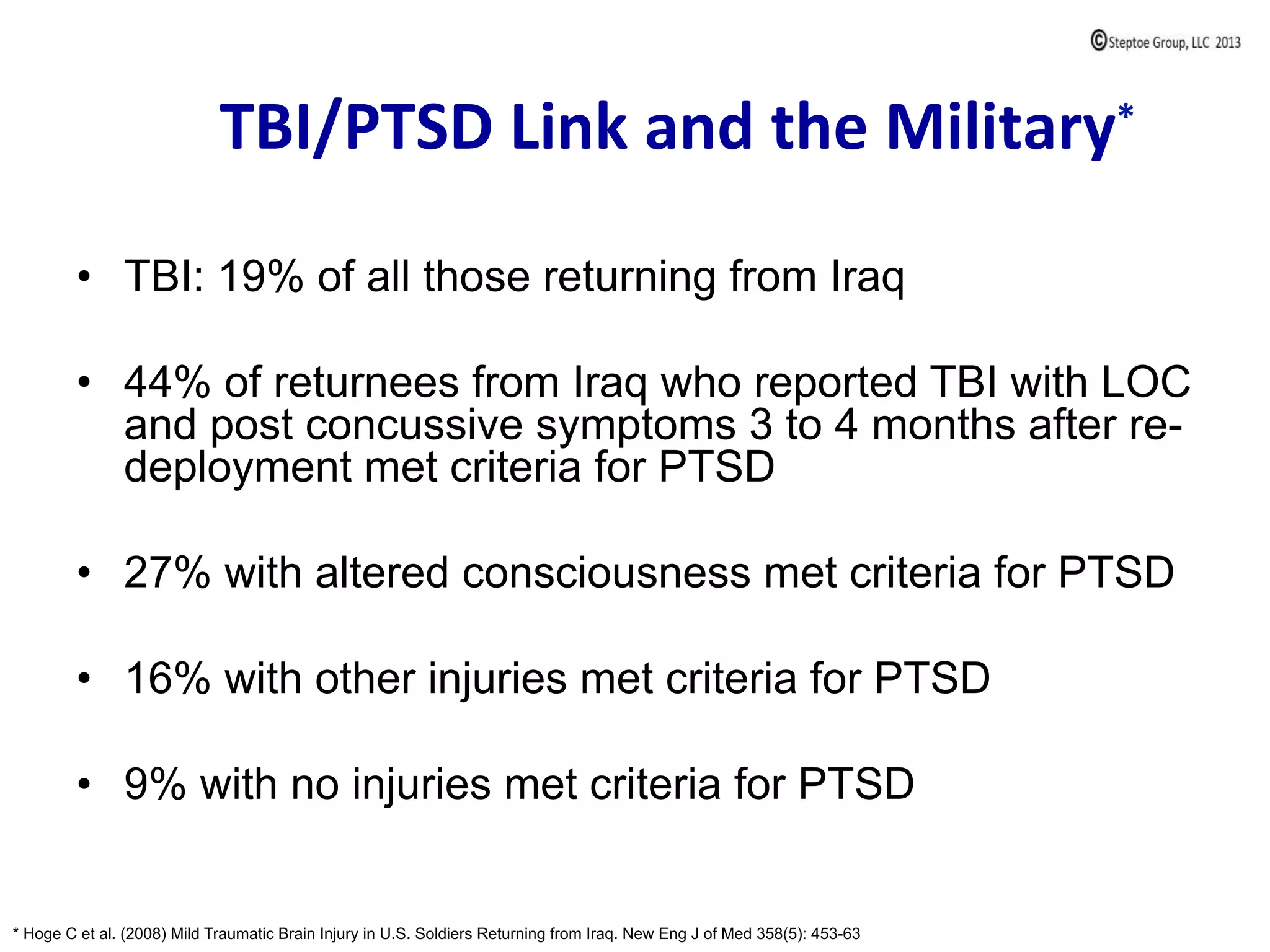
TBI/PTSD	Link	and	the	Military*	
•  TBI: 19% of all those returning from Iraq
•  44% of returnees from Iraq who reported TBI with LOC
and post concussive symptoms 3 to 4 months after re-
deployment met criteria for PTSD
•  27% with altered consciousness met criteria for PTSD
•  16% with other injuries met criteria for PTSD
•  9% with no injuries met criteria for PTSD
* Hoge C et al. (2008) Mild Traumatic Brain Injury in U.S. Soldiers Returning from Iraq. New Eng J of Med 358(5): 453-63
Diana Glendinning, Ph.D.
Department of Neuroscience and Cell Biology
Rutgers, Robert Wood Johnson Medical School
Neurobiology of
Post-traumatic Stress
Disorder
What	happens	during	a	trauma?c	experience?	
Adapted	from	McEwen	2016	
Neuroendocrine	
PVN	
Pituitary	
Cor?sol,	DHEA,	NPY	
Adrenals	
CHR	
ACTH	
Autonomic	
éHR	
éBP	
Fight	or	flight/freeze	
Trauma,	abuse,	violence,	life	events
Our	brains	remember	trauma:	Fear-Learning	
face	
sound	
smell	
Emo?onal	
Responses
“Fear-condi?oning”	is	like	Pavlovian	condi?oning	
Within	the	Limbic	System:	
The	emo?onal	and	memory	
centers	of	the	brain
Emotional-fear learning occurs in the amygdala.
The hippocampal formation stores other features of
memory (spatial features, environment)
Sensory inputs
FEAR
Trauma or Pain
Stress
Trauma?c	or	painful	experience	
and	condi?ons	
Consolida:on	into	Long-term	memory	
Memory	retrieval	
Short-term	memory	
Healthy Fear-memory formation
Adapted from Parksons RG and Ressler KJ.
Nature Neuroscience. 2013;16 (2):146-151
Amygdala/hippocampus	
	
Prefrontal	cortex	
Ex?nc?on/inhibi?on	
Reconsolida:on	
Physiological	&	Behavioral		
Responses	
Period	of	memory	
lability
Trauma?c	or	painful	experience	
and	condi?ons	
Consolida:on	into	Long-term	memory	
Memory	retrieval	
Short-term	memory	
Healthy Fear-memory formation
Adapted from Parksons RG and Ressler KJ.
Nature Neuroscience. 2013;16 (2):146-151
Amygdala/hippocampus	
	
Prefrontal	cortex	
Ex?nc?on/inhibi?on	
Reconsolida:on	
Physiological	&	Behavioral		
Responses	
Period	of	memory	
lability
Increased	autonomic	reac?vity	when	people	are	studied	
during	startle,	at	rest,	or	during	recollec?on	of	events:	
Pitman	et	al.	Nature	Reviews-Neuroscience	(2012)	13:	769	
éHeart	Rate	
éSkin	Conductance	
éFacial	muscular	responsiveness		
éStartle	to	loud	sounds	
Referred	to	as	general	nervous	system	sensi0za0on:	
	
OVen	treated	with	beta-blockers
Trauma?c	or	painful	experience	
and	condi?ons	
Consolida:on	into	Long-term	memory	
Memory	retrieval	
Short-term	memory	
Healthy Fear-memory formation
Adapted from Parksons RG and Ressler KJ.
Nature Neuroscience. 2013;16 (2):146-151
Amygdala/hippocampus	
	
Prefrontal	cortex	
Ex?nc?on/inhibi?on	
Reconsolida:on	
Physiological	&	Behavioral		
Responses	
Period	of	memory	
lability
Only	about	5-30%	of	people	experiencing	trauma	get	PTSD.	
Pre-exis?ng	factors	appear	to	play	a	role.
Etkin	and	Wager	(2007)	Am	J	Psychiary	164:1476-1488	
Increased	fear	responses,	and	decreased	ex?nc?on	is	correlated	with:	
•  Hyperac?va?on	of	amygdala		
•  Underac?va?on	of	prefrontal	cortex	(vPFC)	
during	fear	condi?oning	trials.
ü  regulates	emo?ons		
ü  enable	ex?nc?on	
*frontal	lobe	is	oVen	affected	in	mild	TBI		
Prefrontal	Cortex
Brain	Neurotrauma:	Molecular,	Neuropsychological,	and	Rehabilita?on	Aspects.	
Kobeissy	FH,	editor.	
Boca	Raton	(FL):	CRC	Press/Taylor	&	Francis;	2015.	
Mild	TBI	is	associated	with	PTSD	
•  Pathology	not	well	understood	
Diffuse	axonal	injury	
Brain	swelling	
Cerebral	atrophy	(with	repeated	trauma)	
Symptoms		
•  Loss	of	consciousness	
•  Headache	
•  Memory	problems	
•  Sleep	Disturbance
Anisotropy	of	white	maUer	(from	Diffusion	Tensor	Imaging	Studies)	
in	US	Military	Personnel	who	had	sustained	mTBI	(1-90	days	post-
injury)	
In	Frontal	lobe	
regions	
associated	
with	managing	
emo?onal	
memories
Trauma?c	or	painful	experience	
and	condi?ons	
Consolida:on	into	Long-term	memory	
Memory	retrieval	
Short-term	memory	
Healthy Fear-memory formation
Adapted from Parksons RG and Ressler KJ.
Nature Neuroscience. 2013;16 (2):146-151
Amygdala/hippocampus	
	
Prefrontal	cortex	
Ex?nc?on/inhibi?on	
Reconsolida:on	
Physiological	&	Behavioral		
Responses	
Period	of	memory	
lability	
Exposure	therapy	
Drug	treatments	
CBT	
Exposure	therapy	
Eye-movement	
desensi?za?on	
Exposure	Therapy	
CBT	
Drug	treatments	
(experimental)	
Experimental only:
β-blocker	
NMDA	antagonists	
Protein	synthesis	inhibitors
Ryan	et	al.,	Brain	Injury,	(2011)	25(10):	
This	neuroplas?city	enables	people	suffering	from	PTSD,	with	
the	appropriate	guidance,	treatment	and	support,	to	recover	
from	PTSD.	
Neuroplas:city	is	a	major	feature	of	the	brain	regions	that		
produce	PTSD
2	years	later,	CB	was	seen	for	TBI	in	a	VA	Medical	Center.		His	aUen?on,	working	
memory,	verbal	learning,	memory	and	execu?ve	func?oning	were	intact,	but	he	
reported	anxiety,	depression	and	irritability.		He	also	reported	experiencing	intrusive	
thoughts,	a	heightened	startle	reflex,	nightmares,	social	detachment	and	feelings	of	
guilt.	
C.B.	
Ryan	et	al.,	Brain	Injury,	(2011)	25(10):	
Important	Points:	
	
Recognize	the	symptoms	of	PTSD	
Recognize	that	these	are	more	likely	to	occur	aVer	mTBI	
		
Treatment:	
•  Immediate	referral	to	group	therapy	for	TBI	and	PTSD	
•  15	months	later,	medical	records	indicate	“concussive	symptoms”		
•  24	months	later,	referred	to	VA	for	TBI	
•  Treated	for	PTSD,	with	therapy	for	anger	management.	
•  Reported	beUer	mood,	new	desire	to	return	to	work,	less	pain,	decreased	headaches
Rutgers, The State University of New Jersey
Posttraumatic Stress Disorder
Anthony Tobia, MD
Associate Professor
Department of Psychiatry
Rutgers Robert Wood Johnson Medical School
Risk and Prognostic Factors
•  Pretraumatic factors (predisposing)
•  Peritraumatic factors (precipitating)
•  Posttraumatic factors (perpetuating)
Pretraumatic Factors
Female gender
Family history of mental disorder
Younger adult age at the at time
of trauma
Children and adolescents have
lower rates1
Childhood emotional problems by
6 years of age
Premorbid mental disorders
Lower SES
Lower intelligence
Lower education
Childhood adversity
Cultural characteristics
Minority/ethnic status
Lack of social support
1. May reflect previous criteria were insufficiently developmentally informed
Bio Psycho Social
•  Severity of trauma
•  Perceived life threat
•  Personal injury
•  Interpersonal violence
•  Dissociation
•  Being a perpetrator
•  Witnessing atrocities
•  Killing the enemy
Peritraumatic Factors (psychosocial)
Psychological
•  Negative appraisals
•  Inappropriate coping
strategies
•  Development of ASD
Social
•  Subsequent exposure to
cues
•  Subsequent adverse life
events
•  Financial losses
•  Other losses
•  Lack of social support
Posttraumatic Factors (psychosocial)
Posttraumatic Stress Disorder (PTSD)
http://www.ptsd.va.gov/ DSM-5
Ø  Can occur after you
have been through a
traumatic event
(something terrible
and scary that you
see, hear about, or
that happens to you):
Ø  Terrorist attack
Ø  Combat exposure
Ø  Serious accidents
•  Exposure to actual or
threatened death,
serious injury or sexual
violence
•  Experienced directly,
witnessed or indirectly
Posttraumatic Stress Disorder (PTSD)
http://www.ptsd.va.gov/
Ø  During a traumatic
event, you think that
your life or others' lives
are in danger.
Ø  You may feel afraid or
feel that you have no
control over what is
happening around you.
•  How the individual
experienced event no
longer defining
•  Removed from DSM
•  Peritraumatic social
factor
DSM-5
Comorbidity
http://www.ptsd.va.gov/ DSM-5
Ø  Feelings of
hopelessness, shame,
or despair
Ø  Depression or anxiety
Ø  Drinking or drug
problems
Ø  Physical symptoms or
chronic pain
Ø  Employment problems
Ø  Relationship problems,
including divorce
•  80% more likely than
controls” to have
comorbidity
•  Co- occurrence of
PTSD and TBI in recent
wards is 48%
THE SYMPTOMS
Reliving the event
(Re-experiencing symptoms)
•  You may have bad
memories or
nightmares.
•  You even may feel like
you're going through
the event again (this is
called a flashback).
•  Dissociative sx such as
nightmares, flashbacks
•  Ongoing psychological
distress at exposure
•  NE/sympathetic/
physiological reactivity
on exposure
•  Thoughts and
memories that are
recurrent, intrusive,
distressing
http://www.ptsd.va.gov/ DSM-5
One or more intrusion:
Avoiding situations that remind you of the
event
•  You may try to avoid
situations or people
that trigger memories
of the traumatic event.
•  You may even avoid
talking or thinking
about the event.
•  Avoidance
•  External
–  People
–  Places
•  Internal (things)
–  Memories
–  Thoughts
–  Feelings
http://www.ptsd.va.gov/ DSM-5
Negative changes
in beliefs and feelings
http://www.ptsd.va.gov/
DSM-5
Two or more:
•  The way you think
about yourself and
others may change
because of the trauma.
•  You may feel fear, guilt,
or shame.
•  Or, you may not be
interested in activities
you used to enjoy.
•  Hard time experiencing
positive emotions
•  Out of body experience:
Feelings of detachment
•  Negative emotional states
•  Organism s cognitions about
the cause of trauma distorted
•  Recall of important aspects...
•  Impaired
•  Negative beliefs exaggerated
•  Reduced interest (anhedonia)
Feeling keyed up
(Hyperarousal)
http://www.ptsd.va.gov/
DSM-5
Two or more arousal:
•  You may be jittery, or
always alert and on the
lookout for danger.
•  Or, you may have
trouble concentrating
or sleeping.
•  Hypervigilance
•  Early morning
awakenings
•  Reduced concentration
•  Outbursts of anger or
irritability
•  Exaggerated startle
•  Self-destructive
behavior
Rutgers, The State University of New Jersey
Don’t avoid honorin’ heroes!!!
The Role of the Psychologist
Non-Pharmacologic Treatments
•  Cognitive behavioral therapy (CBT)
•  Eye Movement Desensitization and Reprocessing (EMDR)
Cognitive Behavioral Therapy (CBT)
•  Most effective treatment for PTSD
•  Learn skills to understand how trauma changed your
thoughts and feelings
•  Exposure therapy (variant): talk about your trauma
repeatedly until memories are no longer upsetting
•  You also go to places that are safe, but that you have
been staying away from because they are related to the
trauma
Movement Desensitization and Reprocessing
(EMDR)
•  Involves focusing on sounds or hand movements while
you talk about the trauma
The Role of the Psychiatrist (biological)
•  Guidelines
•  The art of medicine
•  You are treating a person, not a cookbook
Overview
Clinical Focus
Alcohol
or
Substance
Use Disorder
Short-term
(6-8 weeks)
Long-term
(>8 weeks)
No •  Clonazepam
•  Alprazolam prn
•  Paroxetine or
Sertraline1
•  Gabapentin or
Lamotrigine
(adjunct)
Yes •  Atypical AP (SGA)2
•  Antihistamine prn
•  Paroxetine or
Sertraline1
•  Gabapentin or
Lamotrigine
(adjunct)
1.  If first-line agents are ineffective, try Fluoxetine, Venlafaxine (A) or Mirtazapine (B)
2.  Off-label use of sedating SGA (Quetiapine or Olanzapine)
Rutgers, The State University of New Jersey
Mei T. Liu, Pharm.D., BCPP
Psychiatry Clinical Pharmacist
Jersey City Medical Center
RWJBarnabas Health
Pharmacological Treatment Options
of Post-traumatic Stress Disorder
PTSD Treatment
•  No evidence of support pharmacological
treatment to prevent ASD or PTSD
•  Treatment can be divided into 3 categories:
–  Evidence-based psychotherapies
–  Evidence-based pharmacotherapies
–  Adjunctive or supplemental treatment
VA/DoD	Clinical	Prac?ce	Guideline.	Management	of	Post-Trauma?c	Stress	
Guideline	Summary.	Version	2.	2010.
PTSD Pharmacotherapy
A	(Strong	recommenda:on)	
Significant	Benefit	
• SSRI	–	paroxe?ne,	sertraline	(FDA	approved)	and	
fluoxe?ne	
• SNRI	–	venlafaxine	
B	(Fair	evidence)	
Some	Benefit	
• Mirtazapine	
• Prazosin	(use	for	sleep/nightmares)	
• Tricyclic	an?depressants*	
• Nefazodone*	
• Monoamine	oxidase	inhibitors*	
C	(Fair	evidence	but	no	general	
recommenda:on)	
Unknown	
• Prazosin	(for	global	PTSD	symptoms)	
VA/DoD	Clinical	Prac?ce	Guideline.	Management	of	Post-Trauma?c	Stress	Guideline	
Summary.	Version	2.	2010.
PTSD Pharmacotherapy
D (Ineffective or
harmful)
No benefit
• Benzodiazepines (harm)
• Tiagabine
• Guanfacine
• Valproate
• Topiramate
• Risperidone
I (Insufficient
evidence)
Unknown
• Atypical antipsychotics (mono and adjunct)
• Typical antipsychotics
• Buspirone
• Non-benzodiazepine sedative/hypnotics
• Bupropion
• Trazodone (as adjunct)
• Gabapentin
• Lamotrigine
• Propranolol
• Clonidine
PTSD Treatment
Initial
treatment
•  Psychotherapy or SSRI or SNRI
•  Reassess at 2 – 4 weeks
Step 1
•  Access and address adherence
•  Increase dose and/or add psychotherapy if
patient is not already on it
•  Switch to another SSRI or SNRI and /or add
psychotherapy
•  Reassess at 4 – 6 weeks from initial
treatment
VA/DoD	Clinical	Prac?ce	Guideline.	Management	of	Post-Trauma?c	Stress	Guideline	
Summary.	Version	2.	2010.
PTSD Treatment
Step 2
•  Add psychotherapy and/or switch to
mirtazapine
•  Reassess at 8 – 12 weeks from initial
treatment
Step 3
•  Switch to alternative step 2 or to TCA or
nefazodone or MAOI
•  Add psychotherapy
•  Reassess at > 12 weeks from initial
treatment
Add	prazosin	at	any	?me	for	sleep	or	nightmare	
Consider	referral	to	specialty	care	at	any	?me	during	treatment
Pharmacotherapy of co-morbid PTSD and TBI
•  Limited	evidence	to	guide	treatment	in	pa?ents	
with	co-morbid	PTSD	and	TBI	
•  Issues	to	consider	
–  Cogni?ve	and	other	sequelae	of	TBI	that	my	interfere	with	
treatment	
–  Overlapping	symptoms	between	PTSD	and	TBI	
–  Tradeoff	between	adverse	effects	versus	benefit	profiles	when	
treatment	for	one	condi?on	can	be	poten?ally	harmful	for	
another	
HowleU	JR,	Stein	MB.	Chapter	16.	Post-Trauma:c	Stress	Disorder:	Rela:onship	to	Trauma:c	
Brain	Injury	and	Approach	to	Treatment.		Transla?onal	Research	in	Trauma?c	Brain	Injury.	Boca	
Raton	(FL):	CRC	Press/Taylor	and	Francis	Group;	2016.		
hUps://www.ncbi.nlm.nih.gov/books/NBK326723/
Pharmacotherapy of co-morbid PTSD and TBI
•  Start	with	lower	doses	due	to	sensi?vity	to	side	
effects	in	pa?ent	with	TBI	
•  Standard	approach	in	using	an?depressants	
•  An?convulsants	for	treatment	mood	disorders,	
impulsive	anger,	irritability,	and	aggression	
•  Use	low	dose	an?psycho?cs	for	psycho?c	symptoms	
–  May	help	with	reexperiencing	and	hyperarousal		
Tanev	et	al.	Brain	Injury	2014;28(3):261-270.
Pharmacotherapy of co-morbid PTSD and TBI
•  S?mulants	for	fa?gue	and	aUen?on	problems	
–  May	worsen	hyperarousal	in	PTSD	
•  Medica?ons	that	may	cause	cogni?ve	deficit	
associated	in	TBI	
–  An?psycho?cs,	an?convulsants,	anxioly?cs,	and	an?cholinergic	
medica?ons	
•  Monitor	for	adverse	effects	such	as	sleep	
disturbances,	seizures,	gait	and	balance	problems,	
and	deficits	in	sensory	processing	
HowleU	JR,	Stein	MB.	Chapter	16.	Post-Trauma:c	Stress	Disorder:	Rela:onship	to	Trauma:c	
Brain	Injury	and	Approach	to	Treatment.		Transla?onal	Research	in	Trauma?c	Brain	Injury.	
Boca	Raton	(FL):	CRC	Press/Taylor	and	Francis	Group;	2016.		
hUps://www.ncbi.nlm.nih.gov/books/NBK326723/	
McAllister	TW,	Zafonte	R,	et	al.	Neuropsychopharmacology	2016;41:1191-1198.

Neurobiology, Diagnosis & Treatment of PTSD & TBI in Veterans