Zaid Azhar
2017-097
PREOPERATIVE AND
POSTOPERATIVE
ASSESSMENT
• Pre-op assessment Slides 1-16
• Post-op assessment Slides 21-32
Content
When patient is seen at clinic, the
doctor deciding their need for an
operation thinks they need to be
seen in the pre-op setting to ensure
the patient’s readiness for theatre.
Who goes for pre-operative assessment?
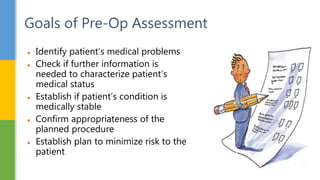
 Identify patient’s medical problems
 Check if further information is
needed to characterize patient’s
medical status
 Establish if patient’s condition is
medically stable
 Confirm appropriateness of the
planned procedure
 Establish plan to minimize risk to the
patient
Goals of Pre-Op Assessment
• History
• Examination
• Investigations
• Consent
What’s included in the Pre Op assessment?
 History of Presenting Complaint
 Past medical history
 Past surgical history
 Family history of disease
 Social history/substance abuse
 Medication
 Drug allergy
 Past Anesthetic history
History
 Year
 Procedure
 Type of Anesthesia
 Complications e.g DVT, MRSA
wound infection.
Past surgical history
 Smoking
 Alcohol
 Substance abuse
 IV abuse - screening for HBV,
HCV, HIV
Social History
Drugs that may cause concern:
 Warfarin
 Aspirin - stop at least 10 days pre-
operatively
 OCP
 DVT
 Pulmonary Embolism
 Discontinue 6 weeks before surgery
 Steroids-dependent patients will need
hydrocortisone injection to over come
peri-operative stress.
 Immunosuppression
 Diuretics
 Electrolyte imbalance
Medication
 Take history of any
reaction in the past or in
family history
 Consider allergy to:
 Anesthetics
 Antimicrobial Drugs
 Antiseptics e.g iodine
 Wound dressings
Drug Allergy
• Difficult intubation
• Aspiration during anesthesia
• Psedocholinesterase deficiency
• Scoline apnea
• Malignant Hyperthermia
Past anesthetic history
 BMI
 GPE
 Vitals
 Pulse
 Blood pressure
 Temperature
 Respiratory rate
 CVS, RES, CNS
 Intubation
 Mallampati score
 Dentition
 Neck movement
 TMJ movement
Examinations
 Cormack-Lehane grade Mallampati score
Ease of intubation
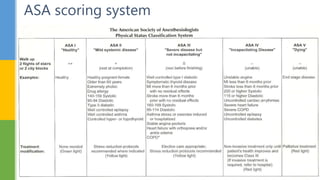
ASA scoring system
 Information : patient should
be aware of his surgeon, staff
and procedure
 Teamwork: Operative team
should be on the same page
 Recording information: all
important information should
be recorded clearly in the
patient notes
Communication
• Antibiotics
• Transfusion
• Nutrition
• Thromboprophylaxis
Preoperative treatment
Cases
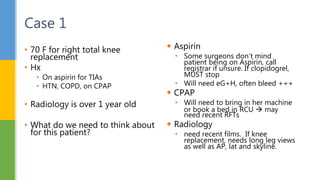
 Aspirin
• Some surgeons don’t mind
patient being on Aspirin, call
registrar if unsure. If clopidogrel,
MUST stop
• Will need eG+H, often bleed +++
 CPAP
• Will need to bring in her machine
or book a bed in RCU  may
need recent RFTs
 Radiology
• need recent films. If knee
replacement, needs long leg views
as well as AP, lat and skyline.
• 70 F for right total knee
replacement
• Hx
• On aspirin for TIAs
• HTN, COPD, on CPAP
• Radiology is over 1 year old
• What do we need to think about
for this patient?
Case 1
• Type 1 diabetic
• On insulin, CANNOT stop it
• Patient will be fasting, not good
for a type 1
• Will need bowel prep.
• Likely will need admission the
night before or morning of
procedure for insulin/dextrose
infusion to control BSLs
• 25 F for colonoscopy
• Hx
• Type 1 DM
• What do we have to think
about for this patient?
Case 2
• Warfarin
• Will need to be stopped as
bleeding is high risk
• Will need to continue
theraputic clexane due to metal
heart valve
• Need a clear plan on stopping
and restarting warfarin.
• 80 M for excision lower leg
SCC
• Hx
• On warfarin
• Mitral valve replacement
• What do we need to think
about this patient?
Case 3
Post operative assessment
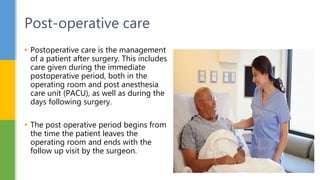
• Postoperative care is the management
of a patient after surgery. This includes
care given during the immediate
postoperative period, both in the
operating room and post anesthesia
care unit (PACU), as well as during the
days following surgery.
• The post operative period begins from
the time the patient leaves the
operating room and ends with the
follow up visit by the surgeon.
Post-operative care
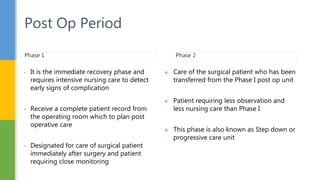
 Care of the surgical patient who has been
transferred from the Phase I post op unit
 Patient requiring less observation and
less nursing care than Phase I
 This phase is also known as Step down or
progressive care unit
• It is the immediate recovery phase and
requires intensive nursing care to detect
early signs of complication
• Receive a complete patient record from
the operating room which to plan post
operative care
• Designated for care of surgical patient
immediately after surgery and patient
requiring close monitoring
Post Op Period
• Clinical assessment and
monitoring
• Respiratory management
• Cardiovascular management
• Renal Management (urine
output)
• Fluid and electrolyte balance
• Control of sepsis
• Nutrition
Post op care instructions
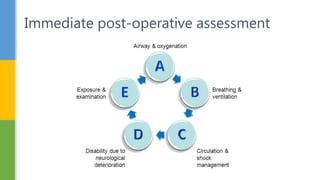
Immediate post-operative assessment
• Assess the patient’s:
i. Pulse
ii. BP
iii. Temperature
iv. RR
v. Oxygen saturation
vi. Level of
consciousness
Immediate post-operative assessment
• Analgesia relieves suffering
• Inadequately controlled pain increases
sympathetic outflow, leading to an increase
HR, vasoconstriction and increased O2
demand, particularly in the myocardium and
may contribute to MI
• Pain (from e.g. abdominal and thoracic
procedures) may impair Respiratory function
leading to atelectasis/Pneumonia
• Good analgesia allows for rehabilitation
Post Op Analgesia
Paracetamol
 Should be given regularly, oral,
rectal or IV
NSAIDs
 Used as adjuncts, Increase
efficacy and reduce opioid use
 Can affect haemostasis and
renal function gastric ulceration
Opioids
 Gold standard in severe pain
Post Op Analgesia
• Cardiovascular complications
• Postoperative pulmonary dysfunction
• Aspiration
• Postoperative renal complications
• Metabolic complications
• Electrolytes and glucose imbalance
• Miscellaneous complications
Complications
• Local complications
• Skin blisters/ bed sores
• Muscle tear and atrophy
• Tendon tear, tendinitis
• Nerve compression and neuritis
• Vascular injury
• Bone malunion
• Contractures
• General complications
• Shock
• DVT
• Tetanus
• Gas gangrene
• Fever
• Fat embolism
• Delerium tremors
Post operative complications
When is the patient discharged?
Preop and postop assessment

Preop and postop assessment

  • 1.
  • 2.
    • Pre-op assessmentSlides 1-16 • Post-op assessment Slides 21-32 Content
  • 3.
    When patient isseen at clinic, the doctor deciding their need for an operation thinks they need to be seen in the pre-op setting to ensure the patient’s readiness for theatre. Who goes for pre-operative assessment?
  • 4.
     Identify patient’smedical problems  Check if further information is needed to characterize patient’s medical status  Establish if patient’s condition is medically stable  Confirm appropriateness of the planned procedure  Establish plan to minimize risk to the patient Goals of Pre-Op Assessment
  • 5.
    • History • Examination •Investigations • Consent What’s included in the Pre Op assessment?
  • 6.
     History ofPresenting Complaint  Past medical history  Past surgical history  Family history of disease  Social history/substance abuse  Medication  Drug allergy  Past Anesthetic history History
  • 7.
     Year  Procedure Type of Anesthesia  Complications e.g DVT, MRSA wound infection. Past surgical history
  • 8.
     Smoking  Alcohol Substance abuse  IV abuse - screening for HBV, HCV, HIV Social History
  • 9.
    Drugs that maycause concern:  Warfarin  Aspirin - stop at least 10 days pre- operatively  OCP  DVT  Pulmonary Embolism  Discontinue 6 weeks before surgery  Steroids-dependent patients will need hydrocortisone injection to over come peri-operative stress.  Immunosuppression  Diuretics  Electrolyte imbalance Medication
  • 10.
     Take historyof any reaction in the past or in family history  Consider allergy to:  Anesthetics  Antimicrobial Drugs  Antiseptics e.g iodine  Wound dressings Drug Allergy
  • 11.
    • Difficult intubation •Aspiration during anesthesia • Psedocholinesterase deficiency • Scoline apnea • Malignant Hyperthermia Past anesthetic history
  • 12.
     BMI  GPE Vitals  Pulse  Blood pressure  Temperature  Respiratory rate  CVS, RES, CNS  Intubation  Mallampati score  Dentition  Neck movement  TMJ movement Examinations
  • 13.
     Cormack-Lehane gradeMallampati score Ease of intubation
  • 14.
  • 15.
     Information :patient should be aware of his surgeon, staff and procedure  Teamwork: Operative team should be on the same page  Recording information: all important information should be recorded clearly in the patient notes Communication
  • 16.
    • Antibiotics • Transfusion •Nutrition • Thromboprophylaxis Preoperative treatment
  • 17.
  • 18.
     Aspirin • Somesurgeons don’t mind patient being on Aspirin, call registrar if unsure. If clopidogrel, MUST stop • Will need eG+H, often bleed +++  CPAP • Will need to bring in her machine or book a bed in RCU  may need recent RFTs  Radiology • need recent films. If knee replacement, needs long leg views as well as AP, lat and skyline. • 70 F for right total knee replacement • Hx • On aspirin for TIAs • HTN, COPD, on CPAP • Radiology is over 1 year old • What do we need to think about for this patient? Case 1
  • 19.
    • Type 1diabetic • On insulin, CANNOT stop it • Patient will be fasting, not good for a type 1 • Will need bowel prep. • Likely will need admission the night before or morning of procedure for insulin/dextrose infusion to control BSLs • 25 F for colonoscopy • Hx • Type 1 DM • What do we have to think about for this patient? Case 2
  • 20.
    • Warfarin • Willneed to be stopped as bleeding is high risk • Will need to continue theraputic clexane due to metal heart valve • Need a clear plan on stopping and restarting warfarin. • 80 M for excision lower leg SCC • Hx • On warfarin • Mitral valve replacement • What do we need to think about this patient? Case 3
  • 21.
  • 22.
    • Postoperative careis the management of a patient after surgery. This includes care given during the immediate postoperative period, both in the operating room and post anesthesia care unit (PACU), as well as during the days following surgery. • The post operative period begins from the time the patient leaves the operating room and ends with the follow up visit by the surgeon. Post-operative care
  • 23.
     Care ofthe surgical patient who has been transferred from the Phase I post op unit  Patient requiring less observation and less nursing care than Phase I  This phase is also known as Step down or progressive care unit • It is the immediate recovery phase and requires intensive nursing care to detect early signs of complication • Receive a complete patient record from the operating room which to plan post operative care • Designated for care of surgical patient immediately after surgery and patient requiring close monitoring Post Op Period
  • 24.
    • Clinical assessmentand monitoring • Respiratory management • Cardiovascular management • Renal Management (urine output) • Fluid and electrolyte balance • Control of sepsis • Nutrition Post op care instructions
  • 25.
  • 26.
    • Assess thepatient’s: i. Pulse ii. BP iii. Temperature iv. RR v. Oxygen saturation vi. Level of consciousness Immediate post-operative assessment
  • 28.
    • Analgesia relievessuffering • Inadequately controlled pain increases sympathetic outflow, leading to an increase HR, vasoconstriction and increased O2 demand, particularly in the myocardium and may contribute to MI • Pain (from e.g. abdominal and thoracic procedures) may impair Respiratory function leading to atelectasis/Pneumonia • Good analgesia allows for rehabilitation Post Op Analgesia
  • 29.
    Paracetamol  Should begiven regularly, oral, rectal or IV NSAIDs  Used as adjuncts, Increase efficacy and reduce opioid use  Can affect haemostasis and renal function gastric ulceration Opioids  Gold standard in severe pain Post Op Analgesia
  • 30.
    • Cardiovascular complications •Postoperative pulmonary dysfunction • Aspiration • Postoperative renal complications • Metabolic complications • Electrolytes and glucose imbalance • Miscellaneous complications Complications
  • 31.
    • Local complications •Skin blisters/ bed sores • Muscle tear and atrophy • Tendon tear, tendinitis • Nerve compression and neuritis • Vascular injury • Bone malunion • Contractures • General complications • Shock • DVT • Tetanus • Gas gangrene • Fever • Fat embolism • Delerium tremors Post operative complications
  • 32.
    When is thepatient discharged?