School for Grown Ups
Educating Rita
Summary
• Educating Rita - by Playwright Willy Russell
• 1980 - Stage play Educating Rita performed by
the Royal Shakespeare Company
• 1983 - Film Educating Rita - dir Lewis Gilbert
Outline
• Rita (Susan) is a 26 year old hairdresser, married
to Denny who wants a child, though she doesn’t,
yet. She sets out to discover herself and enrols
onto an Open University course. Her tutor, Dr.
Frank Bryant is drunk, scruffy, and cynical. He
has one failed marriage behind him and is living
through the last days of another failed
relationship. Reluctant to tutor Rita the two
embark on a fraught journey of discovery and
transformation.
Educating Rita as (part)
Biographical
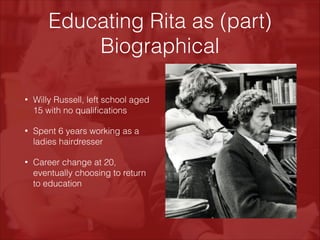
• Willy Russell, left school aged
15 with no qualifications
• Spent 6 years working as a
ladies hairdresser
• Career change at 20,
eventually choosing to return
to education
Observing Mise-en-scène
• The University
• Frank’s House
• Rita’s house and neighbourhood
• Costume
• Indicators of social class and gender
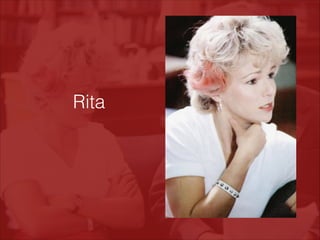
Rita
Frank
The Representation of
Higher Education
“Students sit contemplatively under shady trees. The
male protagonist, lecturer Dr Frank Bryant, works in
his office, a room larger, one suspects, than the
entire ground floor of most academics’ houses and
entirely unrepresentative of the facilities accorded to
most university staff. Its furniture suggests upper-
middle-class taste and wealth: it has huge leather
sofas, an antique desk and space for all the
bookcases one could desire.”
(Fisher et al, 2008: p. 148)
Social Class & Higher
Education
• The working class as deficient though evidence of
consciousness (Rita’s mother?)
• Higher Education is a means of escape - to higher culture, to a
different class
• Humour is drawn from highlighting the working class lack of
culture (Fisher et al, 2008)
• FRANK: Do you know Yeats?
• RITA: The Wine Lodge?
• But, the middle class is problematised
Gender & Higher Education
• A double disadvantage? (working class & female)
• Gendered expectations
• DENNY: It’s that easy Susan. Ya stop goin’ to
that university and you stop takin’ the pill, or
you’re out.
• “the working-class woman as a victim and a joke”
(Fisher et al, 2008: 151)
'It's that stupid bleeding handle on
the door'
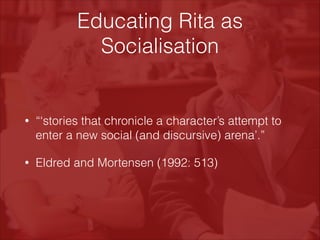
Educating Rita as
Socialisation
• “‘stories that chronicle a character’s attempt to
enter a new social (and discursive) arena’.”
• Eldred and Mortensen (1992: 513)
Pygmalion Movie
• Educating Rita shares features of the film My Fair
Lady , in turn based on Pygmalion
• “student–teacher versions of
Pygmalion” (Keroes 1999: 106)
• Theme of transformation & Frank’s reference to
Mary Shelley
The Student-Teacher
Pygmalion
• Informal Education, an interaction between two
characters
• Verdoodt et al 2010
Teaching as Intimate
• Emotionally & physically close
• “…the teacher may also come to view the
learner as a continuous source of emotional
comfort and familiarity”
• (Markgraf and Pavlik, 1998: 280)
Binary Oppositions
• “…the deep structure of these movies usually
consists to a certain degree in the same binary
oppositions in which ‘high’ culture (of any kind)
is set against ‘low’ culture (of any kind)…”
• Verdoodt et al 2010: 527
Transformation
&Independence
• Theme of Pygmalion continues in Trier (2009)
• Intimacy gives way to greater independence -
grown apart from Frank
• Immersion in academia - signified by scenes of
bike rides, change of clothes, hair, use of
language
Have you come all this way for so very
little?
References
• Eldred, J. C. and Mortensen, P. (1992) ‘Reading literacy narratives’, College English,
54(5),512–539.
• Fisher, R; Harris, A; Jarvis, C (2008) Education in Popular Culture: Telling Tales on
Teachers and Learners, London: Routledge
• Keroes, J. (1999) Tales Out of School; Gender, Longing, and the Teacher in Fiction
and Film, Carbondale, IL: Southern Illinois University Press
• Markgraf, S. and Pavlik, L, (1998) ‘ “Reel” Metaphors for Teaching’, Metaphor and
Symbol, 13 (4): 275-285
• Trier, J. (2009) ‘Educating Rita as a ‘Discourses and Literacies’ Pedagogical Text’,
Interchange, 40 (1): 47-67
• Verdoodt, I.; Rutten, K.; Soetaert, R,; Mottart, A. (2009) ‘Film choices for screening
literacy: the ‘Pygmalion template’ in the curriculum as contact zone’, Journal of
Curriculum Studies, 42(4): 519-538

Educating Rita

  • 1.
    School for GrownUps Educating Rita
  • 2.
    Summary • Educating Rita- by Playwright Willy Russell • 1980 - Stage play Educating Rita performed by the Royal Shakespeare Company • 1983 - Film Educating Rita - dir Lewis Gilbert
  • 3.
    Outline • Rita (Susan)is a 26 year old hairdresser, married to Denny who wants a child, though she doesn’t, yet. She sets out to discover herself and enrols onto an Open University course. Her tutor, Dr. Frank Bryant is drunk, scruffy, and cynical. He has one failed marriage behind him and is living through the last days of another failed relationship. Reluctant to tutor Rita the two embark on a fraught journey of discovery and transformation.
  • 4.
    Educating Rita as(part) Biographical • Willy Russell, left school aged 15 with no qualifications • Spent 6 years working as a ladies hairdresser • Career change at 20, eventually choosing to return to education
  • 5.
    Observing Mise-en-scène • TheUniversity • Frank’s House • Rita’s house and neighbourhood • Costume • Indicators of social class and gender
  • 6.
  • 7.
  • 8.
    The Representation of HigherEducation “Students sit contemplatively under shady trees. The male protagonist, lecturer Dr Frank Bryant, works in his office, a room larger, one suspects, than the entire ground floor of most academics’ houses and entirely unrepresentative of the facilities accorded to most university staff. Its furniture suggests upper- middle-class taste and wealth: it has huge leather sofas, an antique desk and space for all the bookcases one could desire.” (Fisher et al, 2008: p. 148)
  • 9.
    Social Class &Higher Education • The working class as deficient though evidence of consciousness (Rita’s mother?) • Higher Education is a means of escape - to higher culture, to a different class • Humour is drawn from highlighting the working class lack of culture (Fisher et al, 2008) • FRANK: Do you know Yeats? • RITA: The Wine Lodge? • But, the middle class is problematised
  • 10.
    Gender & HigherEducation • A double disadvantage? (working class & female) • Gendered expectations • DENNY: It’s that easy Susan. Ya stop goin’ to that university and you stop takin’ the pill, or you’re out. • “the working-class woman as a victim and a joke” (Fisher et al, 2008: 151)
  • 11.
    'It's that stupidbleeding handle on the door'
  • 12.
    Educating Rita as Socialisation •“‘stories that chronicle a character’s attempt to enter a new social (and discursive) arena’.” • Eldred and Mortensen (1992: 513)
  • 13.
    Pygmalion Movie • EducatingRita shares features of the film My Fair Lady , in turn based on Pygmalion • “student–teacher versions of Pygmalion” (Keroes 1999: 106) • Theme of transformation & Frank’s reference to Mary Shelley
  • 14.
    The Student-Teacher Pygmalion • InformalEducation, an interaction between two characters • Verdoodt et al 2010
  • 15.
    Teaching as Intimate •Emotionally & physically close • “…the teacher may also come to view the learner as a continuous source of emotional comfort and familiarity” • (Markgraf and Pavlik, 1998: 280)
  • 16.
    Binary Oppositions • “…thedeep structure of these movies usually consists to a certain degree in the same binary oppositions in which ‘high’ culture (of any kind) is set against ‘low’ culture (of any kind)…” • Verdoodt et al 2010: 527
  • 17.
    Transformation &Independence • Theme ofPygmalion continues in Trier (2009) • Intimacy gives way to greater independence - grown apart from Frank • Immersion in academia - signified by scenes of bike rides, change of clothes, hair, use of language
  • 18.
    Have you comeall this way for so very little?
  • 19.
    References • Eldred, J.C. and Mortensen, P. (1992) ‘Reading literacy narratives’, College English, 54(5),512–539. • Fisher, R; Harris, A; Jarvis, C (2008) Education in Popular Culture: Telling Tales on Teachers and Learners, London: Routledge • Keroes, J. (1999) Tales Out of School; Gender, Longing, and the Teacher in Fiction and Film, Carbondale, IL: Southern Illinois University Press • Markgraf, S. and Pavlik, L, (1998) ‘ “Reel” Metaphors for Teaching’, Metaphor and Symbol, 13 (4): 275-285 • Trier, J. (2009) ‘Educating Rita as a ‘Discourses and Literacies’ Pedagogical Text’, Interchange, 40 (1): 47-67 • Verdoodt, I.; Rutten, K.; Soetaert, R,; Mottart, A. (2009) ‘Film choices for screening literacy: the ‘Pygmalion template’ in the curriculum as contact zone’, Journal of Curriculum Studies, 42(4): 519-538