Equity Research Methodology
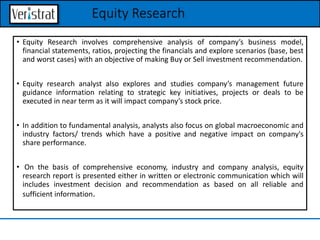
• Equity Research involves comprehensive analysis of company’s business model,
financial statements, ratios, projecting the financials and explore scenarios (base, best
and worst cases) with an objective of making Buy or Sell investment recommendation.
• Equity research analyst also explores and studies company’s management future
guidance information relating to strategic key initiatives, projects or deals to be
executed in near term as it will impact company’s stock price.
• In addition to fundamental analysis, analysts also focus on global macroeconomic and
industry factors/ trends which have a positive and negative impact on company's
share performance.
• On the basis of comprehensive economy, industry and company analysis, equity
research report is presented either in written or electronic communication which will
includes investment decision and recommendation as based on all reliable and
sufficient information.
Equity Research
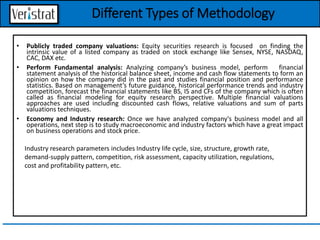
• Publicly traded company valuations: Equity securities research is focused on finding the
intrinsic value of a listed company as traded on stock exchange like Sensex, NYSE, NASDAQ,
CAC, DAX etc.
• Perform Fundamental analysis: Analyzing company’s business model, perform financial
statement analysis of the historical balance sheet, income and cash flow statements to form an
opinion on how the company did in the past and studies financial position and performance
statistics. Based on management’s future guidance, historical performance trends and industry
competition, forecast the financial statements like BS, IS and CFs of the company which is often
called as financial modeling for equity research perspective. Multiple financial valuations
approaches are used including discounted cash flows, relative valuations and sum of parts
valuations techniques.
• Economy and Industry research: Once we have analyzed company's business model and all
operations, next step is to study macroeconomic and industry factors which have a great impact
on business operations and stock price.
Industry research parameters includes Industry life cycle, size, structure, growth rate,
demand-supply pattern, competition, risk assessment, capacity utilization, regulations,
cost and profitability pattern, etc.
Different Types of Methodology
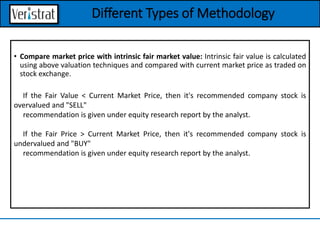
• Compare market price with intrinsic fair market value: Intrinsic fair value is calculated
using above valuation techniques and compared with current market price as traded on
stock exchange.
If the Fair Value < Current Market Price, then it's recommended company stock is
overvalued and "SELL"
recommendation is given under equity research report by the analyst.
If the Fair Price > Current Market Price, then it's recommended company stock is
undervalued and "BUY"
recommendation is given under equity research report by the analyst.
Different Types of Methodology
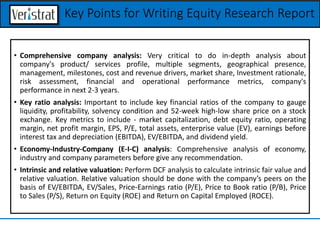
• Comprehensive company analysis: Very critical to do in-depth analysis about
company's product/ services profile, multiple segments, geographical presence,
management, milestones, cost and revenue drivers, market share, Investment rationale,
risk assessment, financial and operational performance metrics, company's
performance in next 2-3 years.
• Key ratio analysis: Important to include key financial ratios of the company to gauge
liquidity, profitability, solvency condition and 52-week high-low share price on a stock
exchange. Key metrics to include - market capitalization, debt equity ratio, operating
margin, net profit margin, EPS, P/E, total assets, enterprise value (EV), earnings before
interest tax and depreciation (EBITDA), EV/EBITDA, and dividend yield.
• Economy-Industry-Company (E-I-C) analysis: Comprehensive analysis of economy,
industry and company parameters before give any recommendation.
• Intrinsic and relative valuation: Perform DCF analysis to calculate intrinsic fair value and
relative valuation. Relative valuation should be done with the company’s peers on the
basis of EV/EBITDA, EV/Sales, Price-Earnings ratio (P/E), Price to Book ratio (P/B), Price
to Sales (P/S), Return on Equity (ROE) and Return on Capital Employed (ROCE).
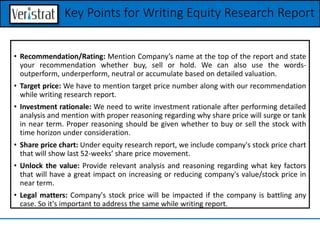
Key Points for Writing Equity Research Report
• Recommendation/Rating: Mention Company’s name at the top of the report and state
your recommendation whether buy, sell or hold. We can also use the words-
outperform, underperform, neutral or accumulate based on detailed valuation.
• Target price: We have to mention target price number along with our recommendation
while writing research report.
• Investment rationale: We need to write investment rationale after performing detailed
analysis and mention with proper reasoning regarding why share price will surge or tank
in near term. Proper reasoning should be given whether to buy or sell the stock with
time horizon under consideration.
• Share price chart: Under equity research report, we include company's stock price chart
that will show last 52-weeks’ share price movement.
• Unlock the value: Provide relevant analysis and reasoning regarding what key factors
that will have a great impact on increasing or reducing company's value/stock price in
near term.
• Legal matters: Company's stock price will be impacted if the company is battling any
case. So it's important to address the same while writing report.
Key Points for Writing Equity Research Report
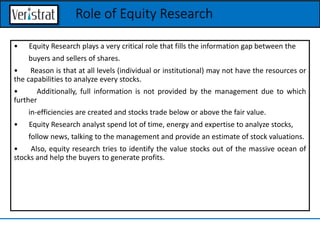
• Equity Research plays a very critical role that fills the information gap between the
buyers and sellers of shares.
• Reason is that at all levels (individual or institutional) may not have the resources or
the capabilities to analyze every stocks.
• Additionally, full information is not provided by the management due to which
further
in-efficiencies are created and stocks trade below or above the fair value.
• Equity Research analyst spend lot of time, energy and expertise to analyze stocks,
follow news, talking to the management and provide an estimate of stock valuations.
• Also, equity research tries to identify the value stocks out of the massive ocean of
stocks and help the buyers to generate profits.
Role of Equity Research
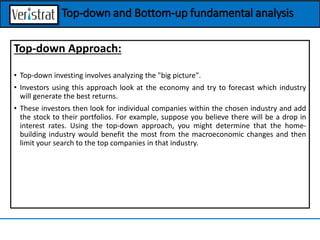
Top-down Approach:
• Top-down investing involves analyzing the "big picture".
• Investors using this approach look at the economy and try to forecast which industry
will generate the best returns.
• These investors then look for individual companies within the chosen industry and add
the stock to their portfolios. For example, suppose you believe there will be a drop in
interest rates. Using the top-down approach, you might determine that the home-
building industry would benefit the most from the macroeconomic changes and then
limit your search to the top companies in that industry.
Top-down and Bottom-up fundamental analysis
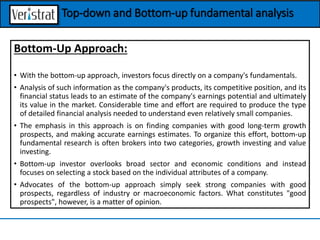
Bottom-Up Approach:
• With the bottom-up approach, investors focus directly on a company's fundamentals.
• Analysis of such information as the company's products, its competitive position, and its
financial status leads to an estimate of the company's earnings potential and ultimately
its value in the market. Considerable time and effort are required to produce the type
of detailed financial analysis needed to understand even relatively small companies.
• The emphasis in this approach is on finding companies with good long-term growth
prospects, and making accurate earnings estimates. To organize this effort, bottom-up
fundamental research is often brokers into two categories, growth investing and value
investing.
• Bottom-up investor overlooks broad sector and economic conditions and instead
focuses on selecting a stock based on the individual attributes of a company.
• Advocates of the bottom-up approach simply seek strong companies with good
prospects, regardless of industry or macroeconomic factors. What constitutes "good
prospects", however, is a matter of opinion.
Top-down and Bottom-up fundamental analysis
Bottom-Up Approach:
• Some investors look for earnings growth while others find companies with low P/E
ratios attractive. A bottom-up investor will compare companies based on these
fundamentals.
• As long as the companies are strong, the business cycle or broader industry conditions
are of no concern.
Top-down and Bottom-up fundamental analysis
• Growth stocks carry investor expectation of above-average future growth in earnings
and above-average valuations as a result of high price/earnings ratios. Investors expect
these stocks to perform well in the future, and they are willing to pay high multiples for
this expected growth. Recent examples include Microsoft, Cisco Systems, and Intel.
• Value stocks, on the other hand, feature cheap assets, strong balance sheets and lower
price/earnings ratios.
• Value investing can be traced back to the value-investing principles laid out by the well-
known Benjamin Graham, who coauthored a famous book on security analysis in the
1930s that has been the foundation for many subsequent security analysts.
Value Versus Growth Investing
Buy Side Analyst
• A buy-side analyst usually works for a pension fund, insurance company, asset
management firms, private equity, hedge funds or mutual fund.
• These individuals perform research and make recommendations to the money managers
of the fund that employs them.
• Buy-side analysts will determine how promising an investment seems and how well it
coincides with the fund's investment strategy; they'll base their recommendations on
this evidence.
• These recommendations, made exclusively for the benefit of the fund that pays for
them, are not available to anyone outside the fund.
• If a fund employs a good analyst, it does not want competing funds to have access to the
same advice. A buy-side analyst's success or talent is gauged by the number of profitable
recommendations he or she makes to the fund.
Buy-Side and Sell-Side Analyst
Sell Side Analyst
• A sell-side analyst works for a brokerage or firm that manages individual accounts and
makes recommendations to the clients of the firm.
• Sell-side analysts are those who issue the often-heard recommendations of "strong
buy", "outperform", "neutral" or "sell".
• These recommendations help clients make decisions to buy and/or sell certain stocks.
This is beneficial for the brokerage because every time a client makes a decision to
trade stock, the brokerage gets a commission on the transactions.
Buy-Side and Sell-Side Analyst
Thank You

Equity Research Methodology

  • 1.
  • 2.
    • Equity Researchinvolves comprehensive analysis of company’s business model, financial statements, ratios, projecting the financials and explore scenarios (base, best and worst cases) with an objective of making Buy or Sell investment recommendation. • Equity research analyst also explores and studies company’s management future guidance information relating to strategic key initiatives, projects or deals to be executed in near term as it will impact company’s stock price. • In addition to fundamental analysis, analysts also focus on global macroeconomic and industry factors/ trends which have a positive and negative impact on company's share performance. • On the basis of comprehensive economy, industry and company analysis, equity research report is presented either in written or electronic communication which will includes investment decision and recommendation as based on all reliable and sufficient information. Equity Research
  • 3.
    • Publicly tradedcompany valuations: Equity securities research is focused on finding the intrinsic value of a listed company as traded on stock exchange like Sensex, NYSE, NASDAQ, CAC, DAX etc. • Perform Fundamental analysis: Analyzing company’s business model, perform financial statement analysis of the historical balance sheet, income and cash flow statements to form an opinion on how the company did in the past and studies financial position and performance statistics. Based on management’s future guidance, historical performance trends and industry competition, forecast the financial statements like BS, IS and CFs of the company which is often called as financial modeling for equity research perspective. Multiple financial valuations approaches are used including discounted cash flows, relative valuations and sum of parts valuations techniques. • Economy and Industry research: Once we have analyzed company's business model and all operations, next step is to study macroeconomic and industry factors which have a great impact on business operations and stock price. Industry research parameters includes Industry life cycle, size, structure, growth rate, demand-supply pattern, competition, risk assessment, capacity utilization, regulations, cost and profitability pattern, etc. Different Types of Methodology
  • 4.
    • Compare marketprice with intrinsic fair market value: Intrinsic fair value is calculated using above valuation techniques and compared with current market price as traded on stock exchange. If the Fair Value < Current Market Price, then it's recommended company stock is overvalued and "SELL" recommendation is given under equity research report by the analyst. If the Fair Price > Current Market Price, then it's recommended company stock is undervalued and "BUY" recommendation is given under equity research report by the analyst. Different Types of Methodology
  • 5.
    • Comprehensive companyanalysis: Very critical to do in-depth analysis about company's product/ services profile, multiple segments, geographical presence, management, milestones, cost and revenue drivers, market share, Investment rationale, risk assessment, financial and operational performance metrics, company's performance in next 2-3 years. • Key ratio analysis: Important to include key financial ratios of the company to gauge liquidity, profitability, solvency condition and 52-week high-low share price on a stock exchange. Key metrics to include - market capitalization, debt equity ratio, operating margin, net profit margin, EPS, P/E, total assets, enterprise value (EV), earnings before interest tax and depreciation (EBITDA), EV/EBITDA, and dividend yield. • Economy-Industry-Company (E-I-C) analysis: Comprehensive analysis of economy, industry and company parameters before give any recommendation. • Intrinsic and relative valuation: Perform DCF analysis to calculate intrinsic fair value and relative valuation. Relative valuation should be done with the company’s peers on the basis of EV/EBITDA, EV/Sales, Price-Earnings ratio (P/E), Price to Book ratio (P/B), Price to Sales (P/S), Return on Equity (ROE) and Return on Capital Employed (ROCE). Key Points for Writing Equity Research Report
  • 6.
    • Recommendation/Rating: MentionCompany’s name at the top of the report and state your recommendation whether buy, sell or hold. We can also use the words- outperform, underperform, neutral or accumulate based on detailed valuation. • Target price: We have to mention target price number along with our recommendation while writing research report. • Investment rationale: We need to write investment rationale after performing detailed analysis and mention with proper reasoning regarding why share price will surge or tank in near term. Proper reasoning should be given whether to buy or sell the stock with time horizon under consideration. • Share price chart: Under equity research report, we include company's stock price chart that will show last 52-weeks’ share price movement. • Unlock the value: Provide relevant analysis and reasoning regarding what key factors that will have a great impact on increasing or reducing company's value/stock price in near term. • Legal matters: Company's stock price will be impacted if the company is battling any case. So it's important to address the same while writing report. Key Points for Writing Equity Research Report
  • 7.
    • Equity Researchplays a very critical role that fills the information gap between the buyers and sellers of shares. • Reason is that at all levels (individual or institutional) may not have the resources or the capabilities to analyze every stocks. • Additionally, full information is not provided by the management due to which further in-efficiencies are created and stocks trade below or above the fair value. • Equity Research analyst spend lot of time, energy and expertise to analyze stocks, follow news, talking to the management and provide an estimate of stock valuations. • Also, equity research tries to identify the value stocks out of the massive ocean of stocks and help the buyers to generate profits. Role of Equity Research
  • 8.
    Top-down Approach: • Top-downinvesting involves analyzing the "big picture". • Investors using this approach look at the economy and try to forecast which industry will generate the best returns. • These investors then look for individual companies within the chosen industry and add the stock to their portfolios. For example, suppose you believe there will be a drop in interest rates. Using the top-down approach, you might determine that the home- building industry would benefit the most from the macroeconomic changes and then limit your search to the top companies in that industry. Top-down and Bottom-up fundamental analysis
  • 9.
    Bottom-Up Approach: • Withthe bottom-up approach, investors focus directly on a company's fundamentals. • Analysis of such information as the company's products, its competitive position, and its financial status leads to an estimate of the company's earnings potential and ultimately its value in the market. Considerable time and effort are required to produce the type of detailed financial analysis needed to understand even relatively small companies. • The emphasis in this approach is on finding companies with good long-term growth prospects, and making accurate earnings estimates. To organize this effort, bottom-up fundamental research is often brokers into two categories, growth investing and value investing. • Bottom-up investor overlooks broad sector and economic conditions and instead focuses on selecting a stock based on the individual attributes of a company. • Advocates of the bottom-up approach simply seek strong companies with good prospects, regardless of industry or macroeconomic factors. What constitutes "good prospects", however, is a matter of opinion. Top-down and Bottom-up fundamental analysis
  • 10.
    Bottom-Up Approach: • Someinvestors look for earnings growth while others find companies with low P/E ratios attractive. A bottom-up investor will compare companies based on these fundamentals. • As long as the companies are strong, the business cycle or broader industry conditions are of no concern. Top-down and Bottom-up fundamental analysis
  • 11.
    • Growth stockscarry investor expectation of above-average future growth in earnings and above-average valuations as a result of high price/earnings ratios. Investors expect these stocks to perform well in the future, and they are willing to pay high multiples for this expected growth. Recent examples include Microsoft, Cisco Systems, and Intel. • Value stocks, on the other hand, feature cheap assets, strong balance sheets and lower price/earnings ratios. • Value investing can be traced back to the value-investing principles laid out by the well- known Benjamin Graham, who coauthored a famous book on security analysis in the 1930s that has been the foundation for many subsequent security analysts. Value Versus Growth Investing
  • 12.
    Buy Side Analyst •A buy-side analyst usually works for a pension fund, insurance company, asset management firms, private equity, hedge funds or mutual fund. • These individuals perform research and make recommendations to the money managers of the fund that employs them. • Buy-side analysts will determine how promising an investment seems and how well it coincides with the fund's investment strategy; they'll base their recommendations on this evidence. • These recommendations, made exclusively for the benefit of the fund that pays for them, are not available to anyone outside the fund. • If a fund employs a good analyst, it does not want competing funds to have access to the same advice. A buy-side analyst's success or talent is gauged by the number of profitable recommendations he or she makes to the fund. Buy-Side and Sell-Side Analyst
  • 13.
    Sell Side Analyst •A sell-side analyst works for a brokerage or firm that manages individual accounts and makes recommendations to the clients of the firm. • Sell-side analysts are those who issue the often-heard recommendations of "strong buy", "outperform", "neutral" or "sell". • These recommendations help clients make decisions to buy and/or sell certain stocks. This is beneficial for the brokerage because every time a client makes a decision to trade stock, the brokerage gets a commission on the transactions. Buy-Side and Sell-Side Analyst
  • 14.