Portfolio of Initiatives:
      An Institutional Model for
Implementing Student Success Initiatives
          Sukhwant Jhaj, Dan Fortmiler,
                 Ella Peterson
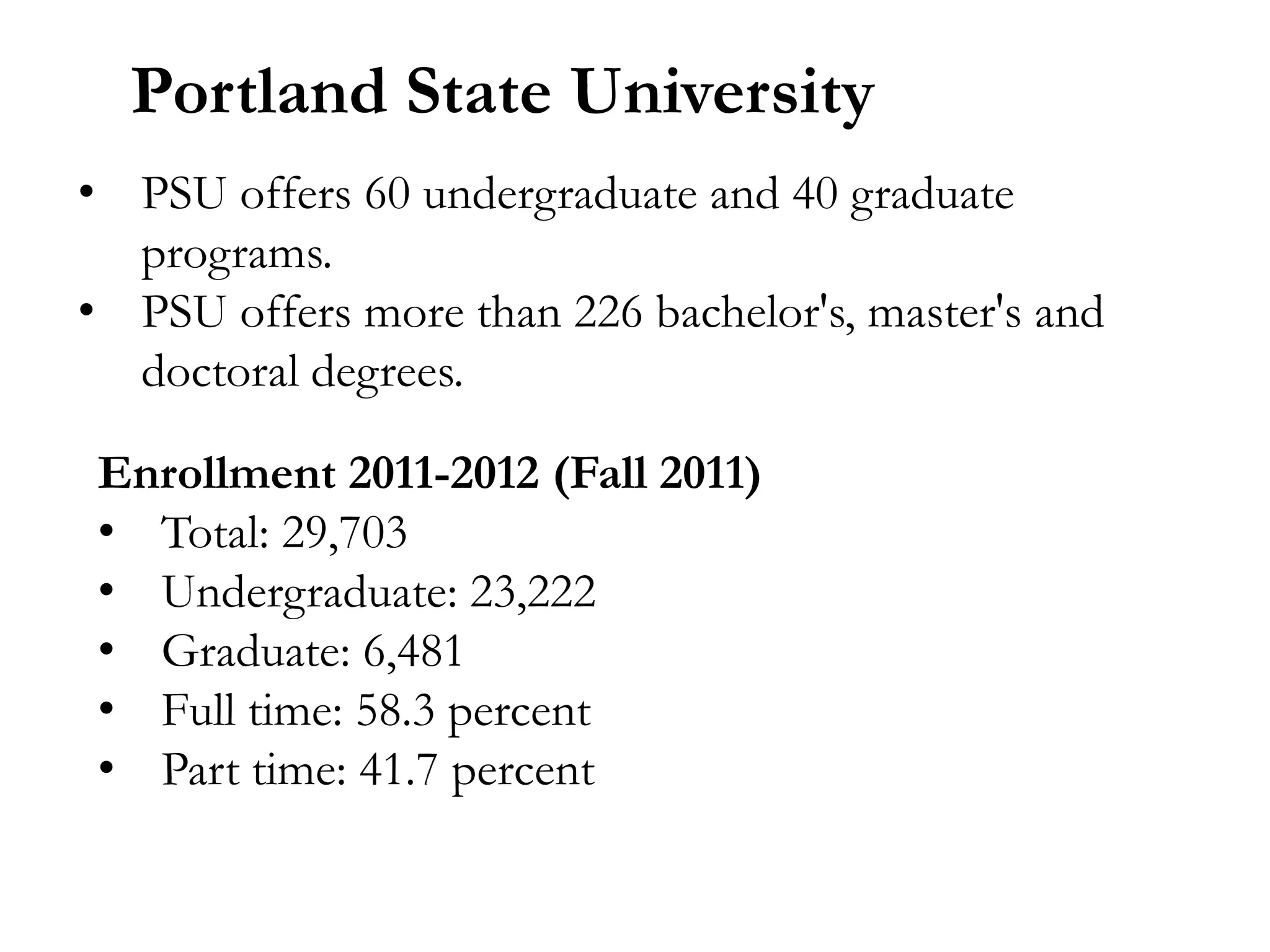
Portland State University
• PSU offers 60 undergraduate and 40 graduate
  programs.
• PSU offers more than 226 bachelor's, master's and
  doctoral degrees.

Enrollment 2011-2012 (Fall 2011)
• Total: 29,703
• Undergraduate: 23,222
• Graduate: 6,481
• Full time: 58.3 percent
• Part time: 41.7 percent
How does one develop strategy in a
     dynamic environment?
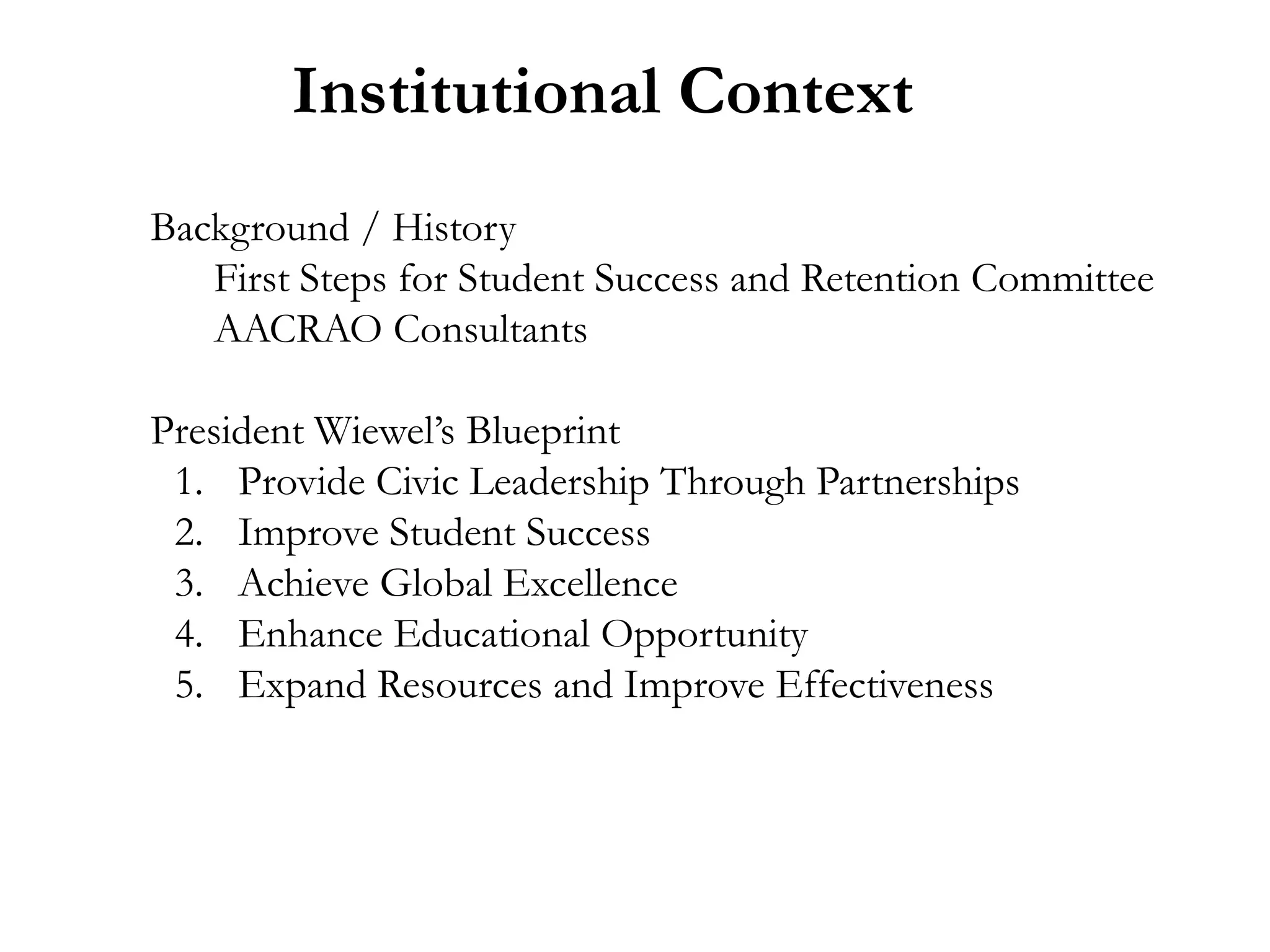
Institutional Context
Background / History
   First Steps for Student Success and Retention Committee
   AACRAO Consultants

President Wiewel’s Blueprint
 1. Provide Civic Leadership Through Partnerships
 2. Improve Student Success
 3. Achieve Global Excellence
 4. Enhance Educational Opportunity
 5. Expand Resources and Improve Effectiveness
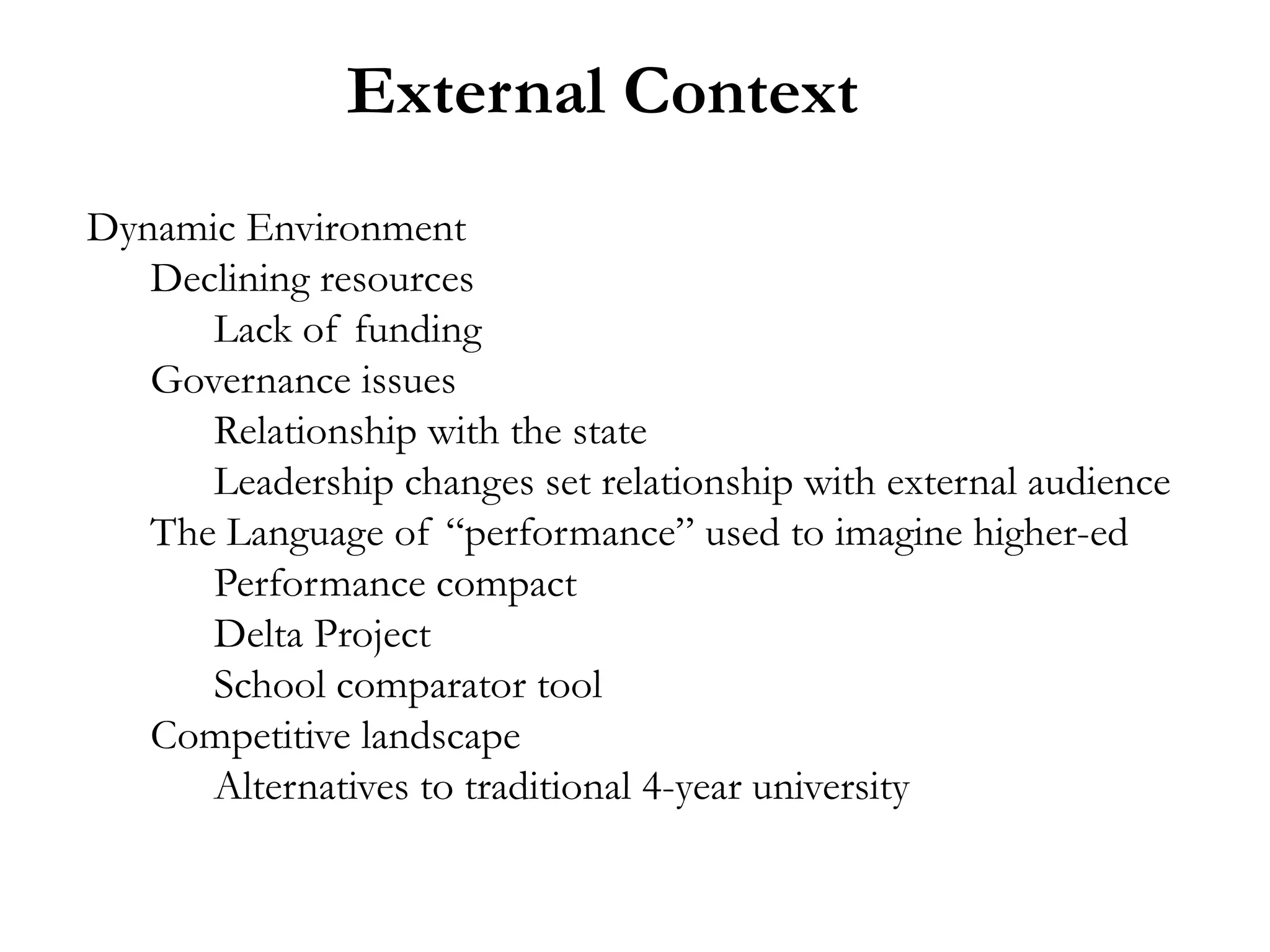
External Context
Dynamic Environment
   Declining resources
      Lack of funding
   Governance issues
      Relationship with the state
      Leadership changes set relationship with external audience
   The Language of “performance” used to imagine higher-ed
      Performance compact
      Delta Project
      School comparator tool
   Competitive landscape
      Alternatives to traditional 4-year university
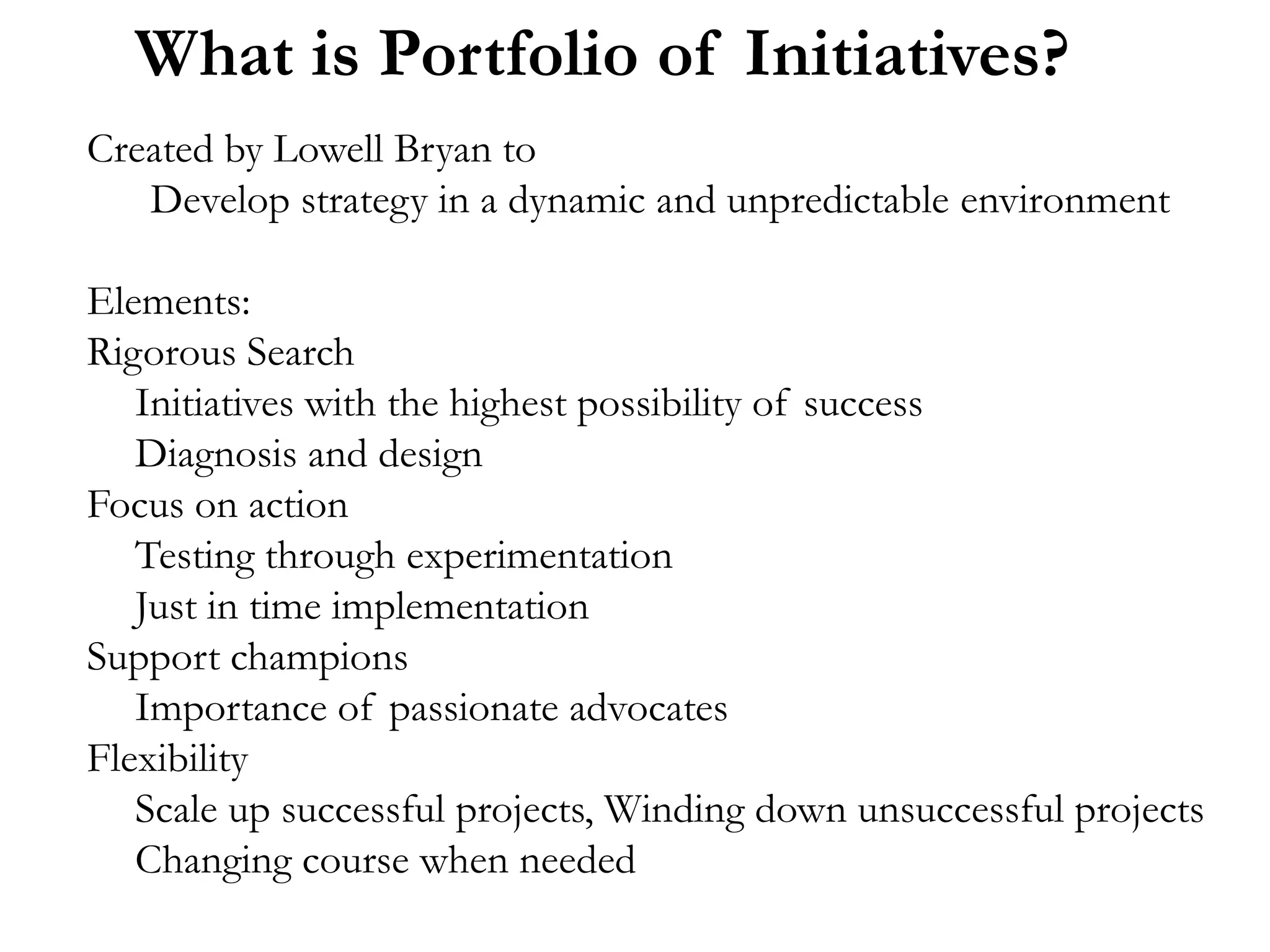
What is Portfolio of Initiatives?
Created by Lowell Bryan to
   Develop strategy in a dynamic and unpredictable environment

Elements:
Rigorous Search
   Initiatives with the highest possibility of success
   Diagnosis and design
Focus on action
   Testing through experimentation
   Just in time implementation
Support champions
   Importance of passionate advocates
Flexibility
   Scale up successful projects, Winding down unsuccessful projects
   Changing course when needed
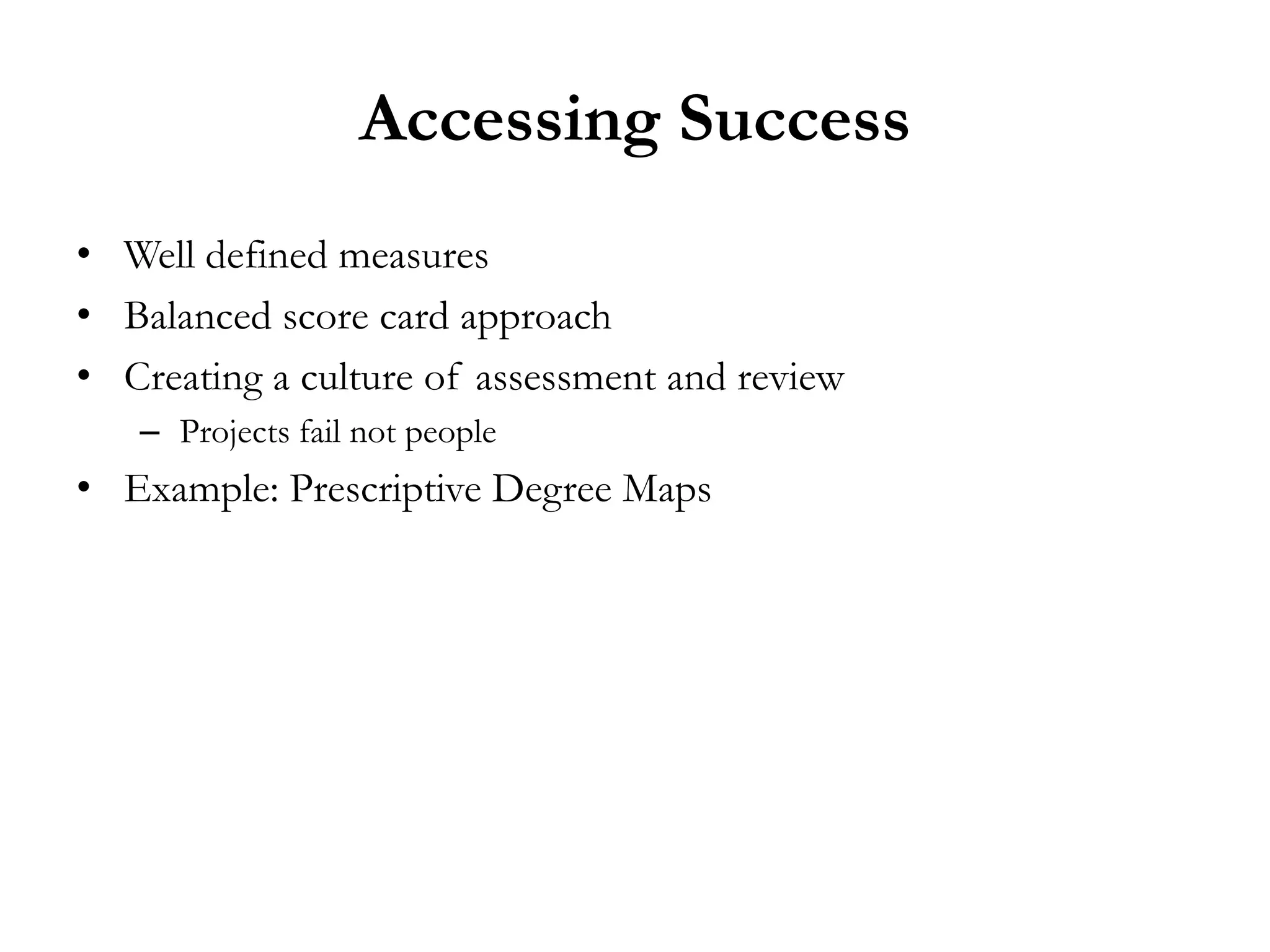
Accessing Success
• Well defined measures
• Balanced score card approach
• Creating a culture of assessment and review
   – Projects fail not people
• Example: Prescriptive Degree Maps
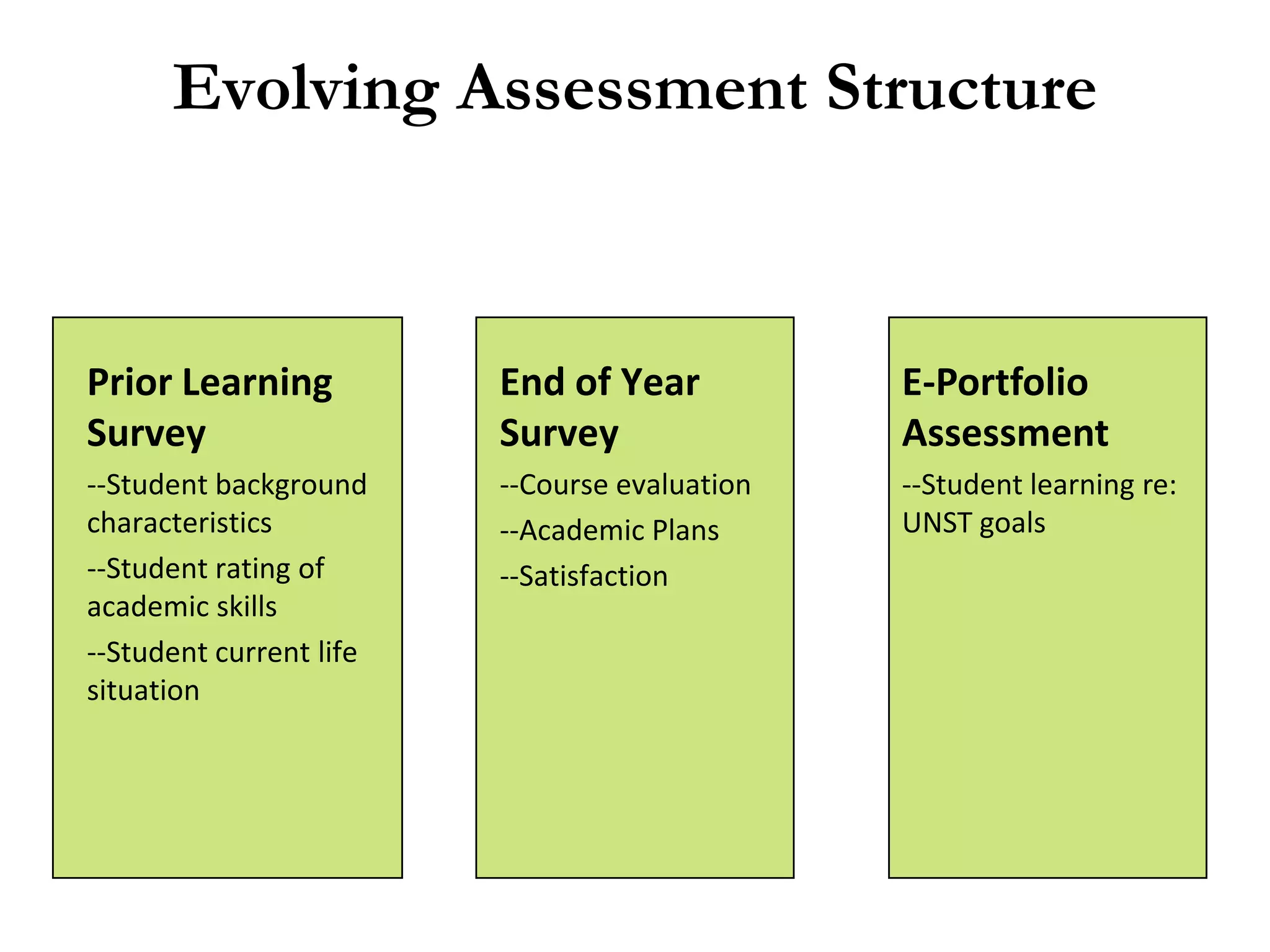
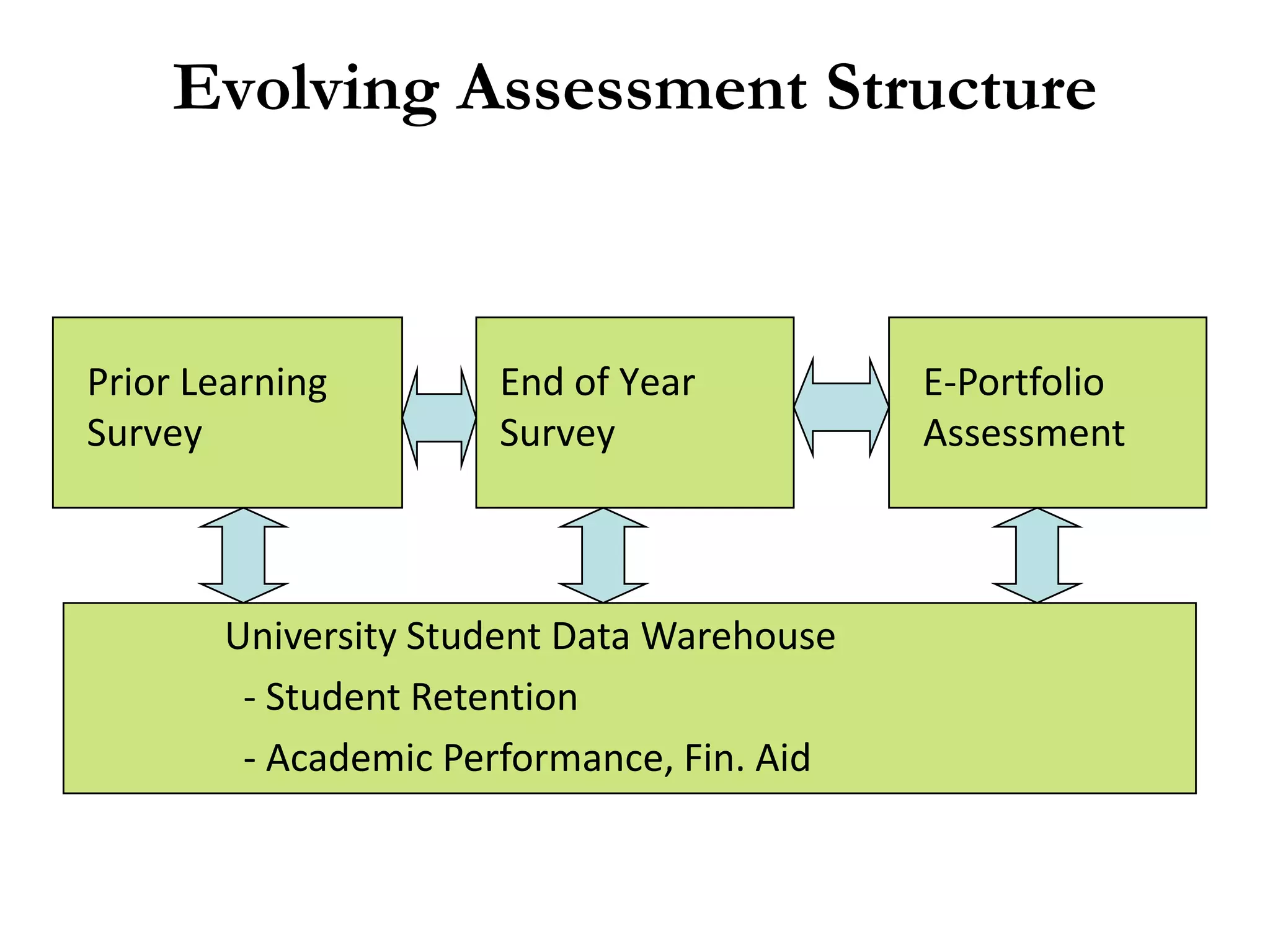
Evolving Assessment Structure


Prior Learning           End of Year           E-Portfolio
Survey                   Survey                Assessment
--Student background     --Course evaluation   --Student learning re:
characteristics          --Academic Plans      UNST goals
--Student rating of      --Satisfaction
academic skills
--Student current life
situation
Evolving Assessment Structure


Prior Learning       End of Year           E-Portfolio
Survey               Survey                Assessment


       University Student Data Warehouse
        - Student Retention
        - Academic Performance, Fin. Aid
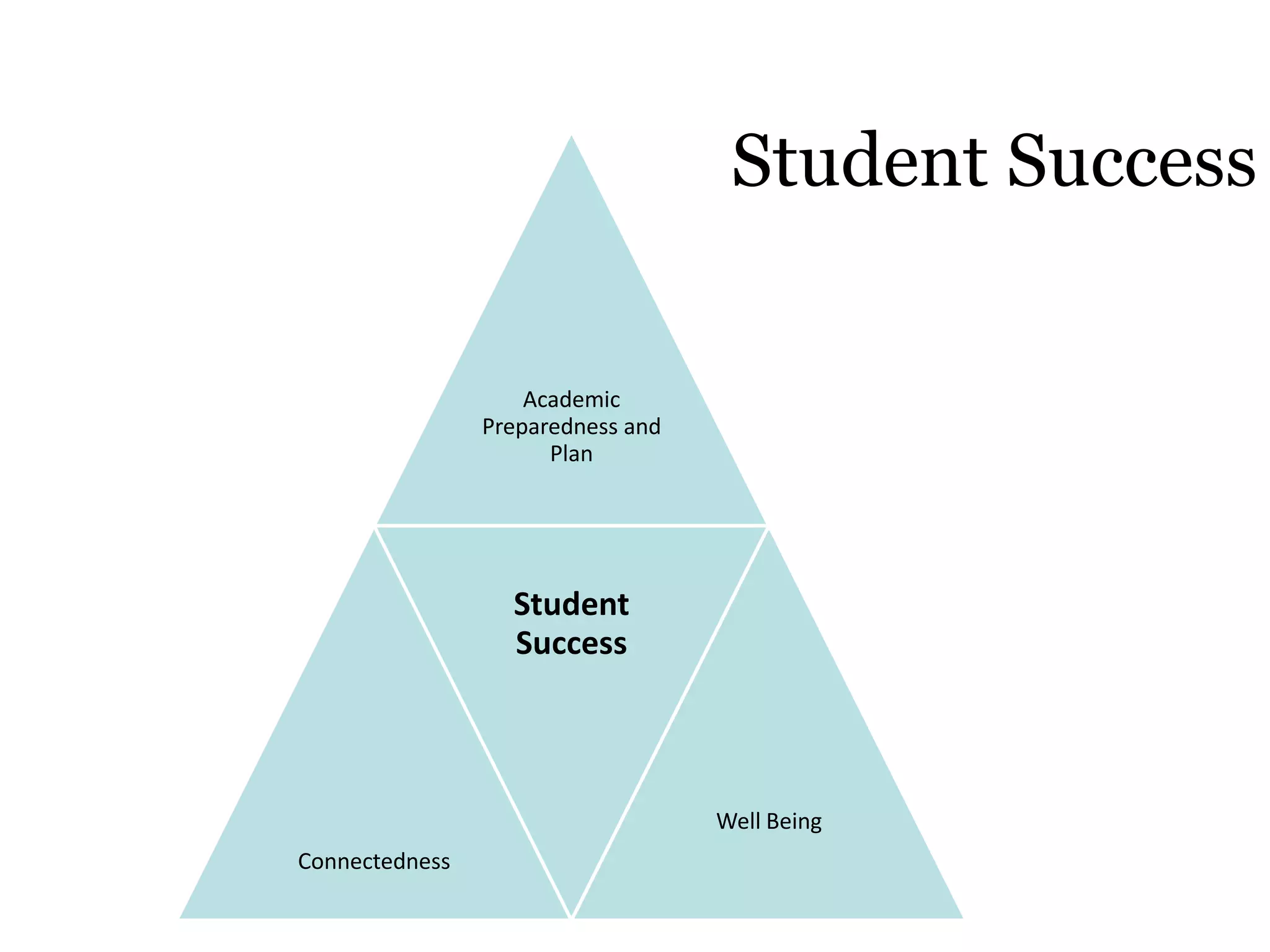
Student Success

                    Academic
                Preparedness and
                      Plan


                  Student
                  Success


                                   Well Being
Connectedness
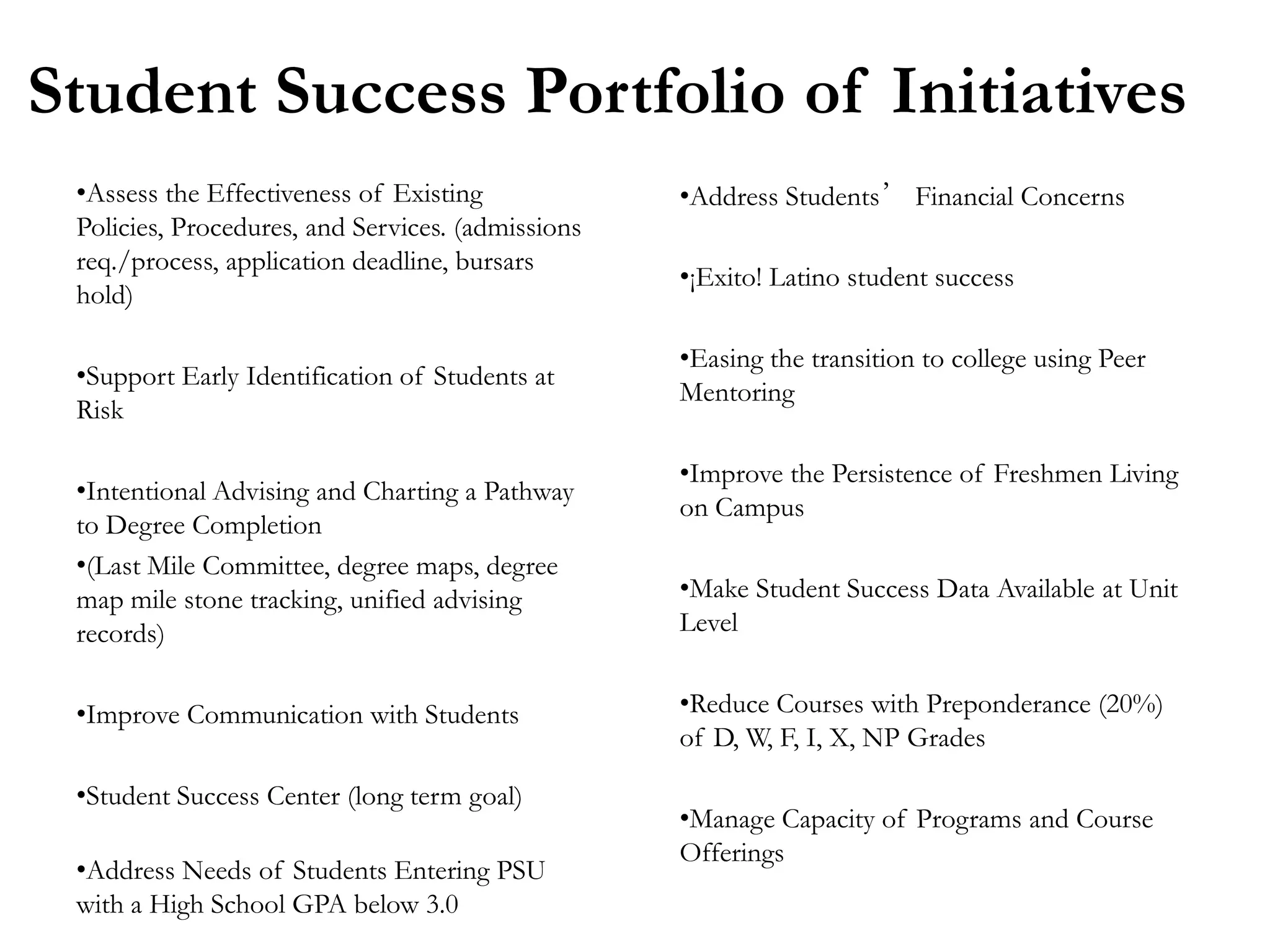
Student Success Portfolio of Initiatives
 •Assess the Effectiveness of Existing             •Address Students’ Financial Concerns
 Policies, Procedures, and Services. (admissions
 req./process, application deadline, bursars
                                                   •¡Exito! Latino student success
 hold)

                                                   •Easing the transition to college using Peer
 •Support Early Identification of Students at
                                                   Mentoring
 Risk

                                                   •Improve the Persistence of Freshmen Living
 •Intentional Advising and Charting a Pathway
                                                   on Campus
 to Degree Completion
 •(Last Mile Committee, degree maps, degree
 map mile stone tracking, unified advising         •Make Student Success Data Available at Unit
 records)                                          Level


 •Improve Communication with Students              •Reduce Courses with Preponderance (20%)
                                                   of D, W, F, I, X, NP Grades

 •Student Success Center (long term goal)
                                                   •Manage Capacity of Programs and Course
                                                   Offerings
 •Address Needs of Students Entering PSU
 with a High School GPA below 3.0
Intentional Advising
• Intentional advising background and history
• Success supported by research
• Intentional Advising supported by
   – Unified advising records,
   – Prescriptive degree maps, and
   – Degree map milestones tracking
   – Last Mile Committee
   – Fall Registration Project
Project: Prescriptive Degree Maps
• Rigorous Search
  – Addition of new academic advisors + Research
  – Support by provost, Advising Council, faculty
• Focus on action
  – Testing through experimentation (pilot project)
  – Embedding degree maps in PSU’s processes
• Support champions
  – Excellent leadership team
• Flexibility
  – Use in curricular efficiency
  – Changing the project direction as a result of tech
      challenges
Project: Prescriptive Degree Maps
Review Handout

Available online at:
http://jhaj.wordpress.com/retention-initiatives/retention-
initiative-3/prescriptive-degree-maps/
Thank you!
       Any questions?
       For more information
or a copy of this presentation visit:
        http://jhaj.wordpress.com

      Sukhwant Jhaj, Dan Fortmiler,
             Ella Peterson

Portfolio of Initiatives: An Institutional Model for Implementing Student Success Initiatives

  • 1.
    Portfolio of Initiatives: An Institutional Model for Implementing Student Success Initiatives Sukhwant Jhaj, Dan Fortmiler, Ella Peterson
  • 2.
    Portland State University •PSU offers 60 undergraduate and 40 graduate programs. • PSU offers more than 226 bachelor's, master's and doctoral degrees. Enrollment 2011-2012 (Fall 2011) • Total: 29,703 • Undergraduate: 23,222 • Graduate: 6,481 • Full time: 58.3 percent • Part time: 41.7 percent
  • 3.
    How does onedevelop strategy in a dynamic environment?
  • 4.
    Institutional Context Background /History First Steps for Student Success and Retention Committee AACRAO Consultants President Wiewel’s Blueprint 1. Provide Civic Leadership Through Partnerships 2. Improve Student Success 3. Achieve Global Excellence 4. Enhance Educational Opportunity 5. Expand Resources and Improve Effectiveness
  • 5.
    External Context Dynamic Environment Declining resources Lack of funding Governance issues Relationship with the state Leadership changes set relationship with external audience The Language of “performance” used to imagine higher-ed Performance compact Delta Project School comparator tool Competitive landscape Alternatives to traditional 4-year university
  • 6.
    What is Portfolioof Initiatives? Created by Lowell Bryan to Develop strategy in a dynamic and unpredictable environment Elements: Rigorous Search Initiatives with the highest possibility of success Diagnosis and design Focus on action Testing through experimentation Just in time implementation Support champions Importance of passionate advocates Flexibility Scale up successful projects, Winding down unsuccessful projects Changing course when needed
  • 7.
    Accessing Success • Welldefined measures • Balanced score card approach • Creating a culture of assessment and review – Projects fail not people • Example: Prescriptive Degree Maps
  • 8.
    Evolving Assessment Structure PriorLearning End of Year E-Portfolio Survey Survey Assessment --Student background --Course evaluation --Student learning re: characteristics --Academic Plans UNST goals --Student rating of --Satisfaction academic skills --Student current life situation
  • 9.
    Evolving Assessment Structure PriorLearning End of Year E-Portfolio Survey Survey Assessment University Student Data Warehouse - Student Retention - Academic Performance, Fin. Aid
  • 10.
    Student Success Academic Preparedness and Plan Student Success Well Being Connectedness
  • 11.
    Student Success Portfolioof Initiatives •Assess the Effectiveness of Existing •Address Students’ Financial Concerns Policies, Procedures, and Services. (admissions req./process, application deadline, bursars •¡Exito! Latino student success hold) •Easing the transition to college using Peer •Support Early Identification of Students at Mentoring Risk •Improve the Persistence of Freshmen Living •Intentional Advising and Charting a Pathway on Campus to Degree Completion •(Last Mile Committee, degree maps, degree map mile stone tracking, unified advising •Make Student Success Data Available at Unit records) Level •Improve Communication with Students •Reduce Courses with Preponderance (20%) of D, W, F, I, X, NP Grades •Student Success Center (long term goal) •Manage Capacity of Programs and Course Offerings •Address Needs of Students Entering PSU with a High School GPA below 3.0
  • 13.
    Intentional Advising • Intentionaladvising background and history • Success supported by research • Intentional Advising supported by – Unified advising records, – Prescriptive degree maps, and – Degree map milestones tracking – Last Mile Committee – Fall Registration Project
  • 14.
    Project: Prescriptive DegreeMaps • Rigorous Search – Addition of new academic advisors + Research – Support by provost, Advising Council, faculty • Focus on action – Testing through experimentation (pilot project) – Embedding degree maps in PSU’s processes • Support champions – Excellent leadership team • Flexibility – Use in curricular efficiency – Changing the project direction as a result of tech challenges
  • 15.
    Project: Prescriptive DegreeMaps Review Handout Available online at: http://jhaj.wordpress.com/retention-initiatives/retention- initiative-3/prescriptive-degree-maps/
  • 16.
    Thank you! Any questions? For more information or a copy of this presentation visit: http://jhaj.wordpress.com Sukhwant Jhaj, Dan Fortmiler, Ella Peterson