


LTIFS Forum on Enrollment Management as a Fiscal Strategy.Roy Koch, ProvostJackie Balzer, Vice Provost for Student AffairsSukhwant Jhaj, Director, University Studies
Long Term Institutional Fiscal Strategies Committee (LTIFS)Committee Membership:Marvin Kaiser (Chair), Jackie Balzer, Alan Cabelly, Doug Crow, Hannah Fisher,Sukhwant Jhaj,Michael McCarthy,Marc Niesenfeld, Steve Reder, Kevin Reynolds,Melody Rose, Jonathan UtoDee Wendler, Jennifer Williamson, Mark Wubbold,Angela Wykoff.Consultants and Staff:David Burgess, Michael Fung, Cathy LaTourette, Mark Wubbold, Nancy Goldman
Committee ChargeConsider - organizational or structural issues that impact our efficiency and/or effectiveness. Consider - operational approaches that could lead to more efficient and effective use of institutional resources. Identify -alternatives for revenue enhancement that provide a more robust and financially sustainable base of funding Consider - University-wide approaches, in addition to incremental reductions within the academic and administrative units, which could be used in dealing with the budget deficits for the 2009-11 biennium. Suggest - approaches and criteria to be used in academic and administrative program consolidation or reorganization.
Committee ProcessCommittee gathered and reviewed numerous internal and external reports. Conducted independent and comparative analyses of PSU funding using data from OIRP and  The Delta Project on Postsecondary Education Costs, Productivity, and Accountability.Collected feedback from campus community.
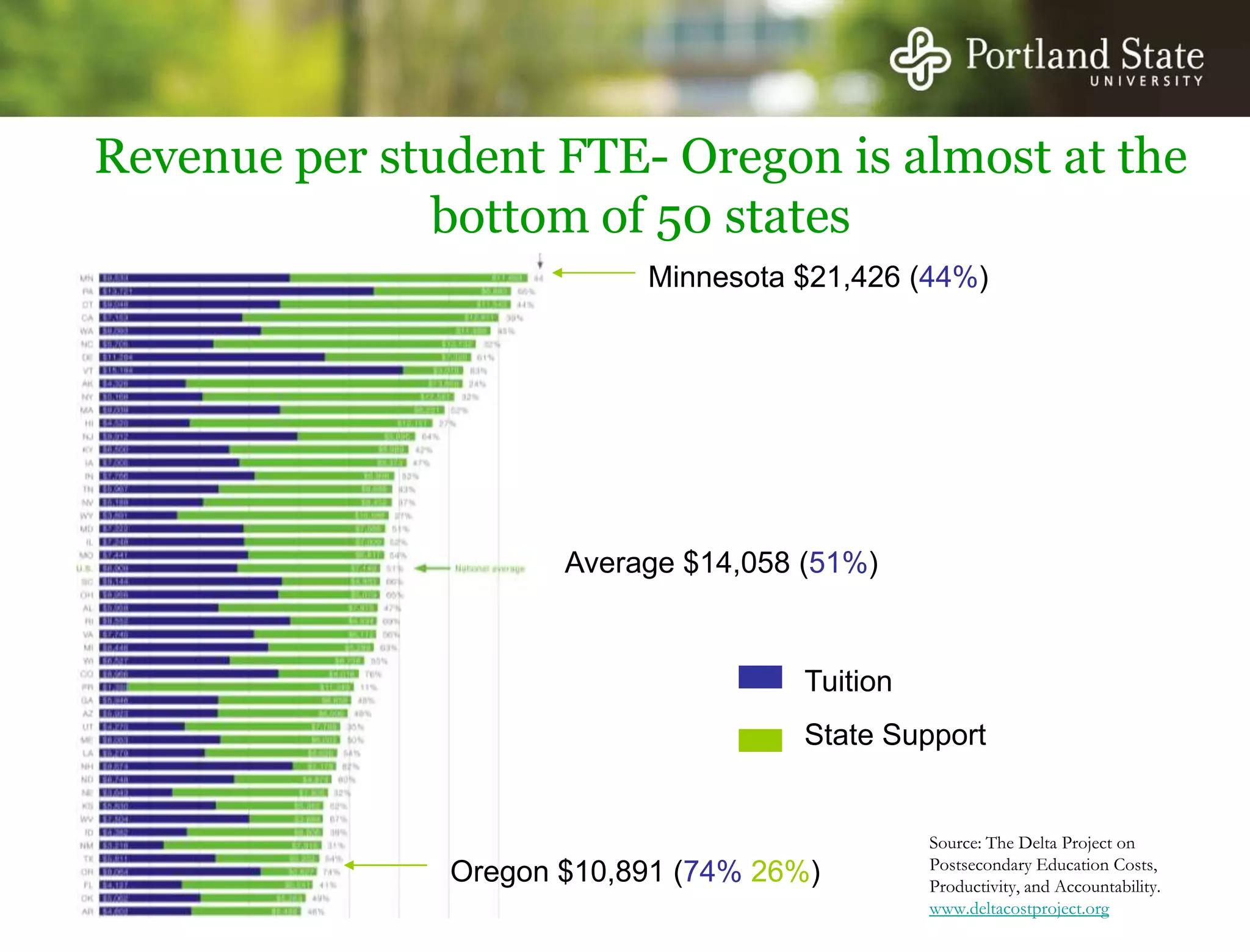
Revenue per student FTE- Oregon is almost at the bottom of 50 states Minnesota $21,426 (44%)Average $14,058 (51%)TuitionState SupportSource: The Delta Project on Postsecondary Education Costs, Productivity, and Accountability. www.deltacostproject.orgOregon $10,891 (74%26%)
PSU revenue ($8,398) per student FTE is even worse.   Lower than University of Oregon and OSU, and our peers. In ThousandsData taken from The Delta Project on Postsecondary Education Costs, Productivity, and Accountability. www.deltacostproject.org
Total dollars per FTE student at PSU have decreased ($764) and the State contribution continues to declineSource: The Delta Project on Postsecondary Education Costs, Productivity, and Accountability. www.deltacostproject.org
Total dollars per student FTE at U of O are higher ($11024), and have increased ($877).State support per FTE student has decreased and is less than that of PSU.  Source: The Delta Project on Postsecondary Education Costs, Productivity, and Accountability. www.deltacostproject.org
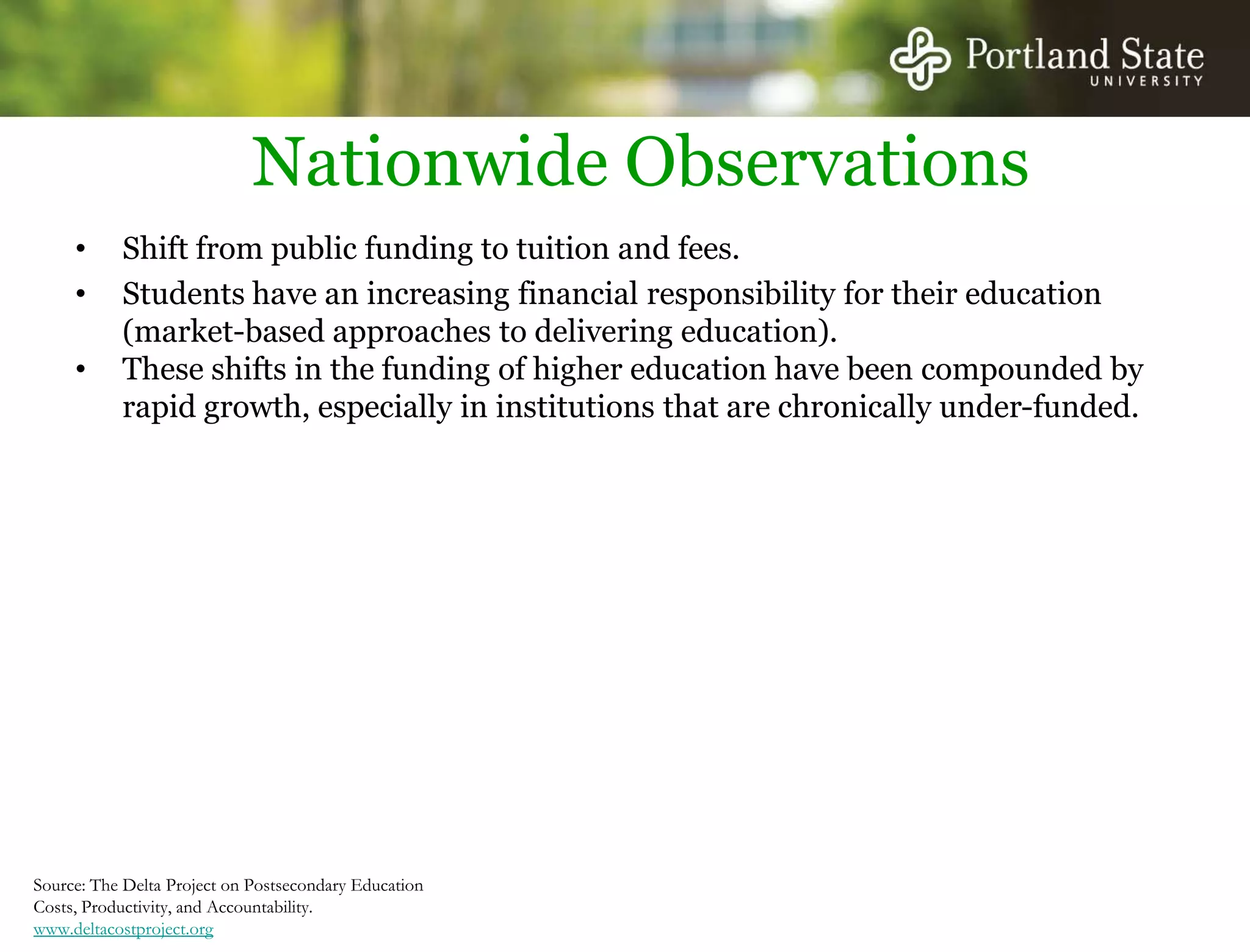
Nationwide ObservationsShift from public funding to tuition and fees.
Students have an increasing financial responsibility for their education (market-based approaches to delivering education).
These shifts in the funding of higher education have been compounded by rapid growth, especially in institutions that are chronically under-funded.Source: The Delta Project on Postsecondary Education Costs, Productivity, and Accountability. www.deltacostproject.org
PSU Observations and PredictionsMirrors nationwide trends but worse (total revenue per student FTE decreased)
Student demand for matriculation will continue to grow
State funded portion for higher education, on a per student basis, will not increase.
Market competition for students will continue to increase, both from our OUS peers and others
The city and the region will look increasingly to Portland State to support its economic, social and cultural development.Clustered RecommendationsCurricular efficiency and effectiveness as a fiscal strategy
Enrollment management as a fiscal strategy
Research as a fiscal strategy
Administrative organization and operation as a fiscal strategy
Partnerships as a fiscal strategy
AthleticsSee handout, Description of the Six Clusters of LTIFS Recommendations, for details.
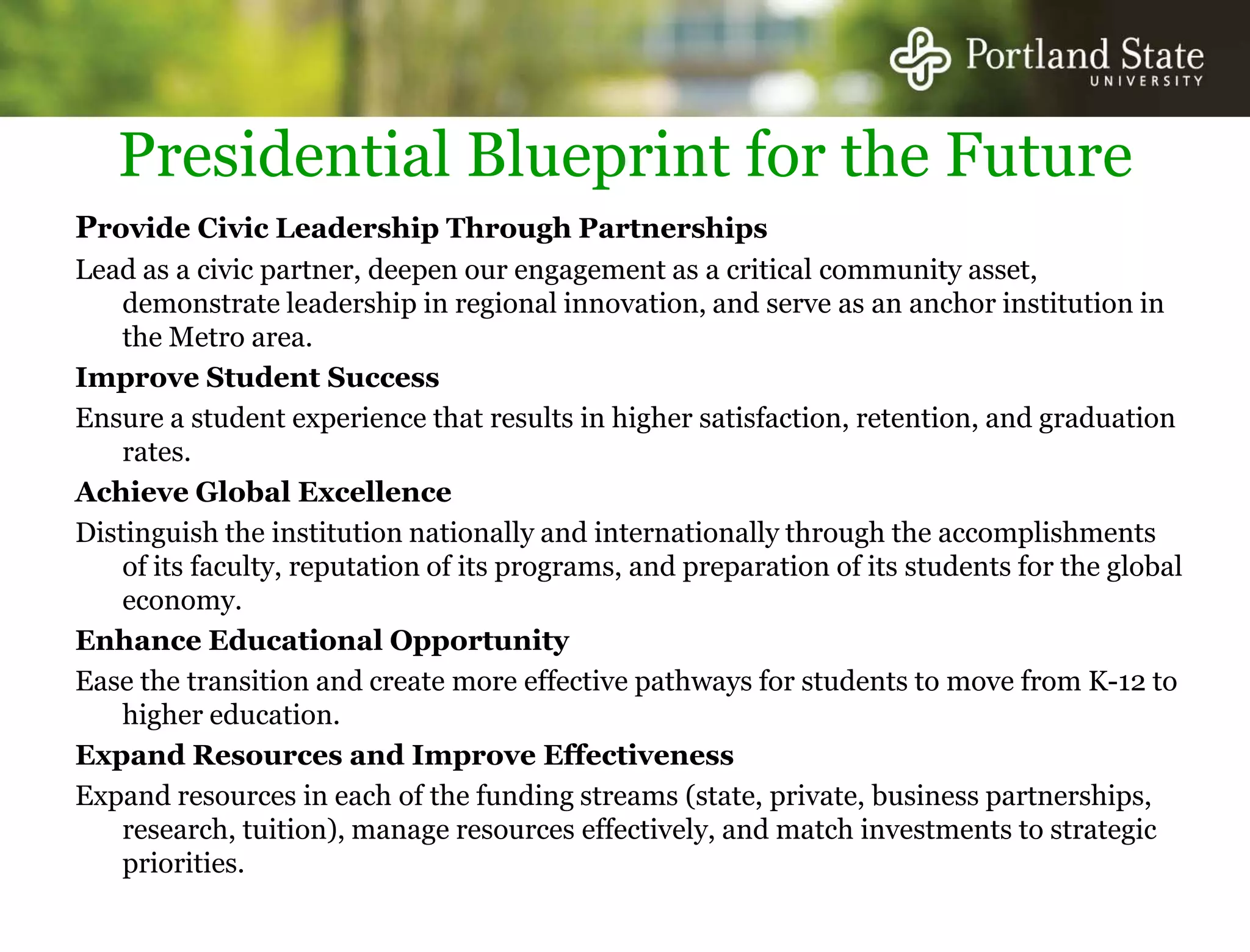
Presidential Blueprint for the FutureProvide Civic Leadership Through PartnershipsLead as a civic partner, deepen our engagement as a critical community asset, demonstrate leadership in regional innovation, and serve as an anchor institution in the Metro area.Improve Student SuccessEnsure a student experience that results in higher satisfaction, retention, and graduation rates.Achieve Global ExcellenceDistinguish the institution nationally and internationally through the accomplishments of its faculty, reputation of its programs, and preparation of its students for the global economy.Enhance Educational OpportunityEase the transition and create more effective pathways for students to move from K-12 to higher education.Expand Resources and Improve EffectivenessExpand resources in each of the funding streams (state, private, business partnerships, research, tuition), manage resources effectively, and match investments to strategic priorities.
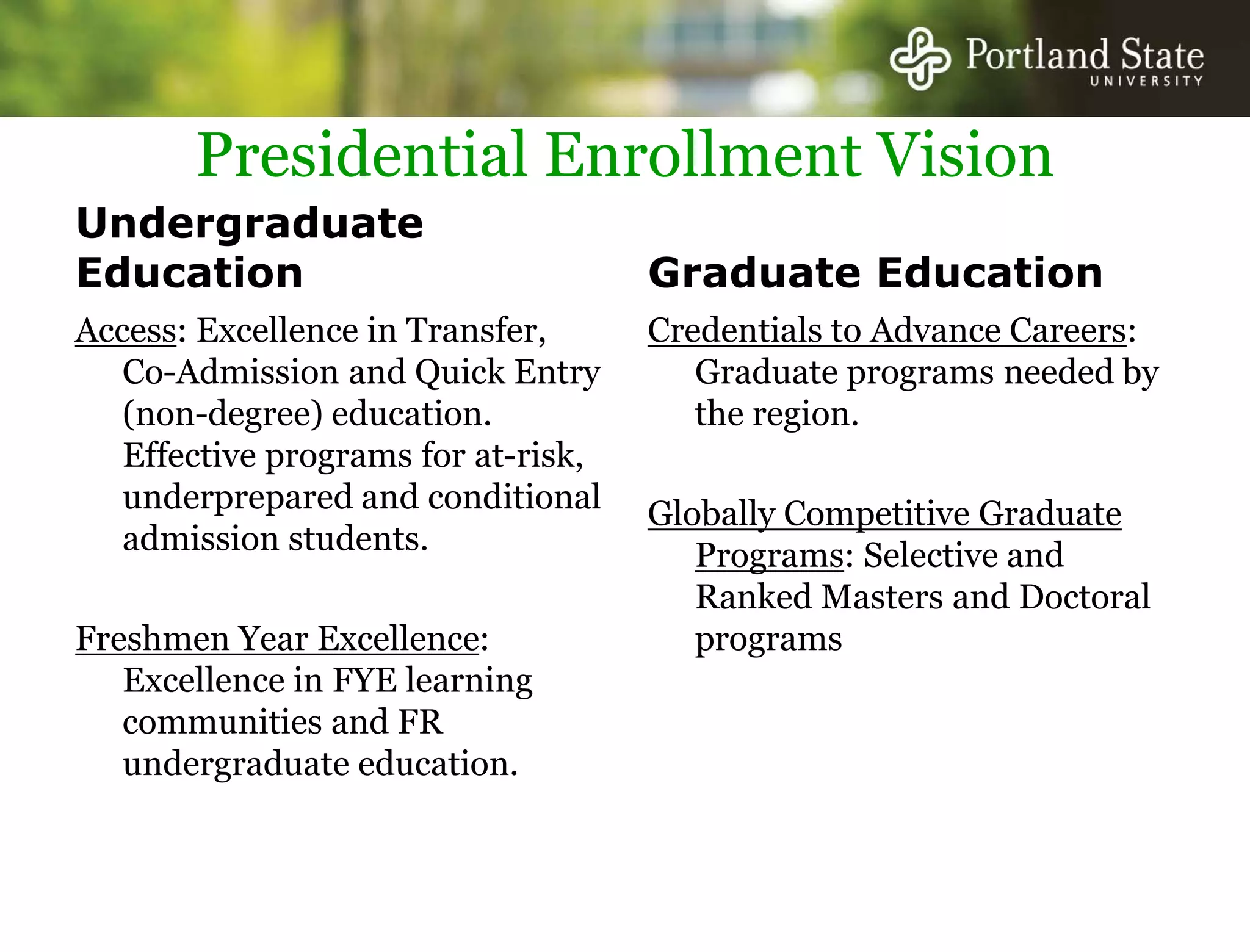
Presidential Enrollment VisionUndergraduate EducationGraduate EducationAccess: Excellence in Transfer, Co-Admission and Quick Entry (non-degree) education. Effective programs for at-risk, underprepared and conditional admission students.Freshmen Year Excellence: Excellence in FYE learning communities and FR undergraduate education.Credentials to Advance Careers: Graduate programsneeded by the region.Globally Competitive Graduate Programs: Selective and Ranked Masters and Doctoral programs

Enrollment management as a fiscal strategy final

  • 1.
    LTIFS Forum onEnrollment Management as a Fiscal Strategy.Roy Koch, ProvostJackie Balzer, Vice Provost for Student AffairsSukhwant Jhaj, Director, University Studies
  • 2.
    Long Term InstitutionalFiscal Strategies Committee (LTIFS)Committee Membership:Marvin Kaiser (Chair), Jackie Balzer, Alan Cabelly, Doug Crow, Hannah Fisher,Sukhwant Jhaj,Michael McCarthy,Marc Niesenfeld, Steve Reder, Kevin Reynolds,Melody Rose, Jonathan UtoDee Wendler, Jennifer Williamson, Mark Wubbold,Angela Wykoff.Consultants and Staff:David Burgess, Michael Fung, Cathy LaTourette, Mark Wubbold, Nancy Goldman
  • 3.
    Committee ChargeConsider -organizational or structural issues that impact our efficiency and/or effectiveness. Consider - operational approaches that could lead to more efficient and effective use of institutional resources. Identify -alternatives for revenue enhancement that provide a more robust and financially sustainable base of funding Consider - University-wide approaches, in addition to incremental reductions within the academic and administrative units, which could be used in dealing with the budget deficits for the 2009-11 biennium. Suggest - approaches and criteria to be used in academic and administrative program consolidation or reorganization.
  • 4.
    Committee ProcessCommittee gatheredand reviewed numerous internal and external reports. Conducted independent and comparative analyses of PSU funding using data from OIRP and The Delta Project on Postsecondary Education Costs, Productivity, and Accountability.Collected feedback from campus community.
  • 5.
    Revenue per studentFTE- Oregon is almost at the bottom of 50 states Minnesota $21,426 (44%)Average $14,058 (51%)TuitionState SupportSource: The Delta Project on Postsecondary Education Costs, Productivity, and Accountability. www.deltacostproject.orgOregon $10,891 (74%26%)
  • 6.
    PSU revenue ($8,398)per student FTE is even worse. Lower than University of Oregon and OSU, and our peers. In ThousandsData taken from The Delta Project on Postsecondary Education Costs, Productivity, and Accountability. www.deltacostproject.org
  • 7.
    Total dollars perFTE student at PSU have decreased ($764) and the State contribution continues to declineSource: The Delta Project on Postsecondary Education Costs, Productivity, and Accountability. www.deltacostproject.org
  • 8.
    Total dollars perstudent FTE at U of O are higher ($11024), and have increased ($877).State support per FTE student has decreased and is less than that of PSU. Source: The Delta Project on Postsecondary Education Costs, Productivity, and Accountability. www.deltacostproject.org
  • 9.
    Nationwide ObservationsShift frompublic funding to tuition and fees.
  • 10.
    Students have anincreasing financial responsibility for their education (market-based approaches to delivering education).
  • 11.
    These shifts inthe funding of higher education have been compounded by rapid growth, especially in institutions that are chronically under-funded.Source: The Delta Project on Postsecondary Education Costs, Productivity, and Accountability. www.deltacostproject.org
  • 12.
    PSU Observations andPredictionsMirrors nationwide trends but worse (total revenue per student FTE decreased)
  • 13.
    Student demand formatriculation will continue to grow
  • 14.
    State funded portionfor higher education, on a per student basis, will not increase.
  • 15.
    Market competition forstudents will continue to increase, both from our OUS peers and others
  • 16.
    The city andthe region will look increasingly to Portland State to support its economic, social and cultural development.Clustered RecommendationsCurricular efficiency and effectiveness as a fiscal strategy
  • 17.
    Enrollment management asa fiscal strategy
  • 18.
    Research as afiscal strategy
  • 19.
    Administrative organization andoperation as a fiscal strategy
  • 20.
    Partnerships as afiscal strategy
  • 21.
    AthleticsSee handout, Descriptionof the Six Clusters of LTIFS Recommendations, for details.
  • 22.
    Presidential Blueprint forthe FutureProvide Civic Leadership Through PartnershipsLead as a civic partner, deepen our engagement as a critical community asset, demonstrate leadership in regional innovation, and serve as an anchor institution in the Metro area.Improve Student SuccessEnsure a student experience that results in higher satisfaction, retention, and graduation rates.Achieve Global ExcellenceDistinguish the institution nationally and internationally through the accomplishments of its faculty, reputation of its programs, and preparation of its students for the global economy.Enhance Educational OpportunityEase the transition and create more effective pathways for students to move from K-12 to higher education.Expand Resources and Improve EffectivenessExpand resources in each of the funding streams (state, private, business partnerships, research, tuition), manage resources effectively, and match investments to strategic priorities.
  • 23.
    Presidential Enrollment VisionUndergraduateEducationGraduate EducationAccess: Excellence in Transfer, Co-Admission and Quick Entry (non-degree) education. Effective programs for at-risk, underprepared and conditional admission students.Freshmen Year Excellence: Excellence in FYE learning communities and FR undergraduate education.Credentials to Advance Careers: Graduate programsneeded by the region.Globally Competitive Graduate Programs: Selective and Ranked Masters and Doctoral programs
  • 24.
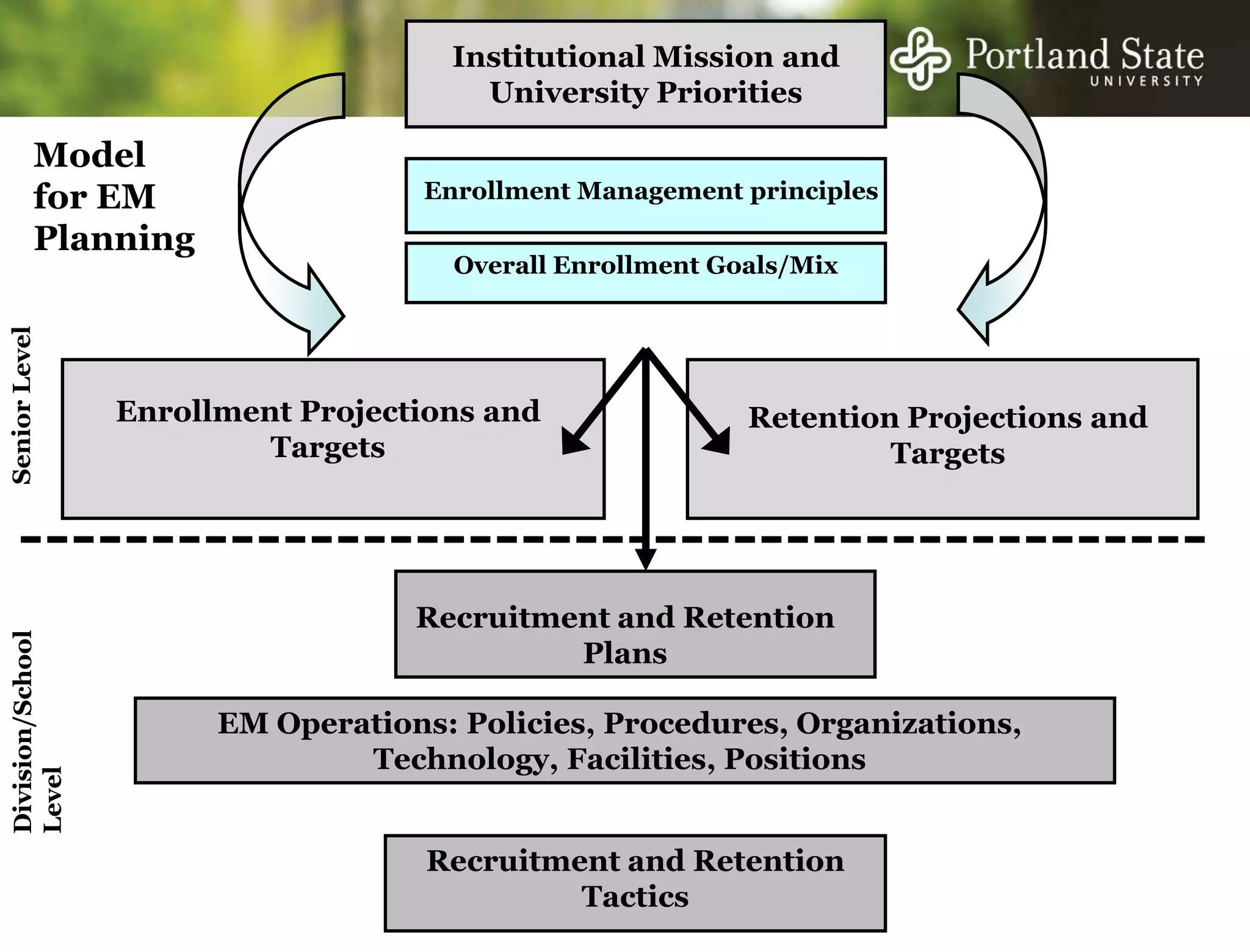
    Institutional Mission andUniversity PrioritiesModel for EM PlanningEnrollment Management principles Overall Enrollment Goals/MixSenior LevelEnrollment Projections and TargetsRetention Projections and TargetsRecruitment and Retention PlansDivision/School LevelEM Operations: Policies, Procedures, Organizations, Technology, Facilities, PositionsRecruitment and Retention Tactics
  • 25.
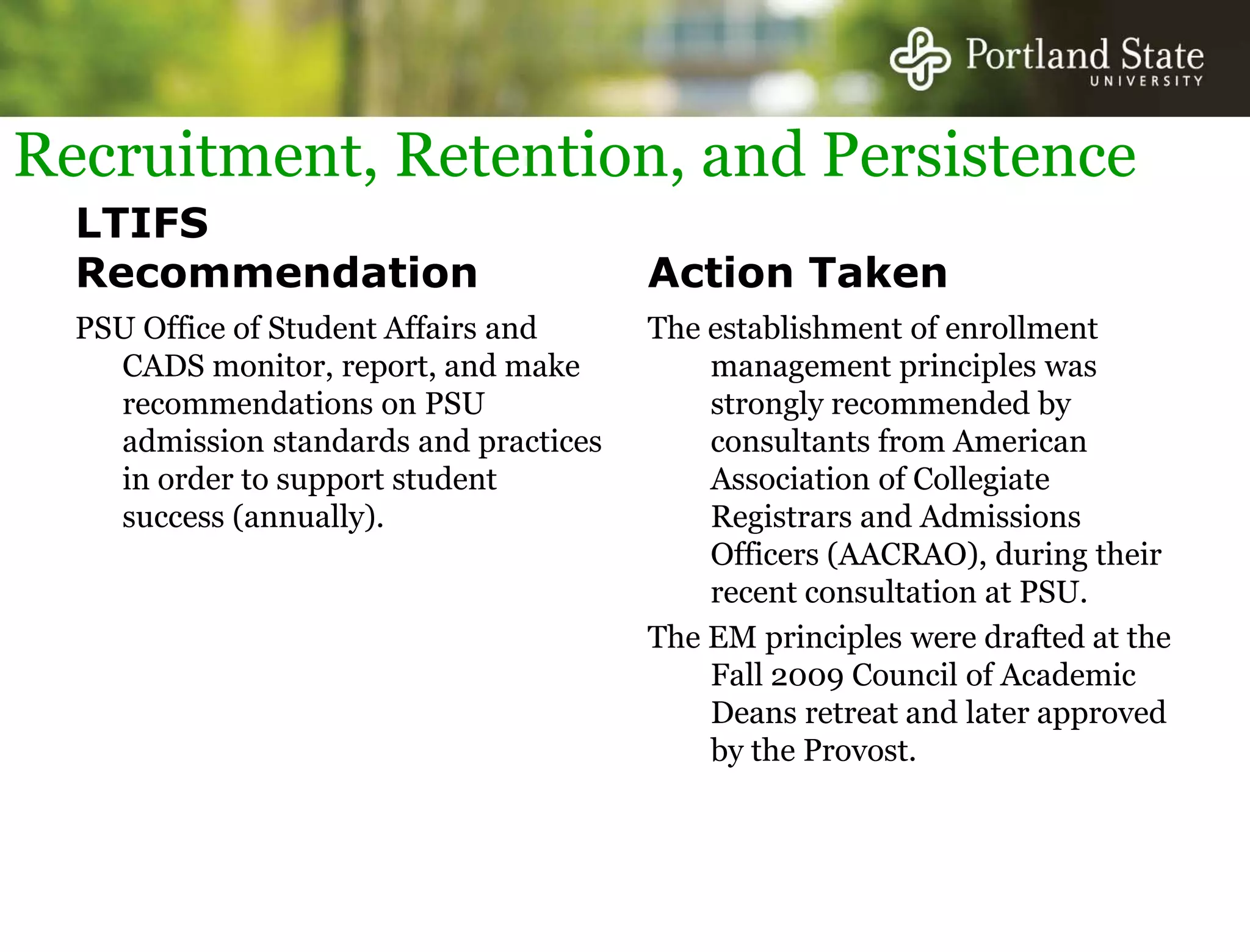
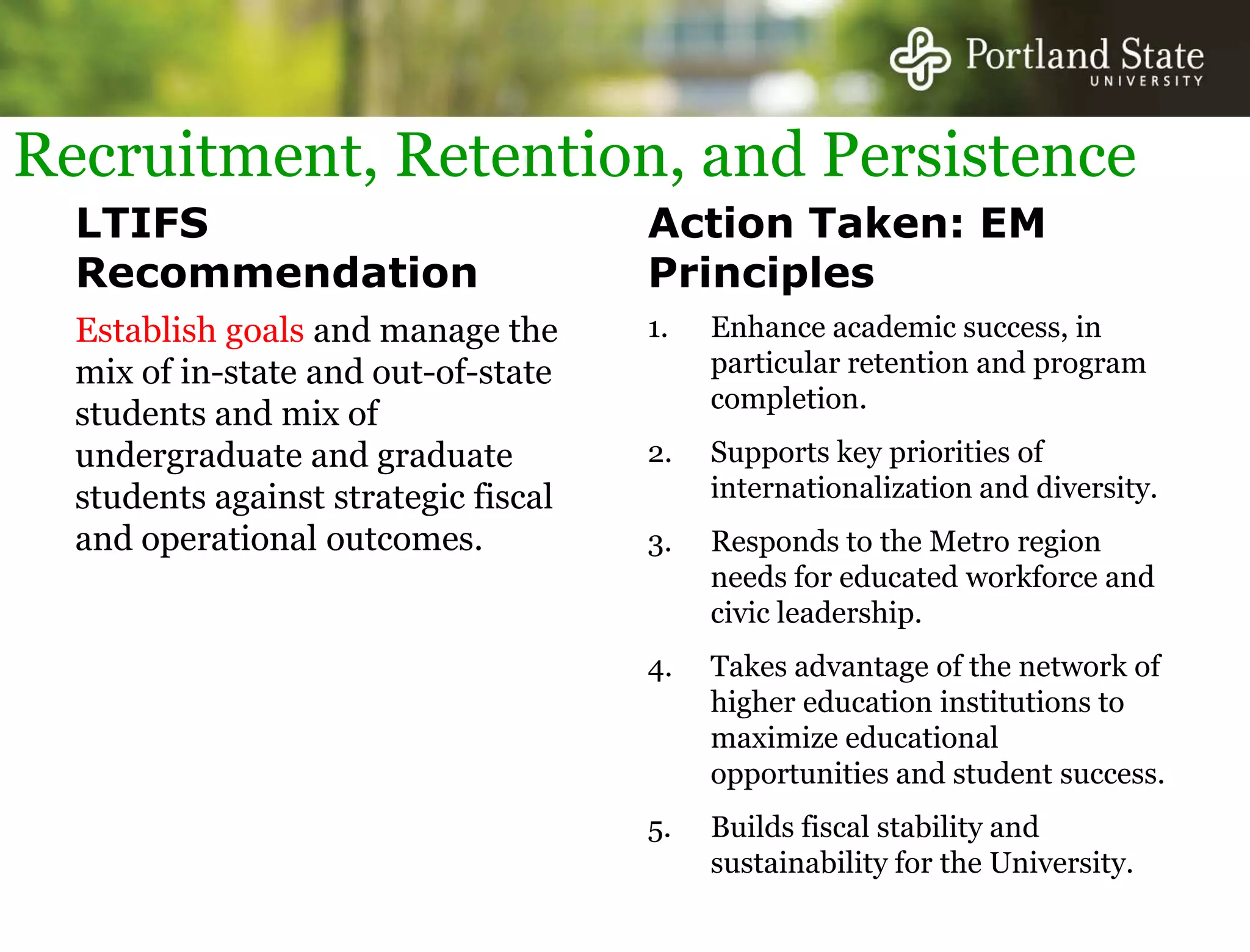
    Recruitment, Retention, andPersistenceLTIFS RecommendationAction TakenPSU Office of Student Affairs and CADS monitor, report, and make recommendations on PSU admission standards and practices in order to support student success (annually).The establishment of enrollment management principles was strongly recommended by consultants from American Association of Collegiate Registrars and Admissions Officers (AACRAO), during their recent consultation at PSU. The EM principles were drafted at the Fall 2009 Council of Academic Deans retreat and later approved by the Provost.
  • 26.
    Recruitment, Retention, andPersistenceAction Taken: EM PrinciplesLTIFS RecommendationEstablish goals and manage the mix of in-state and out-of-state students and mix of undergraduate and graduate students against strategic fiscal and operational outcomes.Enhance academic success, in particular retention and program completion.Supports key priorities of internationalization and diversity.Responds to the Metro region needs for educated workforce and civic leadership.Takes advantage of the network of higher education institutions to maximize educational opportunities and student success.Builds fiscal stability and sustainability for the University.
  • 27.
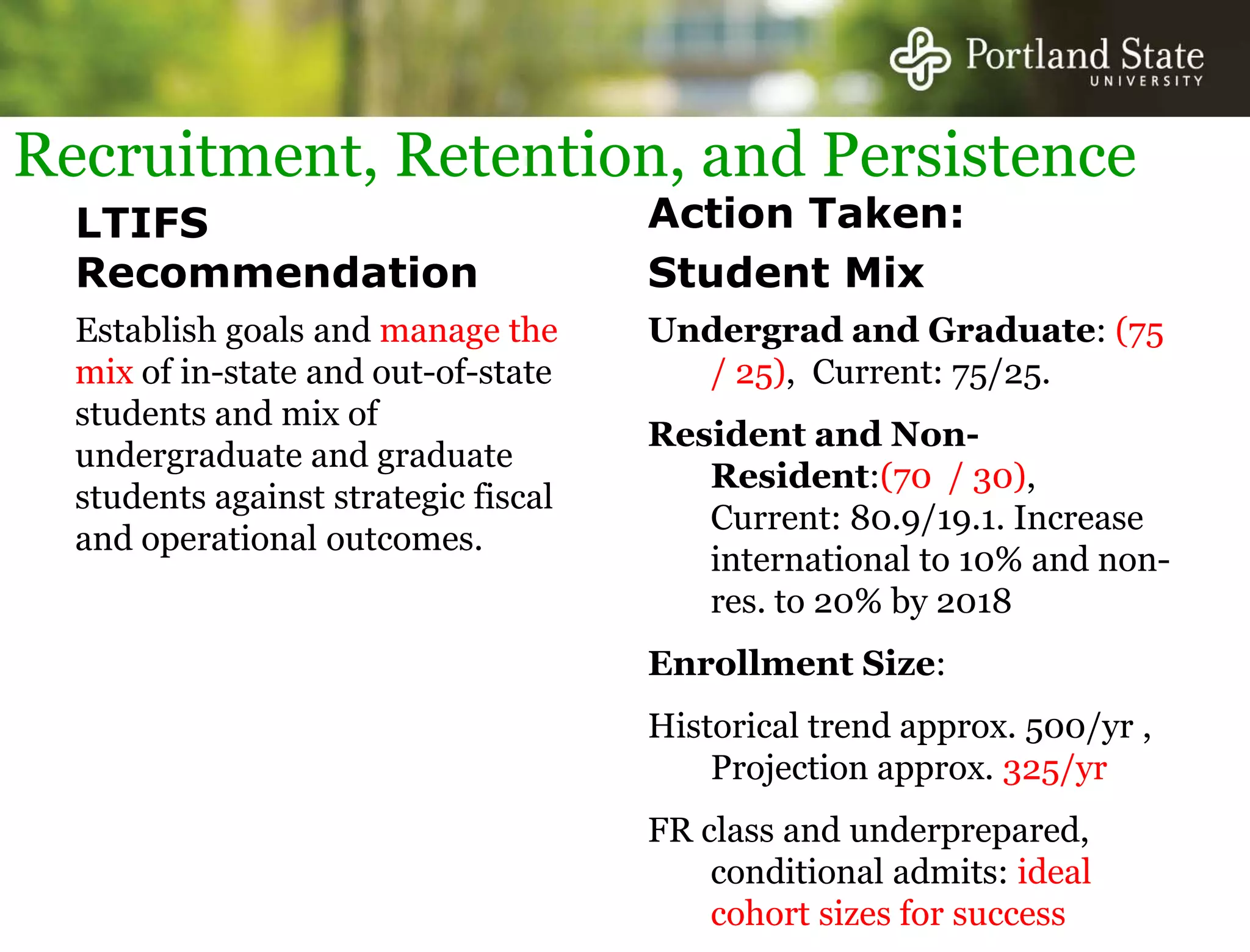
    Recruitment, Retention, andPersistenceAction Taken: Student MixLTIFS RecommendationEstablish goals and manage the mix of in-state and out-of-state students and mix of undergraduate and graduate students against strategic fiscal and operational outcomes.Undergrad and Graduate: (75 / 25), Current: 75/25.Resident and Non-Resident:(70 / 30), Current: 80.9/19.1. Increase international to 10% and non-res. to 20% by 2018Enrollment Size: Historical trend approx. 500/yr , Projection approx. 325/yrFR class and underprepared, conditional admits: ideal cohort sizes for success
  • 28.
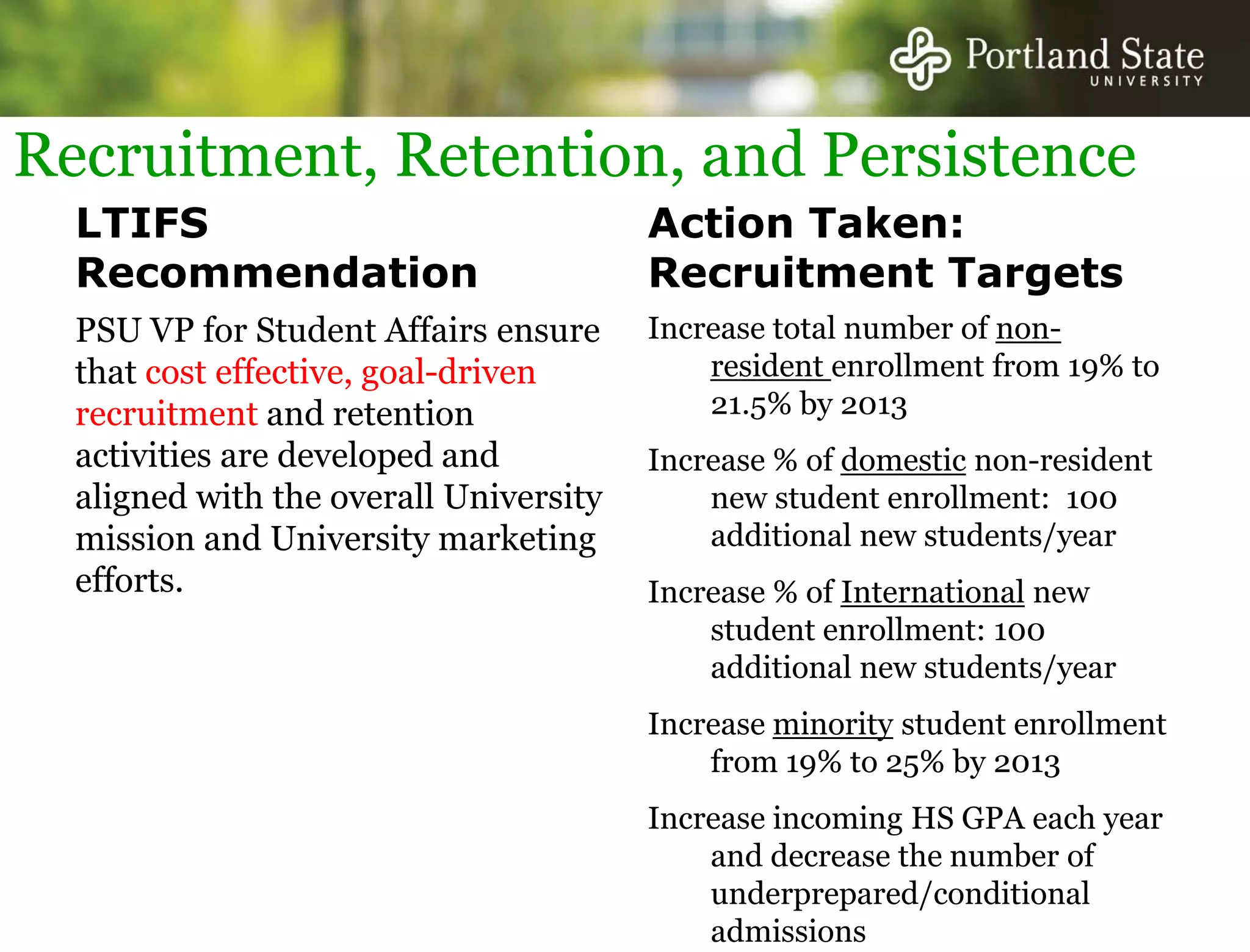
    Recruitment, Retention, andPersistenceAction Taken: Recruitment TargetsLTIFS RecommendationPSU VP for Student Affairs ensure that cost effective, goal-driven recruitment and retention activities are developed and aligned with the overall University mission and University marketing efforts.Increase total number of non-resident enrollment from 19% to 21.5% by 2013Increase % of domestic non-resident new student enrollment: 100 additional new students/yearIncrease % of International new student enrollment: 100 additional new students/yearIncrease minority student enrollment from 19% to 25% by 2013Increase incoming HS GPA each year and decrease the number of underprepared/conditional admissions
  • 29.
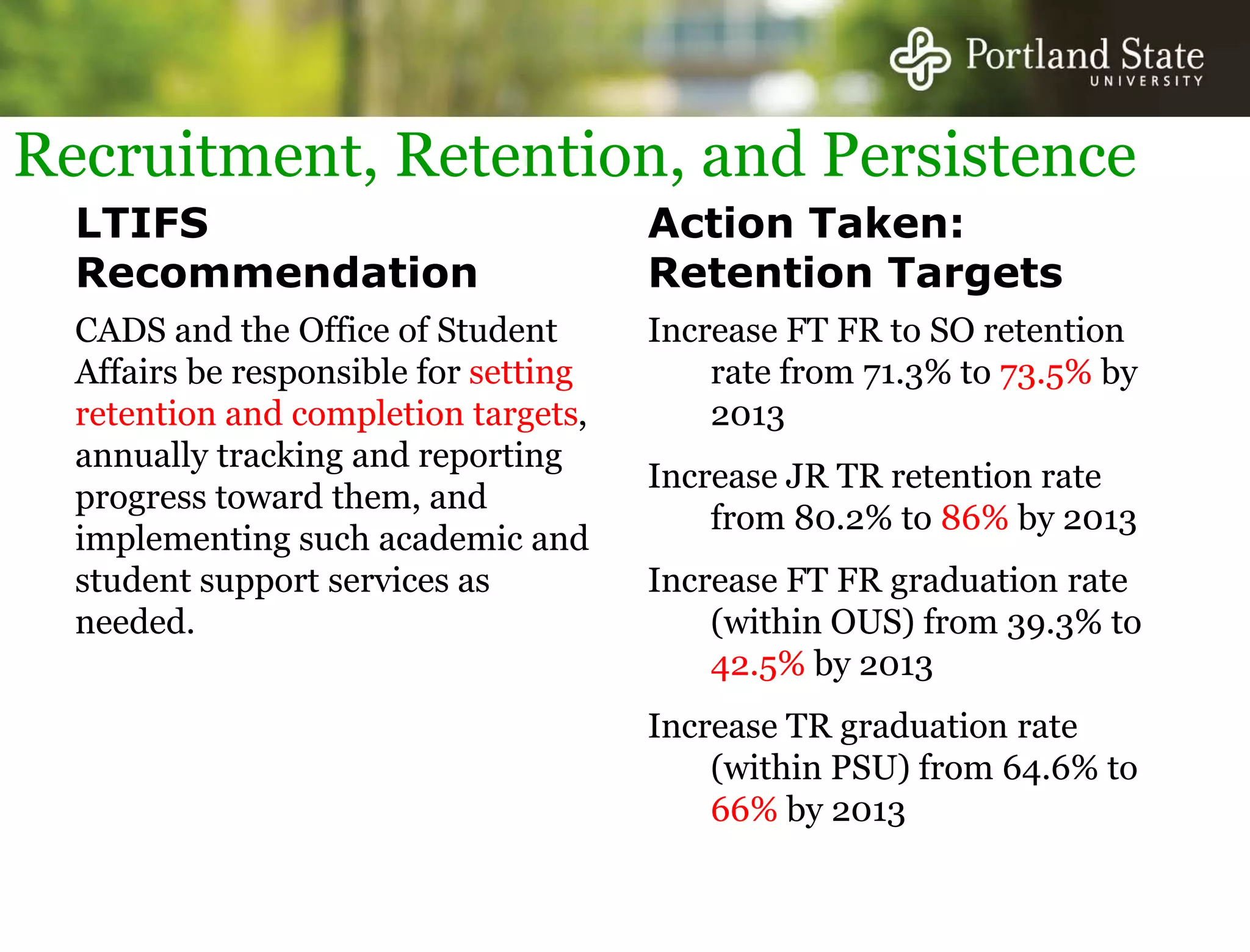
    Recruitment, Retention, andPersistenceAction Taken: Retention TargetsLTIFS RecommendationCADS and the Office of Student Affairs be responsible for setting retention and completion targets, annually tracking and reporting progress toward them, and implementing such academic and student support services as needed.Increase FT FR to SO retention rate from 71.3% to 73.5% by 2013Increase JR TR retention rate from 80.2% to 86% by 2013Increase FT FR graduation rate (within OUS) from 39.3% to 42.5% by 2013Increase TR graduation rate (within PSU) from 64.6% to 66% by 2013
  • 30.
    TuitionLTIFS RecommendationAction TakenThePresident’s Office form (by January, 2010) a campus-wide taskforce which includes students to work with Government Relations to promote legislation that would give PSU maximum tuition management flexibility in the coming biennium.See Restructuring PSU’s Relationshipwith the State: The Case for Change.The whitepaper explores the need for a new governance structure for PSU. The guiding principles include the ability to manage tuition.
  • 31.
    TuitionLTIFS RecommendationAction TakenTheuniversity establish a permanent Tuition Management Committee consisting of representatives of all PSU stakeholders, including students, to study and make long-term tuition recommendations to the University leadership.Plan for establish high level committee to determine how to:Increase strategic use and accountability of scholarship and remission awards
  • 32.
    Decrease Financial Aidand Scholarship award errors
  • 33.
    Decrease number ofWUE scholarships
  • 34.
    Optimal organizational alignmentfor Financial AidDiscussion Questions:Are the EM principles the right ones? What are the possible implications and impacts when we implement them?
  • 35.
    What are thelikely impacts of:
  • 36.
    Increasing non-resident +international enrollment to 30%
  • 37.
    Greater selectivity ofFreshman admission together with proactive support for specially admitted students
  • 38.
    Does the "4University" model represent a good concept for thinking about PSU’s EM strategy? Thank youRoy Koch, ProvostJackie Balzer, Vice Provost for Student AffairsSukhwant Jhaj, Director, University Studies

Editor's Notes

  • #3 Marvin Kaiser, Dean, College of Liberal Arts and Sciences(Council of Academic Deans) CHAIRJackie Balzer, Vice Provost for Students(Office of Academic Affairs) Alan CabellyProfessor, School of Business Administration(Educational Policy Committee Representative)Doug Crow, Adjunct Professor, School of Business Administration(AFT representative) Consultants and Staff:David Burgess, Institutional Research Analyst, Institutional Research & Planning Academic AffairsMichael Fung, Budget Director, Office of Finance AdministrationCathy LaTourette, Human Resources Director, Office of Finance AdministrationMark Wubbold, Special Assistant to the Vice President, Office of Finance Administration Nancy Goldman, Staff to the CommitteeHannah Fisher, ASPSU President(Undergraduate Student Representative), Sukhwant Jhaj, Director of University Studies(Faculty Senate Budget Committee), Michael McCarthy, Graduate Student(Graduate Student Representative), Marc Niesenfeld, Science Support Center(SEIU Representative), Steve Reder, Professor, Linguistics(Academic Department Chair), Kevin Reynolds, Professor, Chemistry(Academic Department Chair),Melody Rose Associate Professor,(Political Science Representative), Jonathan Uto, Educational Equity, Programs and Services(AAUP representative, Academic Professionals), Dee Wendler,Associate Vice President, Finance and Administration(Finance and Administration), Jennifer Williamson, Assistant Vice President, University Communications(University Relations), Mark Wubbold, Special Assistant to the Vice President , (Finance and Administration), Angela Wykoff, (Alumni representative)
  • #23 Process:*Answer each of these three questions as a group, and write your responses on a YELLOW card.Appoint someone from the group to bring these responses to one of the floor micsUse the PINK cards for any additional thoughts*Provost Koch will moderate the discussion at (time)