Collaborative Retention Project:
building blocks for student success
Dr Louise NAYLOR
l.h.naylor@kent.ac.uk
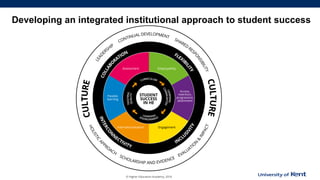
Developing an integrated institutional approach to student success
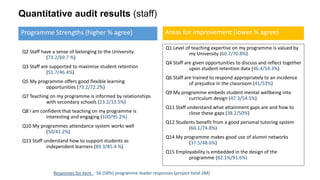
Quantitative audit results (staff)
Q2 Staff have a sense of belonging to the University
(73.2/69.7 %)
Q3 Staff are supported to maximise student retention
(51.7/46.4%)
Q5 My programme offers good flexible learning
opportunities (73.2/72.2%)
Q7 Teaching on my programme is informed by relationships
with secondary schools (23.2/13.5%)
Q8 I am confident that teaching on my programme is
interesting and engaging (100/95.2%)
Q10 My programmes attendance system works well
(50/41.2%)
Q13 Staff understand how to support students as
independent learners (89.3/85.4 %)
Q1 Level of teaching expertise on my programme is valued by
my University (60.7/70.8%)
Q4 Staff are given opportunities to discuss and reflect together
upon student retention data (46.4/54.3%)
Q6 Staff are trained to respond appropriately to an incidence
of prejudice in the classroom (41/53%)
Q9 My programme embeds student mental wellbeing into
curriculum design (47.3/54.5%)
Q11 Staff understand what attainment gaps are and how to
close these gaps (38.2/50%)
Q12 Students benefit from a good personal tutoring system
(66.1/74.8%)
Q14 My programme makes good use of alumni networks
(37.5/48.6%)
Q15 Employability is embedded in the design of the
programme (82.1%/91.6%)
Programme Strengths (higher % agree) Areas for improvement (lower % agree)
Responses for Kent - 56 (58%) programme leader responses (project total 284)
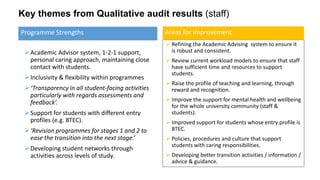
Key themes from Qualitative audit results (staff)
➢Academic Advisor system, 1-2-1 support,
personal caring approach, maintaining close
contact with students.
➢Inclusivity & flexibility within programmes
➢‘Transparency in all student-facing activities
particularly with regards assessments and
feedback’.
➢Support for students with different entry
profiles (e.g. BTEC).
➢‘Revision programmes for stages 1 and 2 to
ease the transition into the next stage.’
➢Developing student networks through
activities across levels of study.
➢ Refining the Academic Advising system to ensure it
is robust and consistent.
➢ Review current workload models to ensure that staff
have sufficient time and resources to support
students.
➢ Raise the profile of teaching and learning, through
reward and recognition.
➢ Improve the support for mental health and wellbeing
for the whole university community (staff &
students).
➢ Improved support for students whose entry profile is
BTEC.
➢ Policies, procedures and culture that support
students with caring responsibilities.
➢ Developing better transition activities / information /
advice & guidance.
Programme Strengths Areas for improvement
Headlines from our Institutional Visit – 22 March 2018
Refreshing the role of the Academic Adviser with a greater
emphasis on employability and being a mentoring / coaching role.
➢ Better support for commuter students, help build networks,
engage with extra curricula activities
➢ Attendance monitoring ‘follow up letter’ should be reviewed
to be more supportive and less punitive.
➢ Bunching of assessment deadlines (especially in January)
Reasons for withdrawing
➢ Mental health & wellbeing challenges
➢ Being a commuter student (cost of parking etc), difficult to
make friends.
➢ Isolation / loneliness
➢ Poor teaching
➢ Adapting to living away from home (1st time living with others)
➢ Early offers of full-time employment
Student Feedback Students: Areas of challenge/opportunity
Headlines from our Institutional Visit (staff)
➢ Greater support for students to ensure they have
chosen the right course.
➢ Raise the profile of Academic Advising, how the
role can support students across all aspects of
their learning and experience at university.
➢ Developing a community of practice for staff to
share ideas and good practice around teaching and
learning
➢ Extend externally to other networks eg Advance
HE online Communities of Practice (Retention,
Assessment & Feedback, Employability), in addition
the RAISE Network works as a genuine students as
partners network. UKAT network on Academic
Advising and Tutoring
Staff feedback Staff : Areas of challenge / opportunity
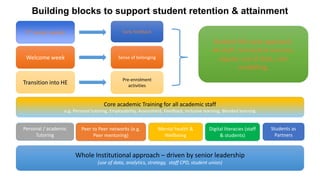
Building blocks to support student retention & attainment
Whole Institutional approach – driven by senior leadership
(use of data, analytics, strategy, staff CPD, student union)
Personal / academic
Tutoring
Peer to Peer networks (e.g.
Peer mentoring)
Mental health &
Wellbeing
Core academic Training for all academic staff
e.g. Personal tutoring, Employability, Assessment, Feedback, Inclusive learning, Blended learning
Transition into HE
Welcome week
1st seven weeks
Digital literacies (staff
& students)
Students as
Partners
Sense of belonging
Early feedback
Pre-enrolment
activities
Student life cycle approach.
All staff, connected services,
regular use of data, role
modelling,
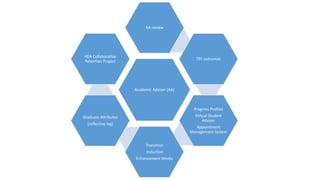
Academic Adviser (AA)
AA review
TEF outcomes
Progress Profiles
Virtual Student
Adviser
Appointment
Management System
Transition
Induction
Enhancement Weeks
Graduate Attributes
(reflective log)
HEA Collaborative
Retention Project
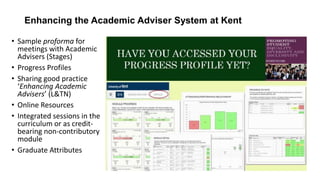
Enhancing the Academic Adviser System at Kent
• Sample proforma for
meetings with Academic
Advisers (Stages)
• Progress Profiles
• Sharing good practice
‘Enhancing Academic
Advisers’ (L&TN)
• Online Resources
• Integrated sessions in the
curriculum or as credit-
bearing non-contributory
module
• Graduate Attributes
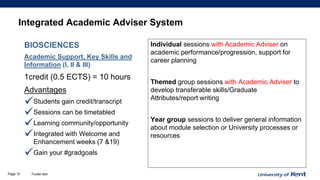
Integrated Academic Adviser System
BIOSCIENCES
Academic Support, Key Skills and
Information (I, II & III)
1credit (0.5 ECTS) = 10 hours
Advantages
✓Students gain credit/transcript
✓Sessions can be timetabled
✓Learning community/opportunity
✓Integrated with Welcome and
Enhancement weeks (7 &19)
✓Gain your #gradgoals
Individual sessions with Academic Adviser on
academic performance/progression, support for
career planning
Themed group sessions with Academic Adviser to
develop transferable skills/Graduate
Attributes/report writing
Year group sessions to deliver general information
about module selection or University processes or
resources
Footer textPage 10
Collaborative Retention Project:

Collaborative Retention Project:

  • 1.
    Collaborative Retention Project: buildingblocks for student success Dr Louise NAYLOR l.h.naylor@kent.ac.uk
  • 2.
    Developing an integratedinstitutional approach to student success
  • 3.
    Quantitative audit results(staff) Q2 Staff have a sense of belonging to the University (73.2/69.7 %) Q3 Staff are supported to maximise student retention (51.7/46.4%) Q5 My programme offers good flexible learning opportunities (73.2/72.2%) Q7 Teaching on my programme is informed by relationships with secondary schools (23.2/13.5%) Q8 I am confident that teaching on my programme is interesting and engaging (100/95.2%) Q10 My programmes attendance system works well (50/41.2%) Q13 Staff understand how to support students as independent learners (89.3/85.4 %) Q1 Level of teaching expertise on my programme is valued by my University (60.7/70.8%) Q4 Staff are given opportunities to discuss and reflect together upon student retention data (46.4/54.3%) Q6 Staff are trained to respond appropriately to an incidence of prejudice in the classroom (41/53%) Q9 My programme embeds student mental wellbeing into curriculum design (47.3/54.5%) Q11 Staff understand what attainment gaps are and how to close these gaps (38.2/50%) Q12 Students benefit from a good personal tutoring system (66.1/74.8%) Q14 My programme makes good use of alumni networks (37.5/48.6%) Q15 Employability is embedded in the design of the programme (82.1%/91.6%) Programme Strengths (higher % agree) Areas for improvement (lower % agree) Responses for Kent - 56 (58%) programme leader responses (project total 284)
  • 4.
    Key themes fromQualitative audit results (staff) ➢Academic Advisor system, 1-2-1 support, personal caring approach, maintaining close contact with students. ➢Inclusivity & flexibility within programmes ➢‘Transparency in all student-facing activities particularly with regards assessments and feedback’. ➢Support for students with different entry profiles (e.g. BTEC). ➢‘Revision programmes for stages 1 and 2 to ease the transition into the next stage.’ ➢Developing student networks through activities across levels of study. ➢ Refining the Academic Advising system to ensure it is robust and consistent. ➢ Review current workload models to ensure that staff have sufficient time and resources to support students. ➢ Raise the profile of teaching and learning, through reward and recognition. ➢ Improve the support for mental health and wellbeing for the whole university community (staff & students). ➢ Improved support for students whose entry profile is BTEC. ➢ Policies, procedures and culture that support students with caring responsibilities. ➢ Developing better transition activities / information / advice & guidance. Programme Strengths Areas for improvement
  • 5.
    Headlines from ourInstitutional Visit – 22 March 2018 Refreshing the role of the Academic Adviser with a greater emphasis on employability and being a mentoring / coaching role. ➢ Better support for commuter students, help build networks, engage with extra curricula activities ➢ Attendance monitoring ‘follow up letter’ should be reviewed to be more supportive and less punitive. ➢ Bunching of assessment deadlines (especially in January) Reasons for withdrawing ➢ Mental health & wellbeing challenges ➢ Being a commuter student (cost of parking etc), difficult to make friends. ➢ Isolation / loneliness ➢ Poor teaching ➢ Adapting to living away from home (1st time living with others) ➢ Early offers of full-time employment Student Feedback Students: Areas of challenge/opportunity
  • 6.
    Headlines from ourInstitutional Visit (staff) ➢ Greater support for students to ensure they have chosen the right course. ➢ Raise the profile of Academic Advising, how the role can support students across all aspects of their learning and experience at university. ➢ Developing a community of practice for staff to share ideas and good practice around teaching and learning ➢ Extend externally to other networks eg Advance HE online Communities of Practice (Retention, Assessment & Feedback, Employability), in addition the RAISE Network works as a genuine students as partners network. UKAT network on Academic Advising and Tutoring Staff feedback Staff : Areas of challenge / opportunity
  • 7.
    Building blocks tosupport student retention & attainment Whole Institutional approach – driven by senior leadership (use of data, analytics, strategy, staff CPD, student union) Personal / academic Tutoring Peer to Peer networks (e.g. Peer mentoring) Mental health & Wellbeing Core academic Training for all academic staff e.g. Personal tutoring, Employability, Assessment, Feedback, Inclusive learning, Blended learning Transition into HE Welcome week 1st seven weeks Digital literacies (staff & students) Students as Partners Sense of belonging Early feedback Pre-enrolment activities Student life cycle approach. All staff, connected services, regular use of data, role modelling,
  • 8.
    Academic Adviser (AA) AAreview TEF outcomes Progress Profiles Virtual Student Adviser Appointment Management System Transition Induction Enhancement Weeks Graduate Attributes (reflective log) HEA Collaborative Retention Project
  • 9.
    Enhancing the AcademicAdviser System at Kent • Sample proforma for meetings with Academic Advisers (Stages) • Progress Profiles • Sharing good practice ‘Enhancing Academic Advisers’ (L&TN) • Online Resources • Integrated sessions in the curriculum or as credit- bearing non-contributory module • Graduate Attributes
  • 10.
    Integrated Academic AdviserSystem BIOSCIENCES Academic Support, Key Skills and Information (I, II & III) 1credit (0.5 ECTS) = 10 hours Advantages ✓Students gain credit/transcript ✓Sessions can be timetabled ✓Learning community/opportunity ✓Integrated with Welcome and Enhancement weeks (7 &19) ✓Gain your #gradgoals Individual sessions with Academic Adviser on academic performance/progression, support for career planning Themed group sessions with Academic Adviser to develop transferable skills/Graduate Attributes/report writing Year group sessions to deliver general information about module selection or University processes or resources Footer textPage 10