Student Initiatives in Collaboration
with Academic Affairs
Developed by: Todd Long, M.Ed.
Student Affairs in conjunction with Academic Affairs are
evaluating our first year experience program
• First-to-second-year retention is generally most critical of
academic affairs and student affairs
• Variety of issues impact retention rates including
selectivity, admissions standards, student characteristics,
institutional characteristics, and more
• Focus for students, faculty, and staff should be on
intentionality by first year experience institution initiatives
Concerns of First Year Experience
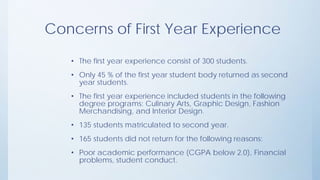
• The first year experience consist of 300 students.
• Only 45 % of the first year student body returned as second
year students.
• The first year experience included students in the following
degree programs: Culinary Arts, Graphic Design, Fashion
Merchandising, and Interior Design.
• 135 students matriculated to second year.
• 165 students did not return for the following reasons:
• Poor academic performance (CGPA below 2.0), Financial
problems, student conduct.
Taking Retention Initiatives Seriously
• Students are more likely to persist and graduate in
settings that hold high and clear expectations
• Challenging but explicit classroom expectations
• Academic advising that provides the roadmap to
degree completion
Taking Retention Initiatives Seriously
• Provide academic and social support
– Students may not be prepared for the
rigors of university coursework so
institutions should provide an array of
support structures
– Students need “safe havens” as they
learn to navigate campuses
• Counseling
• Mentoring
• Connections to peers
Taking Retention Initiatives Seriously
• Feedback is a condition for
student success
– Early alert/intervention programs
– Assessments to accurately gauge
student learning [not just exams]
– Faculty willingness to adjust based
on feedback
– Timely feedback about performance
– Connecting support structures to
feedback
Taking Retention Initiatives Seriously
• Involvement is a condition for student retention
• Academic and social integration opportunities with
faculty, peers, and staff members
• The more students learn, the more they find value in their
learning, the more they persist and graduate
• Build educational communities of learning
Taking Retention Initiatives Seriously
• Comprehensive national survey that looked not only at
retention, progression and graduation rates (public v.
private, etc.) but also provided benchmarks for
institutions
– Program coordination
– Research and assessment
– Orientation programs
– Early warning systems
– Faculty/student interactions
– Advising practices
Taking Retention Initiatives Seriously
• Participants – when compared to
academically and demographically
matched control groups
– earn better grades
– progress more rapidly in academic
standing
– are retained at higher levels

SampleInitiative

  • 1.
    Student Initiatives inCollaboration with Academic Affairs Developed by: Todd Long, M.Ed.
  • 2.
    Student Affairs inconjunction with Academic Affairs are evaluating our first year experience program • First-to-second-year retention is generally most critical of academic affairs and student affairs • Variety of issues impact retention rates including selectivity, admissions standards, student characteristics, institutional characteristics, and more • Focus for students, faculty, and staff should be on intentionality by first year experience institution initiatives
  • 3.
    Concerns of FirstYear Experience • The first year experience consist of 300 students. • Only 45 % of the first year student body returned as second year students. • The first year experience included students in the following degree programs: Culinary Arts, Graphic Design, Fashion Merchandising, and Interior Design. • 135 students matriculated to second year. • 165 students did not return for the following reasons: • Poor academic performance (CGPA below 2.0), Financial problems, student conduct.
  • 4.
    Taking Retention InitiativesSeriously • Students are more likely to persist and graduate in settings that hold high and clear expectations • Challenging but explicit classroom expectations • Academic advising that provides the roadmap to degree completion
  • 5.
    Taking Retention InitiativesSeriously • Provide academic and social support – Students may not be prepared for the rigors of university coursework so institutions should provide an array of support structures – Students need “safe havens” as they learn to navigate campuses • Counseling • Mentoring • Connections to peers
  • 6.
    Taking Retention InitiativesSeriously • Feedback is a condition for student success – Early alert/intervention programs – Assessments to accurately gauge student learning [not just exams] – Faculty willingness to adjust based on feedback – Timely feedback about performance – Connecting support structures to feedback
  • 7.
    Taking Retention InitiativesSeriously • Involvement is a condition for student retention • Academic and social integration opportunities with faculty, peers, and staff members • The more students learn, the more they find value in their learning, the more they persist and graduate • Build educational communities of learning
  • 8.
    Taking Retention InitiativesSeriously • Comprehensive national survey that looked not only at retention, progression and graduation rates (public v. private, etc.) but also provided benchmarks for institutions – Program coordination – Research and assessment – Orientation programs – Early warning systems – Faculty/student interactions – Advising practices
  • 9.
    Taking Retention InitiativesSeriously • Participants – when compared to academically and demographically matched control groups – earn better grades – progress more rapidly in academic standing – are retained at higher levels