Portfolio Management for  New Products
Portfolio Management Portfolio Management for product innovation has surfaced as one of the most important management function. The reasons being Shorter PLC Heightened Global Competition Portfolio Management is the manifestation of the business strategy---- it dictates where and how you will invest for the future
Pitfalls of Poor Portfolio management Strategic- Projects not strategically alligned with the  business  strategy  Many strategically unimportant products in the portfolio R&D spending that does not reflect strategic priorities of the  business Low Value Projects- Deficient Go/kill and project selection decisions No Focus — Strong reluctance to kill project The wrong projects
Importance of Portfolio Management Financial-to maximise returns, to maximise R&D productivity, to achieve financial goals To maintain the competitive position of the business To properly and efficiently allocate scarce resources To forge a link between project selection and business strategy To achieve focus To achieve balance Better communicate priorities within the organization To provide better objectivity to project selection
A typical Scoring Model For Project Prioritization Strategic Alignment: •  Degree to which project aligns with our strategy •  Strategic importance Product/Competitive Advantage : •  Offers customers/users unique benefits •  Meets customer needs better •  Provides value for money for the customer/user Market Attractiveness: •  Market size •  Market growth rate •  Competitive intensity in the market (high=low score)
Synergies (Leverages Our Core Competencies): •  Marketing synergies •  Technological synergies •  Operations/manufacturing synergies Technical Feasibility: •  Size of technical gap (large=low score) •  Technical complexity (barriers to overcome) (many/high = low score) •  Degree of technical uncertainty (high=low score)
Risk Vs. Return: •   Expected profitability (magnitude: NPV) •  Return on investment (IRR) •  Payback period (years; many=low score) •  Certainty of return/profit estimates •  Low cost & fast to do
Portfolio Methods Financial Methods BCG Matrix GE Matrix
 
Portfolio Analysis Strategic Business Unit (SBU) Definition Single independent operation of a company Has its own competitors One manager responsible for performance Allocation of resources over all SBUs Goals Set benchmarks Create generalized descriptions of strategic situations
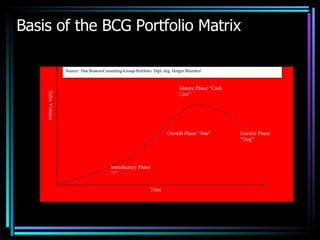
Basis of the BCG Portfolio Matrix Time Introductory Phase “?” Growth Phase “Star” Sales Volume Mature Phase “Cash Cow” Decline Phase “Dog” Source:  Das Boston-Consulting-Group-Portfolio  Dipl.-Ing. Holger Blumhof
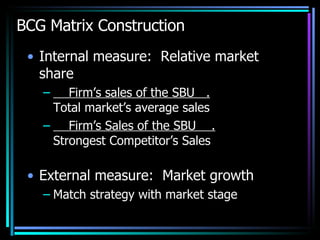
BCG Matrix Construction Internal measure:  Relative market share Firm’s sales of the SBU  . Total market’s average sales Firm’s Sales of the SBU  . Strongest Competitor’s Sales External measure:  Market growth Match strategy with market stage
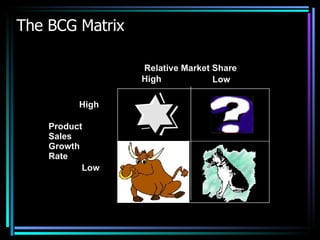
The BCG Matrix High Low High  Low  Product Sales Growth Rate Relative Market Share
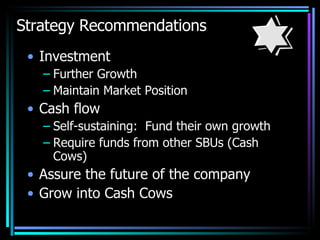
Strategy Recommendations  Investment Further Growth Maintain Market Position Cash flow Self-sustaining:  Fund their own growth Require funds from other SBUs (Cash Cows) Assure the future of the company Grow into Cash Cows
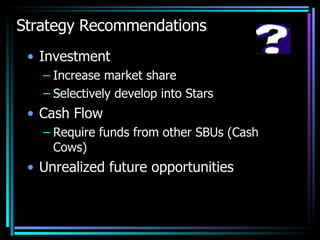
Strategy Recommendations Investment Increase market share Selectively develop into Stars Cash Flow Require funds from other SBUs (Cash Cows)  Unrealized future opportunities
Strategy Recommendations Investment Maintain market share Maintain capacity Cash Flow Positive cash flow Provides funding to support Stars and “?” No potential for profit growth
Strategy Recommendations Investment Divestiture strategy Reduce capacity to free up resources Cash Flow Goal of Positive Cash Flow Negative Cash Flow = Divestment No real growth opportunities
Evaluation of BCG Matrix: Cons Oversimplifies complex decisions Only 2 factors considered = creates risk Uncertainty in market and SBU definition Only considers current businesses   no dynamics Does not recognize possible synergies between SBUs
Evaluation of BCG Matrix:  Pros Simple and rapid Solid basis for decision-making Good measurability of market share and growth Provides information about efficient resource allocation within the organization Generator for strategic options
Conclusion As long as management understands that the BCG Growth/Share Matrix generates options which require further analysis and validation, this tool can greatly enhance strategic decision making

Portfolio Management

  • 1.
  • 2.
    Portfolio Management PortfolioManagement for product innovation has surfaced as one of the most important management function. The reasons being Shorter PLC Heightened Global Competition Portfolio Management is the manifestation of the business strategy---- it dictates where and how you will invest for the future
  • 3.
    Pitfalls of PoorPortfolio management Strategic- Projects not strategically alligned with the business strategy Many strategically unimportant products in the portfolio R&D spending that does not reflect strategic priorities of the business Low Value Projects- Deficient Go/kill and project selection decisions No Focus — Strong reluctance to kill project The wrong projects
  • 4.
    Importance of PortfolioManagement Financial-to maximise returns, to maximise R&D productivity, to achieve financial goals To maintain the competitive position of the business To properly and efficiently allocate scarce resources To forge a link between project selection and business strategy To achieve focus To achieve balance Better communicate priorities within the organization To provide better objectivity to project selection
  • 5.
    A typical ScoringModel For Project Prioritization Strategic Alignment: • Degree to which project aligns with our strategy • Strategic importance Product/Competitive Advantage : • Offers customers/users unique benefits • Meets customer needs better • Provides value for money for the customer/user Market Attractiveness: • Market size • Market growth rate • Competitive intensity in the market (high=low score)
  • 6.
    Synergies (Leverages OurCore Competencies): • Marketing synergies • Technological synergies • Operations/manufacturing synergies Technical Feasibility: • Size of technical gap (large=low score) • Technical complexity (barriers to overcome) (many/high = low score) • Degree of technical uncertainty (high=low score)
  • 7.
    Risk Vs. Return:• Expected profitability (magnitude: NPV) • Return on investment (IRR) • Payback period (years; many=low score) • Certainty of return/profit estimates • Low cost & fast to do
  • 8.
    Portfolio Methods FinancialMethods BCG Matrix GE Matrix
  • 9.
  • 10.
    Portfolio Analysis StrategicBusiness Unit (SBU) Definition Single independent operation of a company Has its own competitors One manager responsible for performance Allocation of resources over all SBUs Goals Set benchmarks Create generalized descriptions of strategic situations
  • 11.
    Basis of theBCG Portfolio Matrix Time Introductory Phase “?” Growth Phase “Star” Sales Volume Mature Phase “Cash Cow” Decline Phase “Dog” Source: Das Boston-Consulting-Group-Portfolio Dipl.-Ing. Holger Blumhof
  • 12.
    BCG Matrix ConstructionInternal measure: Relative market share Firm’s sales of the SBU . Total market’s average sales Firm’s Sales of the SBU . Strongest Competitor’s Sales External measure: Market growth Match strategy with market stage
  • 13.
    The BCG MatrixHigh Low High Low Product Sales Growth Rate Relative Market Share
  • 14.
    Strategy Recommendations Investment Further Growth Maintain Market Position Cash flow Self-sustaining: Fund their own growth Require funds from other SBUs (Cash Cows) Assure the future of the company Grow into Cash Cows
  • 15.
    Strategy Recommendations InvestmentIncrease market share Selectively develop into Stars Cash Flow Require funds from other SBUs (Cash Cows) Unrealized future opportunities
  • 16.
    Strategy Recommendations InvestmentMaintain market share Maintain capacity Cash Flow Positive cash flow Provides funding to support Stars and “?” No potential for profit growth
  • 17.
    Strategy Recommendations InvestmentDivestiture strategy Reduce capacity to free up resources Cash Flow Goal of Positive Cash Flow Negative Cash Flow = Divestment No real growth opportunities
  • 18.
    Evaluation of BCGMatrix: Cons Oversimplifies complex decisions Only 2 factors considered = creates risk Uncertainty in market and SBU definition Only considers current businesses  no dynamics Does not recognize possible synergies between SBUs
  • 19.
    Evaluation of BCGMatrix: Pros Simple and rapid Solid basis for decision-making Good measurability of market share and growth Provides information about efficient resource allocation within the organization Generator for strategic options
  • 20.
    Conclusion As longas management understands that the BCG Growth/Share Matrix generates options which require further analysis and validation, this tool can greatly enhance strategic decision making